
A complete issue · 36 pages · 1925
Judge — April 4, 1925
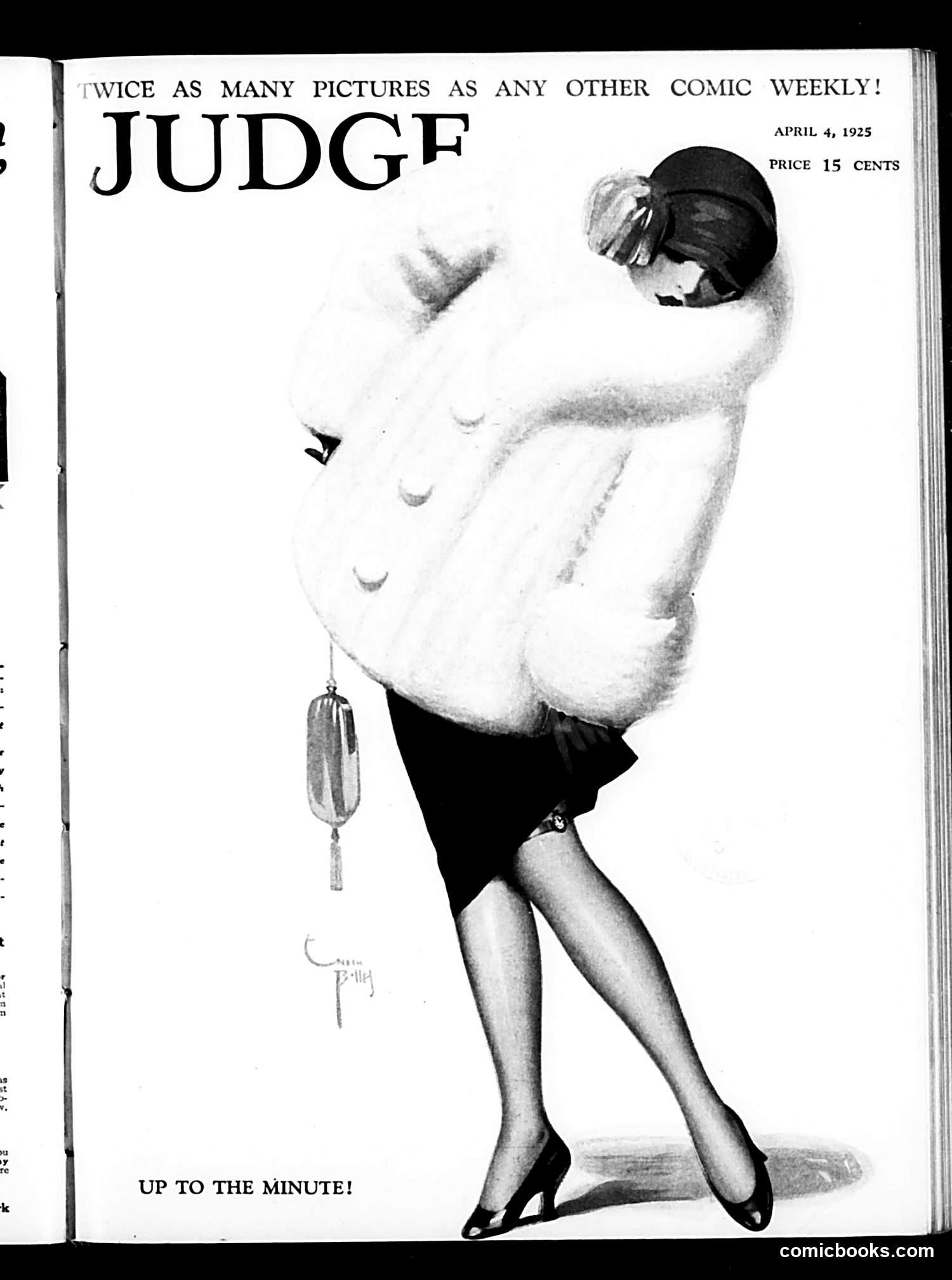
This cover depicts a fashionable woman of the 1920s Jazz Age, shown from behind in a stylized pose. The illustration emphasizes the era's dramatic shift in women's fashion and social norms—notably the drop waistline, shorter hemline, and cloche hat characteristic of the flapper style. The caption "UP TO THE MINUTE!" appears to be satirizing modern women's rapid adoption of contemporary fashion trends. The exaggerated proportions and the figure's confident, somewhat provocative pose likely mock both the new women's liberation and the anxiety such social changes provoked among more conservative viewers. The overall satire seems aimed at the speed of fashion evolution and changing gender roles in the 1920s.
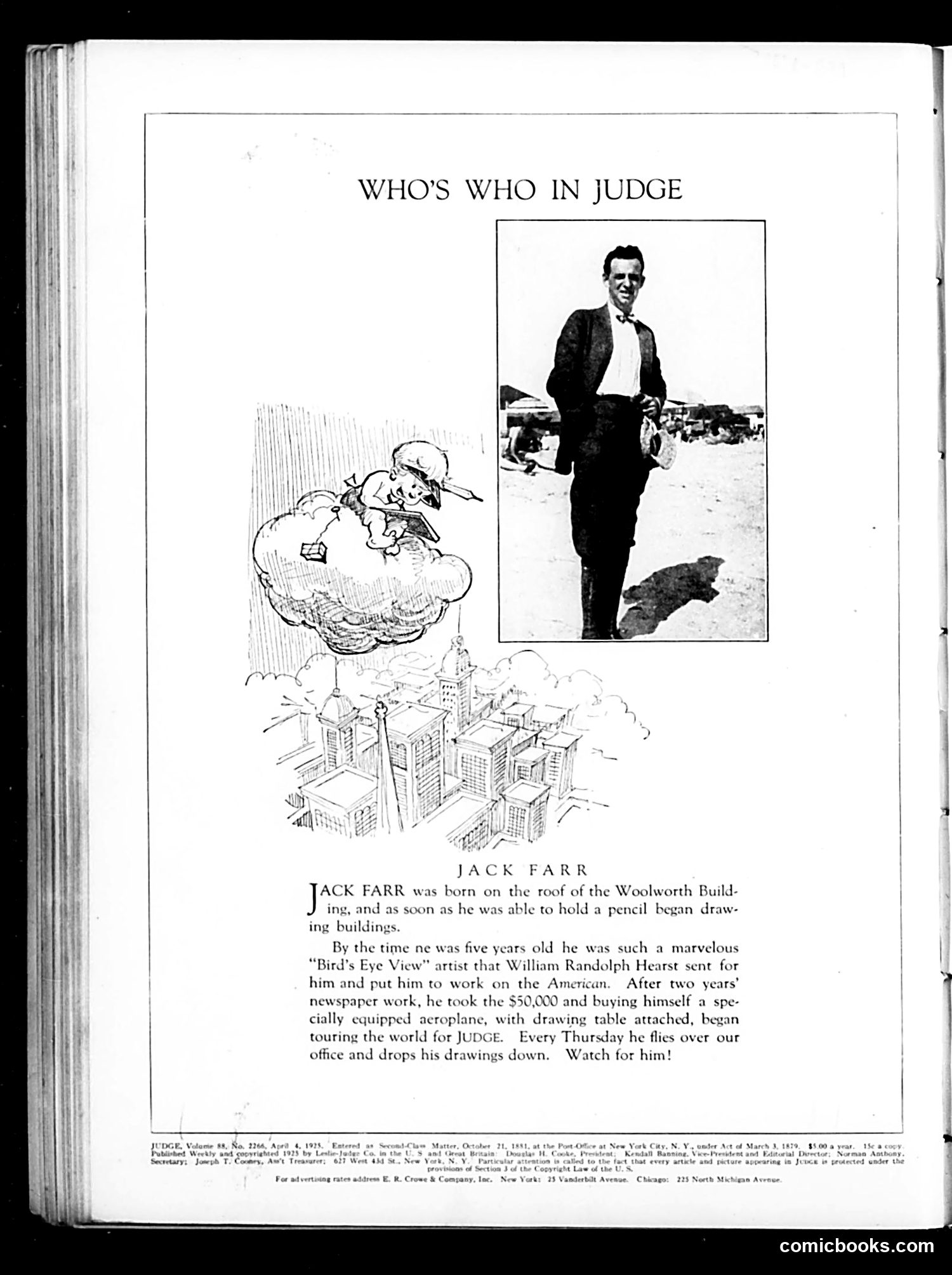
This page profiles Jack Farr, an architectural illustrator and artist. According to the text, Farr was born in the Woolworth Building and began drawing buildings as a child. By age five, he impressed William Randolph Hearst, who hired him for the *American* newspaper. After two years of newspaper work, Farr invested $50,000 in a specially equipped airplane with an attached drawing table, then began touring worldwide to create aerial "bird's eye view" architectural drawings for *Judge* magazine. The cartoon above shows Farr's work literally raining down on a cityscape—a visual pun on his process of dropping completed drawings from his plane each Thursday. The piece celebrates technological innovation and artistic entrepreneurship during the Jazz Age.
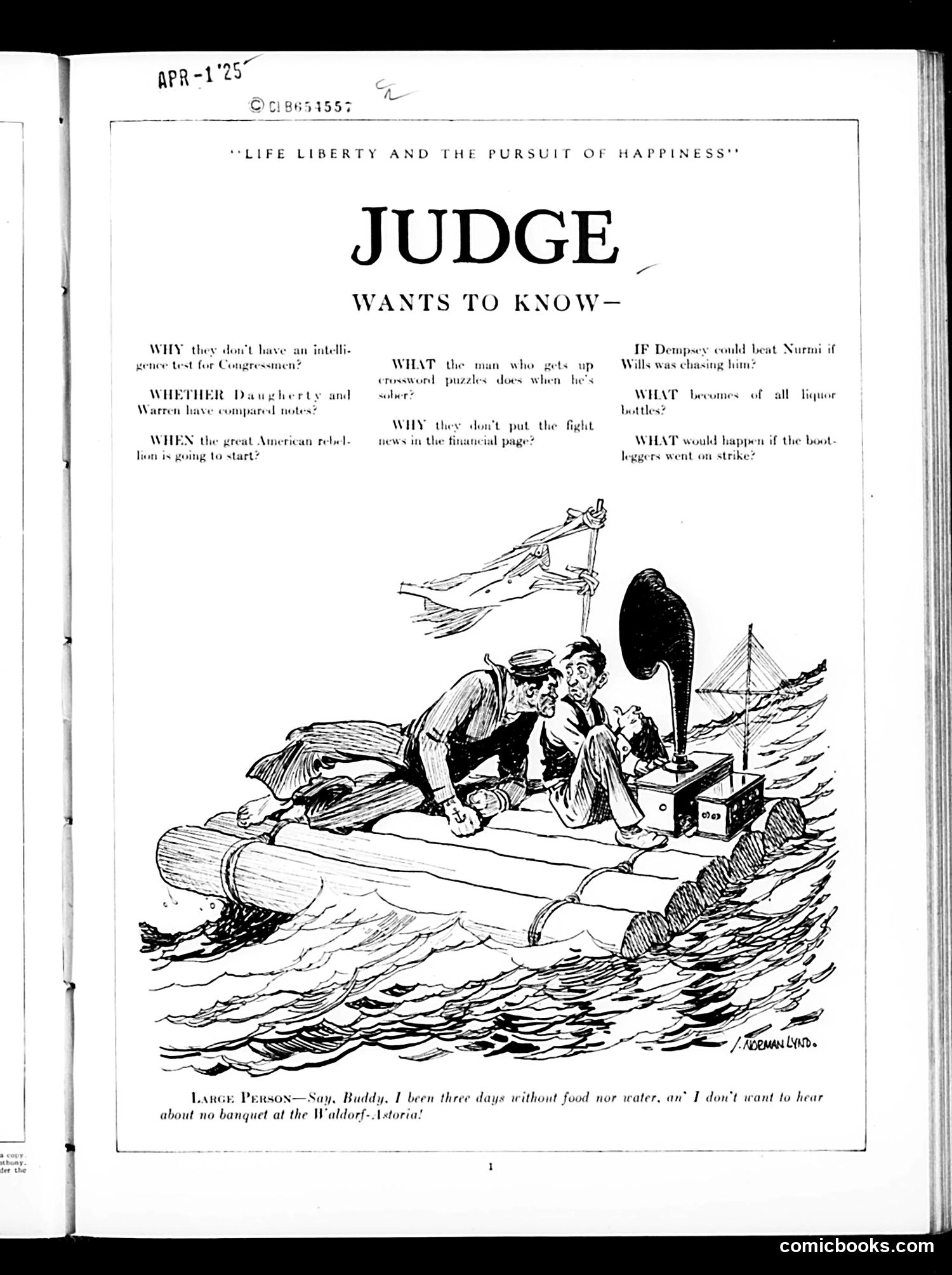
This page from Judge magazine (dated April 1, 1925) features a satirical cartoon about judicial incompetence. The title "JUDGE WANTS TO KNOW" lists questions a judge apparently cannot answer—ranging from whether Dougherty and Warren compared notes, to when the "great American rebellion" will start, to what happens to confiscated liquor. The illustration shows two disheveled men on a life raft in the ocean, apparently judges or legal figures stranded without provisions. The caption's mention of a "banquet at the Waldorf-Astoria" suggests irony: privileged judges enjoying luxury while displaying ignorance about serious matters. The satire targets judicial corruption and incompetence during Prohibition, when alcohol confiscation was rampant and questions about judicial integrity were widespread.
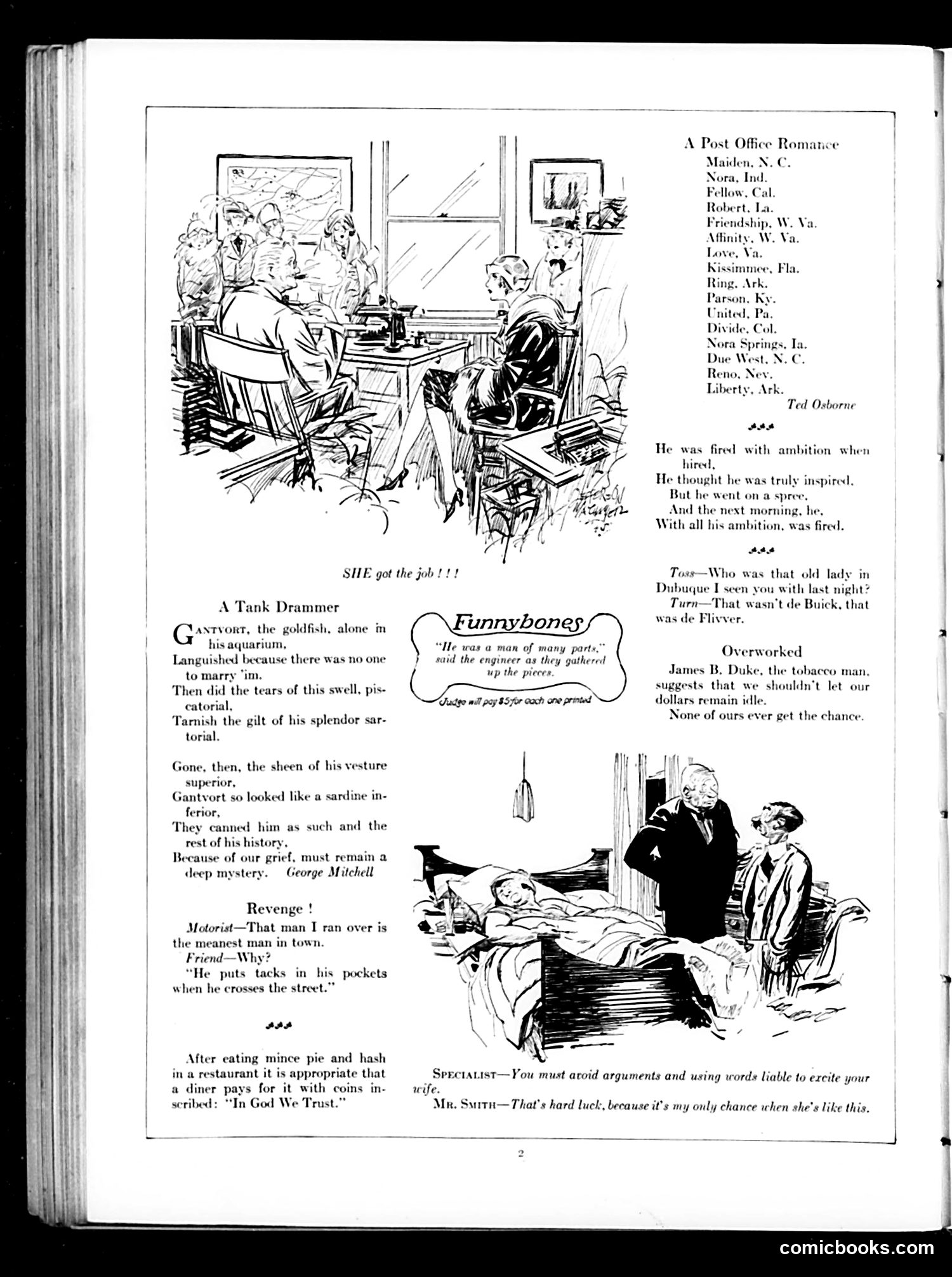
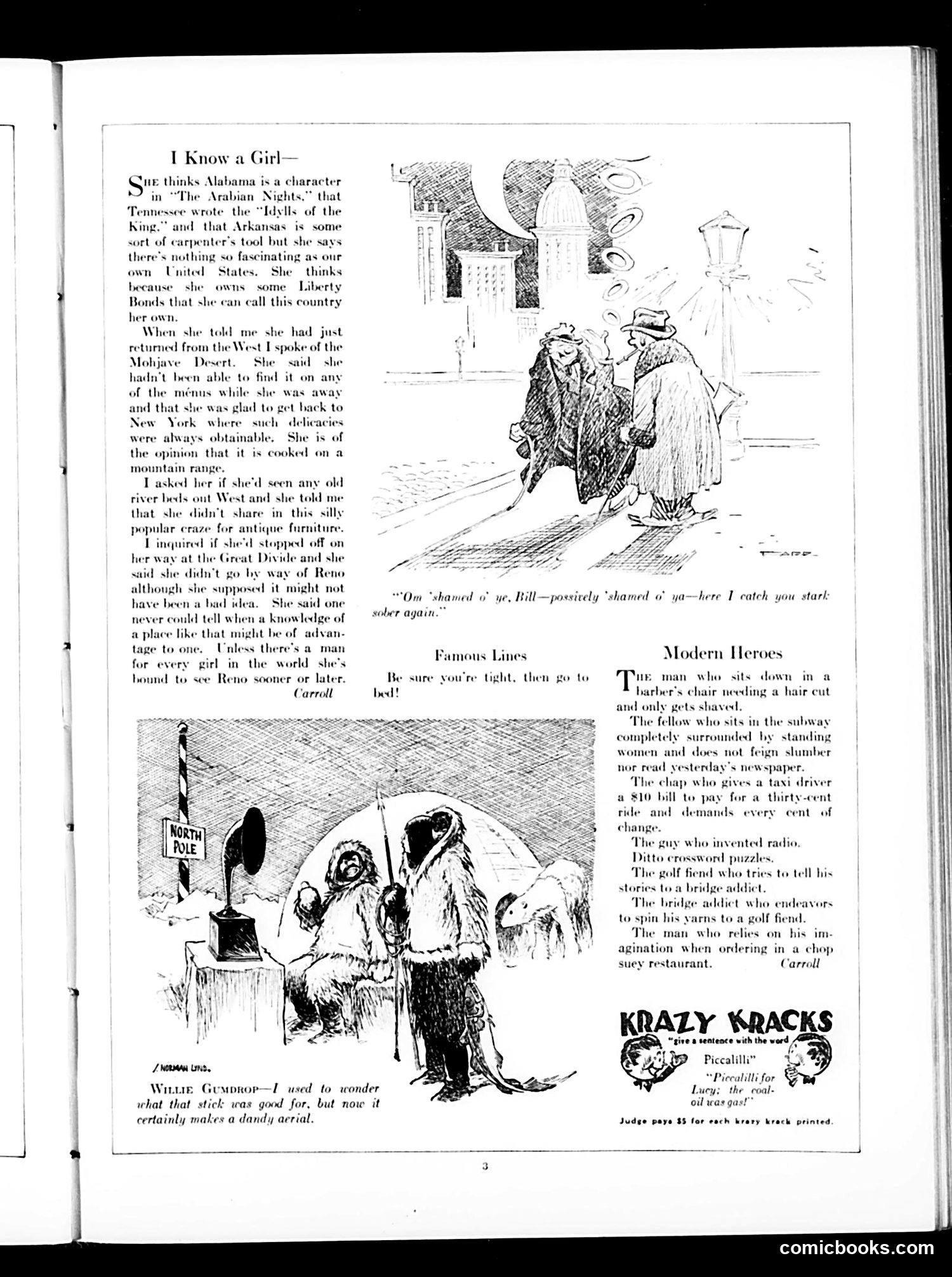
This page contains three distinct sections: **"I Know a Girl"** (top left): A humorous anecdote about a woman who confuses Western geography, thinking Arkansas borders Nevada and the Mojave Desert, and that food cooked on a "mountain range" represents authentic Western cooking. The joke targets Eastern ignorance about Western geography and cuisine. **"Famous Lines / Modern Heroes"** (right): A satirical list mocking contemporary urban male types—barbers, subway riders, radio inventors, golfers, bridge players, and restaurant patrons. The satire suggests these ordinary men fancy themselves important despite mundane activities. **Lower cartoon**: Depicts figures at the North Pole with "Willie Gundrop" commentary about aerial navigation, likely referencing early aviation technology or Arctic exploration trends of the era. The page is primarily humorous social satire rather than political commentary.
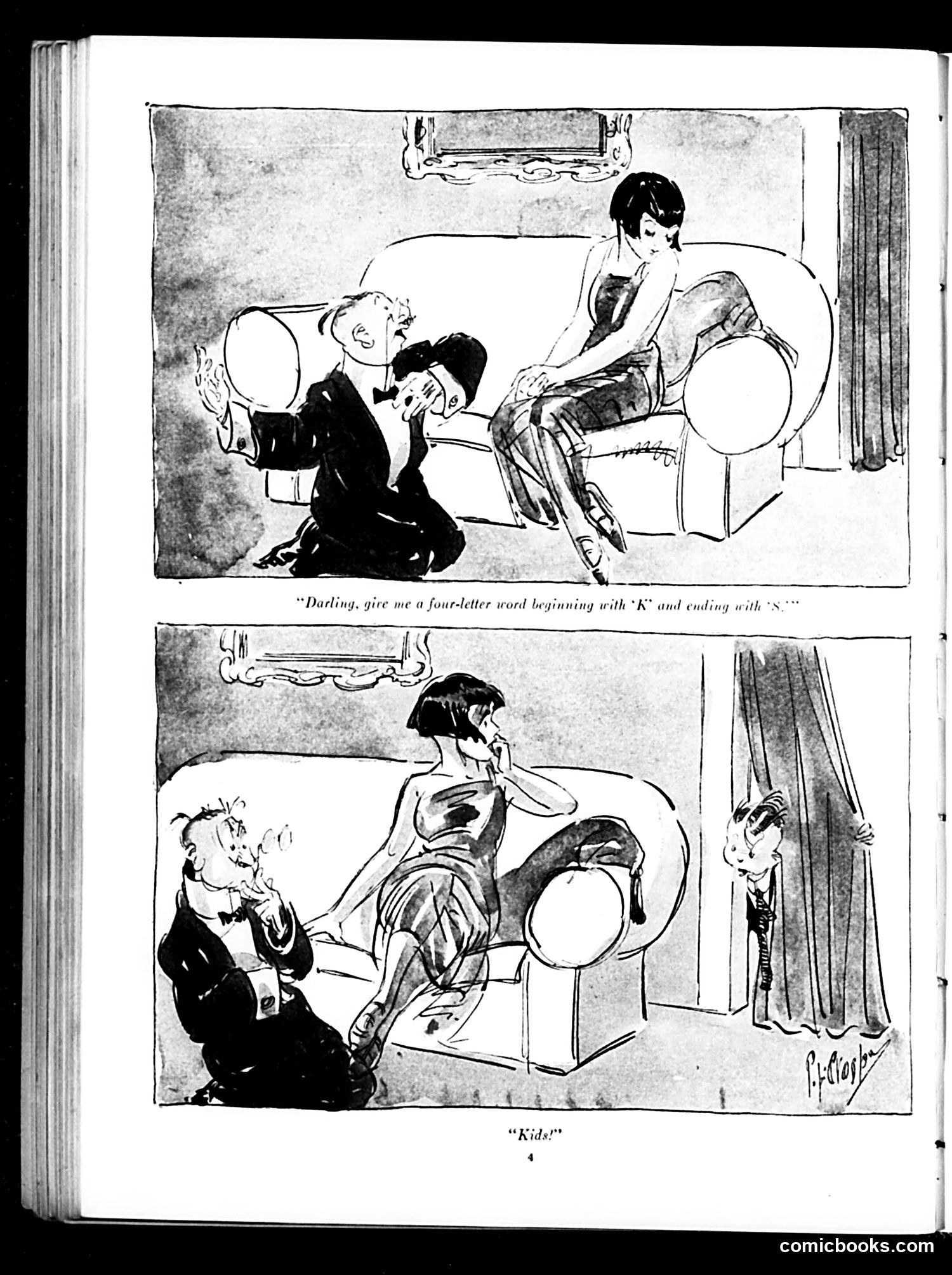
This page contains two comic panels satirizing parlor games and social behavior, likely from the early 20th century. The top panel shows a couple at a social gathering where a man requests: "Darling, give me a four-letter word beginning with 'K' and ending with 'S.'" This is a classic double-entendre joke—the innocent word game conceals a suggestive reference to "kiss," playing on the pretense of innocent entertainment masking flirtation. The bottom panel, titled "Kids!", shows the punchline: children have overheard and are mimicking the adults' behavior, innocently repeating what they've observed. The satire mocks how adults engage in suggestive wordplay at social gatherings while pretending propriety, only to have their behavior reflected back through children's literal interpretation—exposing the hypocrisy.
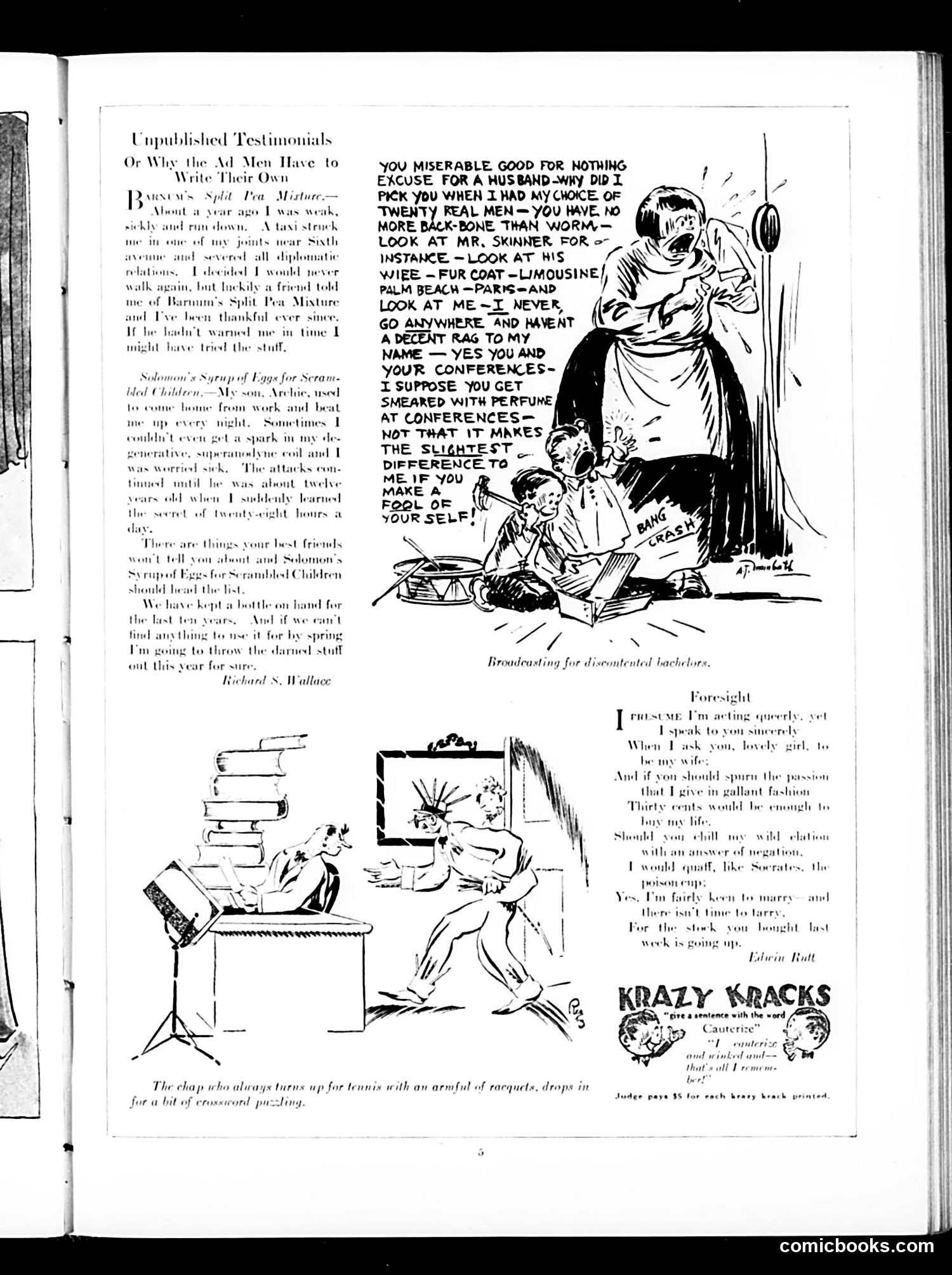
This page contains satirical testimonials and cartoons mocking domestic life and marital dynamics. The large cartoon depicts a woman berating her husband, criticizing his choice of her over "twenty real men" and mocking his lack of backbone. She references his shabby appearance and inability to provide luxuries (fur coat, limousine, travel). The satire targets emasculated husbands and domineering wives—a common Judge theme. The lower cartoon shows a man at a desk surrounded by clutter, apparently distracted from work by various domestic demands, satirizing husbands overwhelmed by household obligations. The "Foresight" poem and "Krazy Kracks" wordplay section provide additional marital humor. The overall message critiques the reversal of traditional gender roles and masculine authority in early 20th-century marriage.
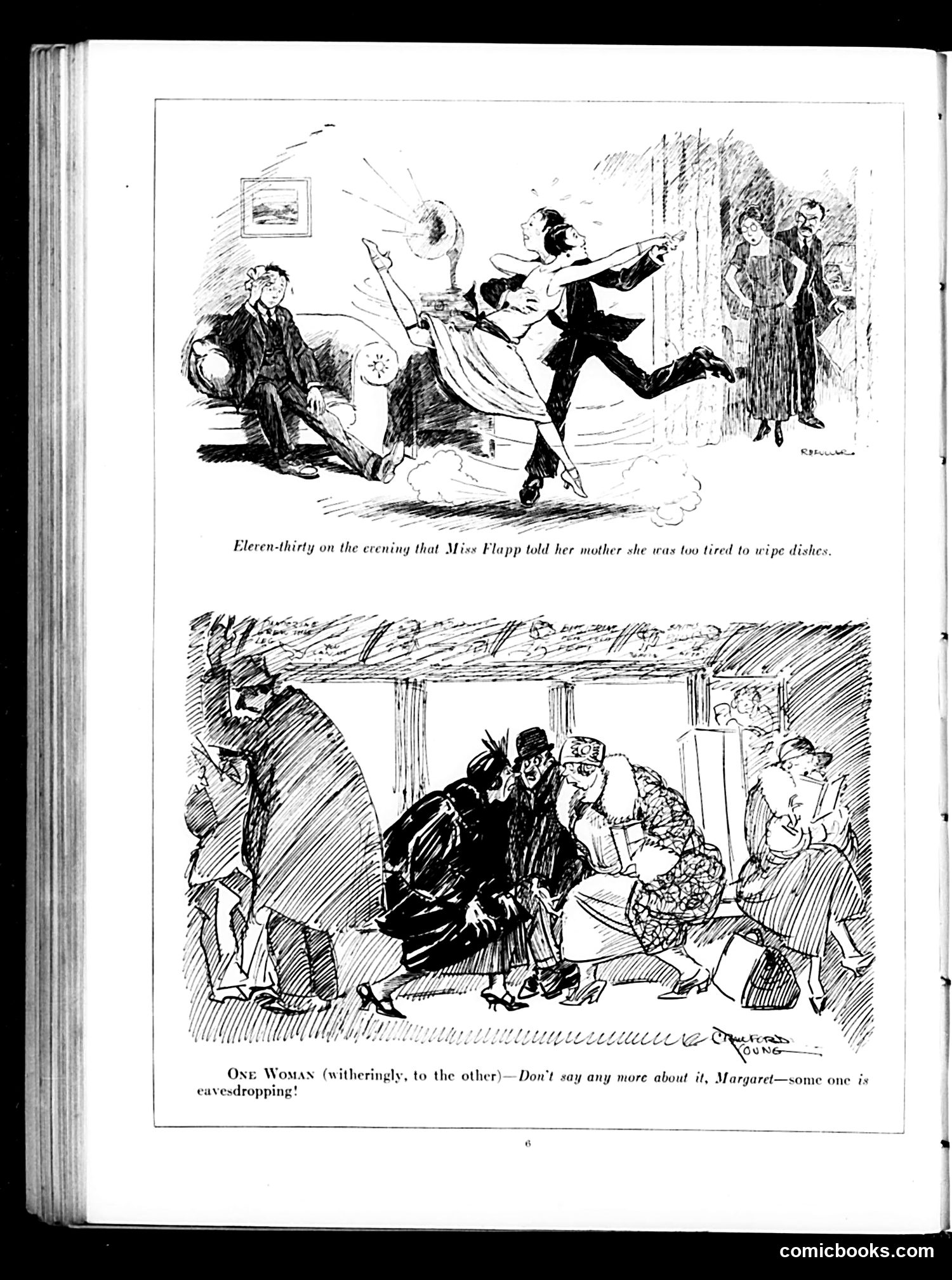
**Top cartoon:** Shows a chaotic indoor scene where a man kicks wildly while others watch. The caption references "Miss Flapp" telling her mother she was "too tired to wipe dishes"—satirizing the 1920s "flapper" stereotype of young women rejecting domestic duties and traditional femininity. **Bottom cartoon:** Two women gossip in what appears to be a public space (possibly a train or carriage). One warns the other to stop talking because "some one is eavesdropping." This jokes about the social awkwardness of being overheard mid-conversation, particularly regarding potentially scandalous gossip among women. Both cartoons target early 20th-century social anxieties about changing gender roles and proper public behavior during the Jazz Age.
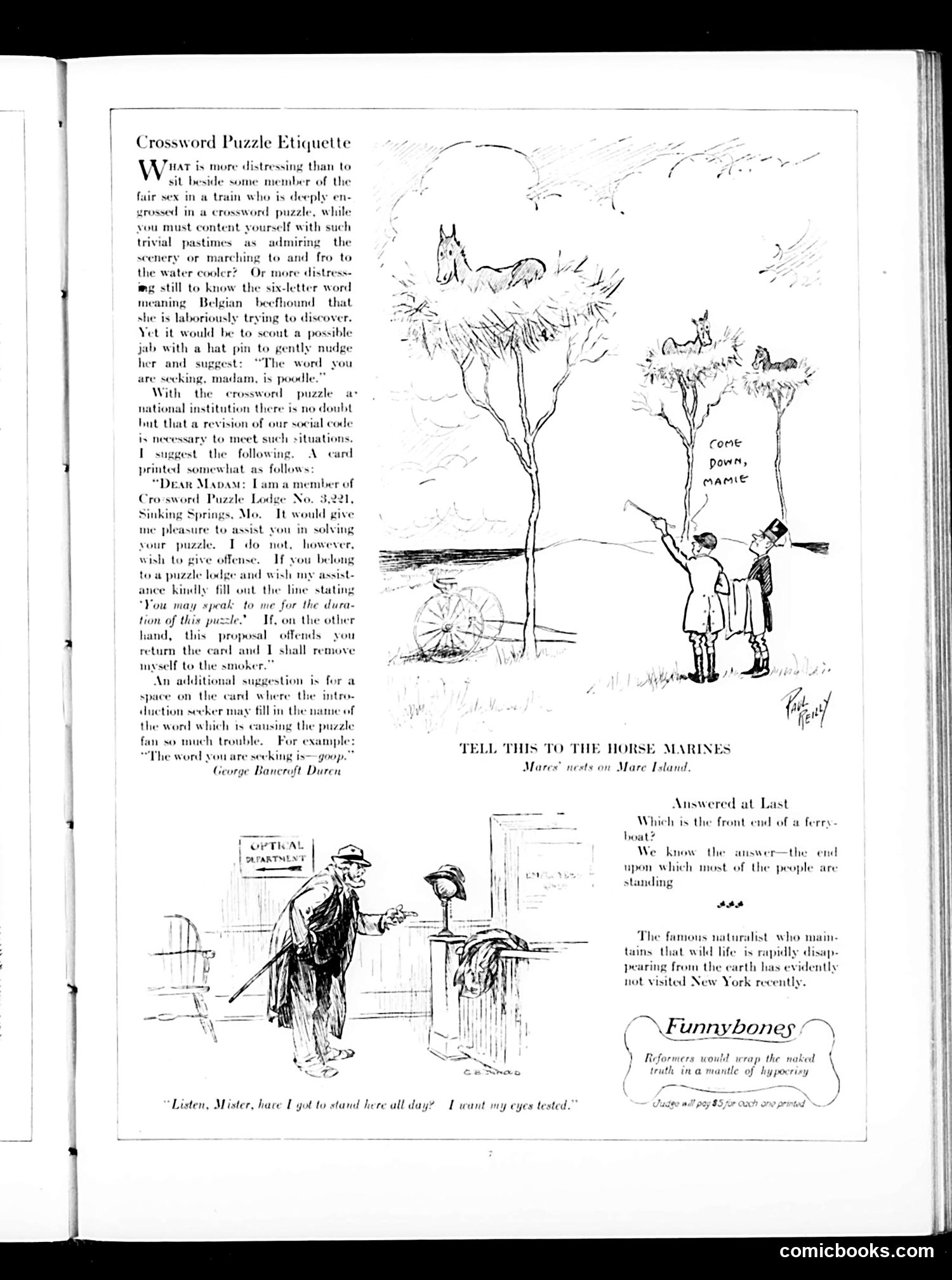
This page contains three satirical pieces typical of early 20th-century American humor: **"Crossword Puzzle Etiquette"** mocks the social phenomenon of crossword puzzles (then newly popular) by imagining formal "lodge" protocols for politely interrupting someone absorbed in solving. The satire targets both the obsessive puzzle-solvers and the awkwardness of modern etiquette around them. **"Tell This to the Horse Marines"** is a visual gag about a man at an optometrist complaining about waiting. "Horse Marines" was a phrase meaning something ridiculous or impossible—the joke is his complaint is absurdly self-evident. **"Answered at Last"** satirizes a naturalist's claim that wildlife is disappearing from Earth by noting he apparently hasn't visited New York recently (implying the city's wildlife, likely rats and vermin, thrives). **"Funnybones"** is a brief quip suggesting reformers hide uncomfortable truths behind hypocritical language. The page reflects early-1900s preoccupations: emerging leisure activities (crosswords), urban life's peculiarities, and contemporary debates about conservation and social reform.
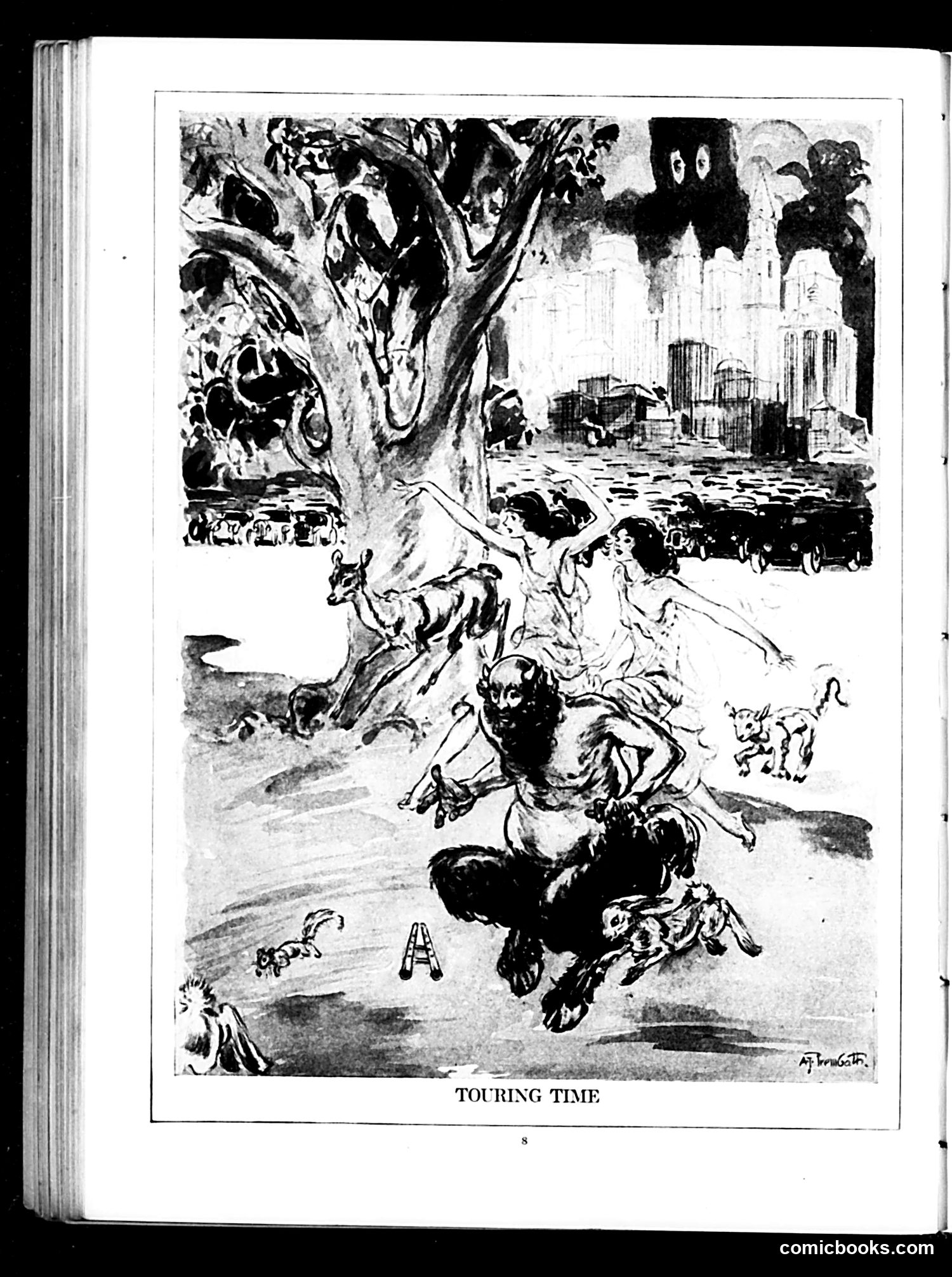
This satirical cartoon depicts a chaotic urban scene with demonic or grotesque figures emerging from beneath a large tree, while well-dressed people flee in panic above. The cityscape in the background shows tall buildings and vehicles. The title "Touring Time" likely refers to automobile tourism, which was increasingly popular in early 20th-century America. The satire appears to mock the disruption or dangers associated with this new phenomenon—possibly suggesting that motor tourism brings chaos, supernatural disorder, or social upheaval to previously peaceful communities. The demonic figures might represent the perceived threat or "invasion" of modern automobile culture, while the fleeing figures above suggest anxiety about rapid social change. The exact political target remains unclear from the image alone, though the cartoon clearly expresses skepticism about touring and automobiles.
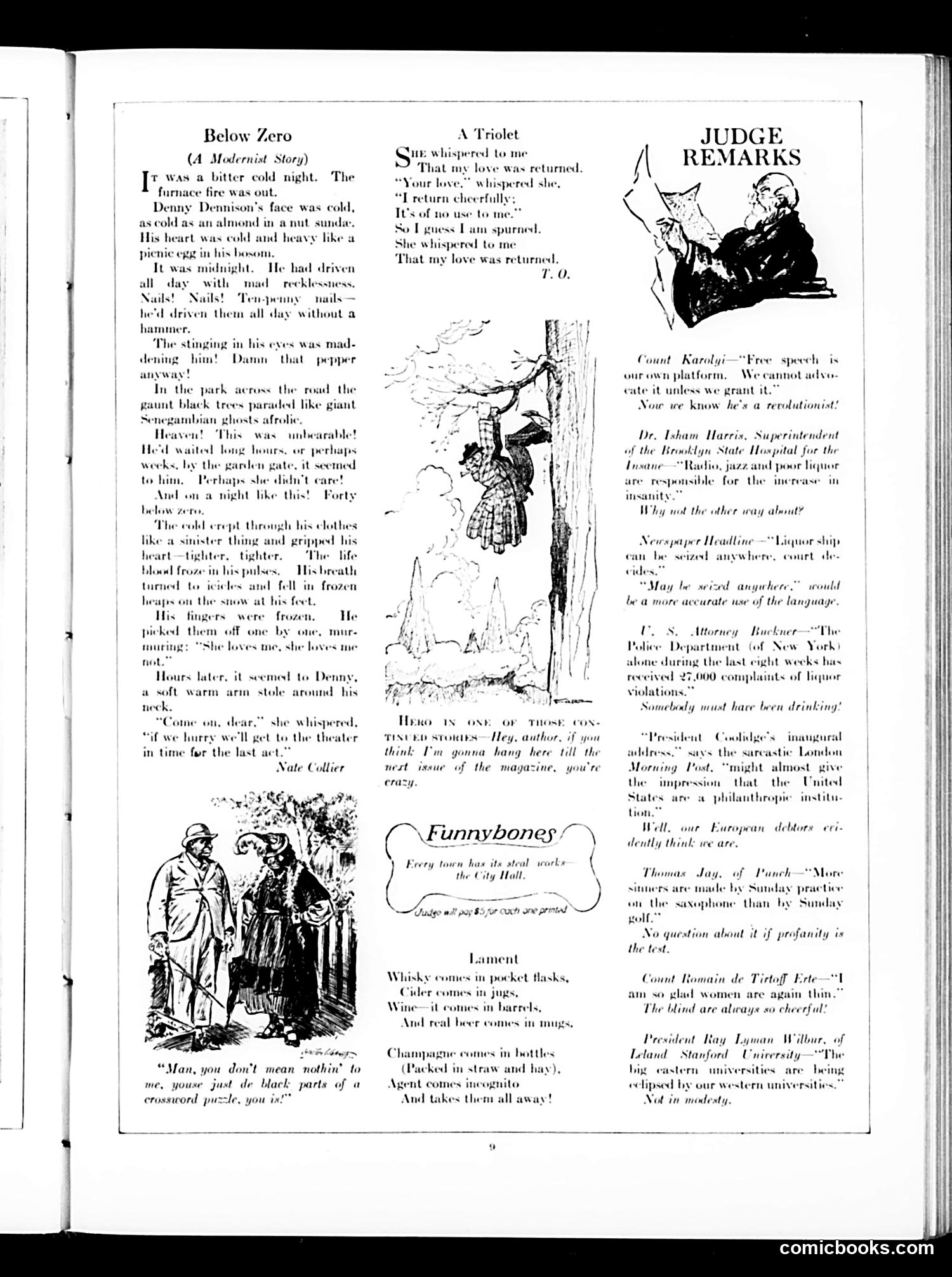
This page contains satirical commentary on 1920s American life, particularly targeting Prohibition-era concerns and public figures. **"Below Zero"** parodies modernist literary pretension—a overwrought story about a man waiting in freezing cold for his lover, using absurdly purple prose ("blood froze in his pulses"). The joke: she arrives with a simple "let's go to the theater"—deflating the dramatic tension entirely. It's mockery of self-serious avant-garde writing. **"Judge Remarks"** section contains brief political jabs: Count Karolyi (Hungarian political figure) is labeled a "revolutionist" for advocating free speech; Dr. Harris blames jazz and liquor for insanity (the commentary questions this causation); various officials are criticized over Prohibition enforcement inconsistencies and the vague language of liquor seizure laws; President Coolidge's charitable reputation is treated skeptically regarding America's motives. The overall tone suggests Judge's conservative skepticism toward modernism, radical politics, and government credibility during Prohibition.
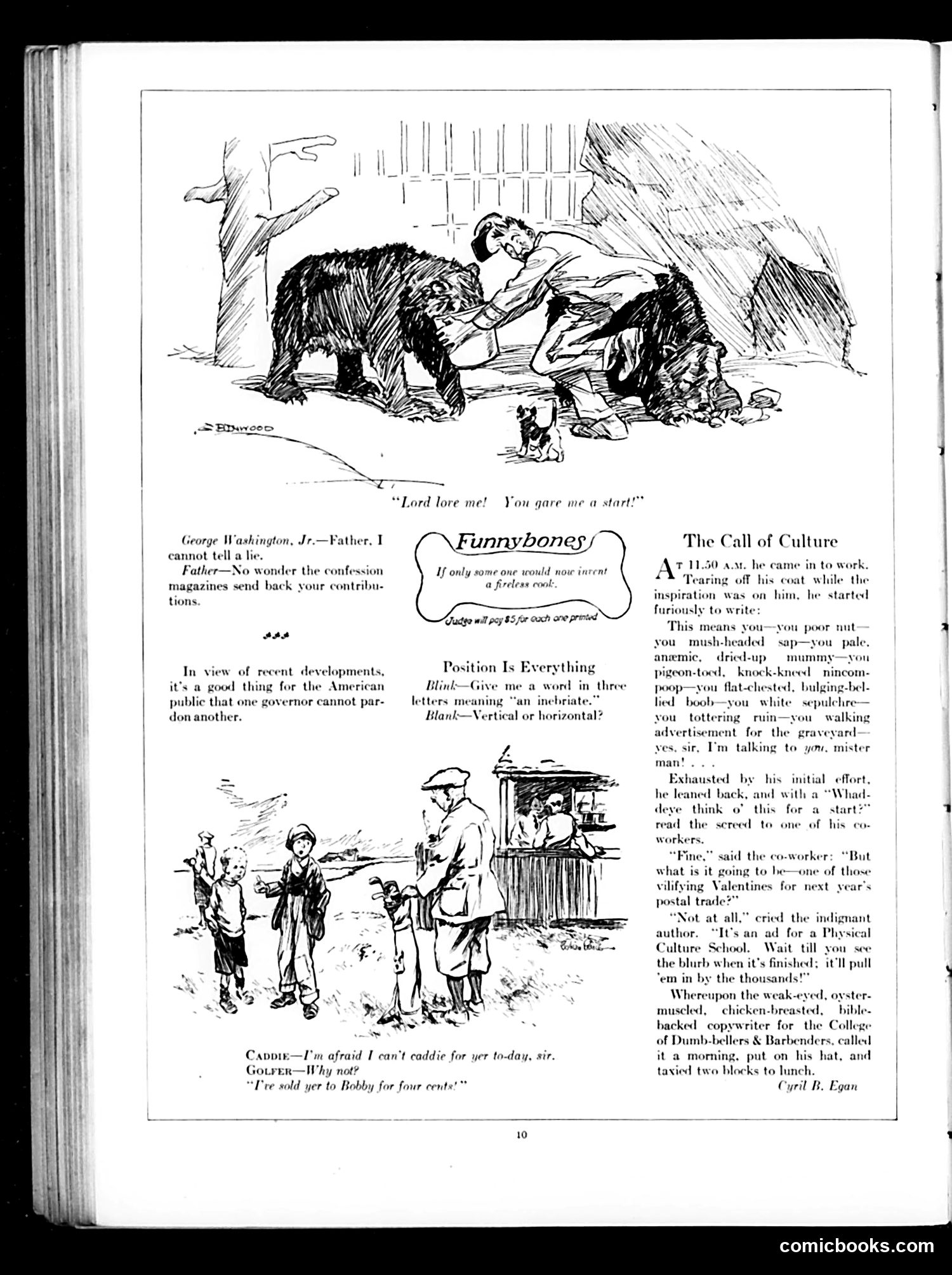
This Judge magazine page contains three satirical pieces: **"George Washington, Jr."** mocks confession magazines (popular periodicals where people admitted secrets). The joke plays on Washington's famous cherry-tree legend about honesty—the father rejects his son's confession because confession magazines reject poorly-written submissions. **"Position Is Everything"** is a golf joke where a caddie has been sold to another golfer for four cents, treating him as disposable labor—satire on working-class treatment. **"The Call of Culture"** satirizes fraudulent fitness advertising. A copywriter, described as weak and out-of-shape, writes insulting ads for a "Physical Culture School" (gyms promising body transformation). The humor: he's selling false promises of transformation while embodying failure himself. His inflammatory ad copy ("you poor nut," "you boob") is actually advertising, not criticism—mocking the absurdity of aggressive fitness marketing that insults potential customers. All three target hypocrisy and commercial deception in early 20th-century America.
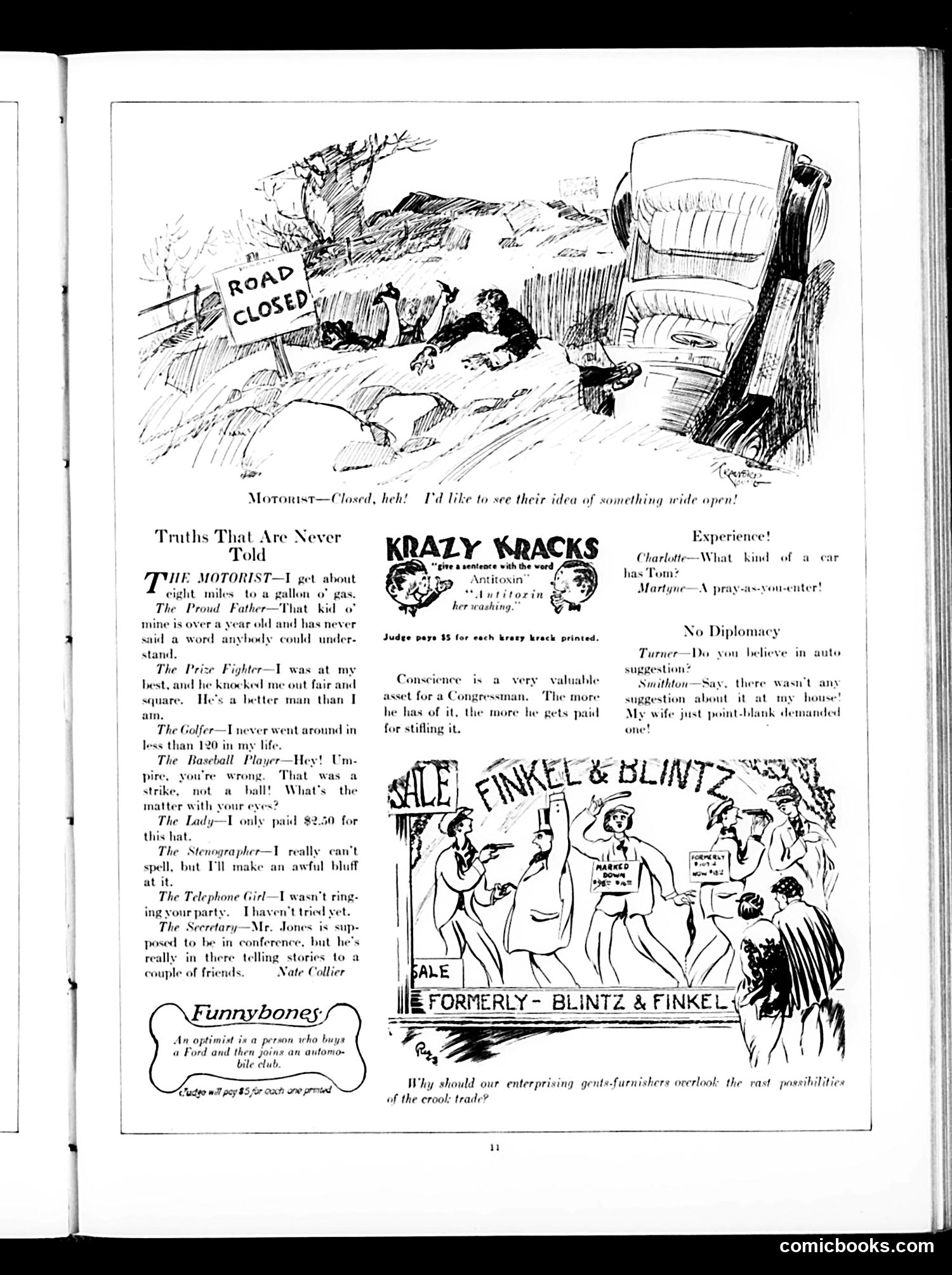
This Judge magazine page satirizes early automotive culture and contains period humor pieces. The top cartoon depicts a "Road Closed" sign with motorists stuck in debris, mocking the motorist's boast about wanting "something wide open"—commentary on poor road conditions and early automobile frustrations. "Truths That Are Never Told" collects confessions from various professions admitting failures or dishonesty: a motorist overstating gas mileage, a prize fighter lying about a loss, a stenographer who can't spell, a secretary telling stories instead of working. These mock professional pretense and hypocrisy. The "Funnybones" definition jokes about Ford owners—calling them optimists for buying a notoriously unreliable vehicle then joining automobile clubs, likely for roadside assistance. "Krazy Kracks" appears to be a reader-submission humor contest paying five dollars per joke. The bottom "Finkel & Blintz" illustration and caption about "crook trade" are unclear without more context but appear to reference fraud or dishonesty in commerce. Overall, the page satirizes early 20th-century American pretense, automobile culture's growing pains, and professional dishonesty.
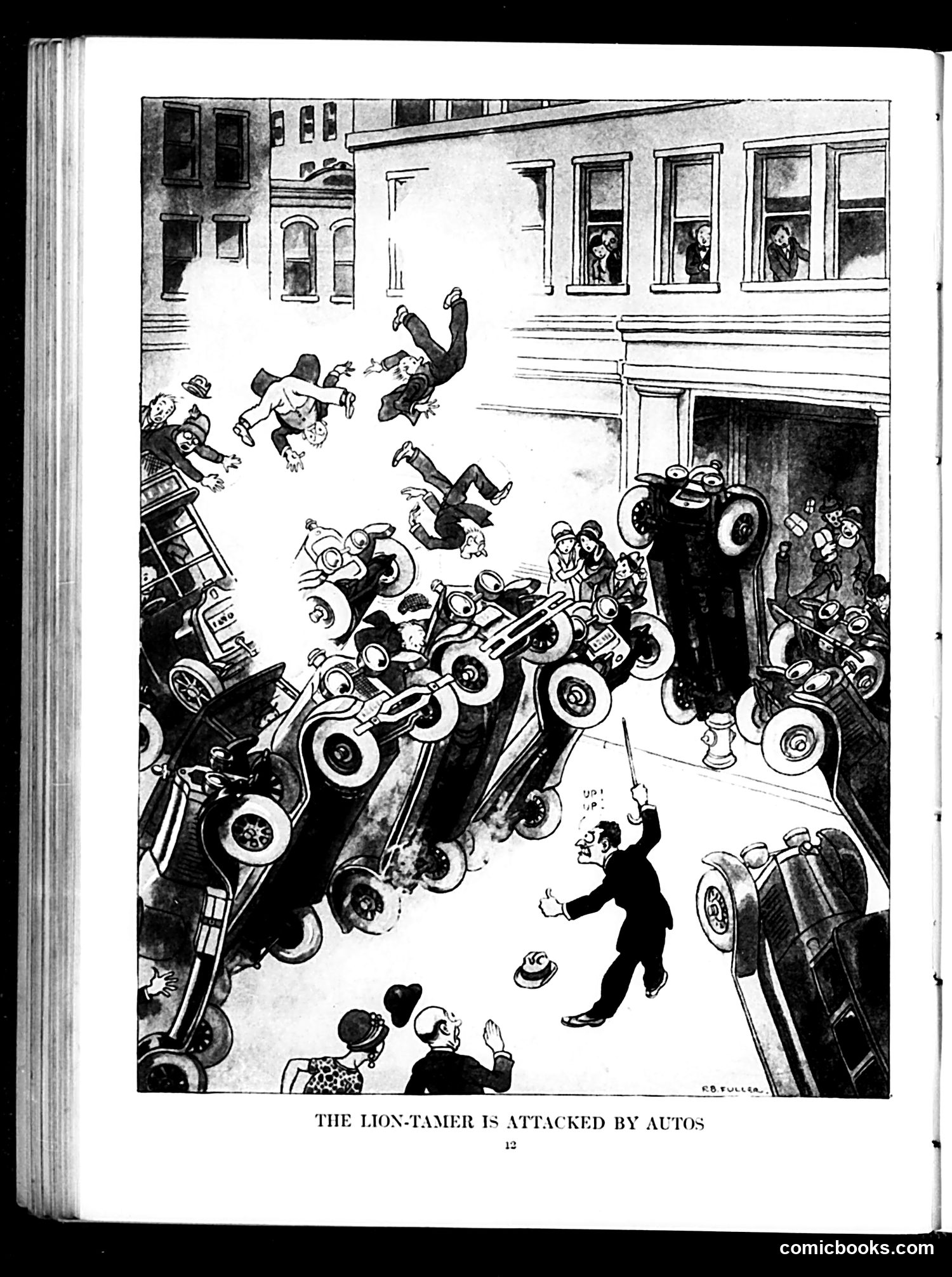
This satirical cartoon depicts a man (the "lion-tamer") surrounded and attacked by automobiles in a city street, with pedestrians watching from buildings and sidewalks. The joke uses animal-taming metaphor to criticize the automobile industry or traffic chaos of the era. The "lion-tamer" appears to represent either a traffic official, politician, or reformer attempting to control the rapidly proliferating automobiles—treated here as dangerous "wild beasts" rather than vehicles. The swarm of cars attacking him suggests that automobiles are uncontrollable and pose a serious public safety threat. This reflects early-20th-century anxieties about automobiles as new, dangerous technology overwhelming urban streets and endangering pedestrians. The satire mocks either the ineffectiveness of regulation or the impossibility of "taming" this modern threat.
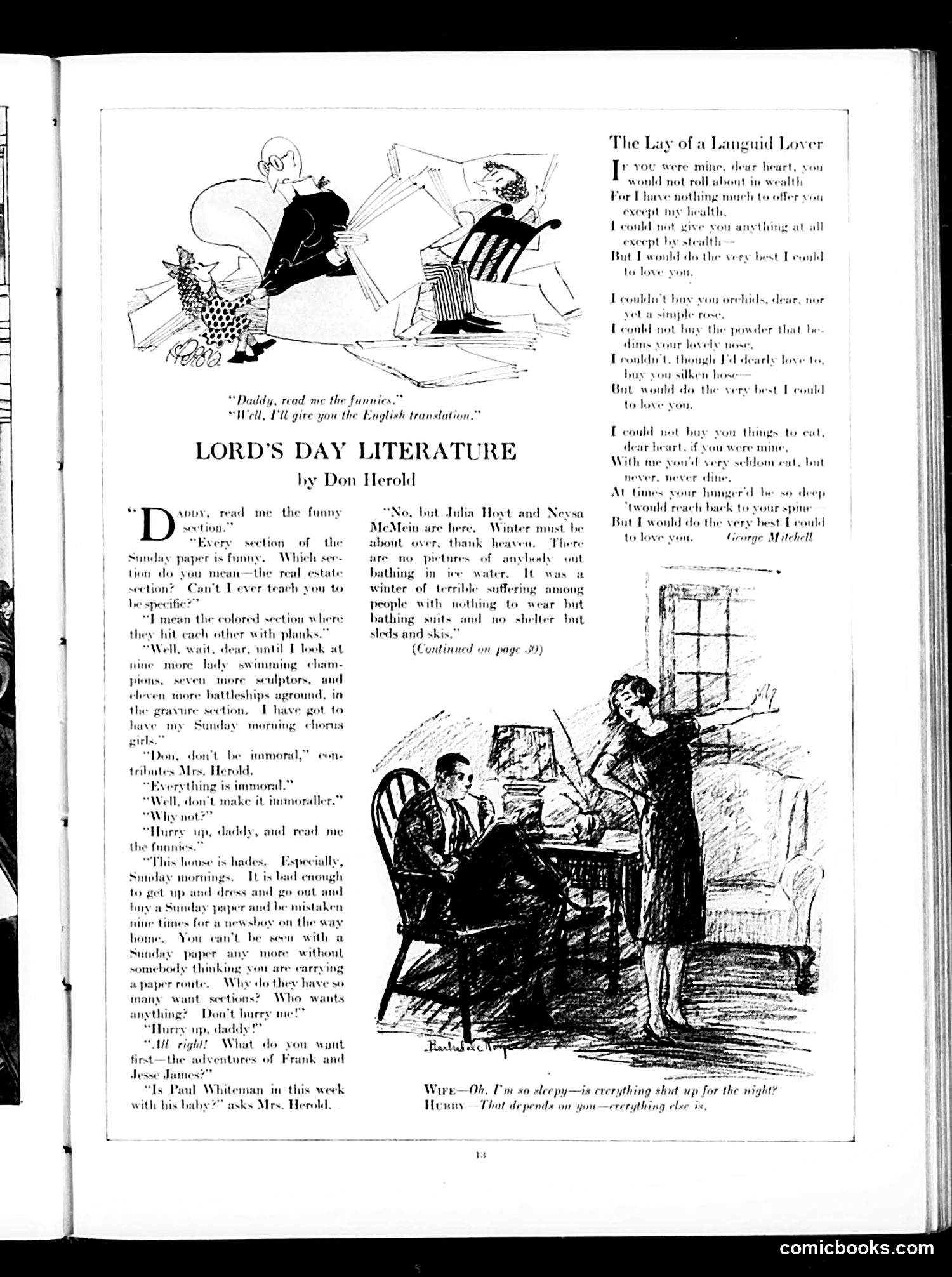
This satirical piece mocks the contrast between religious propriety on Sundays and the actual content of Sunday newspapers. A father is asked to read "the funnies" to his child, but he jokingly offers "the English translation" instead—suggesting the comics are incomprehensible or ridiculous. The humor targets: 1. **Sunday newspaper excess**: Herold critiques how Sunday papers are bloated with multiple sections (real estate, sports with "battleships aground," swimming champions, etc.), making them unwieldy and impractical. 2. **Hypocrisy**: The title "Lord's Day Literature" is ironic—Sunday is supposedly sacred, yet papers are filled with frivolous, immoral content. When Mrs. Herold objects to something being "immoral," the father replies "Everything is immoral," suggesting the papers themselves are morally questionable. 3. **Consumerism disguised as news**: The "want sections" (classifieds) exemplify newspapers as vehicles for commercial desire rather than enlightenment. The accompanying poem "The Lay of a Languid Lover" offers romantic sentimentality, creating comic contrast with the satirical prose.
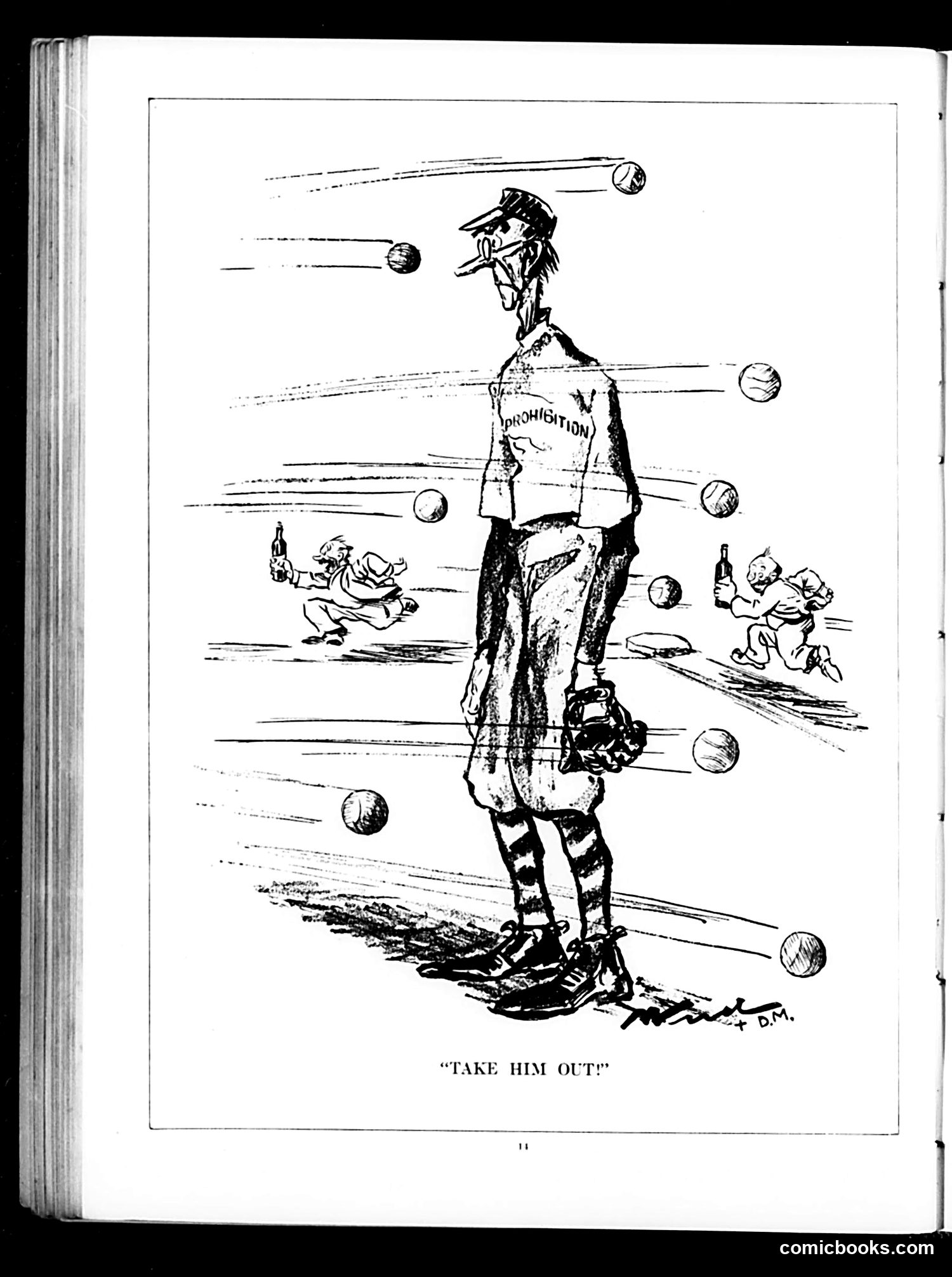
This cartoon depicts Prohibition as a towering figure labeled "PROHIBITION" being pelted with baseballs by smaller figures (appearing to be ordinary citizens or politicians) on either side. The baseballs represent attacks or criticism directed at the policy. The satire criticizes Prohibition—the constitutional ban on alcohol (1920-1933)—by showing it as an unpopular, vulnerable target under assault from the public. The figures throwing baseballs suggest widespread opposition cutting across different groups. The caption "TAKE HIM OUT!" reinforces this message of removal or elimination, advocating against the Prohibition policy. This reflects Judge magazine's satirical stance on a major political issue dividing American society during this period.
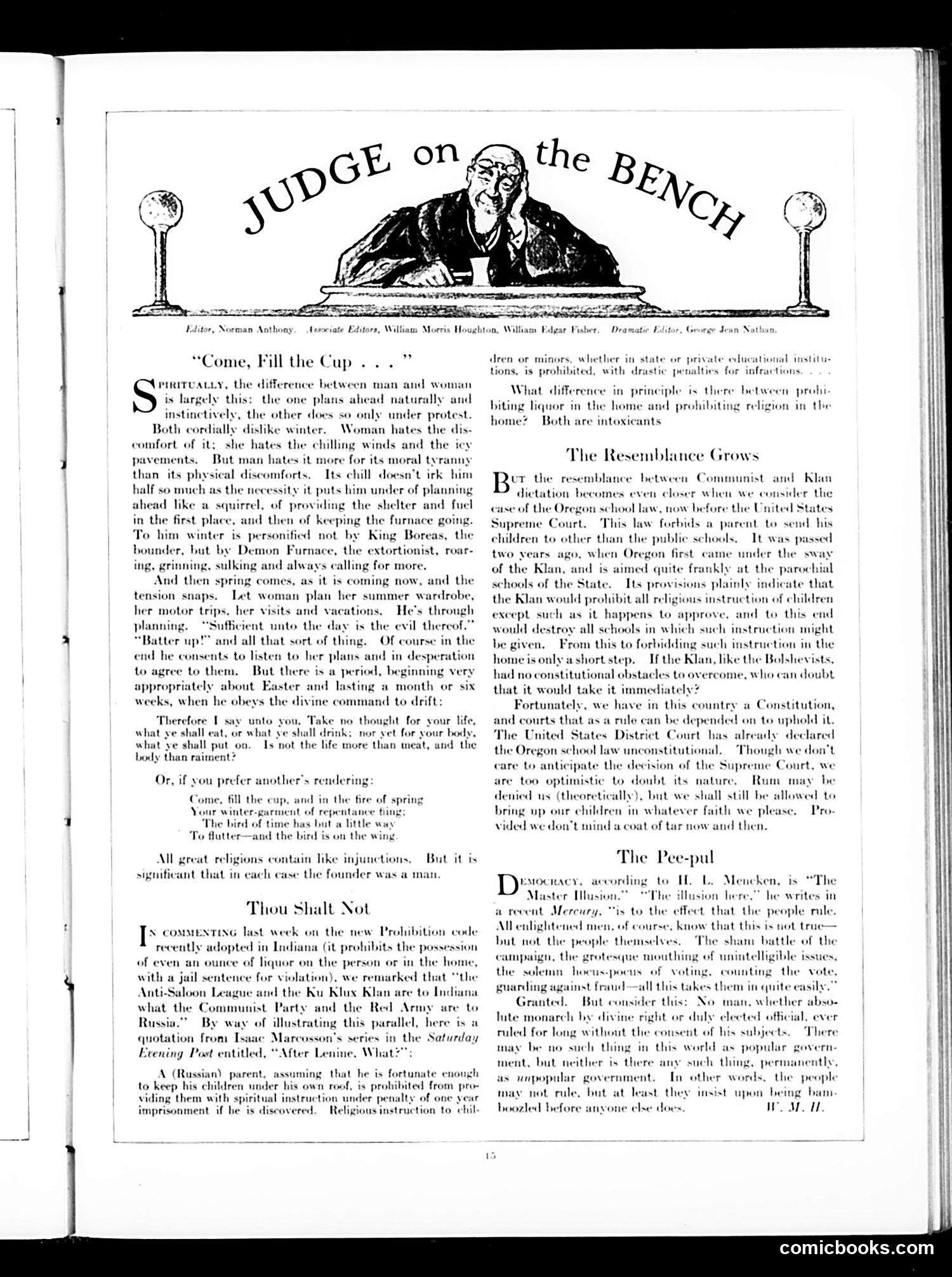
This page contains editorial commentary criticizing two contemporary American movements: Prohibition and the Ku Klux Klan. The opening article ("Come, Fill the Cup") uses a humorous gender contrast to mock spring-time relaxation, quoting Omar Khayyam to suggest men naturally resist planning and welcome drinking season. The substantive critique appears in "Thou Shalt Not" and "The Resemblance Grows," which draw an explicit parallel between the Anti-Saloon League/KKK in Indiana and the Soviet Communist Party/Red Army in Russia. The author argues both represent authoritarian overreach—comparing Prohibition's ban on home liquor to Soviet restrictions on religious instruction, and citing Oregon's KKK-backed school law requiring public (not parochial) education as similarly totalitarian suppression of personal freedom. The satire's point: American anti-alcohol and anti-Catholic movements employ the same coercive government power the magazine associates with Bolshevism, making them un-American threats to liberty.
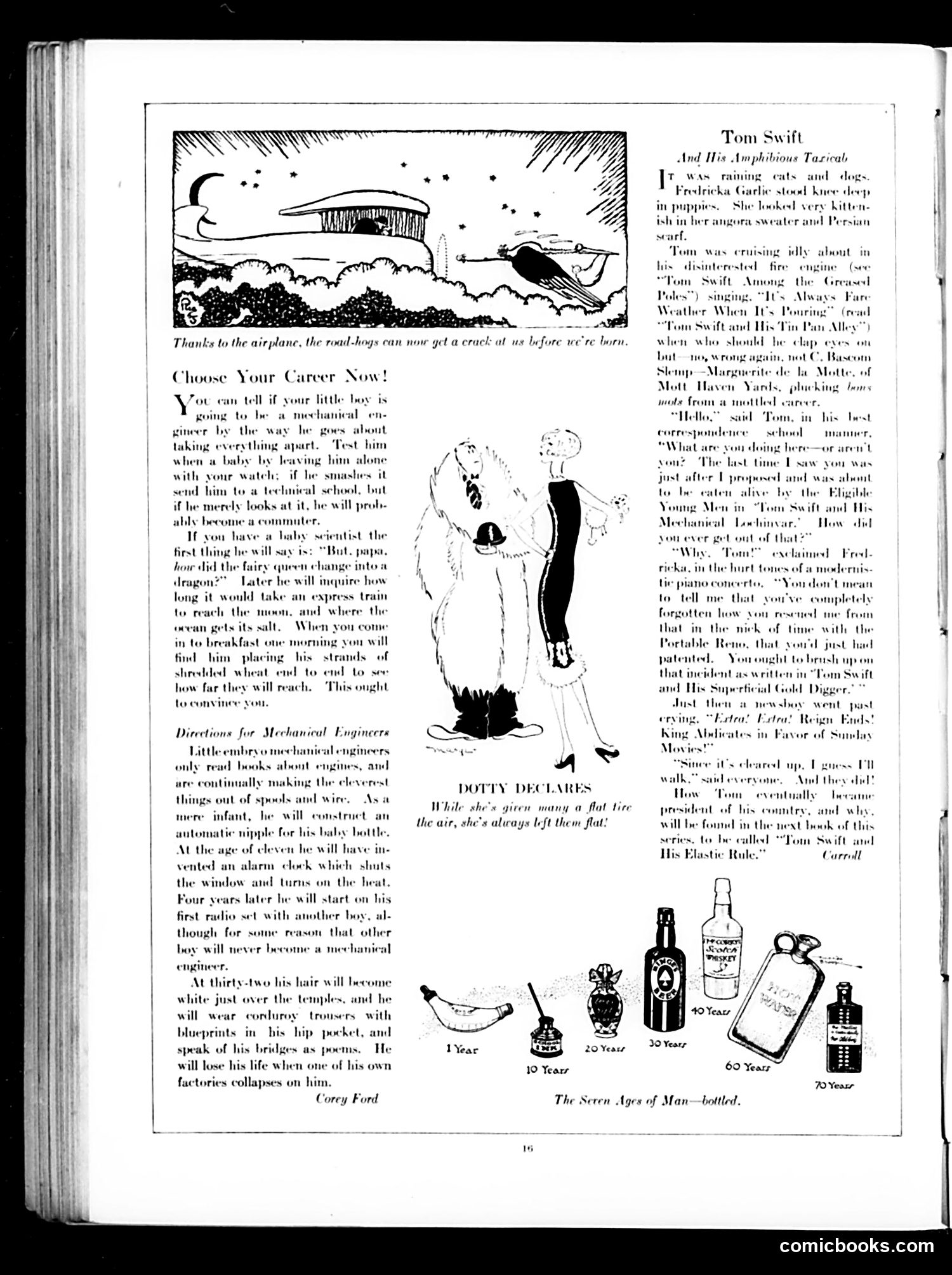
This page contains three distinct humor pieces from Judge magazine: **"Tom Swift Among the Grossed Poles"** (right): A parody of the popular Tom Swift adventure series. The joke plays on the protagonist's characteristic earnest, mechanical solutions to problems. Here, Tom has invented an amphibious taxicab—an absurdly impractical vehicle. The satire mocks the Tom Swift formula: boy-inventor solves every problem with ridiculous contraptions, regardless of practicality. **"Choose Your Career Now!"** (left): Corey Ford's satirical advice for identifying future mechanical engineers in children. The humor lies in the exaggerated life trajectory—from destructive toddler taking apart watches, through professional success, to dying when his own factory collapses. It's dark satire about engineering ambition and occupational hazard. **"Dotty Declares"** (center): A brief gag about a woman who "gives flat tires" but "leaves them flat"—a double entendre about romantic rejection. **"The Seven Ages of Man—bottled"** (bottom): Visual joke showing alcohol bottles labeled by increasing ages, implying drinking progresses through life stages.
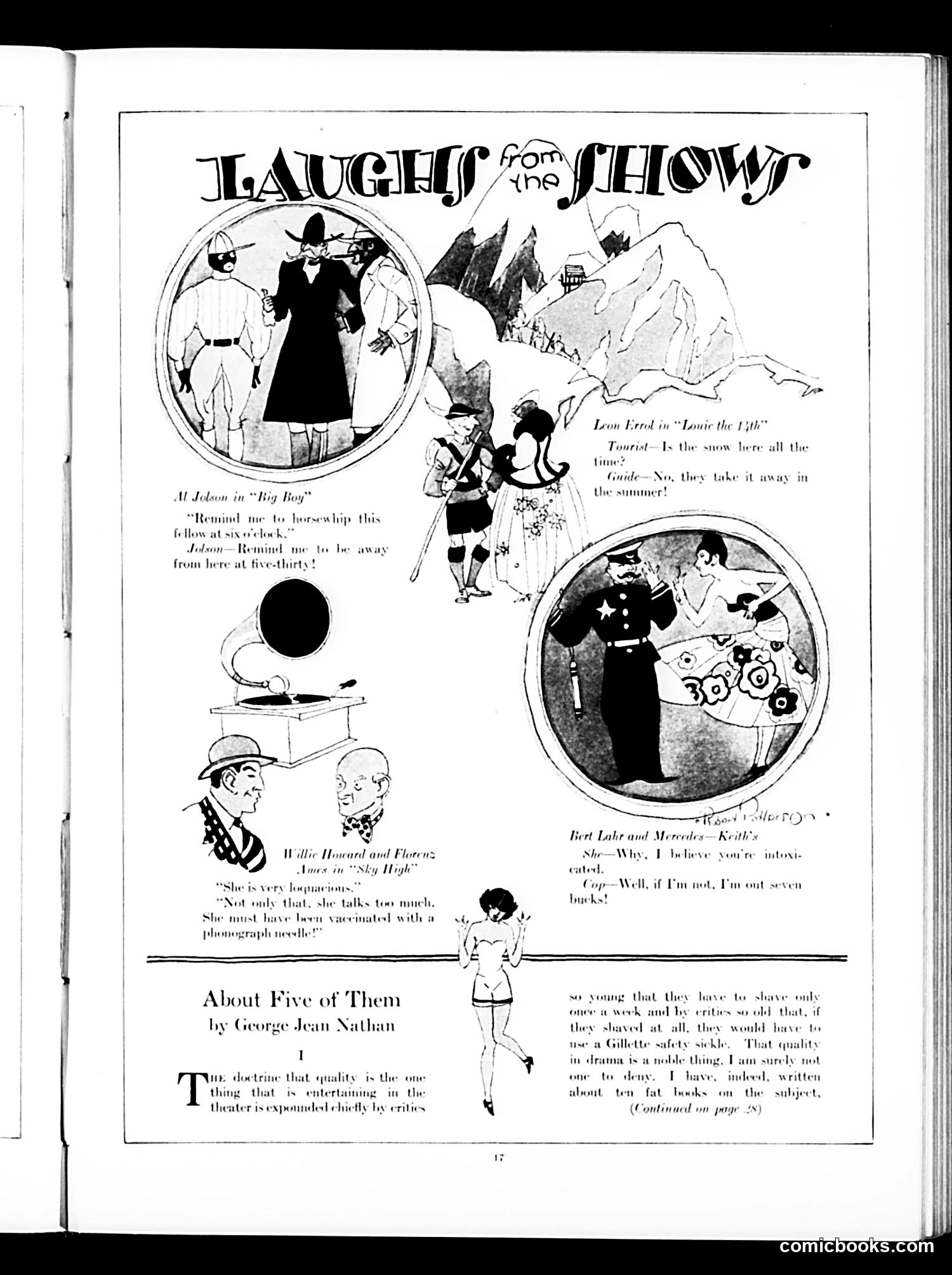
This page features theatrical humor excerpts from popular stage shows of the era (likely 1920s based on style). The jokes mock performers and situations: **Al Jolson** ("Big Boy"): A mutual threat joke where Jolson promises to horsewhip someone at six o'clock, but that person reminds Jolson to leave by 5:30—suggesting Jolson is the one to be feared. **Willis Howard and Florence Aimes** ("Sky High"): A woman is criticized as excessively talkative, with the punchline that she must have been "vaccinated with a phonograph needle"—a contemporary reference to gramophone technology, joking that she's mechanically verbose. **Bert Lahr and Mercedes**: A drunk-driving joke where a policeman accuses someone of intoxication; the reply is "if I'm not, I'm out seven bucks" (likely referencing bail or fines). The lower article by George Jean Nathan discusses theatrical quality, noting critics overemphasize this doctrine—a meta-commentary on theater criticism itself.
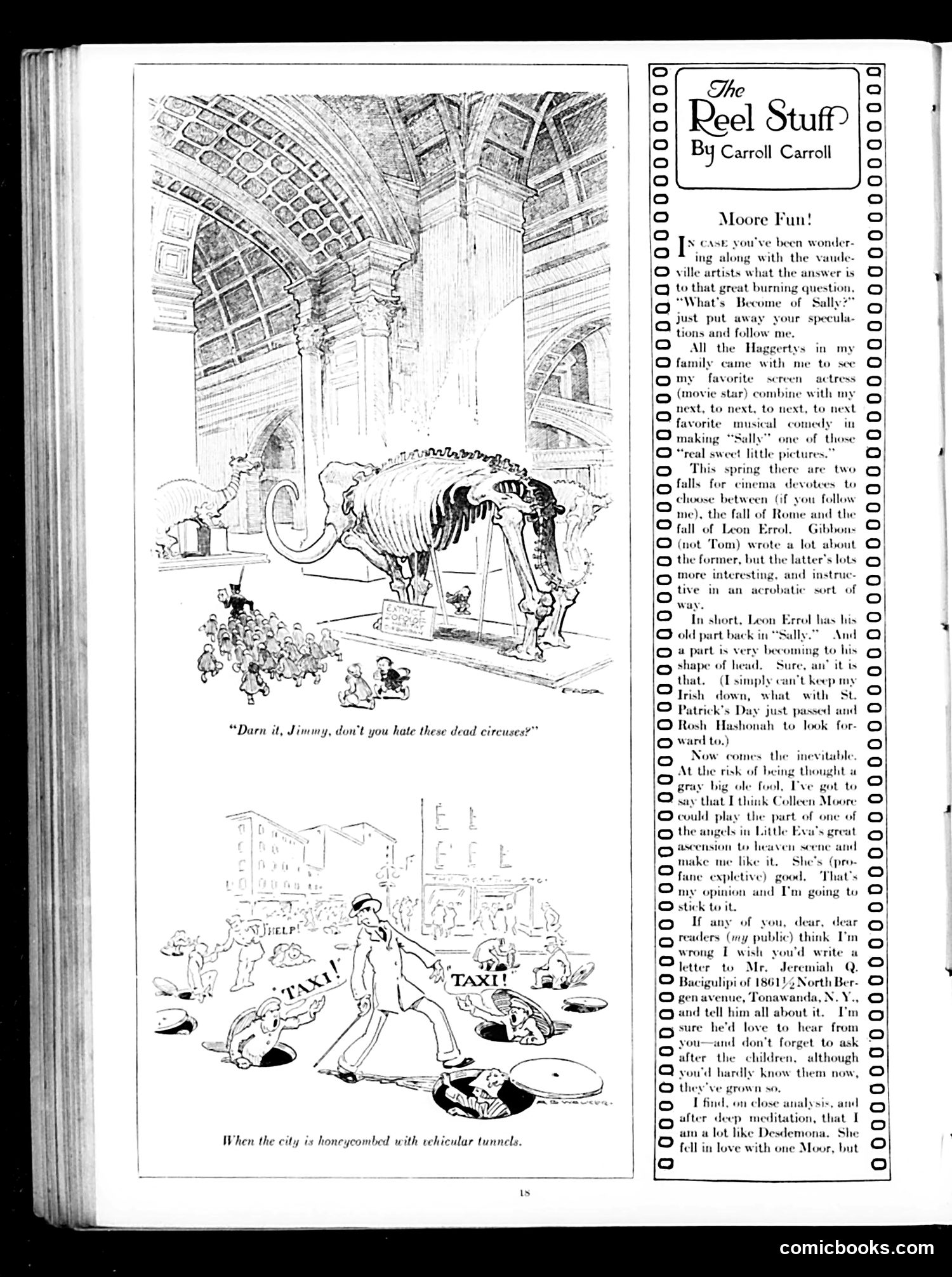
This is a humorous film column by Carroll Carroll discussing movies and actors of the era. The two cartoons illustrate absurdist scenarios: the first shows a circus elephant in a studio, captioned "Darn it, Jimmy, don't you hate these dead circuses?" suggesting movie studios were recycling circus acts. The second depicts a taxi driver navigating a street filled with tunnel-like structures, punning on the phrase "the city is honeycombed with vehicular tunnels." The text primarily discusses actress Colleen Moore and actor Leon Errol, debating whether Errol's return to his comedic role in the film "Sally" suits him. Carroll playfully compares himself to Desdemona (Shakespeare's character who married a man of different race), making a self-deprecating ethnic joke about his Irish heritage. The column's tone is lighthearted gossip about Hollywood productions, typical of entertainment journalism in Judge magazine's satirical style—mixing film criticism with wordplay and absurdist humor.
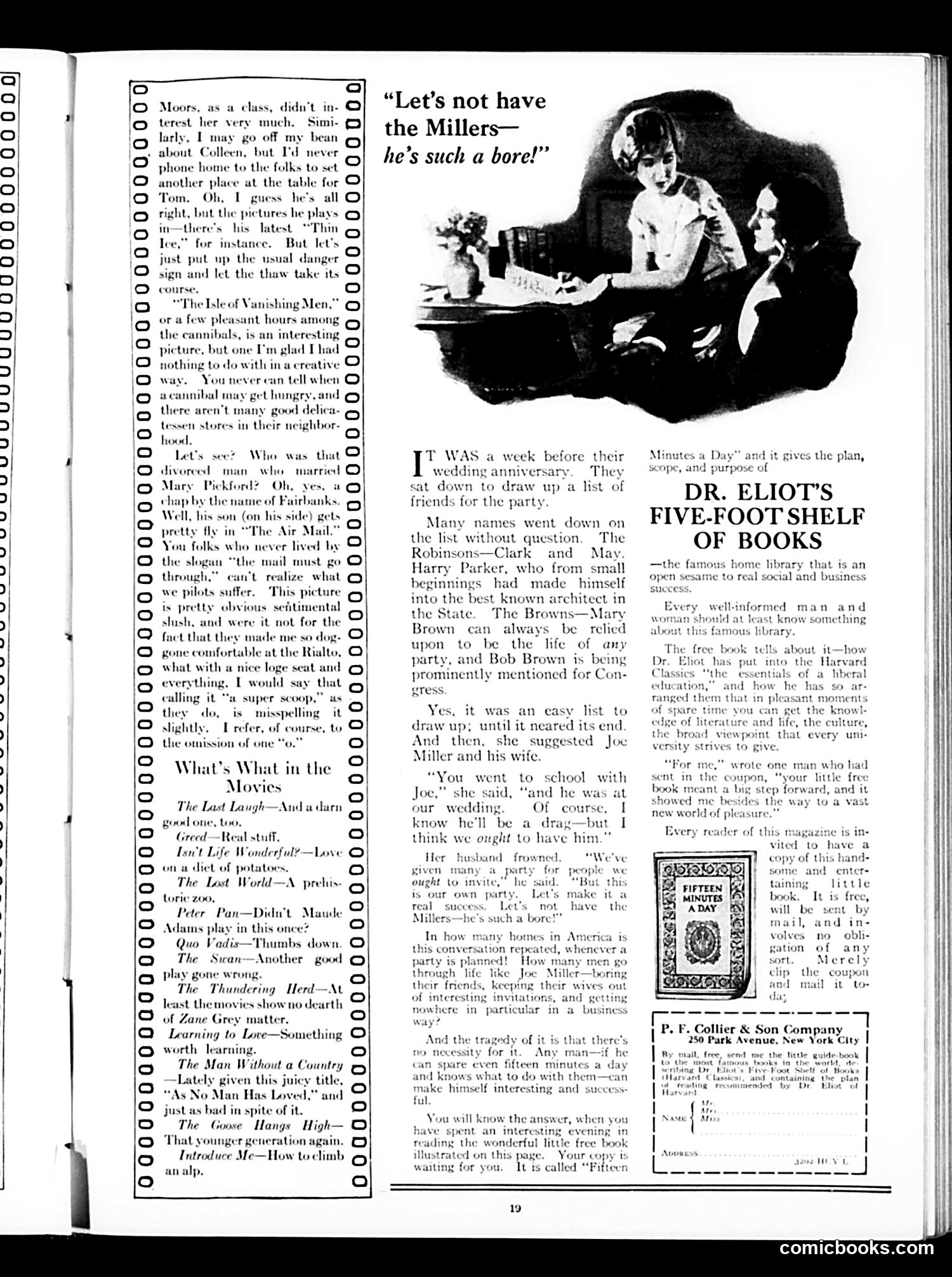
This page contains a short story with social satire about class anxiety and social climbing in 1920s America. A couple planning their wedding anniversary party debates whether to invite Joe Miller, an old school friend now described as a "bore." The husband initially resists—Miller is apparently dull and unremarkable. However, the wife insists they "ought to have him" out of loyalty. The satire targets the arbitrary nature of social status: the couple eagerly includes people like architect Harry Parker and the vivacious Mary Brown (who are "prominently mentioned" and professionally successful), while dismissing Miller as boring and unworthy—despite his longtime friendship. The cartoon illustration shows a woman dismissing the Millers to her companion, capturing the snobbery. The piece satirizes how people reshape their social circles based on perceived prestige rather than genuine friendship or merit, reflecting post-WWI American anxiety about social standing and respectability. The page also advertises "Dr. Eliot's Five-Foot Shelf of Books," suggesting self-improvement through literature.
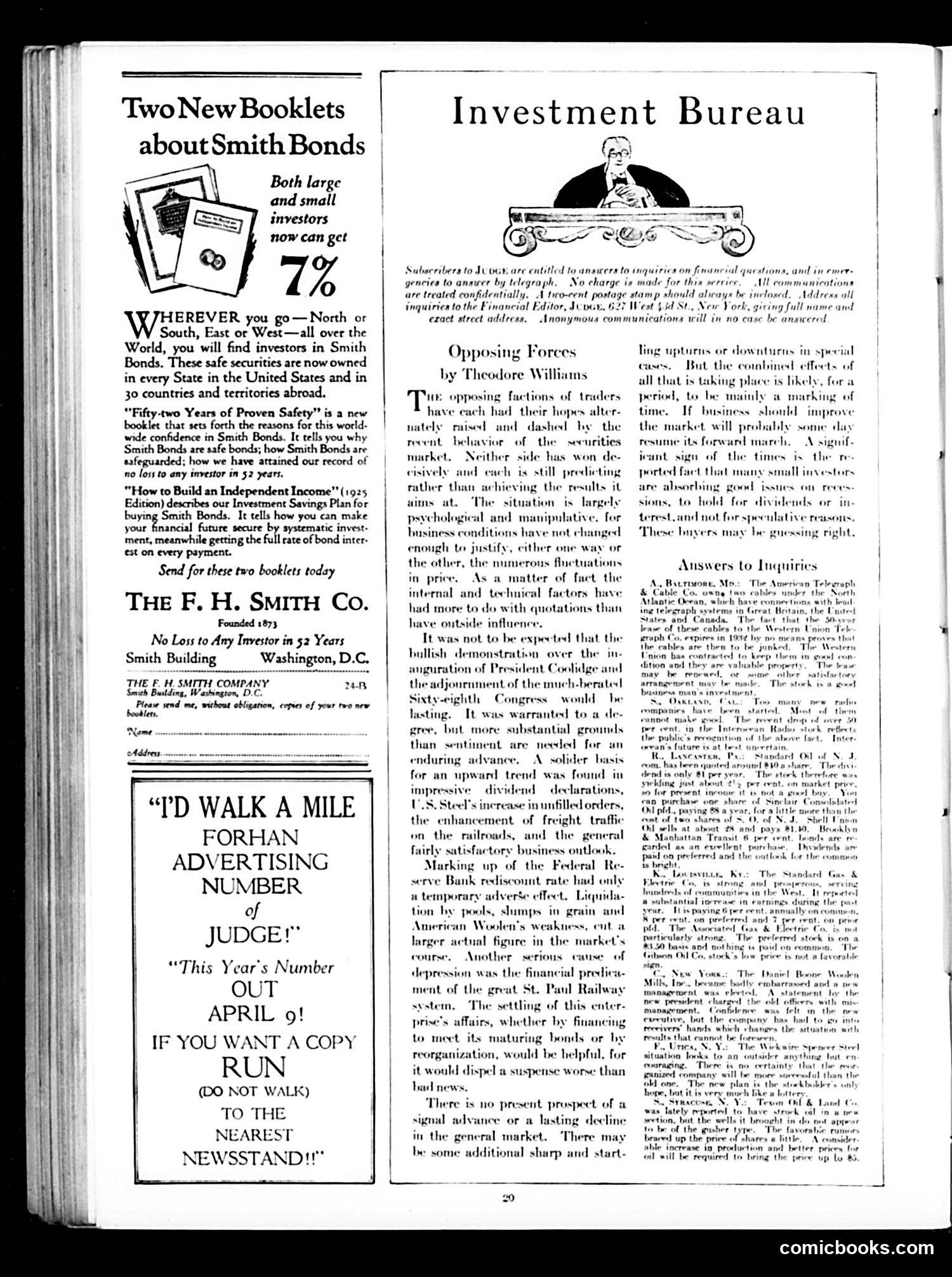
This page is primarily **advertising and financial advice**, not political satire. The left side advertises F.H. Smith Company's bonds and investment booklets promising safety ("Fifty-two Years of Proven Safety") to North American investors. The right side features **"Opposing Forces" by Theodore Williams**, a financial market analysis piece. It discusses competing trader factions and their psychological influence on stock prices, arguing that neither bullish nor bearish sentiment has fundamentally changed business conditions. Williams suggests recent market optimism (tied to President Coolidge's inauguration and Congress adjourning) lacks solid foundation, though he notes positive indicators like U.S. Steel's unfilled orders. Below is an **"Answers to Inquiries"** column addressing reader questions about stock values and market conditions. The page reflects early 1920s financial journalism aimed at small, cautious investors—notably different from modern market discourse.
This page is primarily **advertising**, not satire or political commentary. It contains two main investment advertisements from the 1920s era: 1. **American Bond & Mortgage Company** (left): A serious pitch for first mortgage building bonds, emphasizing 20+ years of reliable dividend payments and 6%+ yields. The appeal is to conservative investors seeking safety. 2. **G.L. Miller Bond & Mortgage Company** (right): A Florida-based competitor advertising bonds with higher yields (up to 7.7%) tied to geographical location. The headline "At Last We Are Saving Money!" suggests consumer confidence in managed investments rather than simple hoarding. Both ads target middle-class investors during the prosperous 1920s before the 1929 crash. The tone is reassuring rather than humorous—the "CONFIDENCE" heading emphasizes trustworthiness during an era when investment schemes were common and investor wariness justified. This appears to be a **page of classified advertising** rather than editorial content, typical of Judge's revenue model.
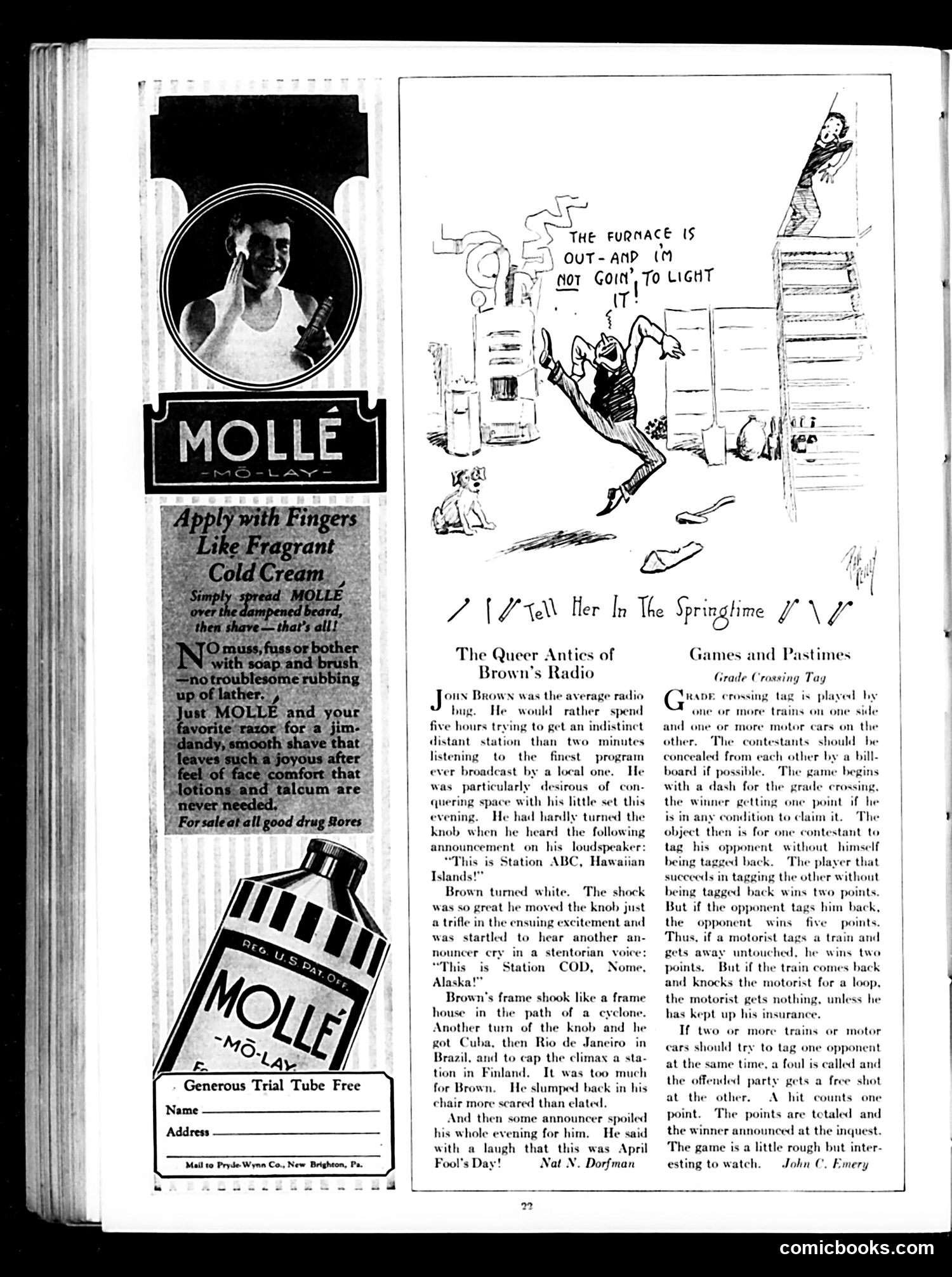
This Judge magazine page contains two distinct pieces of satire: **Left side:** A Mollé shaving cream advertisement (not satire—a commercial product ad). **Right side:** Two satirical pieces: 1. **"The Queer Antics of Brown's Radio"** (by Nat N. Dorfman): A humorous story mocking early radio enthusiasts' obsession with distant stations. Brown spends hours tuning to far-away broadcasts (Hawaii, Alaska, Cuba, Brazil, Finland) rather than enjoying local quality programs. The joke's punchline—it's all an April Fool's prank—satirizes both radio hobbyists' gullibility and the nascent medium's unreliability. This reflects 1920s-era fascination with radio technology as almost magical. 2. **"Grade Crossing Tag"** (by John C. Emery): Dark humor presenting a lethal "game" where people and vehicles play tag at railroad crossings. The satire critiques railroad safety indifference of the era by describing injuries and deaths in game terminology ("unless he has kept up his insurance," "announced at the inquest"). This reflects genuine public concern about grade crossing accidents. Both pieces use absurdist exaggeration to satirize contemporary American attitudes.
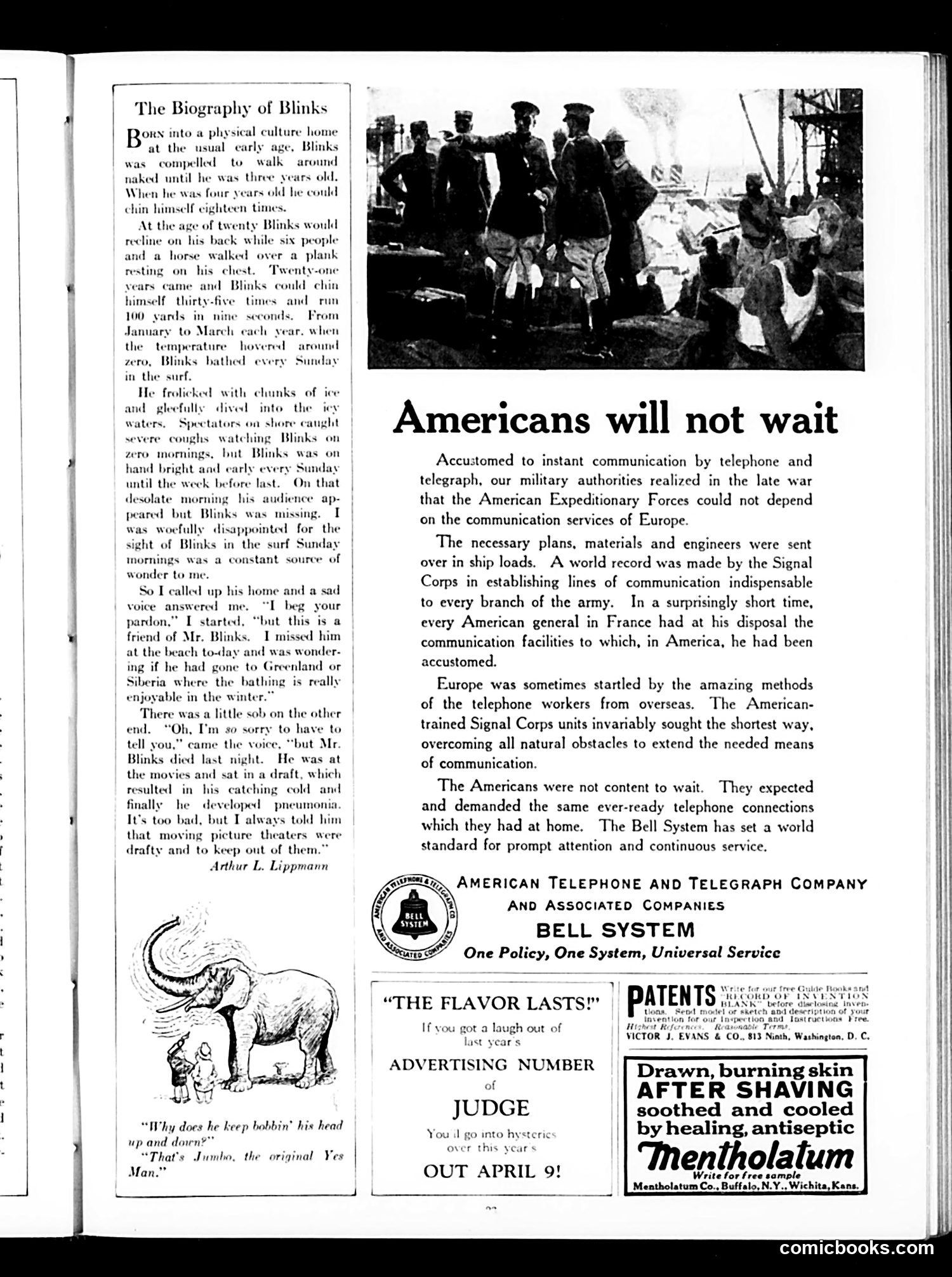
This page contains three distinct elements: **"The Biography of Blinks"** (left): A humorous short story about an extreme physical culture enthusiast who dies from catching a cold in a movie theater—the irony being that someone hardy enough to ice-bathe in winter succumbs to an ordinary draft indoors. The joke satirizes the absurdity of obsessive fitness culture. **"Americans will not wait"** (center/right): A Bell System advertisement leveraging post-WWI American pride. It describes how American Signal Corps engineers in France demanded and installed telephone infrastructure matching American standards rather than relying on European systems. The implicit message: American efficiency and impatience with inferior service drove technological progress—making a commercial virtue of national character traits. **Sidebar cartoons and ads** (bottom): A crude elephant cartoon, a Judge magazine promotion, and a Mentholatum shaving balm advertisement. The page is primarily **advertising disguised as content**, a common Judge magazine approach. The historical context matters: this celebrates American military-industrial competence post-WWI while using consumer products to reinforce national identity.
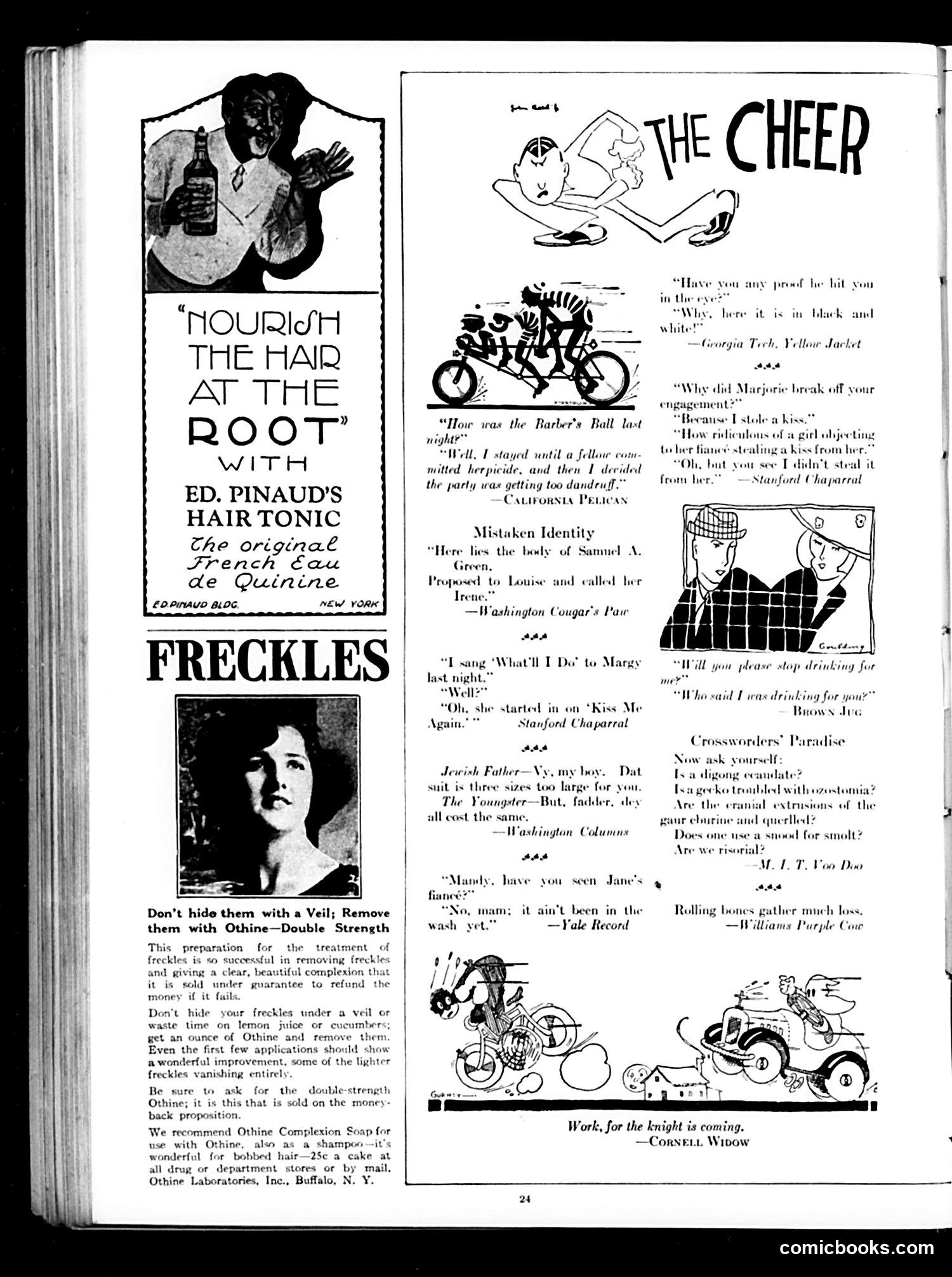
This is primarily a **advertisements and humor page** from Judge magazine, not political satire. The left side features two product ads: Ed. Pinaud's Hair Tonic (promising to strengthen hair) and Othine freckle-removal cream—both reflecting early 20th-century beauty anxieties about appearance. The right side, titled "The Cheer," contains **light social humor** typical of college magazines of the era: - Brief jokes about dating, engagements, and romance - A "Mistaken Identity" quip about a wedding proposal mix-up - Ethnic humor (a "Jewish Father" joke about suit sizing—representative of period comedy, though offensive by modern standards) - Wordplay and puns ("herpicide" killing romance at a barber's ball) - A "Crosswords' Paradise" section with absurdist riddles The cartoons show flapper-era social situations. There's no significant political content—this page reflects mainstream American consumer culture and collegiate humor circa 1920s, focused on courtship, grooming products, and gentle satirizing of social conventions rather than serious social critique.
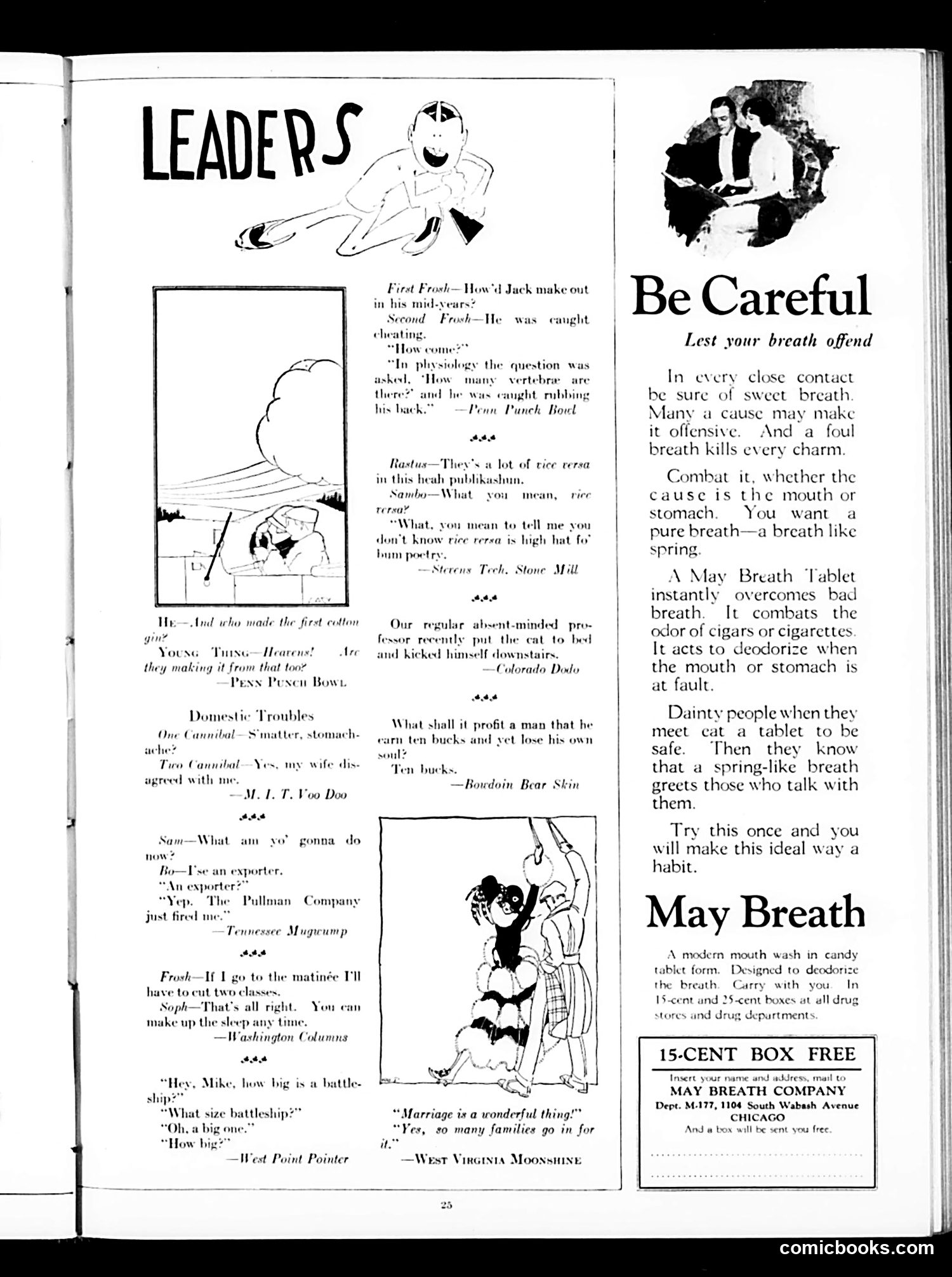
This page contains **humor columns** (labeled "Leaders") featuring jokes with racial stereotypes typical of early 20th-century American comedy, plus a **May Breath Tablet advertisement**. ## The Humor Sections The "Leaders" column collects brief jokes and witticisms from various sources. Notable examples include: - A cotton gin joke playing on double meaning - "Domestic Troubles" featuring caricatured Black dialect ("Voo Doo," "Rastus," "Sambo") making light of serious topics like marital discord and cannibalism - College humor ("Frosh") mocking absent-minded professors - Military jokes (West Point) ## The Advertisement The right page promotes **May Breath Tablets**, a mouthwash product. The ad targets "dainty people" concerned about bad breath during "close contact," positioning fresh breath as essential to charm and social acceptability—a common early advertising anxiety-selling technique. The racial humor reflects Judge's era; such stereotypes were considered acceptable entertainment then but are now recognized as offensive. The ad represents period consumer marketing emphasizing personal refinement and social acceptance.
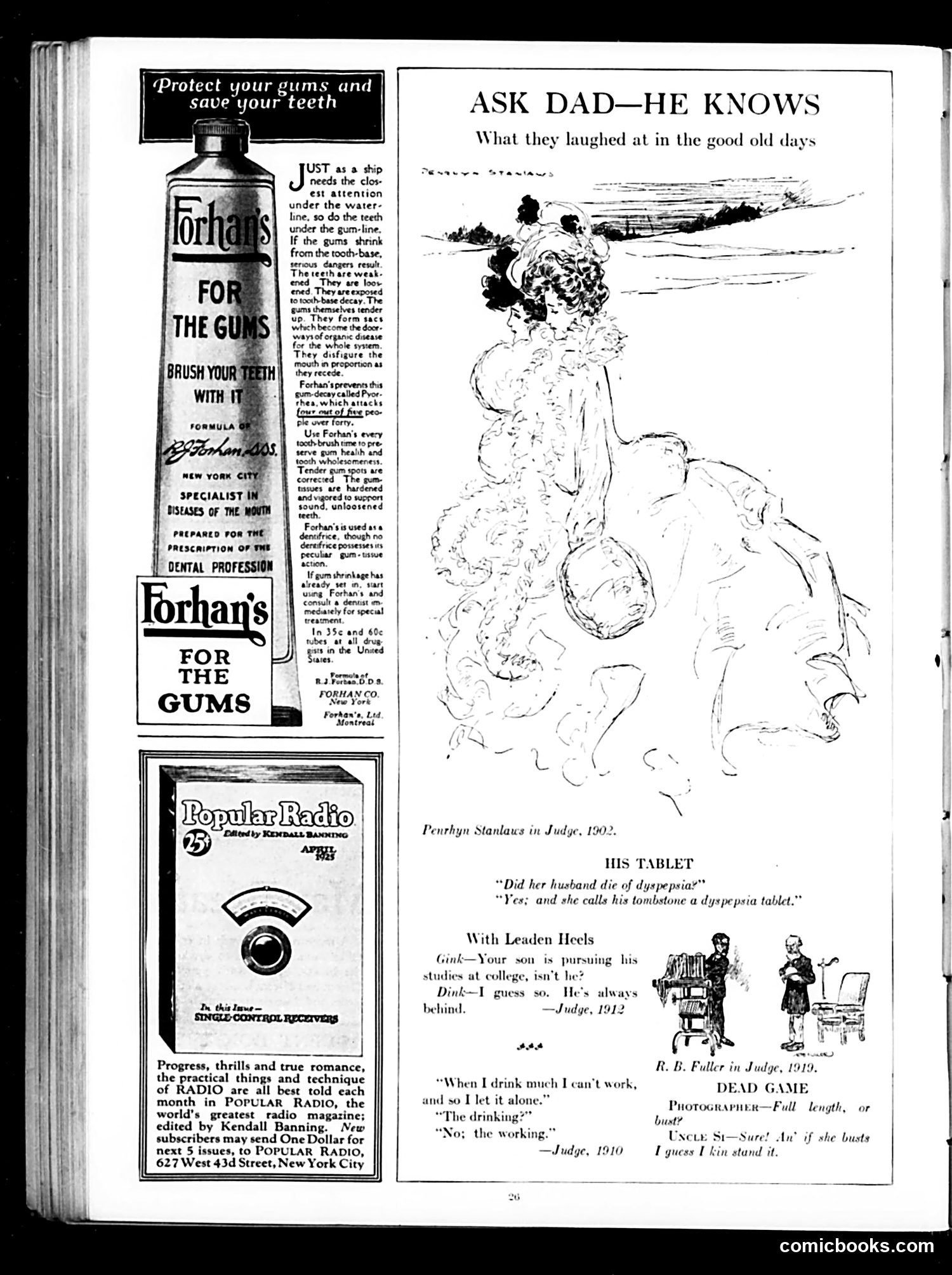
This page combines **advertisements with reprinted vintage jokes** labeled "Ask Dad—He Knows." **Main Advertisement:** Forhan's toothpaste, marketed to prevent pyorrhea (gum disease), with dental-professional endorsement. The copy warns of gum shrinkage dangers and positions the product as preventative medicine. **Reprinted Jokes:** The page includes four satirical pieces from Judge's archives (1902-1919): 1. A visual caricature by Penrhyn Stanlaus (1902) captioned with a pun about dyspepsia tablets/tombstones 2. A joke about a college student perpetually "behind" in his studies (1912) 3. A drinking/working paradox (1910) 4. A crude joke about a woman's durability (1919) These are presented as period humor—"what they laughed at in the good old days"—likely nostalgic filler material. The jokes reflect early-20th-century sensibilities: wordplay, gender stereotypes, and crude double meanings were considered sophisticated comedy.
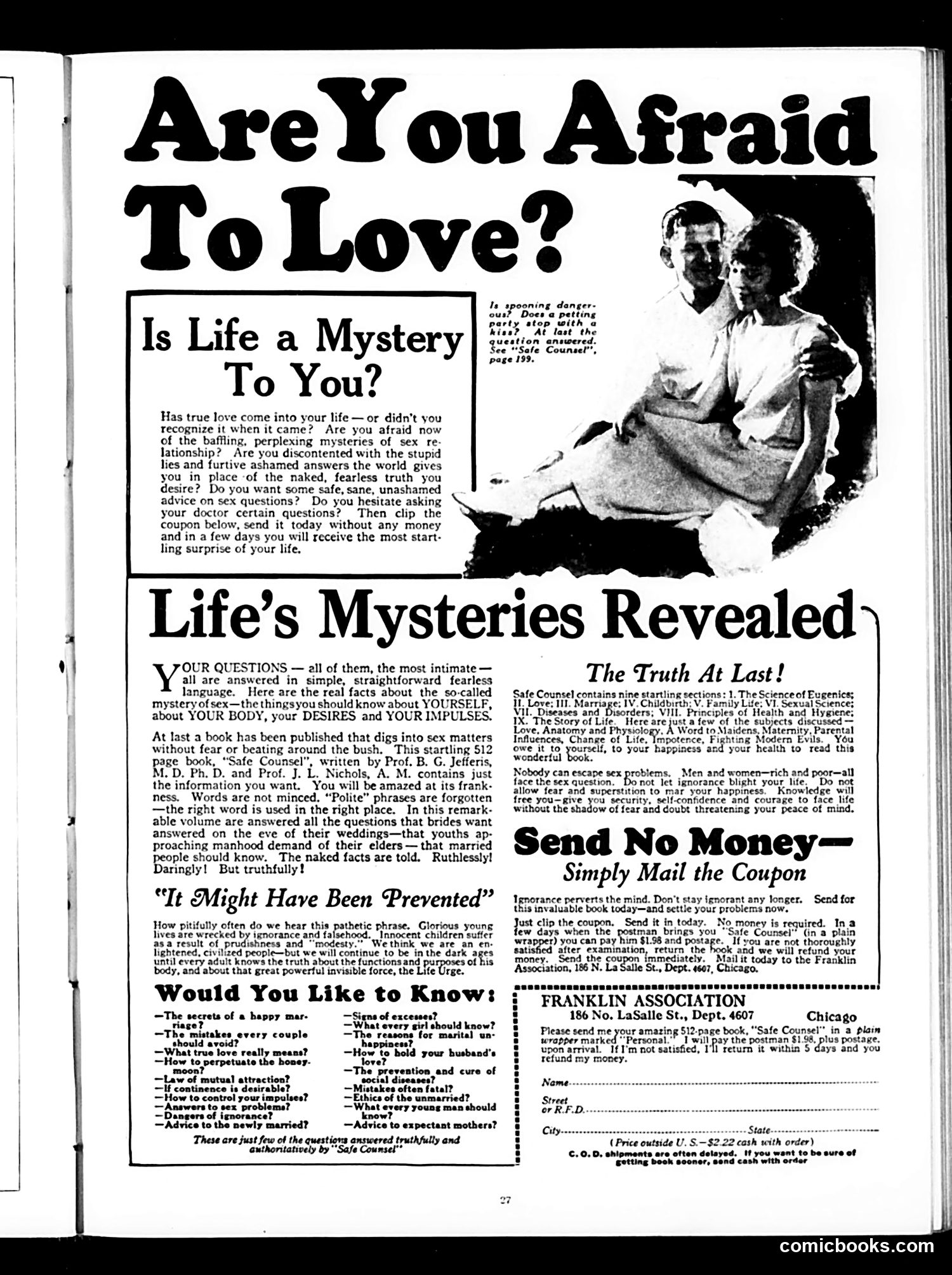
This page is primarily a **mail-order advertisement**, not satire. It promotes *"Safe Counsel,"* a 512-page sex education book by Prof. B.G. Jefferis and J.L. Nichols, pitched as frank, shame-free guidance on sexuality and marriage. The ad targets young adults—particularly unmarried people and newlyweds—claiming they suffer from ignorance and false modesty about sex. It promises answers to questions people feel embarrassed asking doctors, framing sex knowledge as essential to happiness and health. The image shows a heterosexual couple in an intimate pose, reinforcing the book's focus on romantic relationships. **Context:** Published sex education books were controversial in early 20th-century America. This ad's emphatic language ("Ruthlessly! Daringly!") and repeated assurances of scientific legitimacy suggest the publishers anticipated moral objections. By running in *Judge* (a mainstream satirical magazine), they reached educated audiences more receptive to such material.
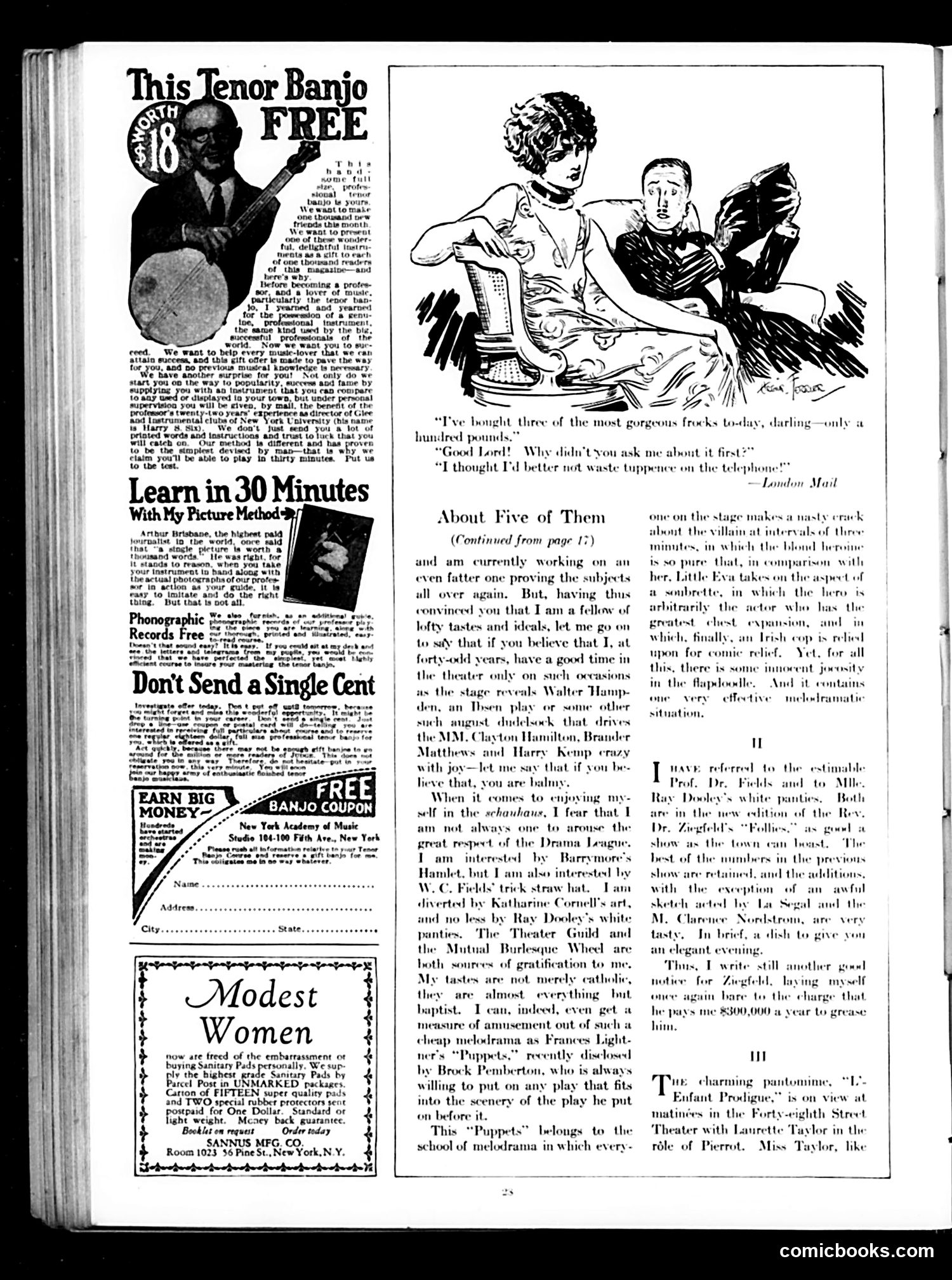
This page contains **advertising and theater criticism rather than political cartoons**. The main content is a review of theatrical productions titled "About Five of Them." The top illustration appears unrelated to the text—showing a woman at a piano with two male figures. A caption quotes the *London Mail*, suggesting this is society humor about extravagant shopping habits ("gorgeous frocks...only a hundred pounds"). The page is dominated by classified advertisements, including: - A **tenor banjo offer** promising to teach music in 30 minutes via "picture method" - A **sanitary pad advertisement** emphasizing discreet delivery to spare women embarrassment (notable for openly discussing a taboo topic, reflecting changing social attitudes of the era) - A **music school coupon** - A **women's hygiene product** promoted under the euphemism "Modest Women" The theatrical column discusses melodramas and productions by theater figures like Clayton Hamilton and Brock Pemberton, offering period-typical theater criticism rather than satire. The page illustrates Judge's mixed format of commentary and commercial advertising typical of early-to-mid 20th century magazines.
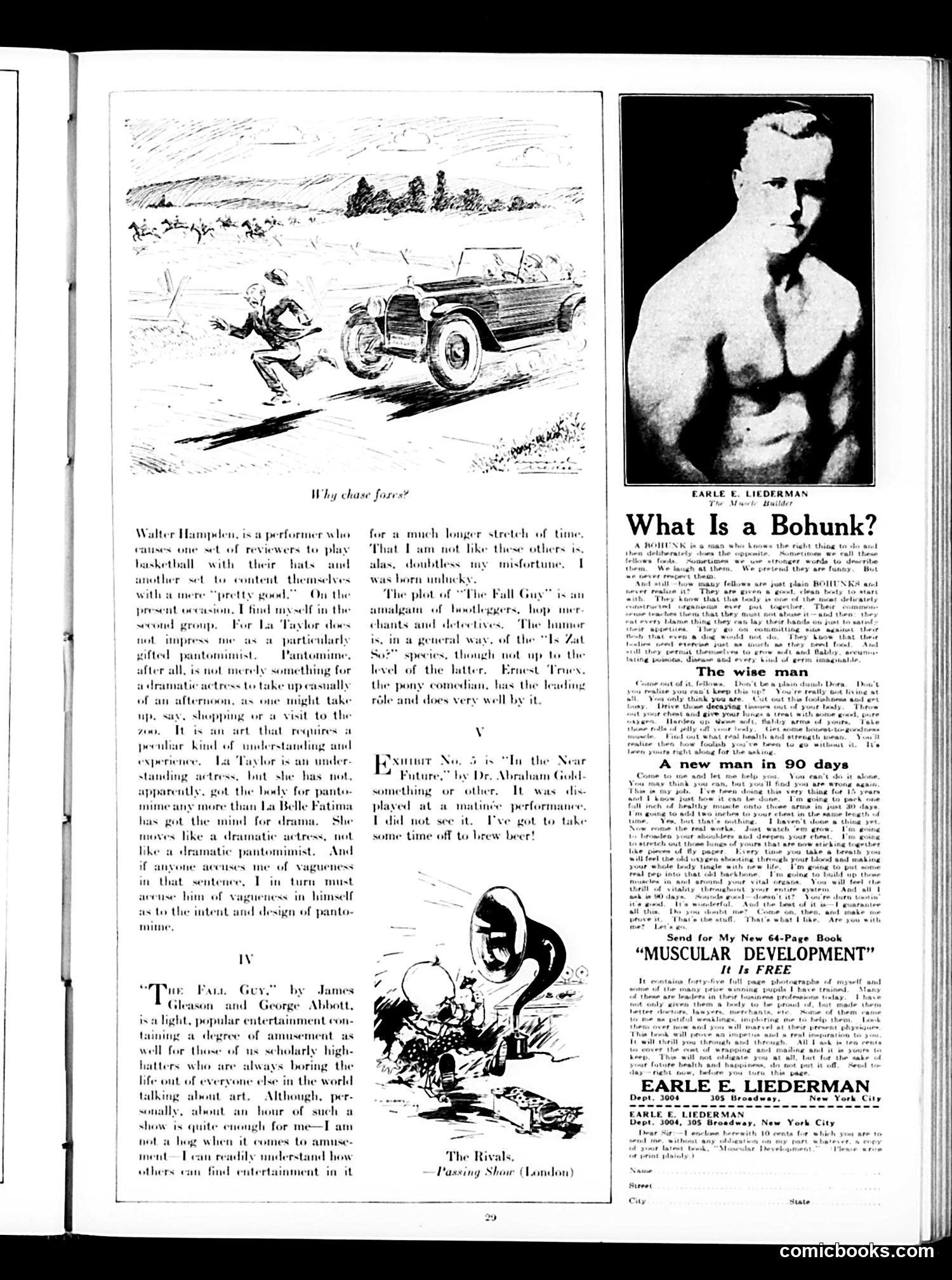
This page contains theatrical criticism alongside period advertising. The left side reviews performer Walter Hampden and discusses the entertainment value of "The Fall Guy" (a contemporary play), debating whether pantomime requires specific physical attributes. The critic argues that dramatic art demands understanding beyond casual appreciation. The right side features a bodybuilding advertisement from Earle E. Liederman promoting his "Muscular Development" book, with a photograph of a muscular man and the headline "What Is a Bohunk?" (a now-offensive ethnic slur for Eastern European immigrants). The satire appears to juxtapose highbrow theatrical discussion with lowbrow physical culture marketing—contrasting intellectual "art" debates with commercialized masculine self-improvement appeals. This reflects early 20th-century anxieties about class, immigration, and competing definitions of American culture and masculinity.
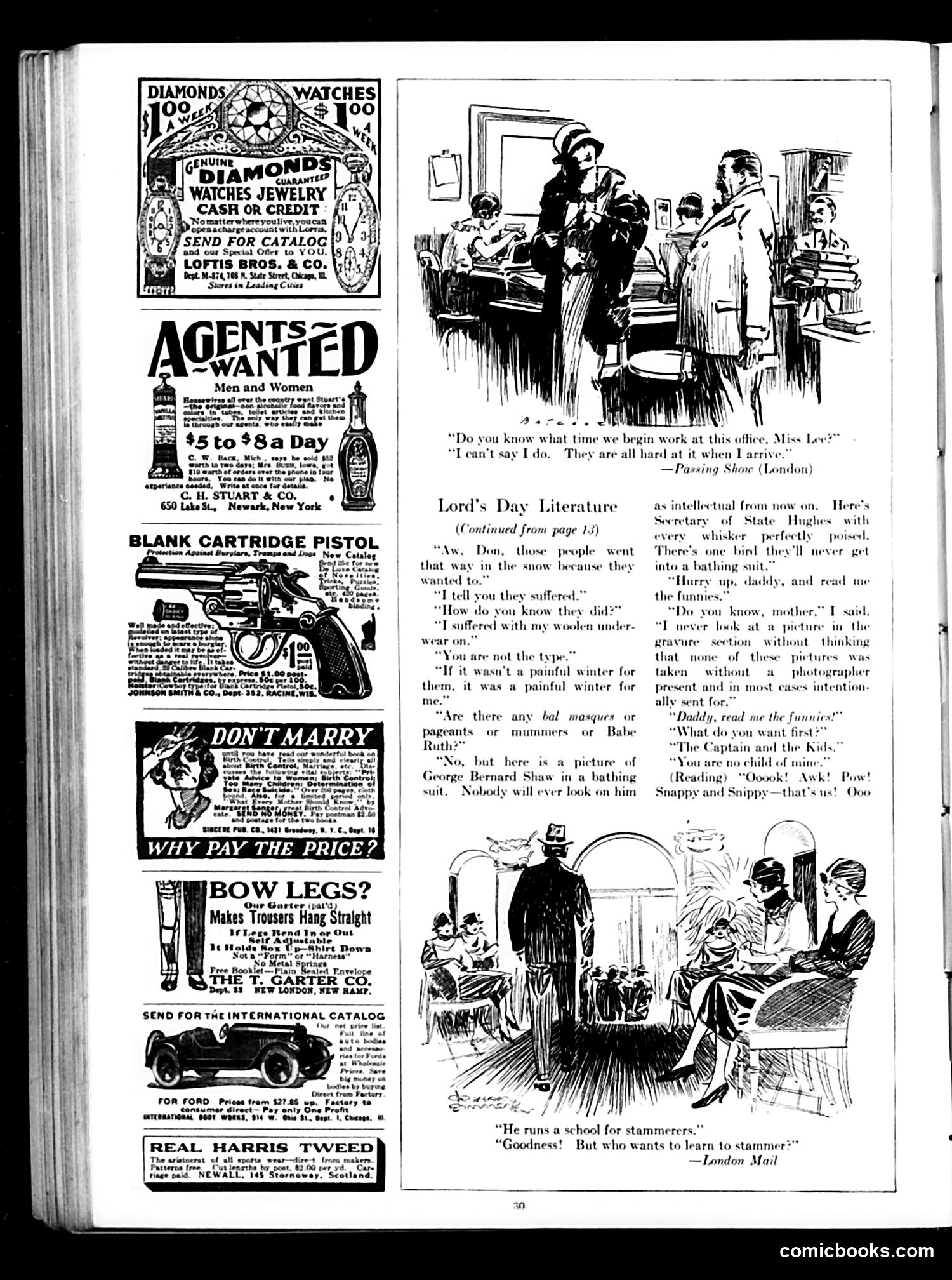
This page contains a satirical piece about what constitutes appropriate Sunday reading. The cartoon dialogue mocks the tension between serious "intellectual" content and popular entertainment. The key reference is **Secretary of State Charles Evans Hughes**, shown with his distinctive beard—presented as example of "intellectual" material deemed suitable for the Sabbath. The satire suggests that respectable publications push highbrow content (like photos of dignified politicians) while dismissing comic strips as frivolous. The humor lies in the generational clash: adults defend serious "Lord's Day Literature" while children naturally prefer "the funnies"—the comic strips with action and humor ("Ooook! Awk! Pow!"). The piece gently mocks Victorian moral standards about what's "appropriate" Sunday reading, implying the distinction between intellectual and popular culture is somewhat artificial. The surrounding advertisements are period commercial clutter, typical for Judge magazine.
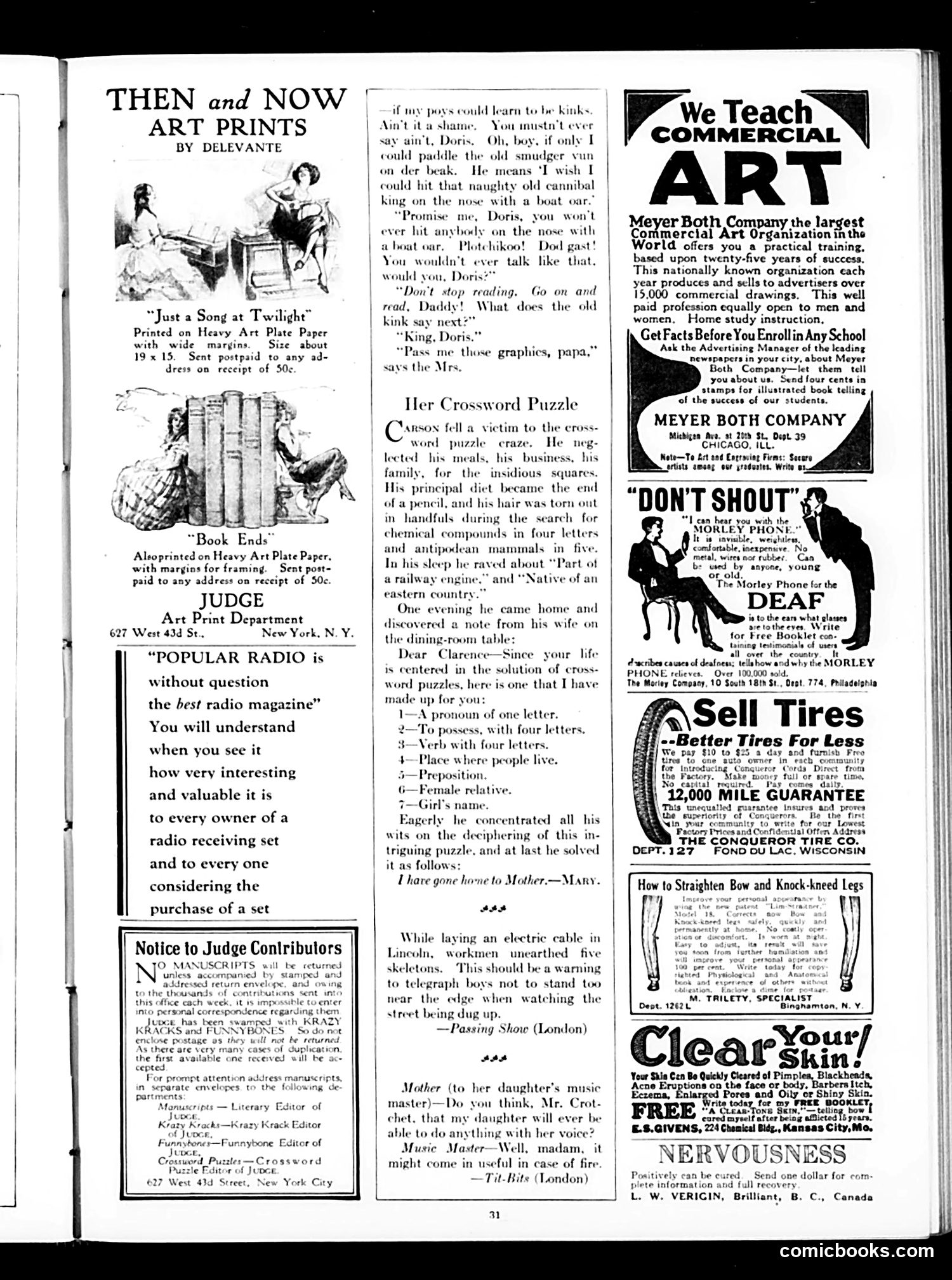
This page consists primarily of **advertisements and filler content** rather than political satire. The main illustrative content includes: - **Art print advertisements** (Delevante prints) from Judge's print department - **Two domestic humor pieces**: One about a parent reading to children who mispronounce words from a book (treating "kink" as slang), and another about a man obsessed with solving crossword puzzles so completely that his wife leaves him a puzzle revealing her departure - **Brief comedic snippets** from other publications (London's *Passing Show* and *Tit-Bits*) about workmen finding skeletons and a music teacher's dismissive comment about a pupil's voice The humor is gentle, suburban domestic comedy—puns about language, domestic frustration, obsessive hobbies. There is **no evident political satire or caricature** on this page. The surrounding ads for commercial art schools, tire companies, and deaf communication devices were typical Judge revenue sources of this era.
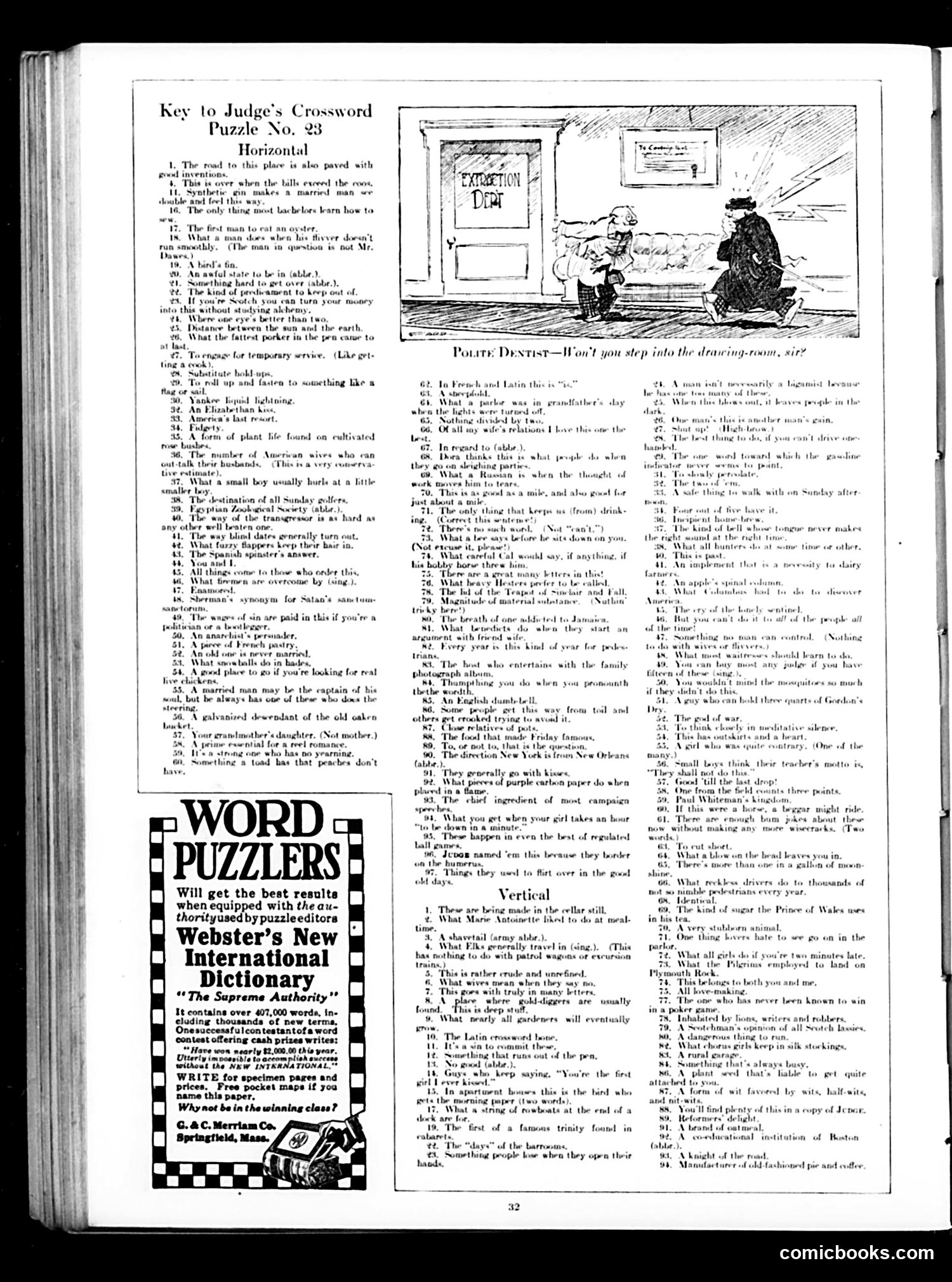
This page is primarily a **crossword puzzle** ("Judge's Crossword Puzzle No. 23") with its answer key, rather than a traditional editorial cartoon. However, the small cartoon illustration at top right—captioned "**Polite Dentist**—'Won't you step into the drawing-room, sir?'"—shows the actual satirical content. The image depicts a dentist's office with an "Extraction Dept" sign, where a patient appears anxious about entering. The joke satirizes the *euphemistic politeness* of dentists who use genteel language ("drawing-room") to mask the unpleasant reality of dental work (extraction/pain). This was a common theme in early 20th-century humor—the contrast between civilized surface manners and uncomfortable realities. The crossword itself contains period-specific clues referencing Prohibition ("synthetic gin"), automobiles, and contemporary social attitudes, serving as both puzzle and cultural snapshot of the 1920s-1930s era.
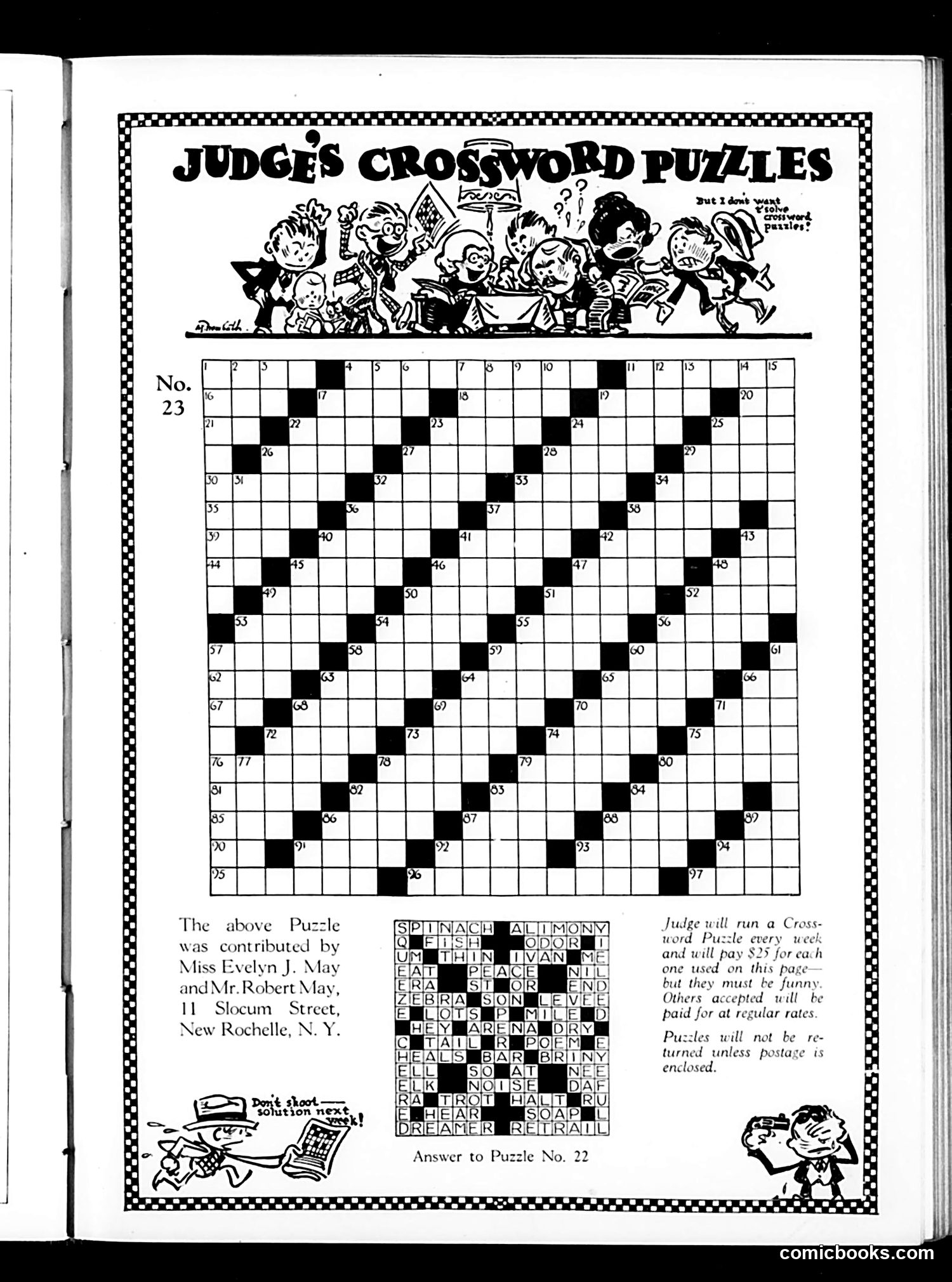
This page features "Judge's Crossword Puzzles," No. 23—primarily a **puzzle competition**, not political satire. The header cartoon shows cartoonish characters celebrating around a cauldron, establishing a playful tone. The page announces Judge's weekly crossword puzzle contest, offering $25 payment for accepted puzzles (with emphasis that submissions must be "funny"). This reflected the **1920s-30s crossword puzzle craze** that had become a cultural phenomenon in America. The puzzle itself appears standard, though the answer grid shown (labeled "Answer to Puzzle No. 22") contains words like "SPINACH," "ALIMONY," and "ODOR"—typical of how Judge's puzzles incorporated contemporary references and mild social commentary through their clue selections, reflecting concerns about marriage, domestic life, and consumer culture of the era.
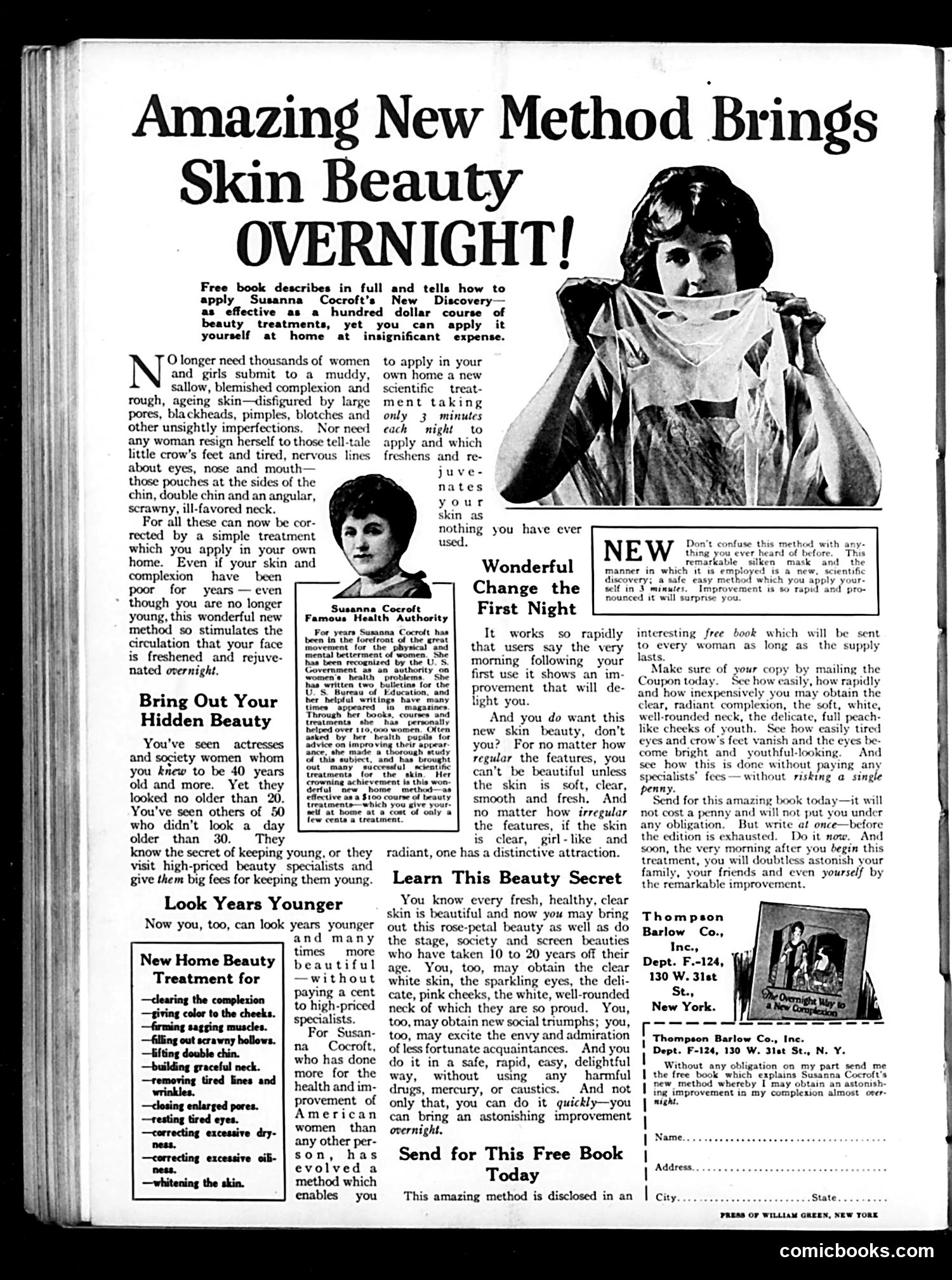
This is **not a cartoon or satire**—it's a straightforward beauty product advertisement disguised as editorial content, a common practice in early 20th-century magazines. The page promotes "Susanna Cocroft's" overnight skin treatment method. The advertiser claims it delivers results equivalent to expensive professional beauty treatments, but costs only pennies and takes three minutes nightly at home. The marketing strategy exploits anxieties about aging (crow's feet, wrinkles, blemishes) while offering democratized beauty—women no longer need expensive specialists or "high-priced" treatments. References to actresses and society women who "look years younger" suggest that beauty secrets exist but are jealously guarded by the wealthy. Notable for modern readers: the ad's promise of "overnight" transformation and comparison to a "$100 course" (significant money then) reflect persistent beauty-industry marketing tactics. The disclaimer warning readers not to confuse this with "anything you ever heard of before" suggests competing products made similar claims. This represents **advertising masquerading as journalism**—a practice that persists today.