
Judge, 1925-04-04 · page 17 of 36
Judge — April 4, 1925 — page 17: what you’re looking at
What you’re looking at
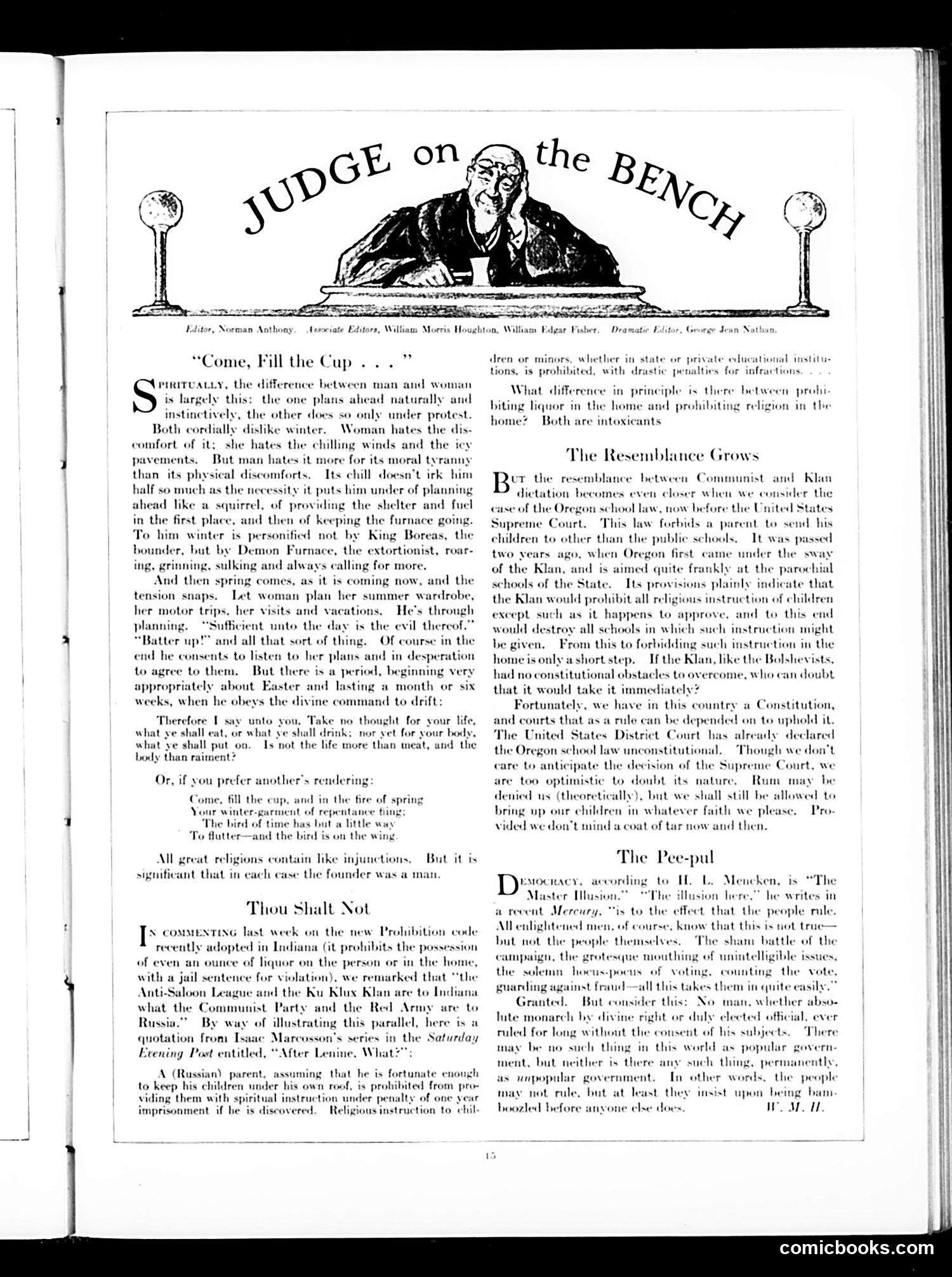
This page contains editorial commentary criticizing two contemporary American movements: Prohibition and the Ku Klux Klan. The opening article ("Come, Fill the Cup") uses a humorous gender contrast to mock spring-time relaxation, quoting Omar Khayyam to suggest men naturally resist planning and welcome drinking season. The substantive critique appears in "Thou Shalt Not" and "The Resemblance Grows," which draw an explicit parallel between the Anti-Saloon League/KKK in Indiana and the Soviet Communist Party/Red Army in Russia. The author argues both represent authoritarian overreach—comparing Prohibition's ban on home liquor to Soviet restrictions on religious instruction, and citing Oregon's KKK-backed school law requiring public (not parochial) education as similarly totalitarian suppression of personal freedom. The satire's point: American anti-alcohol and anti-Catholic movements employ the same coercive government power the magazine associates with Bolshevism, making them un-American threats to liberty.
📄 Transcribed text from this page (OCR, searchable)
Machine-transcribed from the original scan — historical spelling and the odd misread are preserved.
ee Editors, Wil “Come, Fill the Cup...” dd woman PrnituaLry, the difference between man a is largely this: the one plans ahead naturally and instinctively, the other does so only under protest. Both cordially dislike winter. Woman hates the dis- comfort of it; she b ates the chilling winds and the icy pavements. But man hates it more for its moral tyranny than its physical discomforts. Its chill doesn’t irk him half so much as the necessity it puts him under of planning ahead like a squirrel, of providing the shelter and fuel in the first place, and then of keeping the furnace going. To him winter is personified not by King Boreas, the bounder, but by Demon Furnace, the extortionist, roar- ing, grinning, sulking and always calling for more. And then spring comes. . as it is coming now, and the tension snaps. Let woman plan her summer wardrobe, her motor trips, her visits and vacations. He's through planning. “Sufficient unto the day is the evil thereof.” Batter up!" and all that sort of thing. Of course in the end he consents to listen to her plan id in desperation to agree to them. But there is a period, beginning very appropriately about Easter and lasting a month or six weeks, when he obeys the divine command to drift: Ther ha ye sha e Tsay unto y ‘Take no thought for your life, at, or what ye shall drink; nor yet for your body, at ye shall put on. Is ‘not the life more than meat, and the body than raiment? Or, if you prefer another's rendering Come, fill the eup, and in the fire of spring F winter-garment of repenta The bird of time has but a little way To flutter—and the ee ting, 1 is on the wing AMl great religions contain like injunctions. But it is significant that in each ease the founder was a man. Thou Shalt Not Is COMMENTING last week on the new Prol recently adopted in Indiana (it prohibits the possession of even an ounce of liquor on the person or in the home, with I sentence for violation), we remarked t “the Anti-Saloon League and the Ku Klux Klan are to Indiana what the Communist Party and the Red Army are to Russia.” By way of illustrating this parallel, here is a quotation from Is: Marcosson’s series in the Saturday Evening Post entitled, After Lenine, What? ibition code nt, assuming that he is fortunate enough to keep his children under his own roof, is prohibited from pro- viding them with spiritual instruction un f one year imprisonment if he is discovered. Religious instruction to chil . William Edgar Fi Dramatic dren or minors. whether in state or private cducat tions, is prohibited, with dri What difference in principle is there between prohi biting liquor in the home and prohibiting religion in the home? Both are intoxicants val institue penalties for infractions The Resemblance Grows Bu the resemblance between Communist: and Klan dictation becomes even closer when we consider the case of the Oregon school law, now before the Unite Supreme Court. This law children to States rhids a pare his ther than the public schools. It was passed two years ago, when Oregon first. came under the sway of the Klan, and is aimed quite frankly at the parochial schools of the State. Its provisions plainly indicate that the Klan would prohibit all religious instruction of children except such as it happens to approve, and to this end would dest all schools in which such instruction might be given. m this to forbidding such instruction in the home is only a short step. If the Klan, like the Bolshevists, had no constitutional obstacles te foubt that it would take it immediately? Fortunately, we have in this country a Constitution, and courts that asa rule ean be depended on to uphold it. The United States District Court has already declared the Oregon school law unc Though we don't care to anticipate the decision of the Supreme Court, we are too optimistic to doubt its nature. Rum may be denied us (theoretically), but we shall still be allowed to bring up our children in whatever faith we please. Pro vided we don’t mind a coat of tar now and then. ercome, Who car The Pee-pul to HL Lb. Meneken, is “The te tlusion her he writes in is to the effect that the people mile. ourse, know that this is not true— Dut not the people themselves, ‘The sham battle of the campaign, the grote Mocracy, according D Master Hlusio a recent: Mercury, Allenlightened men que mouthing of unintelligible issues, the solemn hocus-pocus of voting, counting the vote, guarding against fread I this takes them in quit: Granted. But consider this: asily.” » man, whether abso- lute monarch by divine right or duly dd official, ever ruled for long without the consent of his subjects. There may be no such thing in this world as popular ment, but neither is there any such thing, as unpopular government. In other wore ern- vermanenthy, . the people ay not rule, but at least they insist upon being bam boozled before anyone else do WoM comicbooks.com