
A complete issue · 36 pages · 1925
Judge — March 21, 1925
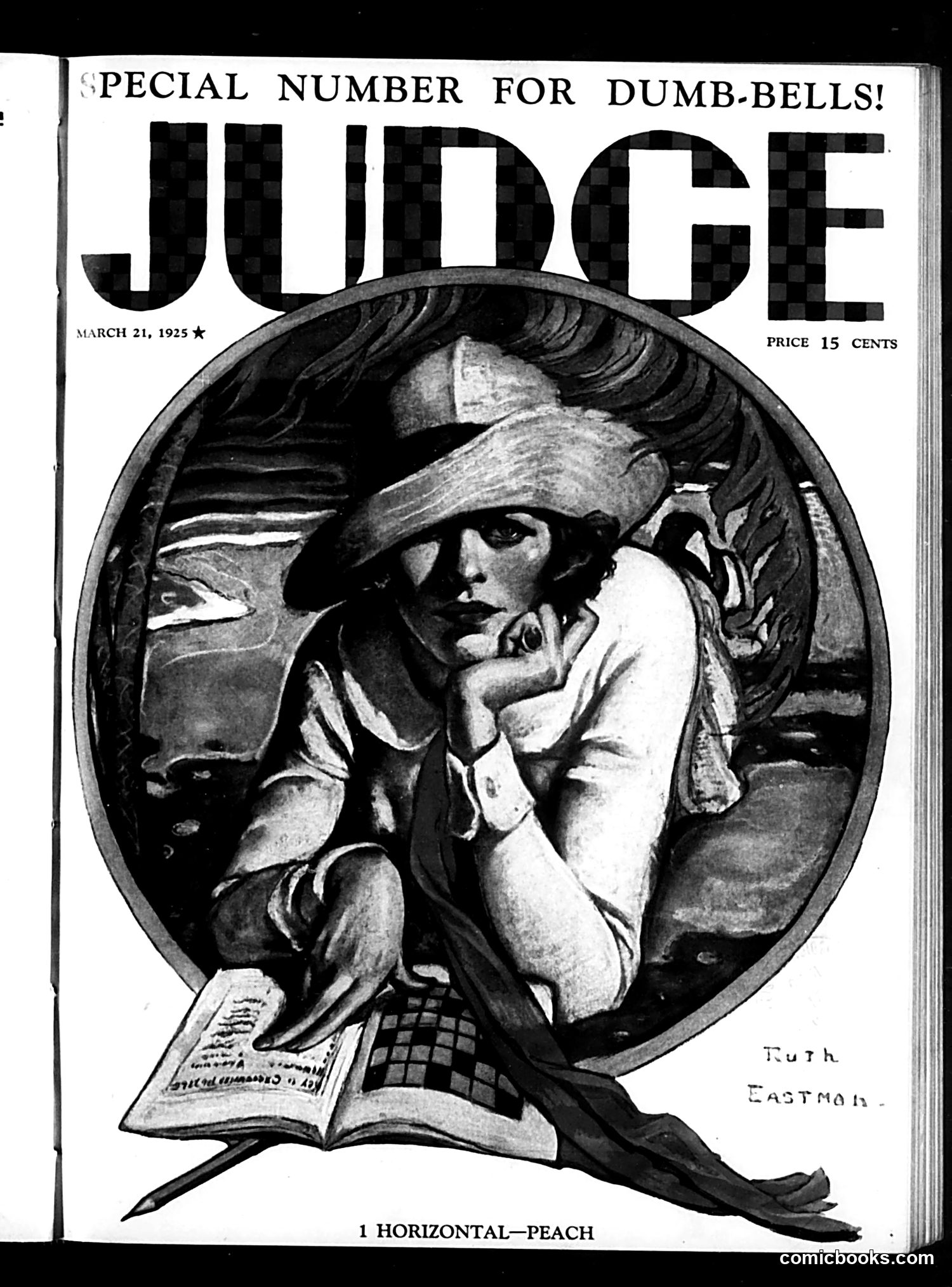
This cover features a figure in a wide-brimmed hat, drawn by Ruth Eastman, positioned within a large "Q" shape. The subtitle describes it as "Special Number for Dumb-Bells" and references "1 Horizontal—Peach." The design appears to be a crossword puzzle joke. The "Q" functions as both the magazine's masthead and a puzzle grid, with the illustrated figure serving as the visual answer to a crossword clue. The "dumb-bells" reference suggests the content targets readers who enjoy word puzzles or light entertainment. The pricing at 15 cents and March 1925 dating places this during the 1920s crossword puzzle craze that had recently swept America, making this a topical satire of the contemporary puzzle obsession among the general public.
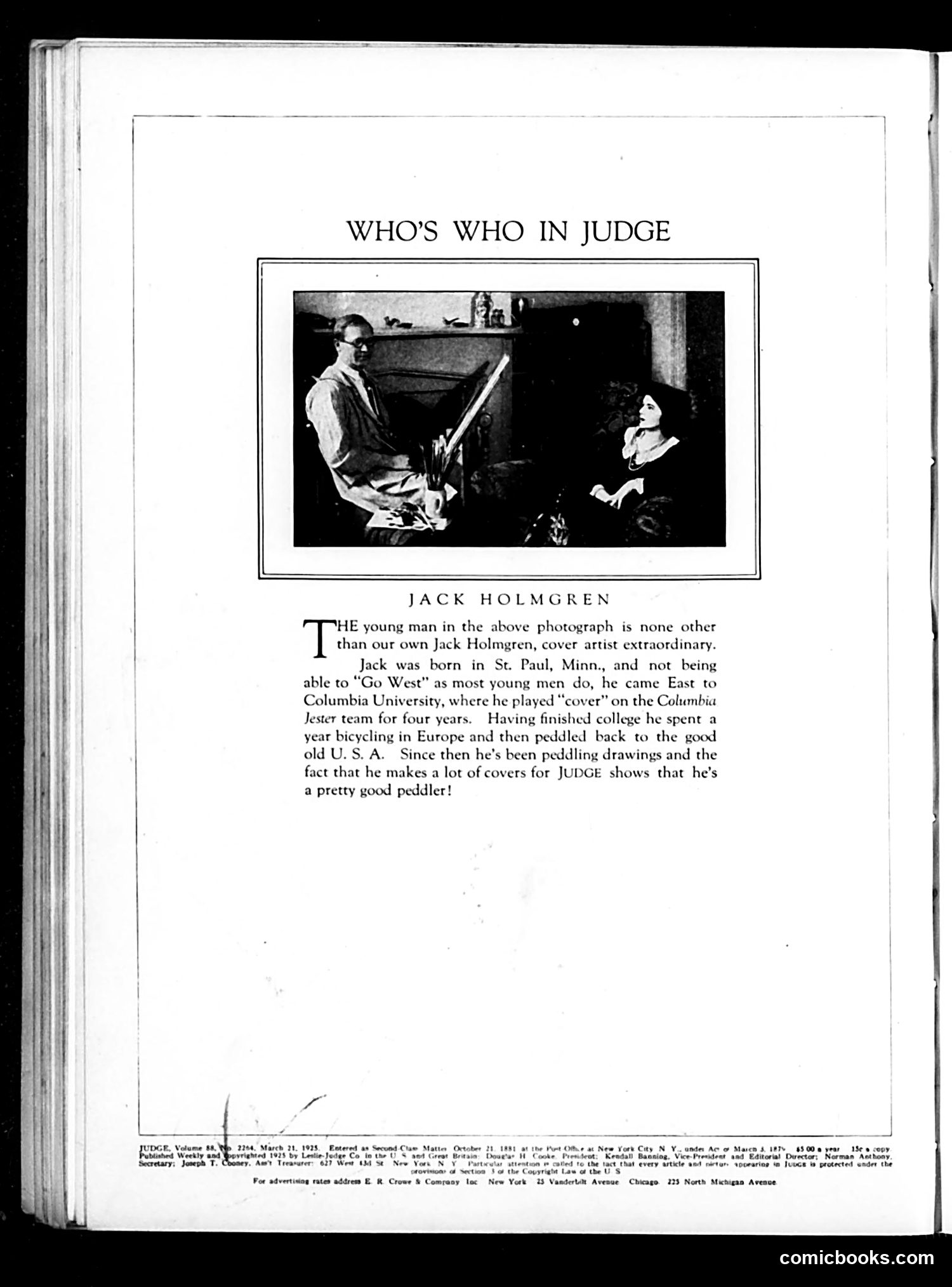
This is a profile feature, not political satire. The page introduces Jack Holmgren, identified as Judge magazine's "cover artist extraordinary." According to the text, Holmgren was born in St. Paul, Minnesota, attended Columbia University (where he played on the jester team for four years), spent a year bicycling in Europe, and returned to the U.S. to create illustrations for Judge. The photograph shows him at work in his studio with a model. The piece is lighthearted promotional content celebrating a staff artist, using the pun "peddler" to reference both his bicycle travels and his career "peddling drawings" for the magazine. This appears to be typical editorial content introducing the publication's contributors to readers.
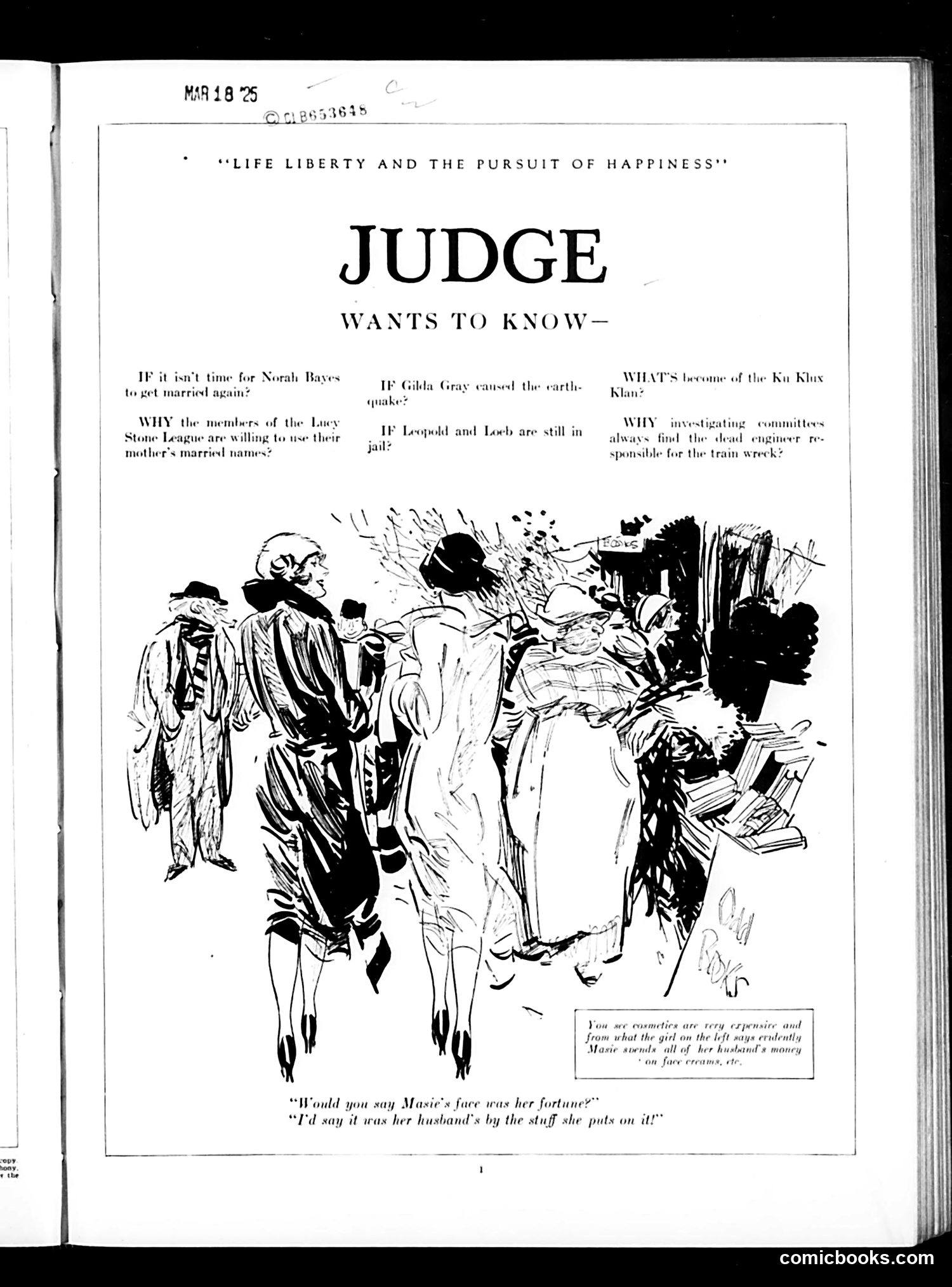
This satirical page from Judge magazine presents "questions a Judge wants to know" about contemporary scandals and social issues. The cartoon mocks high society, particularly wealthy women's obsession with cosmetics and appearance. The central illustration shows fashionable women in conversation. The caption satirizes vanity, with dialogue: "Would you say Musie's face was her fortune?" / "I'd say it was her husband's by the stuff she puts on it!" The joke targets the expensive cosmetics industry and women who rely heavily on makeup and face creams—presented as financial burdens on their husbands. The "Judge wants to know" format references actual scandals (Norah Bayes, Leopold and Loeb, the KKK), contrasting serious issues with frivolous social criticism about women's spending habits and appearance culture.
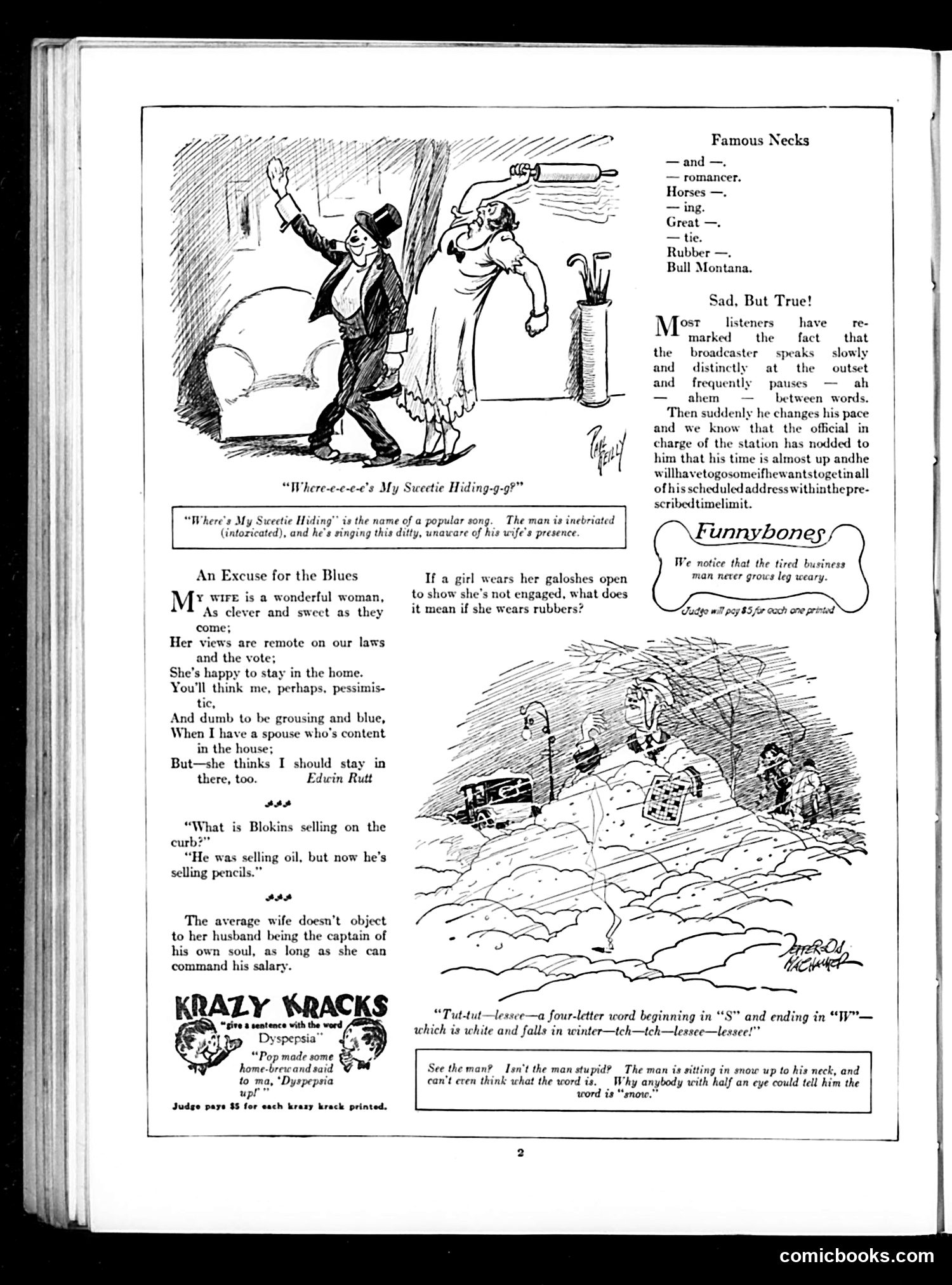
This Judge magazine page contains several humor pieces satirizing early 20th-century domestic and social life: **"Where-e-e-e's My Sweetie Hiding-g-g?"** depicts a man singing a popular song while his wife hides behind furniture, unaware of her presence. The satire mocks men who sing loudly at home, indifferent to their wives' preferences. **"An Excuse for the Blues"** by Edwin Rust humorously justifies a husband's melancholy despite having a content wife—he's simply bored staying home. **"Krazy Kracks"** presents a wordplay puzzle about Blokins changing from selling oil to pencils. The **"Funnybones"** section jokes about tired businessmen. The bottom cartoon shows a man buried in snow, with a visual pun about the word "snow." These pieces reflect common early-20th-century complaints about marriage, domestic life, and office work.
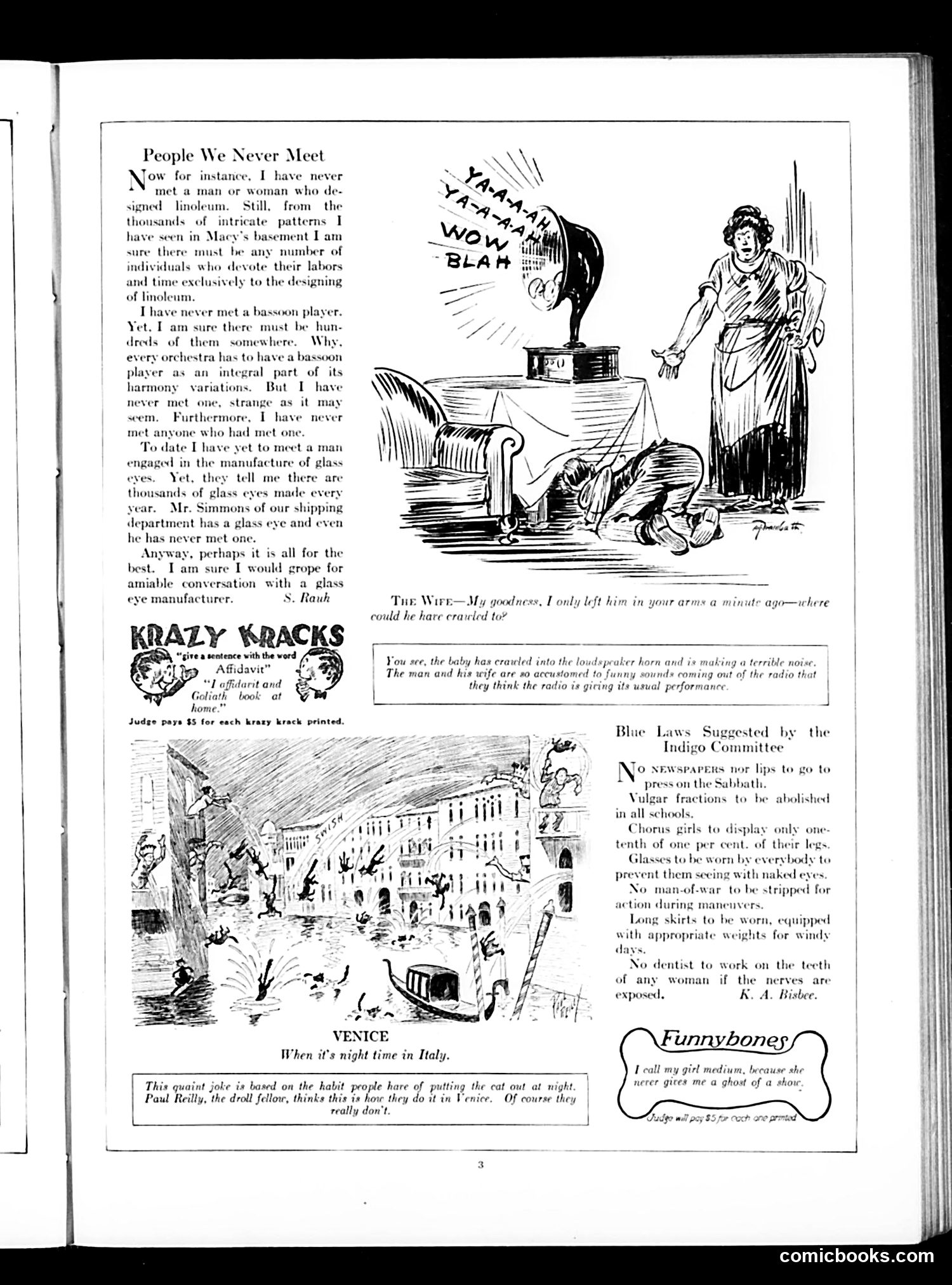
**"People We Never Meet"** is a humorous essay about professions the author claims never to have encountered—linoleum designers, bassoon players, glass eye manufacturers. The satire mocks how certain specialized professions seem to exist theoretically but remain invisible in everyday life. **"The Wife"** cartoon depicts a domestic scene where a baby has crawled into a louddspeaker horn (likely a gramophone or radio), creating loud noise. The wife apologizes to her husband, suggesting she left the baby unattended. This reflects 1920s-30s anxieties about new technologies (radios/gramophones) in homes and absent-minded domestic management. **"Blue Laws Suggested by the Indigo Committee"** proposes absurd restrictive laws (newspapers banned on Sabbath, chorus girls limited, etc.), satirizing overly puritanical regulation. The page contains period humor and advertising typical of Judge magazine.
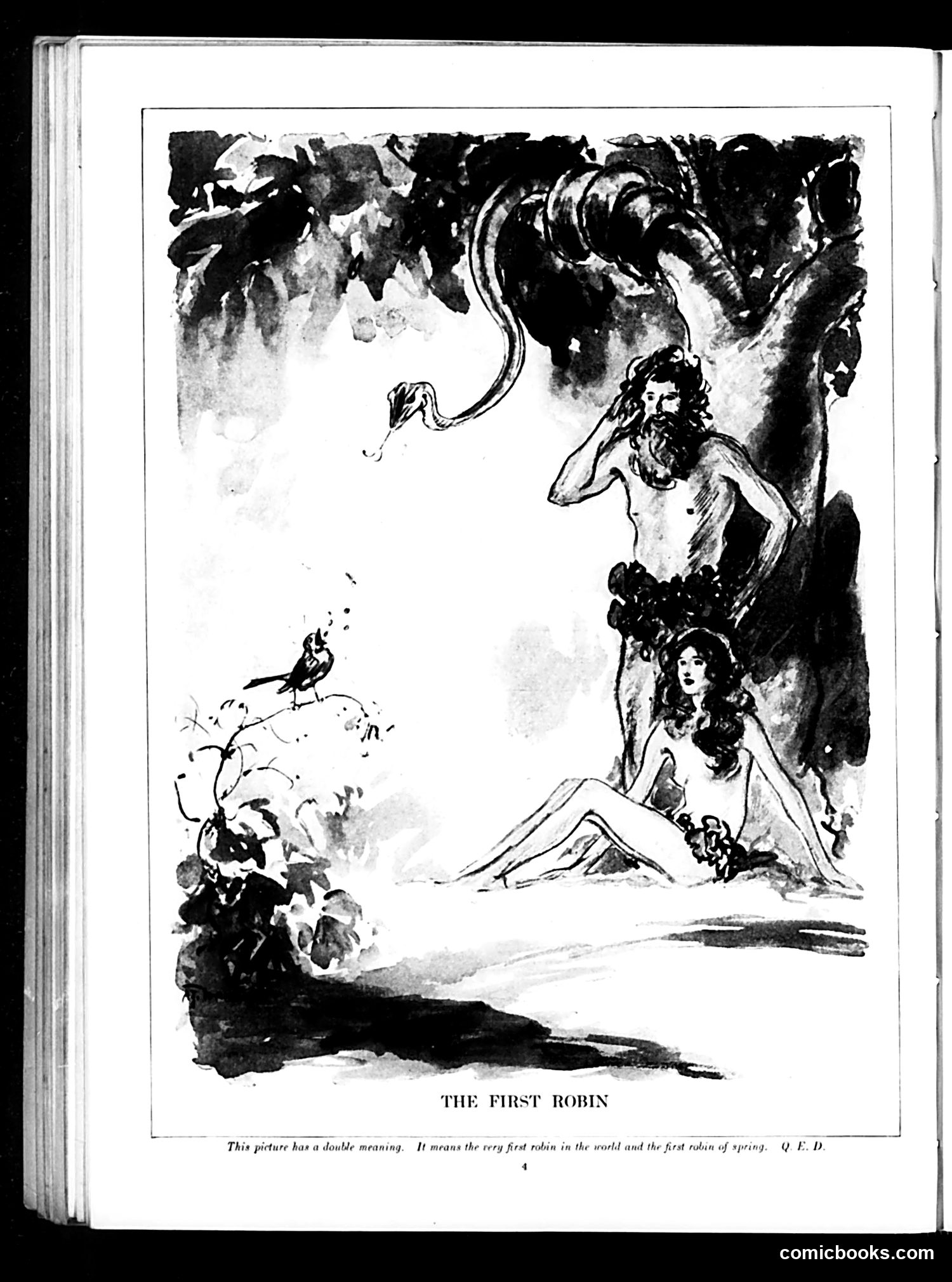
This allegorical cartoon uses the robin—a harbinger of spring—as a double symbol. According to the caption attribution "Q.E.D." (quod erat demonstrandum, "which was to be demonstrated"), the image represents "the very first robin in the world and the first robin of spring." The composition shows mythological figures (likely representing Nature or classical deities) positioned above an emerging robin in a landscape. The satire appears to work on multiple levels: the "first robin" may reference a contemporary political or social figure, with spring symbolizing renewal or the arrival of something anticipated. Without additional context about Judge magazine's publication date, the specific political referent remains unclear, though the artwork's classical framing suggests commentary on an important public arrival or event.
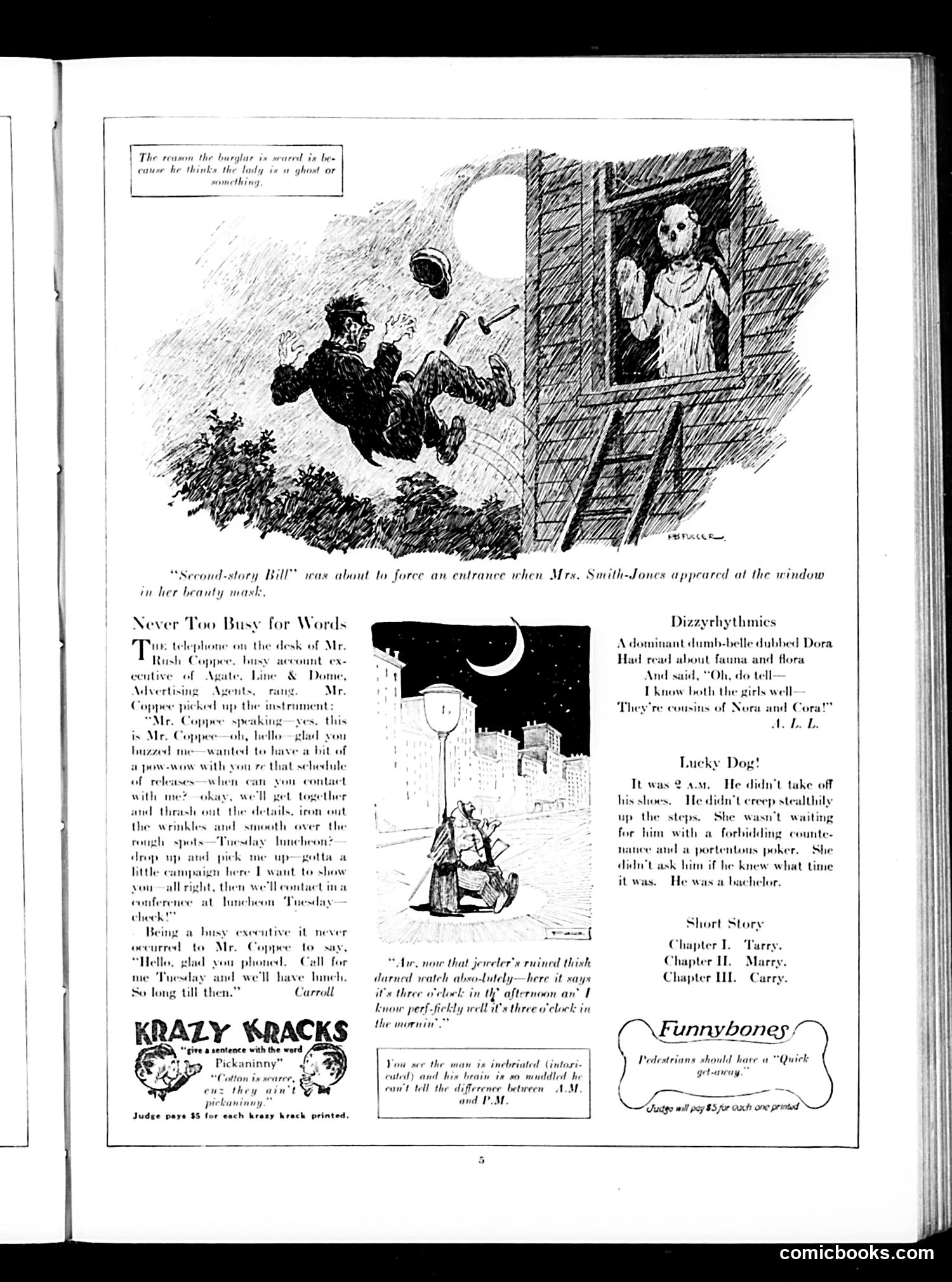
This page is primarily **humorous fiction and advertising** rather than political satire. The main cartoon shows a burglar fleeing a house after encountering a woman in a beauty mask at the window—the joke being he's frightened by her appearance, mistaking her for a ghost or supernatural being. The accompanying stories ("Never Too Busy for Words," "Dizzyrrhythmics," "Lucky Dog!") are light domestic humor typical of 1920s-30s magazines. The "Krazy Kracks" section advertises joke books, while "Funnybones" offers pedestrian punchlines. Overall, this represents **mainstream commercial humor content** rather than political commentary—the magazine's satirical edge appears minimal on this particular page.
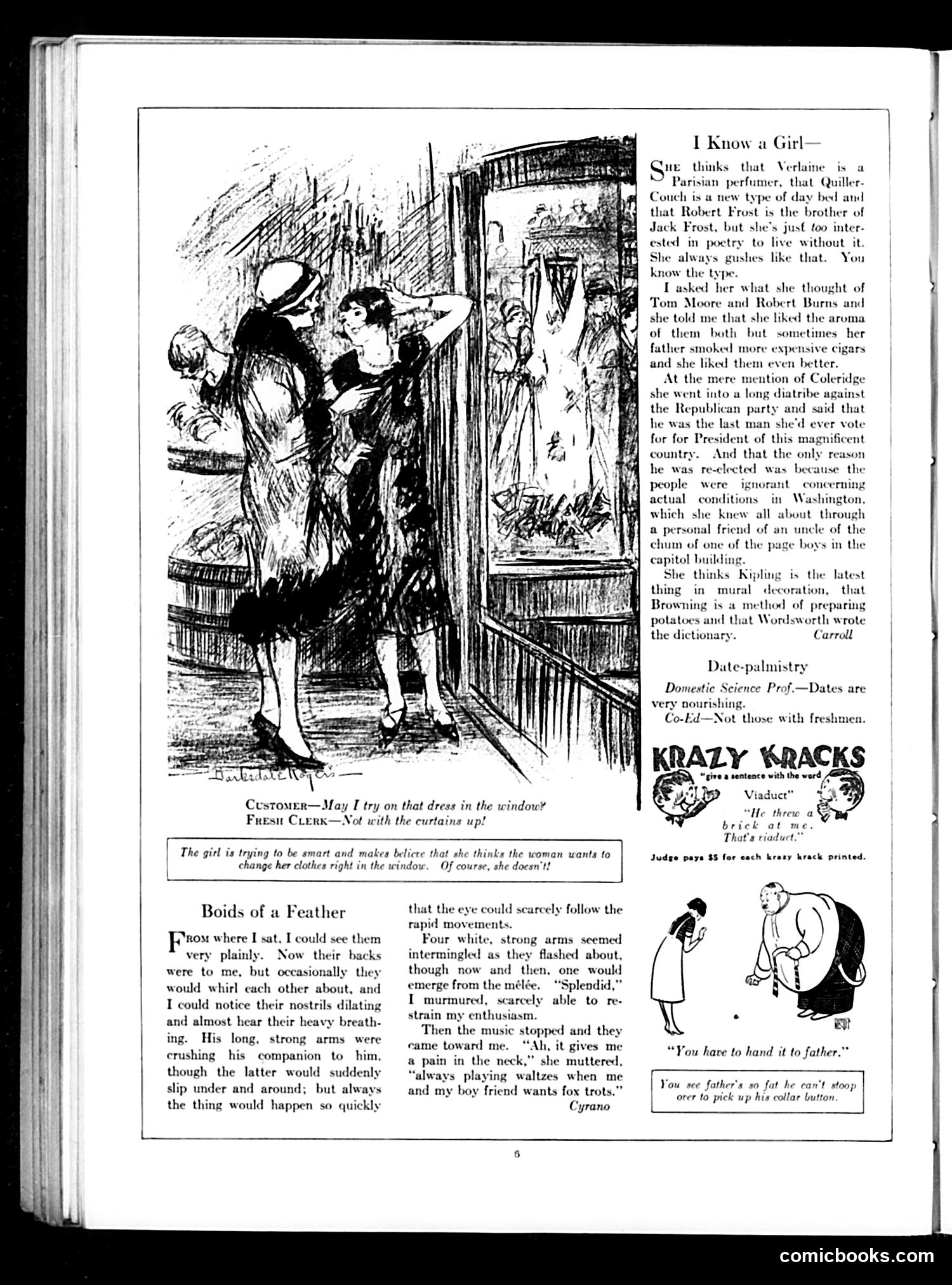
This page contains three separate humor pieces satirizing early 20th-century American life: **"Customer-Fresh Clerk"**: A brief joke about a salesclerk's deliberately obtuse response. When a customer asks to try on a dress displayed in the window, the clerk refuses, pretending to misunderstand—implying the customer wants to undress publicly. The humor lies in the clerk's feigned innocence and the girl "trying to be smart." **"Birds of a Feather"**: A romantic narrative where the narrator observes a couple dancing with passionate intensity, describing their intertwined movements in breathless detail. The twist: the woman complains they're playing waltzes when she and her boyfriend want fox trots—deflating the narrator's poetic romanticization with mundane practicality. **"I Know a Girl"**: Social satire mocking an affected young woman who pretends literary sophistication while completely misunderstanding famous poets and authors (confusing Verlaine with perfume, Coleridge with politics, Kipling with interior decoration). She's portrayed as a pretentious poseur with secondhand opinions. All three pieces gently mock affectation, miscommunication, and the gap between pretense and reality.
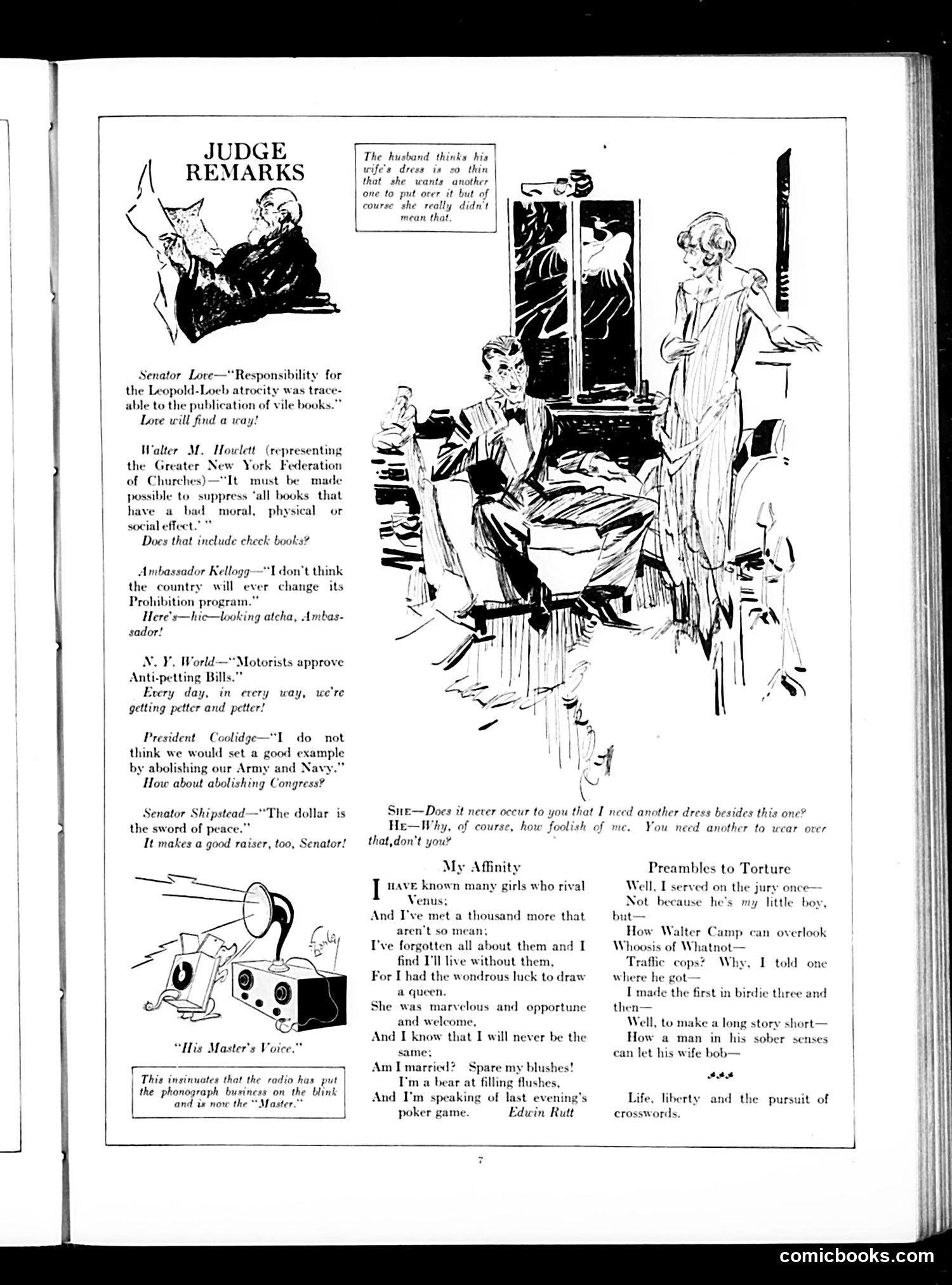
This page from Judge magazine comprises satirical "Judge Remarks" (commentary on public figures) and humorous verses about domestic life and contemporary issues. **The Political Satire:** The "remarks" mock prominent 1920s figures discussing censorship, Prohibition, and military spending. Senator Love blames the Leopold-Loeb murder case on "vile books" (referencing the notorious 1924 Chicago kidnapping). A church representative calls for book suppression. Ambassador Kellogg defends Prohibition. President Coolidge defends the military. The jokes undercut these positions—asking if "check books" should be suppressed, sarcastically welcoming drunk Ambassador Kellogg, and suggesting Congress should be abolished instead of the military. **The Domestic Humor:** Lower sections contain light verse about marriage and relationships. One poem ("My Affinity") plays on the word "flush" (poker term versus facial embarrassment). A "His Master's Voice" cartoon jokes that radio has replaced phonographs. **Overall:** The page satirizes 1920s moral panic about media influence, government hypocrisy, and Prohibition-era absurdities, while mocking conventional domestic complaints about wives' spending and appearance.
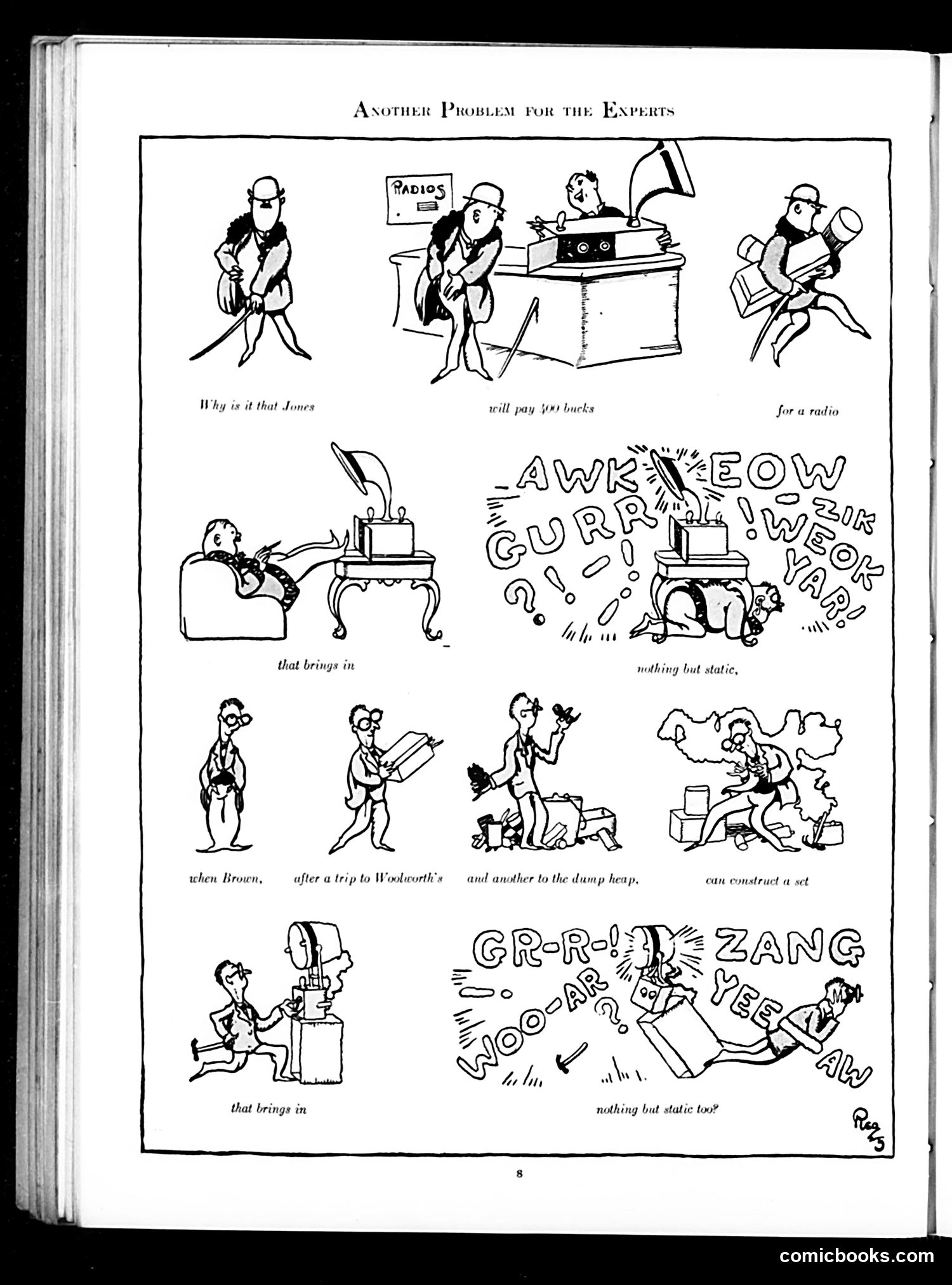
This Judge magazine cartoon satirizes early radio broadcasting problems. The title poses a riddle: "Why is it that Jones will pay you bucks for a radio that brings in nothing but static, when Brown, after a trip to Woolworth's and another to the damp heap, can construct a set that brings in nothing but static too?" The joke mocks the absurdity of consumers purchasing expensive commercial radios while homemade sets (assembled from junk and bargain-store parts) perform equally poorly. Both produce only static and interference—the "nothing but static" serving as punchline. This critiques either poor early radio technology, deceptive marketing, or consumer gullibility during radio's infancy, when reception quality was genuinely unpredictable and unreliable.
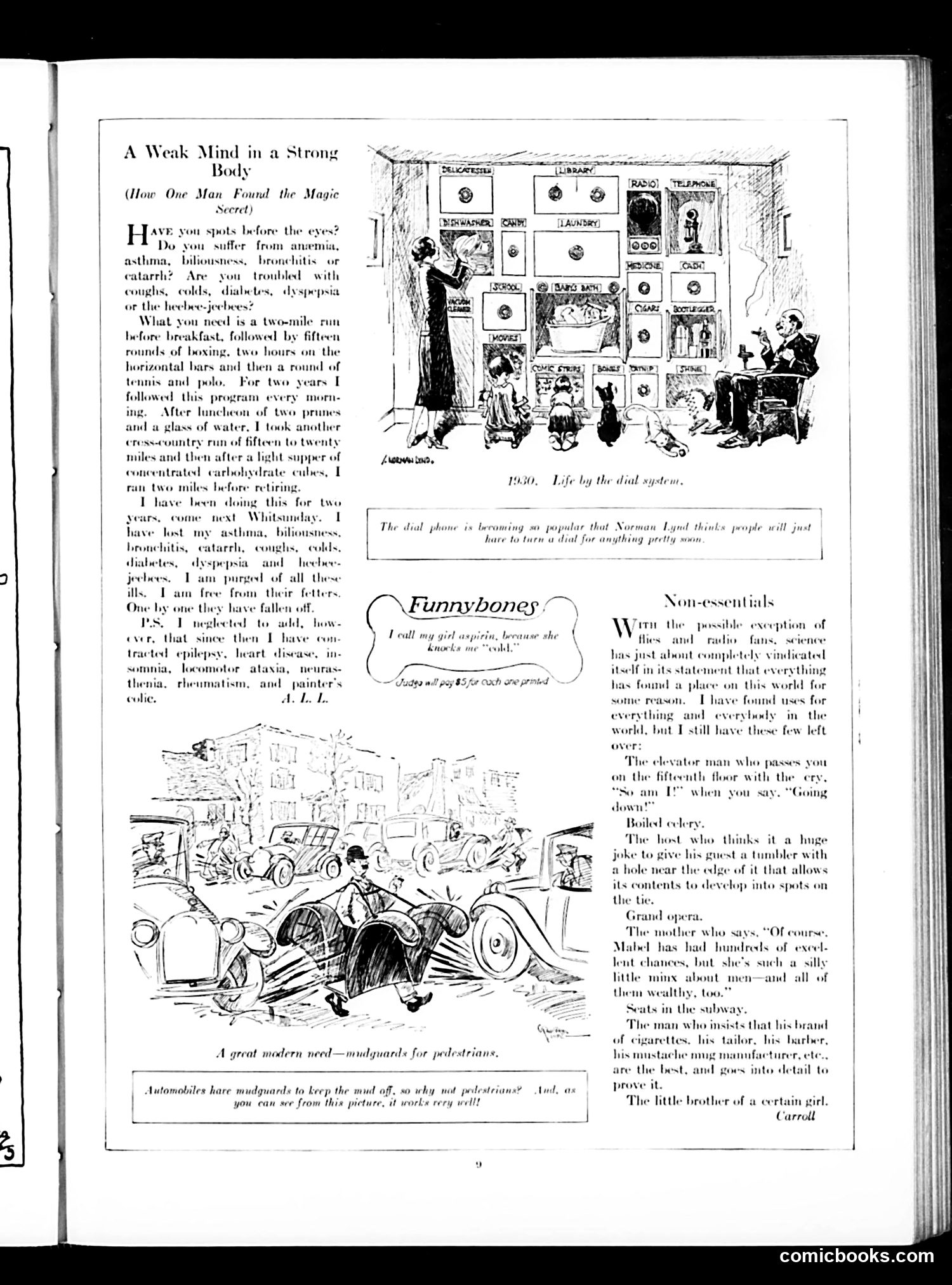
This 1930 page satirizes the obsession with extreme physical fitness and the "magic cure" mentality popular in that era. **Main Cartoon**: A man describes curing various ailments (asthma, biliousness, bronchitis) through an absurdly rigorous daily regimen: two-mile runs, boxing, horizontal bar work, tennis, polo, and specialized diets. The joke's punchline: he's now afflicted with *new* diseases—epilepsy, heart disease, locomotor ataxia, rheumatism—from overexertion. The satire mocks the false promise that extreme exercise cures all illness. **Secondary Cartoon**: Shows automobiles with mudguards to protect pedestrians, sarcastically captioned as "a great modern need." The joke questions why cars need protection devices if pedestrians need protection from cars—absurdist logic highlighting the dangers of unchecked automobile traffic. **"Non-essentials" Column**: Lists supposedly useless modern inventions (boiled celery, subway seats, elevator etiquette), reflecting 1930s anxieties about modern life's trivialities. The page collectively mocks contemporary health fads and modern inconveniences, characteristic of Judge's satirical approach.
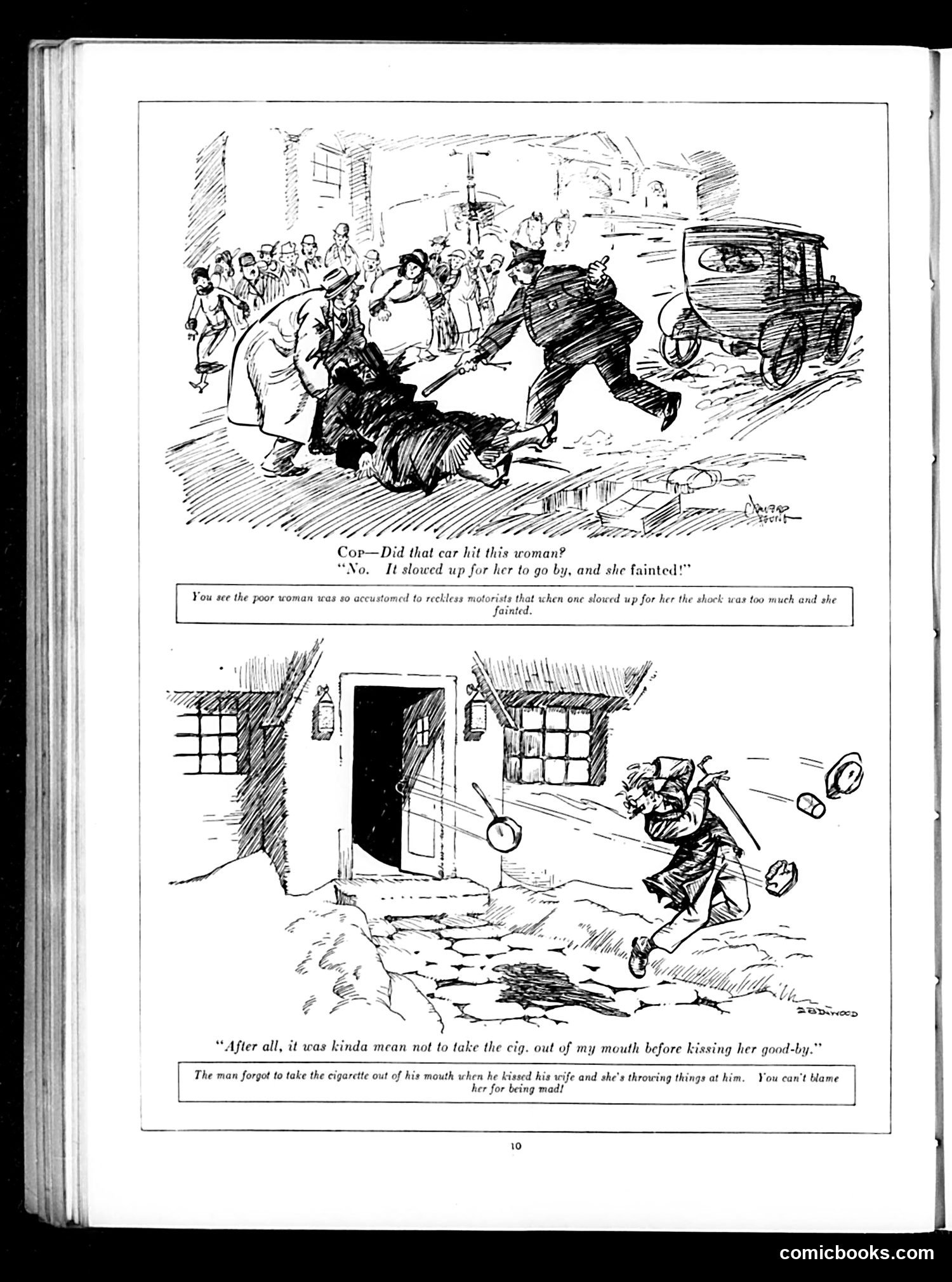
This page contains two satirical comics about early automotive culture and domestic life. **Top cartoon:** A woman has fainted in the street after a motorcar slowed down for her. The joke is that she's so accustomed to reckless drivers that considerate behavior from one—slowing down—shocked her into fainting. This satirizes the dangerous, chaotic state of early automobile traffic and pedestrians' justified fear of motorists. **Bottom cartoon:** A husband kisses his wife goodbye while smoking a cigarette, leaving ash or irritation on her face. She angrily throws objects at him. The caption notes she's justified in her anger—his rudeness was inconsiderate. Both comics use exaggeration to mock contemporary social behaviors: the absurdity of traffic danger and domestic inconsideration, likely from the 1920s-1930s era when automobiles were still relatively novel and smoking etiquette was evolving.
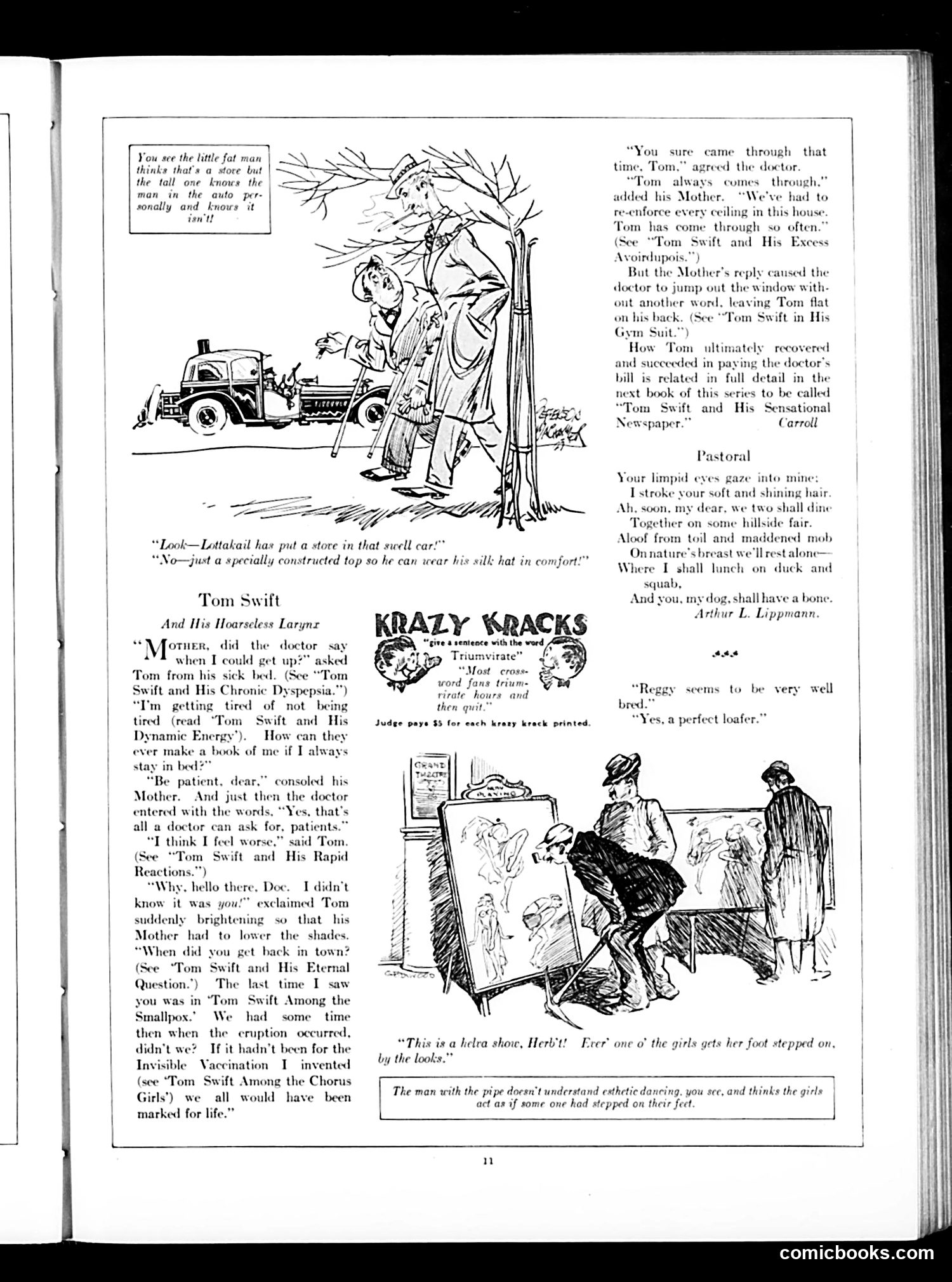
This page satirizes **Tom Swift**, a popular boys' adventure series of the era, through parody. The main piece mocks the formulaic nature of Tom Swift books—each supposedly featuring a new invented device solving some crisis. Here, "Tom Swift and His Hoarseless Larynx" jokes that Tom is so frequently ill and bedridden that his mother must reinforce the house's ceilings from his repeated recoveries. The humor lies in exaggerating the series' repetitive plot structure where Tom constantly invents solutions to problems. The page also includes: - A cartoon joke about a wealthy man's specially constructed car roof to accommodate his silk hat - "Krazy Kracks," a reader-submitted joke section (appearing to be a recurring feature) - A poem mocking pastoral/romantic verse by treating a dog like a romantic companion - A cartoon mocking men who don't understand modern "aesthetic dancing" The satire targets both popular literature conventions and contemporary social pretensions.
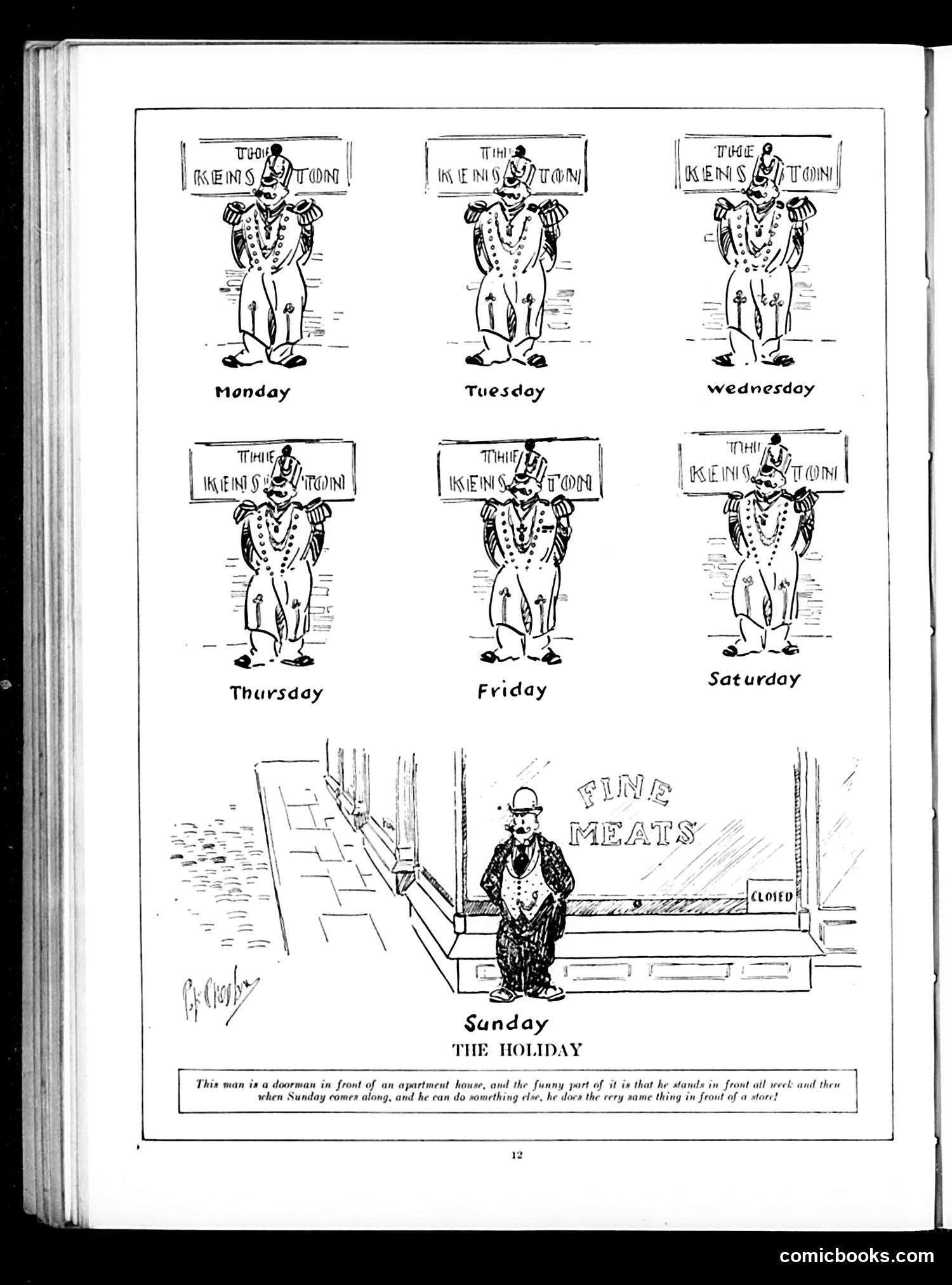
This is a satirical commentary on class and labor in early 20th-century America. The cartoon depicts a doorman dressed in an ornate, decorative uniform standing in front of an apartment building Monday through Saturday. Each day he wears the same elaborate costume with medals and insignia, looking increasingly disheveled as the week progresses. The joke's punchline appears on Sunday: when the doorman has a day off and could do something different, he stands in front of a "Fine Meats" shop—wearing the same formal doorman outfit. The satire targets the absurdity of working-class servitude: the man is so defined by his role that even on his day off, he cannot escape it. He's compelled to perform the same function in a different location, suggesting that laborers of that era had no real freedom or identity outside their employment. The caption reinforces this—he's trapped in an endless cycle of standing "in front" of places.
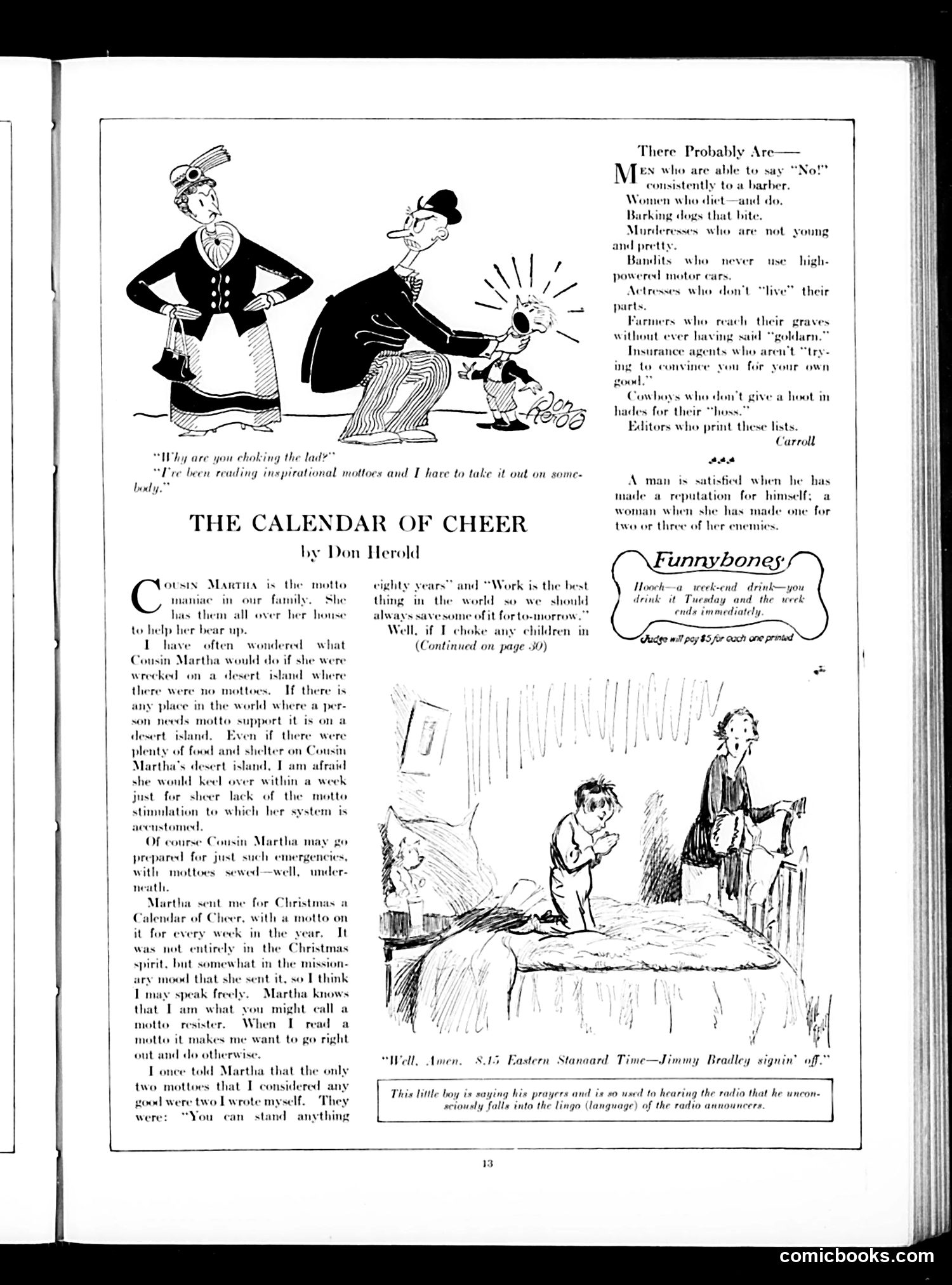
This page contains three distinct pieces of satire: **"There Probably Are—"** is a humorous list mocking things that *don't* exist—men who say no to barbers, actresses who truly "live" their parts, cowboys indifferent to horses. The joke satirizes both common clichés and the inspirational motto culture that permeates American life (see below). **"The Calendar of Cheer"** by Don Herold mocks his relative "Cousin Martha," who compulsively decorates her home with motivational mottos and gifts them to others. Herold jokes that Martha is so dependent on these platitudes for psychological stimulation that she'd collapse without them. The satire targets the era's obsession with self-improvement slogans and their vapid repetitiveness. **The cartoon illustration** shows a child saying radio-style sign-offs during prayers ("8:15 Eastern Standard Time—Jimmy Bradley signin' off"), satirizing how pervasive radio broadcasting culture has become—children unconsciously mimic its language even in intimate moments. Overall, the page ridicules early 20th-century American sentimentality, mass media saturation, and the culture of motivational platitudes.
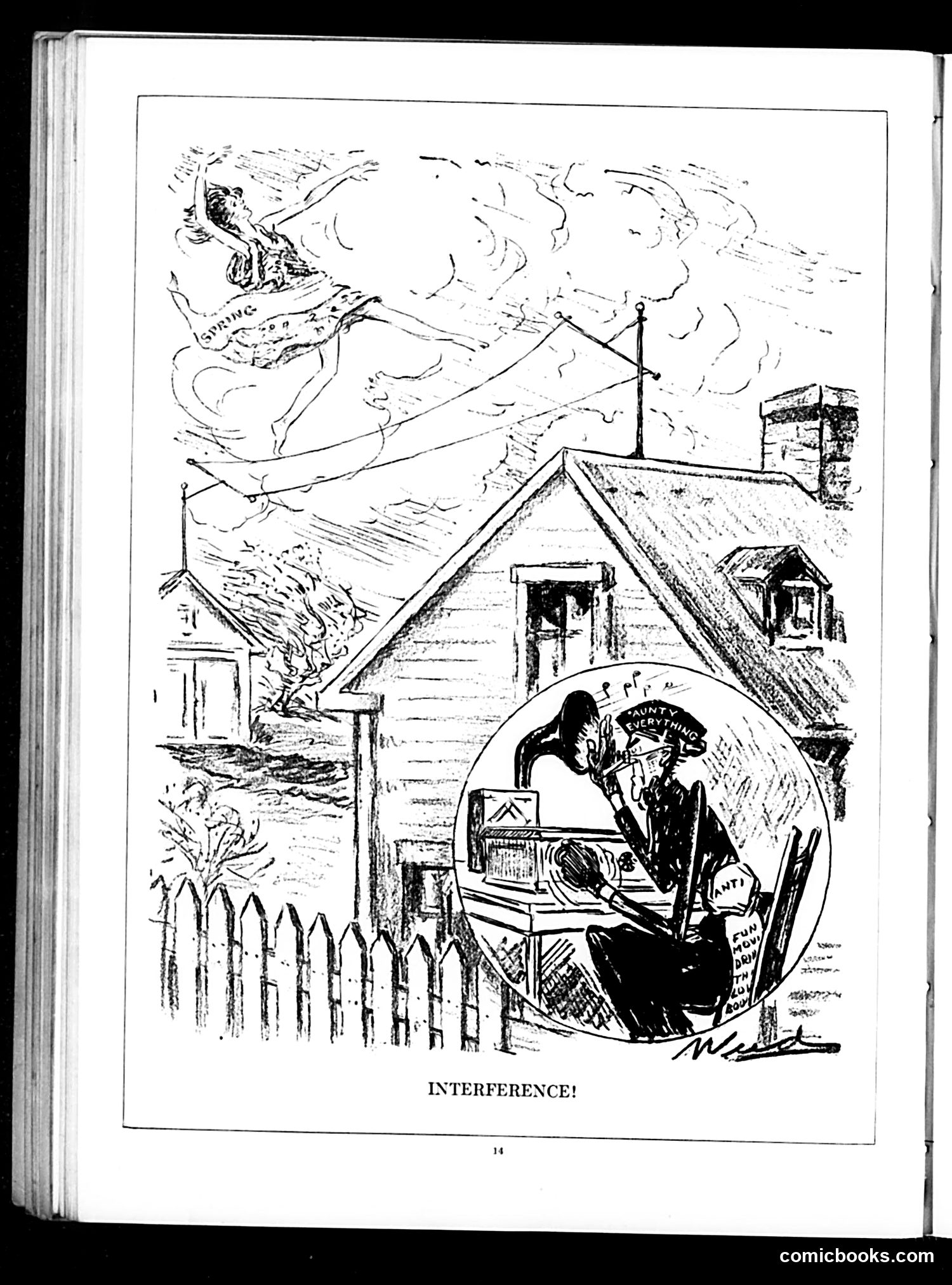
This cartoon depicts a domestic scene where a figure sits at a desk (likely representing a government official or bureaucrat) working on what appears to be county or municipal business. Above, a witch-like figure flies through the sky toward the house—a classical symbol of malevolent interference or unwanted meddling. The title "INTERFERENCE!" suggests criticism of outside forces disrupting local governance or operations. The witch imagery indicates the cartoonist views this interference as malicious or supernatural in nature. The rural setting (house, fence, chimney) emphasizes this as a local/county matter being disrupted by external forces. Without additional context about Judge magazine's publication date, the specific identity of figures remains unclear, but the satire critiques governmental overreach or external meddling in local affairs.
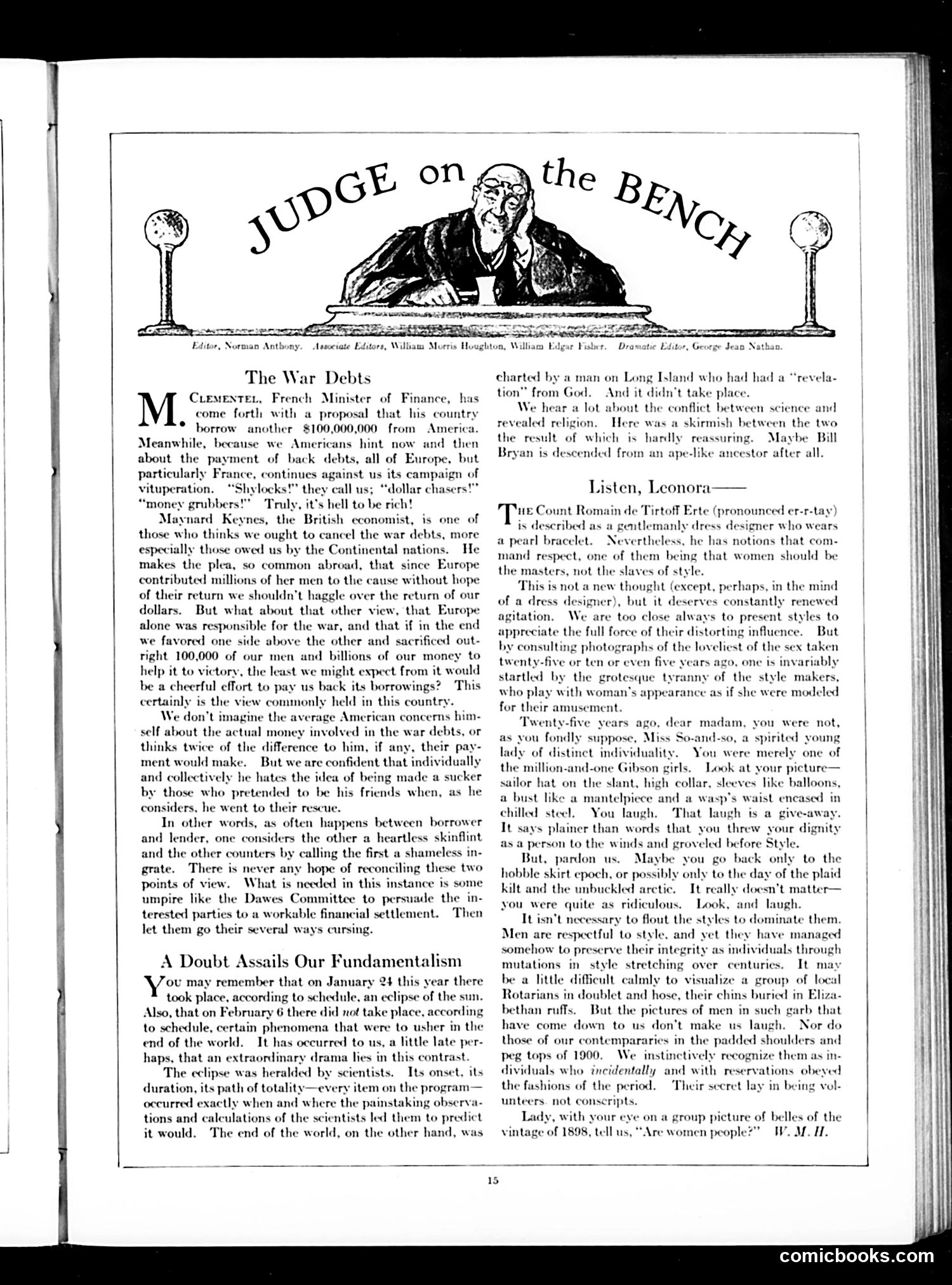
This page contains two satirical pieces: **"The War Debts"** critiques post-WWI financial tensions. France's Finance Minister Clemenceau seeks another $100 million loan from America while European nations insult Americans as "dollar chasers" and "money grubbers." The article sarcastically notes this hypocrisy: Europe expects debt forgiveness despite being responsible for the war, yet resents America for expecting repayment after sacrificing lives and money to aid them. The piece reflects genuine 1920s American frustration with European ingratitude regarding war loans. **"A Doubt Assails Our Fundamentalism"** mocks religious fundamentalism by contrasting scientists' accurate eclipse prediction with a Long Island man's failed God-given prophecy about the world's end (likely referencing William Miller's failed 1844 prediction or similar). The joke: science proves reliable while literal religious prophecy fails, undermining fundamentalist claims. The final jab at William Jennings Bryan suggests even he may descend from ape-like ancestors—a dig at his anti-evolution stance. Both articles satirize contemporary American debates: international finance and science versus religious literalism.
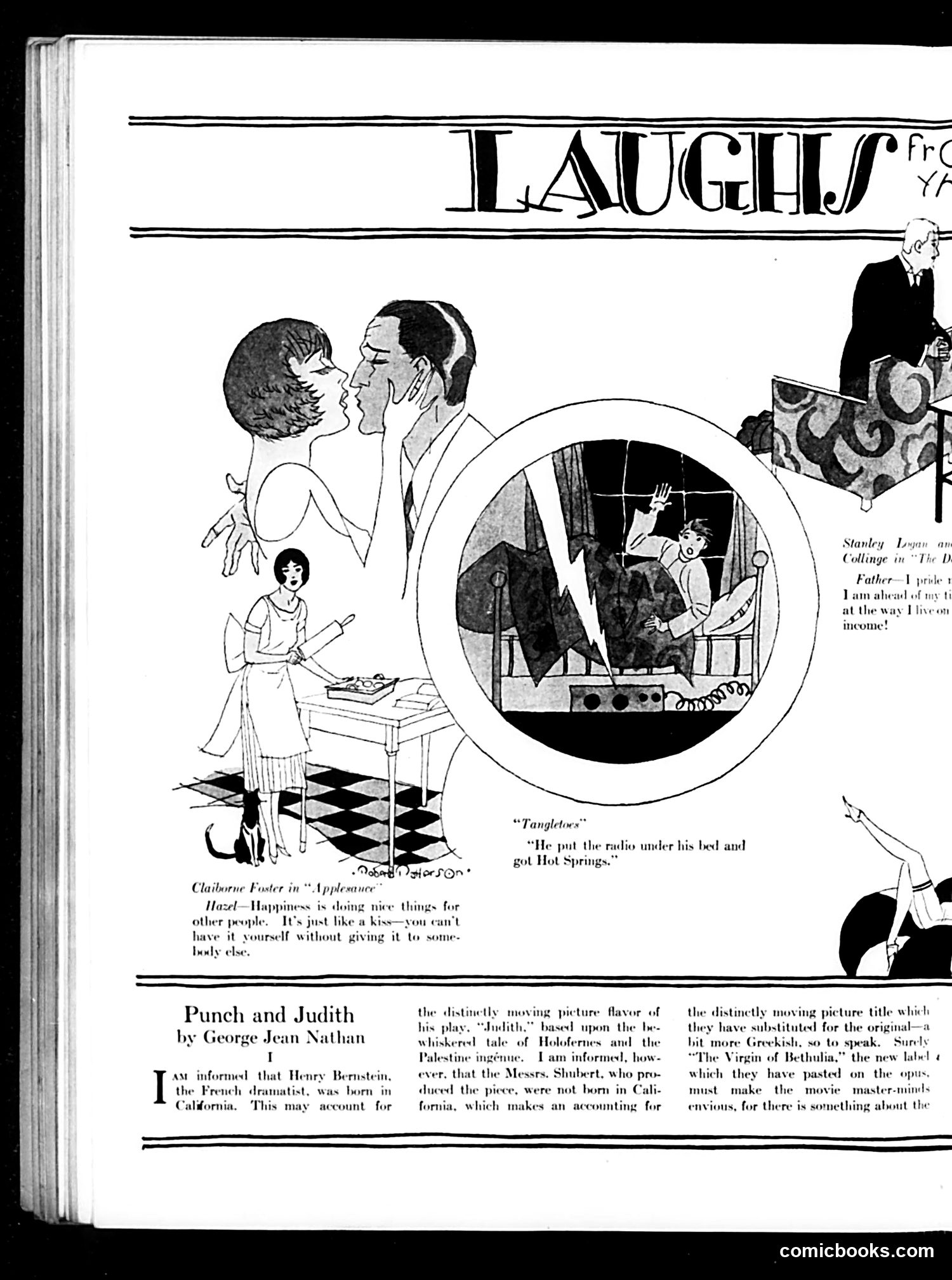
This page from *Judge* magazine presents early 20th-century humor through multiple cartoon vignettes and a theater review. The top cartoons mock domestic and social situations: "Applesauce" shows a flirting couple with a maid present, while "Tangleтoes" appears to joke about hiding a radio (a relatively new technology). A third cartoon depicts a father worried about his son's extravagant lifestyle. The lower half reviews the theatrical production "Punch and Judith" by George Jean Nathan. The review notes that playwright Henry Bernstein, despite being French, was born in California—apparently the critic finds this noteworthy. The play adapts the biblical story of Judith and Holofernes, with Nathan commenting that the producers added Greek theatrical flavor to the biblical source material. The satire relies on period-specific references: radio as novelty technology, theater criticism of European works, and domestic comedy about class and propriety. Modern readers would need context about early radio adoption and 1920s theatrical culture to fully grasp the humor.
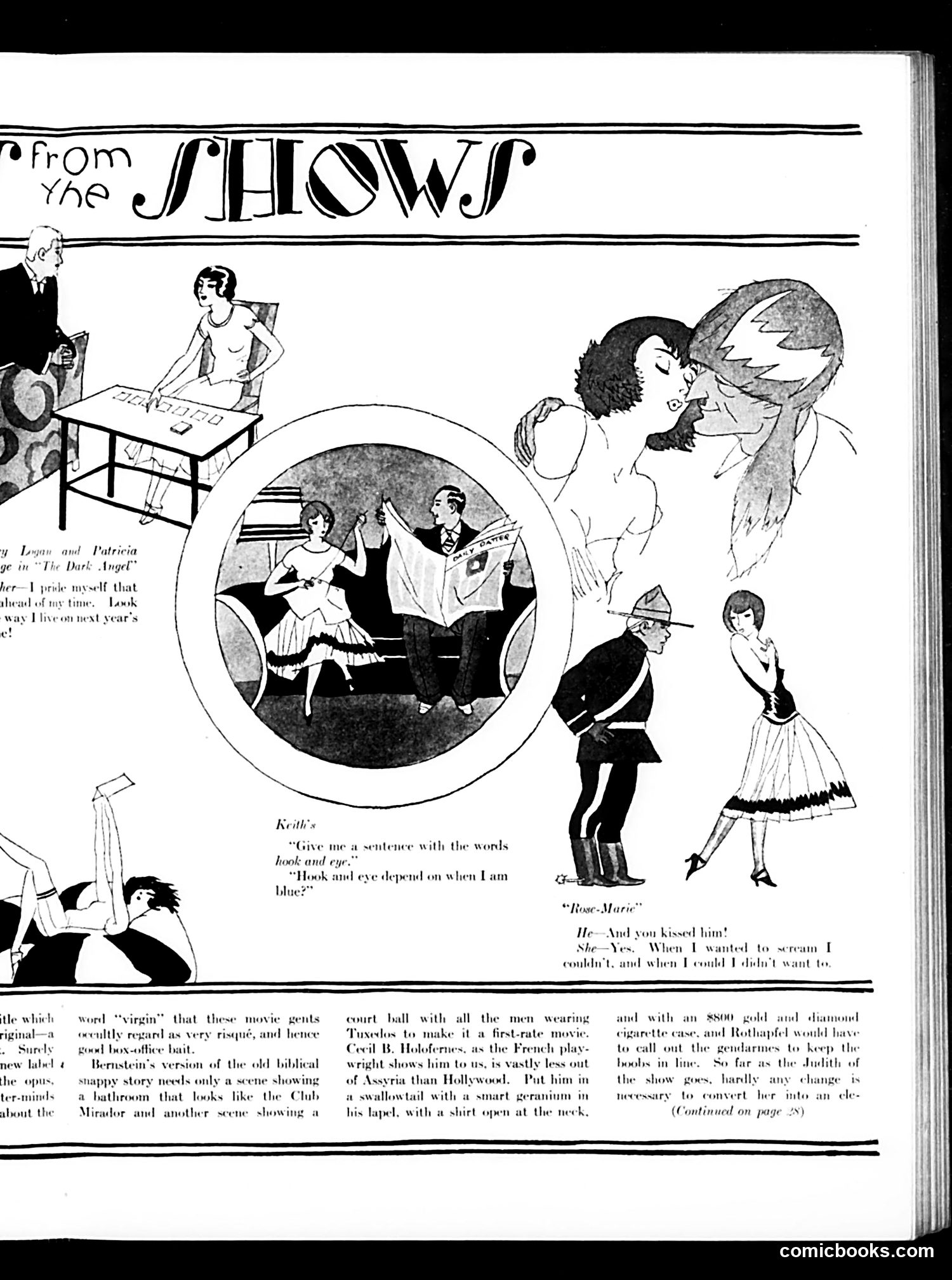
This page satirizes silent film productions and their absurd pretensions. The central circle shows a scene from a movie, while surrounding vignettes mock Hollywood's exaggeration. The satire targets: **Film plots**: References to "The Dark Angel" and other movies suggest Judge is criticizing how cinema adapts literary/biblical material with ridiculous spectacle. The mention of "Cecil B. Holofernes" (likely referencing Cecil B. DeMille) mocks grandiose historical epics that bear little resemblance to their sources. **Sexual innuendo**: The dialogue jokes about "virgin" being considered risqué and flirting ("And you kissed him?") represent criticism of films playing coy with adult content while claiming sophistication. **Shallow materialism**: References to "$800 gold and diamond cigarette cases" mock how films equate luxury goods with glamour and morality. Overall, Judge presents movies as simultaneously prudish and corrupt—dressing up thin plots with expensive props while claiming artistic merit. The tone is dismissive toward both filmmakers' pretensions and audiences who fall for such marketing.
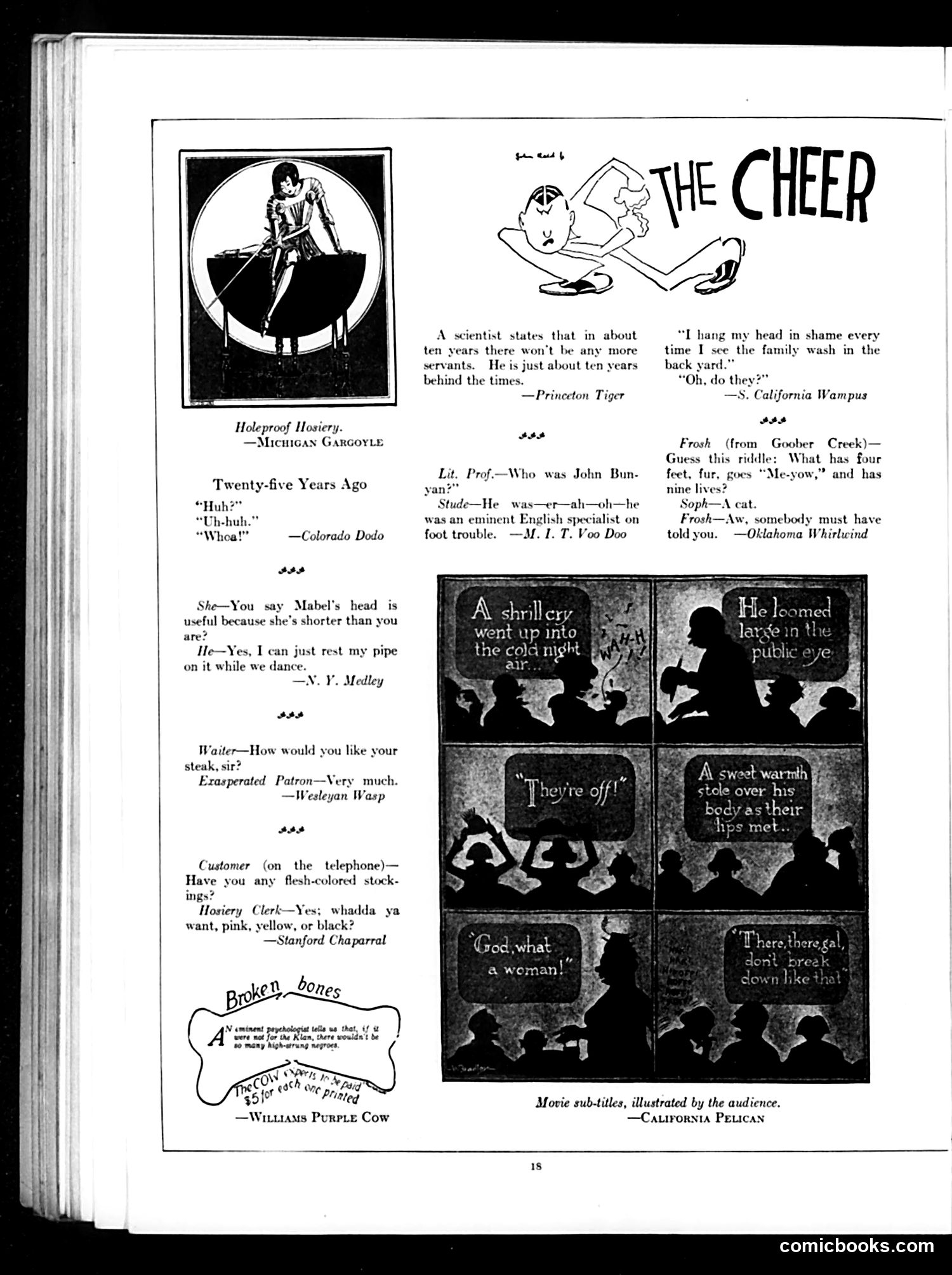
This Judge magazine page collects various college humor and jokes from early 20th-century American publications. Most content consists of brief, pun-based jokes from university humor magazines (Princeton Tiger, Stanford Chaparral, etc.)—typical of the era's gentle collegiate comedy. However, the "Broken Bones" section at bottom-left references the KKK explicitly and appallingly, suggesting the Klan prevented lynchings. This represents shameful historical attitudes. The main cartoon "The Cheer" depicts silent-film audience behavior—the six panels show moviegoers reacting dramatically to film melodrama with physical gestures and exaggerated responses, illustrating how pre-sound films relied on audience imagination to supply dialogue and emotional intensity. This was common entertainment culture before synchronized sound technology. The page overall reflects early 20th-century college humor sensibilities and silent-film viewing practices now largely forgotten.
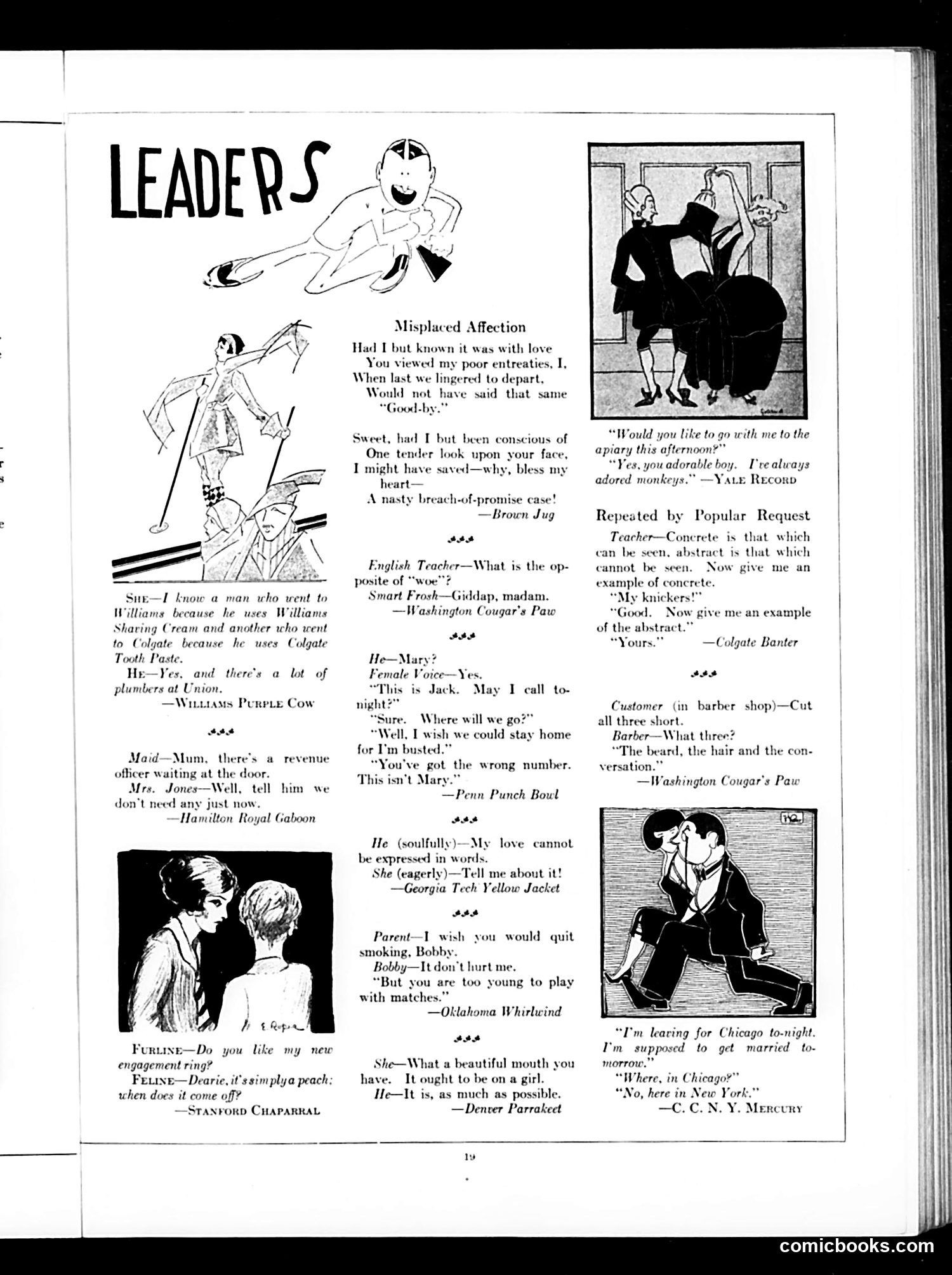
This page from Judge magazine (appears to be early 20th century) is a humor compilation rather than political satire. It consists of short jokes and witticisms, many attributing quips to college publications (Penn Punch Bowl, Georgia Tech Yellow Jacket, etc.). The jokes target recognizable social types: lovesick suitors, flirtatious couples, nagging parents, and frustrated authority figures. References to product advertisements (Williams Shaving Cream, Colgate) suggest commercial tie-ins typical of the era. The cartoons at top show stylized "leaders" in exaggerated poses—likely satirizing popular figures or leadership types, though specific identities aren't indicated. The page prioritizes light romantic and domestic humor rather than political commentary. The repeated phrase "Repeated by Popular Request" (middle-right) indicates these jokes had appeared before, suggesting Judge reprinted popular submissions from college humor magazines and readers.
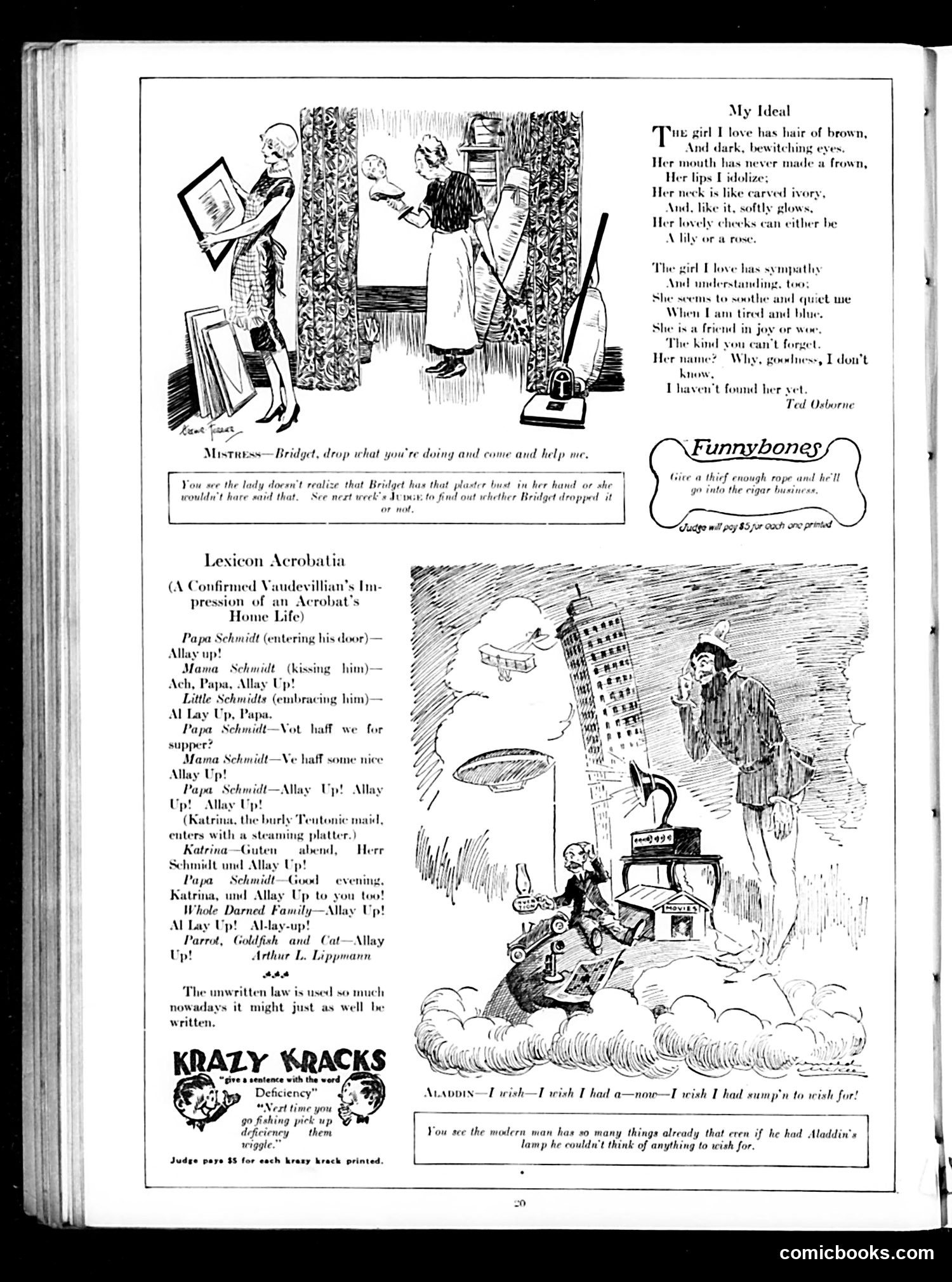
This page contains several distinct humor pieces typical of early 20th-century satirical magazines: **"My Ideal"** (top right): A poem by Ted Osborne presenting romantic irony—a man describes his perfect woman in idealized terms, then admits he hasn't actually met her yet. The joke critiques male fantasies disconnected from reality. **"Mistress—Bridget"** (top left): A domestic comedy about a maid named Bridget. The humor derives from class dynamics: the mistress struggles with a household task and must ask her servant for help, reversing expected hierarchies. The caption suggests uncertainty about whether Bridget caused or solved the problem. **"Lexicon Acrobatia"** (bottom left): A vaudeville-themed piece playing on the German-American accent ("Allay Up" = "All right"). Every family member, even pets, greet each other with this phrase, creating absurdist repetition humor. **"Aladdin"** (bottom right): Modern social satire—a wealthy man with Aladdin's lamp cannot think of anything to wish for because he already possesses everything. It critiques material excess and consumer culture. All pieces employ wordplay and social observation typical of Judge's satirical approach.
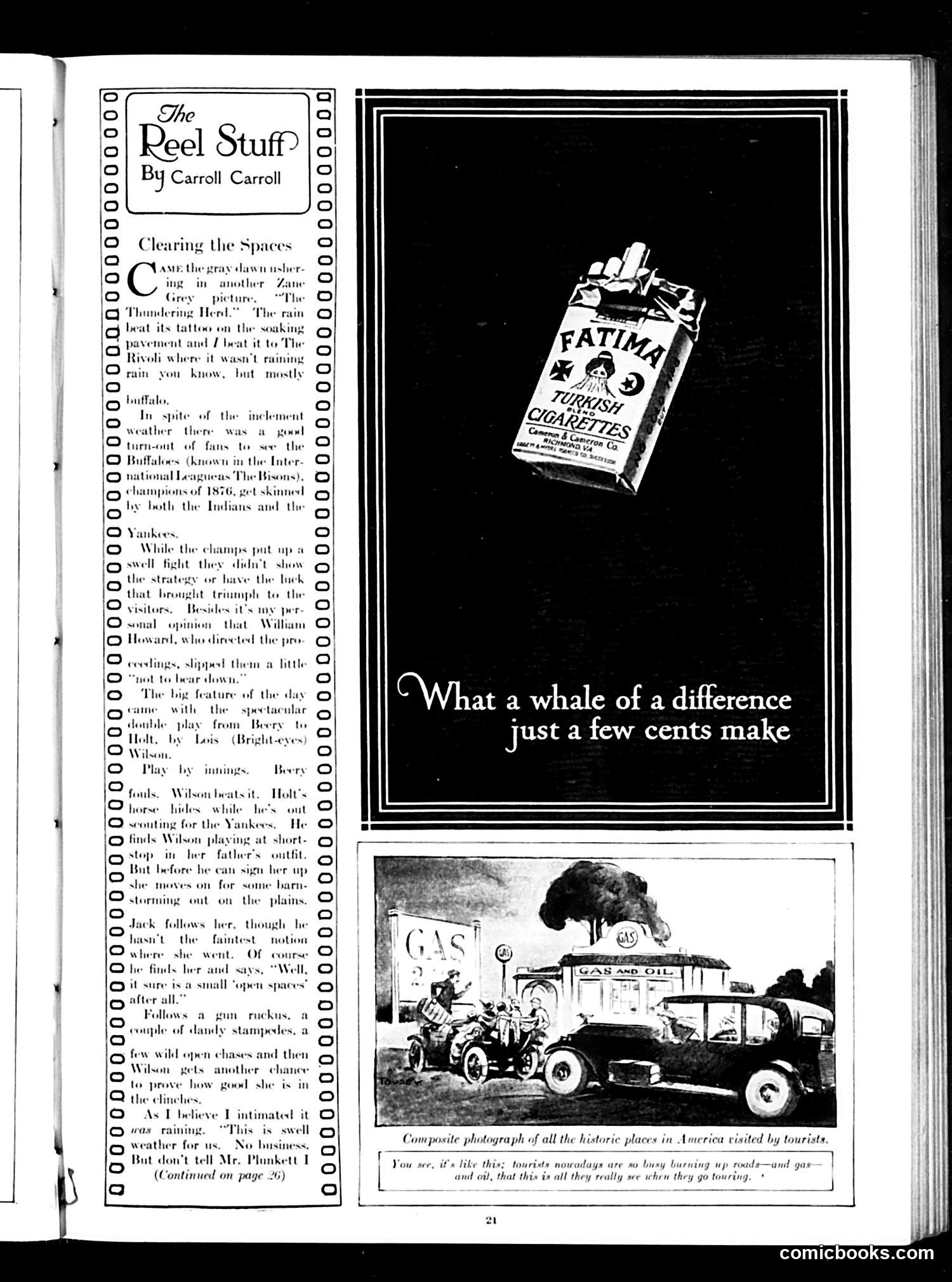
**"The Reel Stuff"** is a film review column by Carroll Carroll discussing a movie featuring actors Lois Wilson and Jack Holt. The review criticizes the film's plot (a Western with romance and action) and its weak dramatic strategy, suggesting the director deliberately underplayed the performances. **The Advertisement** above shows a Fatima Turkish cigarette package with the caption "What a whale of a difference just a few cents make"—a period cigarette brand advertisement. **The Composite Photograph** at bottom is satirical commentary on American tourism. It depicts tourists at a gas station rather than viewing actual historic landmarks, accompanied by text mocking tourists for being too focused on driving ("burning up roads—and gas and oil") to actually experience the places they visit. The satire suggests that modern car travel has replaced genuine sightseeing with mere transit—tourists see only gas stations, not America's actual historic attractions. This reflects 1920s anxieties about automobile culture displacing authentic cultural experiences.
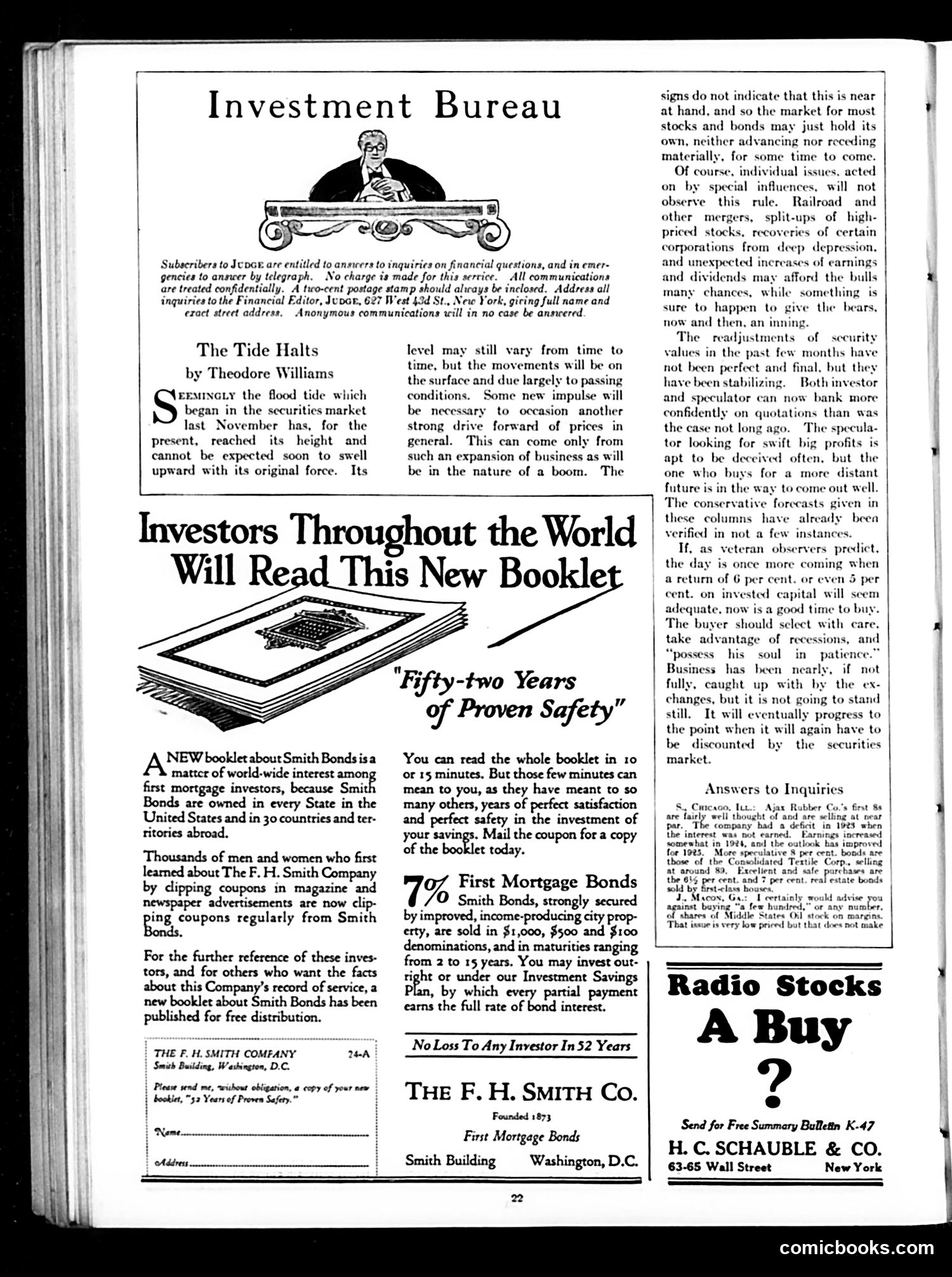
This page is primarily **financial advertising**, not political satire. The main content consists of investment advice and bond advertisements from the F.H. Smith Company, interspersed with a financial column titled "The Tide Halts" by Theodore Williams. The column discusses stock market conditions, suggesting that the market boom from November has plateaued and will likely remain flat without significant business expansion to drive new growth. The author counsels patience and caution—conservative long-term investors should fare better than speculators chasing quick profits. The Smith Bonds advertisements emphasize safety and proven track record ("52 Years of Proven Safety"), marketing first mortgage bonds at 7% interest to investors nationwide and internationally. A coupon invites readers to request a free booklet. The "Investment Bureau" masthead identifies this as Judge magazine's financial advice column for readers with investment questions. This reflects early 20th-century American investment culture and the magazine's role in reaching affluent readers.
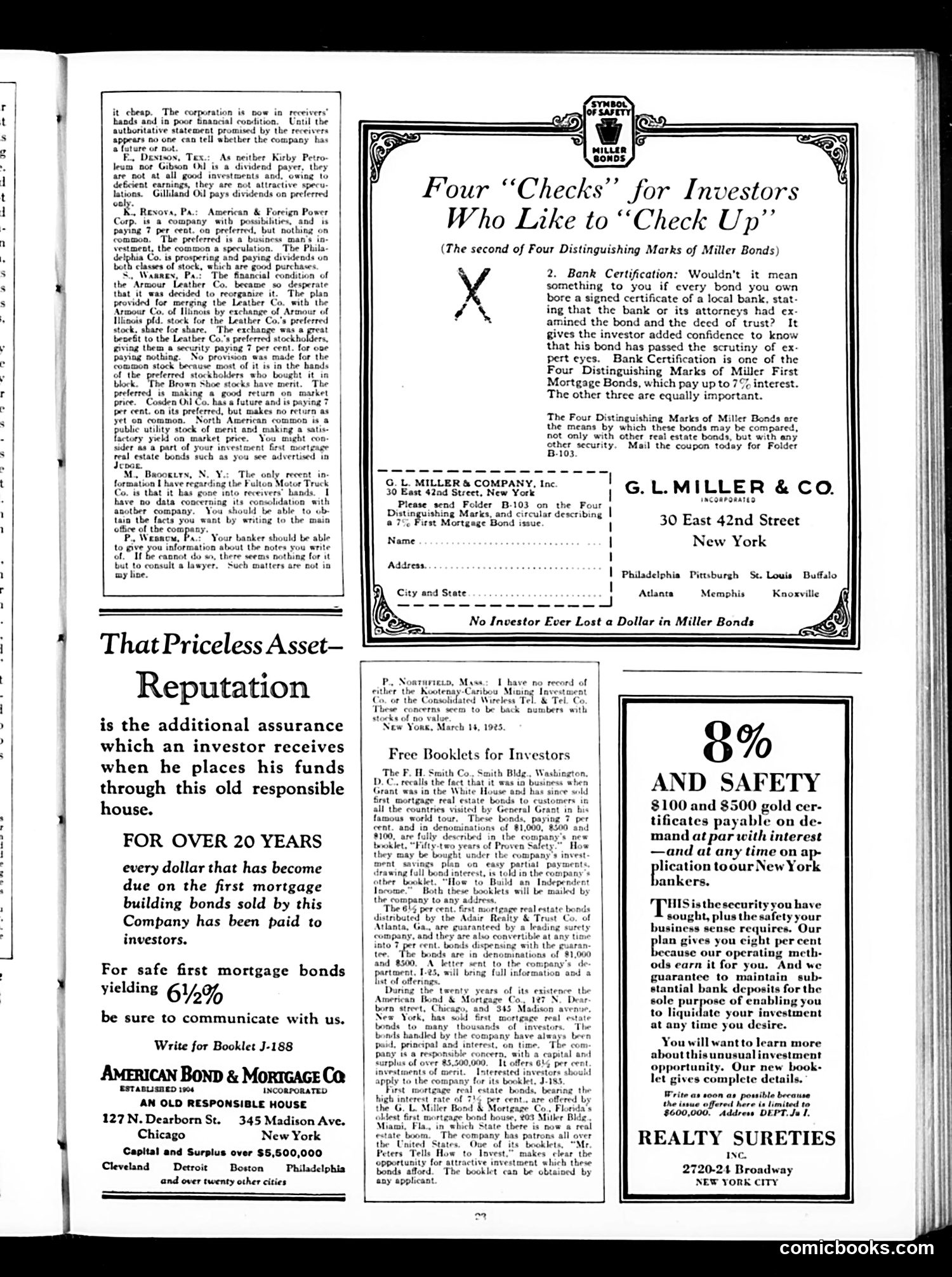
This page is primarily **financial advertising**, not satirical content. It consists of: 1. **An advice column** answering investor questions about various stocks and bonds (Kirby Petroleum, Gilliland Oil, Armour Leather Co., etc.)—typical early-20th-century investment guidance. 2. **Multiple advertisements** for bond investment companies (American Bond & Mortgage Co., G.L. Miller & Company, Realty Sureties Inc.), emphasizing safety and steady returns (6.5%-8%). The key appeal: **reputation and certification as security**. During an era of frequent financial fraud and market instability (pre-SEC regulation), investors were urged to trust "old responsible houses" with proven track records. The ads stress that banks had "examined" bonds and that dividends had been reliably paid "for over 20 years." This reflects the **pre-1929 crash investment culture**—when individual bonds (not stocks) were considered the safe choice, and investors relied heavily on company reputation rather than regulatory oversight.
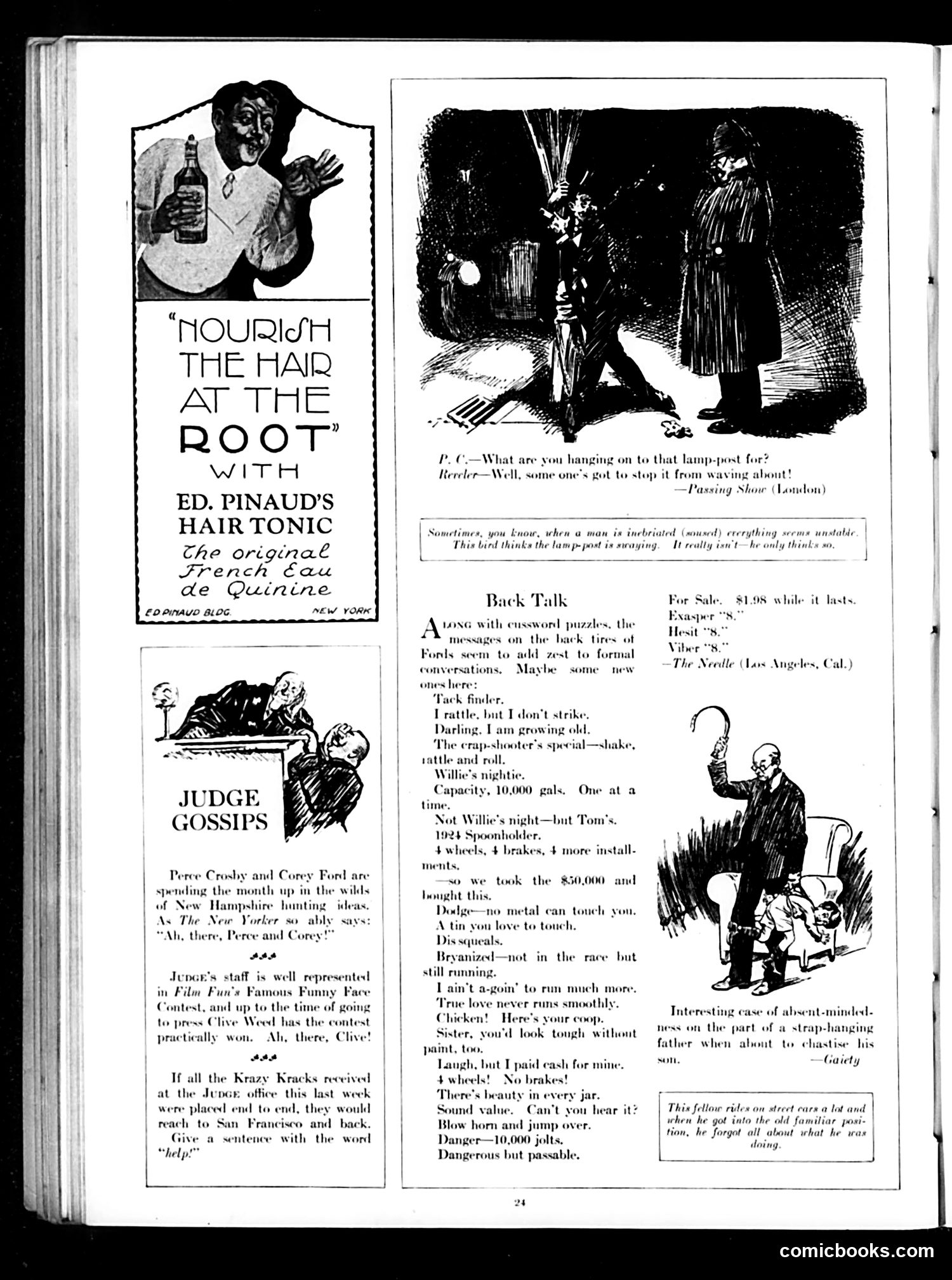
This page combines advertisements and satirical humor typical of Judge magazine's content. **Main Content:** The top advertisement promotes Ed. Pinaud's Hair Tonic, a French product meant to stimulate hair growth at the roots. **"Judge Gossips"** section contains celebrity/society chitchat about hunting trips and entertainment industry figures (Perce Crosley, Corey Ford, Clive Weed), along with a joke about the magazine receiving numerous "Krazy Kracks" (reader submissions). **"Back Talk"** is the page's primary satire—riddles and puns written on Ford automobile tire covers, mocking commercial messaging and advertising trends of the era. These double-entendre clues reference contemporary figures (William Jennings Bryan via "Bryanized"), automobiles, romance, and social behavior. The bottom cartoon depicts a commuter on public transit about to hit his son, having forgotten the boy's presence due to routine habit—satirizing urban absent-mindedness.
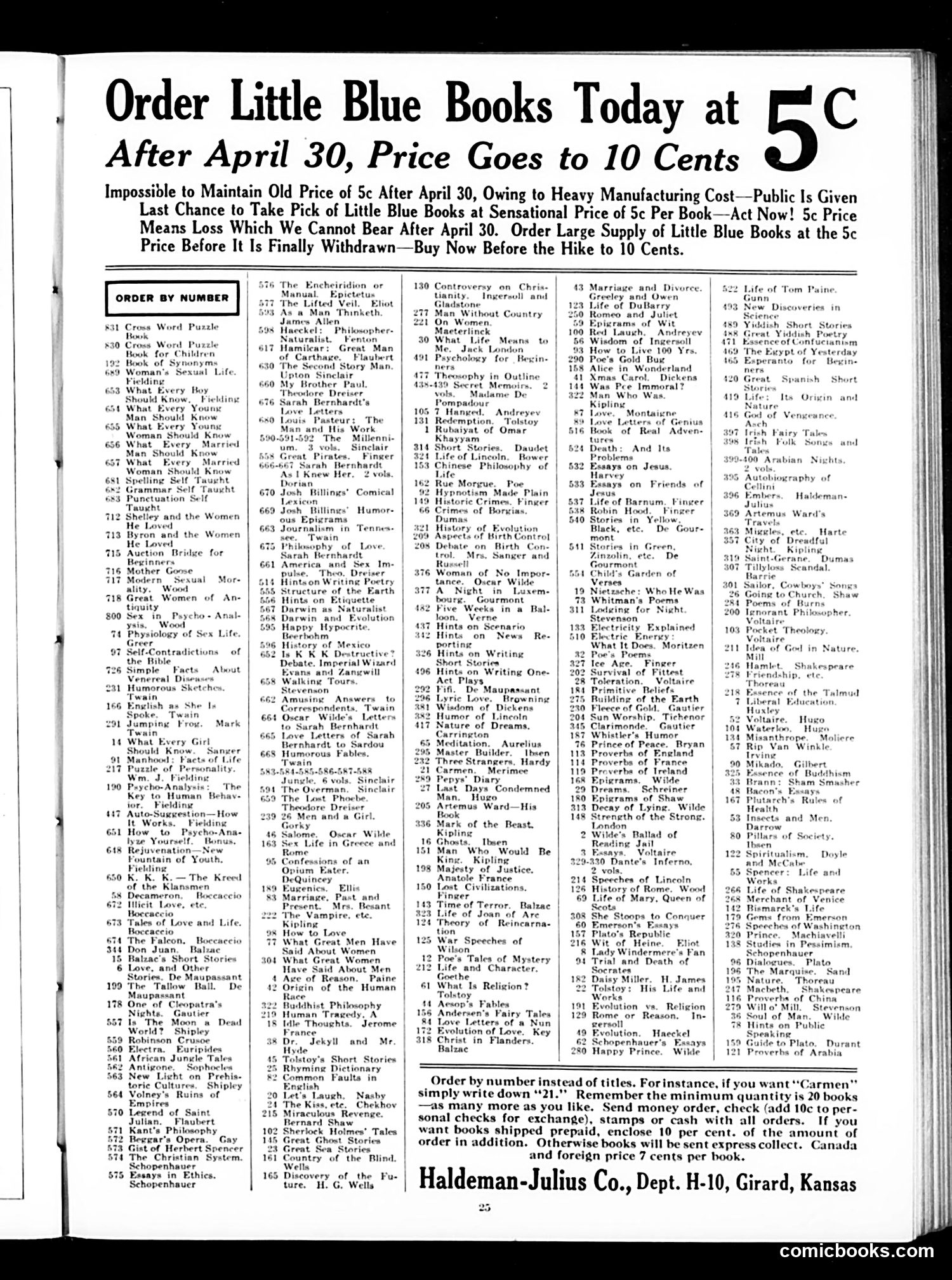
This page is **entirely advertising**, not a cartoon or satirical content. It's a catalog advertisement for "Little Blue Books"—inexpensive paperback reprints published by Haldeman-Julius Co. of Girard, Kansas. **The "news" being sold:** The ad announces a price increase from 5¢ to 10¢ after April 30, framing this as an urgent "last chance" to buy at the old price due to rising manufacturing costs. This is a classic marketing tactic: create artificial scarcity and deadline pressure to drive immediate orders. **The catalog lists 200+ titles** spanning literature (Twain, Dreiser, Shakespeare), philosophy (Schopenhauer, Kant), practical guides ("What Every Girl Should Know"), crossword puzzles, and other subjects—democratizing access to culture for working-class readers. **Historical context:** These were genuine mass-market educational books sold by mail order, hugely popular in early 20th-century America. The price doubling reflects real post-WWI inflation pressures on publishers. This is a straightforward sales document, not satirical content.
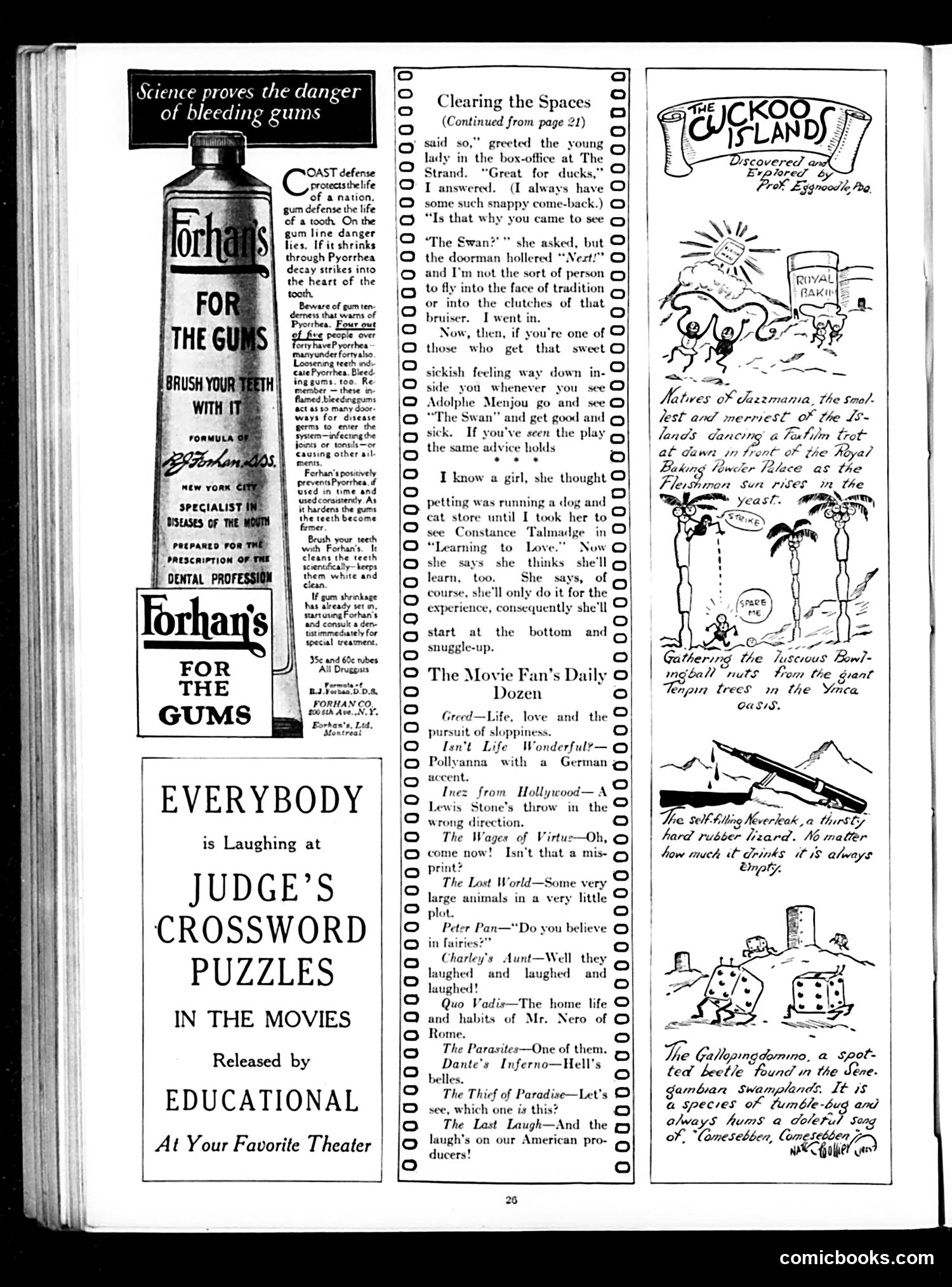
This page is primarily **advertising and filler content** rather than political satire. The main content includes: 1. **Forhan's Toothpaste ads** (left column) - promoting gum disease prevention, a legitimate health concern of the era. References "Pyorrhea," a real dental condition. 2. **Judge's Crossword Puzzles advertisement** - promoting puzzles released by Educational Films for theater exhibition, reflecting 1920s entertainment trends. 3. **"The Cuckoo Lands"** (right side) - a humorous illustrated feature depicting fictional exotic creatures and locations. The drawings and captions are whimsical nature parodies with no political content—purely comedic inventions like the "Galloping domino" beetle. 4. **"The Movie Fan's Daily Dozen"** (center) - brief satirical reviews of contemporary films (The Swan, Peter Pan, Quo Vadis), poking fun at movie plots and stars like Adolphe Menjou and Constance Talmadge, typical of Judge's entertainment criticism. **Overall**: This is a typical entertainment/advertising page from the 1920s with no significant political satire or social commentary.
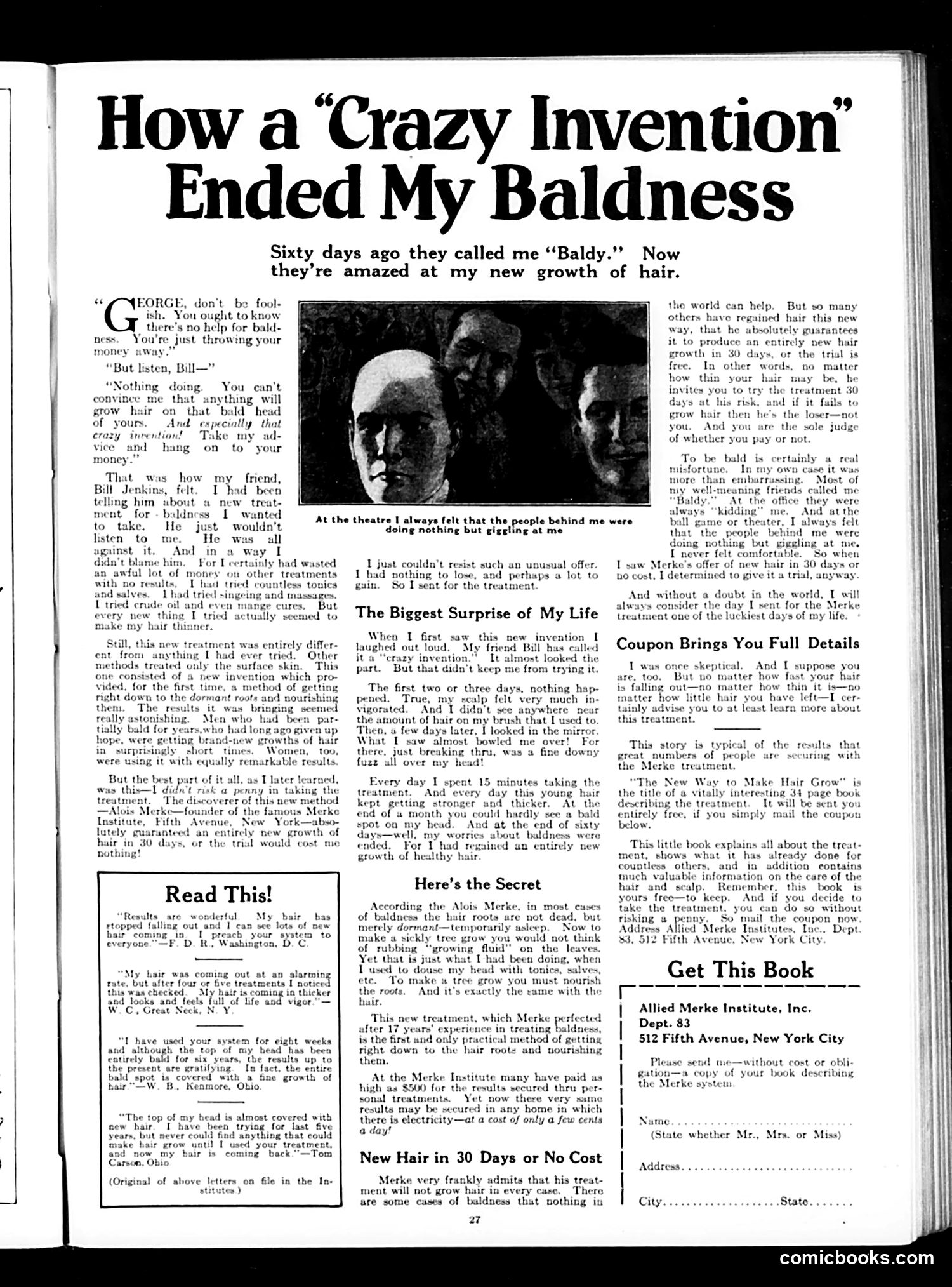
This page is primarily **advertising disguised as testimonial journalism**—a common early 20th-century marketing tactic. It presents the "Merke treatment" for male baldness through a fake success story ("George") claiming dramatic hair regrowth in 30 days. The satire here is subtle: Judge magazine is satirizing the **baldness-cure industry itself**—the proliferation of fraudulent or exaggerated remedies targeting insecure men. The opening dialogue between "George" and skeptical "Bill Jenkins" mocks how desperate men fall for "crazy inventions" despite repeated failures. Key satirical elements: - The absurdly confident testimonials ("I laughed out loud") - The vague pseudoscientific explanation ("dormant" hair roots) - The risk-free guarantee ("No Cost") as a sales hook - Breathless before-and-after drama The cartoon critiques **consumer gullibility** and **predatory marketing** targeting male vanity—showing how even skeptics succumb to hope when facing social embarrassment about baldness. The "Merke Institute" appears to be either a real dubious operation or a fictional target of Judge's satire.
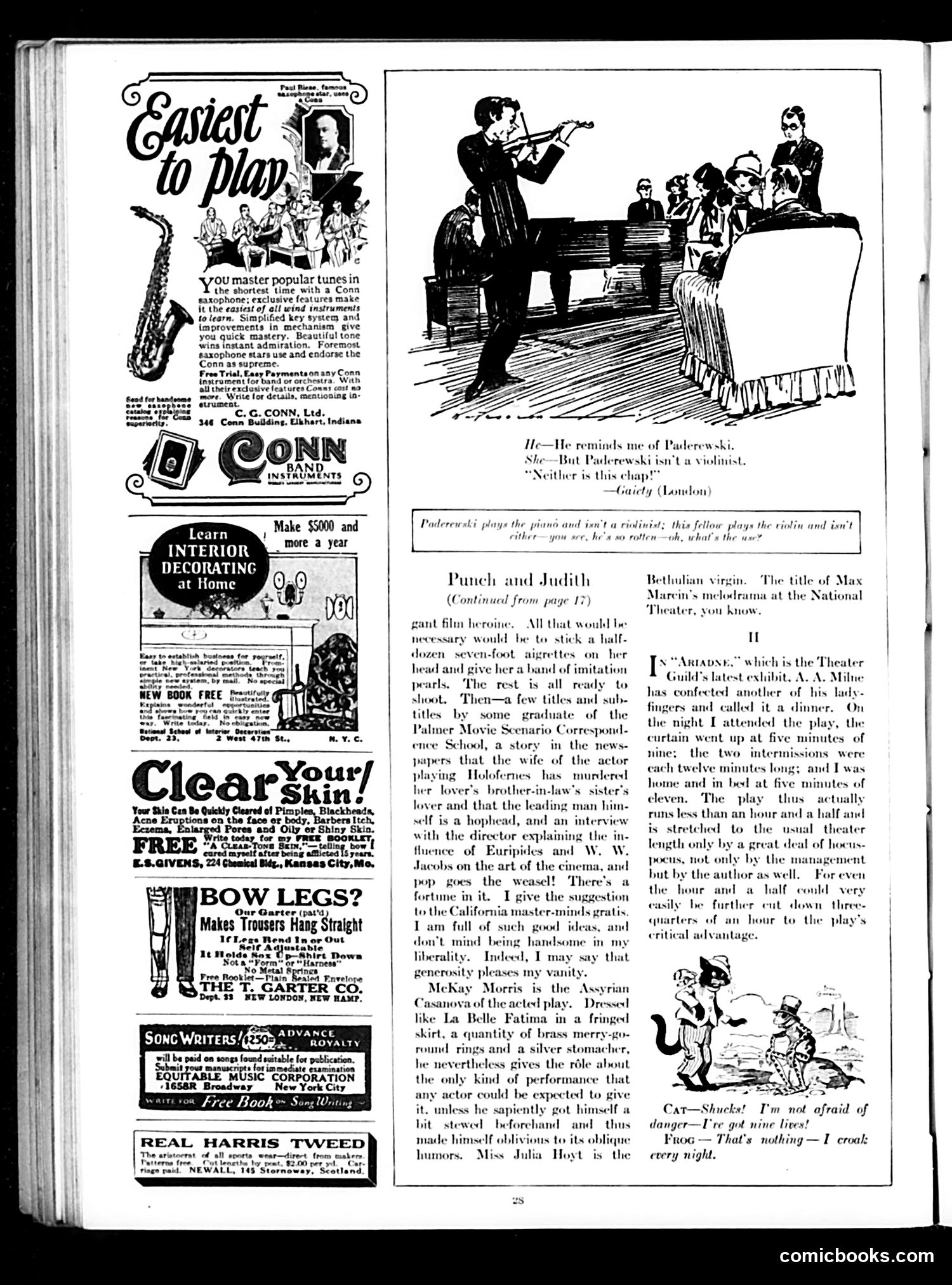
This page is primarily **advertising** with a small editorial cartoon and theater review excerpt. The main cartoon shows a couple at a concert: a violinist performs poorly while a pianist plays competently. The woman remarks the violinist "reminds me of Paderewski" (the famous Polish pianist); the man responds that Paderewski was actually a pianist, not violinist, and this fellow plays violin and "isn't" good—"what's the use?" The joke mocks someone attempting an art form they're unsuited for, with the comparison highlighting the absurdity. The page's bulk comprises advertisements for musical instruments (Conn saxophones), skin treatments, interior decorating courses, and fashion products—typical of Judge's revenue model. A brief theater review discusses "Artapse," a Theater Guild play, critiquing its melodramatic plot and excessive length. The content reflects 1920s concerns: self-improvement courses, cosmetic anxieties, and highbrow theatrical criticism mixed with entertainment industry gossip.
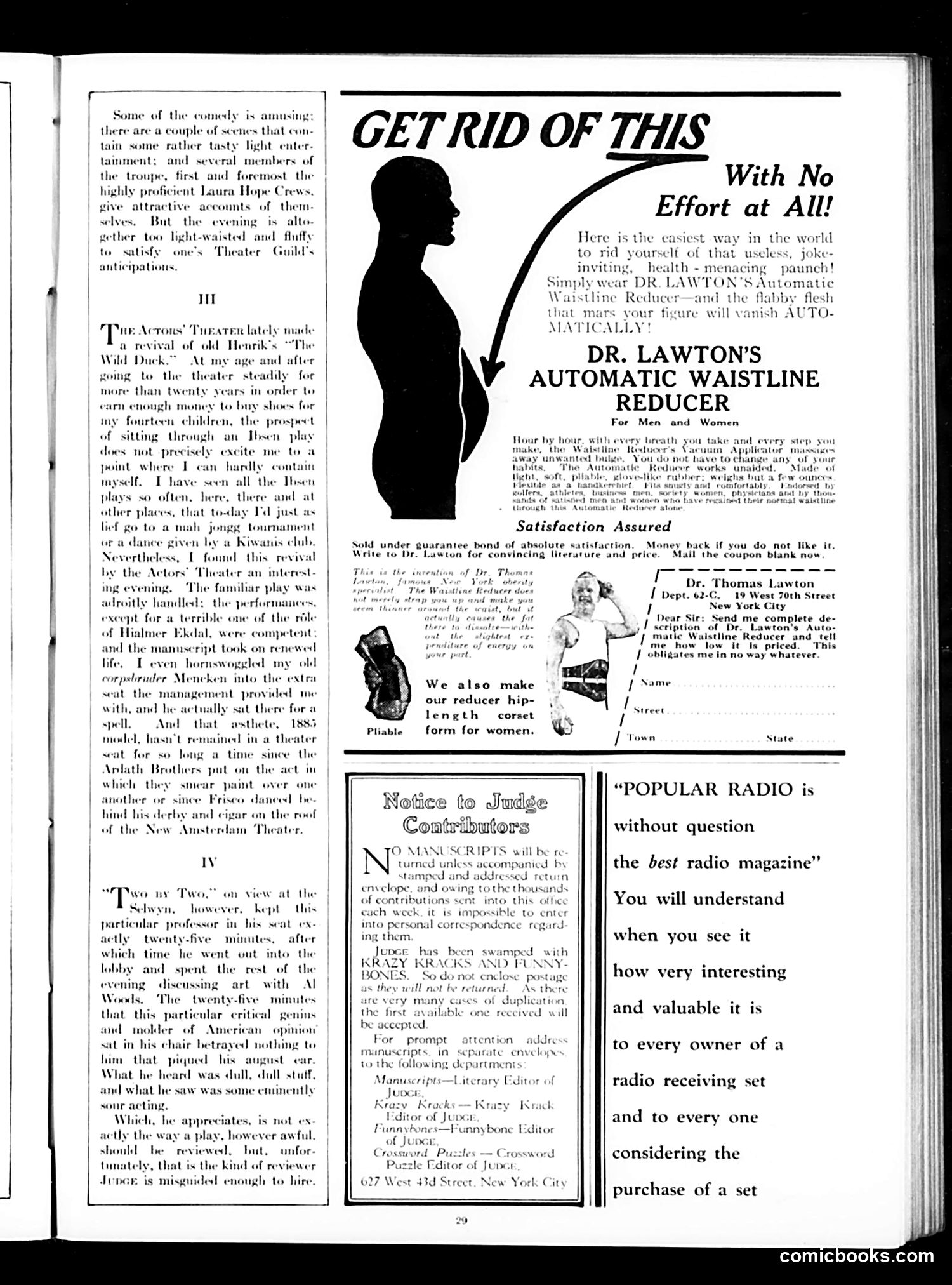
This page contains theater criticism and advertisements from *Judge* magazine. The main content critiques recent Broadway productions, including a revival of Ibsen's *The Wild Duck* at the Actors' Theater and a play called *Two* at the Selwyn. The critic praises the Ibsen production but dismisses *Two* as dull, noting one audience member (likely a prominent theater figure) only sat through 25 minutes. The dominant advertisement promotes "Dr. Lawton's Automatic Waistline Reducer"—a garment claiming to eliminate belly fat effortlessly. This reflects early-20th-century pseudoscience and desperate weight-loss marketing, targeting men and women with promises of automatic results "with no effort at all." The page also includes editorial notices about manuscript submissions to *Judge*'s various sections (jokes, puzzles, etc.) and a radio magazine advertisement. The content overall represents typical magazine fare: arts criticism mixed with dubious health products and editorial housekeeping.
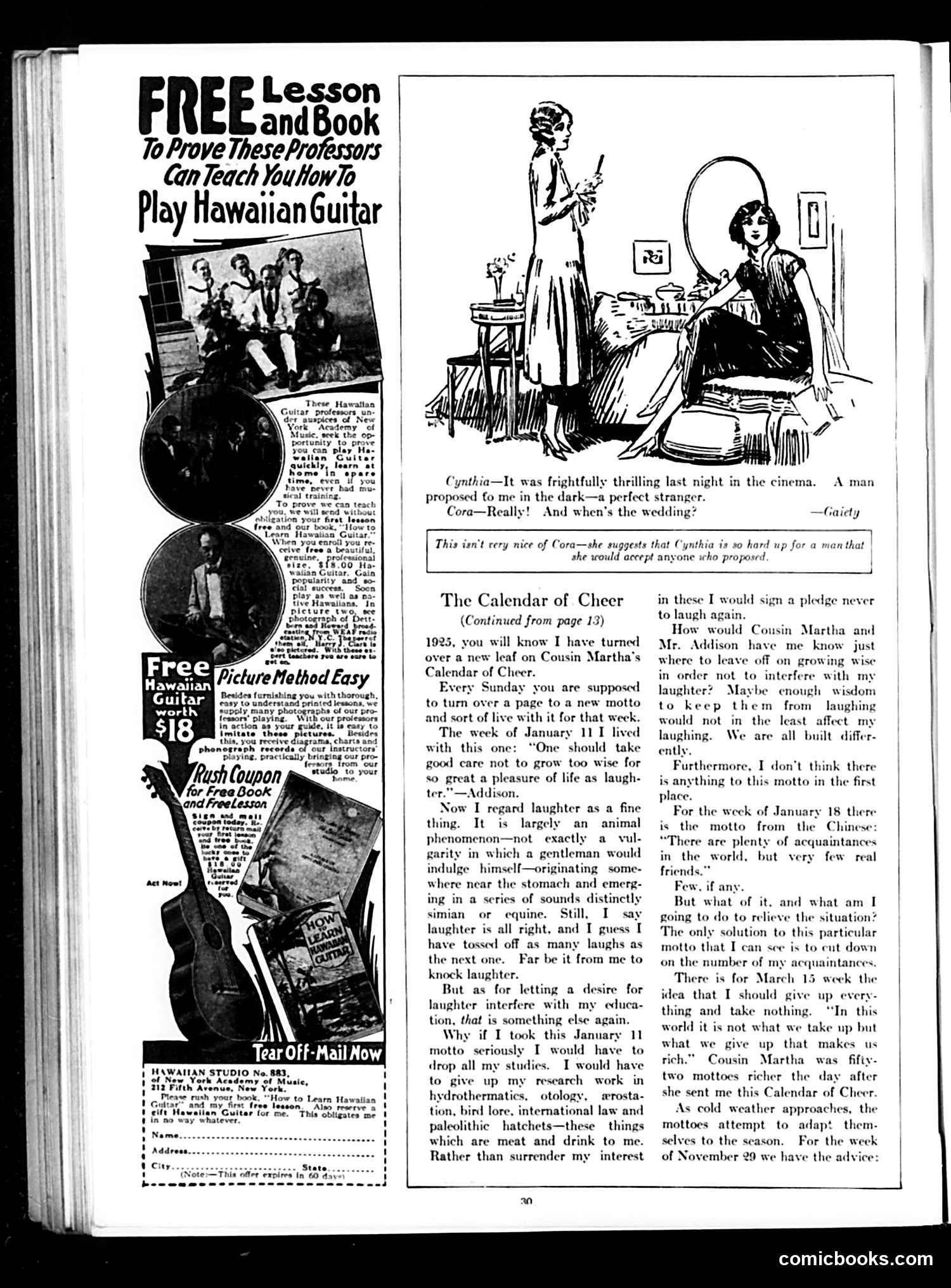
This page contains **primarily advertisements and advice columns**, not political satire. The main content features: 1. **Hawaiian Guitar Advertisement** (left): A mail-order music school promotes learning Hawaiian guitar from home, claiming professors can teach anyone without prior training. This reflects 1920s consumer culture and the Hawaiian music craze popular in that era. 2. **"Calendar of Cheer" Column** (right): A humorous advice piece where a correspondent debates whether pursuing intellectual study (hydrothermatics, law, paleolithic research) should be abandoned to prioritize laughter and joy—a lighthearted domestic philosophy piece. 3. **Comic Dialogue** (top right): Two women discuss a cinema proposal, with editorial commentary mocking the idea that someone would accept a proposal from a stranger just because he proposed. The page reflects **1920s consumer culture and domesticity** rather than political commentary. It targets middle-class readers interested in self-improvement products and gentle moral humor about modern life and relationships.
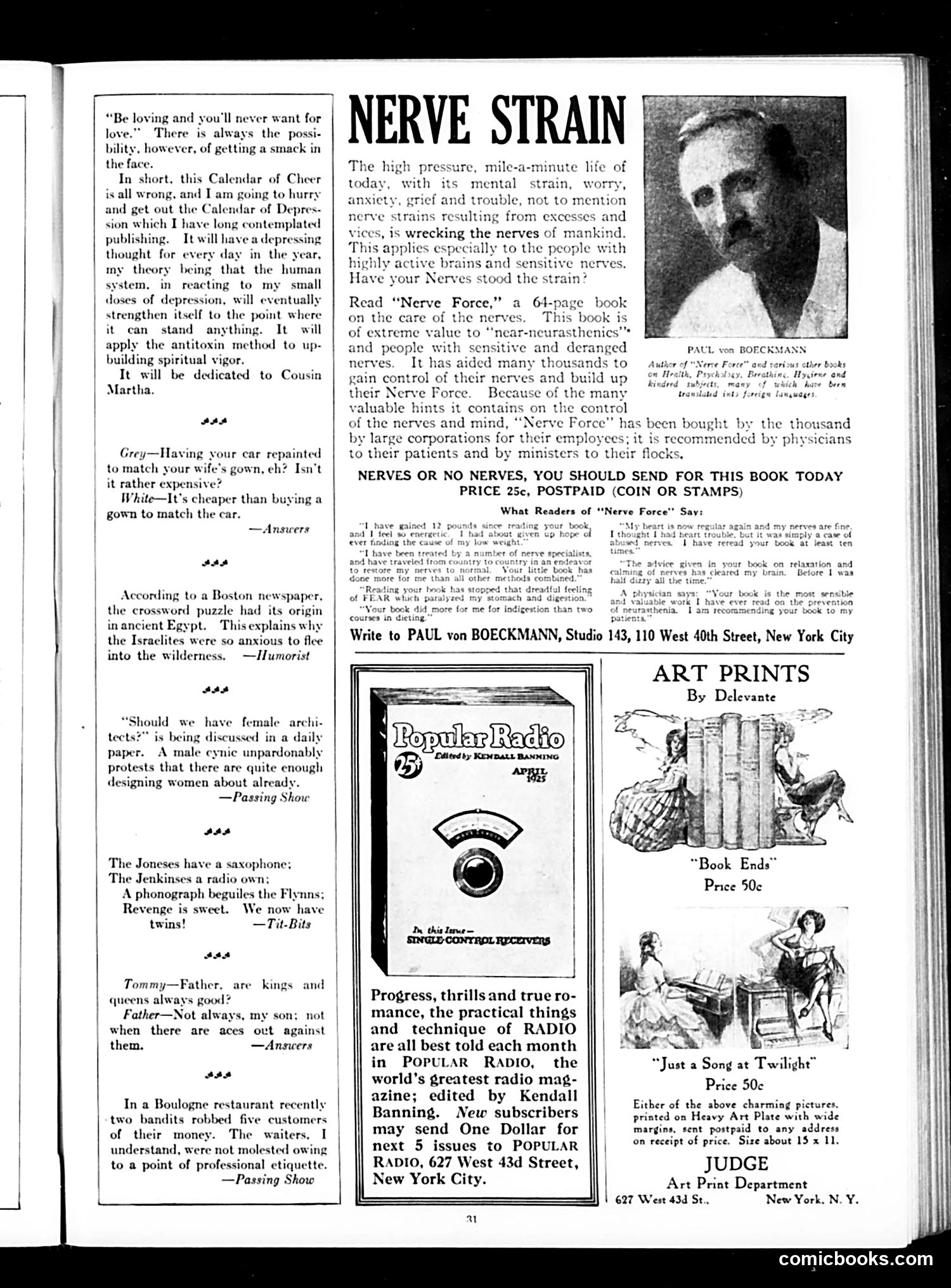
This page is primarily **advertising and humor columns**, not political cartooning. The main content includes: **"Nerve Strain" advertisement**: A pitch for Paul von Boeckmann's self-help book "Nerve Force," targeting anxious modern readers suffering from high-pressure, fast-paced urban life. The ad claims corporations bought it for employees and doctors recommended it to patients—classic early 20th-century wellness marketing. **Humor snippets**: Brief jokes satirizing contemporary domestic life—a husband joking that repainting the car is cheaper than buying his wife matching gowns; a crossword puzzle origin joke blaming ancient Egypt; quips about female architects, radio-owning neighbors, and professional etiquette among bandits. **Advertisements for "Popular Radio" magazine** and **art prints by Delevante** complete the page. The satire is **gentle and domestic** rather than political, reflecting Judge's focus on middle-class social anxieties and consumer culture of the era. No identifiable political figures appear.
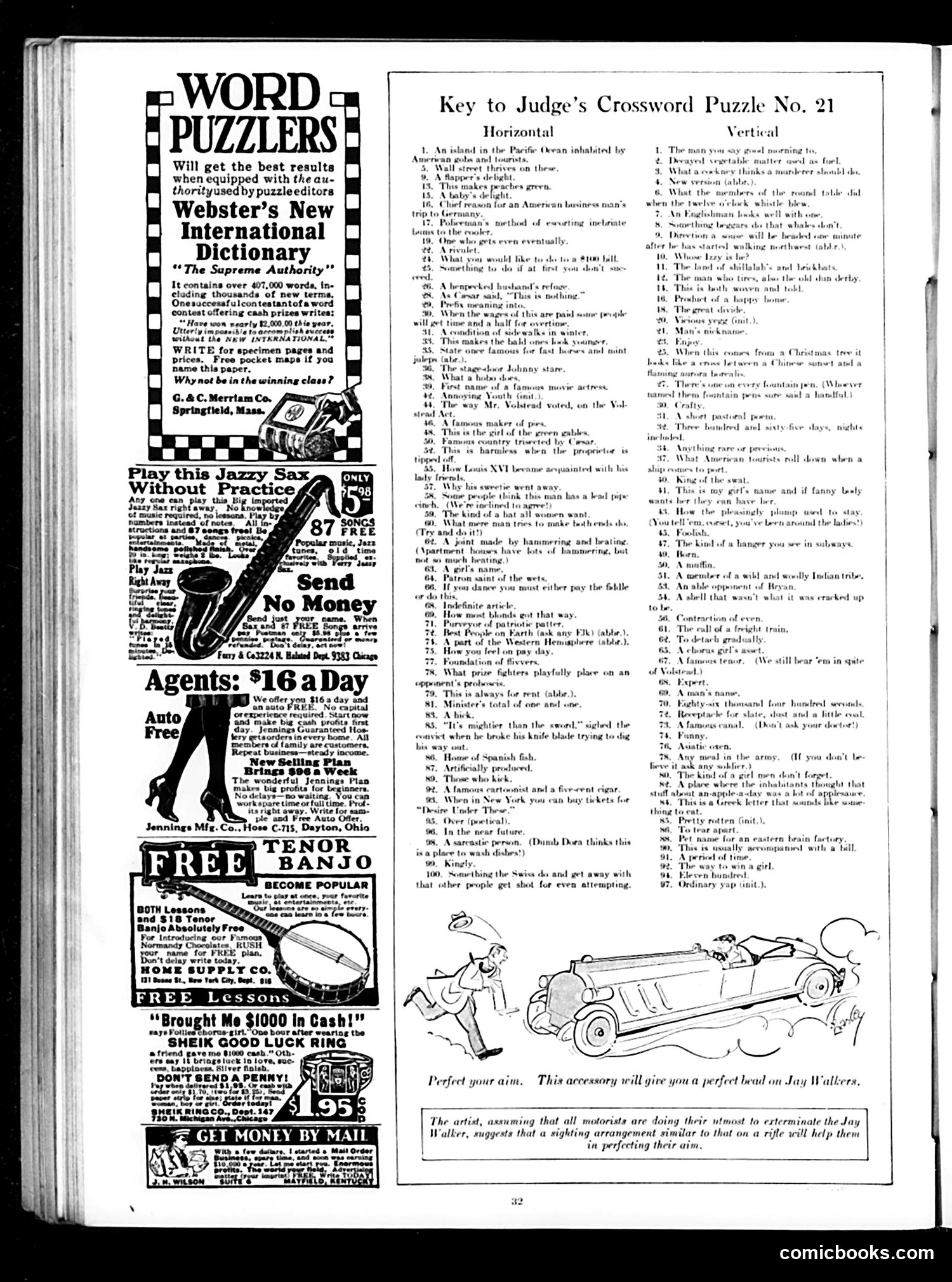
This page is primarily **advertising and puzzle content**, not political satire. The dominant feature is a **crossword puzzle answer key** with an accompanying cartoon. The cartoon at bottom shows a motorist aiming a rifle sight at a jaywalker—a darkly humorous visual joke. It satirizes both reckless drivers and pedestrians who ignore traffic laws. The caption suggests that aiming apparatus "will give you a perfect bead on Jay Walkers," equating pedestrian safety violations with hunting targets. This reflects 1920s anxieties about automobile safety and jaywalking, which was genuinely dangerous as cars became common. The page otherwise consists of vintage advertisements: a dictionary ad, a saxophone correspondence course, a "get rich quick" ring scheme, and a "Sheik Good Luck Ring" promising cash winnings—typical period marketing exploiting readers' financial hopes. The puzzle itself contains dated cultural references (Louis XVI, Volstead Act prohibition references, early film actresses) relevant to 1920s readers.
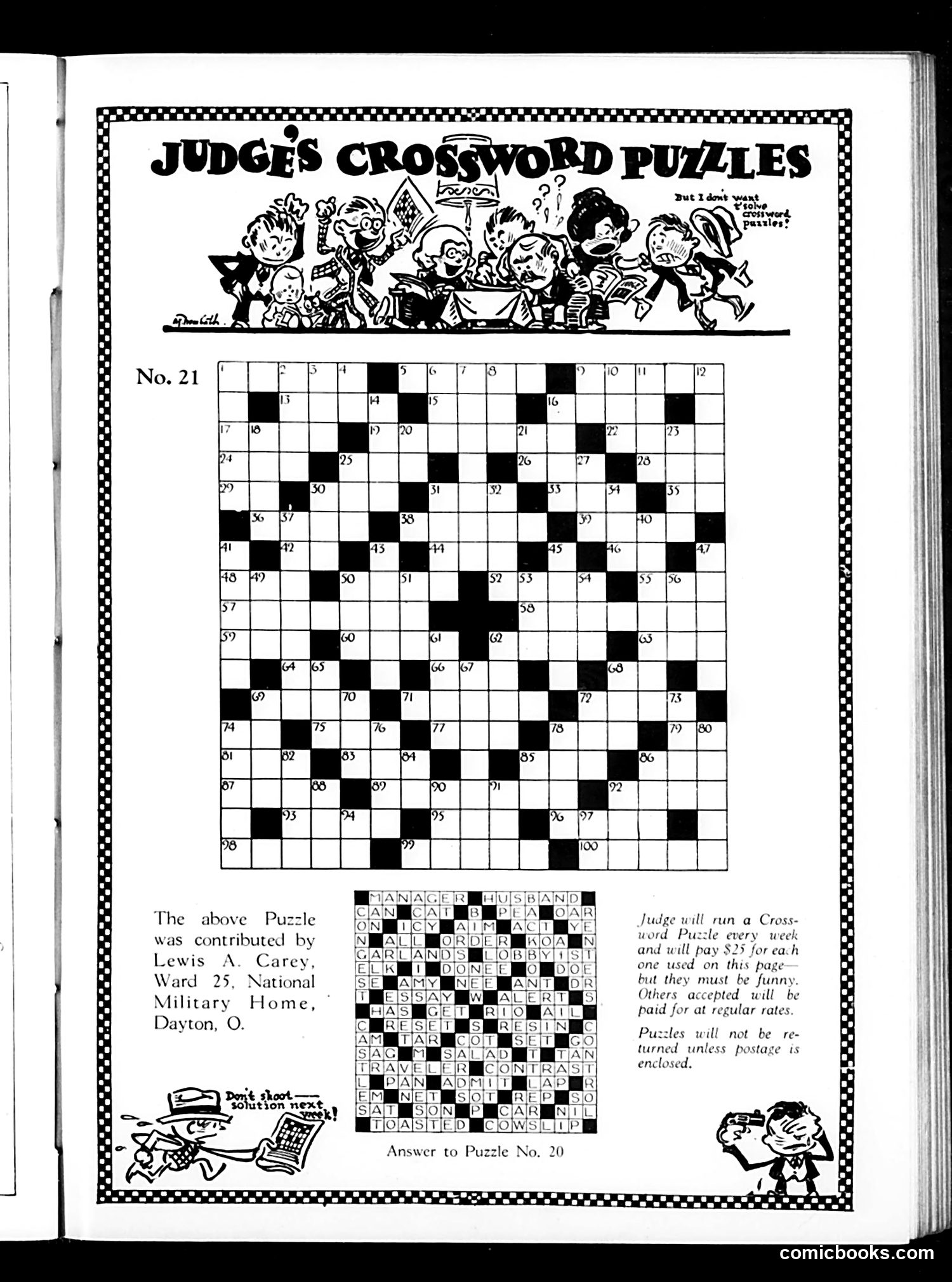
This page features "Judge's Crossword Puzzles," No. 21, a standalone crossword puzzle with no political or social satire evident. The content is purely recreational—Judge magazine is running a weekly crossword puzzle competition, paying $25 for accepted puzzles that meet their humor standards. The puzzle was contributed by Lewis A. Carey from the National Military Home in Dayton, Ohio. The page includes the answer key to the previous week's puzzle (No. 20). Cartoon illustrations of children frame the content, reflecting the lighthearted nature of the feature. This represents Judge's expansion into entertainment beyond political satire during this period.
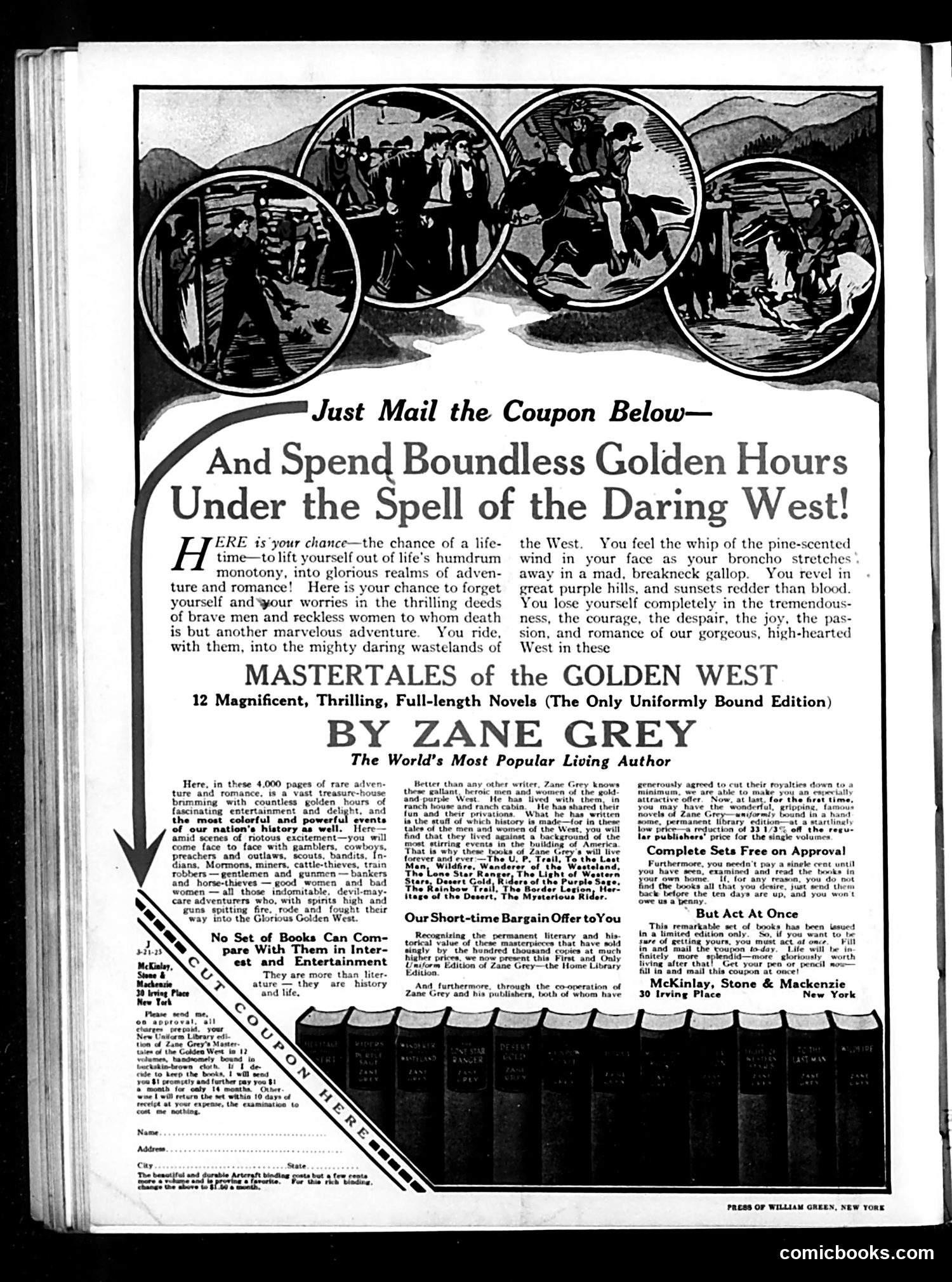
This is **primarily a full-page advertisement**, not a political cartoon. It promotes "Mastertales of the Golden West," a 12-book collection by author Zane Grey, published by McKinlay, Stone & Mackenzie. The page uses nostalgic Western imagery (four circular vignettes showing frontier scenes: gunfights, saloon confrontations, and outdoor adventures) to market escapism. The ad's rhetoric—"lift yourself out of life's humdrum monotony"—appeals to early 20th-century readers seeking fantasy adventure. The text emphasizes Grey's "authority" as someone who "lived with" frontier figures, positioning these novels as both entertainment *and* historical documentation. A mail-in coupon offers a limited-edition set with a trial period ("free on approval"). **The satire, if any, is unintentional**: the overwrought prose about "daring wastelands" and "gorgeous, high-hearted West" now reads as parody, but it represents genuine marketing tactics from Judge magazine's era when such romantic Westerns were genuinely popular.