
Judge, 1925-03-21 · page 17 of 36
Judge — March 21, 1925 — page 17: what you’re looking at
What you’re looking at
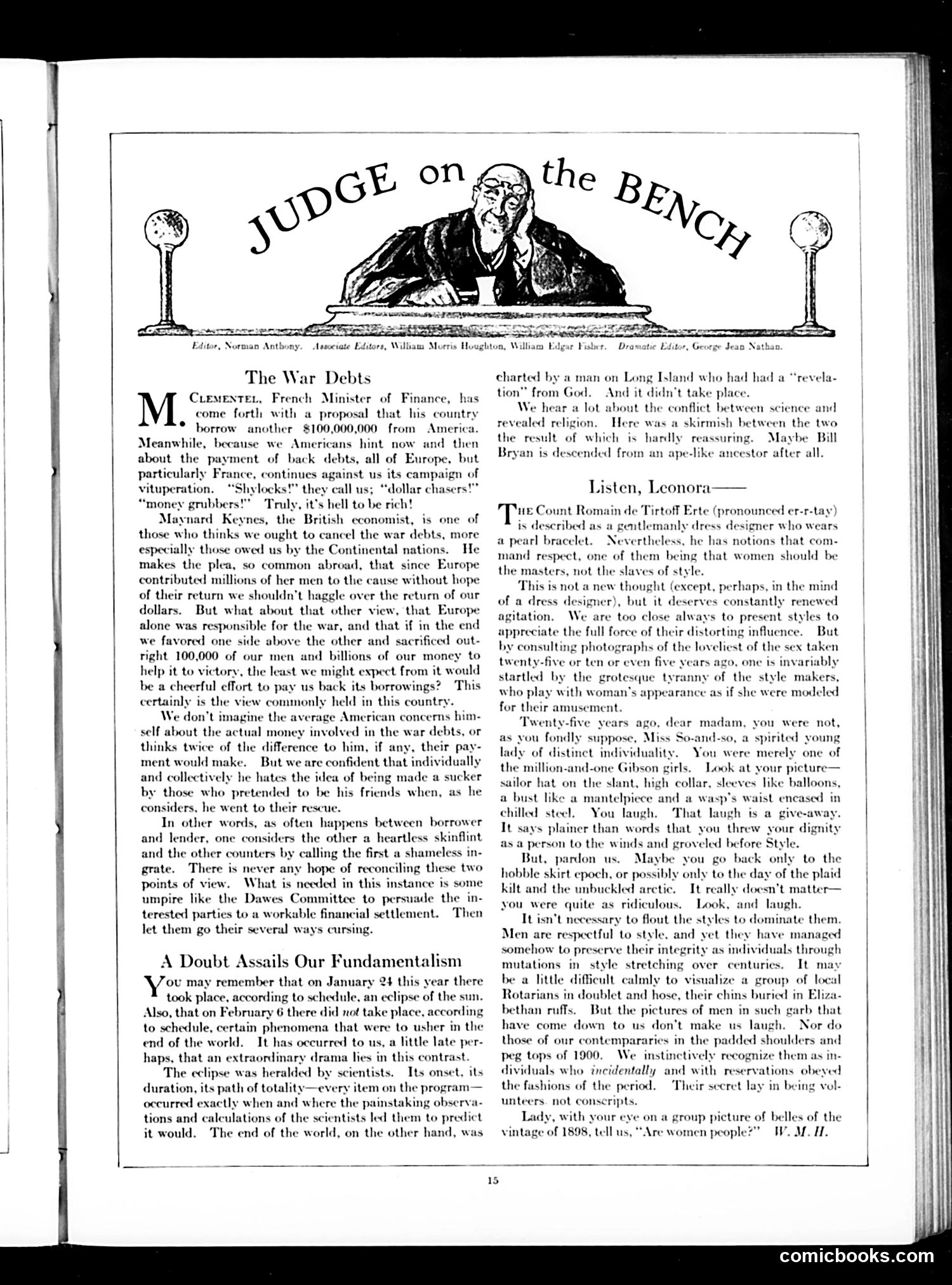
This page contains two satirical pieces: **"The War Debts"** critiques post-WWI financial tensions. France's Finance Minister Clemenceau seeks another $100 million loan from America while European nations insult Americans as "dollar chasers" and "money grubbers." The article sarcastically notes this hypocrisy: Europe expects debt forgiveness despite being responsible for the war, yet resents America for expecting repayment after sacrificing lives and money to aid them. The piece reflects genuine 1920s American frustration with European ingratitude regarding war loans. **"A Doubt Assails Our Fundamentalism"** mocks religious fundamentalism by contrasting scientists' accurate eclipse prediction with a Long Island man's failed God-given prophecy about the world's end (likely referencing William Miller's failed 1844 prediction or similar). The joke: science proves reliable while literal religious prophecy fails, undermining fundamentalist claims. The final jab at William Jennings Bryan suggests even he may descend from ape-like ancestors—a dig at his anti-evolution stance. Both articles satirize contemporary American debates: international finance and science versus religious literalism.
📄 Transcribed text from this page (OCR, searchable)
Machine-transcribed from the original scan — historical spelling and the odd misread are preserved.
Editor, Norman Anthony. Associate Editors, Williams M The War Debts CLementer, French Minister of Finance, has M come forth with a proposal that his country * borrow another $100,000,000 from Americ: Meanwhile, because we Americans hint now and then about the payment of back debts, all of Europe, but particularly France, continues against us its campaign of vituperation. hylocks!”” they call us; “dollar chasers!” 7 y grubbers!’ Truly, it’s hell to be rich! Maynard Keynes, the British economist, is one of those who thinks we ought to cancel the war debts, more especially those owed us by the Continental nations. He makes the plea, so common abroad, that since Europe contributed millions of her men to the cause without hope of their return we shouldn't haggle over the return of our dollars. But what about that other view, that Europe alone was responsible for the war, and that if in the end we favored one side above the other and sacrificed out- right 100,000 of our men and billions of our money to help it to victory, the least we might expect from it would be a cheerful effort to pay us back its borrowings? This certainly is the vi pmmonly held in this country. We don’t imagine the average Am n concerns him- self about the actual money involved in the war debts, or thinks twice of the difference to him, if any, their pay- ment would make. But we are confident that individually and collectively he hates the idea of being made a sucker by those who pretended to be his friends when, as he considers, he went to their rescue. In other words, as often happens between borrower and lender, one considers the other a heartless skinflint and the other counters by calling the first a shameless in- grate. There is never any hope of reconciling these two points of view. What is needed in this instance is some umpire like the Dawes Committee to persuade the in- terested parties to a workuble financial settlement. Then let them go their several ways cursing. A Doubt Assails Our Fundamentalism ‘ou may remember that on January 24 this year there took place, according to schedule, an eclipse of the sun. Also, that on February 6 there did not take place, according to schedule, certain phenomena that were to usher in the end of the world. It has occurred to us, a little late per- haps, that an extraordinary drama lies in this contrast. The eclipse was heralded by scientists. duration, its path of totality—every occurred e: tions and it would. Its onset, its item on the program— actly when and where the painstaking observa- Iculations of the scientists led them to predict The end of the world, on the other hand, was ghito charted by a man on Long Island who had had a “revela- tion” from God. And it didn’t take place. We hear a lot about the conflict between science and vealed religion. Here was a skirmish between the two the result of whieh is hardly reassuring. Maybe Bill Bryan is descended from an like ancestor after all. Listen, Leonora—— ne Count Romain de Tirtoff Erte (pronounced er-r-tay) is described as a gentlemanly dress designer who w a pearl bracelet. Nevertheless, he has notions that com- mand respect, one of them being that women should be the masters, not the slaves of style. This is not a new thought (except, perhaps, in the mind of a dress designer), but it deserves constantly renewed agitation. We are too close always to present styles to appreciate the full force of their distorting influence. But by consulting photographs of the loveliest of the sex t twenty-five or ten or even five years ago, one is invariabl) startled by the grotesque tyranny of the style makers, who play with woman's appearance as if she were modeled for their amusement. Twenty-five years ago, dear madam, you were not, as you fondly suppose, Miss So lady of distinct individuality. You were merely one of the million-and-one Gibson girls. Look at your picture— sailor hat on the slant, high collar, sleeves like balloons, a bust like a mantelpiece and a wasp’s waist encased in chilled steel. You laugh. That laugh is a give-away, It says plainer than words that you threw asa person to the winds and g But, pardon us. nd-so, a spirited young ur dignity led before Style. Maybe you go back only to the hobble skirt epoch, or possibly only to the day of the plaid kilt and the unbuckled arctic, It really doesn’t matter— you were quite as ridiculous. Look, and laugh. It isn’t necessary to flout the styles to dominate them. Men are respectful to style, and yet they have managed somehow to preserve their integrity as individuals through mutations in style stretching over centuries. It may be a little difficult calmly to visualize a group of local Rotarians in doublet and hose, their chins buried in Eliza- bethan ruffs. But the pictures of men in such garb that have come down to us don't make us laugh. Nor do those of our contempararies in the padded shoulders and peg tops of 1900. We instinctively recognize them as in- dividuals who incidentally and with reservations obeyed the fashions of the period. Their secret lay in being vol- unteers. not conscripts. Lady, with your eye on a group picture of belles of the vintage of 1898, tell us, “Are women people?” W. MH. comicbooks.com