
A complete issue · 36 pages · 1925
Judge — March 7, 1925
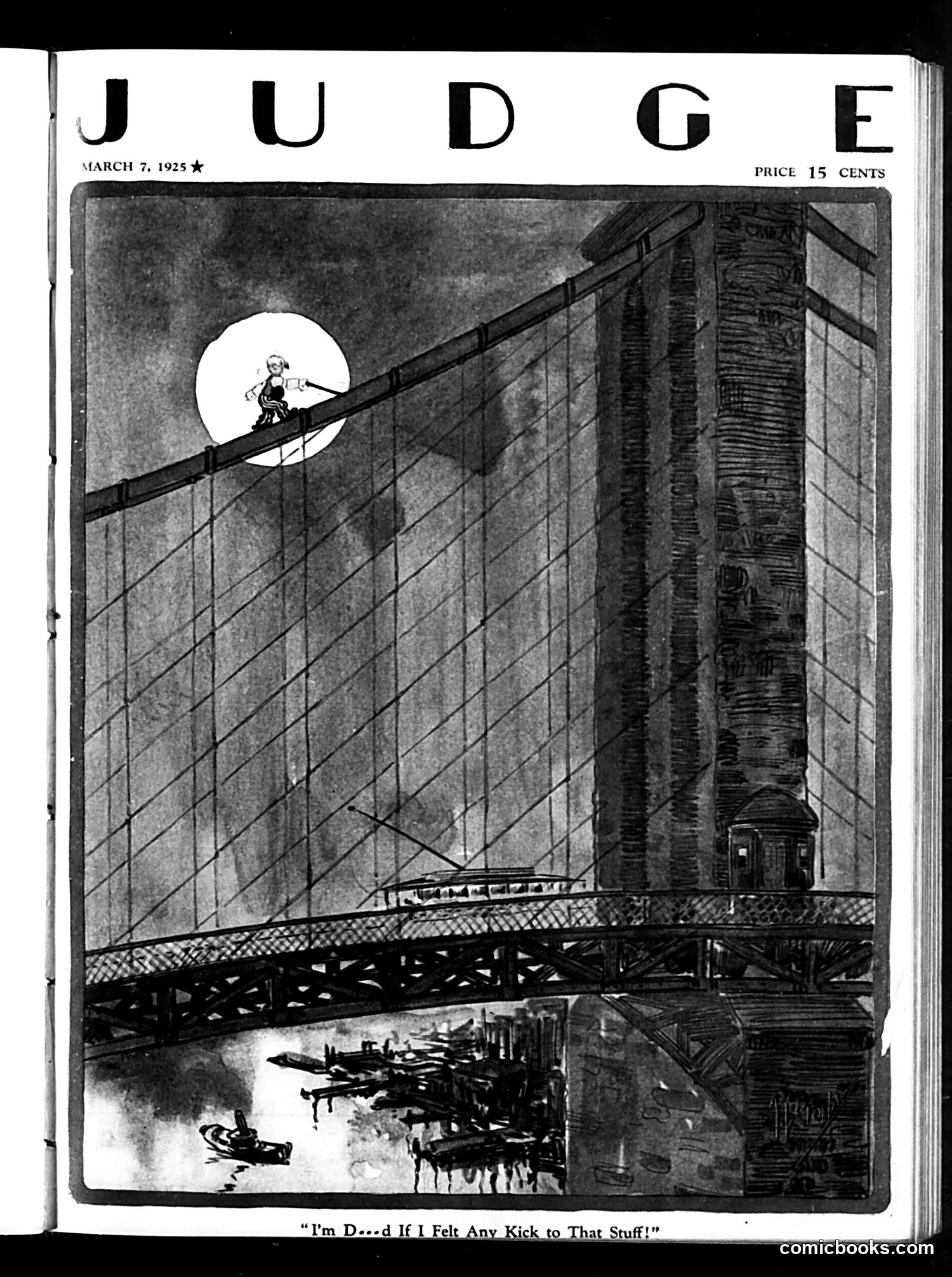
This cover depicts a dramatic silhouette scene: a figure walks a tightrope across a massive suspension bridge (likely the Brooklyn Bridge, given its iconic design), backlit by a full moon. Below is an industrial waterfront with ships and smokestacks. The caption reads: "I'm D—d If I Felt Any Kick to That Stuff!" The image appears to satirize **Prohibition-era concerns** about alcohol smuggling and bootlegging via waterfront routes. The tightrope walker likely represents someone engaged in the dangerous, illegal liquor trade—literally and figuratively walking a precarious line. The censored word (probably "Damned") and the boastful tone suggest commentary on bootleggers' recklessness or defiance during this period of illegal alcohol distribution.
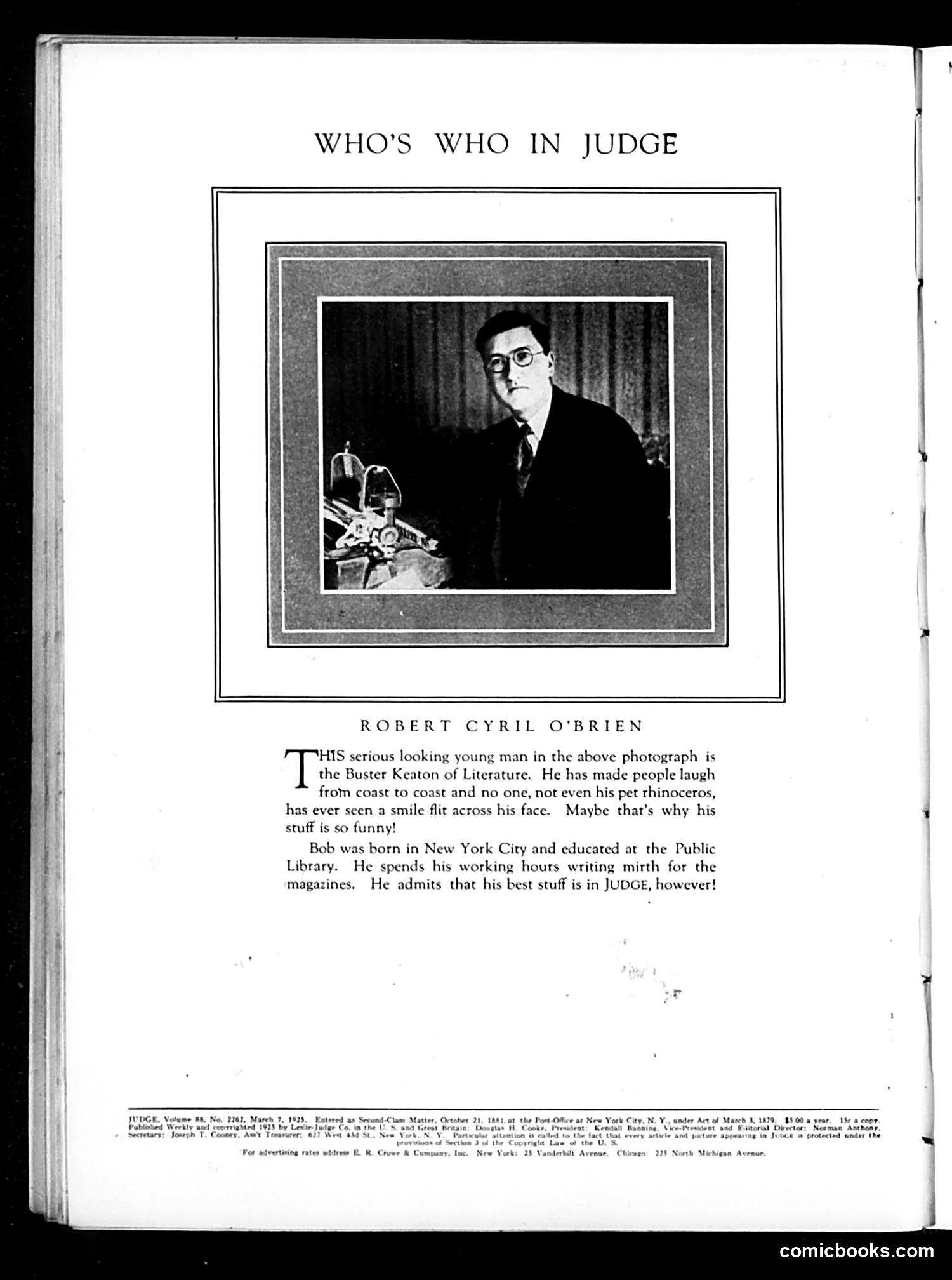
This is a **biographical profile page** rather than a political cartoon. It features **Robert Cyril O'Brien**, identified as the "Buster Keaton of Literature"—a humorist who wrote comedy for magazines. The satire plays on O'Brien's famously **deadpan expression**: the text jokes that he's so serious-looking that "no one, not even his pet rhinoceros, has ever seen a smile flit across his face," suggesting his humor comes from this contrast between his grim appearance and his funny writing. O'Brien was born in New York City, educated at the Public Library, and primarily wrote humorous pieces for magazines, though he preferred his work appearing in *Judge* specifically. This is essentially a celebrity profile celebrating a contributor to the magazine.
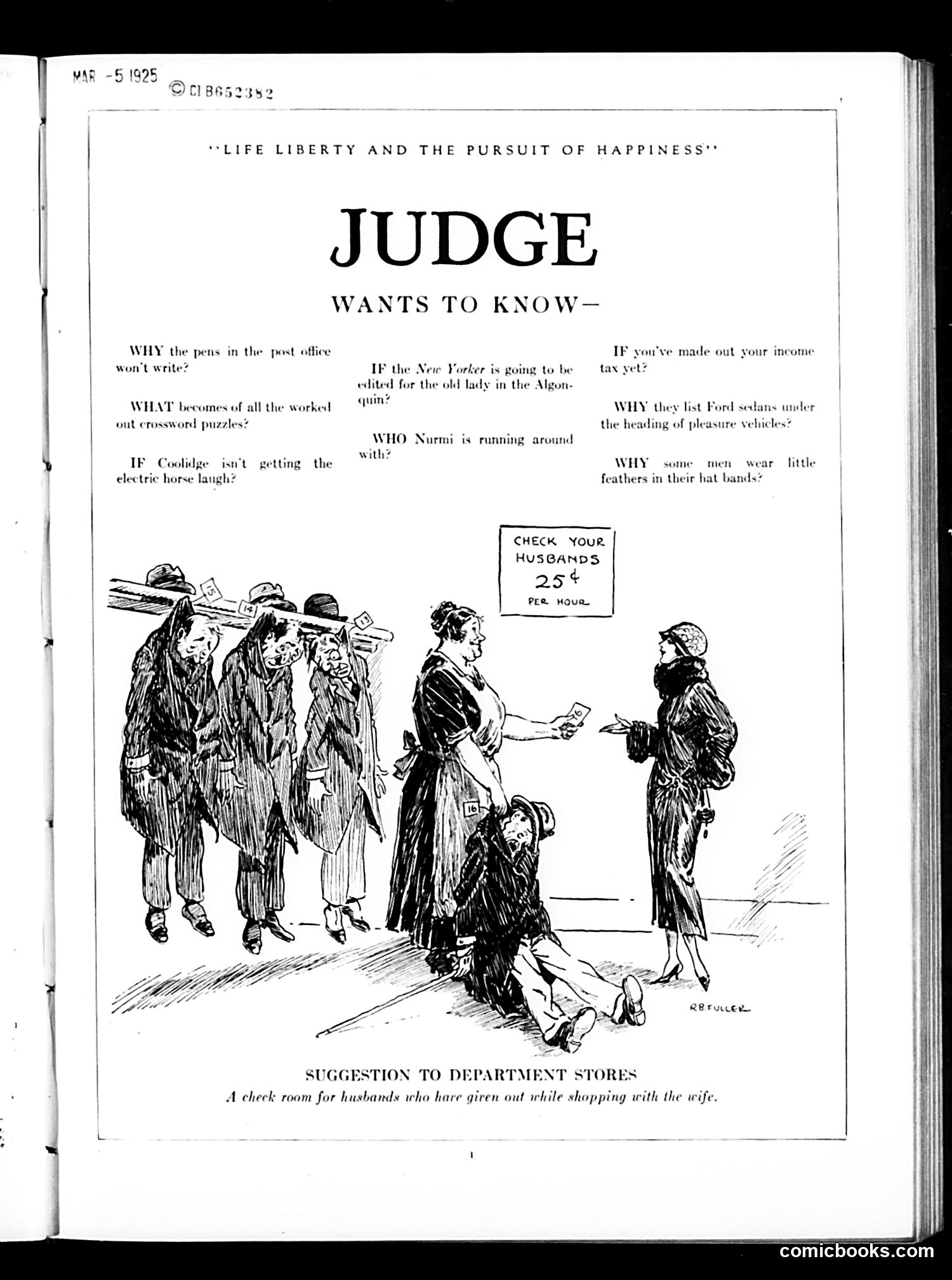
This satirical cartoon critiques gender dynamics and consumer culture of the 1920s. The main illustration shows a woman shopping while her husband waits at a "check room" staffed by attendants, paying 25¢ per hour for childcare-like supervision. The accompanying "questions Judge wants to know" are humorous non-sequiturs about contemporary trivia—references to The New Yorker magazine, Coolidge (President Calvin Coolidge), and Ford automobiles. The cartoon's satire targets husbands accompanying wives on shopping trips, depicting their waiting as equivalent to storing baggage or children. It reflects the era's gender assumptions about shopping as women's domain and men's reluctance to participate in retail, while simultaneously mocking the commercialization of leisure time through paid services.
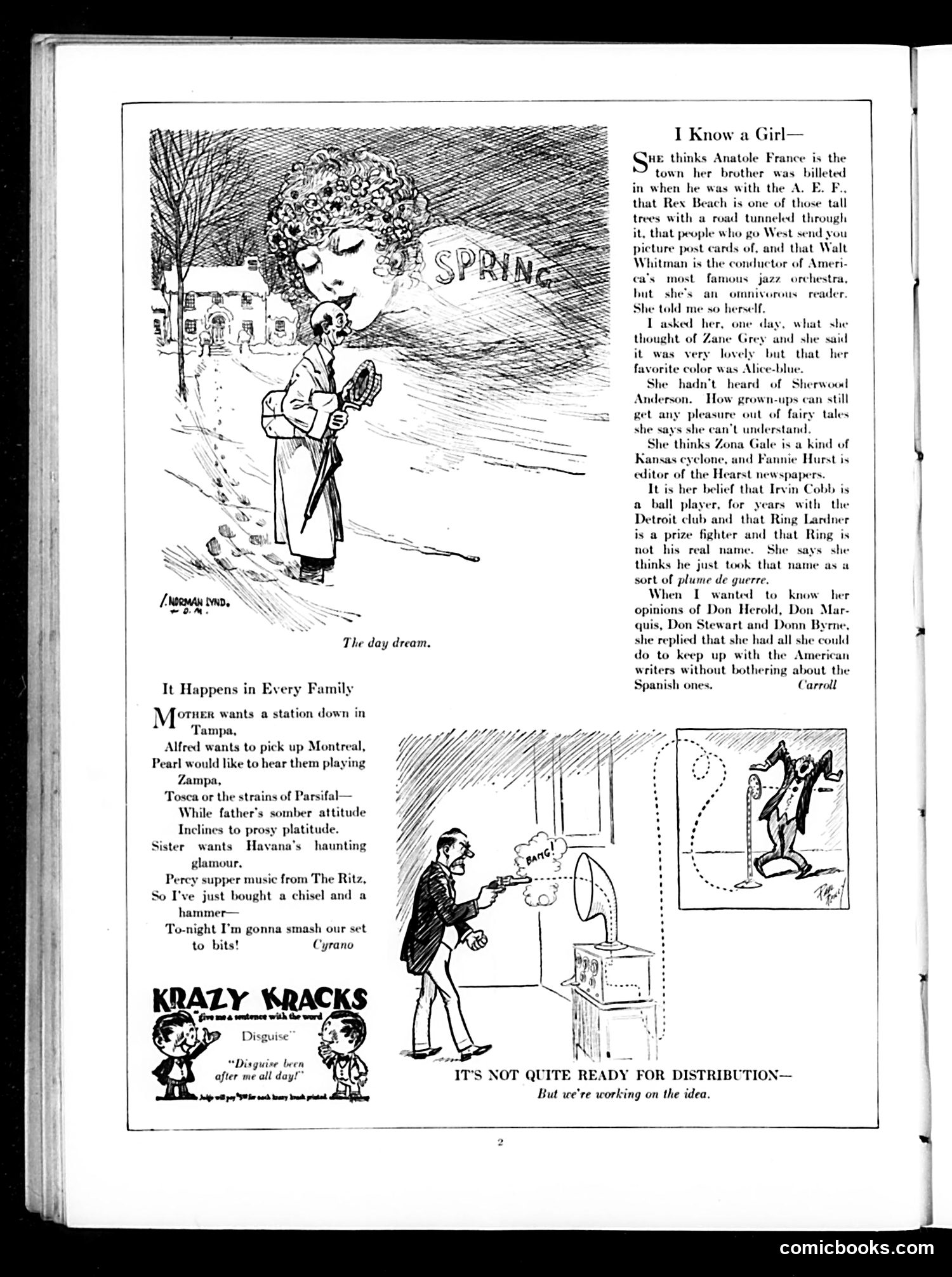
This page contains two distinct pieces: **"I Know a Girl"** (top): A gossipy column about a woman who holds opinions on various celebrities and cultural figures of the era—including Anatole France, Zane Grey, Sherwood Anderson, and boxer Ring Lardner. The satire targets how ordinary people casually discuss famous figures they've never met, often with superficial or contradictory knowledge. **"It Happens in Every Family"** (bottom): A humorous poem about family members' conflicting desires (Tampa station, Montreal, Parsifal opera, Havana, The Ritz) culminating in the narrator buying tools to "smash our set to bits"—satirizing how radio ownership creates household discord through competing entertainment preferences. The *Krazy Kracks* ad is unrelated product advertising.
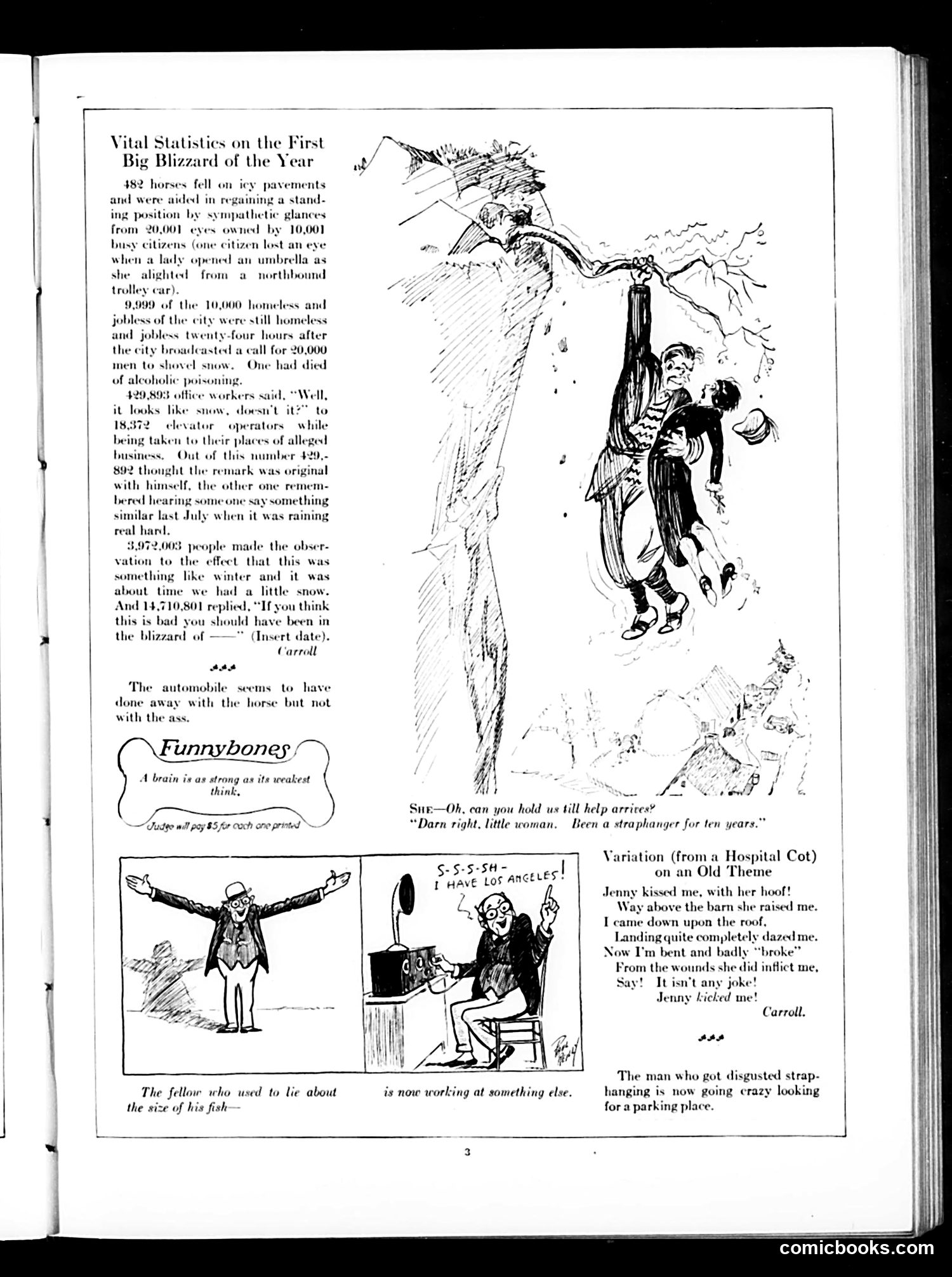
This page satirizes the "First Big Blizzard of the Year" through statistics and humorous illustrations. The main content mocks urban vulnerability to winter weather: 482 horses fell on icy streets, 9,000+ city jobless remained after snow removal efforts, and 129,892 elevator operators were reassigned. The central illustration shows a woman struggling through a blizzard, while lower cartoons depict a man celebrating survival ("The fellow who used to lie about the size of his fish—is now working at something else") and a woman losing Los Angeles in the snow, now "working at something else." The satire targets how unprepared modern cities are for winter, forcing workers into new jobs and creating chaos. The humor relies on exaggeration and the contrast between civilization's pretensions and nature's indifference.
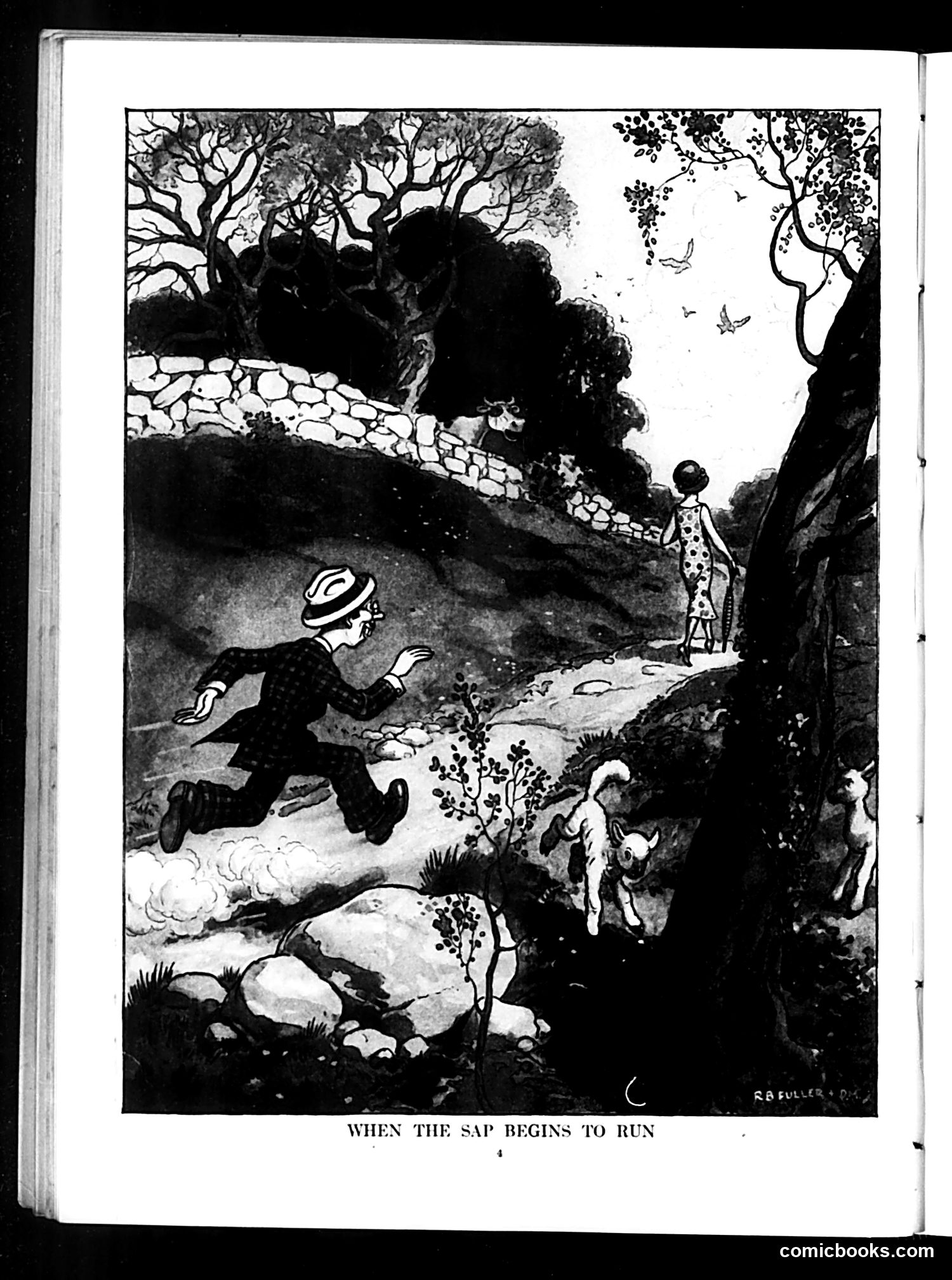
This illustration depicts a man in a straw hat and suit chasing after a woman in a patterned dress through a wooded landscape. The title "When the Sap Begins to Run" uses a double entendre—referring both to springtime tree sap and to male sexual desire awakening in spring. The cartoon satirizes the seasonal onset of romantic or lustful pursuit, portraying the man as eagerly chasing the woman. This reflects early 20th-century humor about spring as a season associated with courtship and romance. The artwork style and magazine context suggest this is lighthearted social commentary on seasonal human behavior and gender dynamics typical of *Judge* magazine's satirical approach.
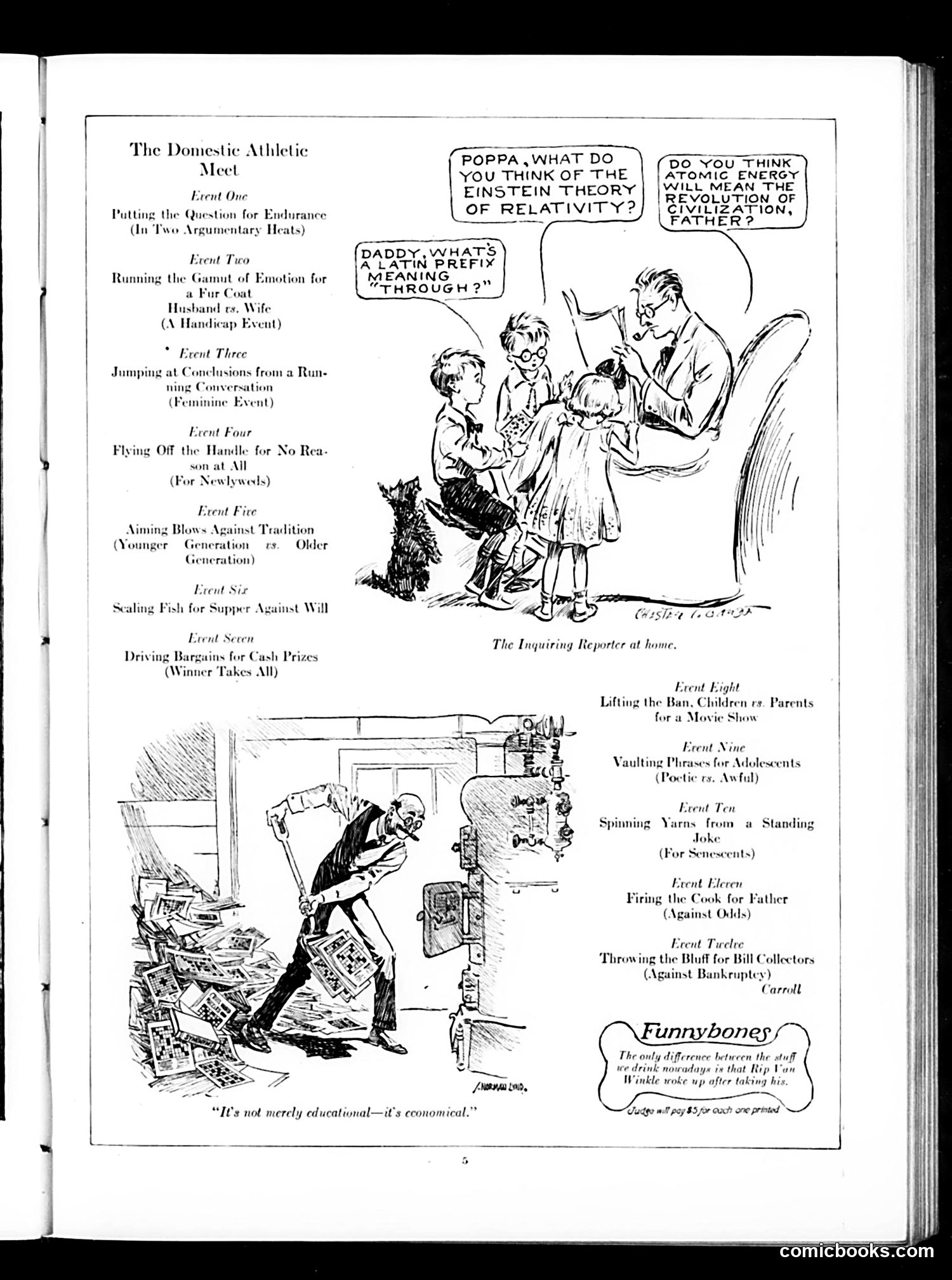
This satirical piece mocks the chaos of American family life through mock "sporting events." The top cartoon shows a father being interrogated by his children with absurdly intellectual questions ("Einstein theory of relativity," "atomic energy revolution"). The humor lies in children pestering adults with incomprehensible modern scientific concepts—satirizing both the era's fascination with new physics and parents' bewilderment. The lower cartoon depicts a man surrounded by bills and papers, captioned "It's not merely educational—it's economical." This mocks how families justify activities (likely referring to children's education or entertainment) by claiming economy, when costs clearly mount. The "Funnybones" section at bottom references Rip Van Winkle, likely joking about staff absences. Overall, the page satirizes modern domestic frustrations and generational disconnect.
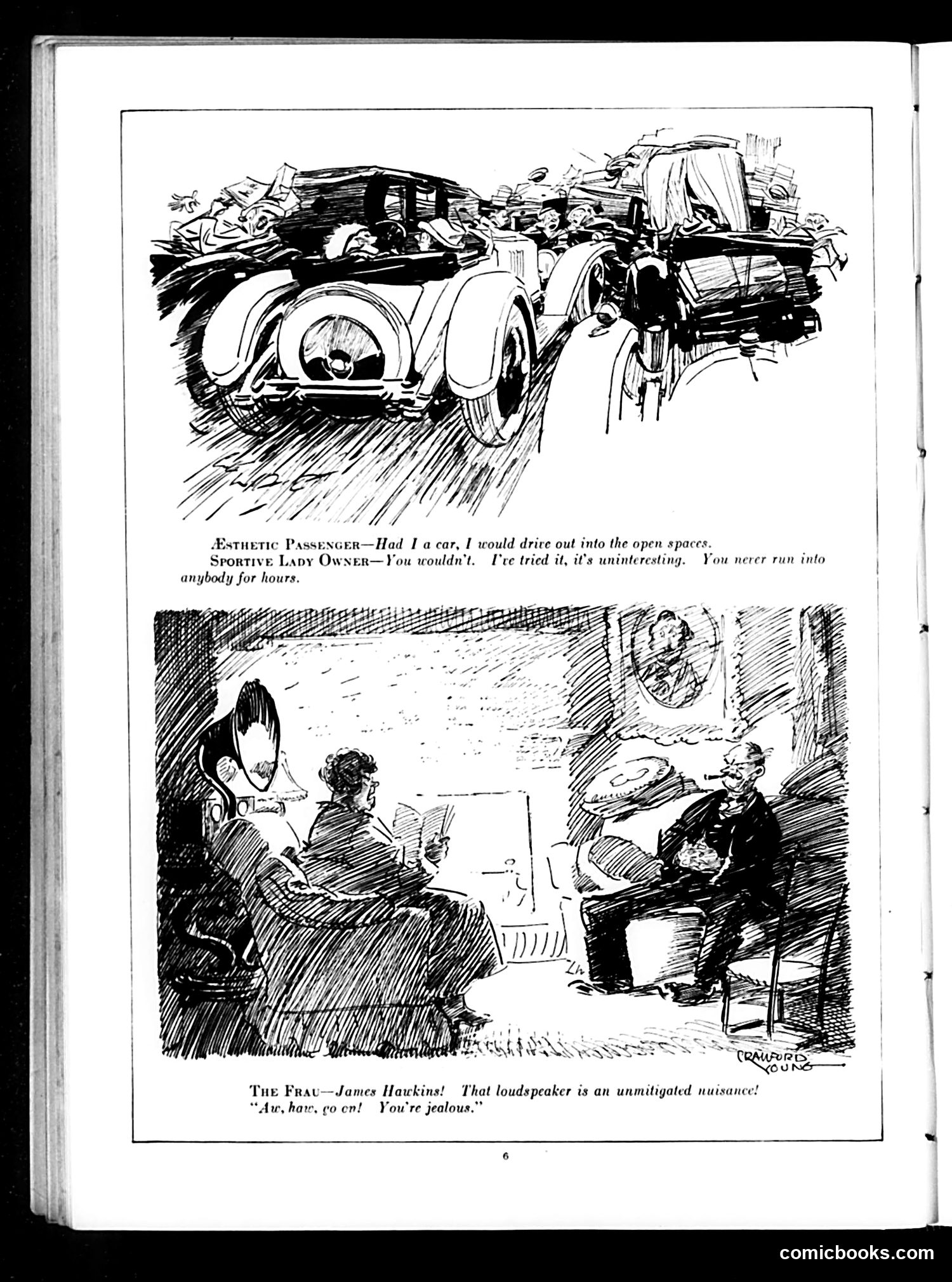
**Top Cartoon:** Satirizes romantic notions about automobile ownership. An "aesthetic passenger" fantasizes about driving into open countryside for solitude and contemplation. A "sportive lady owner" deflates this by revealing the reality: driving in the open is boring because you never encounter other people—implying the actual appeal of car ownership is social visibility and showing off. **Bottom Cartoon:** "The Frau" complains that a loudspeaker (likely a radio or gramophone) is annoying. A man named James Hawkins dismissively responds she's just "jealous," suggesting she's envious of the modern technology rather than genuinely bothered by noise. The joke mocks both his dismissive attitude toward legitimate complaints and the era's enthusiasm for new gadgets regardless of actual utility or nuisance factor. Both cartoons gently satirize 1920s-30s consumer culture and technological enthusiasm.
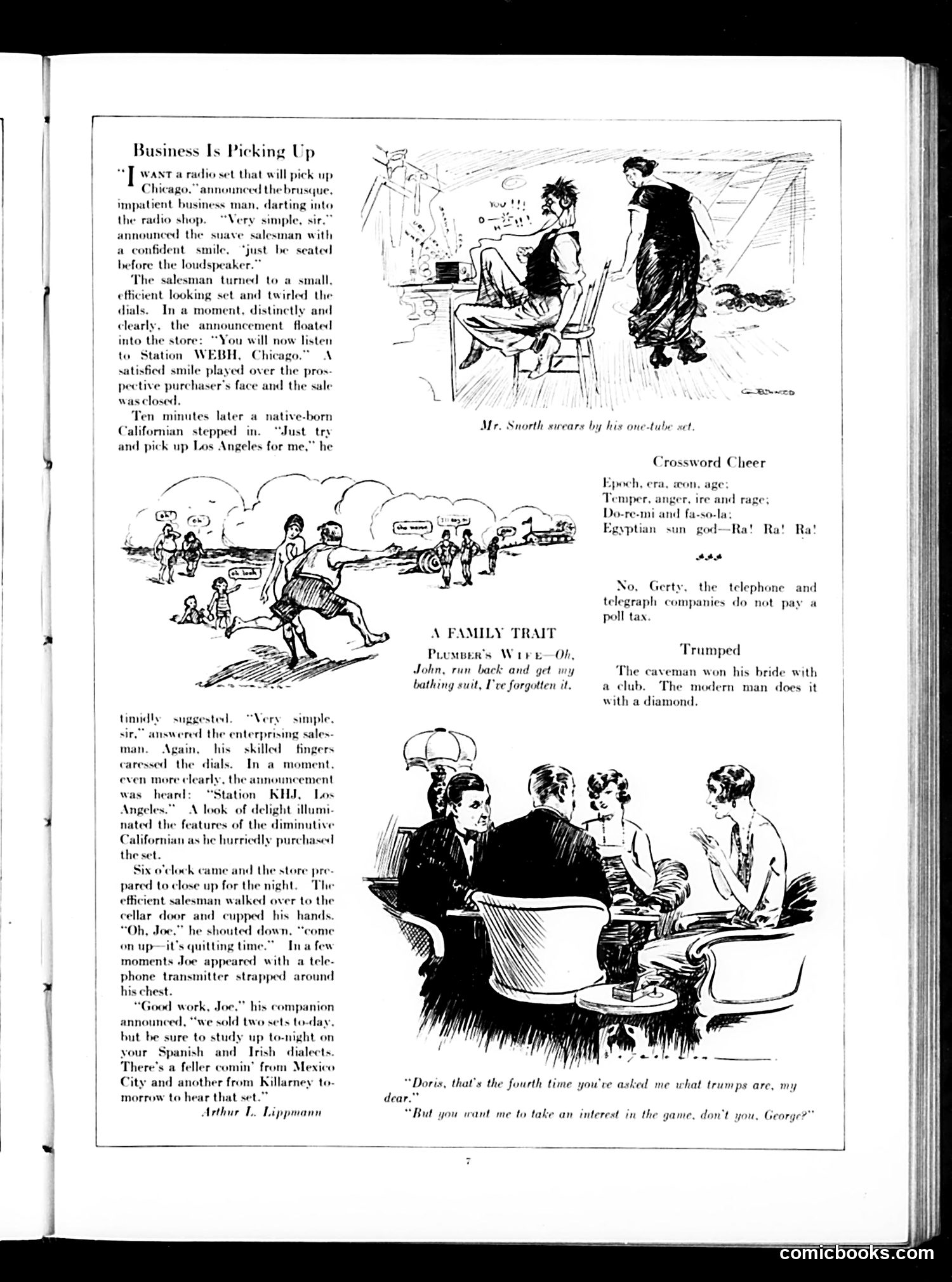
This satirical cartoon mocks 1920s radio sales practices. A clever radio shop salesman sells two customers by fraudulently tuning to their desired stations—Chicago and Los Angeles—through what appears to be legitimate radio reception. The punchline reveals the con: a man named Joe hidden in the cellar, speaking into a telephone transmitter strapped to his chest, impersonating radio broadcasts. The satire targets both deceptive salesmanship and early radio's still-mysterious technology. Consumers didn't fully understand how radio worked, making them vulnerable to such tricks. The joke also suggests radio's limited actual broadcast range at the time, requiring the "help" of a human operator to deliver what customers expected to hear.
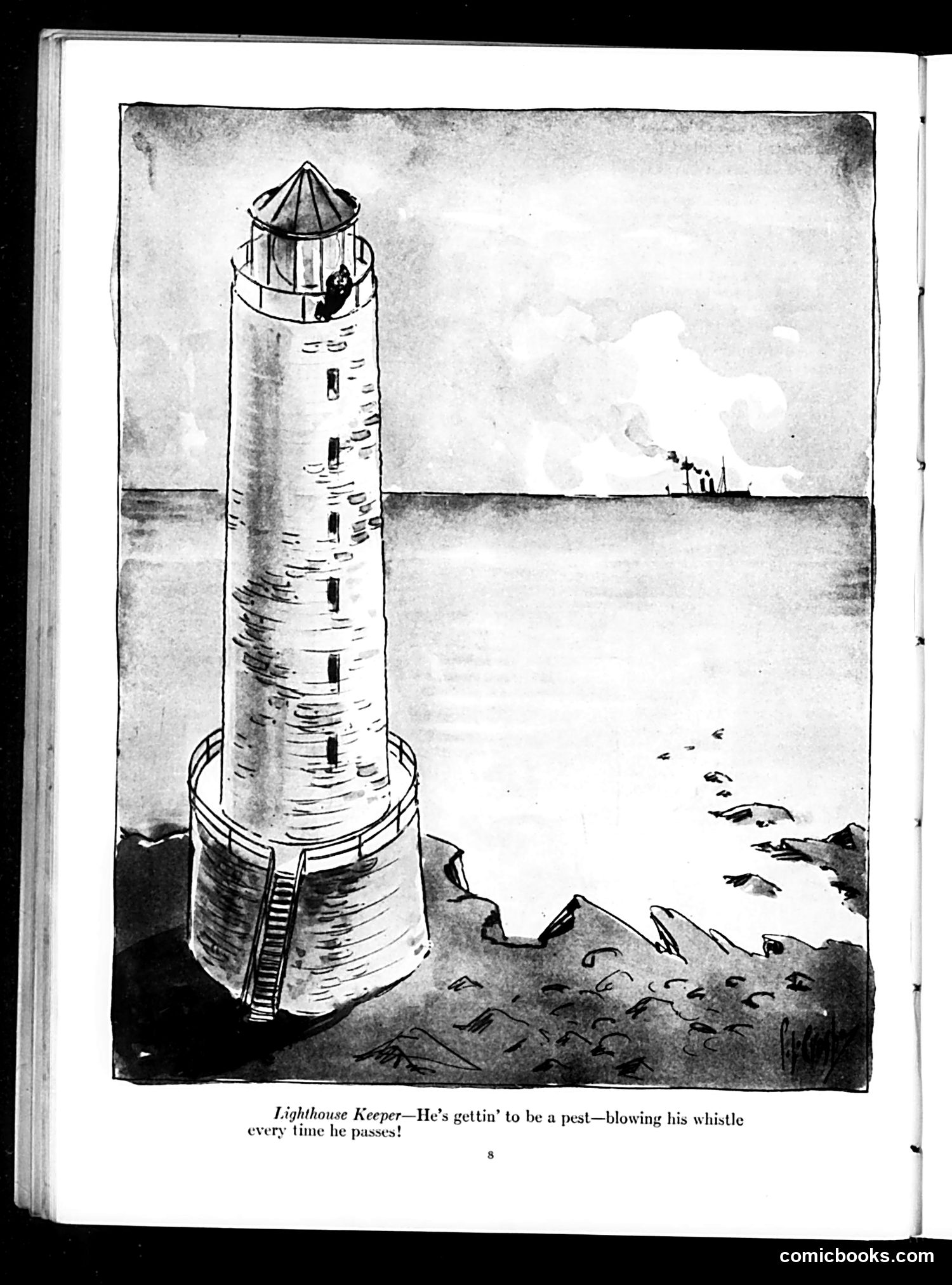
This cartoon depicts a lighthouse keeper in his tower, with the caption suggesting he's become "a pest" by constantly blowing his whistle. The joke appears to be a visual pun or play on words—likely referencing the lighthouse keeper's actual job (maintaining the light and warning ships) versus the complaint that he's making noise. Without additional context from the magazine's date or surrounding content, the specific satirical target remains unclear. It could reference a real person in a lighthouse keeper position, a public official, or use "lighthouse keeper" metaphorically. The humor seems to rest on the keeper being literally doing his job (whistling/signaling) while being criticized for it—possibly satirizing government inefficiency, unnecessary bureaucracy, or someone abusing their authority in a minor way. The crude drawing style is typical of early 20th-century magazine cartoons.
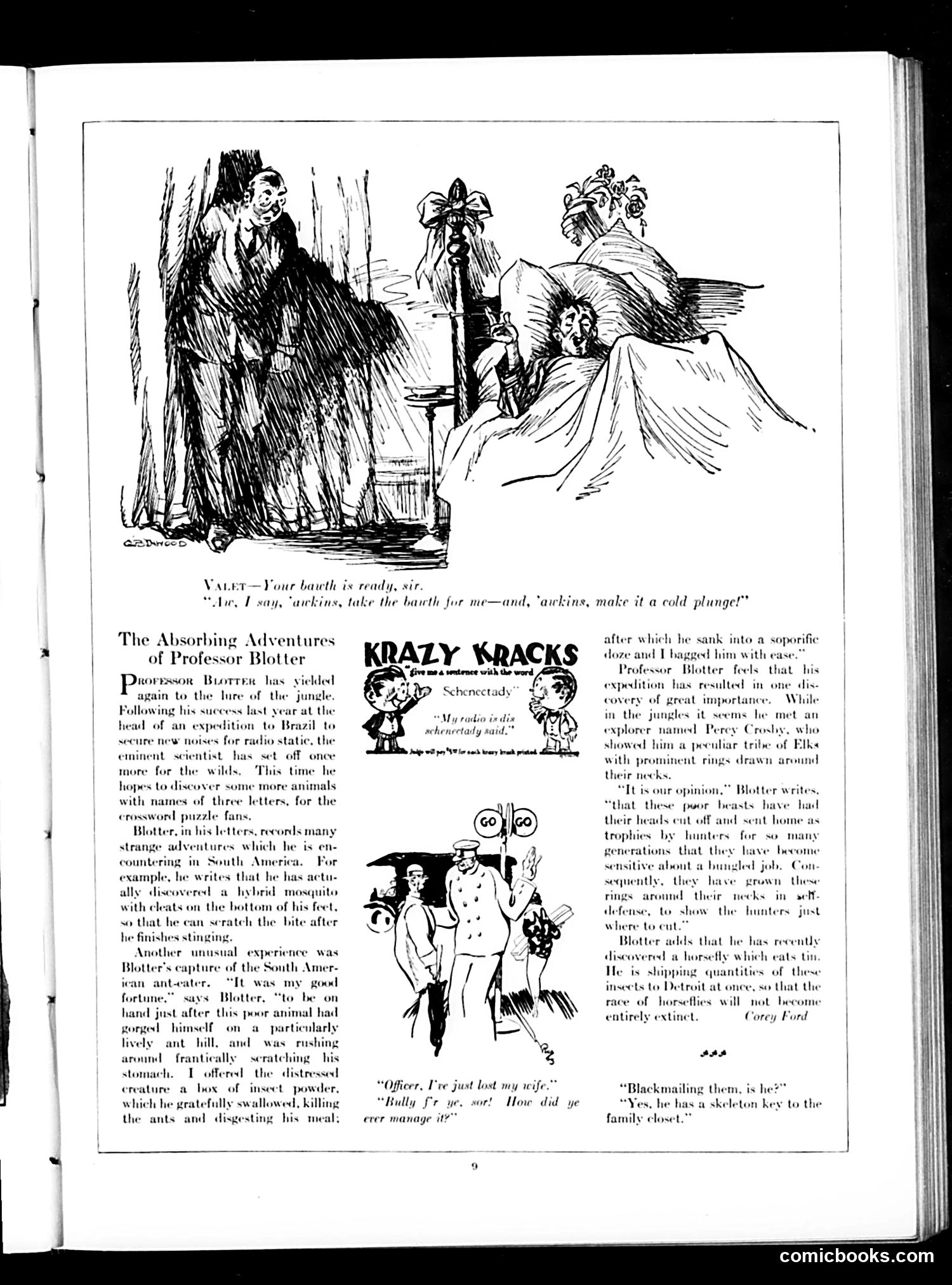
This page contains two separate humorous features: **"The Absorbing Adventures of Professor Blotter"** is a fictional travel narrative satirizing popular expedition literature. Professor Blotter, a scientist, recounts absurd discoveries in South America—including a three-letter-named animal (for crossword puzzles) and an anteater that gorges itself on ants. The humor derives from treating ridiculous situations with pseudoscientific seriousness. The piece appears to parody both academic pretension and the era's fascination with exotic exploration tales. **"Krazy Kracks"** is a joke section featuring brief gags. One plays on the word "Schenectady" (a New York city), another on a man "losing" his wife (implying he misplaced her rather than she died), and a blackmail joke about skeleton keys. The illustration style is typical early-20th-century cartooning. Without visible dates or bylines here, the exact publication date remains unclear, though the magazine format and references suggest roughly the 1920s-1930s era. The comedy relies on wordplay, absurdist situations, and gentle mockery of contemporary fads like crossword puzzles and radio technology.
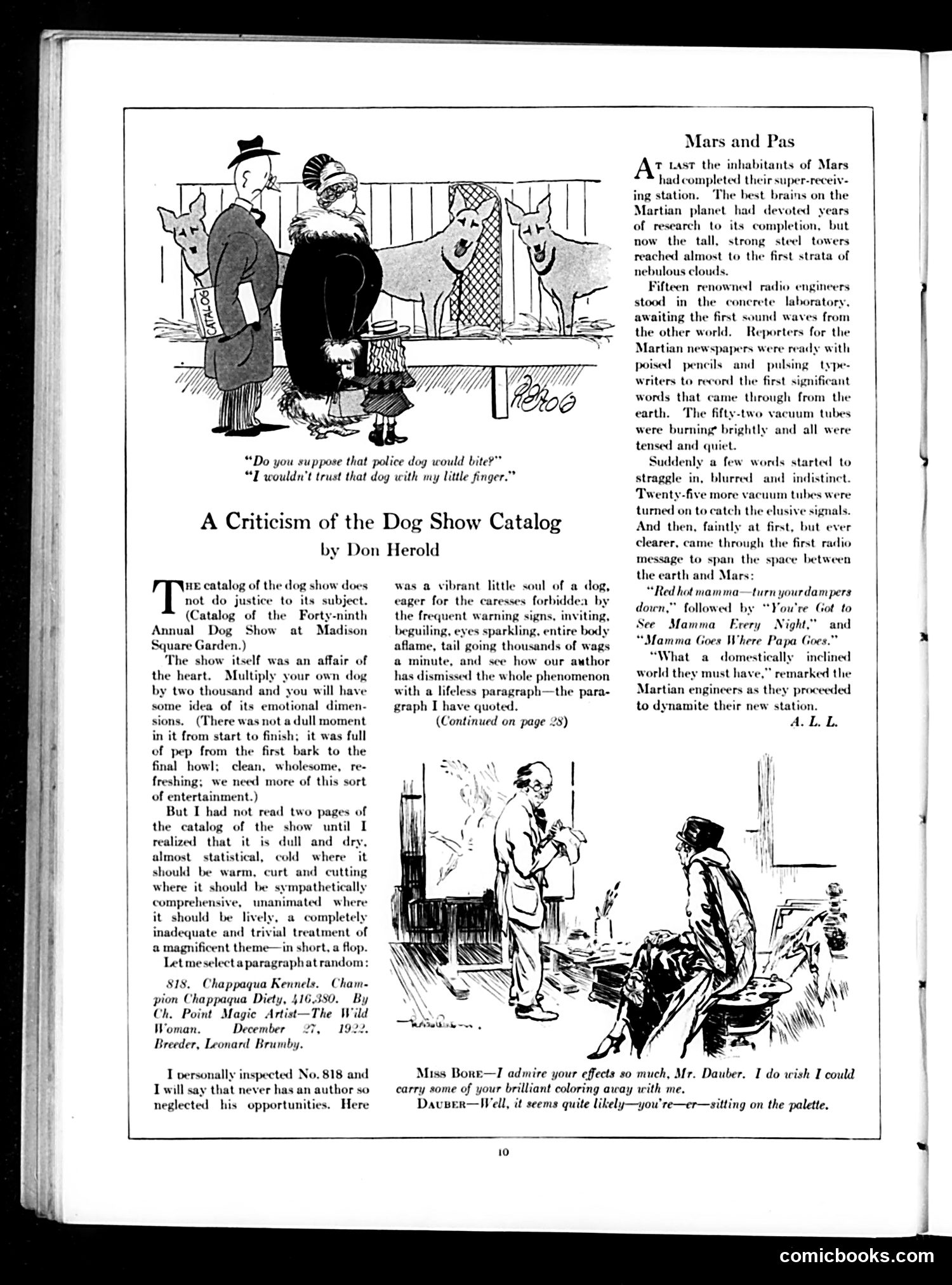
This Judge magazine page contains three satirical pieces: **"A Criticism of the Dog Show Catalog"** (top): Humorist Don Herold mocks the dry, statistical nature of dog show catalogs. He argues they fail to capture the vibrant personality of actual dogs, reducing living creatures to boring pedigree records. The humor lies in treating a dog catalog with the seriousness of literary criticism. **"Mars and Pas"** (right): A science fiction satire where Martians finally receive radio signals from Earth—only to hear popular 1920s jazz songs like "Red Hot Mamma." The joke: advanced alien civilization is disappointed by humanity's trivial popular culture, so they destroy their receiver. This reflects contemporary anxiety about mass entertainment's vapidity. **The cartoon** (bottom): A painter's assistant sits on his palette, ruining it. When complimented on his "brilliant coloring," the painter reveals she's literally contaminating his work through physical contact—a visual pun on her admiration causing damage. All three pieces use humor to critique their respective targets: institutional incompetence, shallow mass culture, and oblivious social interaction.
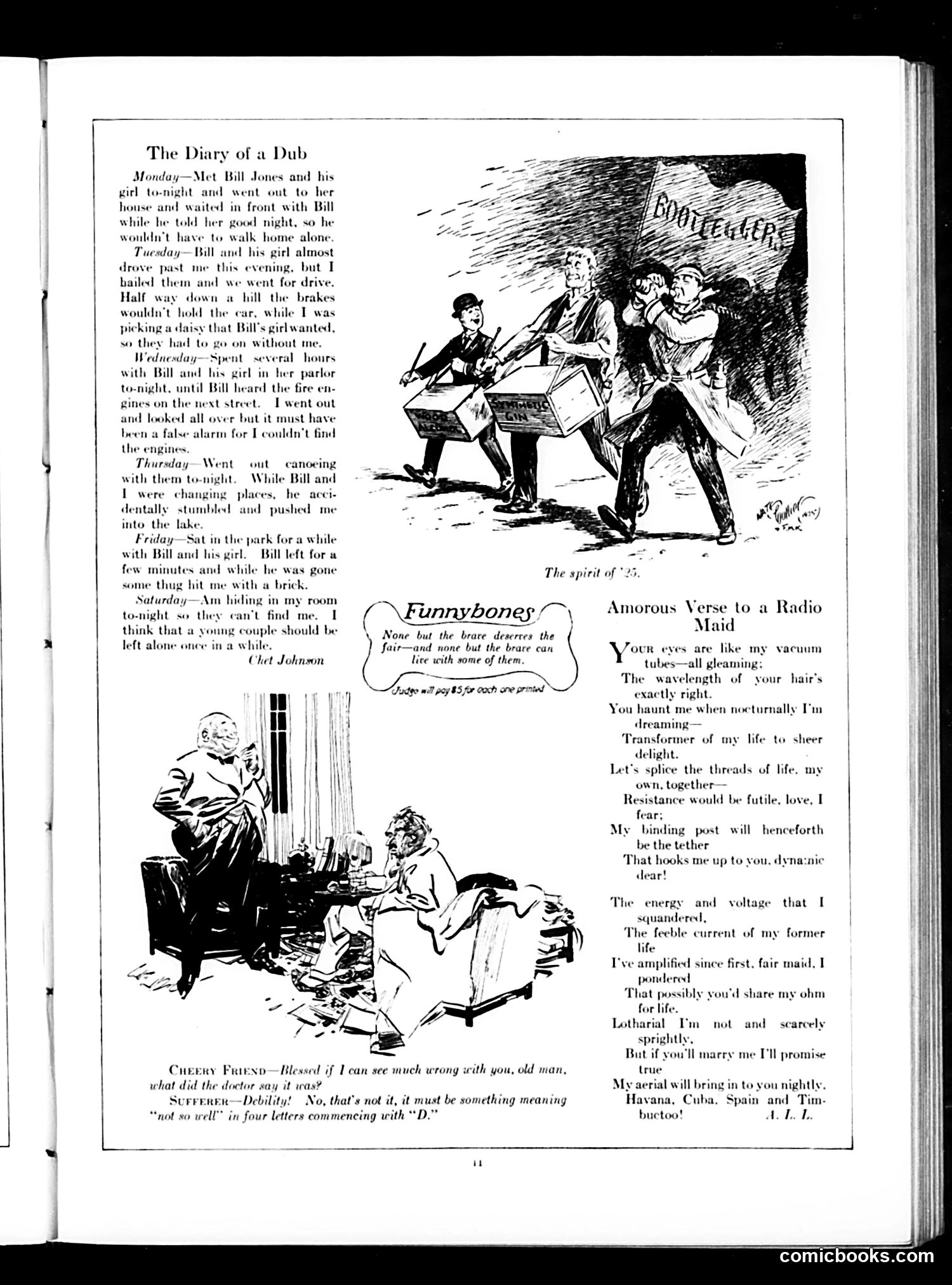
**"The Diary of a Dub"** satirizes a social parasite—a man who constantly third-wheels on his friend Bill's dates. Each day he engineers ways to insert himself into their romantic outings (waiting outside, joining their drive, sitting in their parlor, canoeing). The joke is that his desperate attempts to tag along backfire comically—brakes fail, he gets pushed into a lake, gets hit with a brick. The diary's final entry shows him hiding to escape them, with the moral that couples deserve privacy. **"Amorous Verse to a Radio Maid"** is a humorous poem using 1920s radio/electrical terminology as romantic metaphors—vacuum tubes, wavelengths, transformers, resistance, binding posts, ohms, aerials. It's flirting via technical jargon, reflecting the era's fascination with modern radio technology. Both pieces exemplify 1920s humor: social awkwardness and technophilia presented as comedy.
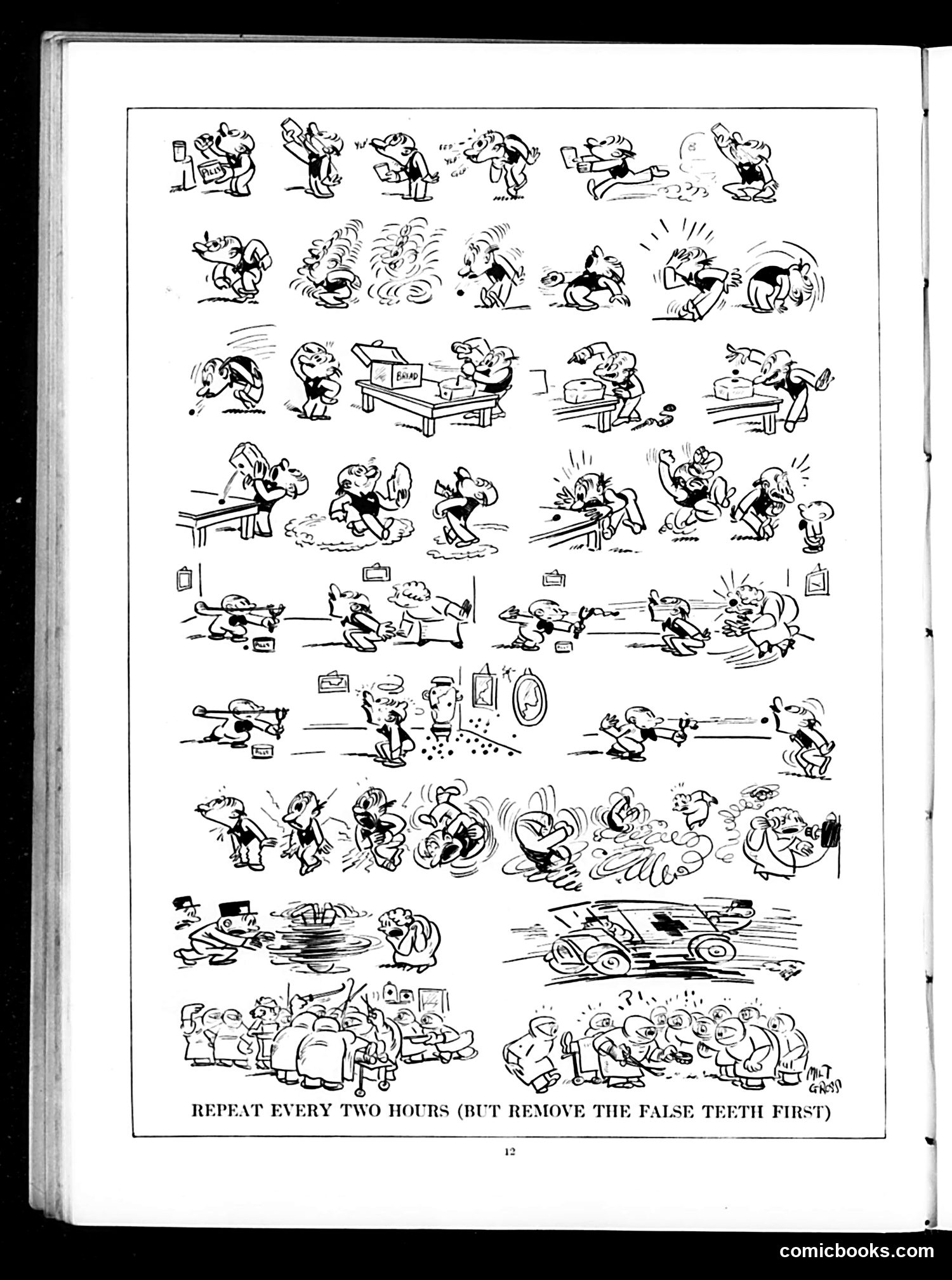
This page presents a visual gag about dentures and medication timing. The caption "REPEAT EVERY TWO HOURS (BUT REMOVE THE FALSE TEETH FIRST)" is the entire joke—a humorous instruction that plays on standard medicine bottle directions. The cartoon strips show various cartoon characters engaged in comedic physical activities and situations, illustrating what happens when someone forgets to remove their false teeth before repeating a dosage. The humor derives from the absurdist image of dentures being somehow incompatible with taking medicine or the resulting side effects. This appears to be a self-contained comic gag rather than political satire, using slapstick and physical comedy typical of Judge magazine's humor during the early-to-mid 20th century. The target audience would be readers familiar with common household items and aging-related stereotypes.
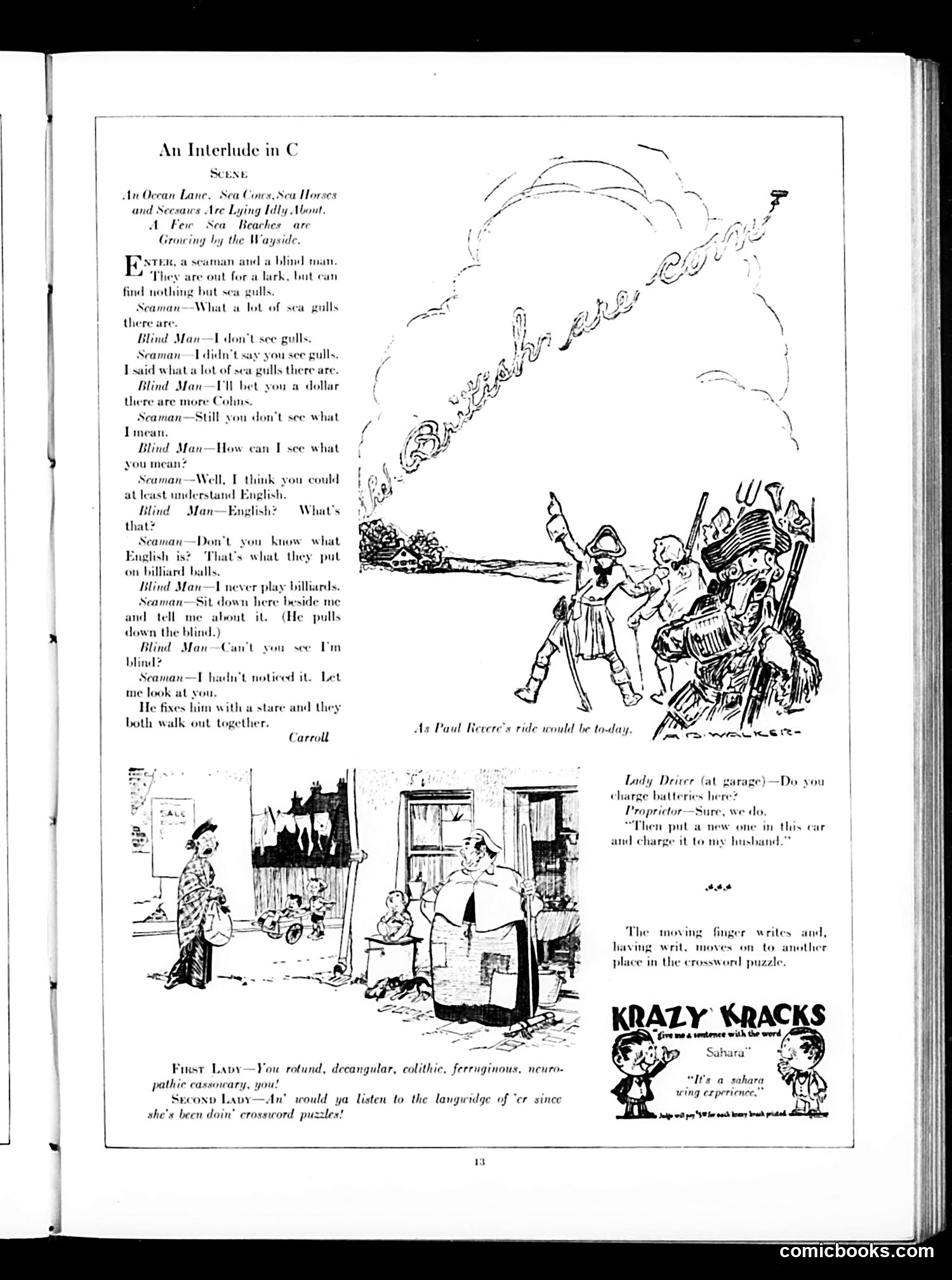
This page contains three distinct satirical pieces: **"An Interlude in C"** (top): A absurdist dialogue between a seaman and a blind man. The humor relies on deliberate misunderstandings—the seaman speaks nonsensically about "sea cows" and "seesaws" on beaches, then defines "English" as markings on billiard balls. The joke mocks pretentious or circular reasoning and someone feigning not to notice obvious facts. **"Lady Driver" (middle)**: Brief sketch satirizing women drivers of the era as oblivious consumers. The female driver asks the proprietor to charge a new car battery to her husband, suggesting women were depicted as financially dependent and impractical about automotive mechanics. **"Krazy Kracks" (bottom): Two pieces mocking crossword puzzle enthusiasts. One criticizes a woman using fancy vocabulary ("rotund, decangular") from puzzles in everyday speech. The other features children using "sahara wing experience" (likely "safari wing experience"?), suggesting crossword solving makes people absurdly pedantic. **Overall theme**: This page ridicules modern fads—nonsensical wordplay, women's independence, and crossword puzzle obsession—typical of 1920s-30s Judge satire.
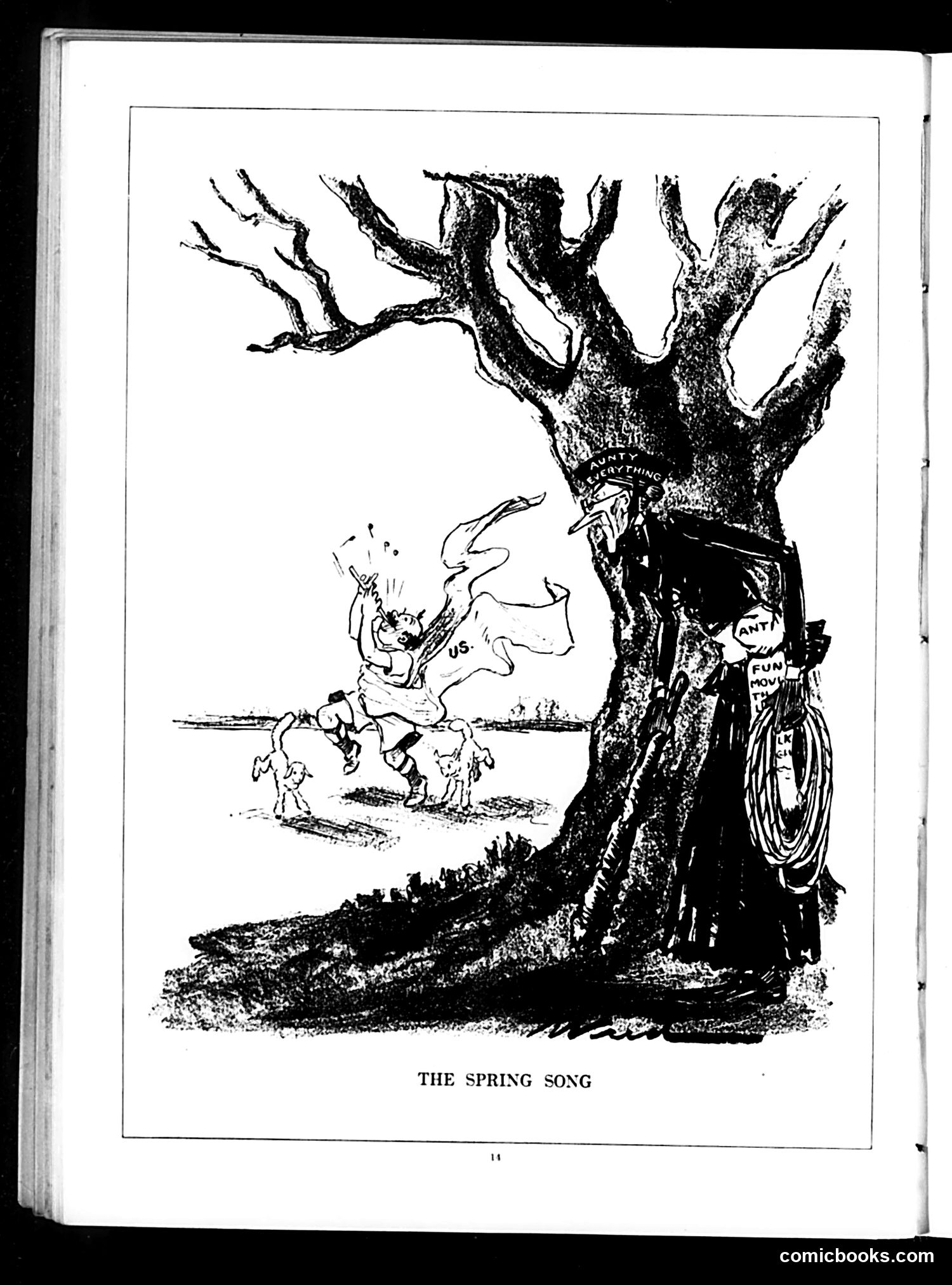
This cartoon depicts a gnarled, ancient tree—labeled with text that appears to reference "Bunty" and "Everything"—beside which animals (likely rabbits or hares) play or dance. A figure on the right, appearing to be dressed formally or in period clothing, watches the scene. The composition suggests a commentary on spring's arrival and natural renewal. Without clearer visibility of all labels and text on the tree, the specific political or social satire remains uncertain. The title "The Spring Song" suggests themes of renewal or seasonal hope. However, the exact targets of Judge magazine's satirical commentary—whether directed at politics, social movements, or cultural attitudes of the period—cannot be definitively determined from the image alone. The formal figure observing the natural scene may represent society or authority witnessing social change.
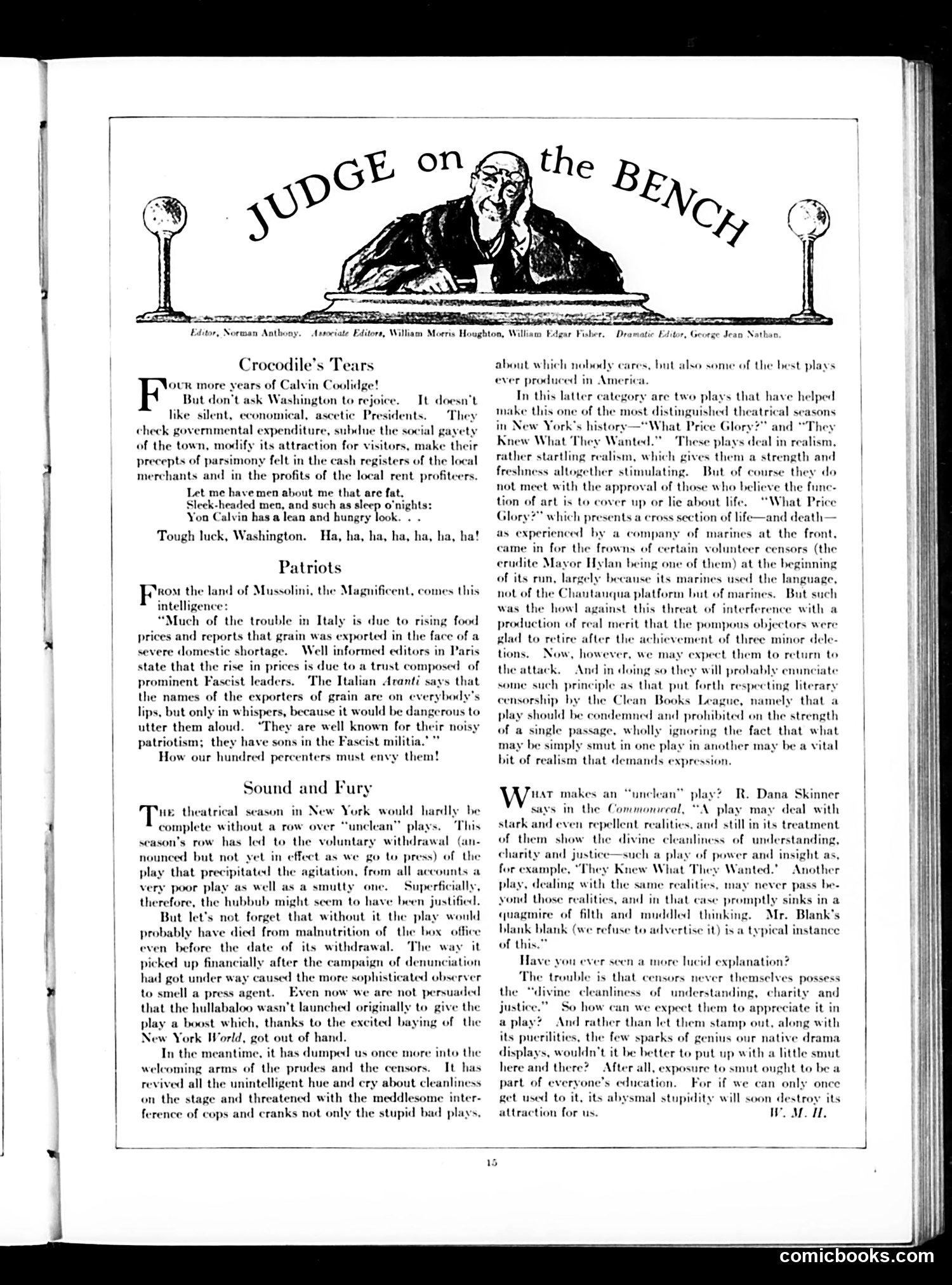
This page from Judge magazine contains three satirical columns attacking political and social hypocrisy in 1920s America. **"Crocodile's Tears"** mocks President Calvin Coolidge's reputation for fiscal restraint. The satire notes Washington celebrates Coolidge's economical nature while continuing wasteful spending—a reference to his campaign promises versus actual government expenditure. **"Patriots"** targets Benito Mussolini's fascist Italy, where grain is allegedly exported while citizens starve due to price-fixing by fascist leaders. The joke: American nationalists ("hundred percenters") admire Italian fascists for their patriotism, yet those same "patriots" secretly profit from their own citizens' suffering. **"Sound and Fury"** defends provocative plays like "What Price Glory?" against censorship campaigns. The author suggests moral crusaders use obscenity complaints as publicity stunts, then weaponize outrage to suppress genuine art. Mayor Hylan's censorship attempt is criticized as pompous interference with realistic depiction of wartime language. All three columns share a theme: exposing contradictions between stated principles and actual behavior among America's political and moral authorities.
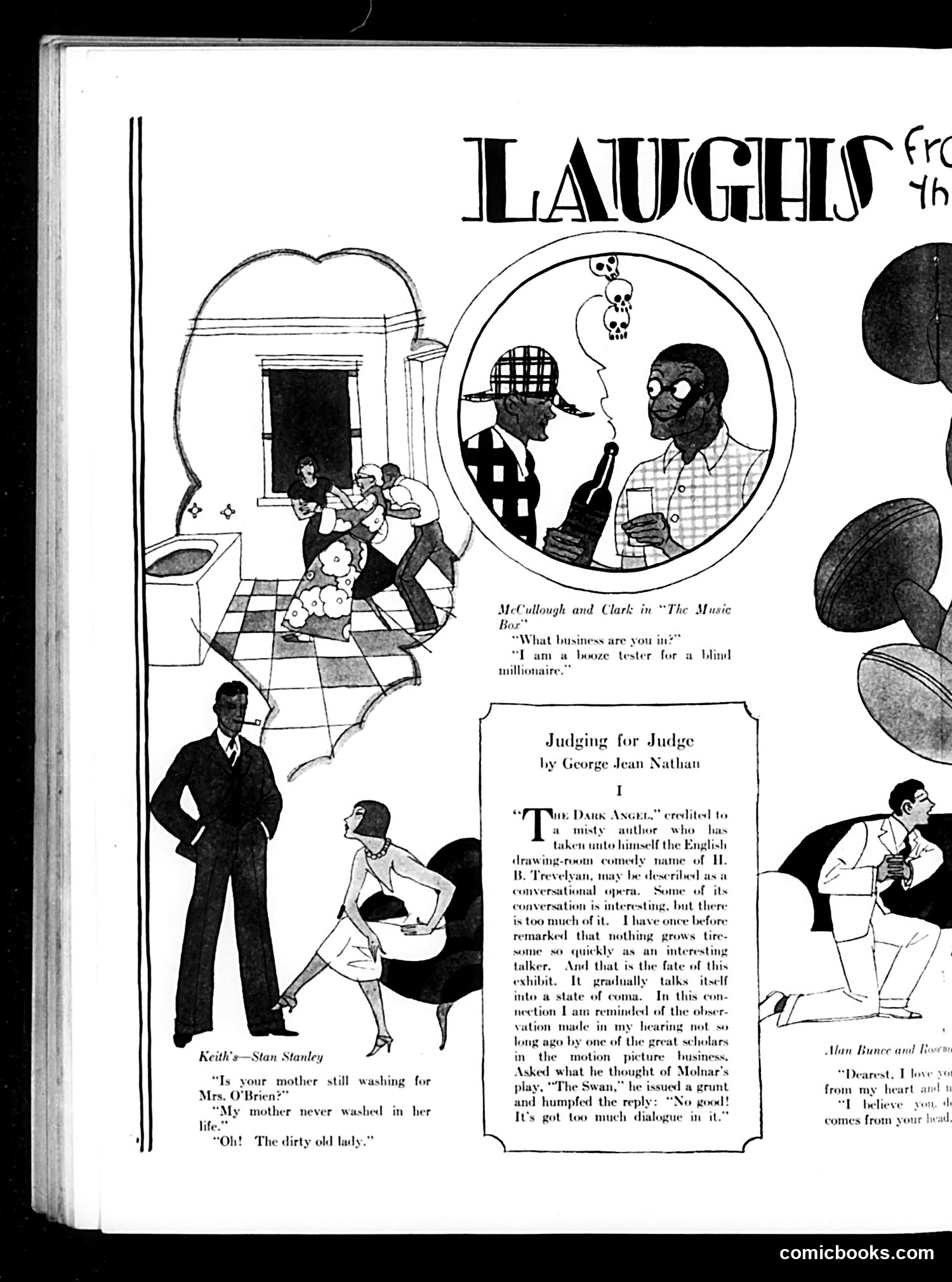
This page contains satirical humor typical of early 20th-century Judge magazine. The central content is George Jean Nathan's theater review column critiquing a play called "The Dark Angel" (attributed to a pseudonymous author "H.B. Trevelyan"). Nathan argues the play suffers from excessive dialogue, noting that "nothing grows tiresome so quickly as an interesting talker." The surrounding cartoons illustrate this critique through jokes. One features McCullough and Clark's film "The Music Box," with a character claiming to be a "booze tester for a blind millionaire"—humor based on Prohibition-era absurdity. Another shows a tired domestic exchange about a mother's laundry habits. The satire targets theatrical excess and verbosity—a common complaint in theater criticism of this era. The cartoons reinforce Nathan's point that endless talking, however witty, becomes tedious. The references to specific actors (Stan Stanley) and contemporary films ground the humor in recognizable entertainment figures of the period.
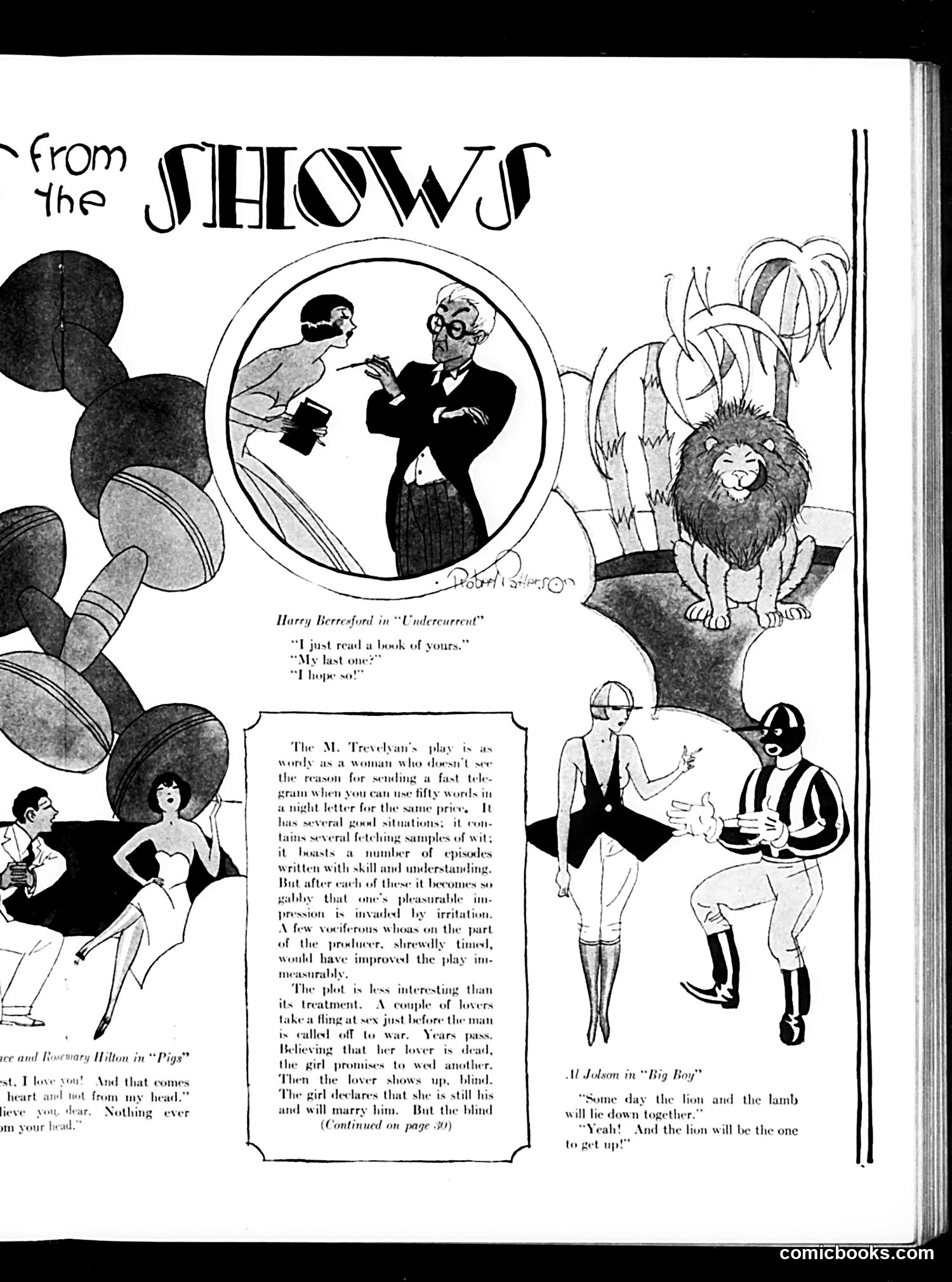
This page reviews theatrical productions currently playing, presenting them through satirical commentary and illustrated scenes. **Content identified:** The main review discusses M. Trevelyan's play, criticizing it as overly wordy—using fifty words where ten would suffice. The critic praises its "good situations" and "wit" but complains the play becomes tedious and "gabby." He suggests the producer needed to "cut" excessive dialogue to improve it. **Other shows referenced:** - "Undercurrent" (featuring Harry Beresford, shown in the circular vignette with dialogue about reading a book) - "Pigs" (with Florence and Rosemary Hilton) - "Big Boy" (starring Al Jolson, shown in a scene with two figures, one appearing to be in blackface—reflecting Jolson's famous minstrel performances of that era) The page's humor targets theatrical excess and wordy playwriting, a common Judge complaint about contemporary stage productions.
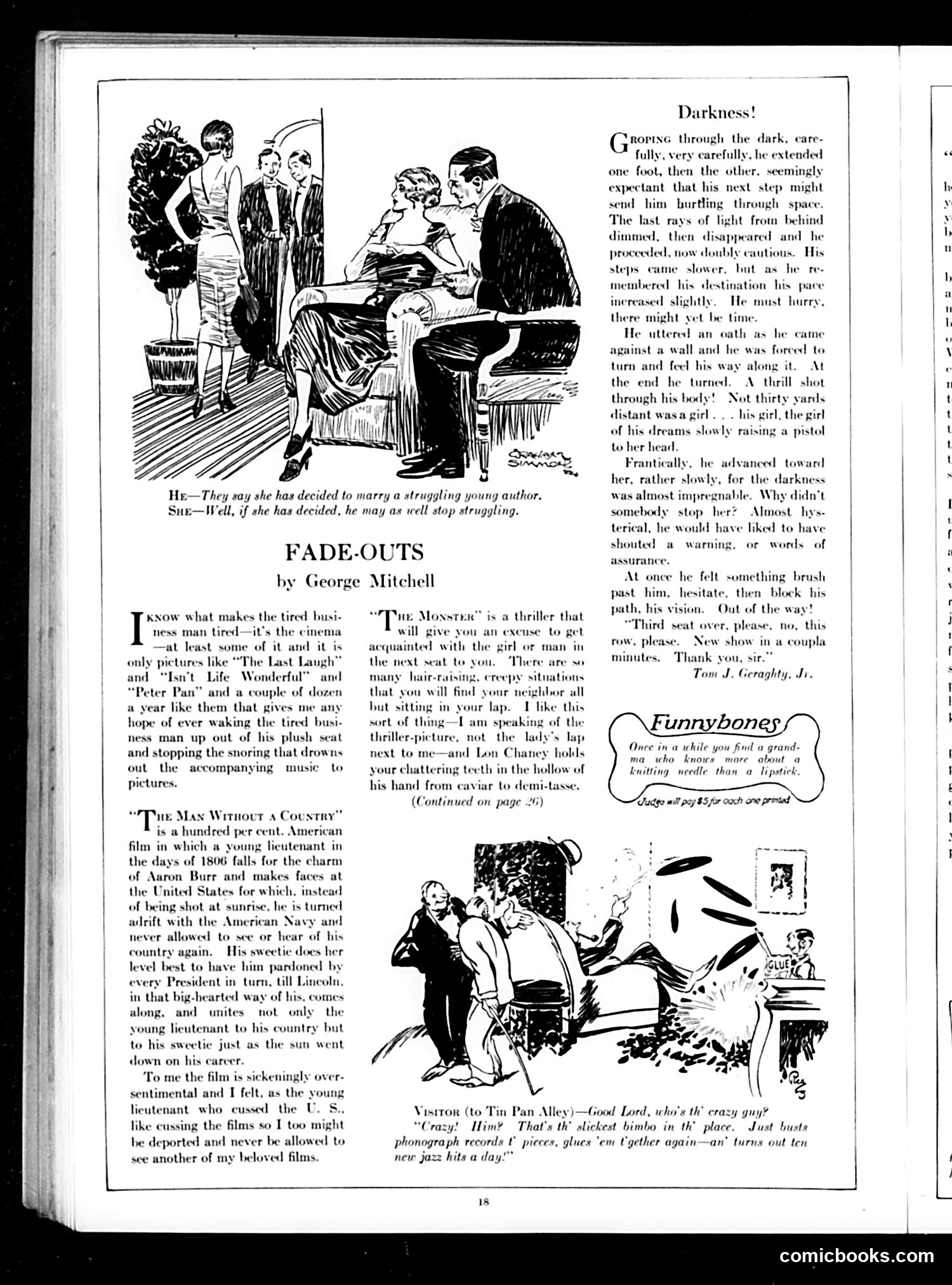
This page contains film criticism by George Mitchell alongside satirical cartoons mocking early 1920s cinema and society. **The main cartoon** jokes about a woman marrying a "struggling young author"—the punchline being that once she's decided to marry him, he can stop his futile efforts to succeed, since her decision removes his motivation to improve himself. It's a quip about male ambition deflating upon securing a wife. **Mitchell's film reviews** critique sentimental American cinema. "The Man Without a Country" is attacked as overly emotional patriotic propaganda. "The Monster" (a Lon Chaney thriller) is praised because it creates excuses for cinema-goers to huddle close in the dark—Mitchell is mocking both the film's appeal and audiences' thin pretenses for physical closeness. **The "Darkness!" serial story** appears to be a melodramatic thriller excerpt, likely parodying overwrought pulp fiction. **The "Funnybones" section** offers a joke setup about someone ignorant of knitting needles and "lip stick" (unclear reference). **The final cartoon** mocks a jazz musician who destroys phonograph records and reassembles them into new compositions—satirizing 1920s jazz as mere novelty rather than genuine music.
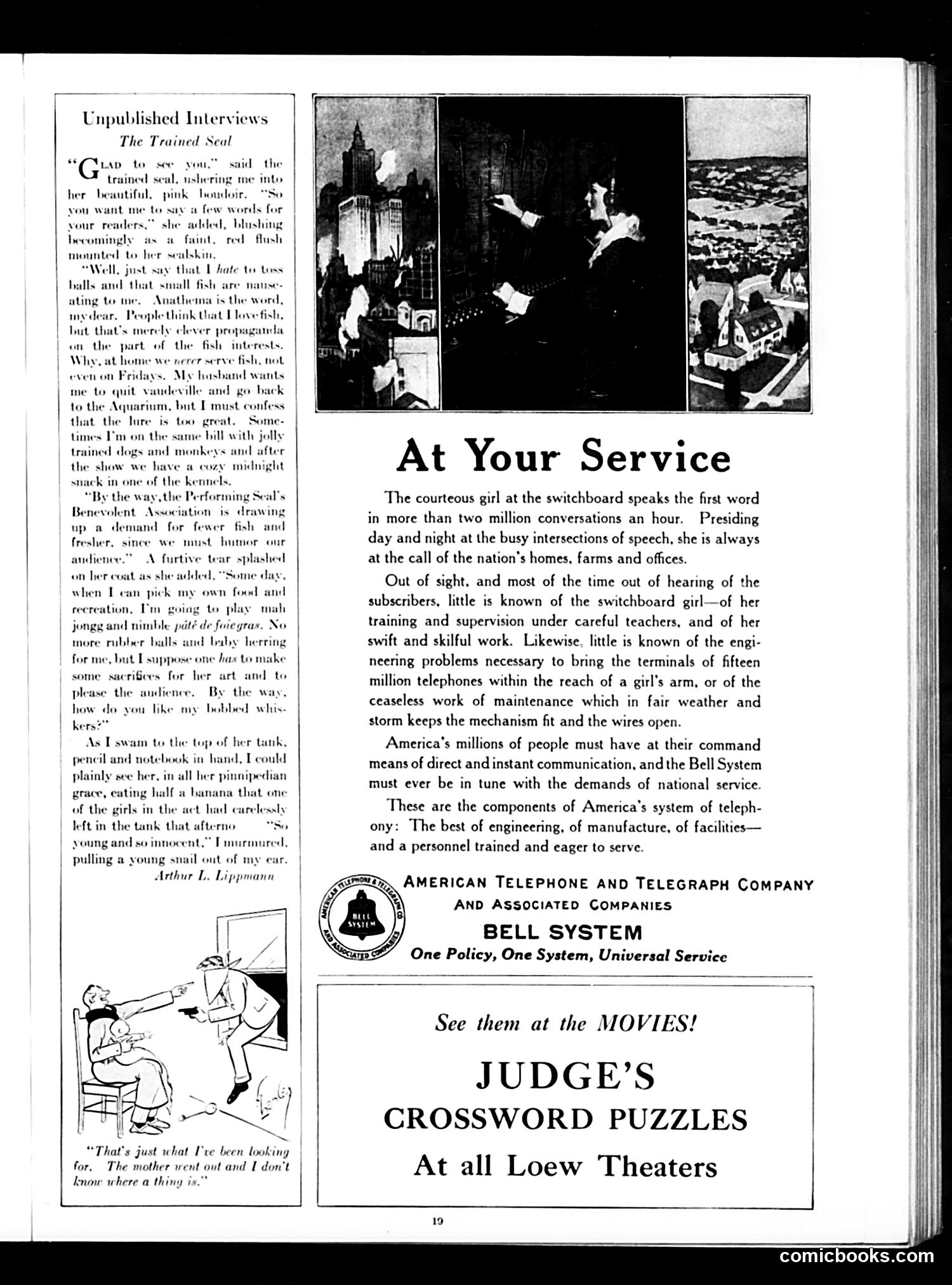
This page contains two distinct items: **The Cartoon/Interview (left):** A humorous monologue titled "The Trained Seal" satirizes performing animals in vaudeville. A trained seal complains about her working conditions—performing tricks, eating rubber balls and herring instead of choosing her own food, and working alongside "trained dogs and monkeys." The satire mocks both the seal's forced servitude and the audience's demand for entertainment from captive animals. The interviewer notes the seal's "bobbed whiskers," a contemporary reference to the 1920s fashion for bobbed hair, anthropomorphizing the animal. **The Advertisement (right):** A lengthy Bell System ad praising telephone switchboard operators as essential infrastructure workers. It emphasizes their invisible labor, training, and dedication to national service—providing "direct and instant communication" to millions. The juxtaposition is likely unintentional, but ironic: the seal's complaint about performing under harsh conditions parallels the ad's romanticization of (female) workers serving the nation.
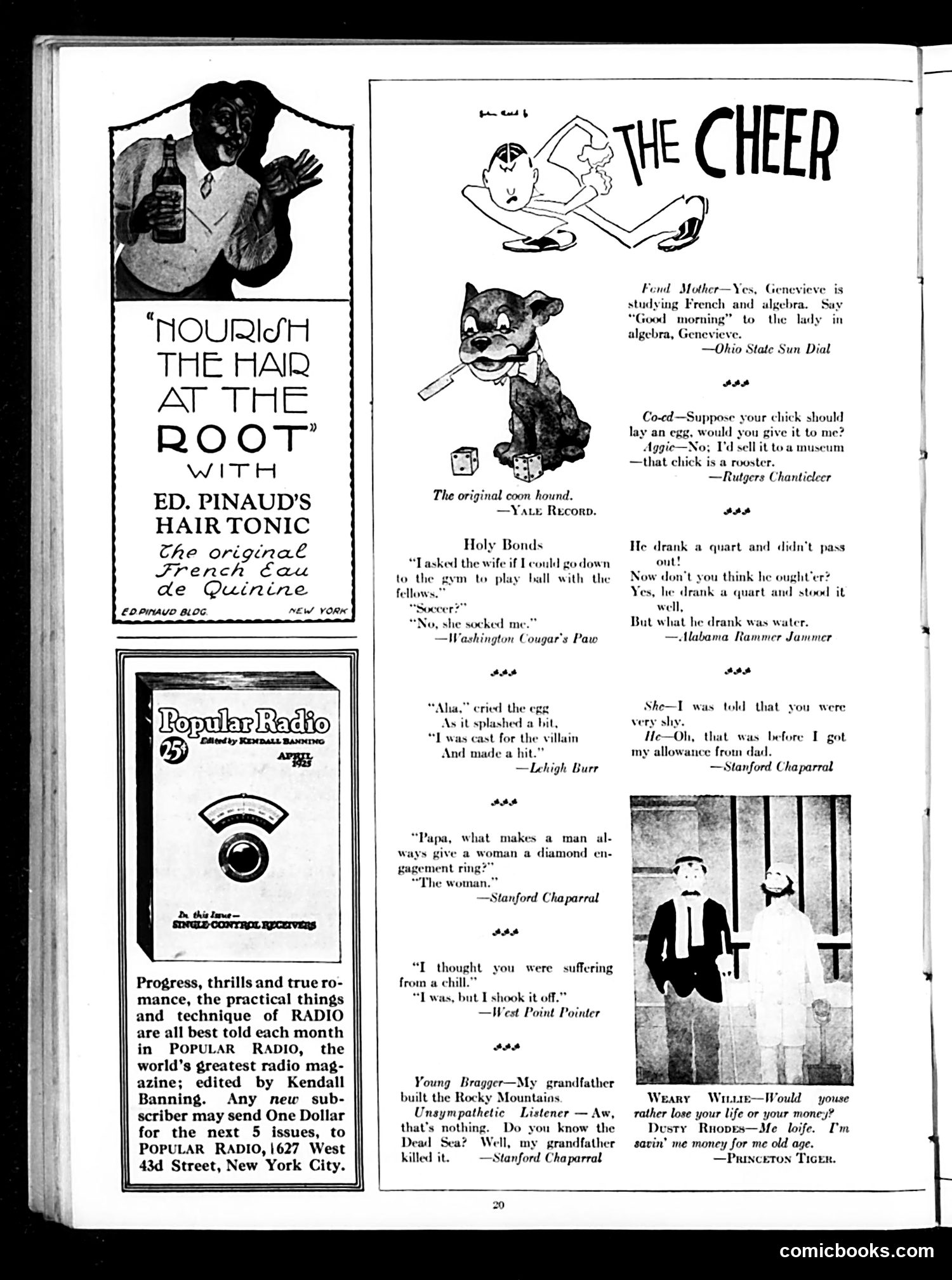
This page from *Judge* magazine is primarily a **humor/joke collection** rather than political satire. It features short quips from various college publications (Stanford Chaparral, Rutgers Chanticleer, Princeton Tiger, etc.), presenting light social comedy typical of 1920s college humor. The jokes target familiar themes: marital dynamics ("wife socked me"), youthful boasting, romantic misunderstandings, and student life. One item uses a racial slur in its caption ("original coon hound"), reflecting the period's casual offensive language. The page also includes **advertisements**: Ed. Pinaud's hair tonic and Popular Radio magazine—standard commercial content for this era. No specific political figures or events are referenced. The satire is gentle and social rather than political, aimed at universal human foibles rather than contemporary events or public figures.
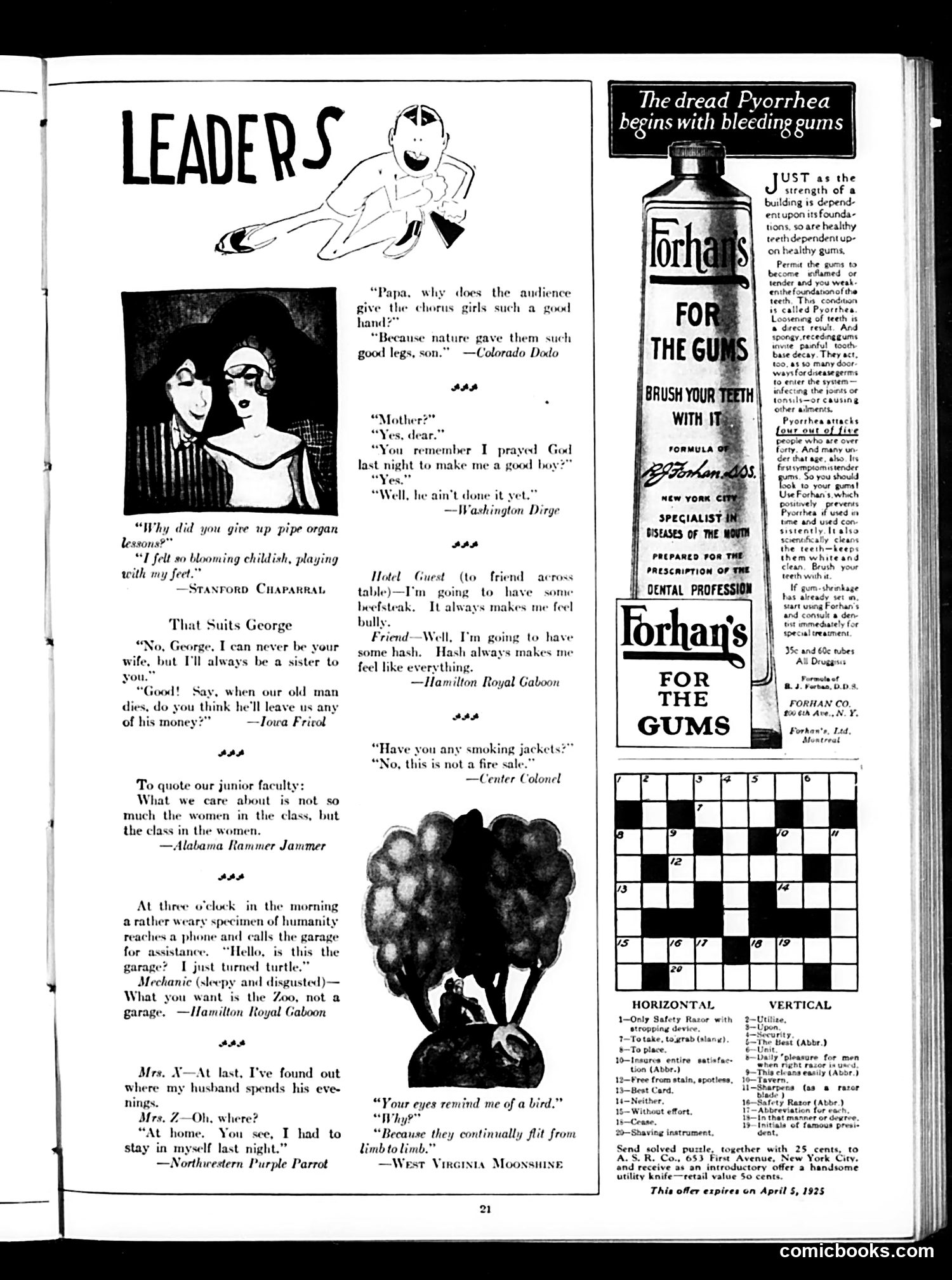
This page is primarily **humor content and advertising**, typical of Judge's format. The left side collects short jokes from college humor magazines (Stanford, Iowa, Alabama, etc.)—mostly mild gags about relationships, money, and bodily functions that reflect 1920s collegiate culture. The right side features a **Forhan's toothpaste advertisement** addressing "Pyorrhea" (gum disease), presented as a serious health concern requiring professional dental care. This was legitimate medical messaging of the era. **The cartoon** at the page's center depicts a man under an explosion or burst of smoke with the caption "Your eyes remind me of a bird / Because they continually flit from limb to limb"—a flirtation joke playing on "limb" as both tree branch and leg, suggesting the speaker's wandering gaze. **The crossword puzzle** at bottom-right was a standard Judge feature. No political satire or caricature appears here. This is entertainment and commercial content aimed at educated, affluent readers—reflecting 1920s sensibilities about courtship, gender, consumption, and dental hygiene.
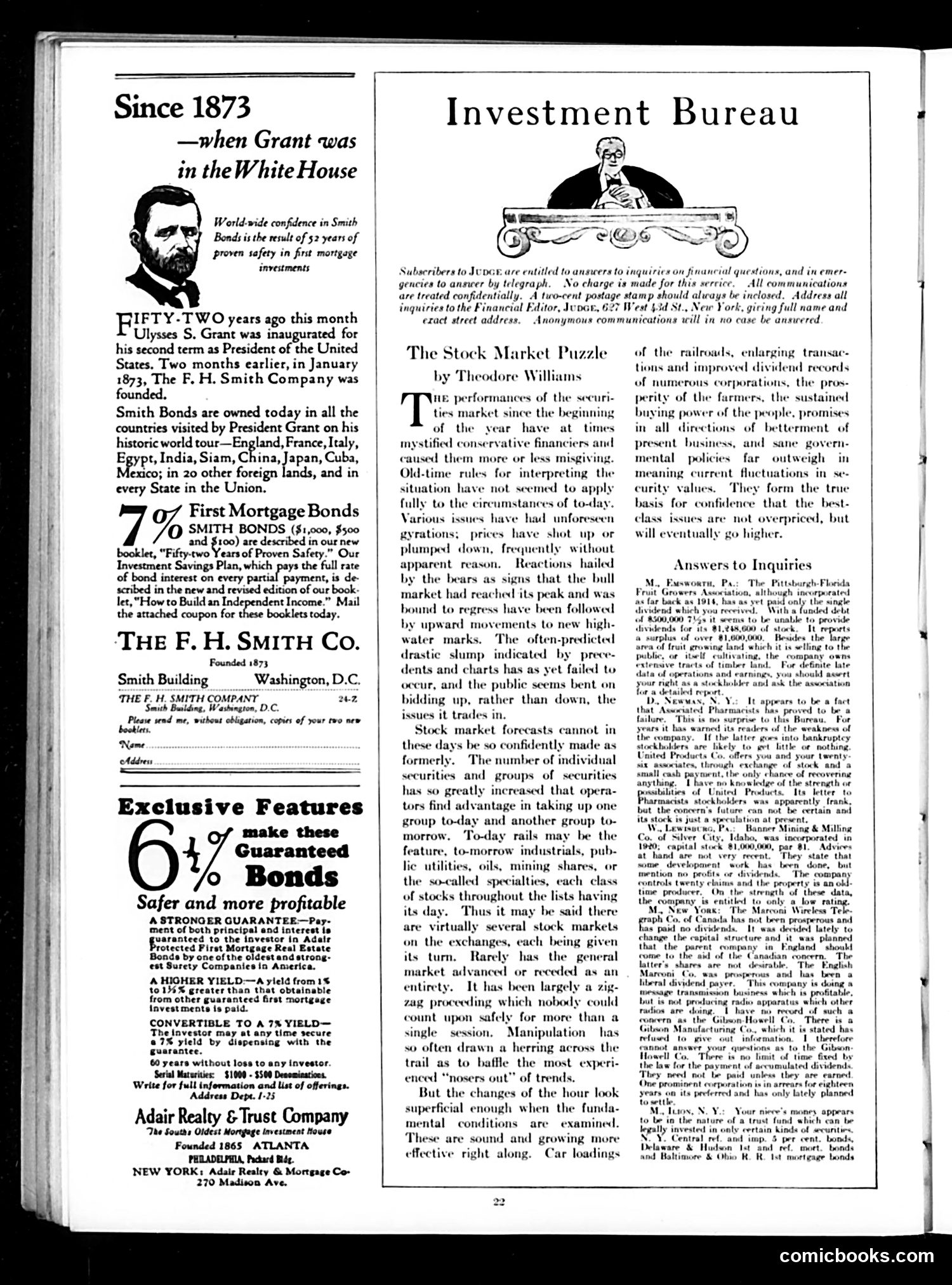
This is primarily a **financial advertising page** from Judge magazine, likely from 1925 (given the "52 years ago" reference to Grant's 1873 inauguration). The left side features ads for investment bonds by F.H. Smith Company and Adair Realty & Trust Company, emphasizing safety and returns. The ads leverage Grant's historical credibility—if bonds were safe during his presidency 52 years prior, they remain trustworthy today. The right side contains a financial column titled "The Stock Market Puzzle" by Theodore Williams discussing stock market volatility and unpredictability in the 1920s. Williams notes that traditional forecasting methods no longer work reliably, and that different market sectors rotate in prominence. **The satire/humor is subtle**: The juxtaposition of conservative bond advertisements alongside an article essentially saying "stock markets are now impossible to predict" creates ironic tension—the ads promise stability while contemporary market conditions suggest uncertainty. There are **no political cartoons** on this page. It's a hybrid advertisement-editorial spread typical of Judge's revenue model.
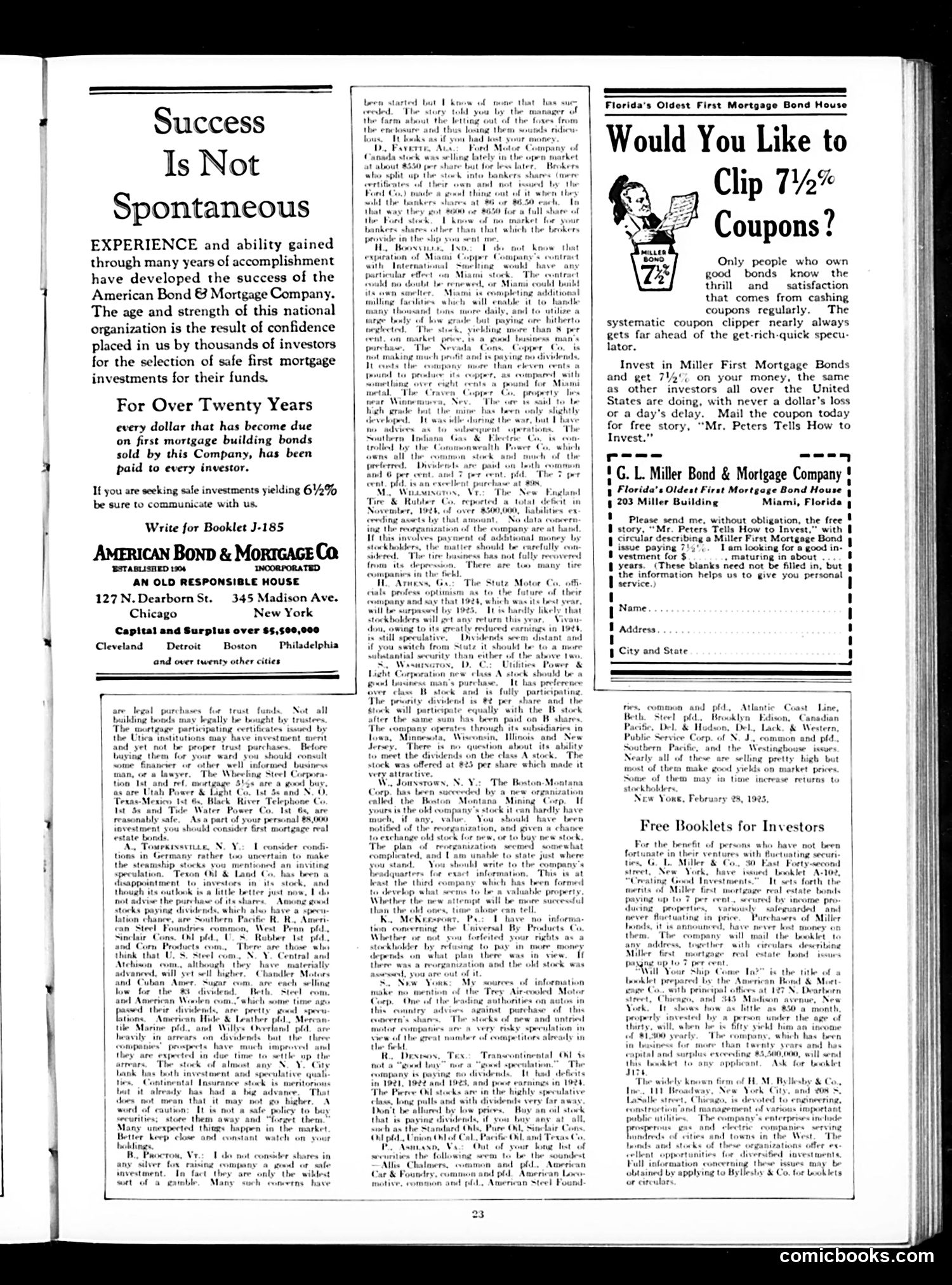
This page is primarily **financial advertising**, not satire or political commentary. It contains two main advertisements: 1. **American Bond & Mortgage Company** (left): A serious investment pitch emphasizing the company's 20+ year track record of paying investors on first mortgage bonds yielding 6½%. 2. **C.L. Miller Bond & Mortgage Company** (right): Appeals to bond investors by highlighting the appeal of clipping 7½% coupons regularly. The bulk of the page features a **financial advice column** answering reader questions about various investment opportunities—stocks, mining operations, utility bonds, and trust funds. The "advice" reflects early 20th-century investment concerns: whether certain stocks are speculative, whether dividends are reliable, and whether reorganizations threaten investor returns. There is **no political satire or cartoon** visible on this page. The content reflects Judge's inclusion of serious financial content alongside its typical humorous material, targeting a wealthy, investment-minded readership during what appears to be the 1920s boom era.
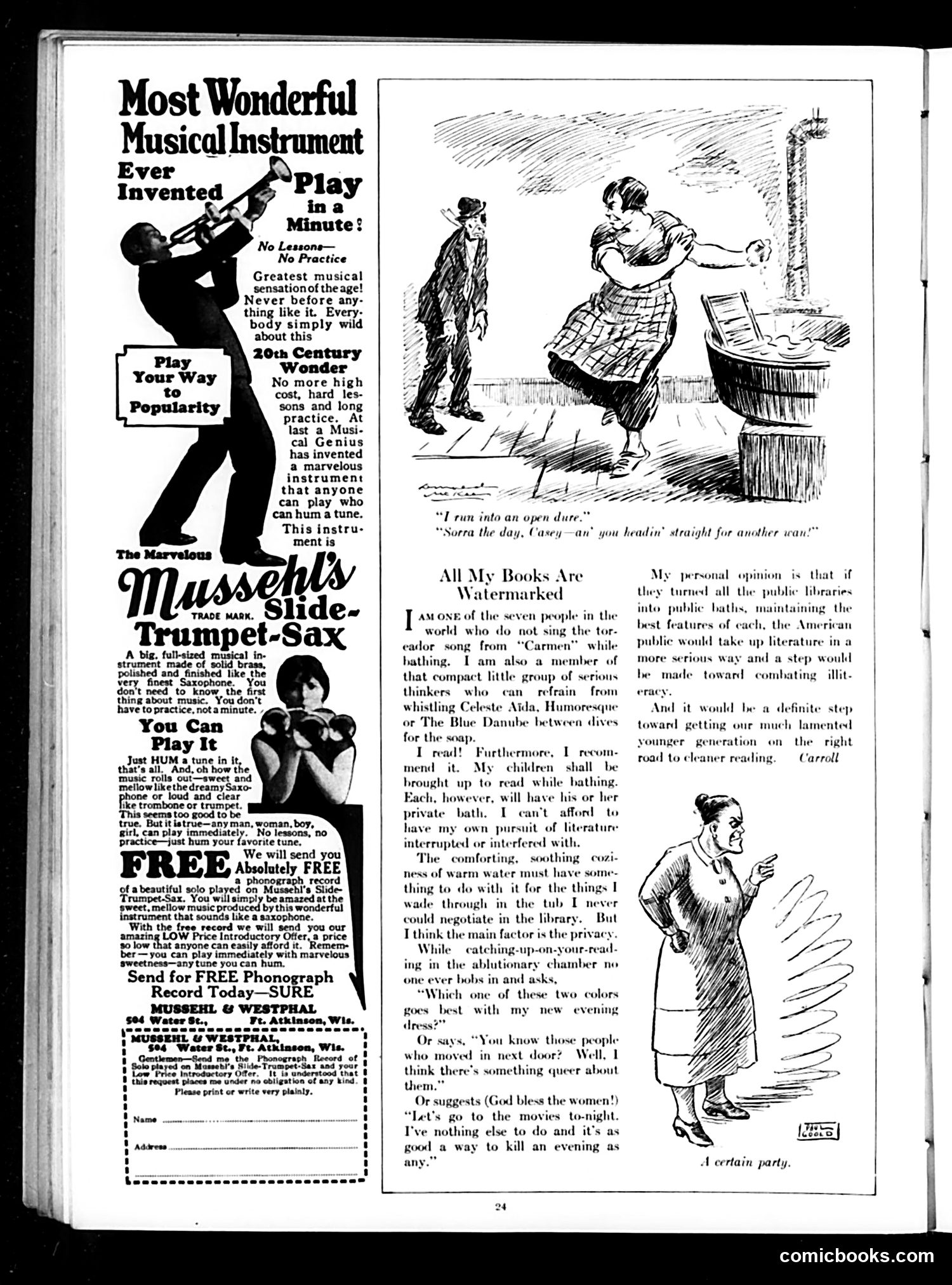
This page contains two distinct elements: **Left side:** A full-page advertisement for the "Mussell's Slide-Trumpet-Sax," a musical instrument marketed as requiring "no lessons" or "practice"—just hum a tune. This is satirical advertising, mocking the era's "get-rich-quick" and "learn-with-no-effort" schemes that proliferated in early 20th-century magazines. The claim that anyone can instantly produce quality music by humming represents absurd false advertising. **Right side:** Two separate pieces. The top cartoon shows a domestic scene where a woman has caught her husband in an "open dare" (unclear reference, possibly a typo). Below is an essay titled "All My Books Are Watermarked" by Carroll, arguing that reading while bathing (in one's private bath) is superior to library reading because it's uninterrupted—no one asks about dress colors or suggests movies. It's humorous social commentary on domestic interruptions and the superiority of privacy for serious reading. The satire targets consumerism and domestic life conventions of the period.
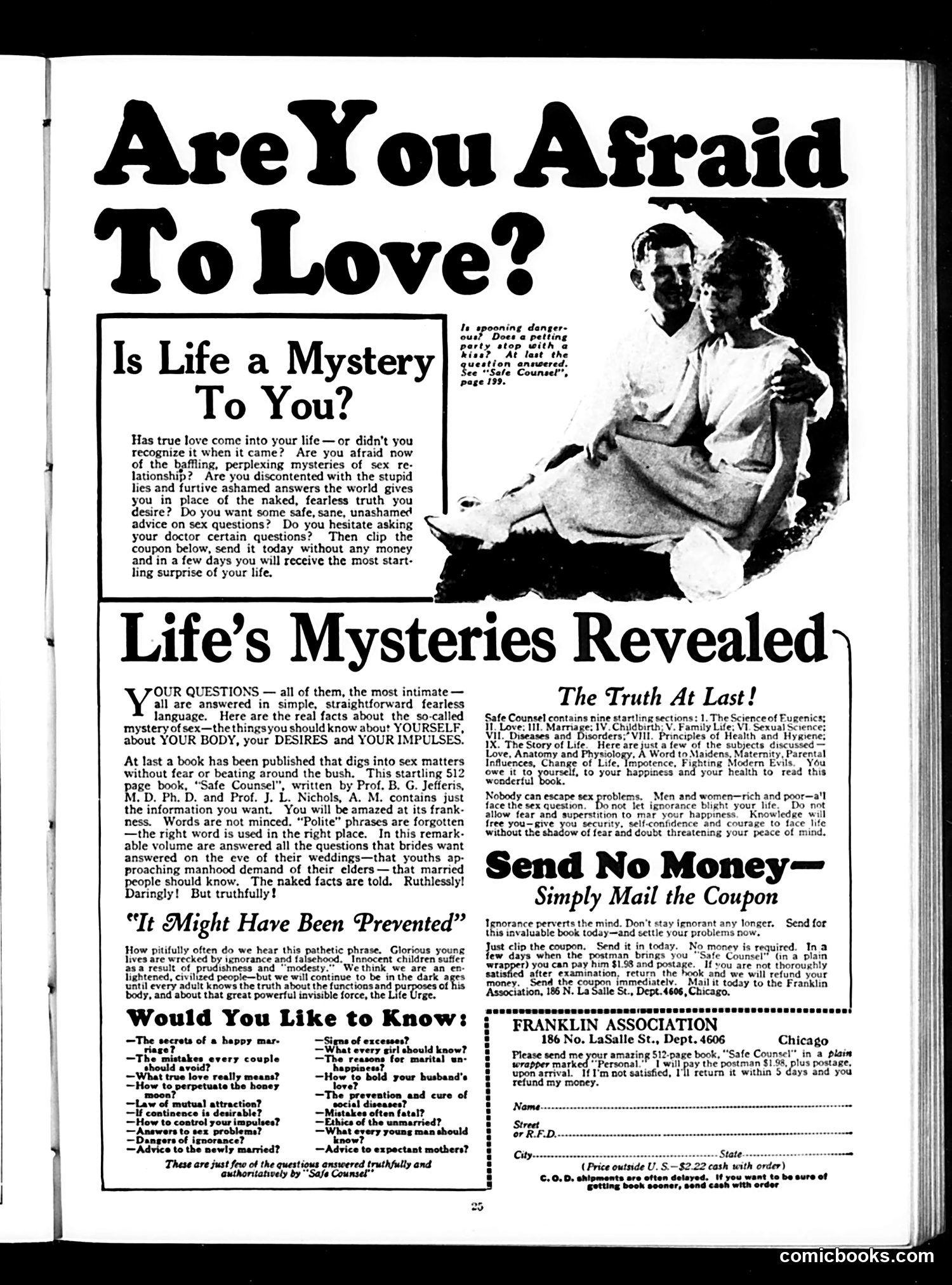
This page is primarily an **advertisement** for a mail-order book titled "Safe Counsel" by Professors Jefferis and Nichols, published by the Franklin Association. It's not political satire. The ad targets anxious readers—particularly young people and couples—facing confusion about sex, marriage, and reproduction. It capitalizes on **widespread sexual ignorance and shame** in early 20th-century America, when frank discussion of sex was taboo and medical information was scarce. The ad's appeal is direct: readers are "afraid," puzzled by "mysteries," and afraid to ask doctors. "Safe Counsel" promises straightforward, "fearless" answers about eugenics, childbirth, disease, impotence, and family planning—topics people desperately needed information about but couldn't discuss openly. The photograph shows an embracing couple, suggesting romantic/marital context. The "send no money" hook was typical mail-order marketing of the era.
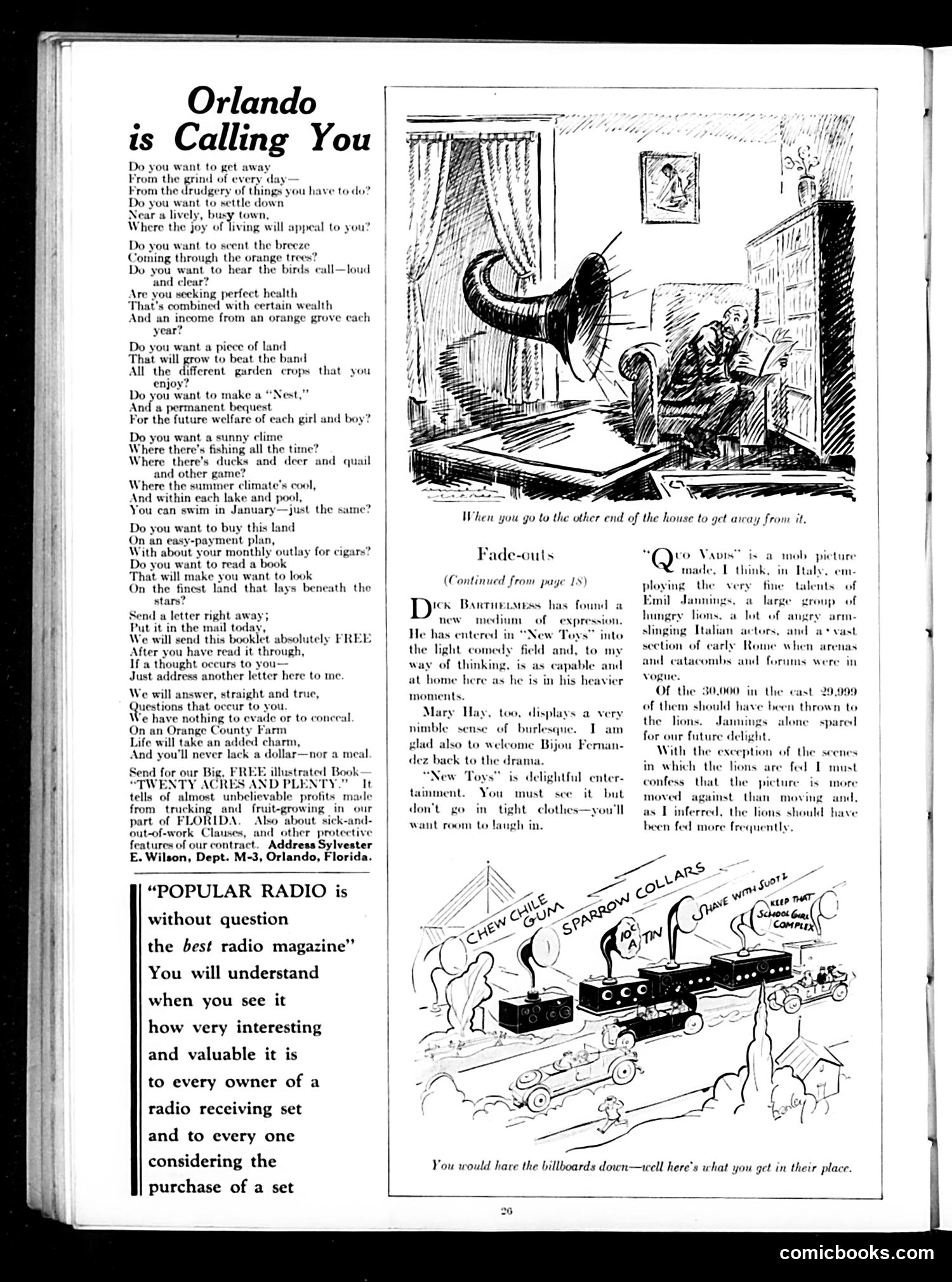
This page contains primarily **advertising and promotional content** rather than political satire. The main feature is a land-development advertisement for **Orlando, Florida**, using rhetorical questions to pitch real estate investment. It promises orange groves, healthy climate, fishing, and permanent wealth—classic early 20th-century land-boom marketing targeting northern readers seeking escape from urban drudgery. The cartoon at bottom satirizes **radio advertising excess**: it depicts commercial billboards (labeled "Chew Gum," "Sparrow Collars," etc.) being replaced by radio advertisements, with the caption suggesting you can't escape commercials even by leaving your house. This reflects contemporary anxiety about radio's invasive new advertising medium. The "Fade-outs" section reviews films including *"New Toys"* (with Dick Barthelmess) and *"Quo Vadis"* (an Italian mob picture set in ancient Rome with lions). The **Popular Radio** advertisement endorses the magazine itself to radio set owners—meta-promotion within a satirical publication.
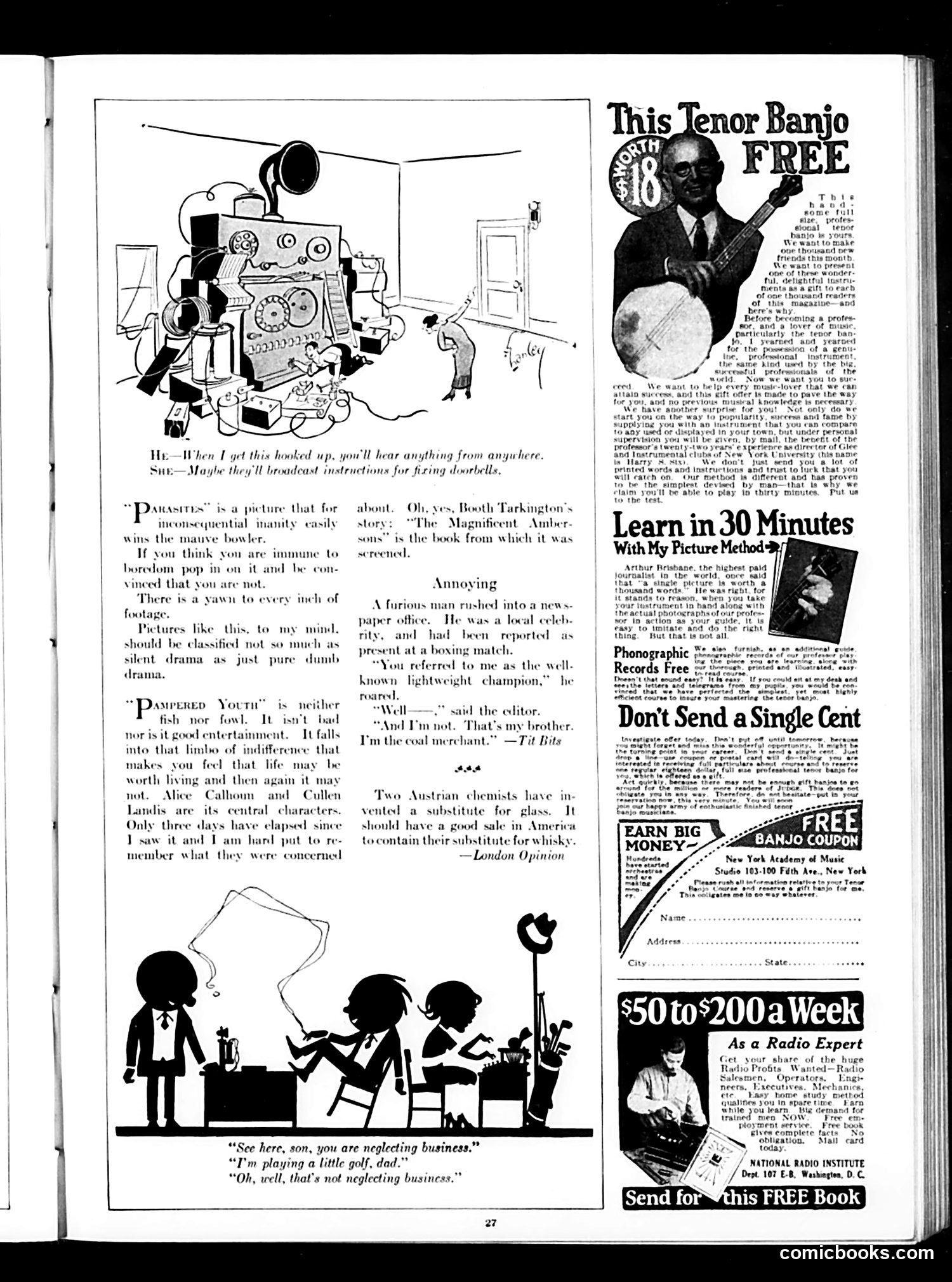
This page contains film reviews, humor pieces, and vintage advertisements typical of 1920s Judge magazine. **Top left cartoon**: Satirizes early radio technology's overhyped promises. A man proudly displays his radio setup, claiming you'll "hear anything from anywhere." His wife's deadpan response—that they might finally get useful content like "instructions for firing doorbells"—mocks radio's actual limited programming and the technology's failure to live up to breathless marketing claims. **Film reviews**: The critic dismisses two silent films as tedious, including one based on Booth Tarkington's "The Magnificent Ambersons," calling it "dumb drama" with no memorable plot. **Bottom cartoon**: A father praises his son for playing golf during business hours, believing leisure *is* business—likely satirizing 1920s commercialism and the blurred lines between work and profit-seeking. **Advertisements**: The right side advertises mail-order courses (banjo, radio expertise, books), typical of Depression-era get-rich-quick schemes promising "$50 to $200 a week."
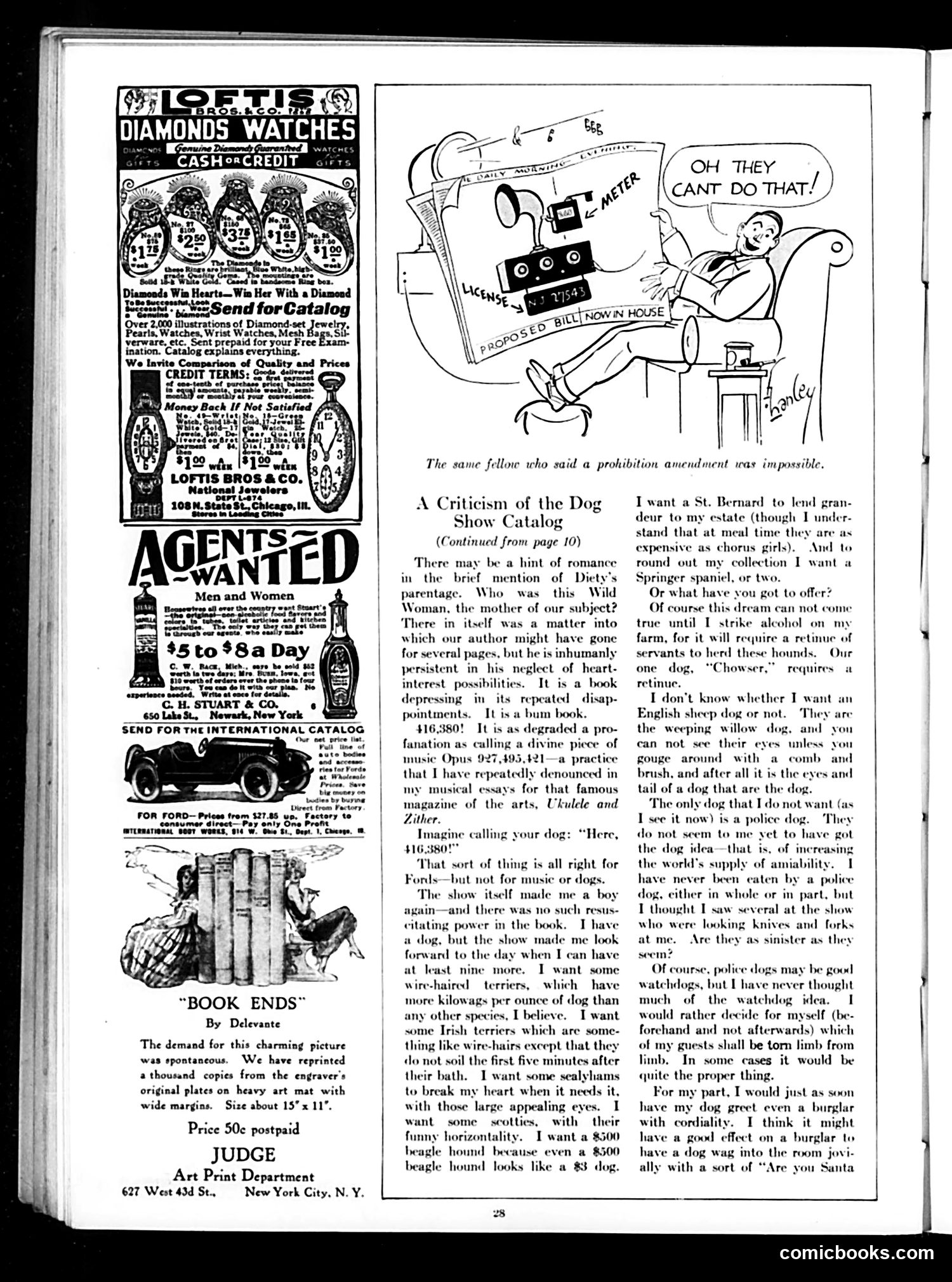
The cartoon depicts a man relaxing in a chair while a mechanical "meter" device dangles above him, measuring something. He exclaims "OH THEY CAN'T DO THAT!" The caption reads: "The same fellow who said a prohibition amendment was impossible." **The Satire:** This mocks someone who previously claimed Prohibition (the constitutional ban on alcohol) was politically impossible to enact—yet it was enacted in 1919. The cartoon suggests he's now facing some new regulatory measure he believes equally impossible, implying his judgment about what "can't" happen politically is unreliable. The meter device appears to reference alcohol measurement or enforcement, fitting the Prohibition-era context. The joke satirizes both overconfidence in predicting political outcomes and the irony of facing consequences from legislation one thought impossible. **Context:** This would have appeared during or shortly after Prohibition's passage, when Americans were adjusting to unexpected legal changes they'd dismissed as unpassable.
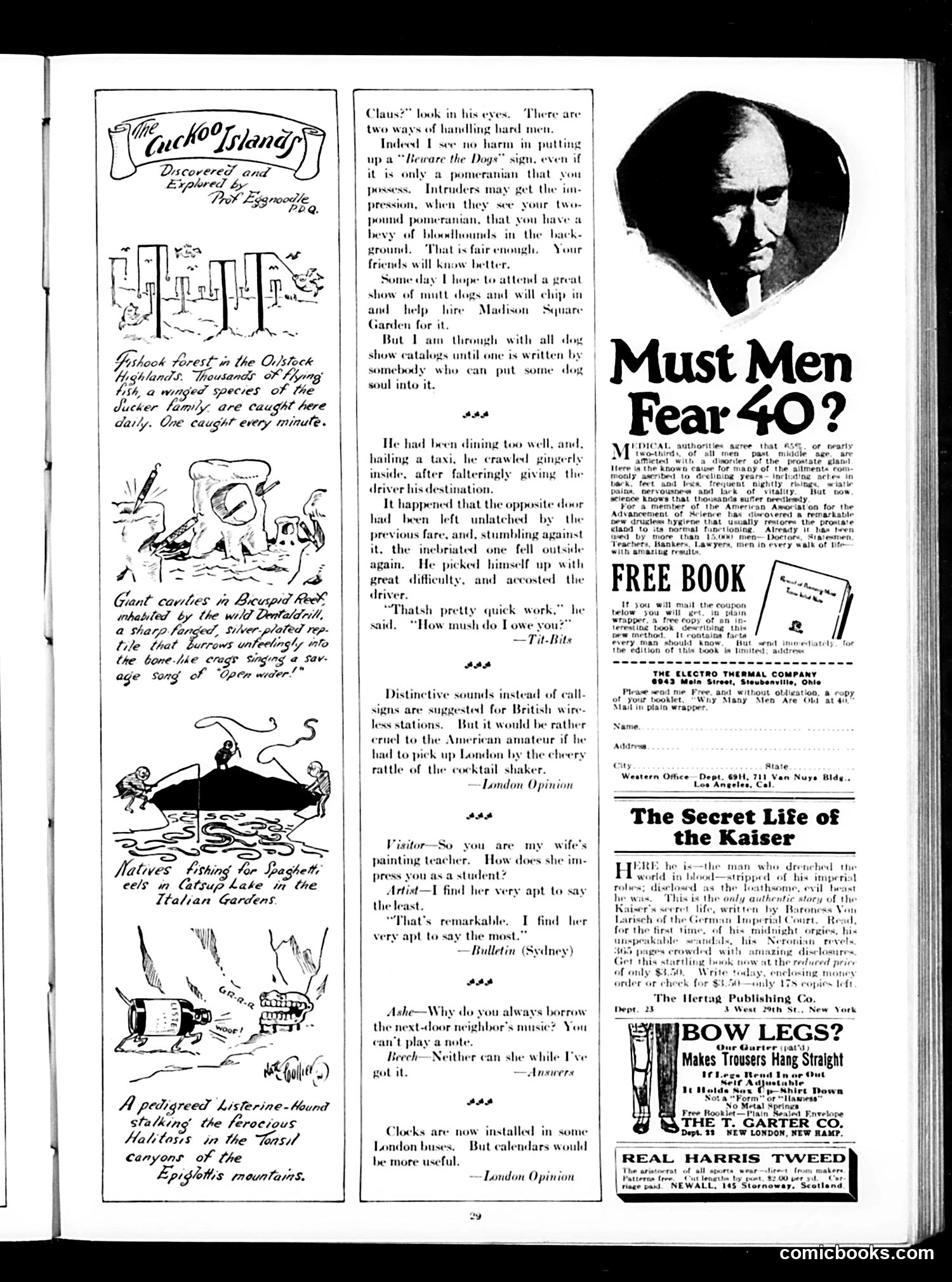
This page mixes humor columns with advertisements, typical of Judge's format. The left column features illustrated nature sketches from "Cuckoo Island," depicting fictional exotic animals (giant cavities, pedigreed listening-hounds) in absurdist style—satirizing travel writing and tall tales about remote locations. The center contains brief humorous anecdotes and observations, including a joke about a drunk passenger falling from a taxi, and commentary on British wireless radio (suggesting distinctive sounds instead of call signs—a lighthearted critique of broadcasting practices). The right side is dominated by advertisements, notably "Must Men Fear 40?" promoting the Electro Thermal Company's "drugless hygiene" treatment for male vitality issues—exploiting masculine anxiety about aging. Below appears an advertisement for "The Secret Life of the Kaiser," sensationalized wartime propaganda about German leadership. The overall page reflects early 20th-century concerns: technological novelty (radio), masculine anxiety, and wartime sentiment against Germany. The satirical animal sketches mock both exotic adventure narratives and scientific pretension.
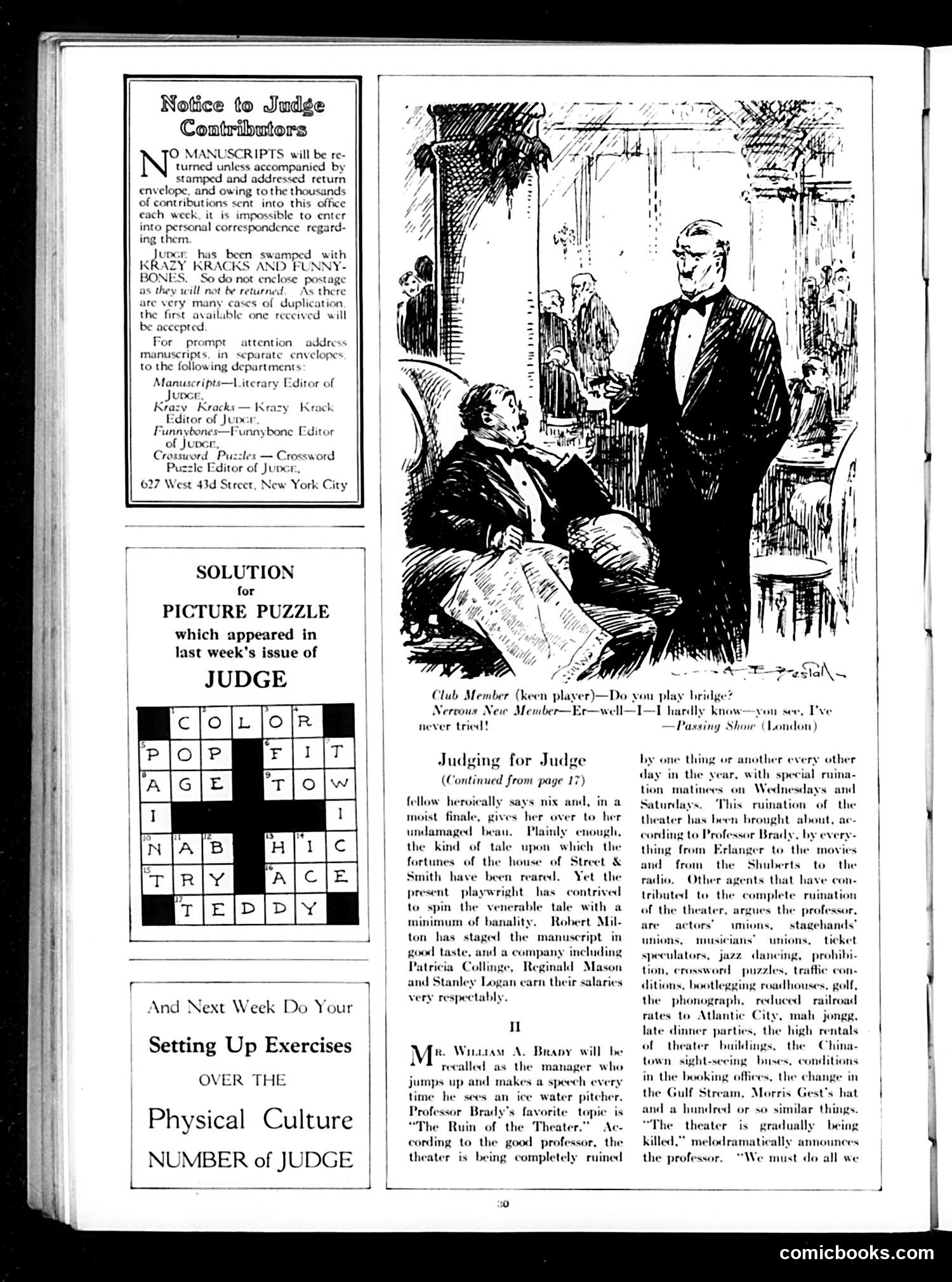
This page contains **administrative content and theater criticism** rather than political satire. The main cartoon depicts a **club scene** where a nervous new member admits to a card player that he's never played bridge—a common social anxiety joke about unfamiliar pastimes among the wealthy. The lengthy article "Judging for Judge" reviews a theatrical production, praising its competent staging while quoting Professor William A. Brady's famous complaint that theater is constantly being "ruined." Brady's list of culprits is satirical: he blames everything from actors' unions and jazz dancing to prohibition, golf, and mah-jong—essentially blaming modern entertainment and social changes for theater's decline. The satire targets **nostalgia and complaint culture**: Brady reflexively blames contemporary society rather than acknowledging any actual theatrical merit or change in audience taste. This reflects 1920s anxieties about modernity undermining traditional entertainment. The page also includes contributor guidelines and a crossword puzzle solution, showing Judge's mixed content approach.
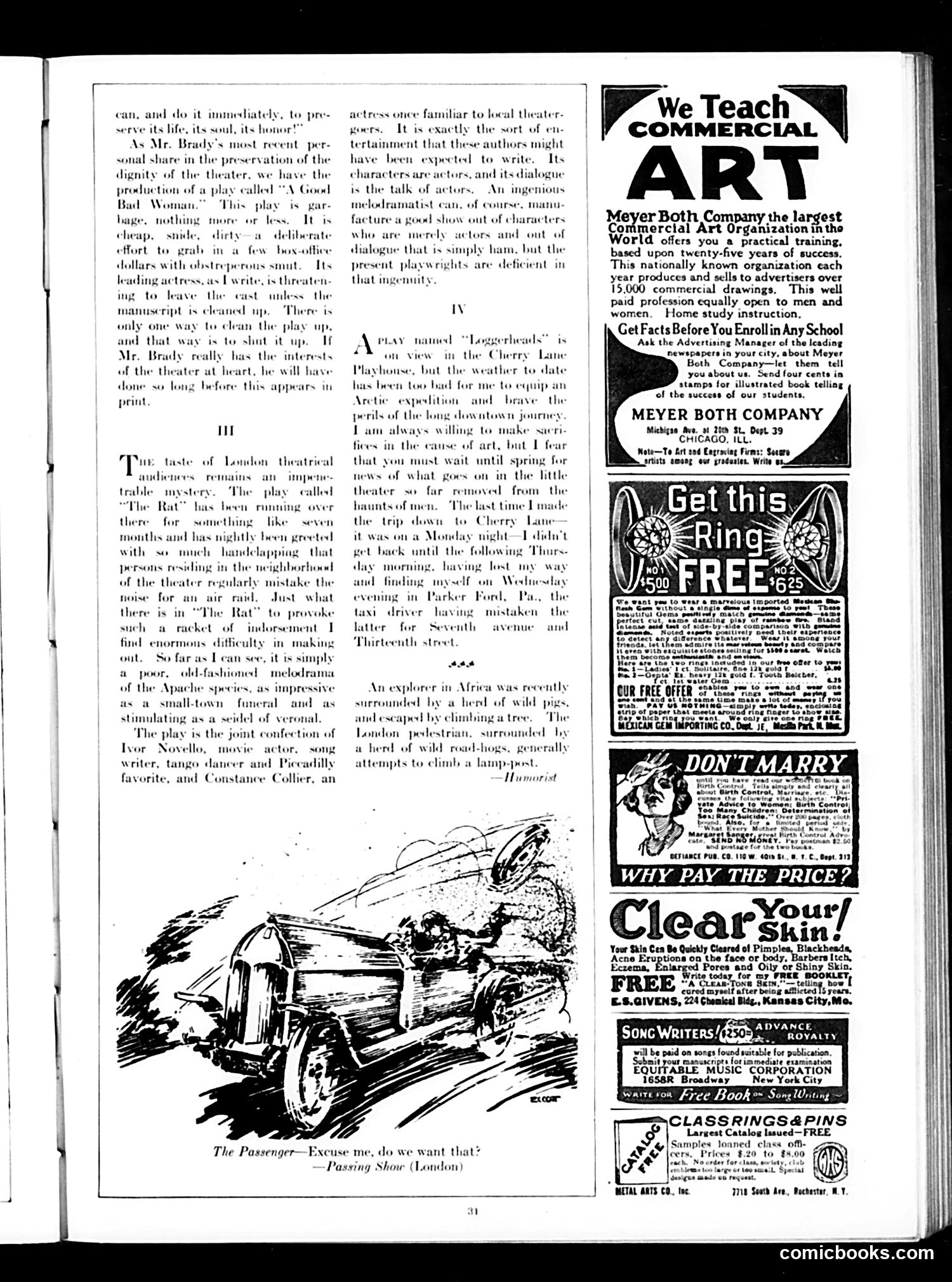
This page from Judge magazine (circa 1920s) contains theater criticism and period advertisements, not political cartoons. **The Main Content:** Critic Mr. Brady discusses London theatrical productions, particularly criticizing a play called "The Rat" running in the West End. He dismisses it as cheap melodrama featuring actors and "Apache" subject matter—dismissing it as artistically worthless despite its popularity. He also references visiting an experimental theater in "Cherry Lane" (likely Greenwich Village), humorously describing getting lost traveling there. **The Single Cartoon:** The illustration shows a car accident with the caption "The Passenger—Excuse me, do we want that?" from a London publication. This is a simple automotive humor joke about the wreck. **The Advertisements:** The right column features typical 1920s ads: commercial art training programs, a free ring offer, skin-clearing remedies, and music publishing opportunities—reflecting common consumer interests of the era. The page primarily showcases theater criticism with period advertising rather than political satire.
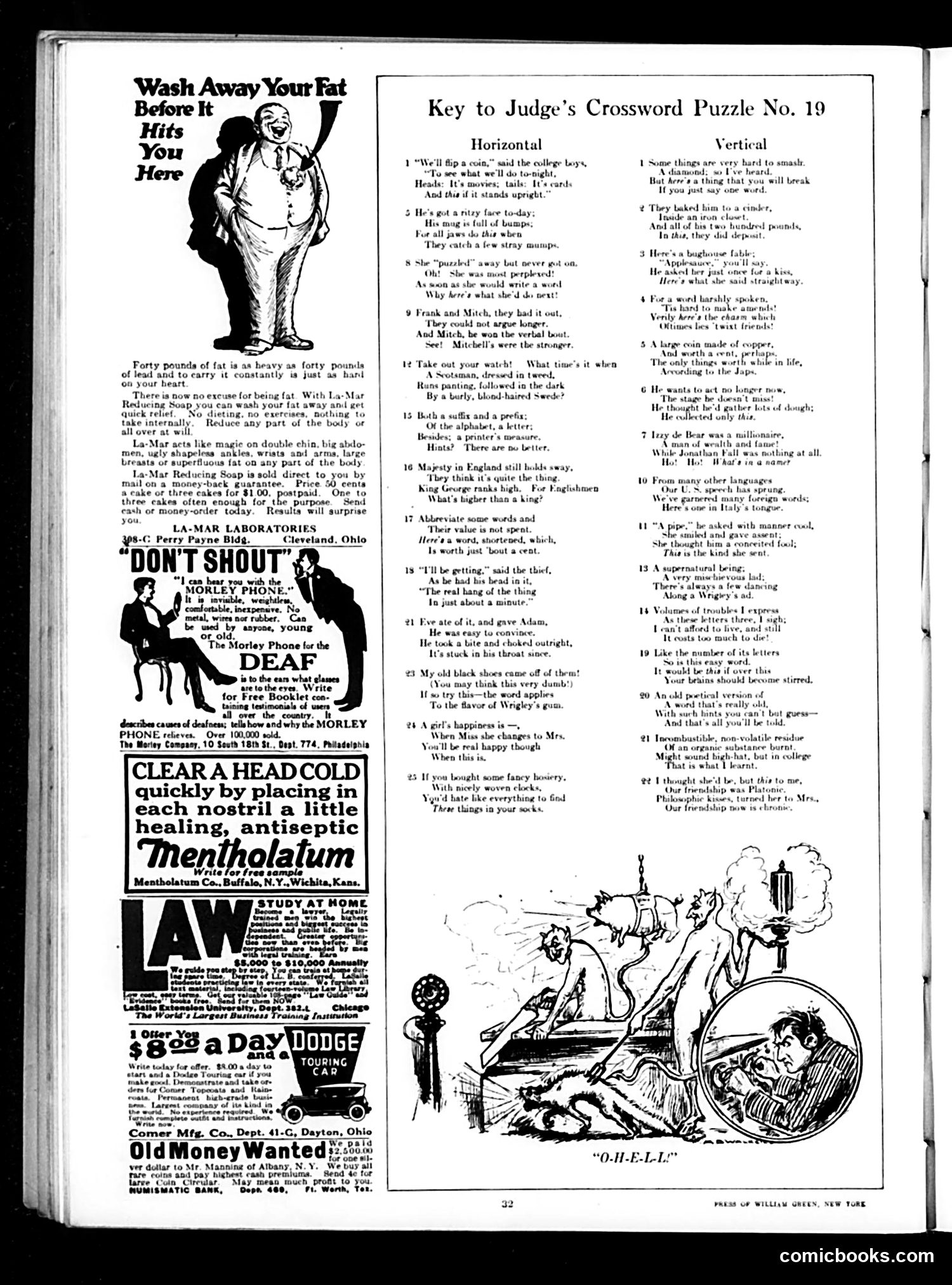
This page is primarily a **crossword puzzle answer key** with accompanying vintage advertisements. The main content is a numbered list of horizontal and vertical clues and answers for "Judge's Crossword Puzzle No. 19." The advertisements surrounding the puzzle key are typical early-20th-century pitches: La-Mar Reducing Soap (promising fat loss without exercise), the Morley Phone (a hearing aid marketed as "invisible"), Mentholatum for colds, and various correspondence courses and schemes to earn money. The crossword itself contains period humor and references—references to mumps, Wrigley's gum, King George, Scottish/Swedish stereotypes, and wordplay typical of 1920s popular culture. The cartoon illustration titled "D-I-E-L-L" at bottom right appears to show figures in some comedic scenario, though details are unclear from this reproduction.
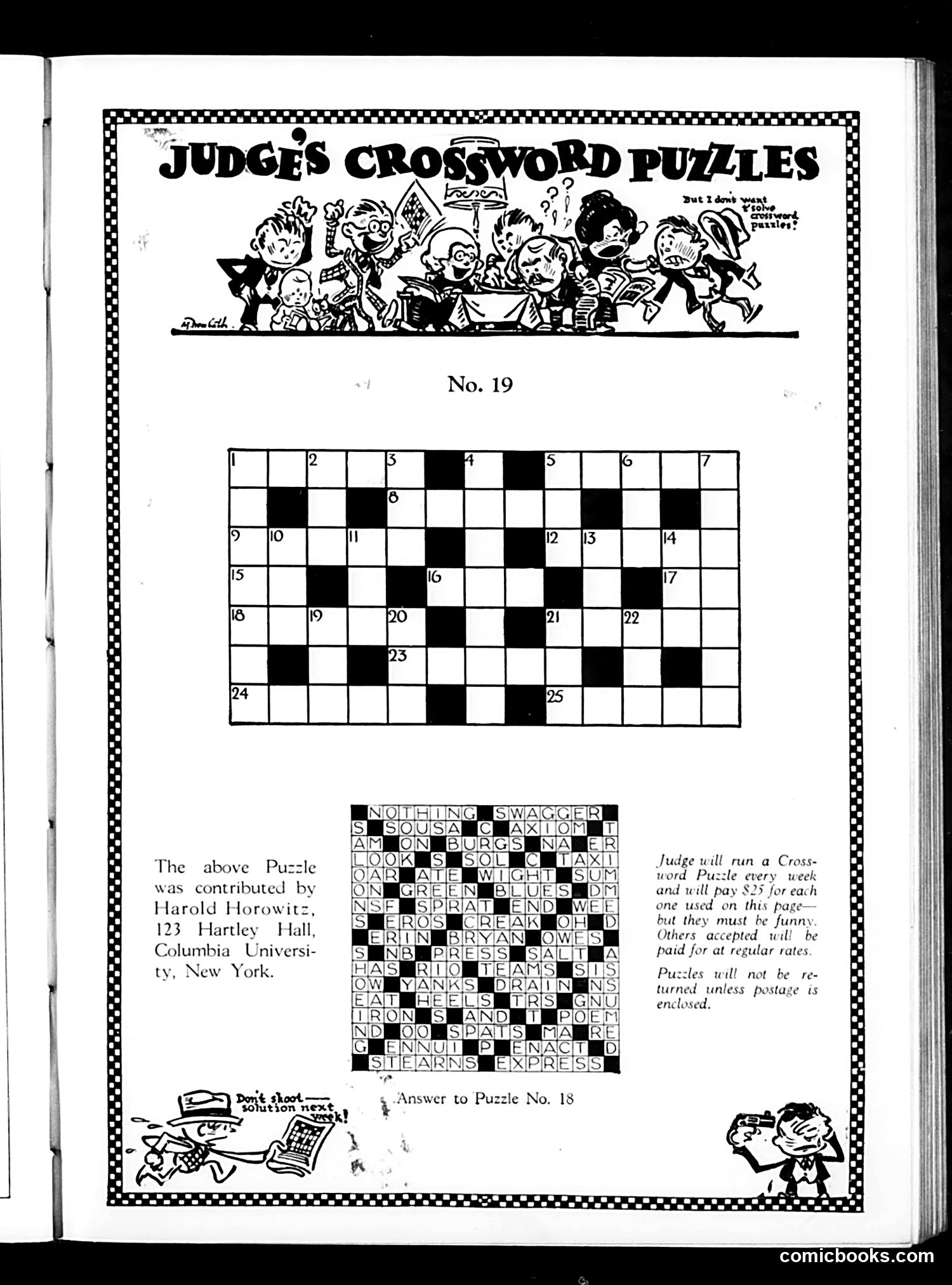
This page features "Judge's Crossword Puzzles," No. 19—a crossword puzzle contributed by Harold Horowitz of Columbia University. Rather than satire, this is primarily **puzzle content**. Judge magazine ran weekly crossword puzzles with a $25 prize for accepted submissions. The page includes the blank grid, the answer key to the previous week's puzzle (No. 18), and submission guidelines. The cartoon elements are decorative rather than satirical—whimsical illustrations of children and performers frame the title, consistent with Judge's style. The actual humor or social commentary, if any, would exist in the puzzle clues themselves, which are largely illegible in this reproduction. This represents how major publications of the era (likely 1920s-30s) integrated puzzle content as entertainment features.
This is a **cigarette advertisement**, not political satire. It promotes Lucky Strike cigarettes with their famous "It's Toasted" slogan, claiming superior quality tobacco. The ad features the product package prominently and includes decorative Art Deco-style borders typical of 1920s-30s magazine design. The text emphasizes that while other cigarettes might claim toasting methods, only Lucky Strikes truly belong to this category—a competitive marketing claim. The well-dressed man in the ornamental frame at the bottom appears to be a generic figure of sophistication, meant to appeal to the target audience. This represents how early American magazines like *Judge* mixed satire and entertainment with commercial advertising, a standard practice before modern advertising regulations.