
Judge, 1925-03-07 · page 17 of 36
Judge — March 7, 1925 — page 17: what you’re looking at
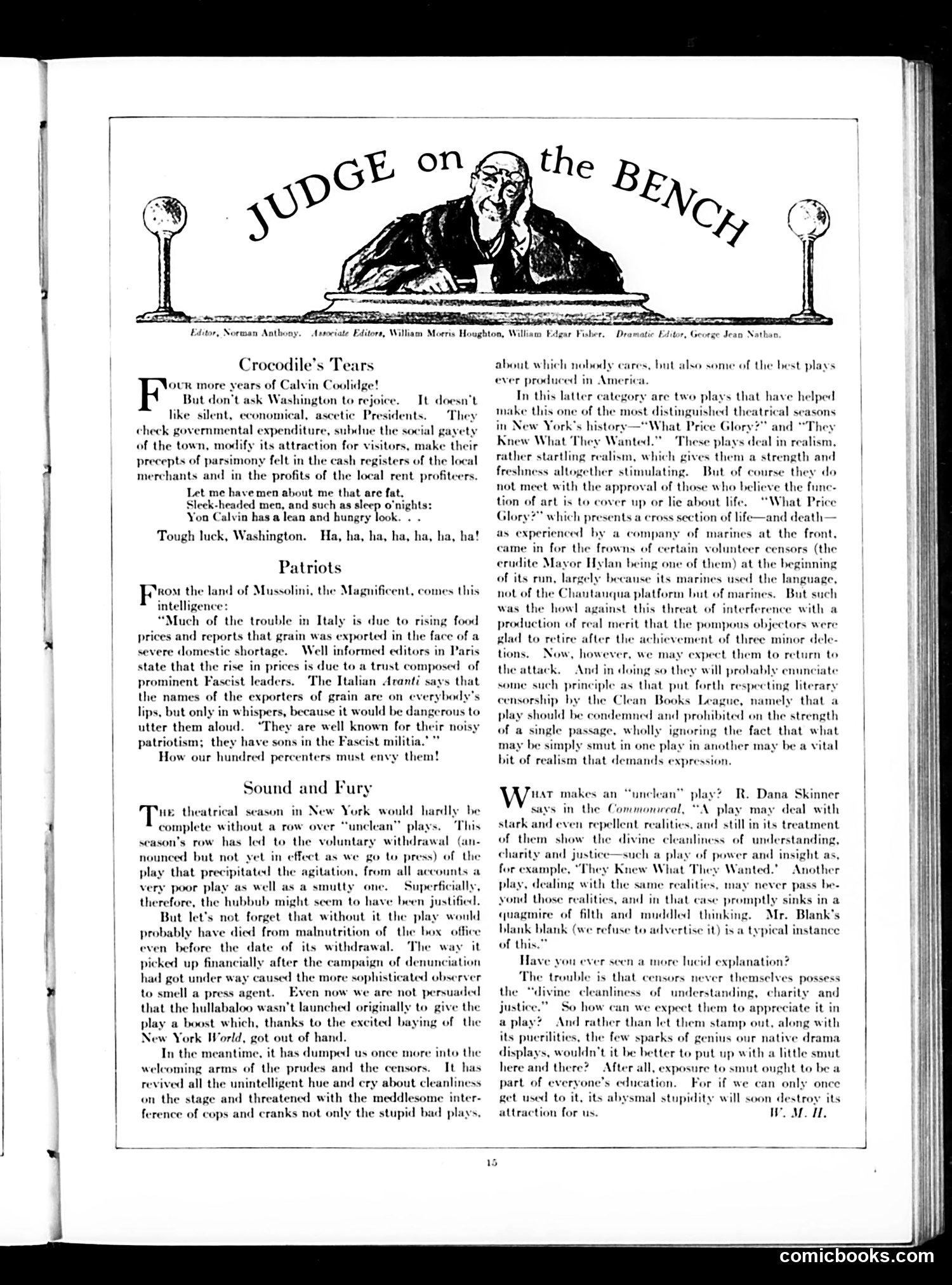
What you’re looking at
This page from Judge magazine contains three satirical columns attacking political and social hypocrisy in 1920s America. **"Crocodile's Tears"** mocks President Calvin Coolidge's reputation for fiscal restraint. The satire notes Washington celebrates Coolidge's economical nature while continuing wasteful spending—a reference to his campaign promises versus actual government expenditure. **"Patriots"** targets Benito Mussolini's fascist Italy, where grain is allegedly exported while citizens starve due to price-fixing by fascist leaders. The joke: American nationalists ("hundred percenters") admire Italian fascists for their patriotism, yet those same "patriots" secretly profit from their own citizens' suffering. **"Sound and Fury"** defends provocative plays like "What Price Glory?" against censorship campaigns. The author suggests moral crusaders use obscenity complaints as publicity stunts, then weaponize outrage to suppress genuine art. Mayor Hylan's censorship attempt is criticized as pompous interference with realistic depiction of wartime language. All three columns share a theme: exposing contradictions between stated principles and actual behavior among America's political and moral authorities.
📄 Transcribed text from this page (OCR, searchable)
Machine-transcribed from the original scan — historical spelling and the odd misread are preserved.
ee, rT = Editor, Norman Anthony. Crocodile’s Tears OUR more years of Calvin Coolidge But don’t ask Washington to re like silent, economical, ascetic Presidents. check governmental expenditure, subdue the social ga of the town, modify its attraction for visitors, make their precepts of parsimony felt in the cash registers of the local merchants and in the profits of the local rent profiteers. Let me have men about me that are fat, Sleek-headed men, and such as sleep o' nights: Yon Calvin has a lean and hungry look. Tough luck, Washington. Tt doe es “tL vice. Ha, ha, ha, ha, ha, ha, ha! | Patriots Fre the land of Mussolini, the Magnificent, comes this intelligence: “Much of the trouble in Italy is due to rising food prices and reports that grain was exported in the face of a severe domestic shortage. Well informed editors in Paris state that the rise in prices is due to a trust composed of prominent Fascist leaders. The Italian Avanti says that the names of the exporters of grain are on everybody's lips, but only in whispers, because it would be | utter them aloud. “They are well known for th patriotism; they have sons in the Fascist militi | How our hundred percenters must envy them! gerous to Sound and Fury He theatrical season in New York would hardly be complete without a row over “unclean” plays. ‘This season’s row has led to the voluntary withdrawal (an- nounced but not yet in effect as we go to press) of the play that precipitated the agitation, from all ants a very poor play as well as a smutty one. | therefore, the hubbub might seem to have been justified. But let's not forget that without it the play would probably have died from malnutrition of the box office even before the date of its withd 1. The way it picked up financially after the campaign of denunc’ had got under way caused the more sophisticated observer to smell a press agent. Even now we are not persuaded that the hullabaloo wasn’t launched originally to give the | play a boost which, thanks to the ted baying of the New York World, got out of hand. In the meantime, it has dumped us once more into the ming arms of the prudes and the sors. It has vived all the unintelligent hue and cry about cleanliness on the stage and threatened with the meddlesome inter- | ference of cops and cranks not only the stupid bad plays, Assoriate Editors, William Morris Houghtow, William Edger Fisher, the p & Dramatic Editor, George Jean Nathan. about which nobody cares, but also some of the best plays ever produced in America. In this latter category | is one of the most Hstinguishedd the: | orks history —"Whe Knew What They V rather startling realism, which gives them a strength and | freshness altogether stimulating. But urse they do not meet with the approval of those who believe the func- tion of art is to cover up or lie about life. “What Price Glory?” which presents a cross section of life—and death— as experienced by a company of marines at the front, came in for the frowns of certain volunteer censors (the erudite Mayor Hylan being one of them) at the beginning of its run, argely because its marines used the language, not of the Chautanqua platform but of marines. But such | was the howl against this threat of interference with a production of real merit that the pompous objectors we glad to retire after the chievement of three minor « tions. Now, however, we may expect them to return to the attack. And in doing so th some such principle y will probably enunciate as that put forth respecting literary censorship by the Clean Books League, namely that a play should be condemned and prohibited on the strength of a single passage, wholly ignoring the fact that what may be simply smut in one play in another may be a vital bit of realism that demands expression. Wi AT makes an s in the Commonreal, stark and even repellent realities of them show the iliness of understanding, ty and justice—such a play of power and insight as, for example, “They Knew What They Wanted.’ Another dealing with the same realities, may never pass be- ities, and in that case promptly sinks in a . Sth a muddled eink _Mr. Blank’s “unelean” play? R. Dana Skinner A play may de and still in its treatment divine auagmire 11 ever seen a more lucid explanation? trouble s that censors never themselves possess “divine cleanliness of understanding, charity and "So how can we expect them to appreciate it in ? And rather t mg with its pucrilities, the few sparks of genius our native drama displays, wouldn't it be better to put up with a little smut here and there? After all, exposure to smut ought to be a part of everyone's education. For if we can only once get used to it, its abysmal stupidity will soon destroy its attraction for us. WoMo WM, let them stamp out comicbooks.com