
Judge, 1925-03-07 · page 12 of 36
Judge — March 7, 1925 — page 12: what you’re looking at
What you’re looking at
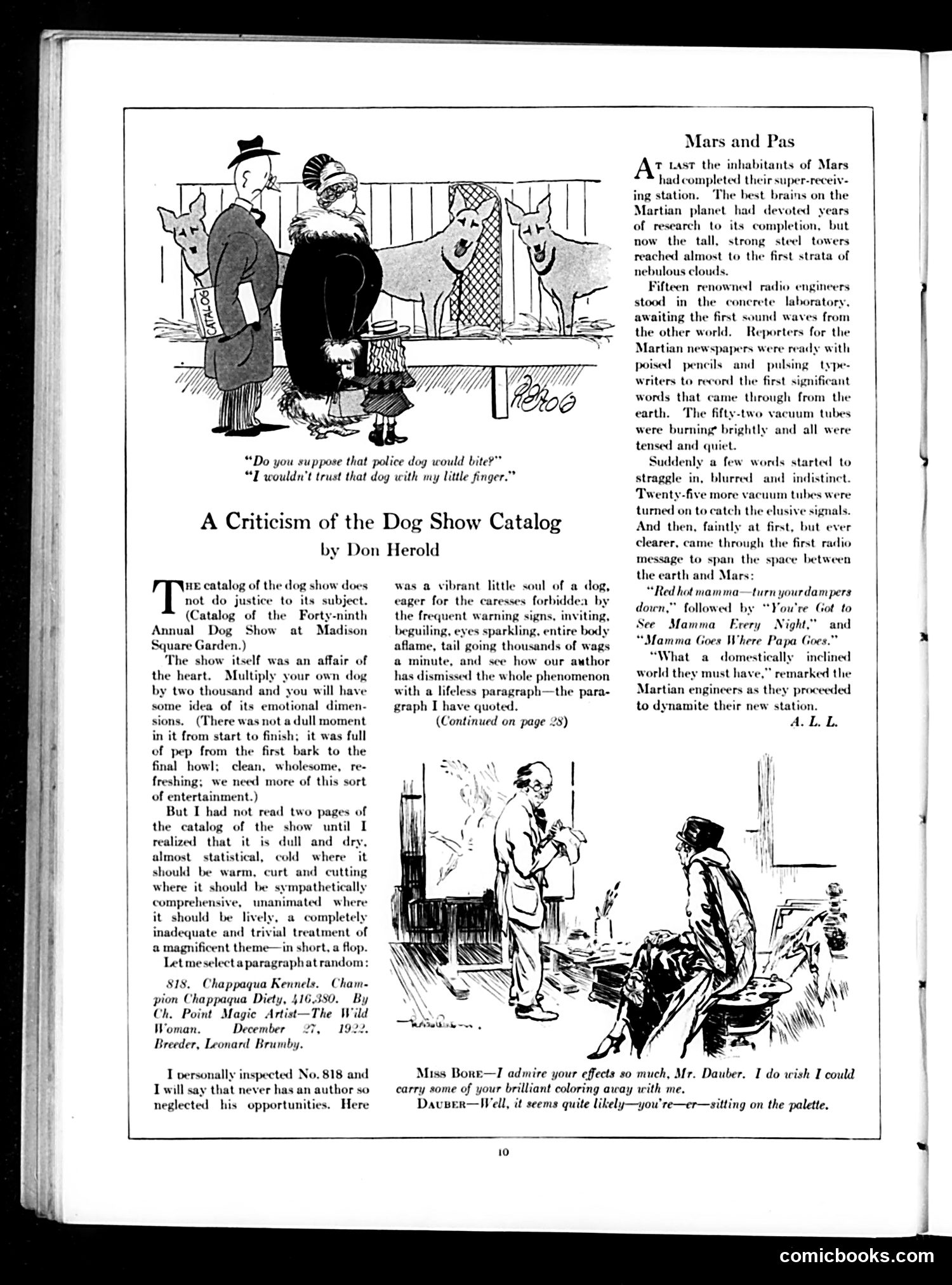
This Judge magazine page contains three satirical pieces: **"A Criticism of the Dog Show Catalog"** (top): Humorist Don Herold mocks the dry, statistical nature of dog show catalogs. He argues they fail to capture the vibrant personality of actual dogs, reducing living creatures to boring pedigree records. The humor lies in treating a dog catalog with the seriousness of literary criticism. **"Mars and Pas"** (right): A science fiction satire where Martians finally receive radio signals from Earth—only to hear popular 1920s jazz songs like "Red Hot Mamma." The joke: advanced alien civilization is disappointed by humanity's trivial popular culture, so they destroy their receiver. This reflects contemporary anxiety about mass entertainment's vapidity. **The cartoon** (bottom): A painter's assistant sits on his palette, ruining it. When complimented on his "brilliant coloring," the painter reveals she's literally contaminating his work through physical contact—a visual pun on her admiration causing damage. All three pieces use humor to critique their respective targets: institutional incompetence, shallow mass culture, and oblivious social interaction.
📄 Transcribed text from this page (OCR, searchable)
Machine-transcribed from the original scan — historical spelling and the odd misread are preserved.
wa eee “Do you suppose that police dog would bite?” “I wouldn't trust that dog with my little finger.” A Criticism of the Dog Show Catalog by Don Herold HE catalog of the dog show does | not do justice to its subject. (Catalog of the Forty-ninth Annual Dog Show at Madison Square Garden.) The show itself was an affair of the heart. Multiply your own dog by two thousand and you will have some idea of its emotional dimen- sions. (There was not a dull moment in it from start to finish; it was full of pep from the first bark to the final howl; clean, wholesome, re- freshing; we need more of this sort of entertainment.) But I had not read two pages of the catalog of the show until I realized that it is dull and dry, almost statistical, cold where it should be warm, curt and cutting where it should be sympathetically comprehensive, unanimated whe it should be lively, a complete! inadequate and trivial treatment of a magnificent theme—in short, a Hoy Let me select a paragraph at random: 818, Chappaqua Kennels. Cham- pion Chappaqua Diety, 416,380. By Ch. Point Magic Artist—The Wild Woman. December 27, 1922. Breeder, Leonard Brumby. I personally inspected No. 818 and I will say that never has an author so neglected his opportunities. Here was a vibrant little soul of a dog, eager for the caresses forbiddea by the frequent warning signs, inviting, beguiling, eyes sparkling, entire body aflame, tail going thousands of wags a minute, and see how our author has dismissed the whole phenomenon with a lifeless paragraph—the para- graph I have quoted. (Continued on page 28) Mars and Pas T Last the inhabitants of Mars had completed their super-receiv- ing station. The best brains on the Martian planet had devoted years of research to its completion, but now the tall, strong steel towers reached almost to the first strata of nebulous clouds. Fifteen renowned radio engineers stood in the concrete laboratory, awaiting the first sound waves from the other world. Reporters for the Martian newspapers were ready with poised pencils and pulsing type- writers to record the first significant words that came through from the earth. The fifty-two ve were burning brightly and all were tensed and quiet. Suddenly a few words started to straggle in, blurred and indistinct. Twenty-five more vacuum tubes were uum tubes turned on to catch the elusive signals. And then, faintly at first, but ever clearer, came through the first radio message to span the space between the earth and Mars: “Red hot mamma—turn your dampers down,” followed by “You're Got to See Mamma Erery Night,” and “Mamma Goes Where Papa Goes.” “What a domestically inclined world they must have,” remarked the Martian engineers as they proceeded to dynamite their new station. ALL. Miss Bore—I admire your effects so much, Mr. Dauber. I do wish I could carry some of your brilliant coloring away with me. Davber—Well, it seems quite likely—you're—er—sitting on the palette. ——__ ££ —— comicbooks.com