
A complete issue · 36 pages · 1925
Judge — February 21, 1925
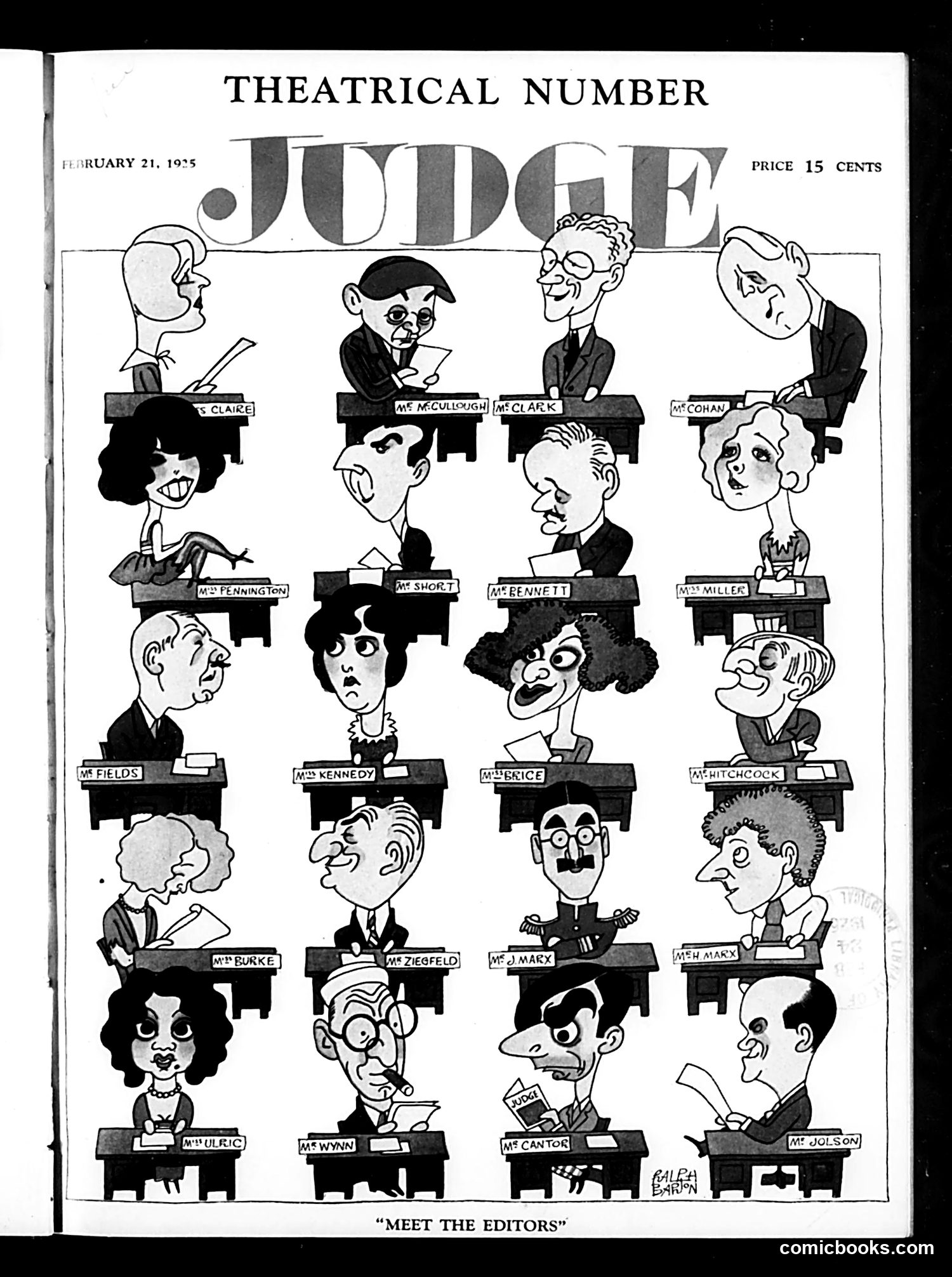
This page presents caricatured portraits of Judge magazine's editorial staff, labeled with their names. The subtitle "Meet the Editors" suggests this is an in-house feature introducing readers to the publication's leadership. The cartoonist (signed "Ralph Barton") uses exaggerated facial features characteristic of 1920s caricature style—prominent noses, distinctive hairstyles, and distinctive expressions—to humorously depict each editor at their desks. This appears to be promotional content rather than political satire, designed to humanize the magazine's staff and perhaps boost reader engagement by giving faces to the names behind Judge's satirical content. The price of 15 cents and February 1925 date place this during the height of Judge's influence as a leading American humor publication.
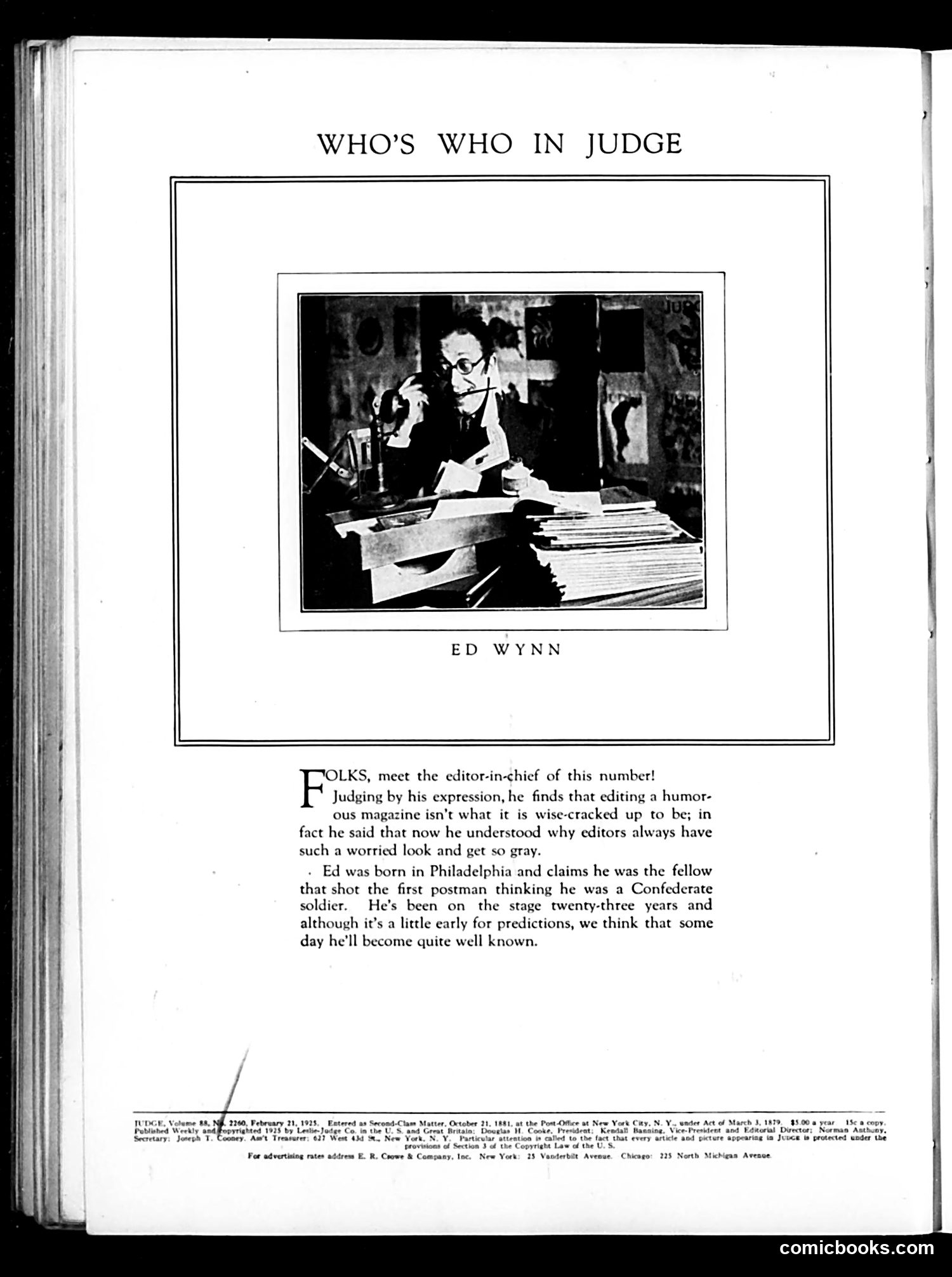
This is a biographical profile of **Ed Wynn**, the editor-in-chief of this issue of *Judge* magazine. The accompanying photograph shows him at his desk surrounded by papers and manuscripts, looking characteristically worried—which the text humorously attributes to the stress of editing a humorous magazine. The brief biography notes Wynn was born in Philadelphia and claimed to have shot the first postman while thinking he was a Confederate soldier (likely a theatrical anecdote or joke). He had been performing on stage for twenty-three years at the time of publication. The text suggests he may become "quite well-known" in the future, indicating this was written early in his career. Wynn later became a famous vaudeville and radio entertainer.
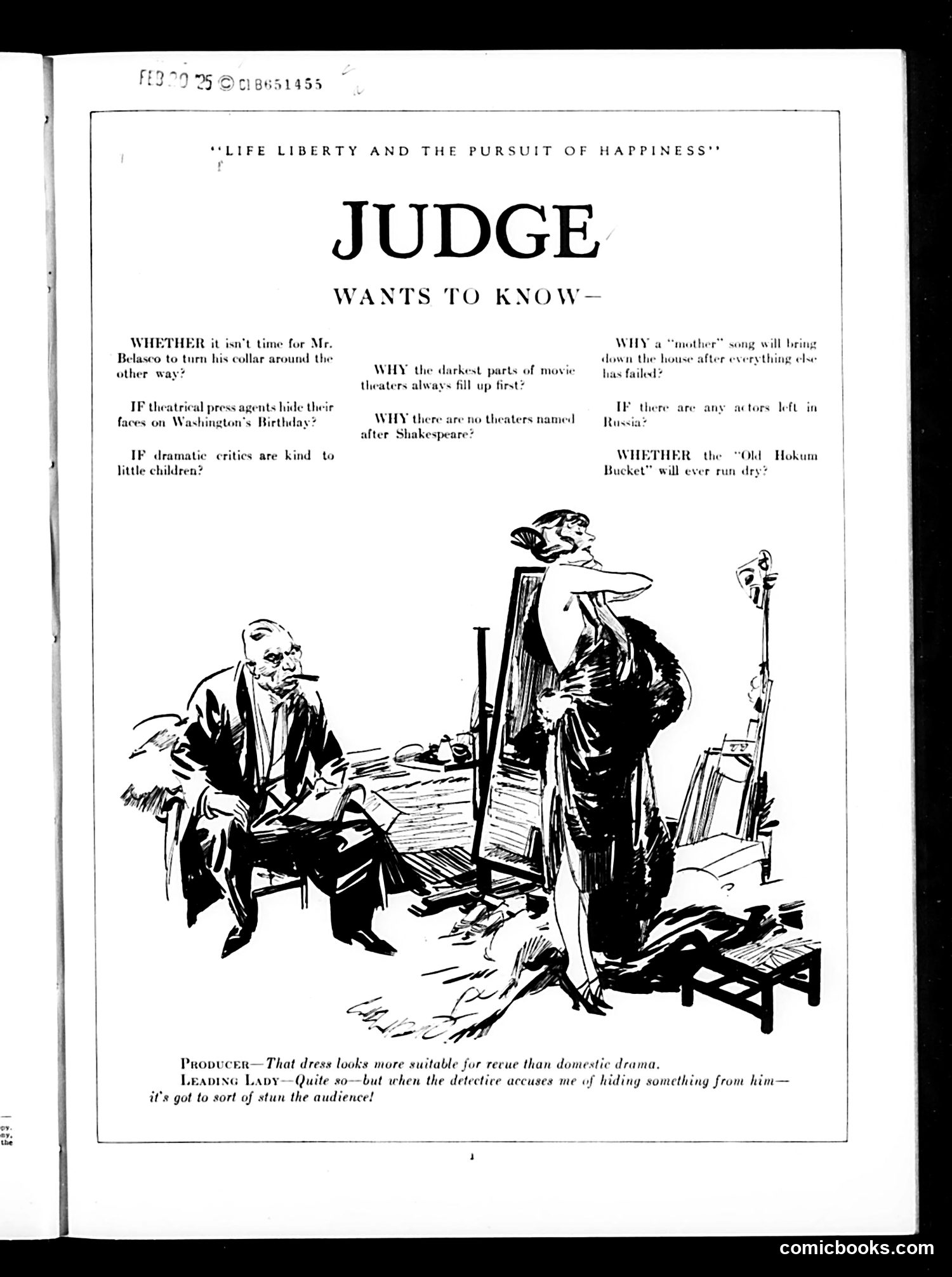
This page satirizes theatrical industry personalities and practices circa early 20th century. The header "Life Liberty and the Pursuit of Happiness" frames questions about show business absurdities. The central cartoon depicts a Producer and Leading Lady in a theatrical conflict. The Producer complains that the Leading Lady's dress is unsuitable for a "rescue" scene in domestic drama, while she argues the detective accuses her of "hiding something from him"—she needs the dress to stun the audience. The surrounding questions mock Broadway conventions: Why are dark theater sections filled first? Why no theaters named after Shakespeare? These target theatrical pretension and commercial priorities over artistic merit—a recurring Judge theme critiquing entertainment industry hypocrisy and audience taste.
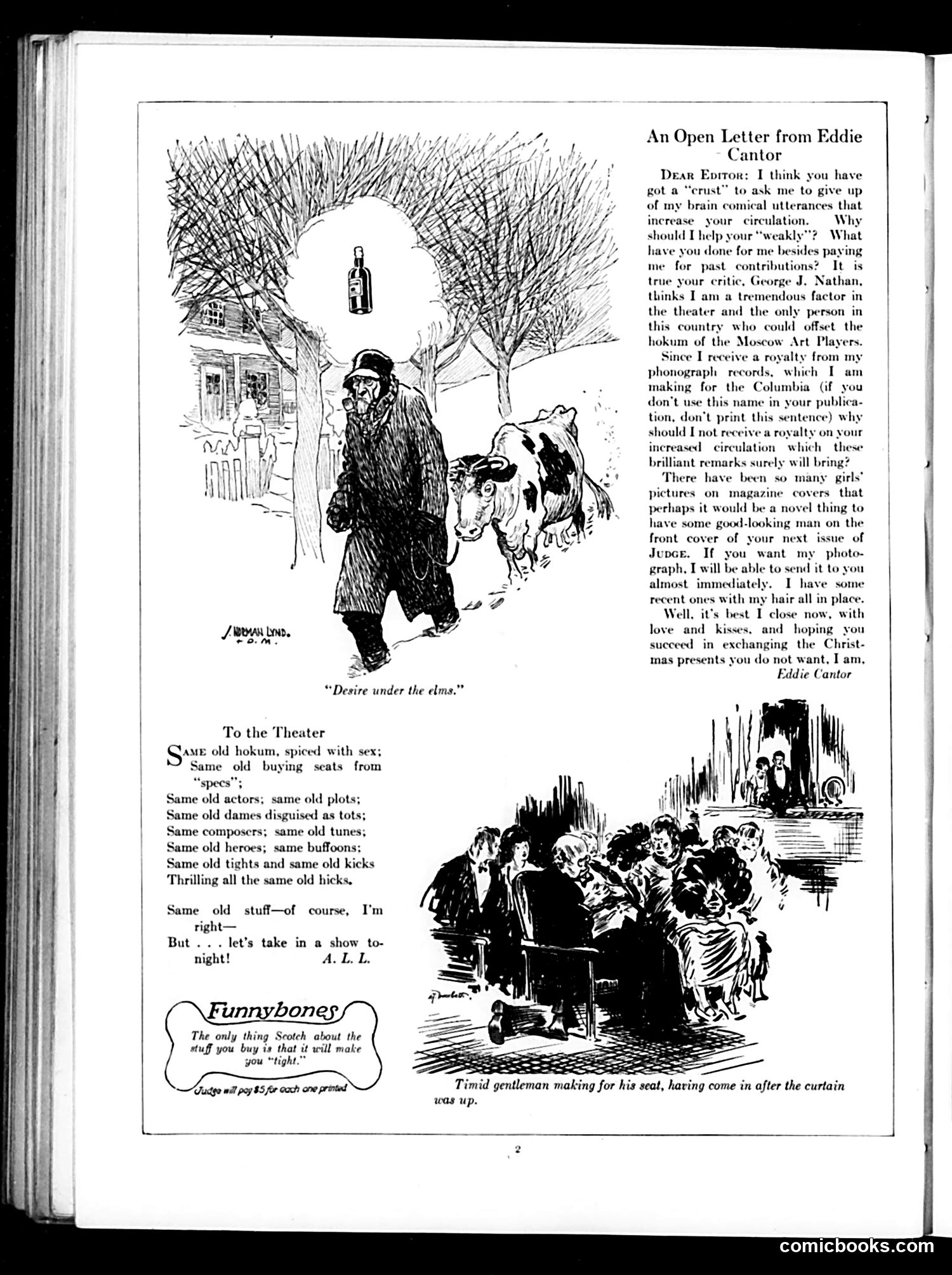
This page contains three distinct pieces: 1. **"Desire under the elms"** (top cartoon): A man with a cow beneath an elm tree, likely a visual pun on the Eugene O'Neill play "Desire Under the Elms" (1924), suggesting rural/pastoral absurdity. 2. **"To the Theater"** (middle poem): A cynical verse by A.L.L. mocking theater conventions—same plots, actors, and audience tricks repeated endlessly. The satire critiques theatrical repetitiveness and predictability. 3. **Bottom cartoon**: A "timid gentleman" arriving late to a theater after the curtain rises, confronted by an annoyed audience. This illustrates the social awkwardness and theater etiquette violations common to urban audiences. The page satirizes both theatrical mediocrity and audience behavior during the Jazz Age era.
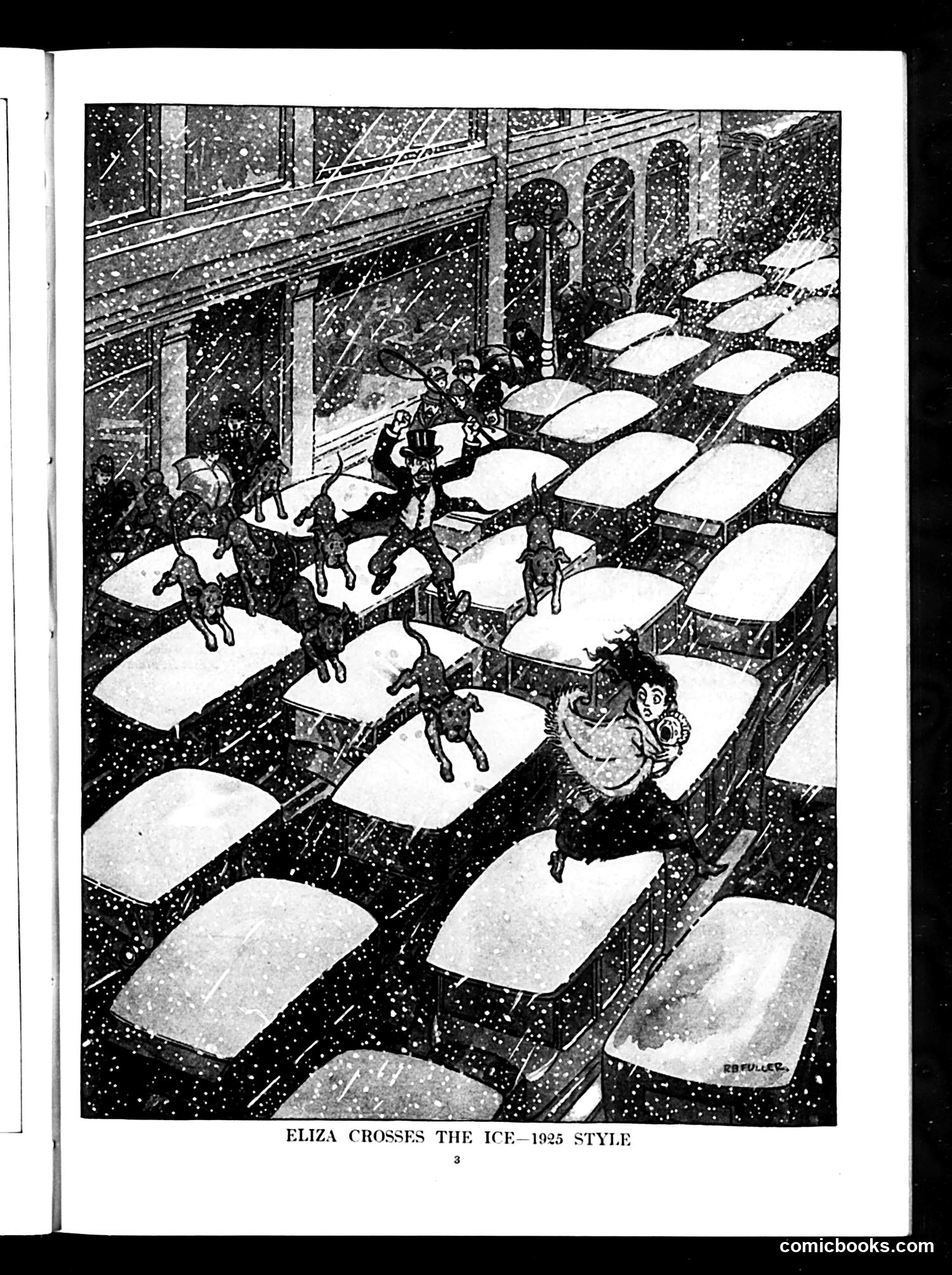
This cartoon references the famous scene from *Uncle Tom's Cabin* where the enslaved character Eliza escapes across a frozen river. The 1925 "modern" version depicts a woman crossing what appears to be an icy floor in an indoor skating rink or similar venue, surrounded by people (possibly skating or playing hockey). The humor relies on contrasting the dramatic, life-or-death escape of the original literary scene with a trivial, recreational modern scenario—suggesting that 1920s concerns have become comically petty compared to serious historical struggles. The cartoon satirizes contemporary society's preoccupations, using the classic literary reference as a foil to highlight how far removed modern problems are from genuine hardship or moral crisis.
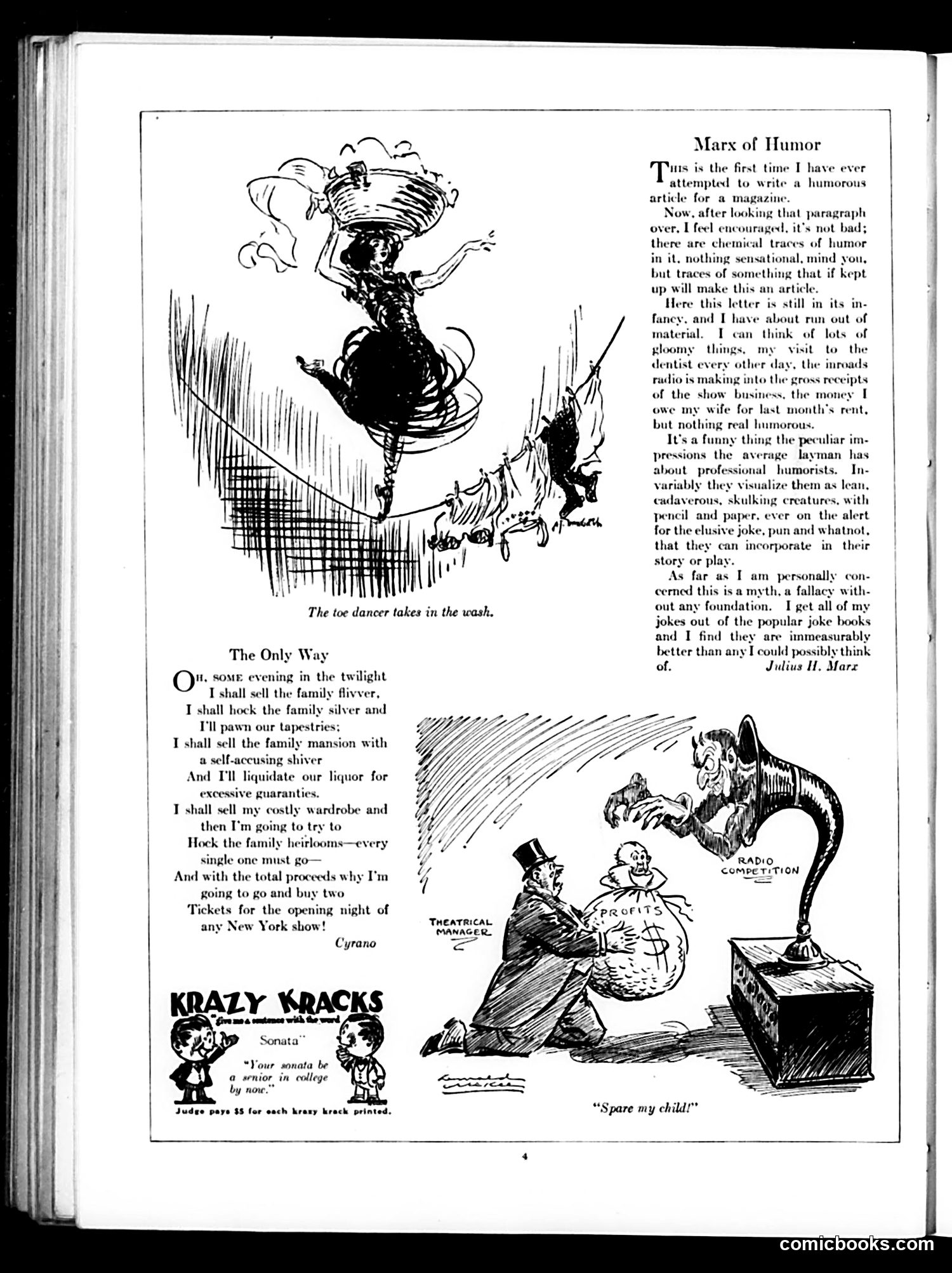
This page contains humor pieces and advertisements rather than political commentary. **"Marx of Humor"** is Julius H. Marx's essay defending his humorous writing, dismissing misconceptions that professional humorists are thin, cadaverous types. He claims his jokes come from popular joke books rather than original wit. **"The Only Way"** is a poem (attributed to Cyrano) humorously listing financial desperation—selling family valuables to buy Broadway theater tickets. **The cartoons** show: 1. A tap dancer doing acrobatics over a wash basin 2. A radio competition scene where a theater manager presents a contestant ("Profits") to what appears to be a radio demon or operator The advertisements include "Krazy Krack" sonatas and other period marketing. Overall, this is light entertainment rather than political satire.
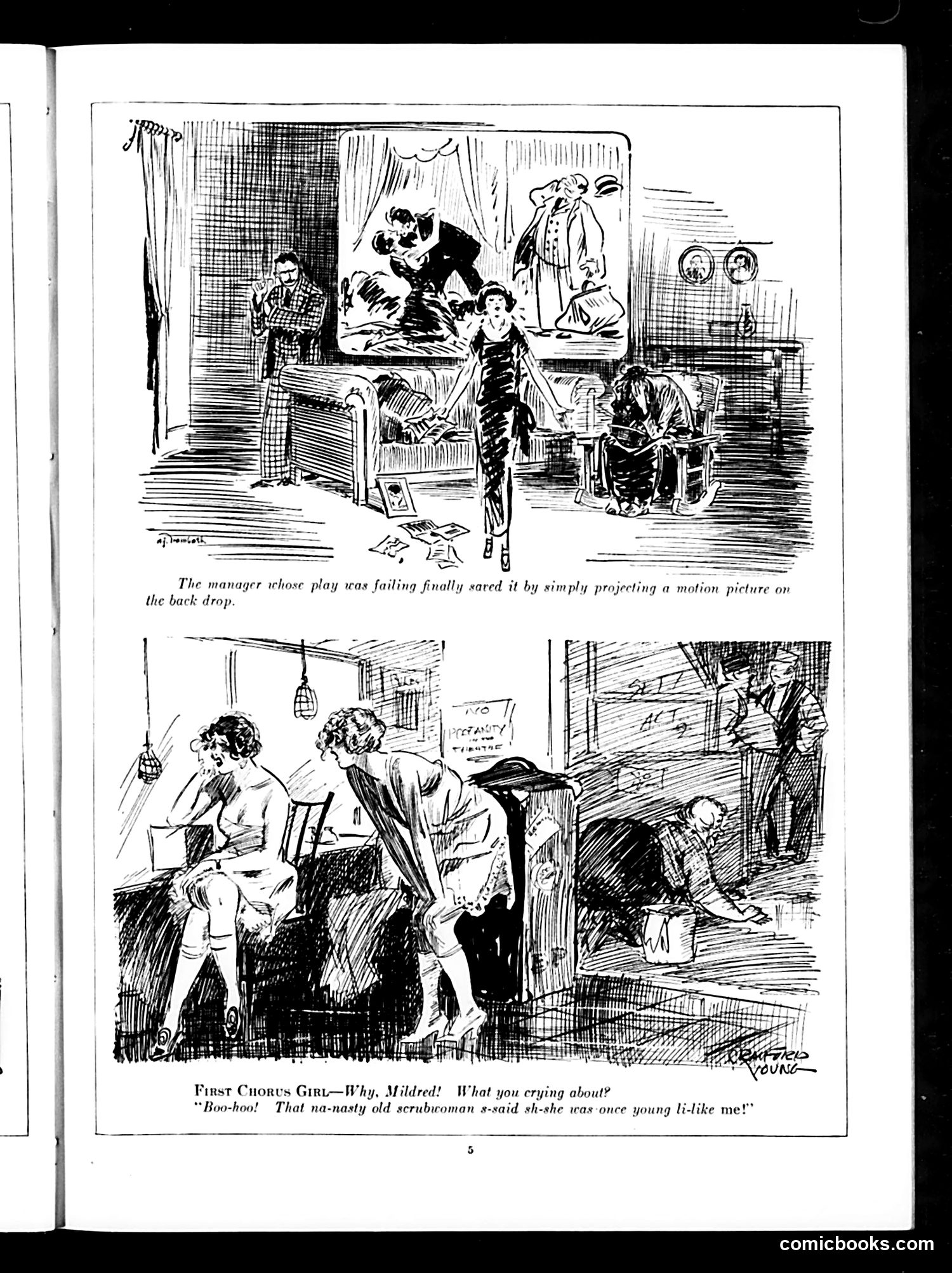
This page contains two theatrical sketches satirizing early 20th-century stage productions. The **top cartoon** mocks a failing theatrical play. The caption explains a manager salvaged a failing production by simply projecting a motion picture onto the backdrop—suggesting that adding cinema (then novel entertainment) could rescue poor live theater. This satirizes both theatrical desperation and the rising competition from film. The **bottom cartoon** depicts backstage drama with chorus girls. The caption's dialogue ("That na-sty old scrubwoman x-said sh-she was once young li-like me!") is meant to be humorous, playing on vanity and aging. The joke appears to mock chorus girls' anxiety about growing older and losing their youth-dependent careers. Both sketches reflect early-1900s theatrical culture and anxieties about changing entertainment.
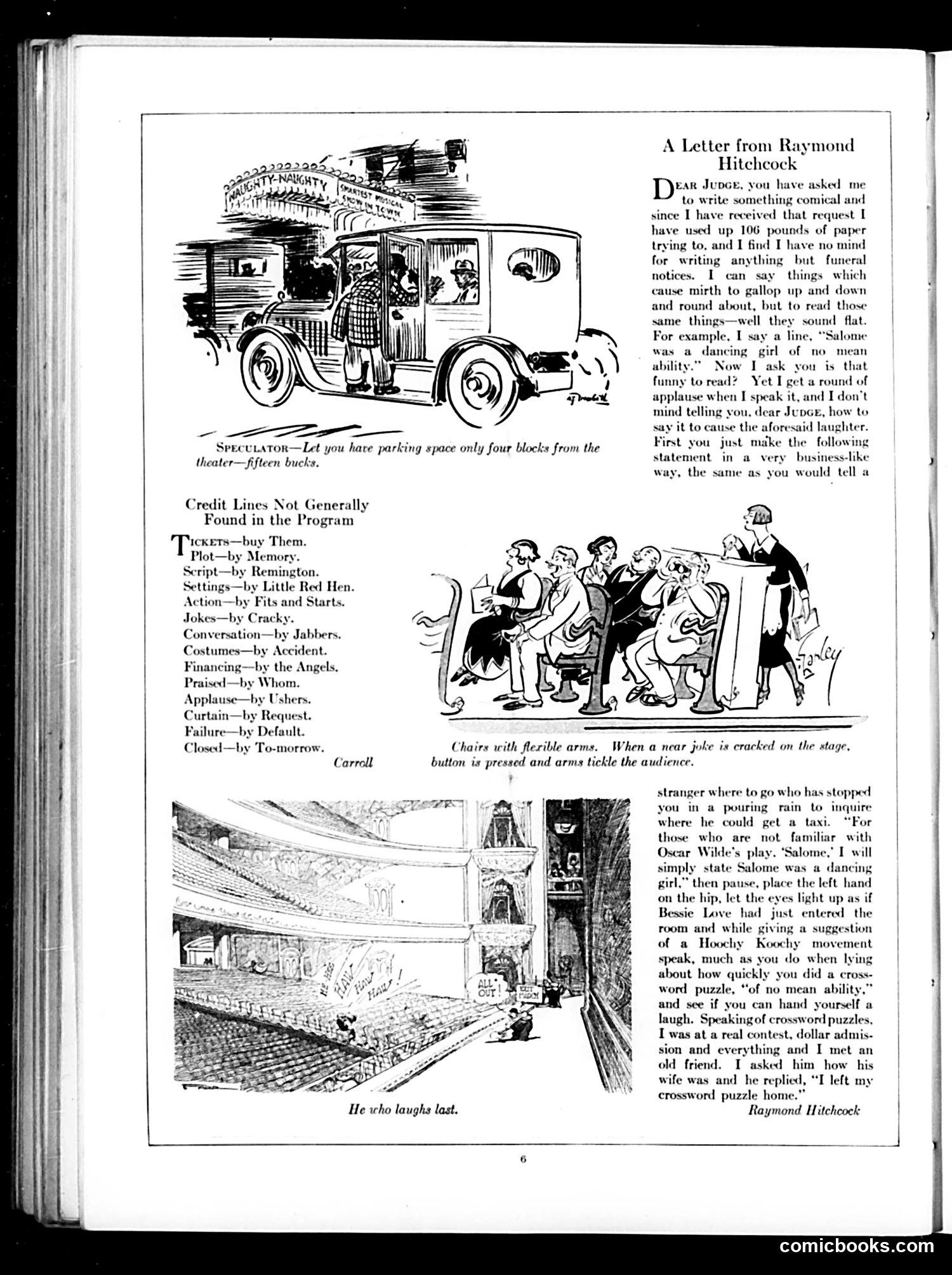
This page contains satirical commentary on theater economics and performance from actor-comedian Raymond Hitchcock. **The Top Cartoon** mocks inflated theater pricing: a speculator charges $15 for parking "only four blocks from the theater"—profiteering on theater-goers' desperation. **"Credit Lines Not Generally Found in the Program"** is a humorous list attributing theatrical elements to unexpected sources: tickets "buy themselves," plots come from "memory," settings from "accident," financing from "angels" (likely meaning miraculous intervention). It satirizes how theater productions actually come together chaotically, contrary to polished program credits. **Hitchcock's Letter** explains how comedic timing differs between live performance and written text. He illustrates with an example from Oscar Wilde's *Salome*—the same line gets applause onstage but reads flat on the page. The anecdote about his friend leaving his crossword puzzle home is a pun joke: the friend abandoned his puzzle (wife = "cross-word" puzzle). **The Theater Interior Sketch** labeled "He who laughs last" depicts audience seating, emphasizing the live-performance context of the page's humor discussion.
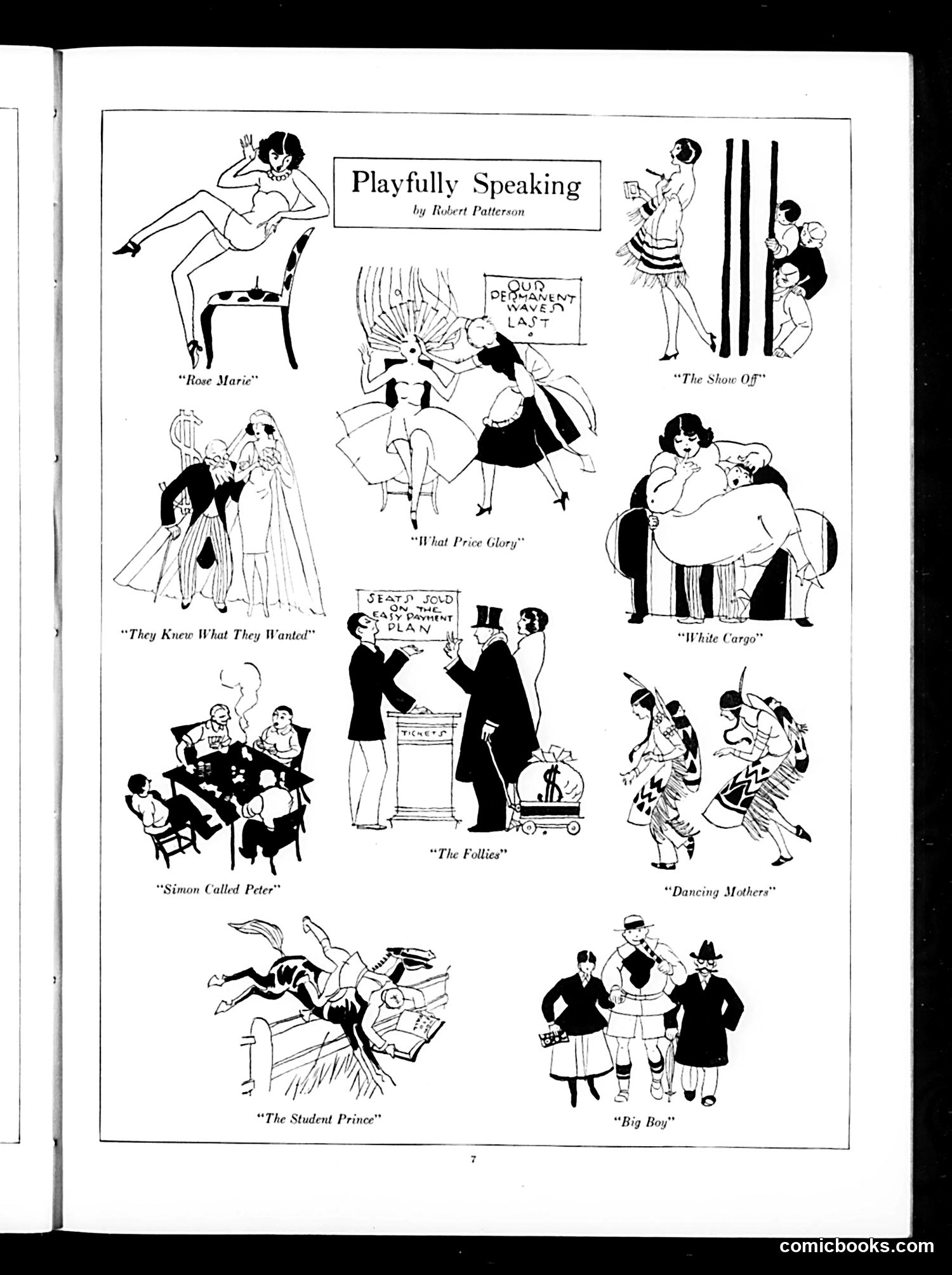
This is a humorous illustration page featuring ten separate cartoon vignettes, each captioned with what appear to be theatrical or popular culture references of the era. The sketches showcase various comedic scenarios: a woman lounging ("Rose Marie"), dancers and performers ("The Show Off," "Dancing Mothers"), domestic situations ("White Cargo," "Simon Called Peter"), and what appears to be operatic or theatrical scenes ("The Student Prince," "Big Boy"). The cartoons use exaggerated character poses and expressions typical of 1920s-30s satirical illustration. Without additional context, the specific social or political commentary isn't entirely clear—these may be references to actual plays, films, or popular entertainments of the period, with the humor deriving from visual gags and character types recognizable to contemporary readers familiar with those works.
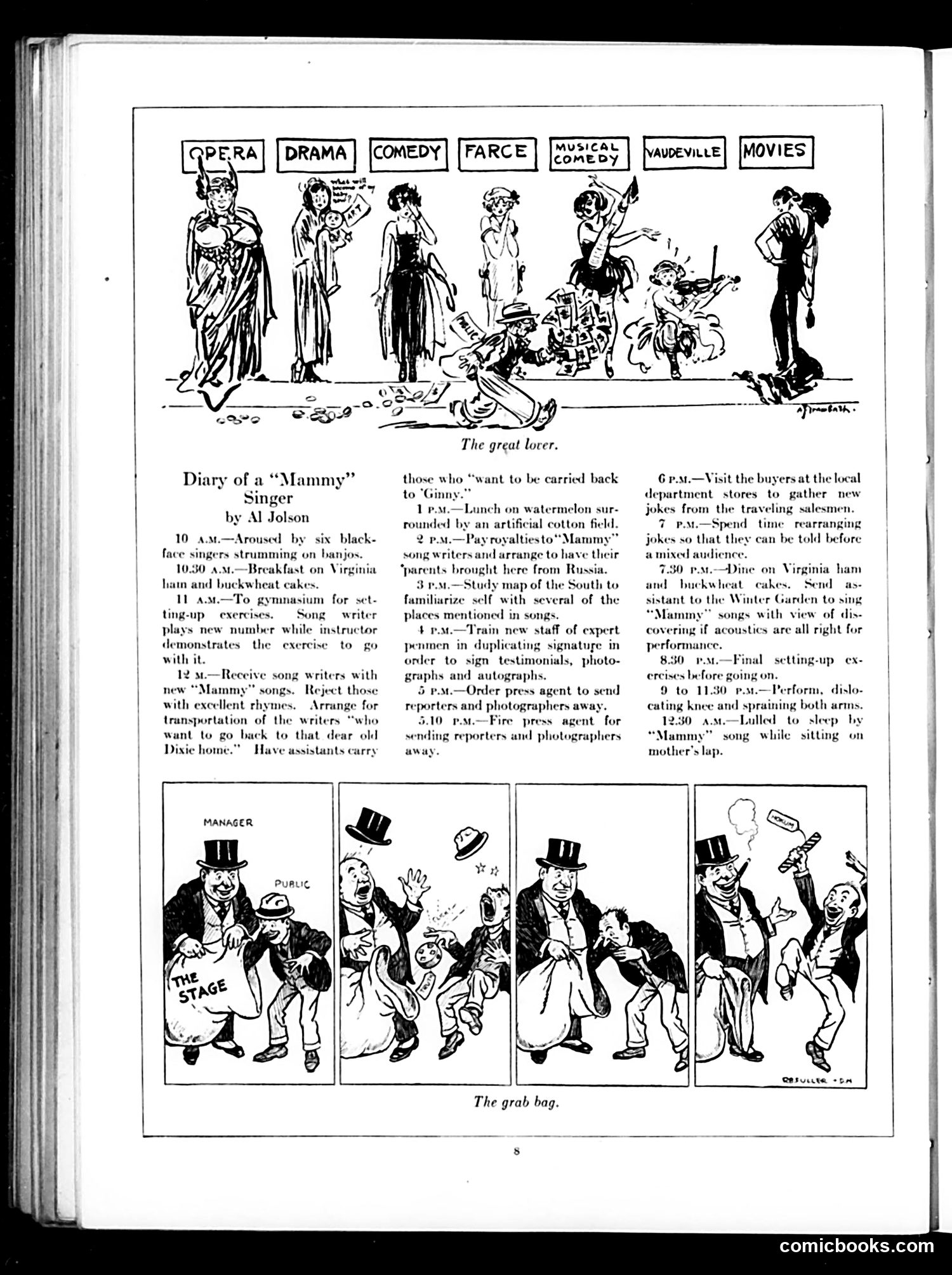
This page satirizes **Al Jolson**, the famous blackface performer of the 1920s, through a mock diary of his daily routine as a "Mammy" singer. The satire targets both Jolson's commercial exploitation of racist entertainment and the infrastructure supporting it. Key targets of the satire: - **Blackface performance**: The diary mocks how Jolson built an entire industry around stereotypical depictions of African Americans, complete with banjos, watermelon, and Southern imagery. - **Manufactured authenticity**: The humor exposes how artificial the "authenticity" was—Jolson studies maps to learn about the South, hires staff to forge his autographs, and rejects song lyrics that sound *too* genuine. - **Commercial cynicism**: References to paying royalties to Russian-Jewish songwriters (likely Jolson's actual collaborators) while performing "Southern" material highlights the disconnect between performers and content. **"The Grab Bag"** cartoon below depicts a theatrical manager distributing money to eager performers—commenting on show business' transactional nature. This represents pre-Civil Rights era satirical criticism of racism in entertainment.
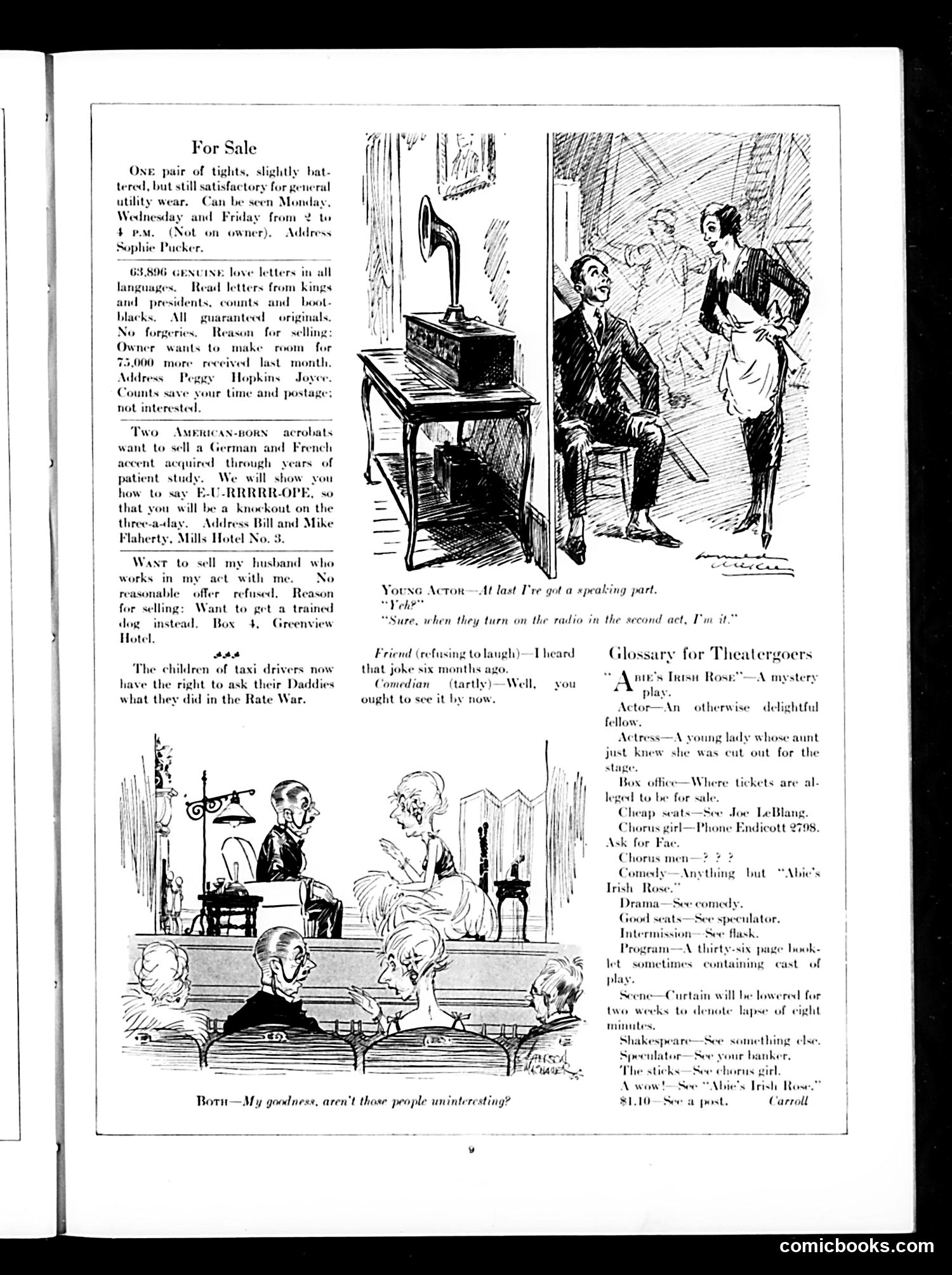
This page contains satirical classified ads and theater humor typical of Judge magazine's comedic approach. **The "For Sale" Section** mocks theatrical desperation through absurdist listings: worn-out tights, "genuine love letters from kings," accents acquired by immigrant acrobats, and notably, a woman selling her husband because she'd "rather get a trained dog instead"—exaggerating marital discord for laughs. **The "Rate War" Reference** appears to joke about taxi drivers' involvement in some labor dispute or competitive conflict; children now ask what their fathers did during this conflict, treating it like wartime service. **The Theater Cartoons** satirize both amateur actors and theater audiences. The top cartoon shows a young actor assured he'll get a speaking part; the bottom shows audience members finding the show tedious ("uninteresting"). **The "Glossary for Theatergoers"** is meta-humor defining theatrical terms mockingly: actors are described as generally untalented, actresses have rich aunts, "cheap seats" are where you go to "see flask" (drink during Prohibition), and the play itself ("Abie's Irish Rose," a popular contemporary show) is anything but comedy. The page satirizes both theatrical pretension and audience sophistication.
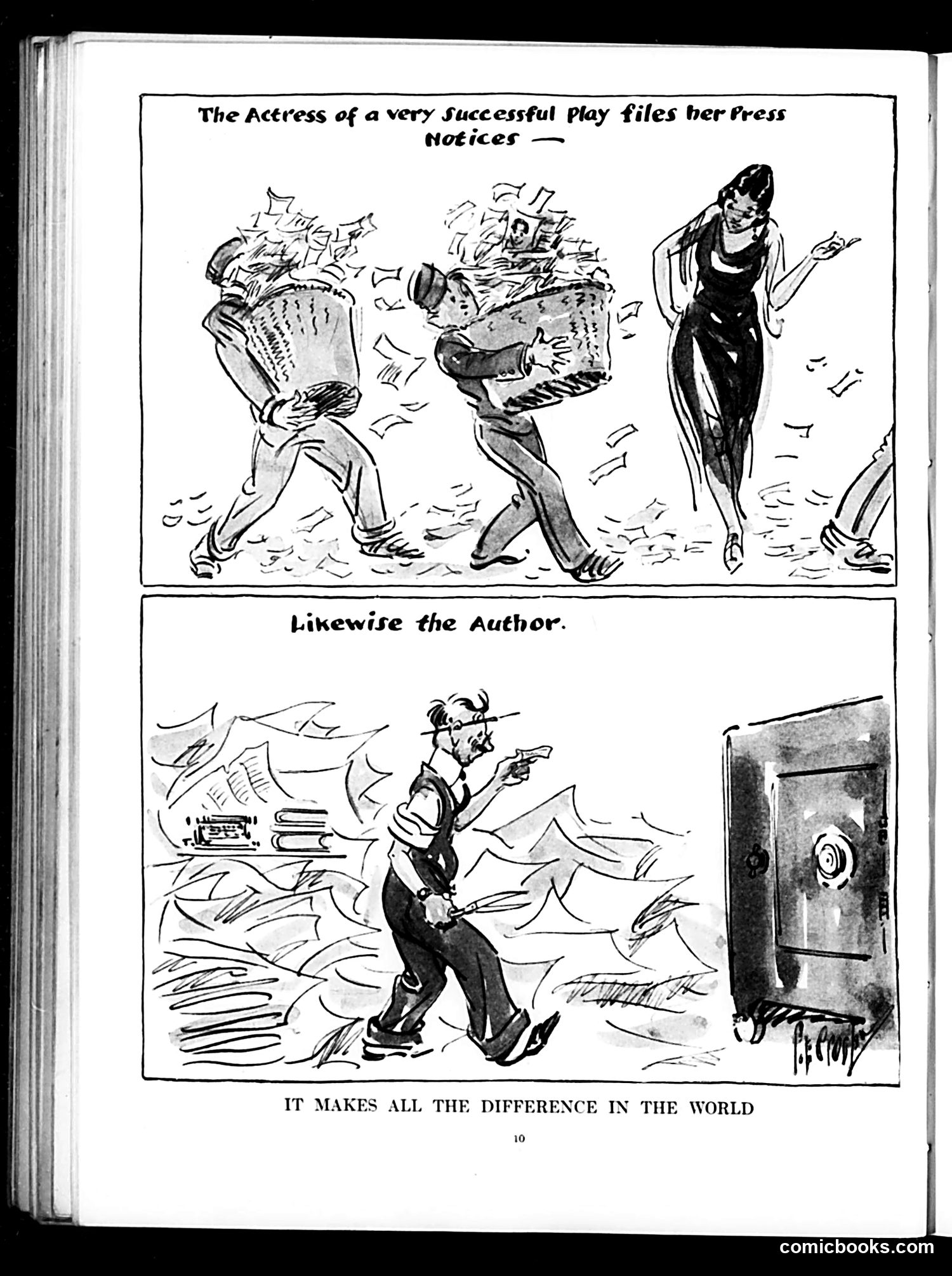
This is a two-panel cartoon contrasting an actress's treatment versus an author's treatment when dealing with press notices. **Top panel**: The successful actress cheerfully tosses away numerous press clippings, unbothered by critics' reviews. Two men carrying baskets overflow with notices she's discarding. **Bottom panel**: Labeled "Likewise the Author," a man is shown drowning in an avalanche of papers and manuscripts, desperately pointing toward a safe—suggesting he's frantically trying to protect his work or finances from the deluge of feedback. **The joke**: The title "It Makes All the Difference in the World" is ironic. While the actress can dismiss poor reviews because her play's success speaks for itself, the author—who likely created the play—cannot escape the same criticism. The satire comments on theatrical credit and how performers benefit from success while playwrights remain vulnerable to critical scrutiny, regardless of actual merit.
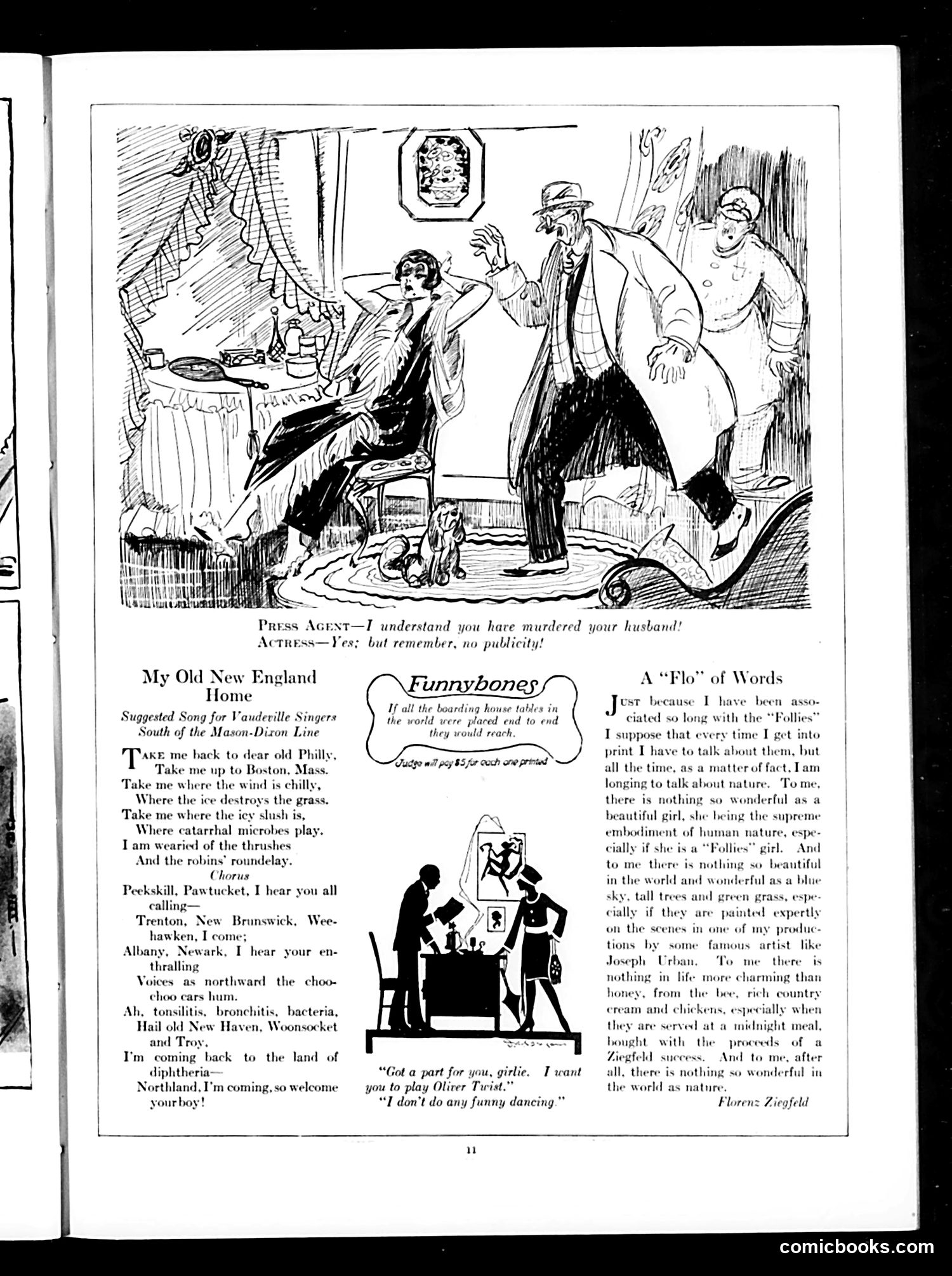
**Top Cartoon:** A press agent confronts an actress who has murdered her husband. Her response—"no publicity"—satirizes theatrical vanity and the era's obsession with controlling public image over actual morality. The joke inverts expected values: she's concerned about reputation damage, not the crime itself. **"My Old New England Home":** A parody of Stephen Foster's sentimental "My Old Kentucky Home," this song mocks Northern cities by replacing pastoral imagery with disease and illness (tonsilitis, bronchitis, bacteria, catarrhal microbes, icy slush). It's a humorous jab at the Northeast's harsh winters and urban conditions, contrasting romanticized nostalgia with gritty reality. **"A 'Flo' of Words":** Florentz Ziegfeld's column celebrates the *Follies* and beautiful showgirls as embodiments of nature—a tongue-in-cheek observation about how theatrical impresarios romanticize their productions and performers while claiming deep philosophical appreciation for "nature."
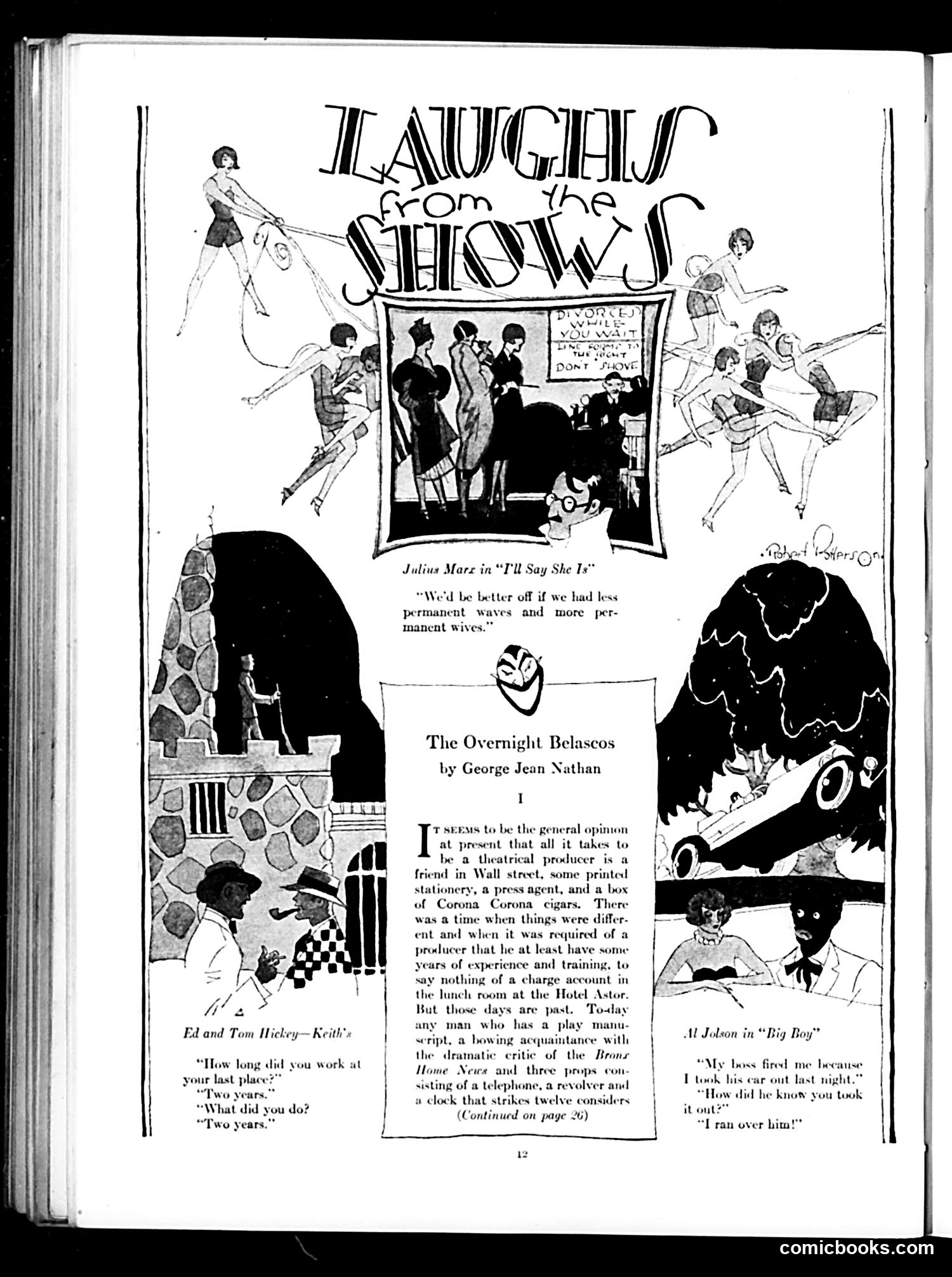
This Judge magazine page offers satirical commentary on 1920s theater and social trends through three distinct pieces: **"The Overnight Belascos"** (main article by George Jean Nathan): Nathan satirizes the decline of theatrical producer standards. He contrasts the past—when producers needed Wall Street connections, stationery, cigars, *and* actual experience—with the present, when any script-holder with theatrical connections can become a producer. The title references David Belasco, a legendary theater producer, implying modern producers are cheap imitations. **"I'll Say She Is"** (Julius Marx quote): Mocks the 1920s beauty trend of "permanent waves" (chemical hair treatments), suggesting society would benefit from permanent marriages instead—a jab at modern divorce rates and women's changing independence. **"Big Boy"** (Al Jolson quote): A brief joke about marital discord, likely from a contemporary Jolson theatrical production. The page reflects Jazz Age anxieties about theatrical professionalization, women's autonomy, and shifting social values.
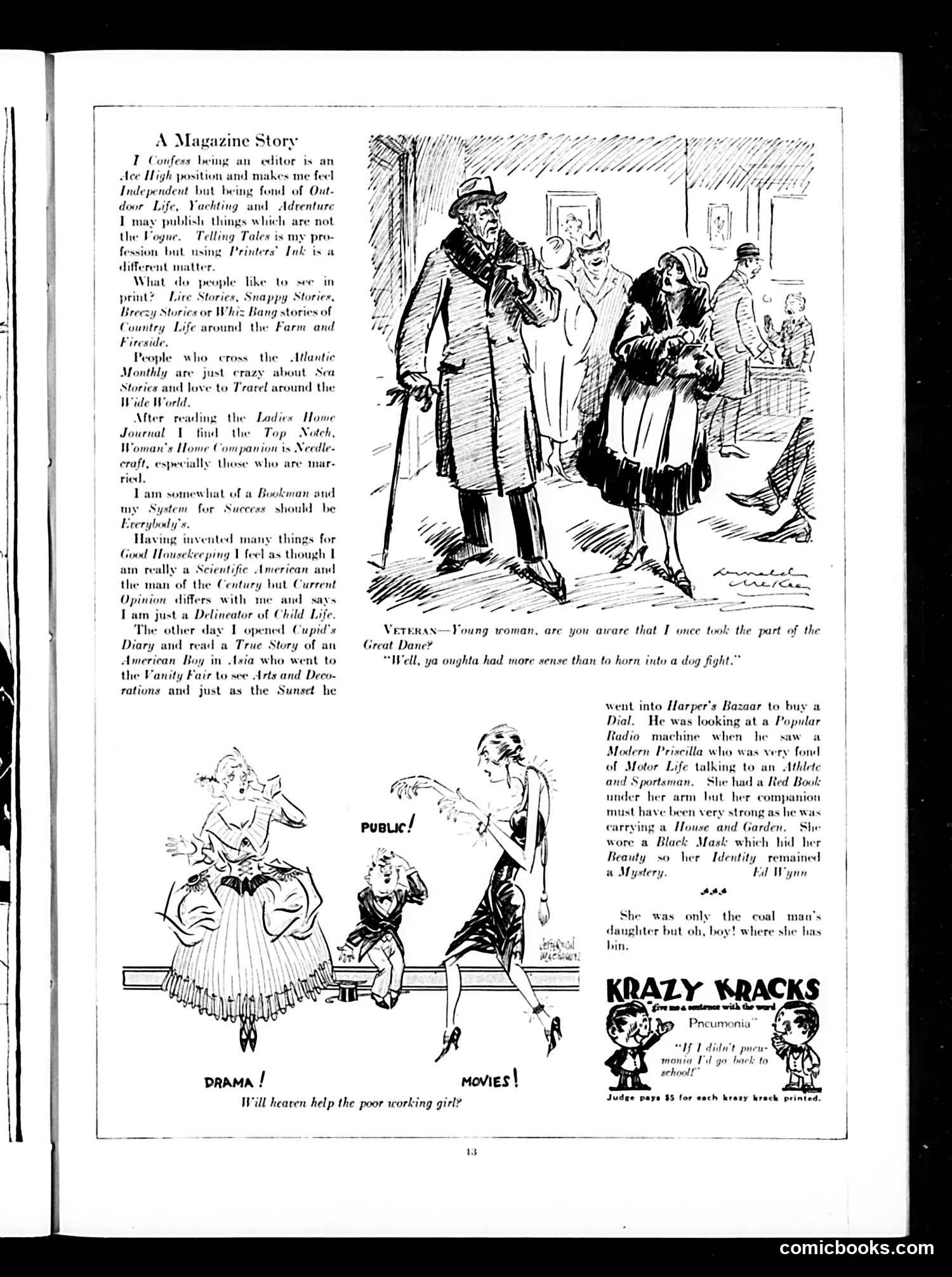
This page is a satirical commentary on **magazine publishing and editorial tastes**. The unnamed editor boasts of his high position while admitting he publishes sensational content—"Telling Tales"—despite recognizing it's not in good taste. The satire targets how different magazines appeal to specific audiences: *Life Stories* and *Whiz Bang* for adventure-seekers; *Atlantic Monthly* for travel enthusiasts; *Ladies Home Journal* and *Woman's Home Companion* for domestic readers. The author cleverly names real popular magazines to mock how editors tailor content to demographic niches. The accompanying cartoons illustrate this: one shows working-class melodrama ("Drama! Will heaven help the poor working girl?"), another depicts frivolous movie-going. The final anecdote—about a young man encountering a mysterious woman—is a parody of pulp romance narratives found in these magazines, complete with the clichéd ending: "She was only the coal man's daughter but oh, boy!" The overall point: editors cynically exploit readers' appetite for manufactured sentimentality and formulaic stories while claiming cultural sophistication.
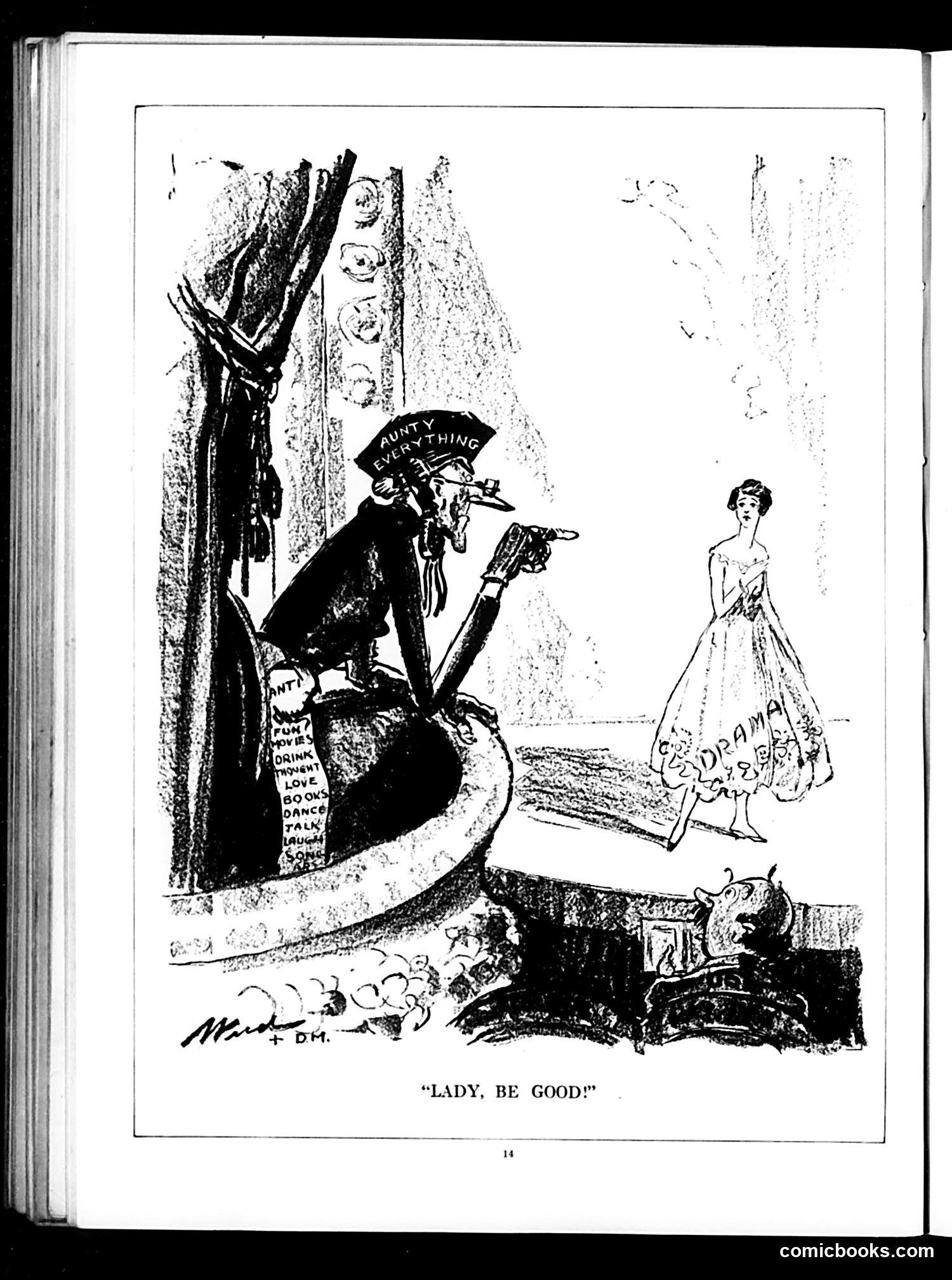
This cartoon satirizes the tension between Victorian moral standards and modern temptation. A demonic or devil-like figure sits on a throne labeled "EVERYTHING," holding a scroll marked "DRAMA" and displaying various vices (drinking, love, songs, dancing, etc.). A well-dressed young woman in a fashionable dress stands nearby, seemingly tempted. The caption "Lady, Be Good!" is ironic—it's an admonition to resist the devil's offerings of worldly pleasures and entertainment. The cartoon criticizes how modern theatrical "drama" and entertainment industry tempt women away from traditional virtue and propriety. This reflects early 20th-century anxieties about urbanization, consumer culture, and changing female social roles.
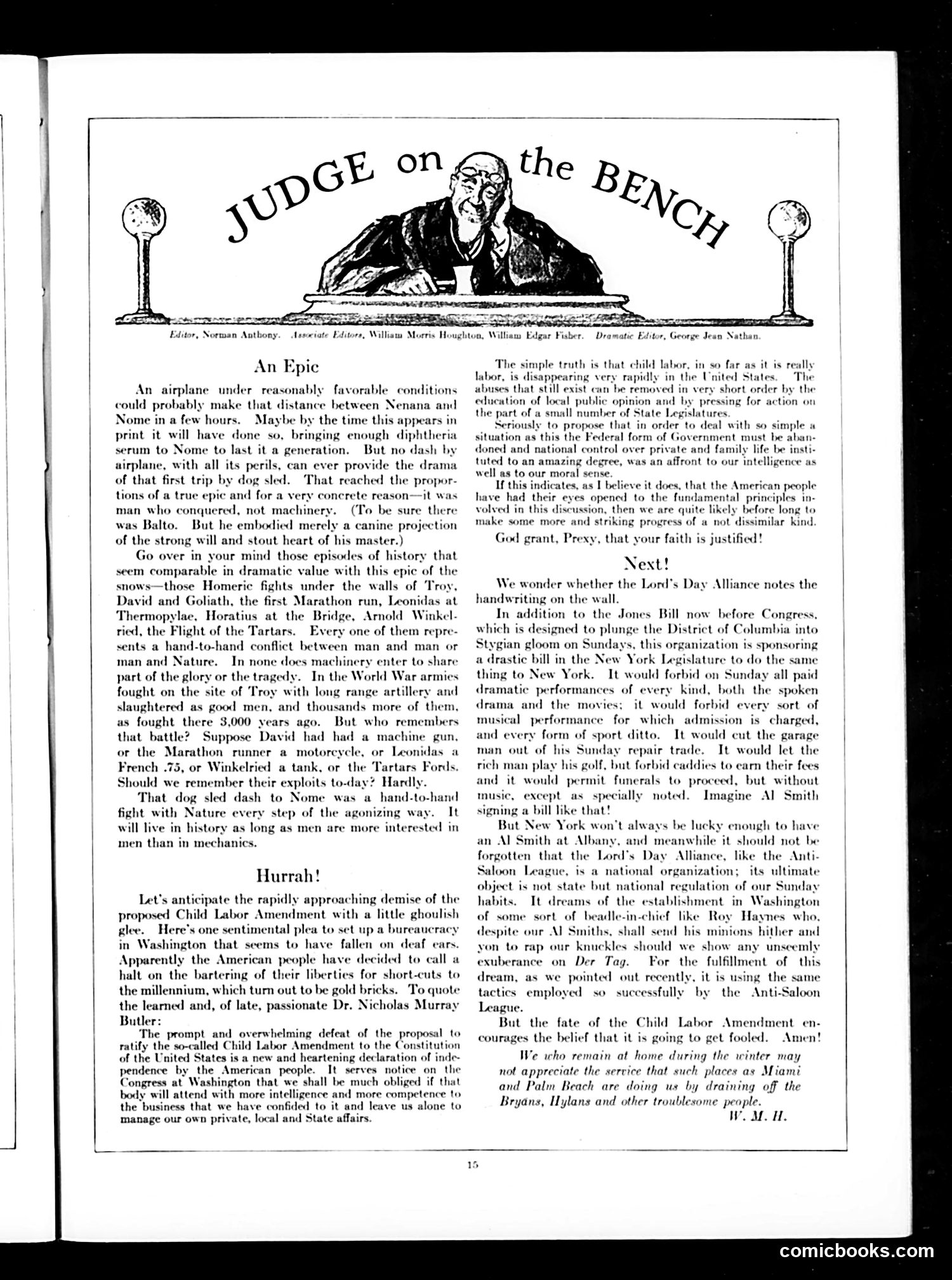
This page from Judge magazine (circa 1925, based on context) contains two distinct editorial pieces: **"An Epic"** praises the 1925 serum run to Nome, Alaska, where dog sleds delivered diphtheria medicine across frozen terrain. The writer argues this human-vs-nature drama rivals historical epics (Troy, Marathon) because it relied on human courage rather than machinery. It's romanticizing pre-industrial heroism over modern technological solutions. **"Hurrah!"** celebrates the defeat of the proposed Child Labor Amendment to the Constitution. The editors quote Dr. Nicholas Murray Butler approvingly, arguing that child labor is already disappearing naturally through public opinion and state action, making federal intervention unnecessary and an affront to liberty and states' rights. The satire targets progressive reformers seeking centralized government control. Judge's conservative stance opposes expanding federal power, preferring local solutions and individual/parental responsibility over national bureaucracy—even on child welfare issues.
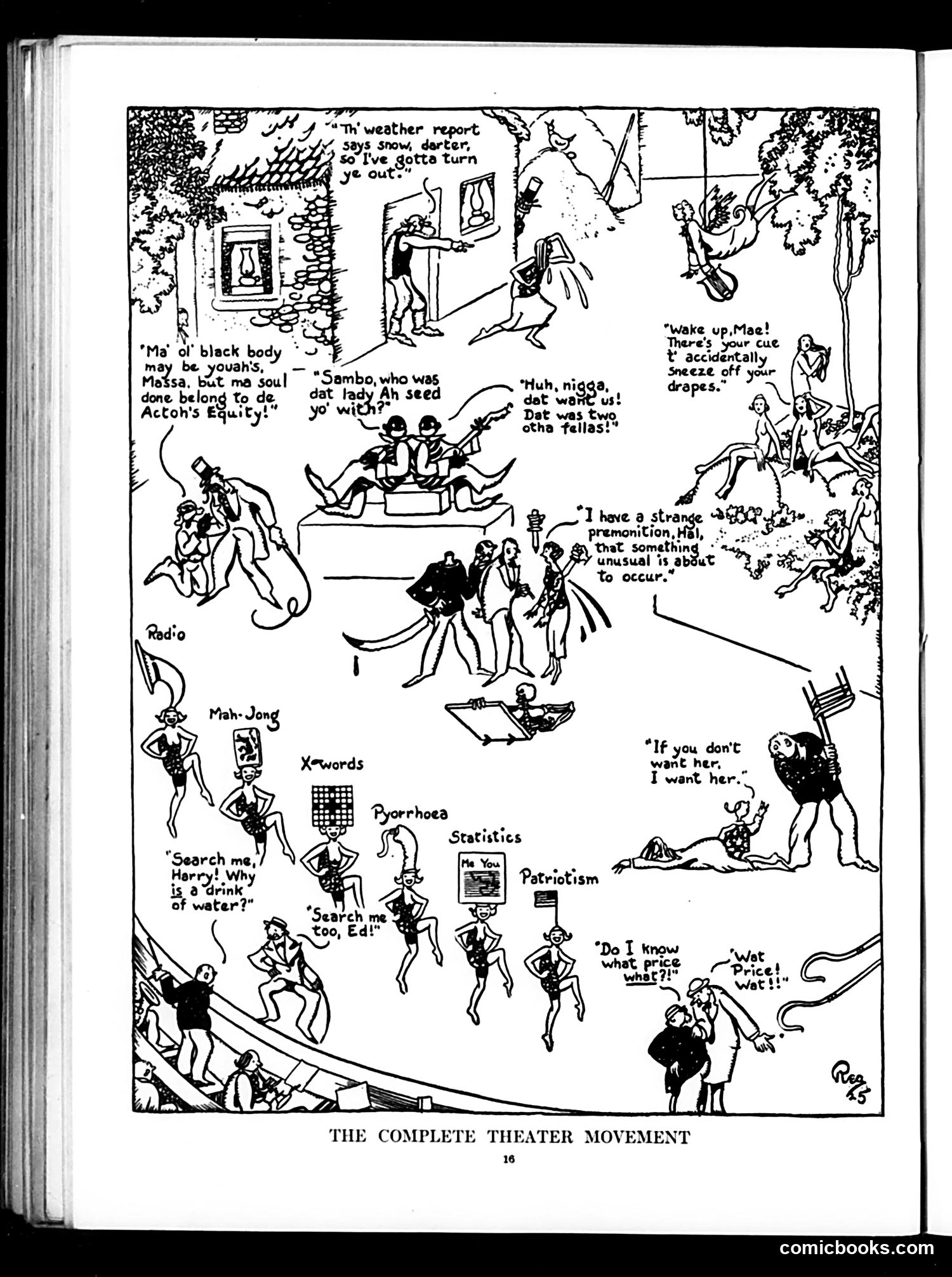
This cartoon satirizes how theatrical entertainment has become completely fragmented and commercialized in American culture. The central image shows various entertainment and leisure activities scattered chaotically—radio, Mah-Jong, crosswords, statistics, patriotism—all labeled as part of "the complete theater movement." The satire suggests that genuine theater has been displaced by superficial diversions and competing entertainments. Characters argue over romantic interests while discussing trivial pursuits. The dialogue mocking African American dialect ("Ma' ol' black body," "Sambo") and references to weather reports, card games, and statistics mock how audiences now consume fragmented entertainment rather than attending actual theatrical productions. The overall message: modern American leisure culture has become so atomized and entertainment-focused that coherent "theater" (meaningful cultural experience) no longer exists—only scattered, lowbrow distractions.
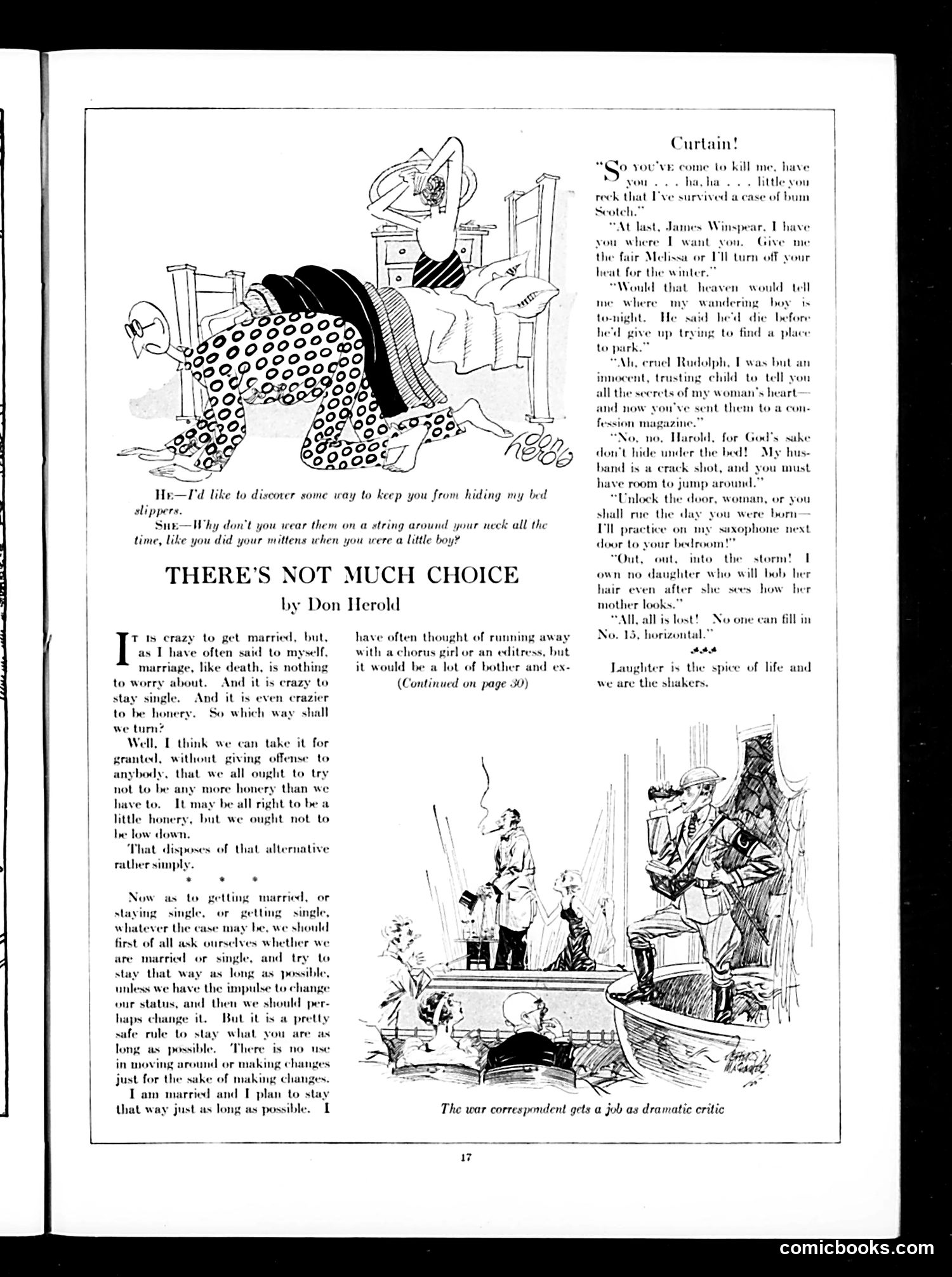
This page presents a humor essay on marriage versus single life, accompanied by two cartoons satirizing domestic life and melodramatic theater. **The main essay** (by Don Herold) humorously argues that marriage, staying single, and loneliness are all equally "crazy," so one might as well stay married to avoid constant change. The opening cartoon jokes about marital annoyances—a husband complaining his wife hides his slippers, she sarcastically suggesting he wear them on a string like a child wore mittens. **The "Curtain!" cartoon** (bottom right) parodies overwrought theatrical melodrama. It depicts exaggerated dramatic confrontations with period-appropriate dialogue about villains, gun violence, infidelity, and scandals—all delivered with absurdly florid language. The caption notes "The war correspondent gets a job as dramatic critic," suggesting that war reporting and melodramatic theater are equally overwrought or ridiculous. The satire targets both the banality of married life and the artificial extremism of stage melodrama, implying modern audiences recognize both as overwrought concerns.
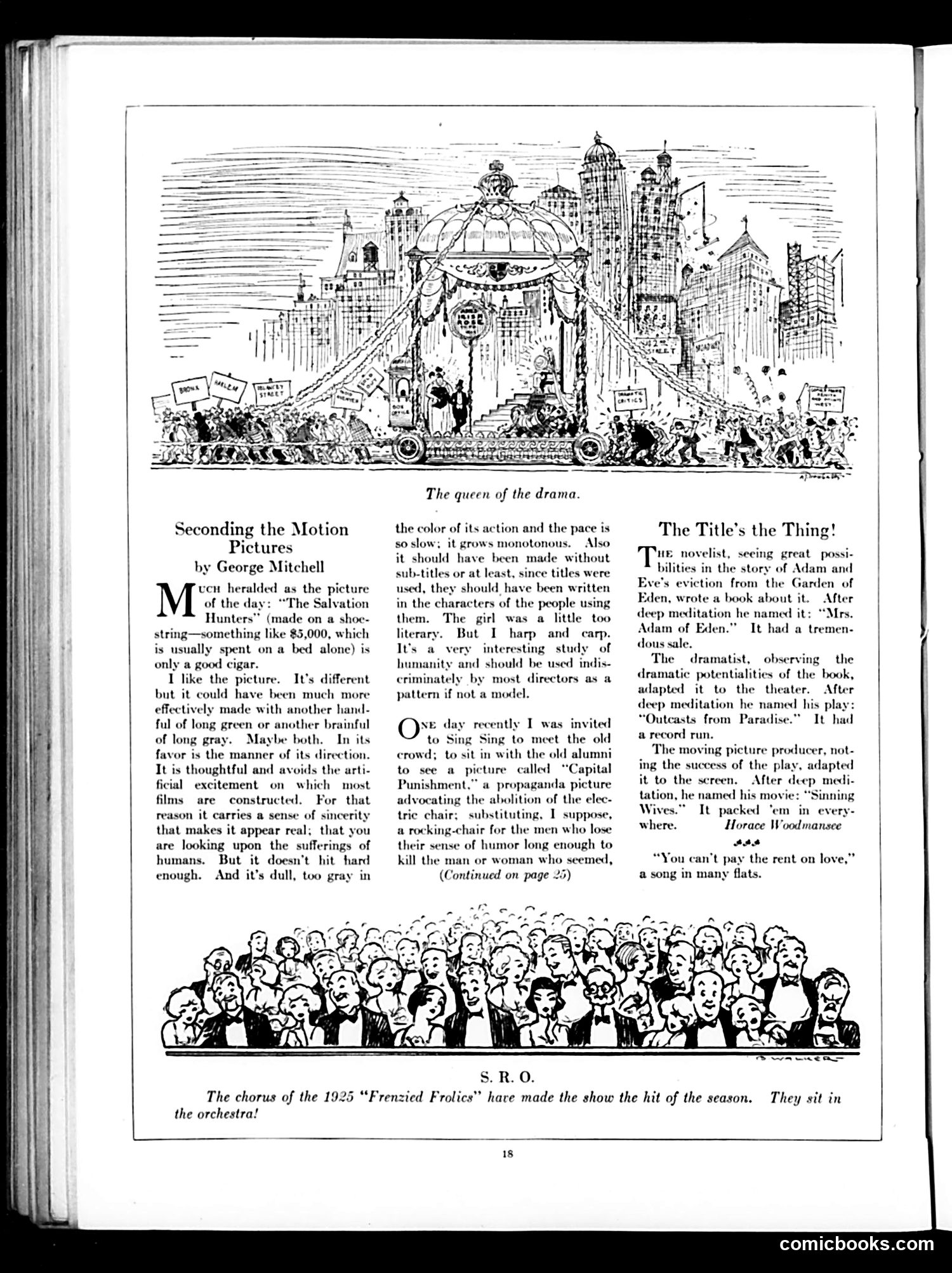
This page from *Judge* magazine contains film criticism and theatrical satire from 1925. **"Seconding the Motion Pictures"** reviews *The Salvation Hunters*, a low-budget ($5,000) film praised for its sincere direction but criticized as dull and monotonous. Mitchell also mentions attending a screening at Sing Sing prison of *Capital Punishment*, a propaganda film opposing the electric chair. **"The Title's the Thing!"** satirizes how producers reshape existing works for profit. A novelist writes about Adam and Eve's exile as "Mrs. Adam of Eden" (sales success); a dramatist adapts it as "Outcasts from Paradise" (record run); a film producer then retitles it "Sinning Wives" for cinema audiences. The joke mocks how the same story gets repackaged with sensational titles for maximum commercial appeal—each intermediary claims credit while chasing profit. The bottom illustration shows a 1925 chorus line from *Frenzied Frolics*, the season's hit show.
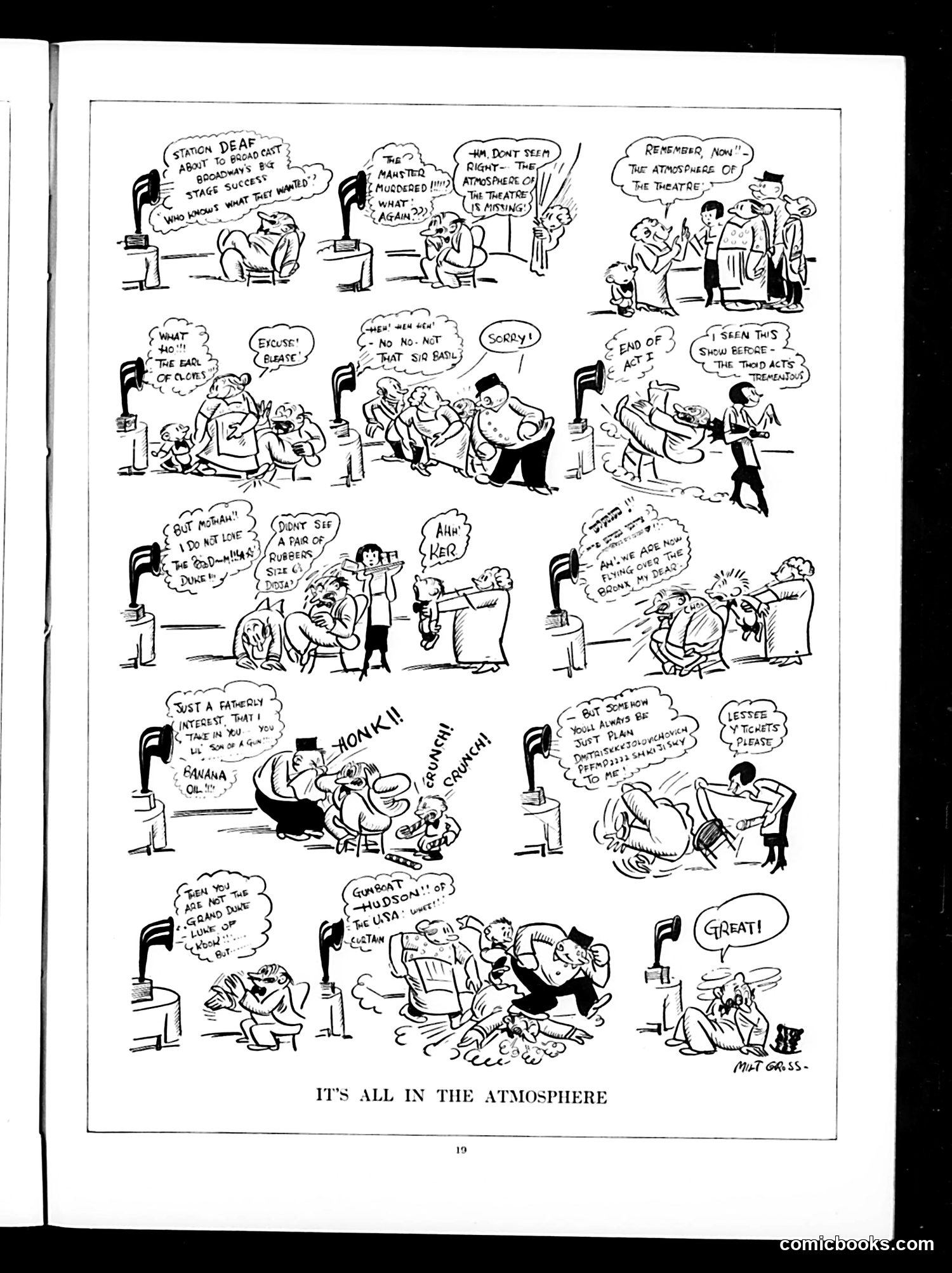
This single-panel comic strip satirizes theater-goers' behavior during performances. A patron at the box office attempts to purchase tickets while making increasingly absurd demands of the ticket seller—requesting the theater maintain proper "atmosphere," complaining about the third act, asking for a banana during the show, and making other disruptive requests. The satire targets audience members who treat theater attendance as an opportunity to be difficult or demanding, rather than respectfully enjoying the performance. The title "It's All in the Atmosphere" ironically suggests that theatergoers' own poor behavior and unreasonable expectations—not the venue—ruin the theatrical experience. The comic mocks entitled patrons who expect special treatment and accommodation.
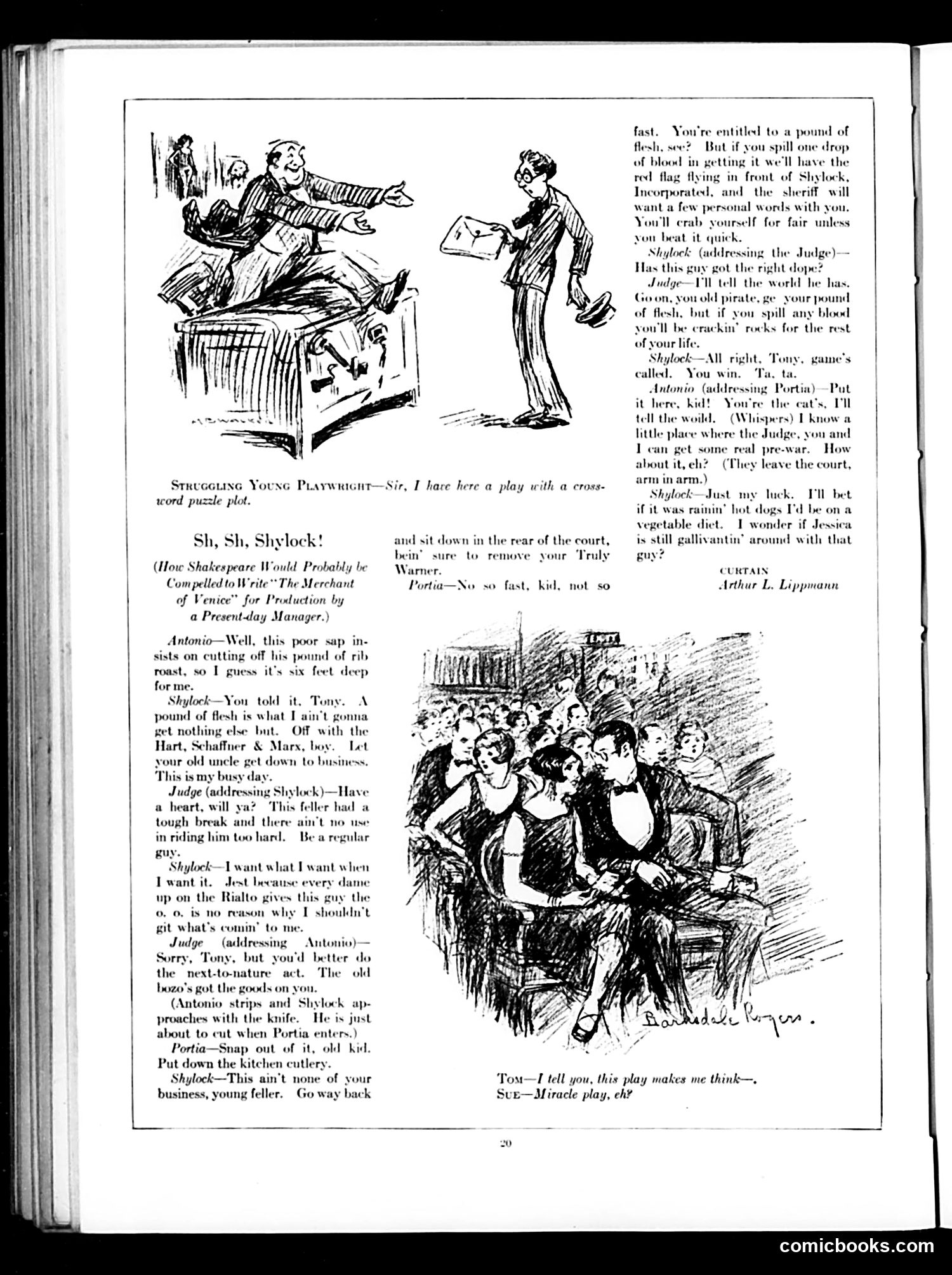
This parody reimagines Shakespeare's *Merchant of Venice* as a 1920s urban crime story, translating the plot into contemporary slang and gangster vernacular. Shylock becomes a hardened loan shark demanding his "pound of flesh" collateral from debtor Antonio, while the Judge and Portia (presented as a savvy lawyer) navigate modern legal complications. The satire mocks both Shakespeare's dated formality and contemporary American judicial laxity. References to "the red flag" (communism), pre-war contraband, and casual corruption ("I know a little place where the Judge...") suggest commentary on Prohibition-era lawlessness and judicial compromises. The final exchange between Tom and Sue—where Sue calls it a "miracle play"—implies the script's absurdity: transforming a Renaissance tragedy into modern wiseguy patter requires miraculous suspension of disbelief. The cartoon critiques how contemporary commercial theater "Americanizes" classics beyond recognition.
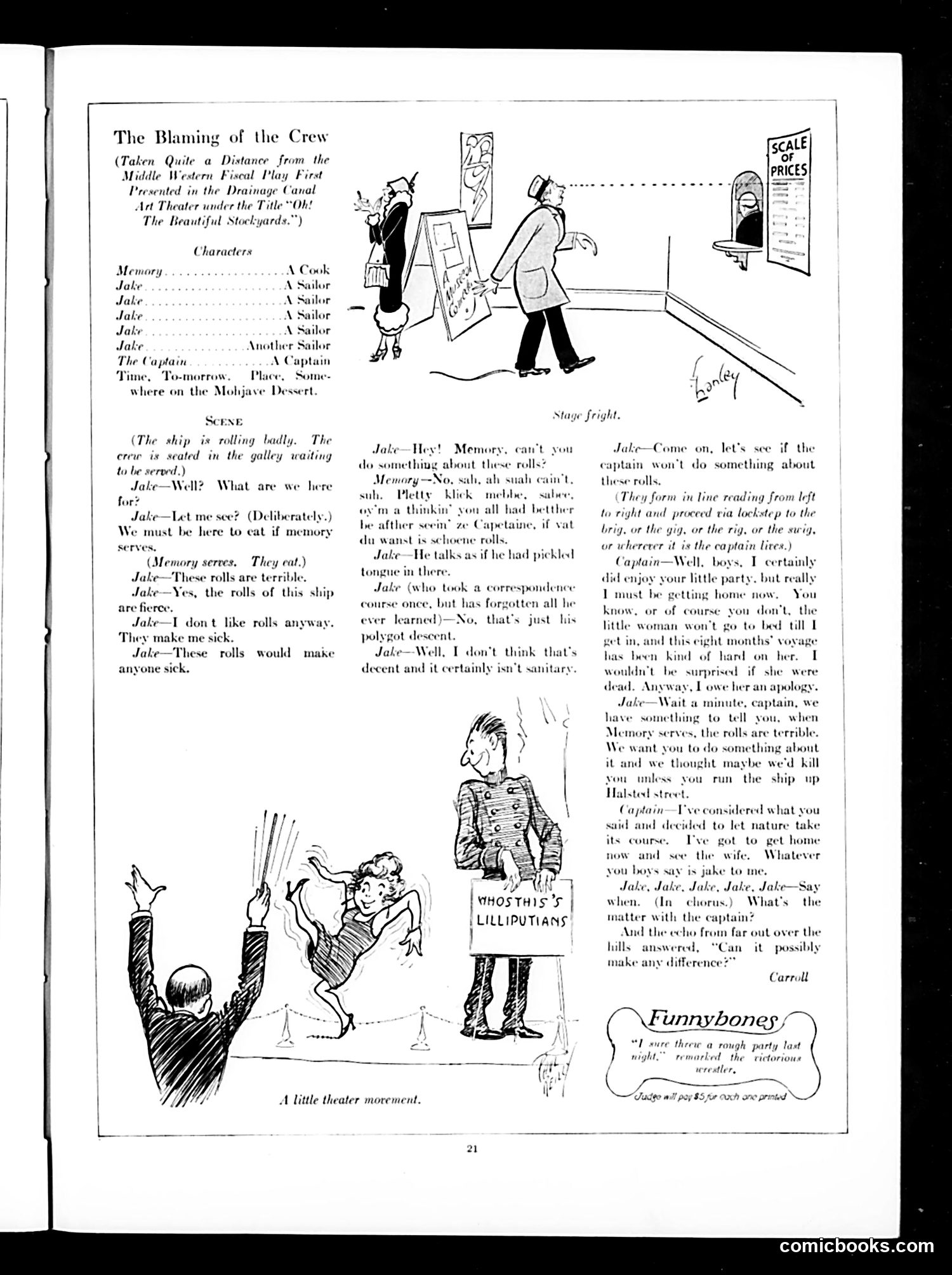
This is a theatrical parody—a one-act play script with accompanying illustrations. It mocks a "Middle Western Fiscal Play" presented at Chicago's Art Theater, apparently titled "Oh! The Beautiful Stockyards." The sketch depicts sailors complaining about inedible ship's rolls to Memory (the cook) and the Captain. The humor centers on wordplay: "rolls" (bread) becomes the title "The Blaming of the Crew," a parody of the literary work "The Blaming of the Shrew." The cook speaks in exaggerated dialect ("suh," "ze Cape"), a common comedic device of the era. When crew members demand action, the captain dismissively refuses, saying he must get home to his wife. The sailors' chorus—"Jake, Jake, Jake"—echoes unanswered into nothing, the final punchline emphasizing the absurdity and futility of their complaint. The satire appears to mock both pretentious art theater and bureaucratic indifference to worker complaints.
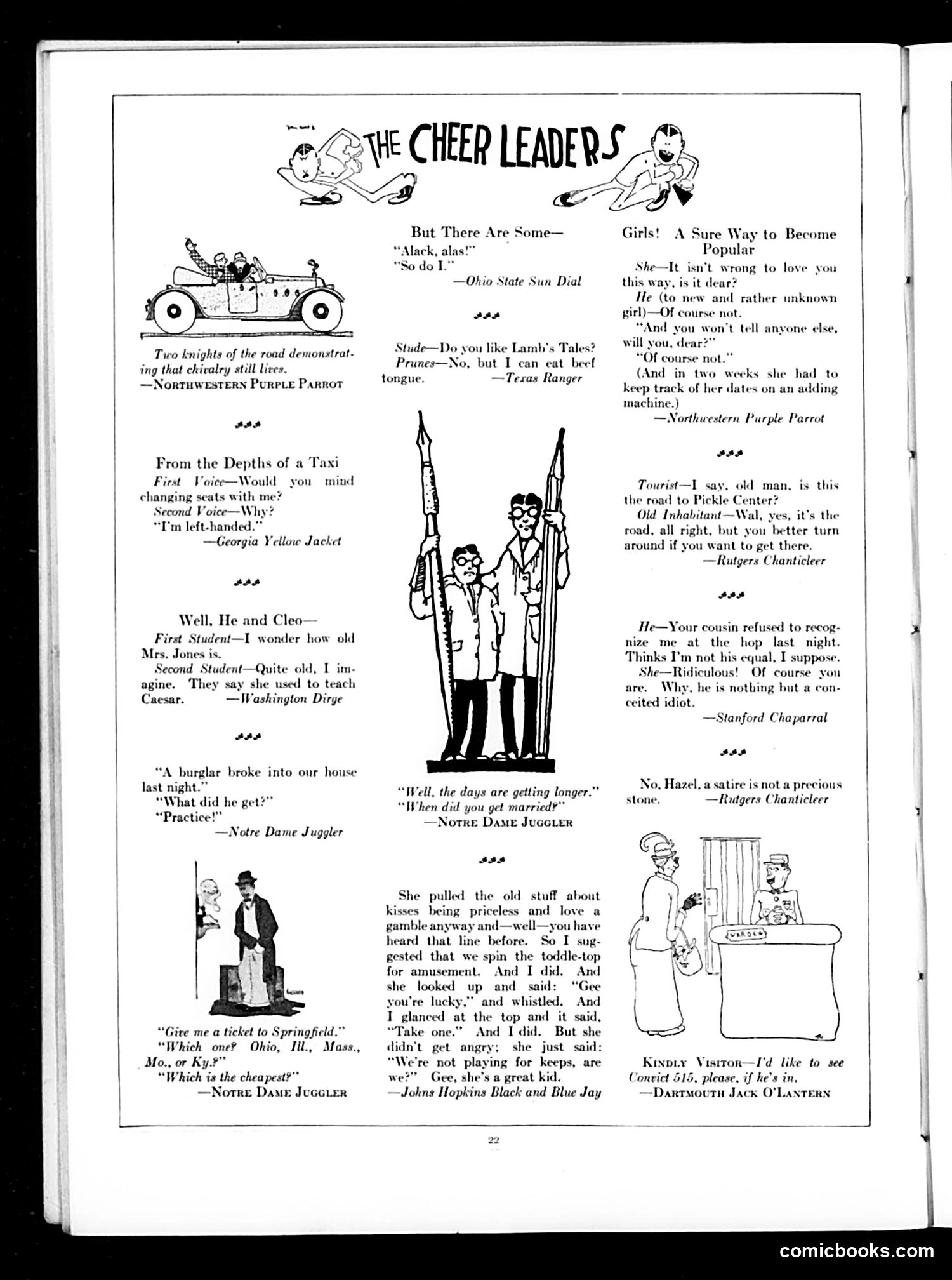
This is a collection of short jokes and comic strips from college humor magazines (cited sources include Ohio State, Texas, Notre Dame, Stanford, and others). The page has no overarching political message—it's primarily **light collegiate satire** from the early 20th century. Key recurring themes: **Romance/Dating humor**: Multiple jokes mock young men's awkwardness with women and girls' manipulation tactics (the adding-machine joke about tracking dates; the "spin the top" seduction scene). **Class/social commentary**: References to taxi-sharing etiquette, burglars as "practice" for home security, and directions deliberately misleading tourists suggest gentle mockery of urban life and rural vs. urban divides. **Generational/educational humor**: Jokes about studying (Lamb's Tales, Caesar), teaching methods, and cousin snobbery reflect college-life concerns. The illustrations are simple line drawings accompanying these quips. Without identifying specific cartoonists or publications beyond the masthead attribution, this appears to be **mainstream college humor**—populist, safe, focused on dating, education, and everyday absurdities rather than political satire.
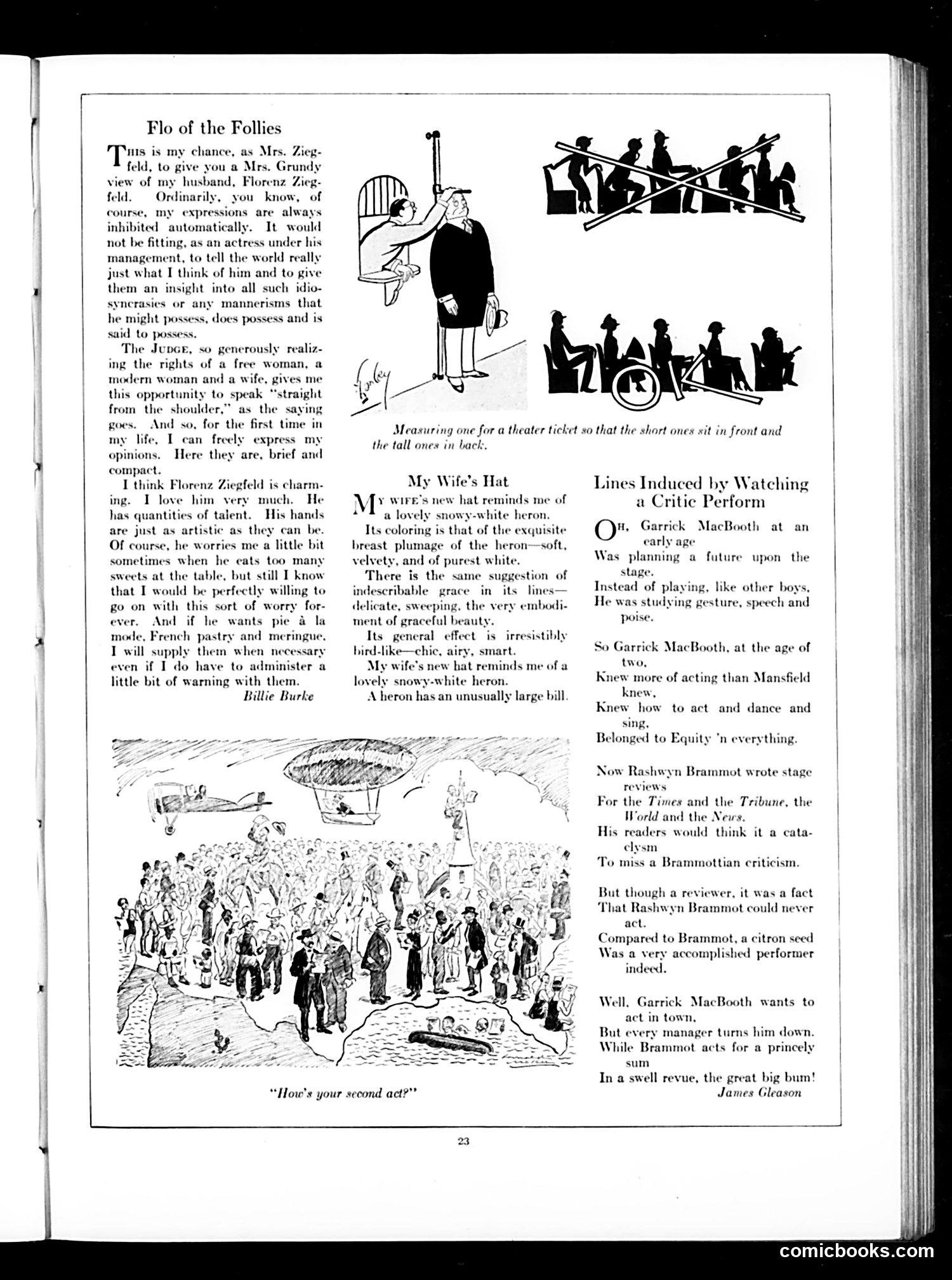
This Judge page satirizes theatrical and entertainment personalities of the era: **"Flo of the Follies"** features Billie Burke, wife of famous impresario Florenz Ziegfeld, supposedly giving candid opinions about her husband. The satire is ironic—she claims to finally speak freely, but delivers only glowing praise (he's "charming," has "quantities of talent"). The joke mocks both Burke's constrained position as a performer under his management and the absurdity of using a satirical magazine for what amounts to promotional puffery. **"My Wife's Hat"** is straightforward sentimental verse comparing a woman's new hat to a white heron—unremarkable filler content. **"Lines Induced by Watching a Critic Perform"** by James Gleason critiques the theater world's inequities: young actor Garrick MacBooth, despite genuine talent, can't get roles, while theater critic Rashwyn Brammot—who can't act—gets stage work in revues. The satire targets the contradiction that incompetent reviewers enjoy performing opportunities denied to actual performers.
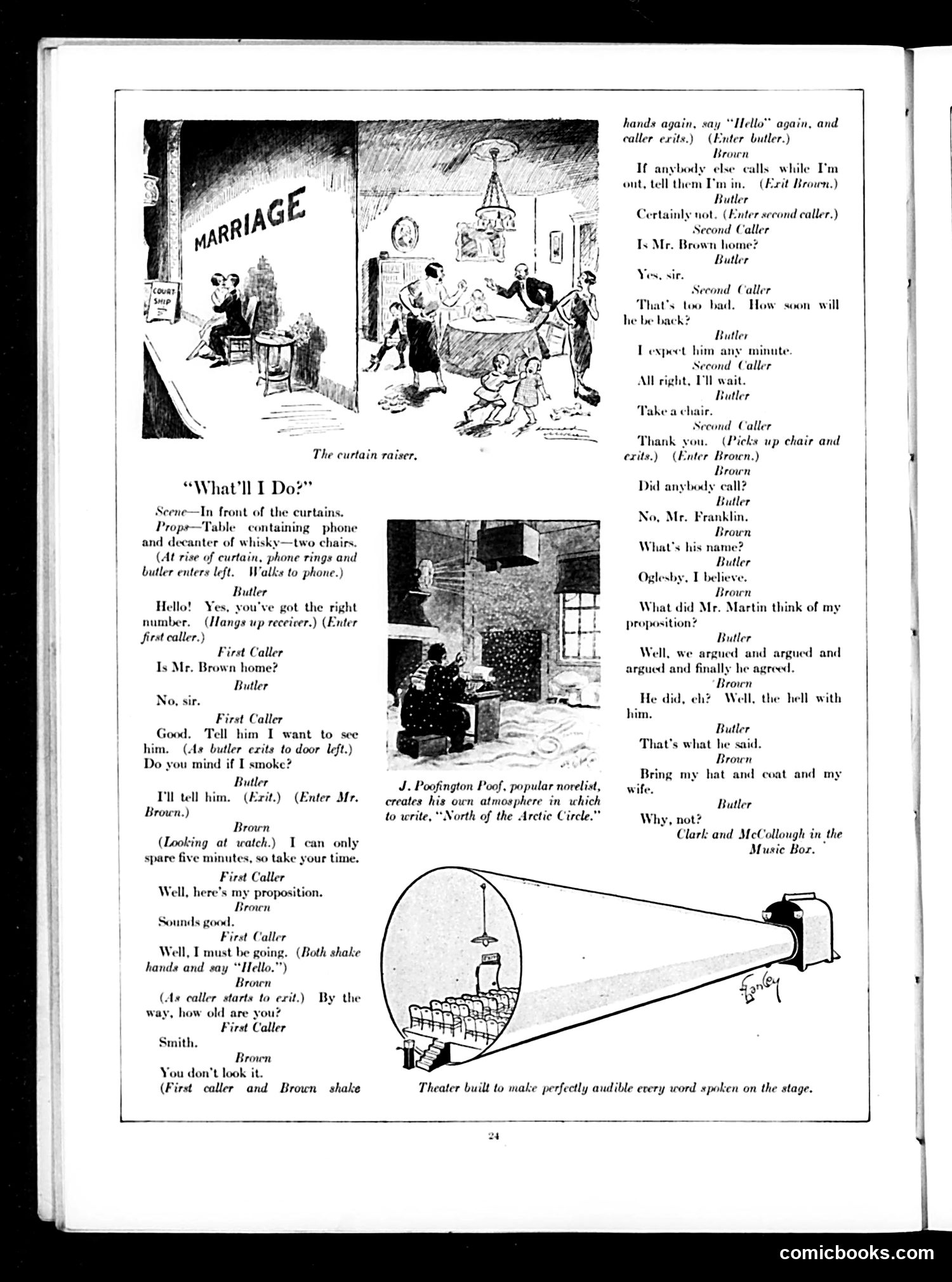
This is a theatrical sketch satirizing the absurdity of business etiquette and social pretense. The humor relies on deliberate contradictions and non-sequiturs: A businessman repeatedly greets callers with "Hello" while shaking hands, yet claims he can't remember their names or details about conversations he just had. The butler comically fails at basic tasks—forgetting the caller's name, mixing up visitors' identities. The punchline involves the protagonist's casual cruelty: after a caller finally agrees to his proposition, Brown dismisses him with "Well, the hell with him." The sketch mocks the performative nature of business dealings, where social rituals ("Hello," handshakes) mask indifference or contempt. It's a satirical commentary on business hypocrisy—how professionals maintain polite facades while harboring contempt for those they negotiate with. The absurdist structure amplifies this critique through escalating nonsense.
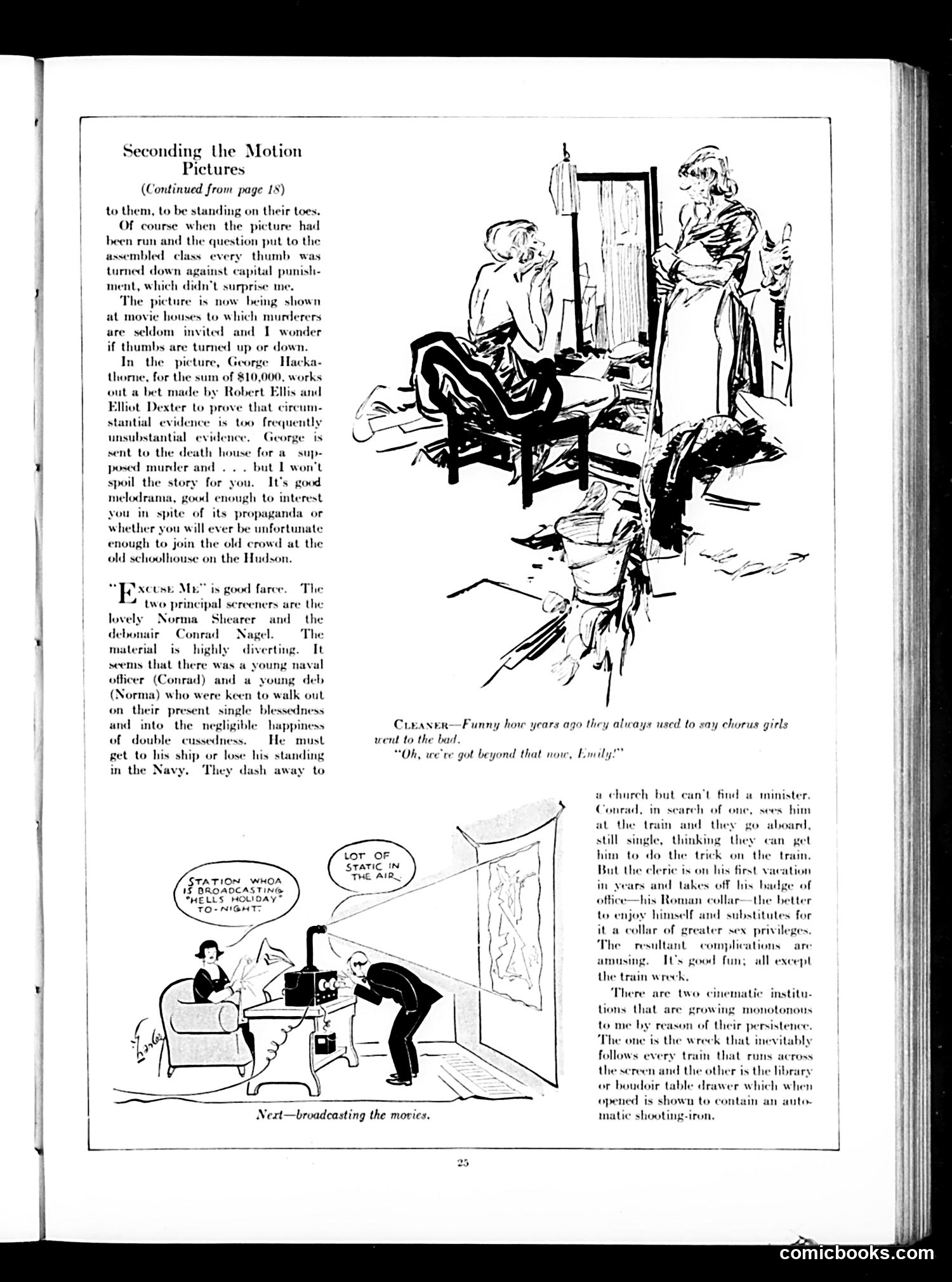
This page reviews recent films while satirizing cinema's heavy-handed moralizing. The main article discusses a George Hacathorne film about circumstantial evidence and capital punishment—noting that while audiences vote against execution in theaters, murderers seldom attend screenings anyway, undercutting the film's supposed reformist impact. A secondary review of "Excuse Me" (starring Norma Shearer and Conrad Nagel) mocks overused cinematic tropes: train wrecks and convenient guns hidden in desk drawers. The cartoon at bottom shows a radio broadcaster complaining about "static in the air" while advertising "Hell's Holiday," with a character quipping that chorus girls no longer "go to the bad"—suggesting changing social morality. The satire targets both cinema's predictable melodrama and the era's moralizing impulse to use entertainment as a reformative tool.
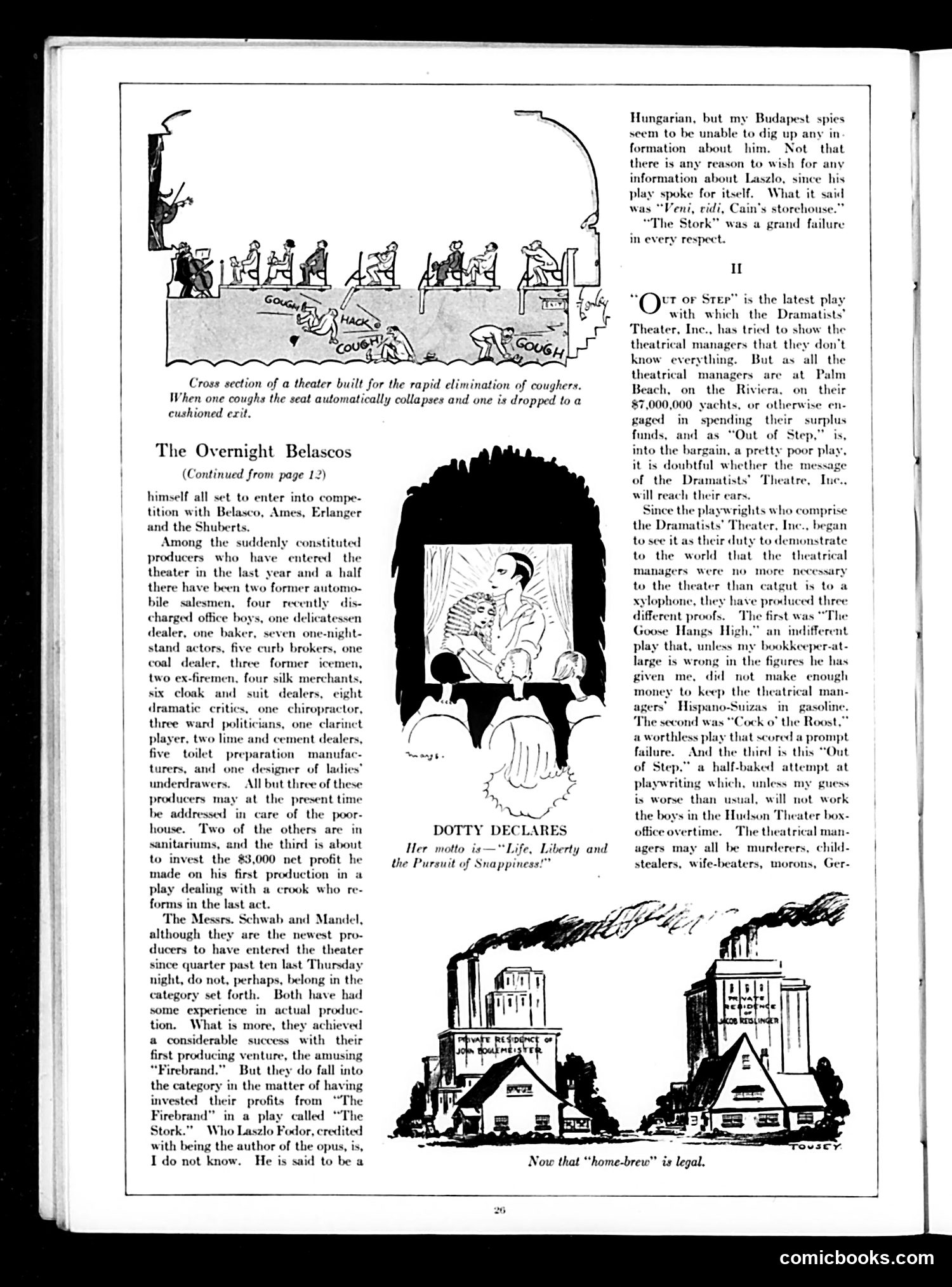
This page satirizes the theatrical industry's recent boom in inexperienced producers. The top cartoon mockingly depicts a theater designed to eliminate coughers by dropping them through collapsing seats—a jab at how many new theater people lack basic professional competence. The article "The Overnight Belascos" criticizes the flood of amateur producers entering theater competition with established figures like Belasco and the Shuberts. The author catalogs their previous occupations (auto salesmen, icemen, coal dealers, dramatic critics, etc.), suggesting these outsiders are unqualified speculators treating theater as a get-rich-quick scheme rather than an art form. The piece then attacks specific failures: "The Stork" (by unknown Hungarian Laszlo Fodor) and plays by the Dramatists' Theater, Inc., which positions itself as proving theatrical managers unnecessary. The author dismisses their recent productions—"The Goose Hangs High," "Cock o' the Roost," and "Out of Step"—as amateurish failures, implying that established managers' expertise actually *does* matter, despite their personal vices.
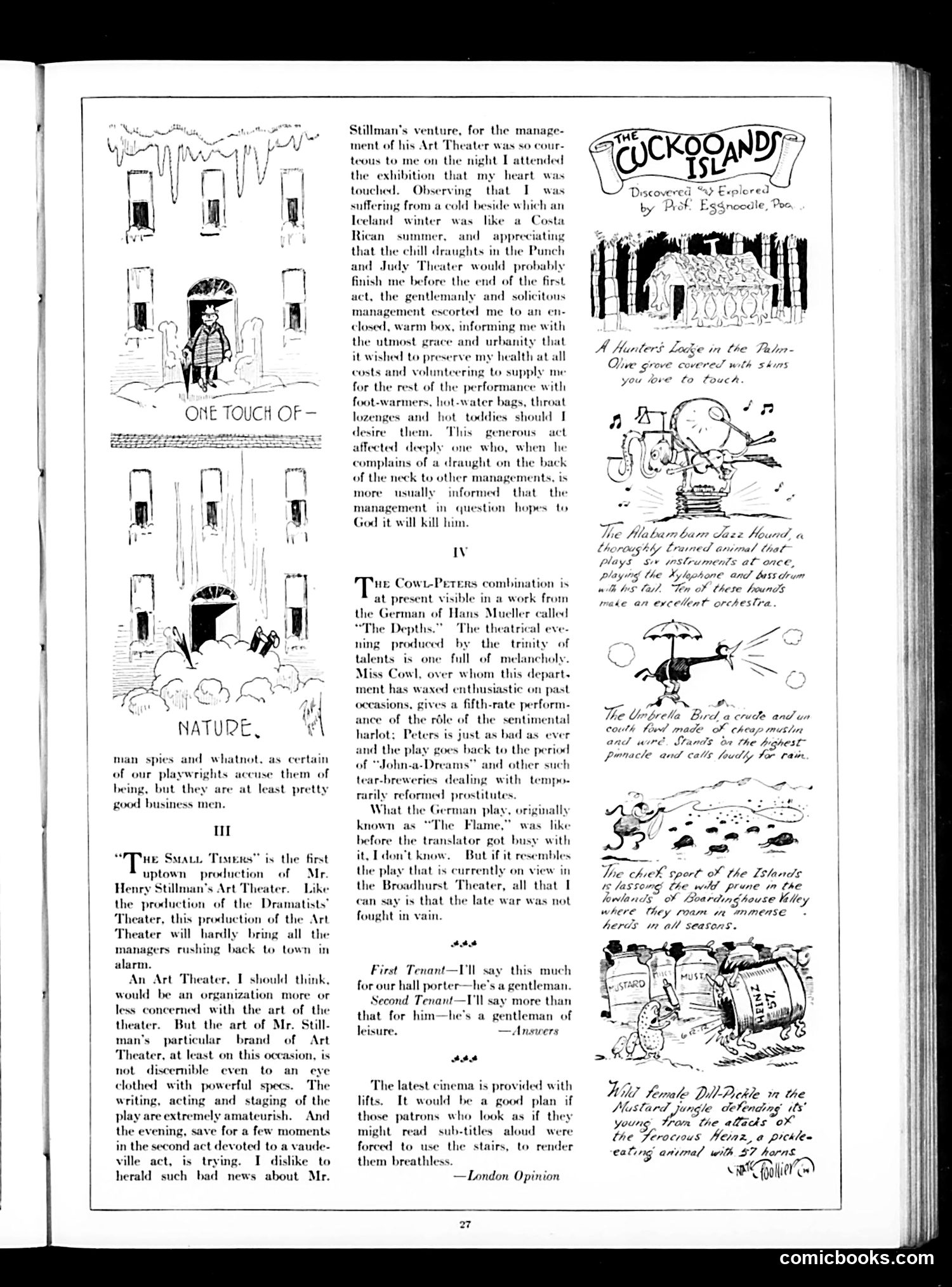
This page contains theater reviews and satirical illustrations of fictional creatures. The main text criticizes Henry Stillman's "Art Theater" production of "The Small Timers," describing it as amateurish despite the management's courteous treatment of the reviewer (who had a cold). A second review dismisses a German play called "The Depths" (originally "The Flame"), featuring performers Cowl and Peters, as poorly executed melodrama about reformed prostitutes. The right side features "The Cuckoo and Islands Explored," a humorous pseudo-scientific section with whimsical drawings of invented animals—a jazz-playing hound, an umbrella bird, and a pickle-like creature. These nonsensical creatures and their absurd descriptions parody scientific discovery publications popular at the time. The bottom includes brief comedic quips about theater etiquette and cinema behavior, typical of Judge's social satire format.
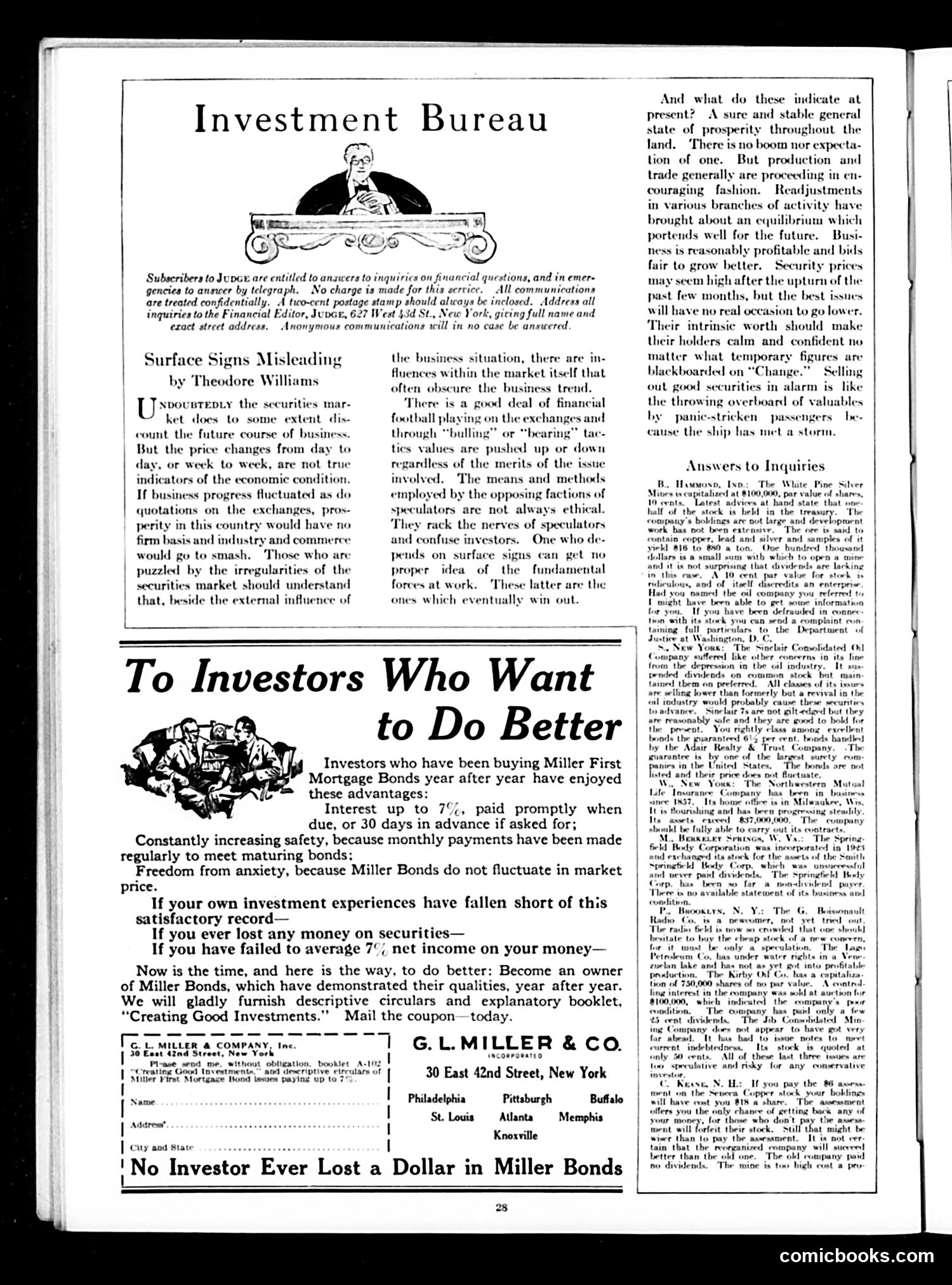
This page mixes financial commentary with advertising. The main editorial piece by Theodore Williams cautions investors that stock market price fluctuations don't accurately reflect actual business conditions. He warns that speculators use unethical "financial football" tactics—artificially inflating or depressing stock values through "bulling" (buying to raise prices) and "bearing" (selling to lower them)—creating market confusion disconnected from genuine economic fundamentals. The bulk of the page is a Miller & Company advertisement for their mortgage bonds, claiming investors "never lost a dollar" and guaranteeing 7% interest. This appears during what was likely a period of market volatility (the reference to panic-stricken selling suggests market anxiety), making the ad's stability promise particularly appealing. The satire is implicit: Williams warns readers not to trust surface market signals, while Miller's ad simultaneously promises safety through their supposedly recession-proof bonds—a classic tension between cautious analysis and sales pitch.
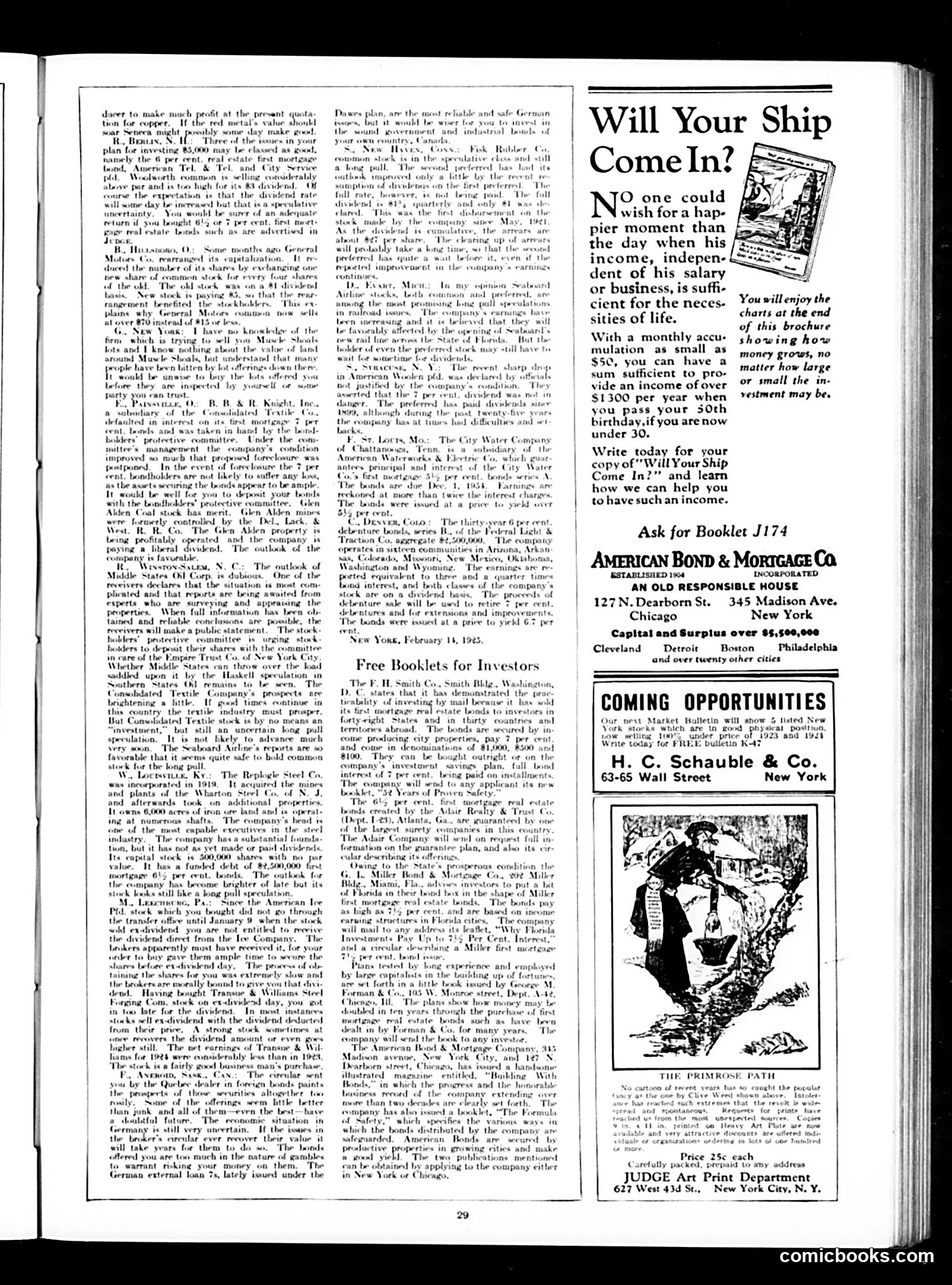
This page is primarily **advertising and financial advice**, not political satire. The main content consists of: **"Will Your Ship Come In?"** — A financial services advertisement for American Bond & Mortgage Co. promoting investment plans. The title uses nautical metaphor (ship imagery) to promise eventual wealth accumulation. It advertises monthly contributions of $50 leading to $1,300+ annual income at retirement. **Stock advice columns** — The left side contains Q&A responses about various stock investments (copper, real estate bonds, General Motors, textile companies, German bonds). The advice generally warns readers against speculation and risky foreign investments, particularly German securities "lately issued under the [economic uncertainty]." The cartoon in the lower right appears to be labeled **"The Primrose Path"** — showing a figure following a tempting but dangerous route, likely illustrating the risks of poor investment choices. **Context for modern readers**: This reflects 1920s-era American investment culture before the 1929 crash, targeting middle-class savers seeking passive income through bonds and stocks.
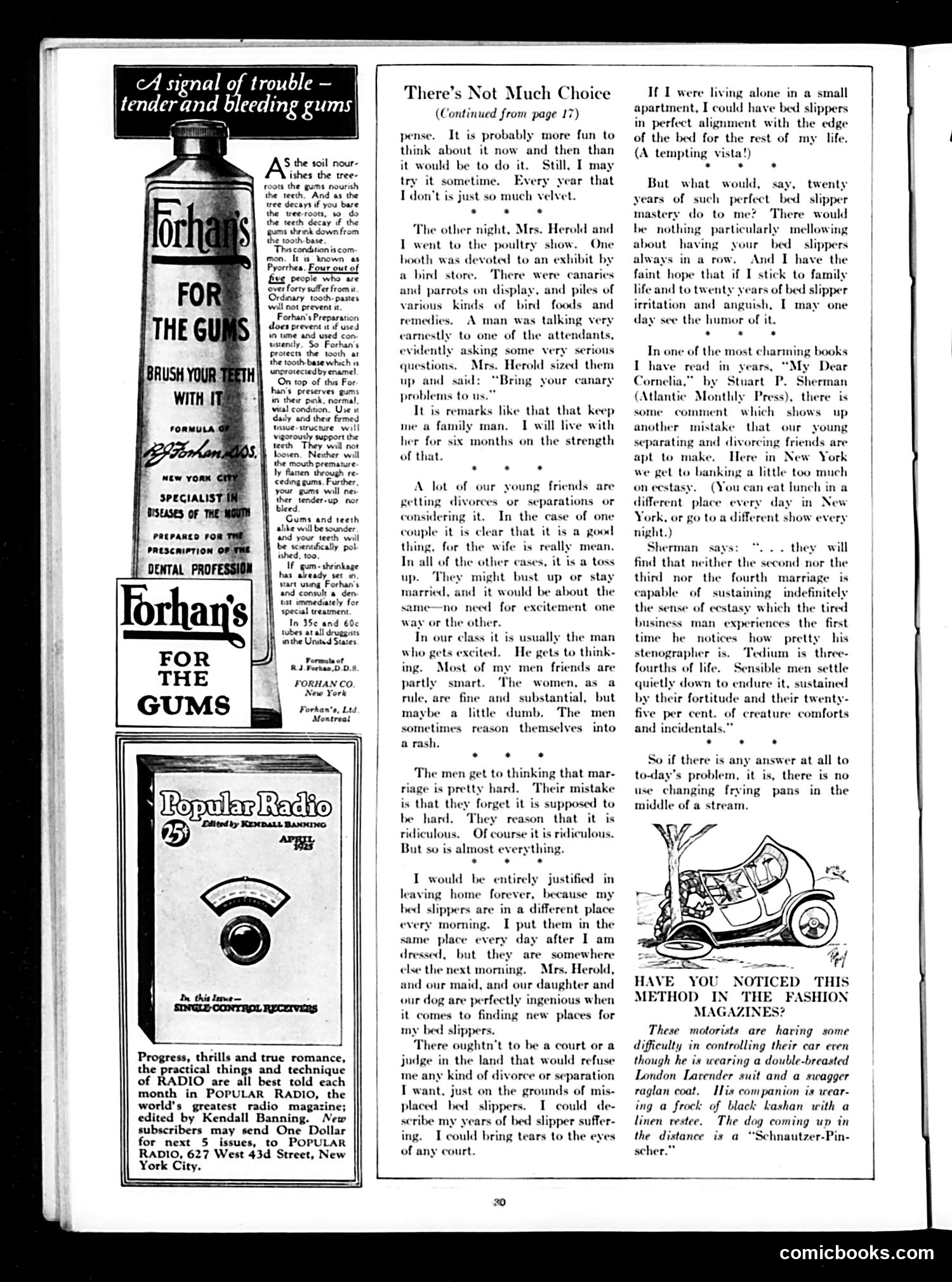
This page contains **advertisements and a humorous essay** rather than political cartoons. **The Ads:** Forhan's toothpaste and Popular Radio magazine promote their products with typical early 20th-century marketing claims about gum health and radio entertainment. **The Main Content:** A lengthy, satirical essay titled "There's Not Much Choice" mocks modern marriage and divorce culture. The unnamed author complains humorously about trivial marital annoyances—particularly his bed slippers mysteriously relocating each morning—yet admits he'd be "entirely justified" in divorcing his wife over such grievances. **The Satire:** The piece ridicules how easily couples rationalize divorce over minor irritations, while simultaneously acknowledging that nearly everything in life is equally absurd. The author suggests marriage isn't meant to be easy, and that men (who he portrays as partly foolish) often overthink relationship problems that women endure more stoically. **The Joke:** Modern readers might miss the era's anxieties about rising divorce rates and changing gender dynamics, presented here through domestic frustration rather than serious social commentary.
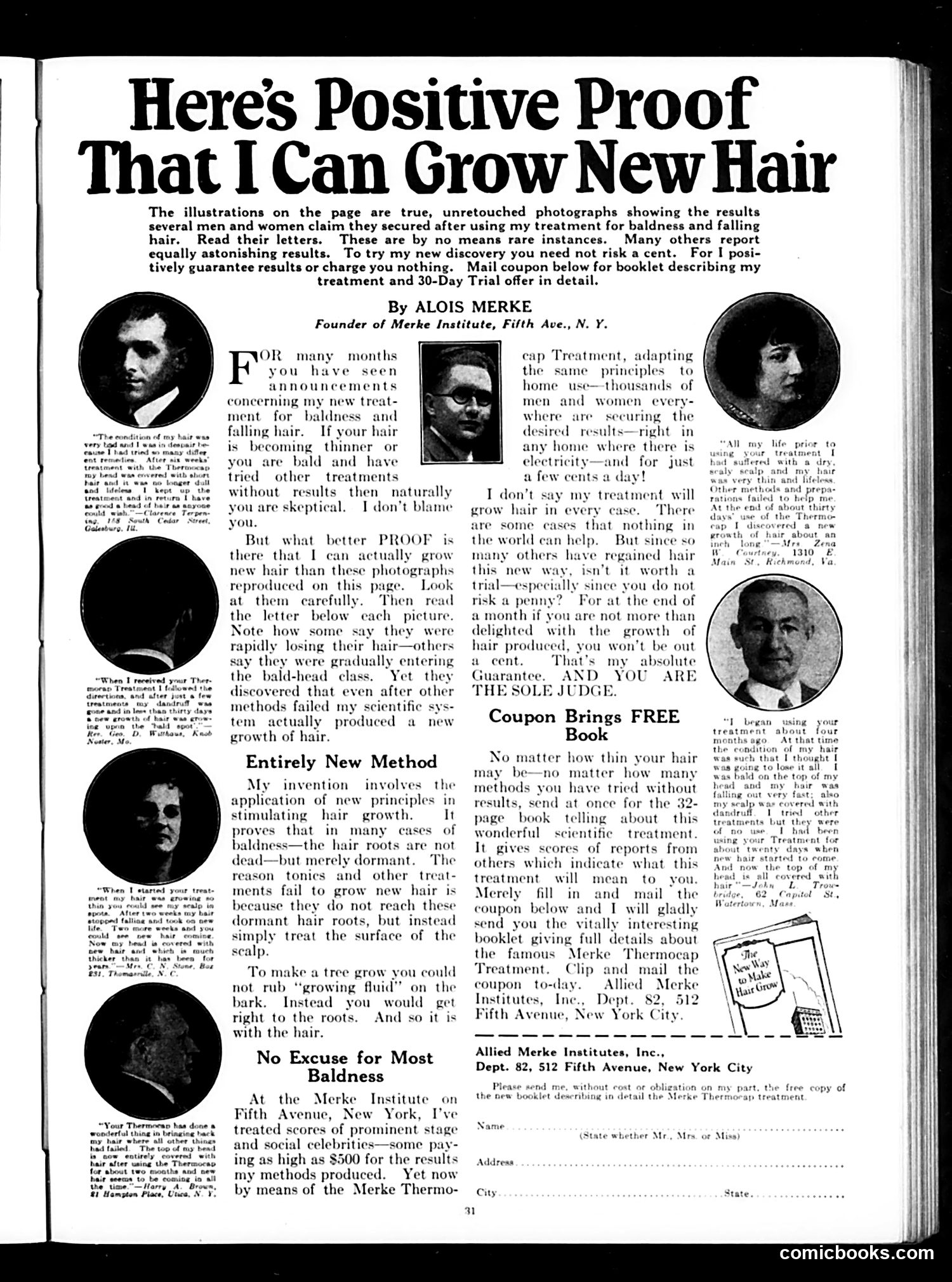
This page is not a political cartoon or satire—it's an advertisement for a hair-growth treatment. Published in *Judge* magazine (which mixed ads with satirical content), it promotes Alois Merke's "Thermocap" hair-restoration method for baldness and hair loss. The ad features testimonial letters from purported customers alongside before-and-after photographs, claims that dormant hair roots can be reactivated through electrical stimulation, and promises a risk-free trial. Merke's Institute on Fifth Avenue allegedly treated wealthy clients for $500. The pitch exploits contemporary anxieties about baldness and aging while using pseudo-scientific language ("dormant hair roots," electrical treatment) to lend credibility. The "free book" offer and guarantee are classic direct-mail tactics. While appearing in a humor magazine, the ad itself is straightforward commercial copy aimed at desperate consumers seeking hair-restoration solutions.
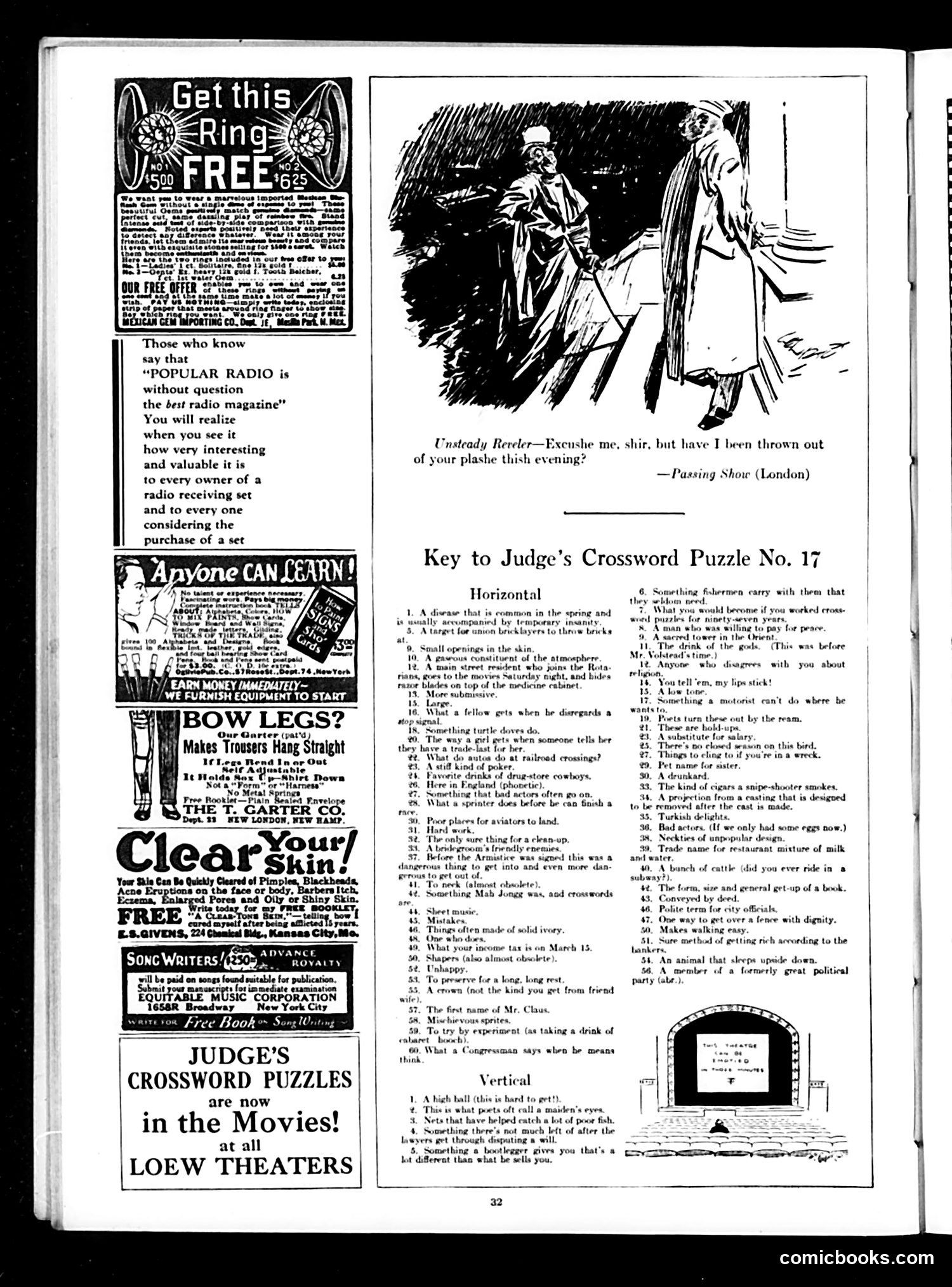
This page is primarily **advertising and puzzles**, not political satire. The dominant content includes: **The cartoon** (upper right) shows a drunk man asking another if he's been "thrown out of your plashe thish evening"—a joke about inebriation, credited to London's *Passing Show*. It's social humor about drunkenness, not political commentary. **The advertisements** promote products typical of the 1920s-30s era: a free ring offer, Popular Radio magazine, a "bow legs" correction garter, skin cream, and song-writing opportunities. These reflect period consumer culture and patent medicine marketing. **The main feature** is Judge's Crossword Puzzle No. 17 with its answer key—a popular entertainment form of the era. **No political figures or satire** are evident on this page. Judge magazine was satirical generally, but this particular page focuses on commercial advertising and recreational puzzles rather than commentary on contemporary politics or events.
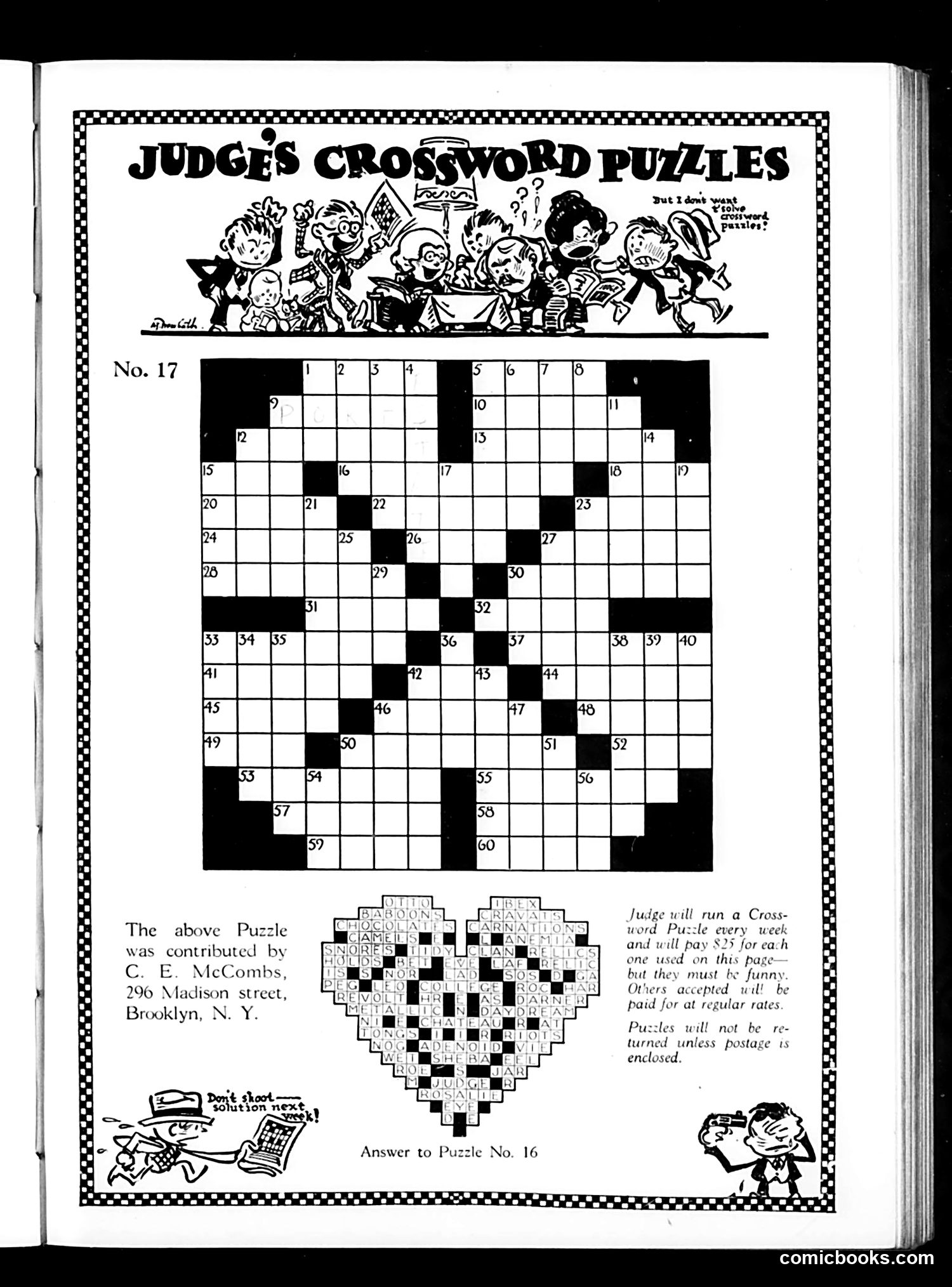
This page is primarily a **crossword puzzle feature**, not political satire. It presents "Judge's Crossword Puzzles No. 17"—a standard puzzle grid with numbered clues typical of early crossword publications. The key content is the **announcement**: Judge magazine will publish a weekly crossword puzzle and pay $25 for submitted puzzles (with additional payment for accepted entries at regular rates). This reflects the **crossword craze of the 1920s-30s**, when these puzzles were enormously popular and magazines competed to feature them. The page includes the answer to the previous week's puzzle (No. 16) displayed in a heart shape, adding decorative appeal. The contributor is credited as C. E. McCombs of Brooklyn, New York. The cartoonish header illustrations and anthropomorphic characters are typical Judge branding—not specific political commentary, but rather the magazine's house style for entertainment content.
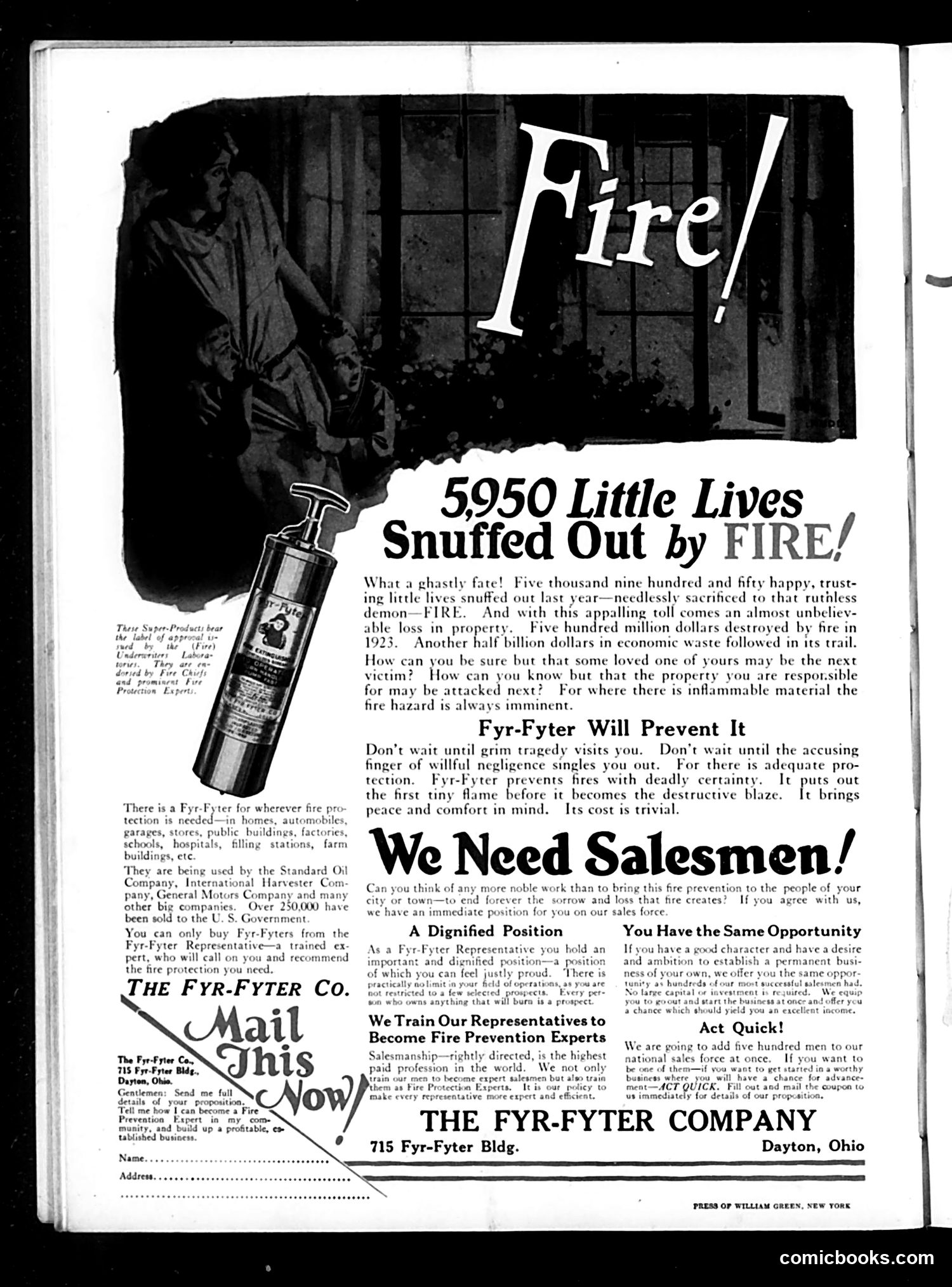
This is primarily a **recruitment advertisement**, not satire or political commentary. The Fyr-Fyter Company uses fear-based messaging to sell both their fire extinguishers and sales positions. **The appeal:** The dramatic image shows a mother and child fleeing a burning building. The headline exploits contemporary anxiety—citing 5,950 child deaths from fire in 1923 and $500 million in property damage—to create urgency. **The pitch:** The company positions itself as a fire-prevention solution while recruiting salesmen by offering "dignified positions" and promising training as "Fire Prevention Experts." They claim 250,000 units sold and endorsements from Standard Oil and International Harvester to establish credibility. **The social context:** This reflects 1920s concerns about industrial safety and fire hazards in poorly regulated buildings. The aggressive sales tactics and emotional manipulation (dead children) were standard advertising practice of the era, before modern consumer protection standards.