
Judge, 1925-02-21 · page 8 of 36
Judge — February 21, 1925 — page 8: what you’re looking at
What you’re looking at
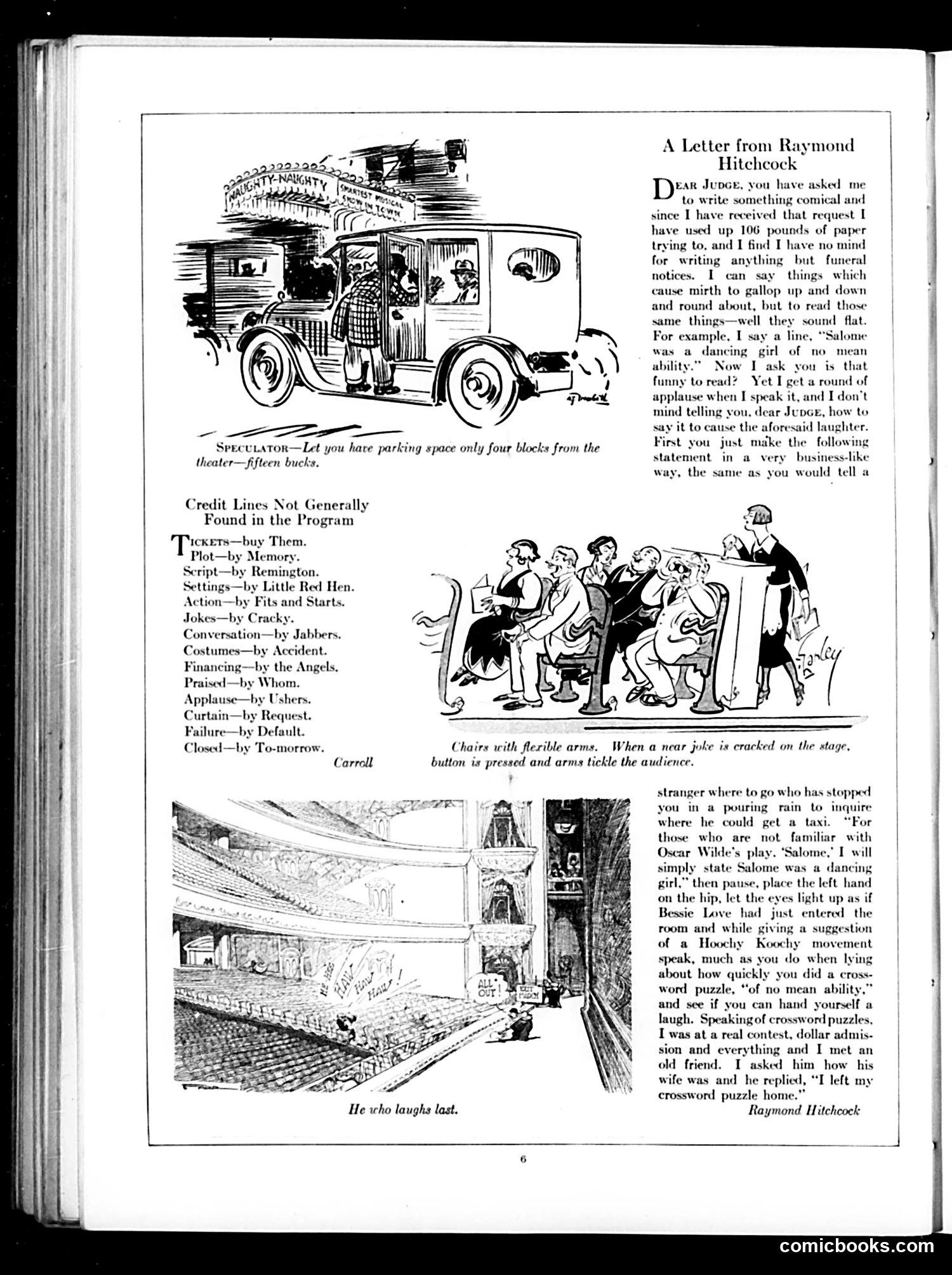
This page contains satirical commentary on theater economics and performance from actor-comedian Raymond Hitchcock. **The Top Cartoon** mocks inflated theater pricing: a speculator charges $15 for parking "only four blocks from the theater"—profiteering on theater-goers' desperation. **"Credit Lines Not Generally Found in the Program"** is a humorous list attributing theatrical elements to unexpected sources: tickets "buy themselves," plots come from "memory," settings from "accident," financing from "angels" (likely meaning miraculous intervention). It satirizes how theater productions actually come together chaotically, contrary to polished program credits. **Hitchcock's Letter** explains how comedic timing differs between live performance and written text. He illustrates with an example from Oscar Wilde's *Salome*—the same line gets applause onstage but reads flat on the page. The anecdote about his friend leaving his crossword puzzle home is a pun joke: the friend abandoned his puzzle (wife = "cross-word" puzzle). **The Theater Interior Sketch** labeled "He who laughs last" depicts audience seating, emphasizing the live-performance context of the page's humor discussion.
📄 Transcribed text from this page (OCR, searchable)
Machine-transcribed from the original scan — historical spelling and the odd misread are preserved.
a sr —_ 7 Ee Eun saeeeseae ts taatnenicas.ysaamenien a oe eee en SpecuLator—Let you have parking space only four blocks from the theater—fifteen bucks. Credit Lines Not Generally Found in the Program 1ckETS—buy Them. Plot—by Memory. Remington. y Little Red Hen. Conversation—by Jabbers. Costumes—by Accident. Financing—by the Angels, Praised—by Whom. Applause—by Ushers. Curtain—by Request. Failure—by Default. Closed—by To-morrow. Carroll Chairs with flerible arms. When a near j A Letter from Raymond Hitchcock EAR JupGE, you have asked me to write something comical and since I have received that request L have used up 106 pounds of paper trying to, and I find I have no mind for writing anything but fun notices. I can say things which cause mirth to gallop up and down and round about, but to read those same things—well they sound flat. For example, I say a line, “Salome was a dancing girl of no mean abil Now I ask you is that funny to read? Yet I 2 round of applause when I speak it, and I don’t mind telling you, dear Jupce, how to say it to cause the aforesaid laughter. First you just make the following statement in a very business-like way, the same as you would tell a is cracked on the stage, button is pressed and arms tickle the audience. He who laughs last. stranger where to go who has stopped you in a pouring rain to ing where he could get a taxi. those who are not familiar with Oscar Wilde's play. “Salome,” I wil simply state Salome was a dancing girl,” then pause, place the left hand on the hip, let the eyes light up as if Bessie Love had just entered the room and while giving a suggestion of a Hoochy Koochy movement speak, much as you do when lying about how quickly you did a cross- word puzzle, “of no mean ability,” and see if you can hand yourself a laugh. Speaking of crossword puzzles, I was at a real contest, dollar admis- sion and everything and I met an old friend. I asked him how his. wife was and he replied, “I left my crossword puzzle home.” Raymond Hitchcock _ comicbooks.com