
Judge, 1925-02-21 · page 27 of 36
Judge — February 21, 1925 — page 27: what you’re looking at
What you’re looking at
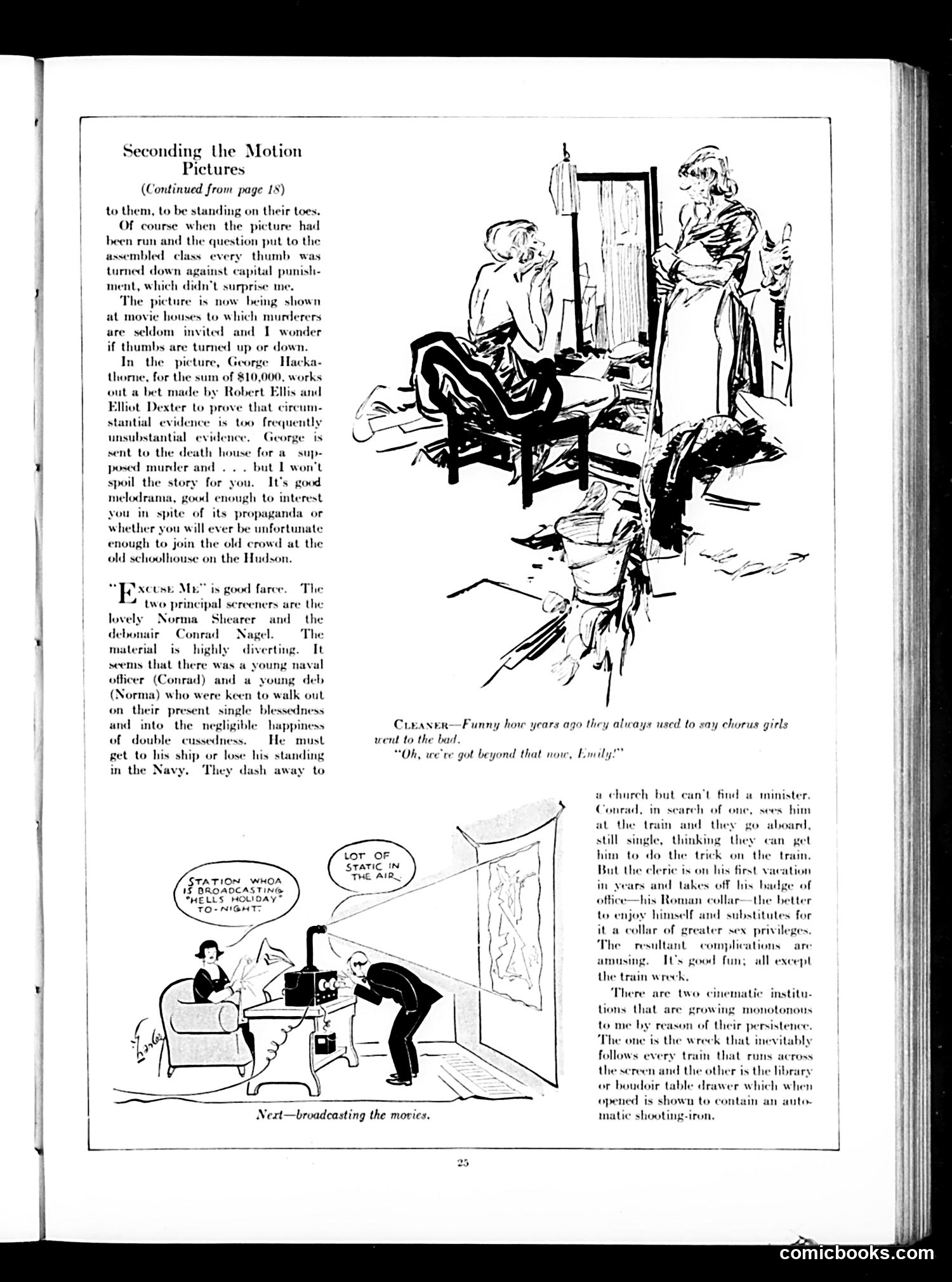
This page reviews recent films while satirizing cinema's heavy-handed moralizing. The main article discusses a George Hacathorne film about circumstantial evidence and capital punishment—noting that while audiences vote against execution in theaters, murderers seldom attend screenings anyway, undercutting the film's supposed reformist impact. A secondary review of "Excuse Me" (starring Norma Shearer and Conrad Nagel) mocks overused cinematic tropes: train wrecks and convenient guns hidden in desk drawers. The cartoon at bottom shows a radio broadcaster complaining about "static in the air" while advertising "Hell's Holiday," with a character quipping that chorus girls no longer "go to the bad"—suggesting changing social morality. The satire targets both cinema's predictable melodrama and the era's moralizing impulse to use entertainment as a reformative tool.
📄 Transcribed text from this page (OCR, searchable)
Machine-transcribed from the original scan — historical spelling and the odd misread are preserved.
t Seconding the Motion ] Pictures | (Continued from page 18) to them, to be standing on their toes. | Of course when the picture had been run and the question put to the assembled class every thumb was turned down against capital punish- | ment, which didn’t surprise me. { ‘The picture is now being shown at movie houses to which murderers are seldom invited and I wonder if thumbs are turned up or down. In the picture, ( | jeorge Hacka- | thorne, for the sum of $10,000, works | out a bet me y Robert Ellis and Elli t Dexter to prove that circum. ntial evidence is too frequently unsubstantial evidence. George is sent to the death house for a sup- | posed murder and... but I won't spoil the story for you. It's good melodrama, good enough to interest you in spite of its propaganda | whether you will ever be unfortunate enough to join the old crowd at the | old schoolhouse on the Hudson. “BE xcuse Mr” is good farce. 4 two principal screener | | lovely Norma Shearer and the debonair Conrad — Nagel. The } material is highly diverting. It seems that there was a young naval officer (Conrad) and a young deb (Norma) who were keen to walk out on their present single blessedness and into. the negligible happiness of double cussedness. = He must get to his ship or lose his standing in the Navy. They dash away to STATION WHOA 13 BROADCASTING *HELLS HOLIDAY” TO- NIGHT: tor OF STATIC IN THE AIR, Creaxer—Funny how years ago they always used to say chorus girls went to the bad. “Oh, we've got beyond that now, Emily!” a church but can’t find a minister. Conrad, in search of one, sees him at the train and they go aboard, still single, thinking they can get him to do the trick on the train. But the eleric is on his first vacation and takes off his badge of —his Roman collar—the better to enjoy himself and substitutes for it a collar of gre The resultant r sex privileges amplications are amusing. [H's good fun; all except the train wreck, ‘There are two cinematic institu- tions that are growing monotonous to me by reason of their persistence. ‘The one is the wreck that inevitably follows every train that runs across the sereen and the other is the library or boudoir table drawer whi when | opened is shown to contain an auto- matic shooting-iron. comicbooks.com