
A complete issue · 36 pages · 1924
Judge — February 9, 1924
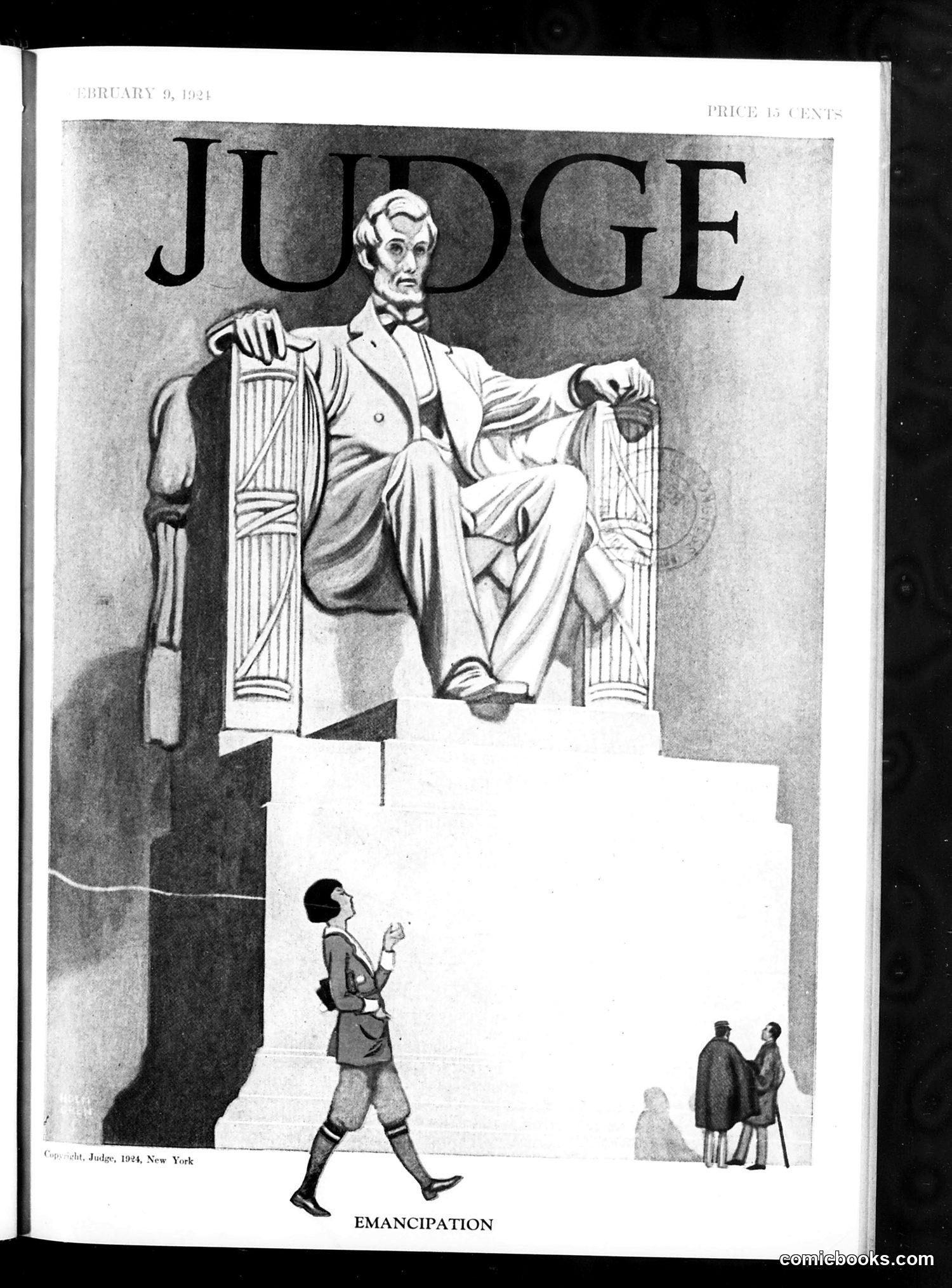
This cartoon depicts a colossal statue of Abraham Lincoln seated in the Lincoln Memorial style, gazing down at a small figure below labeled "Emancipation." The figure appears to be a Black American, shown in athletic/modern dress, walking forward while others observe from below. The satire likely comments on the gap between Lincoln's historical emancipation of enslaved people and the actual lived conditions and freedoms of Black Americans in 1924. Despite Lincoln's monumental legacy and the formal end of slavery, the tiny human figure dwarfed by the statue suggests Black Americans still faced significant limitations and inequality—their actual freedom remaining diminished compared to the grand ideals the memorial represents. The cartoon critiques this stark disparity between promise and reality.
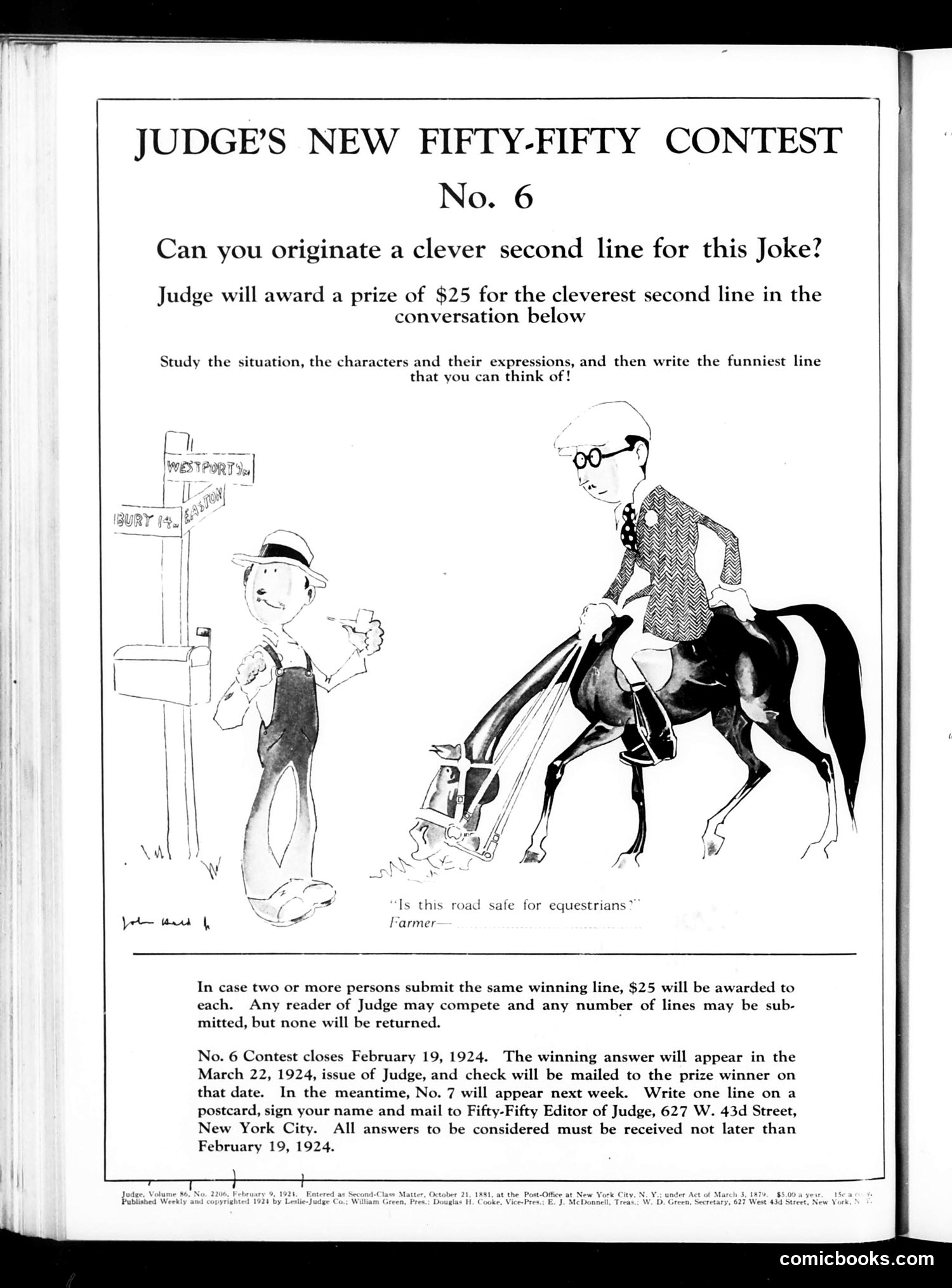
This page presents "Judge's New Fifty-Fifty Contest No. 6"—a humor competition asking readers to complete a joke with a clever second line, offering a $25 prize. The cartoon shows a farmer standing by a rural road sign encountering a well-dressed gentleman on horseback. The farmer's opening line is: "Is this road safe for equestrians?" The joke likely plays on the farmer's formal, somewhat pompous language ("equestrians") when addressing what appears to be a city person, creating comedic contrast between rural and urban speech patterns. The contest invites readers to supply a witty response—presumably either the farmer's practical reply or the gentleman's retort. This represents early-20th-century American humor typical of Judge magazine: gentle satire of class and regional differences, rather than overtly political commentary.
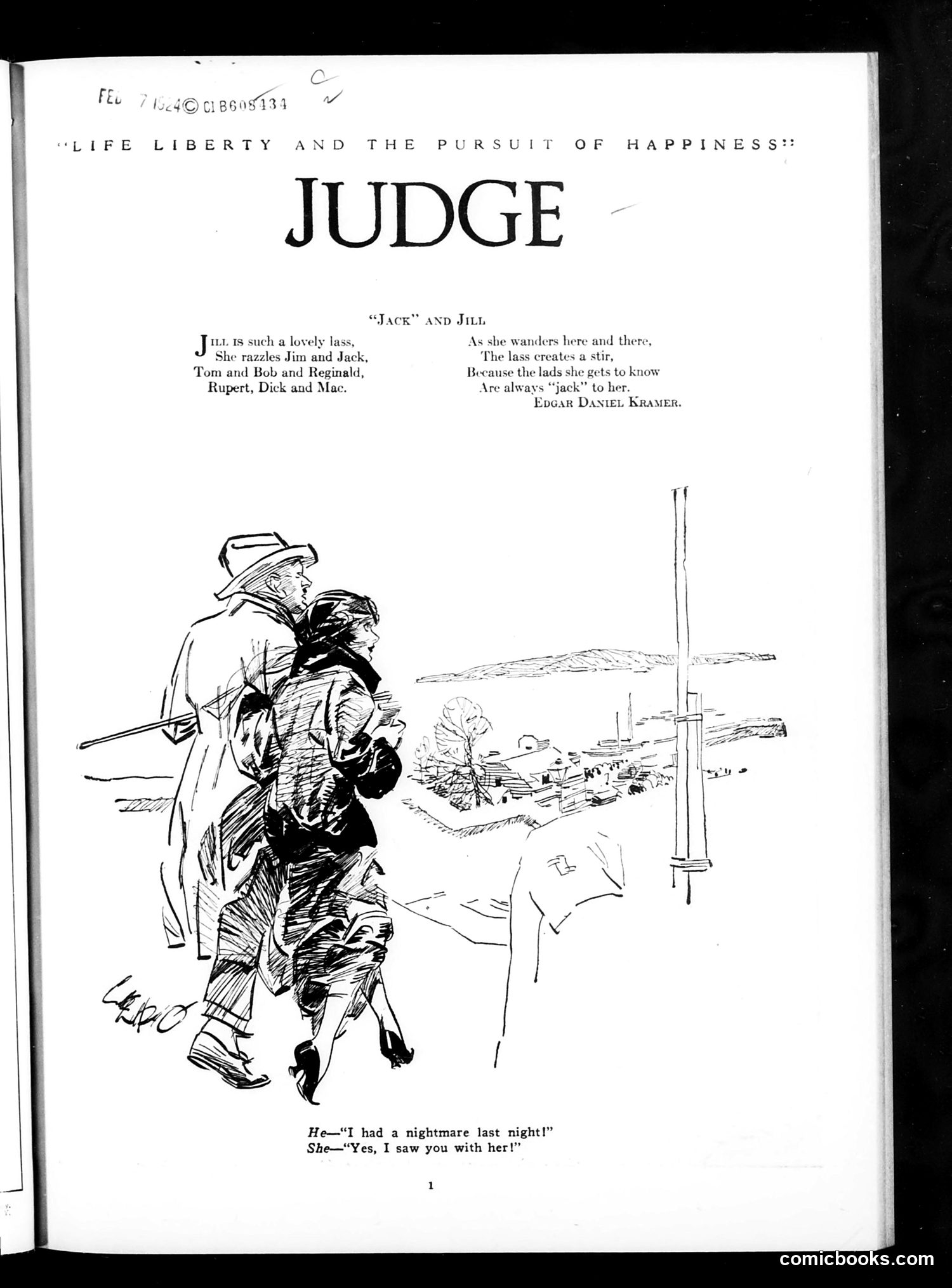
This page from Judge magazine features a satirical piece titled "Judge" with the subtitle referencing "Life, Liberty and the Pursuit of Happiness." The cartoon depicts a man and woman in an outdoor setting, with dialogue suggesting relationship drama: he claims "I had a nightmare last night," she responds "Yes, I saw you with her!" The illustration uses ink-sketch style typical of early-to-mid 20th century satirical magazines. The accompanying poem about "Jack" and "Jill" by Edgar Daniel Kramer appears to be lighthearted social commentary on romantic entanglements and jealousy among young people. The overall piece satirizes domestic suspicion and infidelity concerns—common Judge magazine themes mocking middle-class relationships and social pretense of the era.
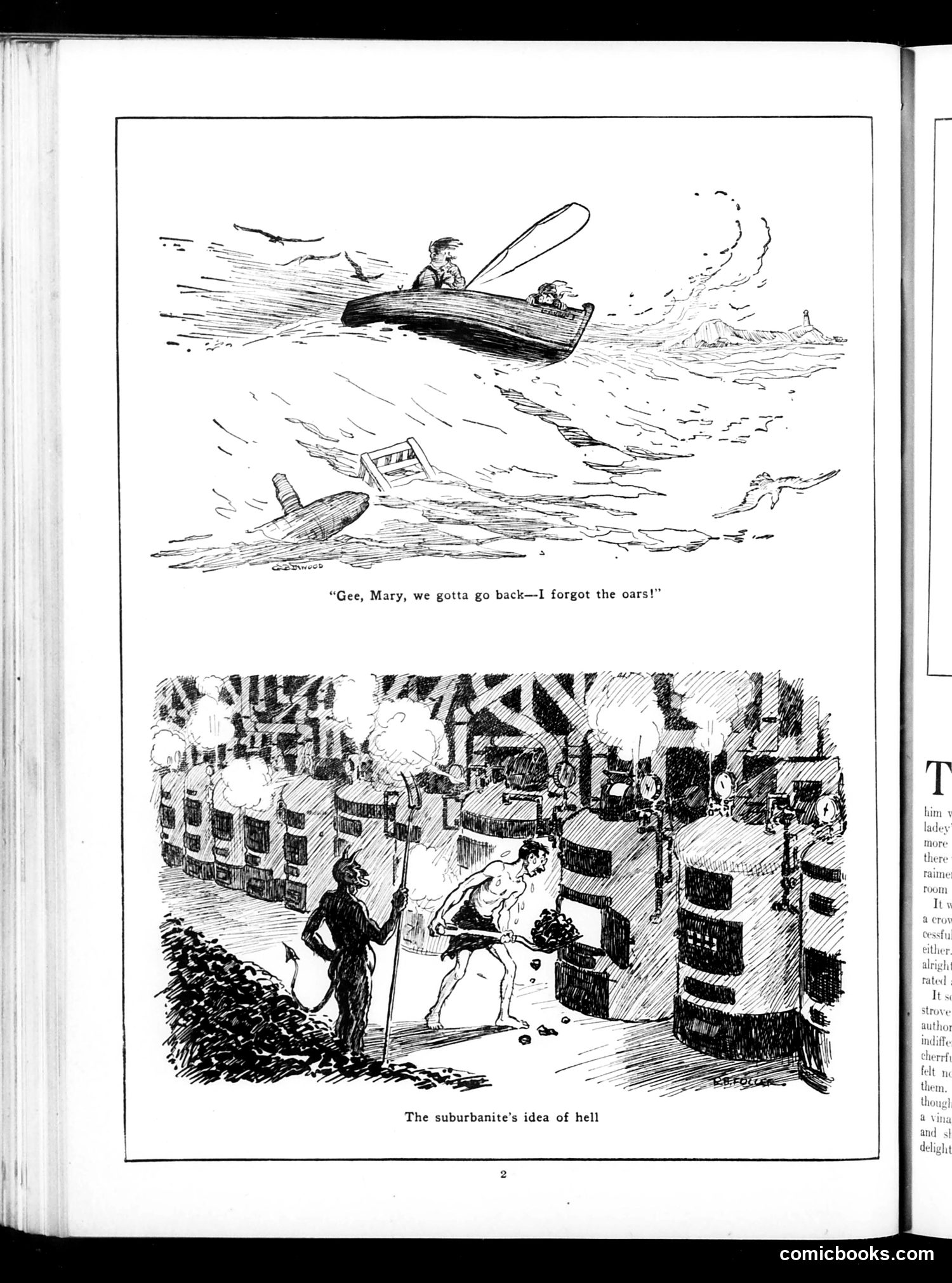
**Top cartoon:** "Gee, Mary, we gotta go back—I forgot the oars!" depicts a couple in a makeshift boat (appears to be a log with a paddle) surrounded by wreckage in turbulent waters. The humor relies on the absurdity of discovering mid-disaster that essential equipment was forgotten—a commentary on poor planning or absent-mindedness with dangerous consequences. **Bottom cartoon:** "The suburbanite's idea of hell" shows two figures playing what appears to be croquet or lawn bowling in a confined urban alley surrounded by tenement buildings. The satire contrasts the suburbanite's idealized leisure activities with cramped city living conditions, suggesting that urban density represents the opposite of their comfortable suburban lifestyle and recreational ideals.
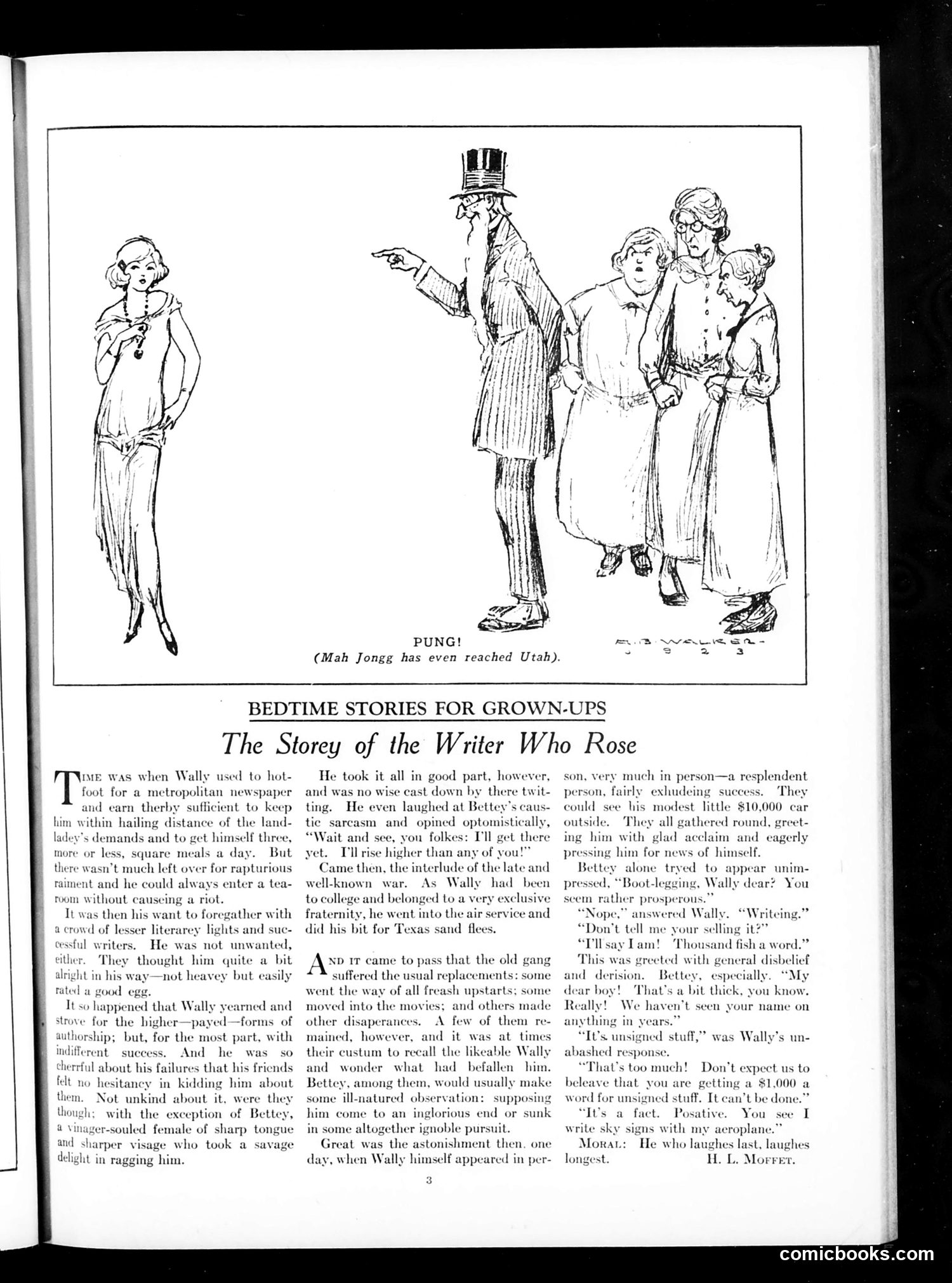
This is a humorous short story rather than a political cartoon. The illustration shows a narrative sequence: a woman on the left appears distressed, while on the right, a tall figure in a top hat (likely representing success or authority) gestures dismissively at a group of women and children. The story satirizes a struggling newspaper writer named Wally who faced rejection and hardship. The satire centers on Wally's eventual success in the motion picture industry—suggesting the emerging film business as an avenue for previously unsuccessful literary figures. The title "Bedtime Stories for Grown-ups" frames this as cynical commentary on modern success narratives, implying that unlikely rises to fortune are fantasy rather than achievable reality for ordinary people.
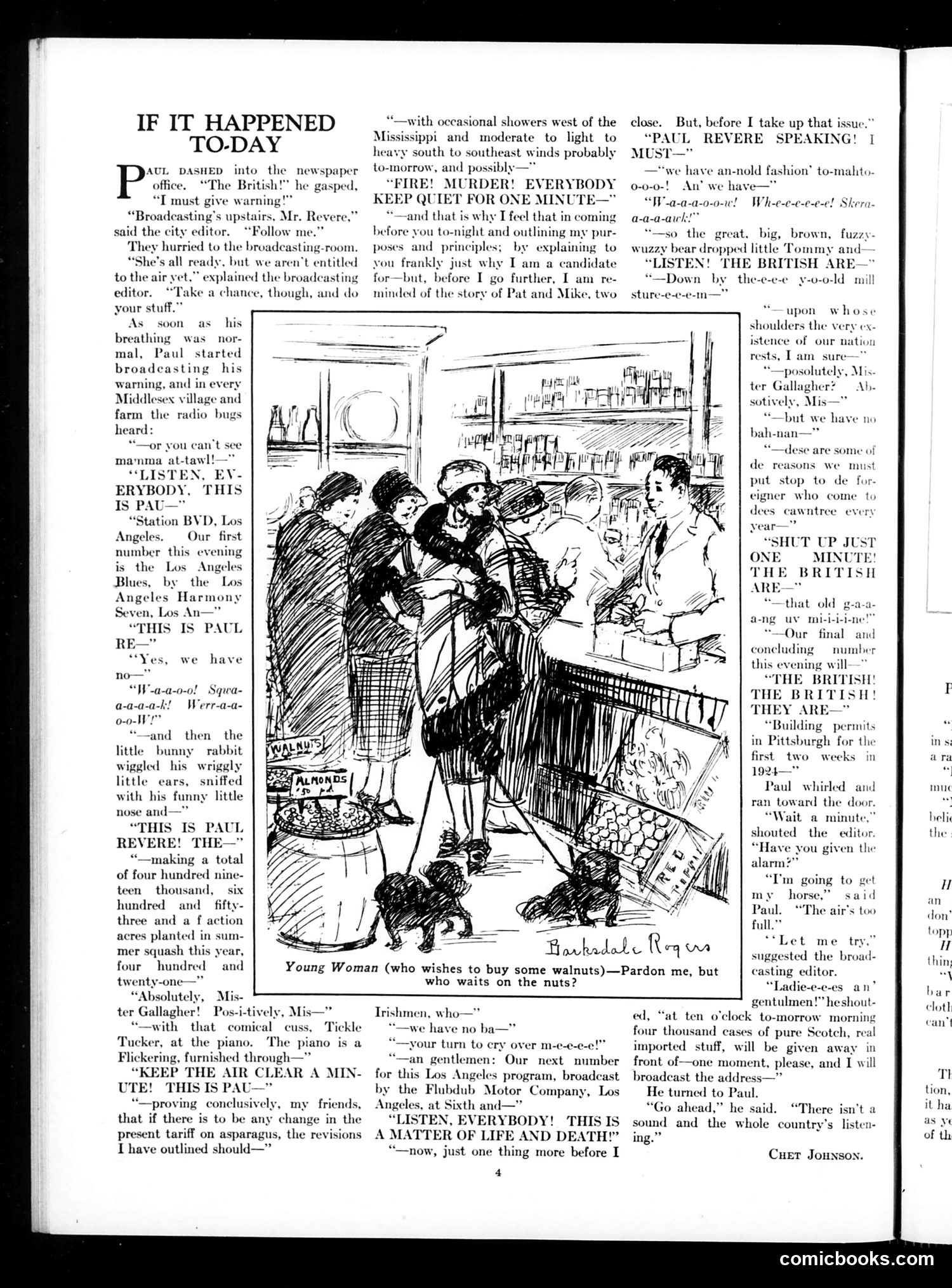
This page from *Judge* satirizes radio broadcasting's early chaos. The main cartoon depicts a crowded radio station where multiple people broadcast simultaneously—creating the cacophony the text describes. The satire targets the unregulated nature of 1920s radio: Paul Revere's famous midnight ride is invoked ironically, as broadcasters create pandemonium rather than clarity. The "Young Woman (who wishes to buy some walnuts)" caption suggests radio's commercial confusion—advertisements mixed with programming, nobody knowing what station or message they're receiving. The text mocks British radio listeners for their orderly conduct versus American chaos. The joke: American broadcasting lacks coordination, with overlapping stations and unclear announcements making the medium useless. This reflects pre-FCC radio's actual regulatory vacuum before 1927.
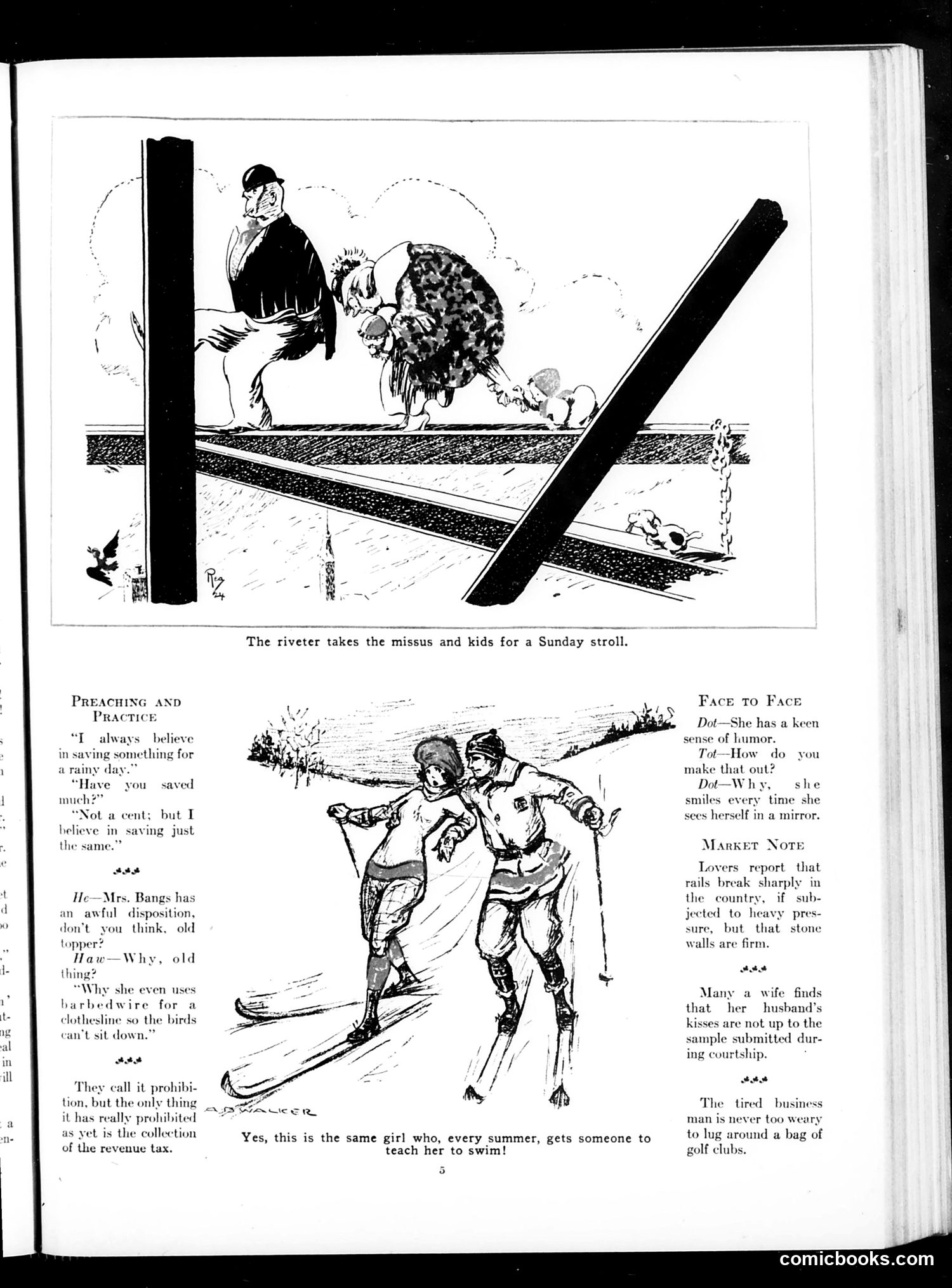
This page from Judge contains several brief satirical jokes and two cartoon illustrations typical of early 20th-century American humor. **Top cartoon**: Shows a working-class man ("the riveter") taking his wife and children for a Sunday stroll near railroad tracks and industrial equipment. The joke satirizes the contrast between harsh industrial working conditions and modest leisure activities—the man's dangerous job contrasts with this simple family outing. **Middle cartoon**: Depicts a couple skiing, captioned about a girl who needs swimming lessons every summer. The joke mocks her apparent inability to retain skills or her use of lessons as a social opportunity. **Text sections** include brief observations on hypocrisy ("preaching and practice"), marital complaints, and social commentary on Prohibition (mocking its ineffectiveness at collecting revenue taxes). The "Market Note" about rails breaking under pressure appears to be a double entendre about couples' behavior in rural areas. Overall, this represents typical Judge humor: cynical observations about marriage, class, gender, and social policies with gentle mockery rather than sharp political critique.
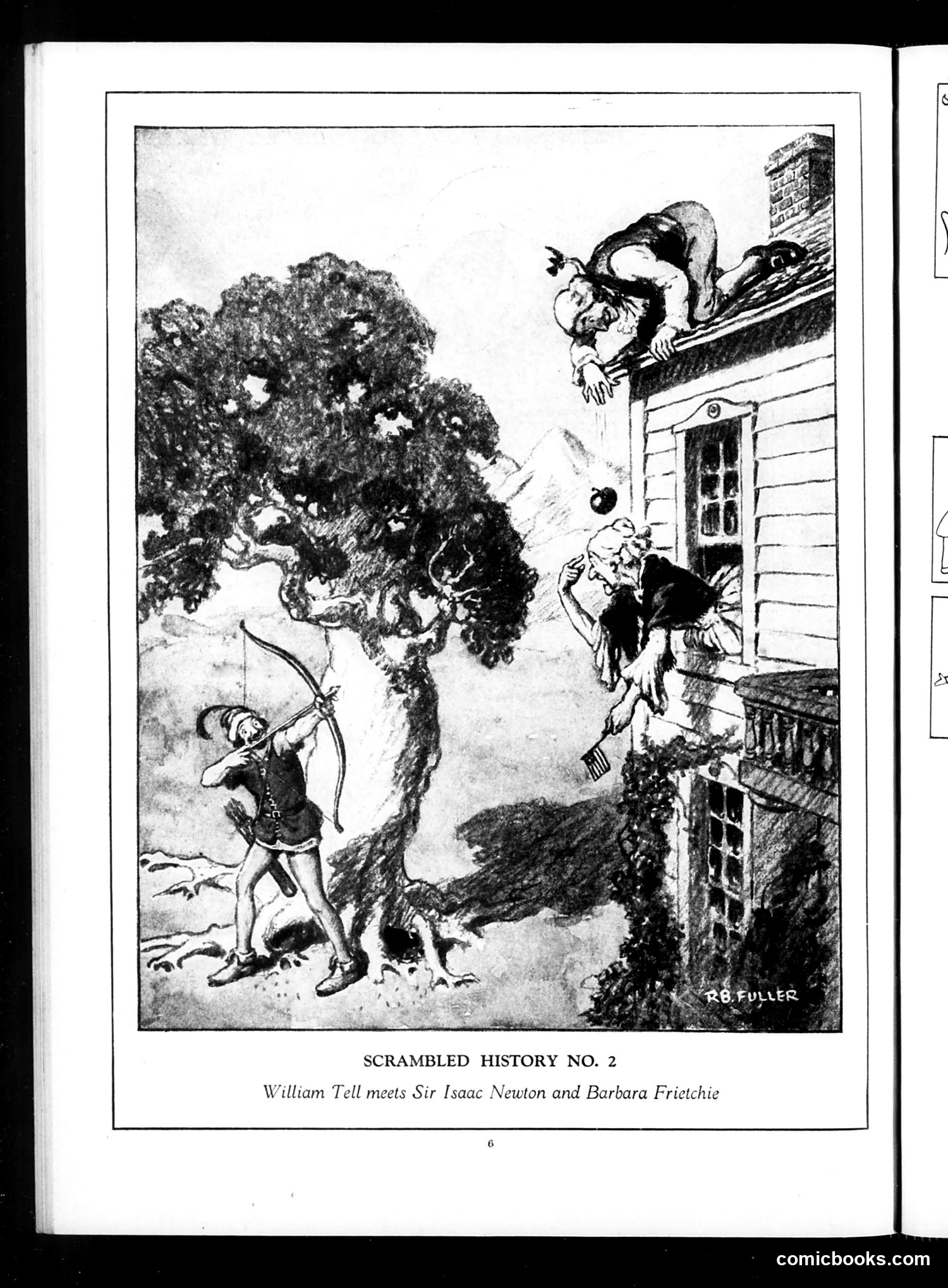
This cartoon blends three historical figures anachronistically for comedic effect. William Tell (left, with bow and arrow) encounters Sir Isaac Newton (on the roof, appearing to be struck by a falling apple) and Barbara Frietchie (the woman at the house). The joke appears to play on famous historical moments: Tell's legendary apple-shooting, Newton's apple-inspired gravity discovery, and Frietchie's Civil War-era patriotism. By cramming these unrelated historical figures into one scene, the cartoon creates absurdist humor—a "scrambled" mashup of separate historical narratives that couldn't logically occur together. The title explicitly signals this is intentional historical confusion for satirical entertainment, typical of Judge magazine's irreverent approach to American history and culture.
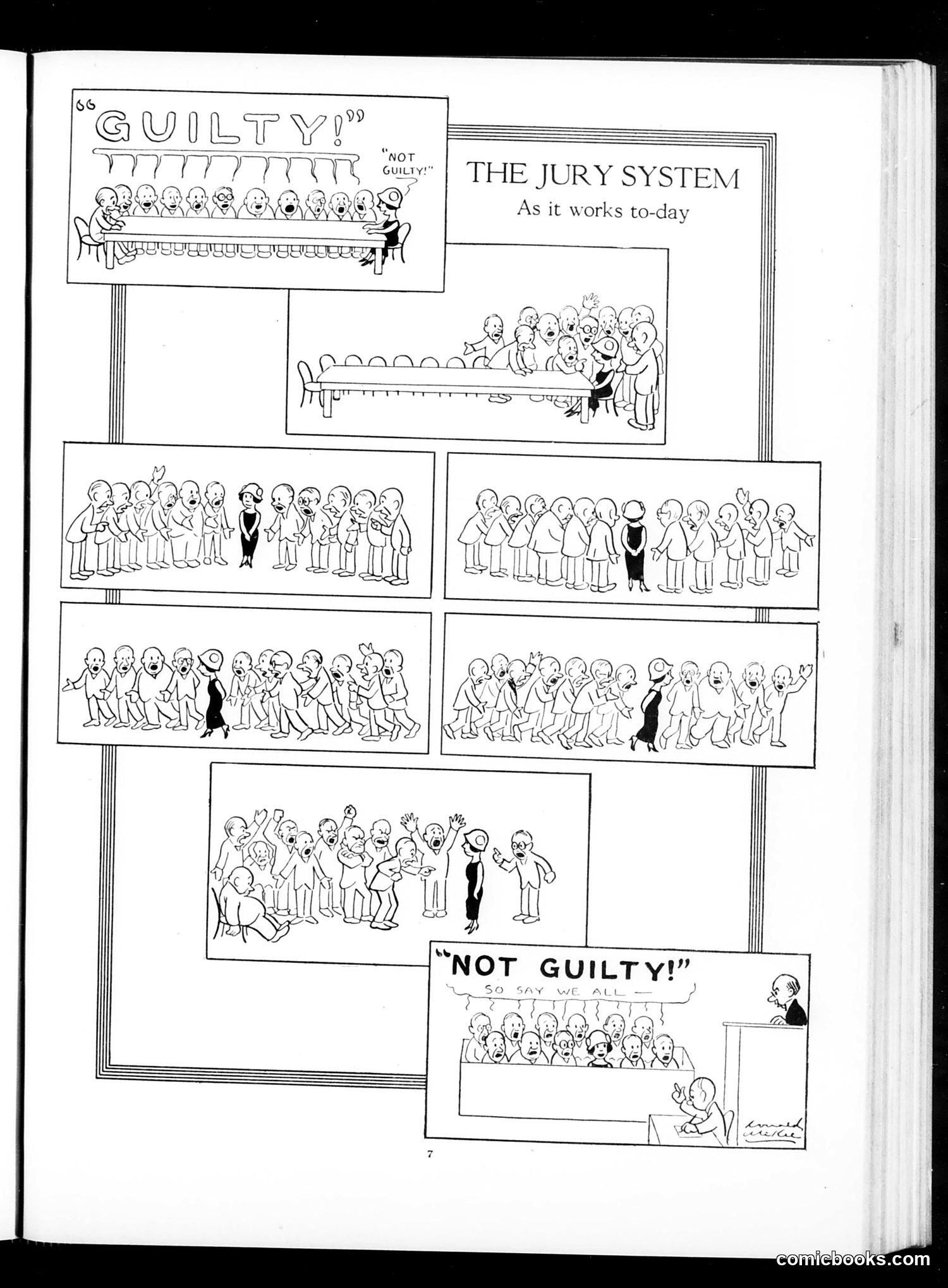
This satirical comic strip critiques the jury system through a visual progression. The top panel shows jurors unanimously declaring "GUILTY," while the final panel shows them collectively announcing "NOT GUILTY!"—suggesting capricious verdicts. The middle panels depict jurors being swayed or influenced through various means as they deliberate, implying jury members are susceptible to manipulation, persuasion, or pressure rather than objective reasoning. The satire suggests that jury verdicts depend less on evidence and more on social dynamics, individual lobbying, or external pressure—that jurors collectively reach predetermined conclusions regardless of facts. The contrasting guilty/not-guilty bookends emphasize the arbitrary nature of jury decisions. This reflects Progressive Era concerns about jury reliability and judicial fairness common in Judge magazine's satirical commentary on American institutions.
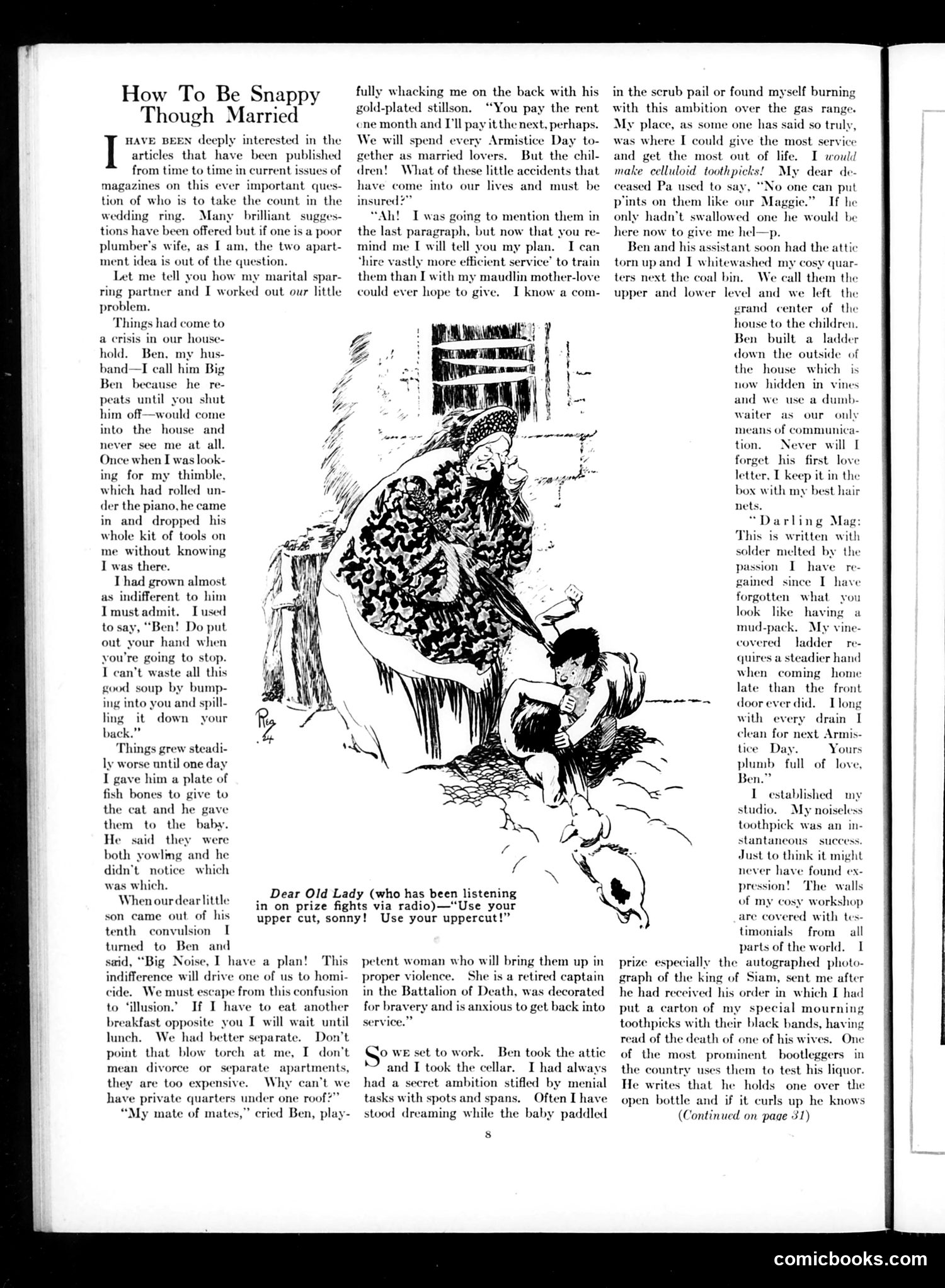
This is a satirical domestic humor piece about marital conflict. The narrative follows a working-class wife ("plumber's wife") and her husband "Big Ben" whose marriage has deteriorated into mutual indifference and dangerous negligence—he drops tools on her, gives fish bones meant for the cat to their baby instead. Their "solution" is absurdist: they separate within the shared house, with him taking the attic and her the cellar, using a dumb-waiter to communicate. She whitewashes her coal-bin quarters and pursues a suppressed ambition for domestic arts (making toothpicks). They hire a "retired captain in the Battalion of Death" to raise their children "in proper violence." The cartoon shows an elegantly dressed woman directing children in boxing, illustrating the satirical proposal. The piece mocks both failed marriages and contemporary advice columns about marital harmony through separate living arrangements—presenting the idea taken to absurd extremes as the only "solution" to incompatible spouses.
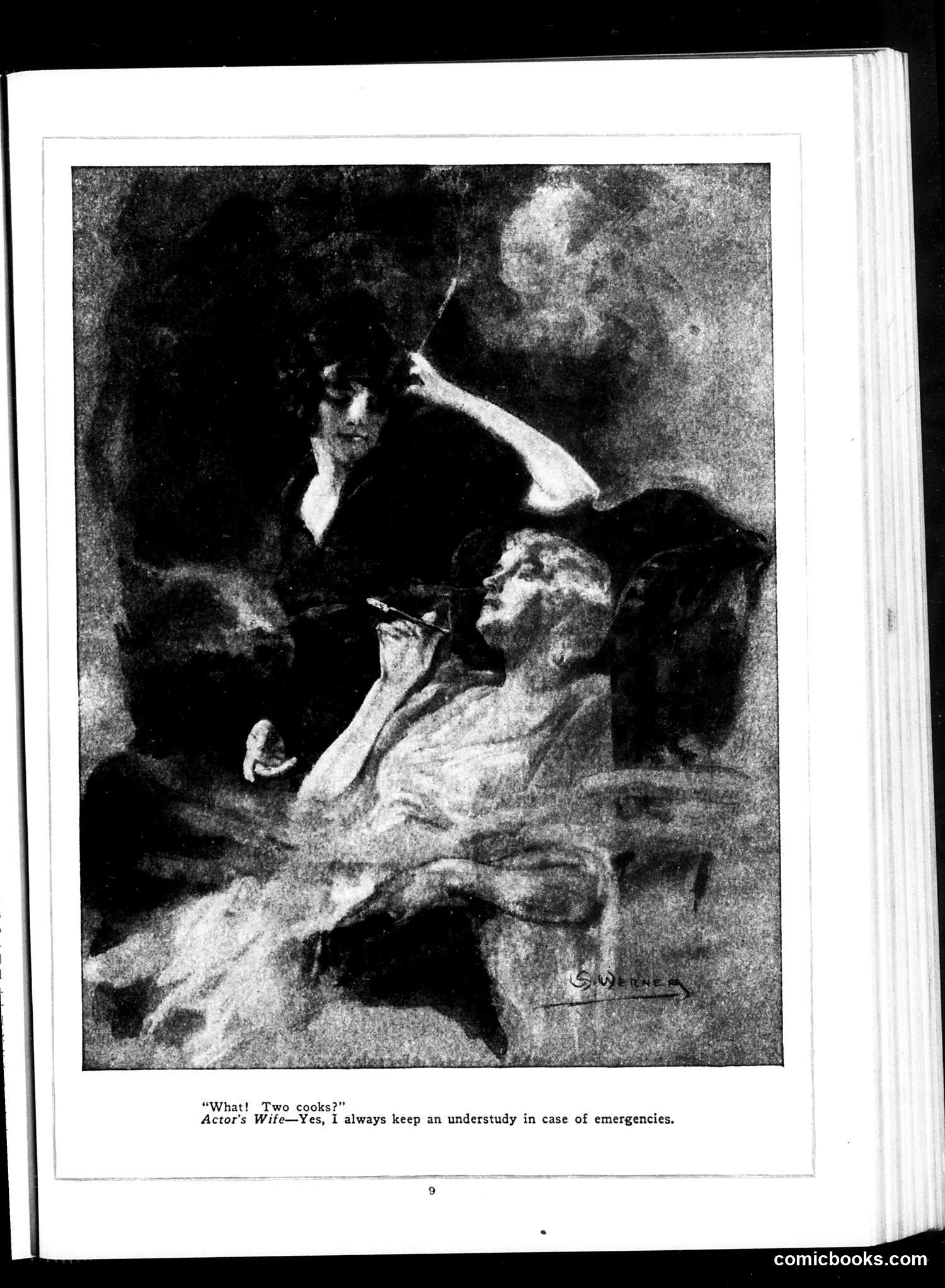
This is a domestic humor cartoon from Judge magazine playing on theatrical terminology. An actor's wife has hired two cooks, which surprises her husband (shown reclining, looking upward in alarm). The joke applies Broadway/theater language to household staff: just as actors maintain understudies for emergencies, the wife keeps a backup cook. The satire targets both theatrical pretension—using industry jargon for mundane domestic matters—and wealthy households' casual overstaffing during a period when servants were common among the affluent. The humor derives from the incongruity of treating kitchen staff with the same professional redundancy as stage productions, mocking upper-class presumption and expense.
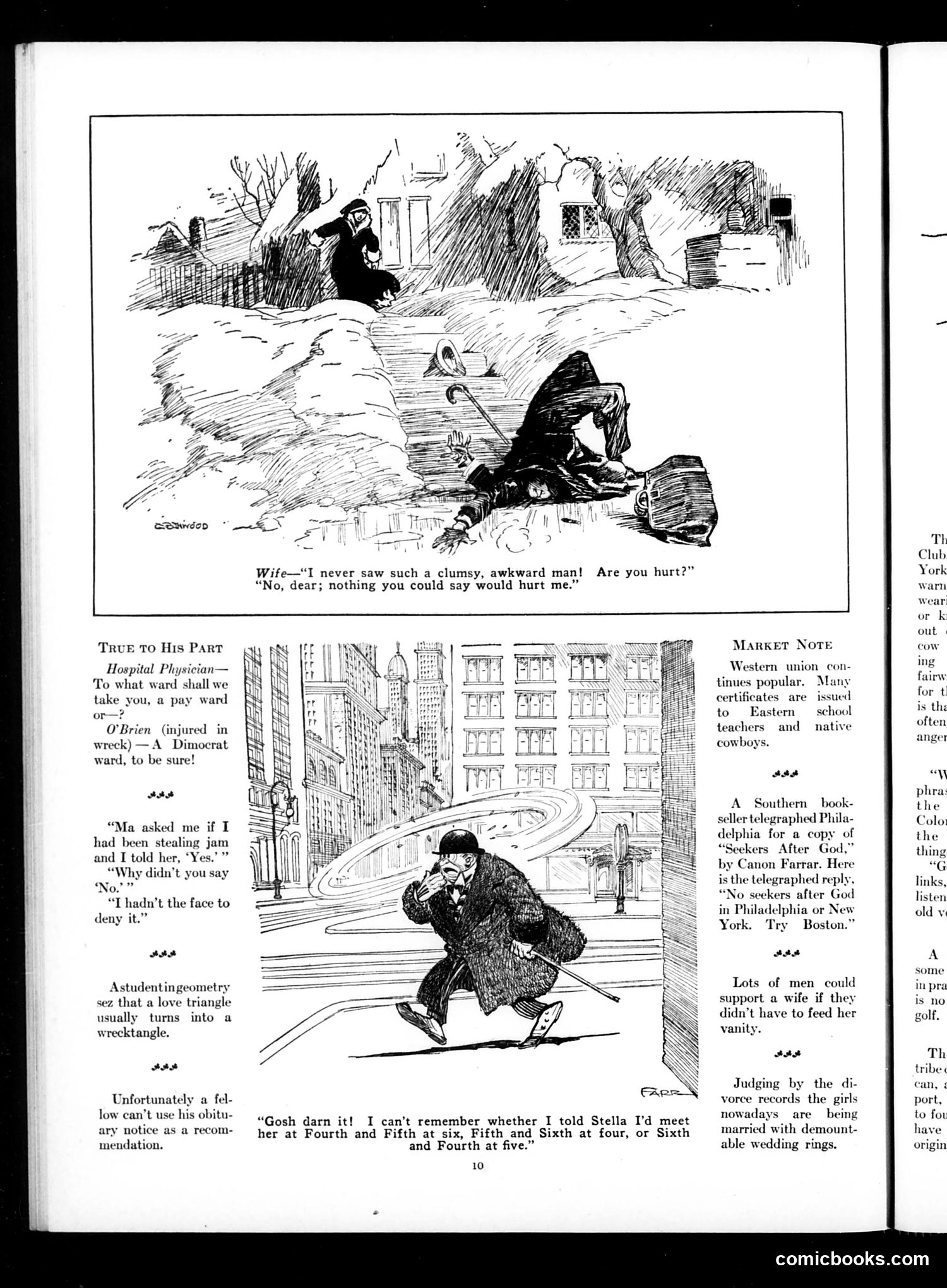
This page contains several unrelated short jokes and satirical items typical of Judge magazine's format. **Top Cartoon:** A man has fallen on ice. His wife asks if he's hurt; he insists nothing could hurt him. The humor plays on masculine pride and stoicism—the implication being that emotional wounds from nagging wives cause more damage than physical injury. **Political Reference:** "True to His Part" jokes about an injured Irishman (O'Brien) requesting a "Democrat ward." This appears to satirize Irish-American political allegiance to the Democratic Party, suggesting it's as reflexive as choosing a hospital ward. **Other Items:** Simple puns and observations—love triangles becoming "wrecktangles," geometric humor, a man unable to deny stealing jam despite lying being easier. The market notes mock Western Union's popularity and include a sarcastic exchange about religious books in Philadelphia versus Boston. **Overall:** This is light, apolitical humor targeting everyday social foibles, ethnic stereotypes (Irish), and absurdist wordplay rather than substantive political satire.
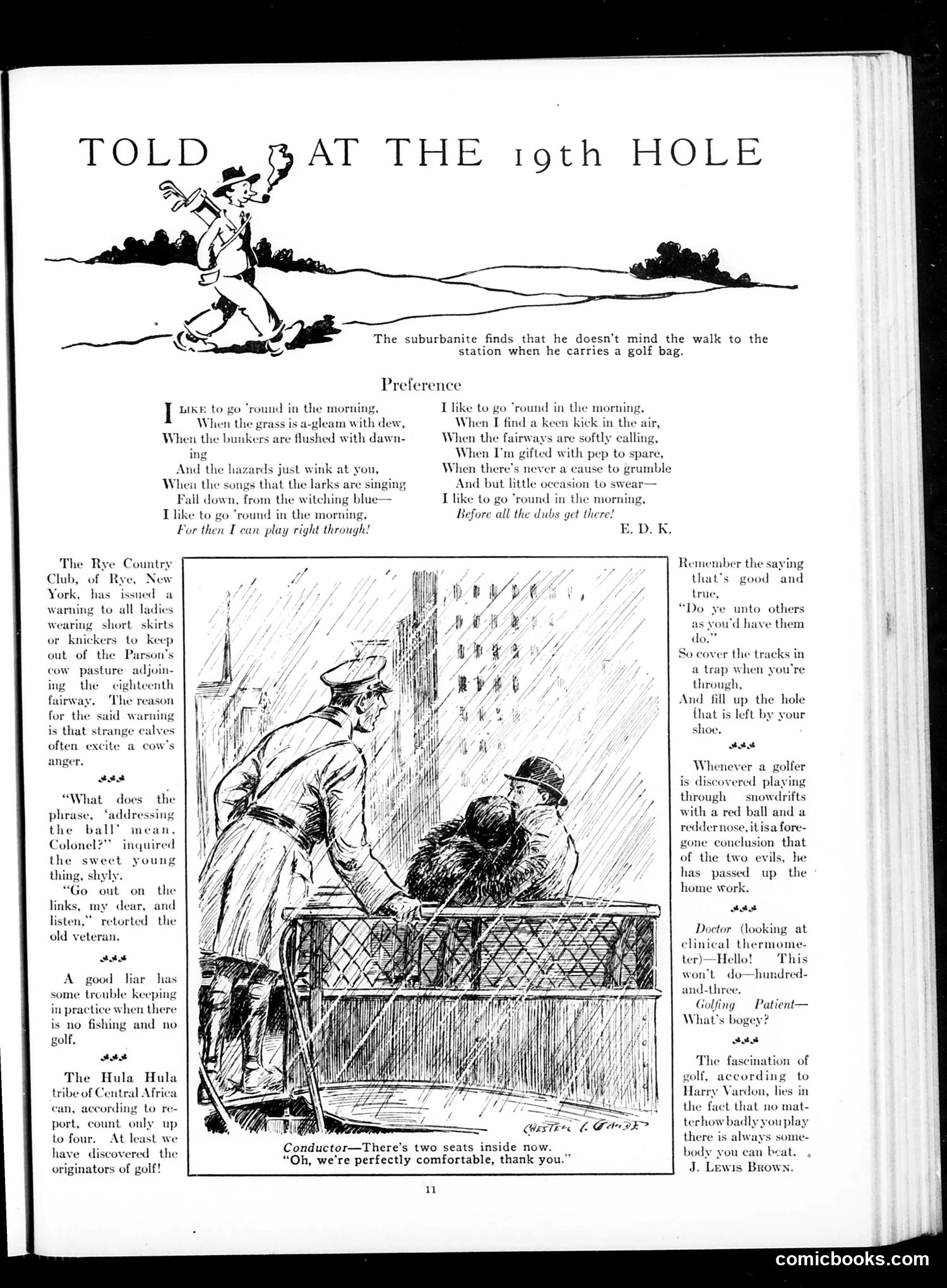
This page from *Judge* magazine collects golf-themed humor and social commentary. The main cartoon depicts a conductor on a train with two passengers who claim comfort despite crowded conditions—a jab at suburban commuters' willingness to endure discomfort if it means accessing golf courses. The text includes golf preference poetry (by E.D.K.) celebrating morning rounds before "the dubs get there"—poking fun at amateur golfers' aspirations. Scattered jokes mock golf culture: a Rye Country Club warning about women in short skirts exciting cows in a cow pasture plays on both fashion anxiety and rural property concerns. A reference to the Hula Hula tribe's inability to count past four, attributed to "originating golf," is a casual, period-typical ethnic stereotype. The overall theme satirizes the suburban middle class's obsession with golf as status symbol and escape from domestic life, while gently mocking amateur players and their pretensions to skill.
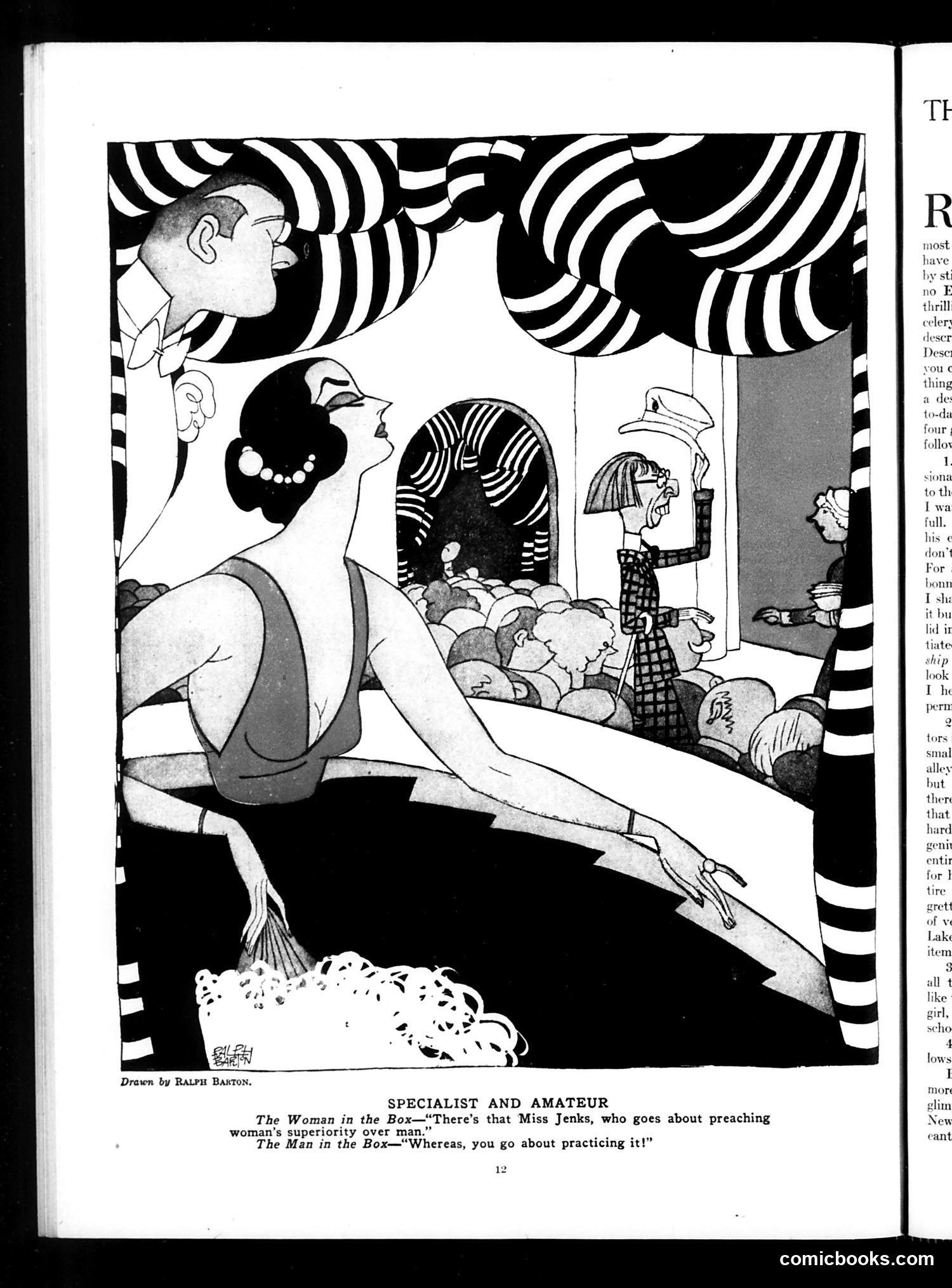
This cartoon satirizes gender relations and feminist rhetoric of the early 20th century. Two figures observe Miss Jenks through windows: a woman preaching about female superiority over men, and a man practicing that superiority through his behavior. The joke relies on a double standard: the woman is criticized for merely *talking* about women's equality, while the man is portrayed as actually *demonstrating* female dominance through his deference or submission. The satire mocks both the feminist advocate (portrayed as all talk) and the compliant man (portrayed as passive). The ornate Art Deco setting and caricature style are typical of Judge magazine's entertainment-focused approach to social commentary. The cartoon suggests skepticism toward 1920s women's liberation movements while also gently mocking men who accommodate feminist demands.
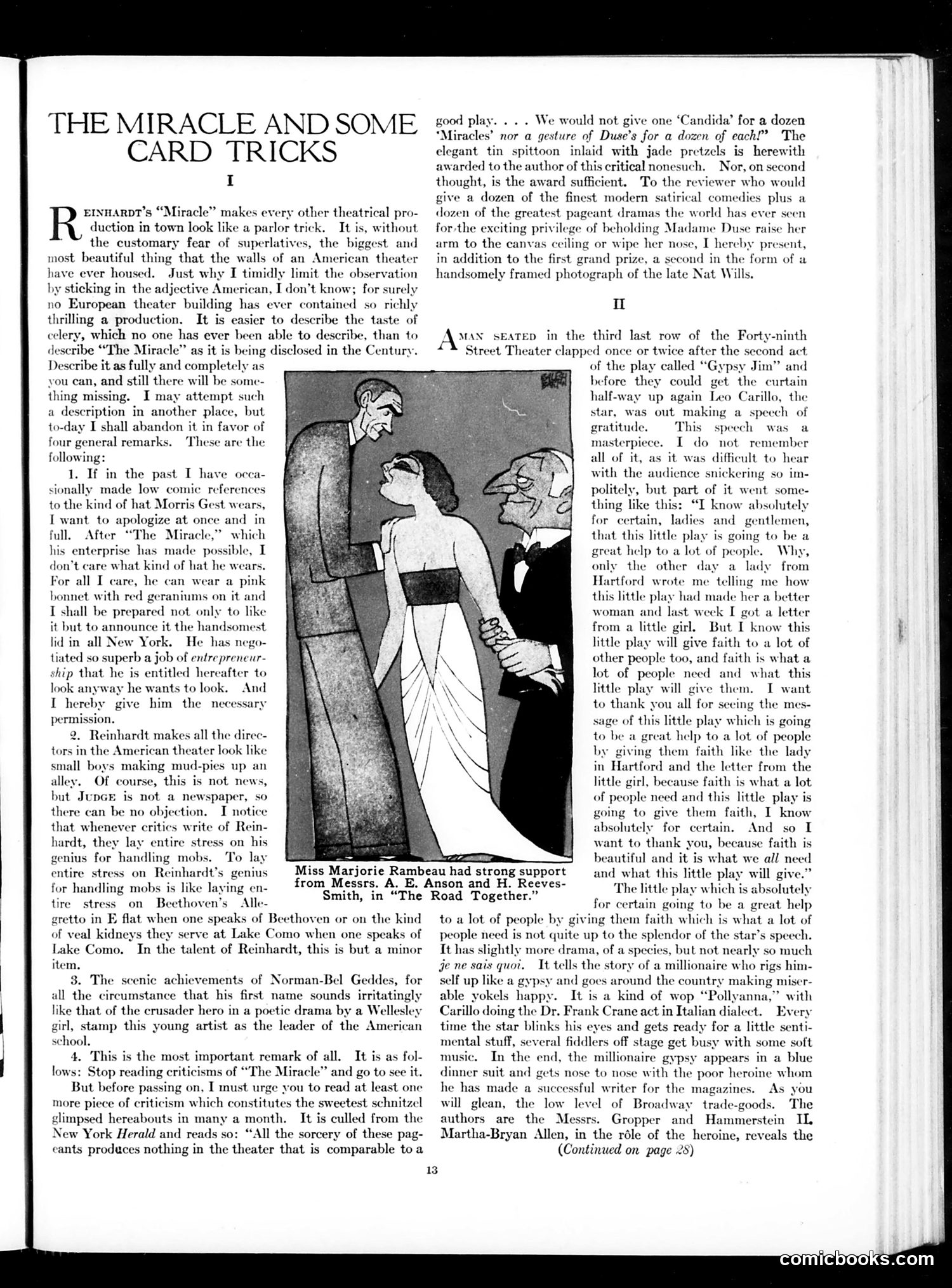
This page reviews "The Miracle," a 1912 theatrical production staged by impresario Morris Gest and directed by Max Reinhardt. The critic praises it as revolutionary American theater. The cartoon shows **Miss Marjorie Rambeau** in classical costume, illustrating the production's grandiose staging style. The text credits her support from actors A.E. Anson and H. Reeves-Smith in "The Road Together." The satire targets theatrical pretension through a mock-serious defense of Reinhardt and Gest against the critic's own previous snark. The author sarcastically awards an "elegant tin spittoon inlaid with jade pretzels" to a New York Herald reviewer who dismissed spectacle compared to dramatic substance—essentially mocking critics who privilege intellectual theater over visual spectacle. The reference to actress Eleonora Duse (noted for subtle acting) versus pageantry reinforces this aesthetic debate common to early 20th-century theater criticism.
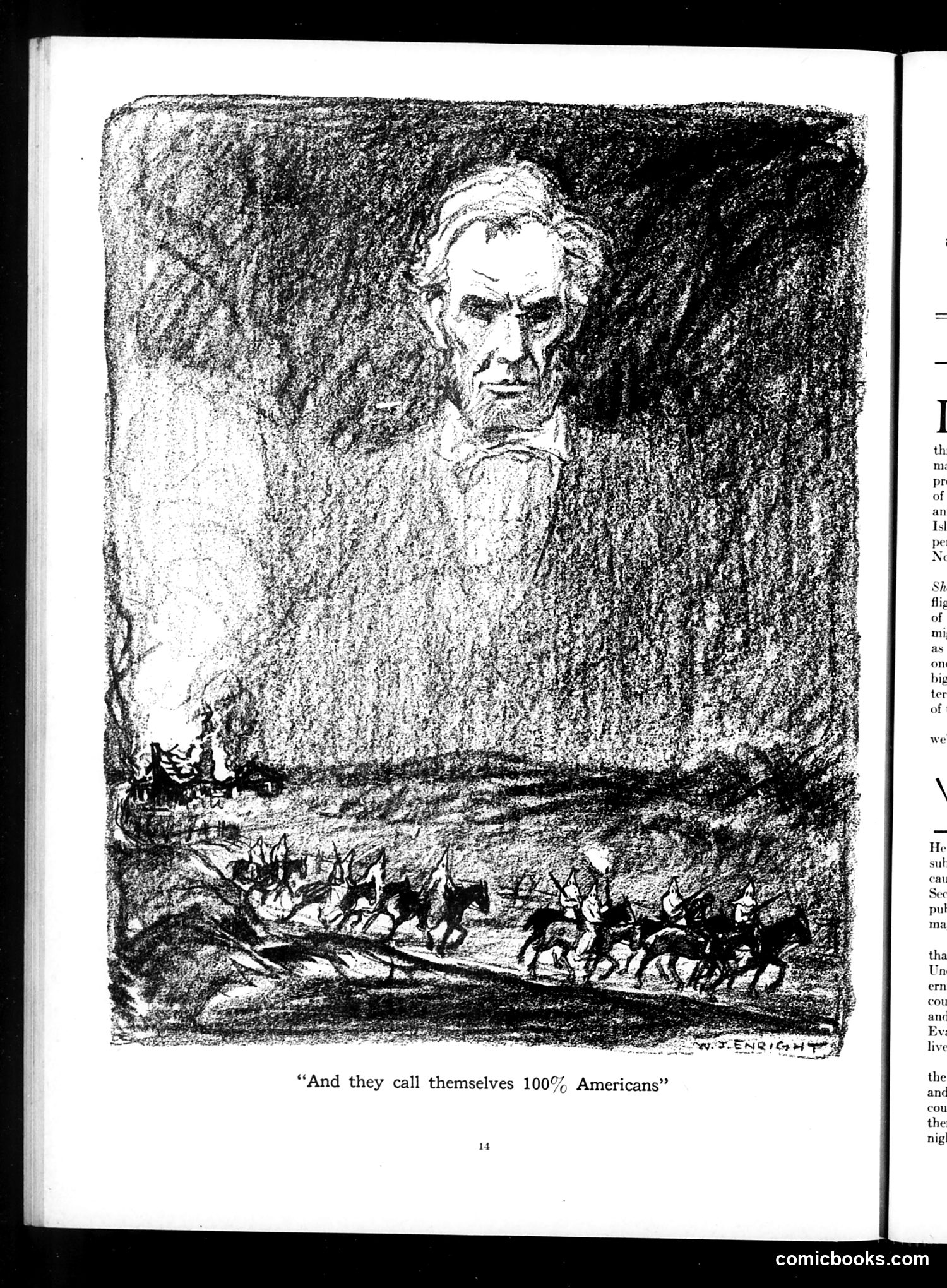
This cartoon satirizes American nativism and hypocrisy. The large figure looming above appears to be a representation of American identity or leadership, while below are depicted what look like KKK members (identifiable by their distinctive pointed hoods and robes) conducting some kind of nighttime activity or gathering. The caption's irony is cutting: these figures—the KKK—claim to be "100% Americans" despite their violent, un-American conduct. The cartoon critiques the contradiction between nativist claims of patriotism and their actual lawless, terroristic behavior. Judge magazine is mocking the KKK's assertion of American supremacy while they operate outside legal and moral bounds, suggesting their version of "Americanism" is fundamentally un-American.
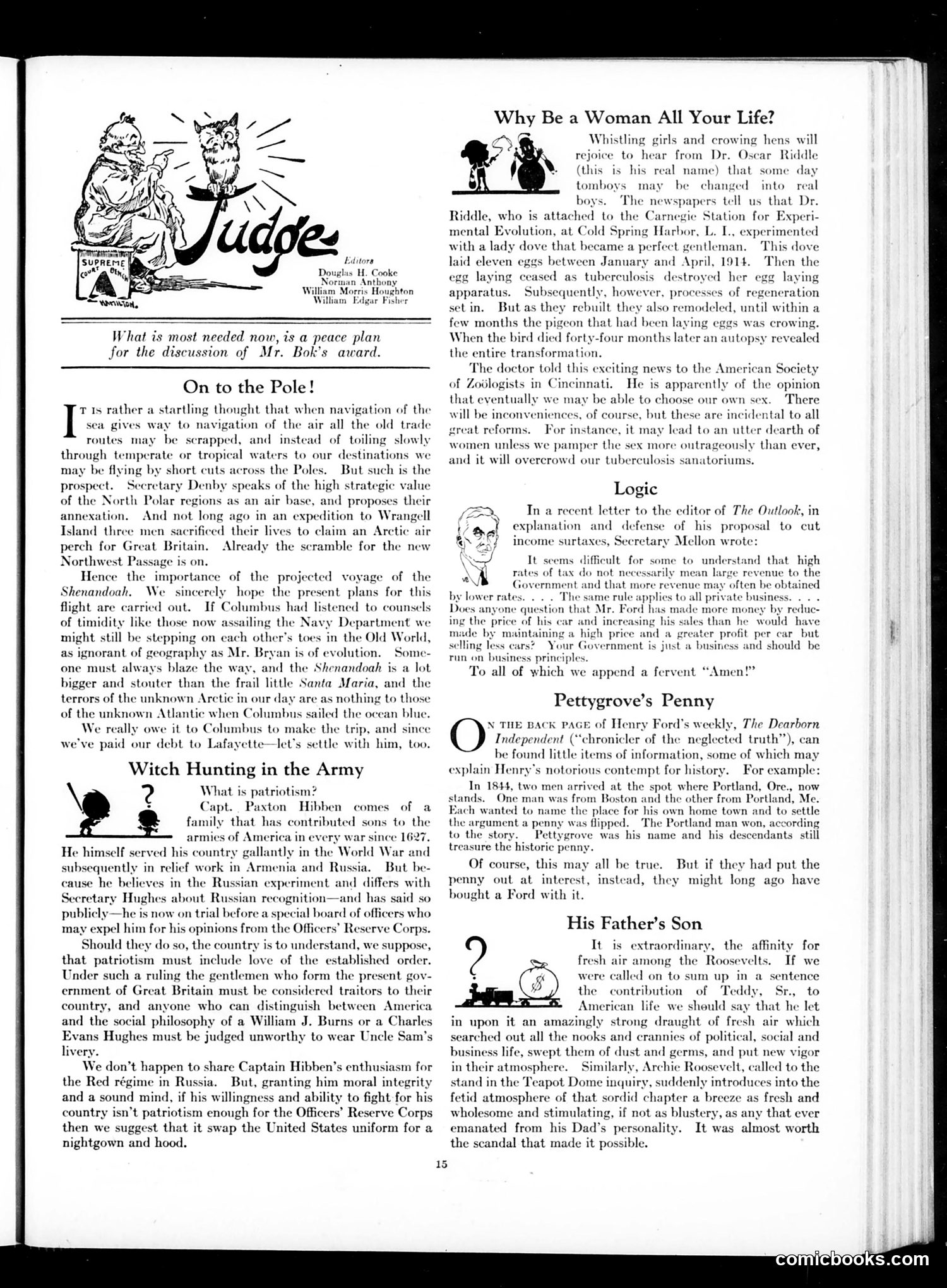
This page contains three separate satirical pieces: **"On to the Pole!"** celebrates the planned Arctic expedition of the airship *Shenandoah*, arguing that polar exploration via aviation represents progress comparable to Columbus's voyage. It mocks those opposing the project, sarcastically comparing them to William Jennings Bryan's ignorance of evolution. **"Witch Hunting in the Army"** defends Captain Paxton Hibben, an officer facing expulsion from the Reserve Corps for supporting Soviet recognition and the Russian Revolution. Judge argues that disagreeing with Secretary of State Charles Evans Hughes shouldn't disqualify someone from military service—equating such loyalty tests to the Spanish Inquisition ("nightgown and hood" references the KKK). **"Why Be a Woman All Your Life?"** reports on Dr. Oscar Riddle's experiments at Carnegie Institution transforming a female dove into a male through biological manipulation. The satire mocks the sensational possibility of changing children's sex, presenting it as absurd scientific progress. All three pieces exemplify Judge's 1920s progressive stance on science, internationalism, and individual liberty against establishment conservatism.
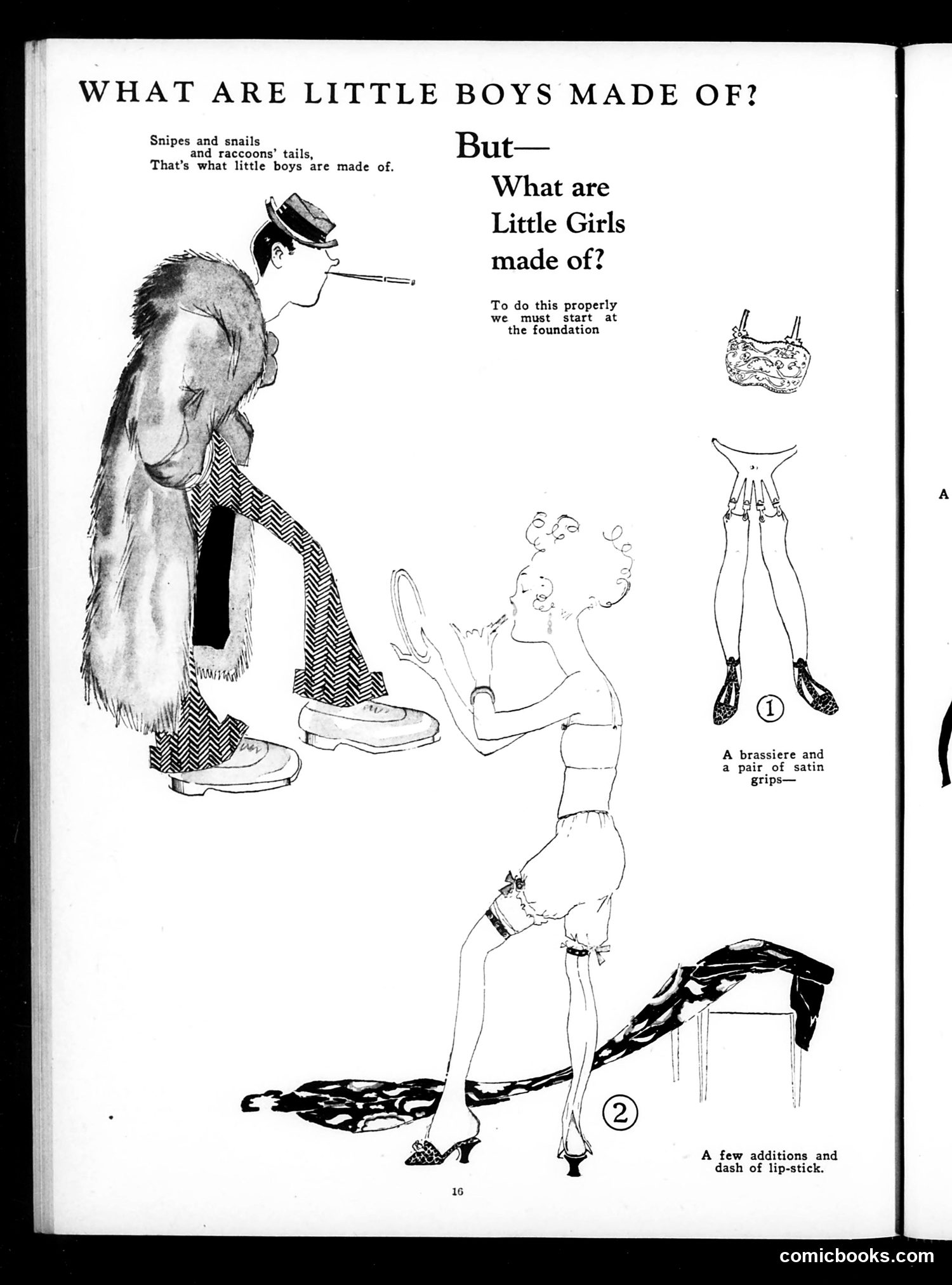
This Judge magazine satirical cartoon subverts the nursery rhyme "What Are Little Boys Made Of?" (snips and snails and puppy dog tails). The humor contrasts boys' supposedly natural composition with girls' construction from artificial components. The illustration shows a fashionably dressed woman with fur stole and cigarette alongside a figure in underwear and heels, labeled with foundation garments (brassiere, satin girdles) and cosmetics (lipstick). The satire targets 1920s-era concerns about women's "artificiality"—mocking both the elaborate undergarments required by fashion and the growing use of makeup. The phrase "start at the foundation" plays on construction language, suggesting women are entirely manufactured rather than naturally formed. This reflects period anxieties about changing gender roles and women's increasing visibility in public life through fashion and cosmetics consumption.
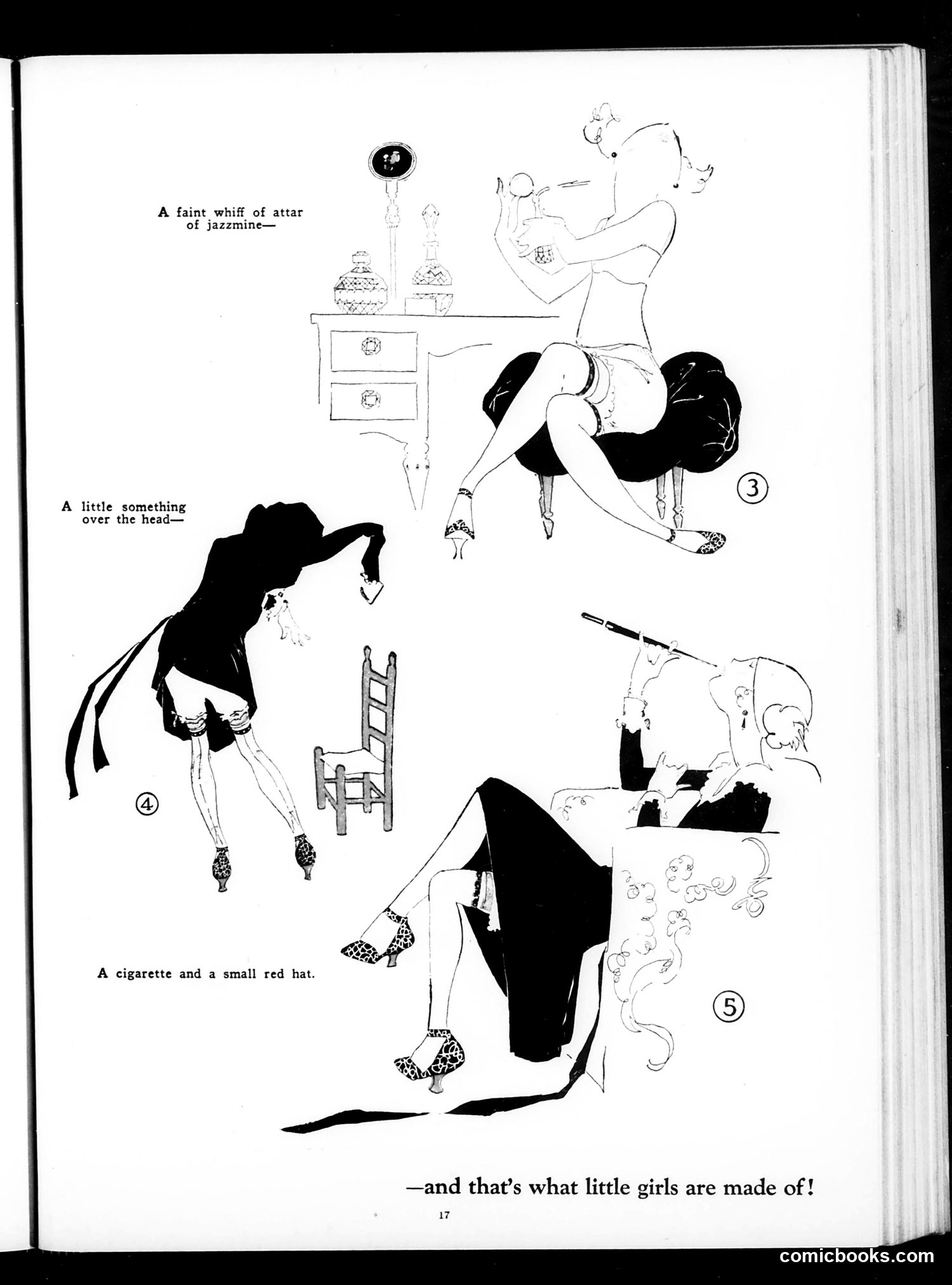
This page parodies the nursery rhyme "Sugar and spice and all things nice, that's what little girls are made of." Instead, the satirical cartoon depicts five numbered scenes showing a modern young woman (presumably 1920s era, given the "Judge" magazine context) engaged in activities considered scandalous or improper: applying perfume ("attar of jazzmine"), wearing revealing clothing, smoking cigarettes, wearing a small red hat, and lounging in what appears to be a suggestive pose. The joke criticizes how contemporary "flapper" culture—with jazz, cosmetics, smoking, and loose morality—has replaced traditional feminine virtues. This reflects conservative anxiety about changing women's behavior and social norms during the Jazz Age.
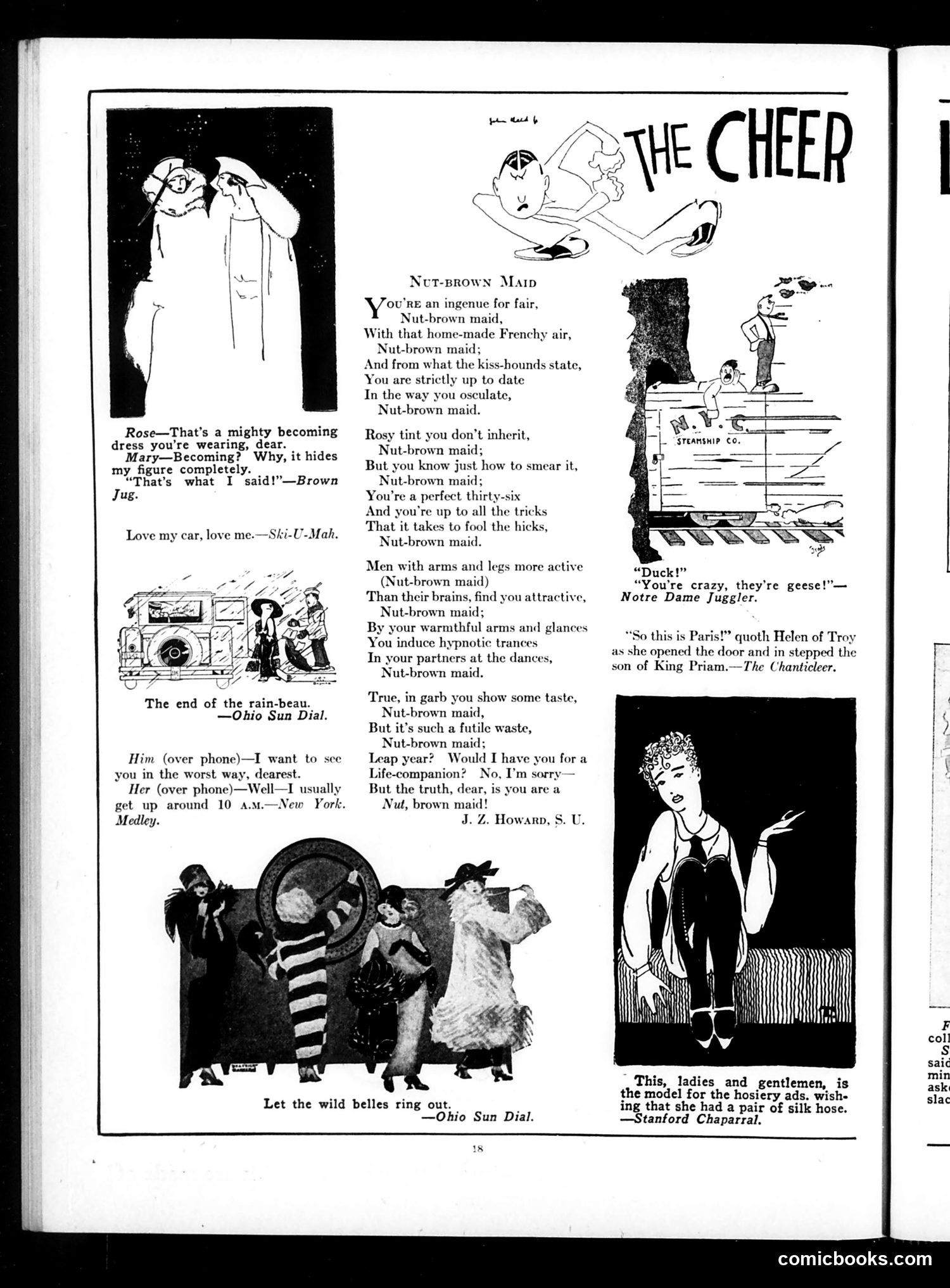
This is a humor miscellany page from *Judge* magazine featuring several short jokes and a satirical song about a "Nut-brown Maid." **The Main Content:** The centerpiece is a lengthy poem mocking a woman with bronzed/tanned skin who affects French sophistication. The satire targets her as artificially glamorous—using makeup ("smear it"), exploiting her physical attractiveness to manipulate men, and lacking genuine substance. The poem's refrain repeatedly calls her a "nut" (fool), ultimately rejecting her as a marriage prospect despite her appeal. **Context:** The piece reflects early 20th-century attitudes about cosmetics, tanning, and women's sexuality. The bronzed complexion was fashionable but viewed with suspicion as artificial and morally questionable. The satire condemns her as superficial and manipulative while acknowledging her physical power over men. **Supporting comics** include brief quips about cars, phones, and dress—typical magazine filler humor of the era, mostly relying on wordplay and domestic situations.
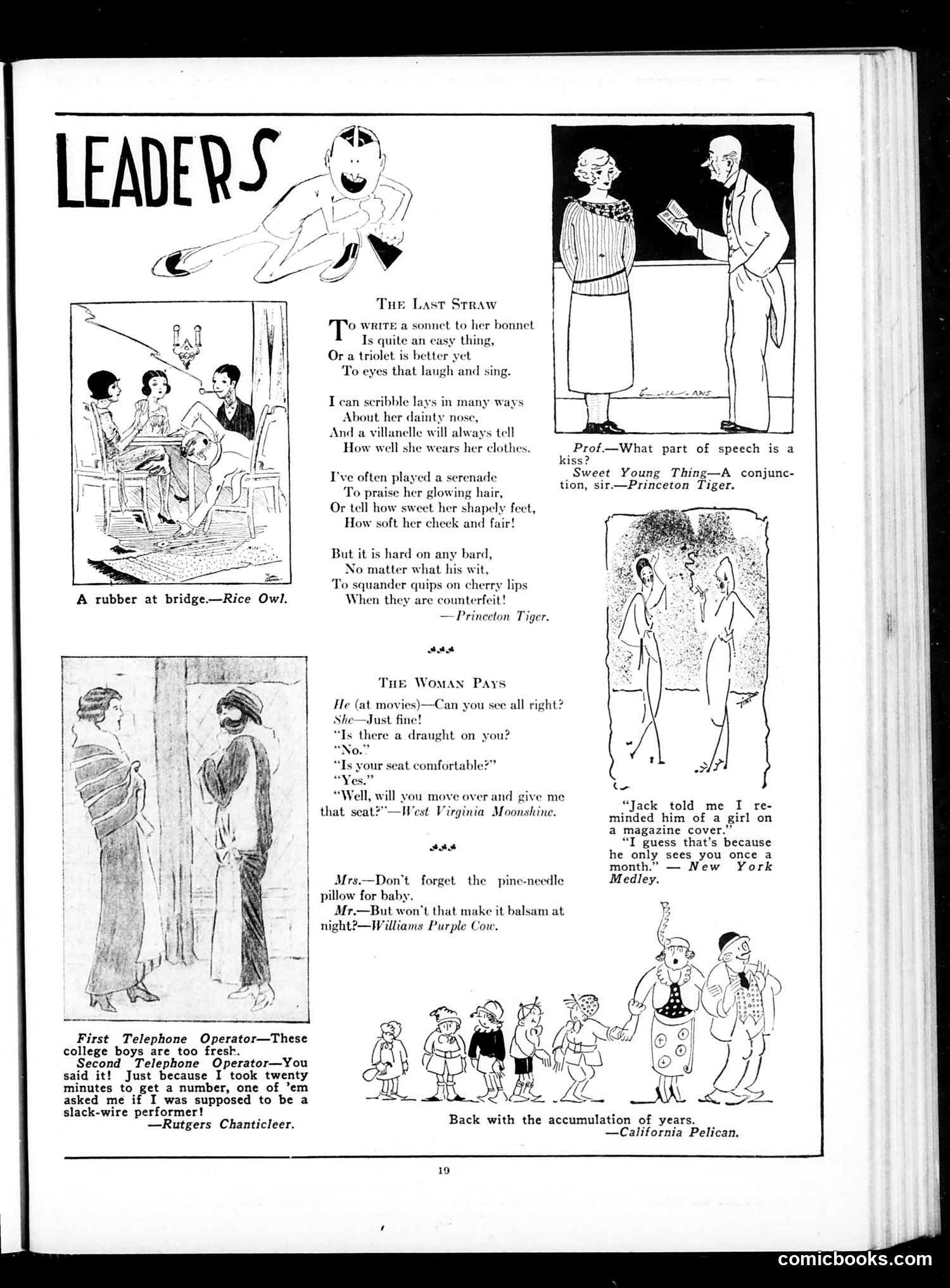
This page collects humorous short pieces and cartoons satirizing early 20th-century social dynamics: **"The Last Straw"** mocks male poets who write flowery verses praising women's beauty, only to end with the punchline that compliments about "counterfeit" lips (likely cosmetics or false teeth) undermine romantic gestures. **"The Woman Pays"** satirizes gender dynamics at movie theaters, where a man asks solicitous questions before ultimately just wanting her seat—exposing male chivalry as performative. **"The Pine-Needle Pillow"** is a pun joke playing on "balsam" (a soothing pillow filling) sounding like "balm same" (implying it wouldn't be soothing at night). **The telephone operator cartoons** mock college boys' rudeness to service workers and criticize slow operators. The overall theme: satire of courtship rituals, gender relations, and modern manners among young people and in emerging service industries. The humor relies on wordplay and social observation typical of 1920s-era college magazine humor.
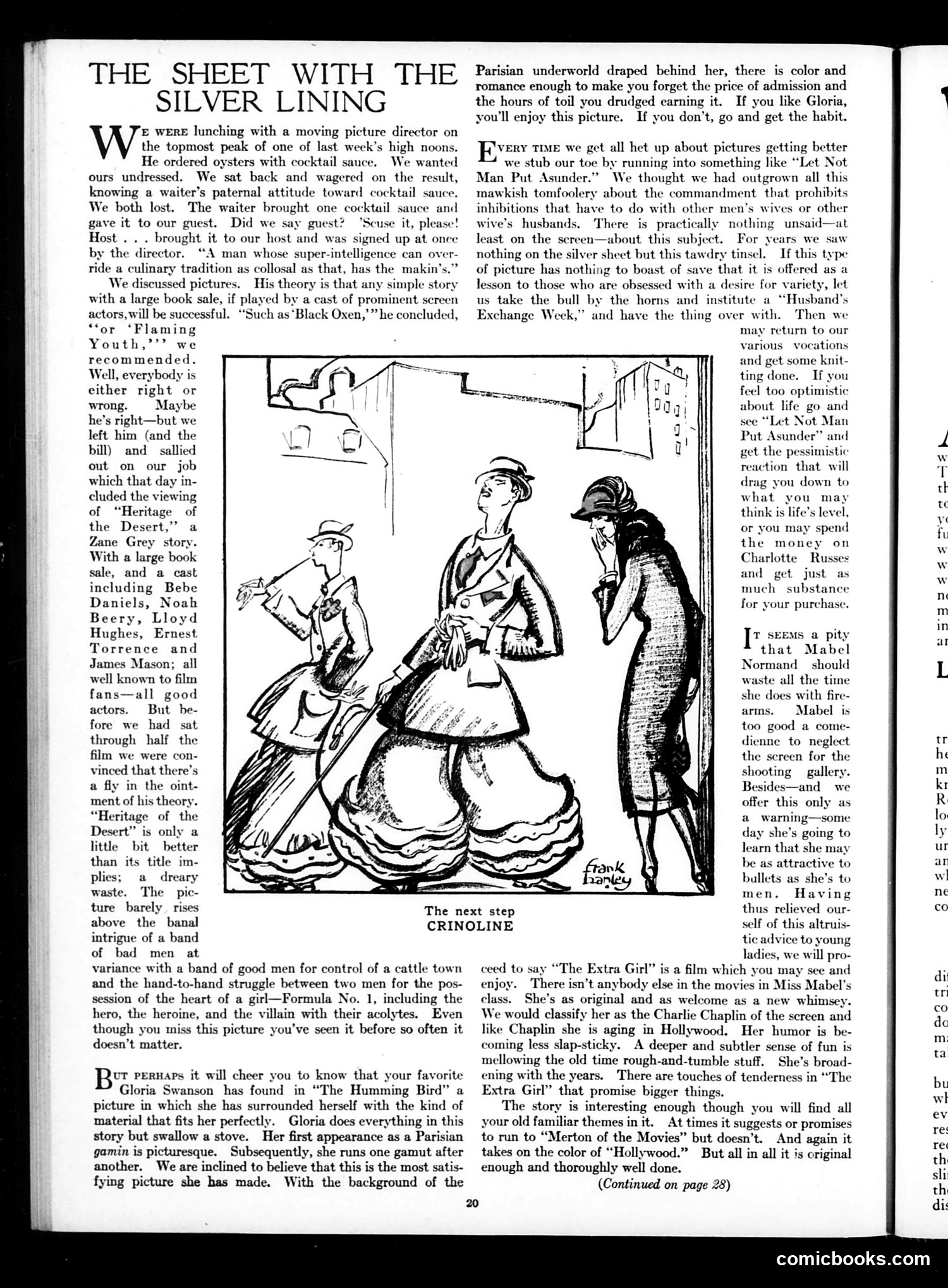
This page contains film criticism masquerading as humor, typical of Judge's entertainment coverage. The author reviews several 1920s movies and critiques Hollywood's filmmaking philosophy. **The Main Cartoon** depicts three figures examining what appears to be a costume or garment labeled "CRINOLINE"—illustrating the shallow nature of film production, where producers believe any famous actors in any tired plot formula will succeed. **Key Points:** - The critic mocks a director's theory that good actors automatically make good pictures, using "Heritage of the Desert" (a Zane Grey adaptation) as evidence—calling it formulaic despite its cast (Bebe Daniels, Noah Beery, etc.) - Praises Gloria Swanson in "The Humming Bird" for having material suited to her talents - Attacks "Let Not Man Put Asunder" as tired, moralistic melodrama about marital infidelity—suggesting audiences would get more value from eating Charlotte Russes (pastries) than watching it - Laments that Mabel Normand wastes her talent on poor material The satire critiques both Hollywood's cynical formulas and audiences' gullibility.
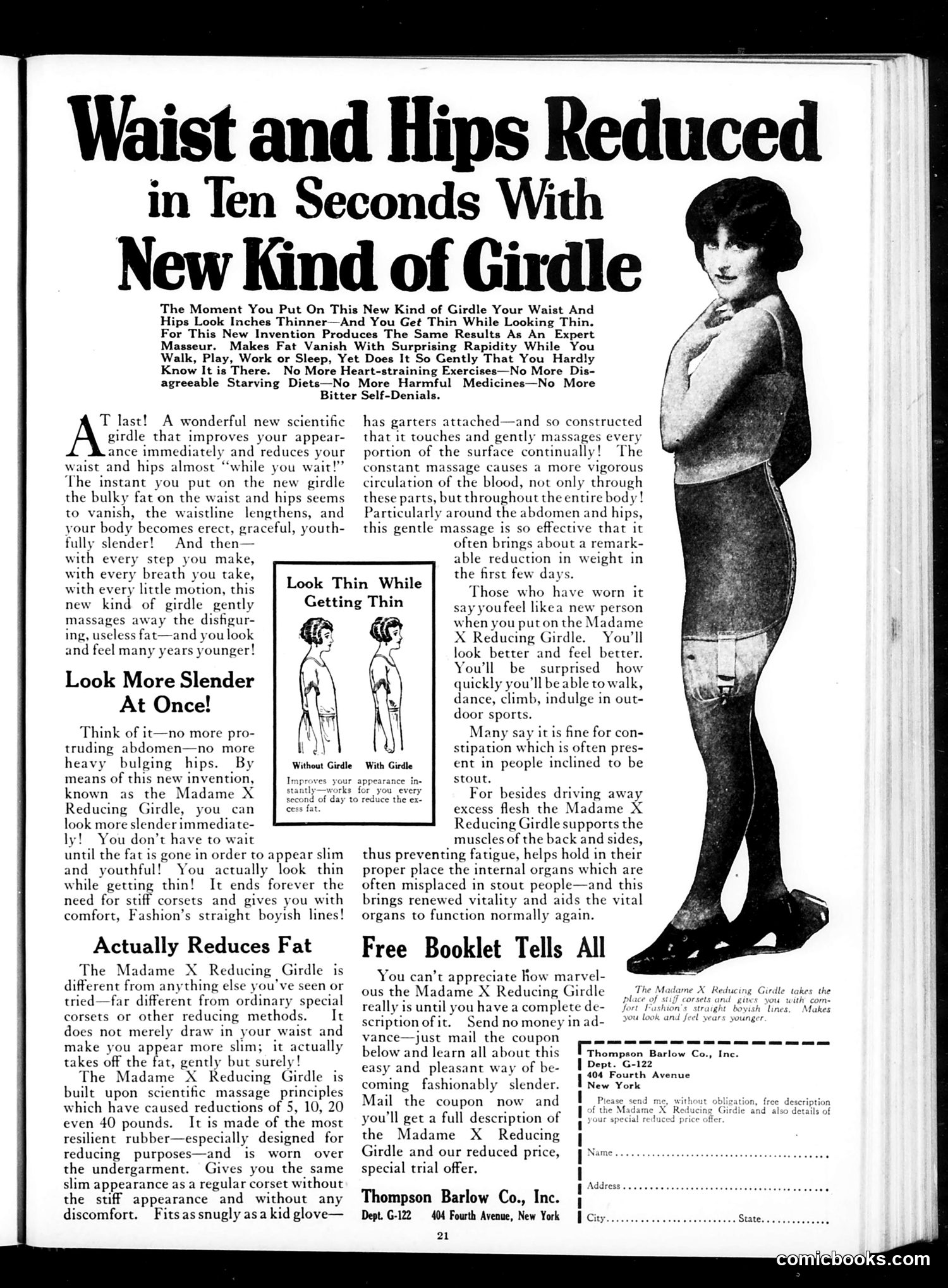
This page is primarily a **product advertisement** for the "Madame X Reducing Girdle," a corset-like undergarment marketed as a weight-loss device. There are no political cartoons or satirical commentary visible. The ad employs typical early 20th-century marketing rhetoric, claiming the girdle will: - Instantly slim the waist and hips - Reduce fat through "scientific massage principles" - Eliminate the need for dieting or exercise - Improve posture and internal organ function A before/after illustration shows a woman appearing slimmer when wearing the girdle. **For modern readers**: This represents the era's aggressive marketing of restrictive shapewear to women, making pseudoscientific claims about fat reduction through massage and compression—promises unsupported by actual evidence. It reflects period attitudes toward female body standards and the commercial exploitation of weight anxiety.
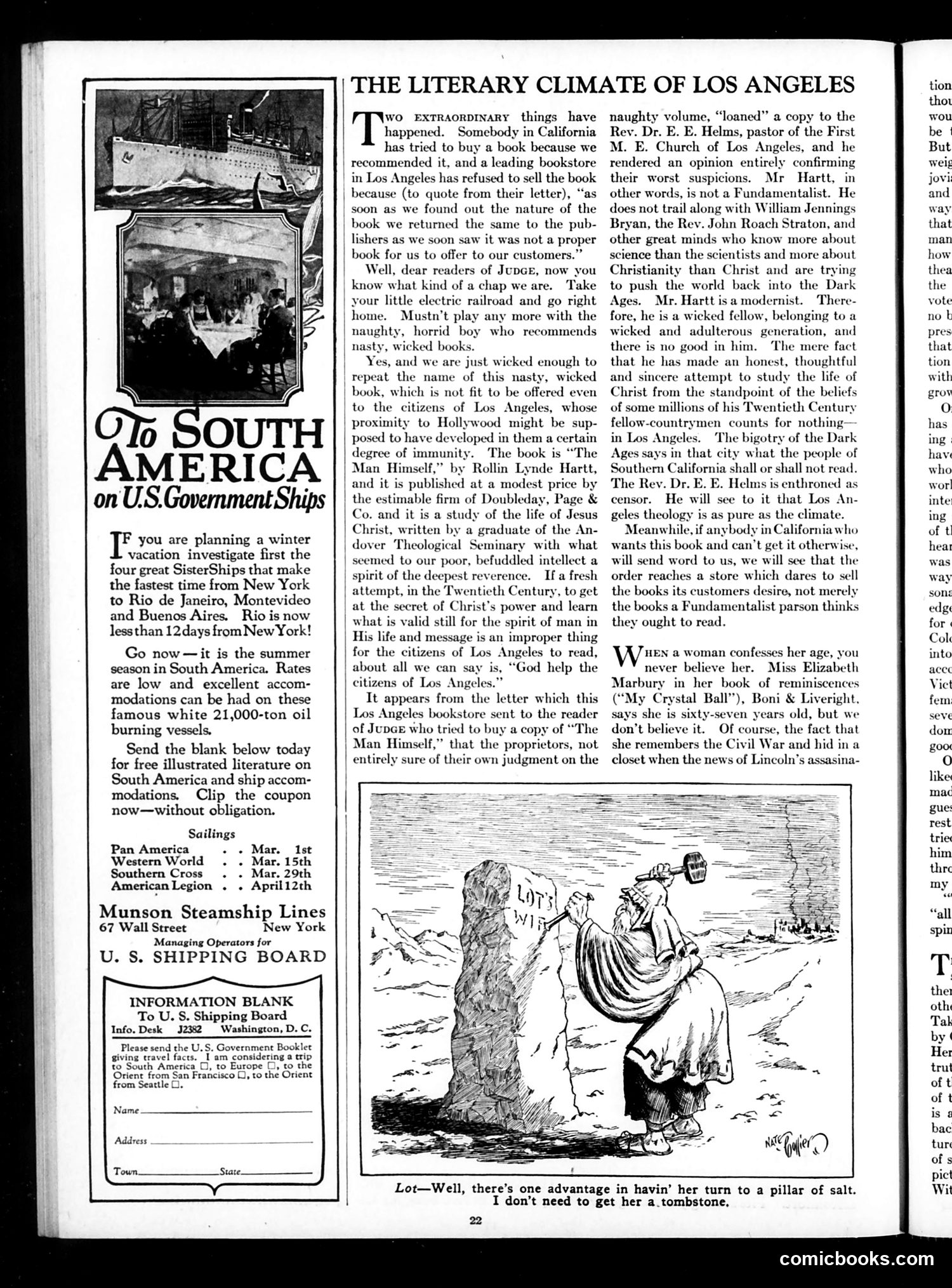
This page combines a shipping advertisement with satirical commentary on Los Angeles's religious censorship. **The main article, "The Literary Climate of Los Angeles,"** criticizes local bookstores for refusing to stock "The Man Himself" by Rollin Lynde Hartt—a moderate, scholarly examination of Christ's life. The bookstore deemed it improper for their customers, apparently because it wasn't fundamentalist enough. Judge mocks this censorship, sarcastically praising Los Angeles's "literary climate" while attacking religious extremists like William Jennings Bryan and Rev. John Roach Straton who reject modern theological scholarship. The magazine defends Hartt as a legitimate "modernist" thinker unfairly condemned by fundamentalist dogmatism. **The cartoon** at bottom shows Lot's wife turned to salt, captioned with a joke about her "advantage" in becoming a "pillar"—unrelated to the main article but consistent with Judge's typical mix of content. The piece reflects 1920s tensions between modernist and fundamentalist Christianity in American cities.
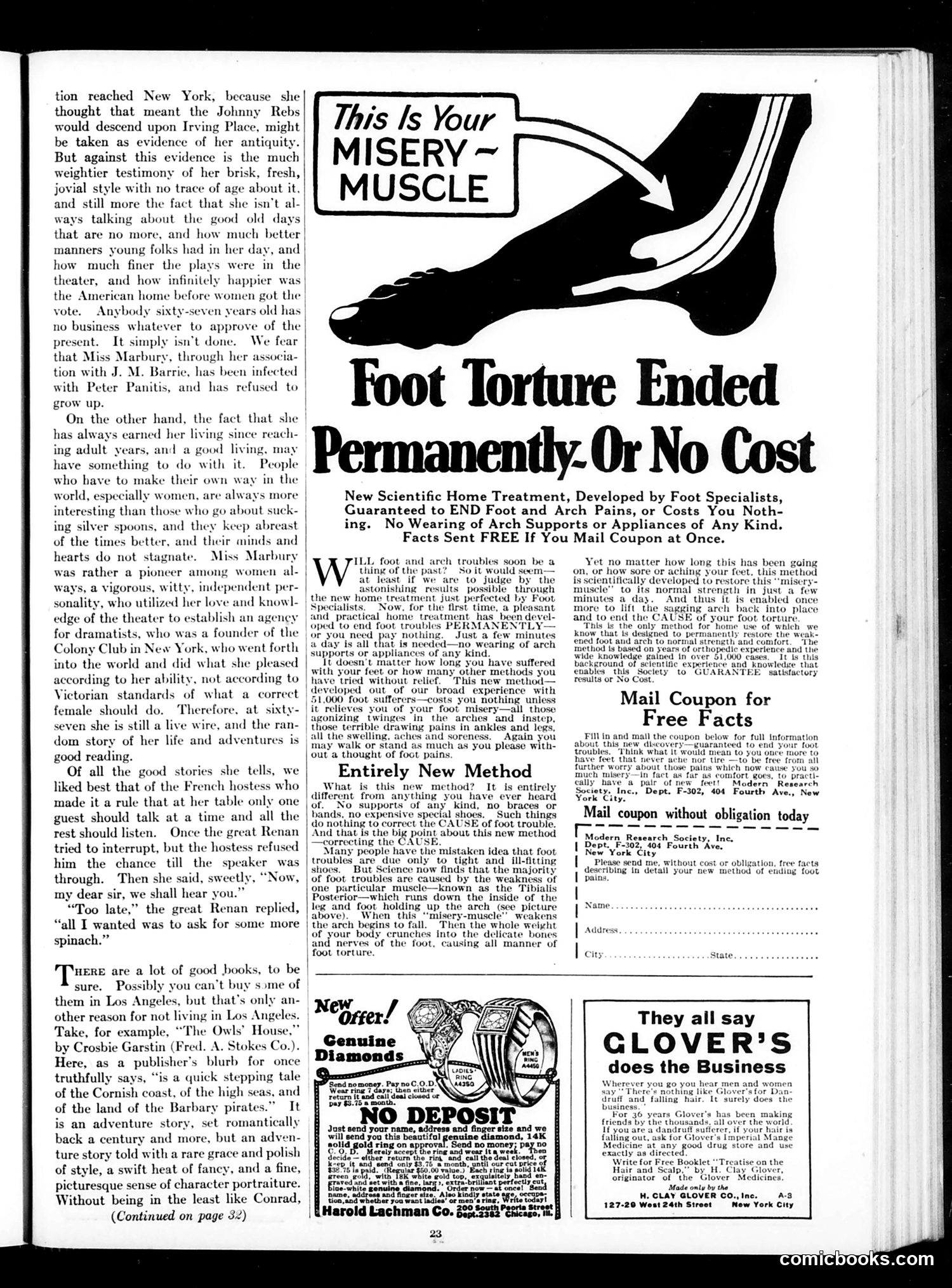
This page is primarily **advertising-driven** rather than political satire. The dominant feature is a large advertisement for a mail-order foot-pain treatment, claiming to permanently end "foot torture" through a home method developed by "foot specialists," with a money-back guarantee. The upper portion contains literary **book reviews and social commentary** about Miss Elizabeth Marbury, a theater agent and women's rights pioneer. The satire mocks how elderly women are expected to constantly lament "the good old days" and oppose modern changes like women's suffrage—yet Marbury, at sixty-seven, defies this stereotype by remaining engaged, independent, and forward-thinking. The joke is that she hasn't succumbed to predictable old-age nostalgia. Lower advertisements include a diamond ring offer and **Clover's** medicinal product testimonial. The page reflects early-20th-century advertising conventions mixing serious journalism with patent medicine-style claims presented as scientific fact—a practice now heavily regulated.
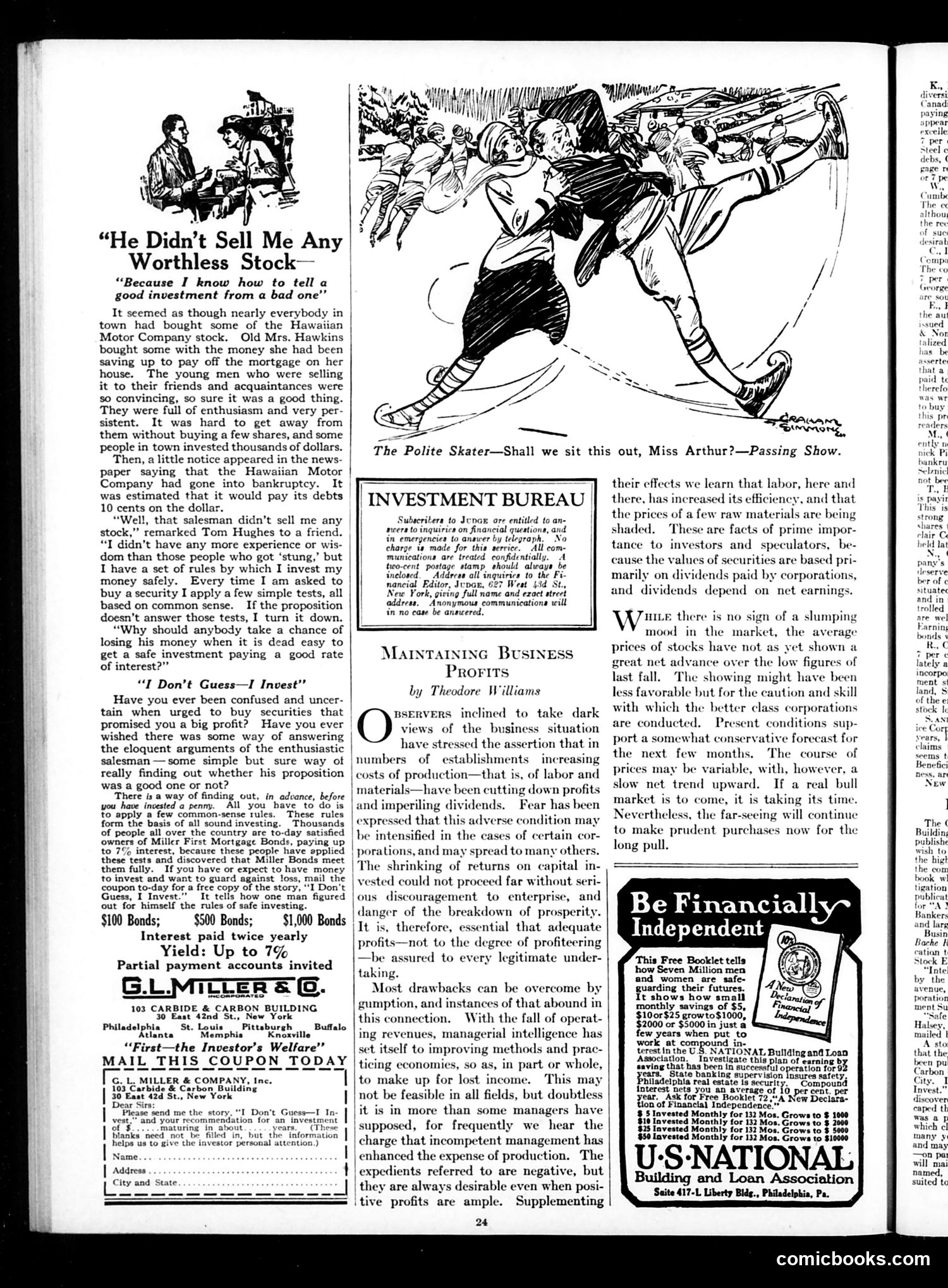
This page presents **investment fraud satire** from the early 20th century. The main cartoon "He Didn't Sell Me Any Worthless Stock" illustrates a common scam of the era: the Hawaiian Motor Company stock collapse, where aggressive salesmen convinced townspeople (including "Old Mrs. Hawkins," who mortgaged her house) to buy shares. The company went bankrupt, paying only 10 cents per dollar invested. The protagonist Tom Hughes escaped loss by applying "simple tests" to evaluate investments—satirizing how easily ordinary people were duped by enthusiastic salesmen despite lacking financial expertise. The accompanying "Investment Bureau" and financial articles address the same concern: how to distinguish legitimate securities from fraudulent ones. This reflects **Progressive Era anxieties** about corporate corruption, stock manipulation, and unprotected investors. The satire targets both naive investors and predatory salesmen exploiting public trust during an economically volatile period.
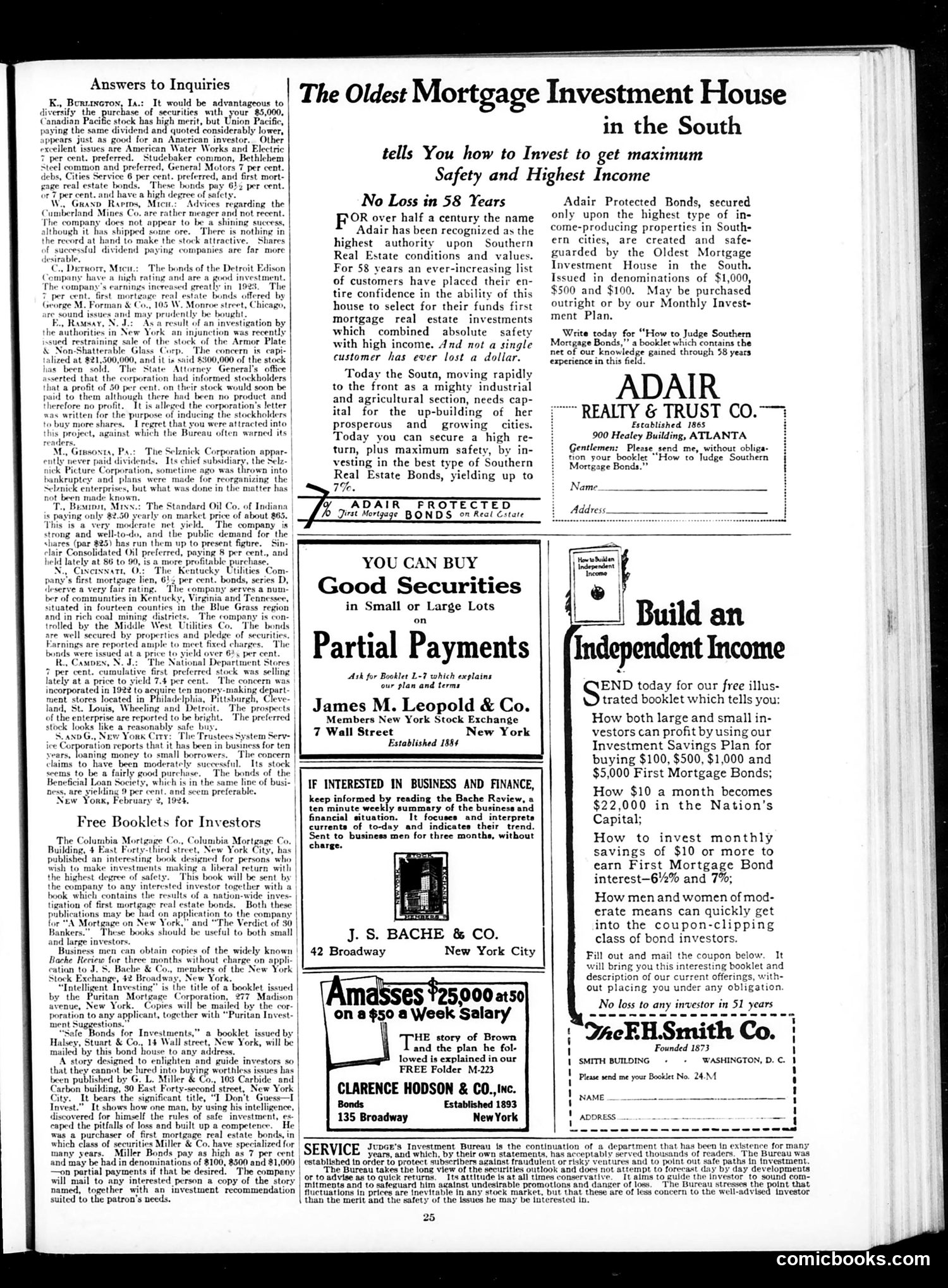
This page is primarily **financial advertising and investment advice**, not a political cartoon. It contains a "Reader Q&A" column answering investor inquiries about stock purchases and bonds, alongside multiple advertisements for investment firms. The content reflects **1920s investment culture** during the economic boom preceding the 1929 crash. Notable elements: - Stock recommendations for industrial companies (Union Pacific, General Motors, Bethlehem Steel) - Discussion of mortgage bonds and real estate investments - Warnings about questionable ventures (like the Cumberland Mines and Selznick Corporation schemes) - The Adair Realty & Trust Co. prominently advertises "No Loss in 58 Years"—a claim that would prove tragically ironic within five years **The satire, if present, is subtle**: The page reflects Judge's audience as affluent investors seeking safe returns. The repeated emphasis on "safety" and "high income" suggests mild skepticism about investment promises, typical of Judge's sophisticated humor targeting the wealthy. There are no identifiable political figures or caricatures visible.
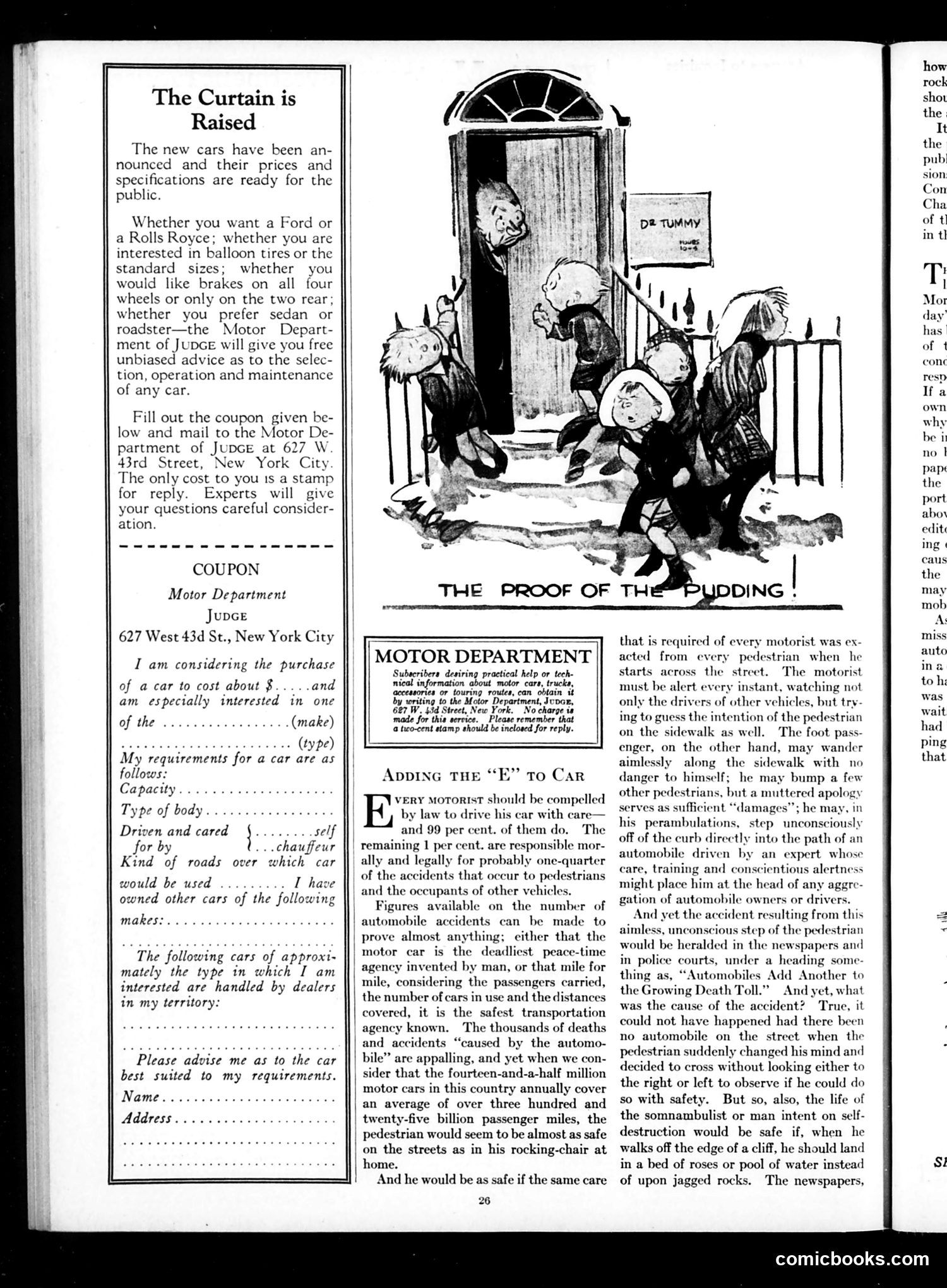
This page contains automobile-safety satire from Judge magazine, likely 1920s-era based on the references to new car models and technology. **The Main Cartoon** ("The Proof of the Pudding") depicts children gathered outside a "Dr. Tummy" office, likely satirizing the newfound dangers of automobiles to pedestrians—particularly vulnerable children—despite manufacturers' safety claims. **The Supporting Article** ("Adding the 'E' to Car") argues that pedestrians bear equal responsibility for traffic accidents as motorists. The author claims that while 99% of drivers exercise care, pedestrians carelessly wander into streets without attention. The satire critiques how newspapers sensationalize accidents as "automobile menaces" while ignoring pedestrian negligence. **Context**: This reflects early automotive-era anxieties about vehicle safety and urban pedestrian culture. Judge uses humor to challenge the narrative blaming only careless drivers, instead suggesting pedestrians' obliviousness contributes significantly to accidents. The accompanying coupon advertises Judge's "Motor Department" as a free expert advice service for car buyers.
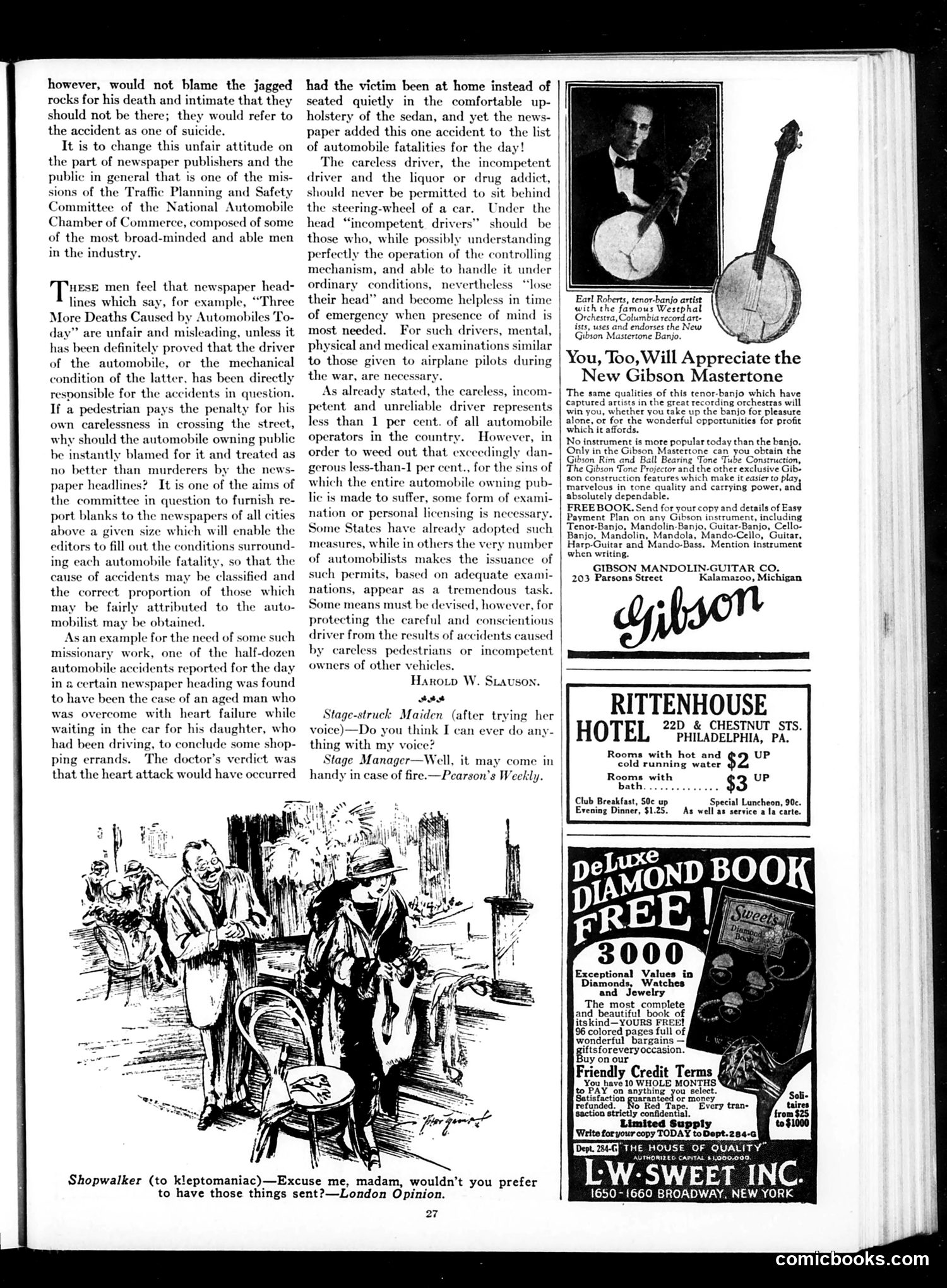
This page primarily contains **editorial advocacy** rather than political satire. The main article, attributed to Harold W. Slauson, argues that newspapers unfairly blame automobiles for all traffic deaths, when many accidents result from pedestrian carelessness or unrelated medical events (the example of a heart attack death in a parked car illustrates this). The piece advocates for **driver licensing and examination standards**—positioning this as protecting responsible drivers from blame for accidents caused by reckless pedestrians or incompetent drivers. It frames dangerous drivers as less than 1% of operators, suggesting the automobile industry's perspective that public perception, not vehicles, is the real problem. The single cartoon (bottom) is an unrelated joke about a stage-struck woman whose poor singing voice might only be useful during a fire alarm. **Context for modern readers**: This represents early automotive industry messaging defending cars against safety criticism—essentially an early form of what we'd now recognize as lobbying or PR advocacy.
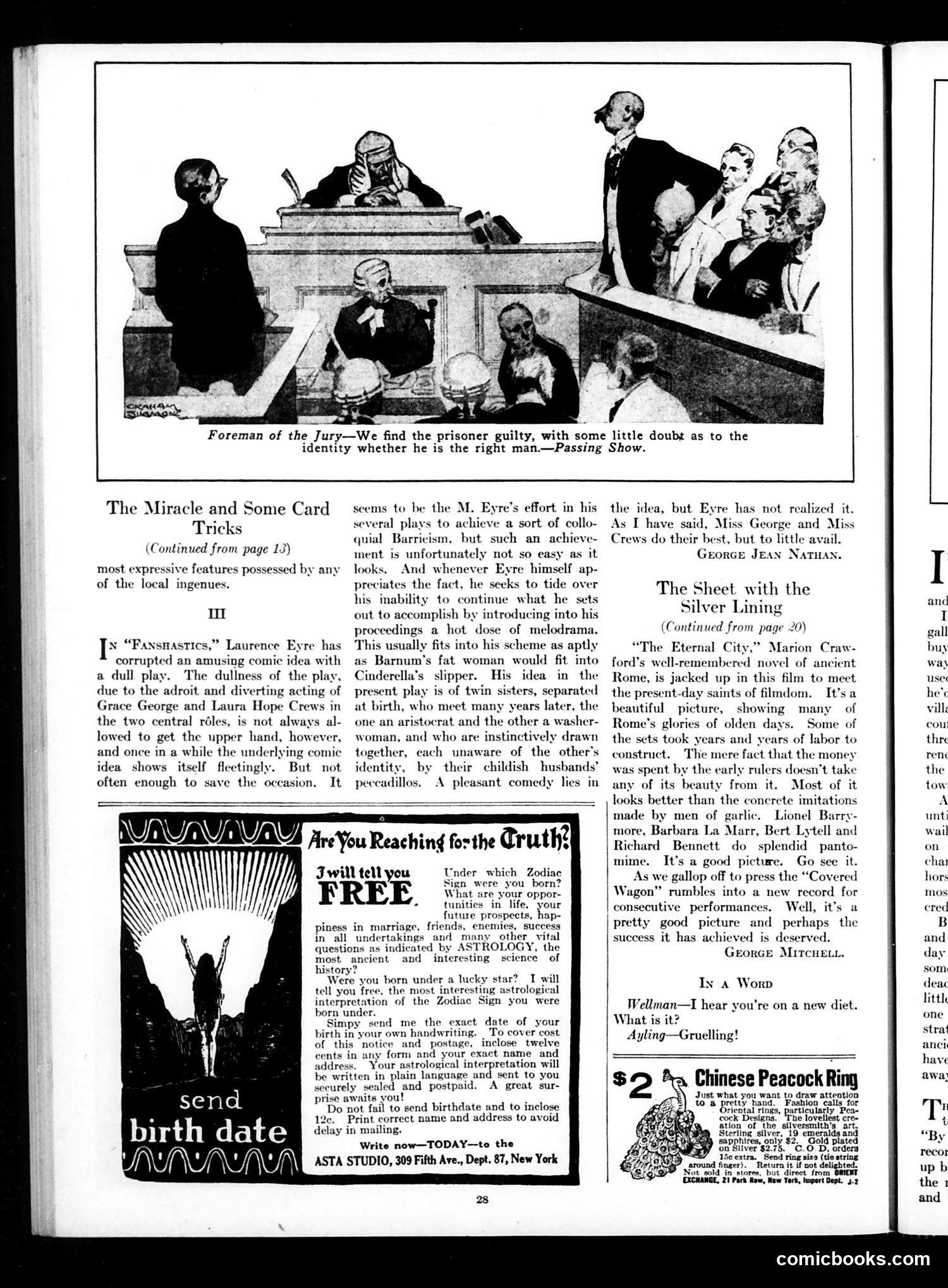
The courtroom cartoon at the top satirizes judicial incompetence. The jury foreman announces a guilty verdict while admitting uncertainty about whether they've convicted the *correct* man—mocking the carelessness of the justice system. This reflects early 20th-century concerns about wrongful convictions and jury unreliability. The page primarily contains **theater reviews** of contemporary plays: "Fanatastics" (criticizing Laurence Eyre's adaptation as dull despite good acting by Grace George and Laura Hope Crews), "The Miracle," and film reviews of "The Sheet with the Silver Lining" and "The Eternal City" (praising its sets and performances by Lionel Barrymore and Bert Lytell). Below are period **advertisements** for astrology services and a "Chinese Peacock Ring"—typical of Judge's mix of satire and commercial content. The page reflects 1920s entertainment culture and contemporary anxieties about law and justice.
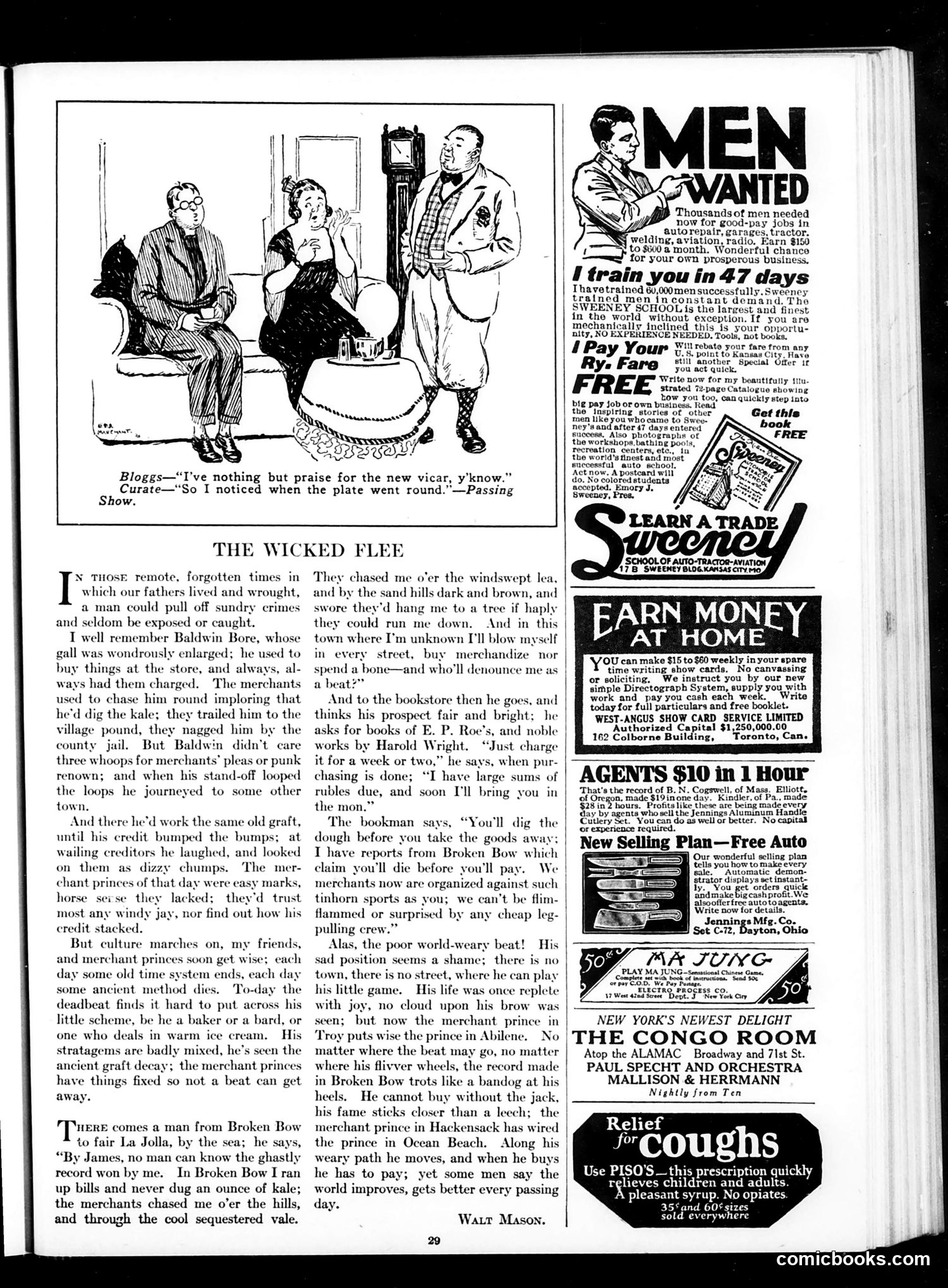
This story by Walt Mason satirizes the changing relationship between merchants and debtors in early 20th-century America. The narrative follows "Baldwin Bore," a con artist who once freely skipped town after running up unpaid bills—merchants could only chase him so far before he'd relocate and restart his scheme elsewhere. The joke's premise: modern commerce has made this grift impossible. The story argues that merchant networks now share credit information ("merchants now are organized against such tinhorn sports"), making it impossible for deadbeats to hide or repeat scams in new towns. A man from Broken Bow tries this old trick in a new city but discovers the bookstore clerk already knows his bad credit history. The satire's point: progress and organization have eliminated the old freelance swindler's advantage. Modern interconnected business practices have made deception harder. Mason presents this ambivalently—sympathizing with the "poor world-weary beat" while acknowledging merchants' reasonable self-protection through information-sharing.
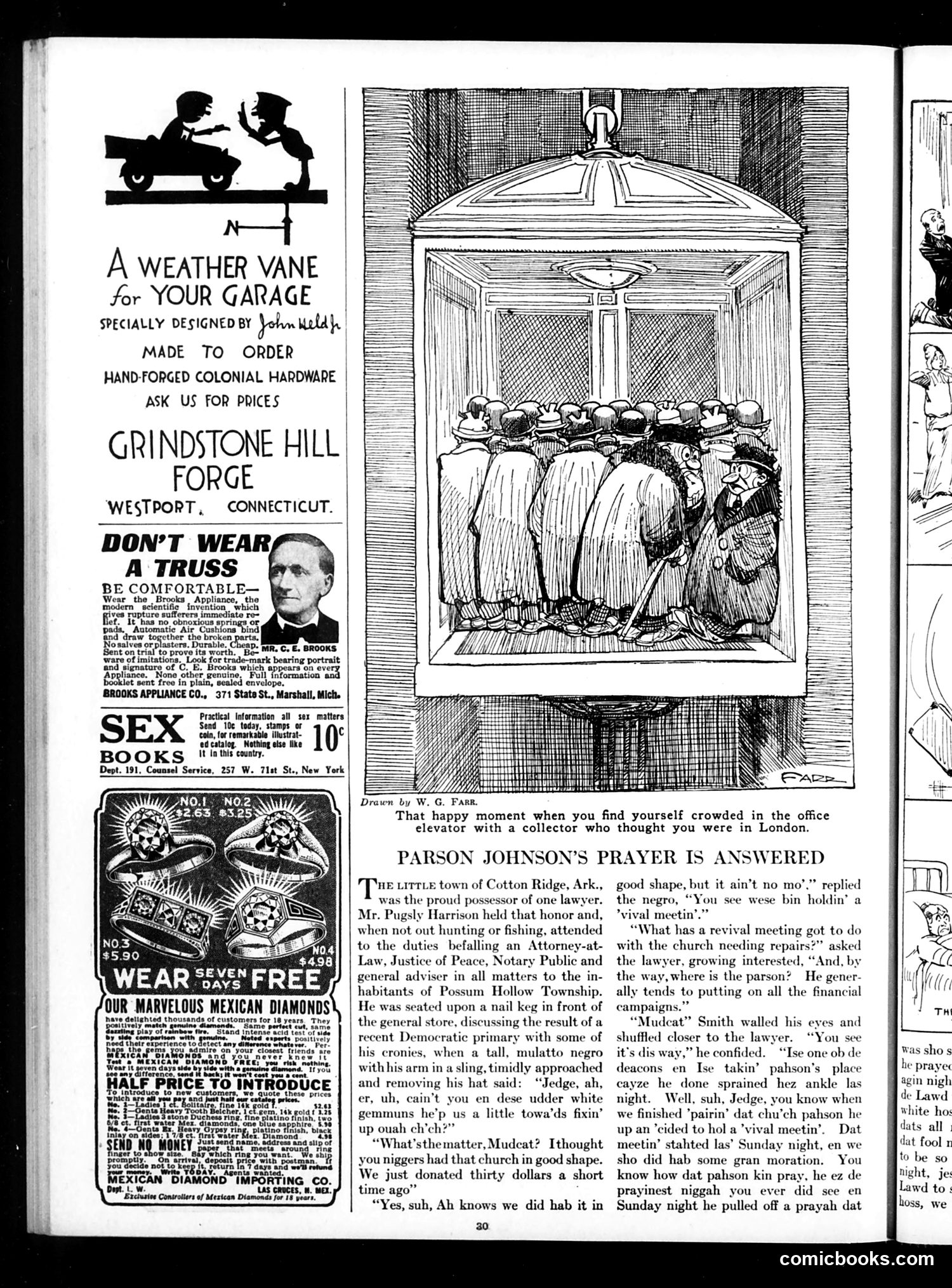
This page is primarily **advertising**, with one cartoon and a humorous short story titled "Parson Johnson's Prayer Is Answered." The cartoon (top right, by W.G. Farr) depicts a social awkwardness: meeting someone in an elevator who you'd claimed to be in London to avoid—a light satire on social pretense and the embarrassment of being caught in a lie. The story uses **racist dialect and minstrelsy conventions** common to early 20th-century American humor. It concerns a Black church in Arkansas that sustained damage during revival meetings—apparently the fervent prayer was so powerful it literally damaged the building. The humor relies on racial stereotypes: exaggerated dialect, the "simple Negro" character, and the idea that Black religiosity is comically excessive. The piece reflects period attitudes where such content was considered acceptable entertainment in mainstream publications. The advertisements below (trusses, sex books, Mexican diamonds) are typical Judge fare—mixing legitimate products with dubious mail-order schemes. **For modern readers**: This represents now-offensive racial humor that was normalized in early 20th-century American satire magazines.
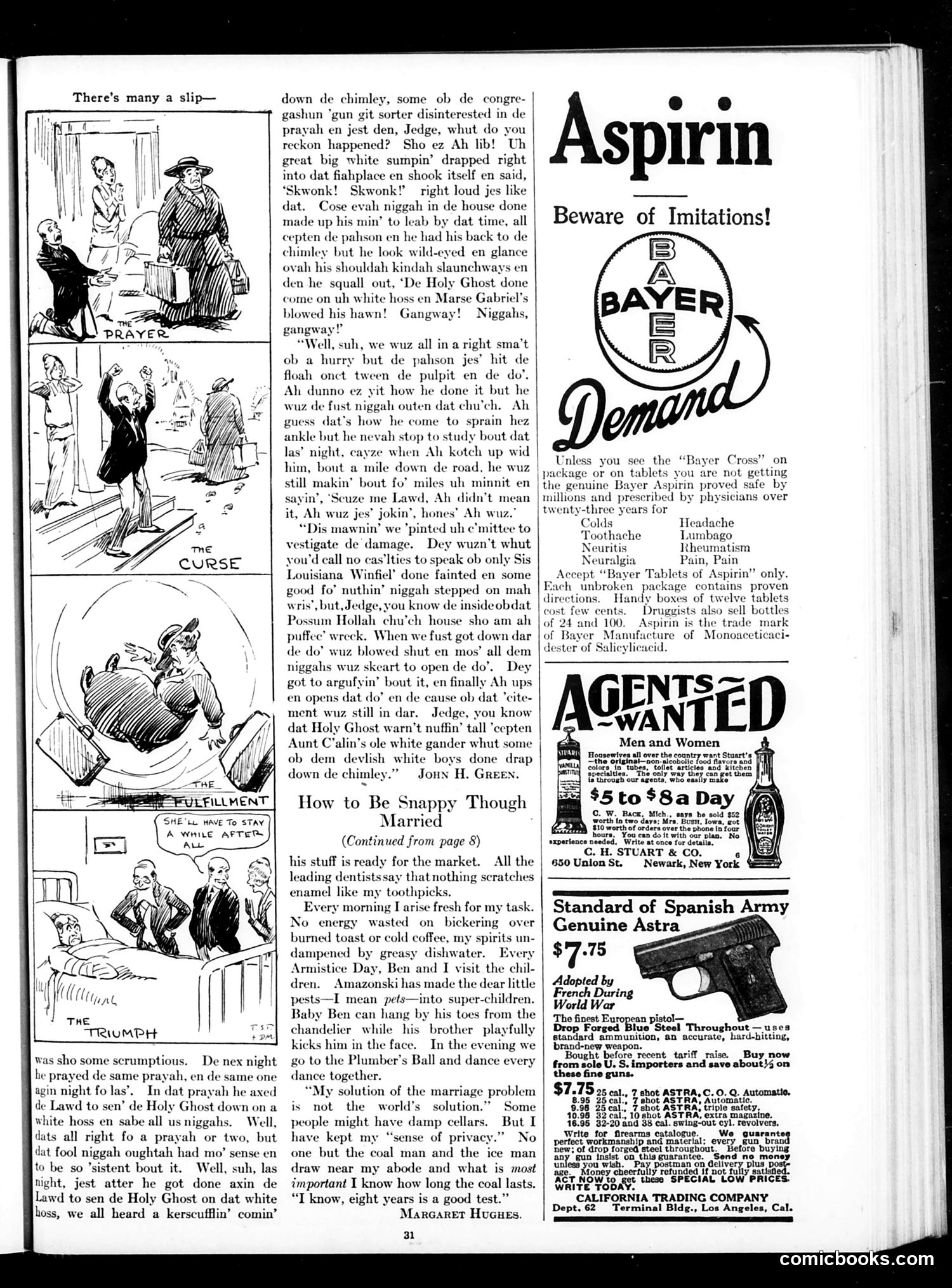
This page contains three distinct elements: **Main Comic Strip ("There's many a slip")**: A dialect humor story using racist caricature. An African American preacher prays for the Holy Ghost to arrive on a white horse; when congregants hear noise in the chimney, they panic—it's actually a white goose dropped by "devlish white boys" as a prank. The humor relies on minstrel-style stereotypes and exaggerated Black dialect. **Marriage Advice Column**: Margaret Hughes offers tips for maintaining marital happiness through organization and emotional distance—she avoids domestic disputes by minimizing interaction. **Advertisements**: Bayer Aspirin dominates, warning against imitations and promoting the "Bayer Cross" trademark. Below is a recruitment ad for salesmen and a Spanish Army pistol advertisement. The content reflects 1920s-era attitudes: casual racism in entertainment, gender dynamics in marriage advice, and aggressive patent/trademark protection in pharmaceutical advertising. Modern readers would find the racial caricature deeply offensive.
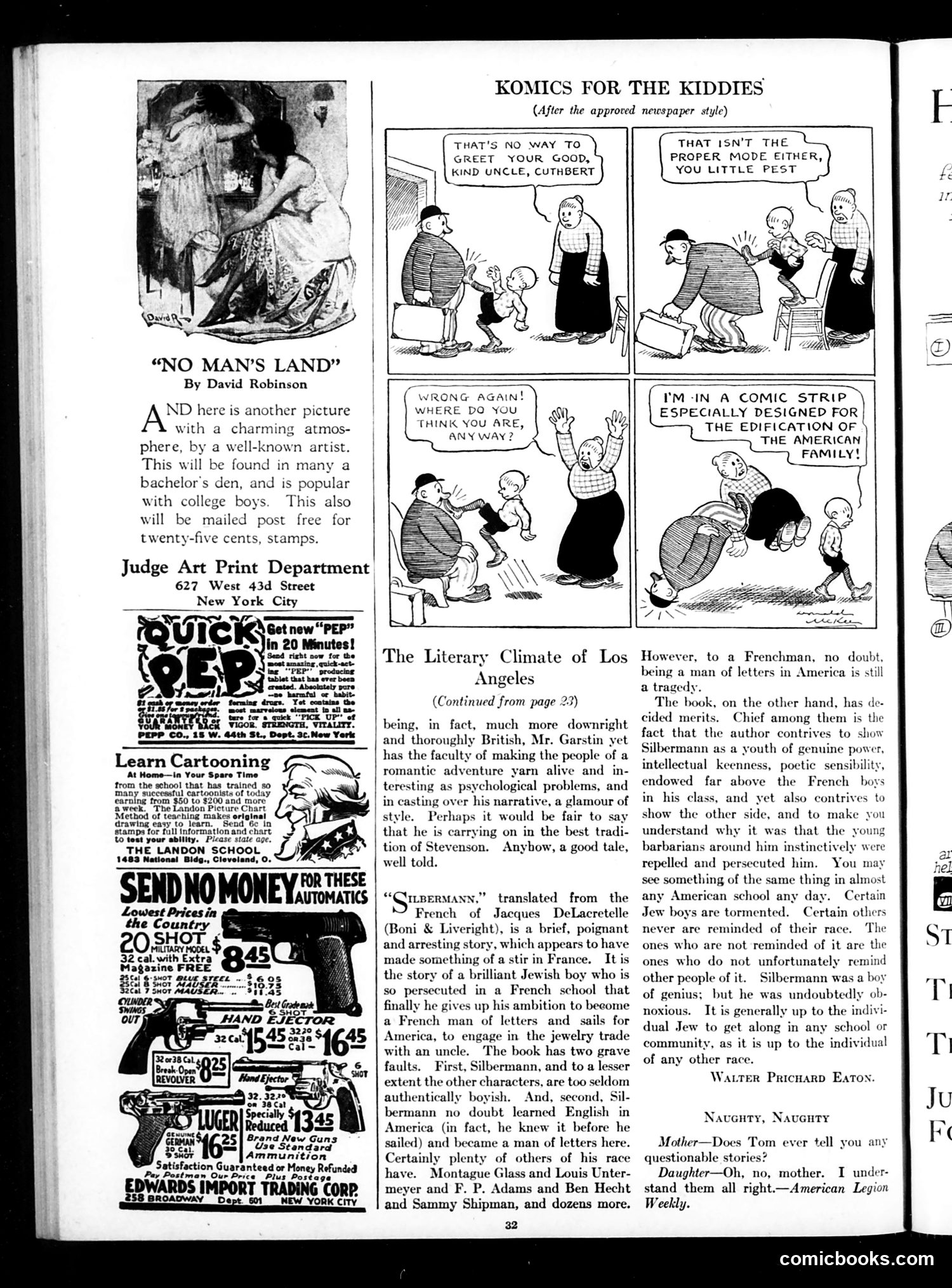
This page mocks the sentimentality and moralizing tone of children's comics in newspapers. The strip, credited to David Robinson, parodies sanctimonious family entertainment by showing a child repeatedly greeting his Uncle Cuthbert *incorrectly*—first too casually, then too aggressively—while an adult corrects each attempt with exaggerated propriety. The humor lies in the absurdity: the child's final panel declares he's in a comic strip "especially designed for the edification of the American family"—a meta-joke exposing how these wholesome strips claimed educational value while actually being preachy and rigid about social conduct. The advertisement for "No Man's Land" above reinforces this: it's marketed as appealing to "bachelor's dens" and "college boys," suggesting the magazine's actual audience was adult men, not families, making the mock-earnest children's content all the more ridiculous.
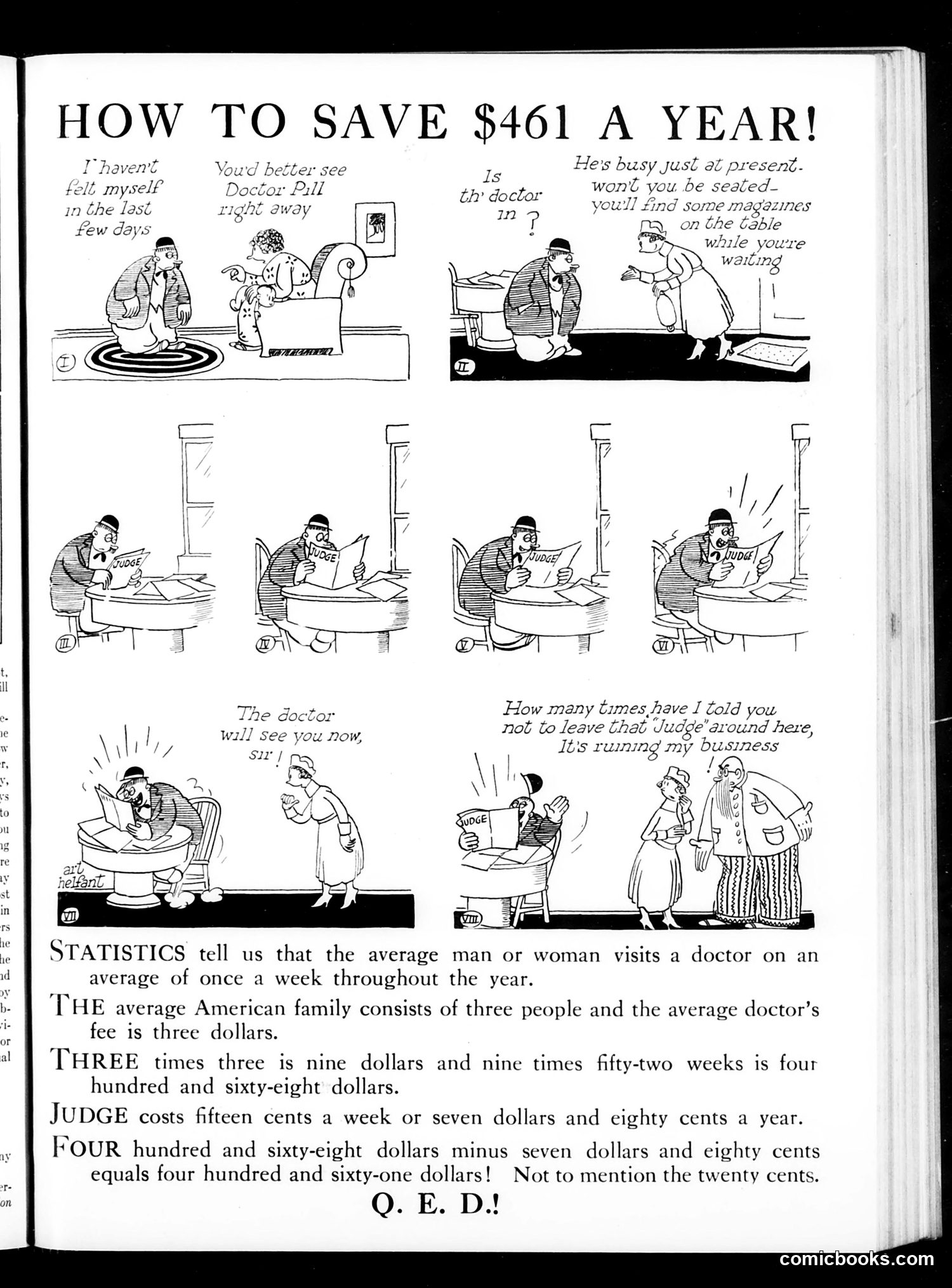
This is a humorous editorial cartoon from *Judge* magazine satirizing American healthcare costs. The comic strip shows a sick man visiting a doctor repeatedly, while the text below presents a mathematical "proof" that subscribing to *Judge* magazine saves money. The satire works on two levels: First, it mocks the frequency of doctor visits (once weekly) as excessive and expensive. Second, it's self-promotional advertising disguised as social commentary—*Judge* argues that reading their magazine costs only $7.80 yearly versus $468 in annual doctor bills, thus "saving" $461 by keeping readers entertained at home rather than visiting physicians. The final panel shows a doctor annoyed that *Judge* magazine is in his waiting room, "ruining my business" by keeping patients healthy through laughter instead of medical intervention. This is typical of early-20th-century magazine humor: satirizing contemporary issues while promoting the publication itself.
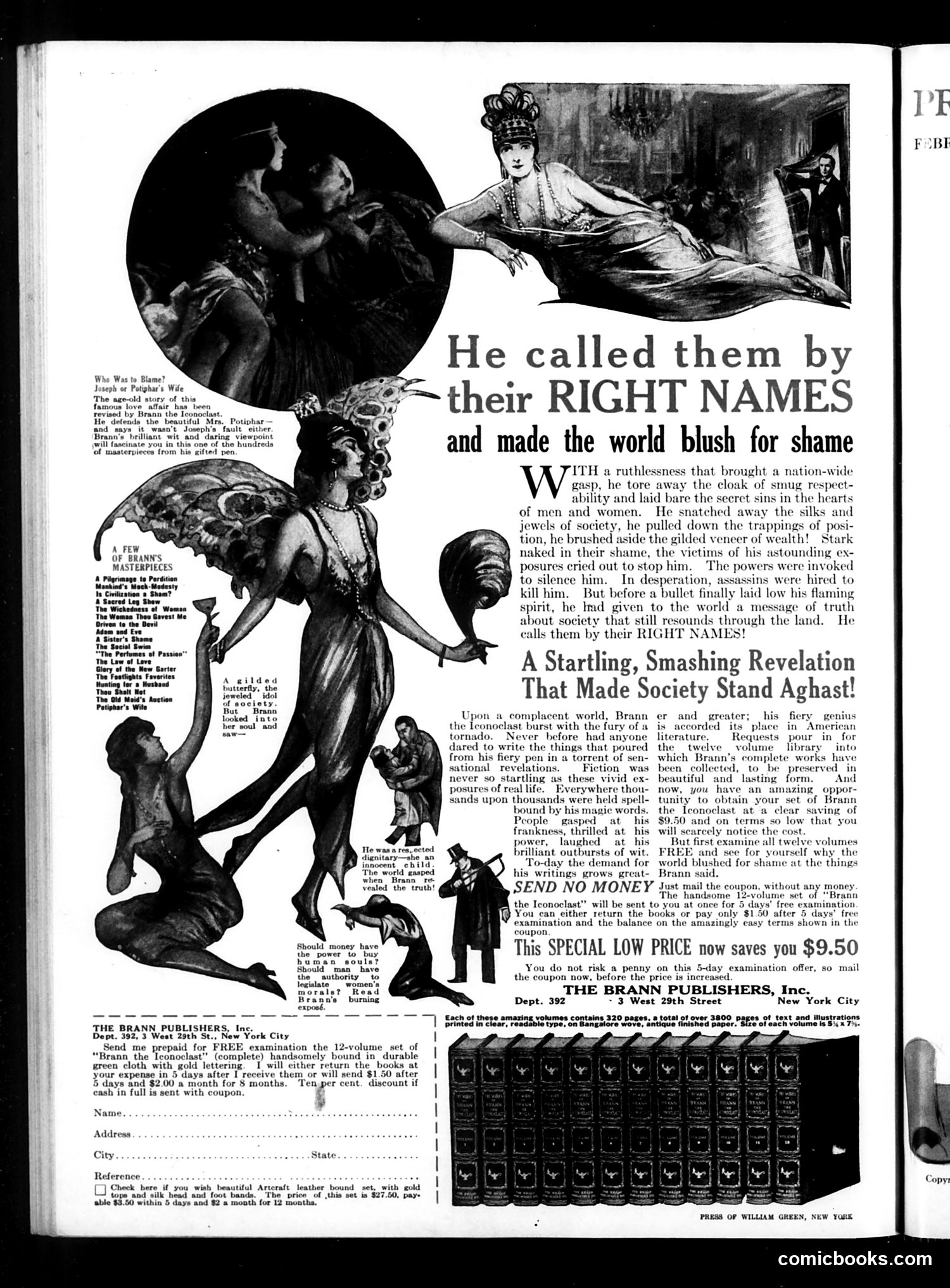
This page is primarily **advertising** for a 12-volume collection of writings by "Brann the Iconoclast"—a real figure (Brann was a late 19th-century polemicist known for scathing social criticism). The ads use dramatic language claiming Brann "called them by their RIGHT NAMES" and exposed society's hypocrisy, "making the world blush for shame." The accompanying illustrations show classical/allegorical figures and scenes of wealth and scandal to suggest Brann fearlessly revealed the corruption of the powerful and privileged. The satirical framing is the advertisement itself: it promises Brann's work as transgressive truth-telling, yet packages and sells it as an aspirational luxury product ($9.50 in installments). This is ironic—Brann supposedly attacked materialism and pretense, yet his books are marketed as a status symbol to desire. The left sidebar references biblical and classical tales (Joseph and Potiphar's Wife) as examples of Brann's moralizing topics.