
Judge, 1924-02-09 · page 34 of 36
Judge — February 9, 1924 — page 34: what you’re looking at
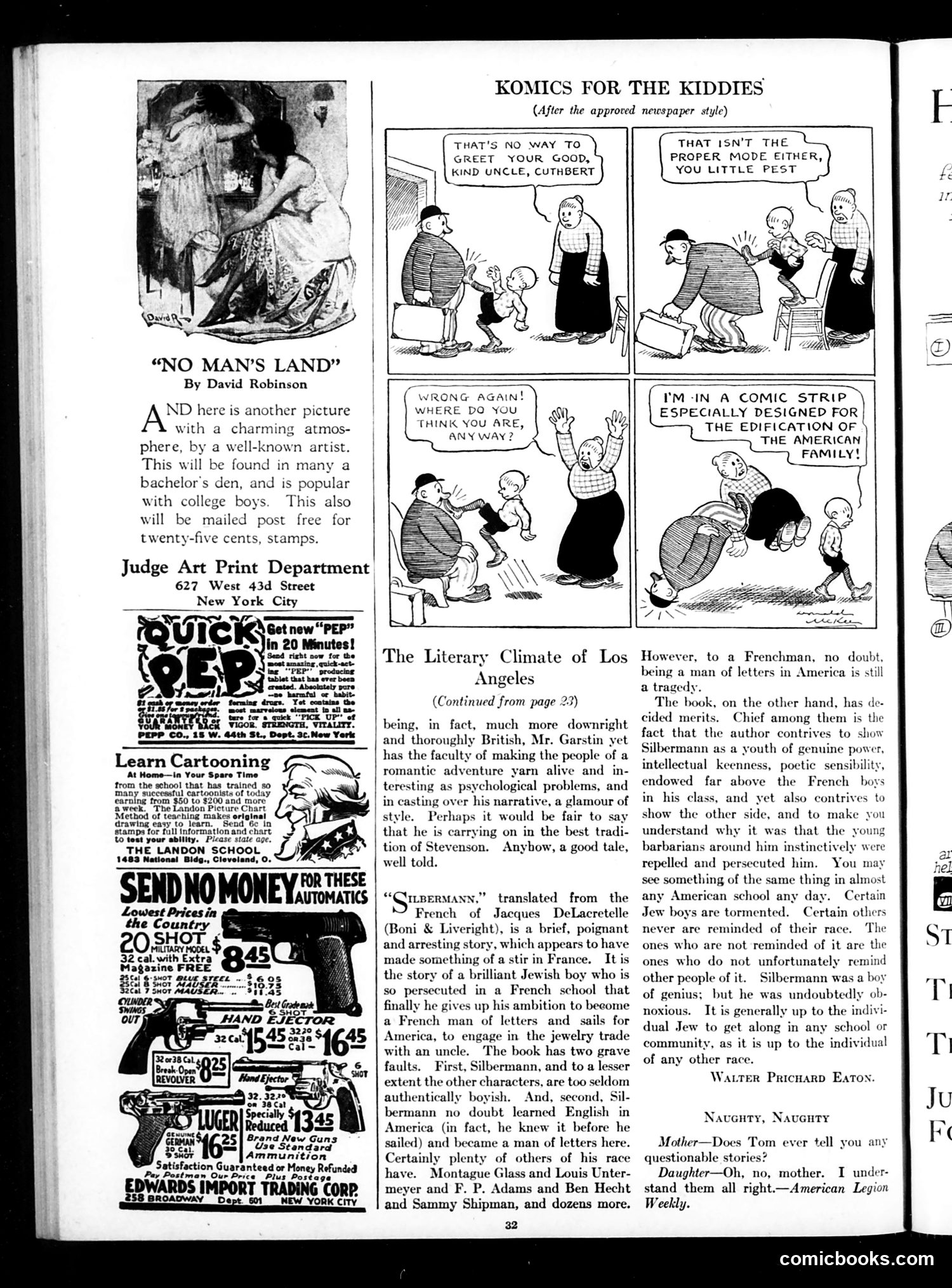
What you’re looking at
This page mocks the sentimentality and moralizing tone of children's comics in newspapers. The strip, credited to David Robinson, parodies sanctimonious family entertainment by showing a child repeatedly greeting his Uncle Cuthbert *incorrectly*—first too casually, then too aggressively—while an adult corrects each attempt with exaggerated propriety. The humor lies in the absurdity: the child's final panel declares he's in a comic strip "especially designed for the edification of the American family"—a meta-joke exposing how these wholesome strips claimed educational value while actually being preachy and rigid about social conduct. The advertisement for "No Man's Land" above reinforces this: it's marketed as appealing to "bachelor's dens" and "college boys," suggesting the magazine's actual audience was adult men, not families, making the mock-earnest children's content all the more ridiculous.
📄 Transcribed text from this page (OCR, searchable)
Machine-transcribed from the original scan — historical spelling and the odd misread are preserved.
“NO MAN’S LAND” By David Robinson ND here is another picture with a charming atmos- phere, by a well-known artist. This will be found in many a bachelor's den, and is popular with college boys. This also will be mailed post free for twenty-five cents, stamps. Judge Art Print Department 627 West 43d Street "New York City Learn Cartooning ‘At Home-—in Your Spare Time from the school that has trained so Many successful cartoonists of today earning from $50 to $200 and more Siweeky ‘The Landon Plecare Chart Method of tearing makes drawing eney to learn. Ben samoe. for full information and c! chart Moet your ability. Please slate ape THE LANDON SCHOOL 1 the rbatiretes SHC OT oT § 32 cal wath Extra i FREE oF Reduced LIS wy Brand New Gun. fies 162 Use Standard: Pde Ammunition Satisfacti Per RDS IMPORT Ti ra? "eee | style. KOMICS FOR THE KIDDIES (After the approved newspaper style) THAT'S NO WAY TO GREET YOUR GOOD, KIND UNCLE, CUTHBERT THAT ISN'T THE PROPER MODE EITHER, YOU LITTLE PEST WRONG AGAIN! WHERE DO YOU THINK YOU ARE, The Literary Climate of Los Angeles (Continued from page 23) being, in fact, much more downright and thoroughly British, Mr. Garstin yet has the faculty of making the people of a romantic adventure yarn alive and in- teresting as psychological problems, and in casting over his narrative, a glamour of Perhaps it would be fair to say that he is carrying on in the best tradi- tion of Stevenson. Anybow, a good tale, well told. ILBERMANN,” translated from the French of Jacques DeLacretelle (Boni & Liveright), is a brief, poignant and arresting story, which appears to have made something of a stir in France. It is the story of a brilliant Jewish boy who is so persecuted in a French school that finally he gives up his ambition to become a French man of letters and sails for America, to engage in the jewelry trade with an uncle. The book has two grave faults. First, Silbermann, and to a lesser extent the other characters, are too seldom authentically boyish. And, second, Sil- bermann no doubt learned English in America (in fact, he knew it before he sailed) and became a man of letters here. Certainly plenty of others of his race have. Montague Glass and Louis Unter- meyer and F. P. Adams and Ben Hecht and Sammy Shipman, and dozens more. 32 I'M-IN A COMIC STRIP ESPECIALLY DESIGNED FOR | THE EDIFICATION OF THE AMERICAN FAMILY! However, to a Frenchman, no doubt, being a man of letters in America is still a tragedy. The book, on the other hand, has de- cided merits. Chief among them is the fact that the author contrives to show Silbermann as a youth of genuine power, intellectual keenness, poetic sensibility, endowed far above the French in his class, and yet also contrives to show the other side, and to make understand why it was that the young barbarians around him instinctively were repelled and persecuted him. You may see something of the same thing in almost any American school any day. Certain Jew boys are tormented. Certain others never are reminded of their race. The ones who are not reminded of it are the ones who do not unfortunately remind other people of it. Silbermann was a boy of genius; but he was undoubtedly ob- noxious. you It is generally up to the indivi- dual Jew to get along in any school or community, as it is up to the individual of any other race. Watter Pricnarp Eaton. Navucuty, NauGuty Mother—Docs Tom ever tell you any questionable stories? Daughter—Oh, no, mother. I under- stand them all right.—American Legion Weekly. comicbooks.com