
Judge, 1924-02-09 · page 15 of 36
Judge — February 9, 1924 — page 15: what you’re looking at
What you’re looking at
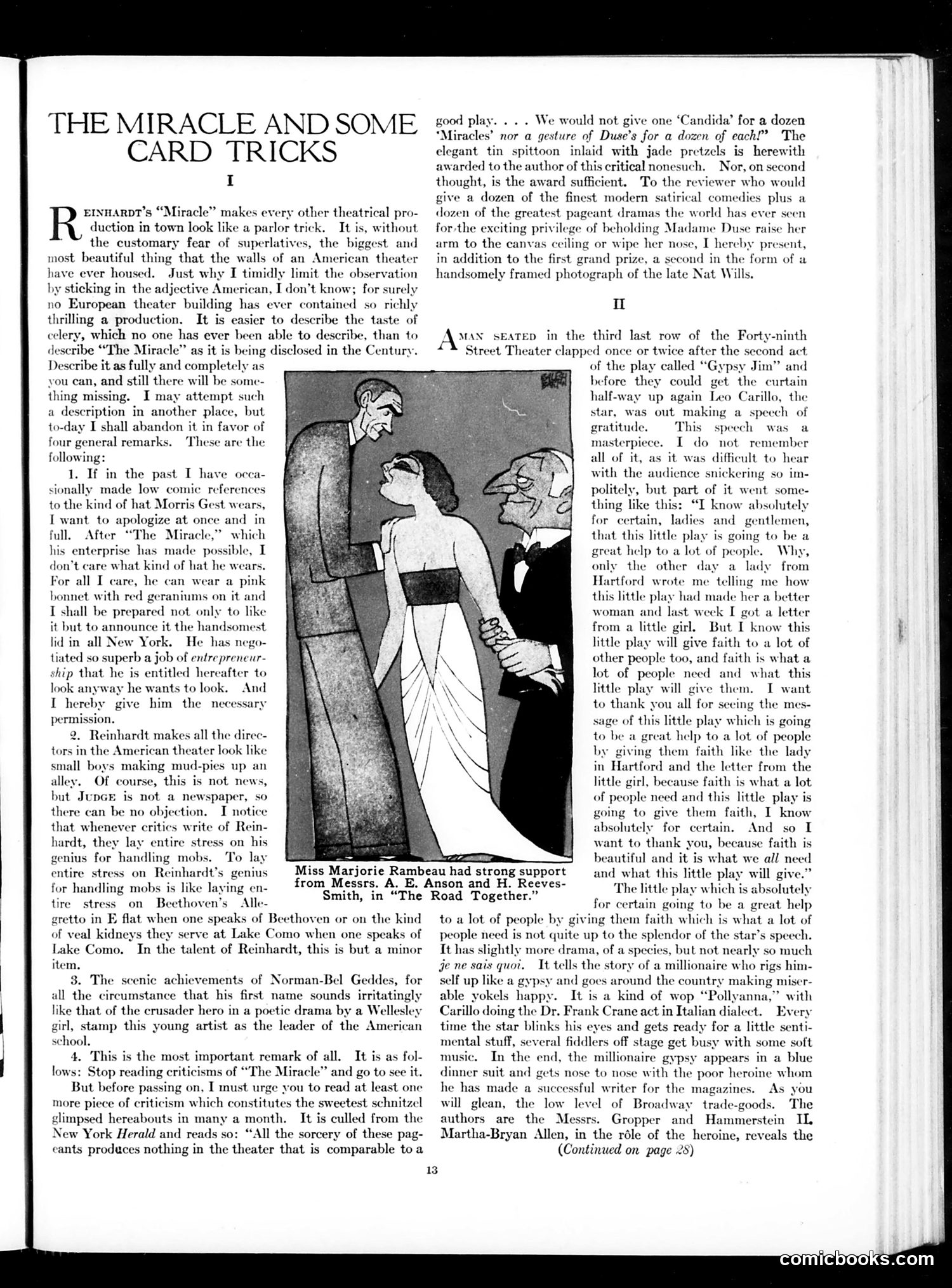
This page reviews "The Miracle," a 1912 theatrical production staged by impresario Morris Gest and directed by Max Reinhardt. The critic praises it as revolutionary American theater. The cartoon shows **Miss Marjorie Rambeau** in classical costume, illustrating the production's grandiose staging style. The text credits her support from actors A.E. Anson and H. Reeves-Smith in "The Road Together." The satire targets theatrical pretension through a mock-serious defense of Reinhardt and Gest against the critic's own previous snark. The author sarcastically awards an "elegant tin spittoon inlaid with jade pretzels" to a New York Herald reviewer who dismissed spectacle compared to dramatic substance—essentially mocking critics who privilege intellectual theater over visual spectacle. The reference to actress Eleonora Duse (noted for subtle acting) versus pageantry reinforces this aesthetic debate common to early 20th-century theater criticism.
📄 Transcribed text from this page (OCR, searchable)
Machine-transcribed from the original scan — historical spelling and the odd misread are preserved.
THE MIRACLE AND SOME CARD TRICKS duction in town look like a parlor tri It is, without the customary fear of superlatives, the biggest and most beautiful thing that the walls of an American theater have ever housed. Just why I timidly limit the observation hy sticking in the adjective American, I don’t know; no European theater building has ever contained so richly thrilling a production. It is easier to describe the taste of celery, which no one has ever been able to describe, than to scribe “The Miracle” as it is being disclosed in the Century. Describe it as fully and completel; you can, and still there will be some- thing missing. I may attempt such a description in another place, but to-day I shall abandon it in favor of four general remarks. These are the following: 1. If in the past I have oc sionally made low comic references to the kind of hat Morris Gest w I want to apologize at once and in full. After “The Miracle,” which his enterprise has made possible, don’t care what kind of hat he wears. For all I care, he can wear a pink bonnet with red geraniums on it and I shall be prepared not only to like it but to announce it the handsomest lid in all New York. He has nego- tiated so superb a job of entrepreneur- ship that he is entitled hereafter to look anyw 1e wants to look. And I hereby give him the necessary permission. 2. Reinhardt makes all the direc- tors in the American theater look like small boys making mud-pies up an alley. Of course, this is not news, but JupGe is not a newspaper, so there can be no objection. I notice that whenever critics write of Rein- hardt, they lay entire stress on his genius for handling mobs. To lay entire stress on Reinhardt’s genius for handling mobs is like laying en- from Meets A, tire stress on Beethoven's Alle- * gretto in E flat when one speaks of Beethoven or on the kind of veal kidneys they serve at Lake Como when one speaks of Lake Como. In the talent of Reinhardt, this is but a minor item, 3. The scenic achievements of Norman-Bel Geddes, for all the circumstance that his first name sounds inritatingly like that of the crusader hero in a poetic drama by a Welle: girl, stamp this young artist as the leader of the American school. 4. This is the most important remark of all. It is as fol- lows: Stop reading criticisms of “The Miracle” and go to see it. But before passing on, I must urge you to read at least one more piece of criticism which constitutes the sweetest schnitzel glimpsed hereabouts in many a month. It is culled from the New York Herald and reads so: “All the sorcery of these pag- eants produces nothing in the theater that is comparable toa Recta is “Miracle” makes every other theatrical pro- for surely Ars, Miss Marjorie Rambeau had strong support E. Anson and H. Reeves- in “The Road Together.” good play. . . . We would not give one ‘Candida’ for a dozen “Miracles” nor a gesture of Duse’s for a dozen of each!” The elegant tin spittoon inlaid with jade pretzels is herewith awarded to the author of this critical nonesuch. Nor, on second thought, is the award sufficient. To the reviewer who would give a dozen of the finest modern satirical comedies plus a dozen of the greatest pageant dramas the world has ever seen for the exciting privilege of beholding Madame Duse raise her arm to the canvas ceiling or wipe her nose, I hereby present, in addition to the first grand prize, a second in the form of a handsomely framed photograph of the late Nat Wills. Il MAN SEATED in the third last row of the Forty-ninth Street Theater clapped once or twice after the second act of the play called “Gypsy Jim” and before they could get the curtain half-way up again Leo Carillo, the star, was out making a speech of gratitude. ‘This speech masterpiece. I do not remember all of it, as it was difficult to hear with the audience snickering so im- politely, but part of it went some- thing like this: “I know absolutely for certain, ladies and gentlemen, that this little play is going to be a great help to a lot of people. Why, only the other day a lady from Hartford wrote me telling me how this little play had made her a better woman and last week I got a letter from a little girl But I know this little play will give faith to a lot of other people too, and faith is what a lot of people need and what this little pl will give them. I want to thank you all for seeing the me: sage of this little play which is going to be a great help to a lot of people by giving them faith like the lady in Hartford and the letter from the little girl, because faith is what a lot of people need and this little play is going to give them faith, I know absolutely for certain, And so I want to thank you, because faith is beautiful and it is what we all need and what this little play will give.” The little play which is absolutely for certain going to be a great help to a lot of people by giving them faith which is what a lot of people need is not quite up to the splendor of the star’s speech. It has slightly more drama, of a species, but not nearly so much je ne sais quoi. It tells the story of a millionaire who rigs him- self up like a gypsy and goes around the country making miser- able yokels happy. It is a kind of wop “Pollyanna,” with Carillo doing the Dr. Frank Crane act in Italian dialect. ry time the star blinks his eyes and gets ready for a little senti- mental stuff, several fiddlers off stage get busy with some soft music. In the end, the millionaire gypsy appears in a blue dinner suit and gets nose to nose with the poor heroine whom he has made a successful writer for the magazines. As you will glean, the low level of Broadway trade-goods. The authors are the Messrs. Gropper and Hammerstein IL Martha-Bryan Allen, in the réle of the heroine, reveals the (Continued on page 28) was a