
A complete issue · 24 pages · 1912
Judge — November 9, 1912
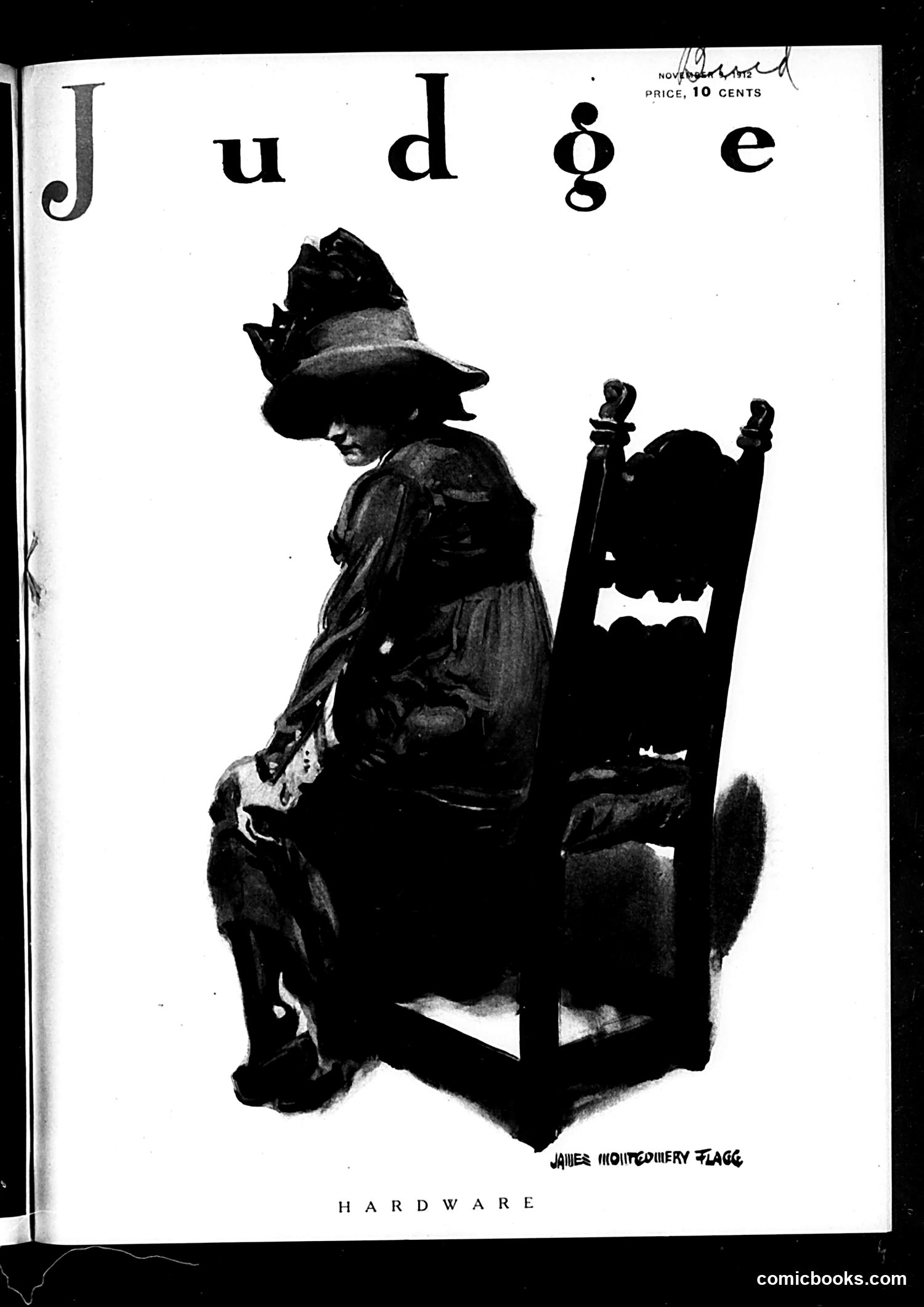
This page from *Judge* magazine features an illustration by James Montgomery Flagg titled "Hardware." The image shows a woman seated in a wooden chair, wearing early 20th-century clothing including a decorative hat with feathers. She holds what appears to be a rifle or long gun. The satire likely plays on the double meaning of "hardware"—both literal tools/guns and the slang term for a woman's physical attributes or "装饰" (adornments). The woman's fashionable dress and posture, combined with the incongruity of holding a weapon, creates the humorous commentary typical of *Judge's* social satire. The exact political or social context remains unclear without additional publication details, but the cartoonist appears to be commenting on gender roles or women's evolving social position in this era.
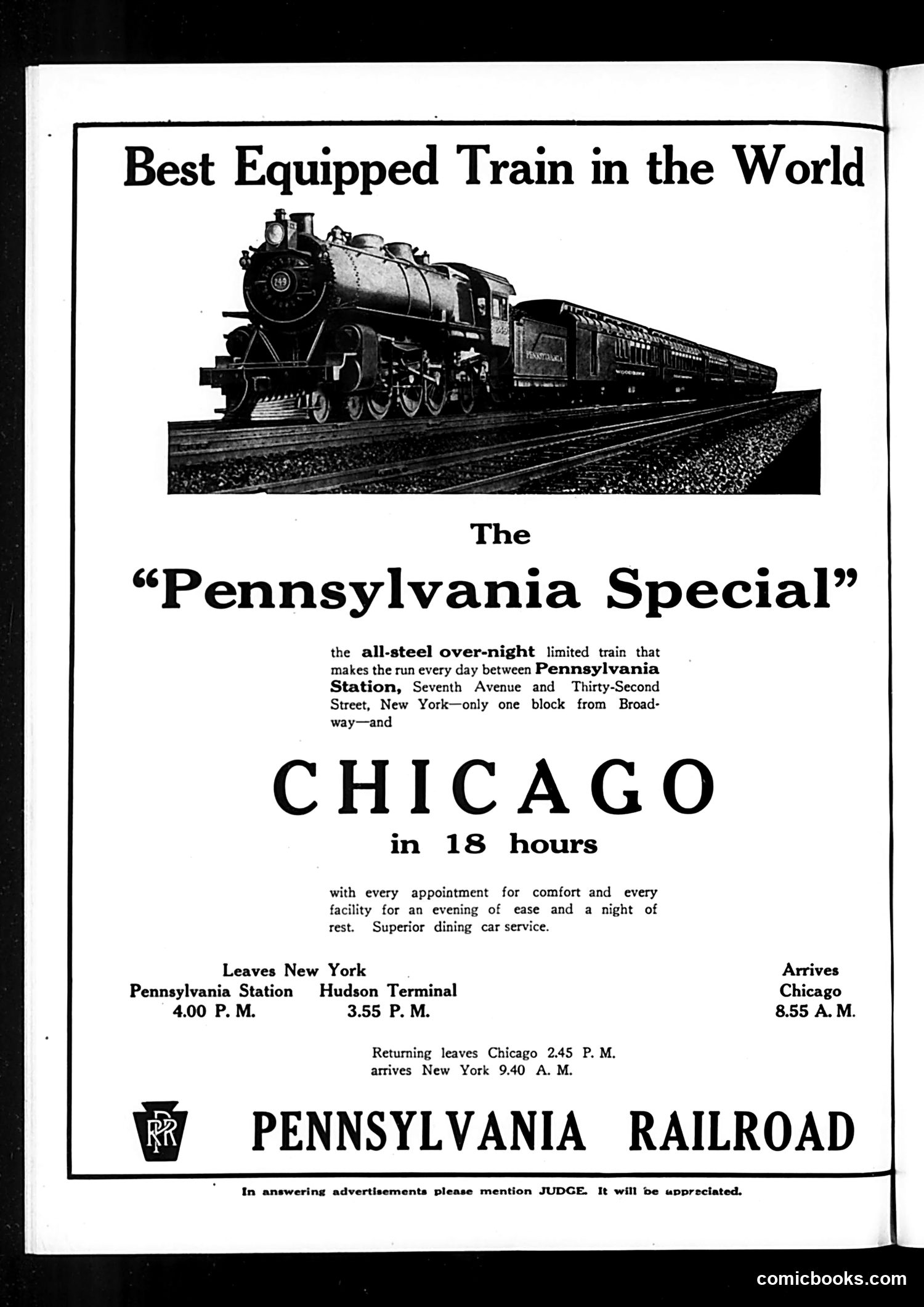
This page is **primarily an advertisement**, not satire or political commentary. It's a Pennsylvania Railroad ad for the "Pennsylvania Special," marketed as the "Best Equipped Train in the World." The ad promotes an all-steel overnight train running daily between New York's Pennsylvania Station and Chicago, completing the journey in 18 hours. It emphasizes luxury amenities: comfortable appointments, dining car service, and rest facilities. The departure/arrival times are specified (4:00 PM from New York, arriving Chicago 8:55 AM), with return service noted. There is **no cartoon, caricature, or satire** present—just a locomotive illustration serving the advertisement's purpose of attracting business travelers and wealthy passengers during the early-to-mid 20th century rail industry's competitive golden age.
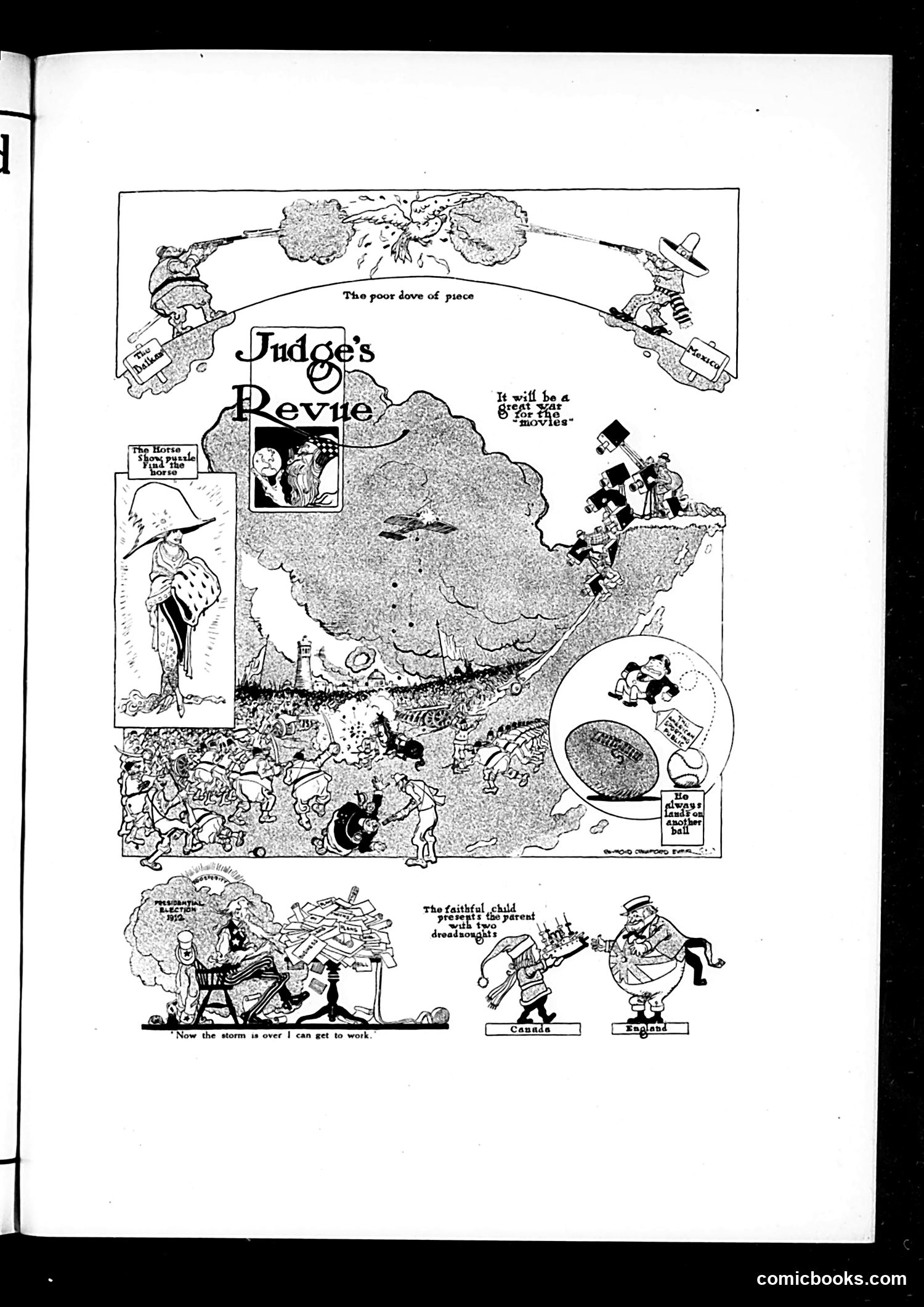
This page presents "Judge's Revue," a satirical theatrical-style commentary. The central map appears to show North America with various caricatured figures depicting different regions or national characteristics. The title "The poor love of piece" suggests commentary on peace negotiations or international relations. Text references include "It will be a great war of the movies" and "Now the storm is over I can get to work," indicating satire about either WWI aftermath or contemporary political conflicts. Bottom panels labeled "Canada" and "England" show caricatured national figures. The overall composition mocks different countries' stereotypes and international relations through exaggerated character drawings typical of early 20th-century Judge magazine satire—likely responding to post-WWI geopolitical tensions or peace efforts.
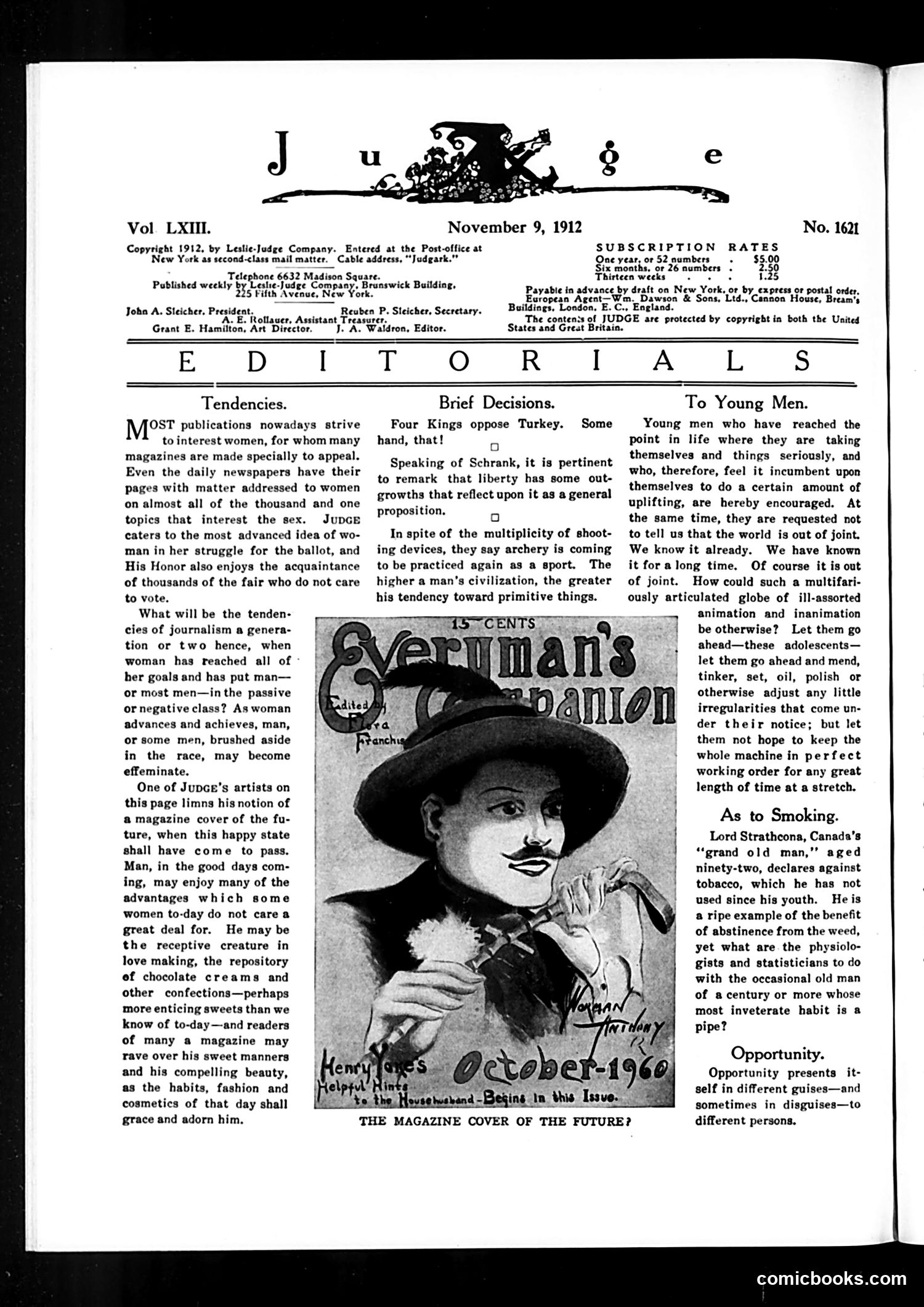
This page features editorial commentary and a prominent advertisement rather than political cartoons. The main image is an advertisement for "Overman's Companion," showing a man in a bowler hat smoking a pipe, dated October 1960—a futuristic reference meant as satire or speculation about future magazine covers. The editorials discuss gender roles in journalism and women's suffrage ("His Honor also enjoys the acquaintance of thousands of the fair who do not care to vote"). Other sections address young men's self-improvement, Lord Strathcona's anti-tobacco stance, and opportunity. The "Four Kings oppose Turkey" brief suggests ongoing Balkan conflicts from 1912, likely referencing the First Balkan War.
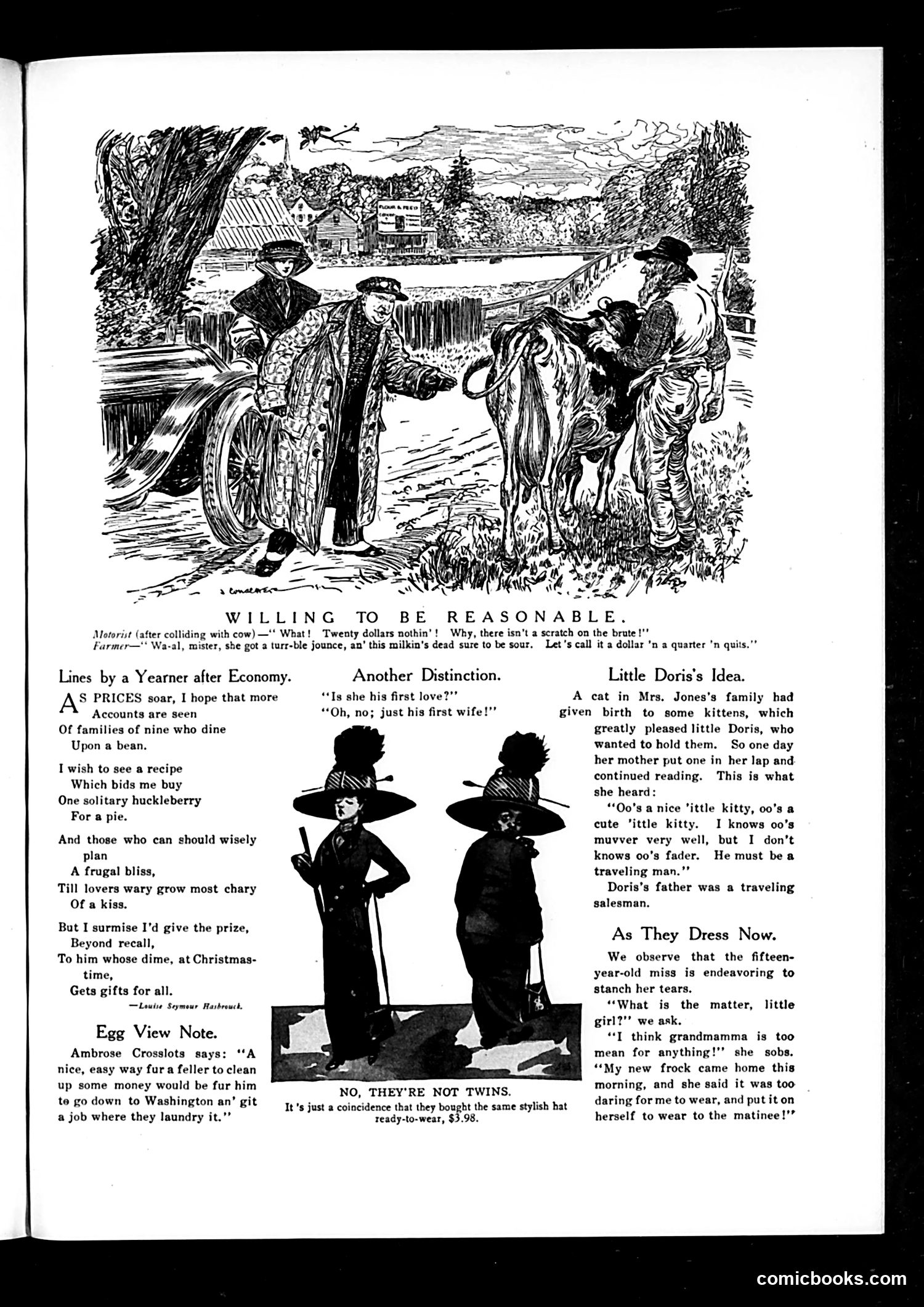
The main cartoon "WILLING TO BE REASONABLE" depicts a farmer negotiating with what appears to be a dairy farmer or milkman over a cow's value. The dialogue references "twenty dollars nothin'" and disputes about the animal's condition, satirizing rural economic disputes and hard-bargaining negotiations common in early 20th-century agricultural transactions. The remaining content consists of three separate pieces: a poem "Lines by a Yearner after Economy" about frugal living, a brief anecdote titled "Little Doris's Idea" about a child's misunderstanding of her father's occupation, and a fashion note "As They Dress Now" mocking a teenage girl's complaints about her new dress. These are light domestic humor pieces typical of Judge's satirical coverage of everyday American life rather than political commentary.
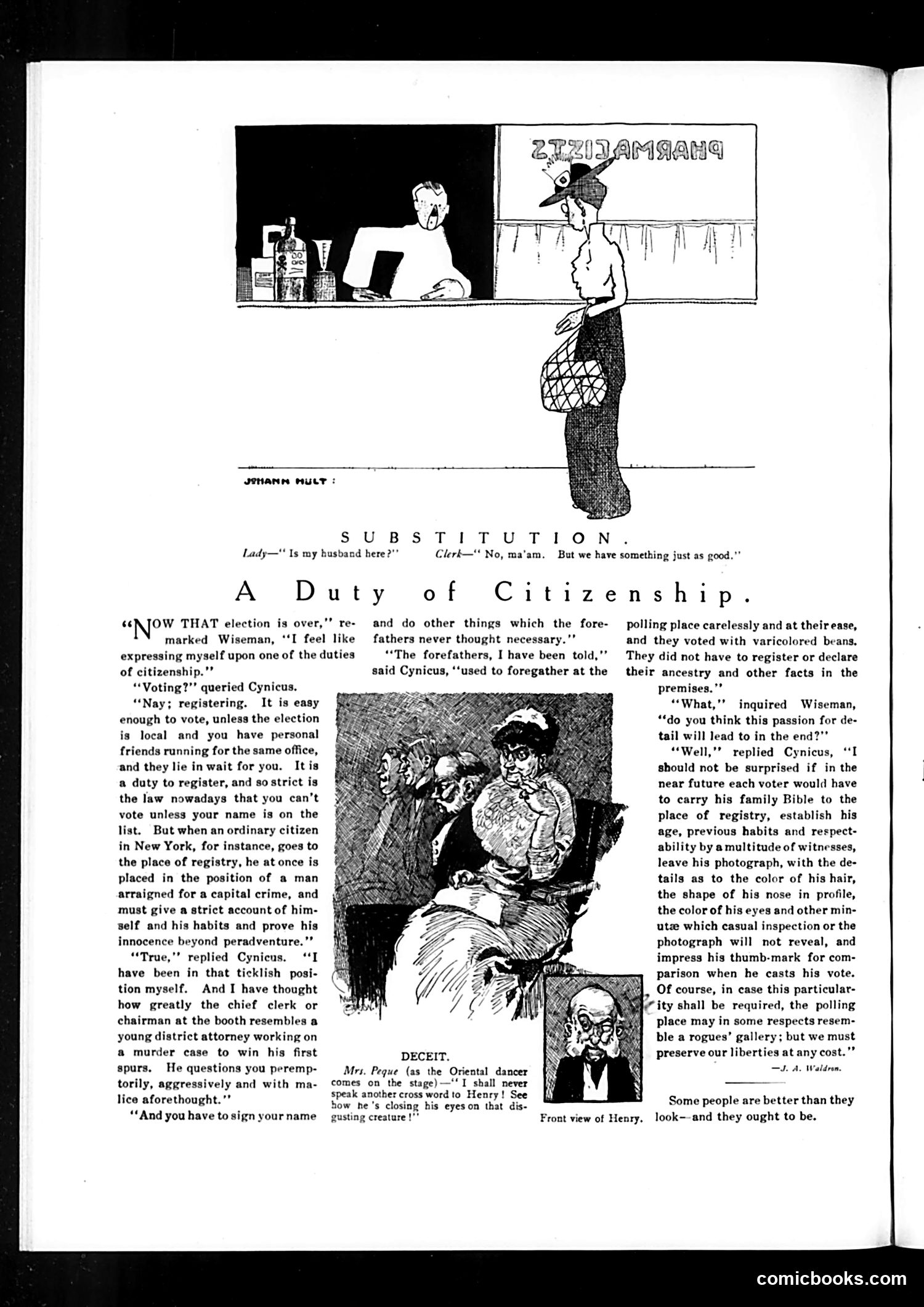
This page contains two separate satirical pieces from Judge magazine: **"A Duty of Citizenship"** (main article with illustrations): A dialogue between "Wiseman" and "Cynicus" mocking the increasingly rigorous voter registration requirements in early 20th-century America, particularly in New York. The satire criticizes how registration officials interrogate voters "aggressively" like district attorneys investigating crimes, demanding detailed personal information. Cynicus sarcastically predicts future absurdities: voters will need family Bibles, photographs, ancestry documentation, and fingerprints—turning polling places into "rogues' galleries." The joke targets both bureaucratic overreach and the irony that protecting "liberties" requires surrendering privacy. **"Substitution"** (small cartoon): A woman (Mrs. Peque, an Oriental dancer) tells her husband Henry she'll never speak crossly to him again—while he closes his eyes to avoid watching her perform. The clerk offers her "something just as good," implying a replacement performer. The humor plays on her obliviousness: her husband's eye-closing signals disgust, not admiration.
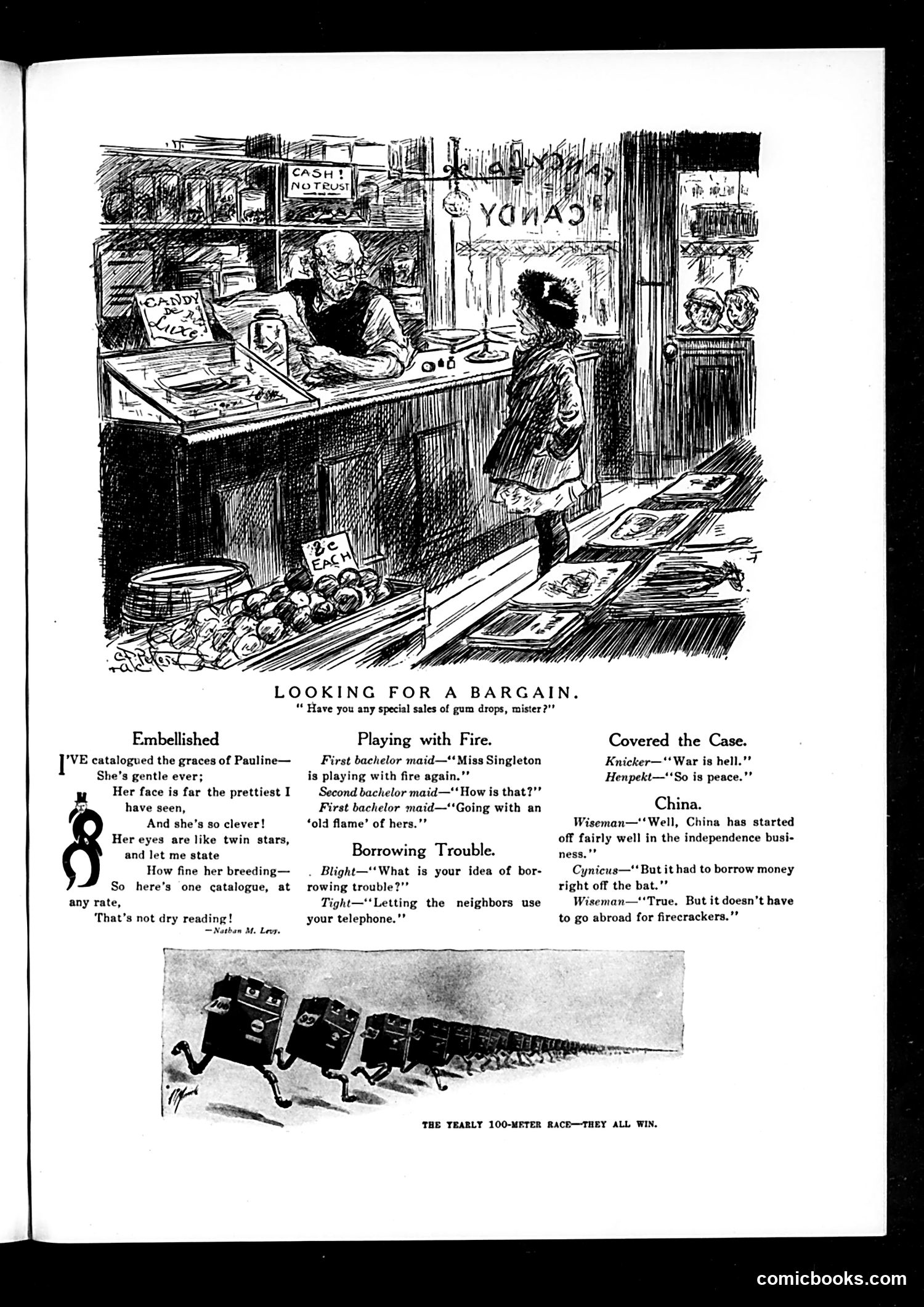
This page contains multiple satirical humor pieces typical of early 20th-century Judge magazine: **Main Cartoon:** "Looking for a Bargain" depicts a candy store scene where a customer asks about gum drop sales—a mundane shopping interaction presented as comedic content. **Text Sections:** Four separate joke vignettes mock various social situations: - "Embellished" sarcastically catalogs a woman's (Pauline's) virtues in overwrought romantic language - "Playing with Fire" jokes about a woman rekindling an old romantic relationship - "Borrowing Trouble" presents a pun on borrowing, equating it with lending neighbors your telephone - "Covered the Case" makes dark humor about war versus marriage/domestic life **Bottom Cartoon:** "The Yearly 100-Meter Race" depicts anthropomorphized bottles racing—likely representing competing commercial products or brands in a satirical commentary on business competition. The page reflects period concerns: romantic entanglements, domestic annoyances, and emerging consumer culture. The humor relies on wordplay, social observation, and visual absurdism rather than political commentary.
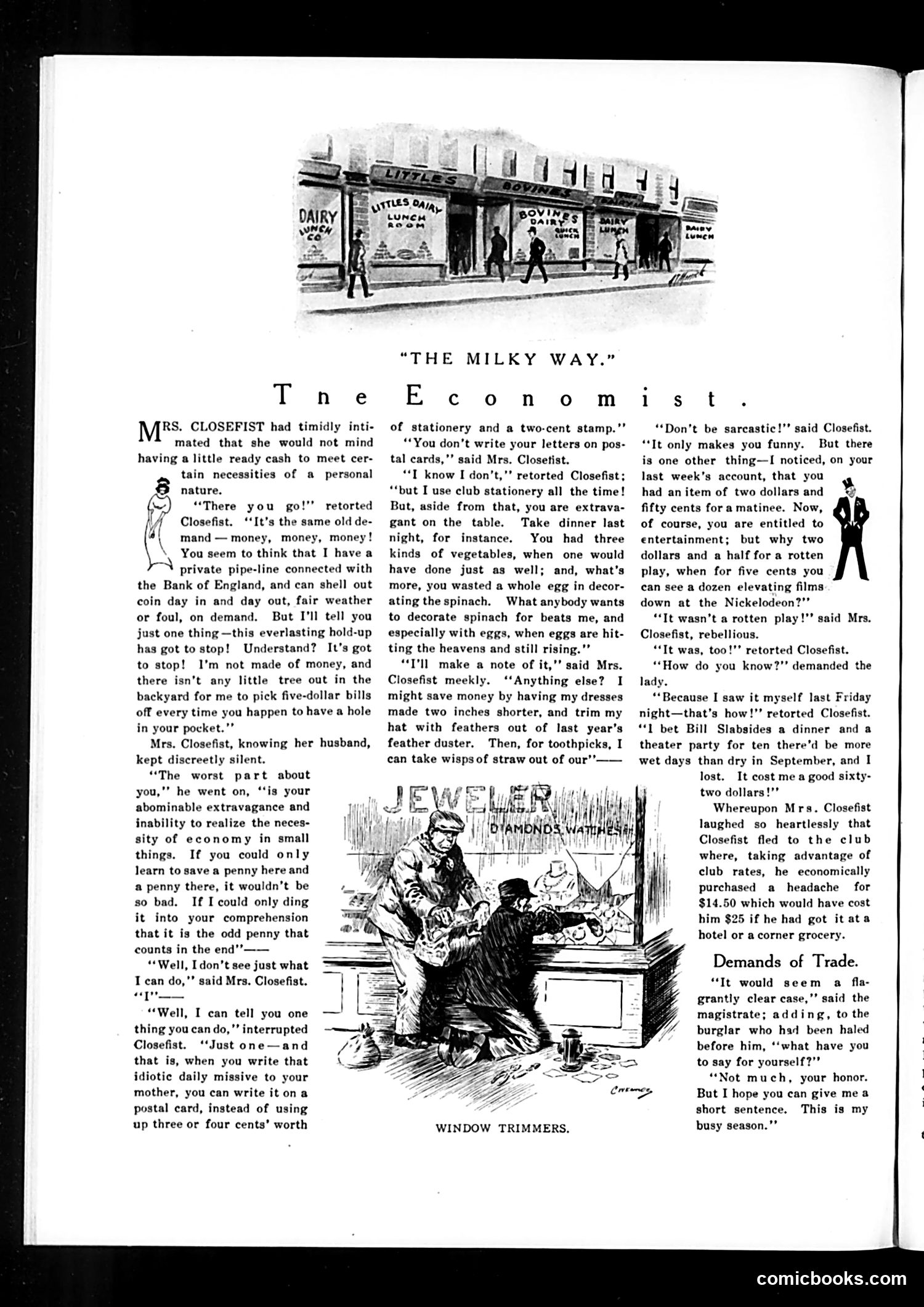
This is a satirical story titled "The Economist," mocking a miserly husband (Mr. Closefist) who obsesses over trivial household expenses while ironically spending money recklessly himself. The narrative contrasts his penny-pinching complaints—demanding his wife write letters on postcards instead of stationery, use one vegetable instead of three, avoid decorating spinach with eggs—with his own wasteful behavior: he admits attending an expensive, bad theater production on Friday and losing a $60+ dinner bet at his club. The accompanying cartoon "Window Trimmers" depicts two figures working at a storefront, likely illustrating small-time commercial labor. The final section "Demands of Trade" is an unrelated short joke about a burglar before a magistrate, apparently filler content. The satire targets hypocritical penny-pinching: men who lecture family about economy while squandering money on personal vices. This reflects early 20th-century social commentary on domestic financial tensions and masculine pretense.
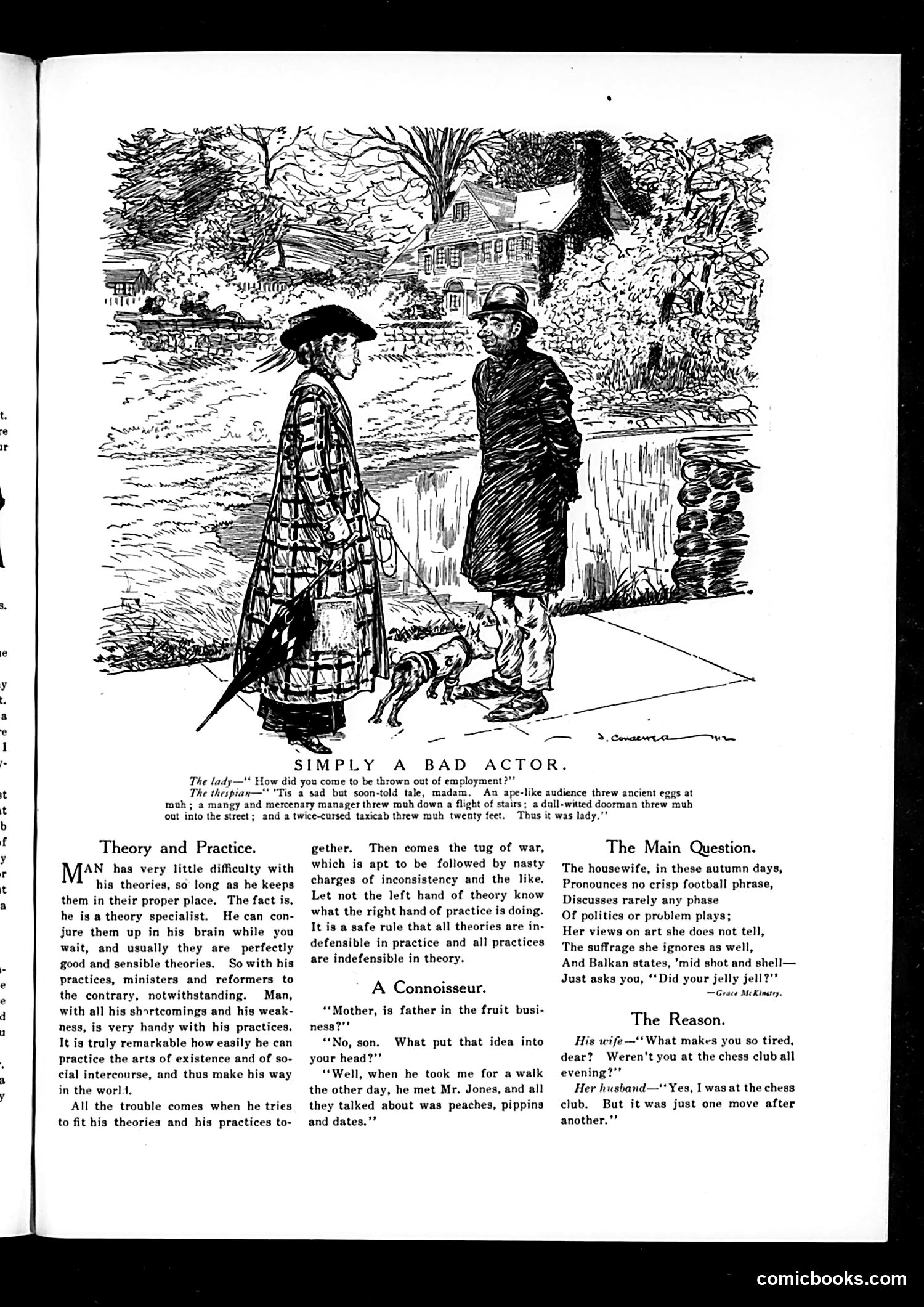
The top cartoon depicts a failed theatrical performer recounting his misfortunes to a lady—he was literally thrown out of employment by audiences (who pelted him with eggs), stairs, and a taxicab. It's a visual pun on "being thrown out" of a job, literalizing the expression. Below are three short satirical pieces typical of Judge's humor: **"Theory and Practice"** mocks reformers and theorists who can't reconcile their abstract ideals with messy reality—a jab at hypocrisy among social improvers. **"A Connoisseur"** is a brief joke where a boy misinterprets his father's fruit-focused conversation (peaches, dates) as evidence he's in the fruit business, when really the father was just making small talk. **"The Main Question"** and **"The Reason"** are domestic humor pieces about what preoccupies women (jelly-making) and the tedium of chess, respectively—light social observation rather than pointed satire.
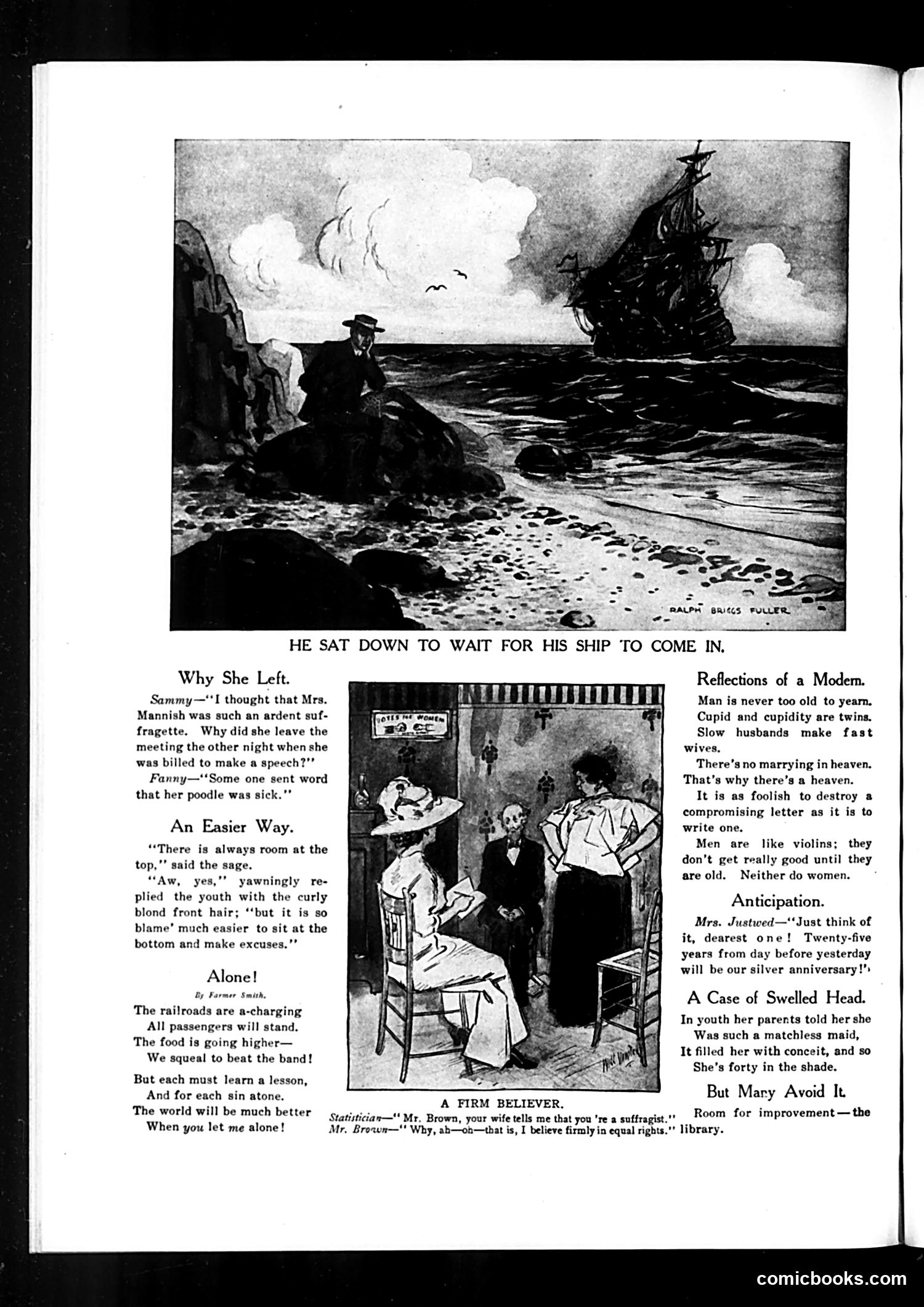
This page from *Judge* magazine contains several satirical commentaries on early 20th-century social issues: **"Why She Left"** mocks women suffragists by suggesting a prominent activist abandoned her public speaking commitment because her pet poodle was ill—implying female activists prioritize trivial concerns over serious causes. **"A Firm Believer"** satirizes male hypocrisy about women's suffrage. Mr. Brown claims to support "equal rights" but only when directly questioned by his wife, suggesting men pay lip service to suffrage without genuine conviction. **"Reflections of a Modern"** offers cynical observations on marriage and gender, including the barb that men and women "don't get really good until they are old"—a comment on aging and desirability. **"A Case of Swelled Head"** warns against parental over-praise, suggesting it breeds vanity that leaves women unmarried at forty. The page overall reflects *Judge*'s editorial skepticism toward both women's suffrage activism and modern marriage culture.
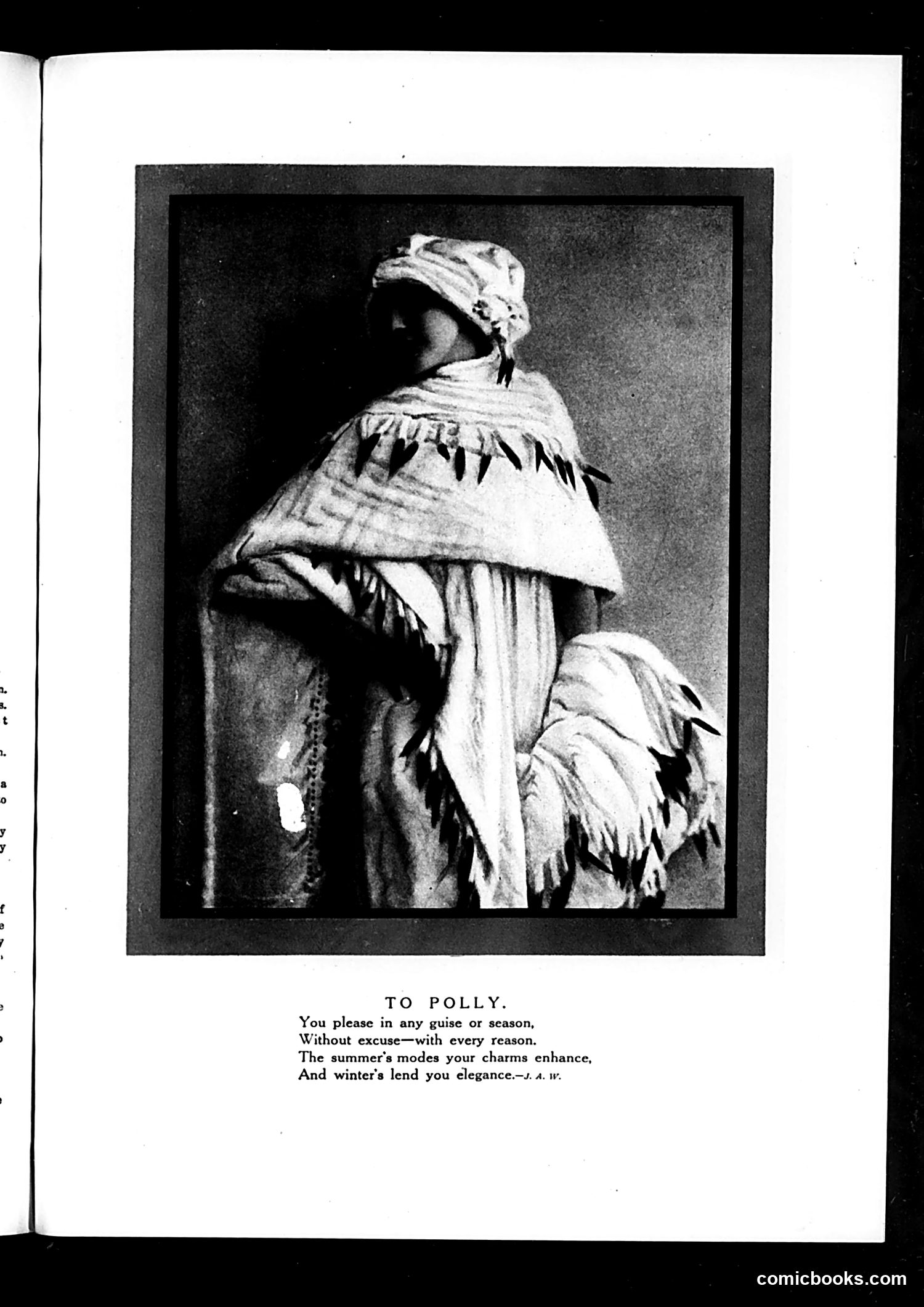
This page features a poem titled "To Polly" addressed to a woman who is attractive and charming in all seasons and clothing styles. The accompanying illustration shows a figure in elaborate draped garments and a decorative head covering, posed elegantly. The content appears to be a complimentary verse—likely a romantic or flirtatious dedication rather than political satire. The poem praises "Polly" for her beauty regardless of fashion or season. Without additional context about who "Polly" refers to (possibly a public figure, actress, or society woman of the era), the specific satirical target remains unclear. The illustration's classical drapery styling suggests an idealized aesthetic typical of Judge magazine's artistic approach to such tributes.
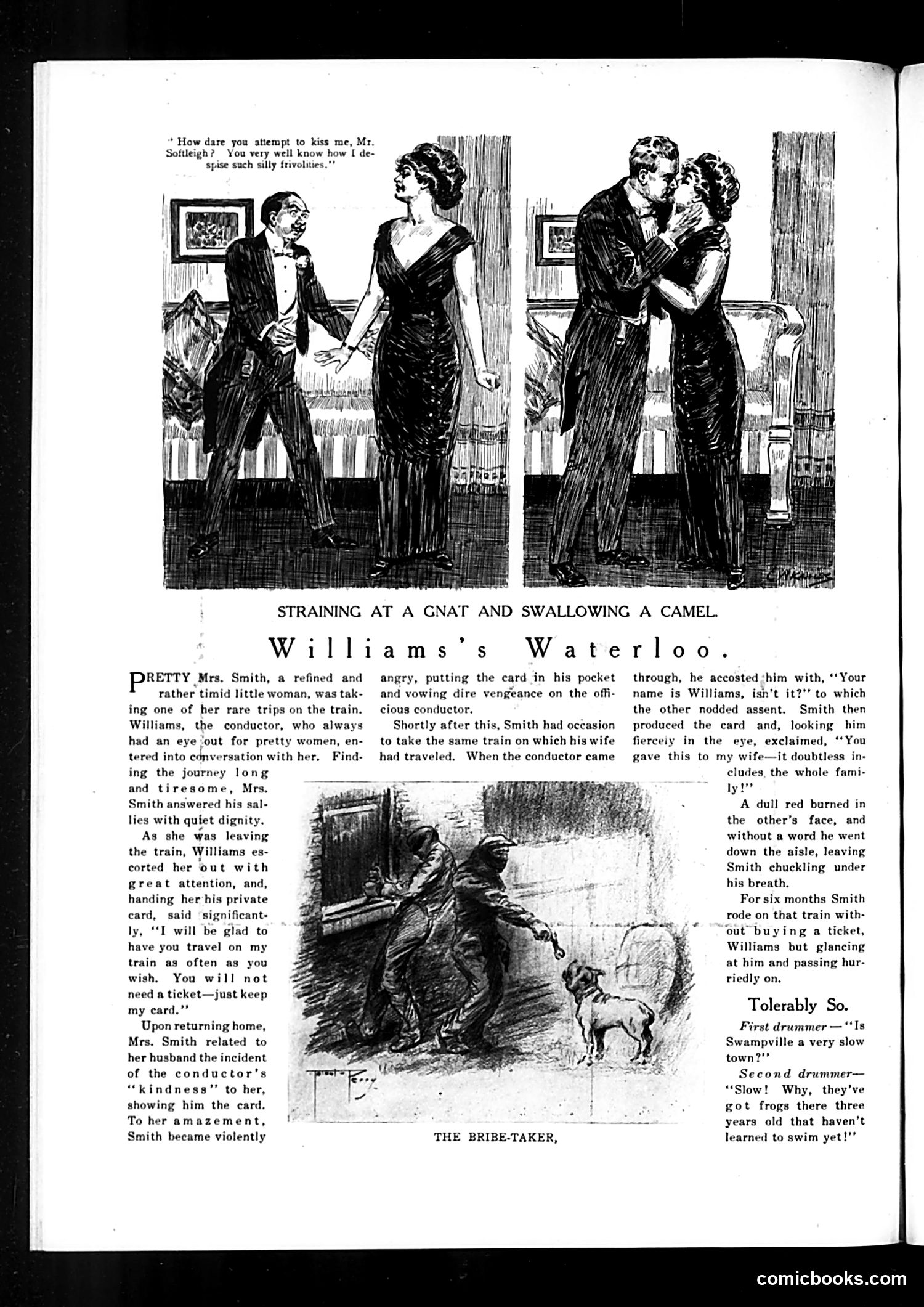
This satirical story illustrates hypocrisy using the biblical phrase "straining at a gnat and swallowing a camel"—condemning minor transgressions while ignoring major ones. Conductor Williams offers Mrs. Smith free train travel (implied as a seduction tactic), which her husband finds outrageous. However, Smith responds by exploiting this "impropriety" to ride free for six months without a ticket—committing the very offense (fraud/bribery) he condemned Williams for attempting. The joke critiques moral double standards: Smith righteously punishes Williams's minor flirtation while casually committing larger dishonesty himself. The title "The Bribe-Taker" ambiguously applies to both men—Williams attempted seduction; Smith accepted ongoing bribes. The cartoon mocks people who selectively enforce ethics based on personal advantage rather than principle.
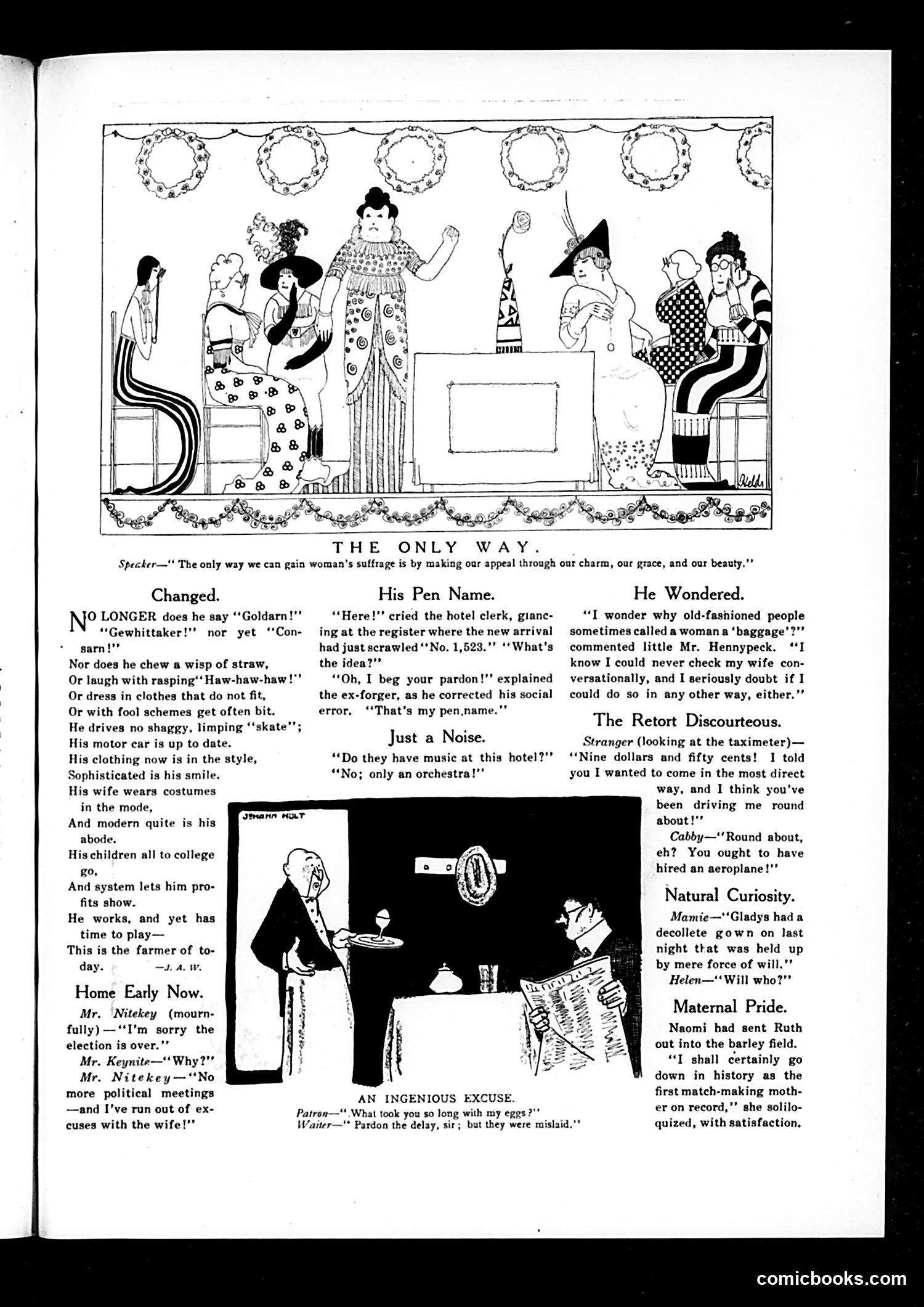
This page contains multiple brief humorous sketches typical of early 20th-century American satirical magazines. **"The Only Way"** (top): A speaker advocates appealing for women's suffrage through "charm, grace, and beauty"—satirizing the condescending male view that women must use feminine wiles rather than rational argument to gain voting rights. **"Changed"** and **"Home Early Now"**: These celebrate the modernized American farmer—no longer crude or rural, now sophisticated with automobiles, proper clothing, and educated children. The election joke mocks husbands using political meetings as excuses to avoid home. **"His Pen Name"**: A hotel clerk confronts a guest who registered as "No. 1,523"—revealed to be an ex-forger making a dark joke about his criminal past. **Various one-liners**: Hotel orchestras, taxi overcharging, and domestic banter represent typical Judge humor mocking modern manners, marriage dynamics, and urban inconveniences. The cartoons reflect upper-middle-class anxieties and amusements circa 1910s-1920s.
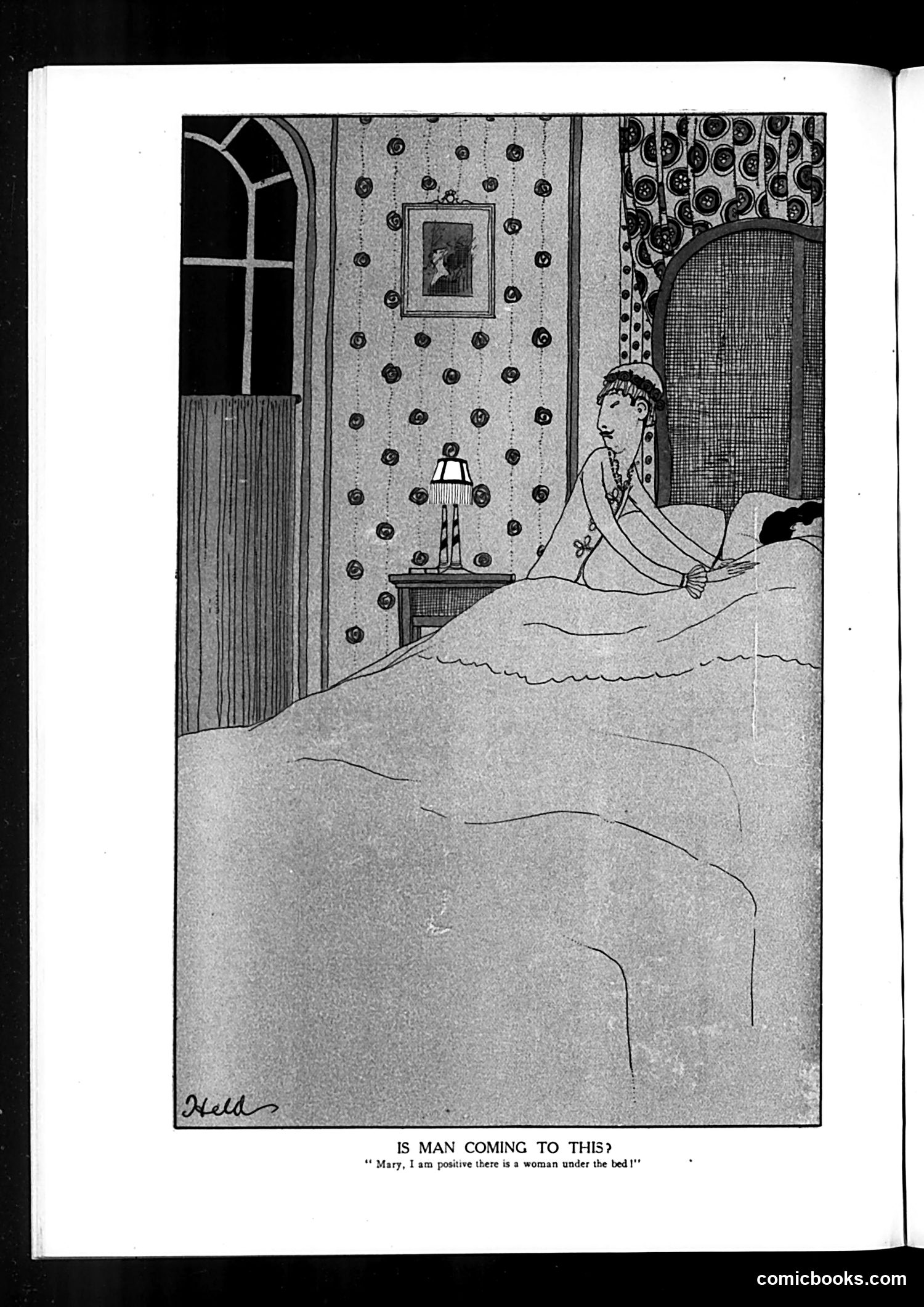
This is a humorous bedroom scene satirizing male anxiety about women's increasing independence and presence in traditionally male spaces. A man lies in bed, nervously insisting to "Mary" (likely his wife) that there's a woman hiding underneath—a paranoid reversal of the classic "something under the bed" fear. The satire targets early 20th-century anxieties about changing gender roles. The ornate, feminized bedroom décor (patterned wallpaper, decorative elements) reinforces the joke: the man feels so overwhelmed by women's expanding social sphere that he imagines female intrusion even in intimate domestic spaces. The caption's dramatic tone ("IS MAN COMING TO THIS?") suggests alarm at women's societal advancement, which *Judge* magazine treated with satirical commentary reflecting period concerns about women's suffrage and independence movements.
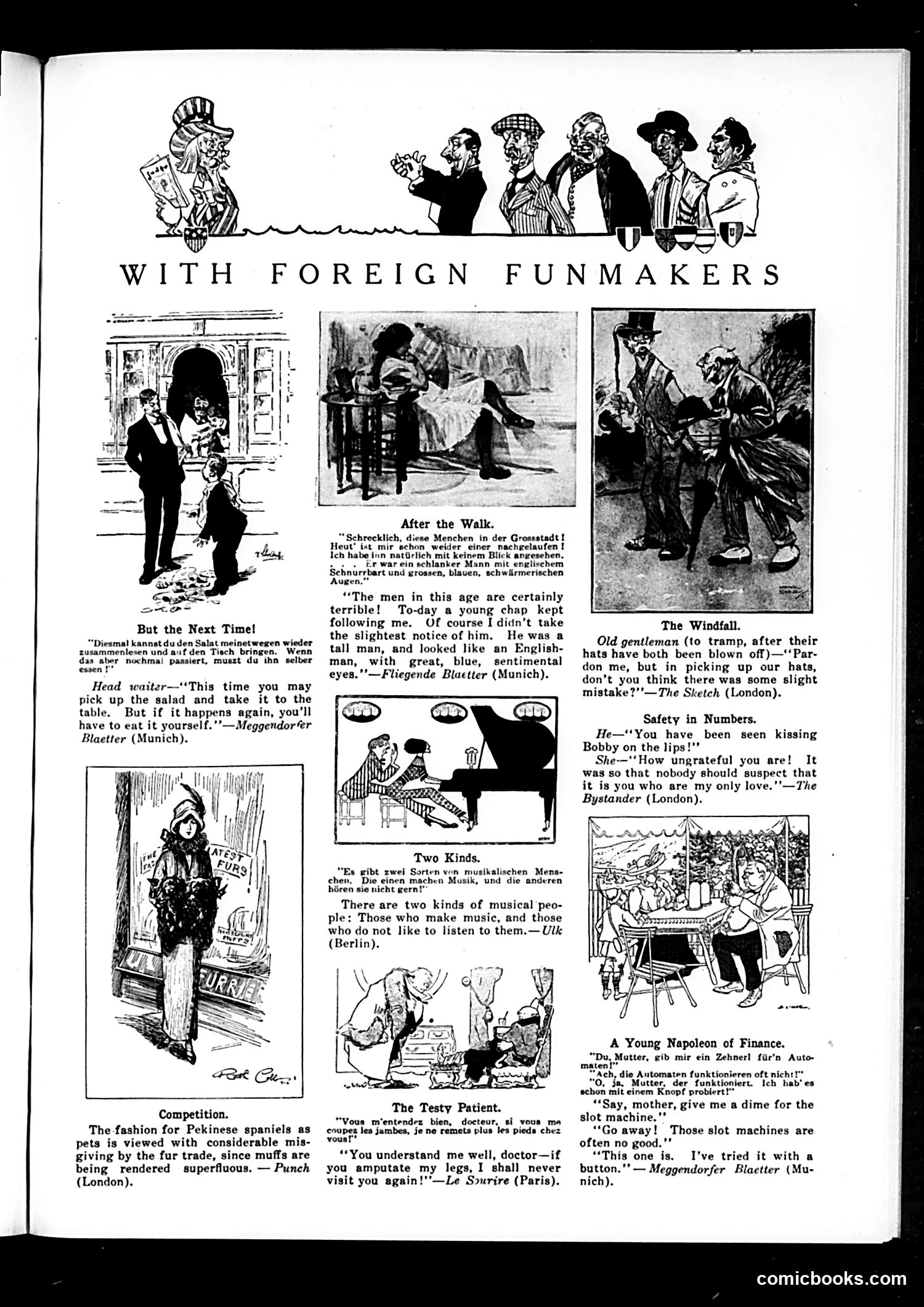
This page collects humorous anecdotes translated from European satirical magazines (Munich's *Fliegende Blaetter*, Paris's *Le Sourire*, London's *Punch*, Berlin's *Ulk*, etc.). Each cartoon or joke illustrates relatable social comedy rather than political satire. The humor targets universal human foibles: a waiter's comeuppance for dropping salad; a woman's vanity about being followed by an admirer; marital jealousy masked by strategic kissing; a doctor's patient threatening never to return if legs are amputated; a child's confidence in slot machines; and a dispute over mixed-up hats. The "Pekinese spaniels" entry mocks fashion—wealthy women keeping lap dogs as accessories, rendering traditional fur muffs obsolete, thus harming the fur trade. This demonstrates early 20th-century *Judge* magazine's practice of reprinting international humor to amuse American readers with "foreign" wit—suggesting sophisticated cosmopolitan taste while poking fun at recognizably human situations transcending national borders.
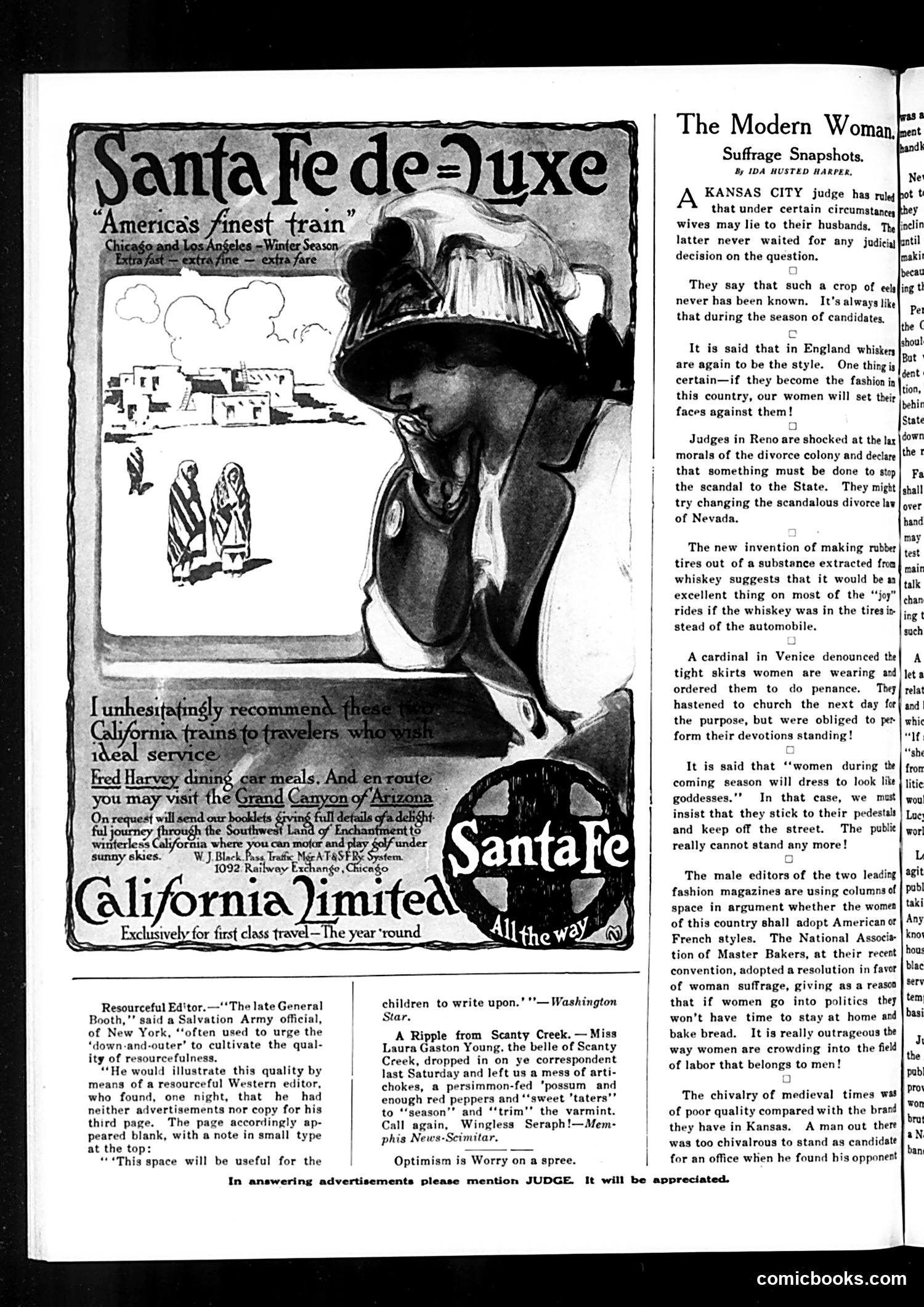
This page features satirical commentary on women's rights and suffrage by Ida Husted Harper. The column mocks anti-suffrage arguments through ironic "snapshots" of contemporary absurdities: A Kansas judge rules wives may lie to husbands (husbands already knew this). Reno's "divorce colony" scandal reflects loose Nevada laws, not moral decay. A cardinal demands women in tight skirts do penance standing—defeating the purpose. Male fashion editors debate whether American women should wear American or French styles, while bakers' associations argue women shouldn't vote because they'd abandon homemaking and baking. The satire exposes the hypocrisy: society simultaneously complains women neglect domestic duties while opposing their political participation. The column suggests these concerns are pretexts masking resistance to female autonomy and equality. The left page features a Santa Fe train advertisement—standard magazine filler unrelated to the suffrage commentary.
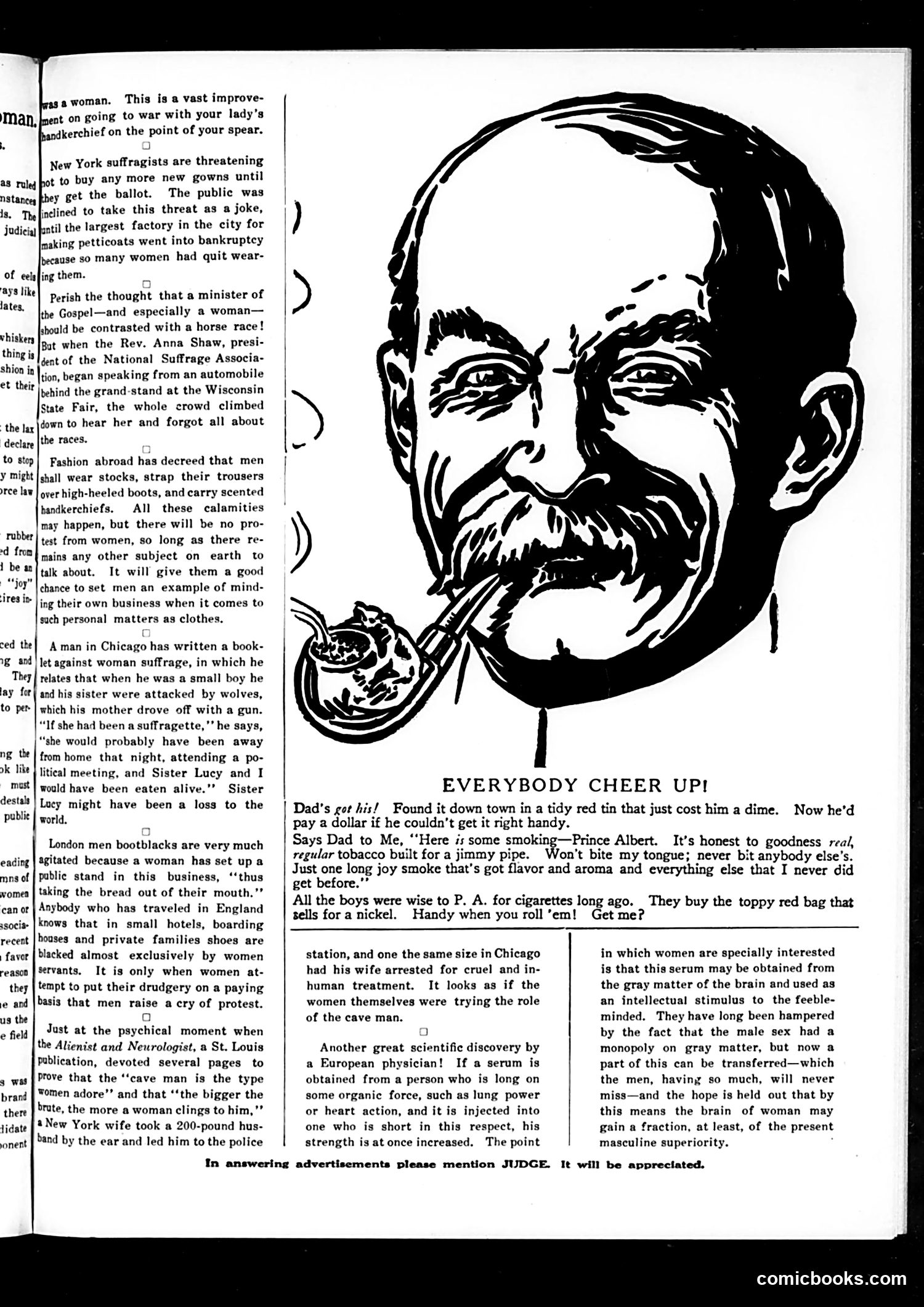
This page from *Judge* magazine satirizes early 20th-century gender debates and women's suffrage. The main cartoon depicts a man smoking a pipe labeled "Prince Albert" tobacco—a period advertisement disguised as editorial content. The surrounding text mocks anti-suffrage arguments through exaggeration. One piece ridicules a Chicago man's claim that his suffragette mother would have abandoned him to wolf attacks while attending political meetings. Another jest notes that New York suffragists' threat to boycott new gowns caused a petticoat factory bankruptcy—implying women's fashion consciousness undermines their serious activism. The piece about London bootblacks complaining that a woman competitor "takes bread from their mouths" ironically exposes male hypocrisy: men resist women's economic independence while performing "women's work" themselves. Overall, the satire works by taking anti-suffrage and anti-feminist arguments to absurd extremes, revealing their illogic to readers sympathetic to women's rights. The magazine uses humor to advocate for suffrage and gender equality.
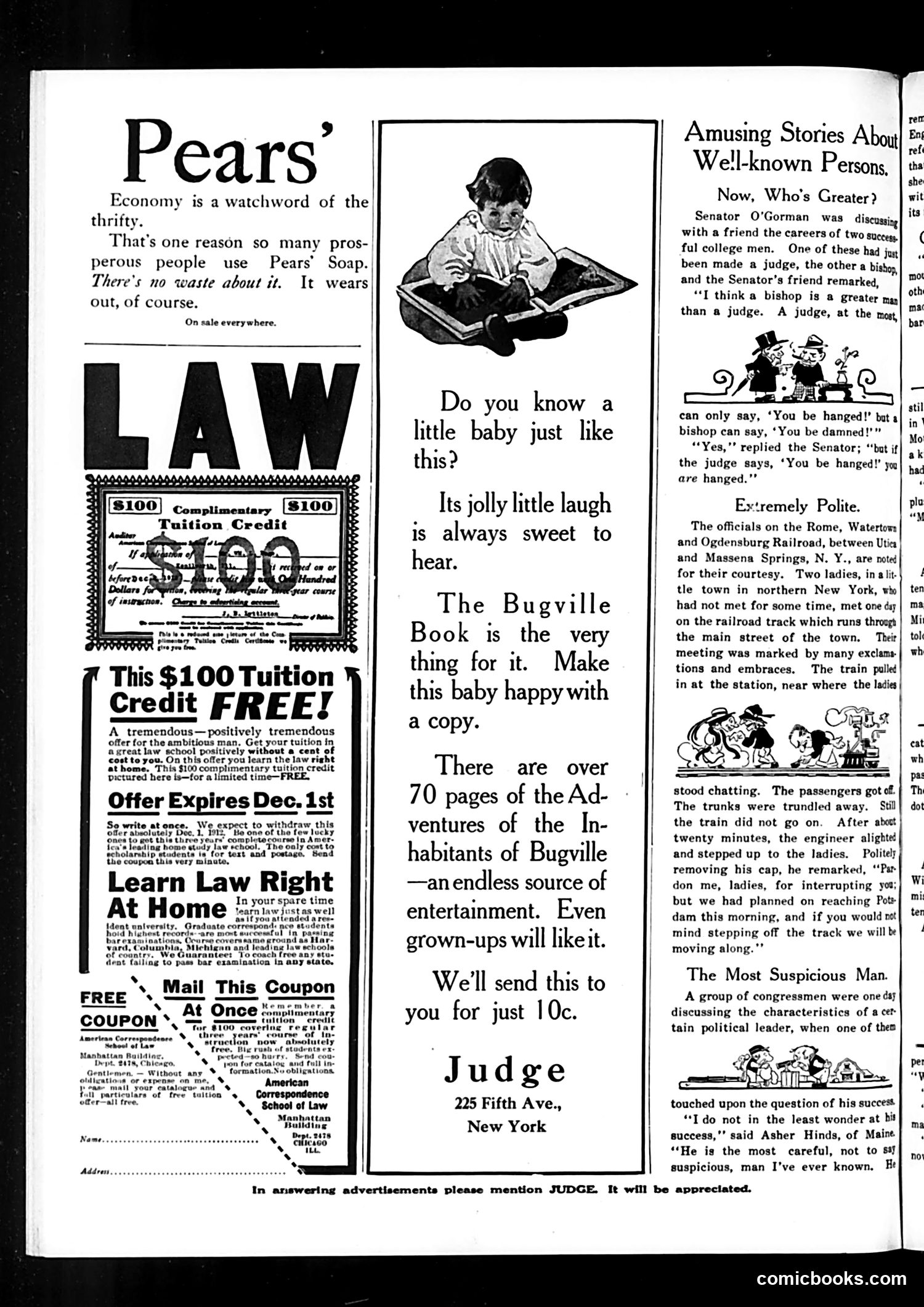
This page is primarily **advertisements and humor anecdotes**, not political cartoons. The main content includes: **Advertisements:** Pears' Soap (emphasizing economy), a correspondence law school offering $100 tuition credit, and the "Bugville Book" children's publication. **Humor pieces:** Three brief anecdotes about well-known persons: 1. **Senator O'Gorman joke:** Contrasts a judge's power ("You be hanged!") with a bishop's ("You be damned!"), concluding the judge's threat has actual enforcement—a play on religious vs. secular authority. 2. **Railroad courtesy story:** A train engineer politely interrupts two chatting ladies to resume service, satirizing excessive politeness. 3. **Political suspicion fragment:** References congressman Asher Hinds of Maine discussing a political leader's suspicious nature contributing to his success. The page reflects early 20th-century American humor and advertising conventions. Without visible dates or clearer context, specific political references remain unclear, though the Hinds reference suggests contemporary congressional figures were satirized regularly in Judge.
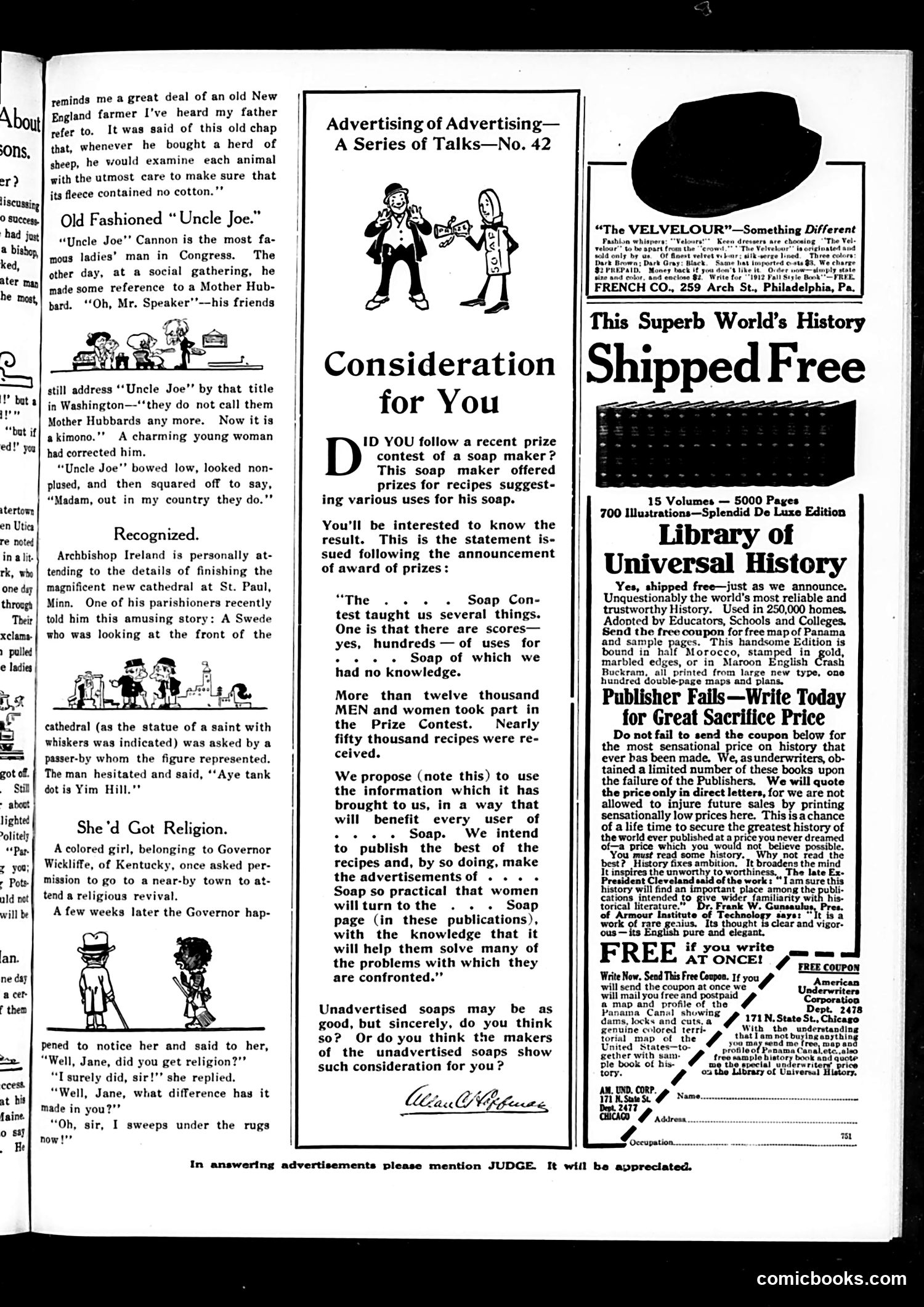
This page from Judge magazine contains a satirical anecdote about **Joseph "Uncle Joe" Cannon**, Speaker of the House of Representatives, known as a ladies' man. The joke plays on social propriety and outdated rural speech. At a formal social gathering, Cannon refers to a fashionable garment as a "Mother Hubbard" (a loose house dress), prompting a younger woman to correct him—such clothing is no longer called by that old-fashioned name. Cannon, embarrassed but defiant, squares off to defend himself by claiming that back in his rural home region ("my country"), the term remains current. The satire mocks both his provincial speech and his attempt to hide social ignorance behind frontier credentials. The cartoon plays on Cannon's public persona: despite his status and political power in Washington, he clings to outdated rural mannerisms, making him appear hopelessly old-fashioned to modern society.
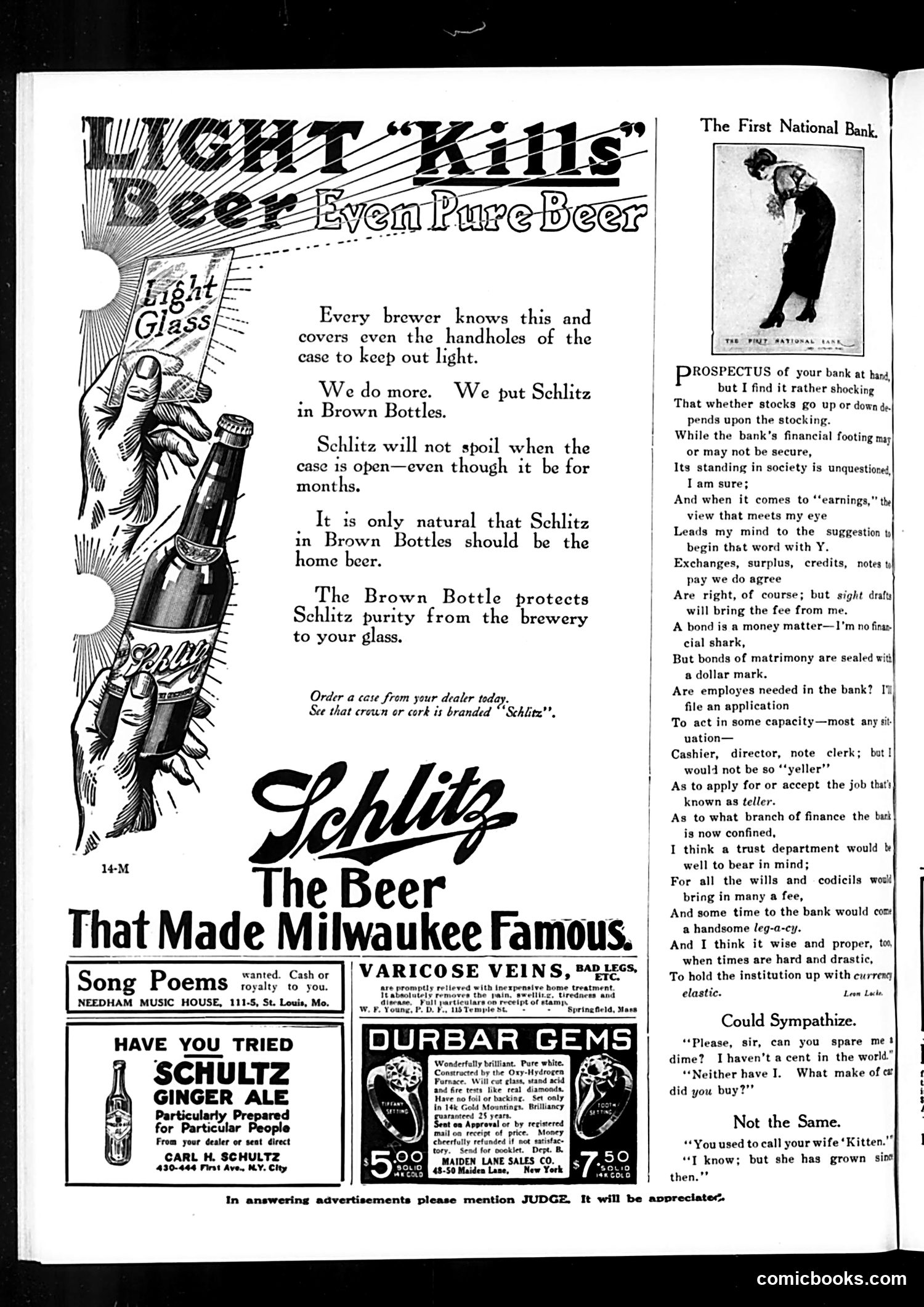
This page is primarily **advertising**, not political satire. It features multiple commercial ads for products popular in early 20th-century America: The dominant ad promotes **Schlitz beer** in brown bottles, claiming the packaging protects beer purity during storage and transport—a genuine concern before refrigeration. Below are smaller ads for **Schultz Ginger Ale**, **Durbar Gems** (jewelry), **Varicose Veins** treatment, and **Song Poems** (a music publisher service). On the right side is a **banking-themed humorous poem** titled "The First National Bank," satirizing a job applicant's desperate attempt to secure employment at a bank, desperately pitching himself for any available position—cashier, director, clerk, or teller. A brief joke at bottom ("Could Sympathize") involves wordplay about a wife's changed nickname from "Kitten" to something less flattering. There is **no political cartoon** on this page. It's a commercial advertising section with light humor typical of Judge magazine's format.
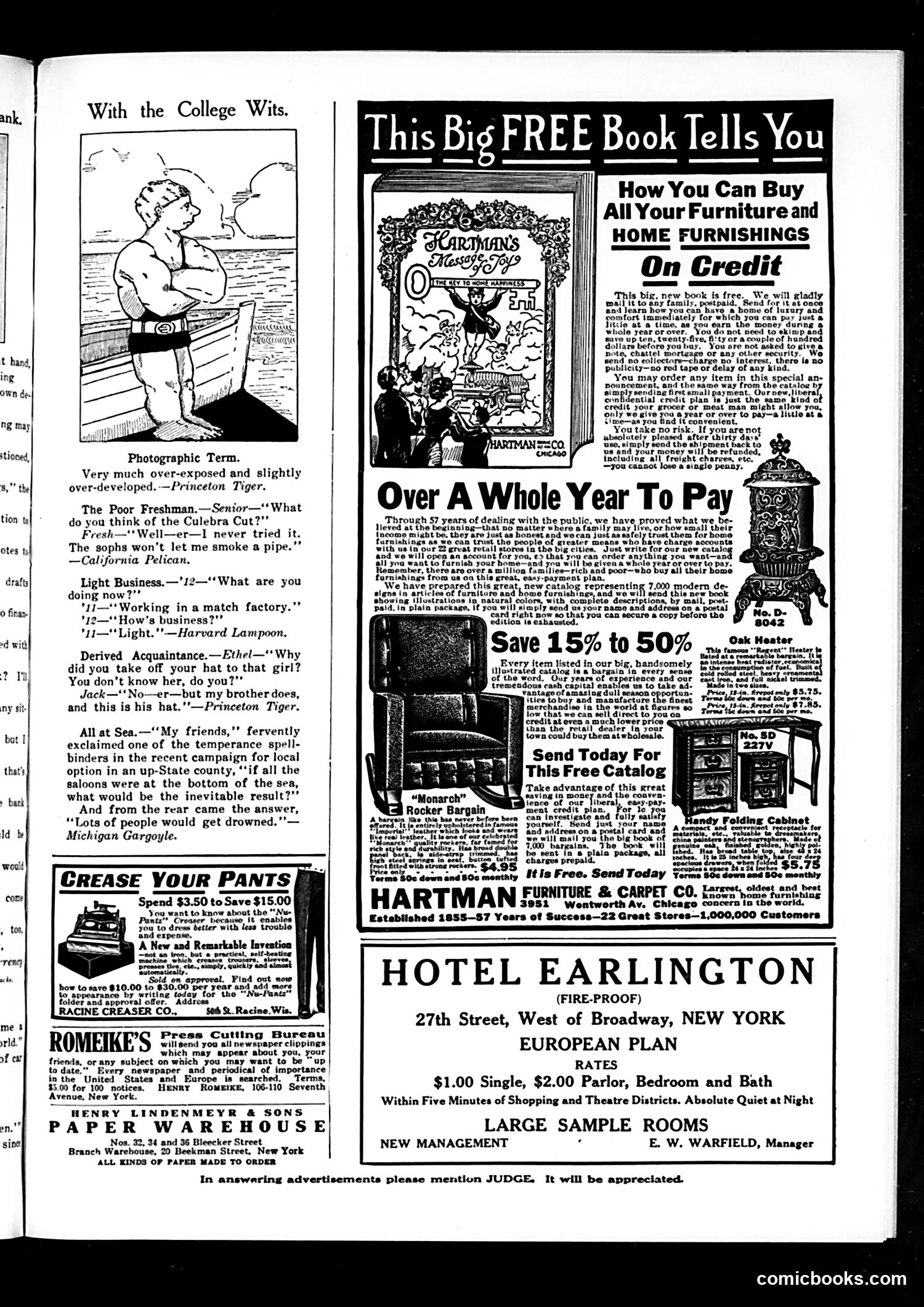
This page is primarily **advertising content** rather than editorial cartoons. The dominant feature is a large Hartman Furniture & Carpet Company advertisement promoting credit-based home furnishing purchases with "Over A Whole Year To Pay." The small editorial content consists of brief **college humor jokes** from various university publications (Princeton Tiger, California Pelican, Harvard Lampoon, Michigan Gargoyle). These are generic collegiate gags about freshmen ignorance, casual acquaintances, and prohibition-era temperance. The "Photographic Term" joke mocks overexposed photography; "All at Sea" jokes about temperance advocates accidentally endorsing drowning by wishing saloons underwater. The page also contains several small **service advertisements**: a pants-creasing device, a press clipping bureau, and a New York hotel. The overall page reflects early 20th-century consumer culture, with credit financing presented as accessible and trustworthy to working-class families—a significant social shift enabling household purchases previously requiring substantial savings.
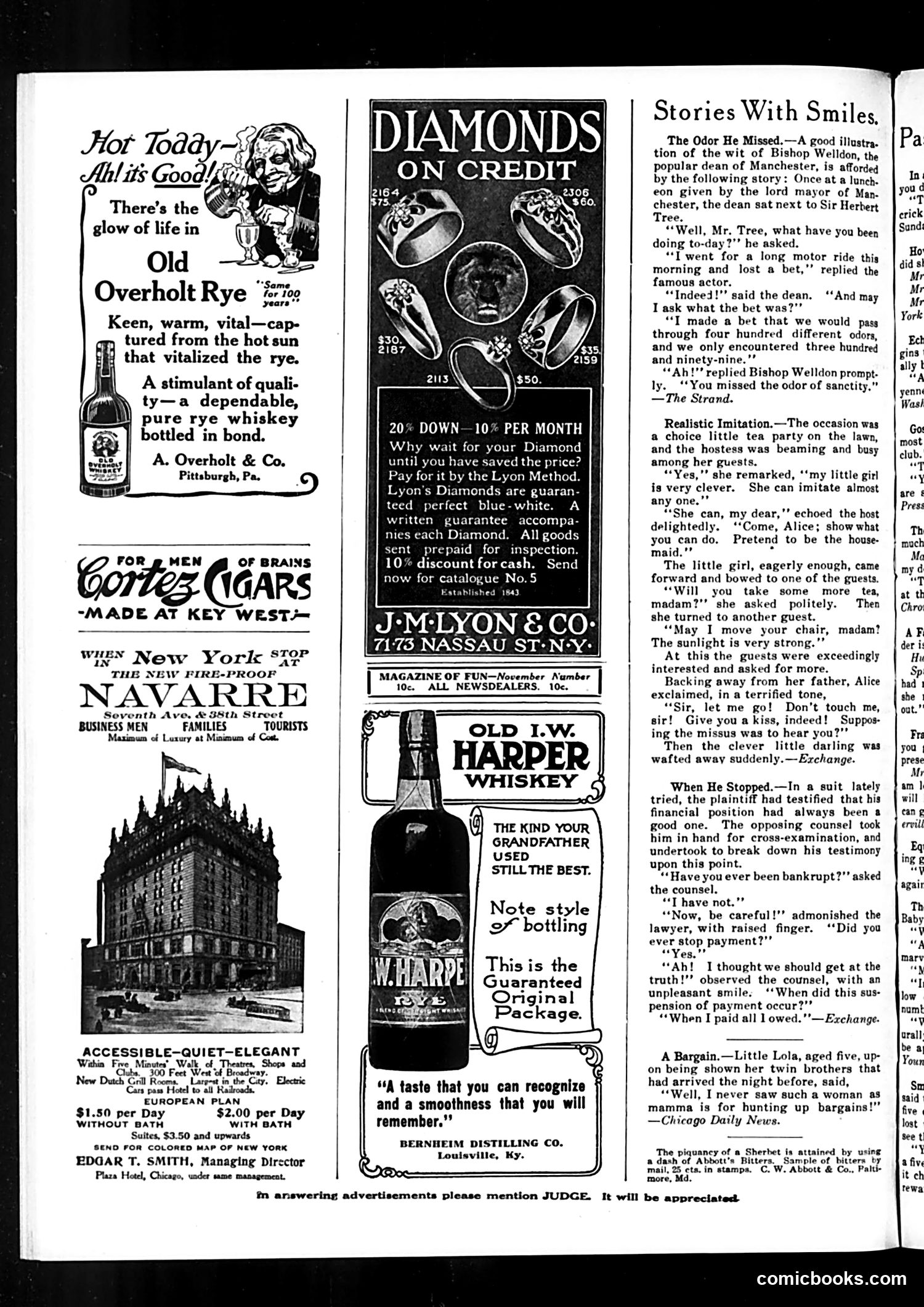
This page is primarily **advertisements and humor columns**, not political cartoons. The content includes: **Advertisements:** Whiskey (Old Overholt Rye, Old I.W. Harper), diamonds on credit, hotels (Navarre, Plaza), cigars, and a fire-proof building. **Humor Section** ("Stories With Smiles"): Three anecdotes showcasing wit: 1. **Bishop Welldon's Retort**: A dean quips to actor Herbert Tree about missing "the odor of sanctity" after Tree claims to have encountered hundreds of different odors on a drive—a pun on ecclesiastical virtue. 2. **The Clever Child**: A girl imitates a housemaid by adopting overly familiar, flirtatious behavior toward male guests, shocking her father—satirizing both child precocity and servant-class stereotypes. 3. **Legal Wordplay**: A counsel attempts to trap a plaintiff into admitting bankruptcy; the plaintiff cleverly redefines "stopped payment" as having paid all debts. These are genteel, wordplay-focused humor pieces typical of early 20th-century Judge magazine—no caricatures or political satire present.
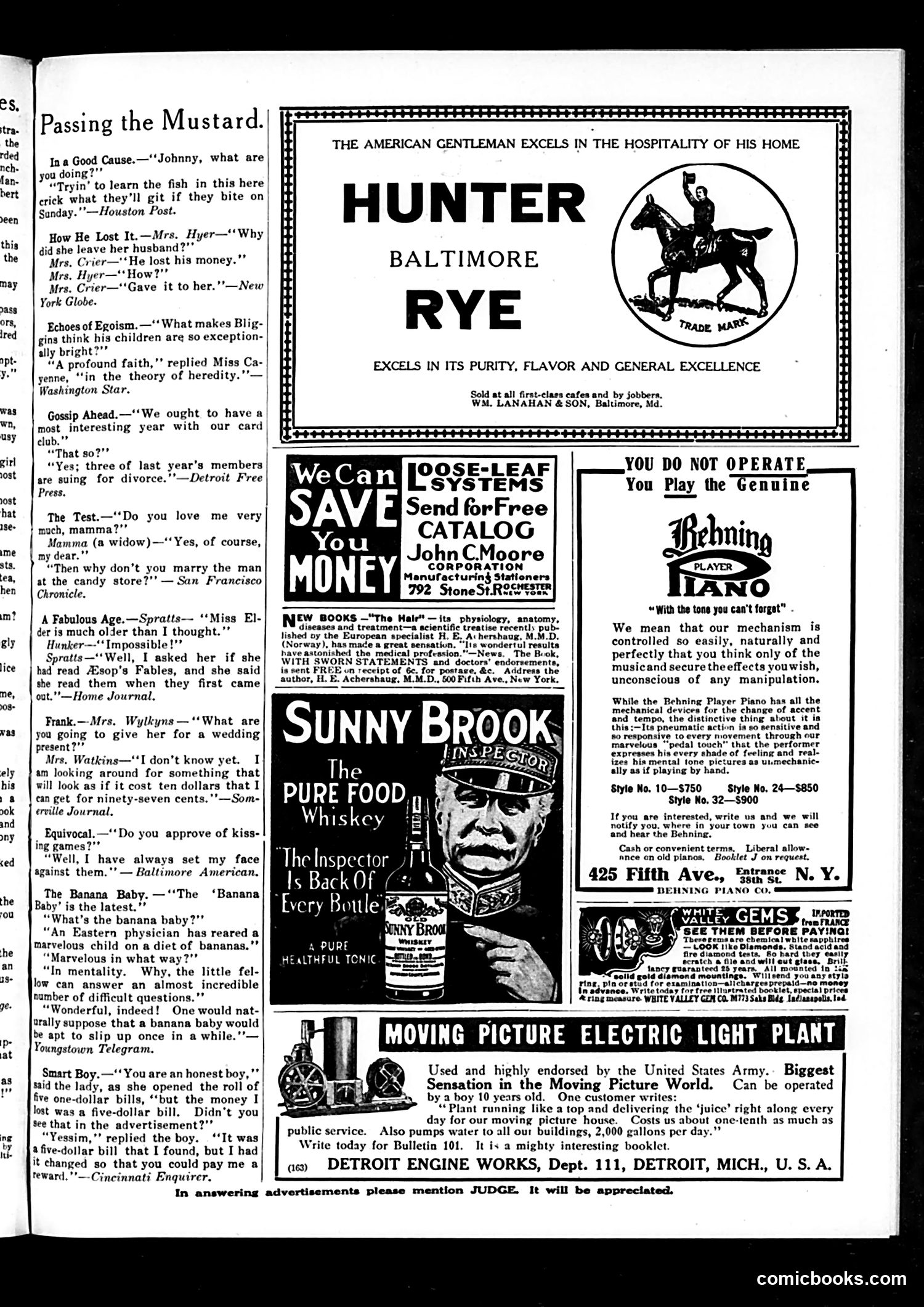
This page is primarily **advertisements** interspersed with short humor items typical of early 20th-century satirical magazines. The humor pieces are brief, cynical observations about marriage, divorce, and domestic life—common Judge fare. Notable examples: a widow won't remarry a candy-store clerk (implying class consciousness), a woman seeks a wedding gift "looking as if it cost ten dollars" for ninety-seven cents (mocking pretense), and a dishonest boy who found money and changed the bill amount before returning it (satirizing false virtue). The advertisements reflect the era's products: Hunter Baltimore Rye whiskey, Sunny Brook whiskey (featuring an "Inspector" character), a Behning player piano, loose-leaf filing systems, and an "electric light plant" operated by a boy. The page offers no political cartoons—just commercial advertising and light domestic satire, typical of Judge's mix of humor and revenue-generating ads from the pre-WWI era.
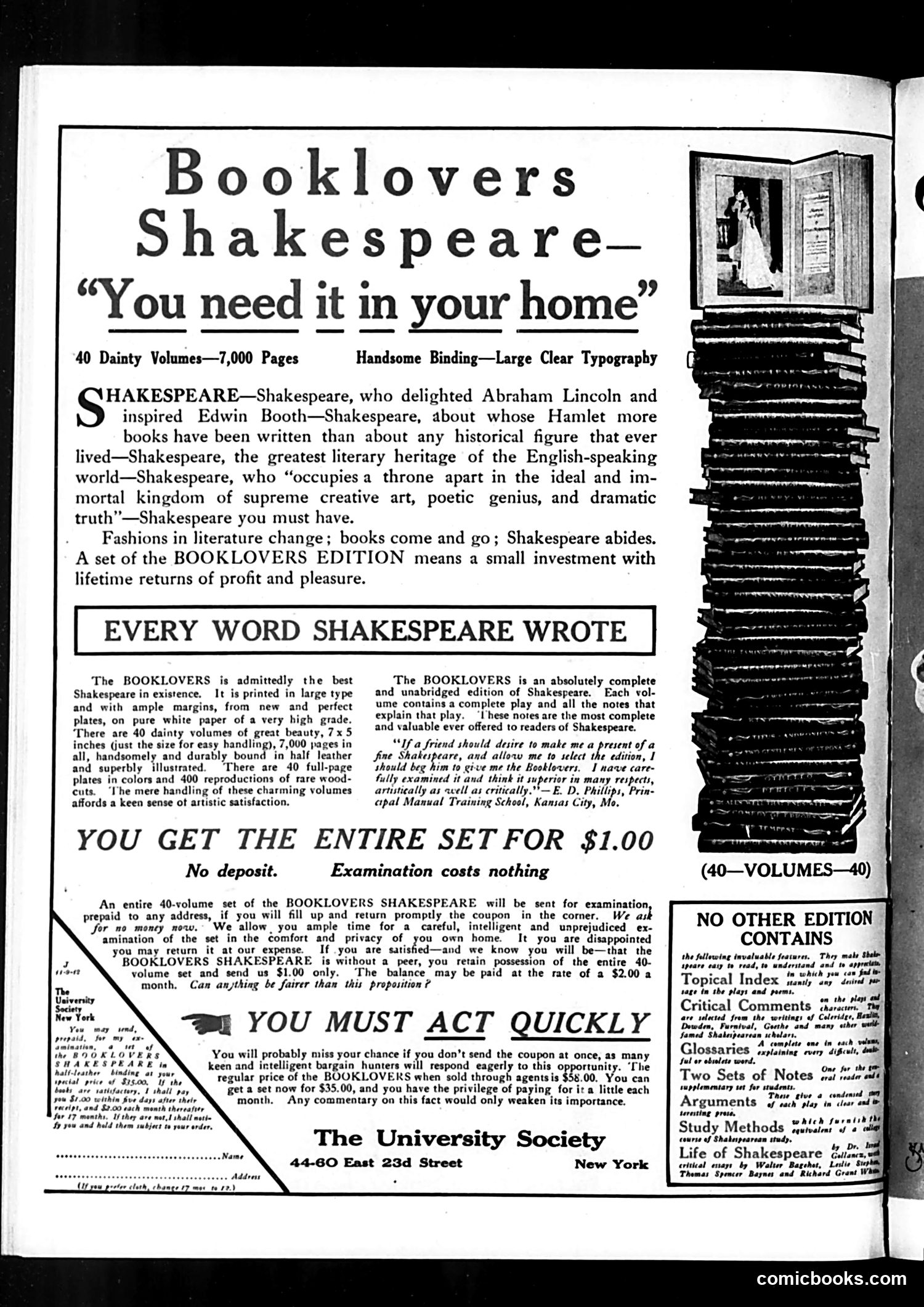
This is a **full-page advertisement**, not satirical content—Judge magazine's pages frequently included paid advertising alongside editorial material. The ad promotes the "Booklovers Edition" of Shakespeare's complete works: 40 volumes, 7,000 pages, leather-bound, with illustrations and scholarly notes. The appeal is explicitly cultural and aspirational—Shakespeare is presented as essential to any refined home library, associated with figures like Abraham Lincoln and actor Edwin Booth. The sales pitch emphasizes affordability ($1.00 to examine; $35 total vs. $58 elsewhere) and psychological pressure ("YOU MUST ACT QUICKLY"). The company offers examination-at-home with no deposit, allowing customers to pay in installments. For modern readers: this reflects early 20th-century consumer culture, where complete literary sets were status symbols marketed to middle-class buyers. The aggressive "limited opportunity" language and payment plans are recognizable modern sales tactics, but the cultural reverence for Shakespeare as a home library centerpiece is distinctly period-specific.