
Judge, 1912-11-09 · page 6 of 24
Judge — November 9, 1912 — page 6: what you’re looking at
What you’re looking at
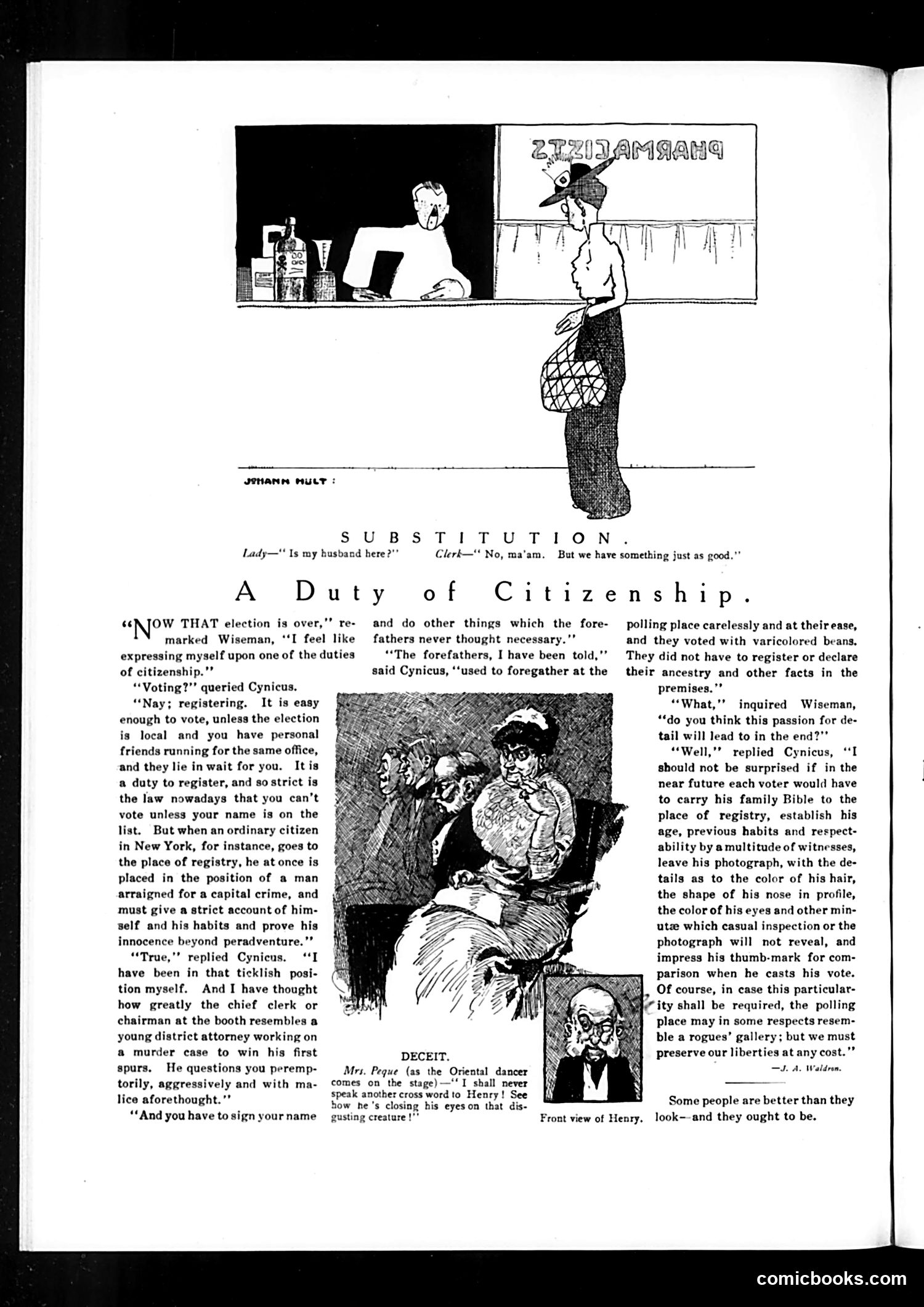
This page contains two separate satirical pieces from Judge magazine: **"A Duty of Citizenship"** (main article with illustrations): A dialogue between "Wiseman" and "Cynicus" mocking the increasingly rigorous voter registration requirements in early 20th-century America, particularly in New York. The satire criticizes how registration officials interrogate voters "aggressively" like district attorneys investigating crimes, demanding detailed personal information. Cynicus sarcastically predicts future absurdities: voters will need family Bibles, photographs, ancestry documentation, and fingerprints—turning polling places into "rogues' galleries." The joke targets both bureaucratic overreach and the irony that protecting "liberties" requires surrendering privacy. **"Substitution"** (small cartoon): A woman (Mrs. Peque, an Oriental dancer) tells her husband Henry she'll never speak crossly to him again—while he closes his eyes to avoid watching her perform. The clerk offers her "something just as good," implying a replacement performer. The humor plays on her obliviousness: her husband's eye-closing signals disgust, not admiration.
📄 Transcribed text from this page (OCR, searchable)
Machine-transcribed from the original scan — historical spelling and the odd misread are preserved.
Lady—"' Is my husband here ?"” A Duty and do other things which the fore- fathers never thought necessary.’’ “The forefathers, I have been told,’’ said Cynicus, ‘‘used to foregather at the 6sA\JOW THAT election is over,’ marked Wiseman, ‘‘I feel like expressing myself upon one of the duties of citizenship.’” “Voting?” queried Cynicus. “Nay; registering. It is easy enough to vote, unless the election is local and you have personal friends running for the same office, and they lie in wait for you. It is a duty to register, and so strict is the law nowadays that you can’t vote unless your name is on the list. But when an ordinary citizen in New York, for instance, goes to the place of registry, he at once is placed in the position of a man arraigned for a capital crime, and must give a strict account of him- self and his habits and prove his innocence beyond peradventure.’’ * replied Cynicus. “I have been in that ticklish posi- tion myself. And I have thought how greatly the chief clerk or chairman at the booth resembles a young district attorney working on a murder case to win his first spurs. He questions you peremp- torily, aggressively and with ma- lice aforethought.”” “And you have to sign your name " re- SUBS TITUT Ci o f Mrs, Peque (as the Oriental dancer comes on the stage)—‘'I shall never speak another cross word to Henry! See how he’s closing his eyes on that dis- gusting creature!" Clerk—"' No, ma'am. ION But we have something just as good." tizenship. polling place carelessly and at their ease, and they voted with varicolored beans, They did not have to register or declare their ancestry and other facts in the premises.’’ “What,’’ inquired Wiseman, “do you think this passion for de- tail will lead to in the end?” “‘Well,’’ replied Cynicus, “I should not be surprised if in the near future each voter would have to carry his family Bible to the place of registry, establish his age, previous habits and respect- ability by a multitude of witnesses, leave his photograph, with the de- tails as to the color of his hair, the shape of his nose in profile, the color of his eyes and other min- utz which casual inspection or the photograph will not reveal, and impress his thumb-mark for com- parison when he casts his vote. |, Of course, in case this particular- i ity shall be required, the polling place may in some respects resem- ble a rogues’ gallery; but we must preserve our liberties at any cost."” J. A. Waldron. Some people are better than they Front view of Henry, look--and they ought to be. comicbooks.com