A complete issue · 16 pages · 1910
Judge — July 16, 1910
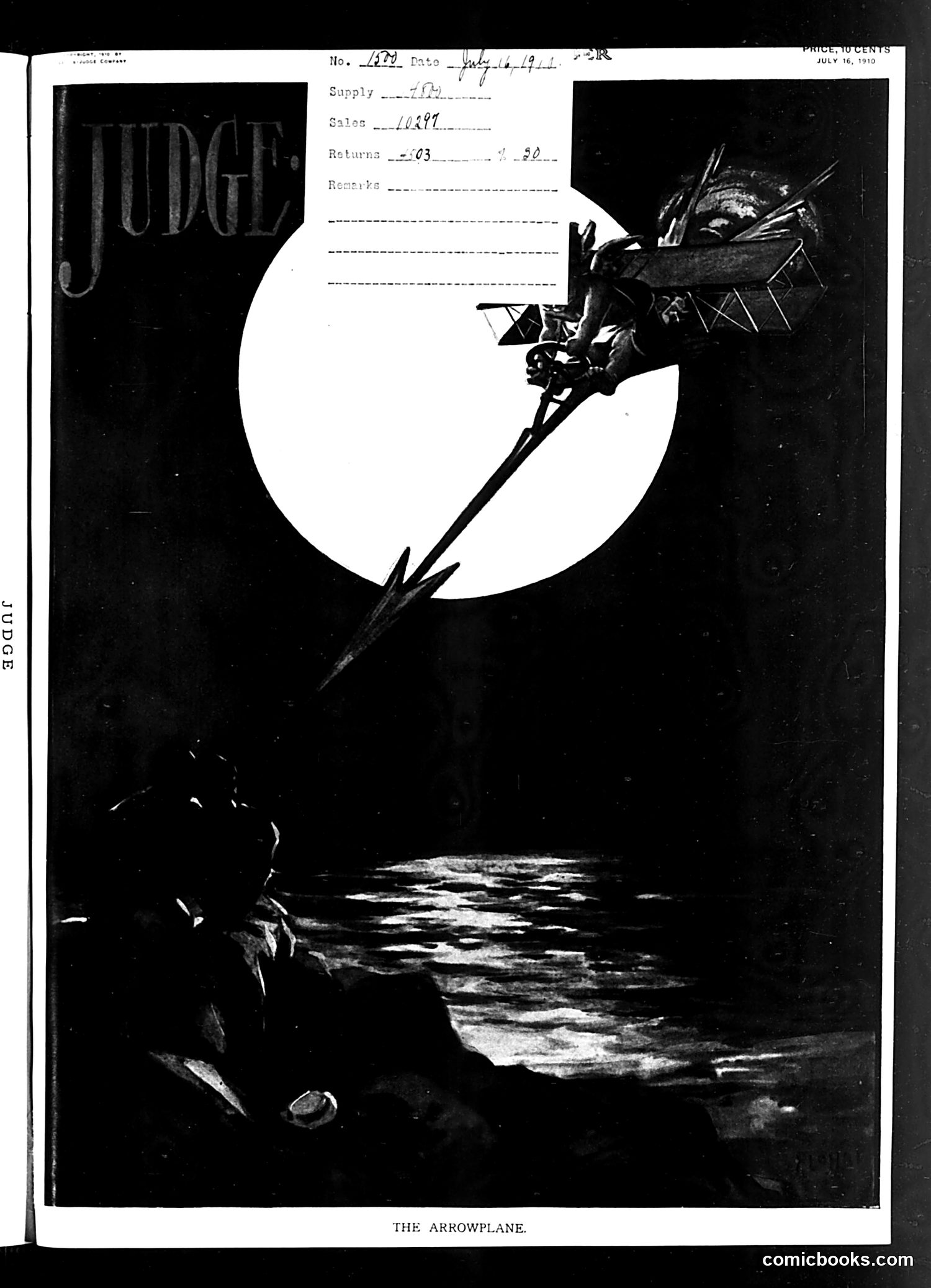
This appears to be an illustration for a satirical piece titled "The Arrowplane," though the full text is not legible in this image. The dramatic silhouette depicts an early aircraft flying past a large moon, with a figure wielding what looks like a bow and arrow aimed at the plane. Below, a person watches from the ground near water. Given the 1913 date, this likely satirizes early aviation's dangers or the novelty of aircraft technology. The "arrow" imagery may reference either primitive weaponry contrasted with modern flight, or perhaps a commentary on the era's anxieties about new technologies. Without the complete article text, the specific satirical point remains unclear, though it clearly plays on the juxtaposition of ancient and modern warfare/technology.
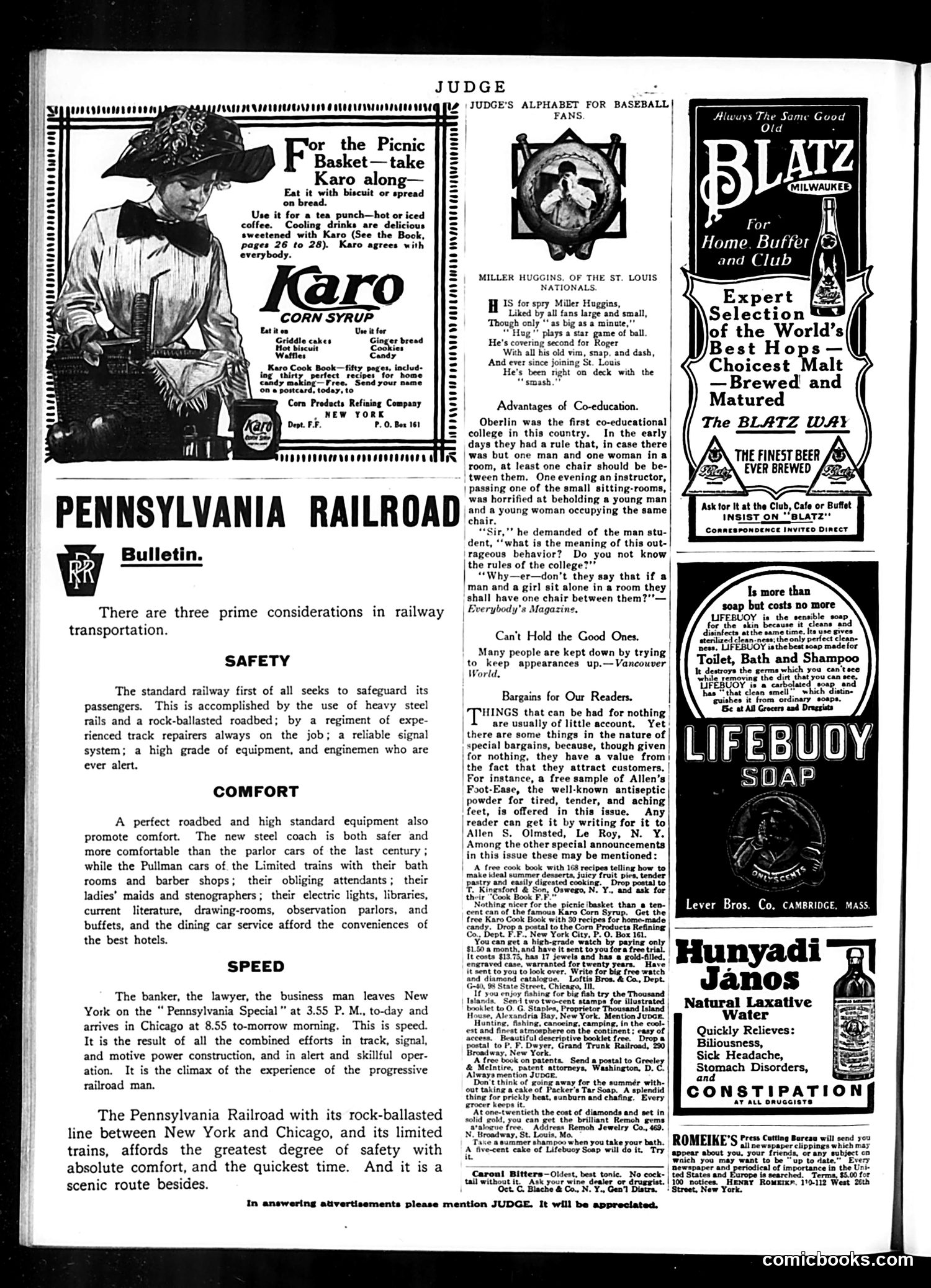
This page is predominantly **advertising rather than satirical content**. The main cartoon shows a woman in a wide-brimmed hat promoting Karo corn syrup for picnic baskets—a straightforward product advertisement, not political satire. The page includes: - A "Judge's Alphabet for Baseball Fans" section featuring Miller Huggins of the St. Louis Nationals (a real 1910s-20s baseball manager) - Multiple product ads: Blatz beer, Lifebuoy soap, Hunyadi János laxative water - A Pennsylvania Railroad bulletin about railway safety, comfort, and speed The baseball reference and advertising style suggest this is from the 1920s era. While Judge was known for satire, **this particular page functions primarily as a commercial vehicle**, mixing light entertainment (the baseball alphabet) with advertisements targeting middle-class consumers.
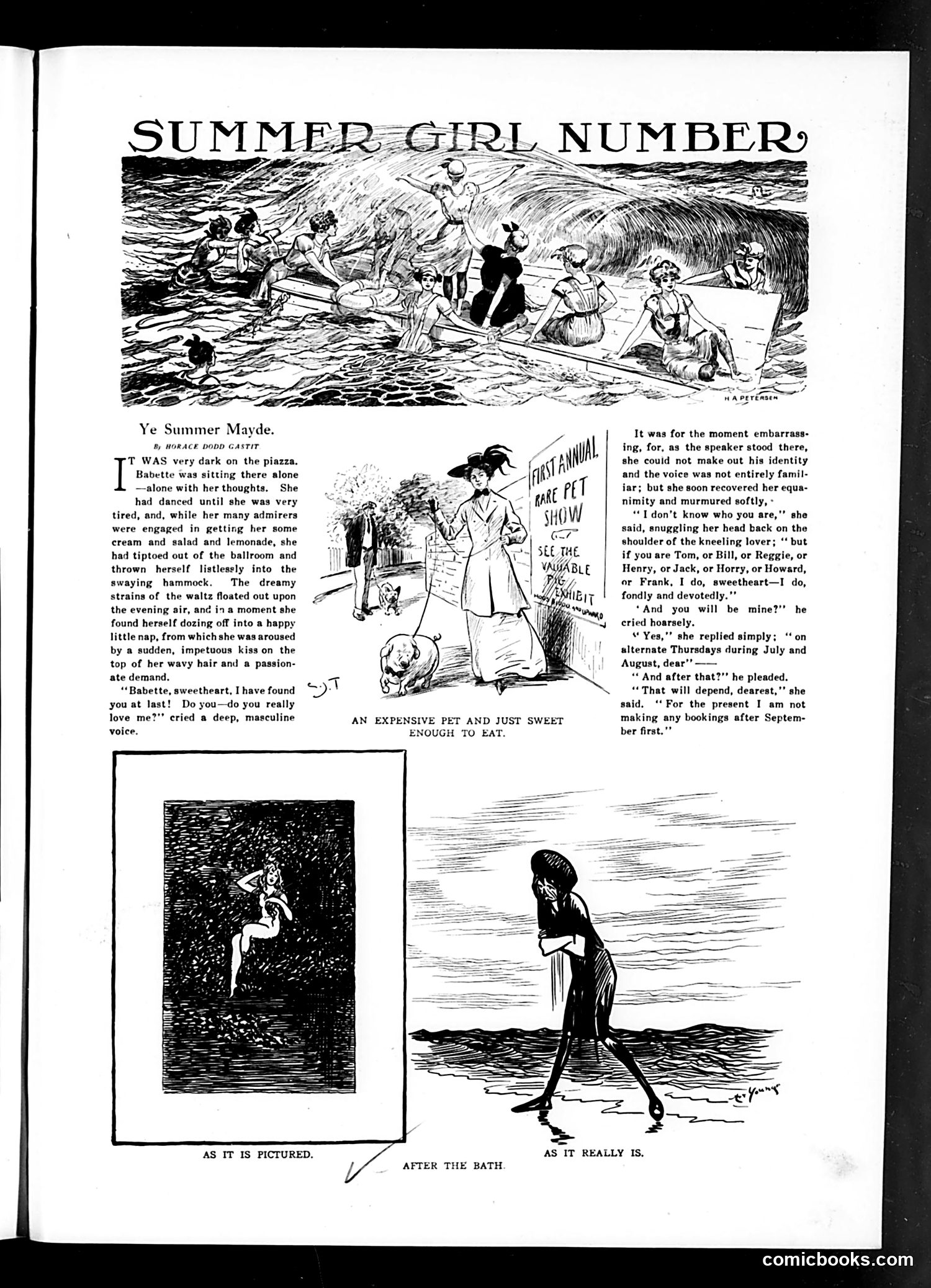
This "Summer Girl Number" satirizes the contrast between idealized and actual female beach appearance in the early 20th century. The top illustration shows an idealized beach scene. The story "Ye Summer Mayde" depicts a woman named Babette at the beach, portrayed romantically as graceful and attractive, inspiring male admiration. However, the bottom two panels mock this fantasy: "As It Is Pictured" shows an ethereal bathing beauty, while "As It Really Is" depicts the same woman as ungainly and awkwardly thin in her actual bathing costume. The joke targets contemporary magazine conventions that presented impossibly glamorous images of women. The satire suggests the gap between artistic fantasy and reality—a critique of how media representation distorted female bodies and beauty standards even in this era.
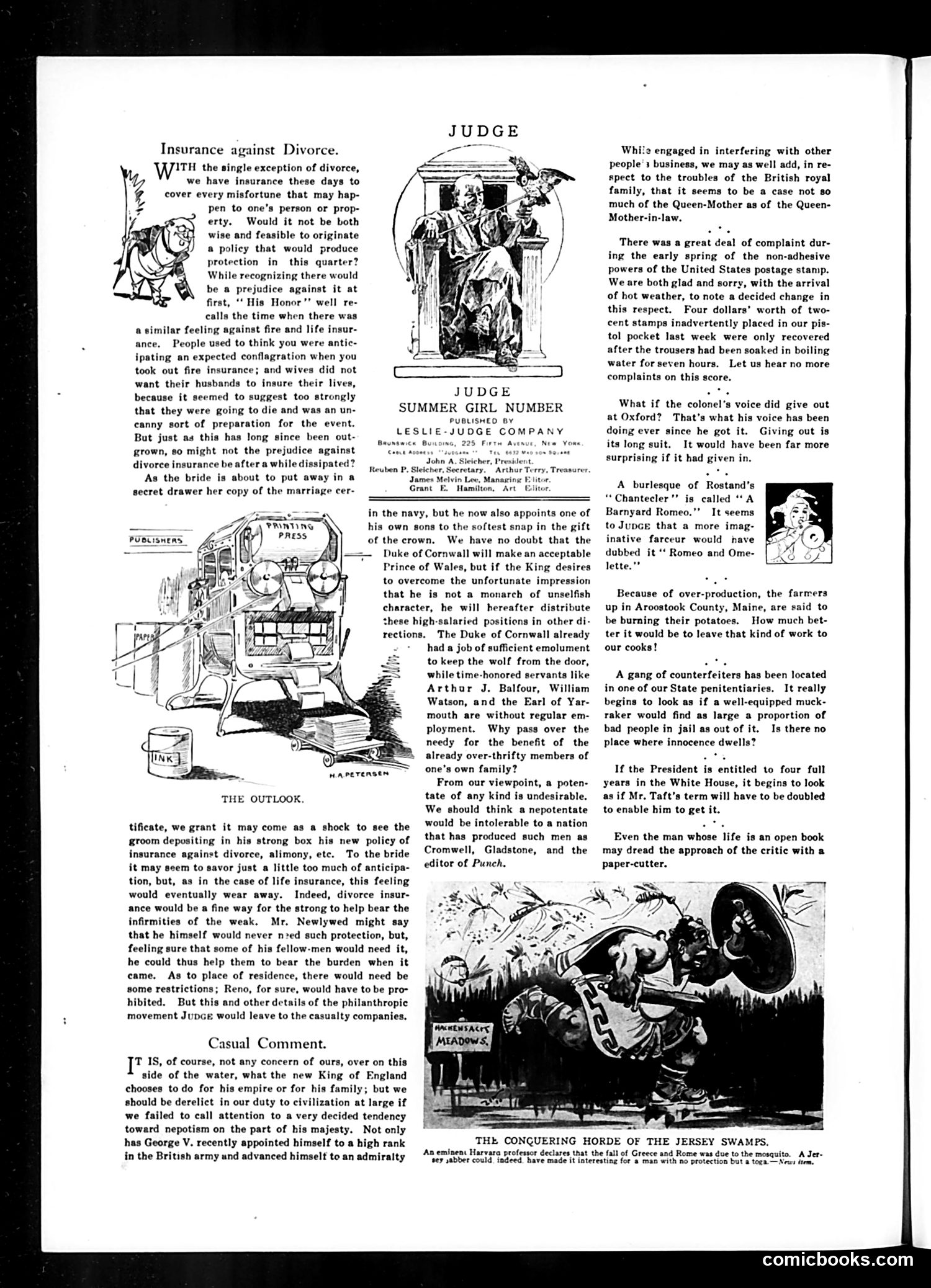
This page contains several satirical pieces from Judge magazine. The main cartoon titled "The Conquering Horde of the Jersey Swamps" appears to mock mosquitoes as a serious pest problem in New Jersey wetlands. The accompanying caption references a Harvard professor's theory that mosquitoes (not Rome or Greece's decline) caused civilizations to fall—satirizing academic overreach. The editorial sections discuss British royal family matters and American political issues, including complaints about defective postage stamps and counterfeiting problems. One piece mocks potential presidential term extensions. The "Insurance Against Divorce" section uses humorous commentary to critique divorce insurance proposals, suggesting such coverage enabled marital irresponsibility. Overall, the page blends political commentary with social satire typical of early 20th-century American humor magazines.
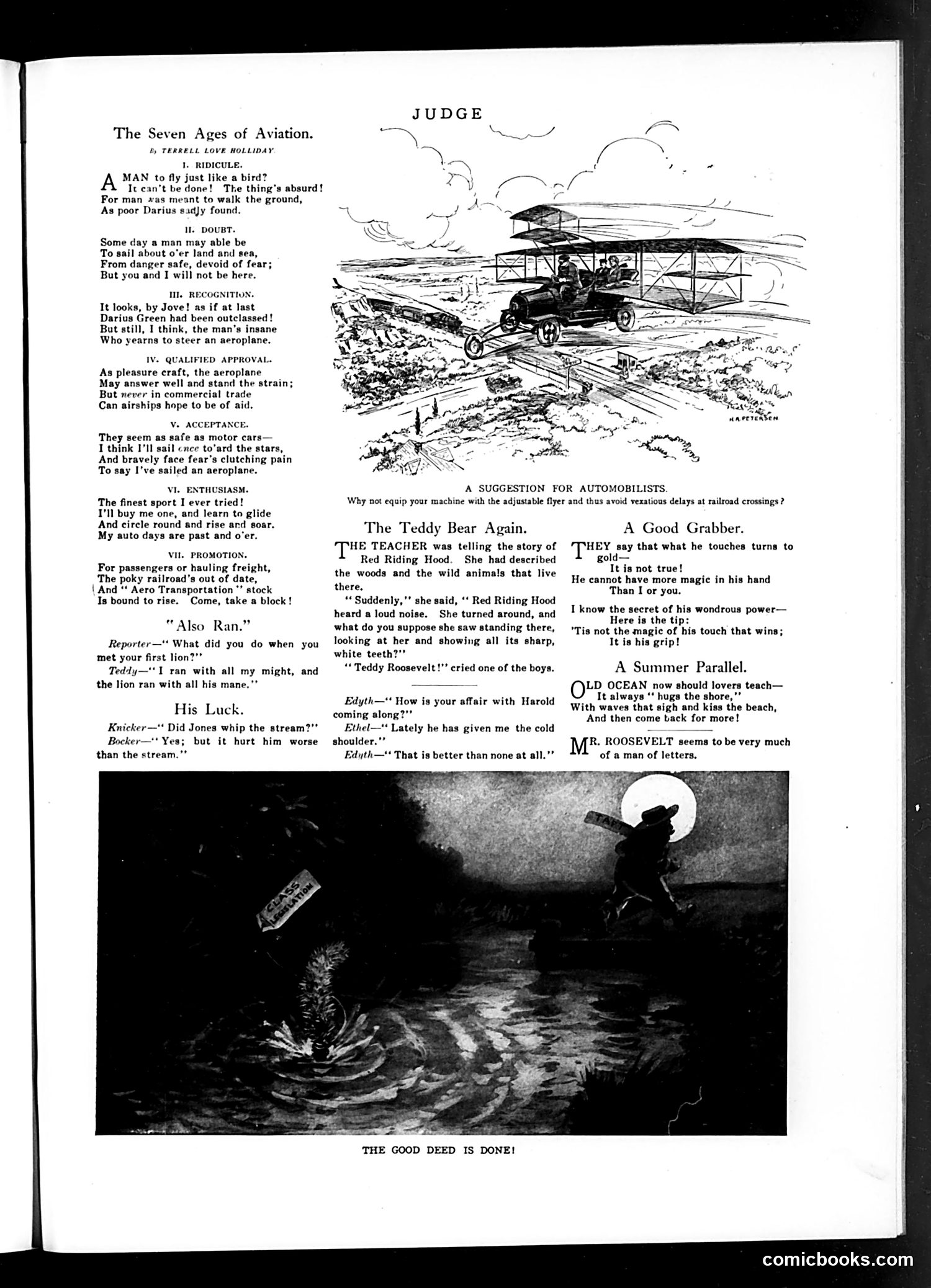
This page contains several pieces of humor content from Judge magazine: **"The Seven Ages of Aviation"** is a poetic satire (by Terrell Love Holliday) mocking early aviation enthusiasm through seven stages, from initial wonder ("A man to fly just like a bird") through practical skepticism about commercial viability. **The illustration** shows an early airplane with an adjustable roof, captioned as "A Suggestion for Automobiles"—satirizing how airplanes might solve traffic problems like railroad crossing delays. **The remaining short pieces** ("The Teddy Bear Again," "A Good Crabber," "A Summer Parallel," "His Luck," and "Mr. Roosevelt seems to be very much of a man of letters") are brief humorous anecdotes typical of Judge's format. The page reflects early-20th-century fascination with aviation technology and playful skepticism about its practical applications.
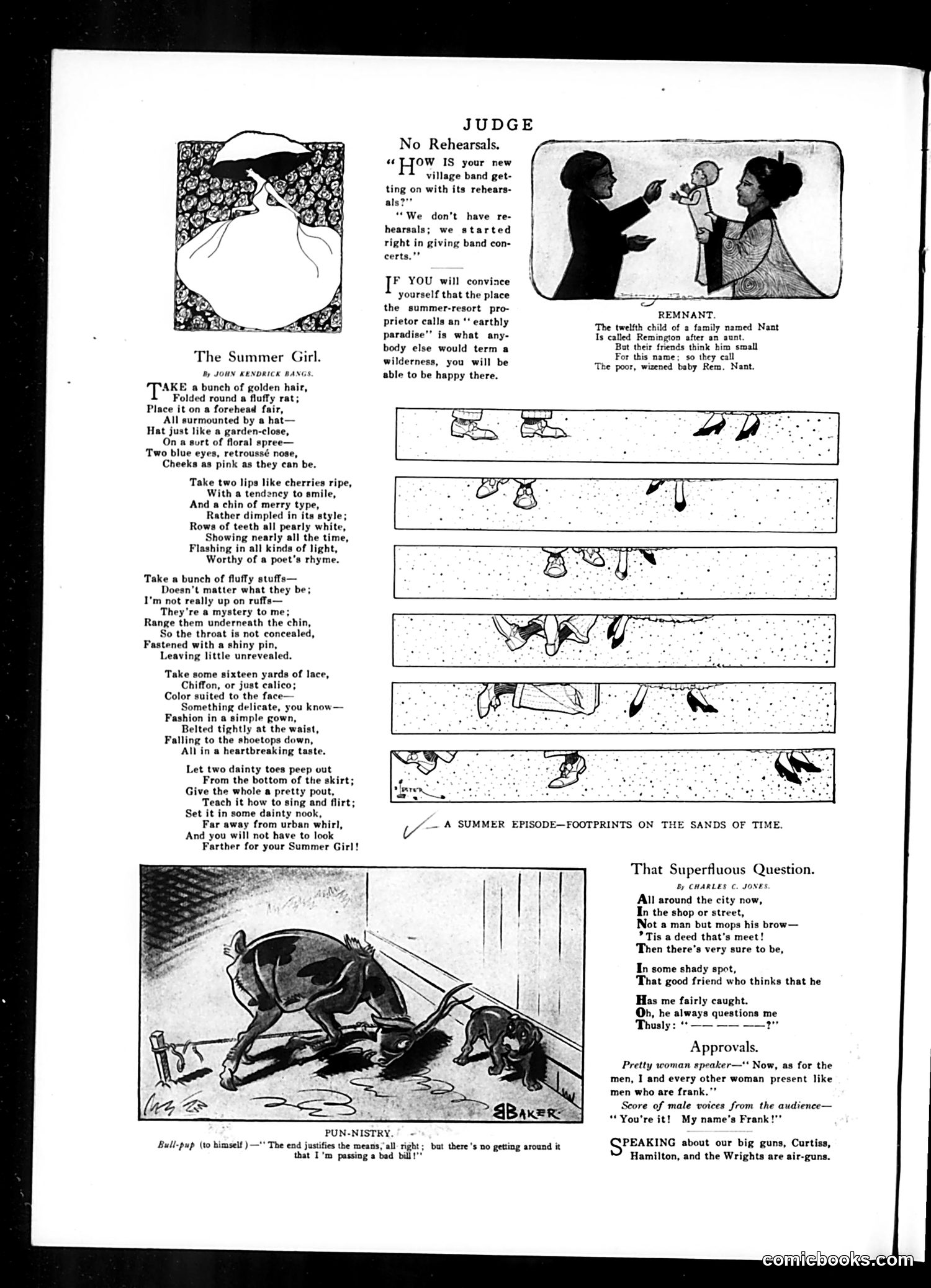
This Judge magazine page contains several pieces of light social commentary typical of early 20th-century humor: **"The Summer Girl"** is a poetic description of idealized feminine beauty—romantic verse celebrating a young woman's appearance and demeanor in a pastoral setting. It's nostalgic rather than satirical. **"No Rehearsals"** jokes about a village band that skipped practice and immediately performed concerts, suggesting amateurish incompetence presented as confidence. **"Remnant"** humorously notes that the twelfth child in a family named Nant gets called "Remnant"—a pun on the fabric/clothing term. **"Footprints on the Sands of Time"** appears to be a sequential comic strip showing everyday beach or seaside scenes. **"That Superfluous Question"** satirizes a female speaker advocating for "frank" men, only to have multiple men named Frank respond—a play on words joke. **"Fun-nistry"** presents a pun about passing a "bad bill" (legislative/financial meaning). The overall tone is genteel, pun-heavy Victorian/Edwardian humor aimed at middle-class readers.
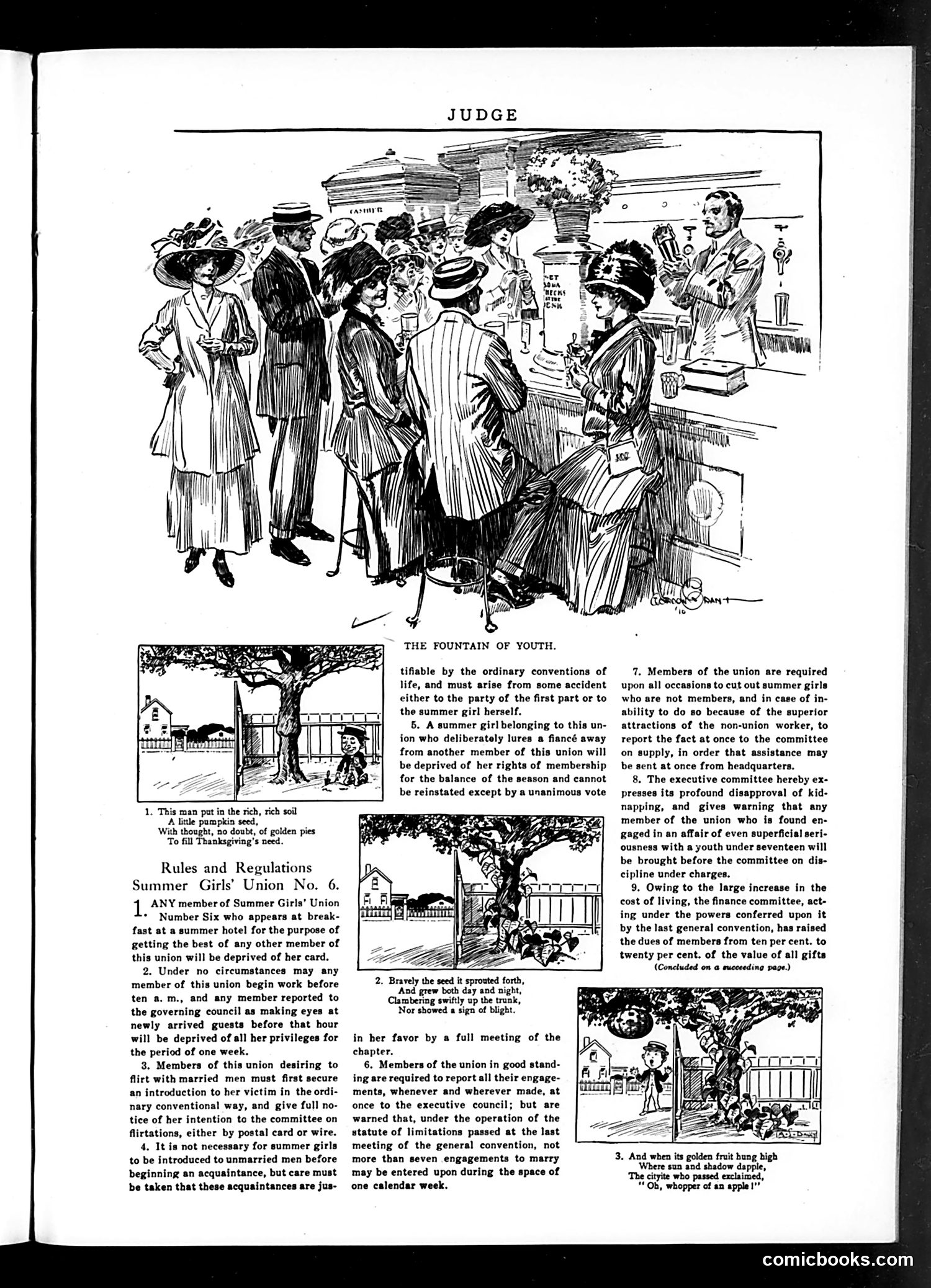
This page satirizes the "Summer Girls' Union," a humorous fictional organization regulating young women vacationing at summer hotels. The mock "Rules and Regulations" parody how these women—often called "summer girls"—pursued romantic flirtations and leisure during summer resort season, a popular activity for unmarried women of the Edwardian era. The satire targets several behaviors: competitive flirting with guests, pursuing married men, casual engagements to marry (rule 6 allows seven engagements per week), and even kidnapping concerns. The detailed bylaws mock both the women's frivolous social maneuvering and the era's rigid courtship conventions requiring formal introductions and parental oversight. "The Fountain of Youth" story (illustrated) offers complementary humor about urban visitors' naiveté regarding country life—a man expecting Thanksgiving pies from a planted pumpkin seed. The overall message: summer resort culture encouraged unserious romantic behavior that required elaborate social policing.
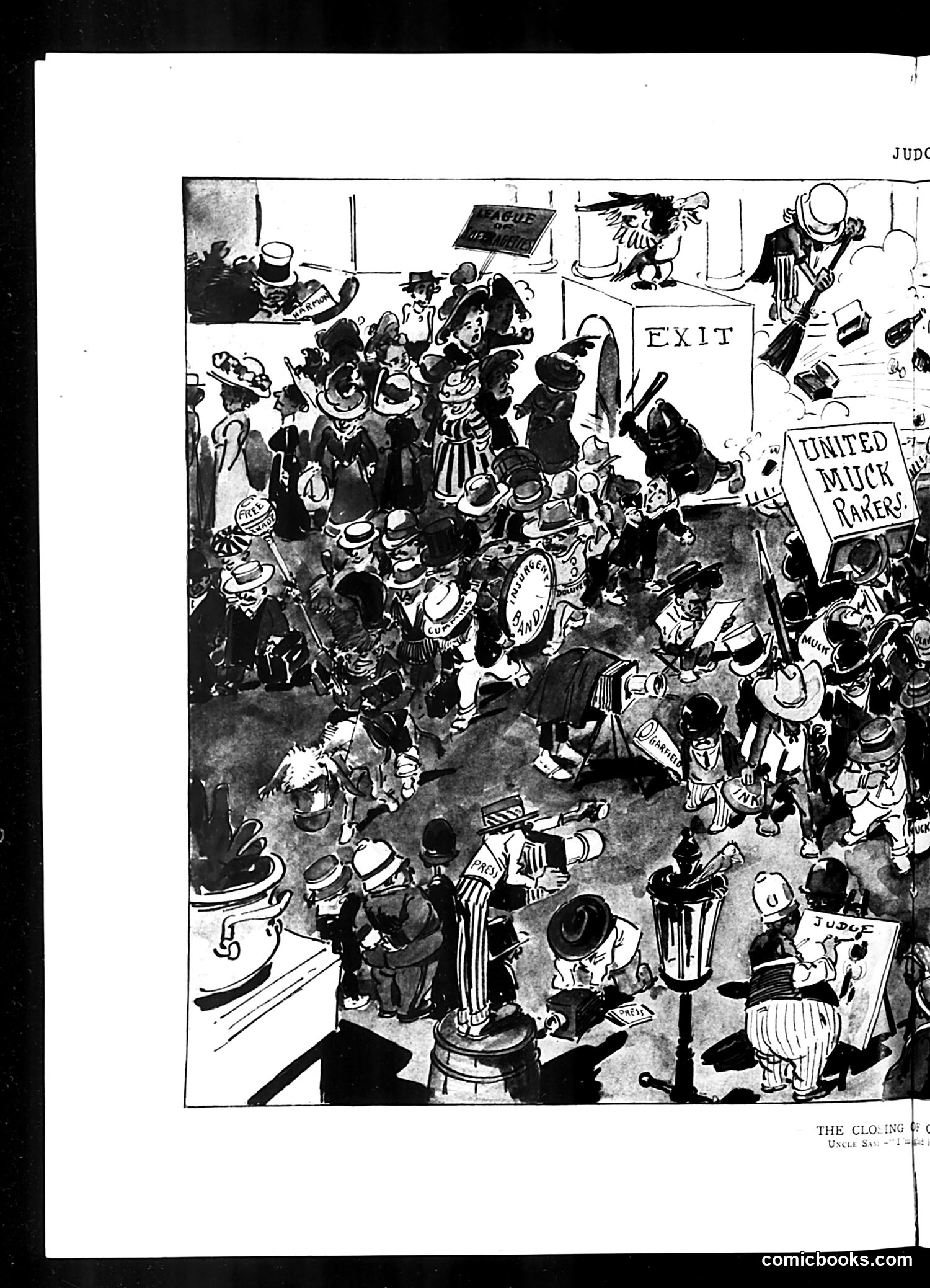
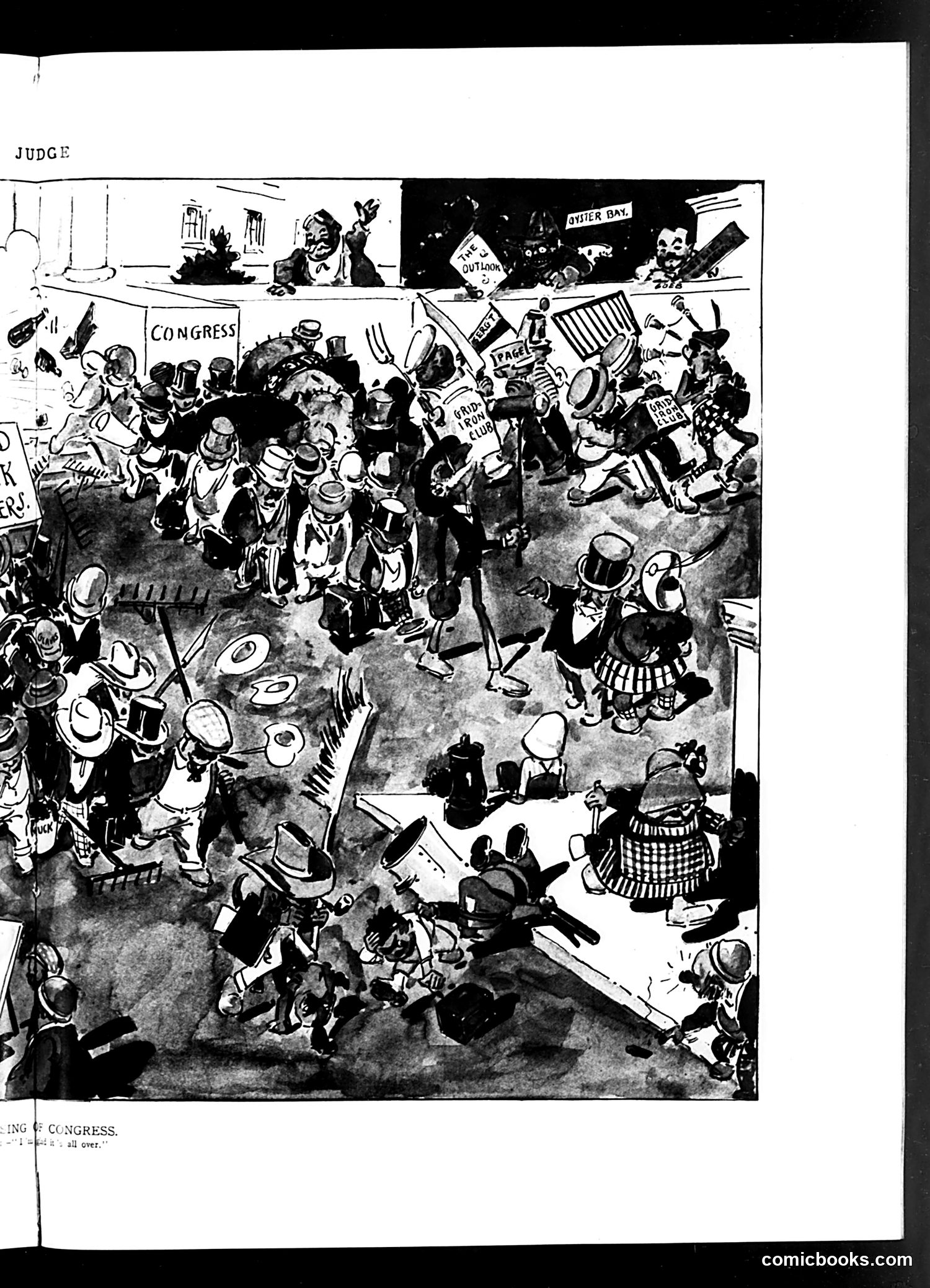
This Judge magazine cartoon depicts a chaotic labor protest or strike scene. The central image shows a crowded gathering with signs reading "UNITED MUCH RAKERS" (likely "UNITED MUCK RAKERS" or similar labor union reference). An "EXIT" sign is visible, suggesting this occurs in an indoor venue—possibly a meeting hall or theater. The cartoon satirizes labor activism, portraying protesters as a disorganized, comedic mob of working-class figures wearing hats and carrying signs. The style is typical of early 20th-century political satire, using exaggeration and caricature to mock labor organizers and their supporters. Without the complete publication date or clearer text, the specific strike or labor dispute cannot be definitively identified, but the overall message appears to ridicule labor movements as chaotic and illegitimate rather than serious political concerns.
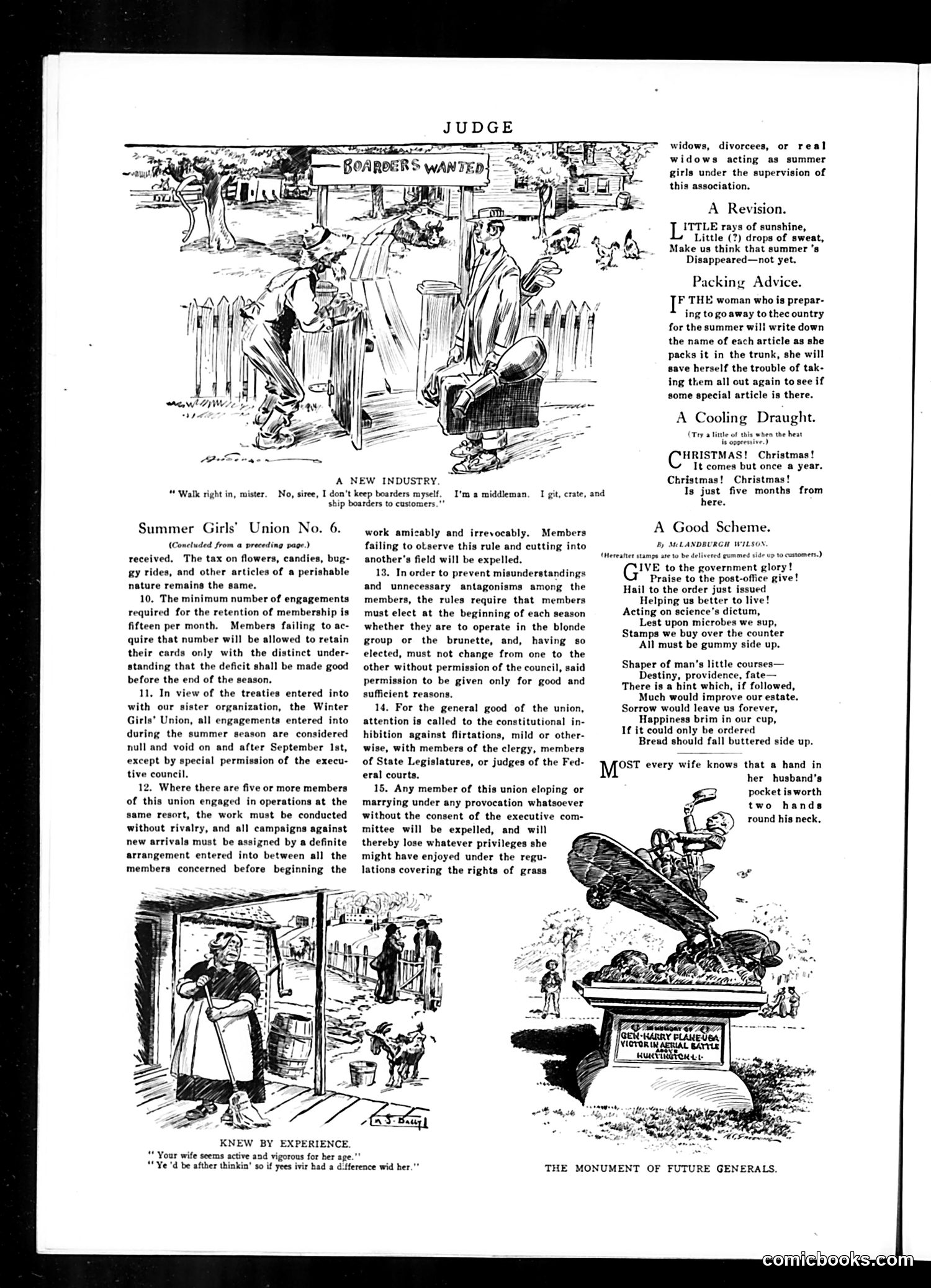
This page satirizes the "Summer Girls' Union," a humorous organization regulating young women hired as seasonal companions/entertainers at resort destinations. The detailed bylaws mock both the formality of labor unions and the commodification of young women's social availability. Key satirical elements include: - **Rule 10**: A "tax" on courtship activities (flowers, carriage rides) - **Rule 13**: Members must declare whether they'll pursue "blonde" or "brunette" men, suggesting women are organized like competing sales divisions - **Rule 14**: Prohibiting flirtation with clergy and judges—implying these were typical targets - **The "middleman"** cartoon above: A man describes himself as a broker supplying "boarders" (young women) to customers, treating romantic companionship as a commercial transaction The satire critiques both the transactional nature of turn-of-century courtship for working-class women and the absurdity of formalizing such arrangements through union rules.
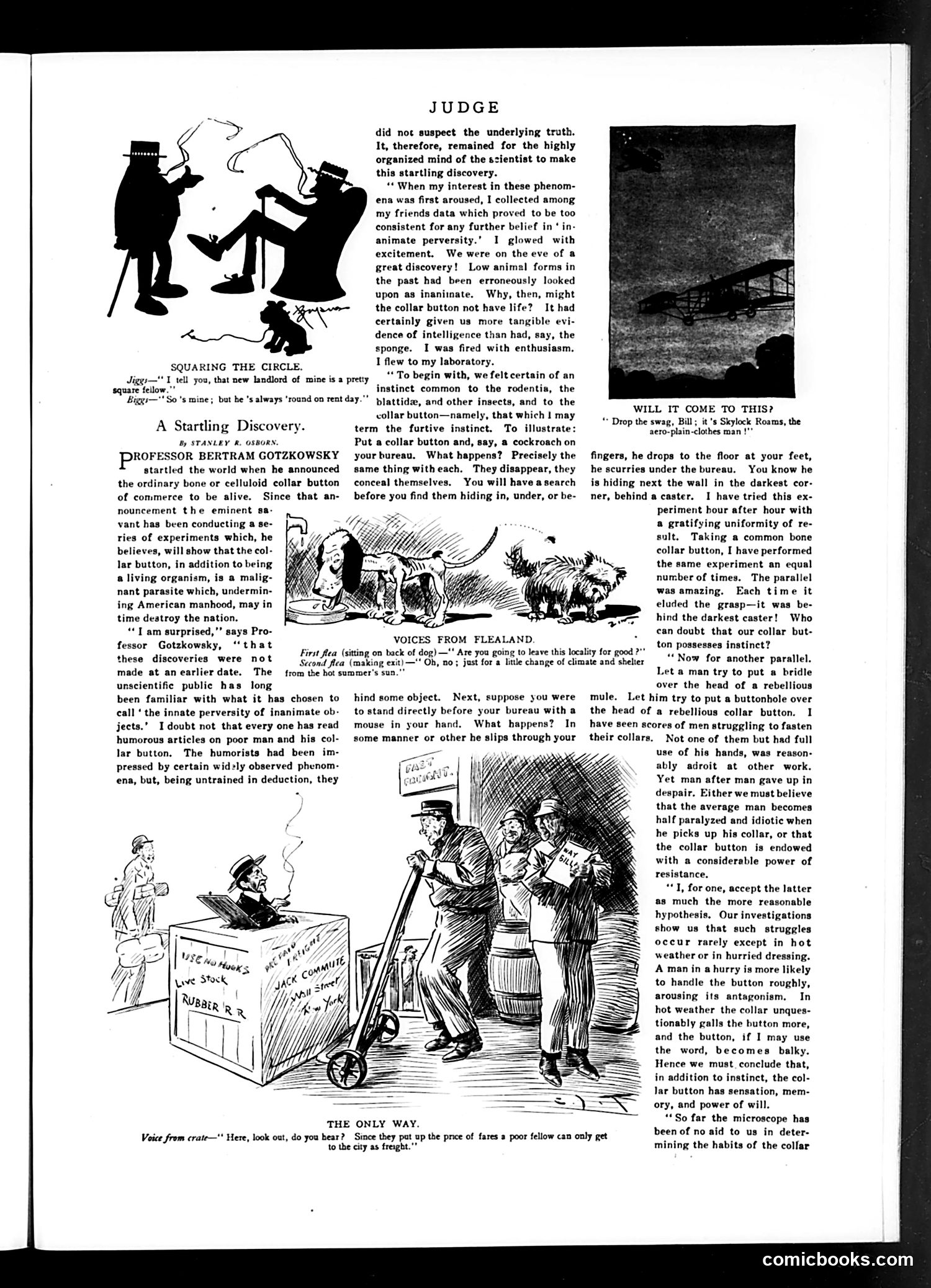
This page satirizes the contemporary frustration with collar buttons—small fasteners that frequently disappear or resist being buttoned. The central conceit, "A Startling Discovery" by Stanley Osbory, presents a fictional Professor Gotzkowsky who claims collar buttons are actually living organisms with "furtive instinct" and "malignant" properties. The satire mocks both pseudo-scientific pretension and the common male experience of struggling with recalcitrant collar buttons. By attributing buttons' elusiveness to deliberate, intelligent behavior rather than chance, the piece humorously validates men's exasperation—suggesting their frustration isn't incompetence but rather combat with a cunning adversary. The supporting cartoons ("Squaring the Circle," "Voices from Flea-land," "Will It Come to This?") are disconnected vignettes typical of Judge's format. The overall effect ridicules the gap between scientific authority and everyday domestic annoyances, while commiserating with male readers about a genuinely irritating Victorian-era problem.
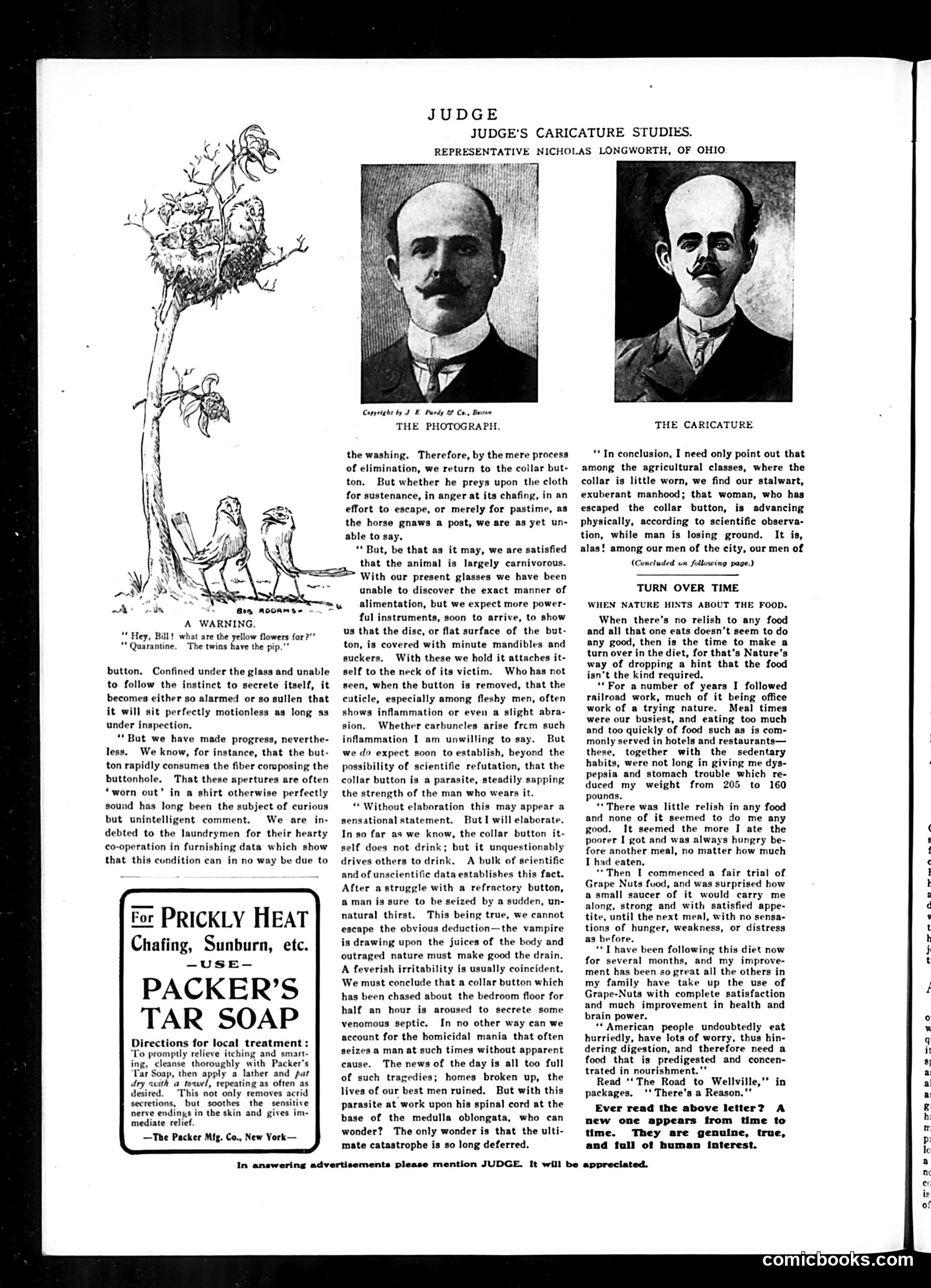
This page presents "caricature studies" of Representative Nicholas Longworth of Ohio—a photograph paired with an exaggerated cartoon drawing. The caricature emphasizes Longworth's distinctive features, particularly his facial structure and prominent mustache, rendered in the unflattering style typical of Judge's political satire. The accompanying text discusses the "collar button" as a parasitic creature, using pseudoscientific language to satirize it as something that drives men to madness and violence. This appears to be a humorous editorial commentary using absurdist humor—a Judge trademark—to mock everyday frustrations. Longworth (1869-1931) was a prominent Republican congressman and later Speaker of the House, so his appearance in this satirical magazine was typical of the era's political cartooning tradition, though the specific satirical point remains unclear from this excerpt alone.
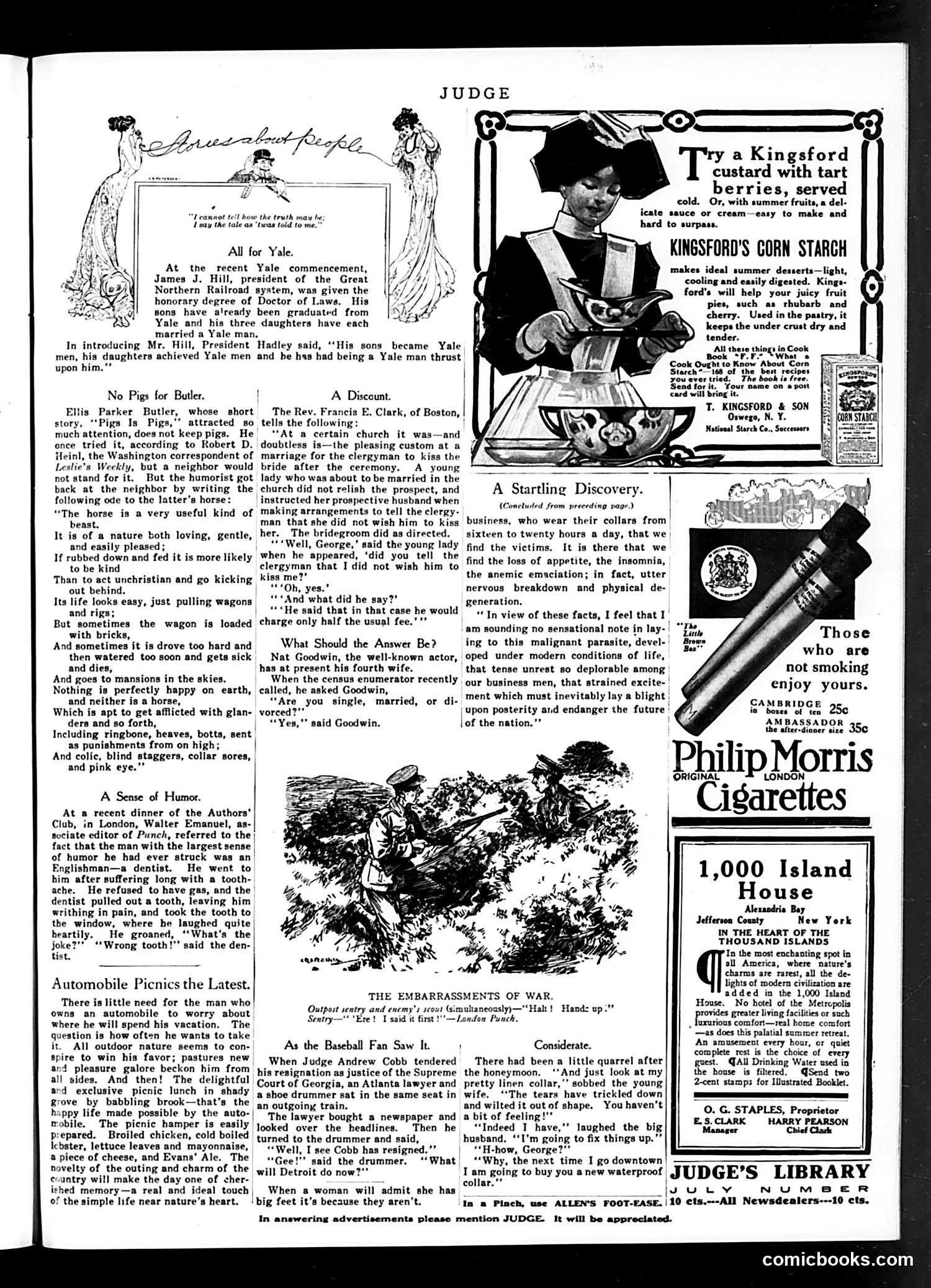
This page from *Judge* magazine contains several humorous anecdotes rather than political cartoons. The pieces include: **"All for Yale"**: A joke about James J. Hill, president of the Great Northern Railroad, receiving an honorary Yale degree. The humor lies in the observation that his entire family—sons, daughters, and sons-in-law—are Yale-connected, so he's had Yale "thrust upon him" despite his success. **"No Pigs for Butler"**: References author Ellis Parker Butler (famous for the story "Pigs Is Pigs"). Butler allegedly wrote a humorous poem mocking a neighbor's horse after the neighbor objected to Butler keeping pigs. **"A Discount"**: A brief anecdote about a clergyman who agrees not to kiss the bride at a wedding—implying he charges less for ceremonies without this traditional act. The page is primarily **light social satire** about upper-class life, literary figures, and social customs—typical of *Judge's* genteel humor. It contains advertisements for consumer products (Kingsford's Corn Starch, Philip Morris cigarettes) alongside the editorial content.
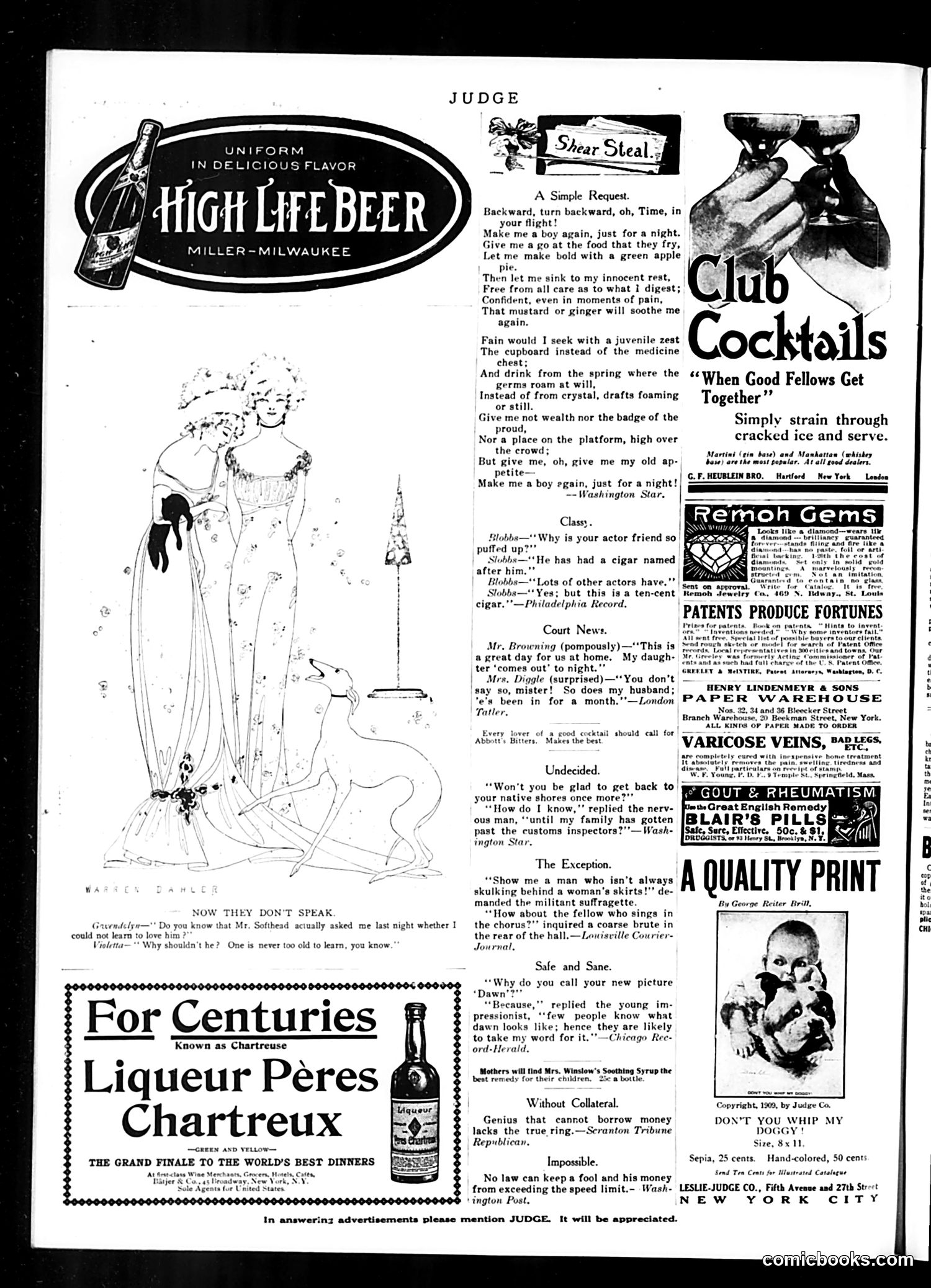
This page from Judge (circa 1909) contains humorous short jokes and advertisements rather than a coherent political cartoon. **Notable Content:** The central illustrated figure appears to be a woman in Edwardian dress, accompanying a poem titled "A Simple Request" about nostalgically wanting to be a carefree boy again—able to eat rich foods and drink unfiltered water without worrying about digestion. **The jokes mock:** - An actor's vanity over a cigar named after him - A husband's recent jail release (dark humor about marital discord) - Suffragettes' militancy, with a quip about male chorus singers - Art world pretension (an impressionist calling a painting "Dawn" because viewers can't verify what dawn looks like) **Advertisements throughout** promote liqueurs, patent medicines (Mrs. Winslow's Soothing Syrup), pills for various ailments, and printing services—typical of Judge's revenue model. The page is largely commercial, with humor serving to attract readers between ads rather than advancing any coherent satirical argument.
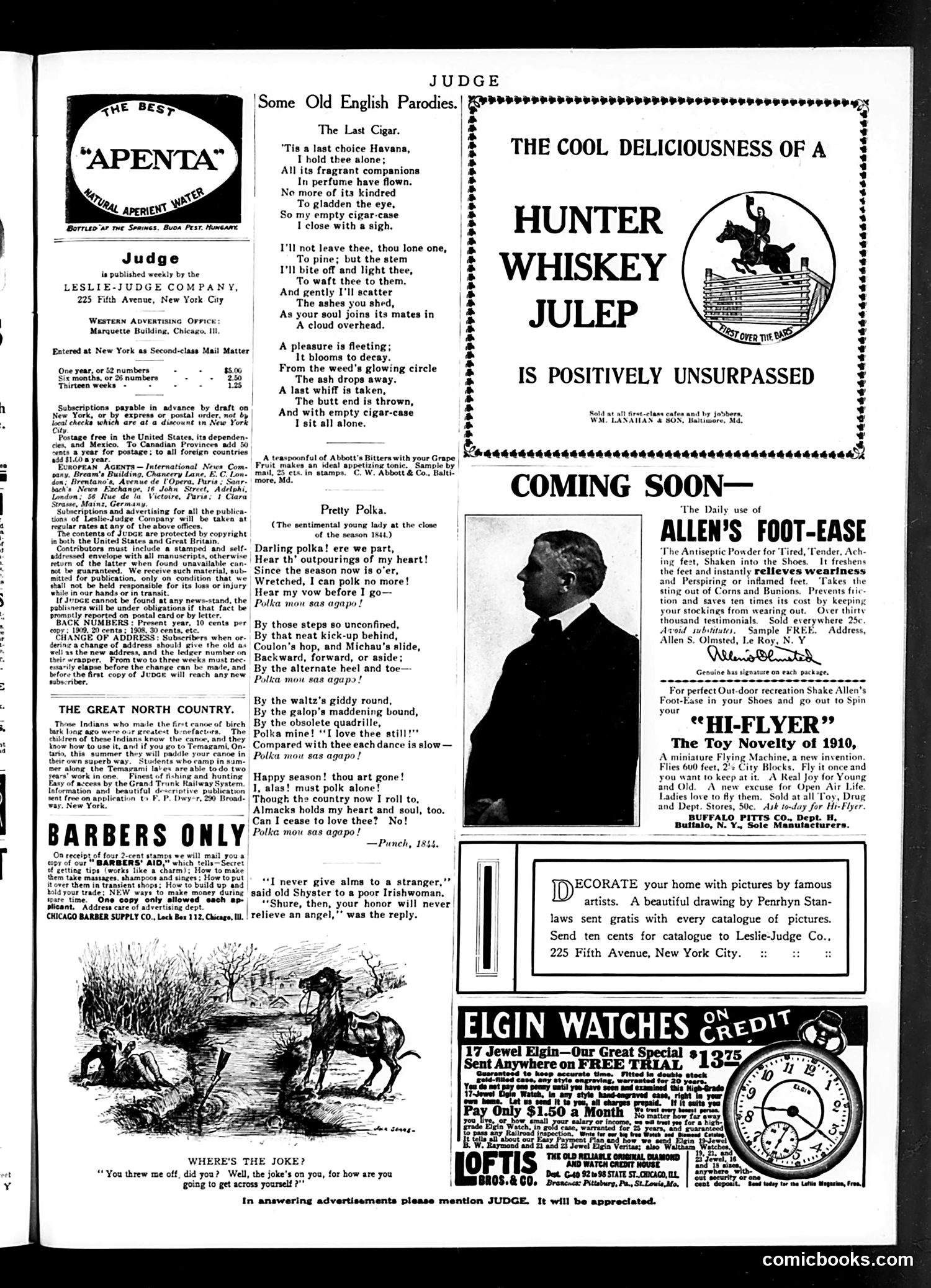
This page consists primarily of advertisements and filler content typical of Judge magazine's back pages, with one notable political parody. The main satirical piece is "Pretty Polka," reprinted from Punch (1844). It's a sentimental Victorian-era parody that personifies the polka dance as a romantic object the speaker must abandon after the social season ends—a gentle mockery of the overwrought sentiment in period love poetry and the rigid seasonal social calendar of the era. The page also includes "The Last Cigar" (another period parody about emotionally mourning a final cigar), advertisements for products like Apenta water and Abbott's Bitters, and an amusing exchange where an old man advises not giving alms to strangers, leading to the Irishwoman's retort that he'll never "relieve an" [angel]—a religious pun on charity versus supernatural beings. The cartoons and sketches are generally light humor targeting Victorian manners and expectations.