
Judge, 1910-07-16 · page 11 of 16
Judge — July 16, 1910 — page 11: what you’re looking at
What you’re looking at
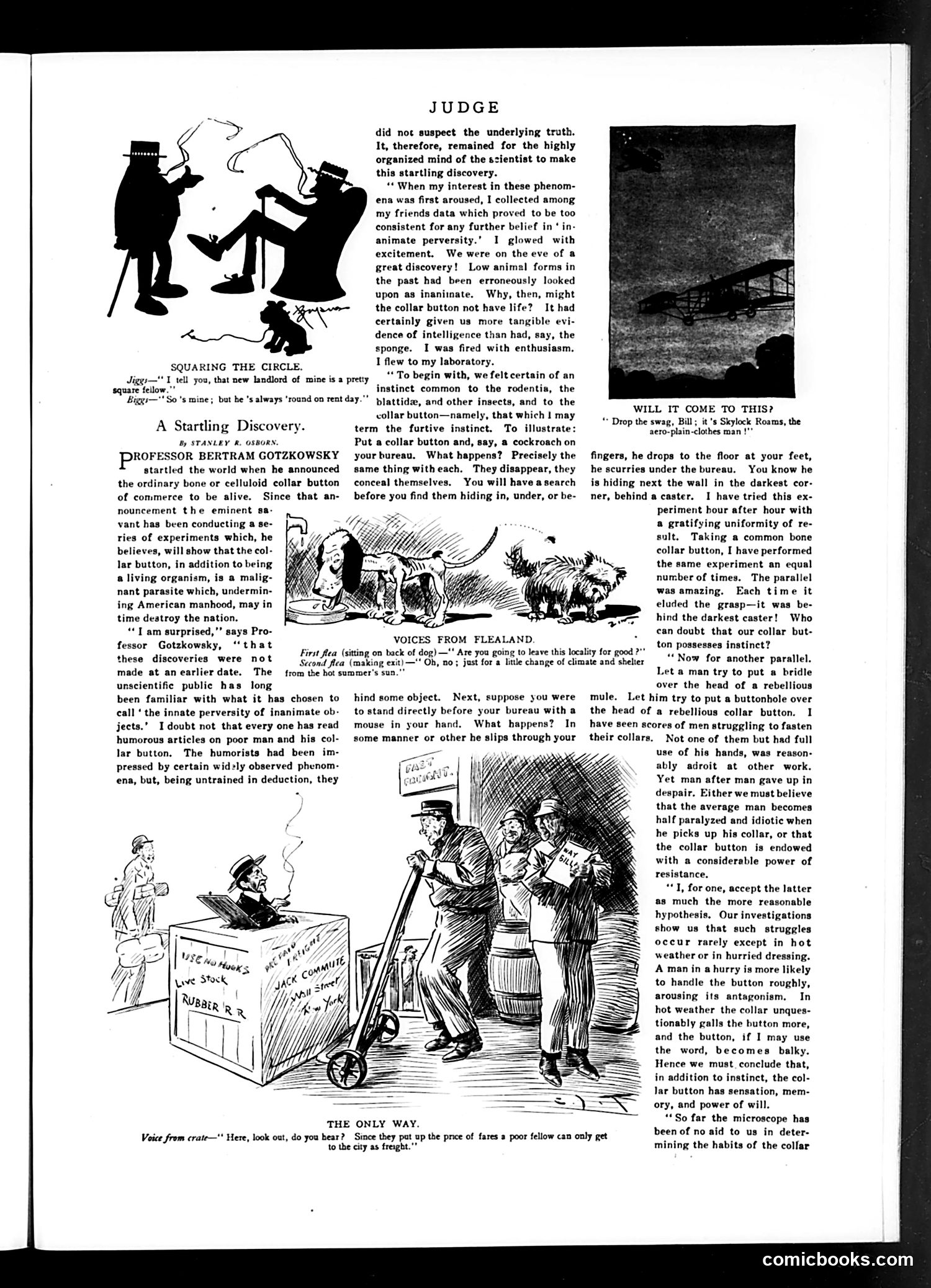
This page satirizes the contemporary frustration with collar buttons—small fasteners that frequently disappear or resist being buttoned. The central conceit, "A Startling Discovery" by Stanley Osbory, presents a fictional Professor Gotzkowsky who claims collar buttons are actually living organisms with "furtive instinct" and "malignant" properties. The satire mocks both pseudo-scientific pretension and the common male experience of struggling with recalcitrant collar buttons. By attributing buttons' elusiveness to deliberate, intelligent behavior rather than chance, the piece humorously validates men's exasperation—suggesting their frustration isn't incompetence but rather combat with a cunning adversary. The supporting cartoons ("Squaring the Circle," "Voices from Flea-land," "Will It Come to This?") are disconnected vignettes typical of Judge's format. The overall effect ridicules the gap between scientific authority and everyday domestic annoyances, while commiserating with male readers about a genuinely irritating Victorian-era problem.
📄 Transcribed text from this page (OCR, searchable)
Machine-transcribed from the original scan — historical spelling and the odd misread are preserved.
SQUARING THE CIRCLE. Jiggs—"" 1 tell you, that new landlord of mine is a pretty square fellow. Biggs—"" So's mine; but he 's always ‘round on rent day."’ A Startling Discovery. by STANLEY &, OSBORY. ROFESSOR BERTRAM GOTZKOWSKY startled the world when he announced the ordinary bone or celluloid collar button of commerce to be alive. Since that an- nouncement the eminent sa- vant has been conducting a se- ries of experiments which, he believes, will show that the col- lar button, in addition to being a living organism, is a malig- nant parasite which, undermin- ing American manhood, may in time destroy the nation. “Tam surprised,’ says Pro- fessor Gotzkowsky, “that these discoveries were not made at an earlier date. The unscientific public has long been familiar with what it has chosen to call ‘ the innate perversity of inanimate ob- jects.’ I doubt not that every one has read humorous articles on poor man and his col- lar button. The humorists had been im- pressed by certain widely observed phenom- ena, but, being untrained in deduction, they Second flea (making exit) —“* Ob, no; from the hot summer's sun.’ JUDGE did not suspect the underlying truth. It, therefore, remained for the highly organized mind of the scientist to make this startling discovery. “* When my interest in these phenom- ena was first aroused, I collected among my friends data which proved to be too consistent for any further belief in‘ in- animate perversity.’ I glowed with excitement. We were on the eve of a great discovery! Low animal forms in the past had been erroneously looked upon as inaniinate. Why, then, might the collar button not have lif It had certainly given us more tangible evi- dence of intelligence than had, say, the sponge. I was fired with enthusiasm. I flew to my laboratory. “To begin with, we felt certain of an instinct common to the rodentia, the blattide, and other insects, and to the collar button—namely, that which | may term the furtive instinct. To illustrate: Put a collar button and, say, a cockroach on your bureau. What happens? Precisely the same thing witheach. They disappear, they conceal themselves, You will have a search before you find them hiding in, under, or be- VOICES FROM FLEALAND. First flea (sitting on back of dog)—"' Are you going to leave this locality for good ?"* just for a little change of climate and shelter hind some object. Next, suppose you were to stand directly before your bureau with a mouse in your hand. What happens? In some manner or other he slips through your WILL IT COME TO THIS? “ Drop the swag, Bill; it’s Skylock Roams, the aero-plain-clothes man !"" fingers, he drops to the floor at your feet, he scurries under the bureau. You know he is hiding next the wall in the darkest cor- ner, behind a caster. I have tried this ex- periment bour after hour a gratifying uniformity of re- sult. Taking a common bone collar button, I have performed the same experiment an equal number of times. The parallel was amazing. Each time it eluded the grasp—it was be- hind the darkest caster! Who can doubt that our collar but- ton possesses instinct? “Now for another parallel. Let a man try to put a bridle over the head of a rebellious mule. Let him try to put a buttonhole over the head of a rebellious collar button. 1 have seen scores of men struggling to fasten their collars. Not one of them but had full use of his hands, was reason- ably adroit at other work. Yet man after man gave up in despair. Either we must believe that the average man becomes half paralyzed and idiotic when he picks up his collar, or that the collar button is endowed with a considerable power of resistance. “+I, for one, accept the latter as much the more reasonable hypothesis. Our investigations show us that such struggles occur rarely except in hot weather or in hurried dressing. A man in a hurry is more likely to handle the button roughly, arousing its antagonism, In hot weather the collar unques- tionably galls the button more, and the button, if I may use the word, becomes balky. Hence we must. conclude that, in addition to instinct, the col- THE ONLY WAY. Voice from crate—"* Here, look out, do you bear? Since they pat up the price of fares a poor fellow can only get to the city as freight."” Jar button has sensation, mem- ory, and power of will. “So far the microscope has been of no aid to us in deter- mining the habits of the collar comicbooks.com