
A complete issue · 16 pages · 1909
Judge — July 17, 1909
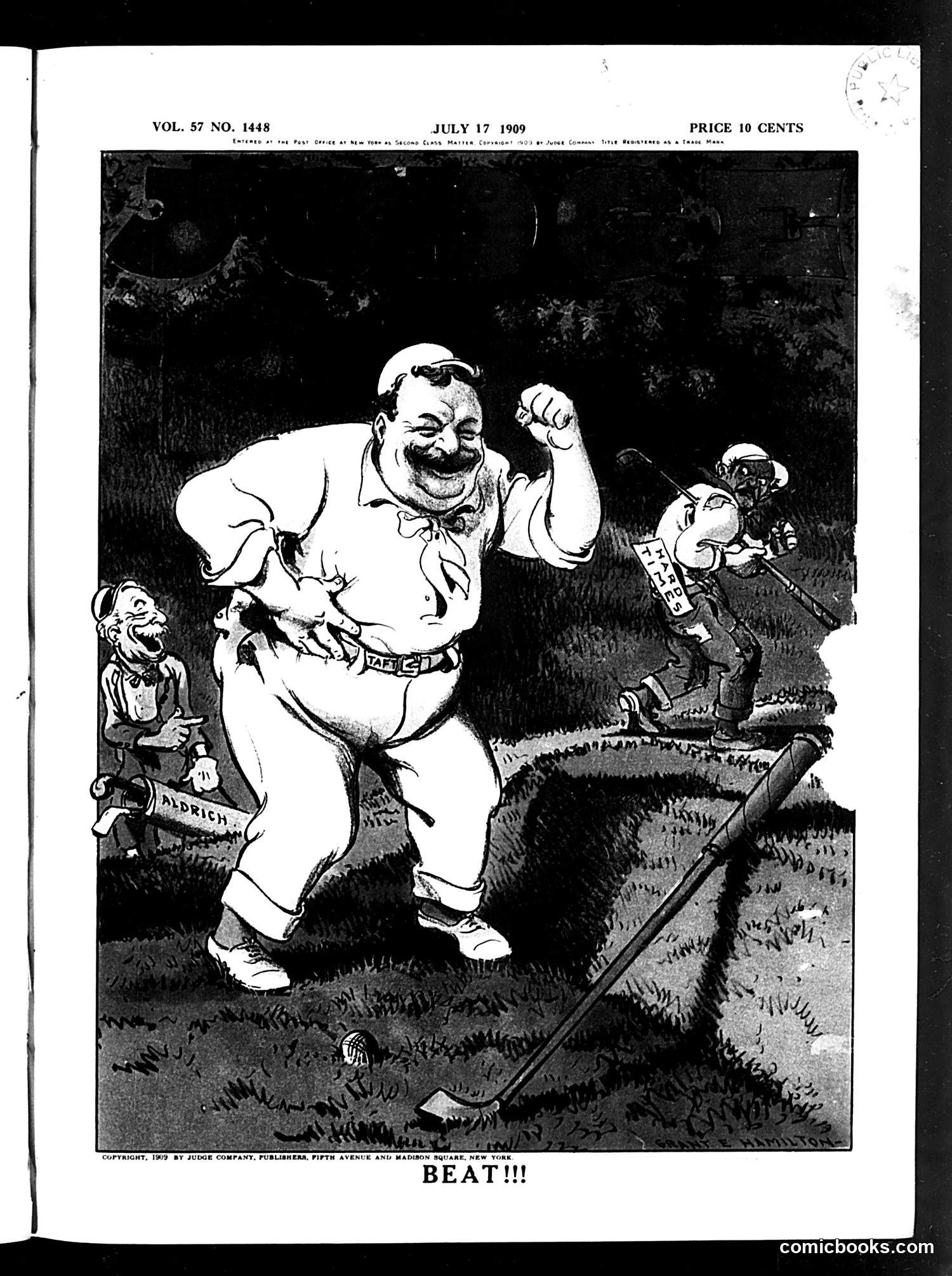
This cartoon depicts a large, jovial man wielding a club or bat, appearing to strike at smaller figures representing what appear to be political opponents or rivals. The central figure's exaggerated features and aggressive posture suggest this is satirical commentary on political conflict or competition. The smaller figures fleeing or cowering suggest they are being defeated or "beaten" in some political struggle. The title "BEAT!!!" emphasizes this theme of victory through force or dominance. Without clearer identification of the specific figures or labels visible in the image, I cannot definitively state which political figures or events this references. The style is consistent with early 20th-century American political satire, likely commenting on a specific contemporary political battle, election, or scandal, but the particular context remains unclear from this image alone.
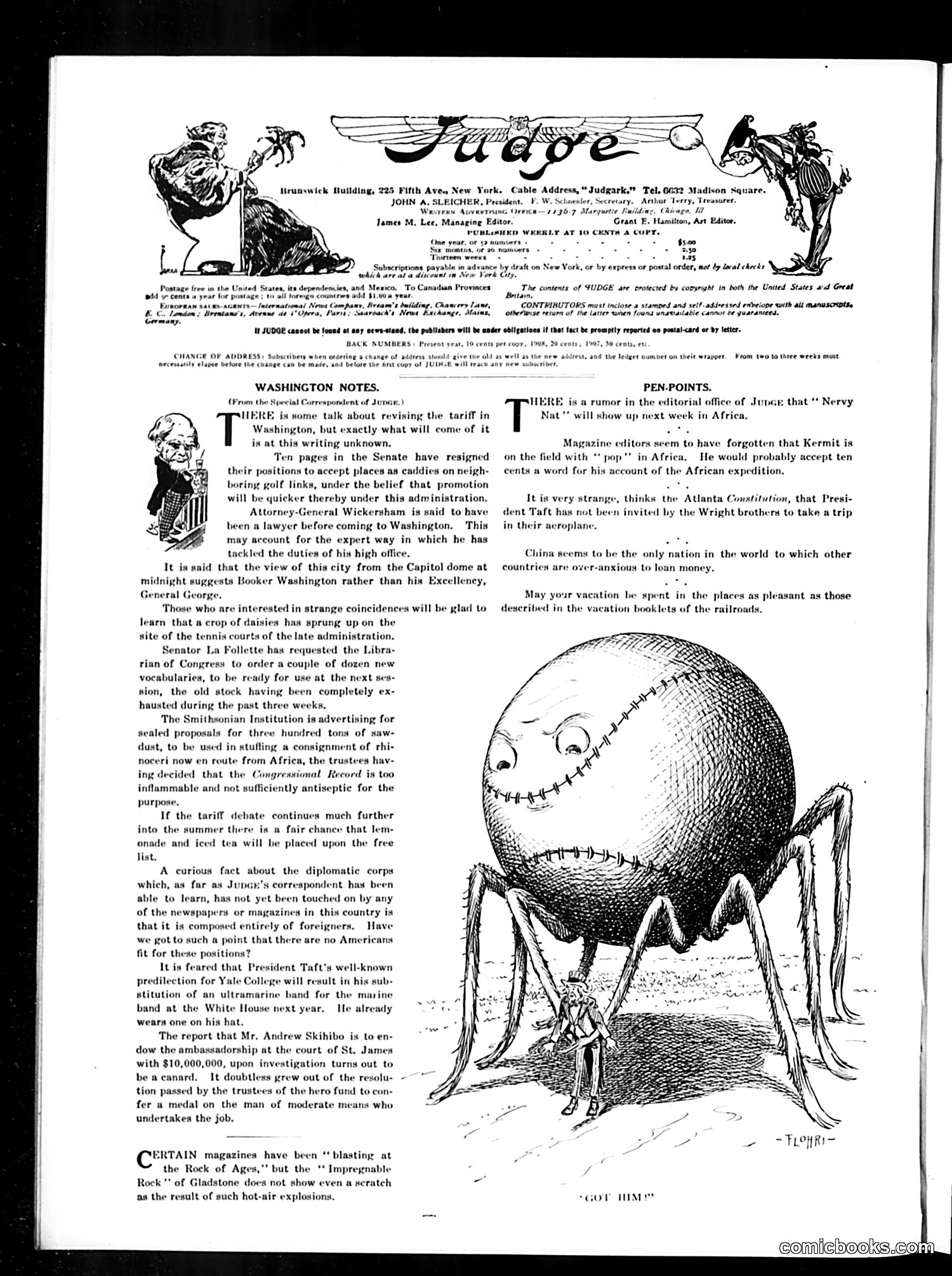
This page from Judge magazine contains political commentary in the "Washington Notes" section by their Special Correspondent. The main topics discussed include: 1. **Tariff debate**: Discussion of ongoing Senate tariff negotiations and Attorney-General Wickersham's involvement 2. **Diplomatic corps**: A note about the diplomatic corps being entirely comprised of foreigners 3. **President Taft**: References to Taft's predilection for Yale College and the Wright brothers' airplane The large cartoon on the right depicts an ostrich with its head buried in sand, captioned "GOD HIM!" This is a visual pun satirizing an unnamed public figure or policy—likely mocking someone for ignoring obvious problems or avoiding confrontation, using the common (though biologically inaccurate) metaphor of an ostrich burying its head in sand. The ornamental header and illustrations are typical of Judge's satirical style from this early 20th-century period.
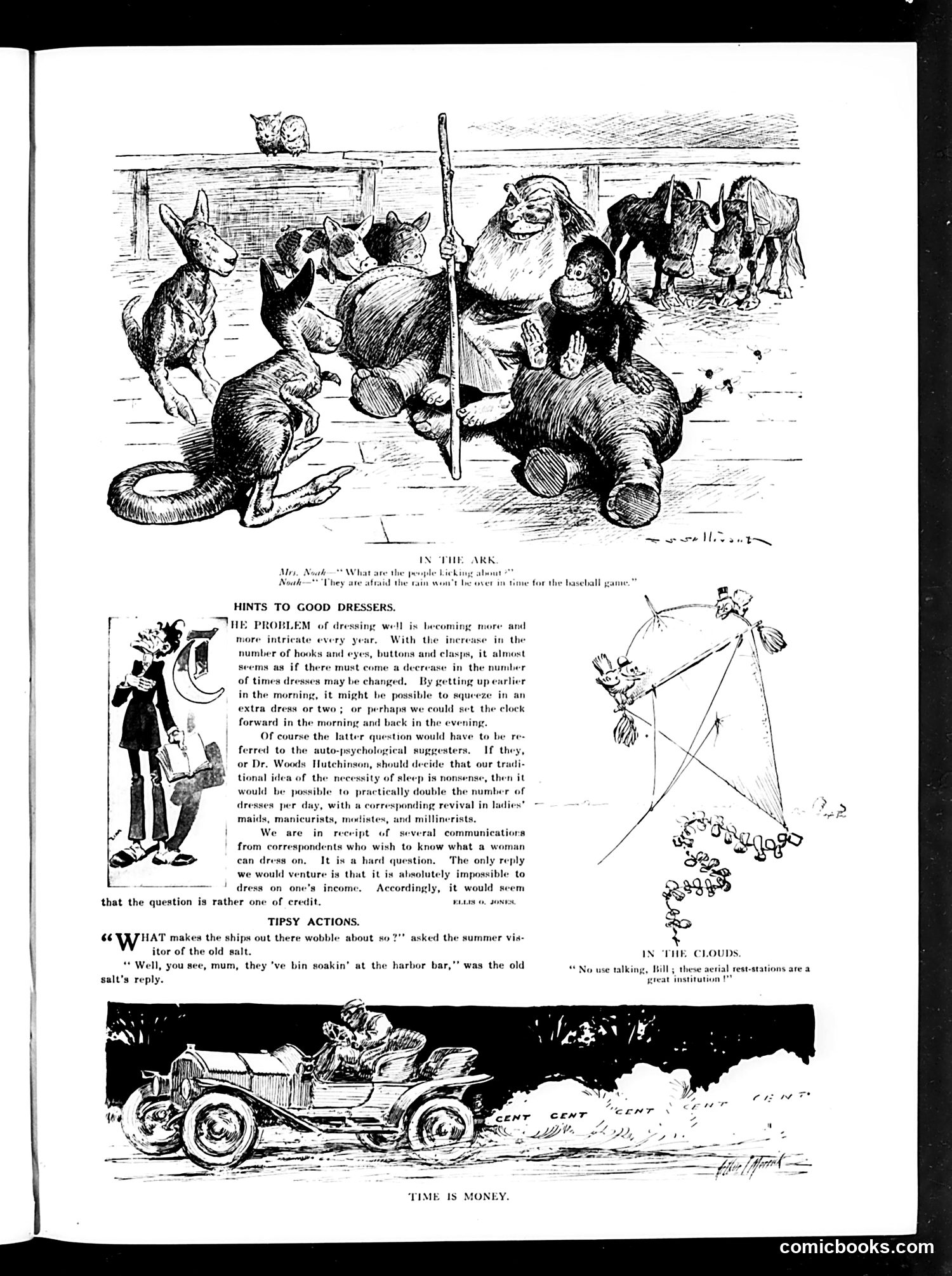
**"In the Ark"** (top): A satirical cartoon showing Noah with various animals discussing baseball. Mrs. Noah asks what people are talking about; Noah replies they're afraid the ark won't reach port in time for the baseball game. This jokes about Americans' obsession with baseball—so intense that even animals in Noah's ark prioritize it over survival. **"Hints to Good Dressers"**: A brief article mocking the impracticality of frequent dress changes, suggesting women would need to hire additional staff if forced to change clothes more often due to modern fashion demands. **"Tipsy Actions" and "Time is Money"**: Humorous vignettes about sailors and automotive speed, using wordplay and visual gags typical of Judge's satirical style.
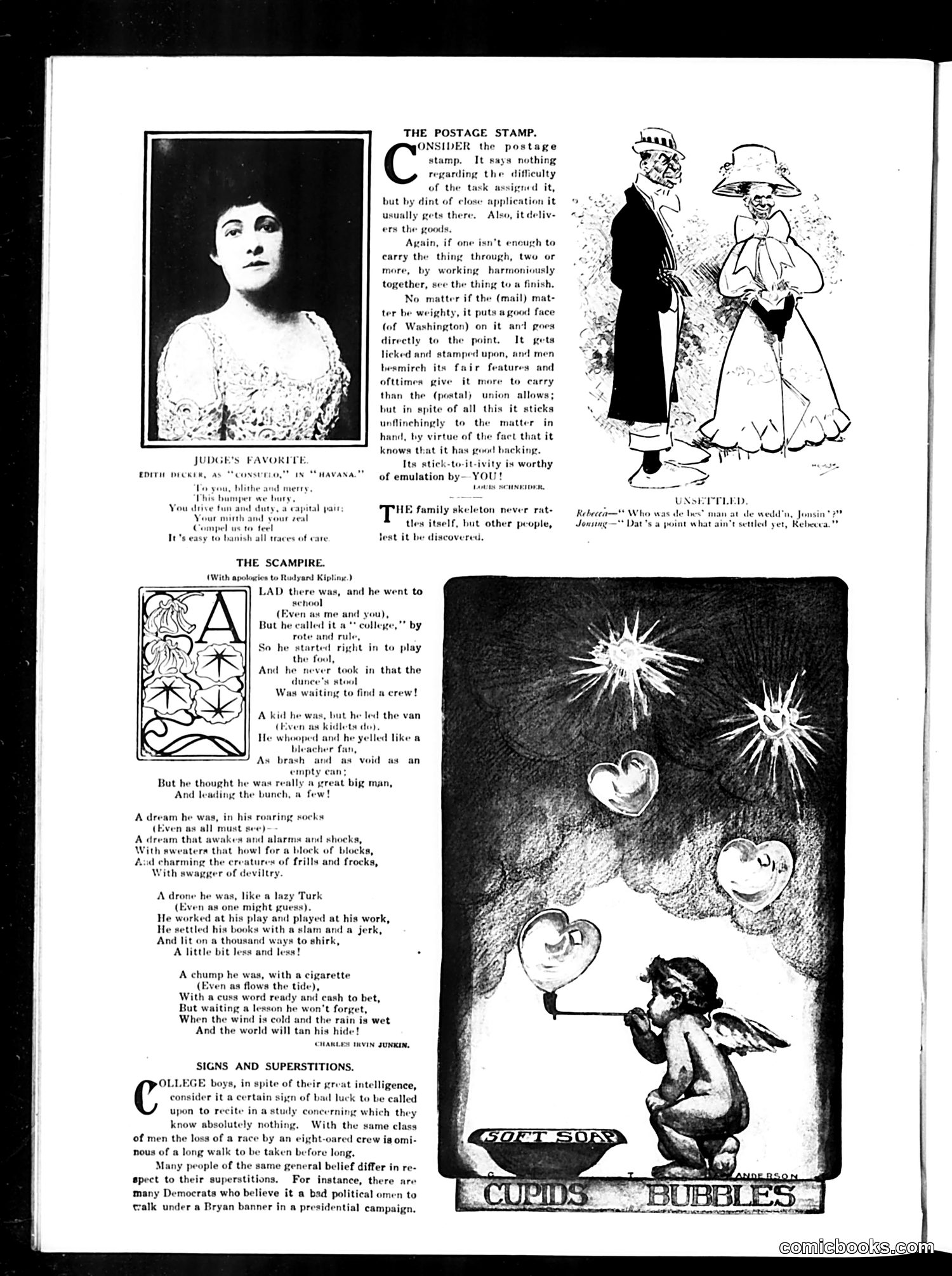
This page contains several unrelated satirical pieces rather than a cohesive political cartoon. **"The Postage Stamp"** (top right) mocks the postal service's inefficiency, illustrated by two figures discussing mail delivery. The satire suggests that despite stamps' supposed function, mail often fails to reach its destination reliably. **"The Scampire"** (left) is a humorous poem about a mischievous boy causing trouble at school—a lighthearted piece with no political content. **"Cupid's Bubbles"** (right illustration) depicts Cupid amid floating soap bubbles, likely romantic/sentimental content for entertainment. **"Signs and Superstitions"** (bottom) discusses superstitious beliefs among college boys and Democratic voters—a gentle mockery of irrational thinking across different groups. The page is primarily entertainment rather than pointed political satire.
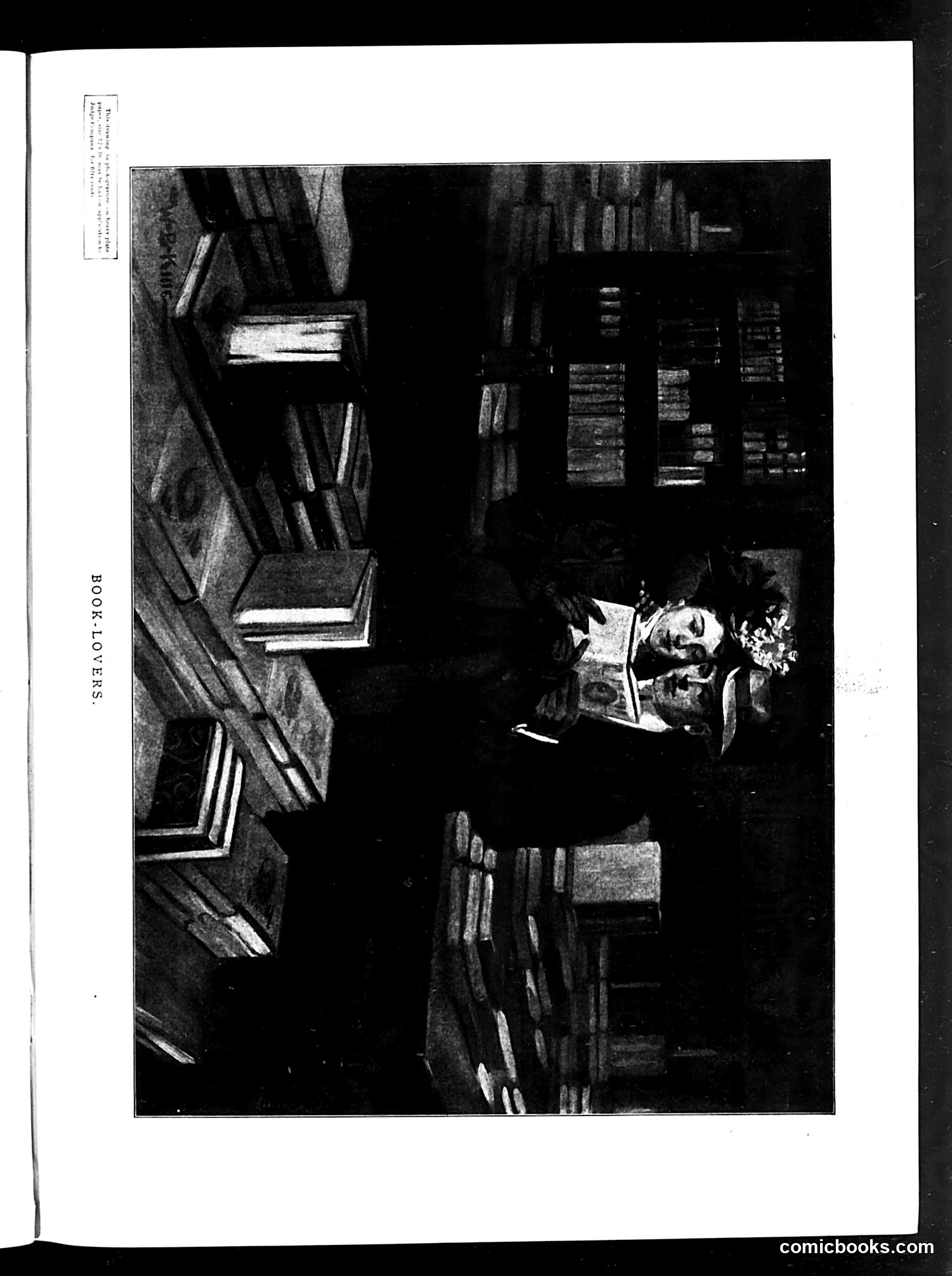
This page appears to be titled "Book Lovers" and shows a satirical scene of a library or bookstore interior. The image depicts what seems to be a person reclining or lying down among bookshelves, surrounded by numerous volumes. The satire likely mocks certain types of book enthusiasts or library patrons—possibly those who treat libraries as places for leisure and relaxation rather than serious study, or perhaps critiques overly passionate bibliophiles. The humor appears to derive from the exaggerated posture and positioning of the figure among the books, suggesting an absurd devotion to reading or collecting literature. Without clearer OCR text or additional context, the specific target of satire remains somewhat unclear, but the visual joke centers on someone's relationship with books taken to an extreme or ridiculous degree.
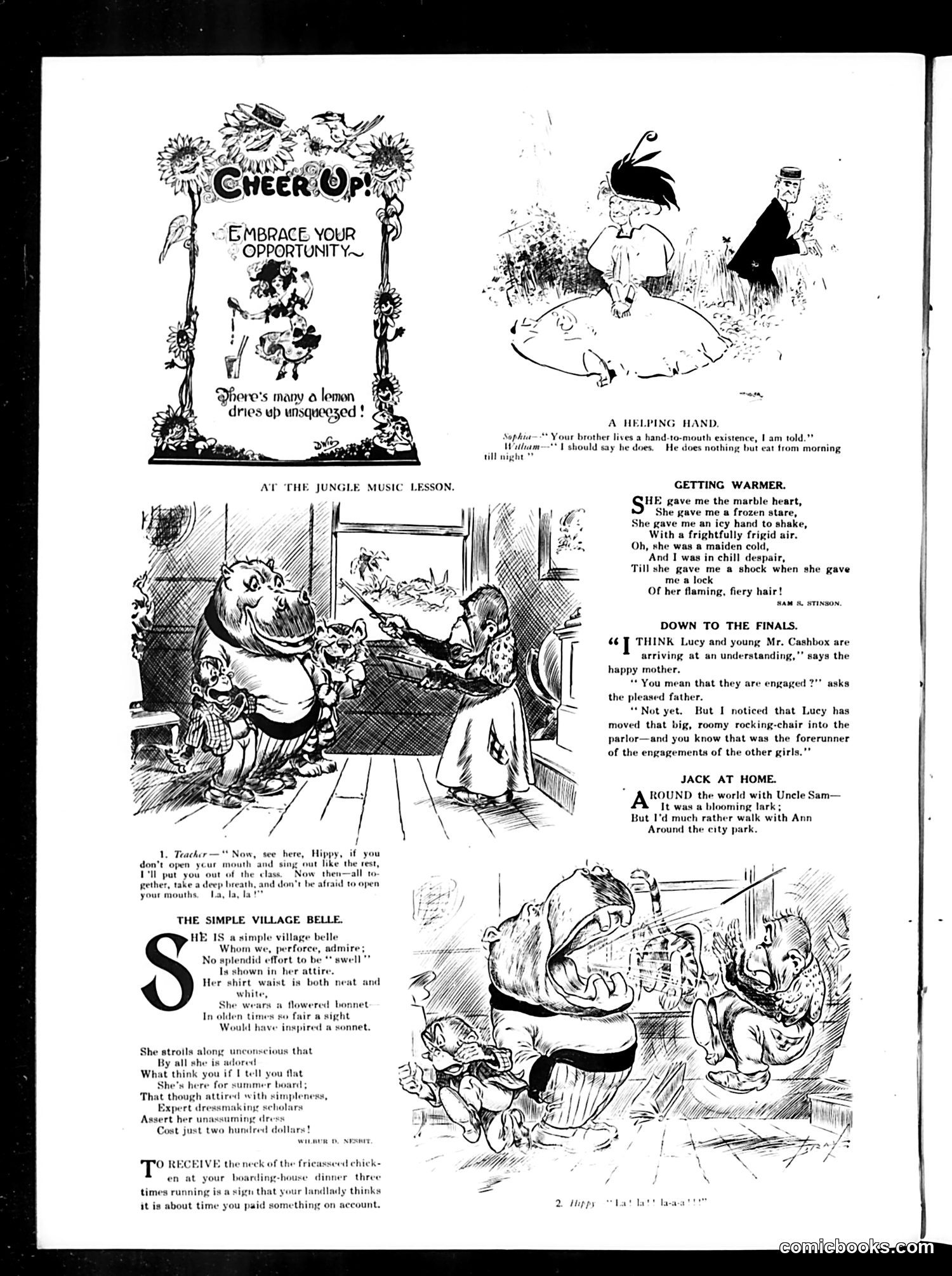
This page from Judge (likely early 1900s) contains several unrelated humor pieces typical of the magazine's satirical format: **"Cheer Up"** (top left): A motivational cartoon about seizing opportunities, using the metaphor of lemons needing to be squeezed—suggesting people shouldn't waste potential. **"A Helping Hand"** and other brief dialogue jokes: Quick one-liners playing on wordplay and domestic situations (someone living "hand-to-mouth," romantic cold-shoulder metaphors). **"Down to the Finals"**: Social satire about middle-class courtship rituals, where a mother interprets a daughter moving a rocking chair into the parlor as a sign of engagement—implying past daughters used similar furniture strategically. **"The Simple Village Belle"**: Satirizes urban snobbery toward rural women, describing an unsophisticated but attractive village girl who becomes fashionable as a summer boarder—mocking both rural simplicity and city pretension. **"At the Jungle Music Lesson"**: A classroom scene (content unclear from OCR). The page reflects early 20th-century American humor: class consciousness, courtship customs, and gentle domestic satire.
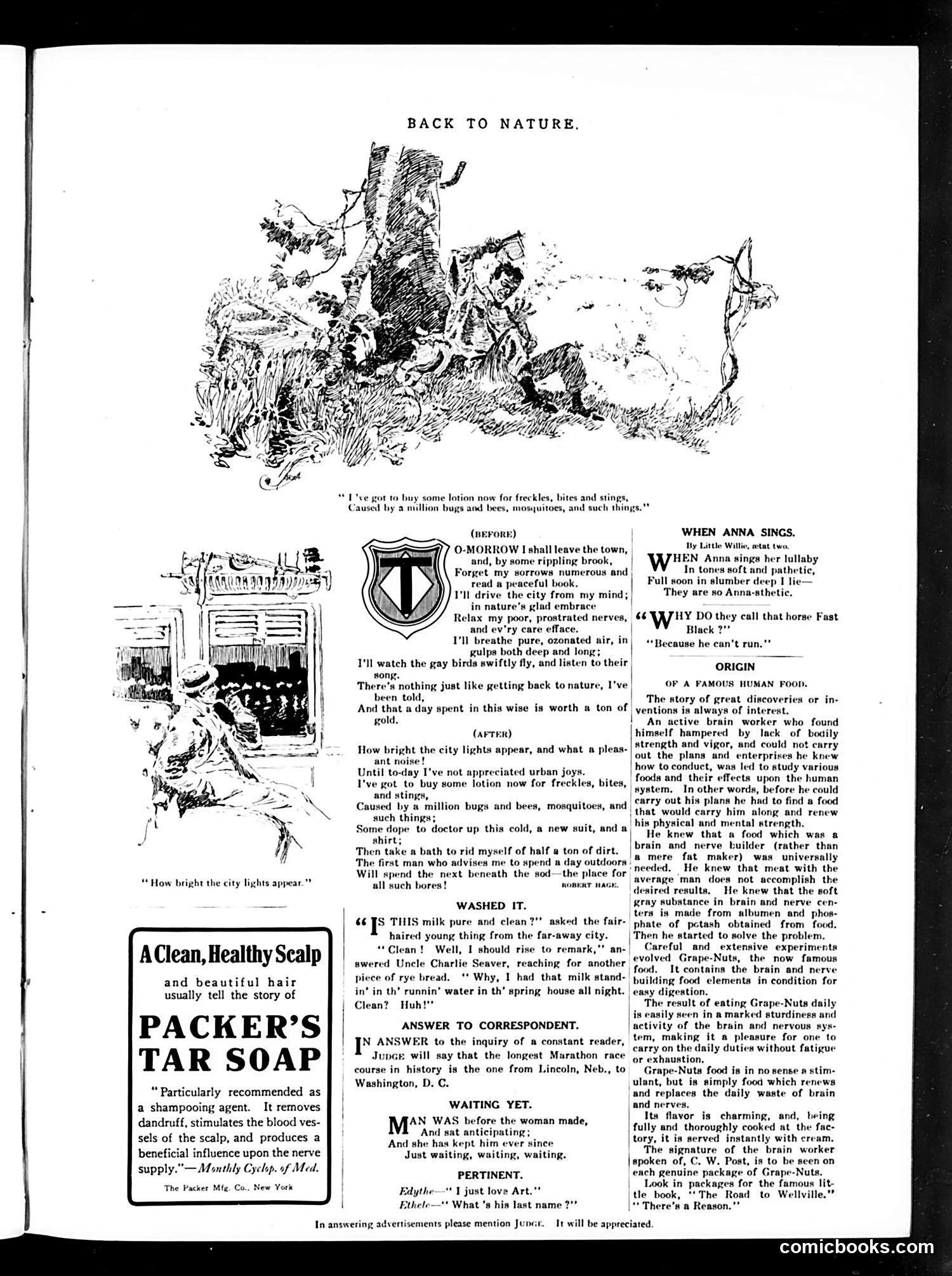
This page satirizes the romantic ideal of escaping urban life for nature. The main cartoon contrasts a man's idealizations (BEFORE) with harsh reality (AFTER). He fantasizes about leaving the city to relax by a brook, breathe pure air, and enjoy birdsong. Instead, he returns covered in insect bites, stings, and dirt—requiring lotion, a doctor visit, and a bath. The joke: nature is far less appealing than city dwellers imagine. The accompanying short pieces reinforce this theme: a city girl naively asks if farm milk is "pure," unaware it's been sitting in spring water; "Washed It" implies nature's cleanliness standards differ from urban ones. The page also contains unrelated advertisements (Packer's Tar Soap) and brief humorous items about wordplay and relationships. The satire reflects turn-of-century skepticism toward the "back to nature" movement popular among urbanites seeking rustic escape.
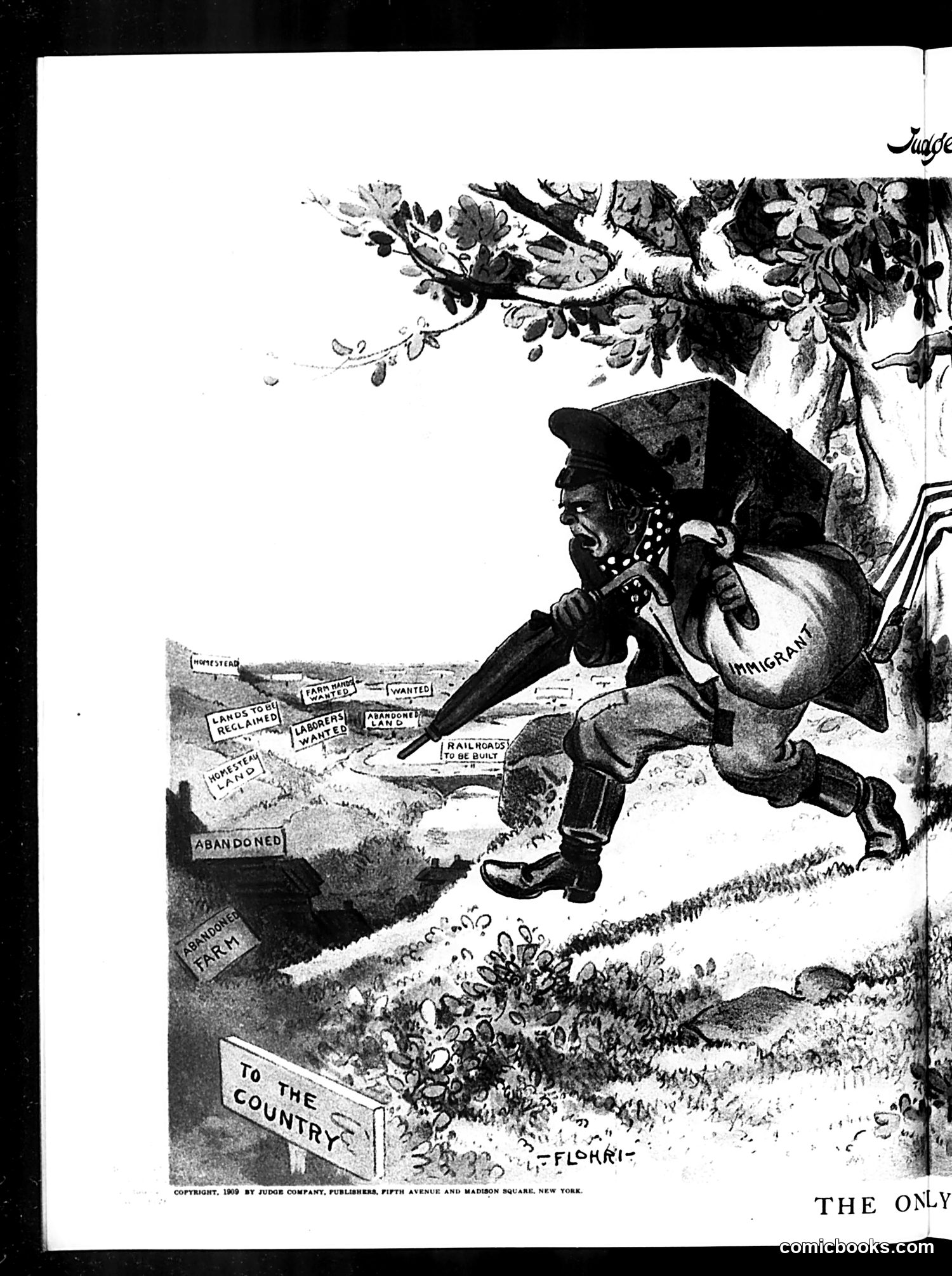
This Judge magazine cartoon depicts an Irish immigrant (identifiable by stereotypical caricature features and accent markers) carrying a large bag labeled "IMMIGRANT." He stands on a hilltop overlooking abandoned American countryside marked with signs reading "LANDS TO BE RECLAIMED," "LANDS WANTED," "RAILROADS TO BE BUILT," and "FARM ABANDONED." The satire criticizes Irish immigration by suggesting immigrants arrive to find only neglected, worthless land—a commentary on anti-immigrant sentiment of the era. The cartoon implies that Irish newcomers represent burdens rather than assets to American development. The path "TO THE COUNTRY" and Florida reference suggests displacement to marginal regions. This reflects late-19th/early-20th-century nativist attitudes opposing Irish Catholic immigration.
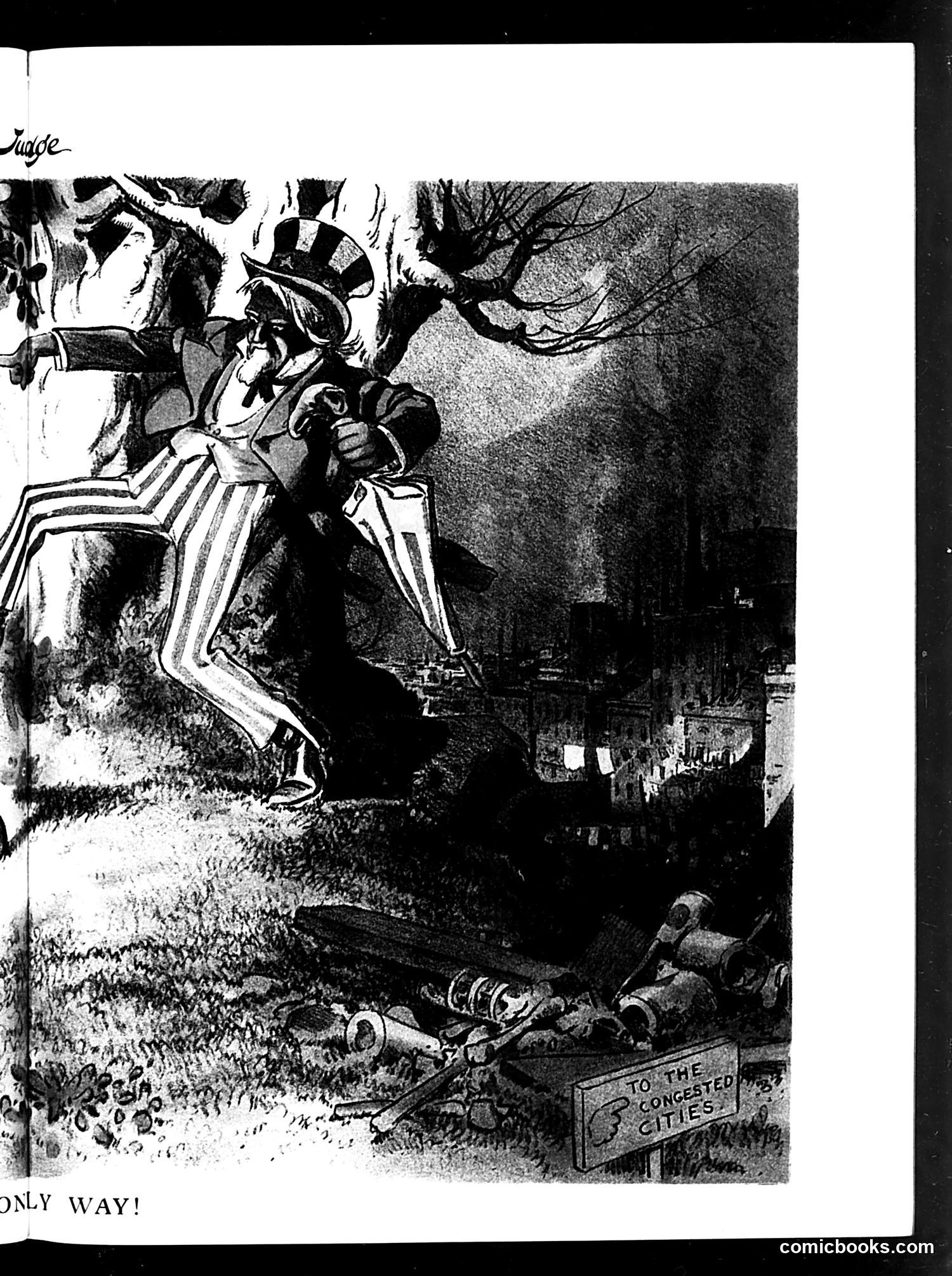
This appears to be a satirical cartoon from *Judge* magazine depicting Uncle Sam (the tall figure in striped pants and top hat) looking down at a cityscape labeled "CONGESTED CITIES" below him. The cartoon seems to criticize or comment on urban overcrowding and congestion in American cities. The partial text "ONLY WAY!" and visible signage suggest the cartoon is advocating for some solution to urban problems—possibly related to urban planning, decentralization, or population dispersal. The dramatic perspective and Uncle Sam's commanding position suggest the cartoon is addressing this as a national concern requiring governmental action or policy change. However, without the complete text or date, the specific historical context and the intended solution remain unclear.
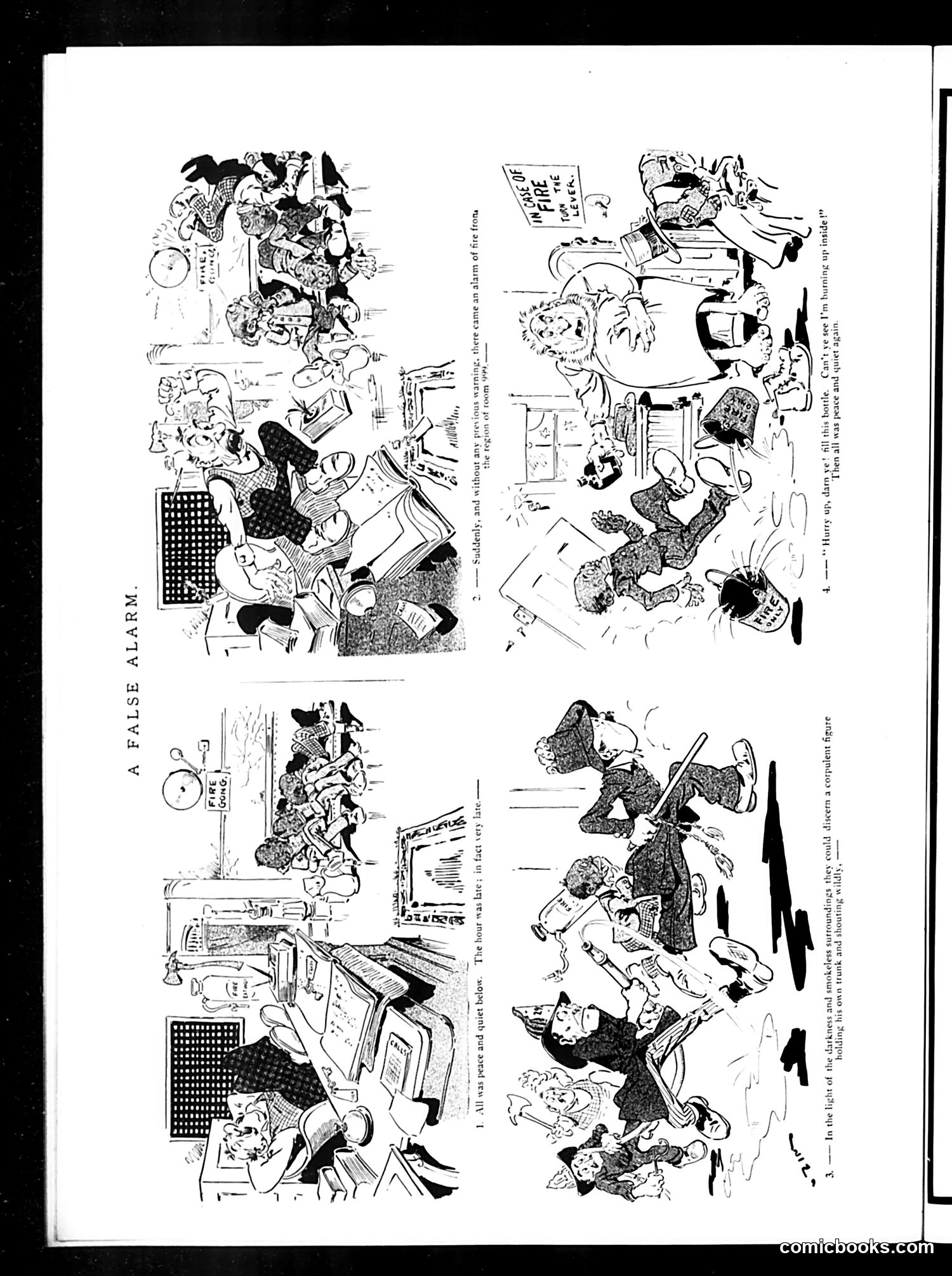
This page contains "A False Alarm," a four-panel satirical cartoon. The OCR text is too fragmented to read clearly, but the visual narrative appears to show a domestic scene involving what looks like a fire alarm or emergency situation. The panels depict figures reacting with alarm and chaos—typical of Judge magazine's humor, which often mocked exaggerated responses to minor crises or false emergencies. The densely-packed illustrations with multiple characters suggest slapstick comedy showing panic spreading through a household or building. Without clearer text, I cannot identify specific public figures or pinpoint the exact social commentary, though the title "A False Alarm" suggests satire about overreaction to perceived threats—a common Judge theme addressing public hysteria or media sensationalism of the era.
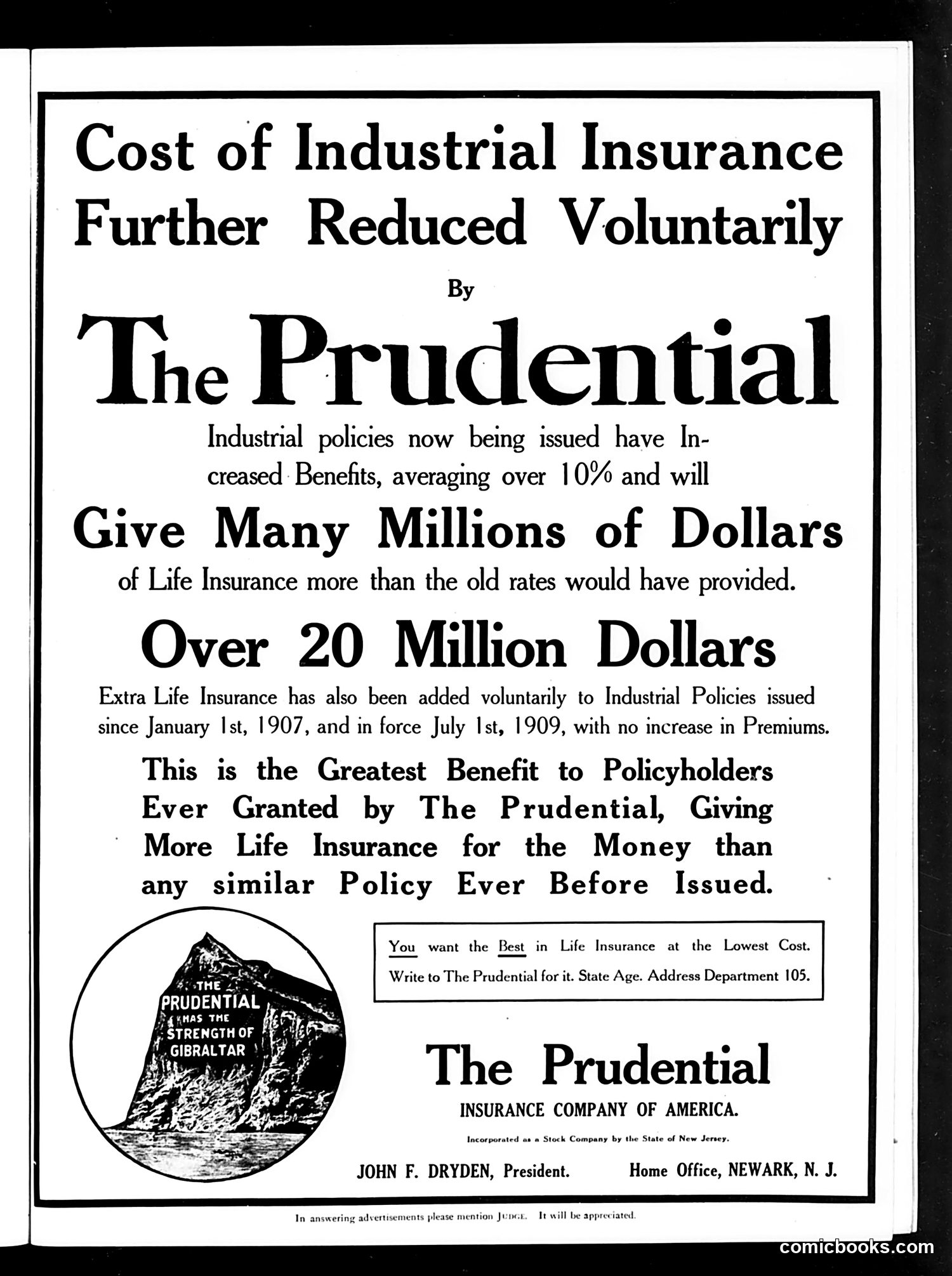
This is a **full-page advertisement**, not satire. The Prudential Insurance Company announces voluntary cost reductions for industrial (working-class) life insurance policies. **Key claims:** - Increased benefits averaging over 10% without premium increases - Over $20 million in extra life insurance added since 1907 - Positioned as unprecedented consumer benefit **Visual element:** The circular image shows the Rock of Gibraltar with the company's slogan "The Strength of Gibraltar"—a common advertising metaphor suggesting stability and permanence. **Context for modern readers:** This represents early-20th-century industrial insurance marketing to working people, highlighting competitive advantages during an era of expanding insurance markets. The "Gibraltar" imagery was widely used by insurance companies to project trustworthiness and durability to consumers unfamiliar with corporate stability. The advertisement emphasizes voluntary corporate generosity rather than regulatory requirement, reflecting the pre-Depression era's lighter insurance regulation.
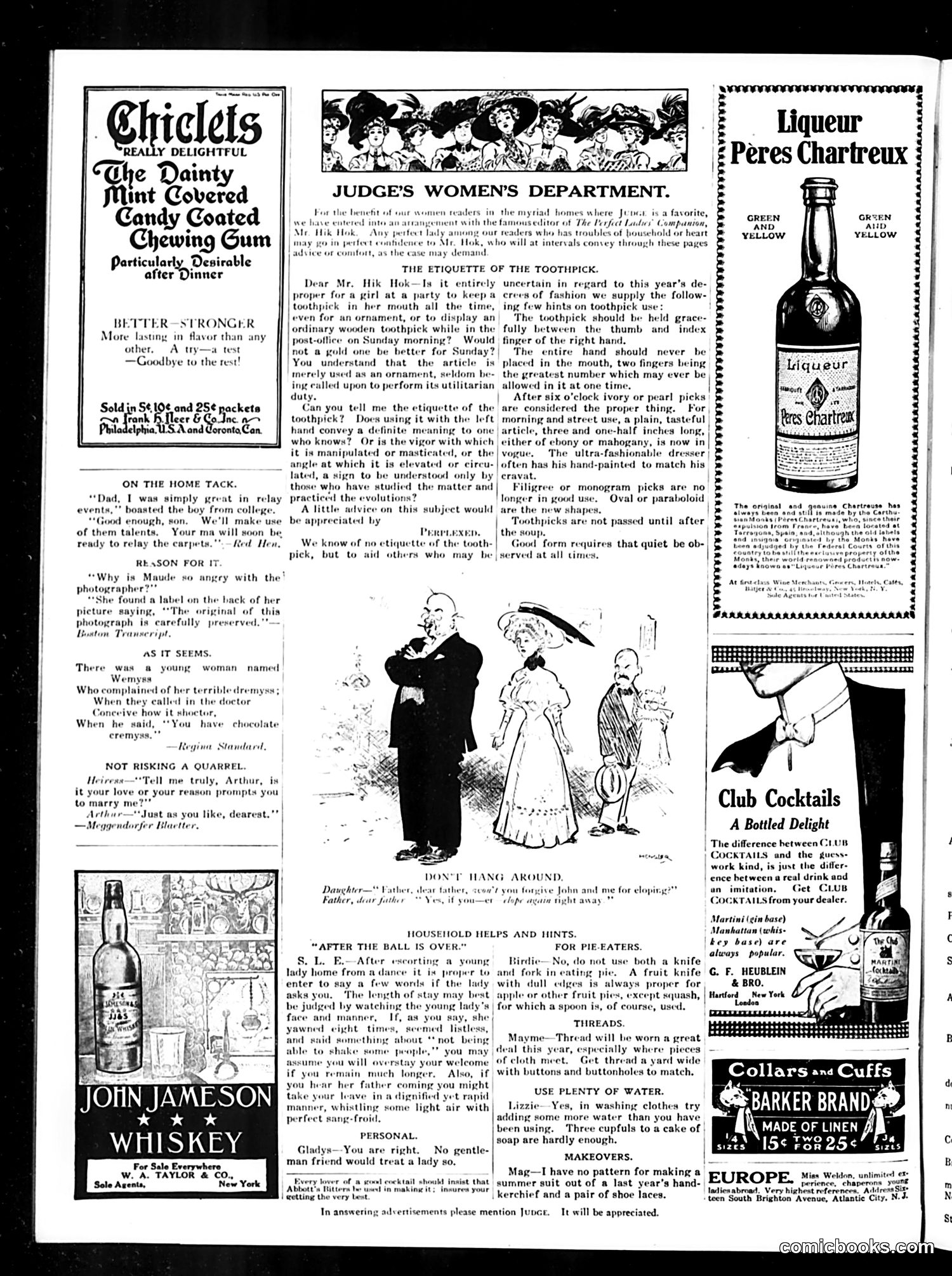
This page is primarily **advertising and advice columns** rather than political satire. The content includes: **Main Features:** - "Judge's Women's Department" advice column answering etiquette questions about toothpick usage at social events (whether it's proper to use one after dinner, which hand, etc.) - Household hints about dining etiquette and table manners - Light humorous verses and personal anecdotes **Advertisements:** - Chiclets chewing gum - John Jameson whiskey - Peres Chartreux liqueur - Club Cocktails - Barker Brand collars and cuffs - Europe travel promotions **The Humor:** The page reflects early 20th-century concerns about **proper social conduct**—specifically dining etiquette. The toothpick question reveals anxieties about maintaining dignity in public. Other items mock romantic relationships and domestic situations with gentle, period-appropriate humor rather than sharp political commentary. This appears to be a women's interest page emphasizing **consumer goods and social propriety** rather than satirical commentary on political events.
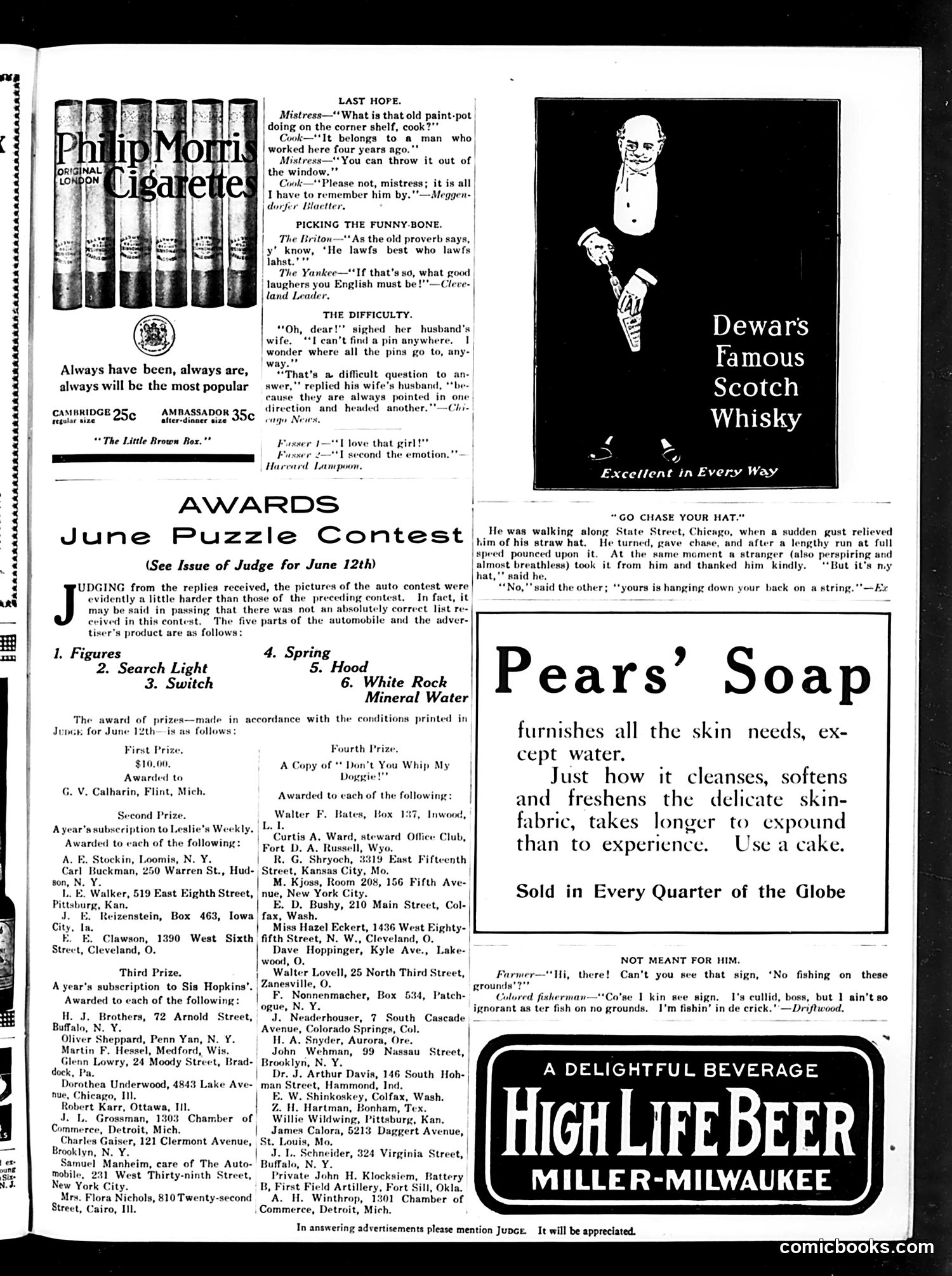
This page from *Judge* (a satirical weekly) is primarily **advertisements and contest announcements**, with brief humorous snippets. The main content includes: **Advertisements**: Philip Morris cigarettes, Dewar's Scotch whisky, Pears' soap, and High Life beer dominate the layout. **Short comic anecdotes** ("Last Hope," "Picking the Funny Bone," "The Difficulty") feature typical turn-of-the-century domestic humor—servants, mistresses, and marital confusions. These rely on period-specific class dynamics and gender roles that would be familiar to contemporary readers. **June Puzzle Contest Results**: The page announces winners of an automobile-identification contest, listing numerous names and addresses of prize recipients. **Minor cartoons**: "Go Chase Your Hat" depicts a slapstick incident of mistaken hat-ownership; "Not Meant for Him" uses racial dialect humor about a Black fisherman misunderstanding a "No Fishing" sign. The racial humor reflects the casual bigotry acceptable in 1900s American publications. Overall, this is a typical magazine filler page blending light humor, product marketing, and contest administration.
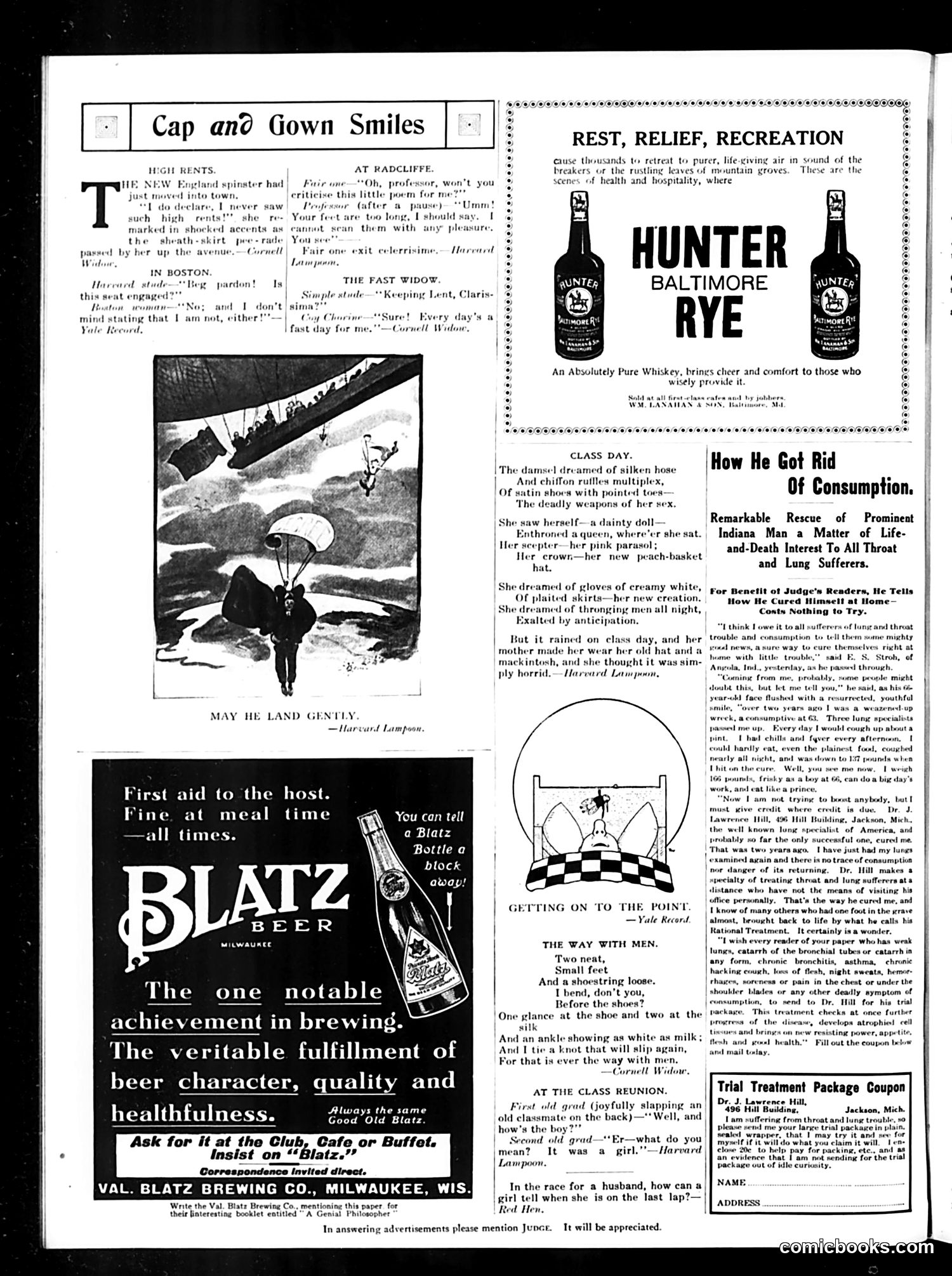
This page combines college humor with period advertising. The "Cap and Gown Smiles" section features brief satirical quips from various universities (Harvard, Yale, Cornell, Radcliffe) mocking contemporary college life—expensive urban rents, fashion-conscious female students, and class day traditions. The humor relies on gentle observations of student behavior and university culture circa early 1900s. The page is dominated by **advertisements** for alcoholic beverages (Hunter Rye whiskey, Blatz beer) positioned alongside health-related content, reflecting the era's marketing practices before modern advertising restrictions. Most notably, a lengthy testimonial advertises "Dr. J. Lawrence Hill's" consumption treatment, featuring a man claiming cure from tuberculosis. This reflects the period's desperate remedies for serious lung disease and the prevalence of mail-order medical solutions—many fraudulent—before FDA regulation. The juxtaposition of drinking advertisements with medical cure-alls is striking to modern readers but typical of early 20th-century magazine publishing.
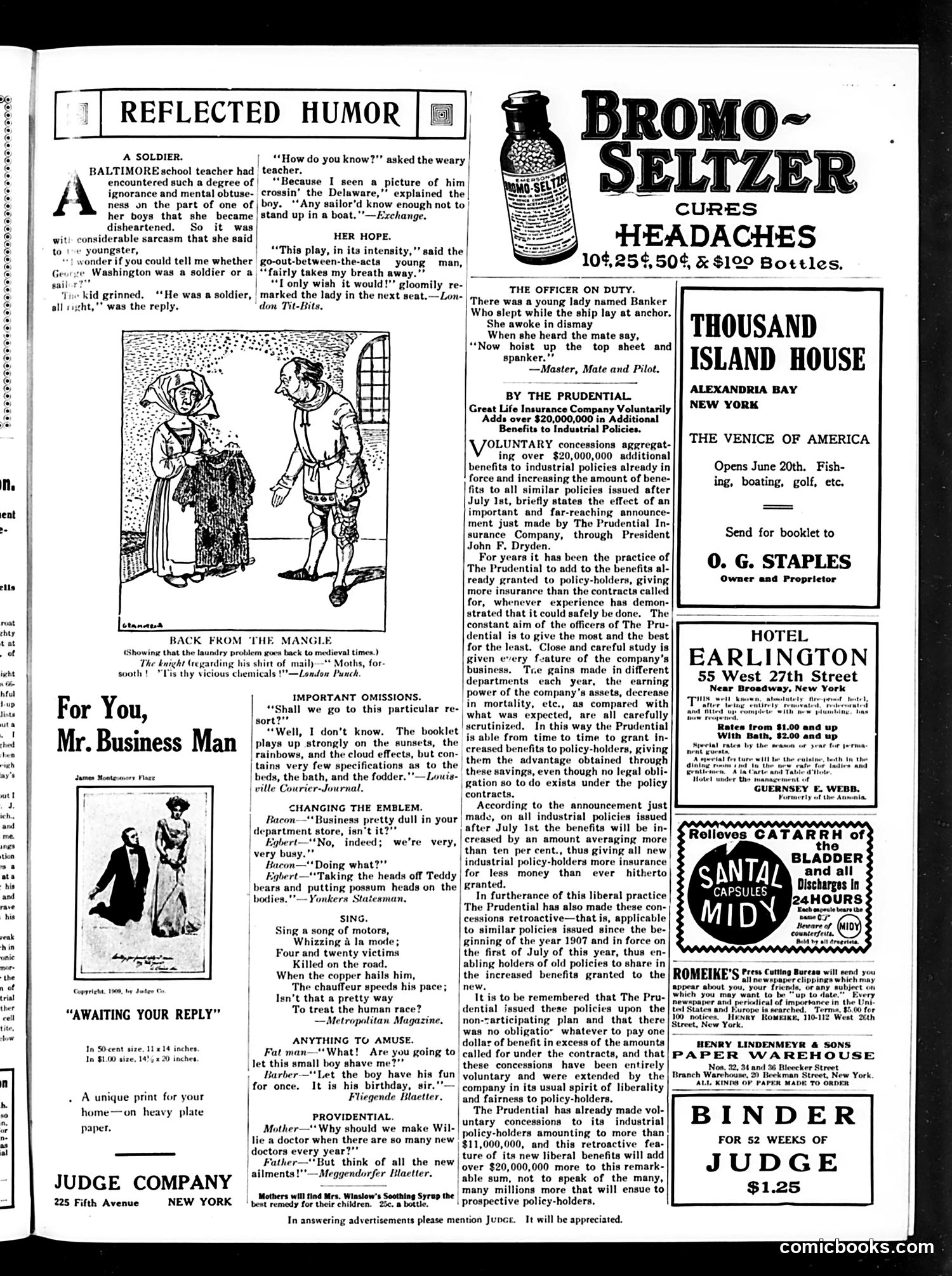
This page combines humor pieces with period advertisements. The main cartoon shows a Baltimore schoolteacher questioning a boy about whether George Washington was a soldier—the joke being the boy's ignorance (he thinks Washington "crossed the Delaware" while standing up in a boat, contradicting basic sailor knowledge). Other brief jokes mock common social anxieties: a woman wishing theatrical performances would literally take her breath away; a ship's mate hoisting bedsheets; business dullness solved by "changing the emblem" (replacing Teddy Roosevelt imagery, likely referencing Theodore Roosevelt's popularity in early 1900s advertising). The advertisements reflect contemporary concerns: Bromo-Seltzer for headaches, life insurance benefits, resort vacations. A "Binder for Judge" suggests this magazine was collectible. The humor is genteel and moralistic—mocking ignorance, laziness, and poor manners rather than punching at political targets.
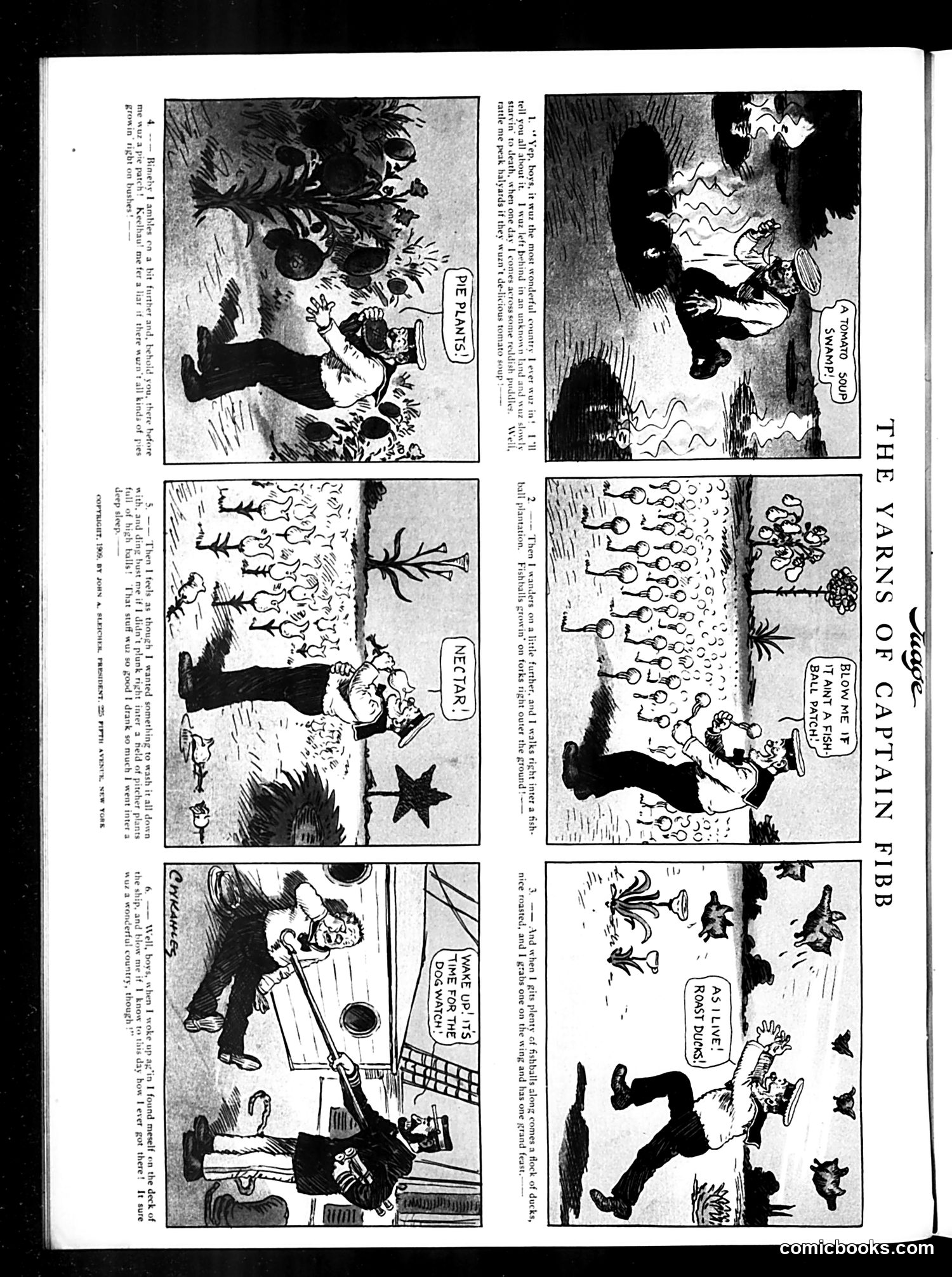
I cannot reliably read the OCR text on this page—it appears heavily corrupted or inverted. From the images themselves, I can see this is "The Yarn's of Captain Fibb" (visible in the title), a multi-panel comic strip. The panels depict a character in black formal wear telling stories to groups of people in various settings—what appears to be social gatherings or audiences. The style suggests early 20th-century satirical comics. However, without legible text or clear historical context about "Captain Fibb," I cannot accurately explain what specific political or social satire this strip intended. The format suggests it's mocking someone's tall tales or exaggerated storytelling, but I cannot confidently identify the target or meaning without reliable OCR text.