
A complete issue · 16 pages · 1909
Judge — July 10, 1909
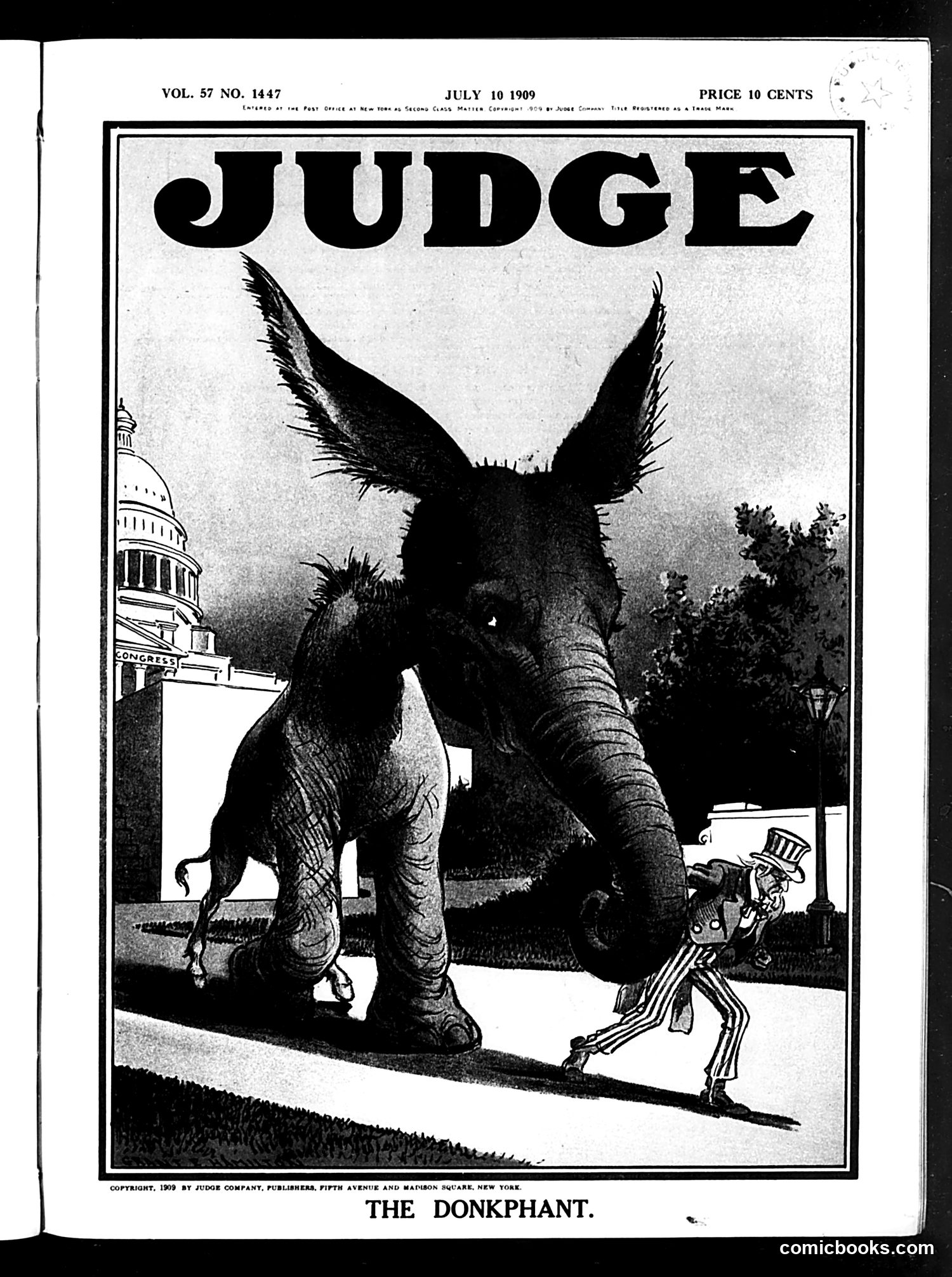
This political cartoon depicts a hybrid creature—part donkey, part elephant—positioned menacingly near the U.S. Capitol building. A tiny Uncle Sam figure appears to be defending against or confronting the beast. The donkey and elephant are traditional symbols of the Democratic and Republican parties respectively. This "Donkphant" likely satirizes anxieties about a political combination or threat formed by both parties uniting against something—possibly against President Theodore Roosevelt or his policies. The cartoon's message appears critical of this bipartisan alliance, presenting it as a dangerous monster looming over American government. Without additional context from the magazine's text, the specific political controversy being referenced remains somewhat unclear, though it clearly expresses concern about major party cooperation.
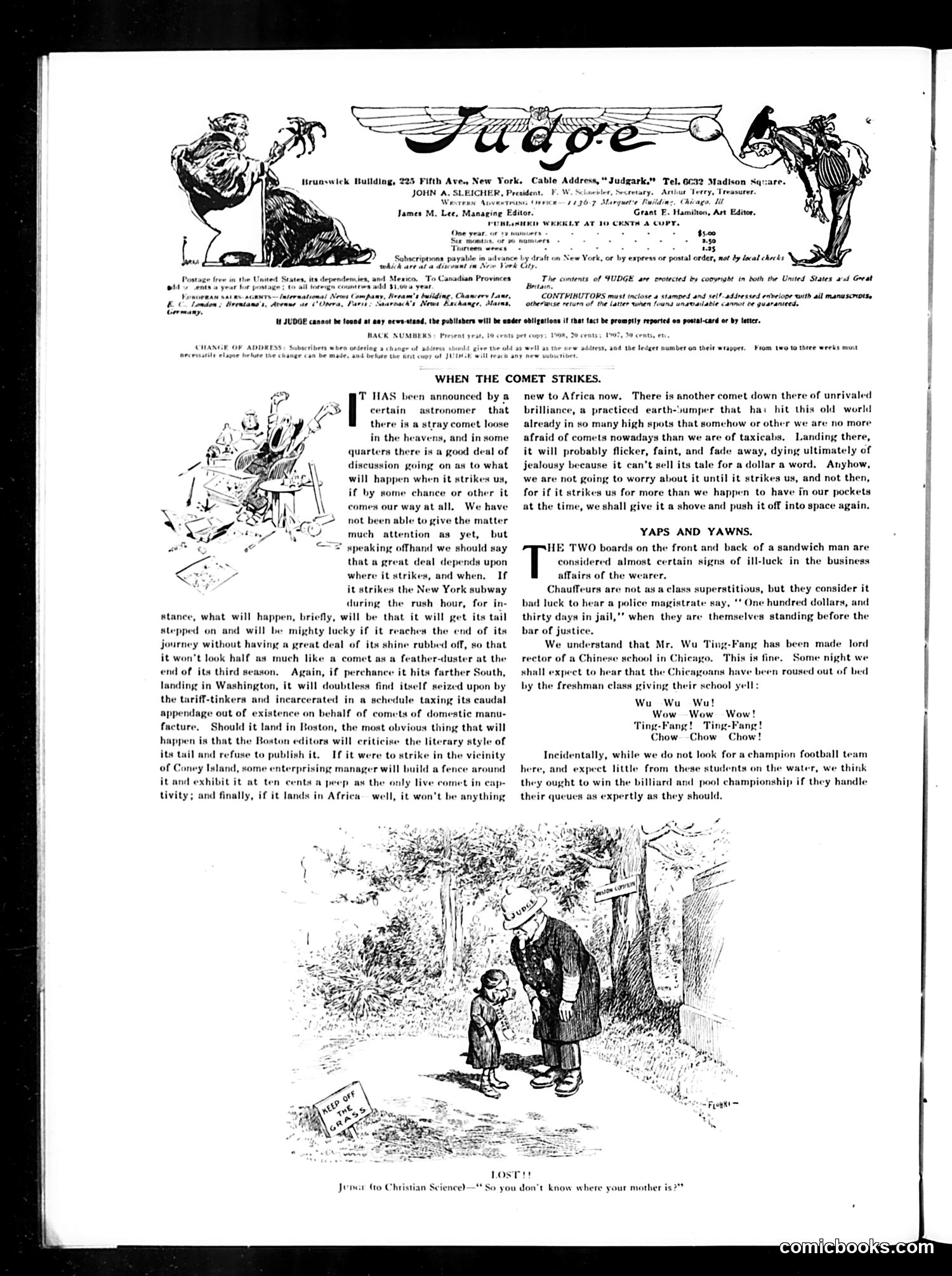
This page contains two satirical pieces: **"When the Comet Strikes"** humorously addresses widespread public anxiety about a comet's potential impact on Earth. The article mocks both the comet panic itself and the predictable consequences—New York subway disruptions, property damage, and media sensationalism. It's satirizing contemporary doomsday fears and suggesting society would quickly move past even catastrophic events. **"Yaps and Yaws"** makes jokes about superstitions among various professions. It mentions a Chinese school in Chicago and pokes fun at perceived superstitions of chauffeurs and police magistrates regarding bad luck. **The bottom cartoon** depicts a child asking an adult, "So you don't know where your mother is?"—likely a dark humor joke about Christian Science beliefs regarding spiritual healing and maternal absence. The page reflects early 20th-century American anxieties and social commentary.
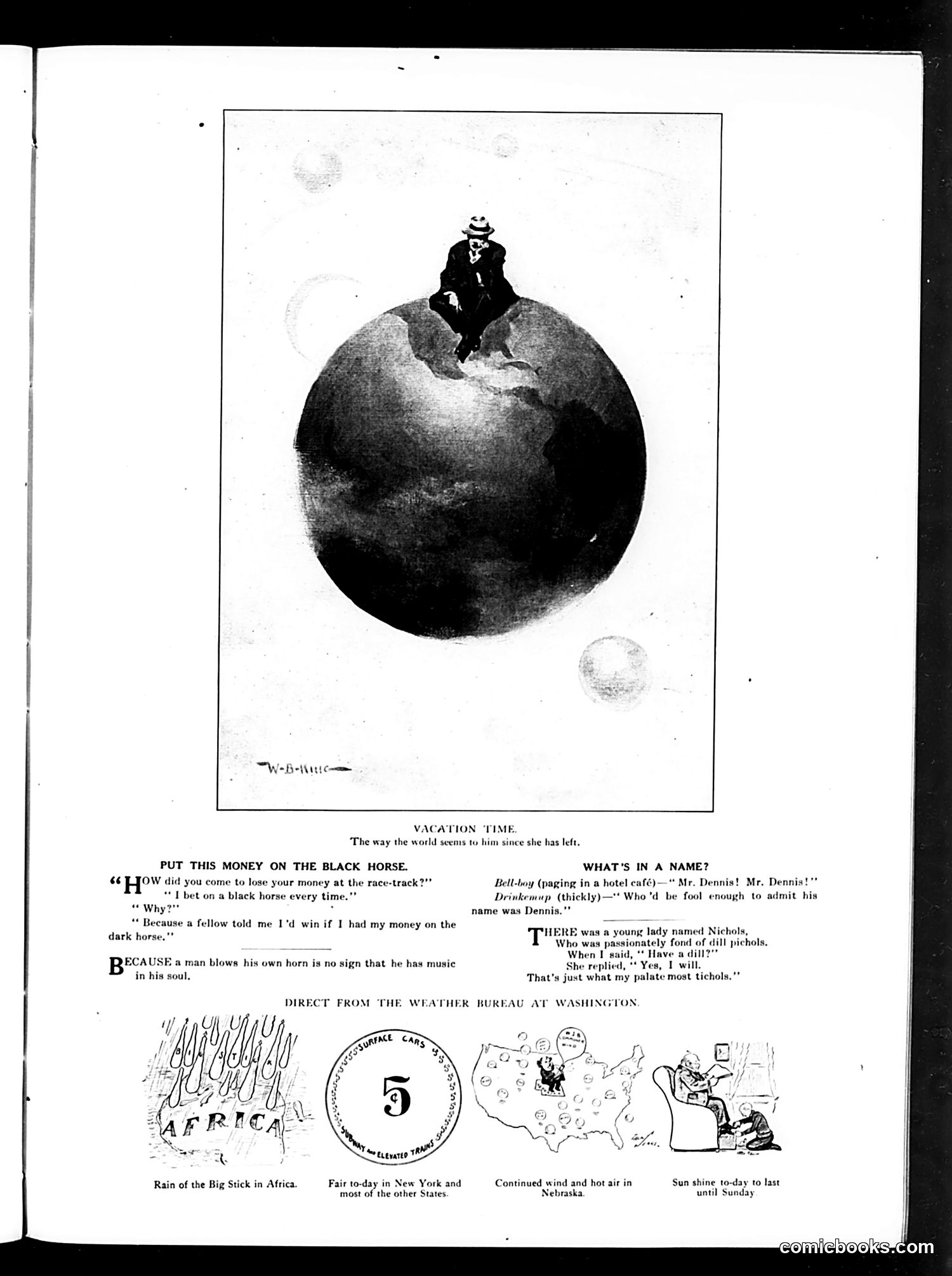
The main cartoon depicts a well-dressed man perched atop an enormous globe, wearing a striped suit and hat. The accompanying text explains the satire through dialogue: someone asks why the man bets on horses at the racetrack, and he responds that "a fellow told me I'd win if I had my money on the black horse." The joke plays on a double meaning—"black horse" refers both to a racehorse and to gambling superstition. The man has literally taken the advice to absurd extremes, traveling the world seeking fortune. The page also includes unrelated humorous anecdotes and a weather forecast section. The satire targets gullible investors or gamblers who follow dubious financial advice, a timeless critique of human folly.
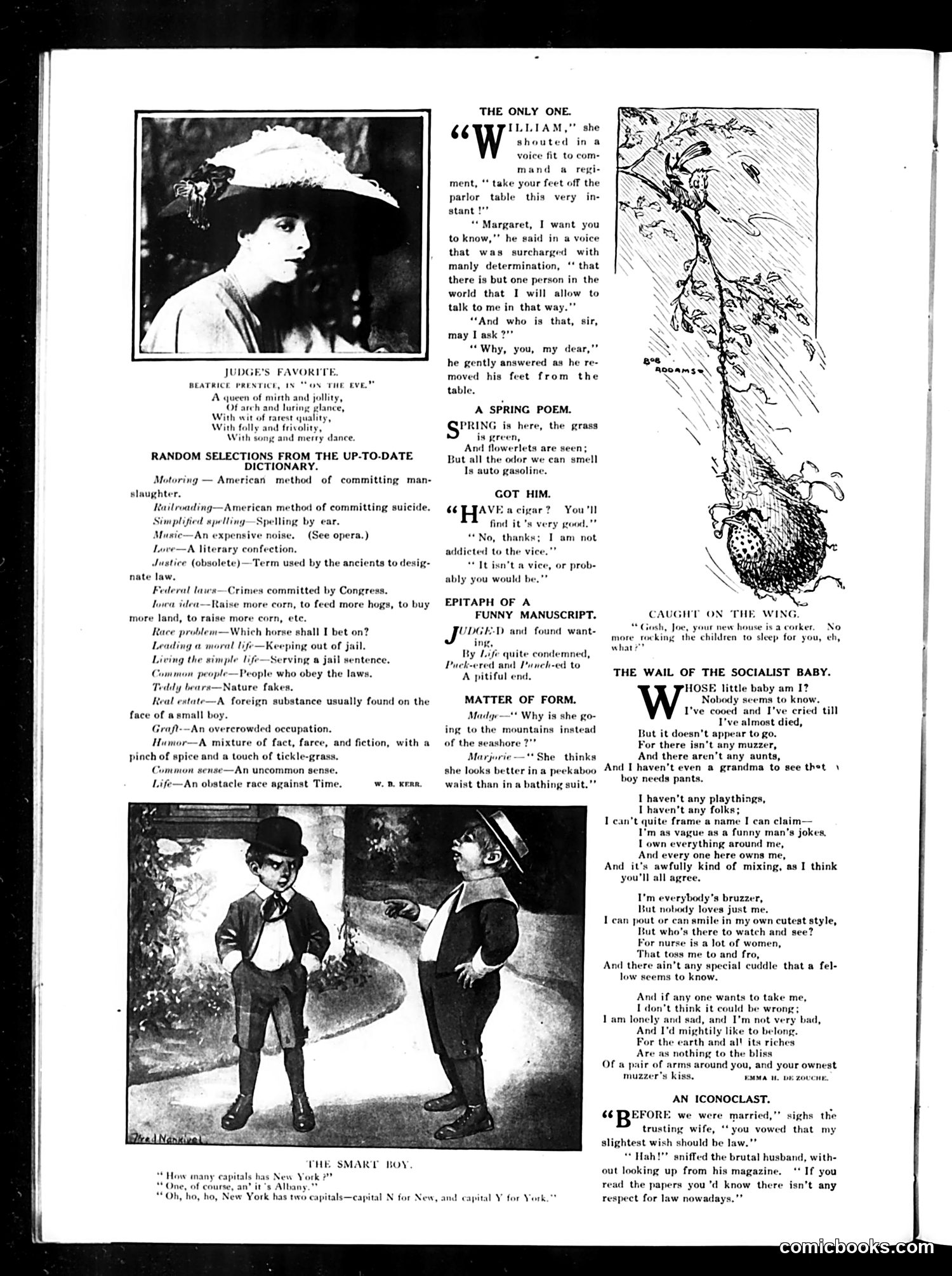
This page contains miscellaneous satirical content rather than a focused political cartoon. The main elements include: **"Judge's Favorite"** — A portrait of Beatrice Sinclair, described as possessing "mirth and jollity" with "fully and frivolity," suggesting she was a public figure of the era, likely an actress or entertainer. **"The Smart Boy"** — A photograph-based cartoon depicting two children in conversation about New York's capitals (likely referring to Albany and New York City's competing political importance). **Various poems and dictionary definitions** pad the page with humor and social commentary on contemporary issues like suicide methods, land acquisition, and socialist critique (evident in "The Wail of the Socialist Baby"). The overall tone reflects Judge's tradition of satirizing American society, politics, and cultural figures through mixed-media presentation rather than focused editorial cartooning.
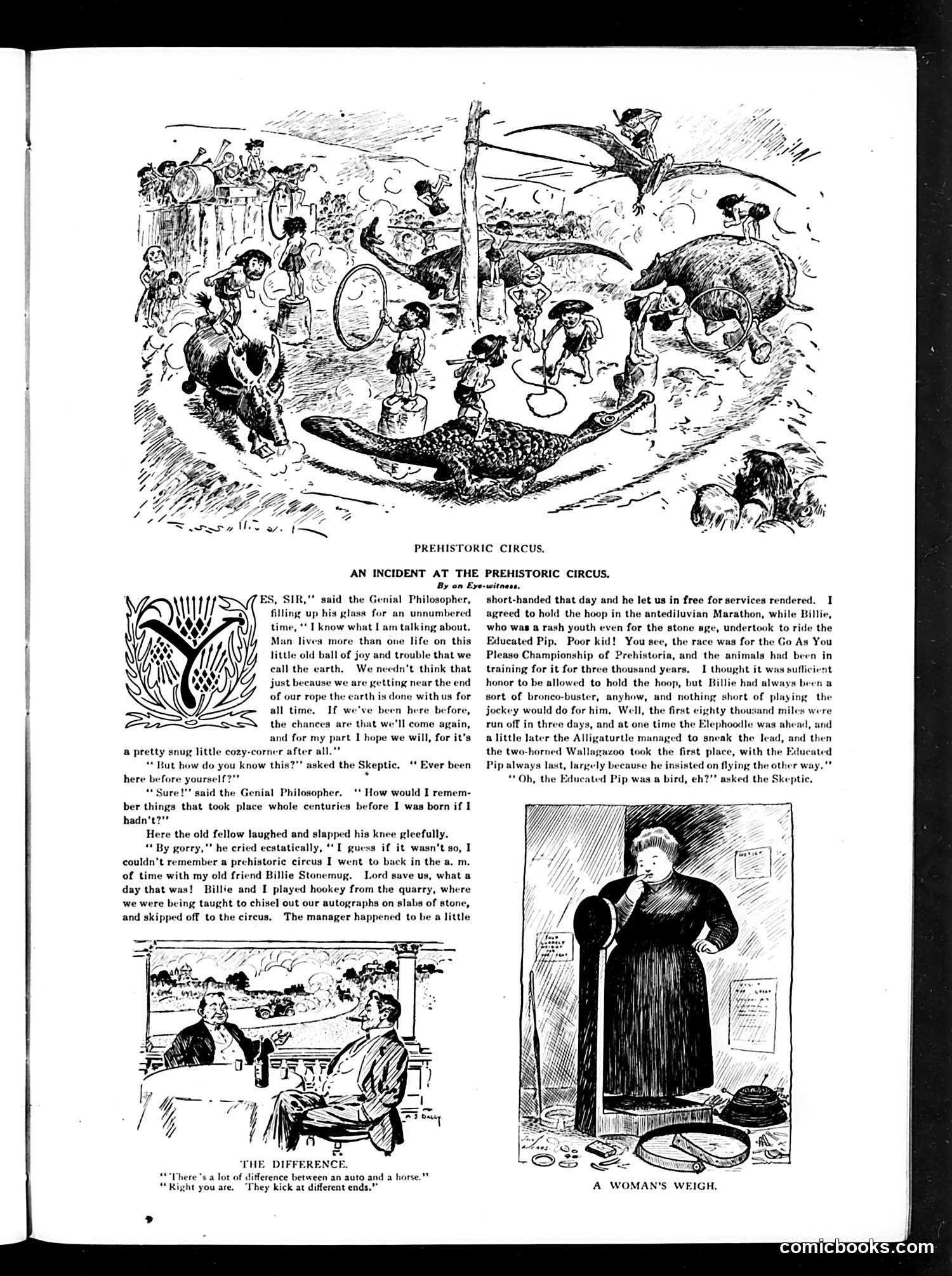
This Judge magazine page contains three satirical pieces: 1. **Top illustration**: "Prehistoric Circus" depicts cavemen operating a circus with dinosaurs, setting up an absurdist scenario for the story below. 2. **Main story**: "An Incident at the Prehistoric Circus" is a dialogue between a Skeptic and a Genial Philosopher about prehistoric times. The Philosopher claims he attended a prehistoric circus where animals performed. The humor derives from the anachronistic impossibility of this claim—using prehistoric settings to mock credulous belief in tall tales or exaggerated historical accounts. 3. **Bottom cartoons**: "The Difference" jokes about automobiles versus horses (a contemporary reference to early 1900s vehicle debates), while "A Woman's Weight" depicts a woman being weighed, likely satirizing contemporary anxieties about women's appearance or weight. The page employs absurdist humor typical of Judge's satirical style.
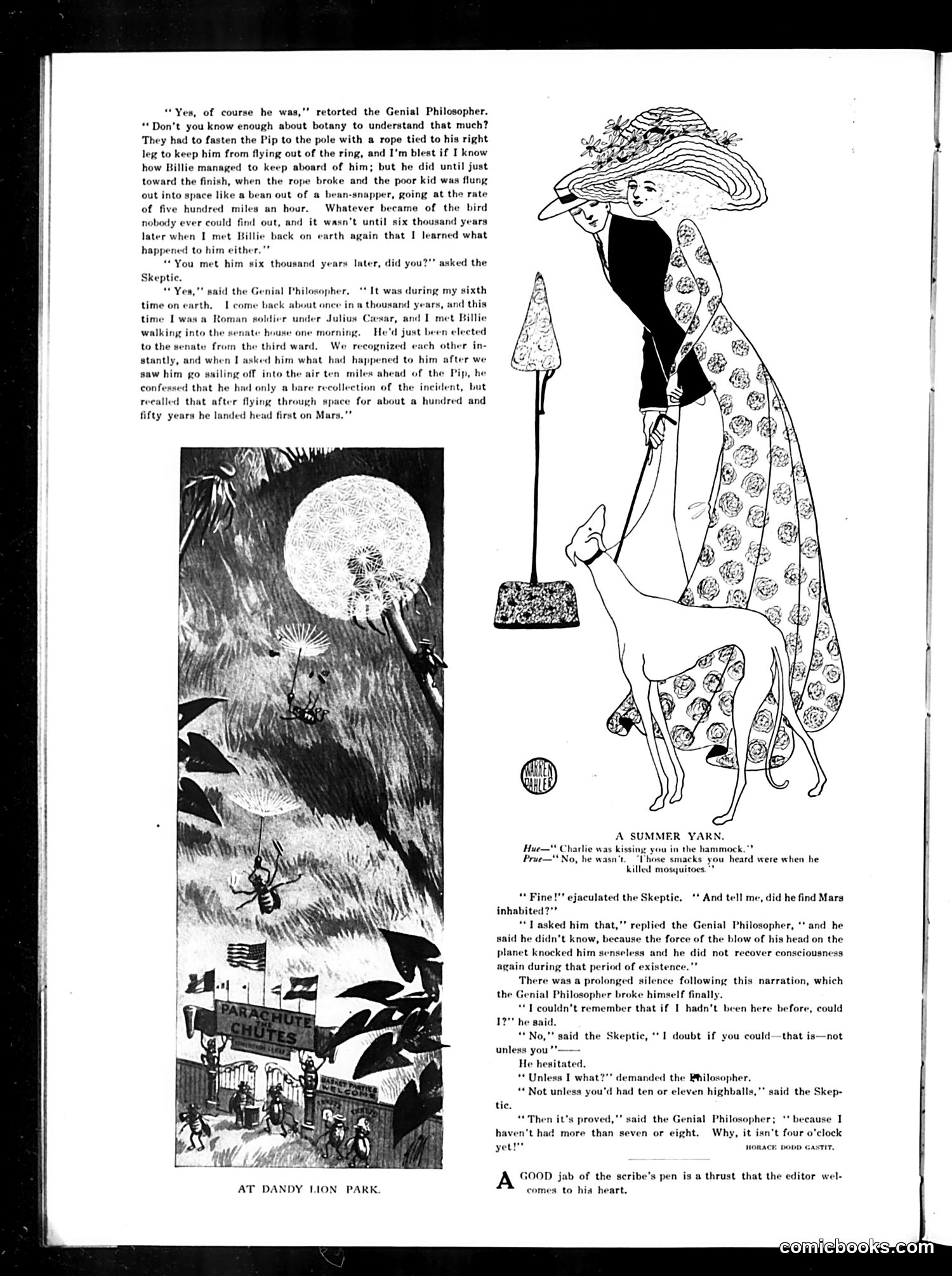
This page presents two distinct pieces of humor: **The Main Story ("A Summer Yarn"):** A tall-tale dialogue between the "Genial Philosopher" (a recurring Judge character known for absurd, elaborately detailed lies) and the "Skeptic." The Philosopher claims to have ridden a giant bird ("the Pip") six thousand years ago, with a boy named Billie. When the rope broke, Billie flew into space and eventually landed on Mars head-first. The joke satirizes credulous storytelling and boasts—the Philosopher's increasingly ridiculous claims keep escalating, and he uses circular logic (needing a drink to have the memory to have needed the drink) to trap the Skeptic. **The Illustrations:** "At Dandy Lion Park" (left, dramatic) and "A Summer Yarn" (right, whimsical) visualize the tall-tale's absurdity. The small dialogue at bottom ("Charlie was kissing you...mosquitoes") provides light domestic humor. The satire targets men who spin exaggerated stories and dodge skepticism through sophistry—common targets in Judge's social commentary.
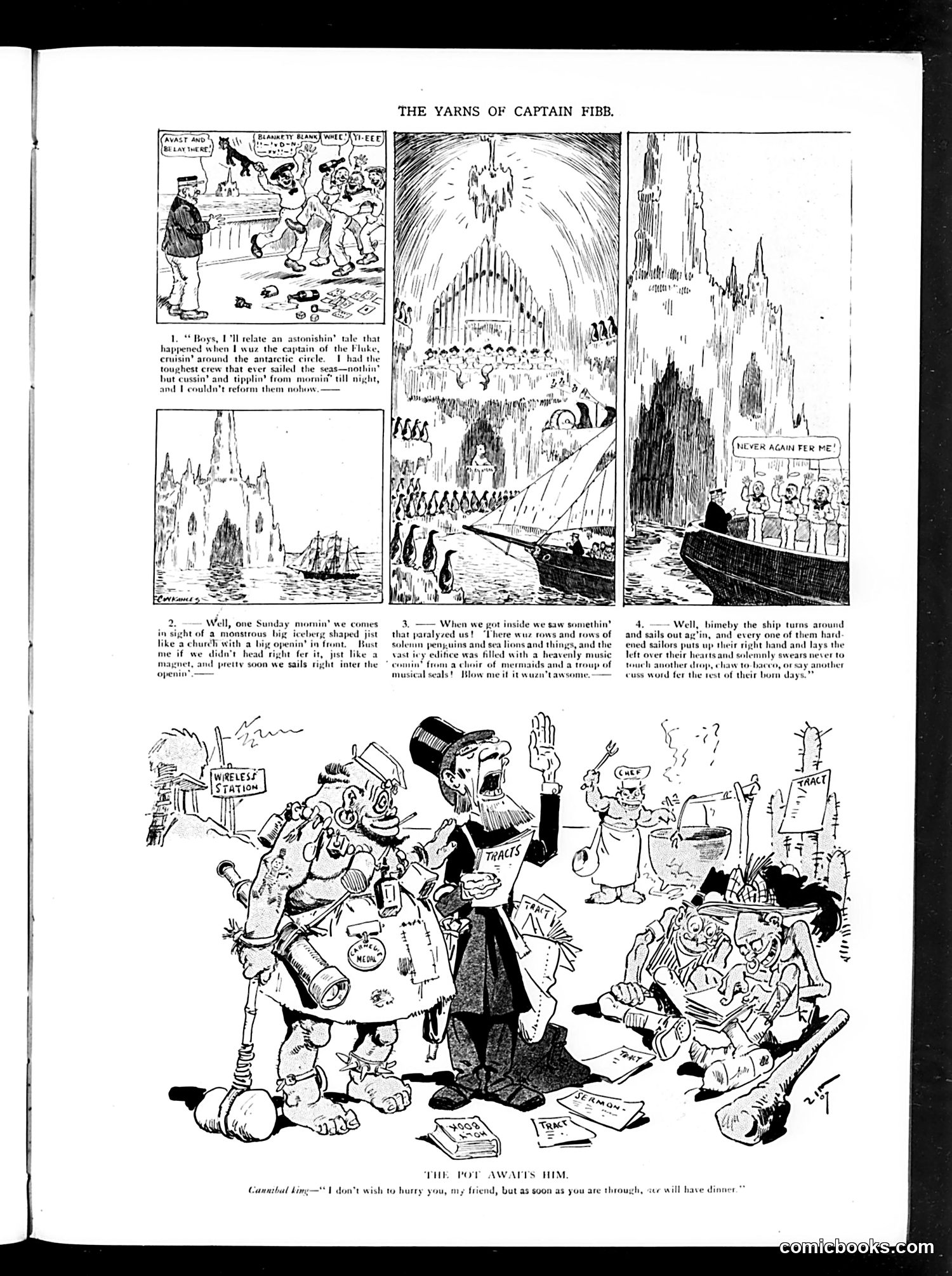
This is a satirical comic strip mocking tall tales and exaggeration. Captain Fibb tells increasingly absurd stories to boys—first about discovering the North Pole, then describing fantastical ice cathedrals and musical seals. The middle panels show his increasingly elaborate fabrications, while the bottom panel ("The Plot Awaits Him") suggests consequences for his deception. The satire targets both unreliable narrators who spin implausible adventure stories and, possibly, explorers' exaggerated expedition accounts popular in early 20th-century journalism. The final image—showing Fibb surrounded by various schemes and dubious characters—implies his dishonesty will ultimately catch up with him. The humor relies on readers recognizing impossibilities in his claims about Arctic exploration.
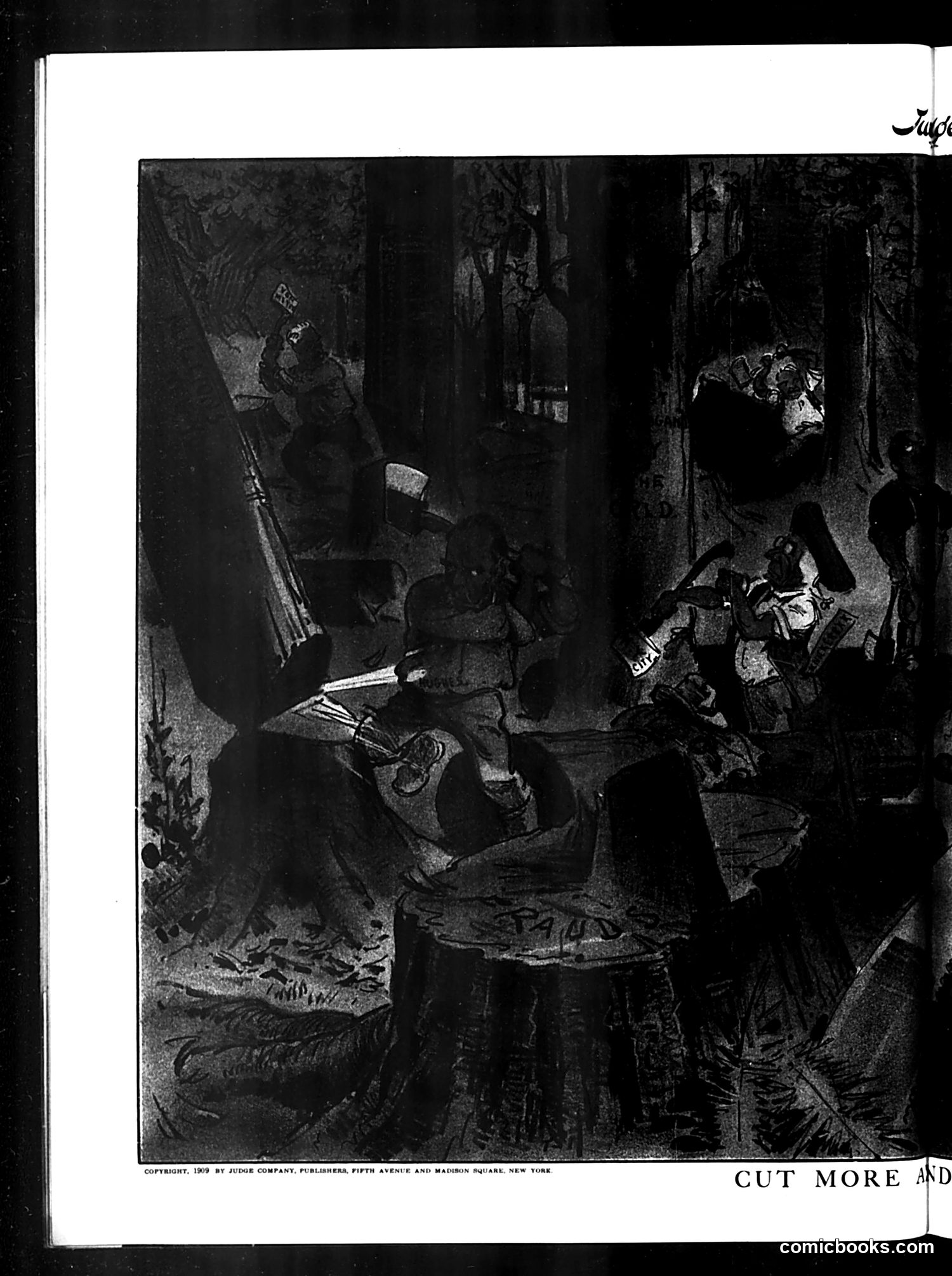
This appears to be a dark, dramatically rendered illustration from Judge magazine (copyright 1893). The image shows what seems to be a nighttime scene with multiple figures in period clothing gathered in a shadowy interior space. The composition is heavily shadowed and atmospheric, typical of late-19th-century satirical illustration. The visible text reads "CUT MORE A[ND]" at the bottom, though the complete caption is cut off, making the specific satirical point unclear without the full title. The dramatic lighting and gathering of figures suggest this may be depicting a political meeting, social gathering, or some form of clandestine activity meant to be commented upon satirically. Without the complete caption or additional context, the specific target of this satire cannot be determined with certainty.
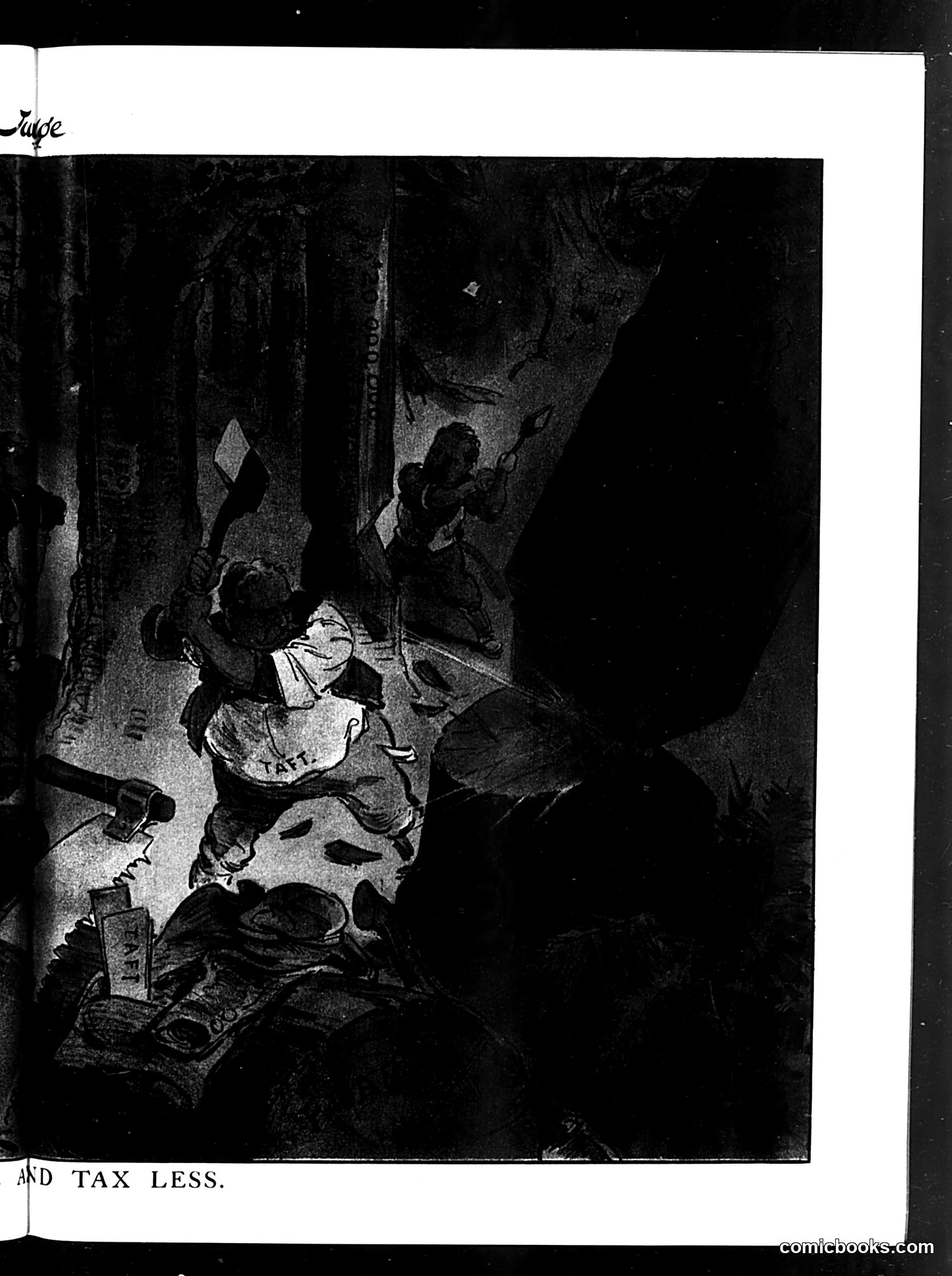
This Judge magazine cartoon satirizes tax policy, depicting what appears to be a beggar or poor person in an alleyway. The figure wears tattered clothing and is surrounded by meager possessions. The caption "AND TAX LESS" suggests this is commentary on taxation and its impact on the economically disadvantaged. The cartoon appears to be arguing that excessive taxation harms the poorest citizens—those who can least afford it. The stark, dark imagery emphasizes the poverty and desperation of the subject. Without the full page context or publication date visible, the specific tax policy being criticized remains unclear, but the message critiques how taxation affects America's poorest populations. This reflects Judge magazine's typical approach of using sharp visual satire to comment on economic and social policy.
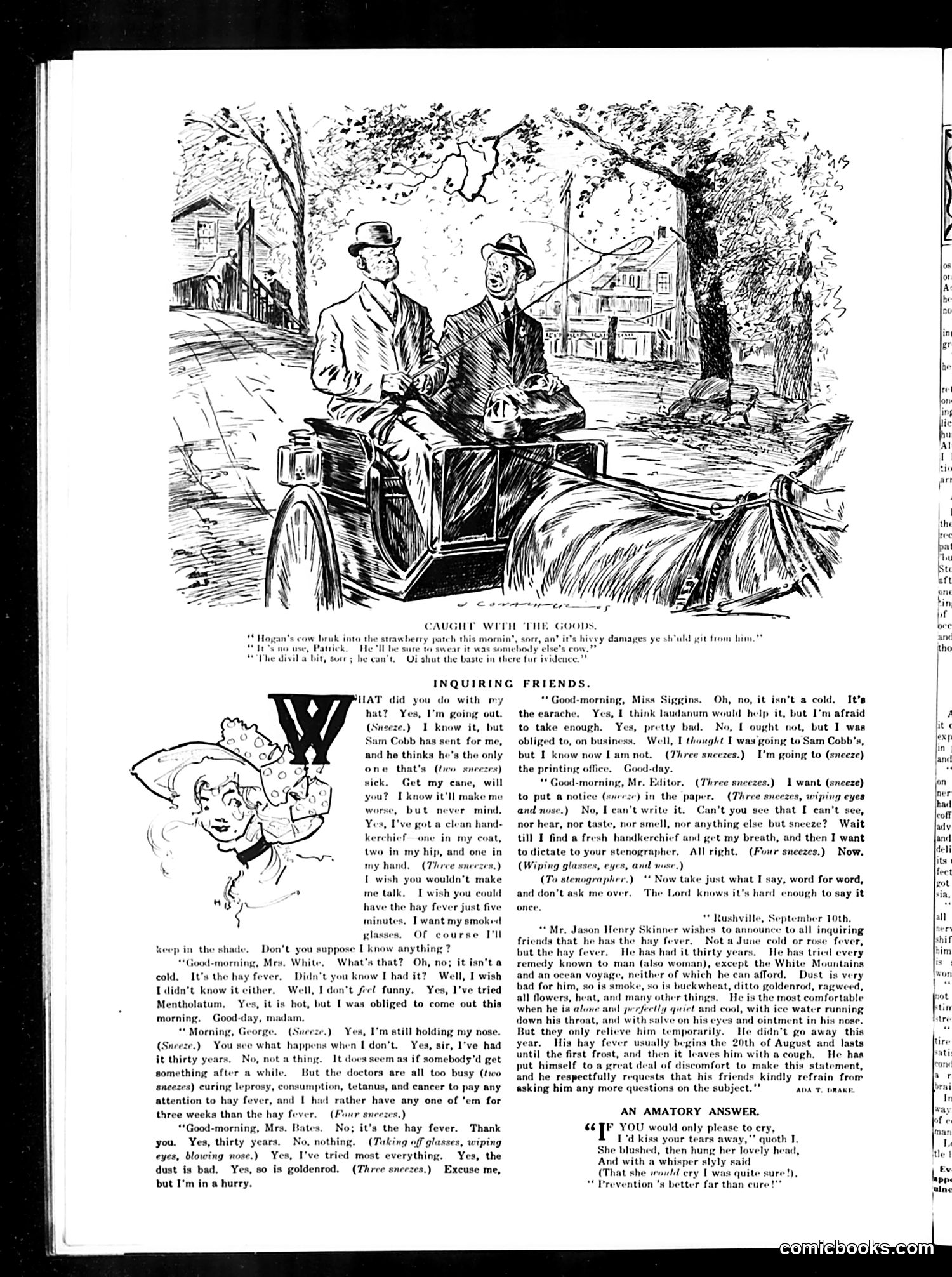
This page from *Judge* satirizes **hay fever sufferers** during what appears to be late summer/early fall (the season when hay fever peaks). The content mocks the chronic complainers and their predictable behaviors. **The main cartoons:** 1. **Top illustration** ("Caught with the Goods"): Two men in a horse-drawn carriage discuss someone caught stealing from a strawberry patch—likely a humorous setup joke. 2. **"Inquiring Friends"**: A series of comic dialogues showing a hay fever victim repeatedly saying the same excuses to different people (it's not a cold, tried everything for 30 years, can't go out, etc.). The humor relies on the **repetition and tedium** of listening to chronic sufferers describe their symptoms. 3. **Bottom section** announces "Mr. Jason Henry Skinner" has suffered hay fever for 30 years, tried every remedy, and is now most comfortable indoors with ice water—satirizing how hay fever becomes a person's defining characteristic and conversational obsession. The satire targets not hay fever itself, but **sufferers' relentless self-pity and the social annoyance** they create by constantly discussing their condition.
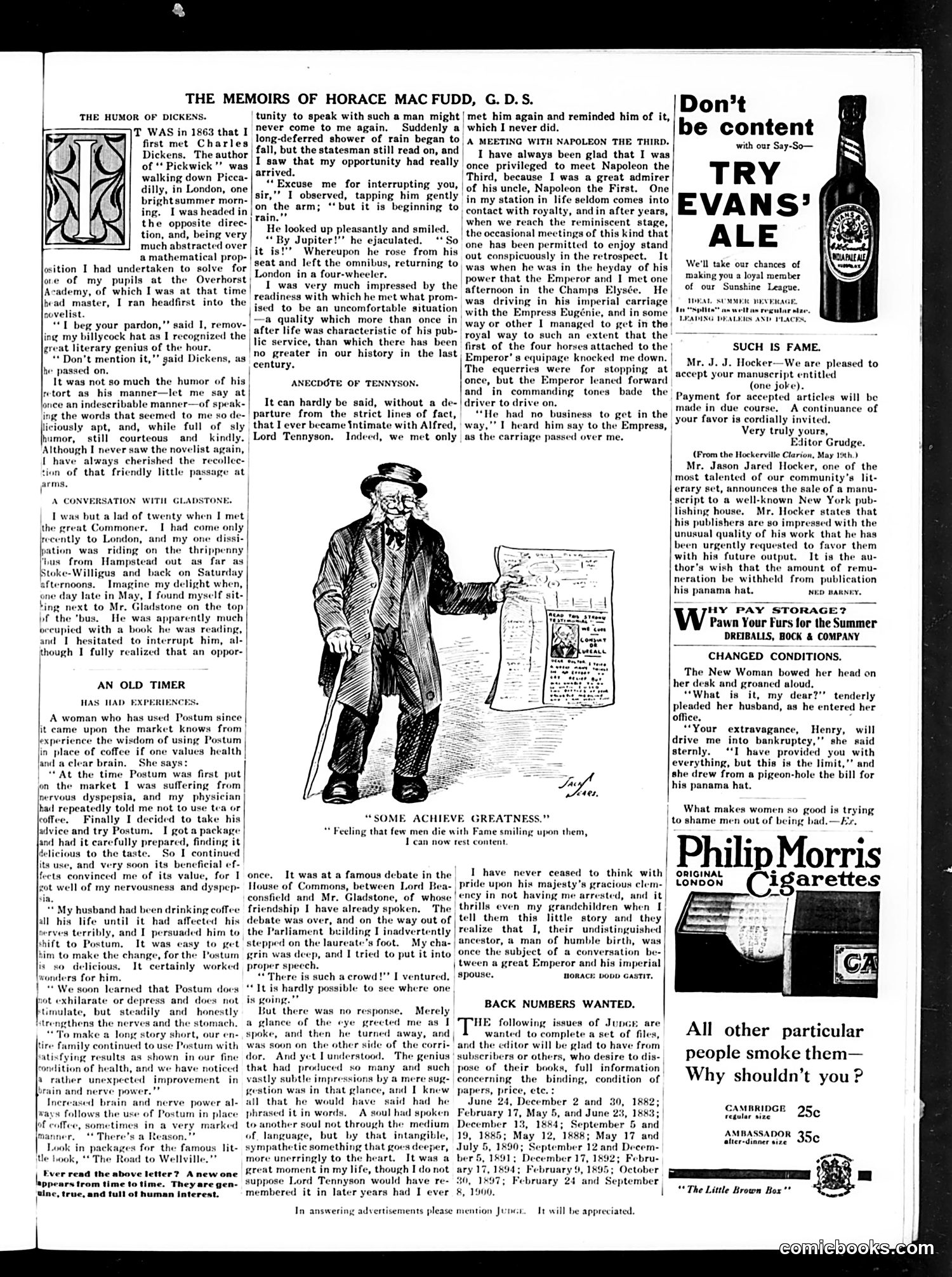
This page is primarily **literary memoir**, not political satire. It contains three anecdotal pieces by readers claiming personal encounters with famous 19th-century figures—Charles Dickens and an unnamed "great Commoner" (likely a British politician). The humor is gentle and nostalgic: the first story plays on a chance meeting where the narrator bumps into Dickens; the second describes awkwardly meeting a politician on a bus, only to have him politely exit when rain begins. The **cartoons** show an elderly man reading a newspaper (captioned "Some Achieve Greatness"), likely illustrating the reminiscence theme. The page also includes vintage **advertisements** for Postum (a coffee substitute), Evans' Ale, Philip Morris cigarettes, and pawn shops—typical of early 20th-century magazines. There is no significant political commentary; instead, this reflects *Judge* magazine's broader editorial mix of humor, personal narratives, and advertising.
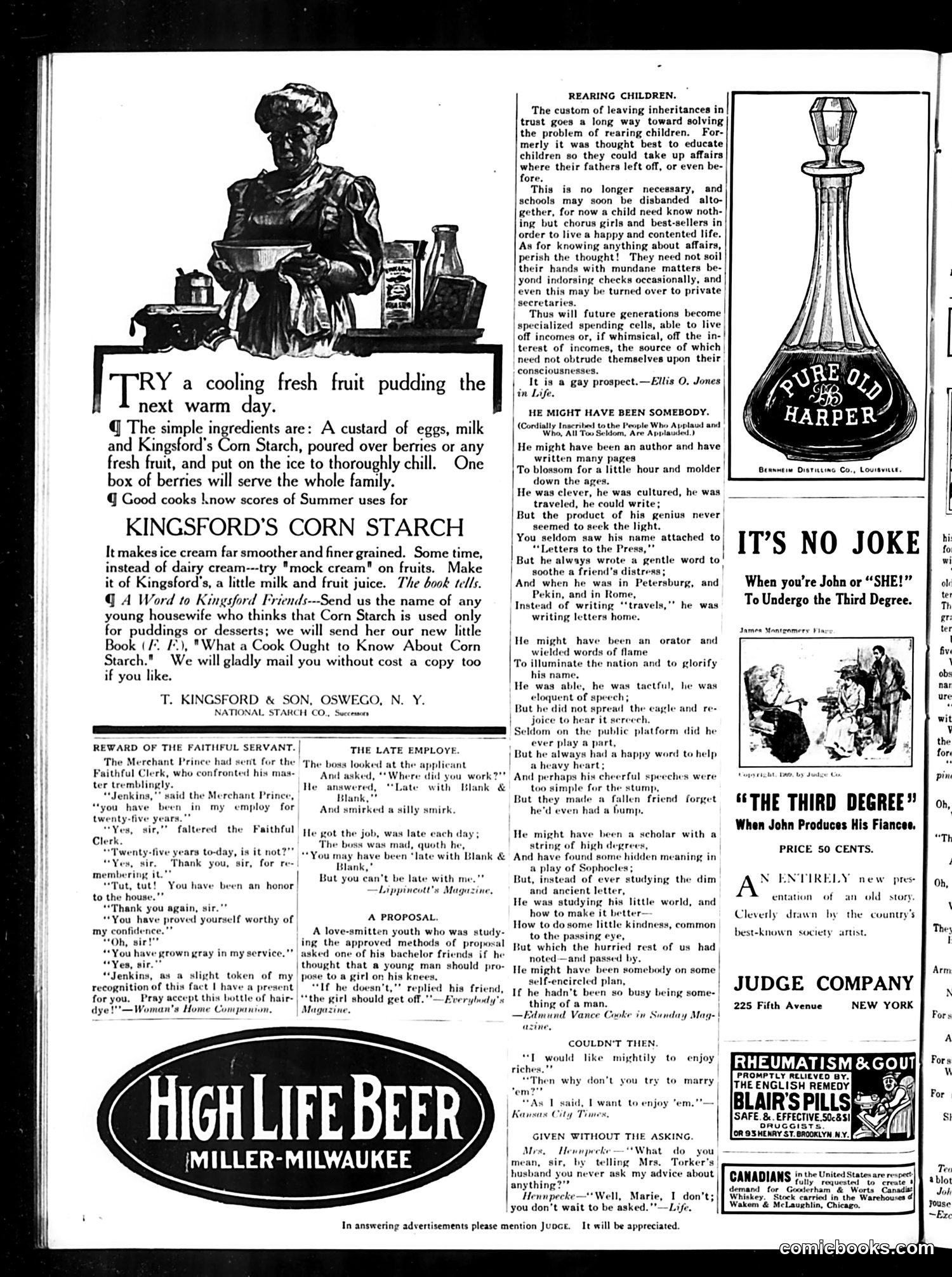
This is primarily an **advertising and advice page** from Judge magazine, not a political cartoon page. The main content includes: **Advertisements:** Kingsford's Corn Starch (featuring a recipe for fruit pudding) and High Life Beer dominate the layout. **Satirical anecdotes** ("The Late Employe," "Reward of the Faithful Servant," "A Proposal") are brief workplace and courtship humor pieces—typical Judge filler content poking fun at employment dynamics and social conventions. **The substantive satire:** "Rearing Children" and "He Might Have Been Somebody" mock contemporary attitudes. The first sarcastically critiques wealthy families who let inheritances eliminate the need for children to be educated or productive—they need only know "chorus girls and best-sellers." The second laments talented individuals who never publicize their abilities, instead quietly helping others. Both satirize class attitudes and wasted potential among the privileged classes. Overall, this reflects Judge's focus on middle-class and upper-class social satire.
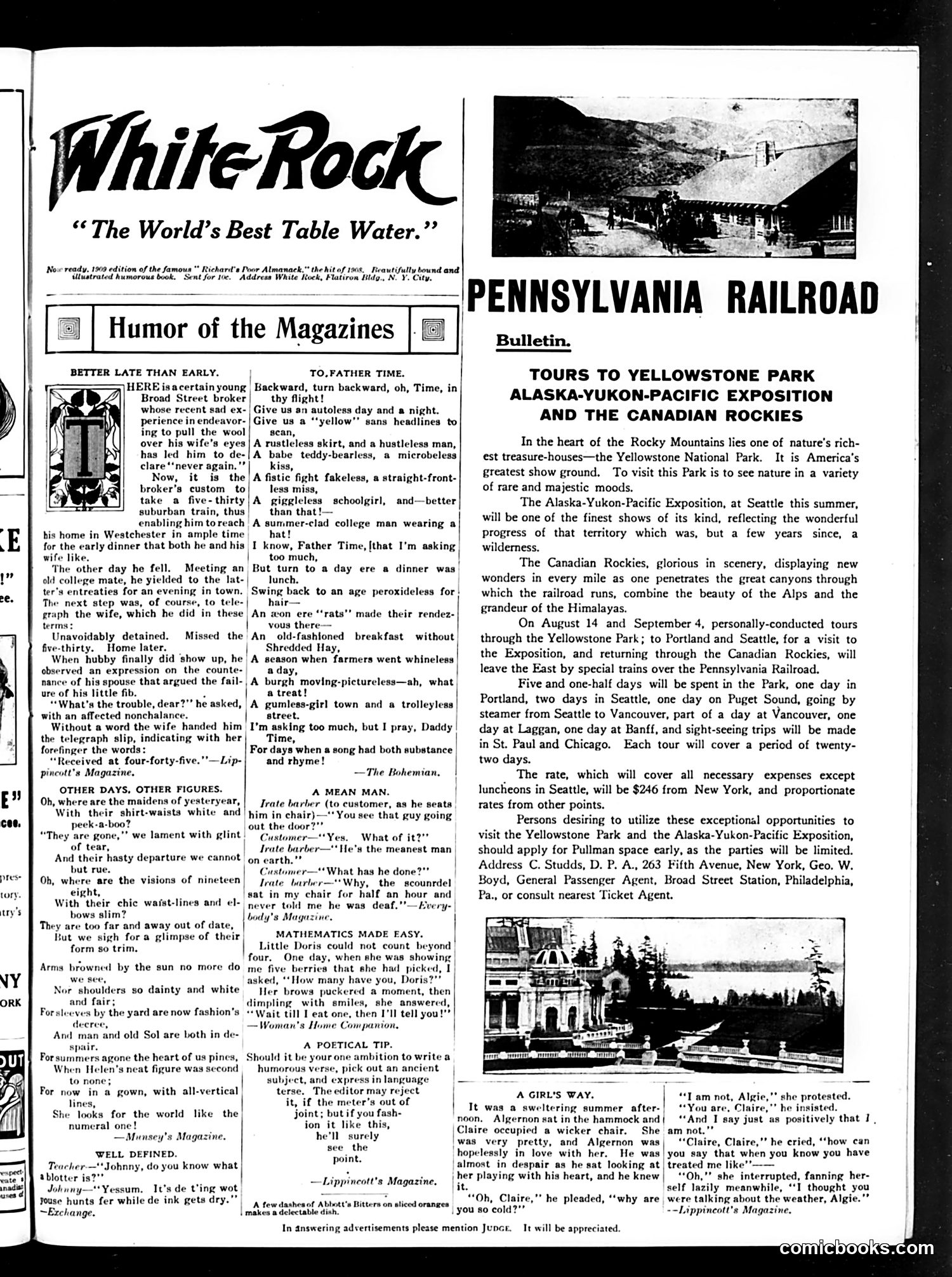
This page collects humorous short pieces reprinted from various contemporary magazines. The cartoons and jokes satirize modern anxieties and social changes of the early 1900s: **"Better Late Than Early"** mocks a businessman who lies about being delayed, only to be caught by his wife's telegraph confirmation of his actual arrival time—exposing the futility of deception. **"To, Father Time"** is nostalgic social satire, pleading for a return to an imagined simpler past: no "yellow" sensationalist newspapers, no teddy bears, no peroxide hair treatments, no movie theaters. It reflects anxiety about modern consumerism and technological change. **"A Mean Man"** portrays a barber's pettiness—holding a grudge because a deaf customer didn't tell him about his deafness, making him waste time talking. **"Mathematics Made Easy"** presents a child's logical solution to counting: eat one berry, then count the remainder—innocent humor about childhood reasoning. These pieces mock modern urban life, technology, vanity, and human nature through gentle irony rather than sharp political commentary.
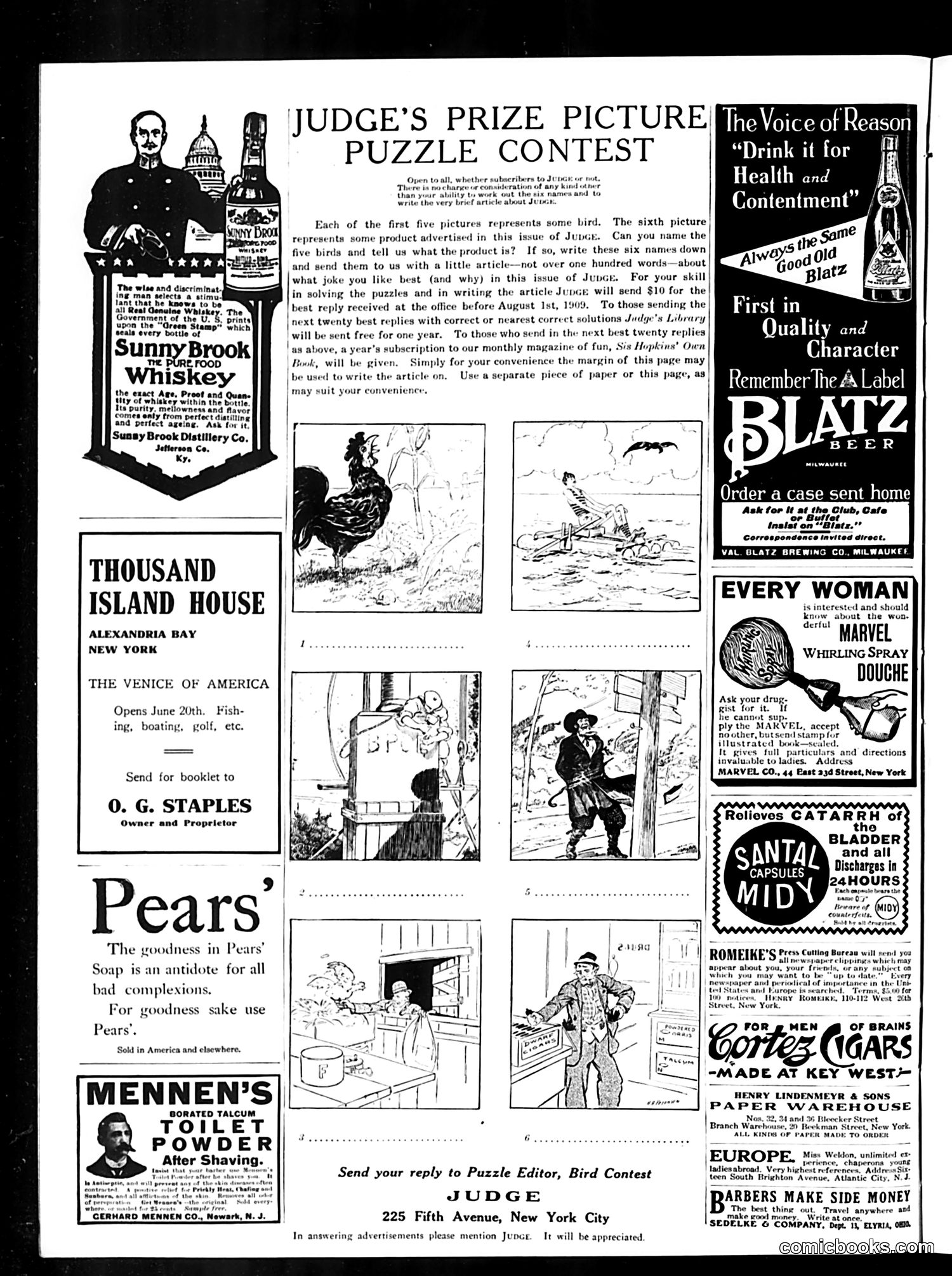
This is primarily a **puzzle contest page** rather than political satire. Judge magazine ran a "Bird Contest" asking readers to identify six birds depicted in simple line drawings, then write brief articles explaining the jokes and which they preferred. Winners received cash prizes ($10 for first place) or subscriptions to Judge's sister publication, *Sir Hopkins' Own Book*. The page is surrounded by period **advertisements** for consumer products: Sunny Brook Whiskey, Pears' Soap, Mennen's talcum powder, Blatz Beer, Marvel feminine hygiene product, and cigars. These ads reflect early 1900s consumer culture and marketed goods. The contest instructions occupy the center, while advertisements fill the margins—typical of Judge's revenue model. The content reflects Judge's identity as entertainment for middle-class readers who could afford both the magazine and advertised luxury goods.
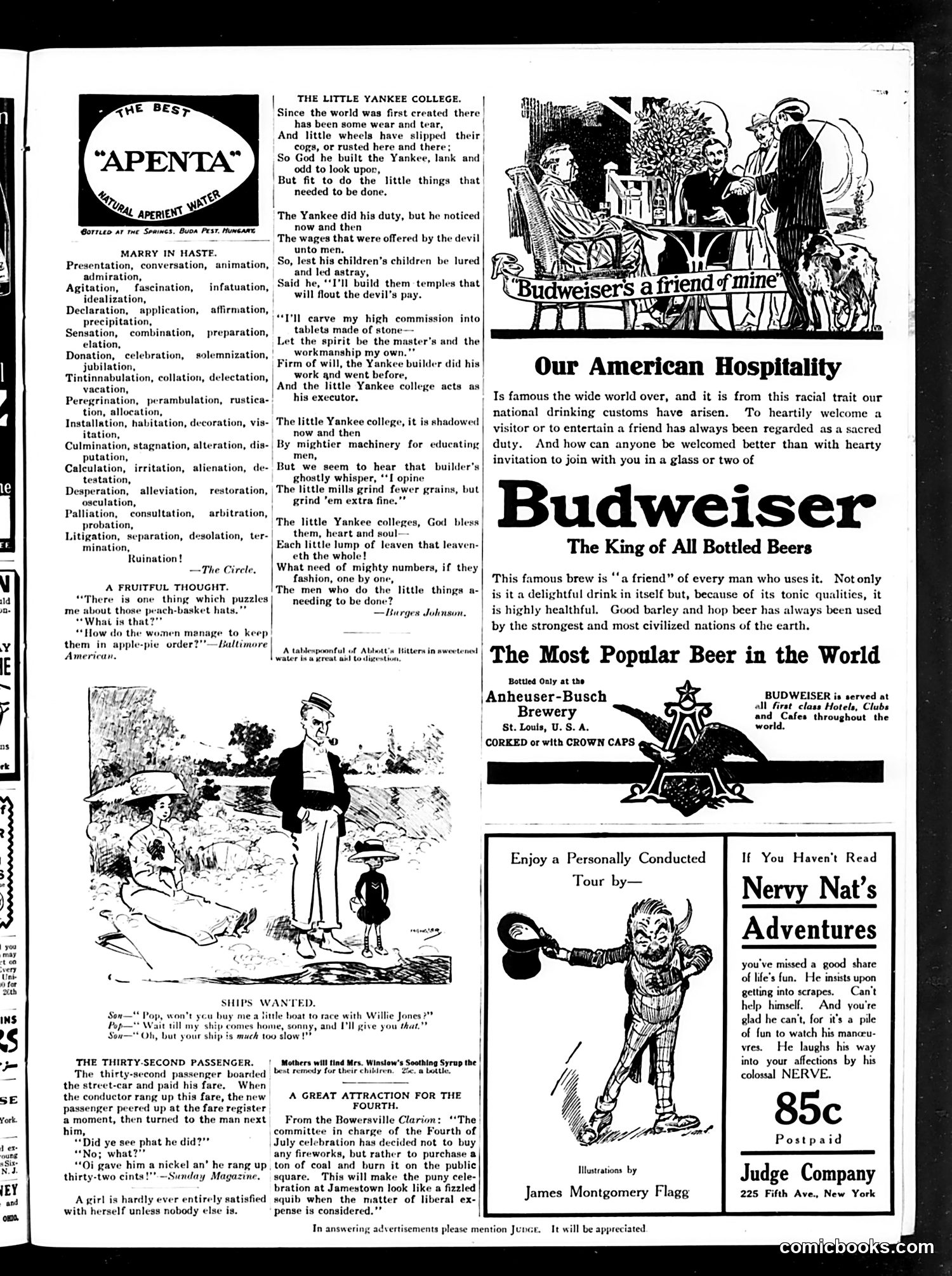
This page primarily consists of advertisements and light humorous pieces rather than political satire. **Main Content:** The page features the Budweiser beer advertisement as its centerpiece, promoting beer as embodying "American Hospitality"—a common early 20th-century marketing approach linking alcohol consumption to national character and social obligation. **Humorous Pieces:** - "The Little Yankee College" is a poem praising American educational institutions as continuing the moral work of Yankee founders - "Marry in Haste" is a comedic list of polysyllabic words - Several brief jokes about boats, conductors, and fireworks appear in the margins **Historical Context:** These pieces reflect pre-Prohibition attitudes (the page predates 1920) when beer advertising could openly associate drinking with hospitality and virtue. The "Little Yankee College" invokes nostalgic American values—hard work, moral education, and Yankee ingenuity—typical of early 1900s magazine content. The page is primarily commercial rather than satirical.
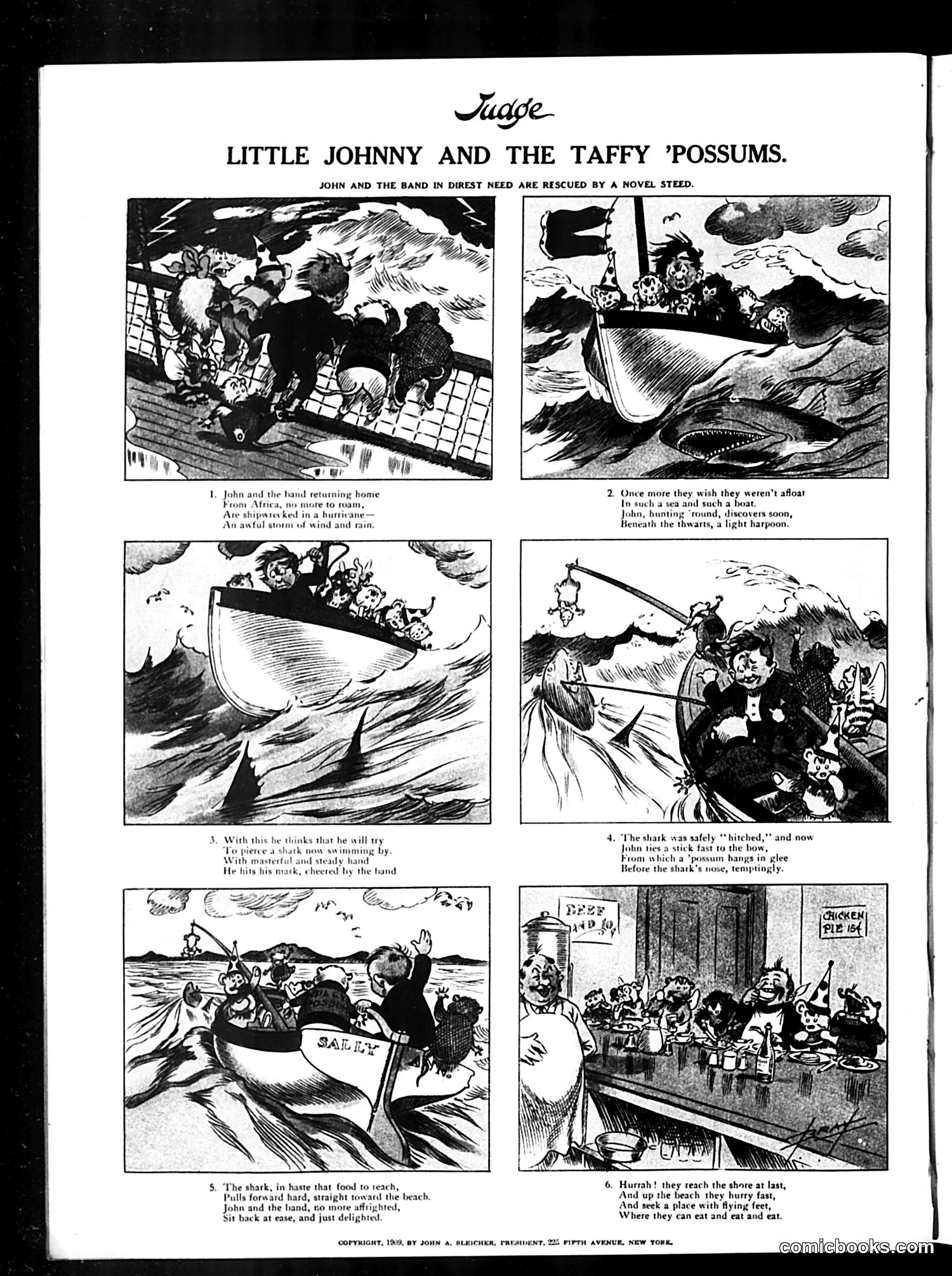
This is a whimsical adventure comic strip, not political satire. The narrative follows a boy named Johnny and a band who are shipwrecked and rescued by an improvised method: they use a possum (a marsupial animal) as bait dangled from their boat's bow to lure a shark to shore, then ride the shark to safety like a makeshift steed. The comic plays on early 20th-century American humor featuring clever resourcefulness and absurdist scenarios. The "taffy 'possums" in the title refers to the possums used in this scheme. This appears to be a standalone children's adventure story with no deeper political meaning—simply entertainment from *Judge* magazine's lighter content, typical of the publication's mix of satire and general humor pieces.