
A complete issue · 20 pages · 1909
Judge — May 29, 1909
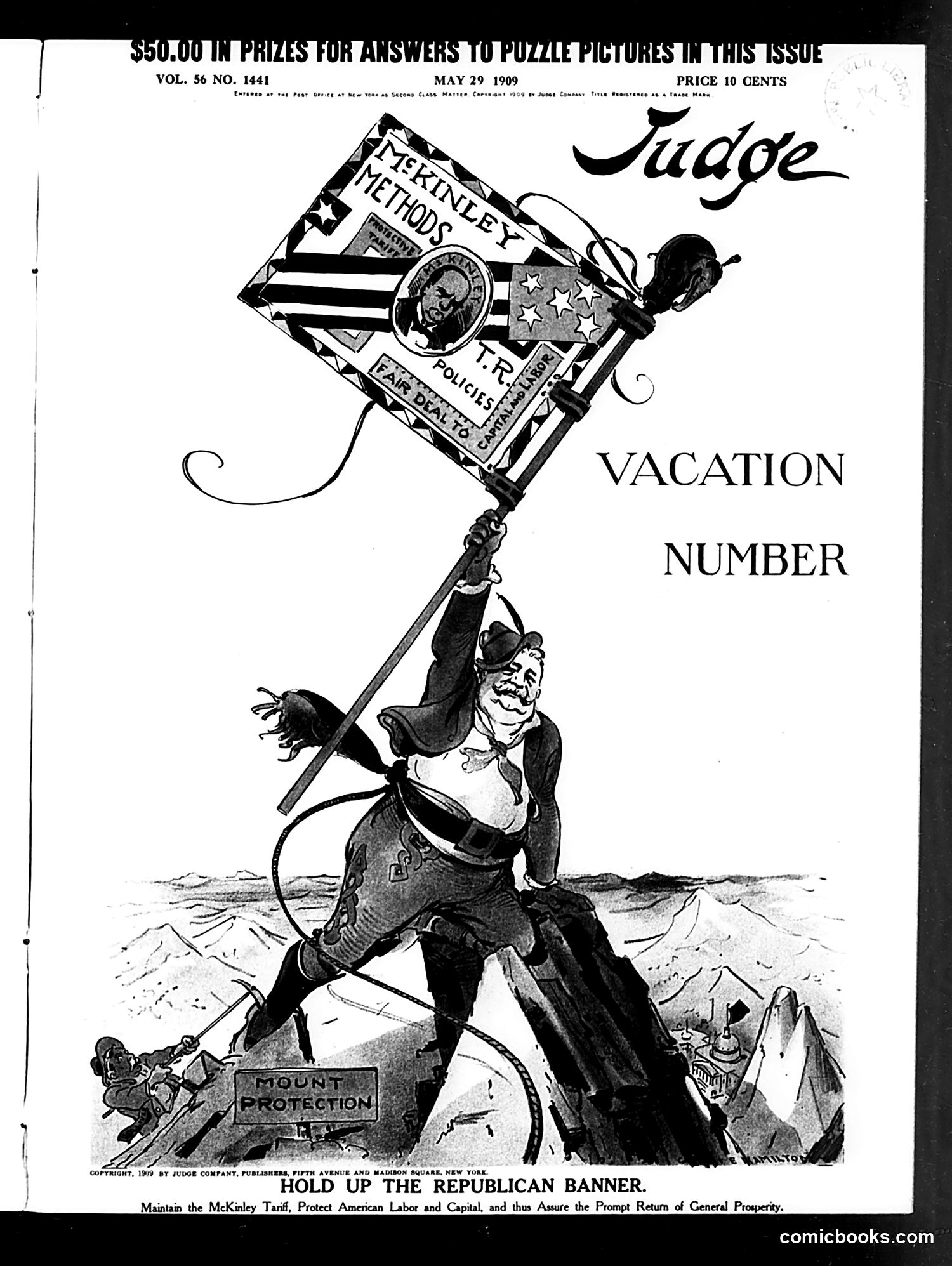
This is Judge magazine's vacation issue from 1909, featuring a political cartoon criticizing Republican economic policy. The central figure appears to be a caricatured Republican politician or capitalist holding aloft a kite made of policy documents (including "McKinley Methods" and references to tariffs and protections). Below, marked "Mount Protection," sits a figure labeled as representing American labor and capital. The satire critiques the McKinley Tariff and Republican protective trade policies. The caption "Hold up the Republican Banner" is ironic—the kite represents how Republicans claim to protect American interests, but the cartoon suggests these policies actually benefit the wealthy at workers' expense. The vacation theme underscores the leisurely indulgence this represents for the privileged classes.
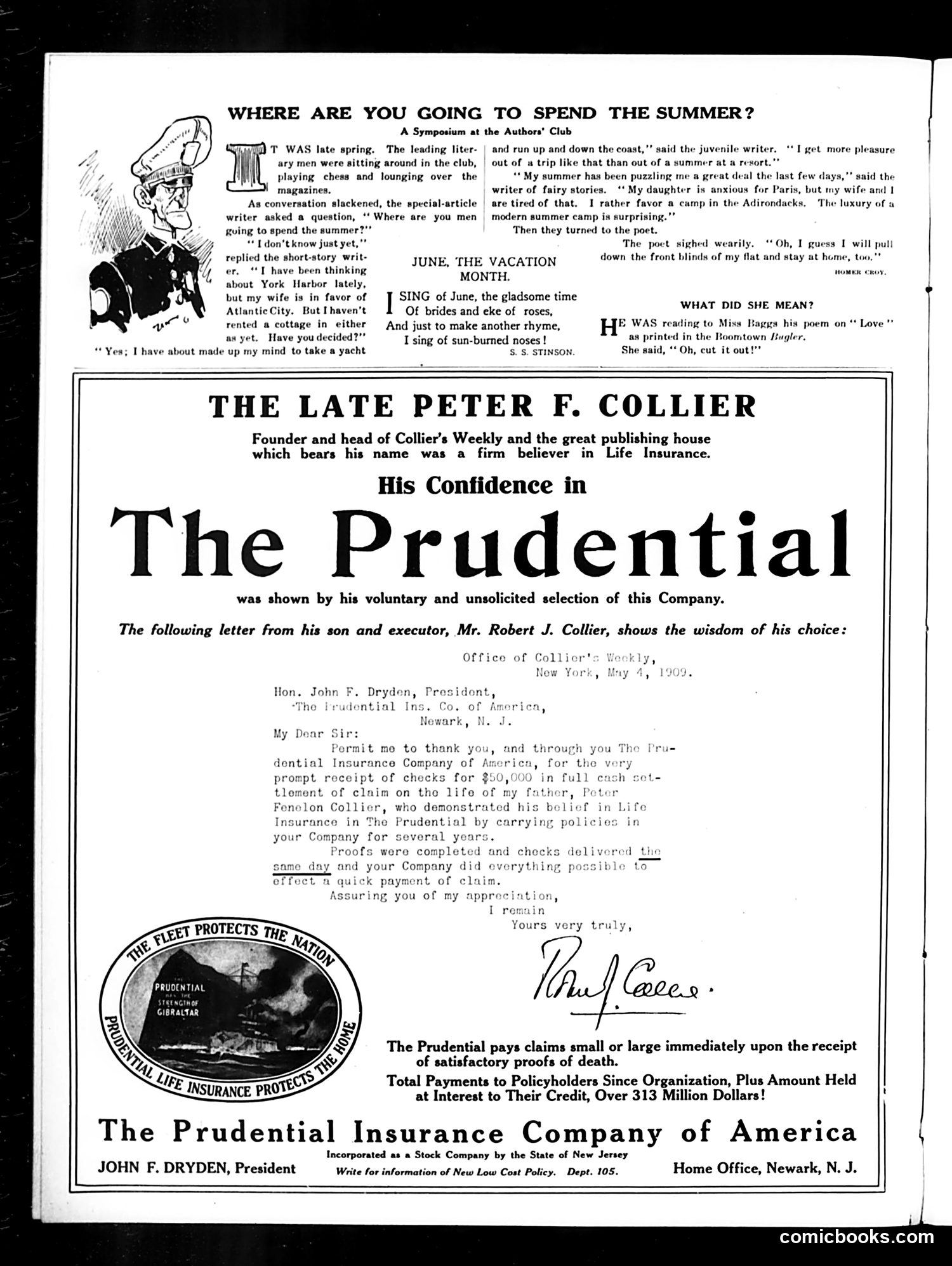
This page is primarily **advertising**, not satirical content. The dominant element is a full-page advertisement for The Prudential Insurance Company of America, featuring a letter from Robert J. Collier (son of Peter F. Collier, founder of Collier's Weekly magazine) endorsing the company's life insurance services. The upper portion contains a brief conversational symposium titled "Where Are You Going to Spend the Summer?" with literary figures discussing vacation plans, followed by a humorous poem about June by S.S. Stinson. The Prudential ad emphasizes prompt claim payments and includes the company's motto about protecting the nation. The testimonial from a prominent publisher served as credibility-building marketing typical of early 20th-century advertising in quality magazines.
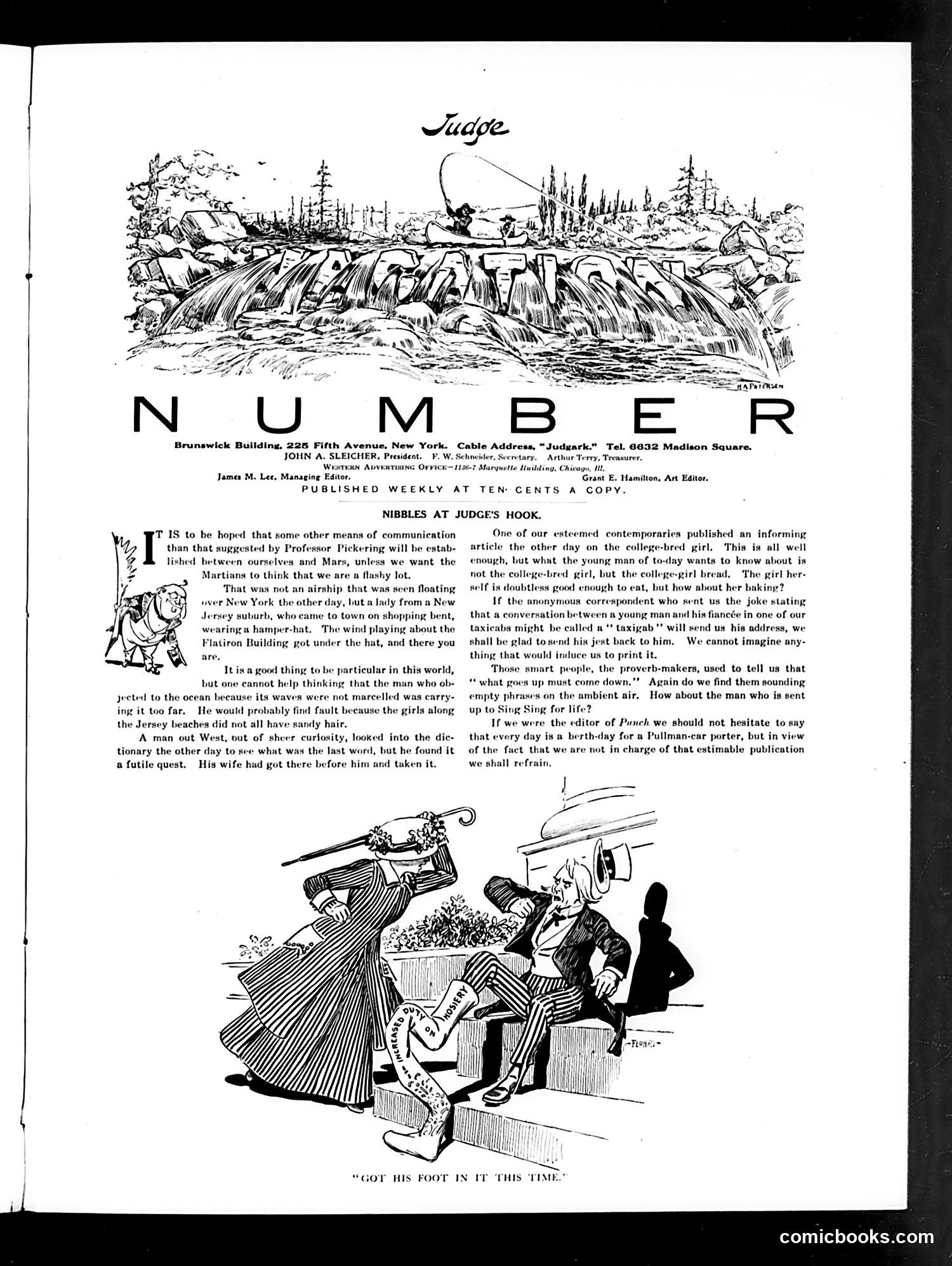
This page from Judge magazine contains editorial commentary titled "Nibbles at Judge's Hook" discussing contemporary communication methods and social trends. The top illustration depicts fishing at "Judge's Hook," a landscape vignette. The lower cartoon, captioned "Got His Foot in It This Time," shows a man (appears to be a politician or public figure) who has stepped into something problematic—literally depicted as having his foot caught in a trap or compromising situation. A woman and another figure observe. This satirizes someone who has made a misstep or gotten caught in scandal. The text references airship sightings, beach behavior, and criticizes anonymous newspaper correspondents spreading rumors about college girls. It uses lighthearted social satire typical of Judge's approach, though specific contemporary references (dates, names) are unclear without additional context.
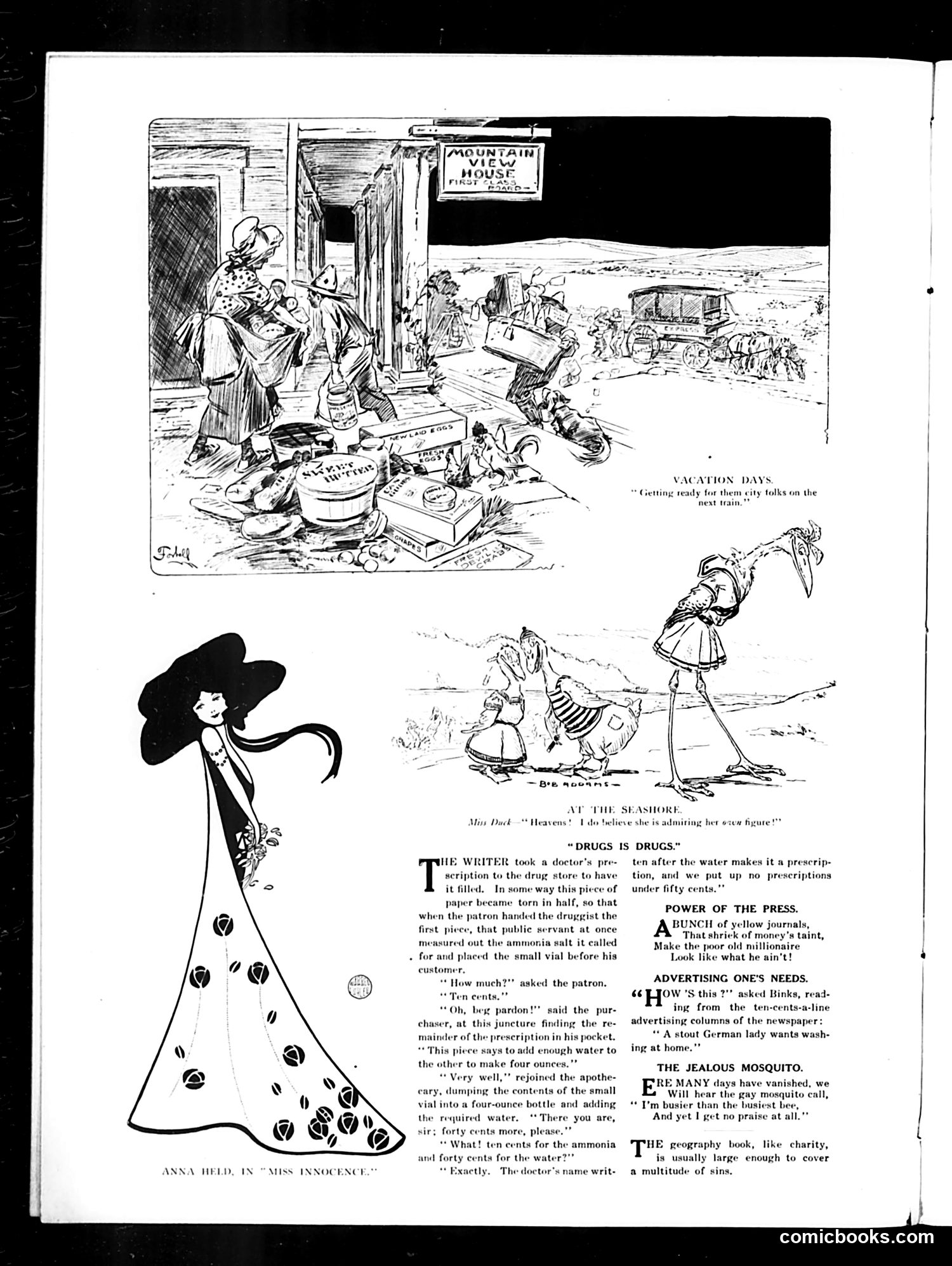
This page contains multiple satirical pieces reflecting early 20th-century American concerns: **"Vacation Days"** (top): Mocks city dwellers attempting rustic mountain tourism. The "Mountain View House" sign and chaotic scene of unprepared visitors suggest satiric commentary on urban tourists' incompetence in rural settings—a recurring theme as automobile travel expanded leisure culture. **"Drugs is Drugs"**: Satirizes pharmacy practices, where a doctor's prescription for ammonia becomes comically inflated in price and quantity through a druggist's miscommunication, ultimately costing forty cents for water. This criticizes pharmaceutical markup and confusing pricing practices. The page also includes brief humorous pieces on advertising, newspaper columnists, and mosquitoes—typical Judge fare mocking contemporary consumer culture and small social annoyances rather than directly political content.
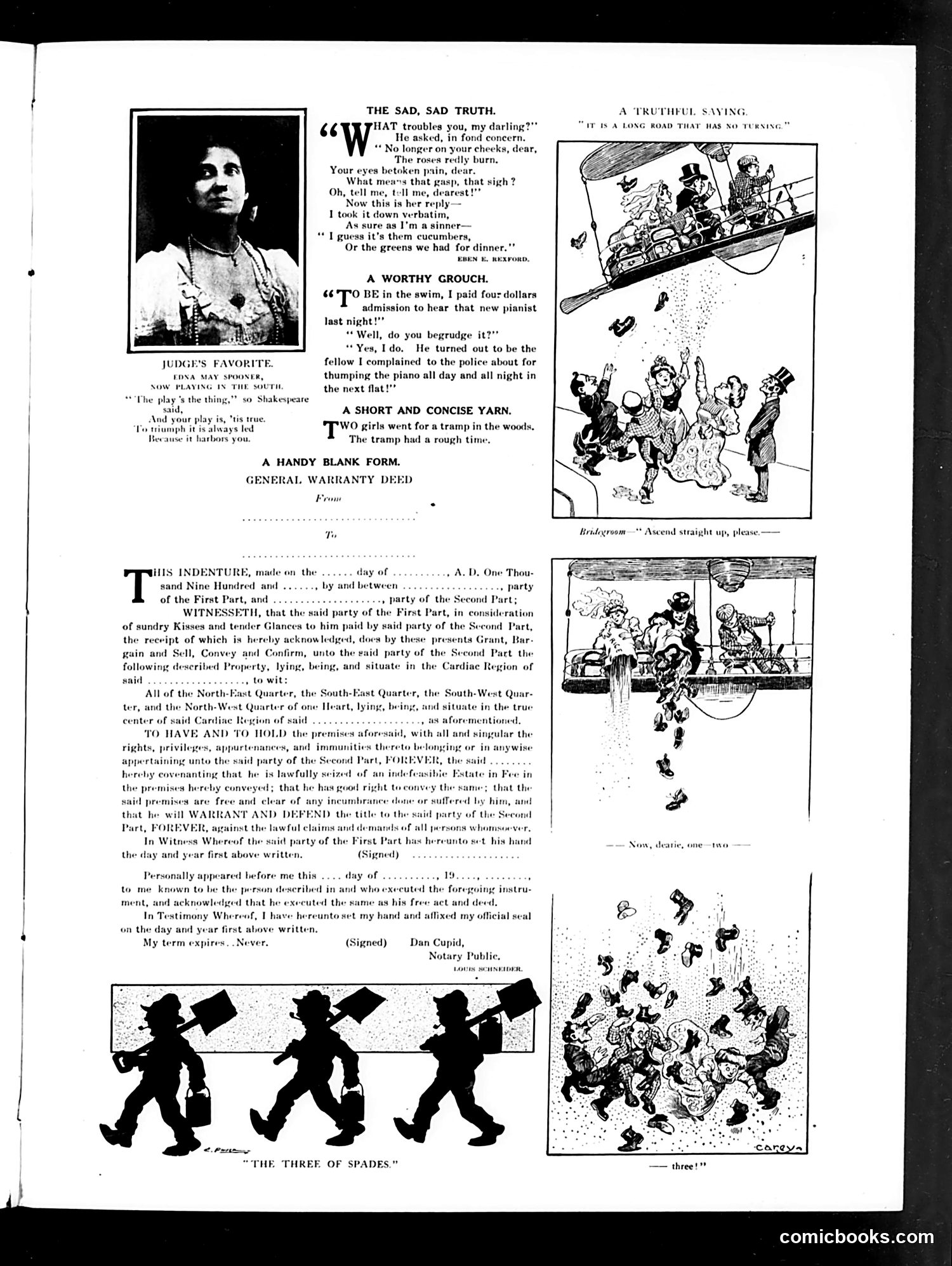
This page contains several unrelated satirical pieces typical of early Judge magazine: **"The Sad, Sad Truth"** presents a poem about romantic disappointment, with an accompanying portrait photograph. **"A Worthy Grouch"** is a brief joke about someone paying four dollars for concert admission, then complaining to police about piano noise. **"A Short and Concise Yarn"** humorously describes two girls encountering a tramp in the woods. **"A Handy Blank Form"** provides a template for a "General Warranty Deed"—satirizing legal document language through its absurdly verbose phrasing about property transfer "in the Cardiac Region of said [blank]." The cartoons on the right side appear to be humorous domestic or social scenes with minimal text, though their specific satirical targets are unclear from the image quality and OCR'd text provided.
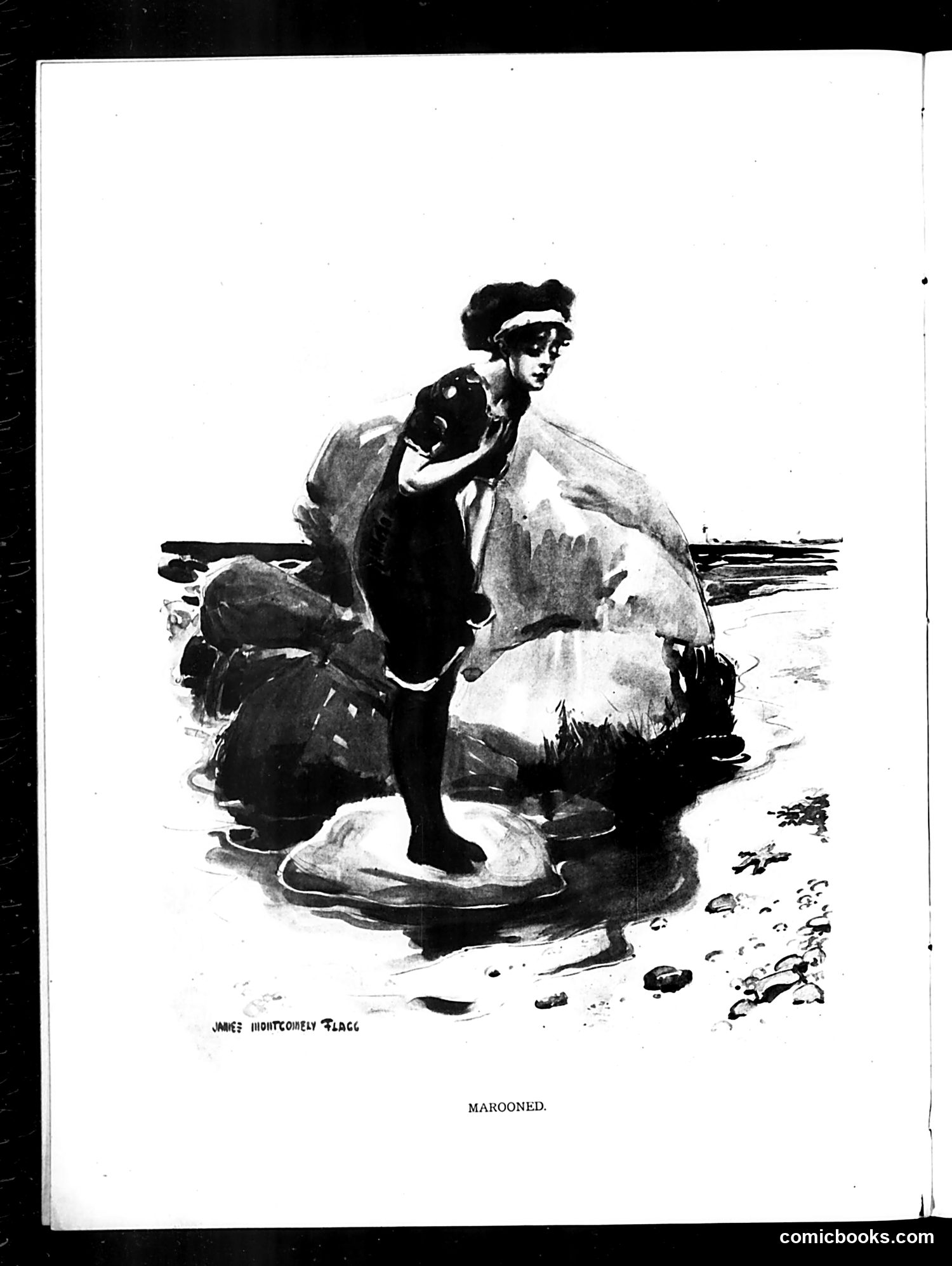
This illustration depicts a figure stranded on what appears to be a rocky shore or island, wearing tattered clothing and a headband. The figure clutches a bundle of possessions while standing amid scattered debris and wreckage. Without additional context from the magazine's date or surrounding articles, the specific political or social reference remains unclear. The title "Marooned" suggests abandonment or being left helpless, potentially commenting on someone's political downfall, social exclusion, or failed circumstances. The artistic style and subject matter are typical of Judge magazine's satirical commentary on public figures and events of its era, but the identity of the figure and the precise historical event being referenced cannot be determined from the image and text alone.
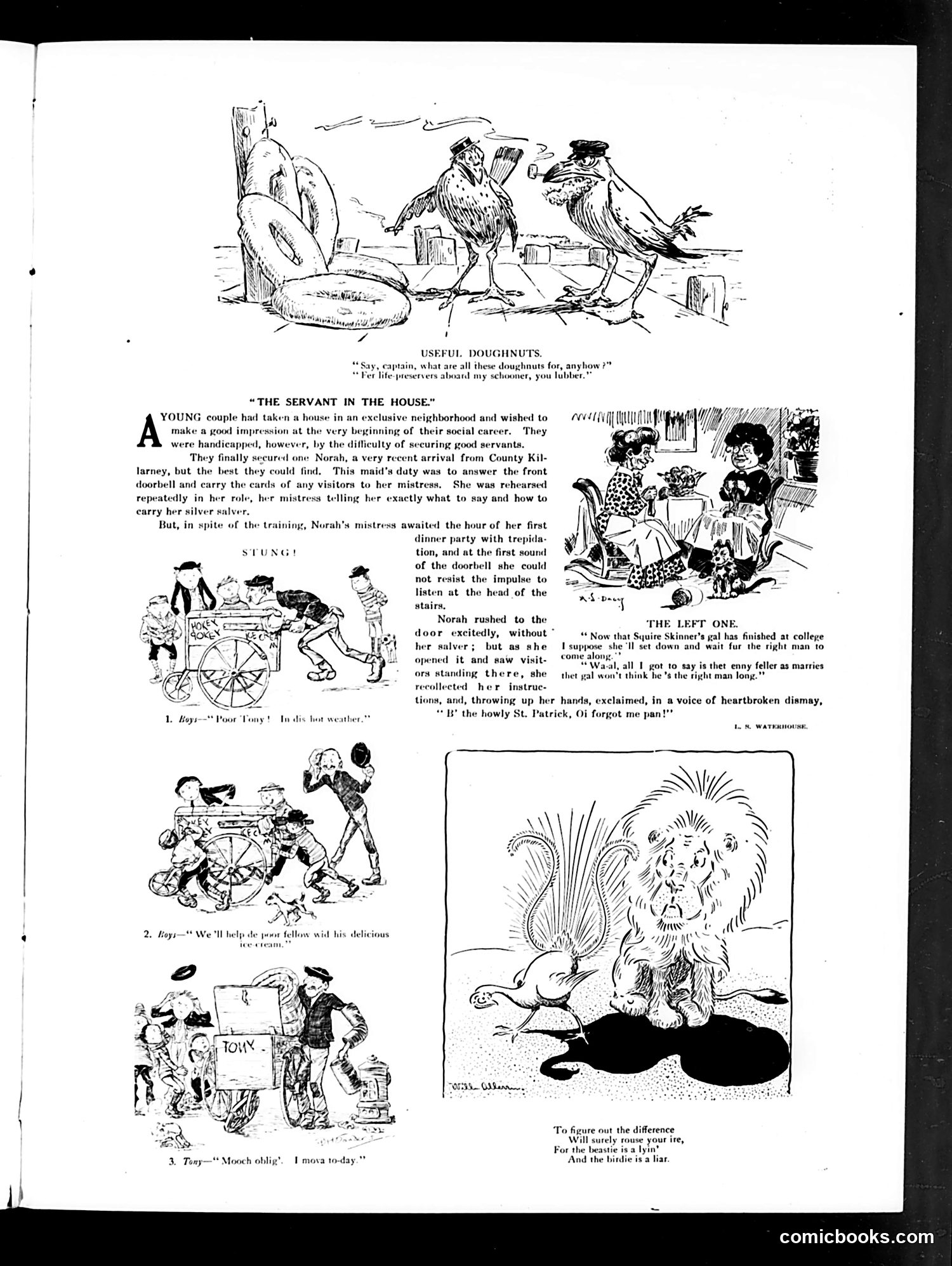
This page satirizes the anxieties of newly wealthy Americans attempting to establish themselves socially. A young couple hires Norah, a recently arrived Irish immigrant servant, to answer their door and impress dinner guests. Despite careful training on proper etiquette, Norah panics at the doorbell and abandons her instructions, greeting visitors with an exclamation in thick Irish dialect: "B' the howly St. Patrick, Oi forgot me pan!" The humor targets both the pretensions of social climbers and ethnic stereotypes of Irish immigrants as uncouth and unreliable. The sidebar "The Left One" mocks women seeking advantageous marriages. The cartoons use exaggerated dialect and caricature to mock working-class Irish servants as inherently unable to acquire proper manners, reflecting period prejudices common in American humor.
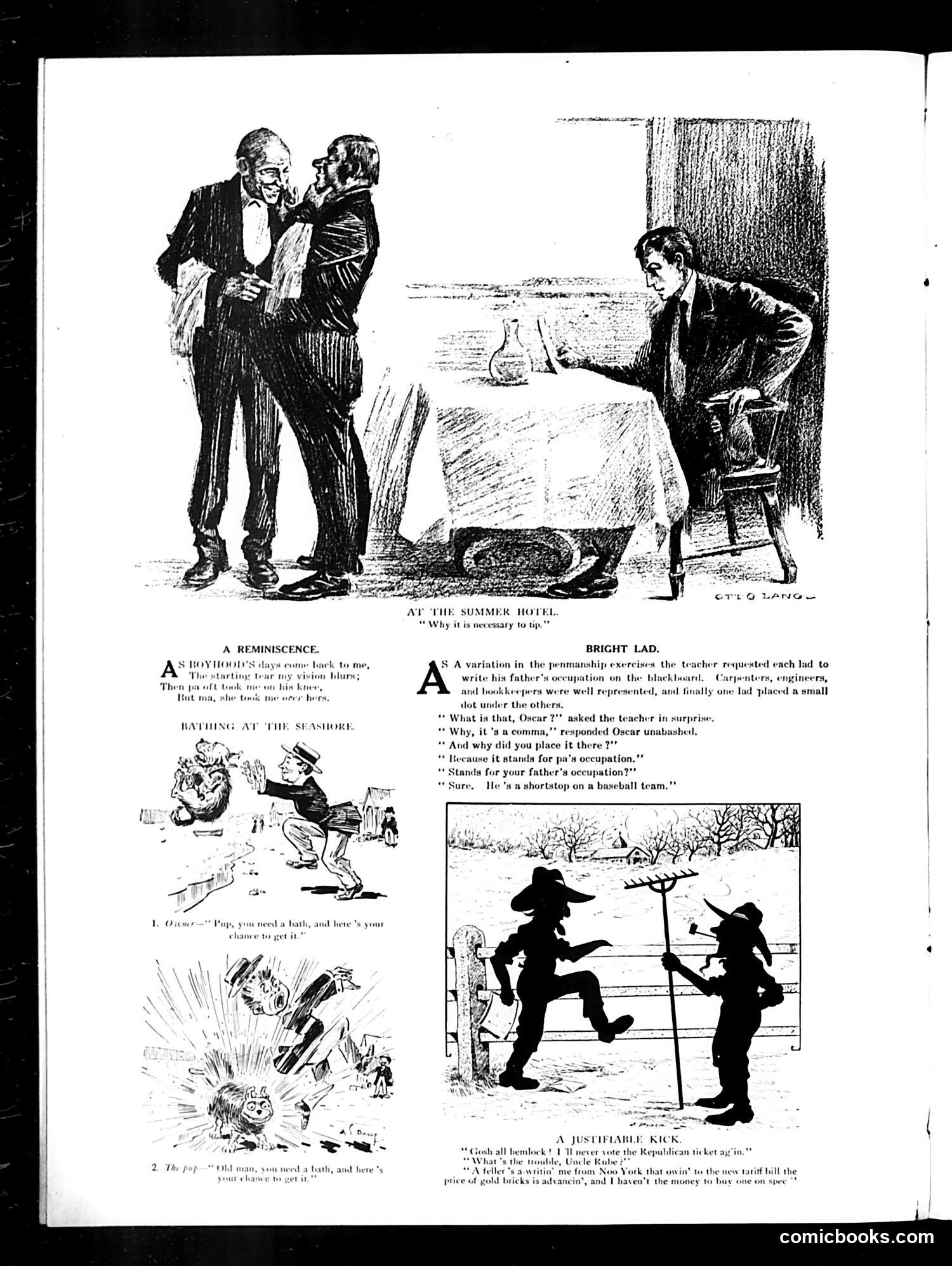
This page satirizes American social customs of the early 20th century, likely early 1900s. **"At the Summer Hotel"** depicts the practice of tipping at resort hotels—showing two men discussing why gratuities are "necessary," implying the custom was somewhat obligatory yet resented. **"Bathing at the Seashore"** shows comedic beach mishaps with minimal captions, relying on visual humor. **"Bright Lad"** mocks a schoolteacher's exercise where students write their fathers' occupations. One boy lists a "shortstop on a baseball team"—absurd as an occupation. The satire targets either the boy's naiveté or the exercise's questionable utility for teaching penmanship. **"A Justifiable Kick"** depicts cowboys or Western figures discussing Republican politics and currency issues—likely referencing debates over gold standards and tariffs that were contentious political topics of the era. The page overall humorously critiques American social conventions, education, and politics through various domestic and regional scenes.
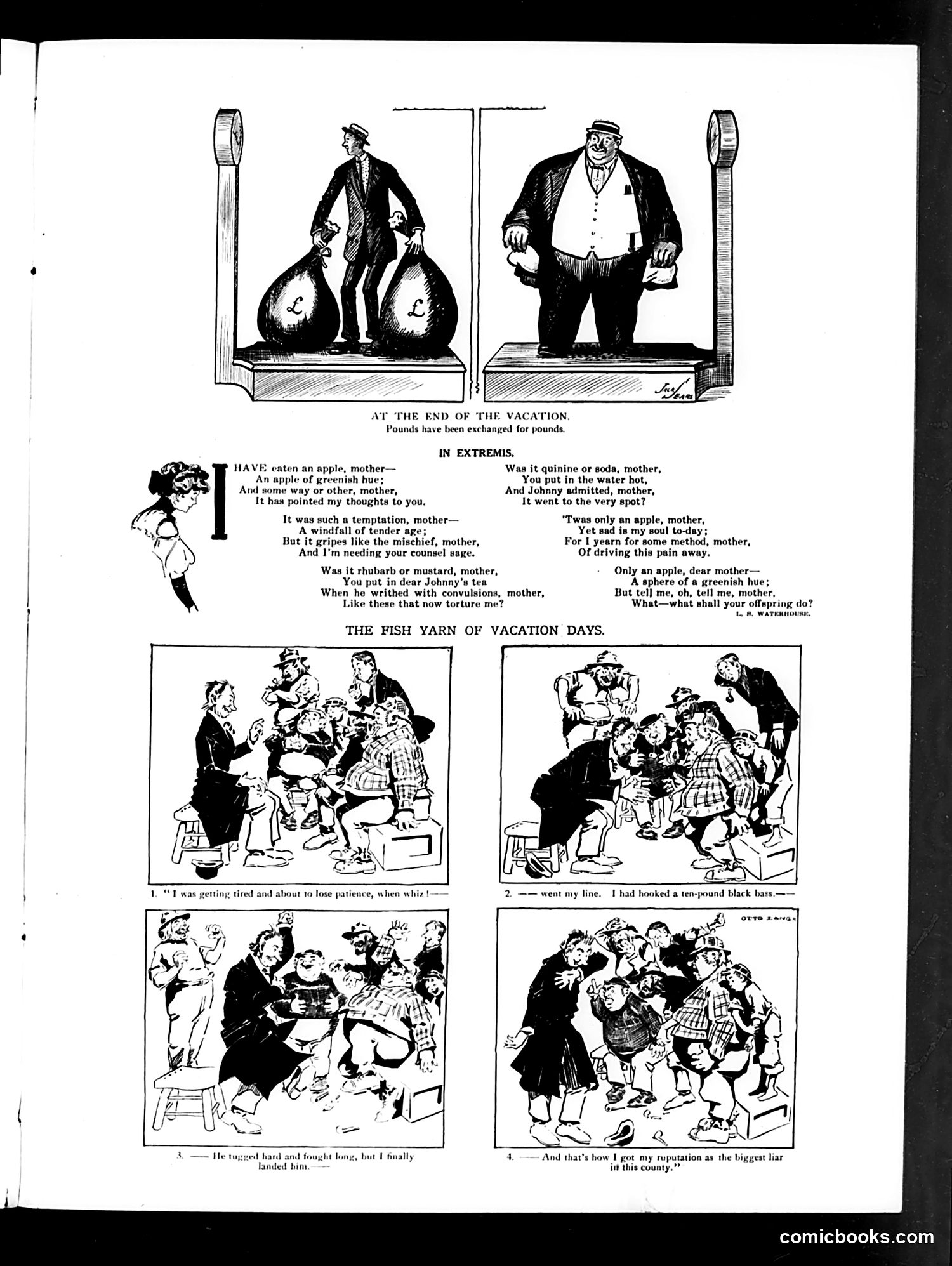
This page contains satirical content about vacation experiences and their consequences. **"At the End of the Vacation"** (top): The cartoon shows a man before and after vacation, depicted as two money bags labeled with pound symbols. The caption "Pounds have been exchanged for pounds" jokes that the vacationer has spent his weight in money—he's gotten fatter while his wallet got thinner. It's a straightforward commentary on vacation expenses. **"In Extremis"** (middle): A humorous poem where a child complains to mother about stomach pain from eating a greenish apple, asking whether she'd poisoned him with quinine, rhubarb, or mustard (common Victorian remedies). The joke satirizes overprotective mothers and period medical practices—the child suspects deliberate poisoning by remedy rather than accepting simple indigestion. **"The Fish Yarn of Vacation Days"** (bottom): A four-panel comic shows a fisherman telling tall tales to children about catching a ten-pound bass. The final panel reveals his reputation as "the biggest liar in this county"—mocking the clichéd vacation storytelling tradition of fishermen exaggerating their catches.
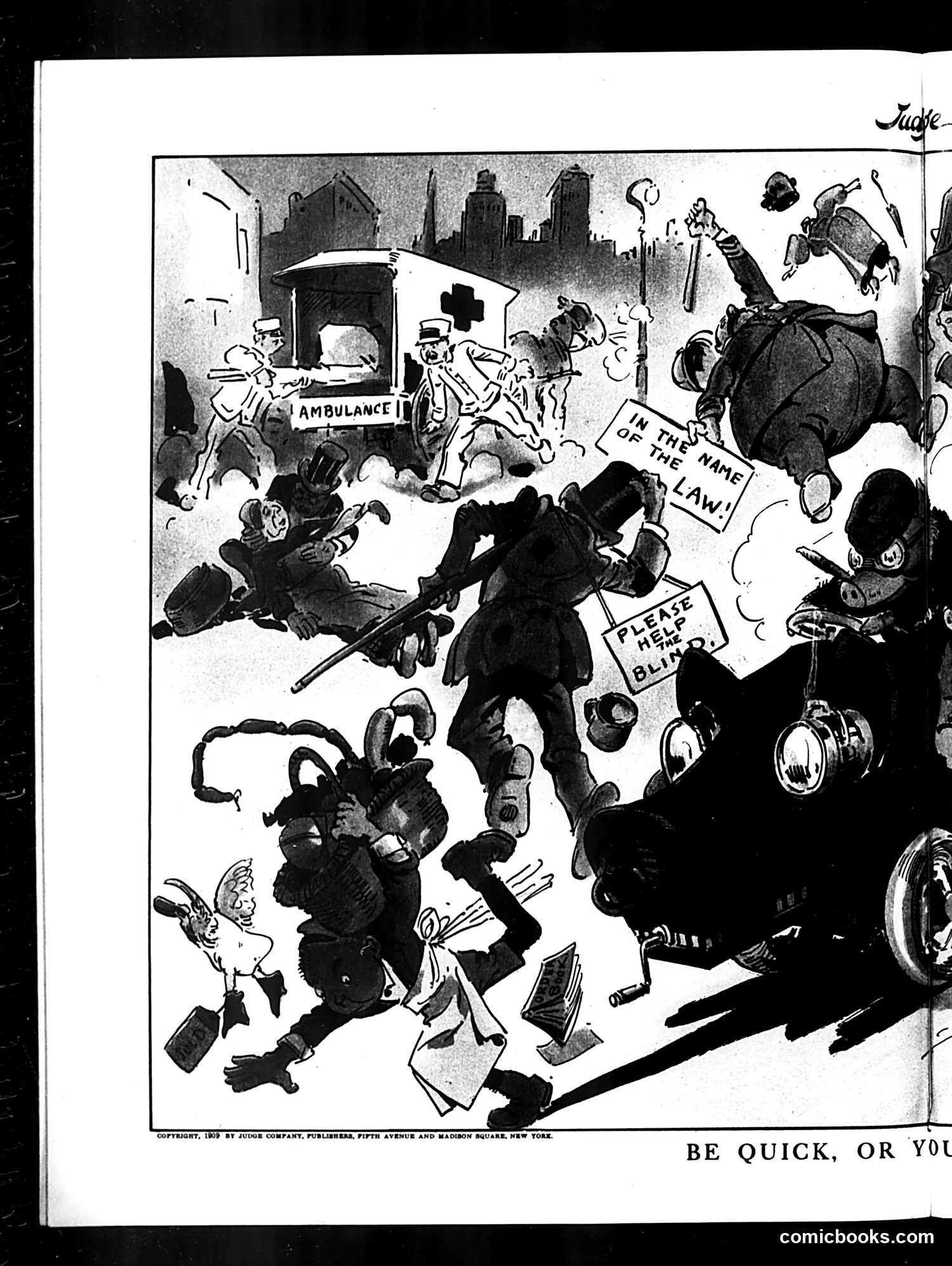
This Judge magazine cartoon satirizes urban chaos and law enforcement inefficiency. The scene depicts a chaotic street accident involving an ambulance, with various officials and bystanders in disarray. Signs reading "IN THE NAME OF THE LAW!" and "PLEASE HELP A BLIND" suggest commentary on competing authority figures and street hustlers. The cartoon appears to mock the confusion created when multiple parties (police, ambulance workers, street people) converge on a single incident, with nobody effectively taking charge. The title "BE QUICK, OR YOU..." (cut off) likely completes a warning about the dangers of urban congestion. The exaggerated, frantic illustrations emphasize the comedy of incompetence and bureaucratic disorder—a common Judge theme critiquing turn-of-the-century city management and public safety.
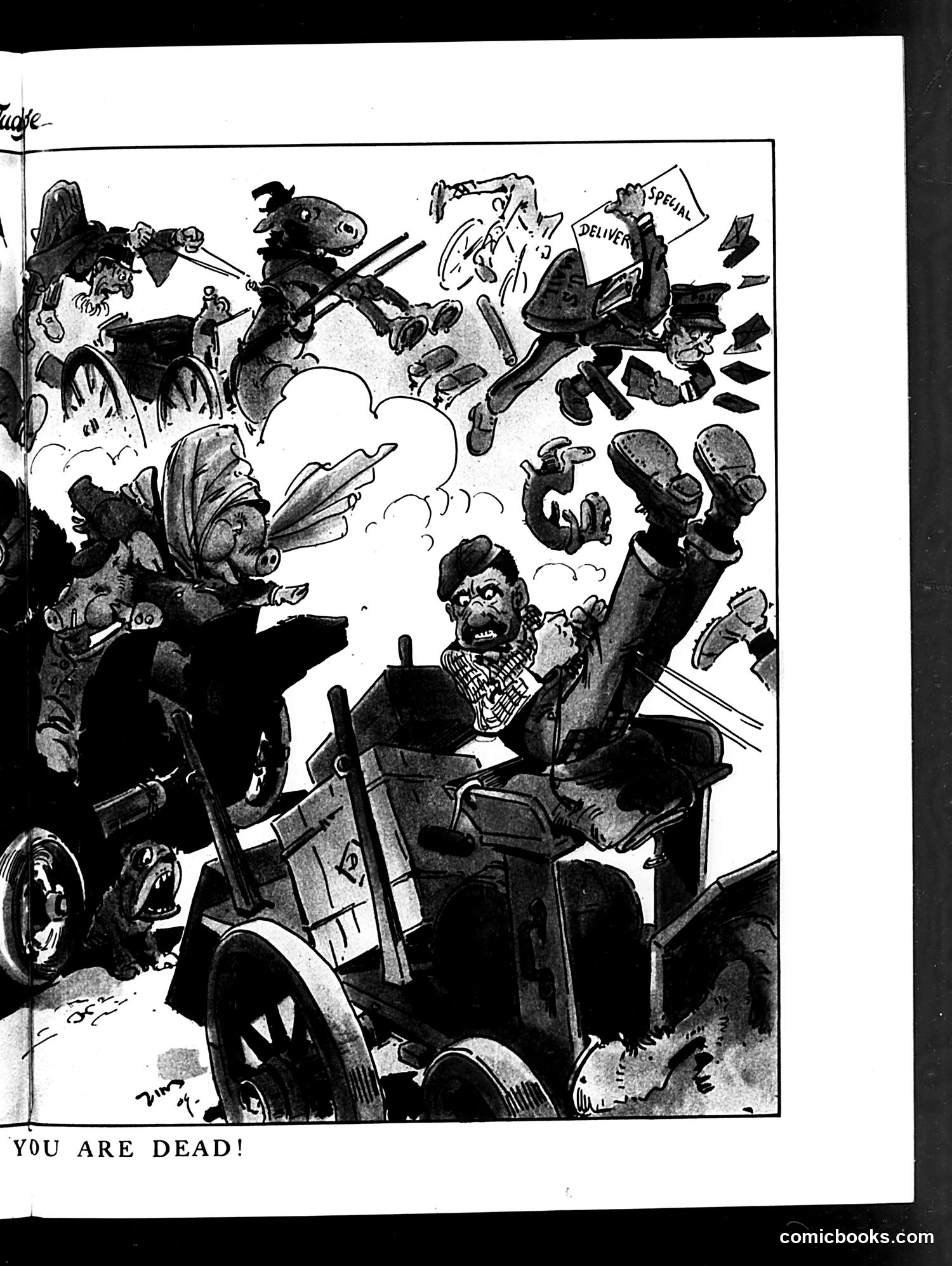
This Judge magazine cartoon depicts a chaotic traffic accident scene, with the caption "YOU ARE DEAD!" The central figure—appearing to be a driver in an early automobile—is surrounded by colliding vehicles, flying debris, and what seem to be casualties. The style and vehicles suggest early 20th-century America. The satire likely comments on the dangers of automobiles, which were still relatively new and dangerous at the time. The exaggerated, violent imagery mocks either reckless drivers, poor traffic safety, or perhaps the nascent automobile industry's dismissal of accident risks. The grim humor was typical of Judge's satirical approach to contemporary social issues and public anxieties about new technologies.
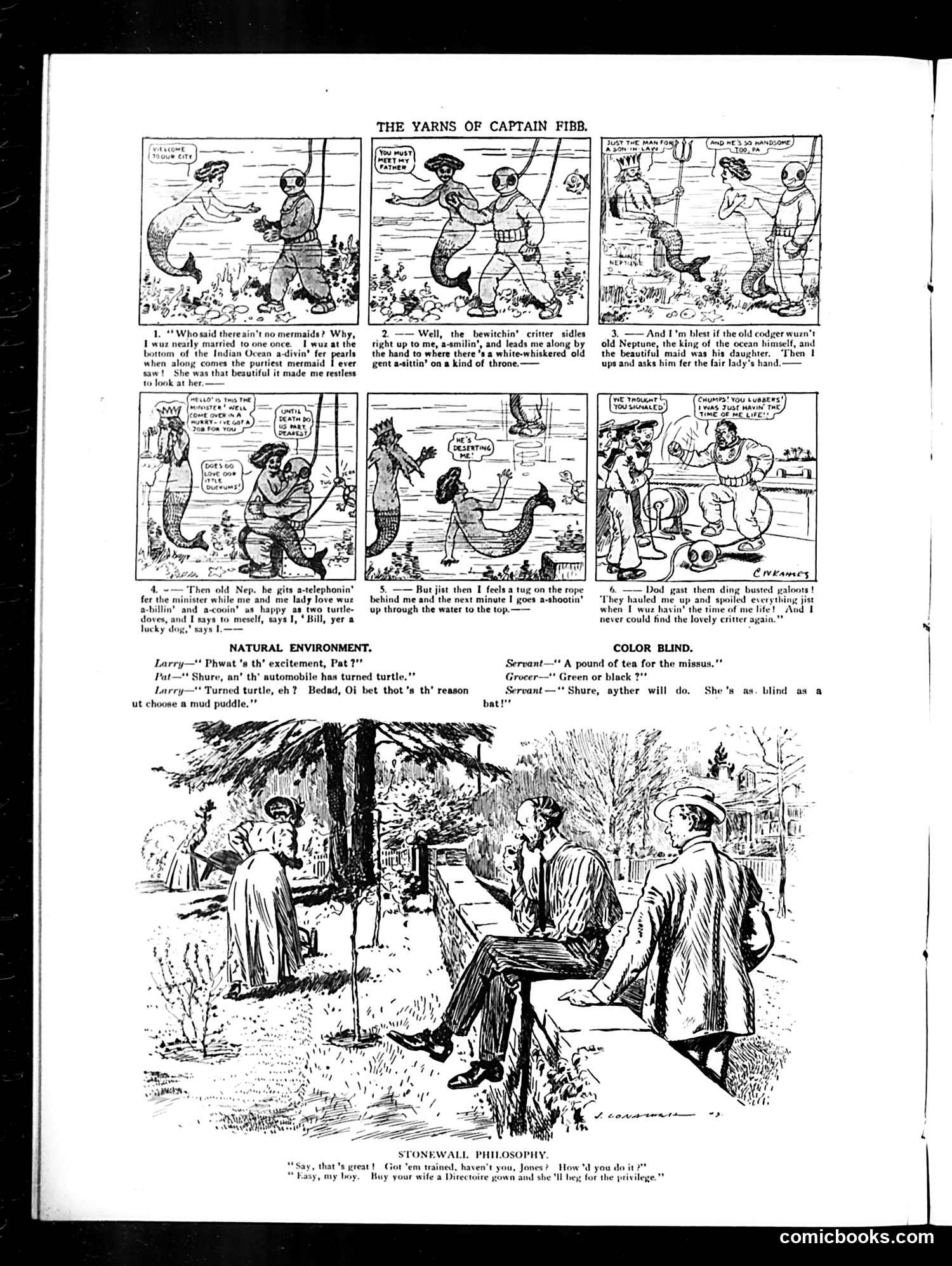
**Main Comic Strip (Top):** This is a tall-tale sequence featuring Captain Fibb, a stereotypical seafaring raconteur spinning increasingly absurd stories. In this episode, he claims to have nearly married a mermaid he met while pearl diving, encountered Neptune himself, but was pulled away by his crew before completing the wedding. The humor relies on the classic "fisherman's exaggeration" trope—obviously fictional, presented as fact. **Bottom Cartoons:** Two brief jokes: "Natural Environment" plays on Irish immigrant dialect (Pat and Larry), joking that an overturned car in mud resembles a turtle. "Color Blind" depicts a servant so color-blind she can't distinguish tea colors, leading to a punchline about buying her a "Directoire gown" (fashionable women's wear) so she'll beg for the privilege of wearing it—implying women care more about fashion than practicality. **Context:** These represent typical Judge magazine humor: tall tales, ethnic stereotypes (Irish accents), and gentle mockery of women's fashion obsession—all common early 20th-century American comic conventions.
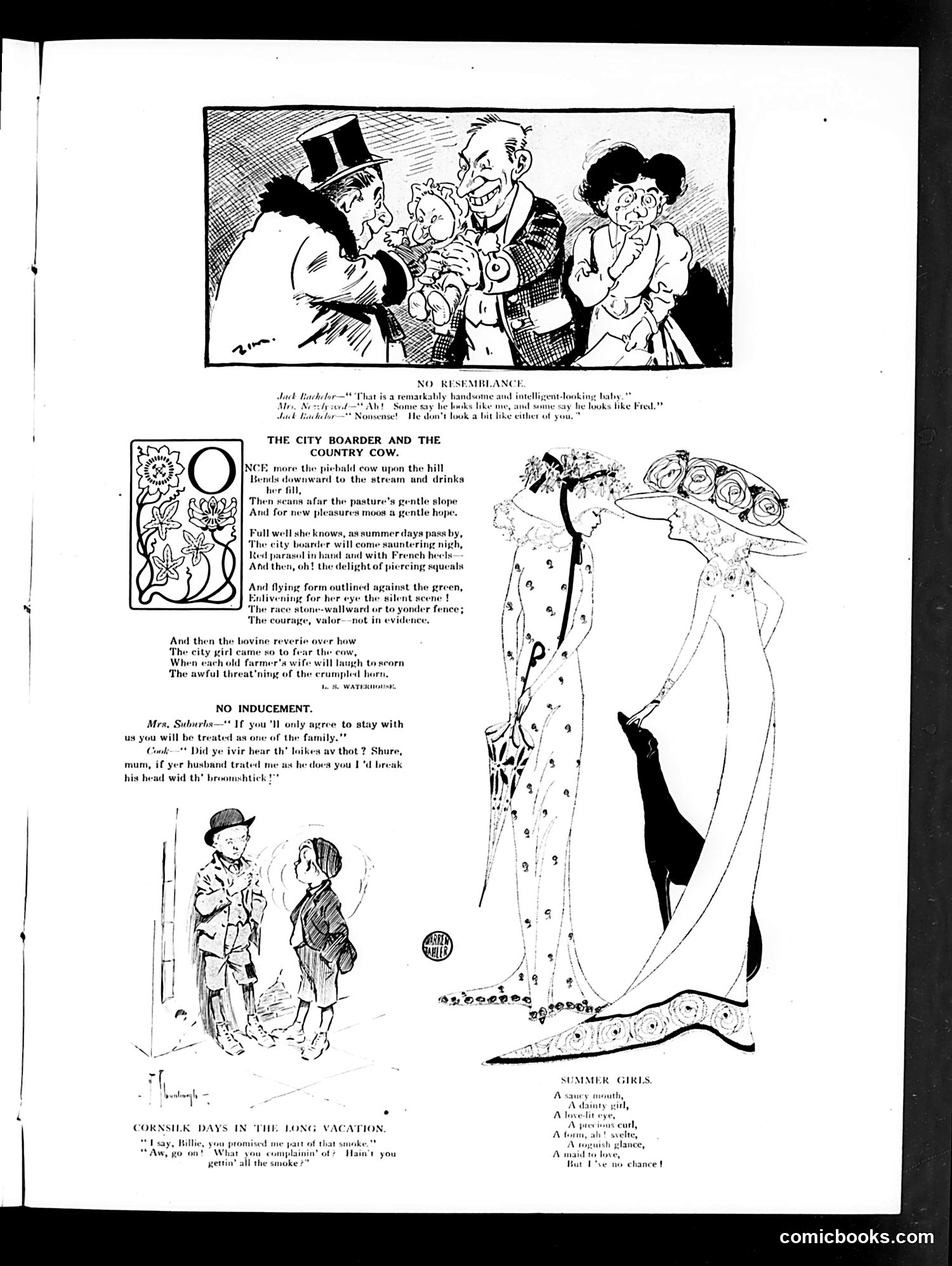
This page contains three distinct pieces of humor: 1. **"No Resemblance"** (top): A cartoon joke about a bachelor showing off a baby to a skeptical woman, with the punchline suggesting the baby looks nothing like the proud father. 2. **"The City Boarder and the Country Cow"** (center): A narrative poem with accompanying illustration depicting an urban visitor's frightening encounter with a cow. The humor plays on city dweller ignorance of rural life and farm animals. 3. **"No Inducement"** (bottom left): A brief comic exchange between a woman inviting someone to stay as "family" and the skeptical response about the host's violent temperament—domestic humor about inhospitable hosts. 4. **"Summer Girls"** (right): A short poem listing stereotypical female archetypes of the era in humorous fashion. The page represents typical Judge magazine fare: light social satire and domestic humor targeting urban middle-class readers.
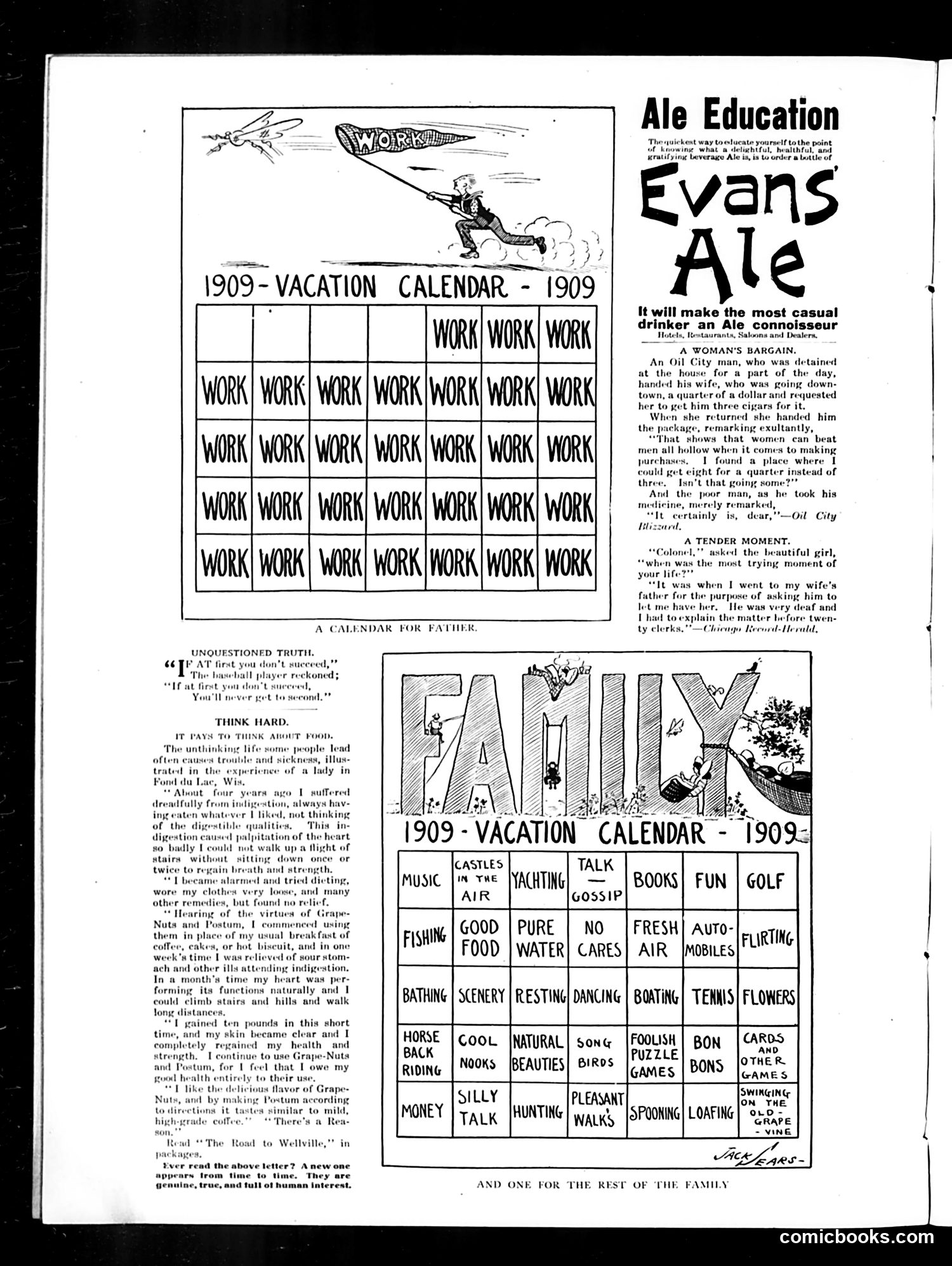
This 1909 *Judge* magazine page satirizes the work-dominated lives of American men, particularly fathers. The top cartoon shows a "Vacation Calendar" where every day is labeled "WORK"—the joke being that vacations don't actually exist for working men, only labor. The accompanying "Ale Education" advertisement for Evans Ale positions drinking as a leisure activity and form of education, contrasting sharply with the relentless work calendar. This appears to mock both the exhausting work culture and the escapism alcohol promised. Supporting anecdotes (a wife getting a better bargain on cigars; a tender marriage proposal moment) use humor to comment on gender roles and domestic life. A lengthy testimonial about Grape-Nuts cereal and digestive health suggests the physical toll work takes on bodies. The bottom calendar offers vacation alternatives (yachting, golf, fishing, music)—luxuries most working men couldn't afford—emphasizing the gap between ideal leisure and actual working-class reality. The satire targets Industrial-era American masculine culture: endless labor, minimal rest, and bodies worn down by stress.
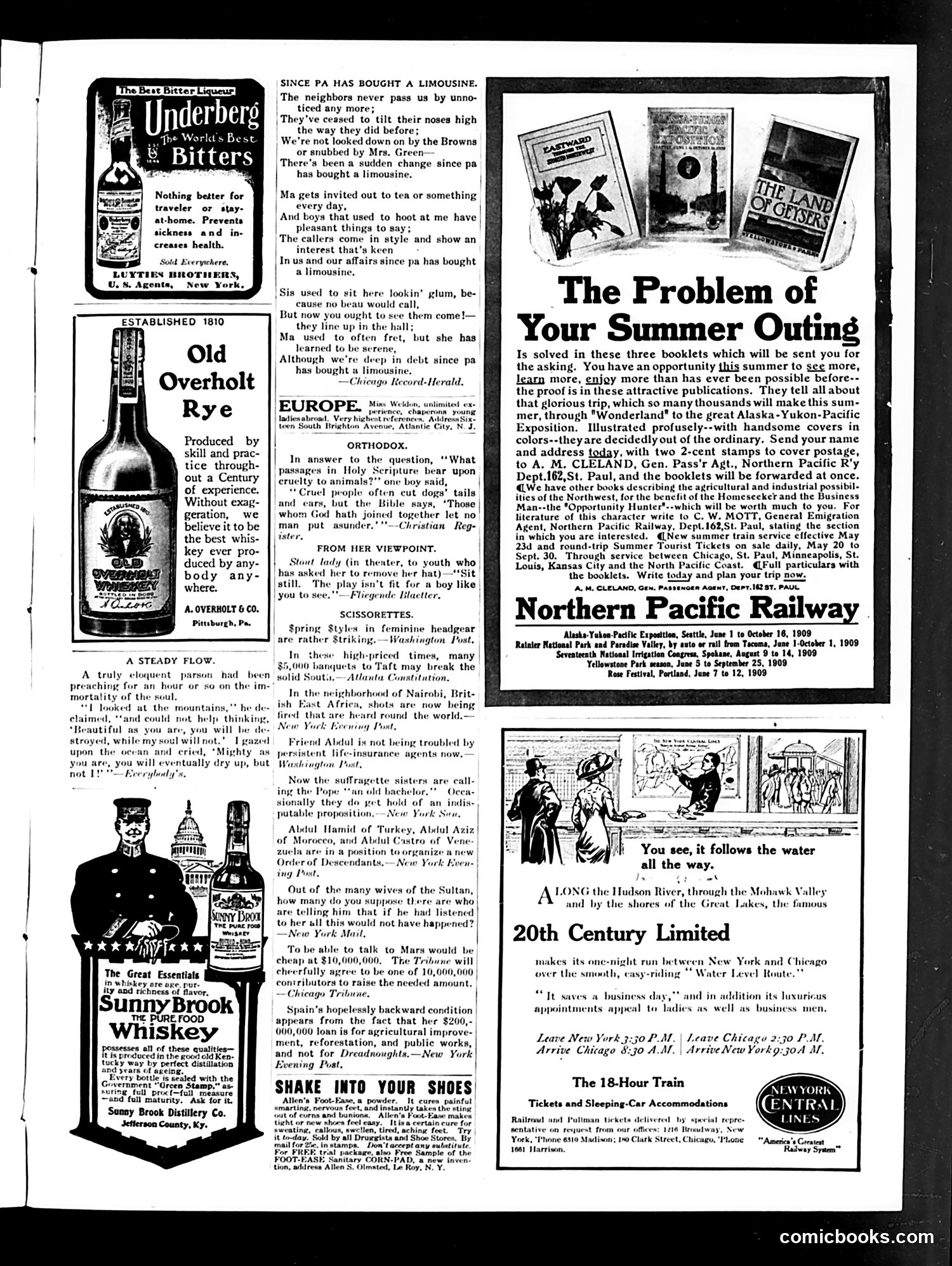
This satirical poem mocks the social climbing and materialism of the emerging American middle class in the early 1900s. The narrative voice describes how purchasing a limousine has dramatically transformed the family's social status—neighbors now respect them, the mother receives tea invitations, and the shy daughter attracts suitors. The joke exposes the hollowness of this newfound respect: it's based entirely on conspicuous consumption rather than genuine character or accomplishment. The final reveal—"Although we're deep in debt since pa has bought a limousine"—undercuts all the previous bragging, suggesting the family has overextended financially to maintain appearances. This reflects broader Progressive Era anxieties about automotive culture, conspicuous consumption, and the fragility of social status in rapidly changing American society. The satire suggests that American values had become dangerously superficial and debt-driven.
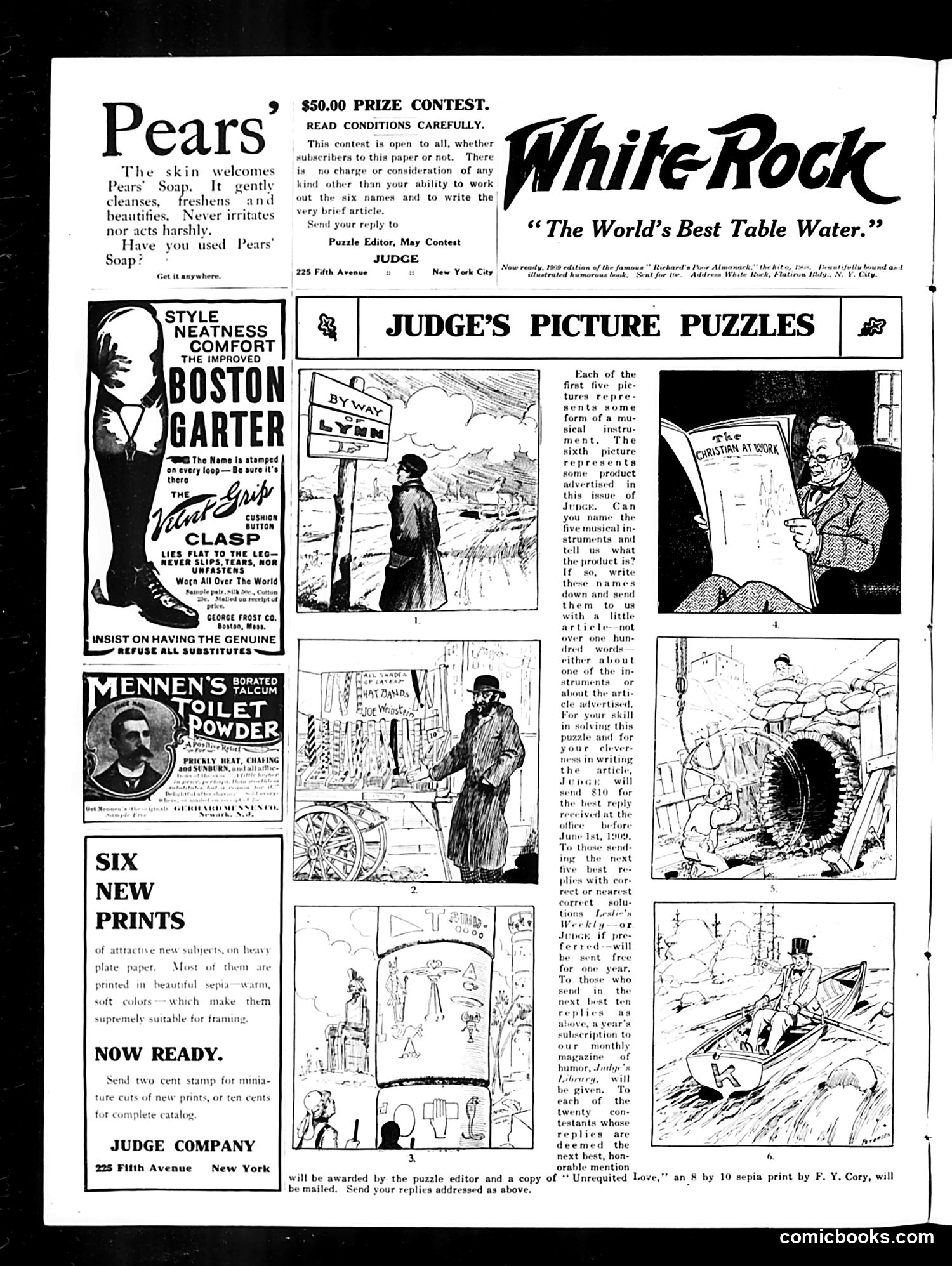
This page is primarily **advertising and a puzzle contest**, not political satire. The main content features "Judge's Picture Puzzles"—a $50 prize contest where readers identify five musical instruments and one advertised product hidden within six cartoon illustrations. The cartoons depict various scenes (a street sign, a man in a coat, domestic interiors, a person in a tunnel, and a boatman) where these items are concealed. The surrounding advertisements promote period products: Pears' Soap, Boston Garter suspenders, Mennen's talcum powder, and Judge Company's new sepia prints. White Rock mineral water is advertised as "The World's Best Table Water." **No political figures or satirical commentary are present.** This is a typical early-20th-century magazine page combining light entertainment (visual puzzles) with commercial advertising—representative of Judge's mixed content format beyond its better-known satirical cartoons.
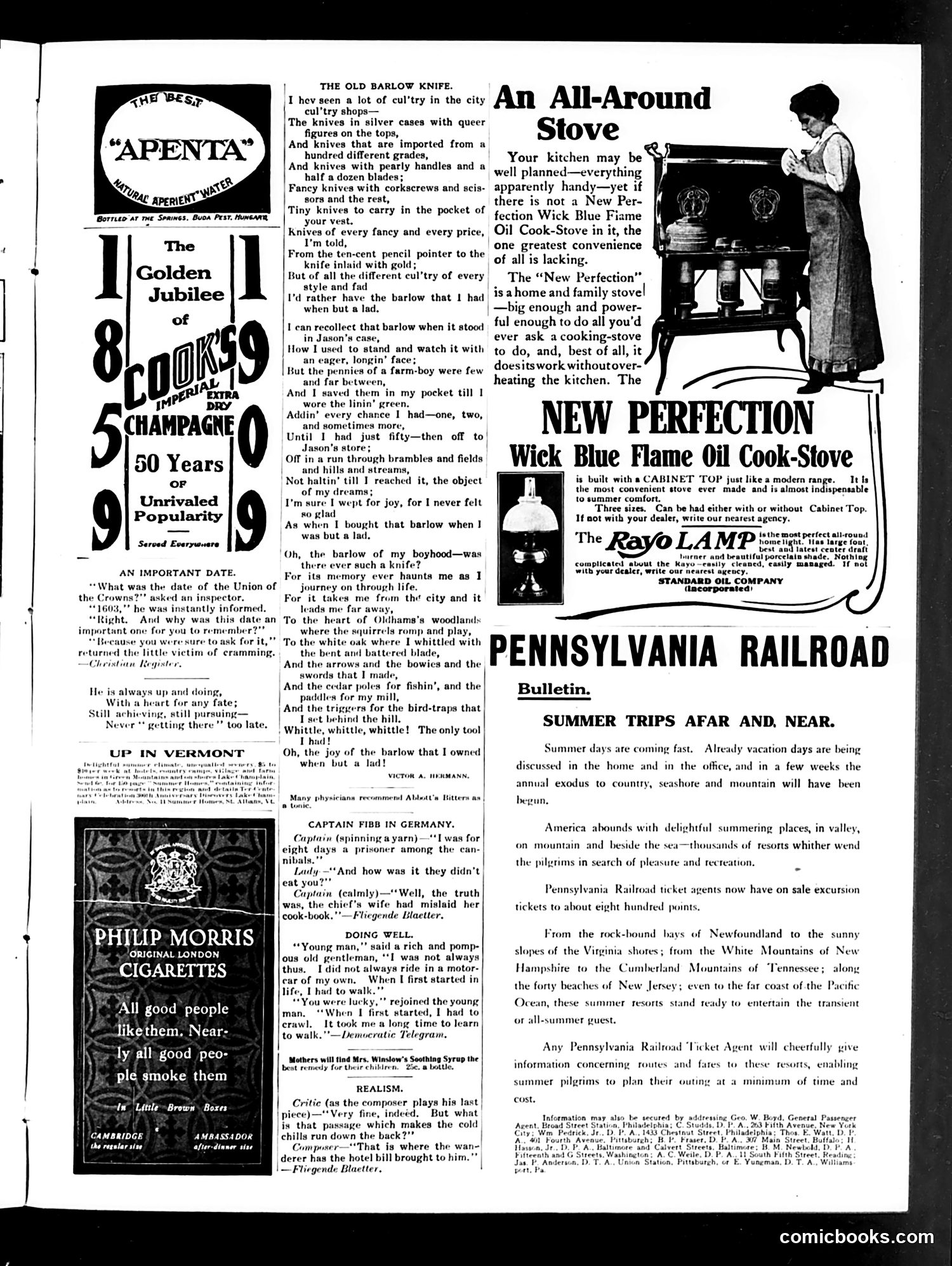
This page is primarily **advertising and light humor**, not political satire. The main content includes: **Advertisements:** Apenta water, Cook's champagne, Philip Morris cigarettes, and the "New Perfection" oil cook-stove dominate the page. **Humor pieces:** Several short, anecdotal jokes and poems, including "The Old Barlow Knife" (nostalgic rural Americana about a childhood pocket knife), "Captain Fibb in Germany" (a mild joke about a prisoner spared because his captor's wife lost her cookbook), and "Doing Well" (wordplay about starting in life). **Pennsylvania Railroad bulletin:** Promotes summer travel to American resorts. These are genteel, non-partisan jokes typical of Judge magazine's lighter fare—sentimental Americana, mild domestic humor, and international anecdotes rather than sharp political commentary. The page reflects early 1900s advertising aesthetics and taste in humor.
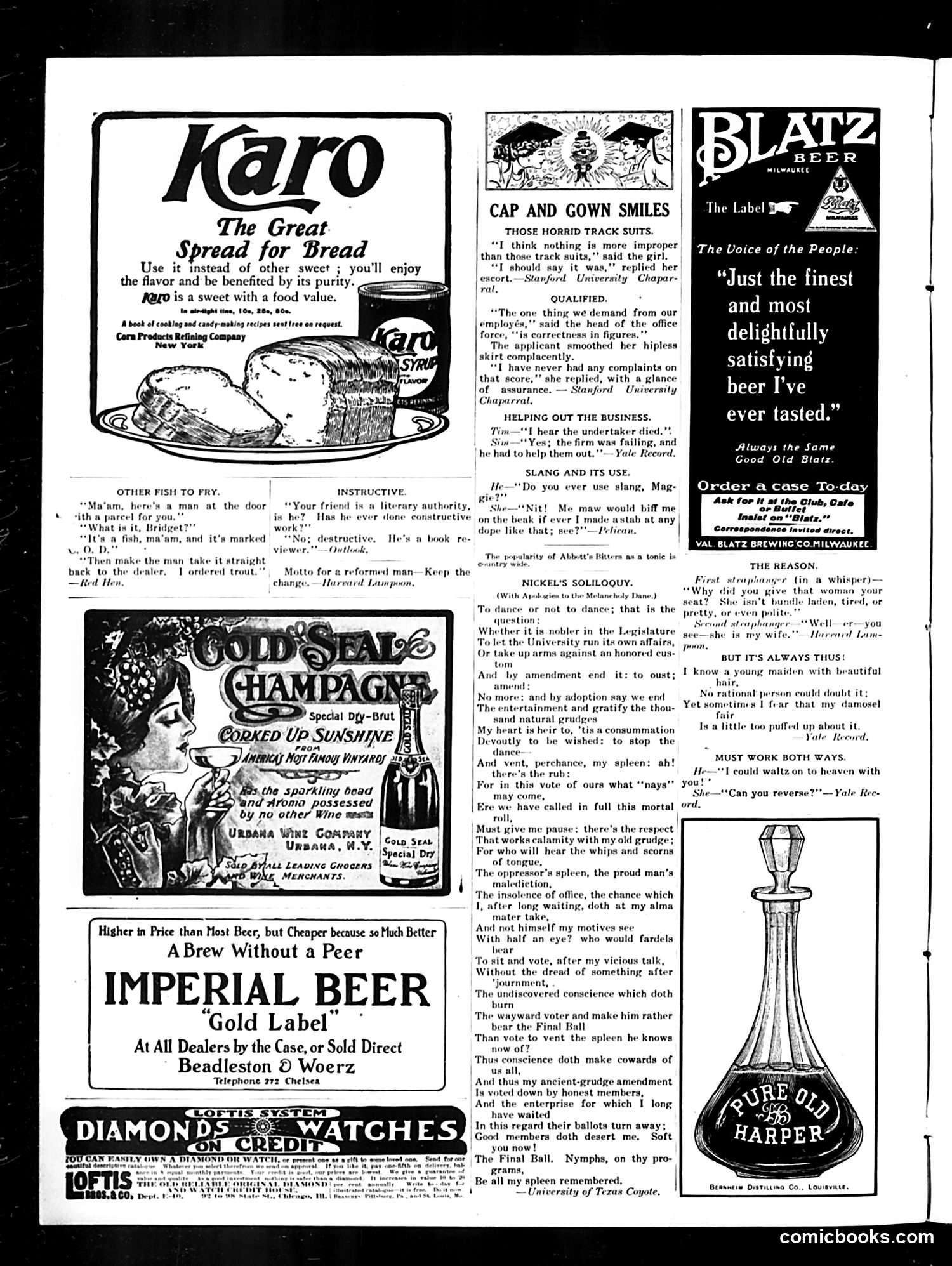
This page is primarily **advertising with humorous filler content**, typical of early 20th-century magazines. The ads promote consumer products: Karo corn syrup spread, Gold Seal Champagne, Imperial Beer, Blatz Beer, and Oftis diamonds/watches. The editorial content consists of **college humor** — short jokes sourced from university publications (Stanford, Yale, Harvard). These include mild satire about track suits being improper, a pun about an undertaker's failing business, and slang usage among young people. Most substantially, "Nickel's Soliloquy" parodies **Hamlet's famous soliloquy**, replacing existential meditation with a college student's internal debate about whether to attend a dance and vote on a campus "amendment" — likely involving a fraternity grudge. The joke mocks overwrought student drama and indecision. The scattered one-liners reflect period social attitudes toward courtship and gender roles (women's appearance, romantic awkwardness). Overall: a typical entertainment/advertising hybrid page with lightweight satirical humor targeting college-educated readers.
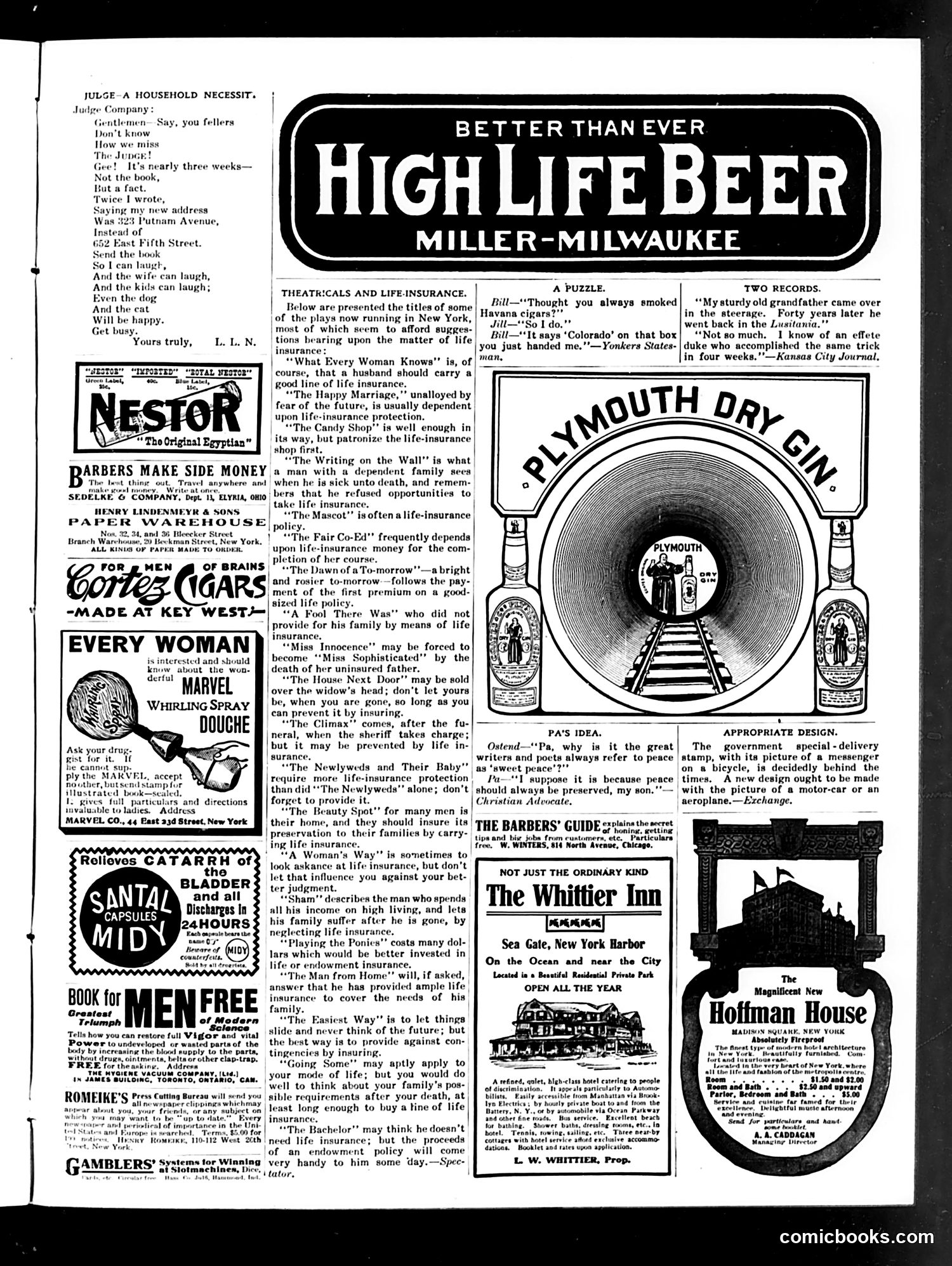
This page is primarily **advertising and advice columns** rather than political satire. The content centers on life insurance messaging woven into entertainment criticism. ## Main Content: The **"Theatricals and Life Insurance"** section uses current Broadway plays as springboards for life insurance advocacy—a common early 20th-century editorial strategy. Shows like "What Every Woman Knows" and "The Happy Marriage" are reframed as cautionary tales about inadequate insurance protection. The implicit message: husbands have a moral duty to insure themselves for their families' security. The **"Two Records"** joke plays on changing social status: a man's grandfather crossed the Atlantic in steerage; forty years later, the grandson returns on the *Lusitania* (a luxury liner), yet he achieves the same economic outcome through an insurance trick rather than legitimate advancement. The page also includes standard period advertisements for products like Nestor cigars, Marvel douches, and the Whittier Inn resort hotel. **No identifiable political figures or satire** appear—this reflects Judge's focus during this era on commercial messaging and lifestyle advice rather than direct political commentary.
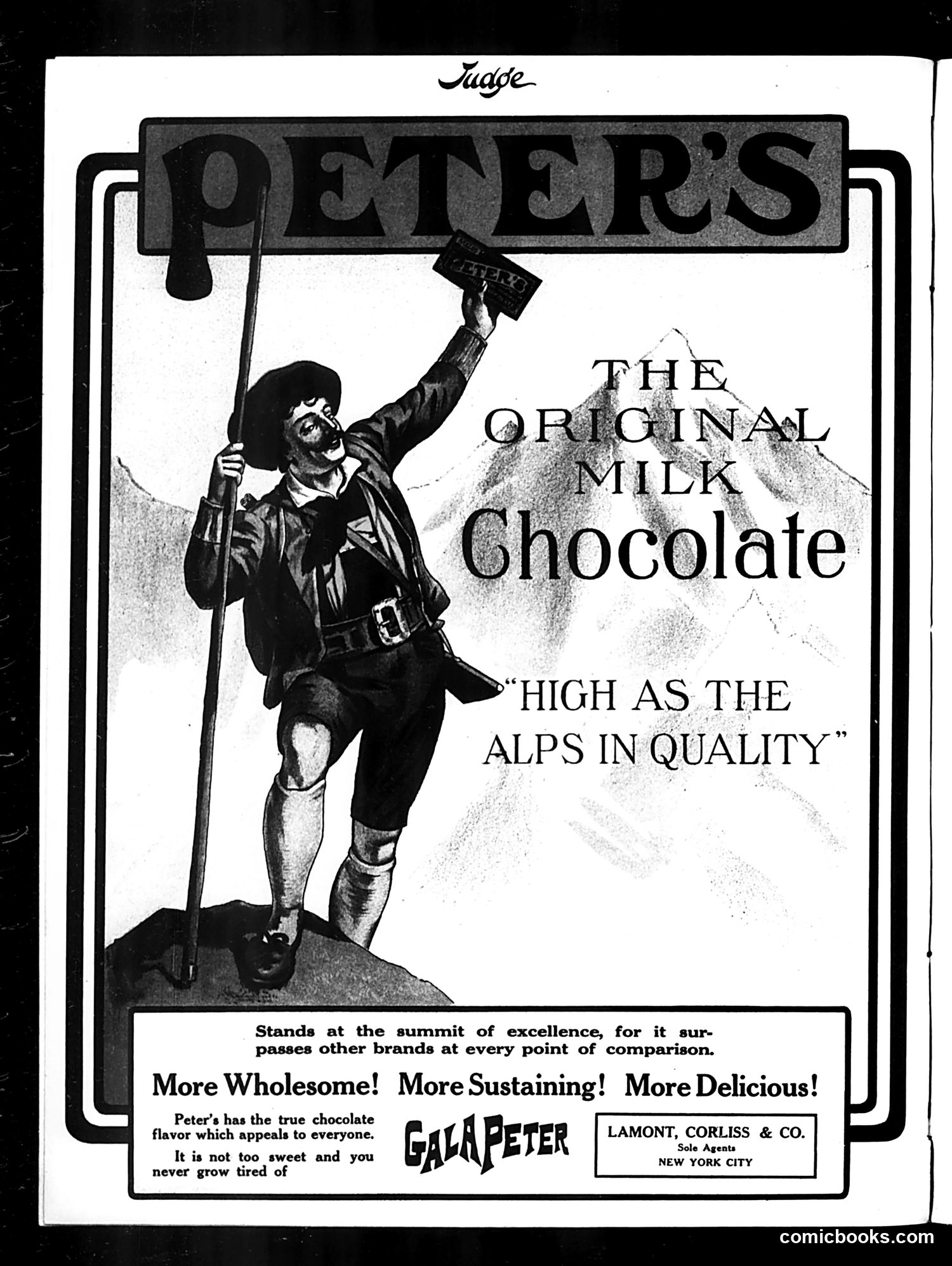
This page is **primarily an advertisement**, not political satire or a cartoon. It advertises Gala Peter milk chocolate, made by the company Peter's and distributed by Lamont, Corliss & Co. in New York City. The imagery shows a mountaineer planting a flag at a peak, illustrating the tagline "High as the Alps in Quality"—a metaphor claiming the chocolate reaches the summit of excellence. The mountaineer's triumphant pose and alpine backdrop serve as visual rhetoric suggesting superiority and achievement. The ad emphasizes the product is "More Wholesome! More Sustaining! More Delicious!" and notes the chocolate has authentic flavor without being overly sweet. This appears to be vintage advertising from Judge magazine, using aspirational Alpine imagery common in early 20th-century marketing to connote premium quality and European sophistication.