
A complete issue · 16 pages · 1909
Judge — May 15, 1909
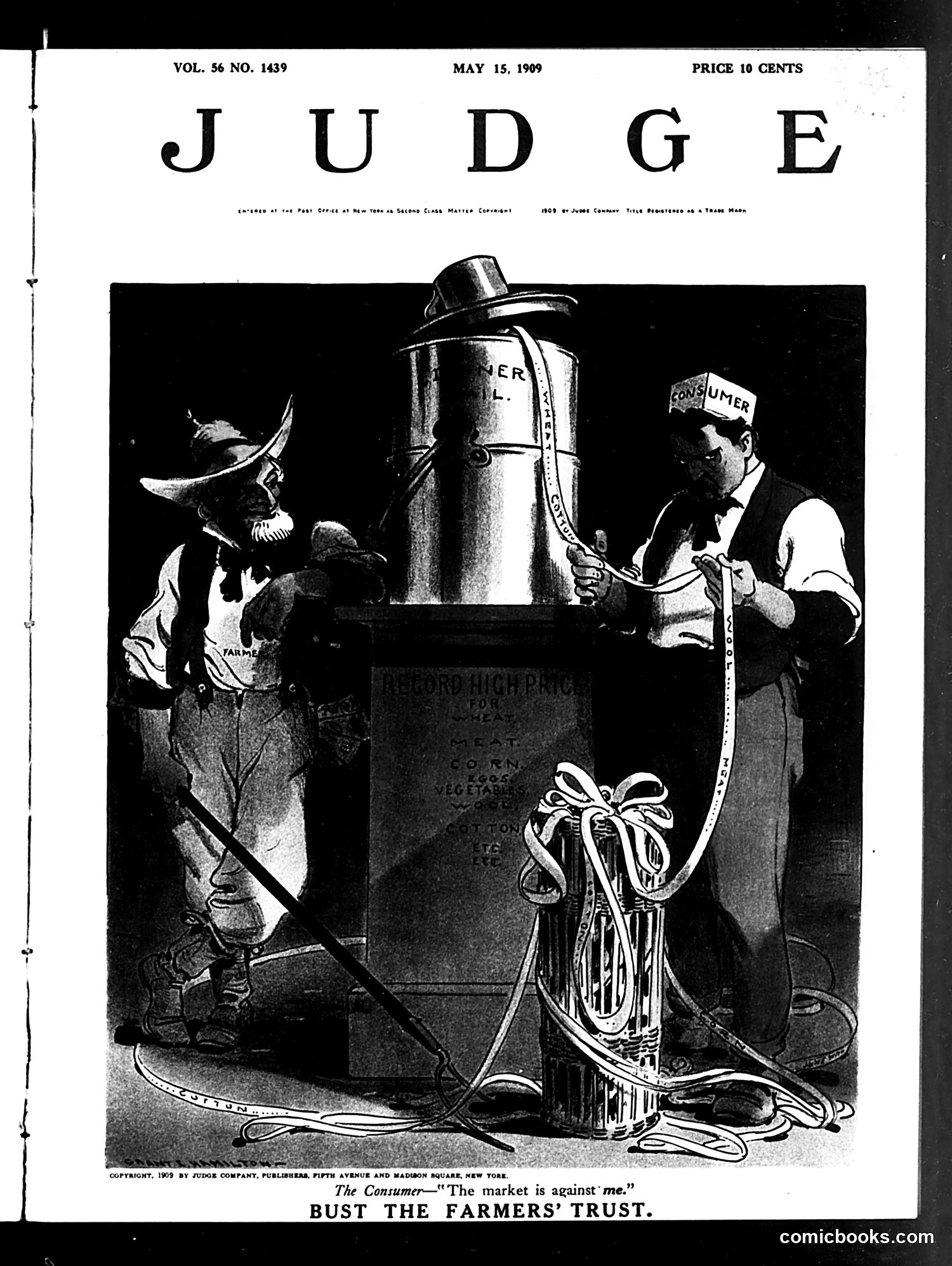
This political cartoon satirizes agricultural monopolies and price-fixing. A figure labeled "Consumer" (wearing a cap) confronts a "Farmer" on the opposite side of a large cylindrical container labeled "Record High Prices for Meat, Corn, Eggs, Vegetables, etc." The container appears to be a measuring device or pump, with coiled tubing suggesting the apparatus controlling market prices. The caption reads: "The market is against me." The cartoon critiques how farmers, despite appearing to prosper from "record high prices," are actually victims of trusts—monopolistic business combinations that manipulate markets. The satire suggests farmers aren't benefiting from high prices; rather, trusts control distribution and pricing, harming both producers and consumers. This reflects Progressive Era concerns about corporate monopolies exploiting the agricultural sector.
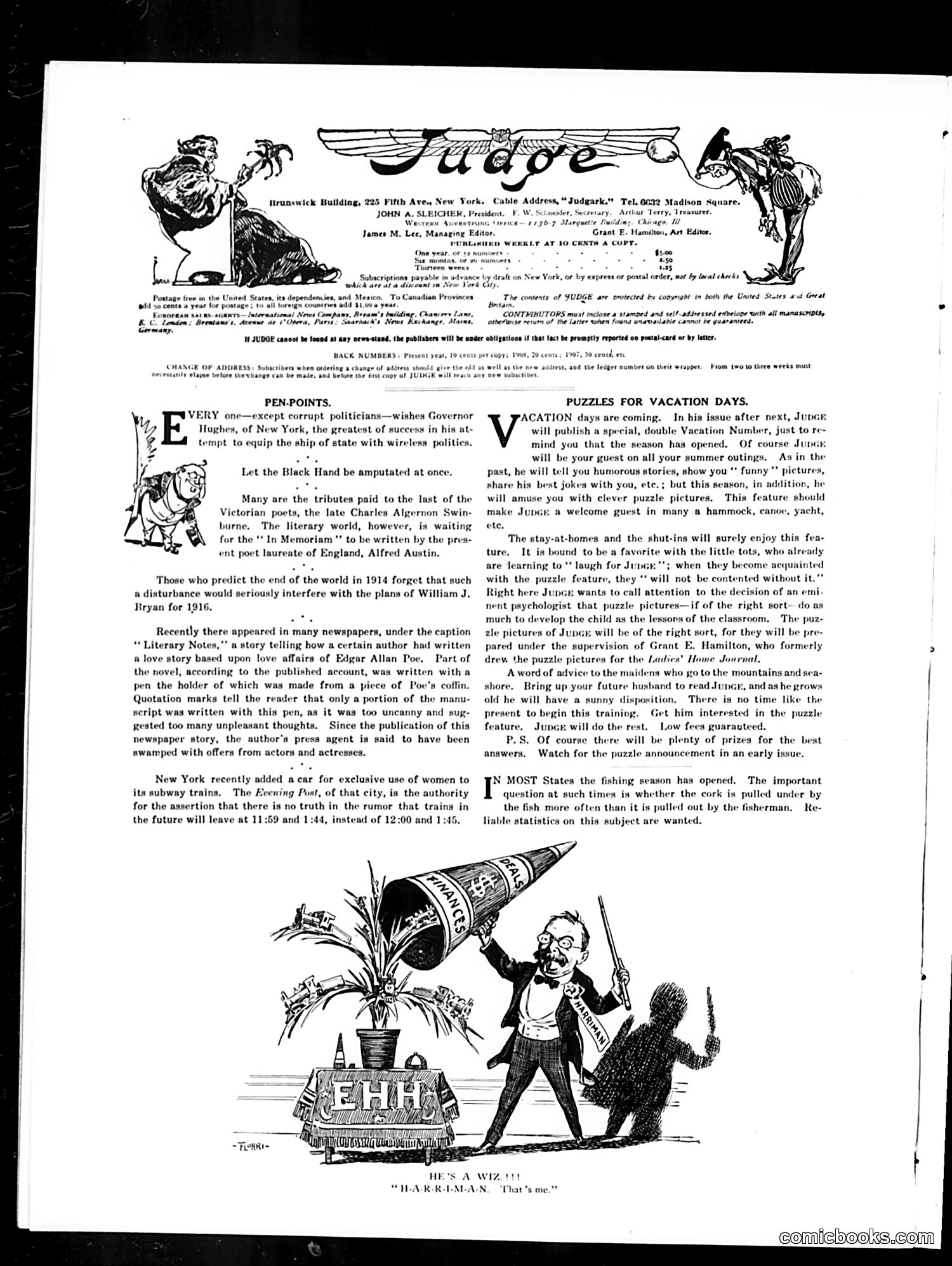
This page contains three distinct sections: **"Pen-Points" Editorial:** Discusses Governor Hughes of New York and praise for his success in wireless politics, mentioning predictions about 1914 world events and references to Edgar Allan Poe. **"Puzzles for Vacation Days":** Advertisement promoting Judge's summer puzzle feature for family entertainment. **Main Cartoon ("He's a Wiz"):** The large illustration shows a figure labeled "HHH" (likely representing someone with initials matching a contemporary politician) being praised as a "wizard" and "harriman." The cartoon appears satirical, though the specific political reference is unclear without additional context about who "HHH" represents and what achievement or claim is being mocked. The overall page mixes editorial commentary, advertisements, and political satire typical of Judge's format.
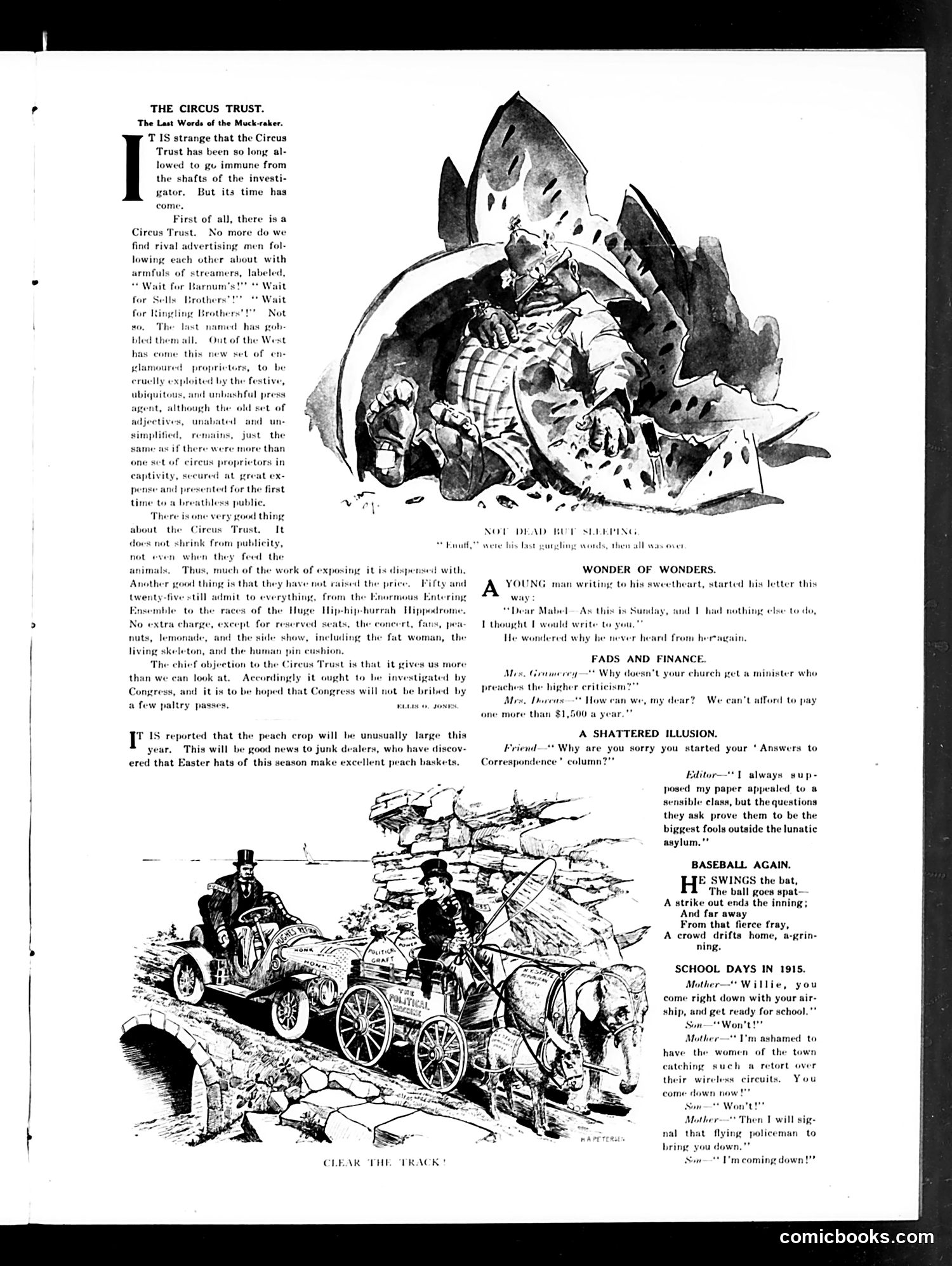
This page satirizes the "Circus Trust," a consolidation of circus companies that had eliminated competition among rival advertisers. The main editorial argues that unlike other industries investigated for monopolistic practices, the circus merger hasn't drawn Congressional scrutiny—despite using similarly aggressive, unethical advertising tactics. The illustration "Clear the Track" depicts circus wagons and performers clearing debris, satirizing how the monopoly dominates public space. The page also contains miscellaneous humor columns ("Wonder of Wonders," "Fads and Finance," "Baseball Again," "School Days in 1915") typical of Judge's format—brief comedic sketches mocking contemporary social issues and family dynamics. The overall thrust: the Circus Trust exemplifies corporate consolidation that Congress ignores while investigating other industries.
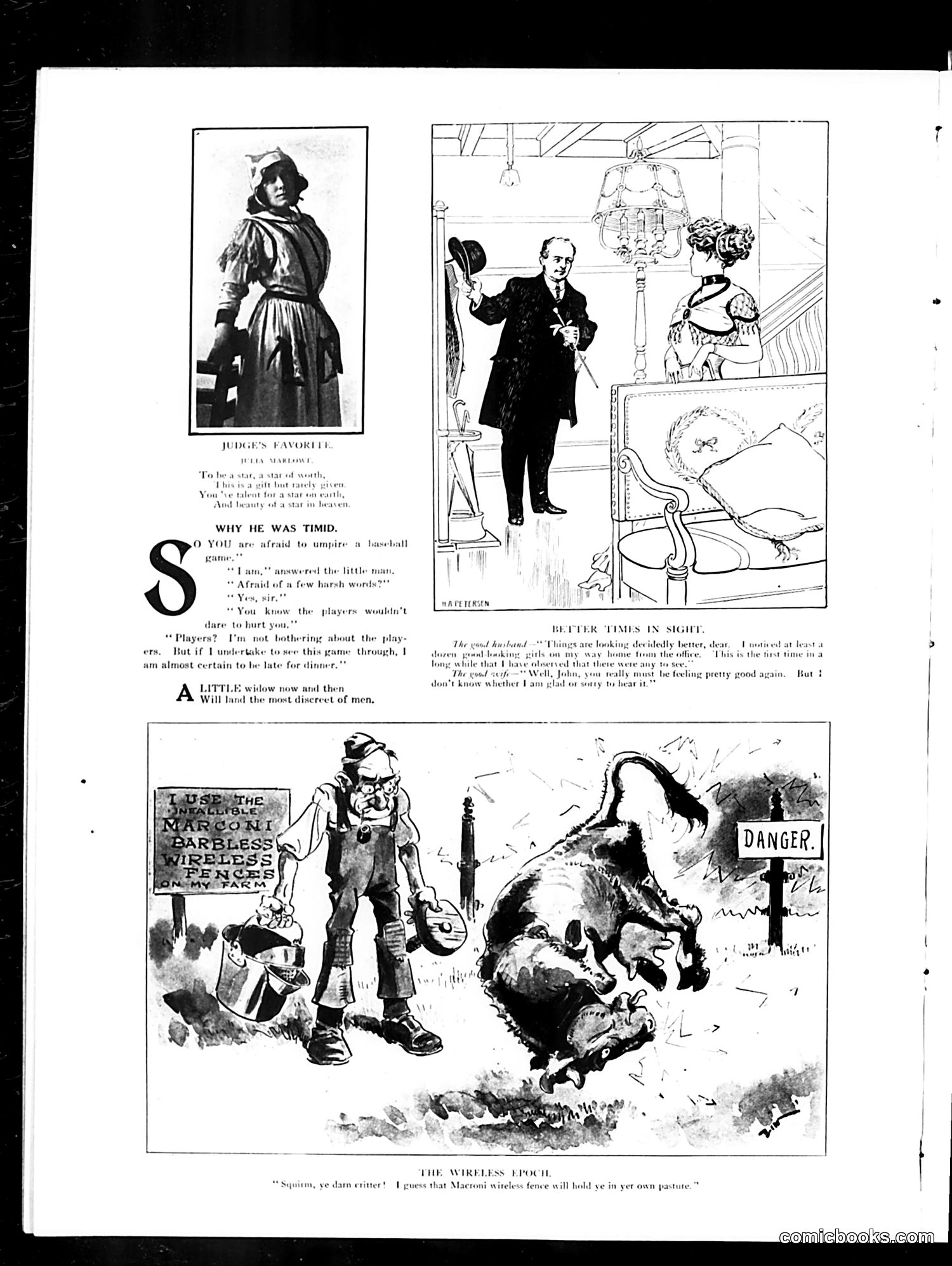
This Judge magazine page contains three distinct pieces: **Top left**: A portrait labeled "Judge's Favorite" with verse about a woman's beauty and virtue—likely a society column feature. **Top right**: "Better Times in Sight" depicts a man umpiring a baseball game while two women flirt with him. The joke plays on baseball umpiring and romantic attention. **Bottom**: "The Wireless Fence" shows a large man (appearing to represent Marconi wireless technology) with a warning sign about a "wireless fence." The accompanying caption mocks the idea that Marconi's wireless fence would hold someone on pasture—satirizing the gap between wireless technology promises and practical reality. This likely references early-1900s skepticism about wireless technology's practical applications.
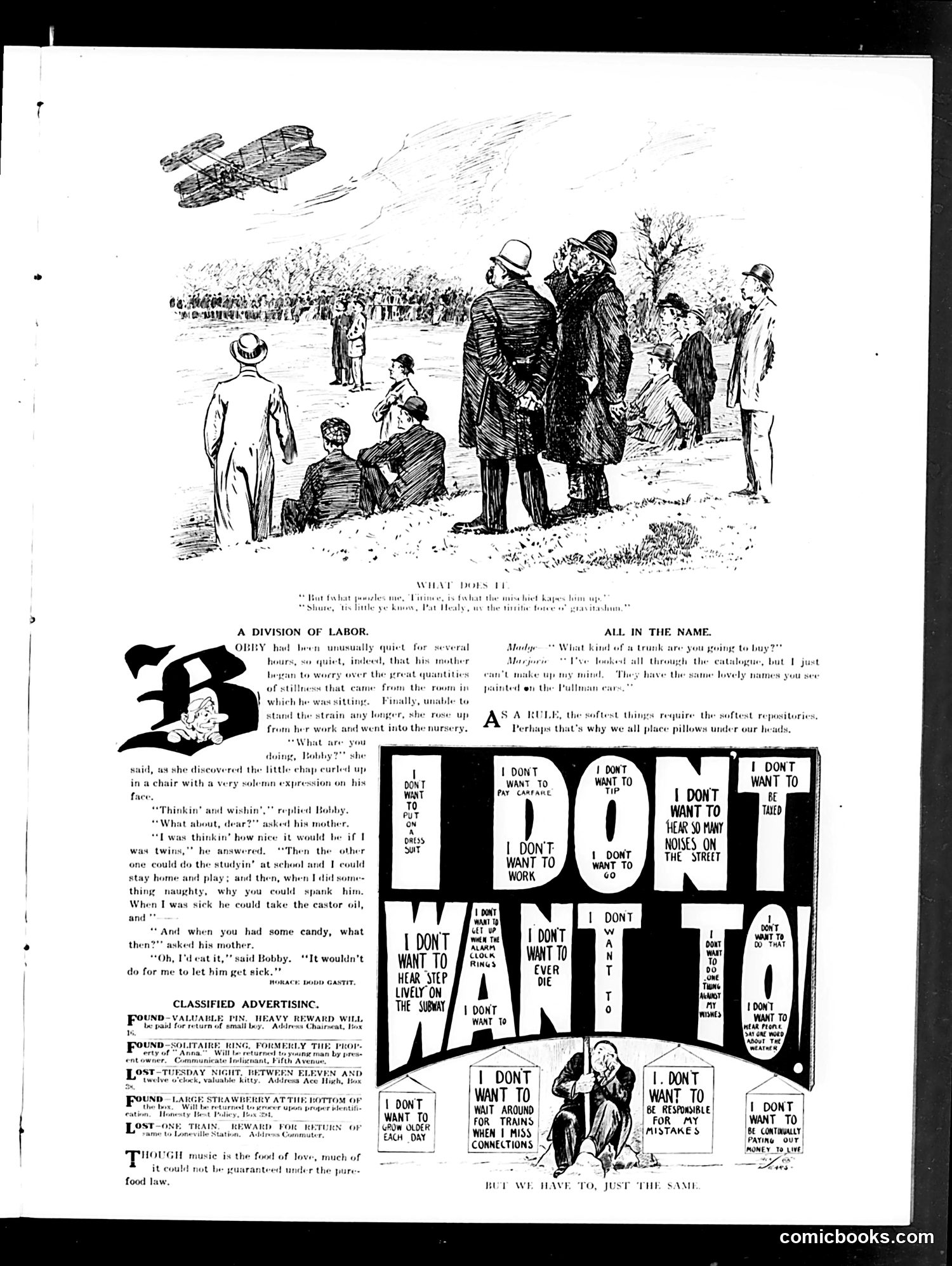
This Judge magazine page satirizes early 20th-century labor complaints through two pieces: **Top illustration**: Shows an airplane flying over a large crowd gathering, depicting what appears to be a public spectacle or aviation demonstration—a novel technology that captivated public attention. **Main comic ("A Division of Labor" / "All in the Name")**: A mother worries excessively about her son Bobby, imagining catastrophic scenarios he might encounter—working, hearing noises, missing trains, being responsible for accidents. The repeated "I DON'T WANT TO" refrain mocks both overprotective parenting and workers' resistance to responsibilities. The satire critiques how anxieties about modern industrial life—whether from mothers or laborers—create paralysis and avoidance rather than productive engagement with necessary work. The point: complaints and fears don't excuse inaction; duties remain regardless.
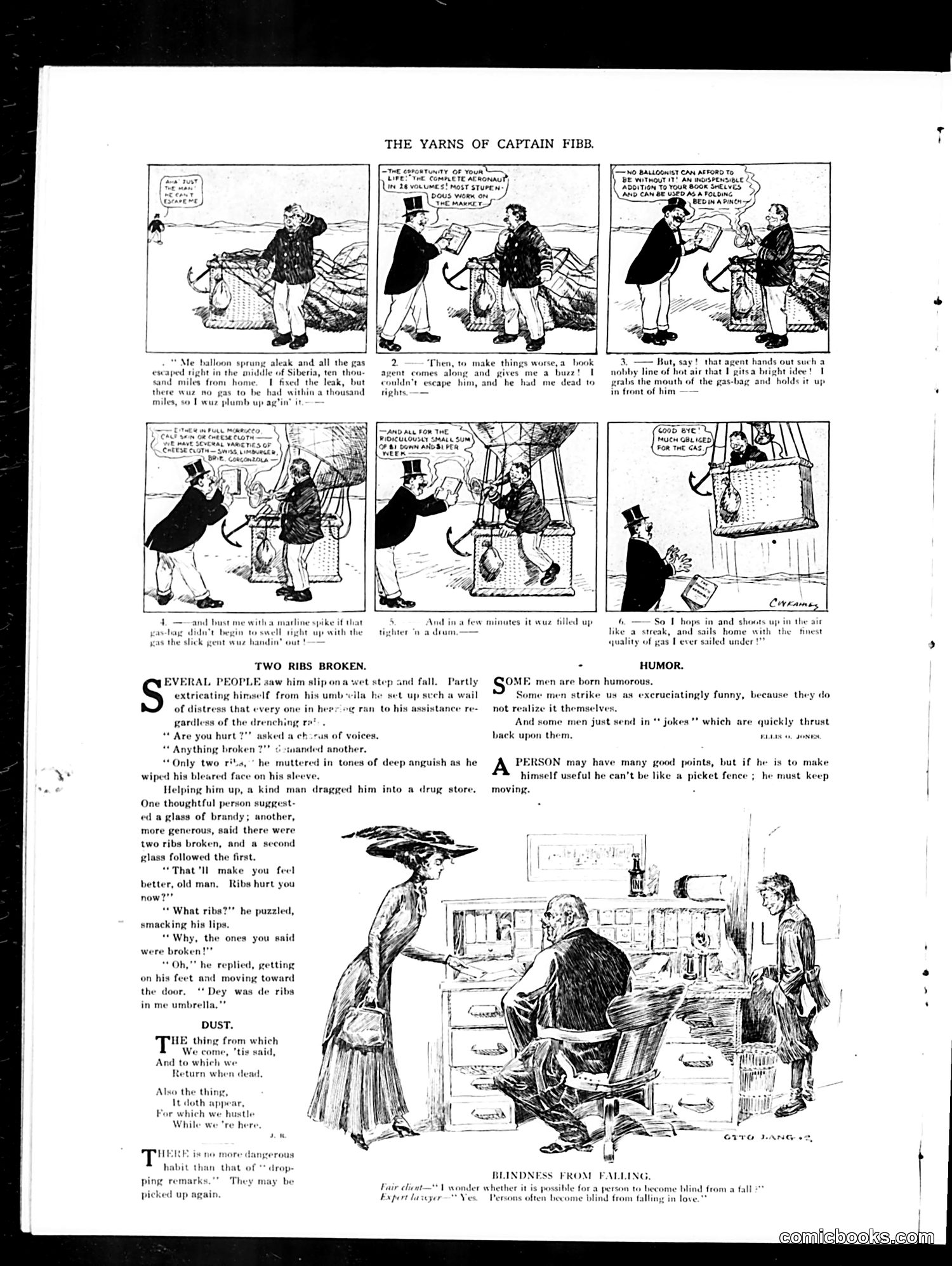
This page features **"The Yarns of Captain Fibb,"** a tall-tale comic strip mocking exaggerated adventure narratives popular in early 20th-century literature. The protagonist tells absurd stories—including one about a balloon escape in Siberia—that strain credibility. The humor derives from the deliberate implausibility and the character's earnest delivery of obvious fabrications. The page also includes humorous vignettes about human nature: a man who breaks his umbrella's ribs (not his own) but accepts brandy anyway; observations on humor and social behavior; and a medical note on blindness from falls. The content satirizes **bombastic storytelling conventions** of the era while offering gentle social commentary on human foolishness, gullibility, and pretense. No specific political figures appear to be targeted—the satire is broadly directed at universal character flaws and narrative excess.
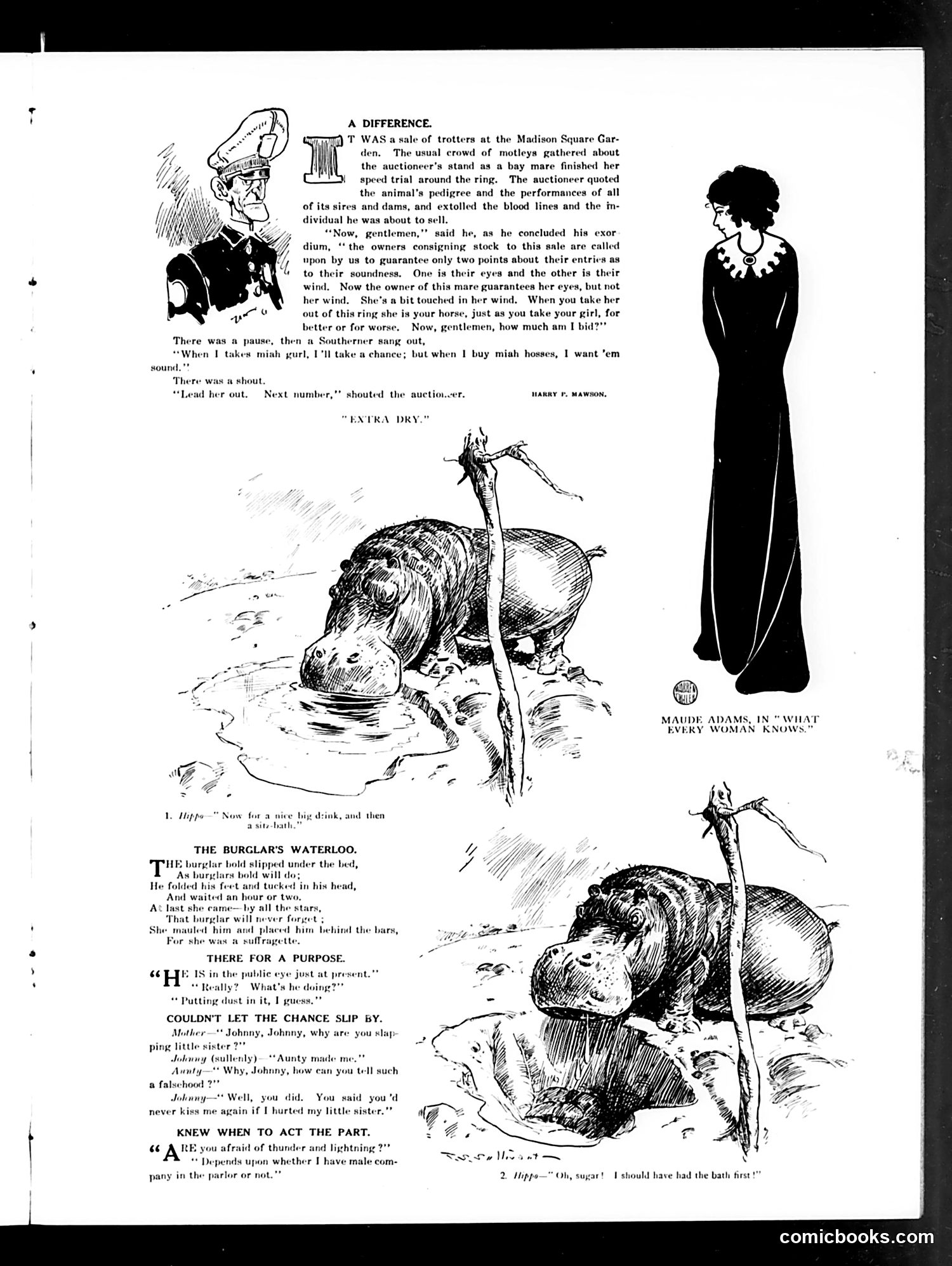
This page contains several satirical pieces typical of early 20th-century Judge magazine humor. The main story "A Difference" mocks racial stereotypes through an auction scene. An auctioneer sells a horse, comparing it to "taking your girl," guaranteeing only its eyes and wind (health). A Southern man responds that when buying horses, unlike women, he demands them "sound"—implying Black men were considered unreliable or defective. The joke relies on crude racial caricature and the era's casual racism. The page also includes unrelated comic vignettes: "The Burglar's Waterloo" (a woman's strength surprises a burglar), "There for a Purpose" (domestic humor about children), and "Knew When to Act the Part" (about feigning emotions). An illustration credits Maude Adams in "What Every Woman Knows." The cartoons reflect period attitudes toward race, gender roles, and domestic life that modern readers should recognize as offensive stereotyping rather than humor.
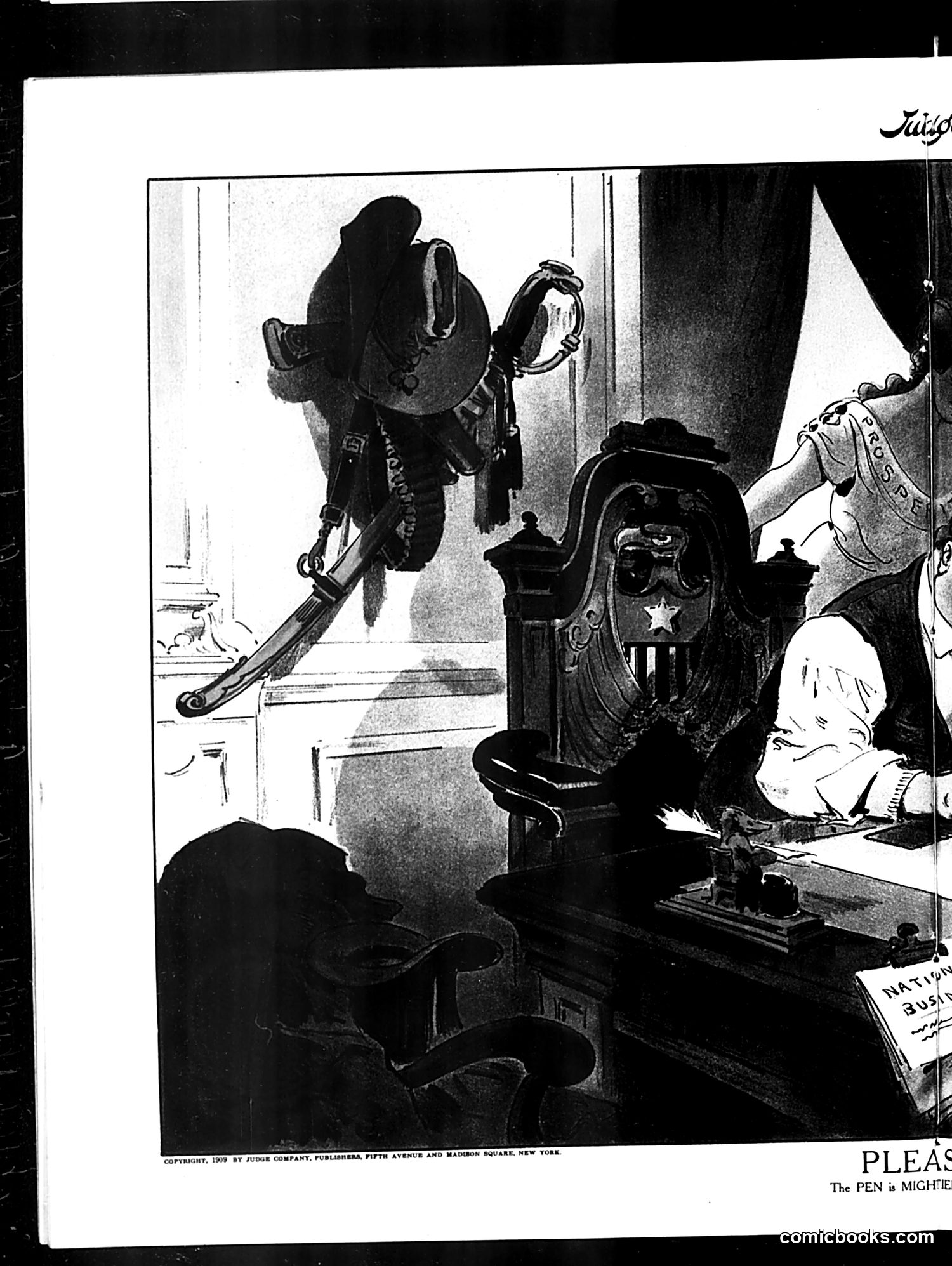
This appears to be a satirical illustration from Judge magazine (copyright 1893). The image shows a figure in military or formal dress seated at a desk, while another figure enters through a doorway above, wielding what appears to be a large pen or writing instrument as a weapon. The visible text references "The PEN is MIGHTIER" (likely completing the phrase "than the sword"), suggesting the cartoon satirizes the power of written word or journalism over military/political force. Without clearer identification of the specific figures or a complete caption, the exact political reference remains unclear. However, given the 1893 date and Judge's satirical nature, this likely critiques contemporary political figures or debates about press influence versus governmental authority. The militaristic imagery contrasts with the pen as the dominant weapon, emphasizing journalism's power.
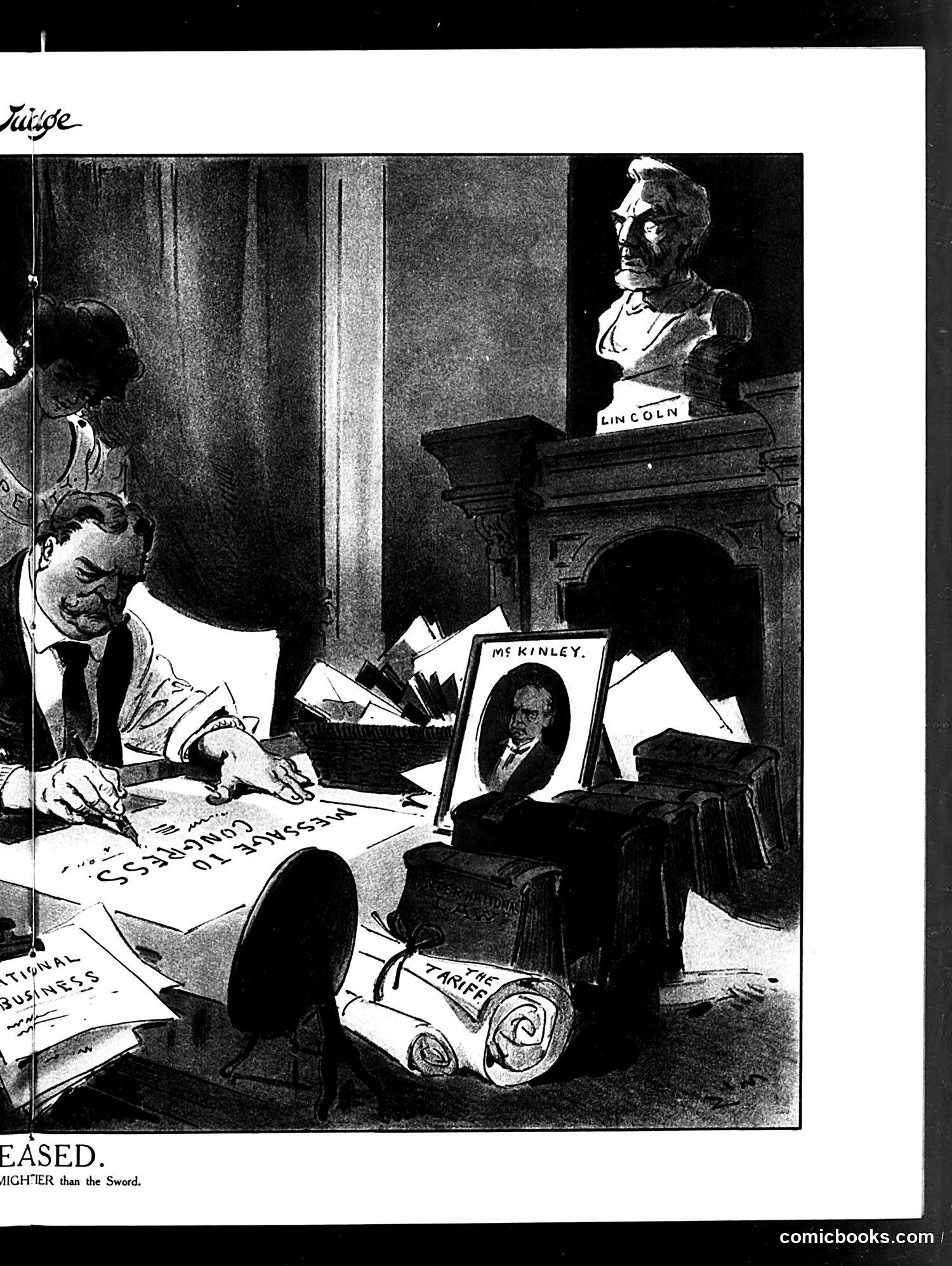
This appears to be a Judge magazine cartoon satirizing President McKinley's administration. A man (likely representing a politician or bureaucrat) sits at a desk covered with documents labeled "National Business" and "Tariff" matters, working with official papers. Behind him stands a bust of Lincoln labeled "LINCOLN," and a framed portrait of "McKINLEY" sits on the desk. The cartoon's caption reads "...EASED" and "MIGHTIER than the Sword," suggesting commentary on how policies or decisions are being "eased" through—possibly critiquing the administration's handling of tariff or business legislation. The presence of Lincoln's bust suggests comparison between the two presidents' approaches to governance or moral leadership. The exact date and specific satirical point remain unclear without additional context.
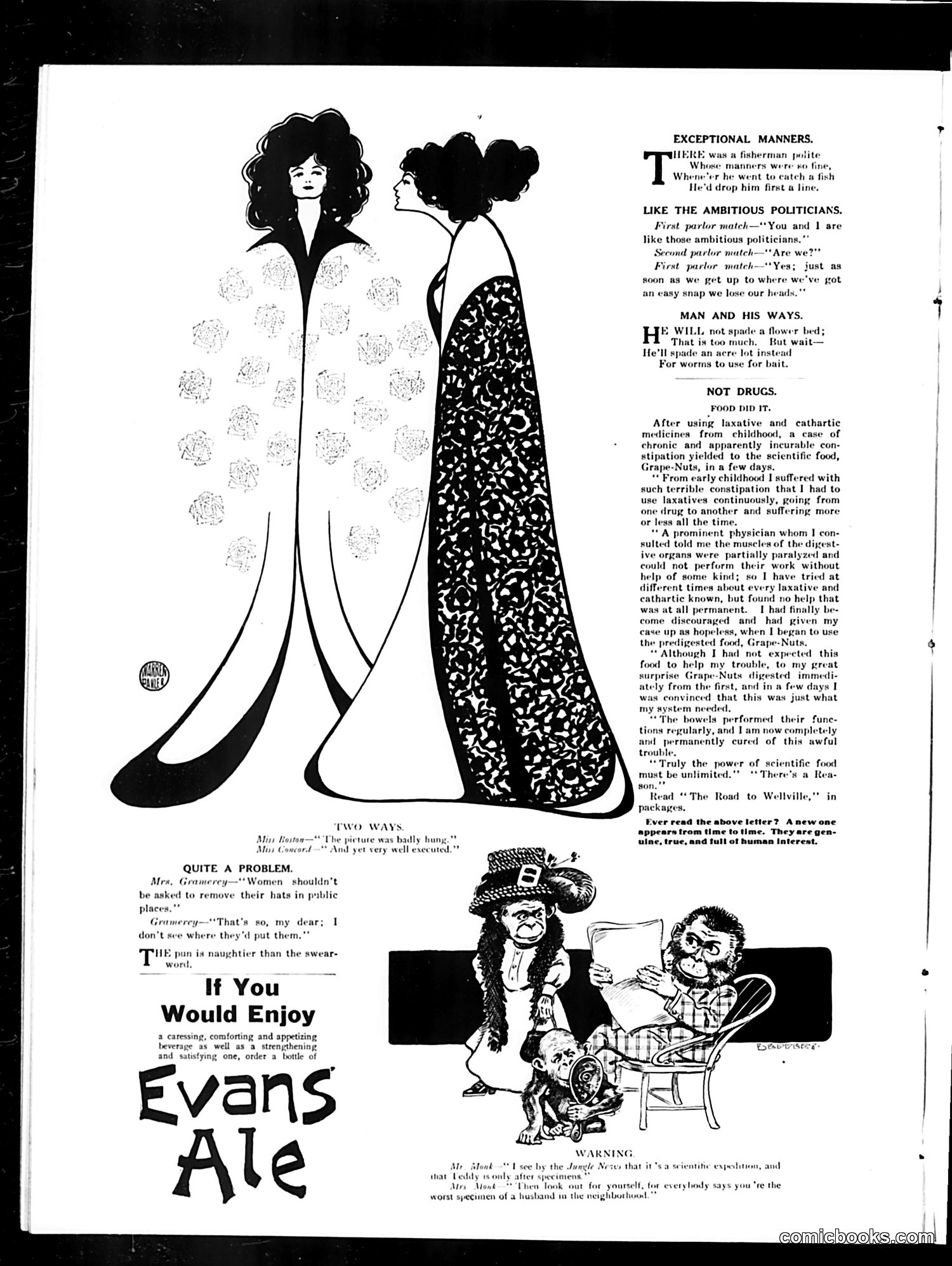
This page contains multiple brief satirical pieces typical of early 20th-century humor magazines: **"Exceptional Manners"** and **"Like the Ambitious Politicians"** are short joke verses playing on wordplay and social observation—comparing politicians' ambition to matchsticks that "lose our heads" once they reach success. **"Man and His Ways"** jokes about contradictory male behavior regarding flower beds and worms. **"Not Drugs"** is a testimonial advertisement for Grape-Nuts cereal, claiming it cured chronic constipation without laxatives—representing the era's fascination with "scientific foods" as health solutions. **"Two Ways"** and **"Quite a Problem"** are brief social jokes about art criticism and women's hats in public spaces. The bottom section advertises **Evans Ale**, while a small cartoon shows caricatured apes/primates in human dress—typical period imagery using animal caricature for satirical effect, though the specific reference is unclear from visible text. The page blends entertainment, advertising, and gentle social satire characteristic of Judge's format.
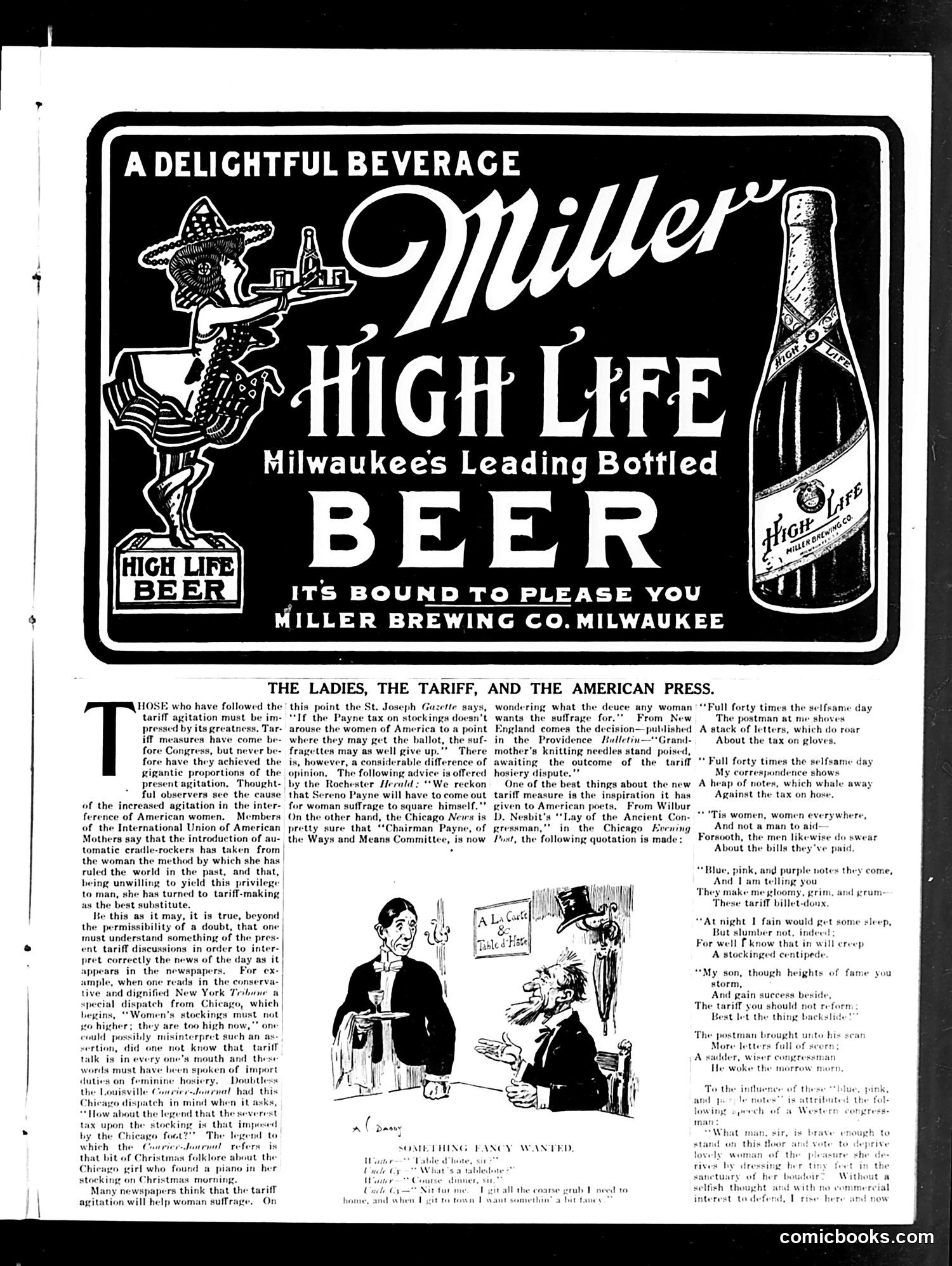
This page is primarily a **Miller High Life beer advertisement** with an accompanying satirical article about women and the tariff debate. The article discusses how the Payne tariff's tax on women's stockings has unexpectedly energized women's political activism and suffrage movements. The satire suggests that imposing taxes on items women care about (stockings, gloves, hosiery) has motivated them toward political engagement more effectively than ideology alone. The humorous centerpiece is a poem about a man receiving endless letters complaining about tariff taxes—featuring the phrase "a stockinged centipede" as comedic imagery of women's complaints arriving endlessly. **Historical context:** This reflects early 20th-century debates about protective tariffs and their unintended political consequences. The piece mocks how economic policy affecting consumer goods mobilized women voters during the pre-suffrage era, suggesting women's political interests were dismissively attributed to shopping concerns rather than principle. The beer ad is incidental to the satire's actual content.
This page is primarily **advertising** with some editorial content mixed in. The main satirical piece concerns **co-education** and women factory workers. The editorial argues that a congressman romanticizing "delicate" college women is hypocritical while actual women workers in Pennsylvania hosiery mills struggle for fair wages and working conditions. The piece criticizes newspapers and politicians who speak eloquently about women's rights while ignoring the material needs of working-class women—fifty thousand of whom depend on mills and are demanding tariff protection (higher duty on foreign gloves). The satire's point: there's a disconnect between sentimental rhetoric about genteel womanhood and the practical economic realities facing laboring women. The contrast between the congressman's flowery language and the workers' straightforward plea ("All We Ask Is 1½-3 Cents More") underscores this hypocrisy. The page also includes vintage advertisements for beer, champagne, revolvers, and patent medicines—typical of Judge's mixed-content format.
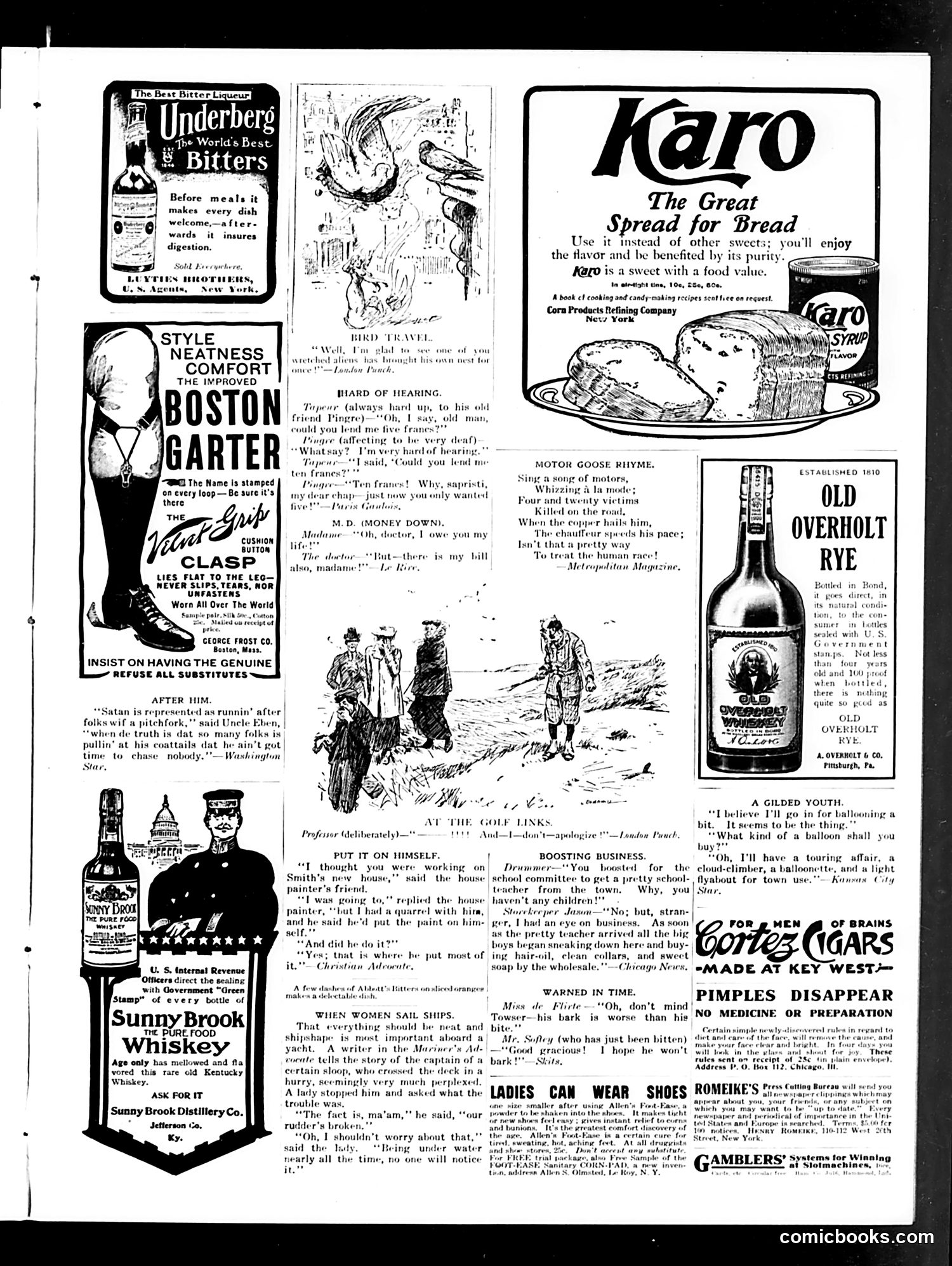
This page is primarily advertising from an early-20th-century American magazine. The cartoons and humorous anecdotes scattered throughout are brief, genteel jokes typical of *Judge* magazine's satirical style. The visible comic content includes: **"Wizard of Hearing"** — A French joke about a deaf man repeatedly asking to borrow money, pretending not to hear the lender's refusals. **"Motor Goose Rhyme"** — Dark satire updating "Sing a Song of Sixpence," replacing blackbirds with automobile deaths ("four and twenty victims / Killed on the road"), mocking the emerging danger of motorcar traffic. **"At the Golf Links"** — A professor joke about apologizing (unclear punchline in OCR). **"When Women Sail Ships"** — A brief anecdote about a ship's rudder breaking, with someone unconcerned because "being under water all the time, no one will notice." The page is dominated by advertisements for liquor (Underberg Bitters, Sunny Brook Whiskey, Old Overholt Rye), food products (Karo syrup), garters, and dubious remedies. The tone is lighthearted and decidedly non-political.
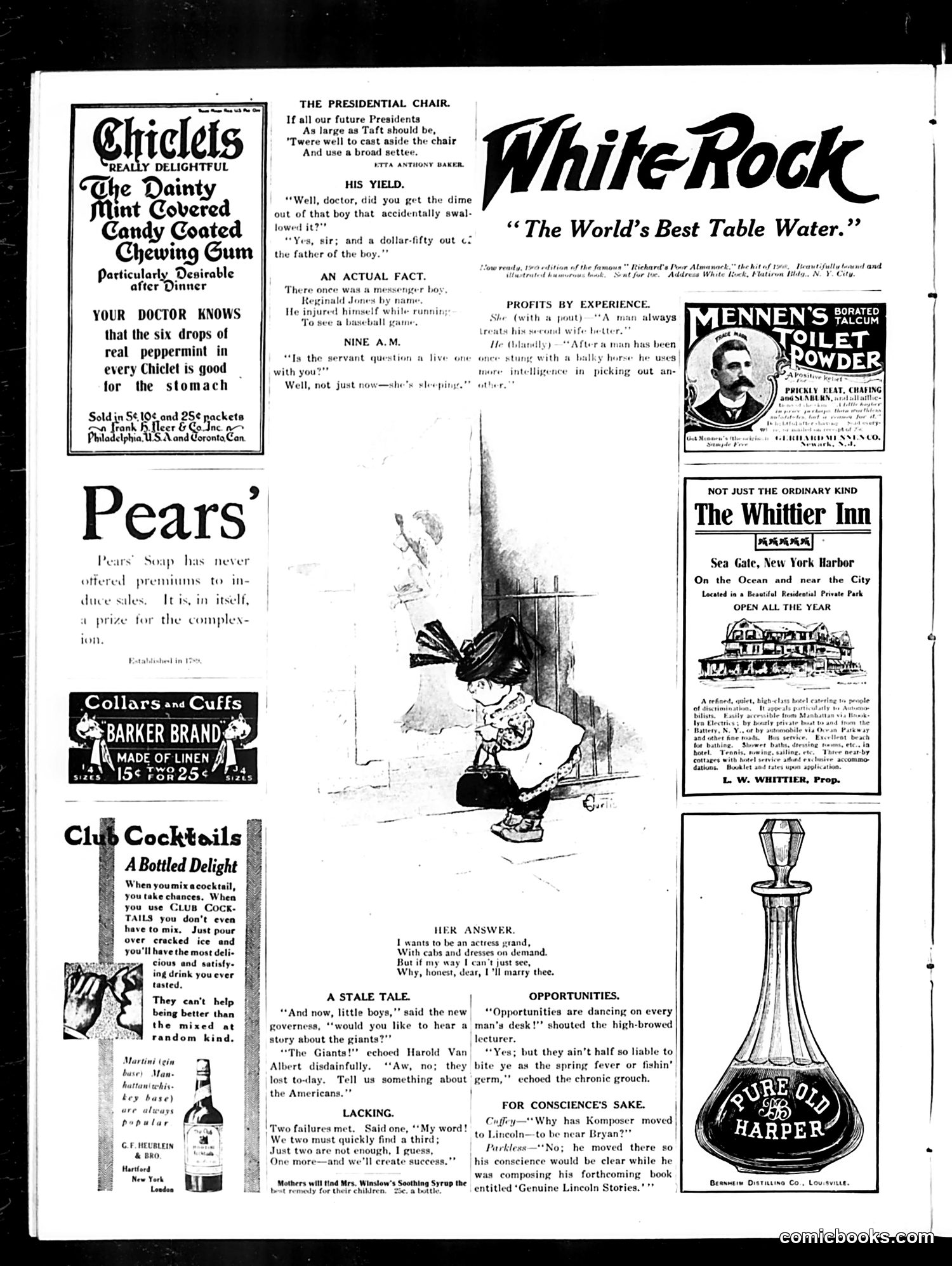
This page is primarily **advertising**, typical of Judge's revenue model. The content includes product ads (Chiclets gum, Pears' soap, Barker Brand collars, Club Cocktails, White Rock water, Mennen's talcum powder, The Whittier Inn hotel, and Pureold Harper whiskey). The few cartoons/jokes are minor: 1. **"The Presidential Chair"** references **President Taft's known obesity**, joking that future presidents as large as him would require replacing the presidential chair with a settee—a contemporary dig at Taft's size. 2. **"His Yield"** is a doctor/boy joke about extracting money from a father after the boy swallows a dime. 3. **"A Stale Tale"** mocks children's disinterest in old giant stories, preferring current events (the Giants baseball team's loss). 4. **"Lacking"** is a simple joke about needing three partners. The remaining brief items are light humor pieces with no obvious political content. This appears to be a typical early 20th-century Judge issue blending light satire with substantial advertising space.
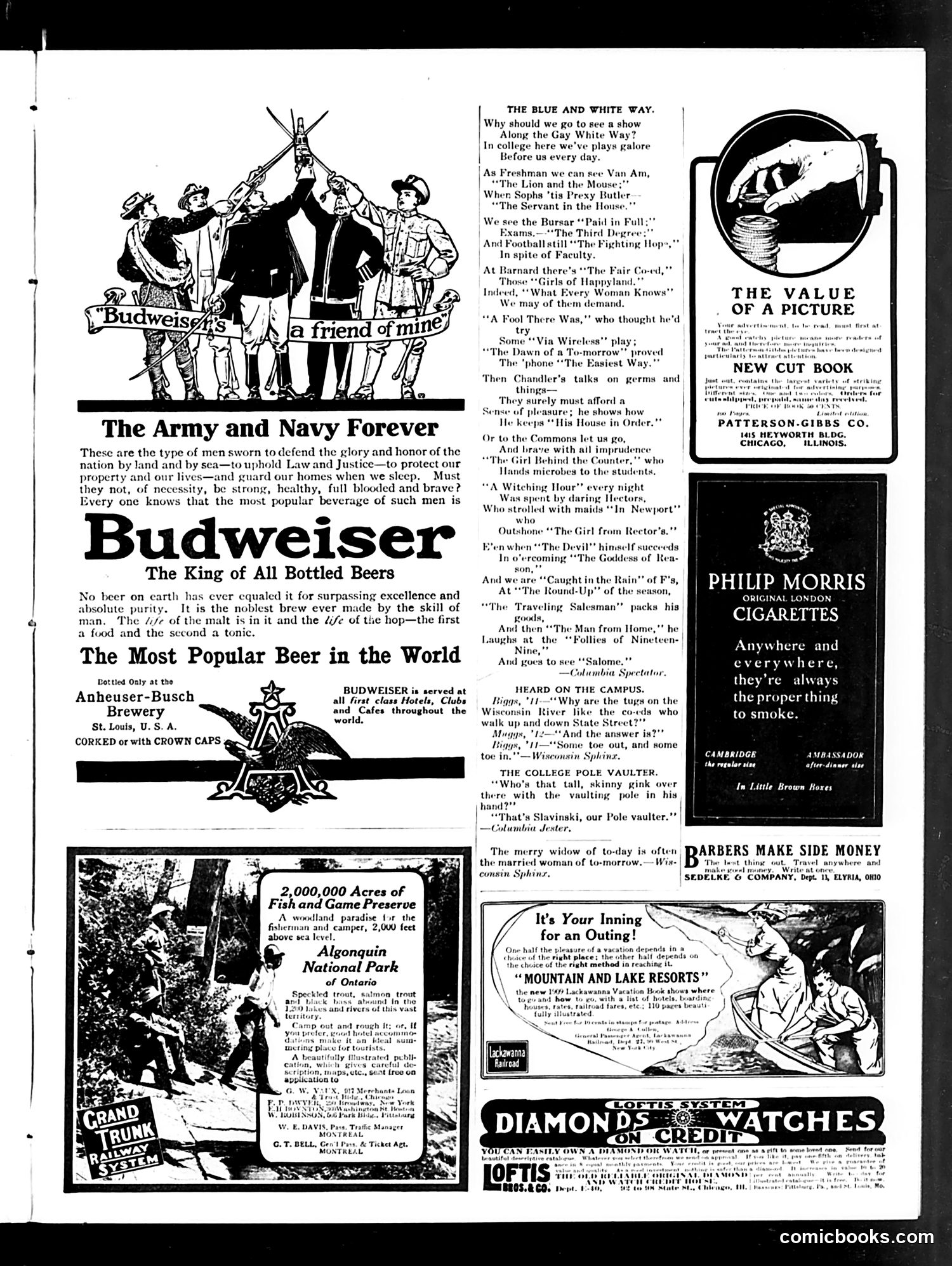
This is primarily an **advertising page** from Judge magazine, not a political cartoon. The dominant content is commercial rather than satirical. The page features a large **Budweiser beer advertisement** prominently positioning the product as "The King of All Bottled Beers" and "The Most Popular Beer in the World." The ad uses patriotic framing—emphasizing that soldiers and sailors defending the nation naturally drink Budweiser—a marketing strategy linking beer consumption to masculinity and national service. Interspersed are **college humor pieces** (brief, witty observations about campus life at what appears to be Barnard College), various small ads for cigarettes, watches, and tourism, and a section titled "Heard on the Campus" with undergraduate jokes. The only satirical element is the "Blue and White Way" poem, which jokes that college theatrical productions are so frequent they rival Broadway entertainment—a gentle jab at theatrical oversaturation in campus life. Overall, this reflects early 20th-century magazine economics: humor content mixed with paid advertising to subsidize publication.
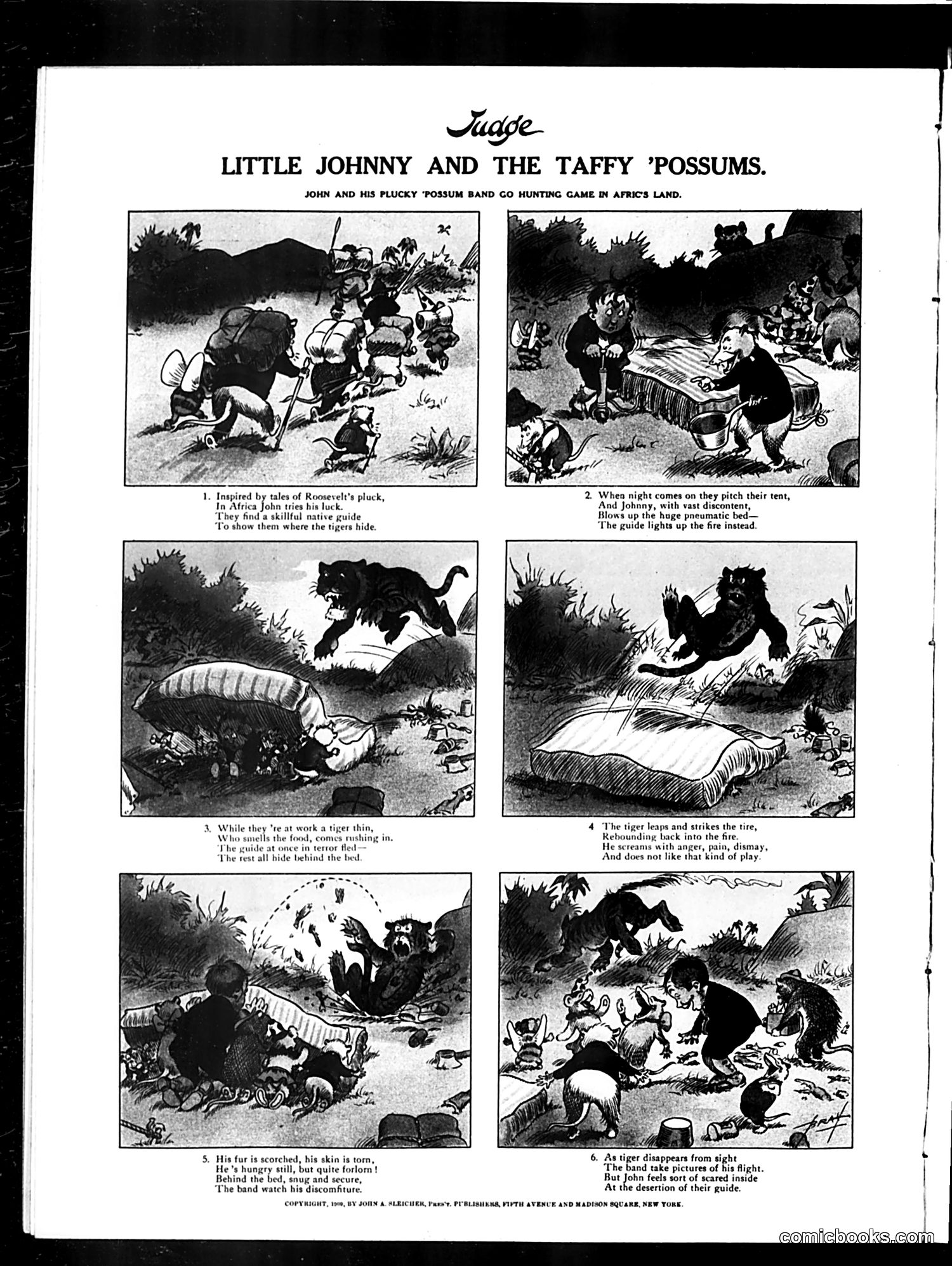
This is a humorous six-panel comic strip satirizing Theodore Roosevelt's famous African hunting expedition. The story follows "Little Johnny" and his band of anthropomorphized possums on a mock safari, apparently inspired by Roosevelt's well-publicized 1909-1910 hunting trip to Africa. The joke relies on the contrast between Roosevelt's celebrated hunting prowess and the comic incompetence of Johnny's group. Each panel depicts disasters: a tiger attacks their tent, catches fire, injures the guide, and sends the entire party into panicked hiding. The "taffy possums" (likely a pun on "tough" or satirizing Roosevelt's "tough" persona) prove entirely unprepared for actual African wildlife. The humor targets both Roosevelt's adventure narrative and contemporary enthusiasm for big-game hunting, presenting it as chaotic and undignified rather than the heroic enterprise Roosevelt's supporters claimed.