
A complete issue · 20 pages · 1909
Judge — April 24, 1909
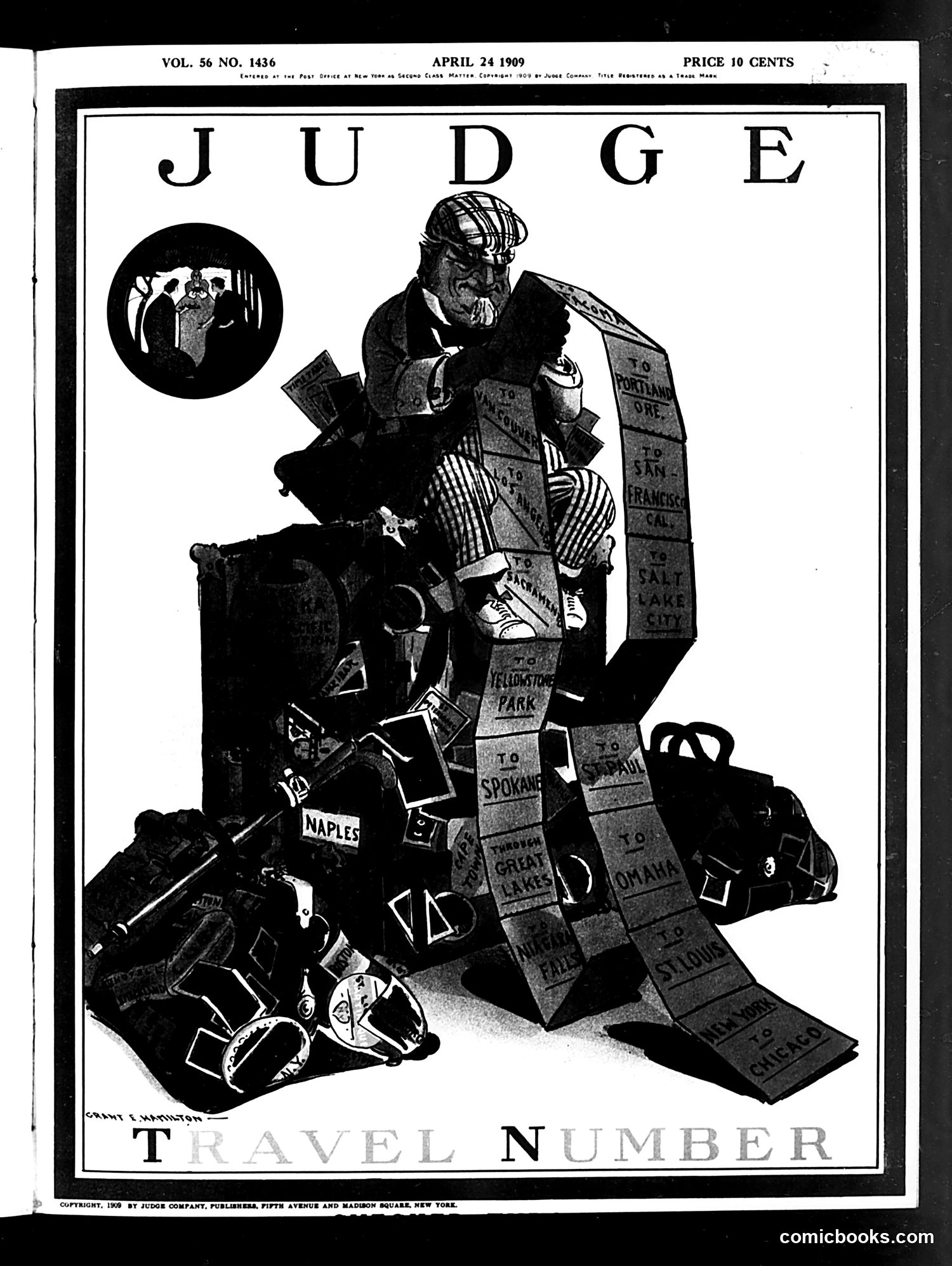
This is a "Travel Number" cover satirizing American tourism. A portly, well-dressed gentleman (representing the typical wealthy American tourist) is burdened with an enormous stack of travel destination labels and baggage tags—visible destinations include Yellowstone Park, San Francisco, the Great Lakes, Salt Lake City, Spokane, and Omaha, among others. The satire mocks two things: the excess baggage of leisure travelers and the emerging American habit of collecting destinations as status symbols. The small circular inset (upper left) appears to show the man overwhelmed by his travels. The joke reflects early-20th-century anxieties about newly wealthy Americans' conspicuous consumption and their obsession with "doing" America's tourist attractions, loaded down with possessions and pretension.
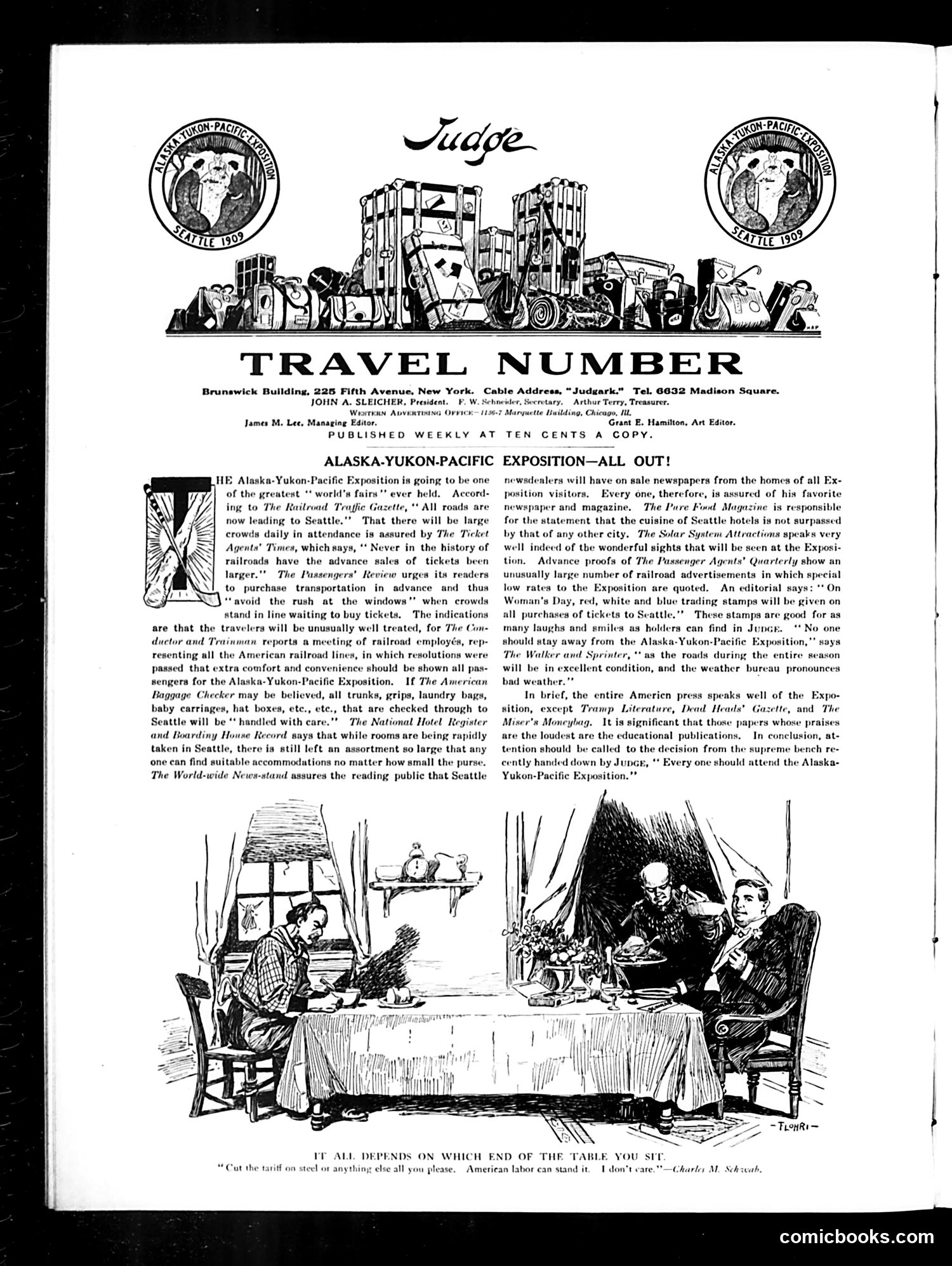
This page celebrates the **Alaska-Yukon-Pacific Exposition** (a major 1909 Seattle world's fair). The editorial praises railroad companies for promoting the event through advance ticket sales and press coverage. The cartoon below depicts a labor dispute at a dining table. A worker tells his employer: "Cut the tariff on steel or anything else all you please. American labor can stand it. I don't care"—attributed to Charles M. Schwab (steel magnate). The satire critiques the **tariff debate** of the era: it suggests American workers will tolerate protective tariffs on imports, but the real issue is their own wages and working conditions. The cartoon implies worker frustration that employers use tariff arguments while underpaying labor—the actual "end of the table" determining workers' fates.
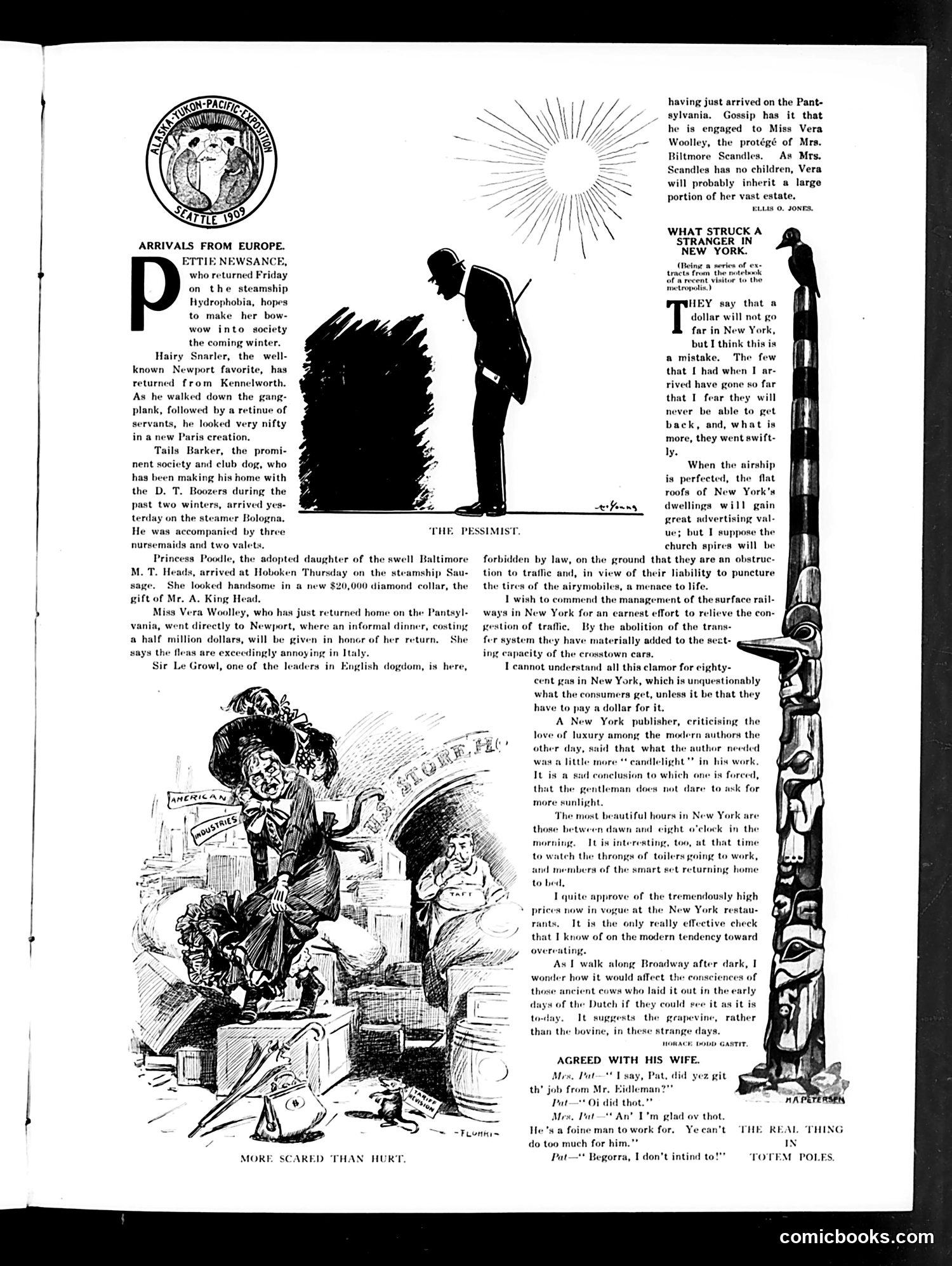
This page contains two distinct sections: **"Arrivals from Europe"** (top left) reports on society figures returning from Europe, including Hairy Shaffer, Taits Barker, and Princess Poosie—typical society gossip content for Judge's wealthy readership. **"What Struck a Stranger in New York"** (right column) is social criticism about New York's rising costs and inequality. The author argues that a dollar doesn't stretch far in New York and expresses concern about wealth disparity and affordability—an early commentary on urban economic inequality. **"The Pessimist"** and **"More Scared Than Hurt"** (left illustrations) appear to be unrelated satirical cartoons, though their specific targets are unclear from the visible text. The page reflects Judge's dual purpose: society gossip for elites and social commentary on contemporary urban issues.
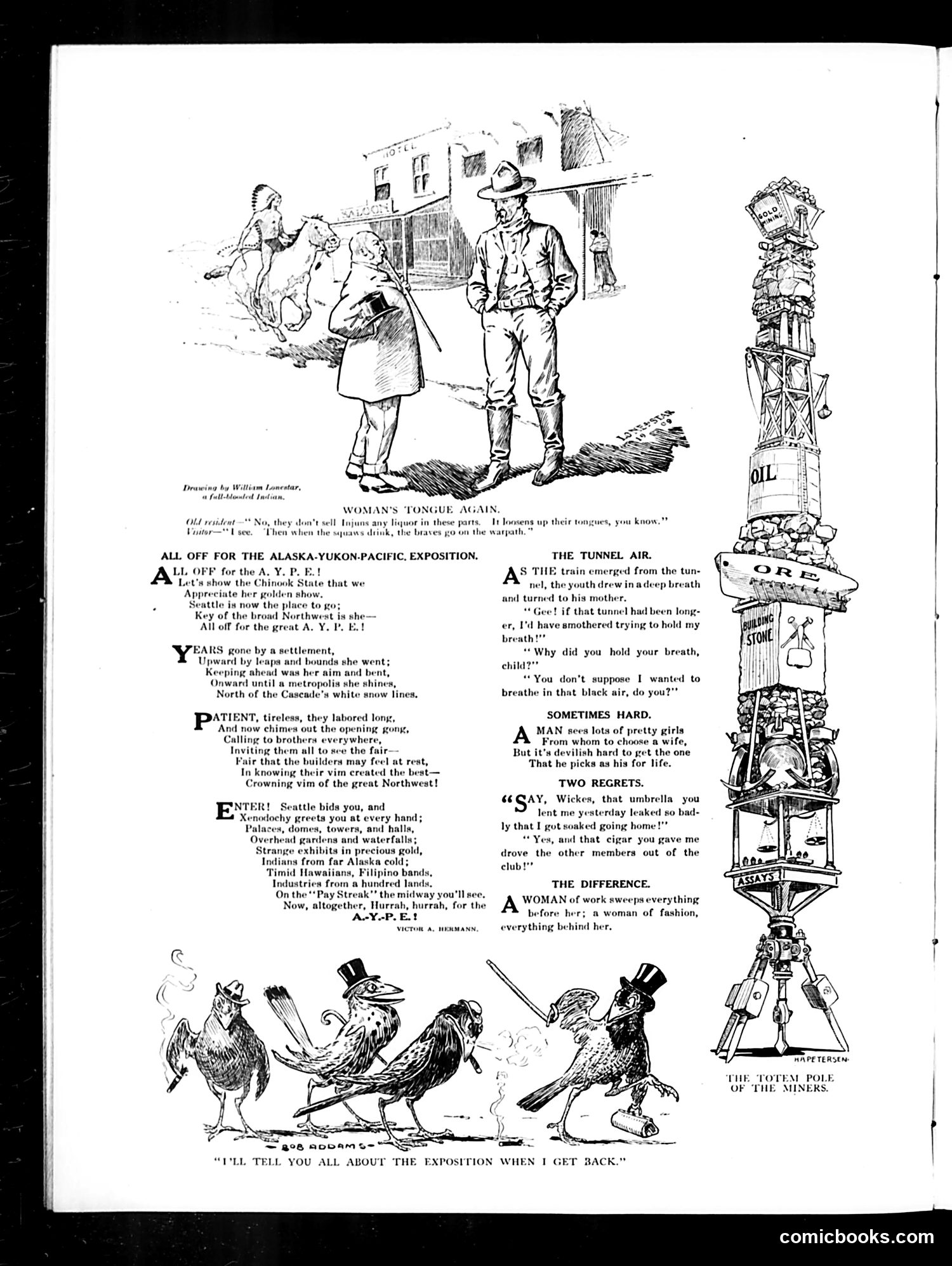
This page from *Judge* magazine contains several satirical pieces about the 1909 Alaska-Yukon-Pacific Exposition in Seattle. The main cartoon "Woman's Tongue Again" depicts a woman lecturing a cowboy-dressed man about liquor sales at the exposition, satirizing women's temperance activism of the era. The accompanying poems celebrate the exposition's showcase of western resources and development. Below are humorous short pieces: "The Tunnel Air" jokes about foul air in train tunnels, "Sometimes Hard" comments on marriage choices, and "Two Regrets" depicts domestic quarrels. The bottom cartoon shows birds gossiping, captioned with one promising to report exposition details. On the right, "The Totem Pole of the Miners" illustrates a tall stack of mining industry symbols, celebrating Alaska's resource wealth—a key exposition theme. The overall satire mixes progressive-era concerns (temperance, women's voices) with boosterism for western industrial development.
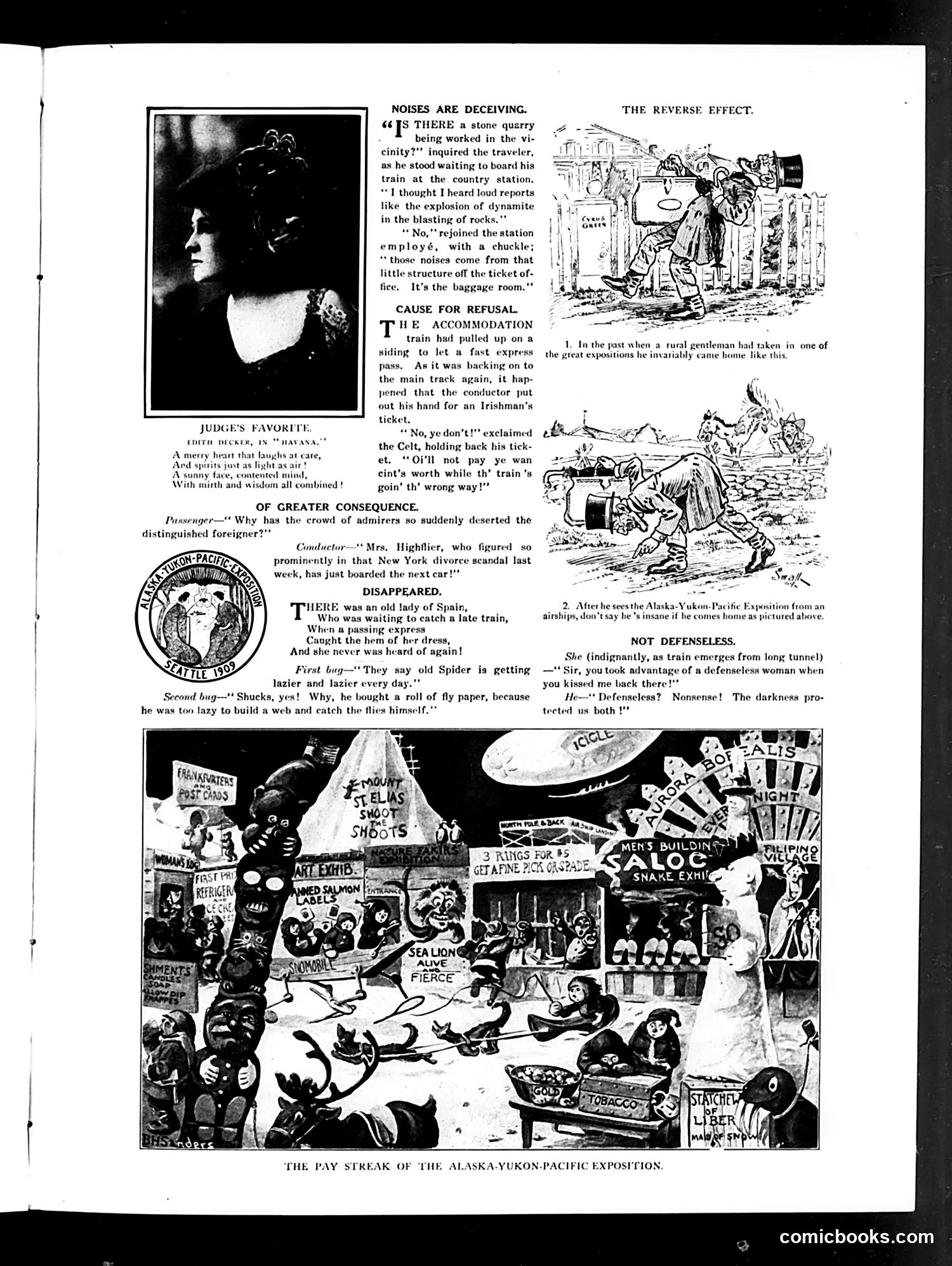
This page from *Judge* contains several satirical pieces about early 1900s society and the Alaska-Yukon-Pacific Exposition. **"Judge's Favorite"** is a humorous poem about a merry heart and wisdom. **"Of Greater Consequence"** mocks social pretension, featuring dialogue between a passenger and conductor about a "distinguished foreigner" and a New York divorce scandal. **"Disappeared"** is a brief, dark poem about a Spanish nobleman who vanished while catching a train. **"The Reverse Effect"** cartoon satirizes rural exposition-goers, contrasting their imagined sophistication with reality. **The large bottom cartoon**, "The Pay Streak of the Alaska-Yukon-Pacific Exposition," depicts the chaotic midway with carnival attractions, hucksters, and crowds—satirizing the commercialization and sensationalism of the 1909 Seattle exposition. The overall theme critiques American social climbing and carnival culture.
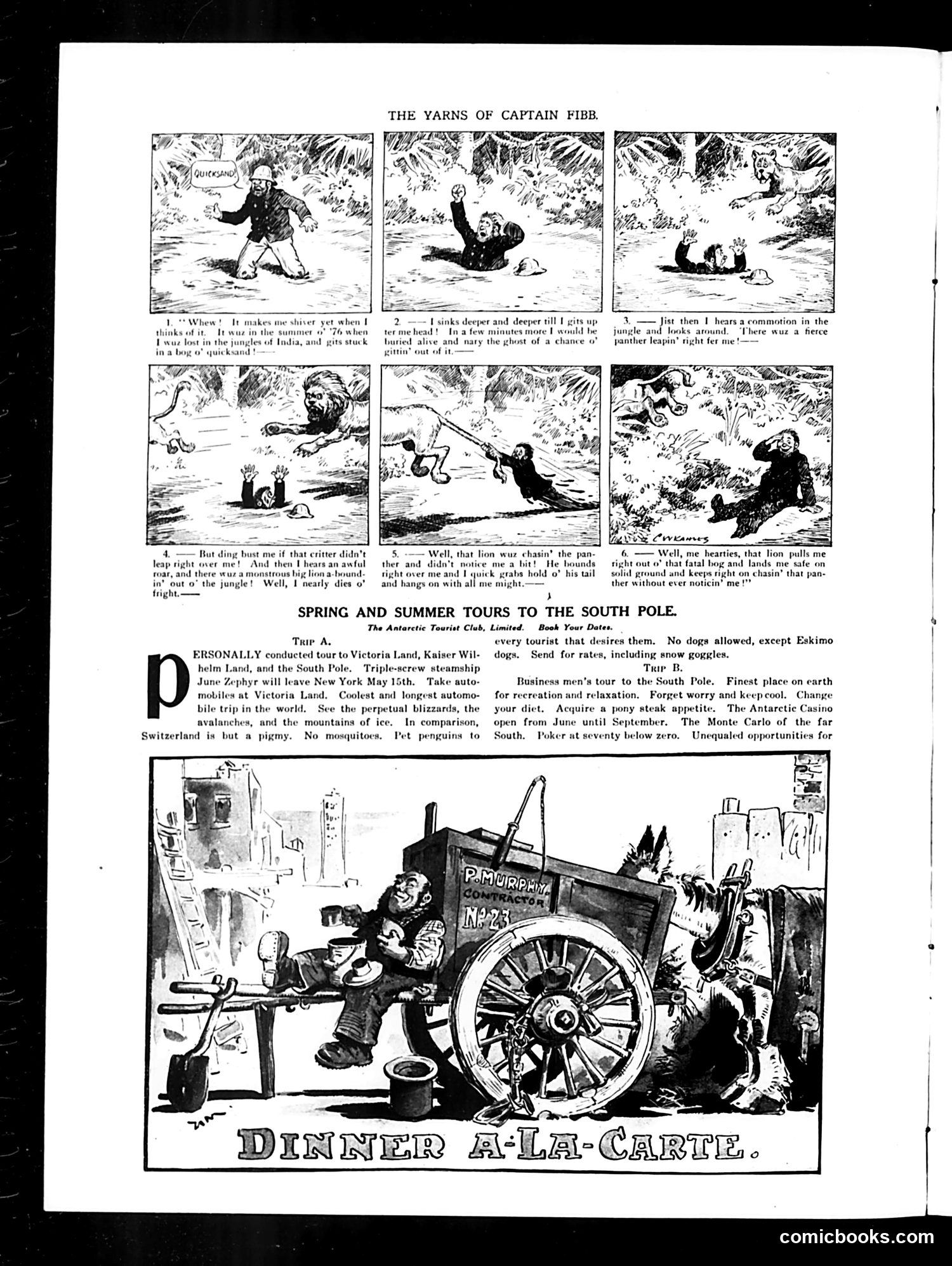
The top section presents a tall-tale comic strip featuring Captain Fibb, a boastful storyteller recounting increasingly implausible jungle adventures—surviving quicksand, encountering lions, and riding panthers. This mocks the "fisherman's tale" tradition of exaggerated adventure narratives popular in period humor. The lower section satirizes the era's emerging tourist industry through fake advertisements for Antarctic trips. "The Antarctic Tourist Club" parodies luxury tour operators by comically proposing the South Pole as a vacation destination with amenities like automobiles, casinos, and fine dining ("Dinner à-la-carte")—absurdly incongruous for Earth's most inhospitable region. References to "poker at seventy below zero" and acquiring "pony steak appetite" highlight the ridiculous disconnect between genteel tourism marketing and Antarctic reality. Together, the page mocks both tall-tale boasting and the period's aggressive commercialization of exotic travel.
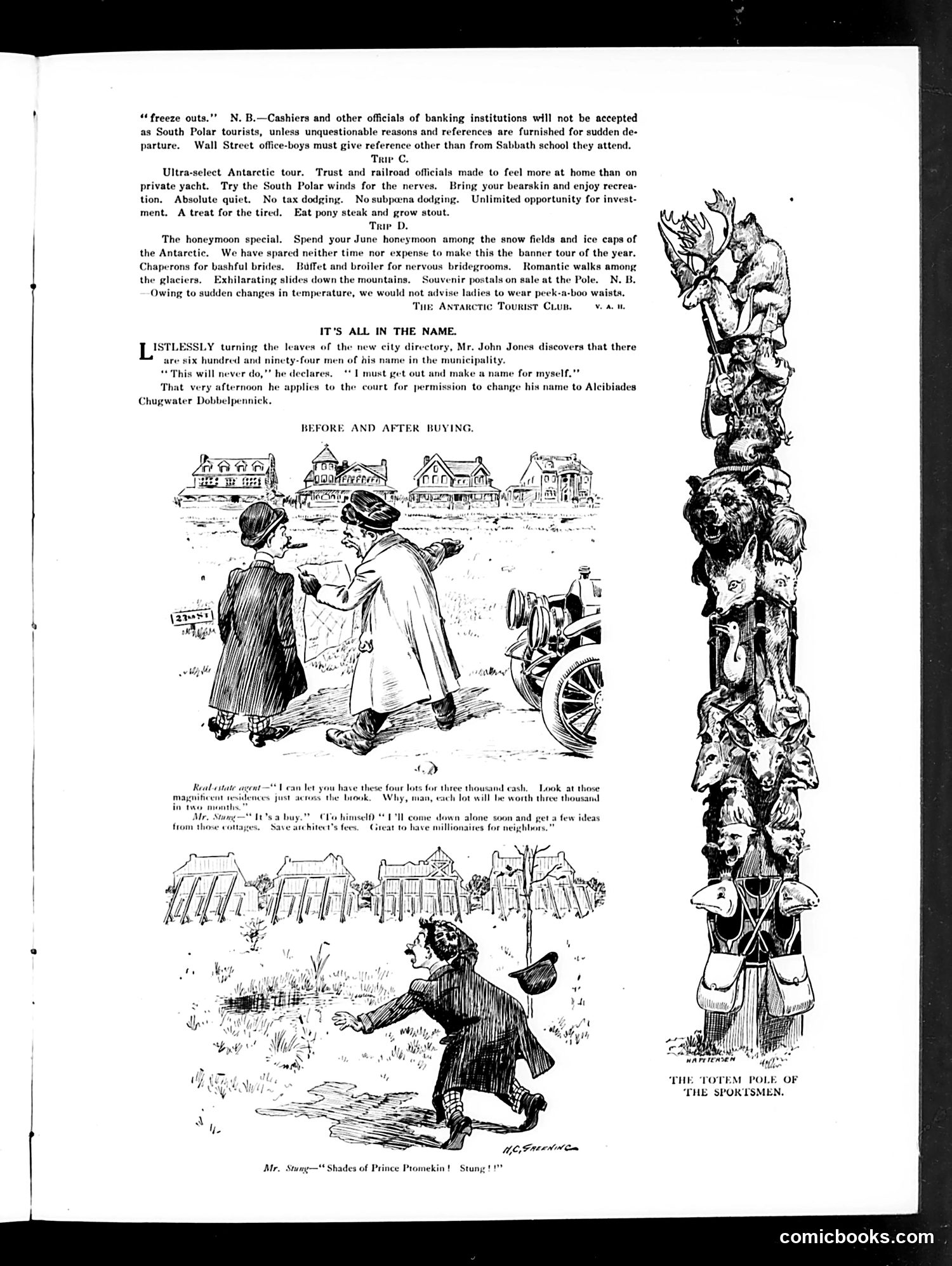
This page contains multiple satirical pieces mocking early 1900s American society: **"Freeze Outs" / Antarctic Tours**: Mock advertisements targeting corrupt financiers and Wall Street figures. The satire suggests sending dishonest bankers, railroad officials, and embezzlers on Antarctic expeditions—essentially exiling them. References to "tax dodging" and "subpoena dodging" indicate these tours humorously propose removing criminals from society. The note about Wall Street office-boys needing references "other than from Sabbath school" mocks their hypocrisy. **"It's All in the Name"**: A brief joke about a man named John Jones discovering six hundred others share his name in the city directory, so he legally changes it to the absurdly pretentious "Alcibiades Chugwater Dobbelpennick"—satirizing status-seeking through ridiculous name changes. **"Before and After Buying"**: Two cartoons showing a man's disappointed reaction after purchasing supposedly valuable real estate. The final caption "Shades of Prince Potemkin! Stung!" references Potemkin's fake villages, suggesting the buyer was defrauded into buying worthless property. The "Totem Pole" illustration on the right appears decorative rather than narrative.
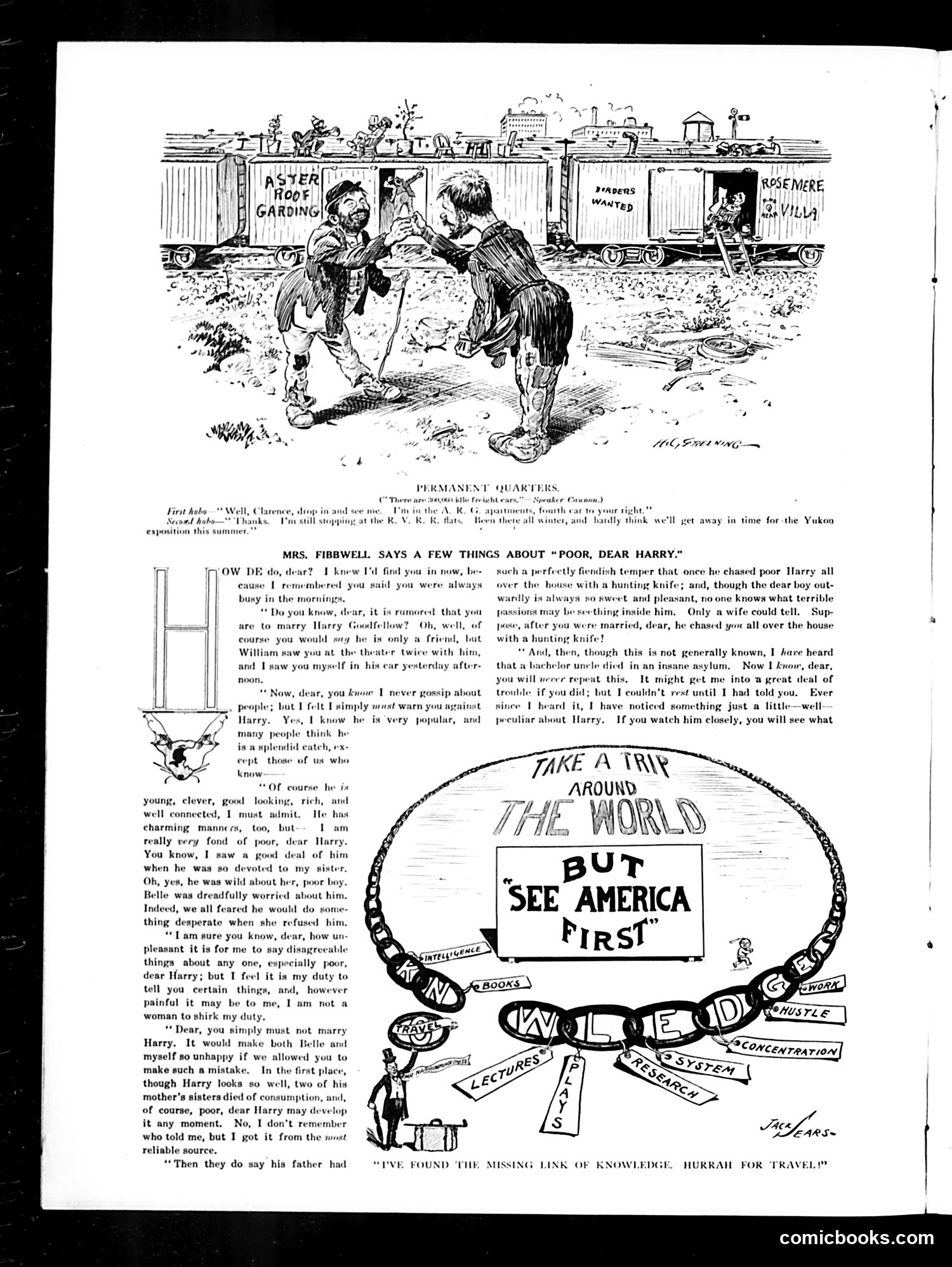
**Top Cartoon - "Permanent Quarters":** Two hobos (itinerant workers) discuss staying in railroad freight cars during winter rather than traveling to the Yukon for gold prospecting work. The satire mocks the era's hobo culture and the Gold Rush mentality—men choosing stable (if humble) quarters over risky fortune-seeking. **Main Article - "Mrs. Fibwell Says...":** A gossiping woman warns another against marrying "poor dear Harry," listing baseless rumors: his family has mental illness and tuberculosis history, his ex-girlfriend was rejected, he has a violent temper. The satire ridicules how rumors and innuendo destroy reputations regardless of truth. The piece is titled mockingly—Mrs. Fibwell claims reluctance while eagerly spreading damaging gossip. **Bottom Right Advertisement:** A travel promotion urging Americans to "See America First" before traveling abroad, featuring various attractions and activities. This reflects early-20th-century nationalism and domestic tourism marketing. All three pieces satirize different American social behaviors: homelessness, gossip culture, and consumerism.
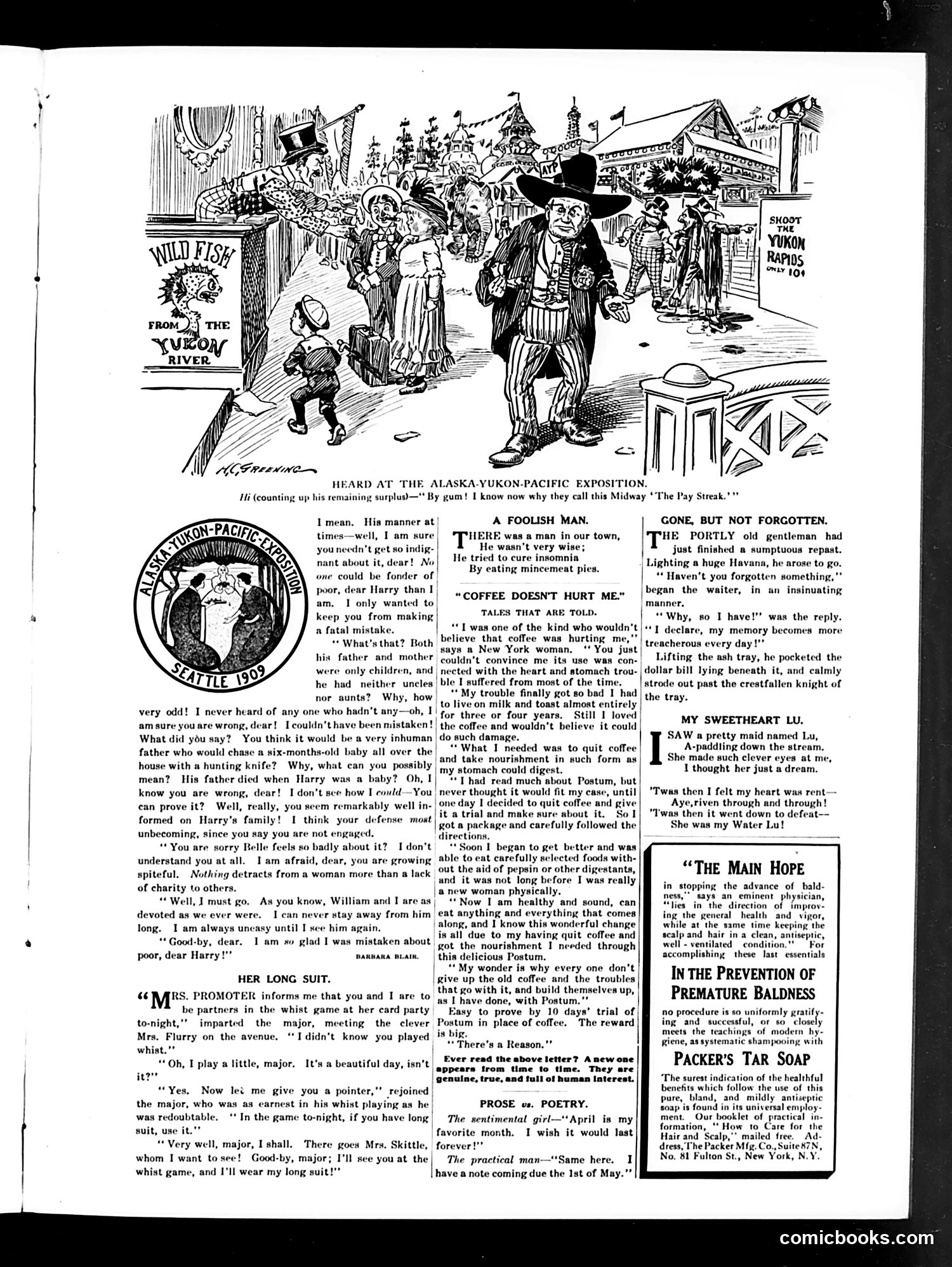
This page from Judge magazine (circa 1909, based on the Alaska-Yukon-Pacific Exposition reference) contains multiple satirical pieces: **Main Cartoon**: "Heard at the Alaska-Yukon-Pacific Exposition" depicts a man at the fair's midway who has spent his surplus money and now understands why it's called "The Pay Streak"—a pun on both the fairground and prospecting terminology. **"Her Long Suit"**: A comedy sketch about Mrs. Flurry, who claims to play whist despite the major's doubts. The joke plays on "suit" (cards vs. clothing). **Advertisements**: The page includes substantial advertising, particularly a Postum coffee substitute ad featuring testimonials about coffee's harmful health effects—a common early-1900s marketing angle claiming coffee caused heart and stomach troubles. **"A Foolish Man" and other brief pieces**: Humorous anecdotes typical of Judge's satirical format. The page reflects Progressive-era anxieties about health and consumer products, alongside general social satire about manners and relationships.
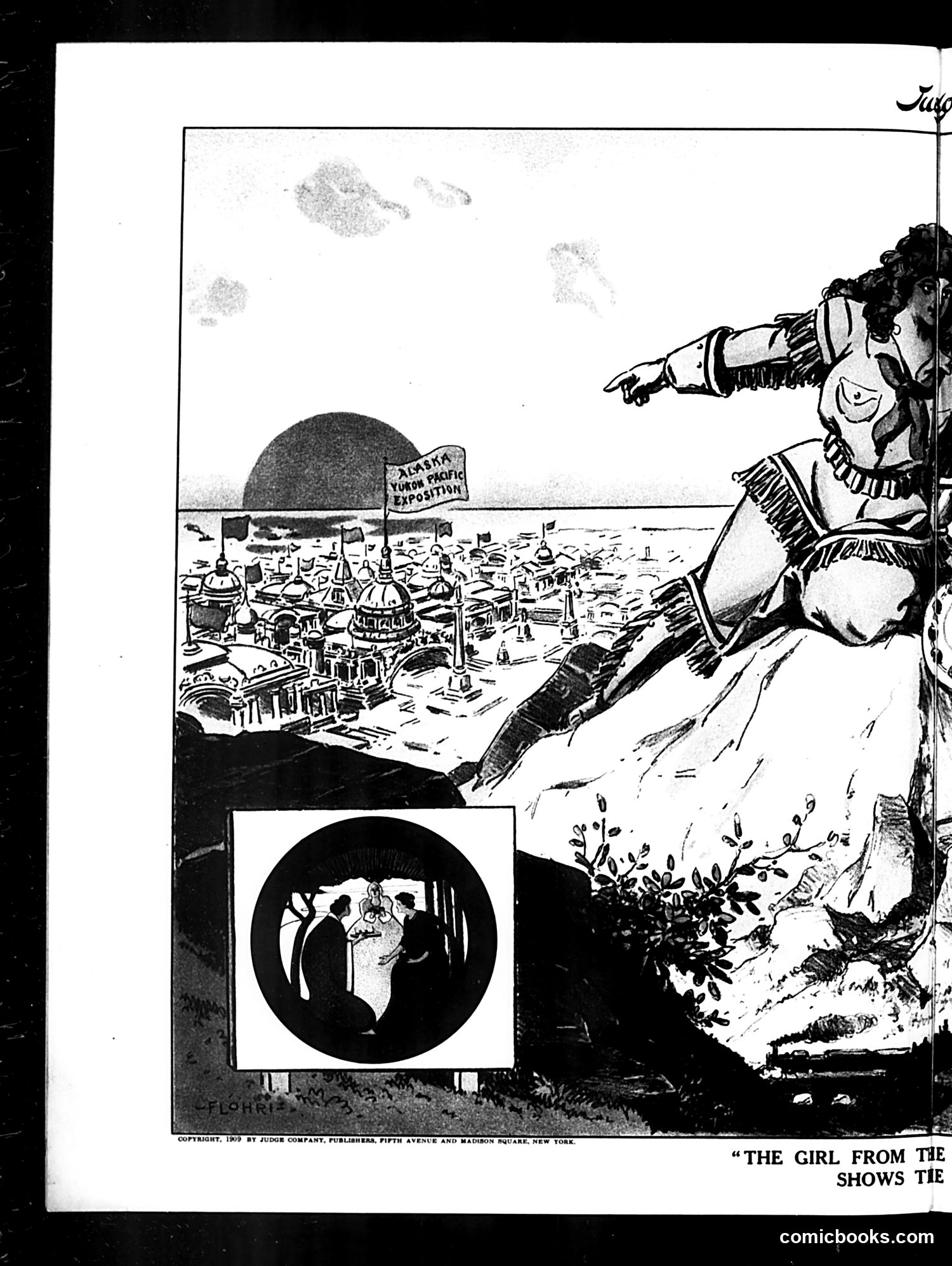
This 1909 Judge cartoon appears to satirize a theatrical production or musical show. The main panel shows a giant figure (likely representing a character or concept from a popular show) pointing toward an elaborate futuristic or fantastical city with domed buildings and a sign reading "LUNA PARK" or similar exposition grounds. The smaller circular inset depicts what appears to be an interior scene with figures in formal dress, possibly showing a contrast between the theatrical spectacle and real life. The satire likely mocks either the extravagant productions of Broadway shows of the era, the popular amusement parks like Luna Park that were attractions at the time, or the disconnect between theatrical fantasy and reality. Without clearer text identifying the specific show referenced, the exact target of ridicule remains uncertain, though it clearly critiques contemporary entertainment culture.
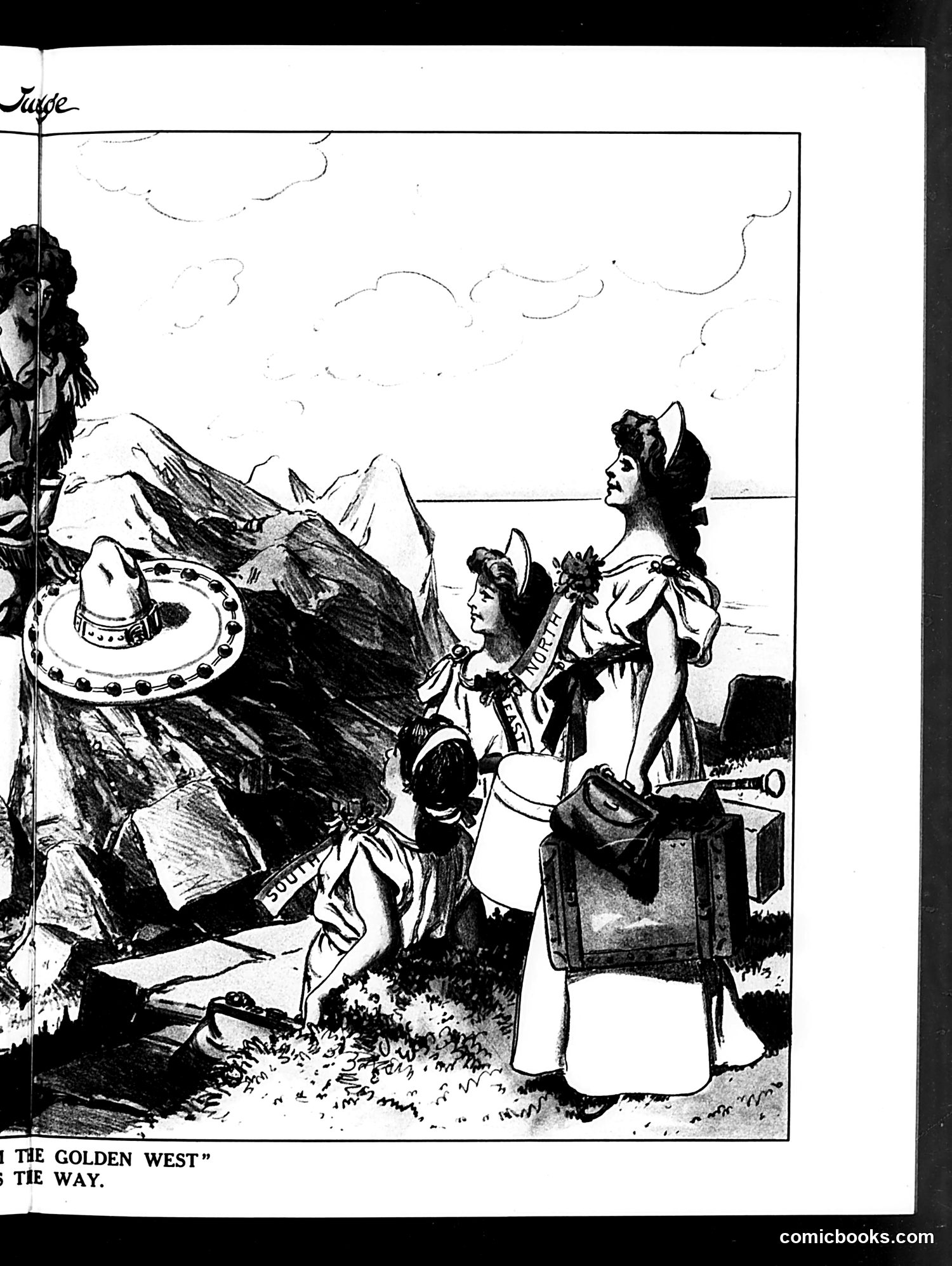
This cartoon satirizes romanticized notions of the American West. The image shows what appears to be theatrical or traveling performers dressed in exaggerated "Western" costumes—elaborate outfits with decorative details, wide-brimmed hats, and theatrical styling. They're posed dramatically near a tent and travel gear. The satire targets the gap between popular fantasy and reality: the "Golden West" presented in entertainment versus actual frontier life. The performers' elaborate, impractical costumes and theatrical posturing mock how the Wild West was being sensationalized and romanticized for Eastern audiences through dime novels, Wild West shows, and theatrical productions. The title suggests irony—these are the artificial trappings, not genuine Western life.
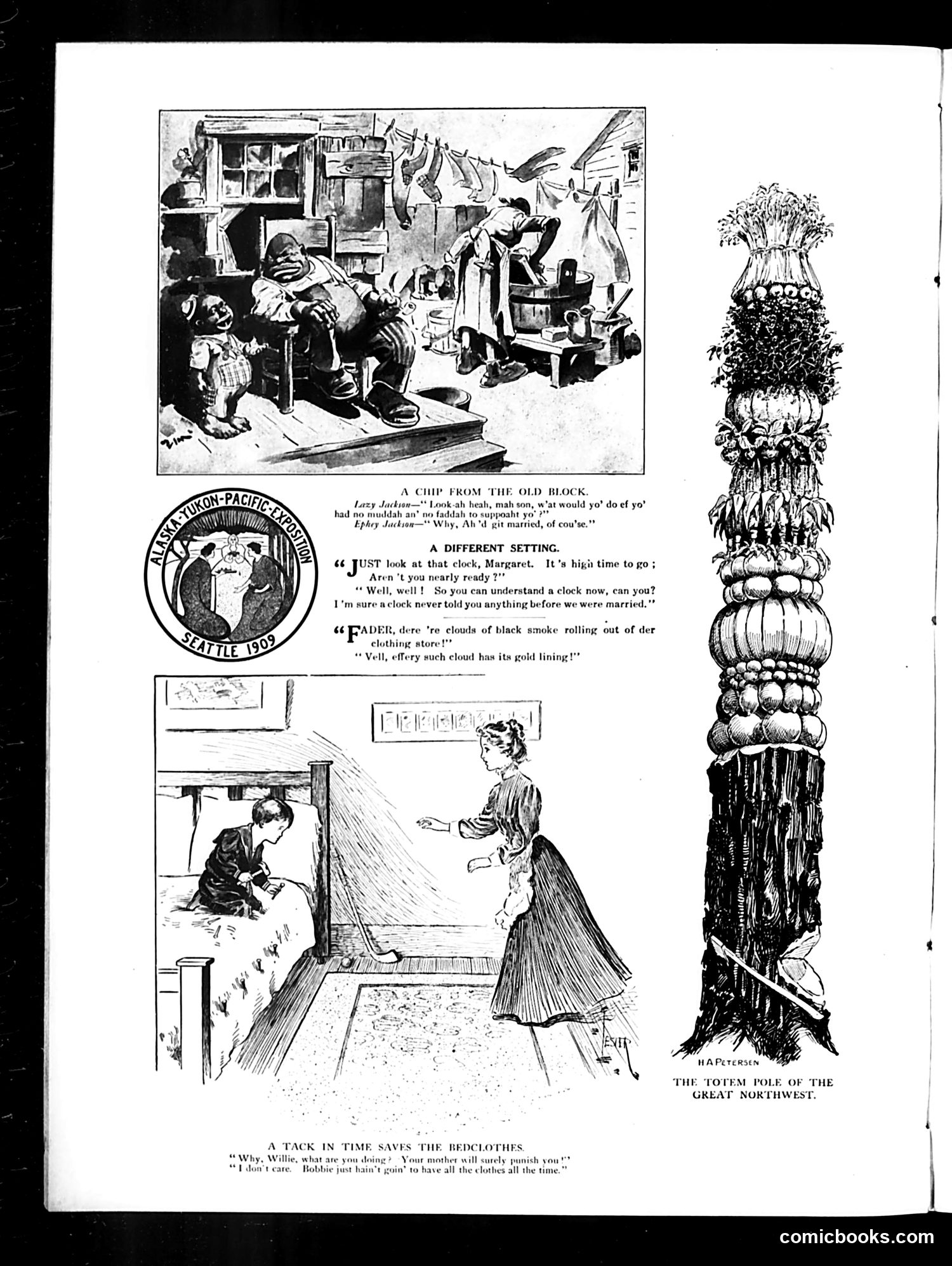
This page contains domestic humor and ethnic stereotypes typical of early 1900s American satire. **"A Chip from the Old Block"** shows a Black man and child in poverty, with dialogue in exaggerated dialect. The joke relies on racist caricature—depicting Black Americans through crude stereotypes. **"A Different Setting"** presents a middle-class couple where the wife sarcastically notes her husband only understands clocks since marriage, implying husbands ignore their wives before marriage but gain awareness after. **"Every Cloud Has a Gold Lining"** appears to show a man making light of a fire at a clothing store, suggesting silver linings to disasters. The right side features "The Totem Pole of the Great Northwest"—an illustration of a Native American totem pole, reflecting era fascination with Indigenous art, though likely presented without cultural context. The page's humor relies heavily on ethnic/racial caricature and gender stereotypes standard to 1900s American satire but deeply offensive by modern standards.
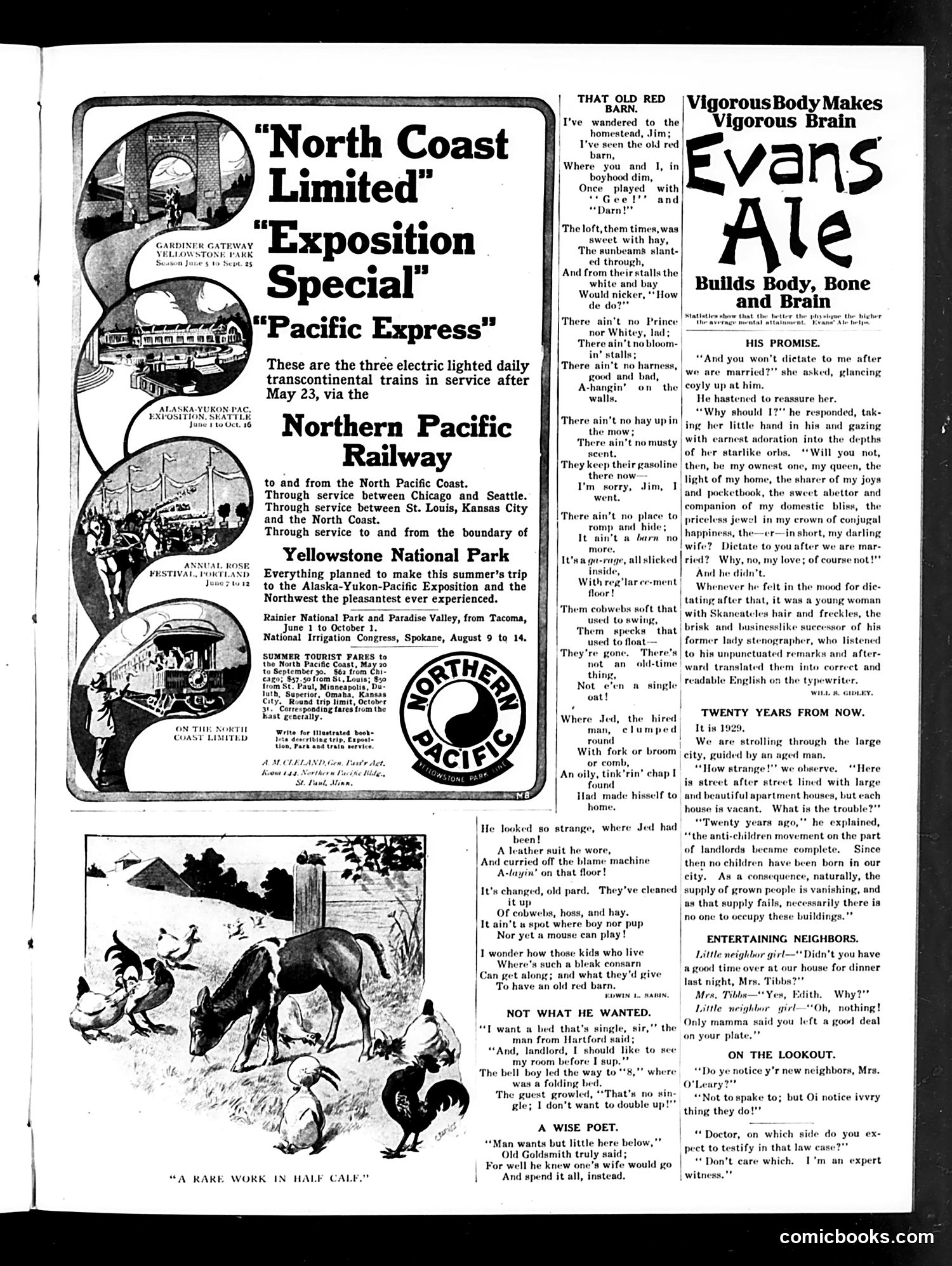
This page from *Judge* magazine contains mostly **commercial advertising** for Northern Pacific Railway's transcontinental trains and tourist destinations (Yellowstone, Alaska-Yukon-Pacific Exposition). The non-advertising content includes several **humorous short stories and poems**: 1. **"That Old Red Barn"** — A nostalgic poem about visiting a childhood farm; the speaker finds it modernized and commercialized, no longer a place for children's play. 2. **"Not What He Wanted"** — A brief joke about a hotel guest requesting a single bed, misunderstood as wanting a "single" room rather than a "double." 3. **"Evans Ale" advertisement** — Claims the beverage builds physical vigor and mental acuity. 4. **"A Wise Poet"** and **"His Promise"** — Short humorous pieces about marriage and domestic life. The bottom illustration shows farm animals (cows, pigs), likely accompanying the barn poem. Overall, this appears to be a **typical *Judge* magazine page mixing advertisements with light comedic fiction**, rather than political satire.
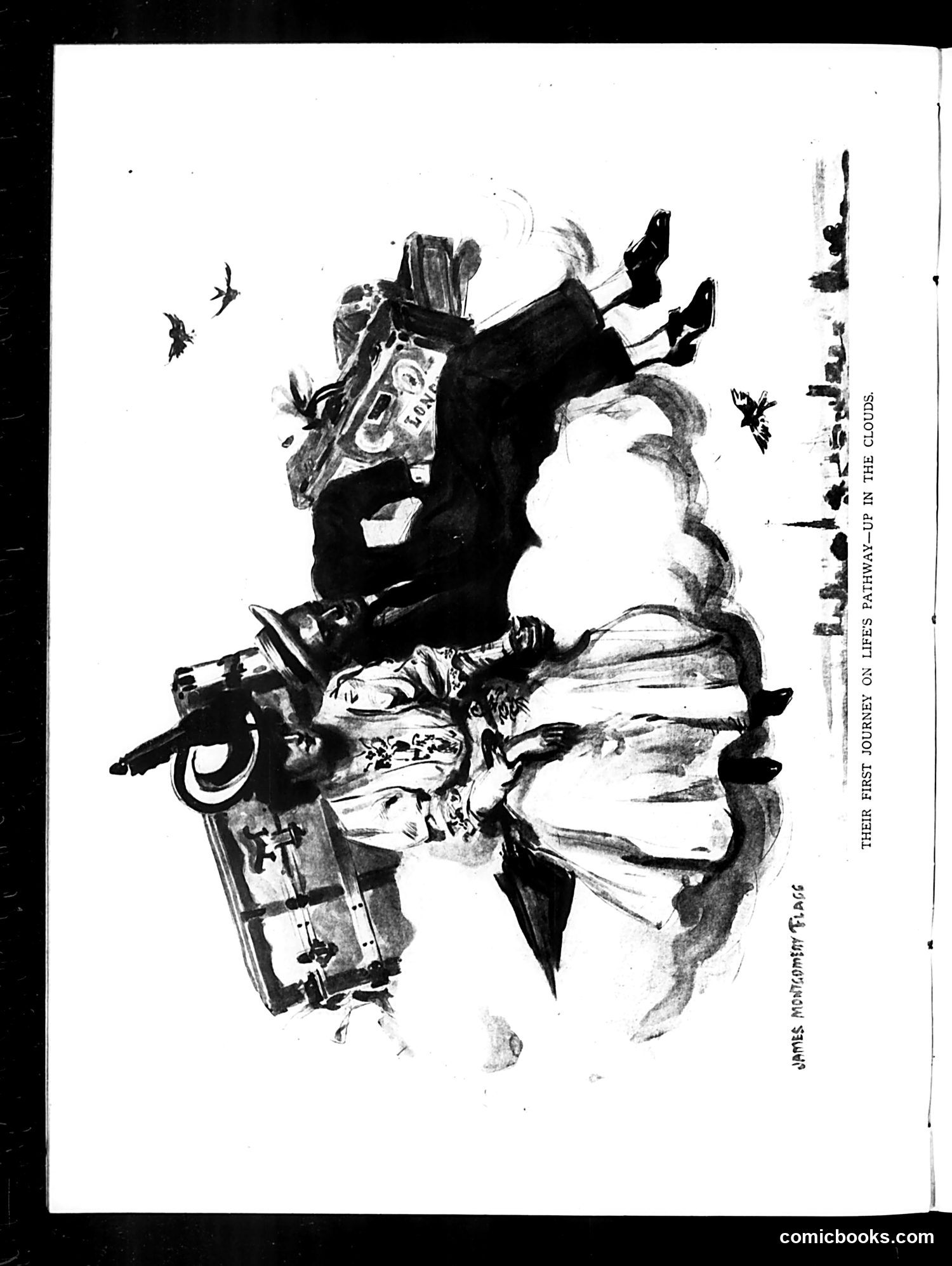
The OCR text is reversed/corrupted, making it unreadable. However, the image shows a political cartoon featuring a rotund, well-dressed man in formal attire being lifted/thrown upward by what appears to be a mechanical device or spring mechanism, with birds scattering in alarm. The figure's exaggerated facial features and posture suggest ridicule of a specific politician or public figure. Without legible text identifying the subject and the specific political context, I cannot definitively explain which figure is caricatured or what event is being satirized. The style and composition suggest early 20th-century American political satire, likely mocking someone's sudden fall from power or embarrassing exposure, but I cannot specify whom or what without clearer textual information.
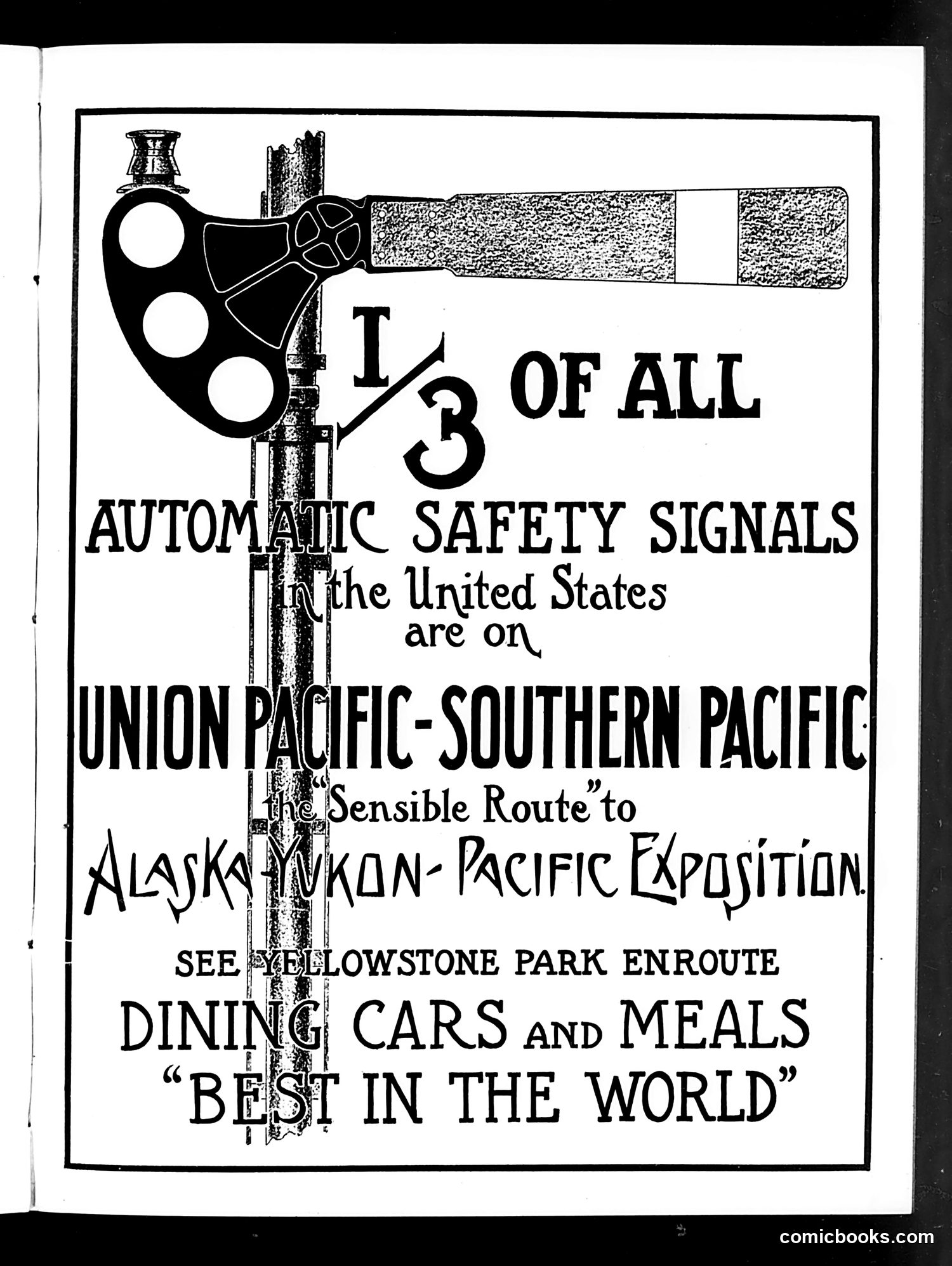
This is primarily an **advertisement**, not political satire. It promotes railroad travel on Union Pacific-Southern Pacific lines to the Alaska-Yukon-Pacific Exposition, highlighting the "sensible route" that passes Yellowstone Park. The visual centerpiece is a **revolver** with three chambers visible, illustrating the headline "1/3 OF ALL AUTOMATIC SAFETY SIGNALS" — likely referring to the railroads' safety technology. The ad emphasizes amenities ("dining cars and meals 'best in the world'") to attract passengers to this early-1900s exposition. The revolver imagery appears designed to convey reliability and safety rather than violence—a mechanical metaphor common in early industrial advertising. This reflects the era's enthusiasm for technological progress, western tourism, and railroad expansion.
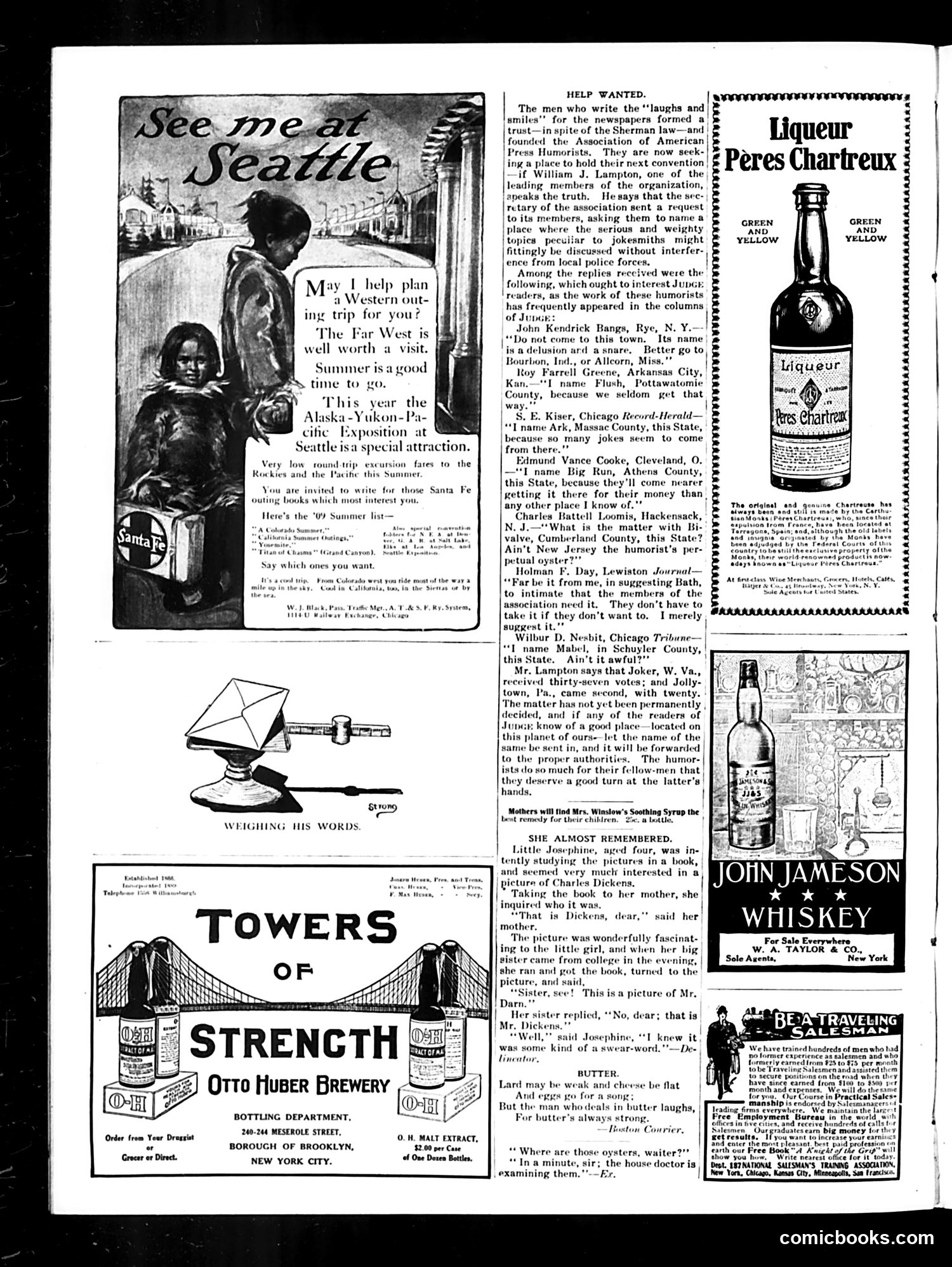
This page from Judge magazine (appears to be early 1900s) contains several elements: **Main Cartoon - "Weighing His Words"**: A figure at a balance scale suggests that careful measurement of language matters—likely commentary on public speech or political discourse during an era when words carried weight. **"Help Wanted" Section**: Humorists from the Association of American Press Humorists suggest joke town-names for their convention (Flush, Pottawatomie; Big Run; Joker, W.Va.). The satire mocks small-town names that sound ridiculous or unfortunate, while also gently poking fun at the humorists themselves for needing such places. **"She Almost Remembered"**: A light humor piece about a child mistaking a Dickens portrait for something else—typical period family humor. The page is primarily **advertisements** for liqueurs, whiskey, and breweries (Otto Huber Brewery, John Jameson Whiskey, Liqueur Pères Chartreux), reflecting Judge's commercial content typical of early 20th-century American magazines.
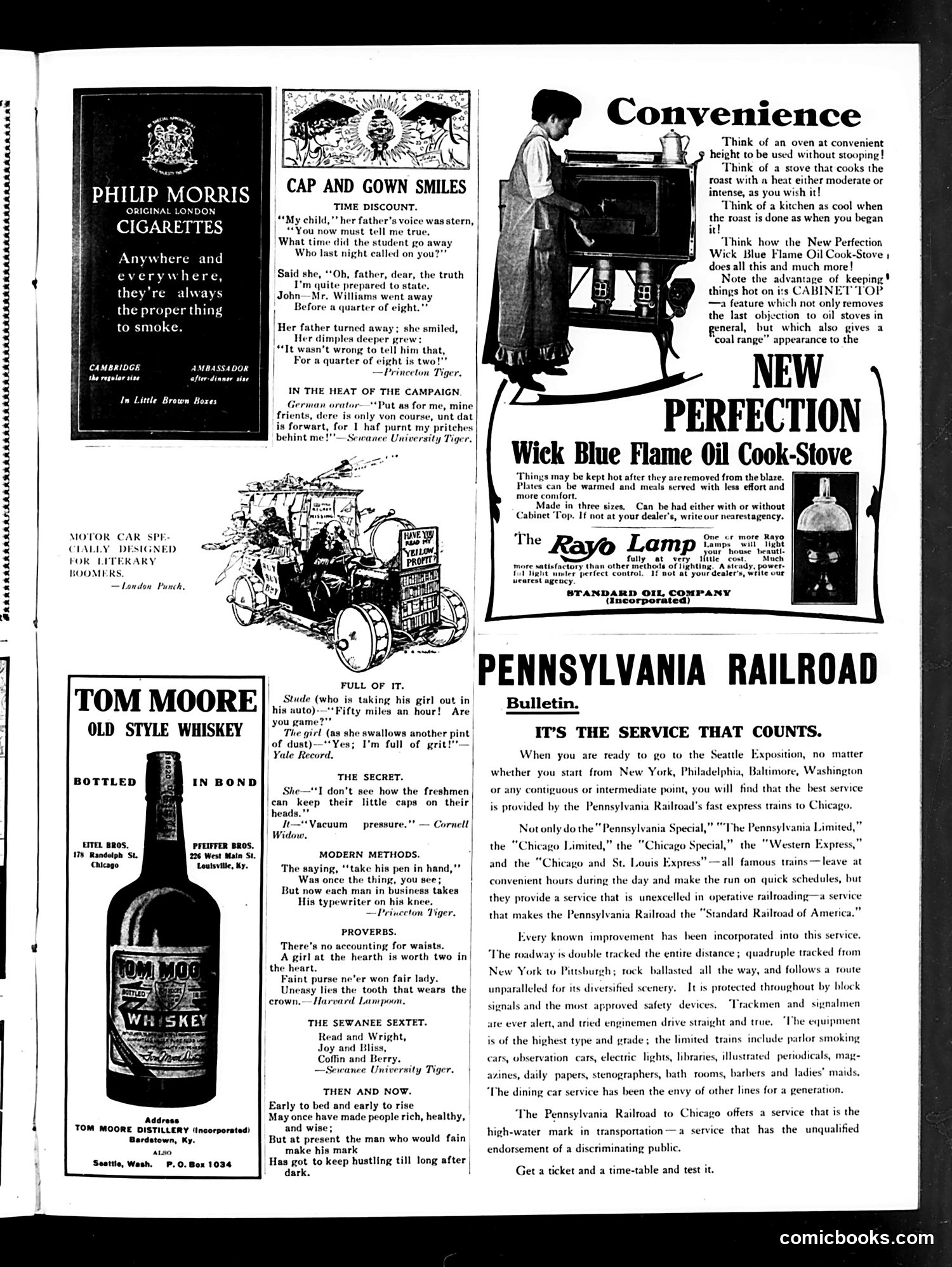
This is primarily an **advertising page** with embedded humor pieces, typical of Judge magazine's format. The **satirical content** includes: - **"Cap and Gown Smiles"**: A joke about a college girl misleading her father about when a suitor left—technically truthful ("before a quarter of eight") but deceptive, playing on wordplay (quarter = 15 minutes, so "two quarters" = 30 minutes past eight). This mocks both young women's cunning and parental naivety. - **"In the Heat of the Campaign"**: A German-accented speaker uses mixed metaphors about being "forward" while having "burnt my britches behind me"—satirizing immigrant political rhetoric and malapropisms. - Various **college humor pieces** (from university publications like Princeton Tiger, Yale Record) about dating, freshmen, and modern business culture—standard early-20th-century campus comedy. The **advertisements** (Philip Morris cigarettes, Tom Moore whiskey, Pennsylvania Railroad, oil stoves, lamps) dominate the layout, reflecting Judge's revenue model. No specific political figures or events are targeted; this represents generalized social satire and consumer marketing typical of the era.
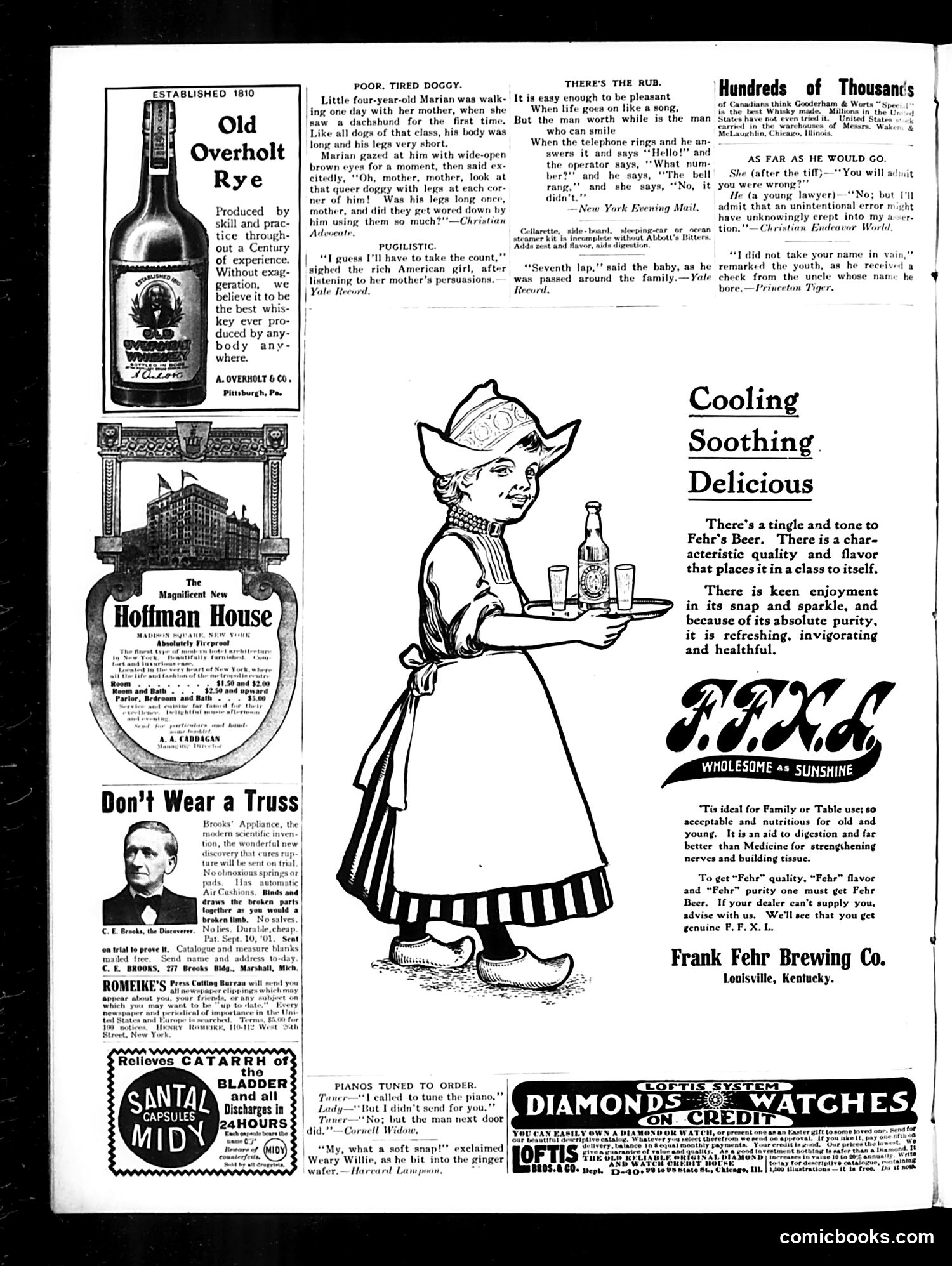
This page is primarily **advertising with brief humorous filler content**—typical of Judge magazine's format. The small comic pieces are wordplay jokes: a child's innocent observation about a dachshund's short legs; a boxing pun ("take the count"); a piano tuner arriving at the wrong house. These offer mild humor but no political commentary. The advertisements dominate: Old Overholt Rye whiskey, Hofman House hotel, the Santal Capsule medicinal product (for hemorrhoids), Frank Fehr Beer, and Oftis jewelry on credit. **For modern readers**: This reveals early 1900s America's casual acceptance of now-problematic products—whiskey and tonics marketed as healthful, medicinal capsules with vague claims. The "buy on credit" diamond ad shows how installment purchasing was normalized. These ads, taken seriously then, now illustrate historical attitudes toward health, spending, and marketing. The page contains **no identifiable political figures or satire**—it's a snapshot of period commerce and light humor.
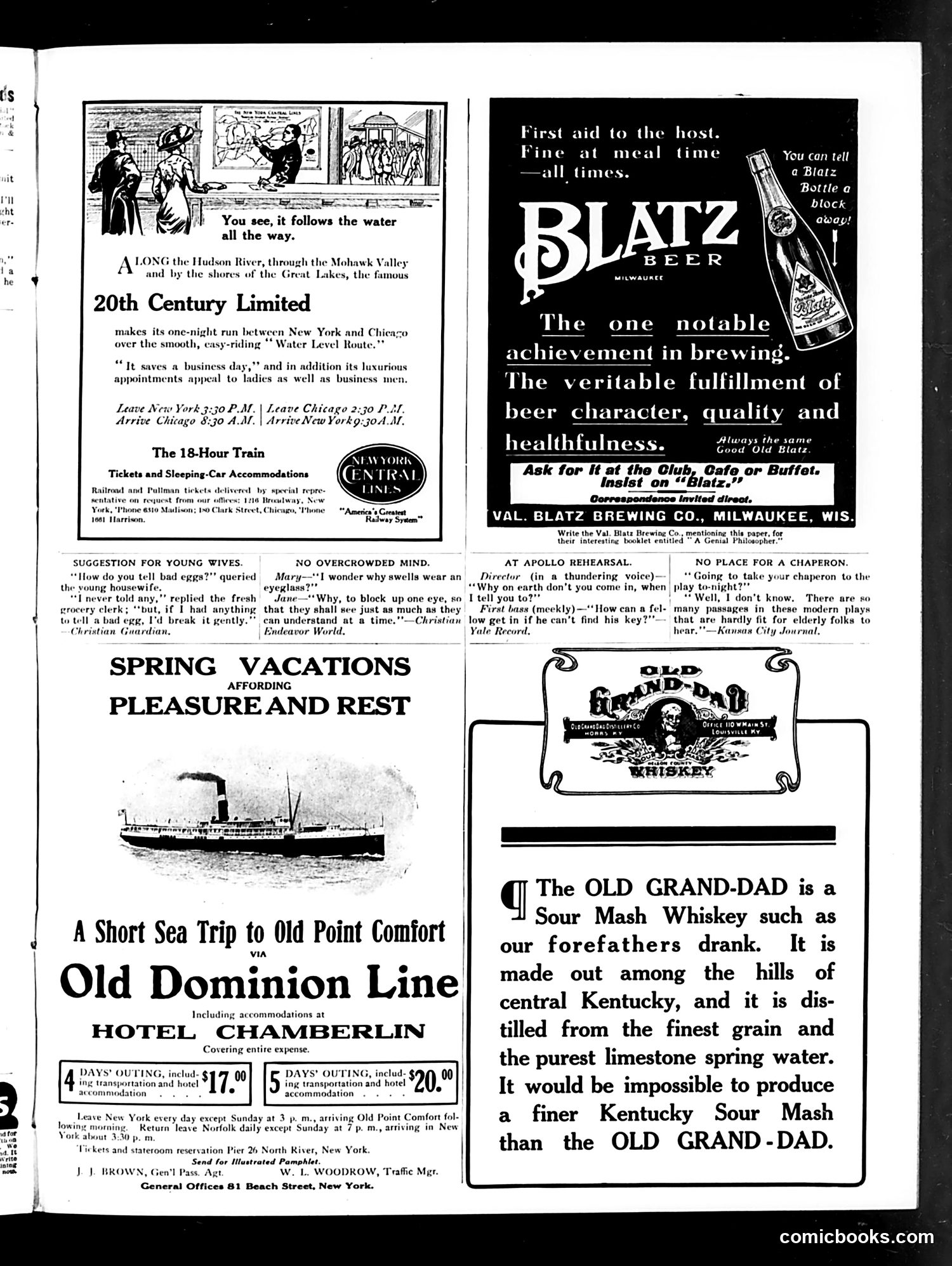
This page is primarily **advertising**, not satire or editorial content. The cartoons present are minor comic filler between ads. The two small cartoons at bottom-left are simple joke exchanges: one about distinguishing bad eggs (domestic humor), another mocking wealthy people wearing monocles as affectation masking limited intelligence. The page's main content promotes: - **20th Century Limited train** (NYC-Chicago luxury service) - **Blatz Beer** (Milwaukee brewery, emphasizing quality and healthfulness) - **Old Dominion Line** (sea cruises to Old Point Comfort) - **Old Grand-Dad whiskey** (Kentucky sour mash, marketed as traditional/"forefathers' " quality) These ads reflect early-20th-century leisure culture: railroads, steamship travel, and alcohol consumption as respectable recreation. The Grand-Dad ad's nostalgic appeal to pre-Prohibition drinking habits is notable—this likely predates or approaches the Prohibition era (1920-1933). The scattered quotes beneath cartoons appear to be filler content from contemporary publications like *Yale Record* and *Kansas City Journal*.
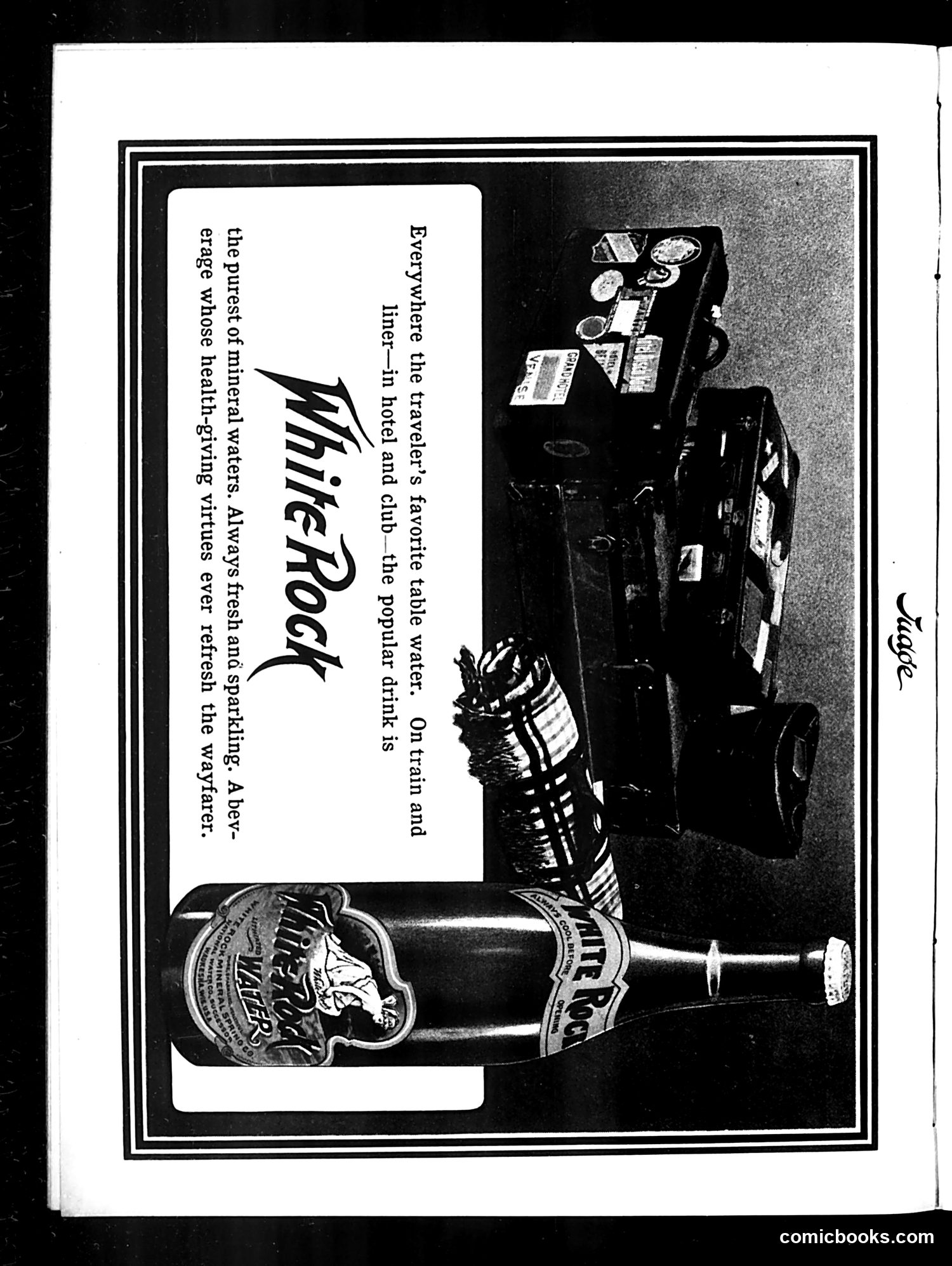
This is a full-page advertisement for White Rock mineral water, not a political cartoon. The ad features a bottle of White Rock water in the foreground and an image of a traveler (appearing to be a well-dressed man) enjoying refreshments at what looks like a dining table, positioned as if the page is rotated 90 degrees. The copy emphasizes White Rock's availability and appeal to affluent travelers—specifically those using trains, ocean liners, hotels, and clubs. The marketing pitch centers on purity, freshness, and health benefits ("health-giving virtues"), targeting the early-to-mid 20th century consumer perception that mineral water offered medicinal value. This reflects the era's widespread belief in the curative properties of spring and mineral waters, before such claims faced modern regulation.