
A complete issue · 16 pages · 1909
Judge — January 30, 1909
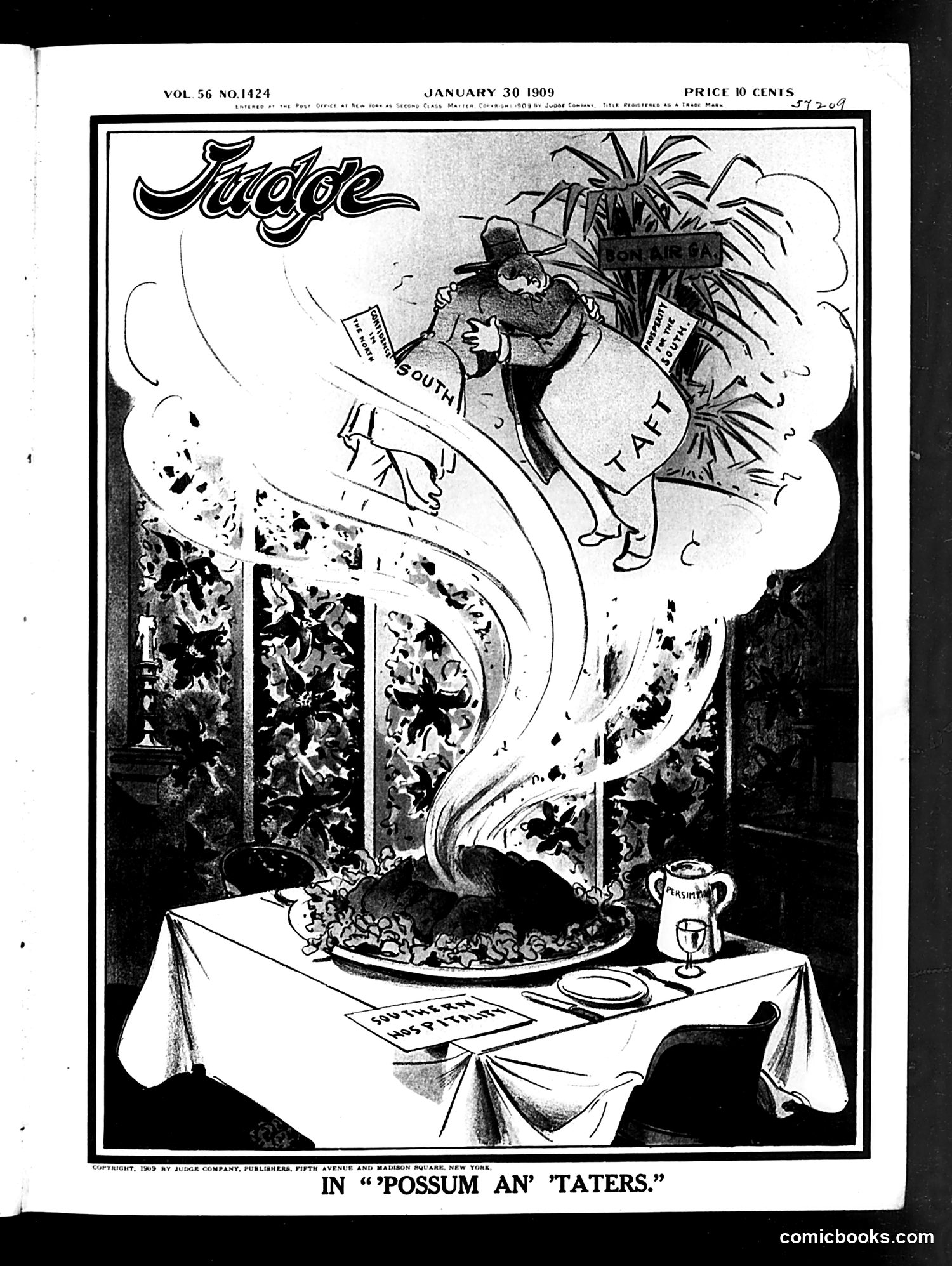
This Judge magazine cover from January 30, 1909 appears to be satirizing Southern cuisine and culture. The illustration shows a figure in formal attire riding atop a stylized dish containing what appears to be a possum (a traditional Southern food) surrounded by other ingredients. The figure carries labels reading "SOUTH" and "TAFT," suggesting this references President William Howard Taft or Southern political matters of that era. The title "In 'Possum an' Taters" uses dialect spelling to evoke rural Southern speech. The overall image likely satirizes either Southern eating habits, regional stereotypes, or Taft-era politics and the South's relationship to the new administration. The exaggerated style is typical of Judge's satirical approach to contemporary social and political topics.
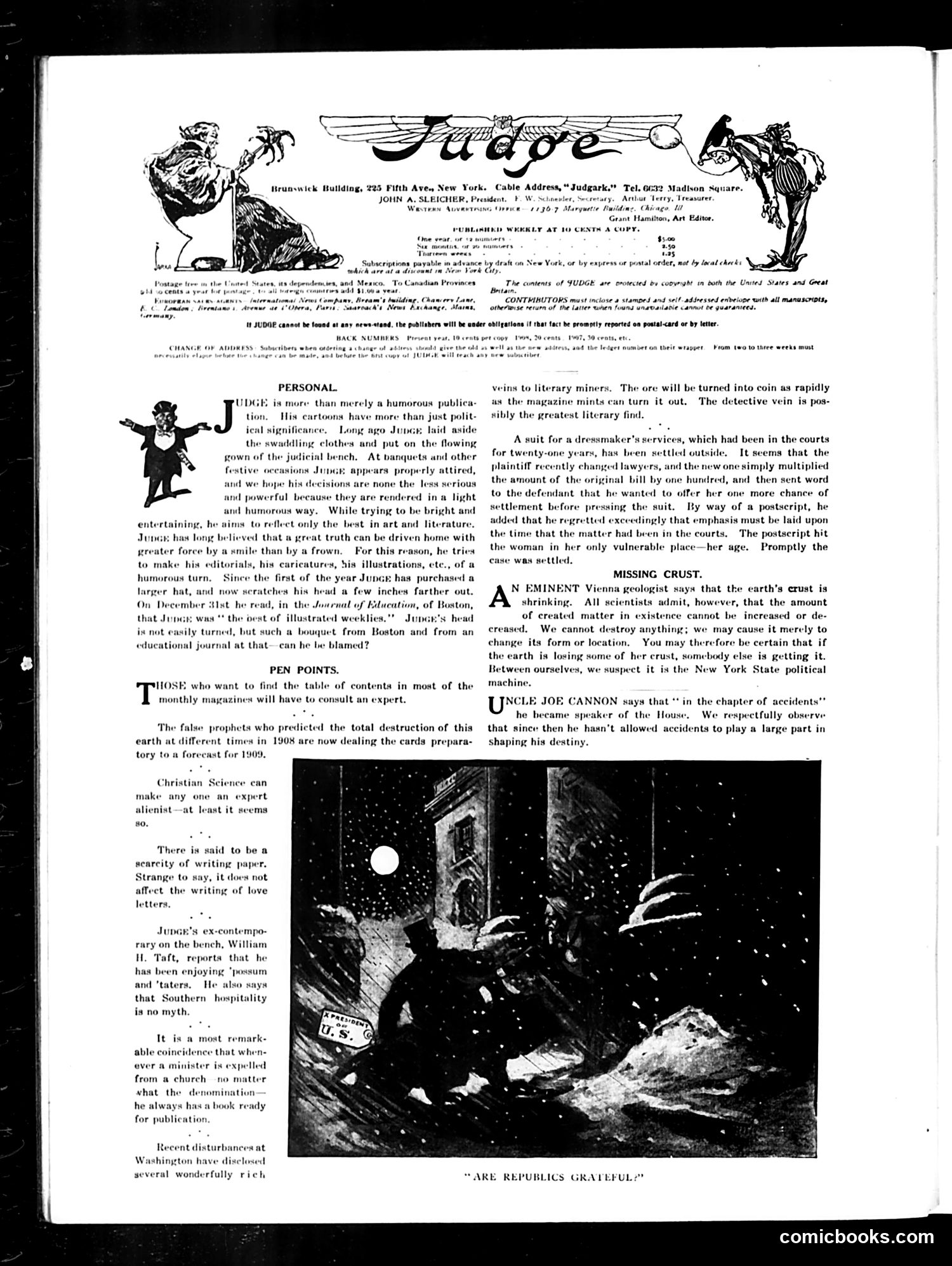
This page consists primarily of **editorial commentary and short humor pieces** rather than political cartoons. The visible sections include: 1. **"PEN POINTS"** - A column discussing editorial practices, noting that false prophets predicting Earth's destruction in 1906 now forecast for 1909. 2. **"MISSING CRUST"** - Commentary on a Vienna geologist's claim about Earth's shrinking crust, humorously suggesting it's a "New York real estate machine." 3. **"UNCLE JOE CANNON"** - A brief joke about Speaker of the House Joseph Cannon and accidents in the House chamber. The bottom image titled **"ARE REPUBLICS GRATEFUL?"** appears to be a political illustration, though specific reference is unclear from this reproduction. The page demonstrates Judge's typical mix of satirical commentary on contemporary scientific claims and political figures.
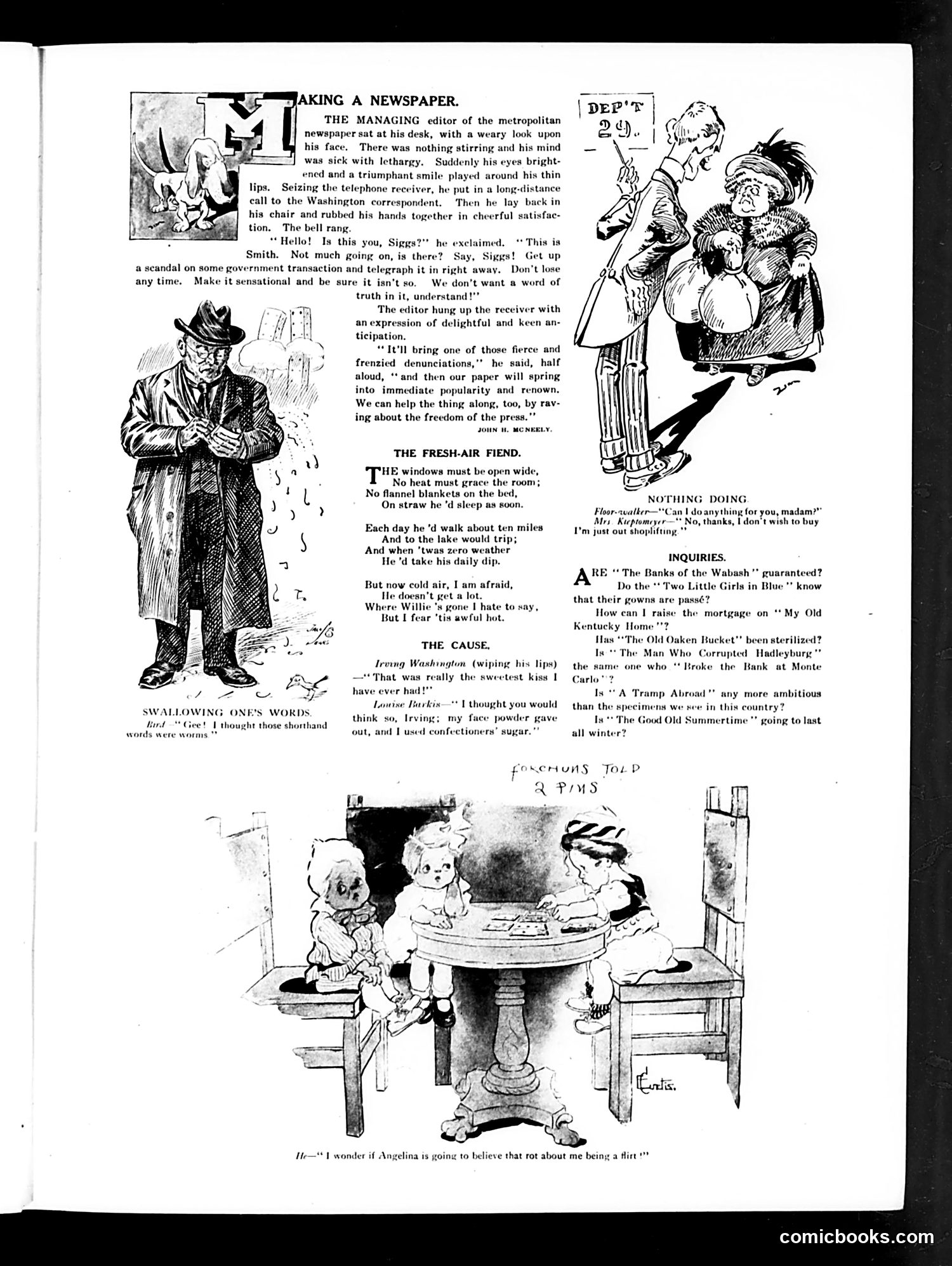
**"Making a Newspaper"** depicts a managing editor orchestrating sensationalism. He instructs a subordinate to fabricate or exaggerate a government scandal, explicitly directing him to make it "sensational" while obscuring truth. The editor then calls the Washington correspondent, planning to manufacture a "fierce and frenzied denunciation" to boost circulation and public appeal. This satirizes yellow journalism—the practice of prioritizing sensational stories over factual reporting to increase readership and profit. The other sketches on the page ("The Fresh-Air Friend," "Nothing Doing," "Troubles," "The Cause," and "Fictions Told by Boys") appear to be unrelated humorous vignettes typical of Judge's comic content, rather than interconnected political satire.
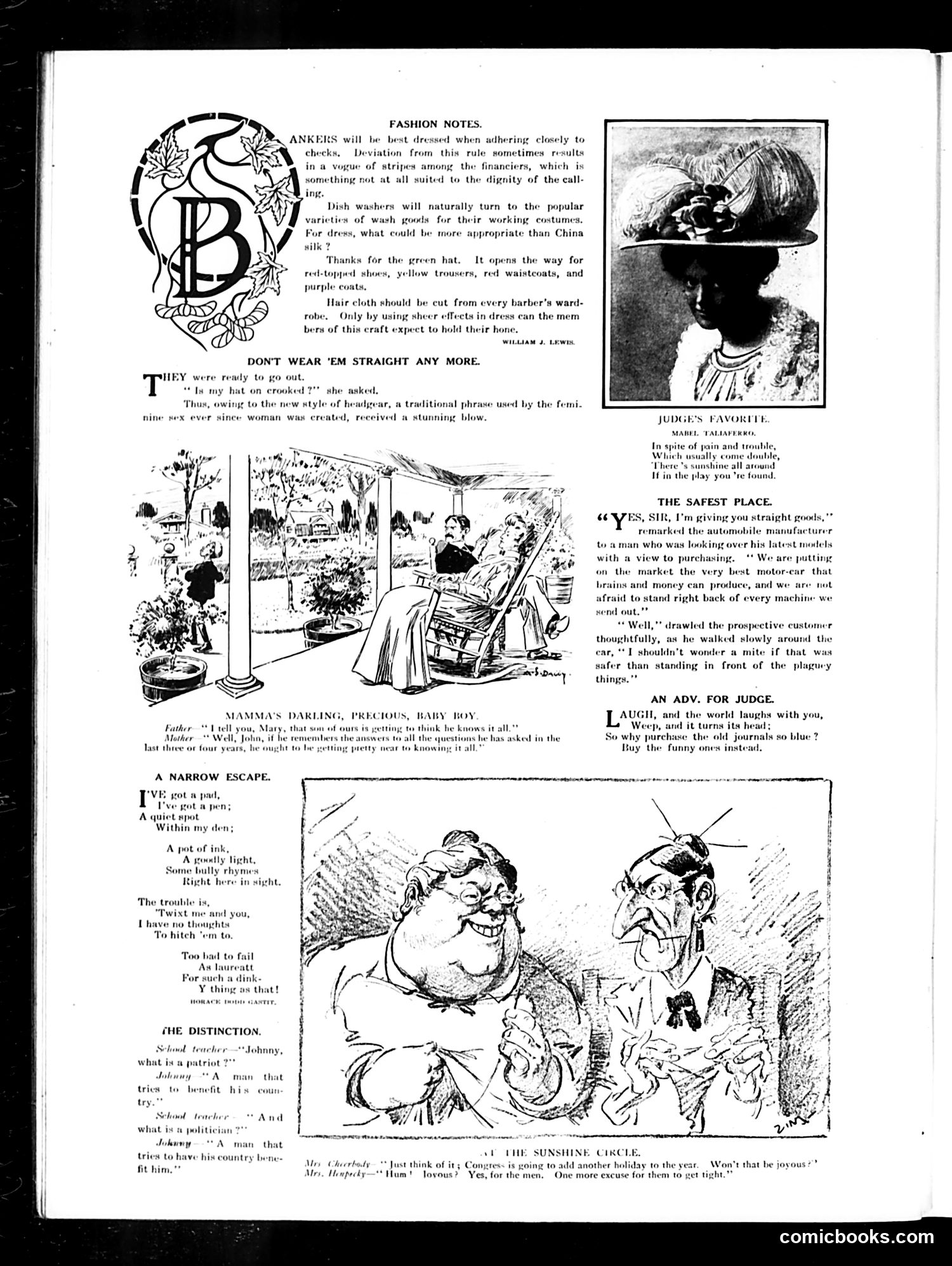
This page contains fashion commentary, humorous sketches, and brief satirical pieces typical of Judge's editorial content. **"Don't Wear 'Em Straight Any More"** mocks women adopting a more relaxed, less corseted fashion stance—a reference to early 20th-century dress reform movements challenging Victorian rigidity. **"The Safest Place"** satirizes automobile safety concerns through a conversation between a manufacturer and prospective customer, joking that standing before a car's front is safer than riding in it—commentary on early automobiles' notorious unreliability and danger. **"An Adv. for Judge"** is self-promotional humor encouraging readers to buy Judge magazines rather than old newspapers. The political cartoon **"The Sunshine Circle"** appears to reference Congressional budget/fiscal matters, though specific figures remain unclear without additional historical context.
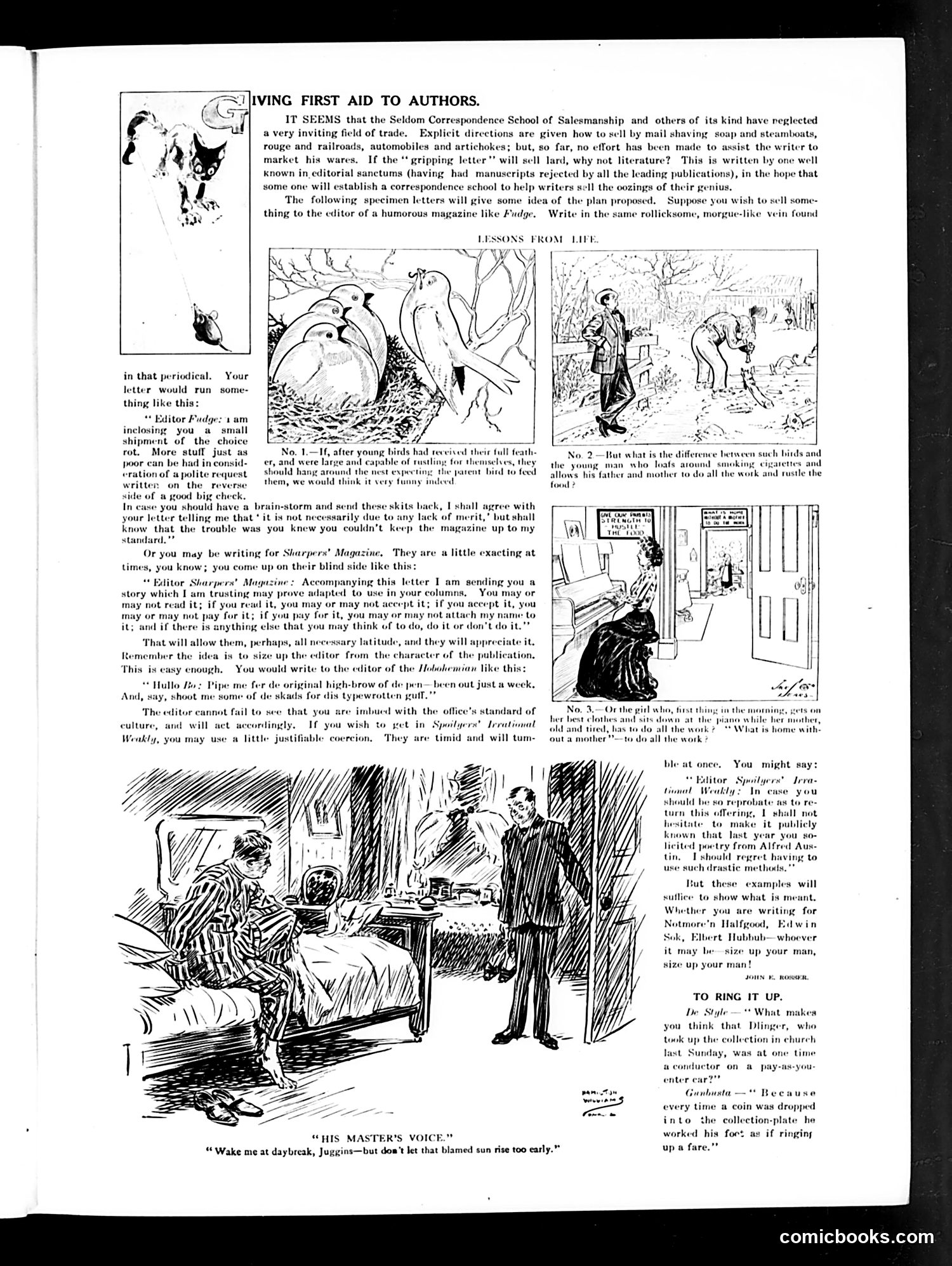
This page offers writing advice rather than political satire. Under "GIVING FIRST AID TO AUTHORS," the magazine provides specimen rejection letters and editorial guidance for aspiring writers. The three numbered illustrations labeled "LESSONS FROM LIFE" appear to show practical scenarios: birds learning to feed themselves (No. 1), a child observing wildlife with parents (No. 2), and a girl doing morning chores (No. 3). These illustrate life lessons about self-sufficiency and responsibility. The large sketch captioned "HIS MASTER'S VOICE" depicts a bedroom scene with someone waking another person at daybreak, with the caption mocking an early wake-up call. The final section "TO RING IT UP" contains a humorous anecdote about a church collection plate, played as a pun on conductor fees. This is primarily instructional content rather than political commentary.
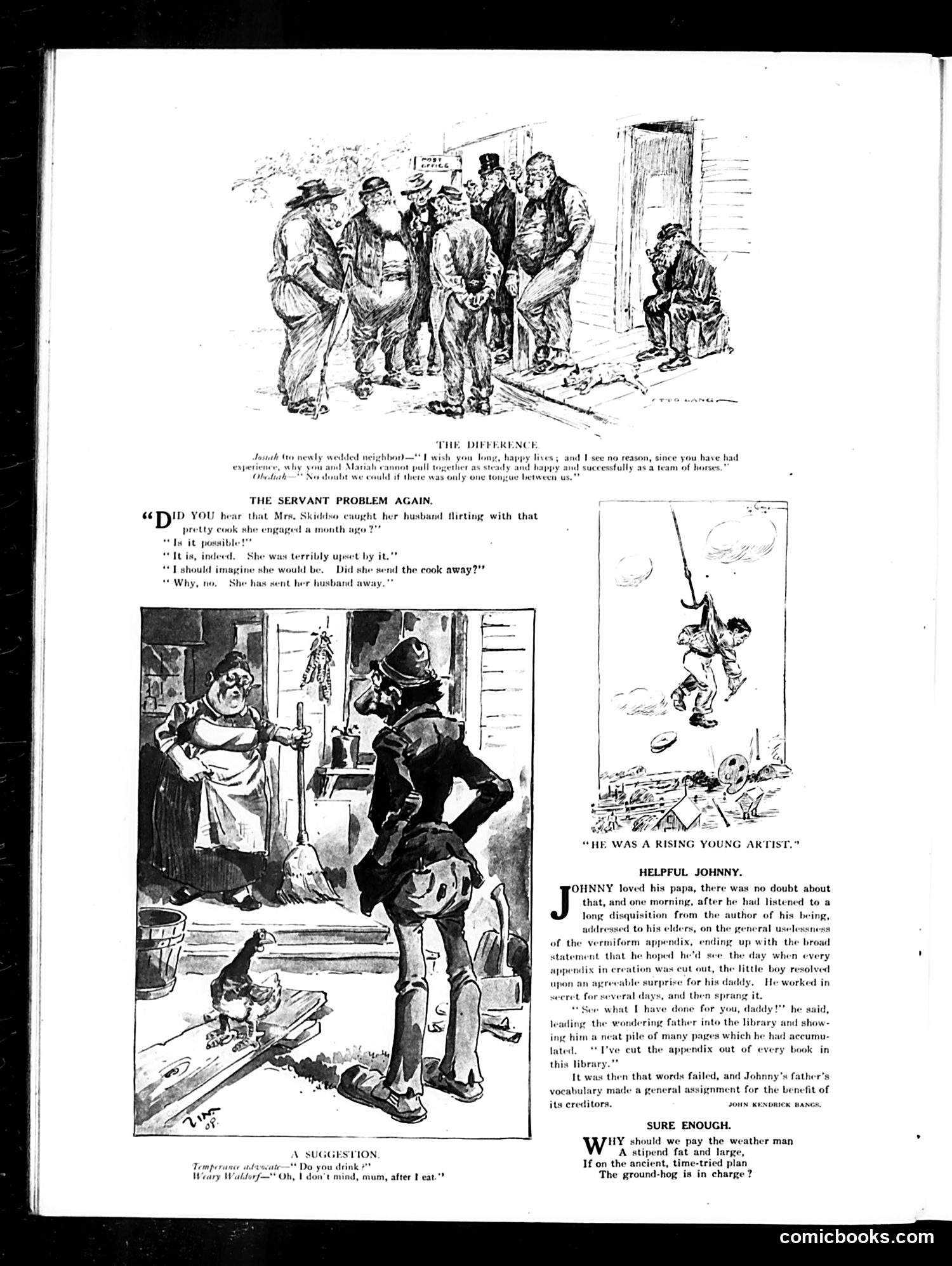
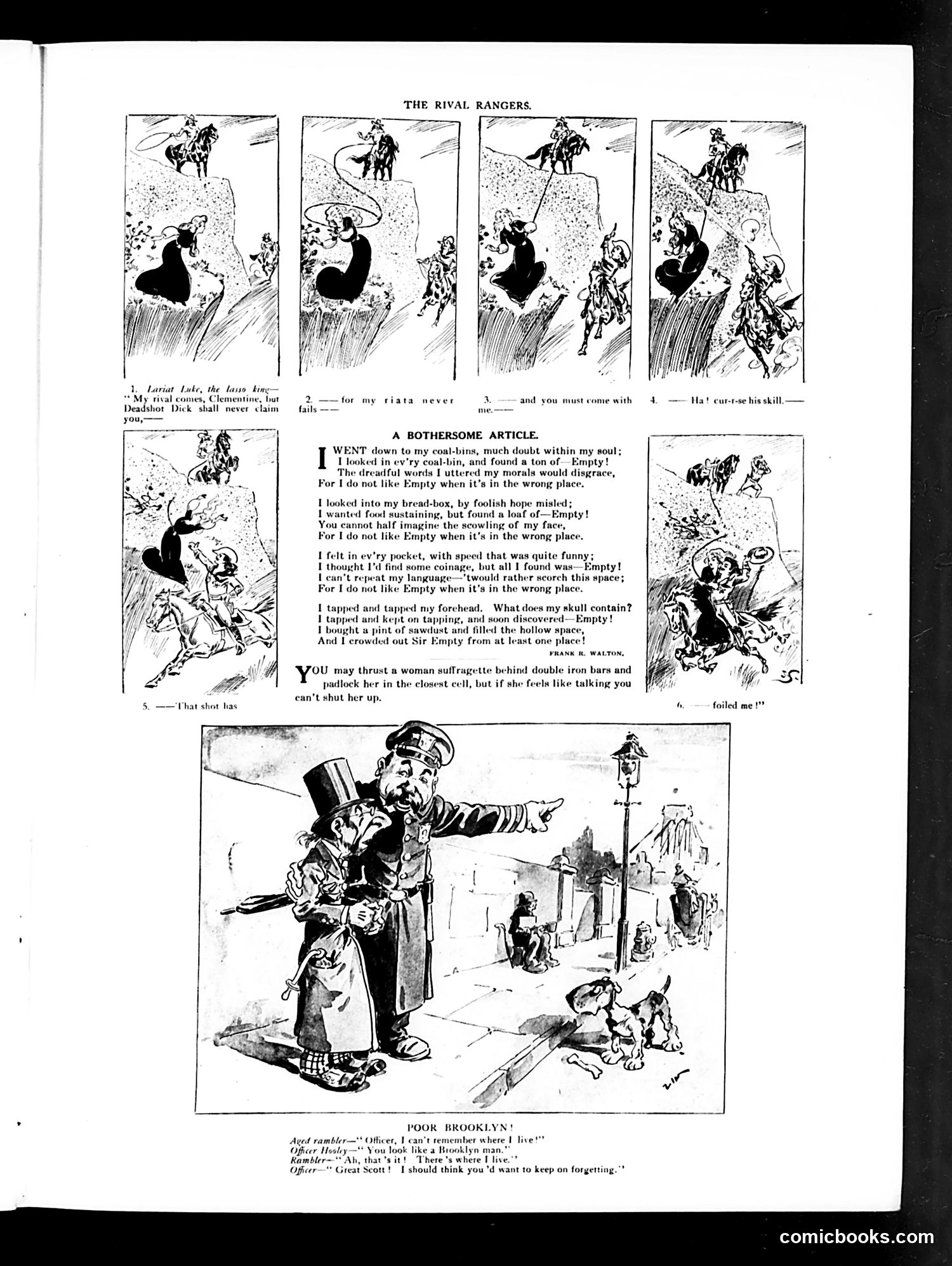
**Top Comic Strip:** A Western parody featuring two competing cowboys ("Lariat Luke" and "Deadshot Dick") competing over a woman using lasso tricks. The humor is slapstick—exaggerated Western clichés of rival gunfighters, rendered absurd through increasingly elaborate rope displays. **"A Bothersome Article":** A humorous poem by Frank R. Walton using repetitive structure (mimicking Gilbert & Sullivan) to catalog everyday frustrations—empty coal bins, bread boxes, pockets, and skull. The joke plays on "Empty" appearing when least wanted: a gentle satire on domestic disappointment and the human tendency to complain about minor inconveniences. **Woman Suffrage Quip:** A brief gag asserting women's determination to be heard politically, even if physically restrained—topical to Judge's era when women's voting rights were hotly debated. **"Poor Brooklyn":** A regional stereotype joke: a confused elderly man can't remember where he lives until told he "looks like a Brooklyn man," immediately recognizing the insult implicit in that identification—satirizing Brooklyn's perceived unfashionability or undesirability.
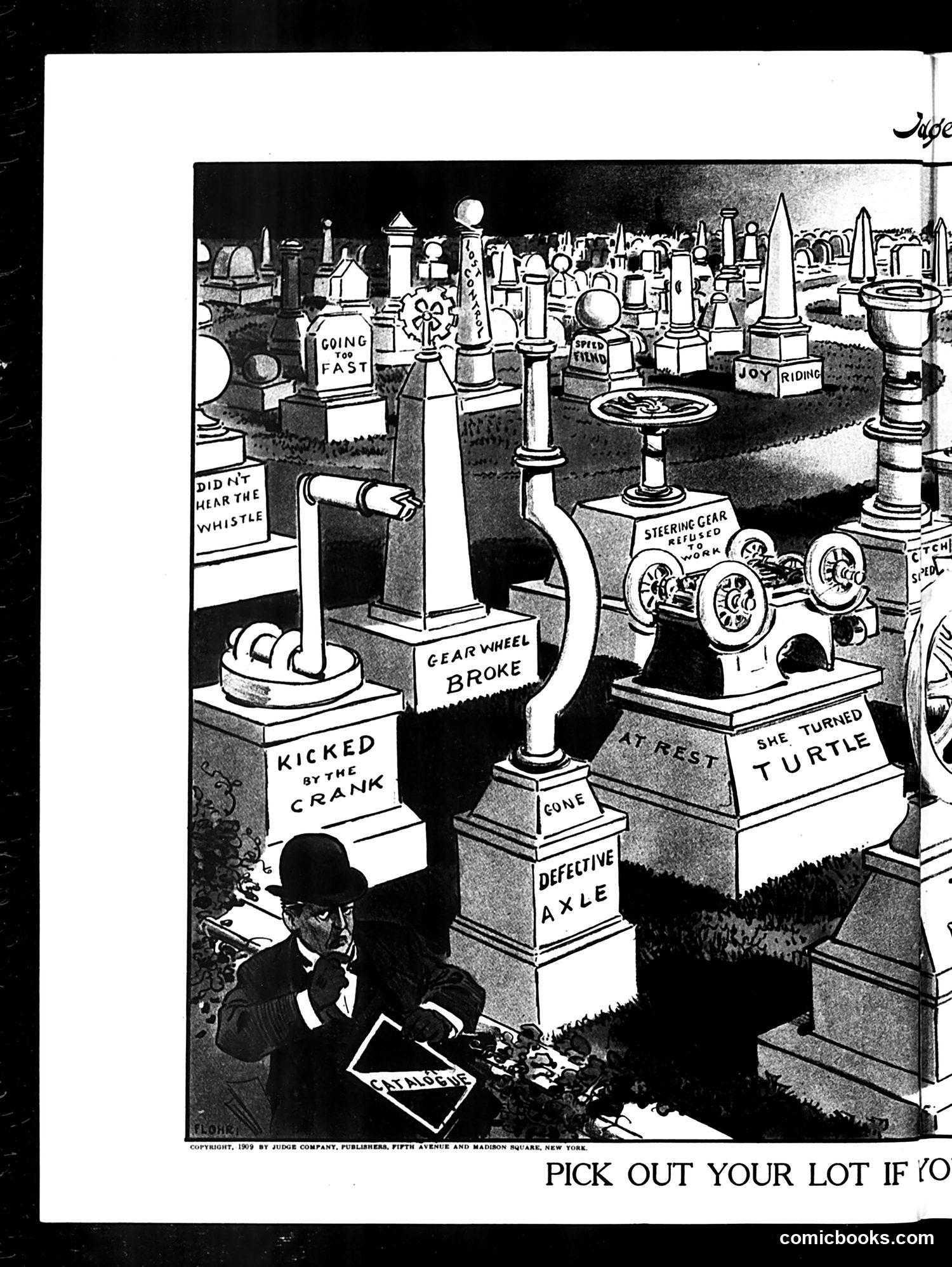
This is a satirical cartoon depicting a cemetery of automobile defects and failures. Each tombstone represents a different car problem: "Kicked the Crank," "Gear Wheel Broke," "Defective Axle," "She Turned Turtle" (rolled over), "Steering Gear Reduced," "Going so Fast," "Speed Fiend," and "Joy Riding." A well-dressed man in the foreground examines a catalog, appearing to "shop" for which car problem he'll experience. The satire criticizes early automobile unreliability and the hazards of reckless driving. Rather than celebrating cars as modern marvels, Judge mocks their tendency to fail catastrophically and their association with dangerous, irresponsible behavior. The cartoon reflects genuine public concern about automobile safety in the early motor age.
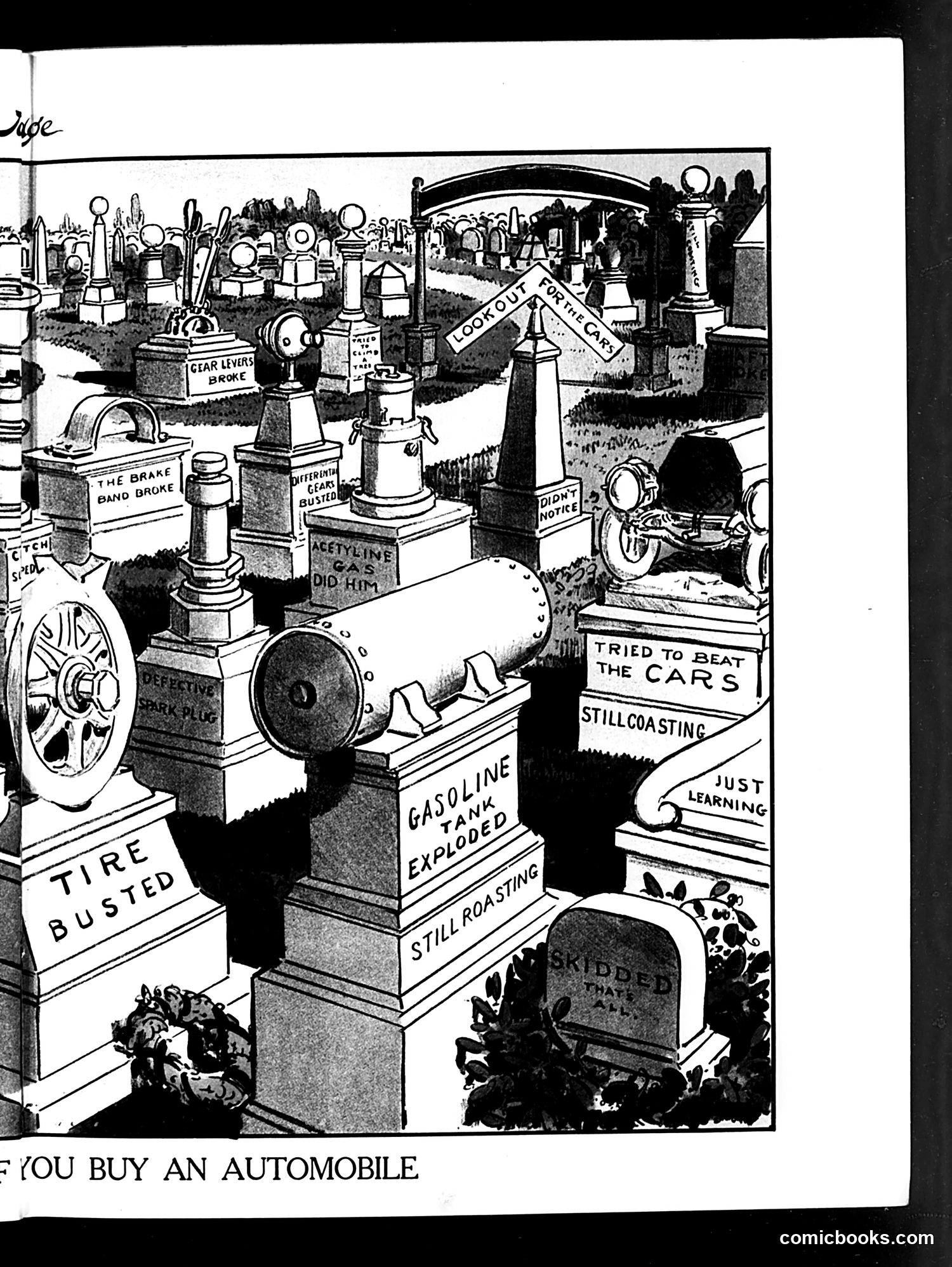
This is a satirical cartoon depicting a cemetery of defunct automobile components and failed car features. Each grave marker represents a different automotive problem or failed innovation that buyers encountered: - "Tire Busted" - "Brake Band Broke" - "Defective Spark Plug" - "Cigar Lighter Broke" - "Acetylene Gas Did Him" - "Gasoline Tank Exploded" - "Tried to Beat the Cars" (still coasting) - "Just Learning" - "Skidded That's All" The satire mocks the early automobile industry's notorious unreliability and mechanical failures. Rather than celebrating cars as modern marvels, Judge presents them as death traps plagued by exploding tanks, brake failures, and other serious defects. The caption "If You Buy an Automobile" suggests this graveyard awaits purchasers—a dark joke about the risks of early car ownership around the 1910s-1920s era.
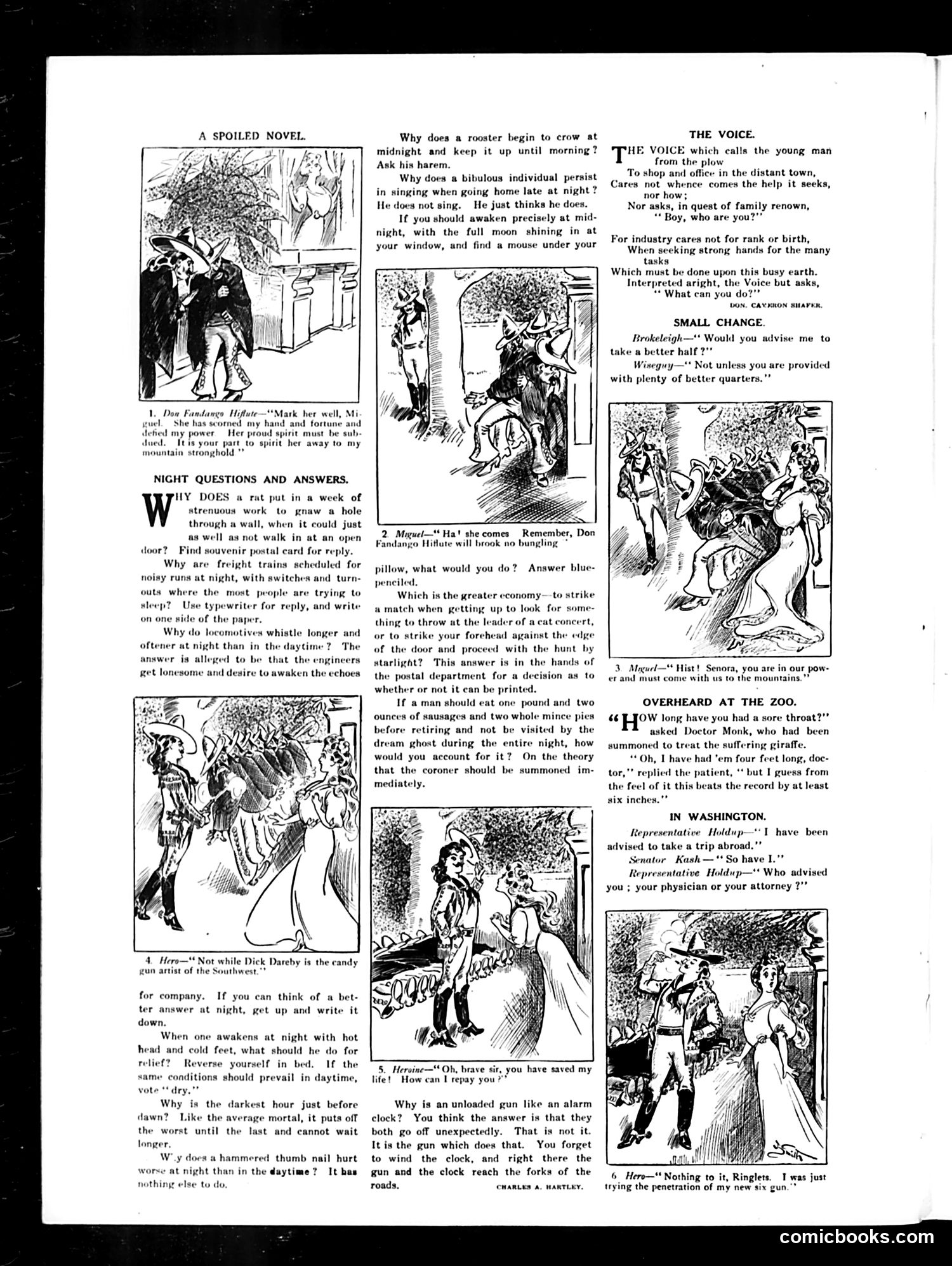
This page from Judge contains several humor pieces typical of early 20th-century American satire: **"A Spoiled Novel"** mocks melodramatic Victorian fiction through exaggerated dialogue about seduction and abduction, illustrated with period costumes. It's satire of overwrought romantic novels. **"Night Questions and Answers"** is absurdist humor—a question-and-answer column with deliberately ridiculous responses to mundane nighttime problems (why rats gnaw holes, why hammered thumbs hurt at night, etc.). The jokes rely on absurd logic and anti-humor. **"The Voice"** appears to be serious verse celebrating labor and industry's indifference to social class—promoting meritocratic values. **"Small Change"** and the other brief items are short jokes about marriage, zoo animals, and Washington politicians (the names "Representative Holdup" and "Senator Kash" suggest corruption through obvious wordplay). Overall, the page mixes light satire of literature, absurdist humor, and gentle political jabs typical of Judge's accessible, middle-class audience.
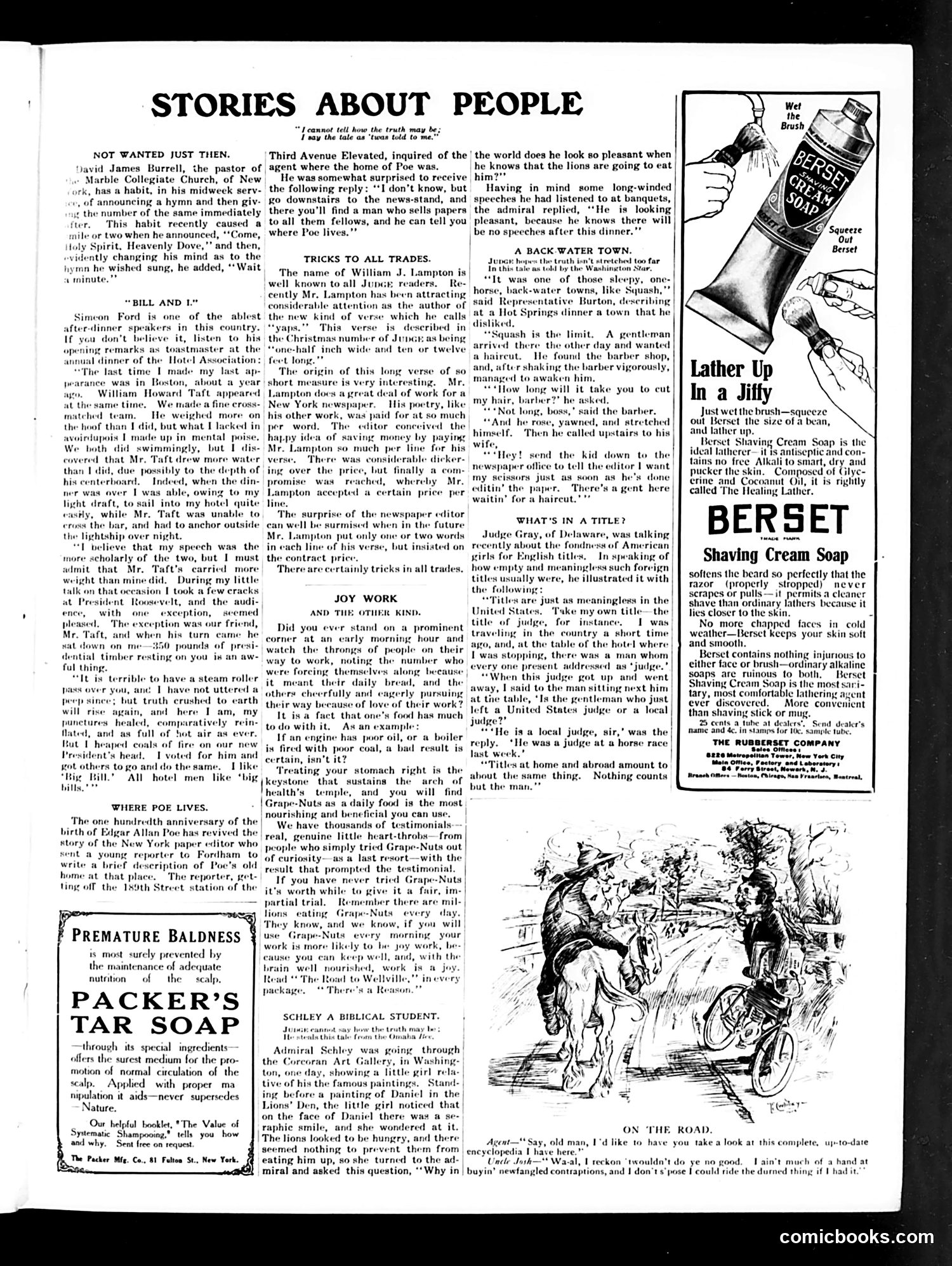
This page from *Judge* contains humorous anecdotes about public figures and advertising. Key content: **"Not Wanted Just Then"**: Pastor David James Burrell of Marble Collegiate Church announced hymn #1, then changed his mind mid-announcement, asking the congregation to "wait a minute"—a mild joke about indecision during worship. **"Bill and I"**: Simeon Ford, a famous after-dinner speaker, humorously compares himself to President William Howard Taft at a Boston hotel dinner. Ford jokes that Taft, being heavier, drew larger applause ("more weight"), while Ford's lighter wit couldn't compete. The "bar" and "lightship" metaphors play on nautical terms. **"Tricks to All Trades"**: William J. Lampton, a humor writer for *Judge*, negotiated payment per-line rather than per-word for his long-form verses. The editor anticipated savings, but Lampton outwitted him by writing very short lines—maximizing payment while minimizing actual content. The remaining content is product advertising (Packer's Tar Soap, Berset Shaving Cream) typical of period magazines.
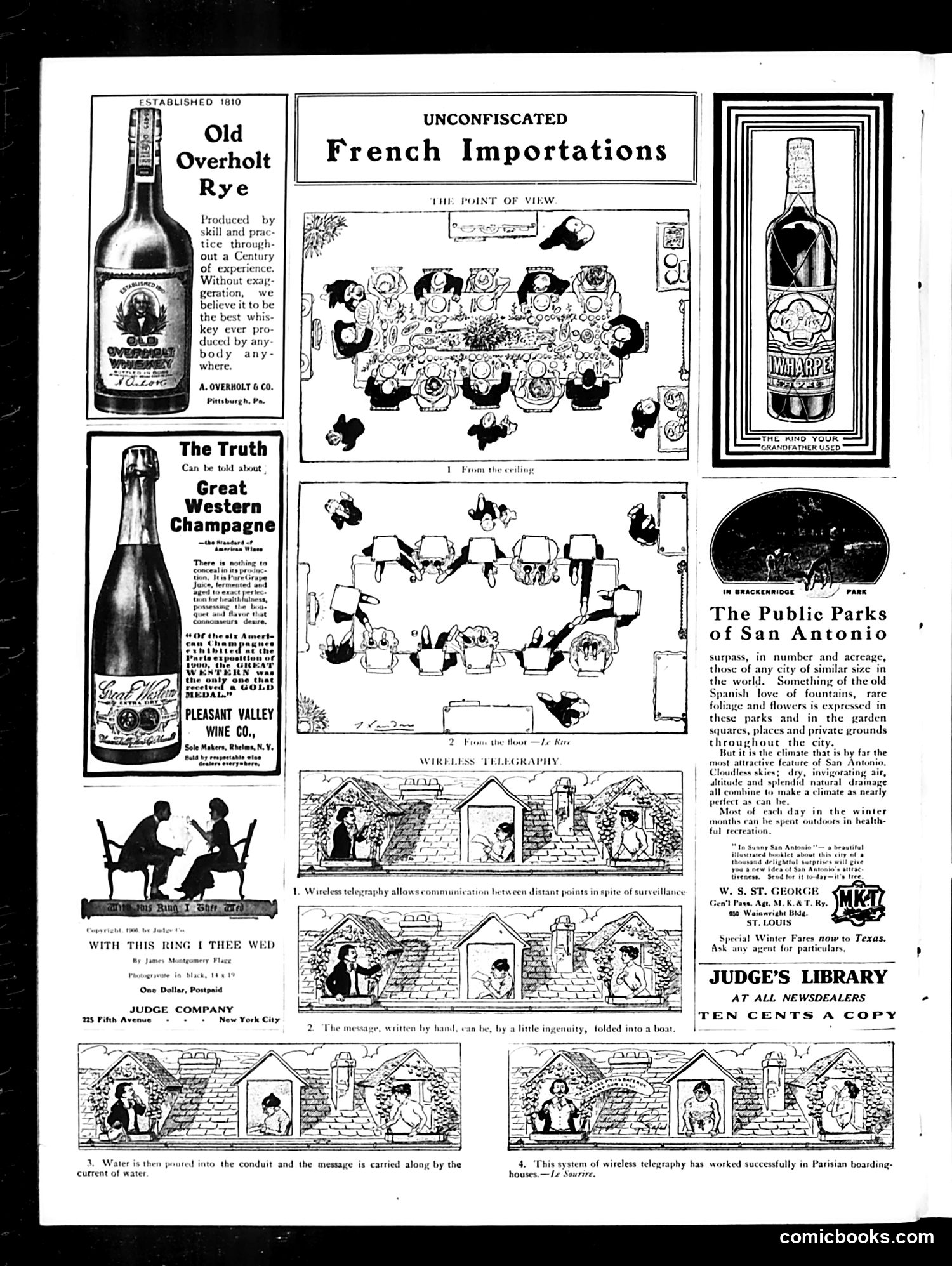
This page is primarily **advertising and editorial content**, not political satire. The layout includes: **Advertisements:** Whiskey brands (Old Overholt Rye, Great Western Champagne) dominate the left side, promoting products with claims of quality and tradition. **Main Content:** The center and right feature two unrelated pieces: 1. **"Unconfiscated French Importations"** — A humorous illustrated feature showing dining and social scenes, apparently satirizing French customs or dining etiquette (labeled "The Point of View" and "From the ceiling/floor"). 2. **"Wireless Telegraphy"** — A multi-panel comic strip illustrating how wireless telegraph messages travel through water conduits in Parisian boarding houses, credited to *Le Sourire* (a French publication). This appears educational/whimsical rather than satirical. 3. **"The Public Parks of San Antonio"** — A travel advertisement promoting Texas tourism. The page reflects early-1900s interests: emerging technology (wireless), French cultural fascination, and product promotion. Without identifying specific figures or clear political messaging, this appears to be a typical Judge issue mixing advertising, light humor, and travel content.
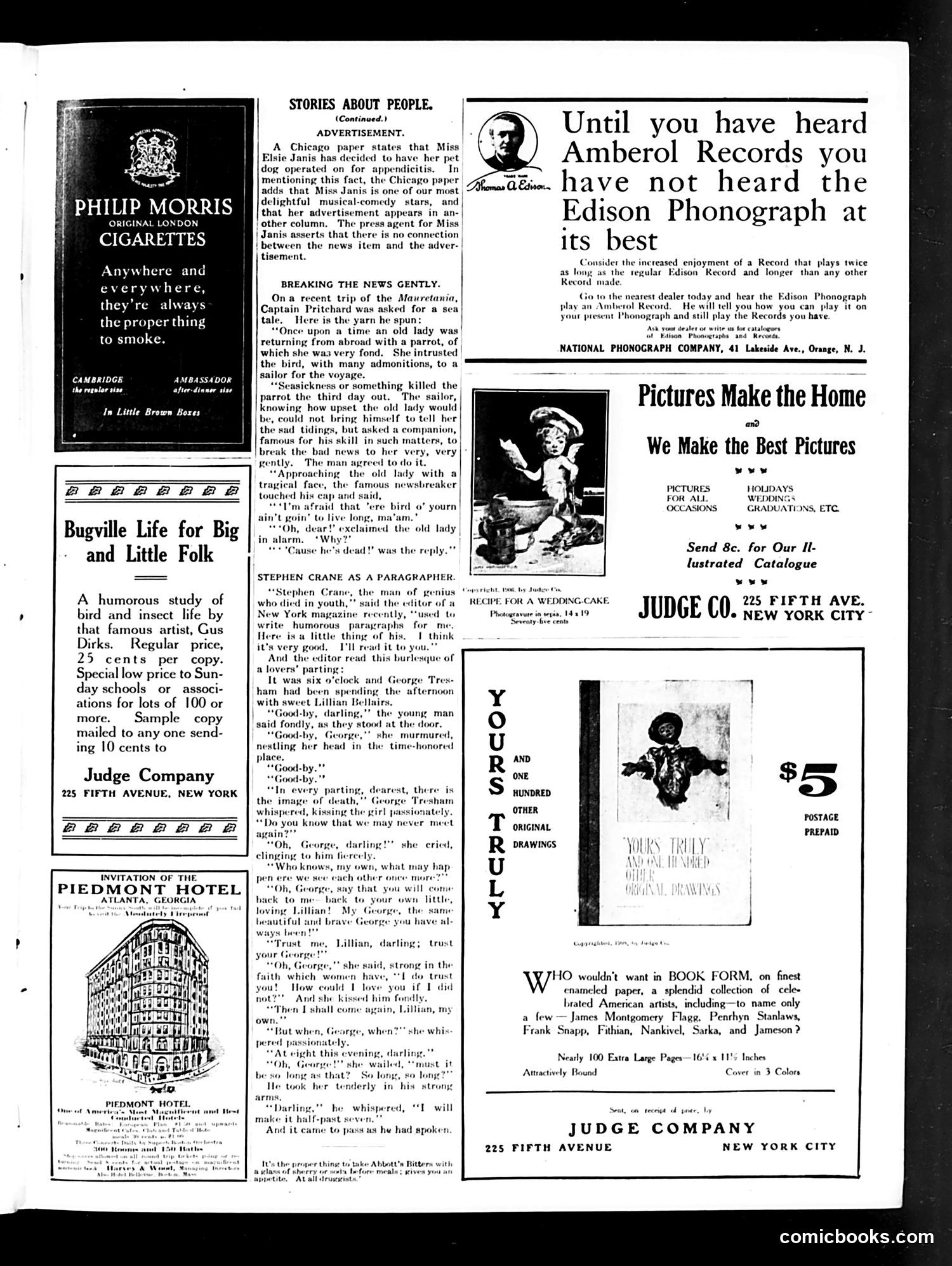
This is primarily an **advertising page** from Judge magazine, not satirical content. The page consists mainly of commercial advertisements interspersed with short feature articles. **Notable Content:** The main featured piece is "Stephen Crane as a Paragrapher," discussing the famous author's humorous writing. A brief romantic dialogue excerpt is included—a parody of sentimental Victorian-era love scenes, typical of Judge's gentle mockery of period conventions. **Advertisements include:** - Philip Morris cigarettes - Edison phonographs (Amberol Records) - Judge Company publications (picture books) - Bugville Life children's magazine - Piedmont Hotel (Atlanta) The romantic excerpt gently satirizes overwrought Victorian sentimentality through exaggerated dialogue ("Oh, George, darling!"), but this is mild period humor rather than pointed social commentary. **Overall:** A commercial page showcasing products and light cultural commentary typical of early 20th-century magazines aimed at middle-class readers.
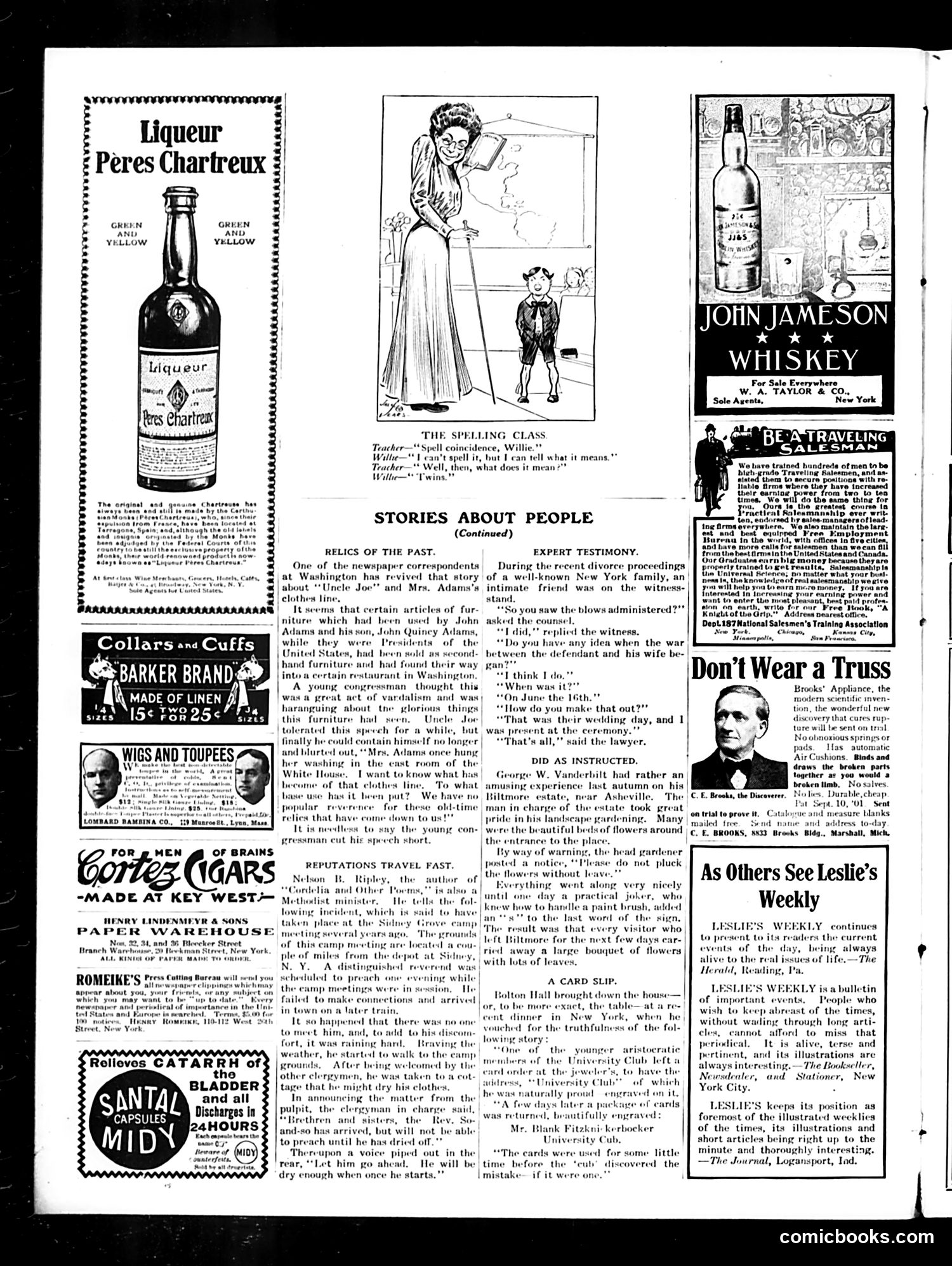
This page is **primarily advertising** with some satirical content interspersed. The main cartoon, "THE SPELLING CLASS," depicts a teacher-student exchange where a child cannot spell a word but claims to know its meaning—illustrating the gap between rote learning and comprehension. This mild satire critiques educational methods. The remaining content consists of advertisements for liqueurs, cigars, trusses, and patent medicines (typical Judge fare), mixed with brief anecdotes under "STORIES ABOUT PEOPLE." These include: a tale about presidential furniture ending up in a Washington restaurant; an "expert testimony" courtroom exchange about divorce proceedings; and "Did As Instructed," a story about a Baltimore gardener instructed to preserve flowers who apparently removed them entirely—a subtle joke about literal obedience versus good judgment. The page lacks prominent political satire. It reflects early 20th-century Judge content: light humor about domestic life, courtroom absurdities, and social foibles, alongside aggressive patent-medicine marketing now recognized as dubious.
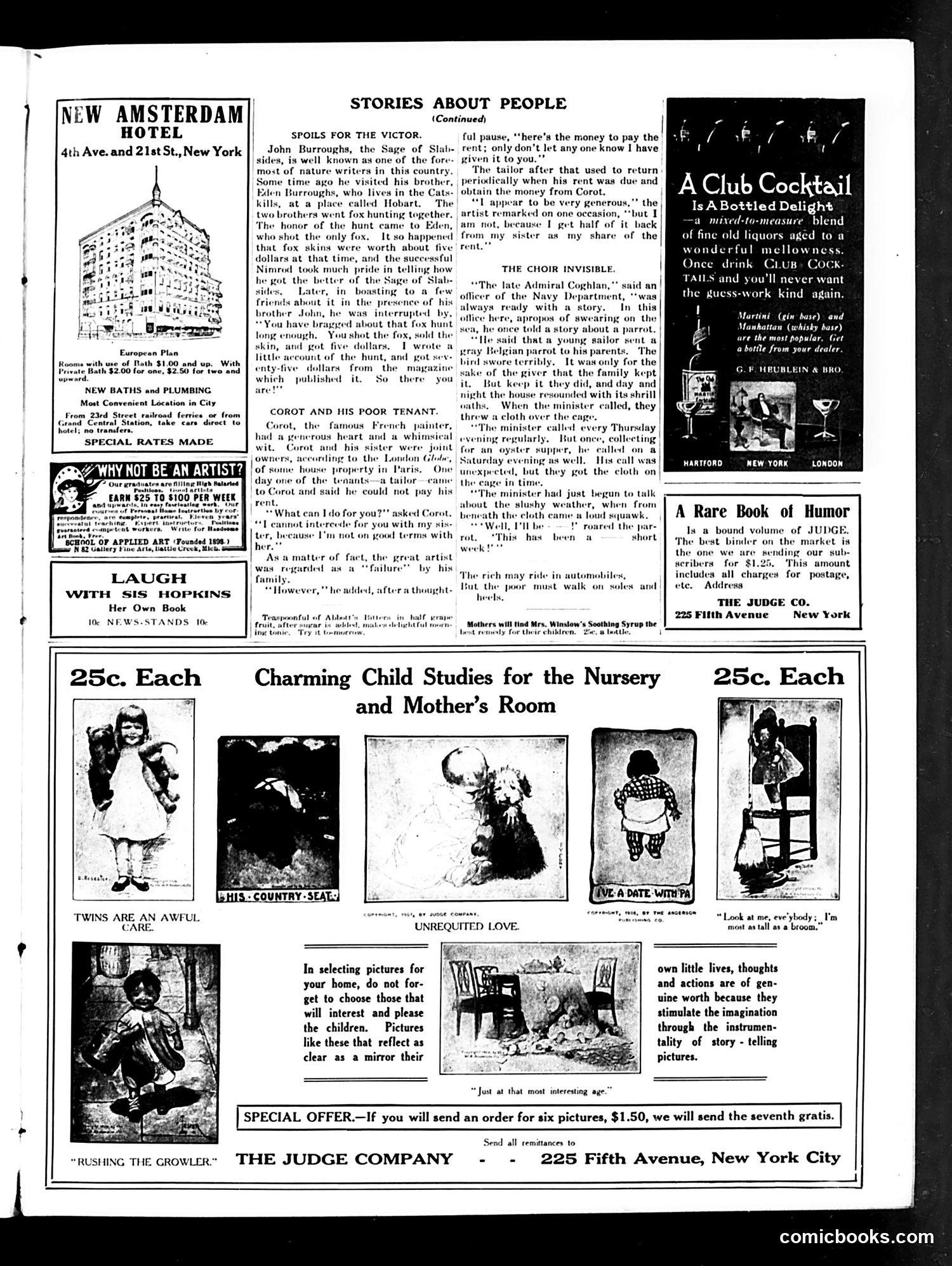
This page is primarily **advertising and filler content** rather than political satire. The main elements include: **"Stories About People" section**: Three anecdotes about famous figures—naturalist John Burroughs, painter Corot, and a naval chaplain—illustrating themes of generosity, resourcefulness, and moral behavior. These are light human-interest stories without political commentary. **Advertisements**: The page features numerous ads for the New Amsterdam Hotel, art instruction, a "Sis Hopkins" humor book, cocktails ("Club Cocktail"), a rare book of Judge reprints, and child nursery pictures (25¢ each). **"Charming Child Studies" section**: Six illustrations of children in domestic scenes, marketed as wholesome nursery decoration for mothers' rooms. The content reflects early 20th-century magazine filler—moral anecdotes and domestic advertising targeting middle-class readers. No clear political cartoons or satirical commentary are evident on this particular page. It's representative of Judge's typical mix of light humor, commercial material, and genteel storytelling.
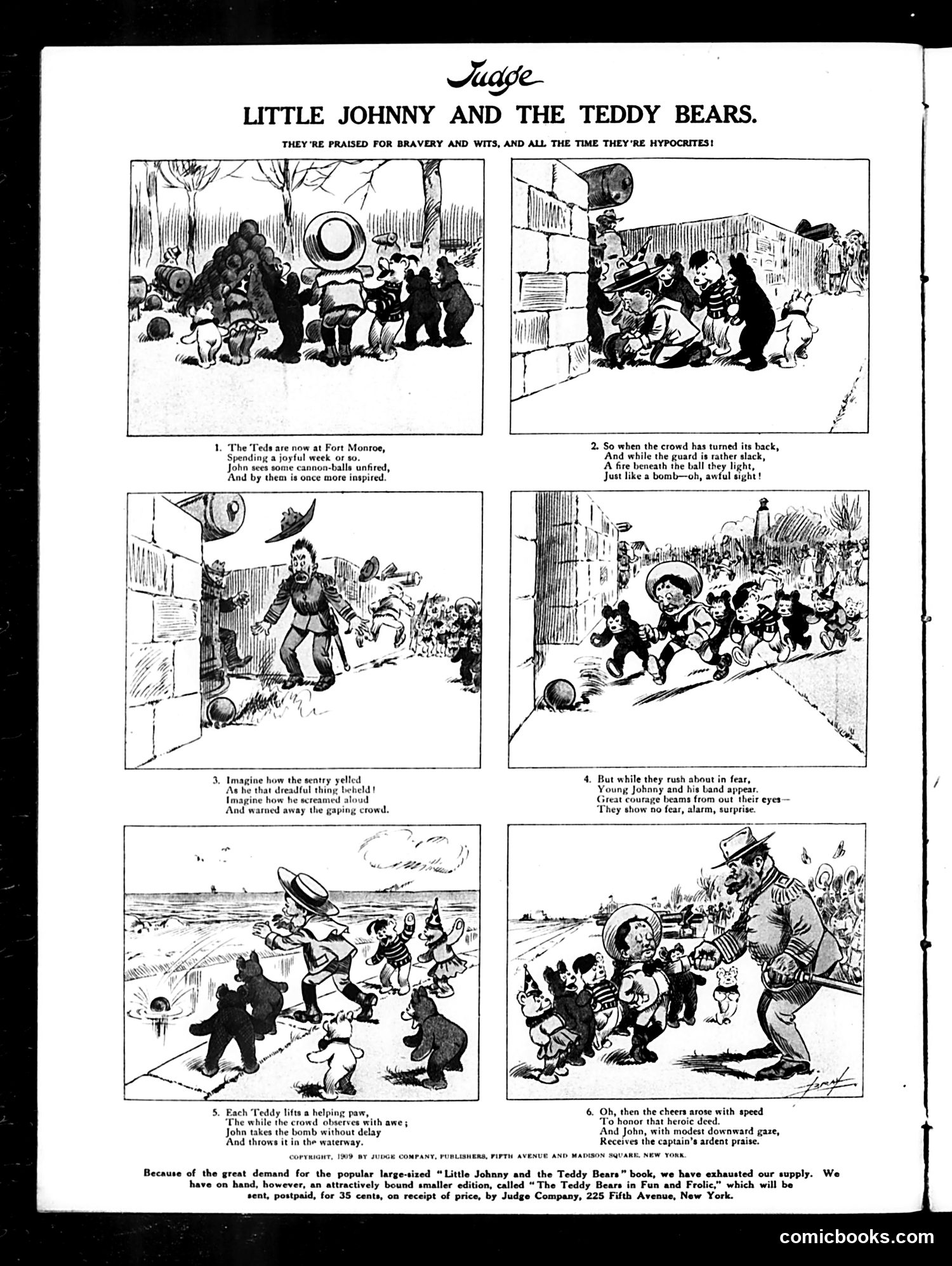
This six-panel satirical comic depicts "Little Johnny" and anthropomorphic "Teddy Bears" as hypocrites who appear brave but act cowardly. The narrative shows them: attending a public gathering, secretly setting a bomb-like fire, panicking when discovered, then being rescued by Johnny—who becomes celebrated as a hero despite the bears' earlier deception. The satire likely critiques a specific political group or public figures of 1909 praised for bravery and wit, yet revealed as self-serving phonies. The "Teddy Bears" reference suggests a connection to President Theodore Roosevelt's administration or policies, given the term's contemporary association with him. The comic mocks how public perception can be manipulated: cowards receive hero's honors while true courage goes unrecognized. The subtitle's emphasis on hypocrisy is the central point—exposing the gap between public image and actual character.