
A complete issue · 16 pages · 1909
Judge — January 16, 1909
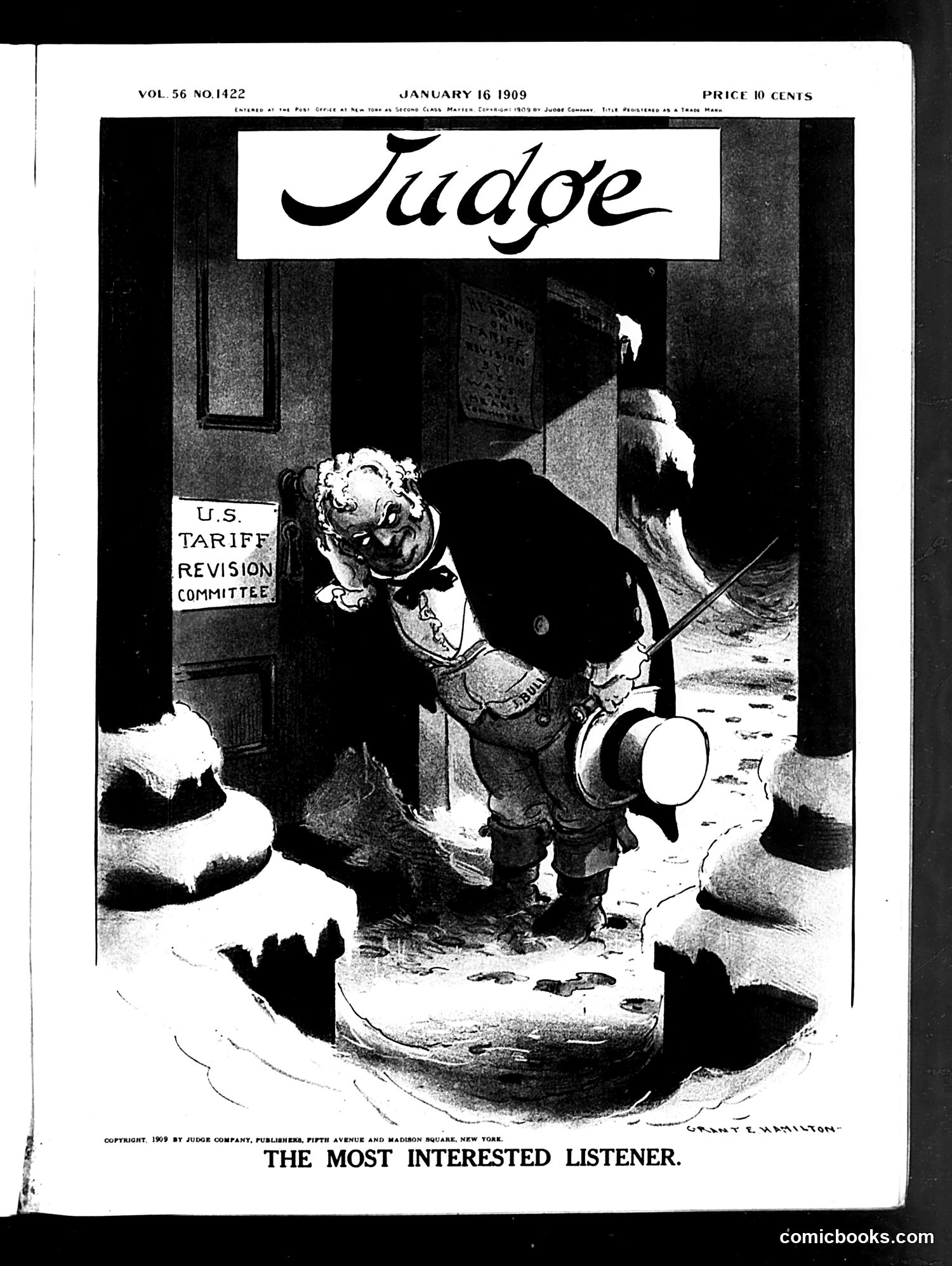
This Judge magazine cover from January 16, 1909 satirizes the U.S. Tariff Revision Committee through political caricature. An elderly man with exaggerated features stands outside the committee's door, holding what appears to be a pot or container, listening intently to proceedings inside. An eagle (symbol of America) perches nearby, also attending. The cartoon mocks the tariff committee's work by suggesting that ordinary citizens—represented by this eager listener—are intensely focused on its decisions because tariffs directly affected consumer prices and business interests. The caricatured figure suggests the public's keen, almost desperate interest in what protections or trade policies the committee would establish, making the committee's work a matter of widespread public concern and scrutiny.
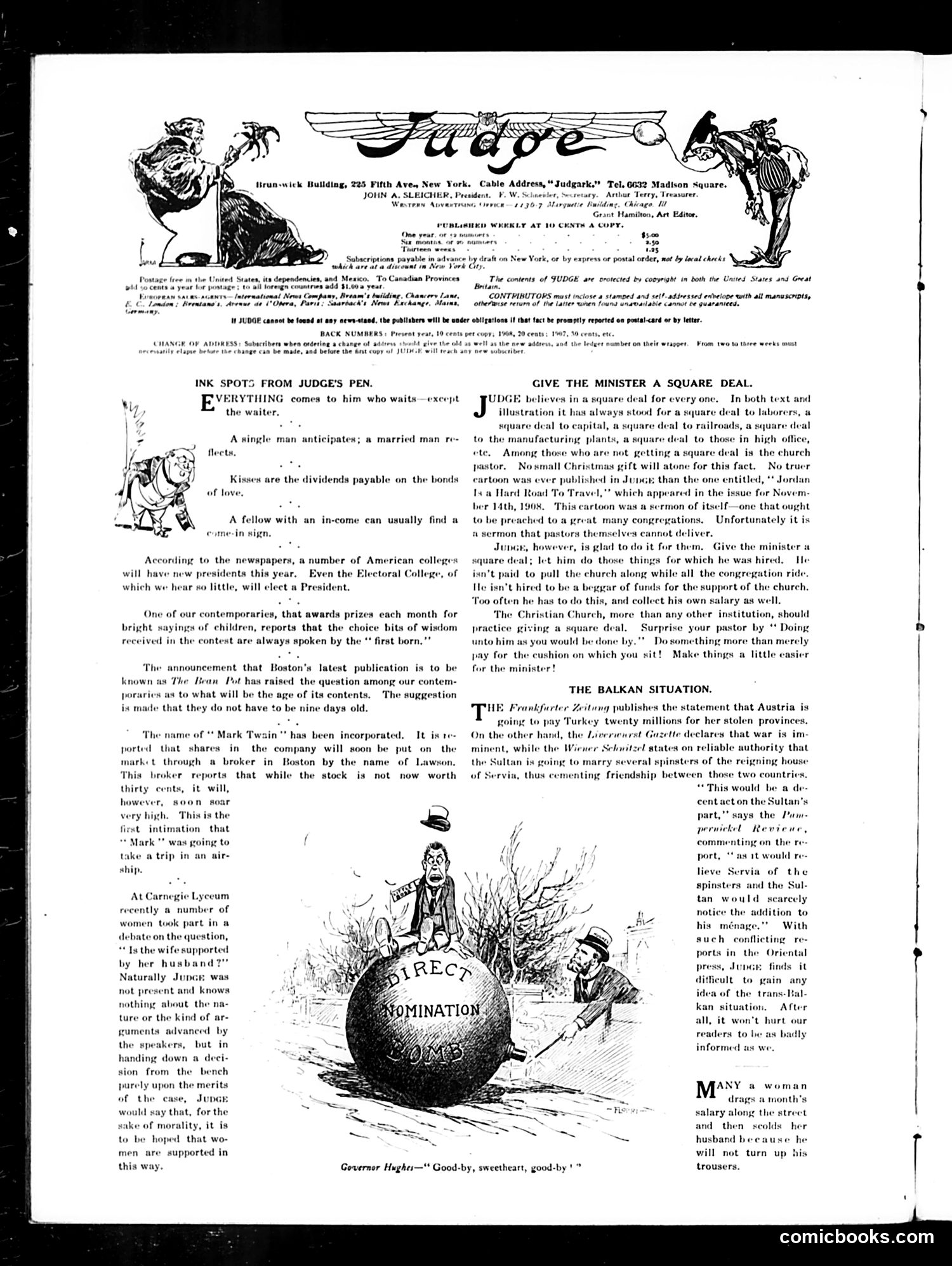
This page contains three distinct sections: **"INK SPOT FROM JUDGE'S PEN"** presents brief witticisms about unmarried versus married men, kisses, and fellows with income—typical light social humor of the era. **"GIVE THE MINISTER A SQUARE DEAL"** argues that churches should provide ministers adequate compensation and support, contrasting their financial struggles with other professions. The author suggests pastors deserve better treatment. **"THE BALKAN SITUATION"** discusses contemporary Austro-Turkish relations, referencing Austria's payments to Turkey and war concerns affecting Serbia and the Sultan's relationships with neighboring powers—likely referring to early 20th-century Balkan geopolitical tensions. The central cartoon depicts "Direct Domination" as a large sphere with figures struggling around it, satirizing political control or imperial ambitions in the Balkans, though exact identities remain unclear from the image alone.
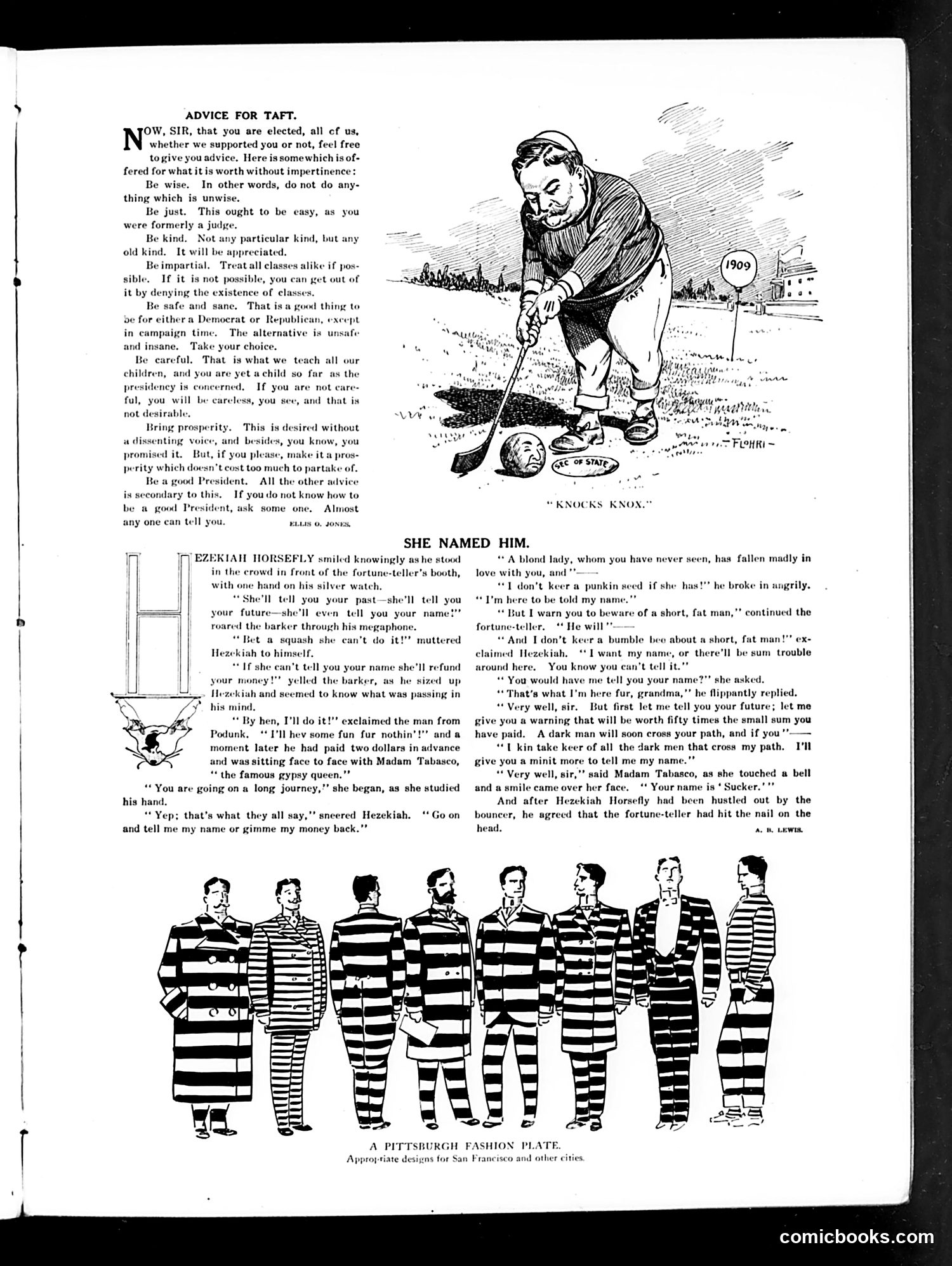
**Top Cartoon "Knocks Knox"**: This political cartoon depicts a large figure striking a ball labeled "TAFT" toward a hole marked "OUT OF STATE." The 1909 date and reference to Knox suggest commentary on Secretary of State Philander Knox's policies under President Taft. The caricature appears to criticize the administration's direction or foreign policy decisions. **"She Named Him" Story**: A humorous narrative about a fortune-teller named Madame Tabaaco who predicts a man's future. The Hezekiah Horsefly character becomes "Sucker"—satirizing gullible people who trust fortune-tellers. **Bottom Image**: "A Pittsburgh Fashion Plate" shows eight men in identical striped prison uniforms, likely satirizing Pittsburgh business or political figures as criminals or fraudsters.
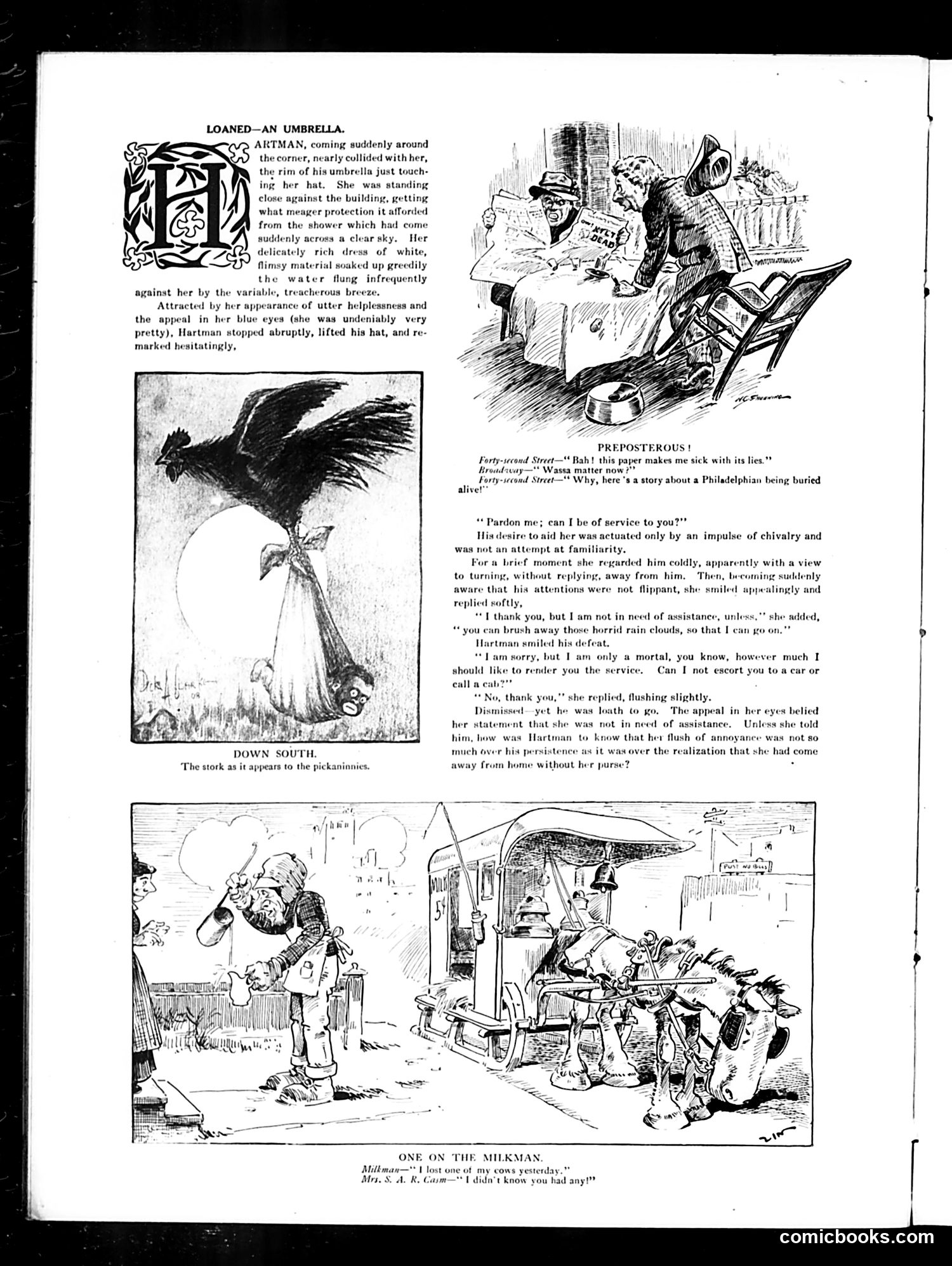
This page contains a humorous short story illustrated with four ink drawings. The narrative follows an artman who borrows a woman's umbrella during a rainstorm. The story plays on class anxieties and social embarrassment: the woman's dress becomes soaked and ruined, yet she must politely accept the man's inadequate apologies due to social convention. The cartoons depict the encounter, a rooster ("Down South"), and urban street scenes. The humor derives from the tension between the woman's obvious irritation and her need to maintain social propriety by accepting dismissal without complaint—a critique of restrictive Victorian etiquette that forced women to suppress legitimate grievances for the sake of appearing gracious.
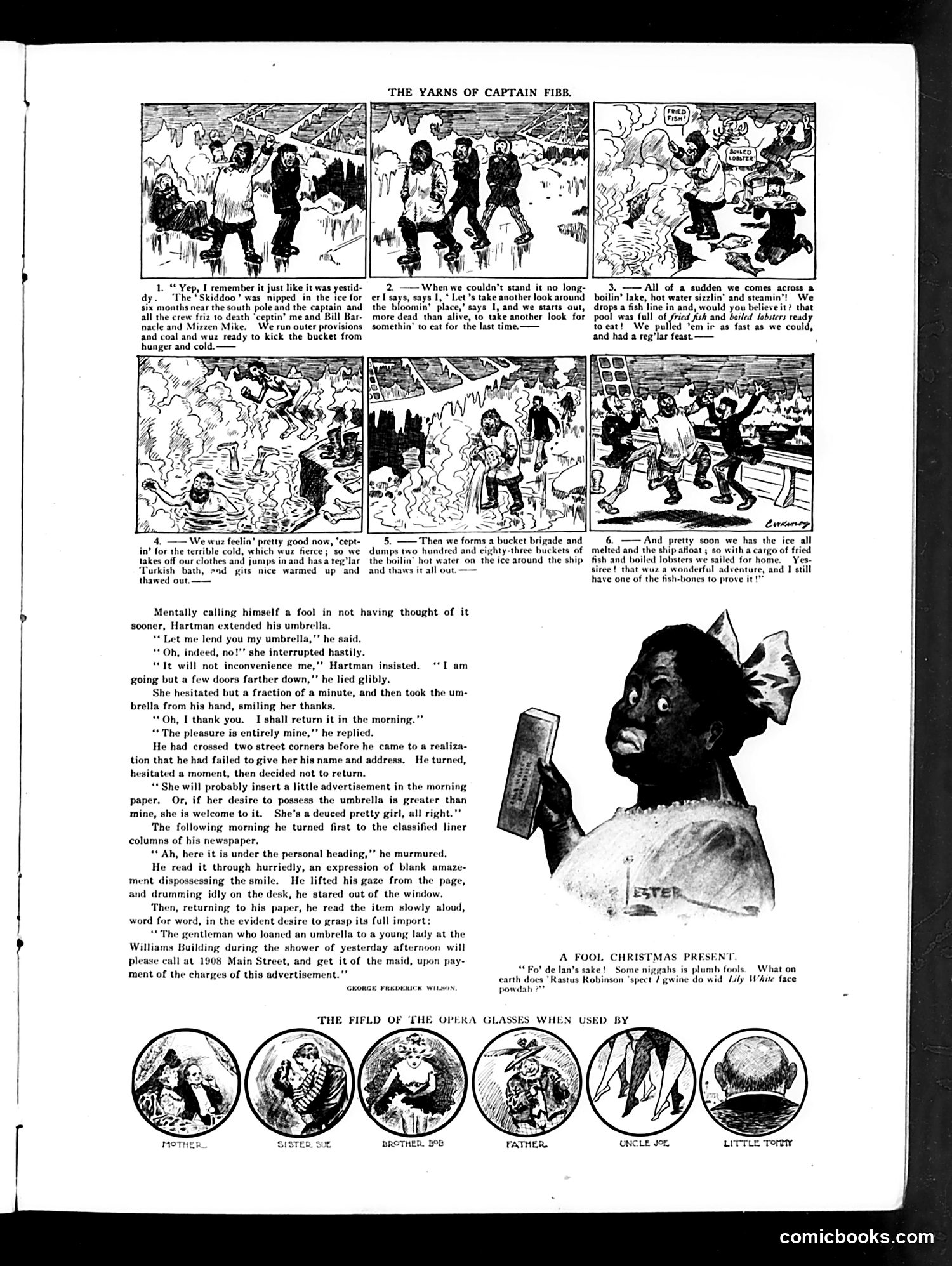
This is a serialized comic strip depicting a seafaring tall tale. The narrative follows Captain Fibb recounting an exaggerated Arctic expedition where his crew becomes trapped in ice. The panels show increasingly absurd situations: men freezing, forming a "bucket brigade" to bail water, and eventually discovering an abundant fish pool to eat from. The humor relies on classic tall-tale conventions—outlandish survival scenarios presented as fact. The accompanying text includes dialogue where Fibb's companion Hartman grows skeptical of the implausible story. The page also features "A Fool Christmas Present"—a separate satirical piece about a lost umbrella—and a bottom section showing "opera glasses" used by various family members, each revealing different humorous observations. This represents early 20th-century American comic humor mixing seafaring adventure with domestic comedy.
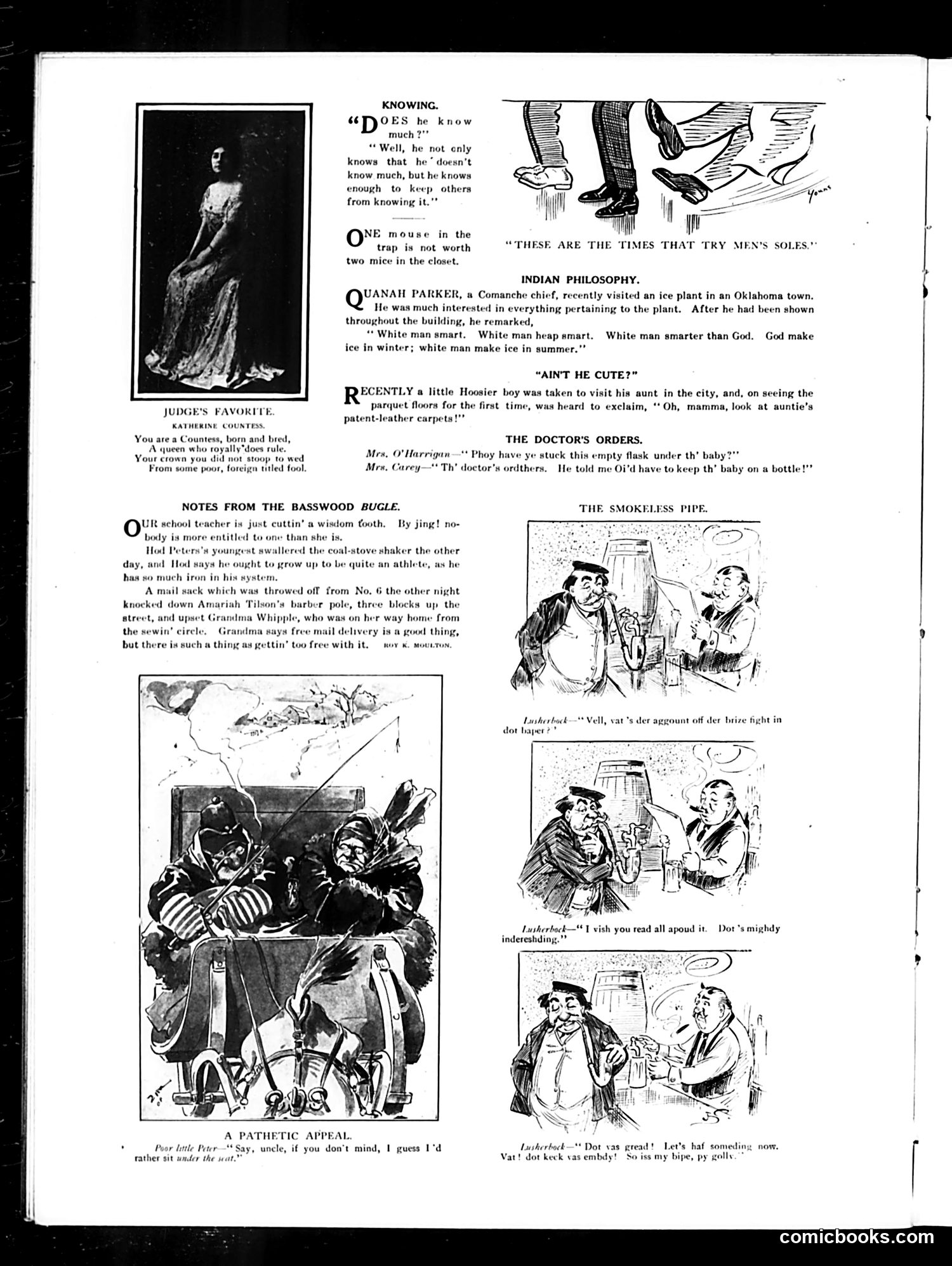
This page contains several short humorous items typical of early 20th-century American satirical magazines: **"Indian Philosophy"** mocks Native American perspectives through a supposed quote from Comanche chief Quanah Parker visiting an ice plant. The "joke" presents Indigenous wisdom as quaint and inferior—Parker supposedly marvels that white men can make ice in summer while God only makes it in winter. This reflects the era's racist stereotyping of Native Americans as intellectually primitive. **"Ain't He Cute?"** and **"The Doctor's Orders"** are simple domestic humor about children's misunderstandings—a boy calling polished floors "patent-leather carpets," and confusion over keeping a baby "on a bottle." **"The Smokeless Pipe"** and other brief items are ethnic humor featuring caricatured Irish and German-accented speakers in working-class situations—standard Judge fare mocking immigrant groups. The overall tone reflects late 19th/early 20th-century American humor that relied heavily on racial and ethnic stereotyping, now recognized as offensive.
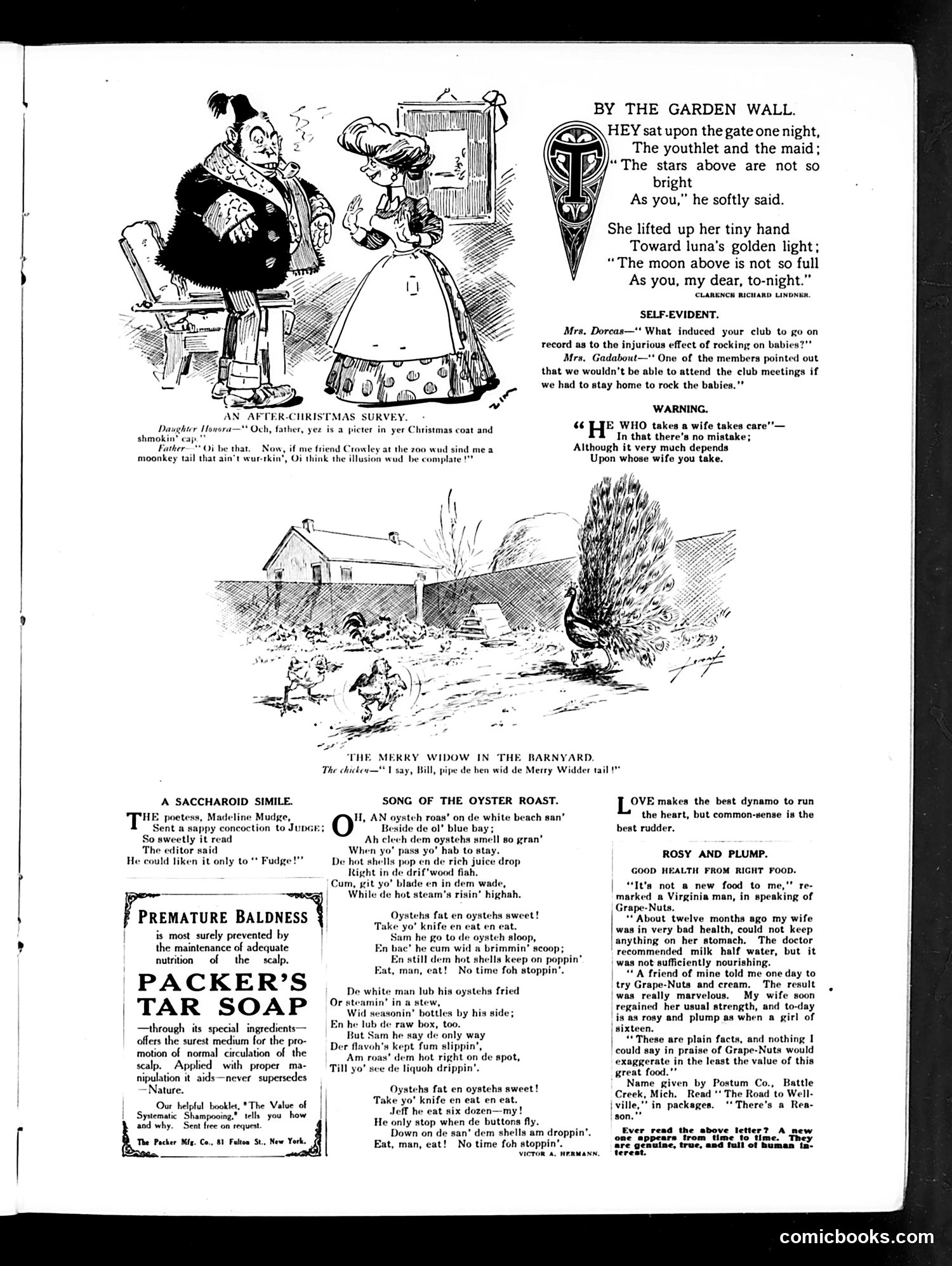
This page contains several satirical pieces typical of early 20th-century American humor: **"By the Garden Wall"** is a romantic poem mocking saccharine courtship dialogue—the joke being the maid's competitive compliment-matching ("the moon above is not so full / As you"). **"Self-Evident"** satirizes women's club culture, suggesting members prioritize social gatherings over childcare—a dig at the emerging women's club movement. **"The After-Christmas Survey"** features an Irish immigrant father figure making a joke about his daughter resembling a monkey in her Christmas outfit—ethnic humor typical of the era's vaudeville traditions. **"Song of the Oyster Roast"** is a dialect poem in African American vernacular, depicting oyster-eating with exaggerated speech patterns common to period minstrelsy traditions. The page also contains advertisements (Packer's Tar Soap, Grape-Nuts) and lighter domestic humor about marriage and food health claims. The content reflects Judge's satirical approach to American social life, though some pieces employ now-offensive ethnic stereotyping standard to the publication's era.
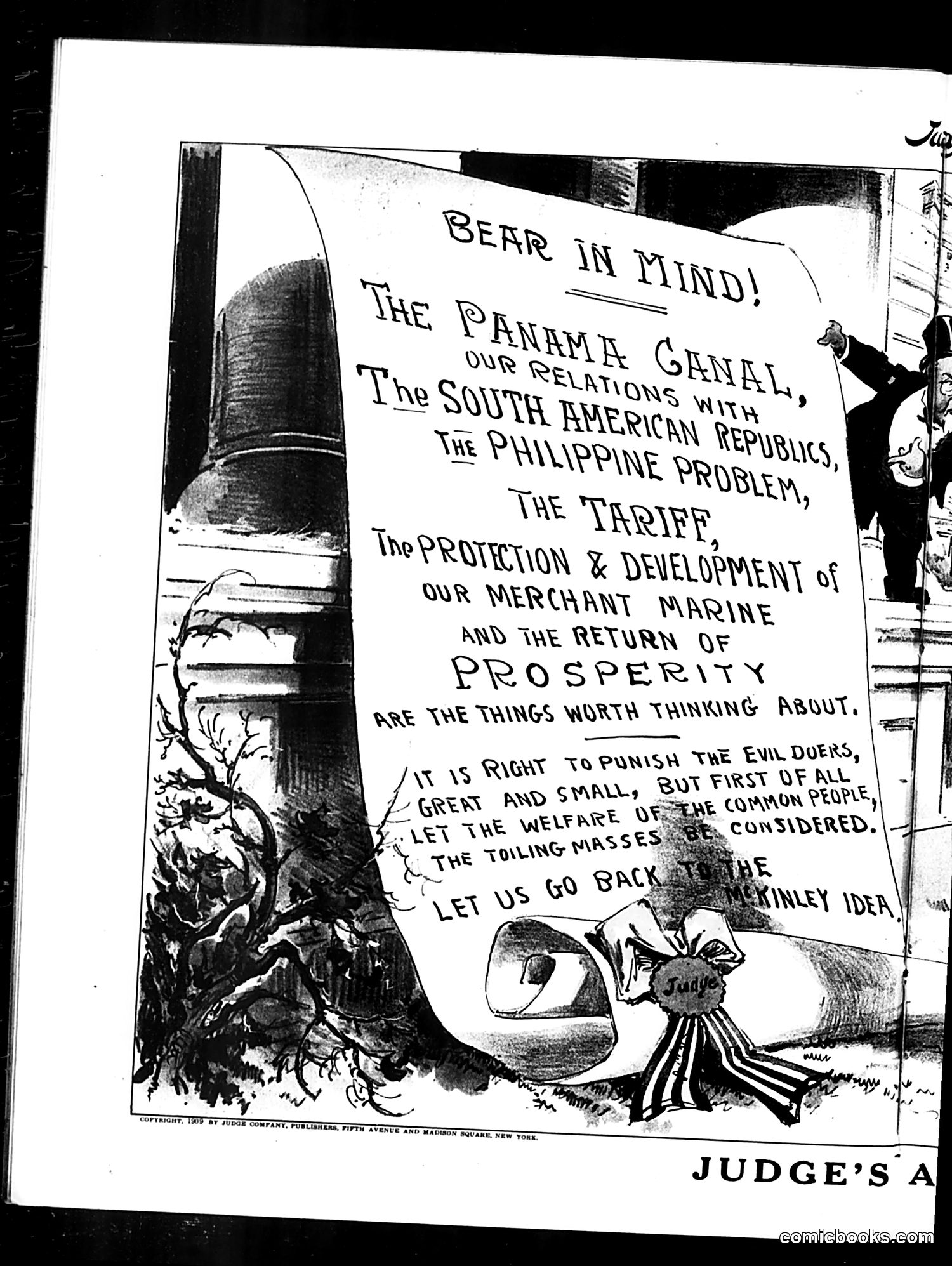
This Judge magazine cartoon satirizes American imperialist policy during the early 20th century. An Uncle Sam figure (shown as a bear) holds a list of issues to consider, including the Panama Canal, relations with South American republics, the Philippine problem, tariffs, and merchant marine protection—all framed as paths to "prosperity." The satire's point appears to be critiquing imperialist priorities: the text argues these grand political schemes deserve attention, but sarcastically insists the "welfare of the common people" and "toiling masses" must come first. The phrase "McKinley Idea" (partially visible) likely references President William McKinley's expansionist policies. The cartoon mocks the disconnect between elite political ambitions and working-class concerns, suggesting that imperial ventures were prioritized over domestic welfare.
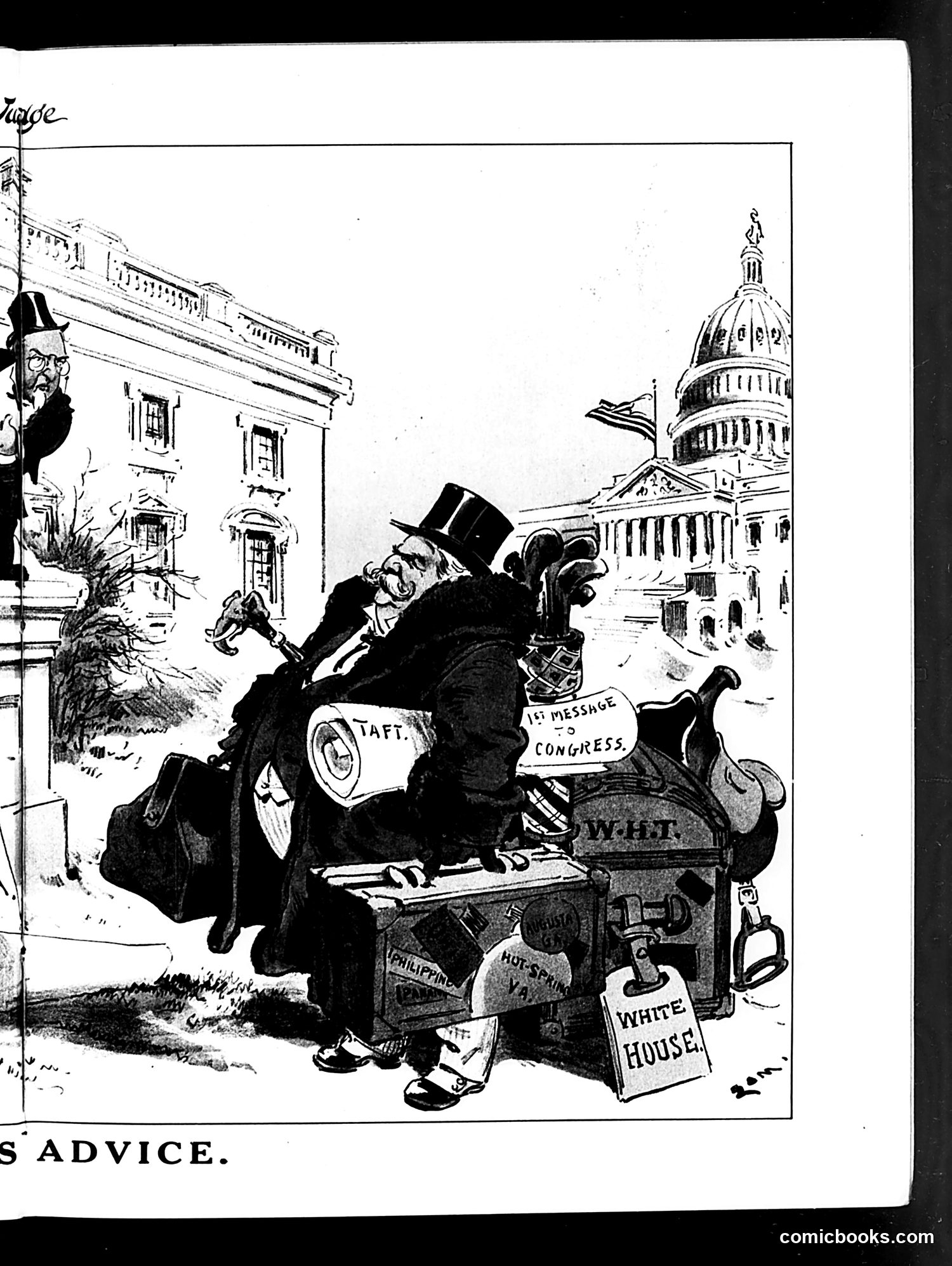
This satirical cartoon depicts a figure labeled "TAFT" (President William Howard Taft) receiving conflicting guidance at the White House. The caricatured figures advising him appear to represent different political factions or interests, each offering contradictory counsel—one says "1ST MESSAGE TO CONGRESS" while another declares "ADVICE." The cartoon lampoons Taft's presidency as beset by competing pressures and advisors pulling him in different directions. The Capitol Building visible in the background emphasizes the Washington political context. Labels visible on boxes/items suggest references to Philippine policy and other contemporary issues ("PHILIPPINES," "HOT STUFF"). The satire suggests Taft was receiving poor, conflicting, or self-interested guidance rather than principled counsel during his administration.
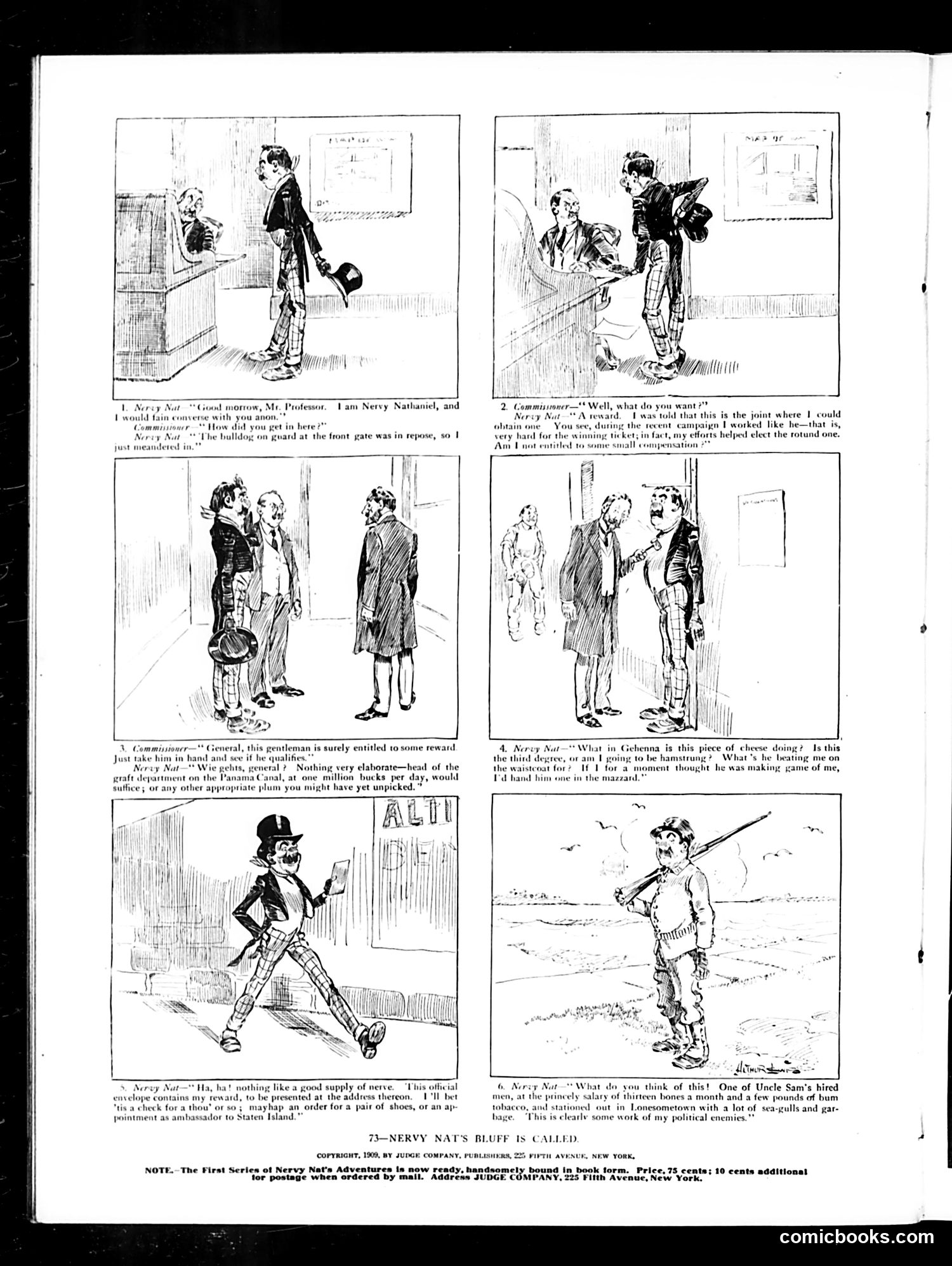
This is a sequential comic strip featuring "Nervy Nat," an apparently confident but ultimately unsuccessful character. The narrative follows Nat attempting to bluff his way into a government position or reward by claiming entitlement to compensation. A Commissioner challenges him, asking what specifically he wants and what qualifies him. Nat responds with vague boasts about working hard during a recent campaign, claiming credit for electoral success while admitting he's made enemies through "political work." The satire targets self-aggrandizing opportunists who inflate their contributions to political campaigns in hopes of securing patronage jobs or financial rewards—a common practice in the era of political spoils systems. Nat's inability to articulate concrete accomplishments, combined with the Commissioner's skeptical response ("What do you think of this?"), suggests his bluff has been called. The humor lies in exposing the fraudulence of such claims to unearned political favor.
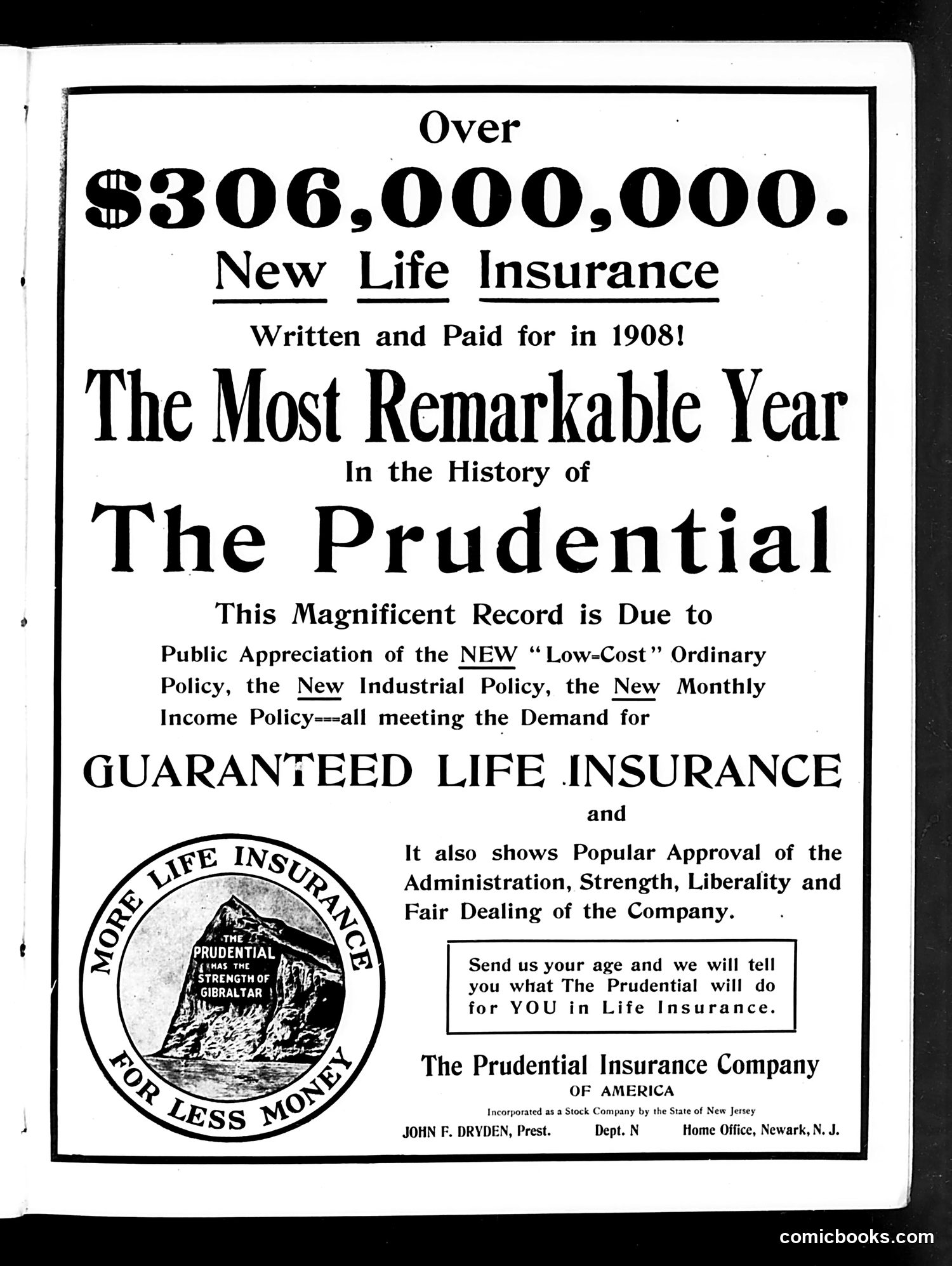
This page is primarily a **full-page advertisement**, not political satire. It's a 1908 Prudential Insurance Company ad celebrating their record $306 million in new life insurance written that year. The ad emphasizes Prudential's new affordable policies—the "Low-Cost" Ordinary Policy, Industrial Policy, and Monthly Income Policy—positioning them as meeting public demand for accessible life insurance. The company's Rock of Gibraltar logo appears, symbolizing strength and stability. The headline "The Most Remarkable Year in the History of The Prudential" frames this as a major corporate achievement. The text stresses the company's "Administration, Strength, Liberality and Fair Dealing," suggesting Prudential wanted to project trustworthiness during an era of growing consumer skepticism about large corporations. The closing call-to-action invites readers to request personalized insurance quotes by age. This reflects early 20th-century corporate marketing in *Judge*, using the magazine's space to reach affluent readers.
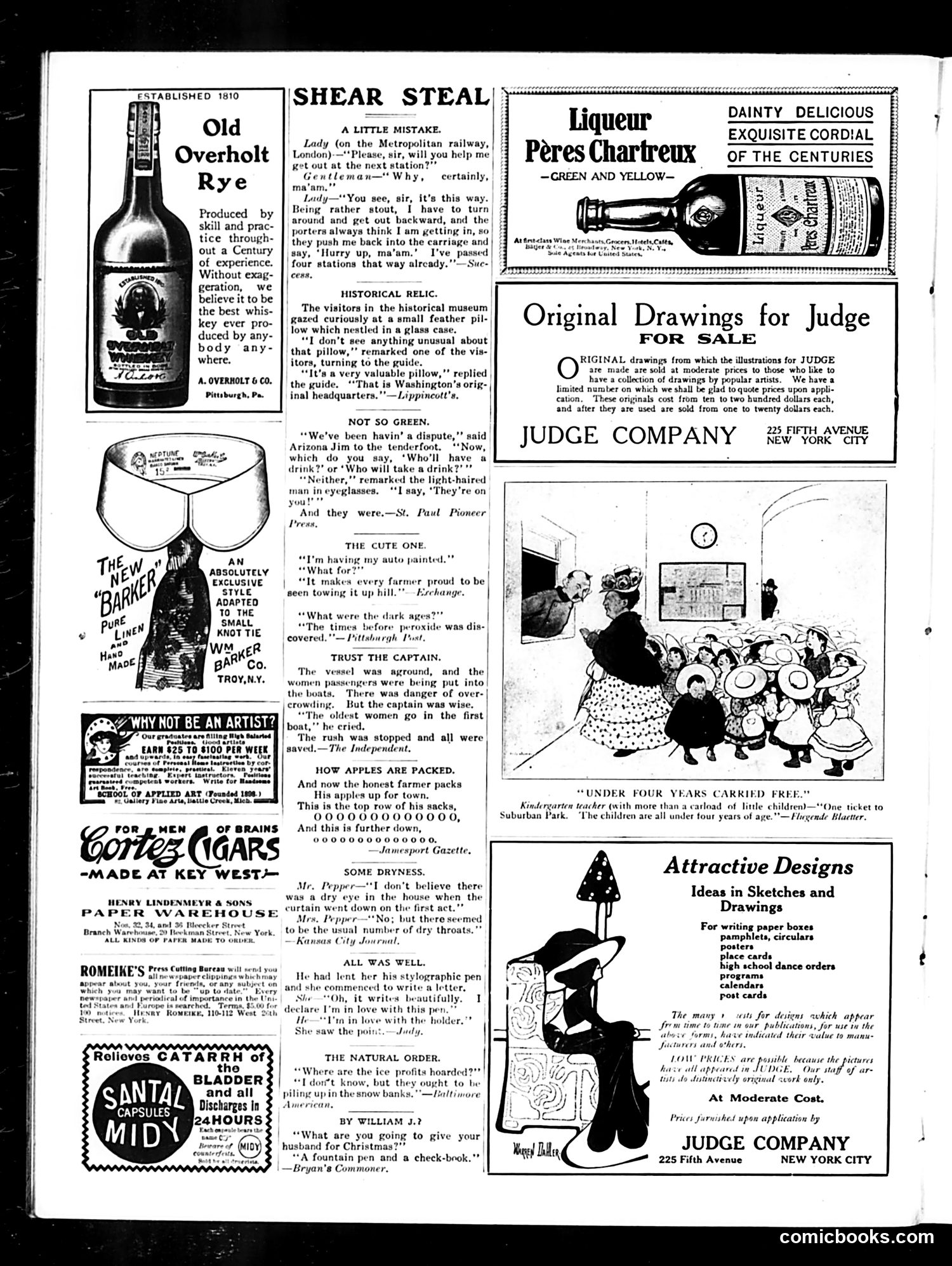
This is primarily an **advertising and humor page** from Judge magazine, a satirical weekly. The page contains: **Main Content:** A series of brief humorous anecdotes and jokes typical of Judge's format—short, punchy social observations: - A stout lady on the London Underground repeatedly pushed back into trains - A museum displaying George Washington's "headquarters" (actually a pillow) - Grammar dispute over whether to say "Who'll have a drink?" or "Who will take a drink?" - A farmer proudly towing a newly-painted automobile uphill - An honest farmer's apple-packing deception (nice apples on top, inferior ones below) - A kindergarten teacher transporting free children under four **Advertisements:** The page features ads for Old Overholt Rye whiskey, Cortez cigars, Pères Chartreux liqueur, and Judge Company's original artwork sales. **Historical Context:** These jokes satirize early 20th-century social pretensions, class anxieties (the automobile, city transportation), rural-urban divides, and simple human vanities—typical of Judge's genteel humor for educated middle-class readers.
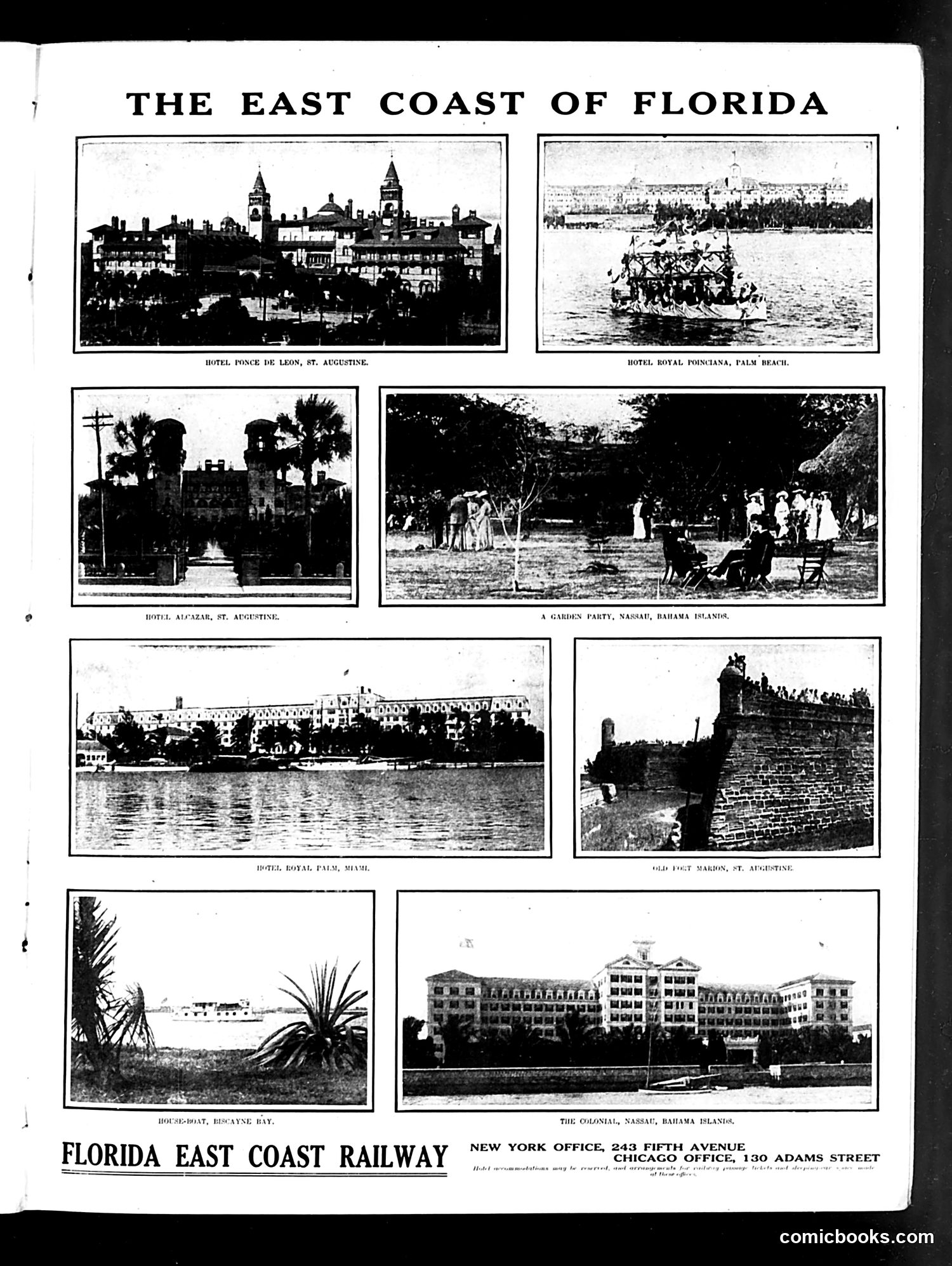
This page is primarily **advertising, not satire or political commentary**. It showcases scenic photographs of Florida's East Coast destinations served by the Florida East Coast Railway, including: - Hotel Ponce de Leon in St. Augustine - Hotel Royal Poinciana in Palm Beach - Hotel Alcazar in St. Augustine - Garden parties in Nassau, Bahama Islands - Hotel Royal Palm in Miami - Old Fort Marion in St. Augustine - Houseboat in Biscayne Bay - The Colonial in Nassau The images promote luxury tourism destinations and transportation infrastructure. This appears to be a travel/tourism advertisement placed in *Judge* magazine to reach affluent readers. There is no visible political or satirical content—it's straightforward promotional material for the railway and its associated resort destinations.
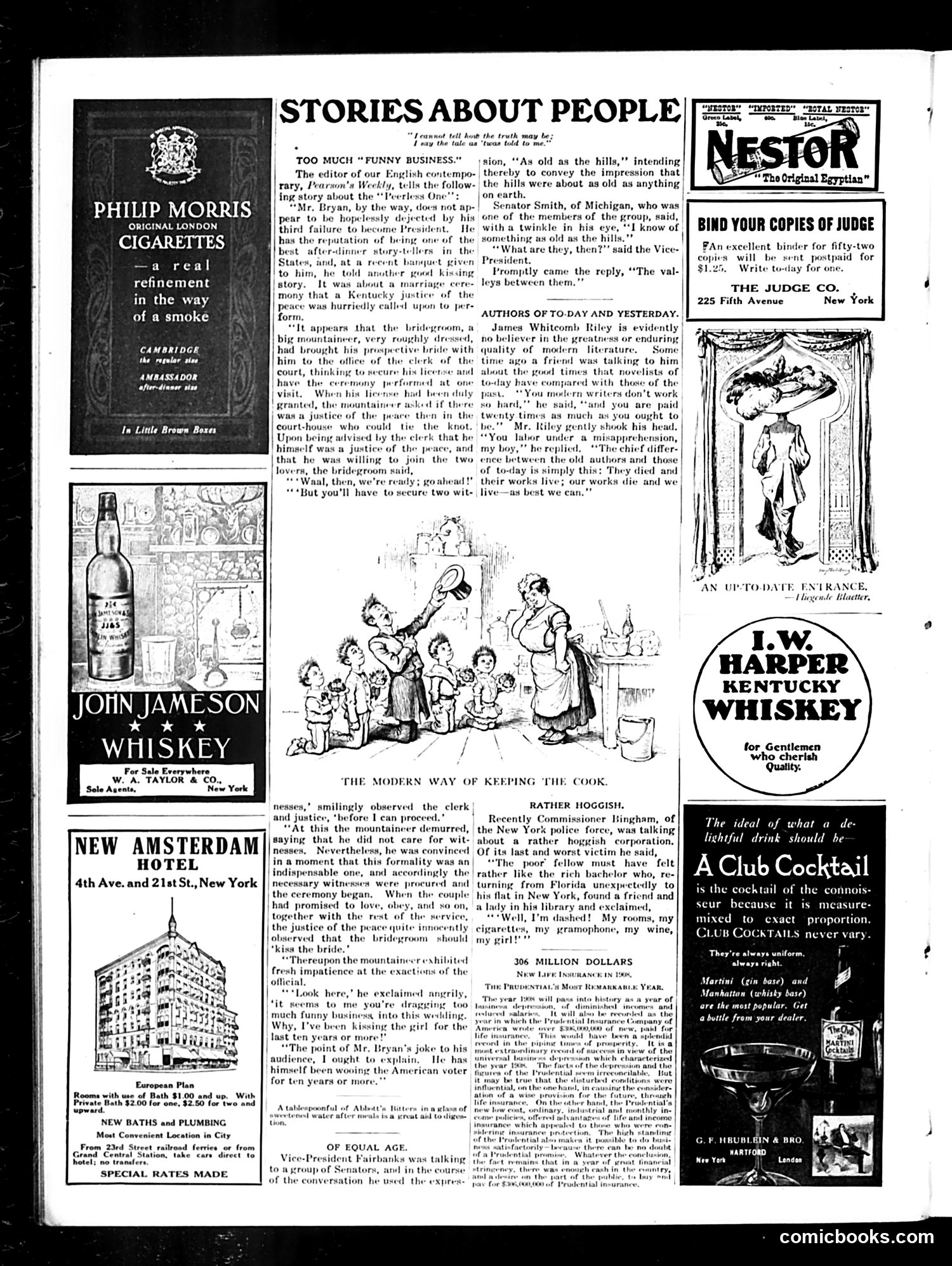
This page is primarily **advertising** interspersed with several short humorous anecdotes in the "Stories About People" column. The main illustrated cartoon, "The Modern Way of Keeping the Cook," depicts a domestic scene where a woman (presumably the cook) is being physically restrained or held back by multiple family members, suggesting difficulty in retaining household staff—a relatable concern for affluent readers of the era. The text stories reference **William Jennings Bryan** (three-time presidential candidate), **Senator Smith of Michigan**, and **James Whitcomb Riley** (celebrated American poet). The Bryan anecdote jokes about his reputation as a storyteller and failed presidential ambitions. The Riley story contrasts living authors with deceased ones, suggesting contemporary writers sacrifice longevity for commercial success. The "Rather Hoggish" anecdote, attributed to Police Commissioner Bingham, satirizes wealthy businessmen who abandon civic responsibilities for personal indulgence—a critique of Gilded Age excess. The advertisements promote luxury goods (Philip Morris cigarettes, whiskey, hotels) to Judge's affluent readership.
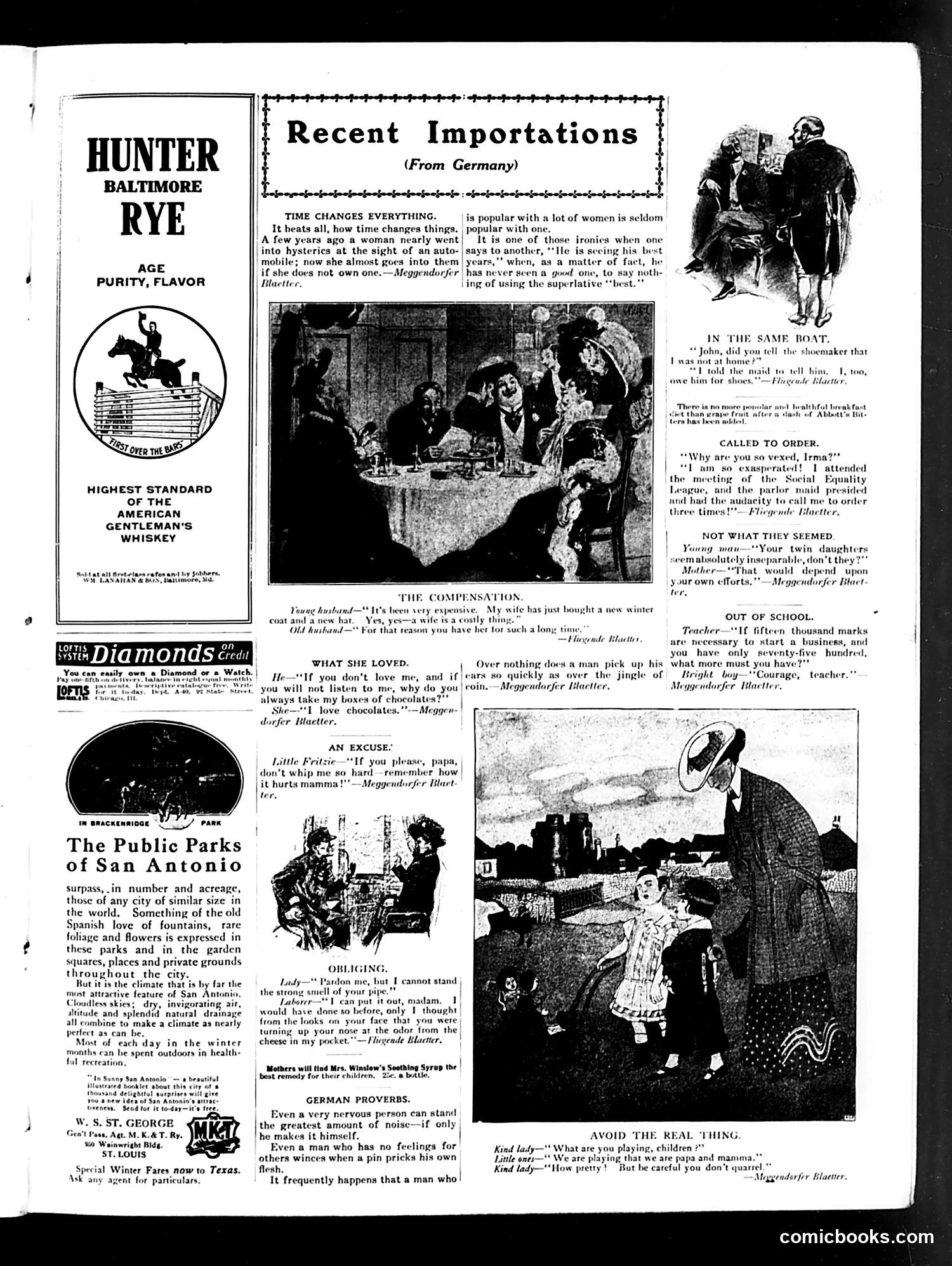
This page consists primarily of **short humorous anecdotes** translated from *Fliegende Blätter* (a German satirical magazine), interspersed with advertisements. The cartoons and jokes satirize **domestic life and social manners** of the early 20th century. Key recurring themes: - **Women's materialism**: "Time Changes Everything" mocks how women's desires shift—once horrified by automobiles, now they demand owning one. - **Marriage dynamics**: Multiple jokes depict wives as expensive ("costly thing") and husbands as long-suffering providers. - **Class/social pretension**: "Called to Order" ridicules a parlor maid presiding over a Social Equality League meeting, satirizing working-class social climbing. - **Children's innocence**: "Out of School" and similar pieces show children's literal interpretations of adult concepts. The page reflects **early 1900s attitudes toward gender roles, consumption, and social hierarchy**. The repeated sourcing from German publications suggests *Judge* regularly imported European humor for American audiences.
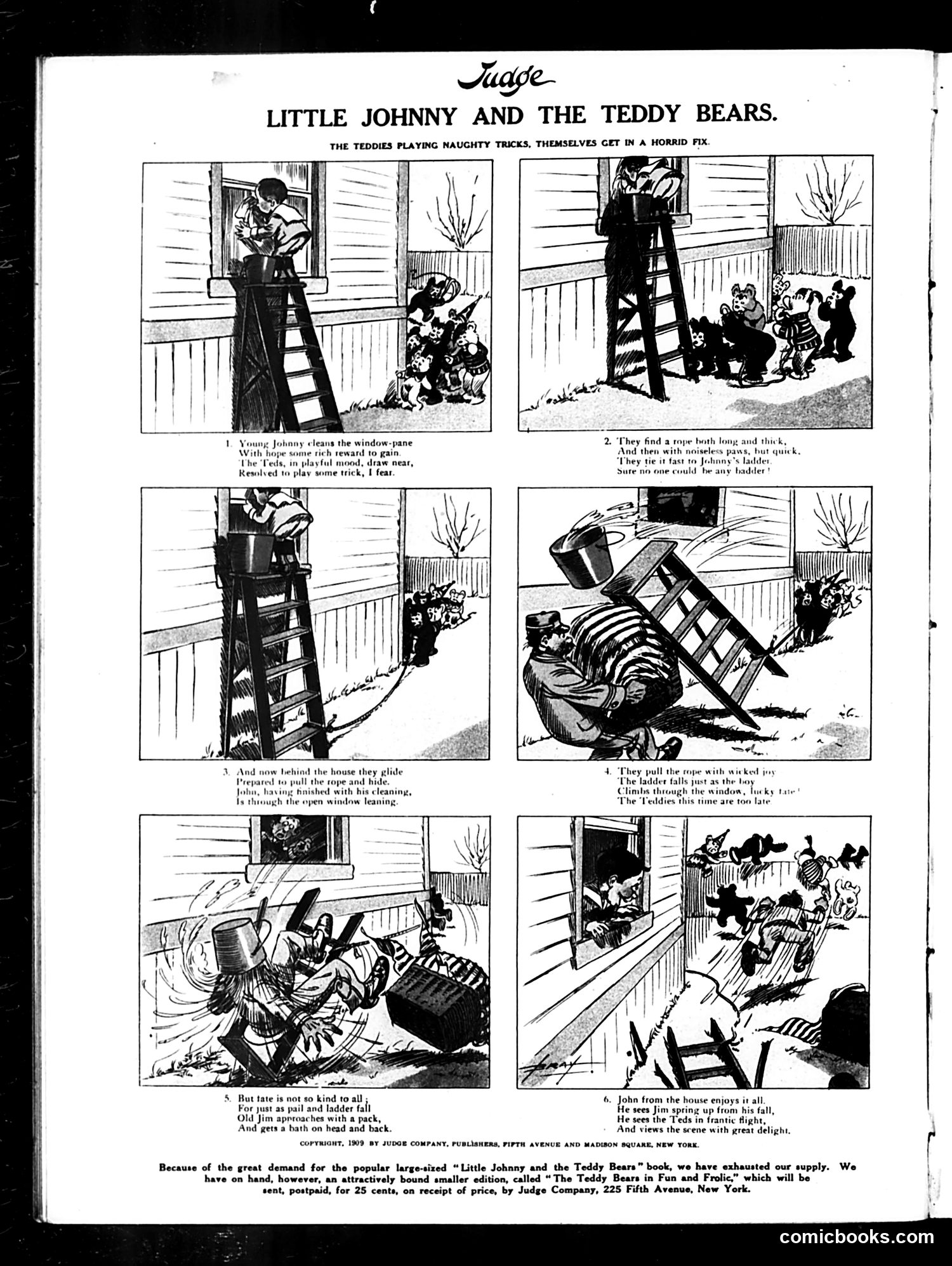
This is a children's comic strip, not political satire. It depicts a boy named Johnny attempting window-cleaning chores while teddy bears—apparently his toys or companions—play pranks that backfire catastrophically. The narrative shows: Johnny on a ladder cleaning windows; the bears finding a rope; the group sneaking around the house; the bears pulling the rope, which causes a bucket and ladder to fall on them; and finally Johnny watching the chaotic result from inside. The humor is slapstick—mischievous characters (the "Teddies") attempt pranks but suffer the consequences themselves, ending in physical comedy. "Teddy bears" references the popular stuffed toys named after President Theodore Roosevelt. The footer advertises the full-sized book and a smaller 25-cent edition, indicating this was promotional content for Judge Company's children's publications.