
A complete issue · 16 pages · 1908
Judge — December 19, 1908
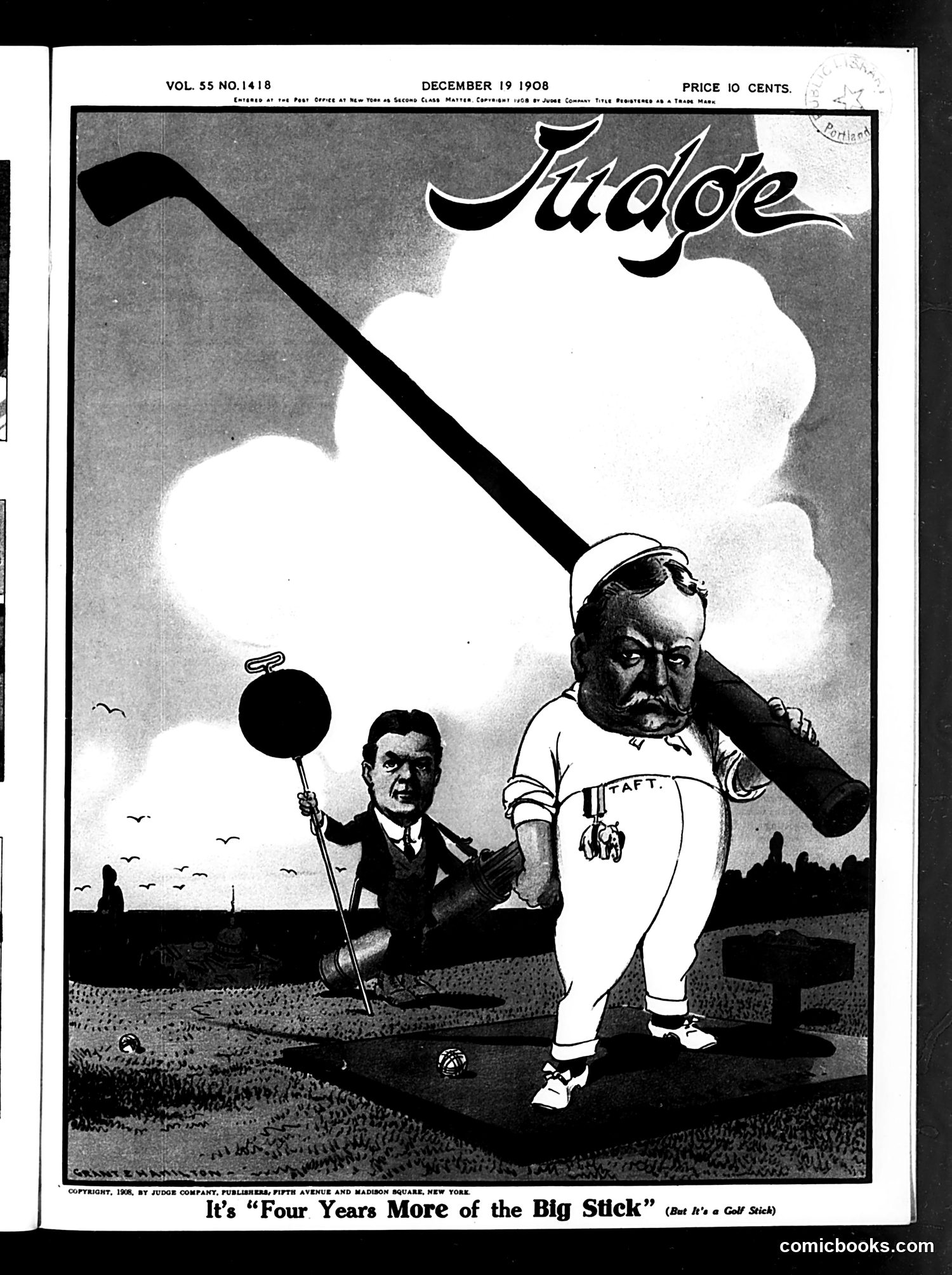
This political cartoon satirizes President Theodore Roosevelt's promised departure from office. The caption "It's 'Four Years More of the Big Stick'" (with parenthetical clarification that it's a golf stick, not a weapon) depicts Roosevelt as a golfer with an enormously oversized club about to swing. The smaller figure on the left appears to be another political figure, possibly William Howard Taft (Roosevelt's chosen successor, visible on the baseball uniform), watching nervously. The satire suggests Roosevelt's continued political dominance—his "big stick" diplomacy—would persist despite his pledge to leave office after four years, with the golf metaphor implying his retirement from the presidency wouldn't diminish his influence over American politics.
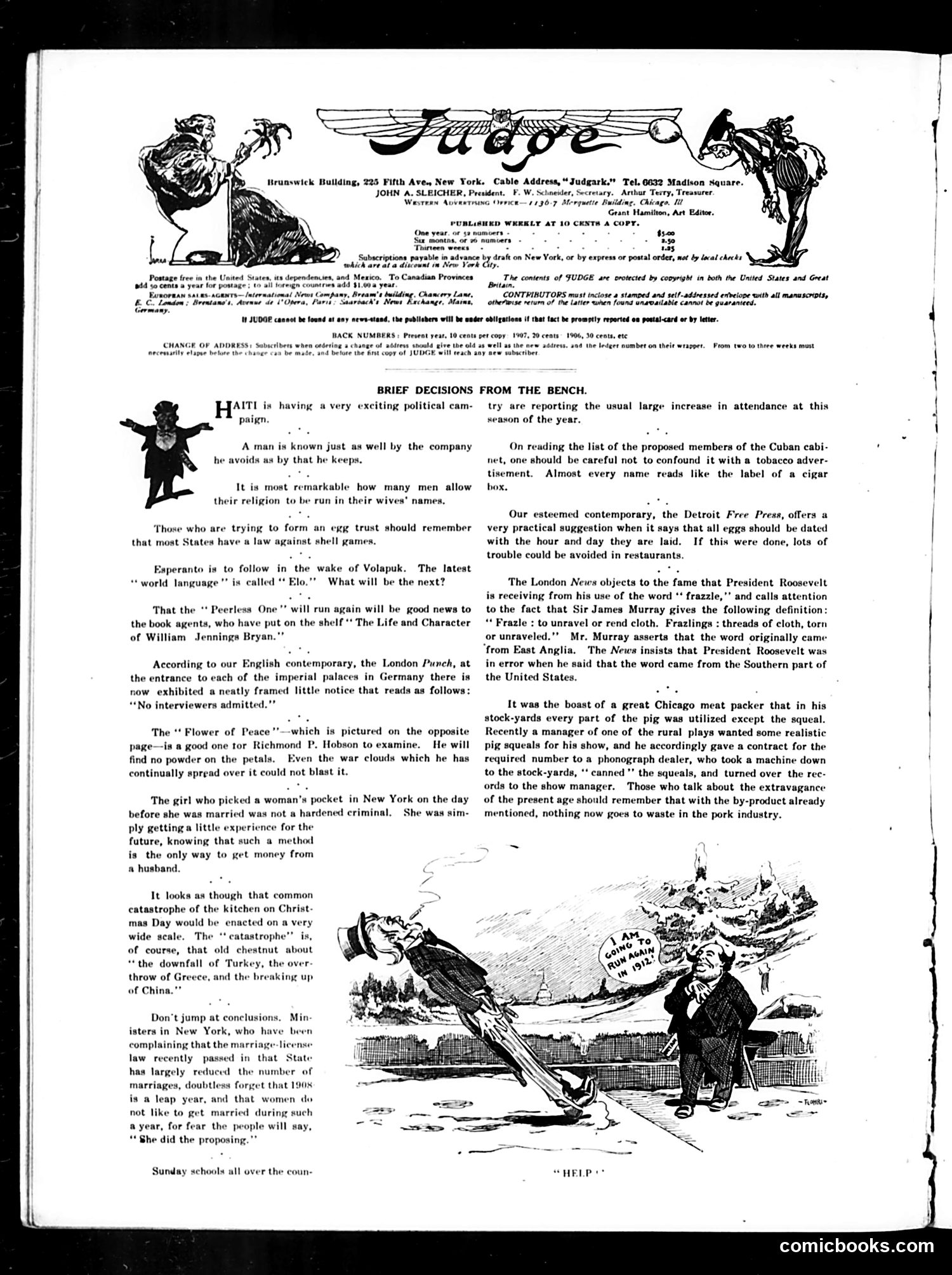
This page contains editorial commentary and social satire typical of early 20th-century Judge magazine. The main cartoon labeled "HELP" depicts a figure in formal dress (possibly representing wealth or authority) appearing distressed while observing destruction or chaos in the background, likely satirizing economic or social upheaval. The text discusses various topics including Haiti's political situation, marriage law reforms, and references to President Roosevelt's use of the word "frazzle." There's commentary on a Chicago meat packer's exploitation of pig byproducts and criticism of theatrical productions. The satire targets political hypocrisy, social pretension, and industrial excess. Without clearer dating or additional context, the specific historical moment remains somewhat unclear, though the tone suggests commentary on Progressive Era social issues.
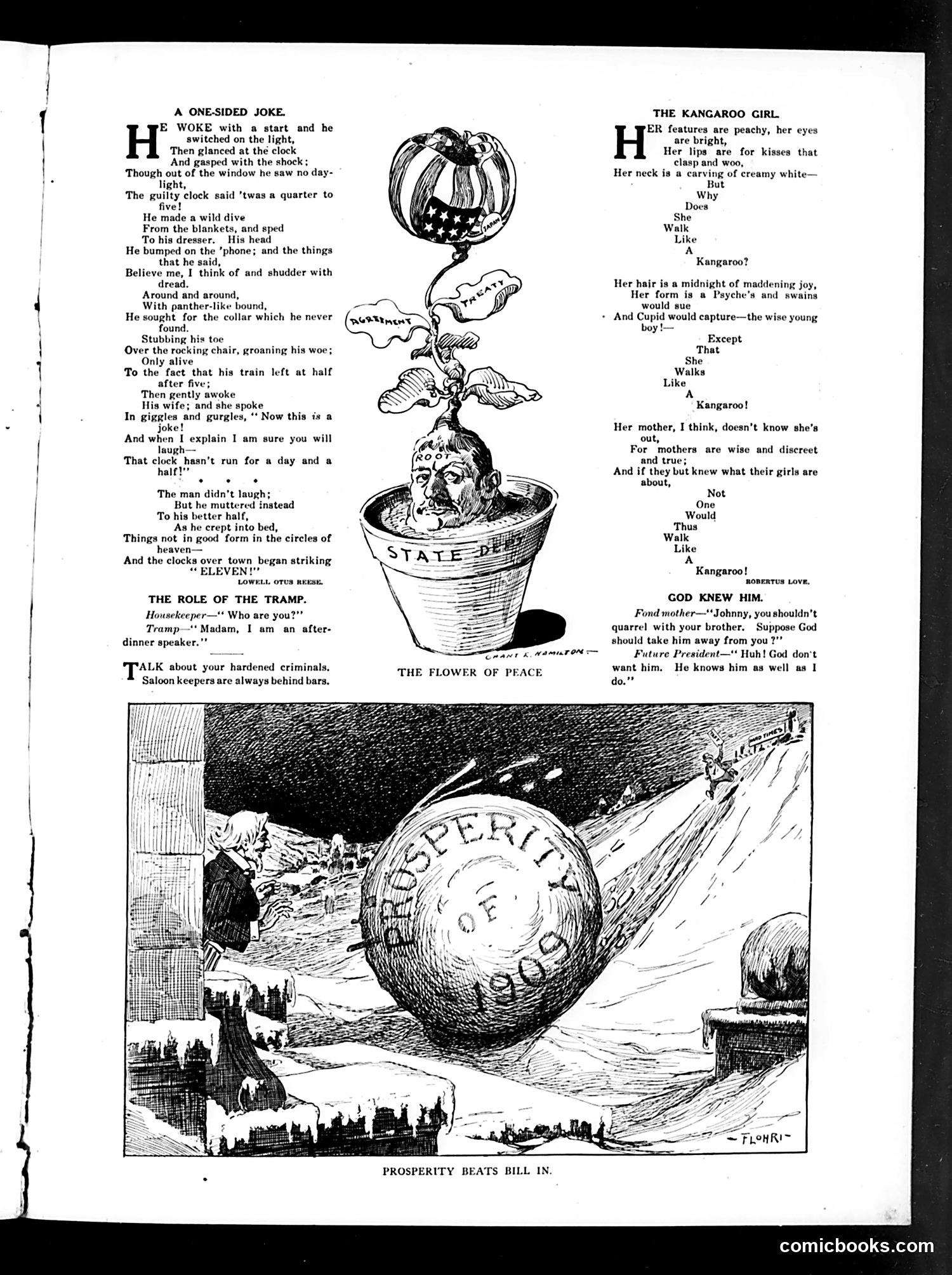
The large cartoon titled "PROSPERITY BEATS BILL IN" depicts a massive sphere labeled "PROSPERITY" rolling through a cityscape, crushing buildings and structures beneath it. This appears to be Cold War or post-war era American satire about economic growth overwhelming legislative concerns. The phrase "beats bill in" suggests prosperity is literally outpacing or defeating some proposed legislation. The cartoon critiques how rapid economic expansion dominates political discourse, potentially pushing aside careful legislative consideration. The other page content includes lighter poems and jokes unrelated to the main political cartoon. Without clearer historical dating or caption context, the specific bill referenced remains unclear, though the overall message critiques prosperity's outsized influence on governance.
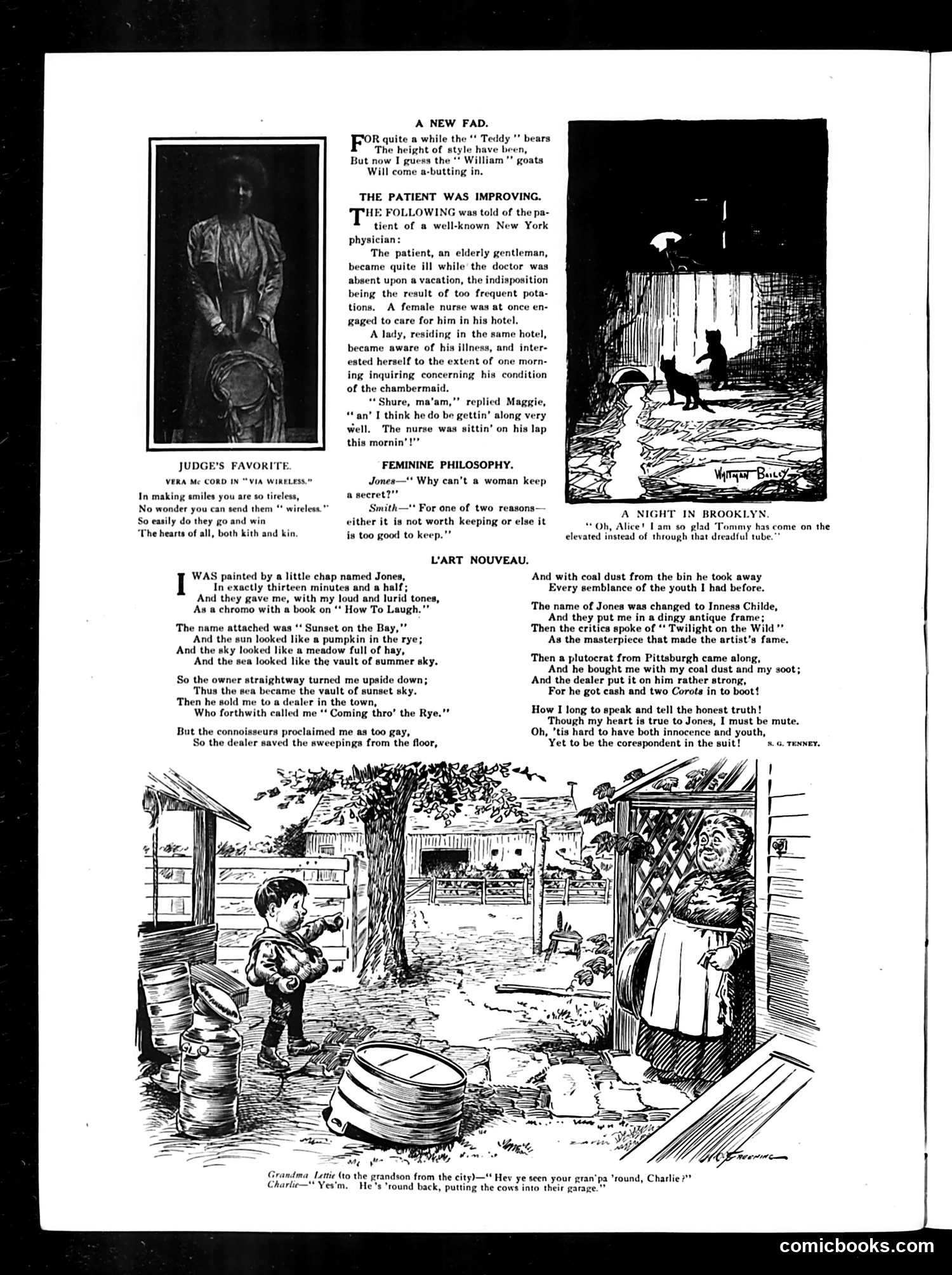
This page contains several unrelated satirical pieces typical of Judge magazine: **"A New Fad"** mocks the "Gibson Girl" aesthetic that dominated fashion, predicting "William" goats will become the next style trend—poking fun at how women followed beauty fads uncritically. **"The Patient Was Improving"** appears to be a humorous anecdote about a nurse's colloquial language and a patient's recovery, relying on dialect humor common to the era. **"Feminine Philosophy"** presents a brief joke about women keeping secrets, reflecting period stereotypes about female gossip. **"L'Art Nouveau"** is a poem satirizing the Art Nouveau movement's pretentiousness and rapid commercialization—mocking how avant-garde artistic movements quickly became commodified and sold to the wealthy. **The bottom illustration** shows a rural domestic scene with humorous dialogue, typical of Judge's rural/urban contrast comedy. The page reflects turn-of-the-century American attitudes toward fashion, artistic movements, and gender roles.
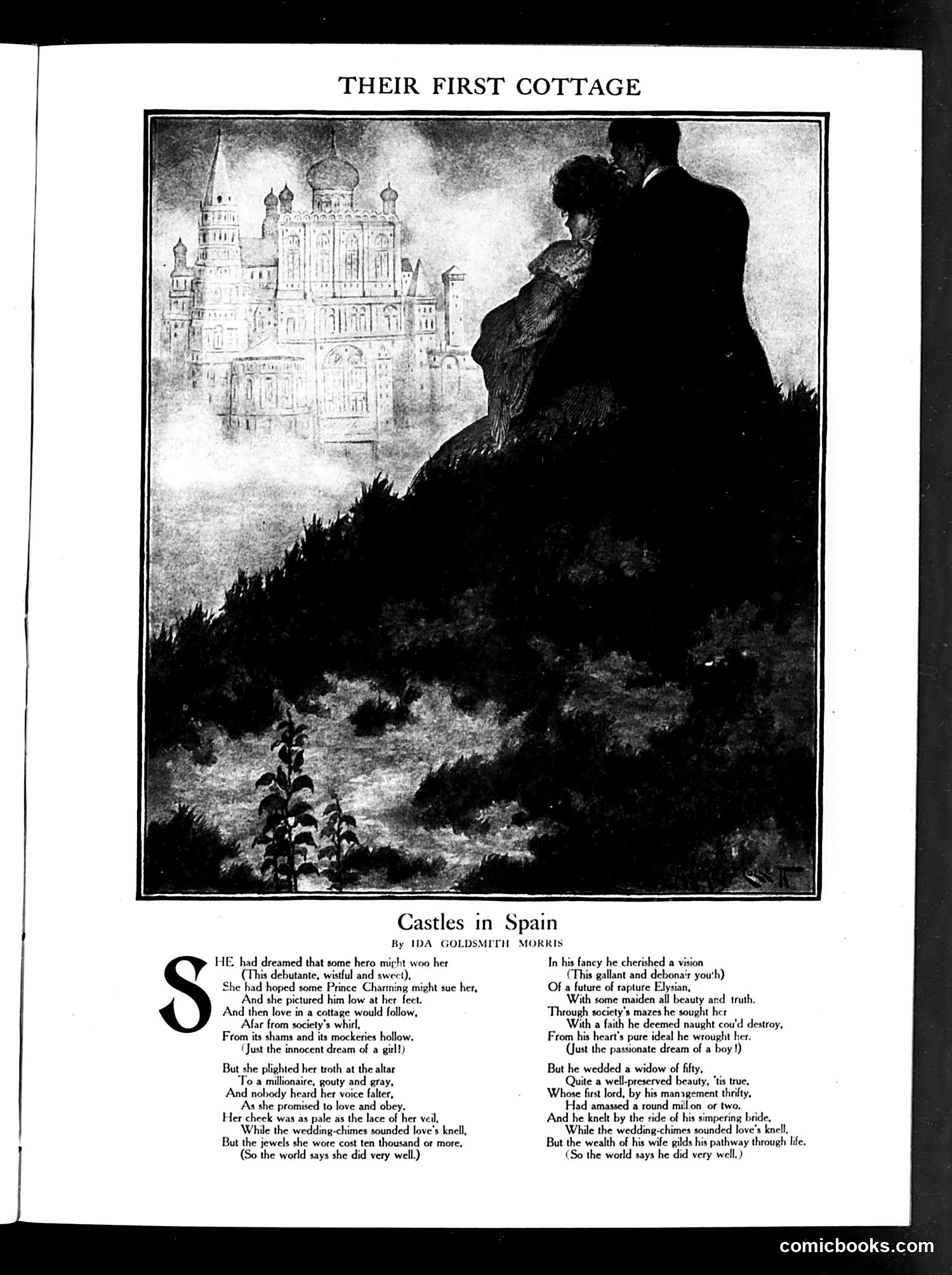
This is a romantic illustration accompanying a poem by Ida Goldsmith Morris titled "Castles in Spain." The image shows a couple gazing at an elaborate castle in the distance while standing on a hilltop—a visual metaphor for the poem's theme. The poem satirizes romantic idealism versus harsh reality. It narrates how a man dreams of marrying a woman of beauty and virtue, imagining a glorious future together. However, the reality proves disappointing: he marries "a widow of fifty" who is merely "well-preserved," and her wealth diverts him from his noble dreams. The title "Castles in Spain"—meaning impossible dreams or fantasy—captures the satire: romantic illusions crumble when confronted with practical, unglamorous reality, particularly regarding marriage and wealth.
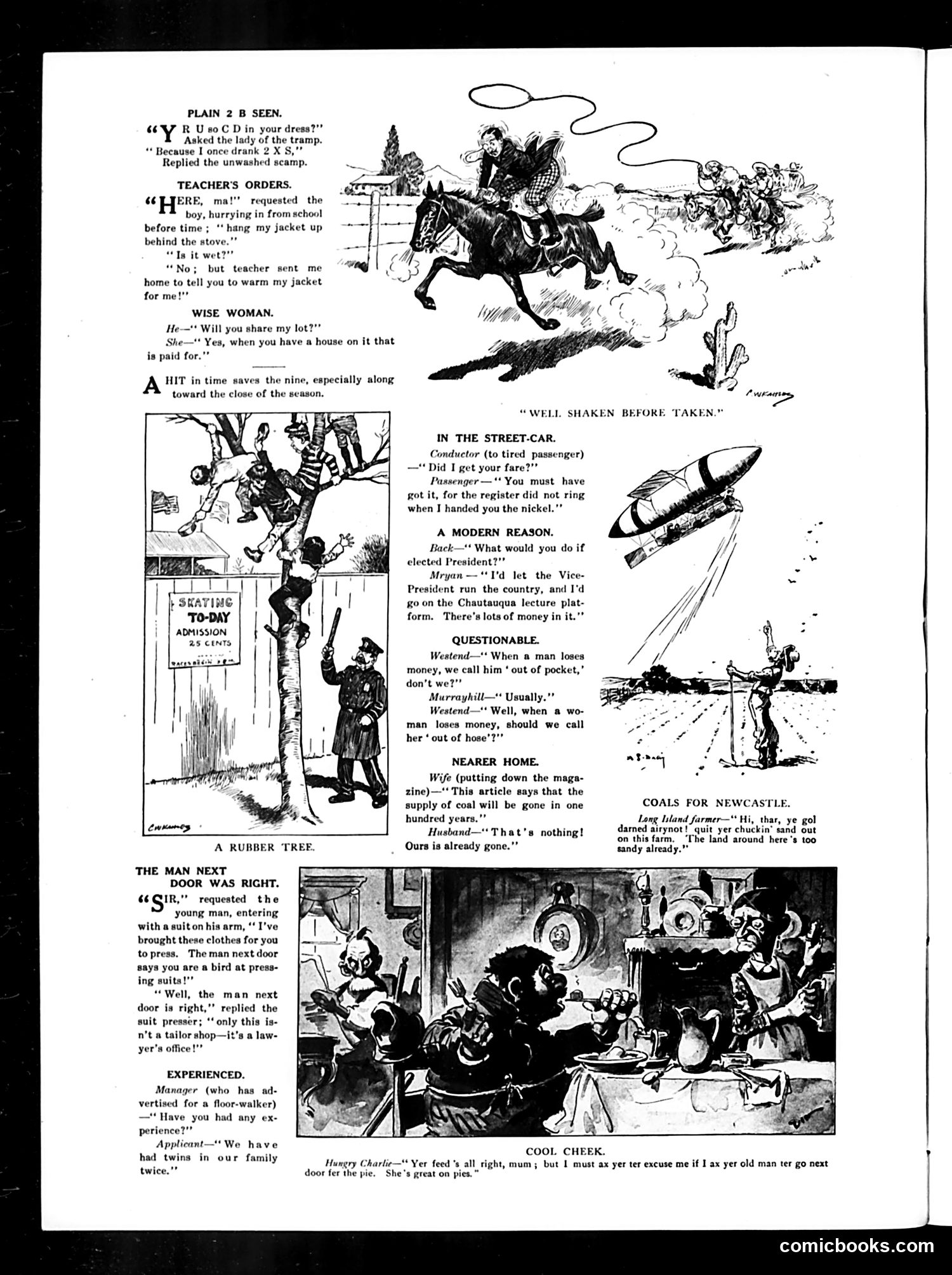
This page contains brief satirical jokes and comic vignettes typical of early 20th-century humor magazines. **Key content includes:** - **"A Modern Reason"**: Mocks William Jennings Bryan (identified as candidate "Bryan"), suggesting he'd become President merely to profit from Chautauqua lecture circuit appearances—satirizing politicians' mercenary motivations. - **Street-car conductor joke**: Satirizes dishonest transit workers who pocket fares without ringing them on registers. - **Gender humor**: Multiple jokes about women's financial irresponsibility and materialism ("she'll marry you when you own property outright"). - **Class commentary**: Jokes about working-class incompetence (the "rubber tree" pressing clothes in a lawyer's office; the inexperienced floor-walker). - **Rural satire**: The Long Island farmer and hungry vagrant represent stock working-class characters. The page satirizes typical early-1900s concerns: political corruption, urban transit fraud, gender relations, class pretension, and economic anxiety—delivered through quick, punchy jokes rather than sustained narratives.
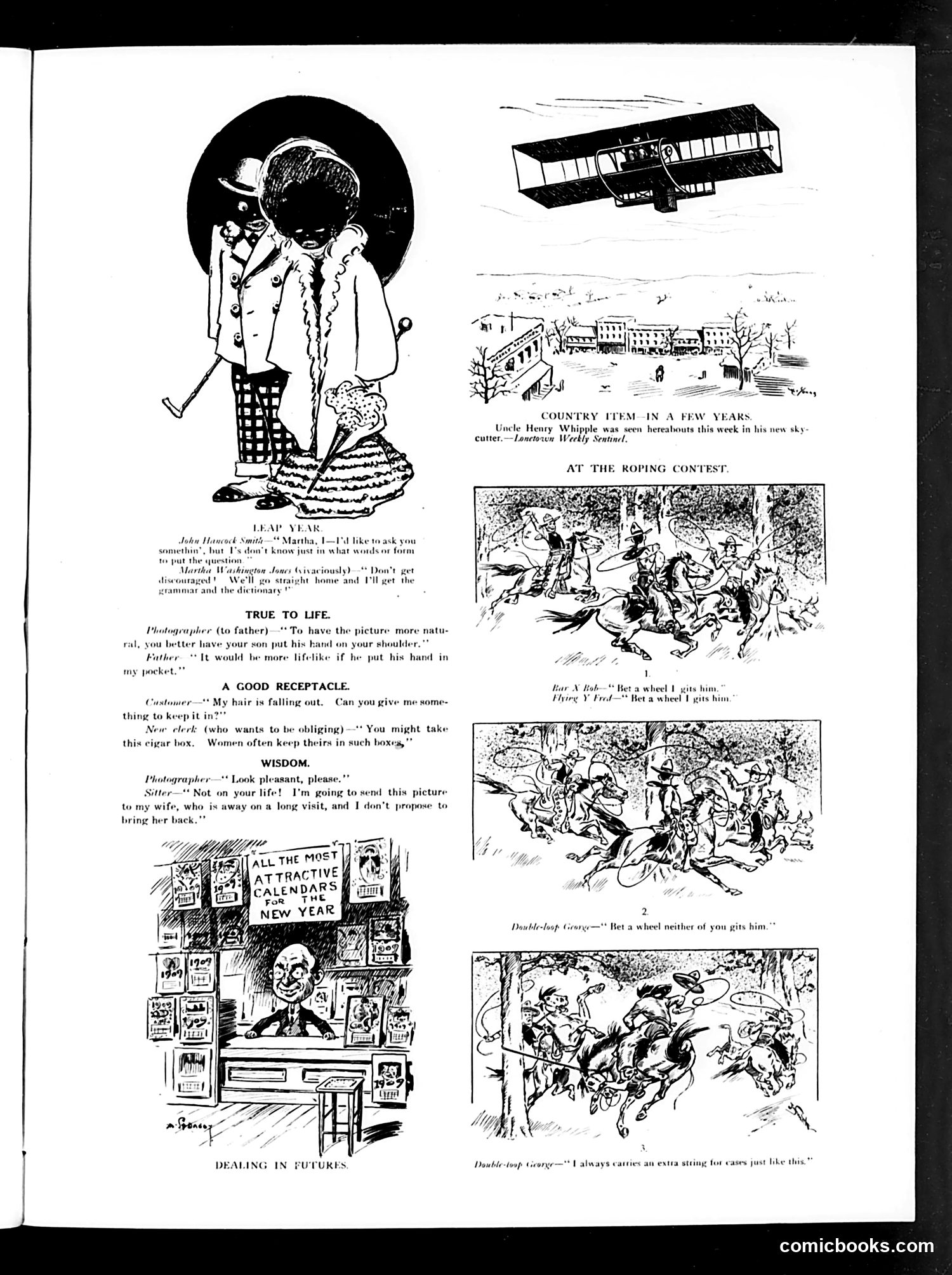
This page contains several unrelated humor pieces typical of early 20th-century Judge magazine. The cartoons are mostly domestic comedy with no clear political content: **"Leap Year"** jokes about women's traditional boldness during leap years when they could propose to men. **"True to Life"** and **"A Good Receptacle"** are photographer and barber shop jokes about vanity and practicality. **"Wisdom"** features a man refusing to look pleasant in a photograph because he doesn't want his absent wife to see a good picture of him—implying marital discord. **"Country Item"** appears to reference Uncle Henry Whipple's new aircraft, predicting future aerial transportation. **"At the Roping Contest"** shows cowboys at a roping competition with dialogue about betting and equipment. The **"Dealing in Futures"** cartoon depicts a calendar seller, likely satirizing commercialism. These are primarily social humor pieces rather than political satire.
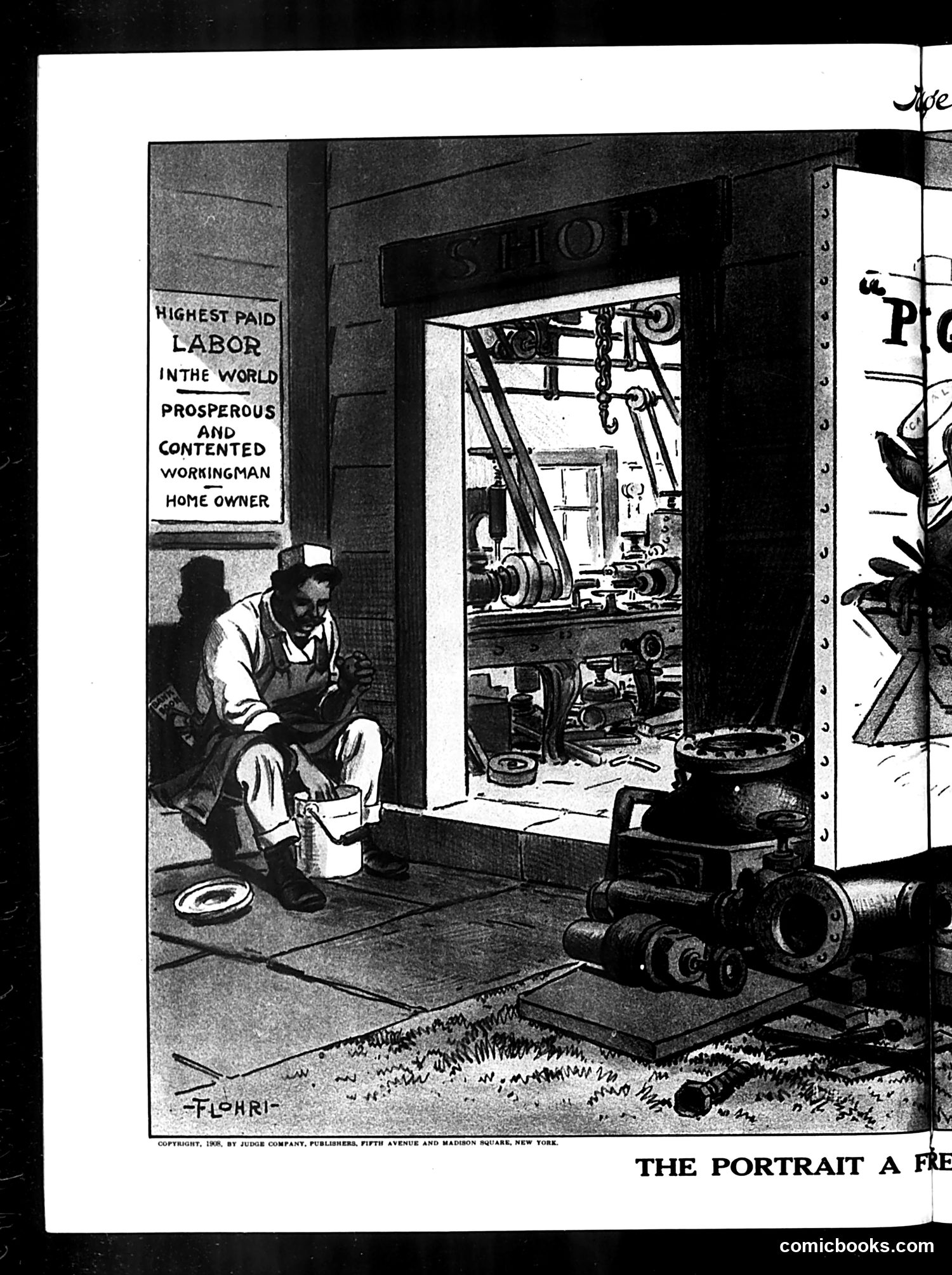
This cartoon depicts a working-class man sitting outside a factory or shop, eating from a bucket—likely his lunch pail. The sign behind him declares "HIGHEST PAID LABOR IN THE WORLD" and references the "PROSPEROUS AND CONTENTED WORKINGMAN HOME OWNER." The satire appears to be **ironic commentary on American labor conditions**, contrasting official claims about worker prosperity with the actual visual reality: a man eating modest food outside an industrial workplace, surrounded by machinery and work materials. The cartoon's message suggests skepticism about propaganda promoting American workers as the world's best-paid and content, when visible evidence shows humble working conditions. This likely reflects early 20th-century labor debates regarding wages, working conditions, and the gap between political rhetoric and workers' actual lives. The artist is credited as "Fiorhi" (or similar).
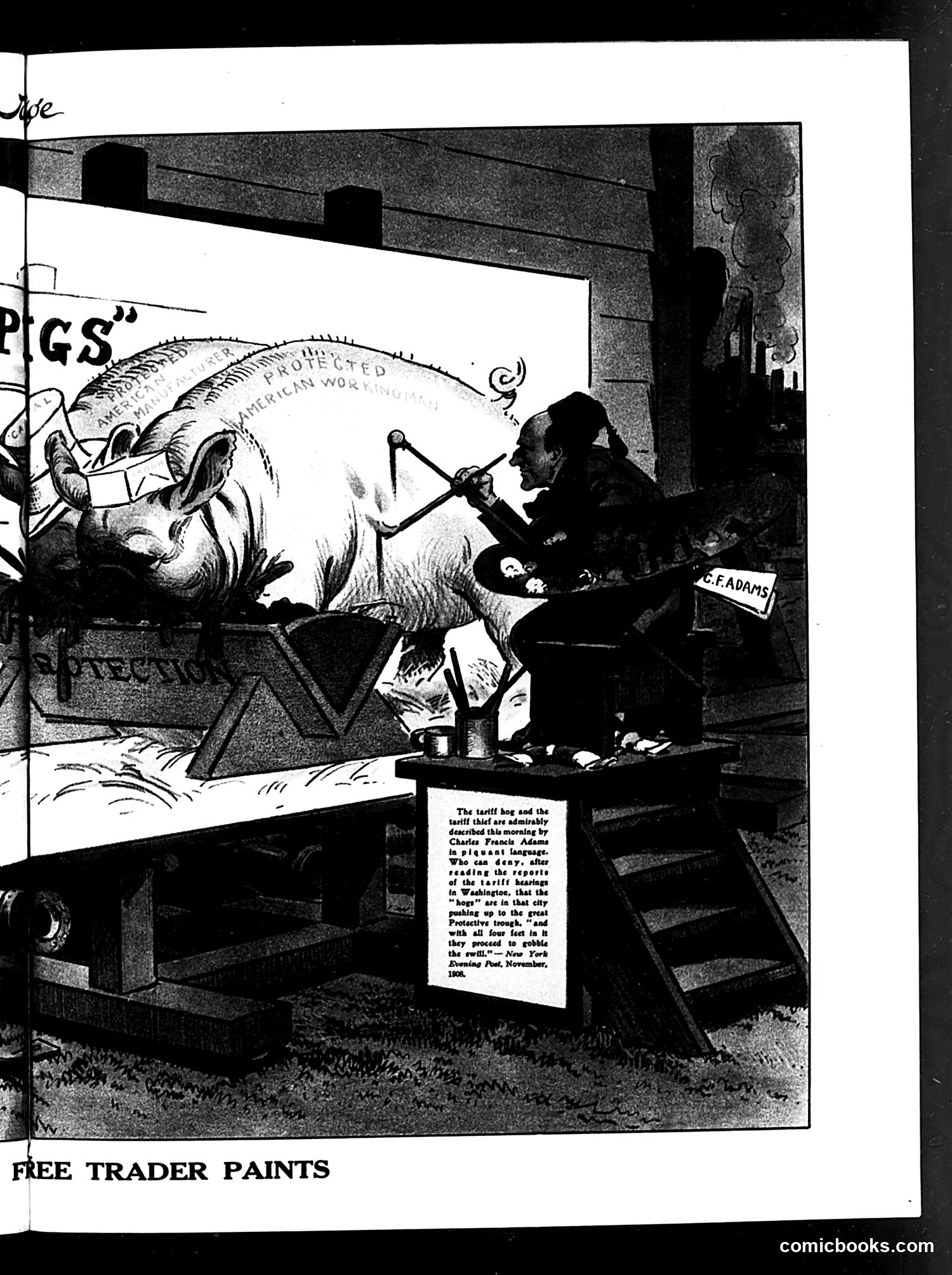
This political cartoon satirizes American protectionist tariff policies, likely from the 1908 election period. The image shows a caricatured figure (labeled C.F. Adams, visible on the right) painting or depicting large pigs labeled "PIGS" and marked "PROTECTED." The accompanying text references a New York Evening Post quote describing politicians as "hogs" pushing to the "Protective trough" in Washington, greedily consuming government benefits. The satire criticizes how tariff protection benefited special interests and wealthy industries—depicted as pigs feeding at public expense. The artist is apparently painting propaganda celebrating this system. This reflects the era's debate over free trade versus protectionism, with critics viewing tariffs as corrupt corporate welfare.
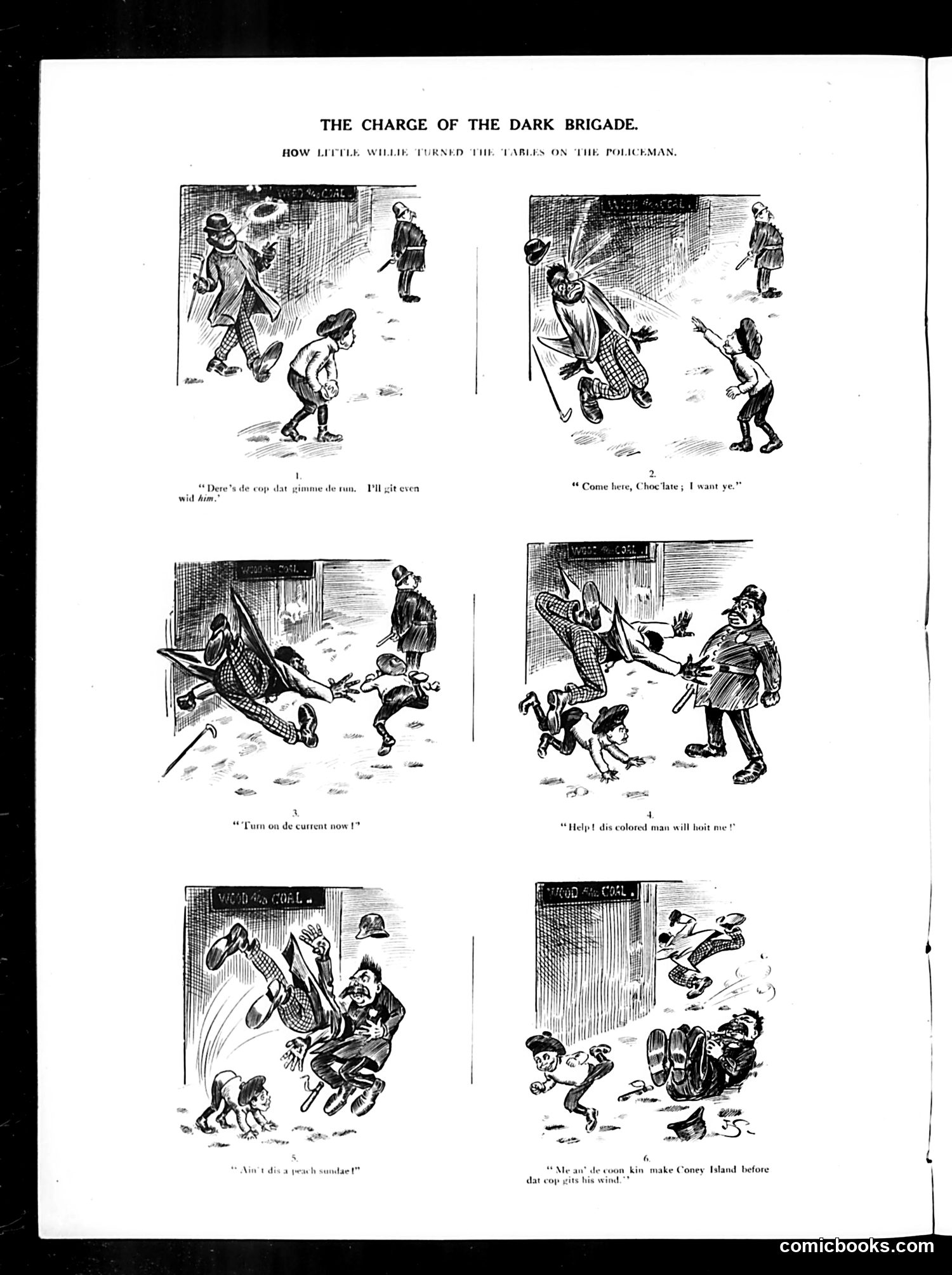
This is a satirical six-panel sequence titled "How Little Willie Turned the Tables on the Policeman." The narrative shows a small boy ("Willie") initially fleeing from a pursuing policeman, then reversing the dynamic through escalating chaos. The humor relies on role-reversal: the powerless child becomes the aggressor, attacking the authority figure with increasingly absurd methods—swinging from a net, kicking, causing the cop to lose his hat and dignity. The final panels show Willie creating such pandemonium that the policeman is overwhelmed and humiliated. The satire appears to mock both the ineffectual law enforcement of the era and celebrate mischievous childhood defiance. The "Dark Brigade" title parodies military language, treating a child's pranks as heroic rebellion. This reflects turn-of-the-century Judge magazine's irreverent tone toward civic institutions.
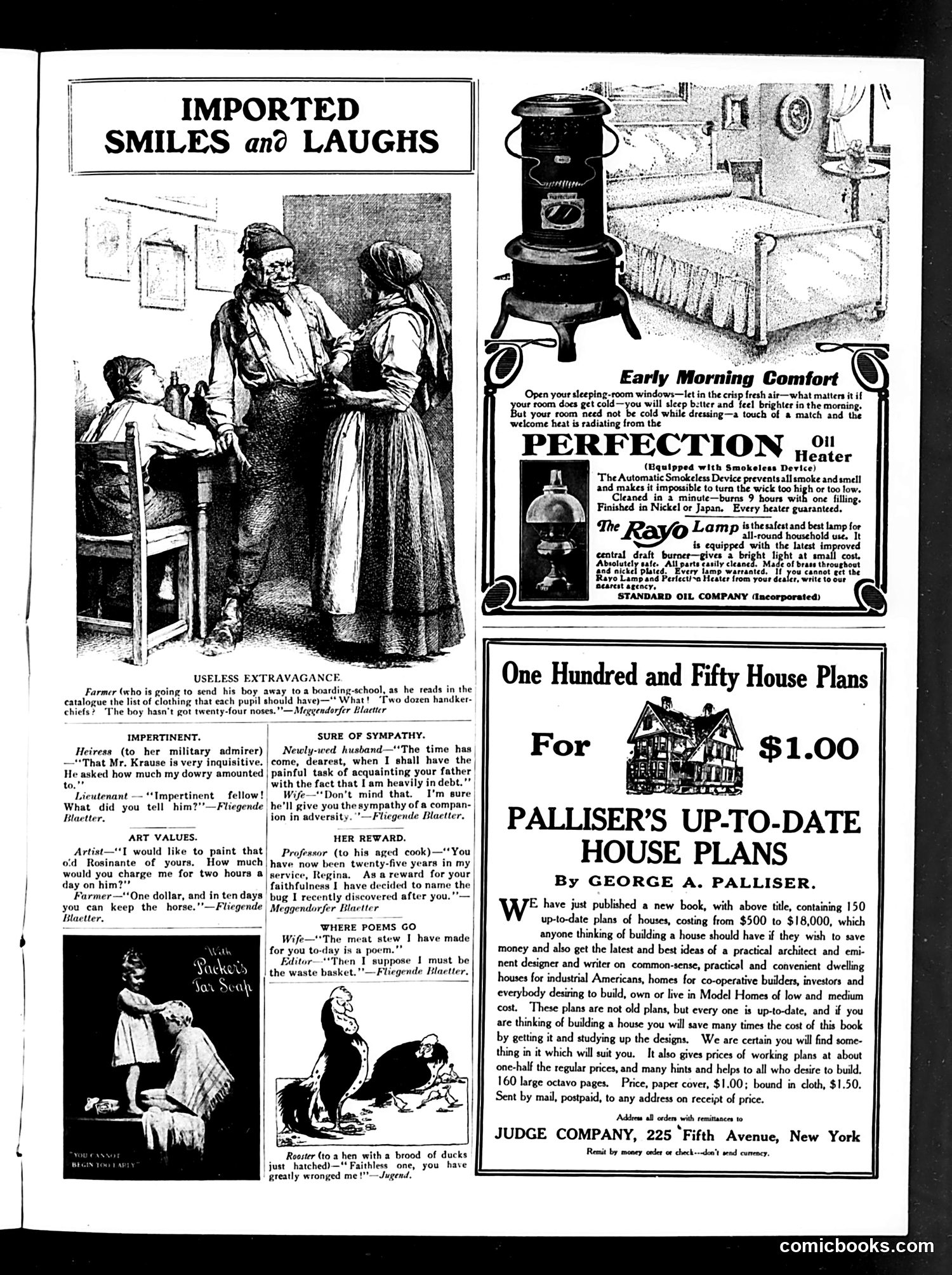
This page from *Judge* magazine combines satirical comics with period advertisements. The humor pieces, reprinted from European sources (*Fliegende Blätter*, *Meggendorfer Blätter*), satirize class divisions and social pretension through brief scenarios: **"Useless Extravagance"** mocks wealthy boarding schools' clothing requirements—a farmer's practical objection to needing two dozen handkerchiefs highlights the absurdity of upper-class excess. **Other vignettes** target military suitors asking about dowries, newlyweds' debt problems, and an artist undervaluing farm labor—standard turn-of-the-century social comedy about money, marriage, and class friction. The page is primarily **advertising**: Perfection Oil heater and Rayo lamp (Standard Oil Company products) dominate the right side, while Palliser's House Plans occupy the lower section—appealing to aspiring middle-class homeowners. Together, the content reflects early 1900s anxieties: rapid industrialization, class mobility, and consumer culture. The satirical comics legitimize *Judge's* identity as witty social commentary while advertisements market modernity to readers.
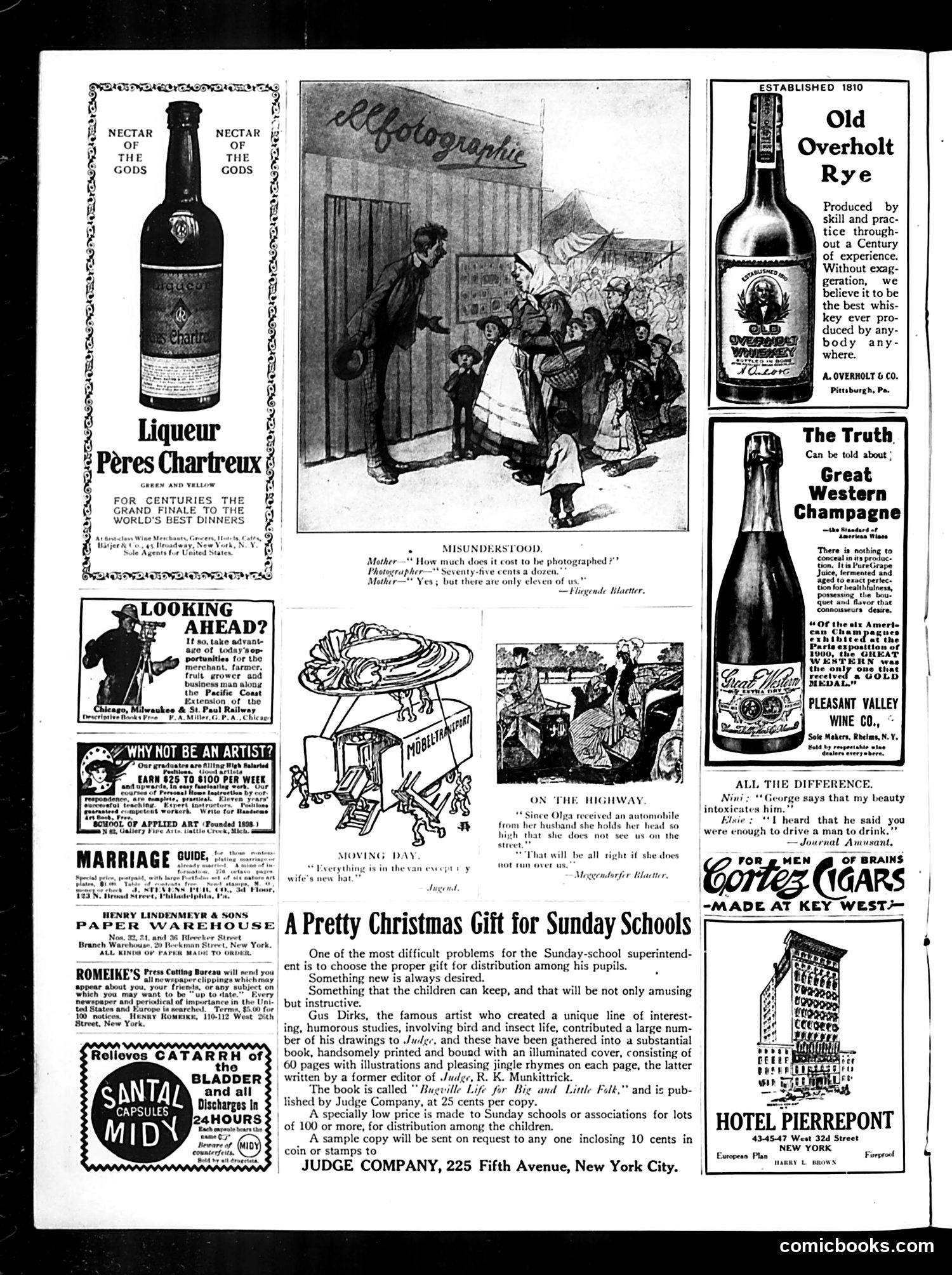
This page is primarily **advertising and promotional content** rather than political satire. It features: **Advertisements:** High-end liquor brands (Liqueur Pérès Chartreux, Old Overholt Rye, Great Western Champagne, Cortes Cigars) and the Hotel Pierrepont—typical luxury product placements for Judge's affluent readership. **Small Comic Illustrations:** Three brief captioned sketches with mild humor: - "Misunderstood": A photographer's misquote creates comedy - "On the Highway": A car-related joke about wives and perception - "Moving Day": A domestic scene joke **Main Content:** An announcement promoting "Bugville Life for Big and Little Folk," a children's book illustrated by artist Gus Dirks, published by Judge Company at 25 cents. The page emphasizes it as an ideal Sunday School gift—educational, amusing, and affordable for bulk distribution. The page reflects early 20th-century middle-class consumer culture and concerns, with light domestic humor typical of Judge's family-oriented advertising sections.
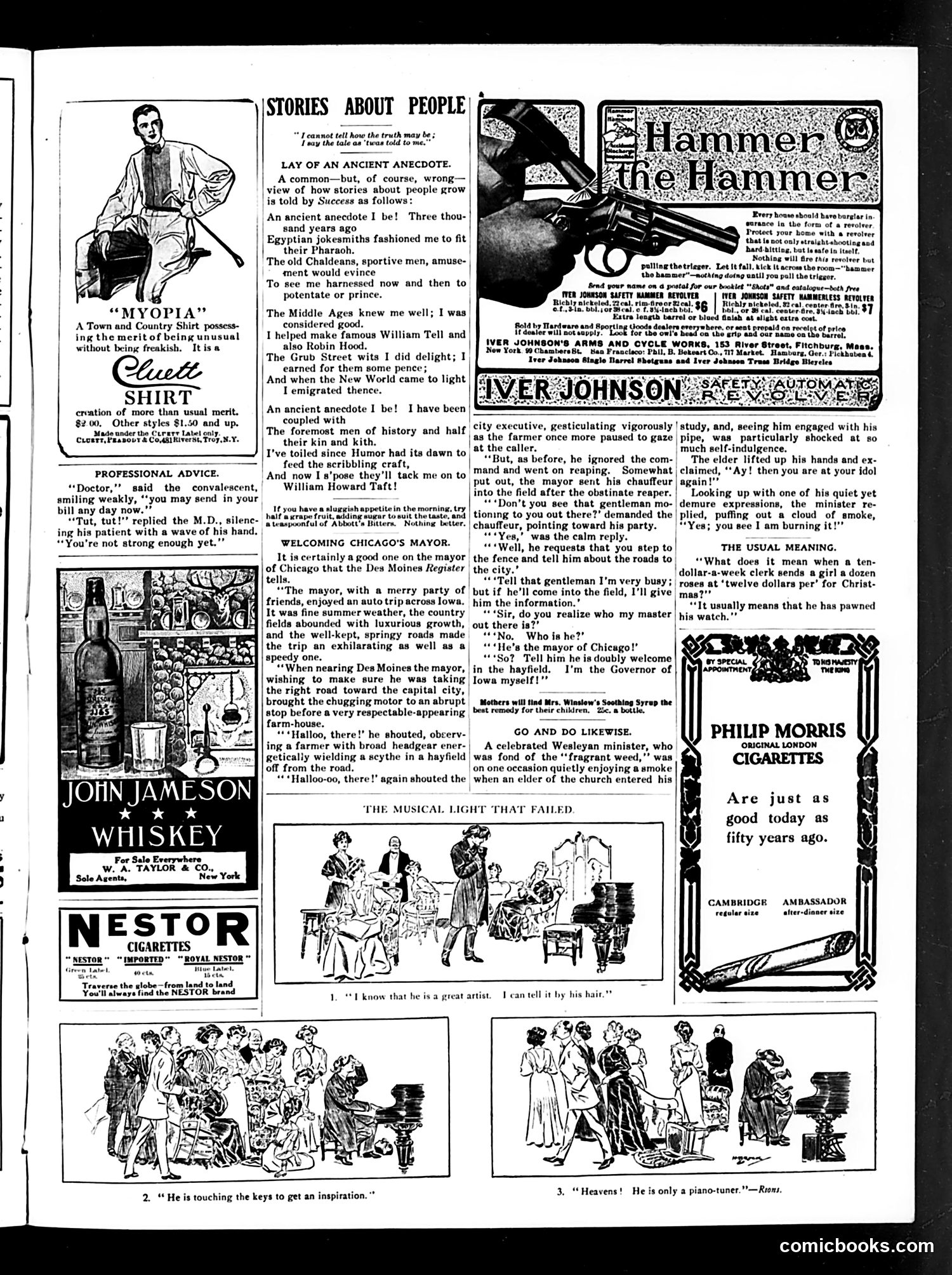
This *Judge* magazine page contains satirical stories and period advertisements. The main satirical piece, "Lay of an Ancient Anecdote," traces how a joke supposedly originated 3,000 years ago in Egypt and has been recycled through history—passed among Pharaohs, Chaldeans, Medieval figures (William Tell, Robin Hood), and now attached to contemporary figures like William Howard Taft. The joke criticizes how old anecdotes are constantly repurposed and credited to new famous people rather than being original. "Welcoming Chicago's Mayor" satirizes a mayor's visit to Iowa farm country. When the mayor stops to ask directions, a farmer ignores him, continuing to work. The humor derives from rural indifference to urban political authority—the farmer doesn't recognize or care about the mayor's importance. The page also includes period advertisements for whiskey, cigarettes, shirts, and notably, an *Iver Johnson Safety Hammer Revolver*, emphasizing home protection—reflecting early 20th-century concerns about burglary.
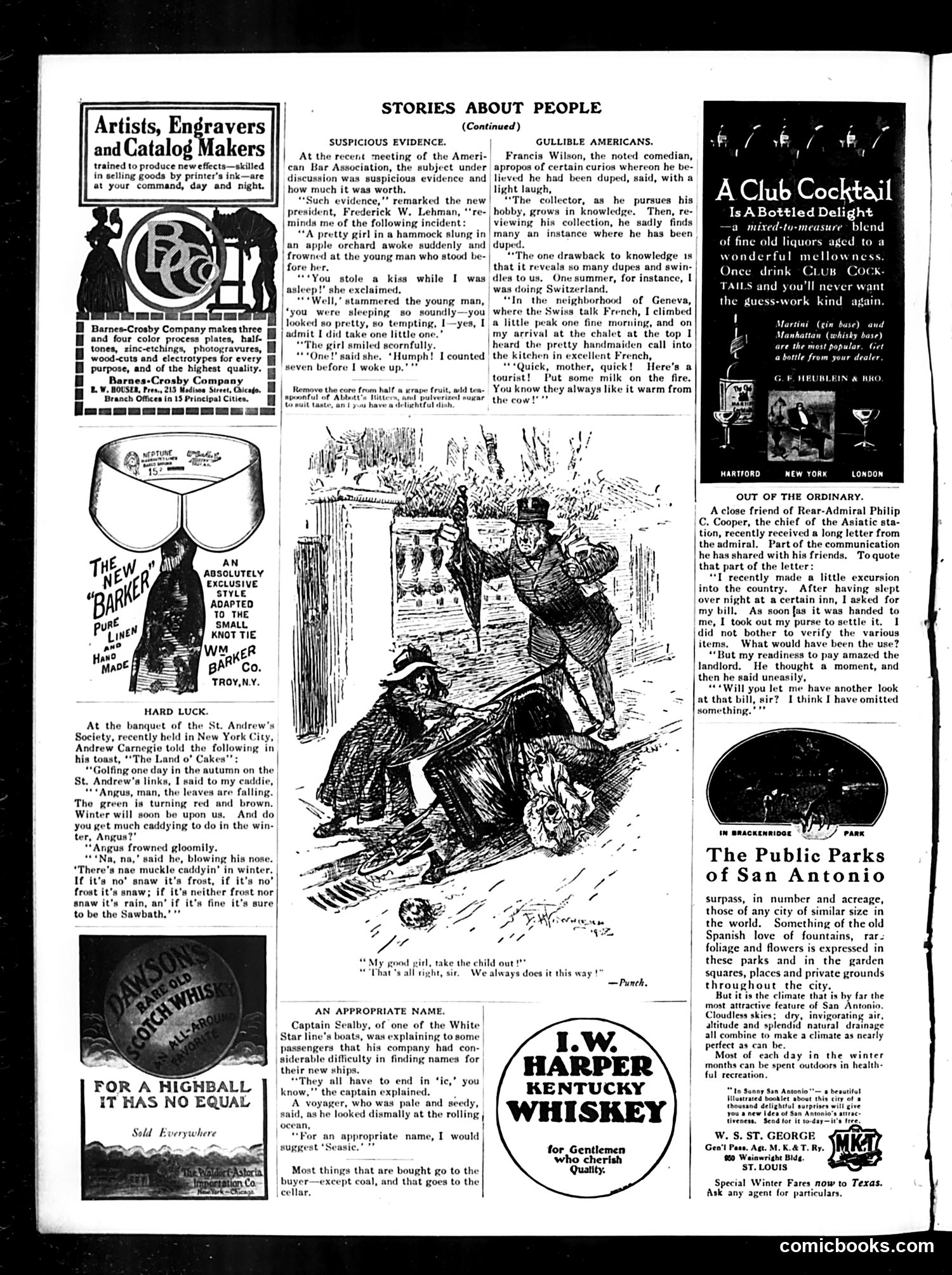
This page contains three anecdotal stories ("Stories About People") and period advertisements, rather than political cartoons. **The stories** are humor pieces: One jokes about a young man stealing a kiss from a sleeping girl and using "suspicious evidence" as excuse. Another describes American tourists' gullibility—a Swiss innkeeper's daughter deliberately serves warm milk to tourists, knowing they expect it. The third recounts Andrew Carnegie's golf caddie lamenting Scotland's poor weather for caddying work. **The humor** relies on mild sexism and ethnic stereotyping typical of early 20th-century American magazines. The jokes target romantic deception, tourist naïveté, and Scottish thriftiness—common comedic tropes of the era. **The advertisements** promote whiskey, cocktails, and printing services, reflecting Judge's target audience of prosperous businessmen. This appears to be a typical Judge page mixing light social satire with commercial content.
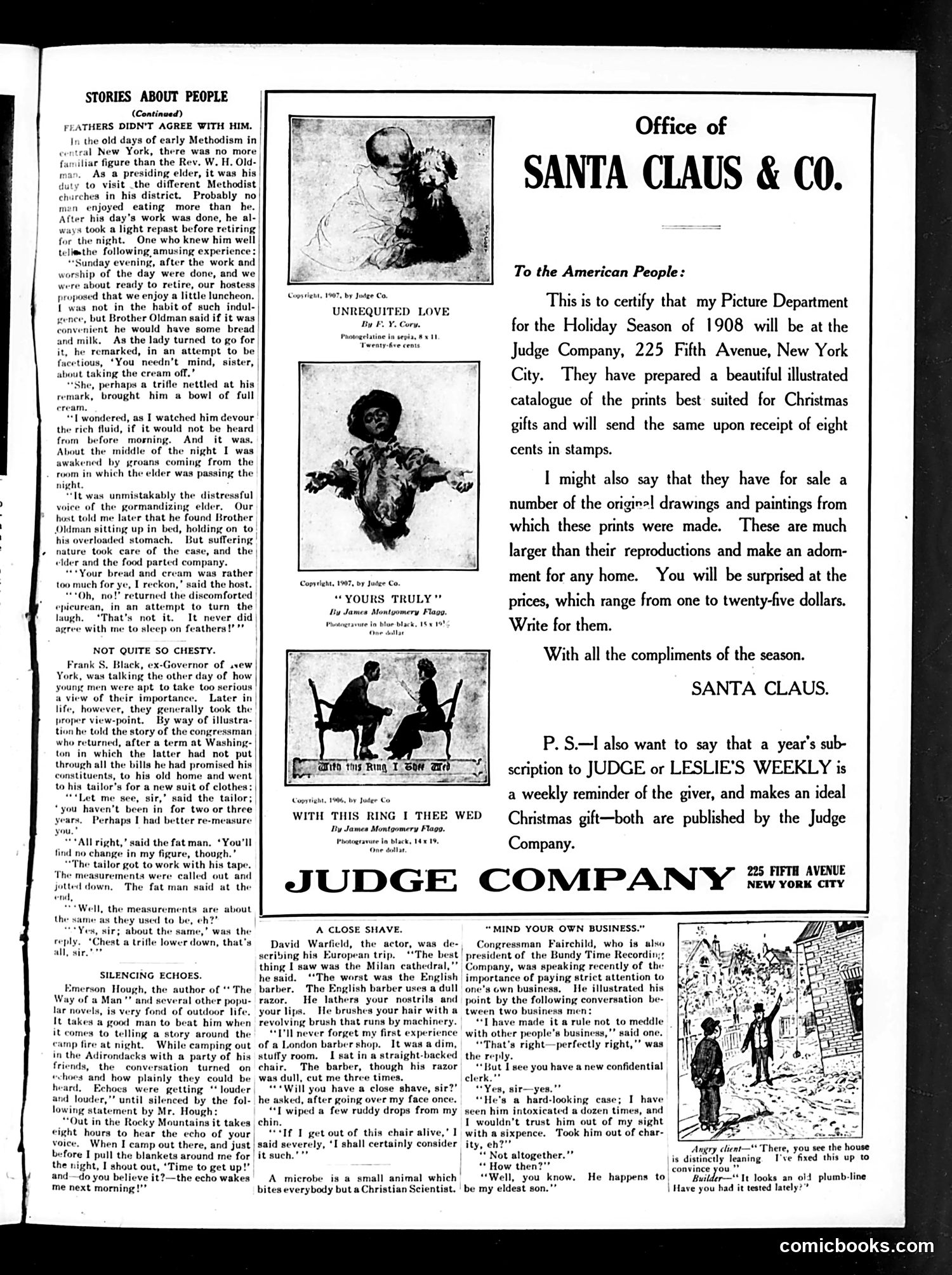
This page is primarily **advertising content** disguised as editorial material. The right half features a letter from "Santa Claus & Co." promoting Judge Company's 1908 holiday picture catalog and original artworks for sale (priced $1-$25). The left side contains brief humorous anecdotes: 1. **"Feathers Didn't Agree with Him"**: A Methodist minister's digestive misadventure after eating bread and cream before bed—a simple punchline about overeating. 2. **"Not Quite So Chesty"**: An anecdote about a congressman's inflated self-importance being deflated upon returning home to his tailor, who must re-measure him (implying weight loss or physical diminishment after leaving Washington). These are light, moralistic humor pieces—common to Judge magazine's "Stories About People" column. They contain no sharp political satire, merely gentle jabs at human vanity and excess. The page exemplifies Judge's dual function: satirical commentary mixed with advertising revenue.
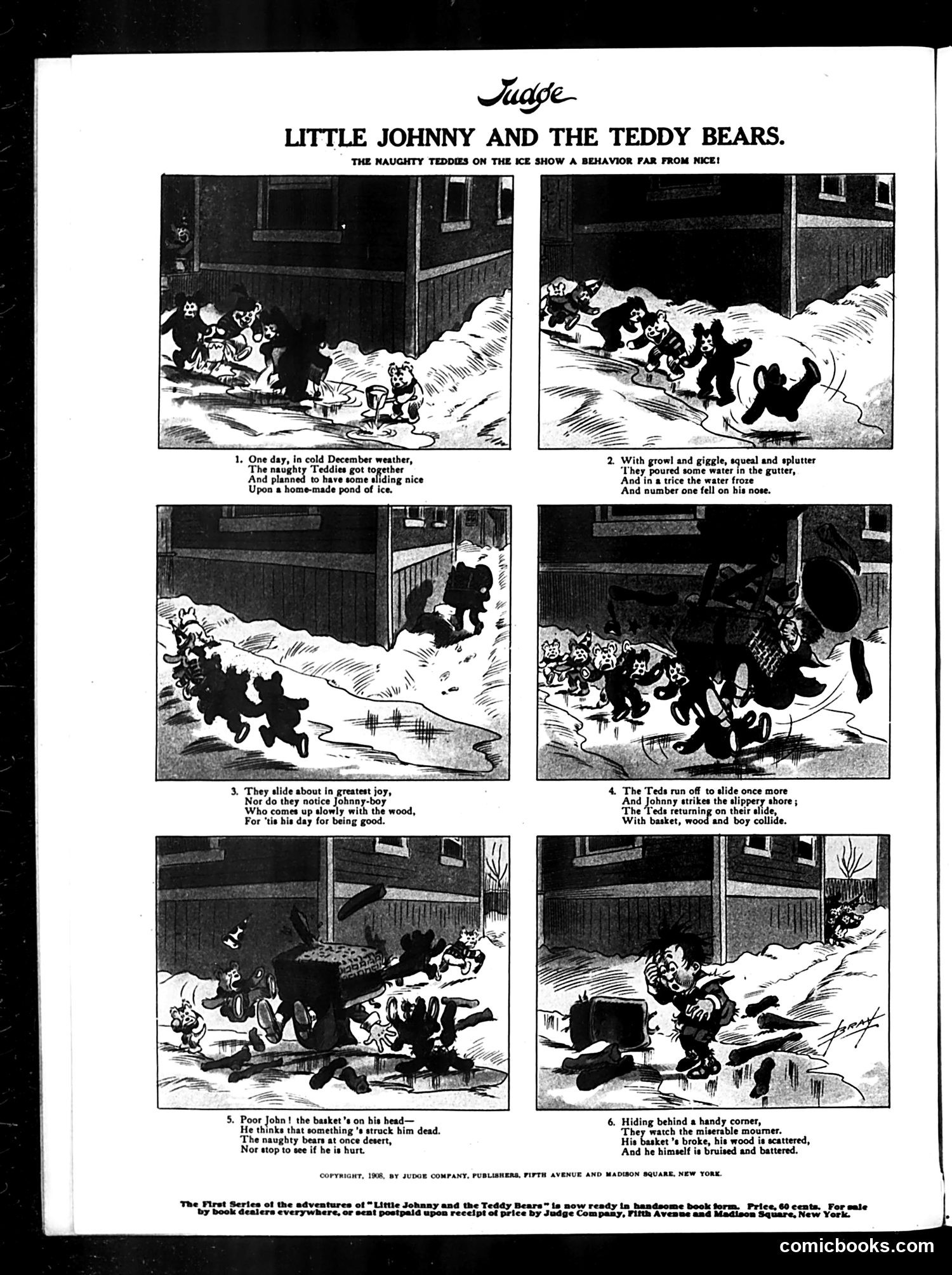
This is a six-panel children's comic strip, not political satire. It depicts "Little Johnny" encountering mischievous teddy bears on an icy winter day. The narrative shows the bears causing chaos—they create an ice slide, pour water to freeze it, and play recklessly while Johnny approaches carrying wood (his assigned chore). The bears' slide collides with Johnny, sending him tumbling with a basket on his head. The bears abandon him without checking if he's hurt, exemplifying their "naughty" behavior as the subtitle promises. The strip appears designed as lighthearted entertainment about childhood misbehavior. The "Teddy Bears" reference likely alludes to the popular toy trend following President Theodore Roosevelt, though the bears here are anthropomorphic characters rather than political commentary. An advertisement at bottom promotes the storyline in book form, indicating Judge used this strip as marketable content for younger readers.