
A complete issue · 16 pages · 1908
Judge — October 10, 1908
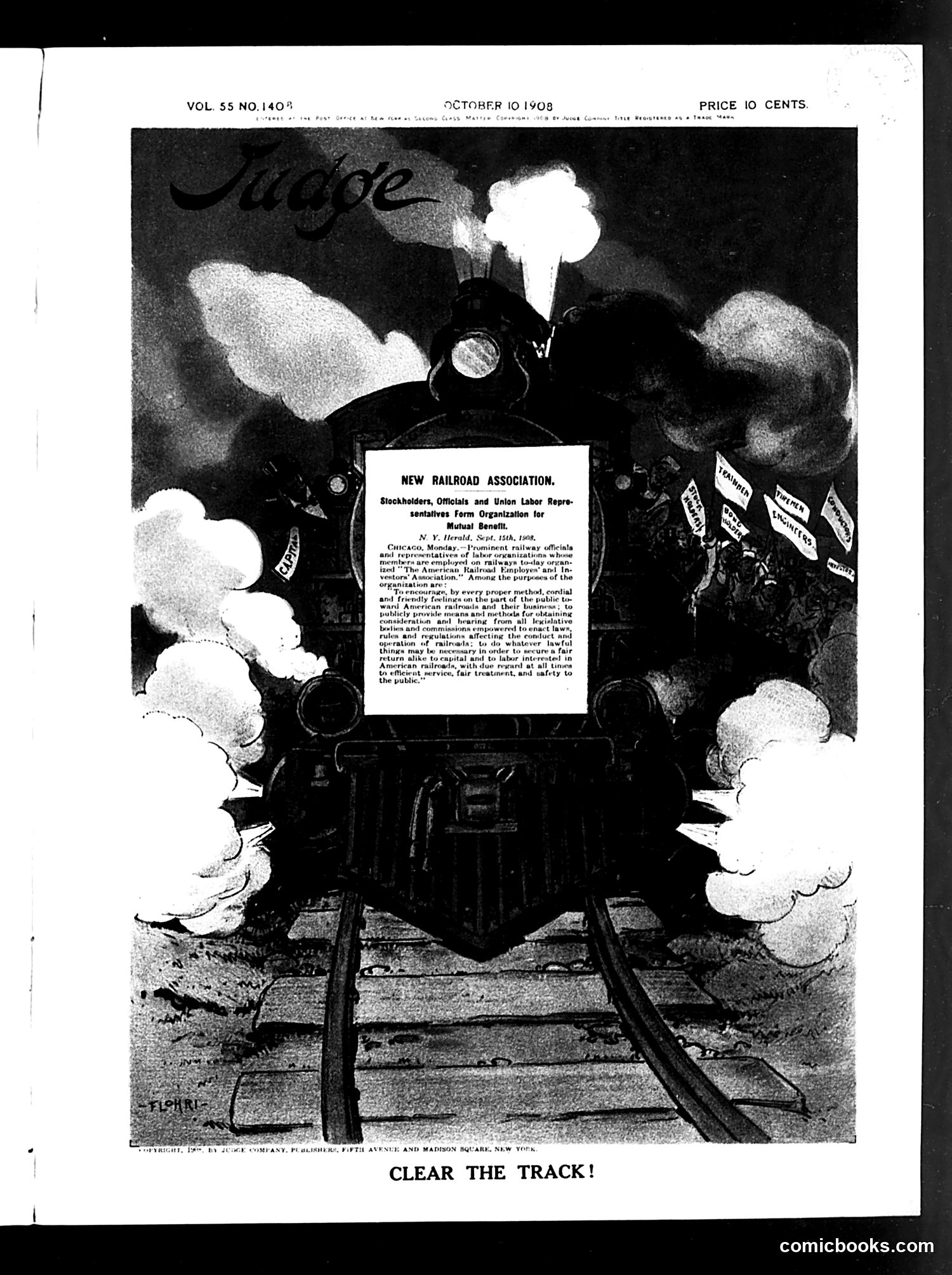
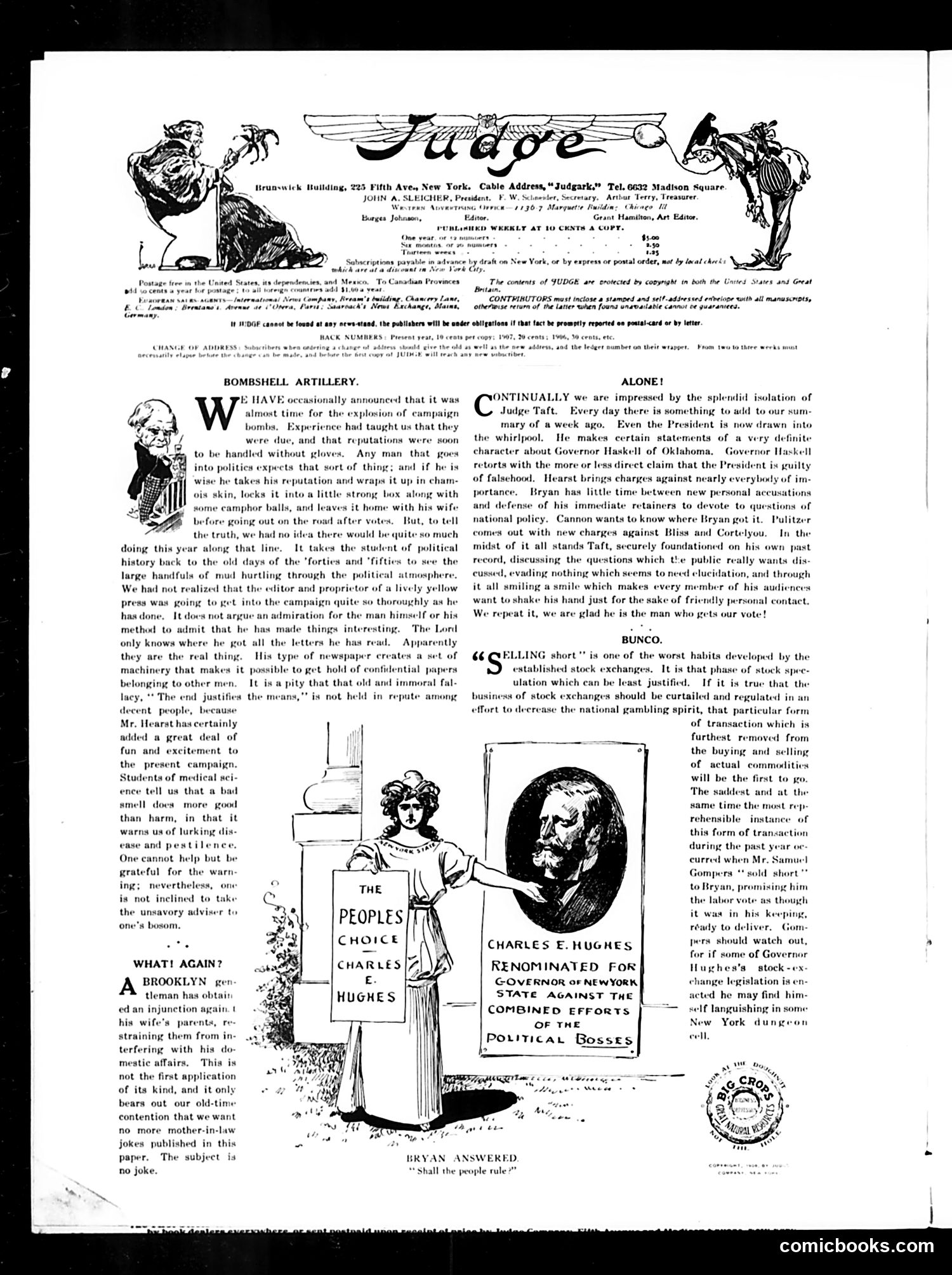
This page contains three separate political commentaries from what appears to be an early 20th-century Judge issue. **"Bombshell Artillery"** mocks unnamed political figures for denying campaign bombs existed, then claiming they were necessary—apparently referencing actual bombing incidents during a political campaign. **"The People's Choice"** features an illustration endorsing Charles E. Hughes for New York Governor, presenting him as the public's preferred alternative to "combined efforts of the political bosses." **"Bunco"** criticizes stock exchange "short selling," arguing it damages the national economy and should be legislated against. The author suggests this financial practice is among "the worst habits developed by the established stock exchange." The page reflects Progressive Era concerns about political violence, machine politics, and financial reform.
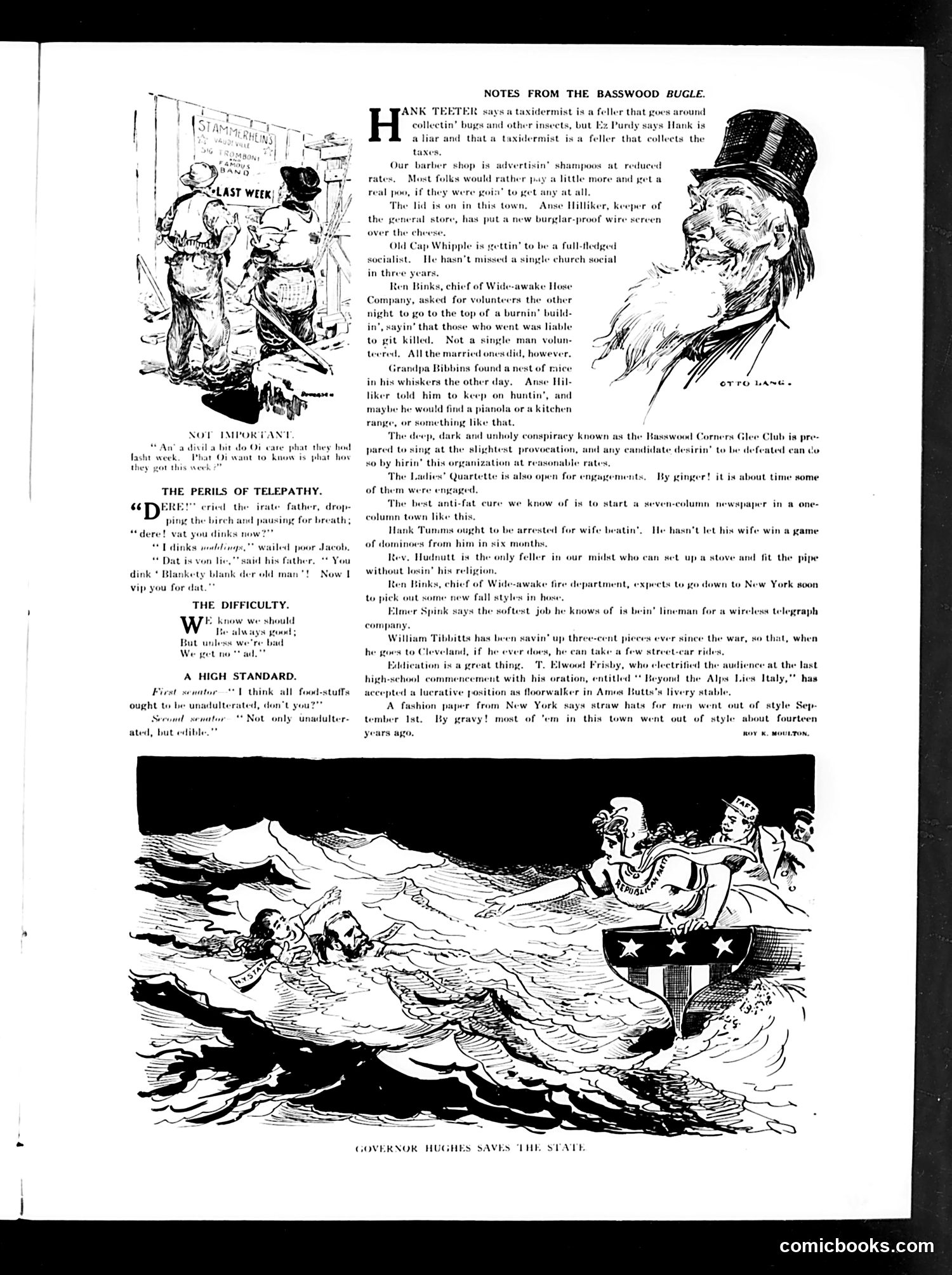
The main cartoon depicts Governor Hughes (identifiable by the shield with stars) rescuing the state from turbulent waters. The drowning figures in the water appear to represent state problems or corruption Hughes is addressing. The surrounding text contains humorous anecdotes and observations about small-town life, including mentions of local characters like Hank Teeter (taxidermist), Cap Whipple (socialist), and Red Rinks (fire chief). These satirize various social types and institutions through exaggerated stereotypes. The "Perils of Telepathy" section mocks miscommunication and misunderstandings. Overall, the page celebrates Hughes's gubernatorial leadership while using humor to critique small-town foibles and social pretensions of the era.
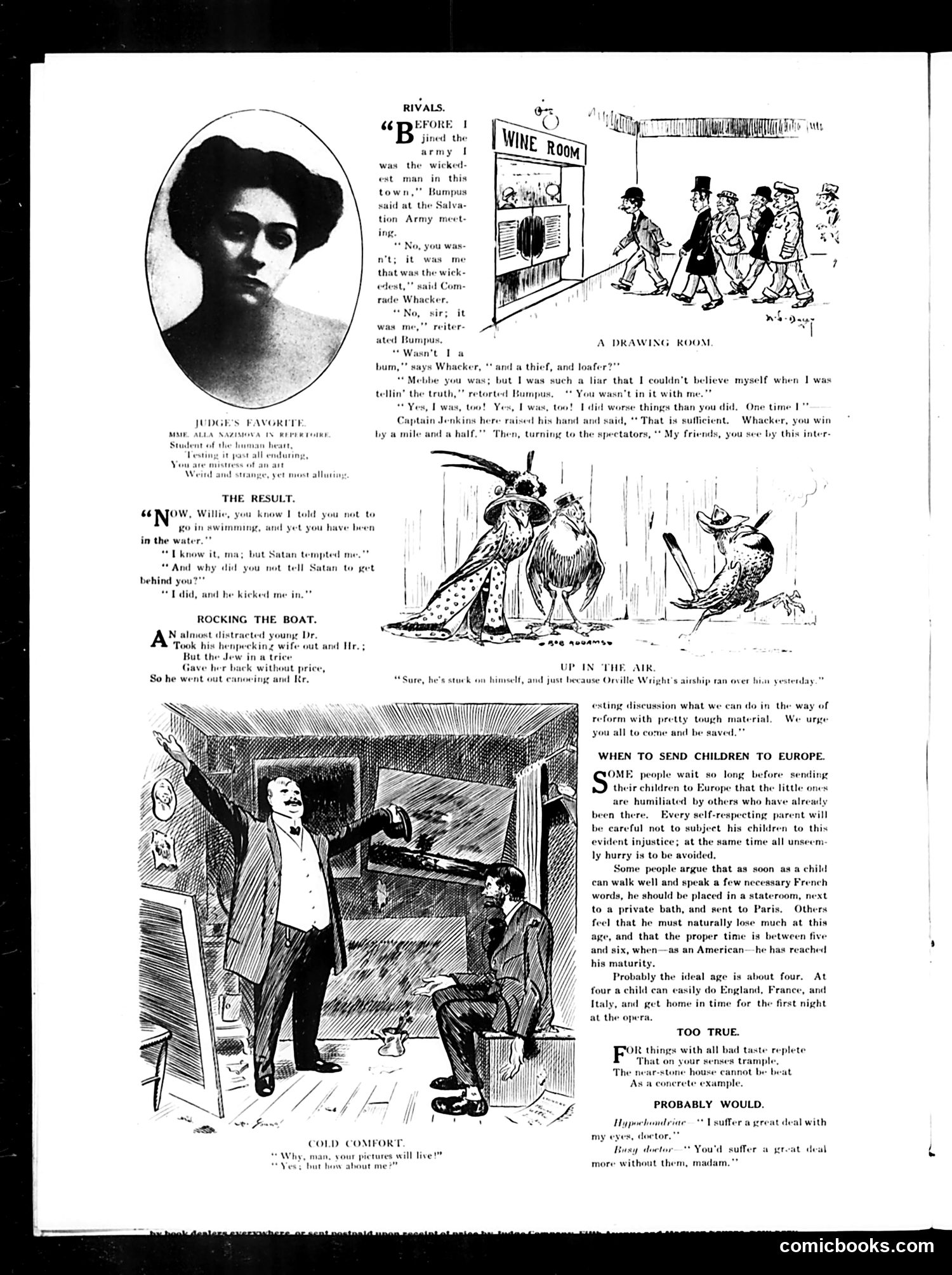
This page contains several unrelated satirical pieces typical of Judge's format: 1. **"Judge's Favorite"** - A portrait (identity unclear) with humorous verse about enduring life's difficulties. 2. **"Rivals"** - A dialogue between Hampus and Comrade Whacker debating who was the "wickedest" person, establishing themselves as competitive scoundrels. The joke appears to be their mutual boasting about moral failings. 3. **"A Drawing Room"** - Cartoon showing men entering a wine room, captioned as a social observation. 4. **"Cold Comfort"** - A sketch of a man discussing his portrait with an artist, playing on vanity and artistic representation. 5. **"When to Send Children to Europe"** - Serious advice column recommending careful timing for children's European travel to avoid cultural shock. The page mixes humor, social commentary, and practical advice—typical Judge content blending entertainment with social observation.
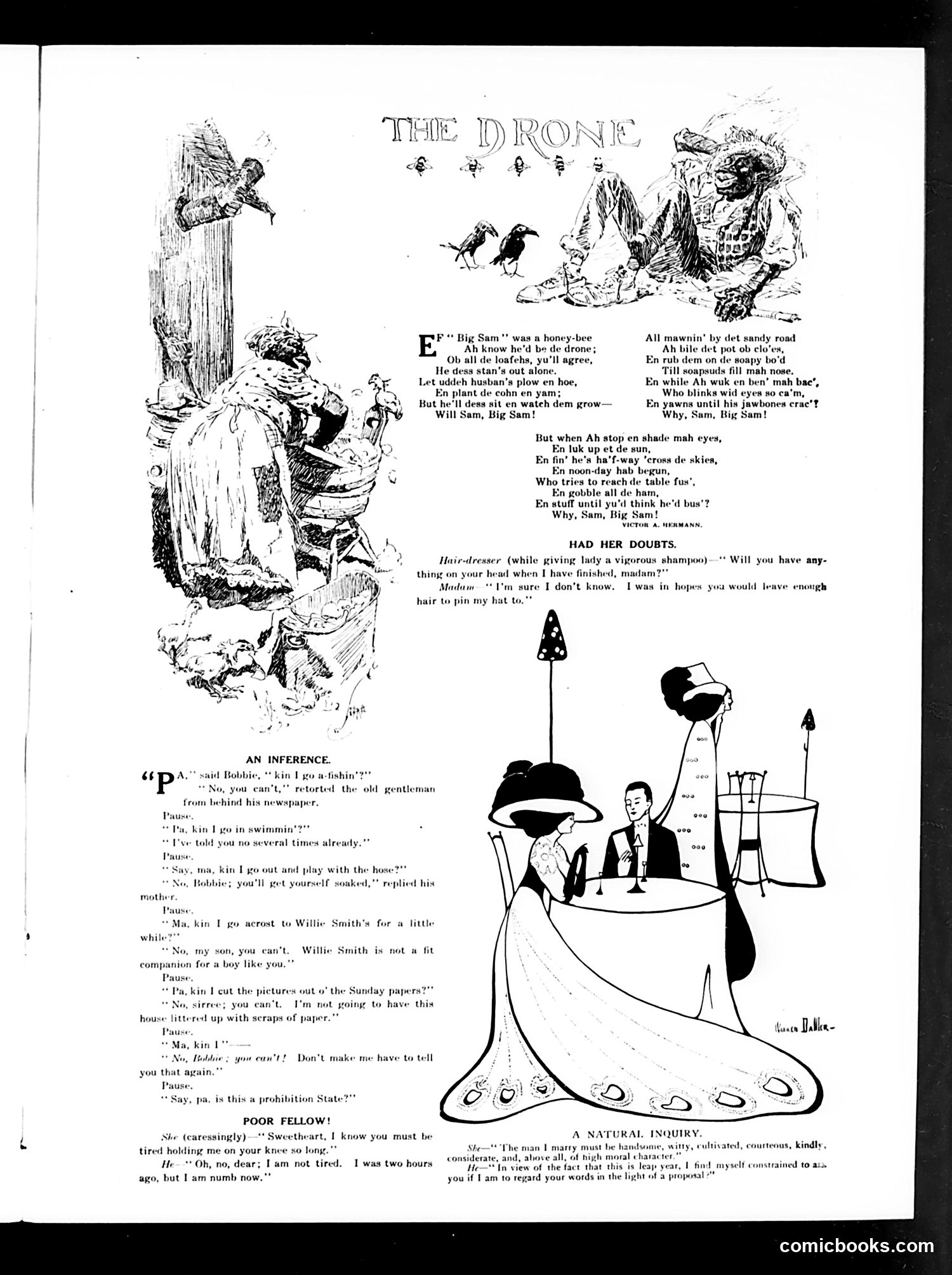
This page satirizes idle, unproductive men through multiple sketches. "The Drone" poem mocks "Big Sam," a lazy man who won't work or contribute—he "stan't out alone" and avoids labor while expecting others to support him. The accompanying illustrations show him lounging while others toil. The other sketches ("An Inference," "Had Her Doubts," "Poor Fellow," "A Natural Inquiry") depict domestic conflicts and social awkwardness typical of Judge's humor—nagging wives, exhausted husbands, class pretensions, and marital discord. The overall message reflects Progressive Era anxieties about masculine vigor and productivity. The "drone" represents feared social parasitism—a man failing his economic duty to family and society, a common target of satirical magazines aimed at middle-class male readers.
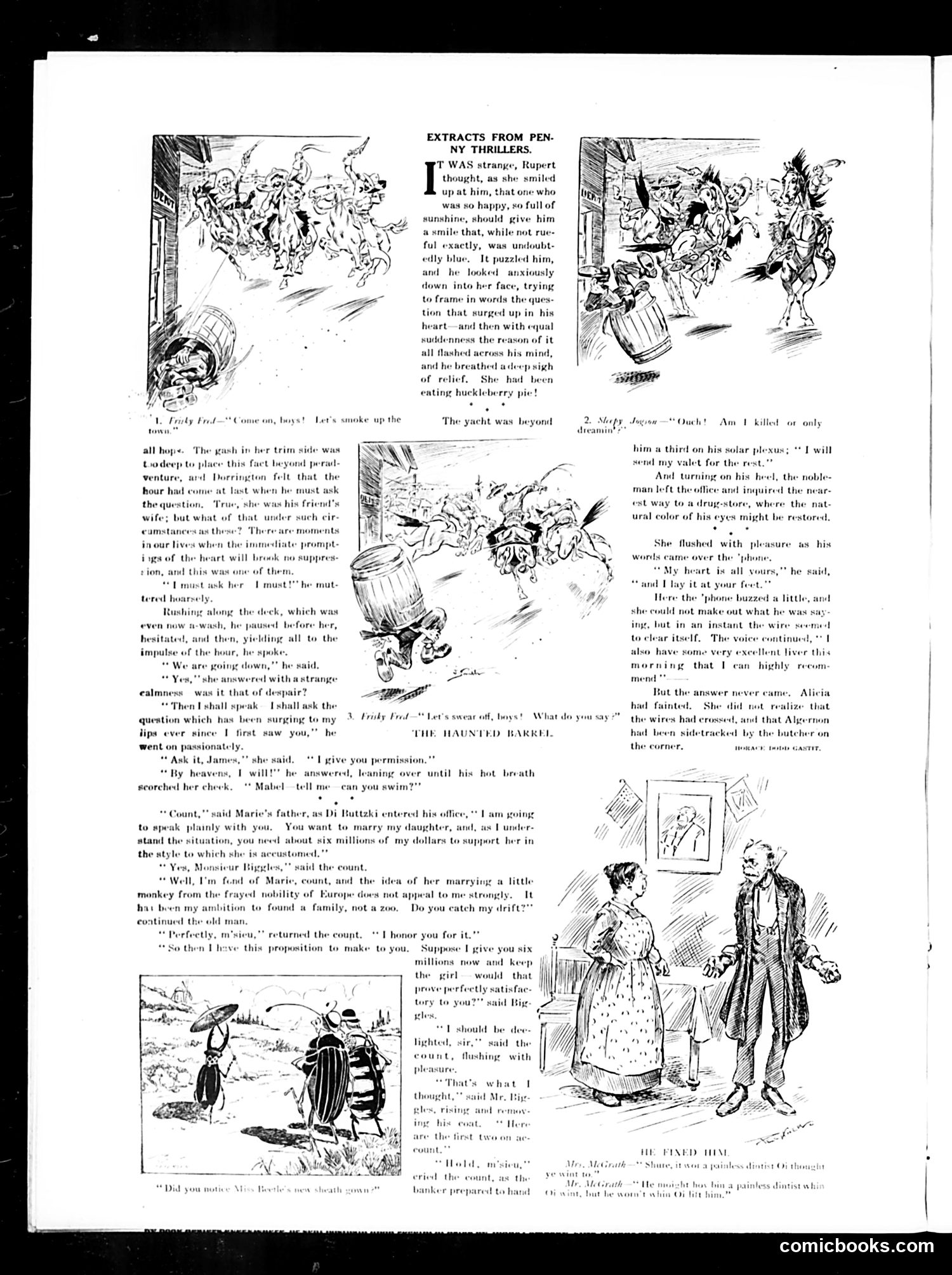
This page collects satirical "penny dreadful" parodies—mocking the melodramatic serial fiction popular with working-class readers. The sketches exaggerate the genre's absurd plot twists and overwrought emotion. **The cartoons mock:** 1. **Romantic melodrama**: Young men agonizing over women with implausible earnestness ("Can you swim?" as a marriage proposal) 2. **Class anxieties**: A wealthy banker (Monsieur Biggles) offering six million dollars to marry off his daughter to a nobleman, treating her as a commodity—satirizing both aristocratic fortune-hunting and bourgeois desperation to marry "up" 3. **Penny dreadful conventions**: Absurd plot devices (the "haunted barrel," wires crossing telephone wires), coincidental complications, and breathless narration **The point**: Judge ridicules both the lowbrow fiction itself and the social pretensions it reflected—pretentious suitors, mercenary marriages, and contrived dramatic complications. This is sophisticated satire aimed at readers educated enough to recognize the clichés.
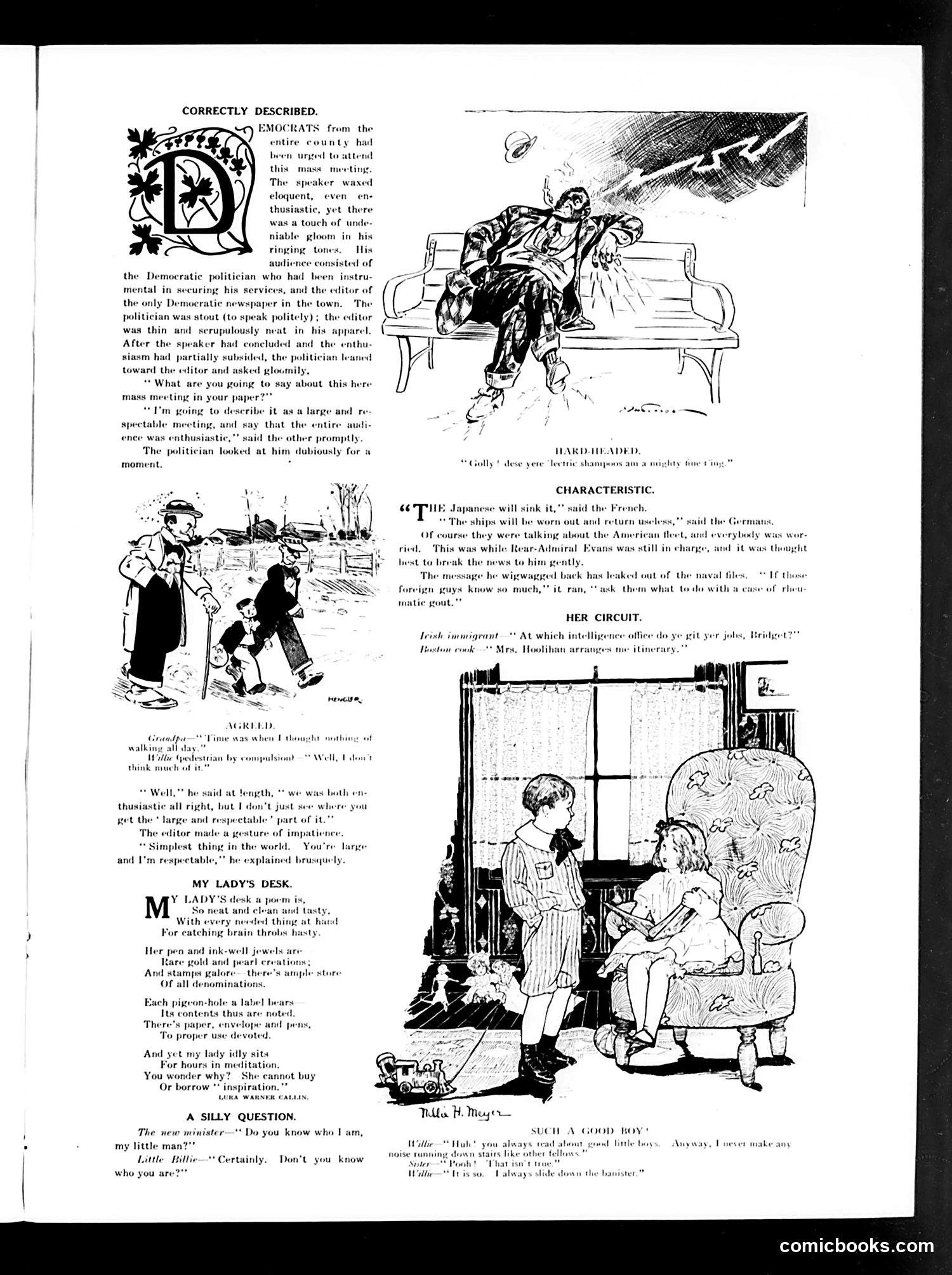
This page contains several short comic strips and humorous pieces typical of early 20th-century American satirical journalism. **"Correctly Described"** mocks a Democratic political rally where a newspaper editor struggles to describe an enthusiastic but ultimately unremarkable speech. The satire targets both politicians' empty rhetoric and journalists' difficulty finding newsworthy content in routine political events. **"My Lady's Desk"** is a sentimental poem about a woman's ornate writing desk—standard literary fare for the era, not political satire. **"A Silly Question"** jokes about class and immigration, depicting a new minister condescendingly questioning a working-class boy (implied Irish immigrant), who responds matter-of-factly. The humor relies on period stereotypes about immigrant speech patterns. **"Her Circuit"** and **"Such a Good Boy"** are domestic humor strips with no apparent political content. The page reflects Judge's mix of political commentary, social satire, and genteel humor aimed at educated, middle-class readers.
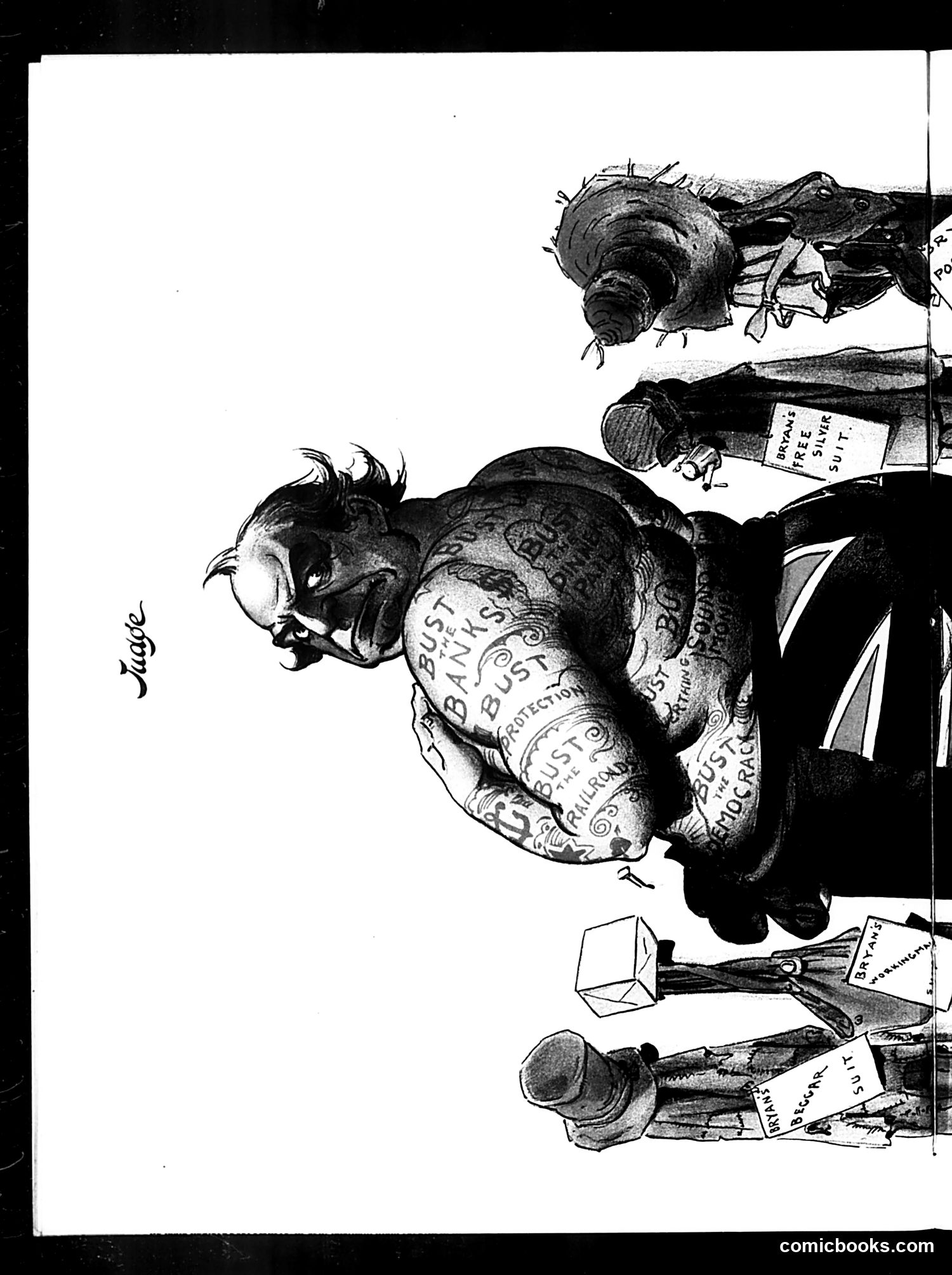
This page appears to be a political cartoon, though the OCR text is largely unreadable. The image shows a caricatured figure with exaggerated features wearing clothing labeled with text that includes "BUST," "PROTECTION," and "TARIFF" (visible on the body/torso area). The cartoon likely satirizes **protectionist tariff policies**, a major political issue in American history. The figure appears bloated or swollen, suggesting the cartoon criticizes how tariffs inflated prices or benefited certain interests at public expense. Without clearer text or dating information visible on the page, I cannot specify which political figure is depicted or the exact historical moment referenced. The style suggests **late 19th or early 20th century**, when tariff debates were prominent in American politics.
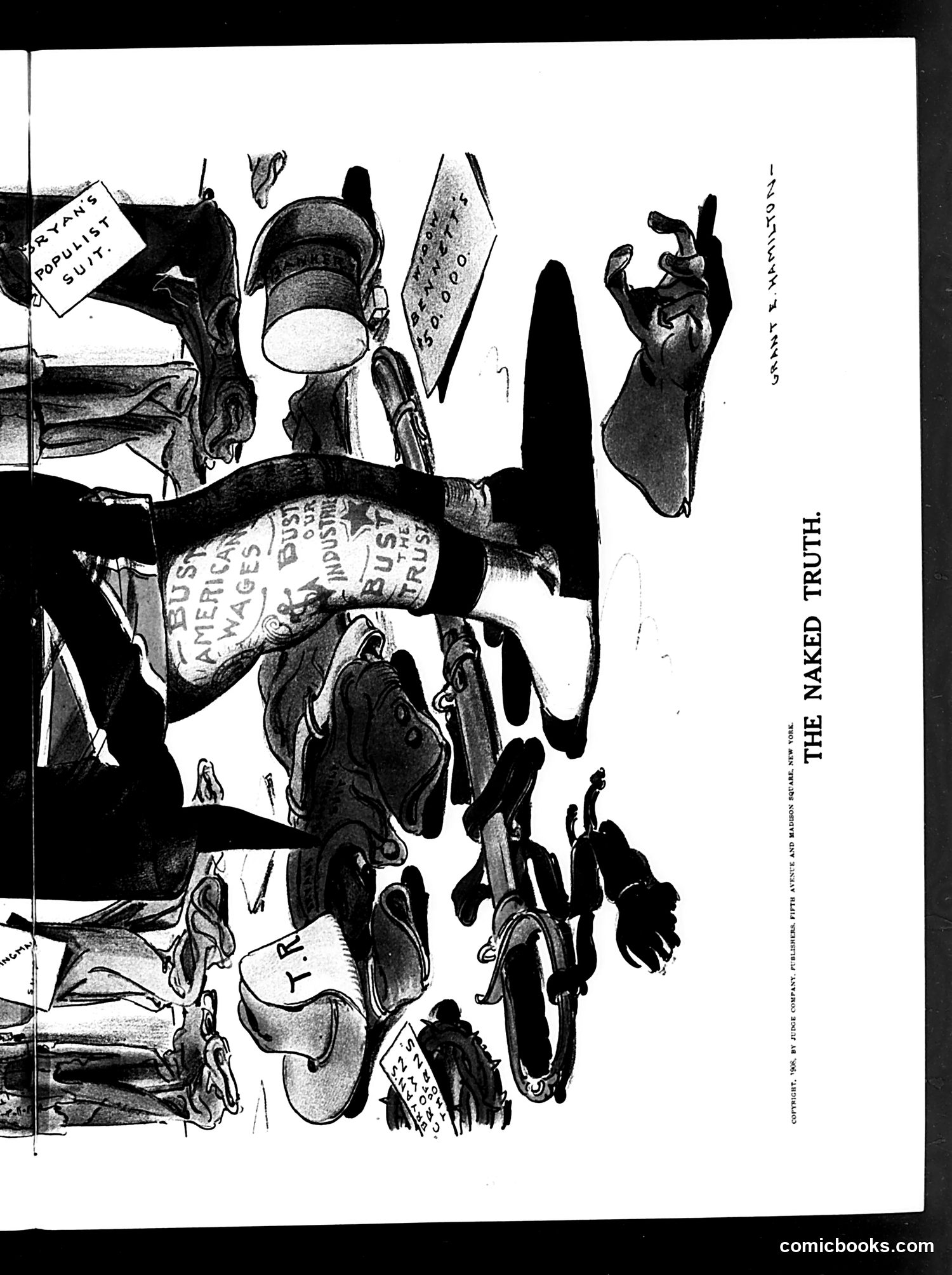
I can see this is a political cartoon from Judge magazine, but the OCR text is largely corrupted and unreadable, making it difficult to identify specific references with confidence. The cartoon appears to show multiple figures in period dress (likely late 19th or early 20th century) arranged vertically or in a compositional stack. One figure has a label reading "RYAN'S POPULIST SUIT," suggesting commentary on populist politics. The artistic style and arrangement suggest satire about political movements or figures of that era. Without clearer text, I cannot reliably identify the specific politicians, issues, or events being satirized. The "Populist" reference suggests commentary on the Populist Party movement, but the corrupted OCR prevents me from explaining the cartoon's specific point or identifying other figures depicted.
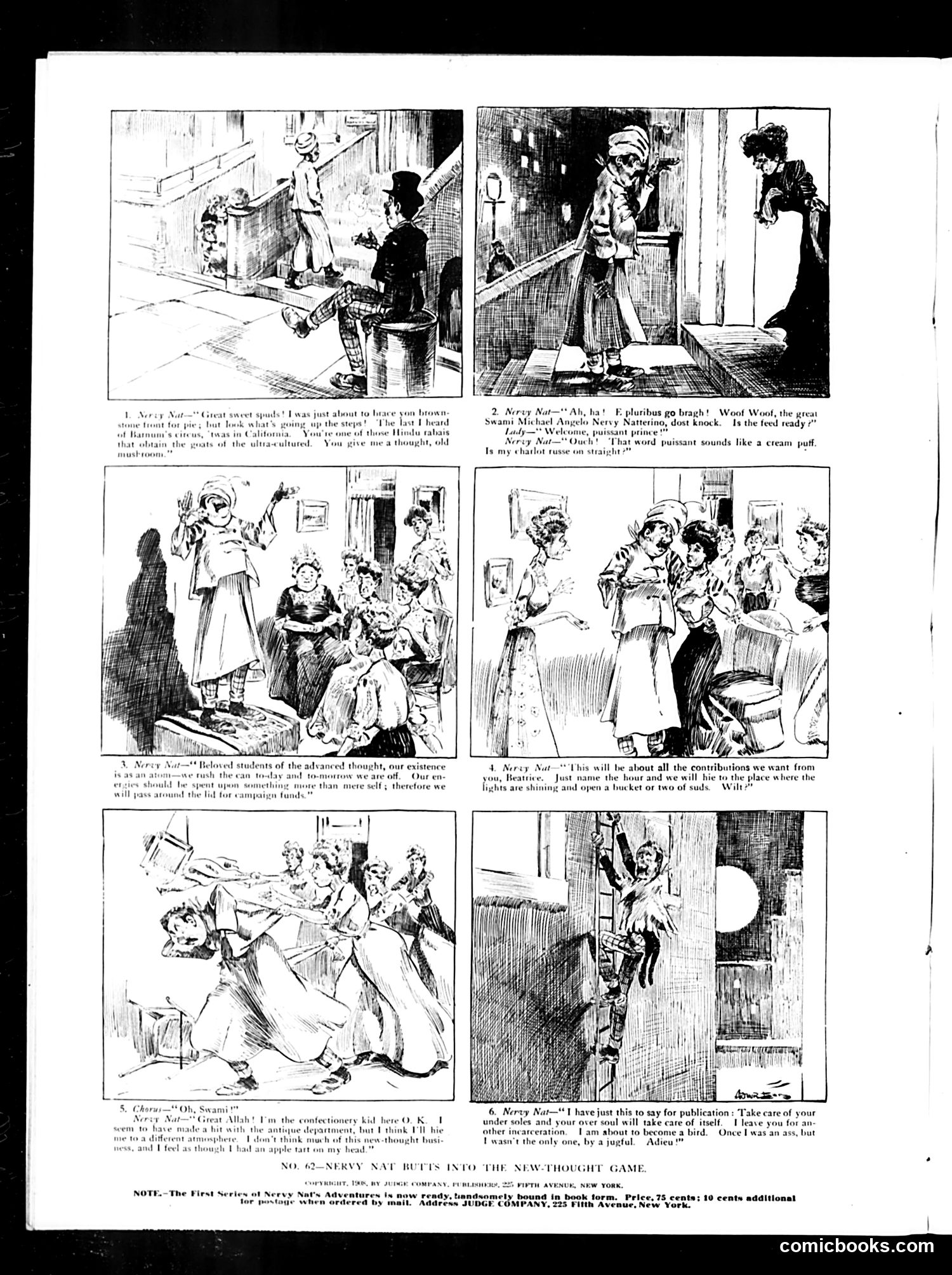
This six-panel comic strip satirizes the "New Thought" movement—a late 19th/early 20th-century spiritual philosophy emphasizing positive thinking and mental healing. The protagonist "Nervy Nat" appears to be a con artist or charlatan who disrupts a respectable New Thought gathering (panel 3) claiming to be an "advanced thinker." He systematically infiltrates the group's charitable fundraising efforts, ultimately swindling them through increasingly absurd schemes—culminating in panel 6 where he literally dangles from the building, having escaped with their money. The satire mocks both the gullibility of New Thought adherents and the era's susceptibility to fraudsters exploiting spiritual movements. The "Nervy" protagonist embodies the predatory charlatan taking advantage of sincere but naive believers. The comic suggests New Thought's idealistic promises about positive thinking left practitioners vulnerable to exploitation.
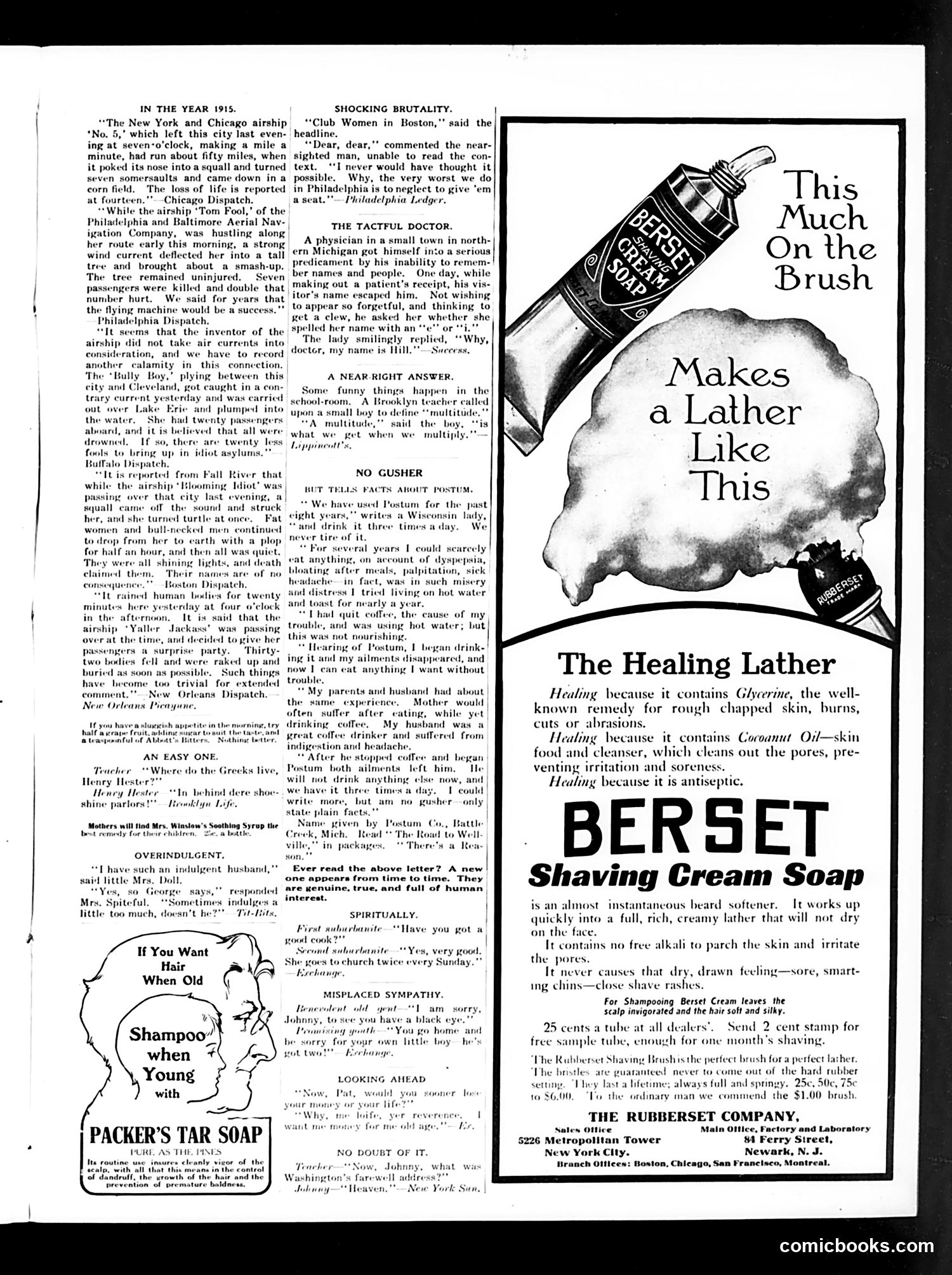
This page satirizes early aviation disasters and modern life's absurdities. The main content is a mock-news section titled "IN THE YEAR 1915" depicting fictional airship crashes with darkly comic dispatches from various cities. The satire works by presenting increasingly callous newspaper reports—deaths become routine, bodies "buried as soon as possible" draws no comment, and a near-sighted man's innocuous observation about neglecting to offer seats to club women becomes the "shocking brutality" headline. The humor relies on contrasting trivial social failures (not giving women seats) with actual tragedies, while the escalating indifference toward aviation casualties mocks both the era's dangerous experimental aircraft and journalism's sensationalism. Surrounding this are unrelated advertisements and humorous anecdotes, typical of *Judge*'s satirical format.
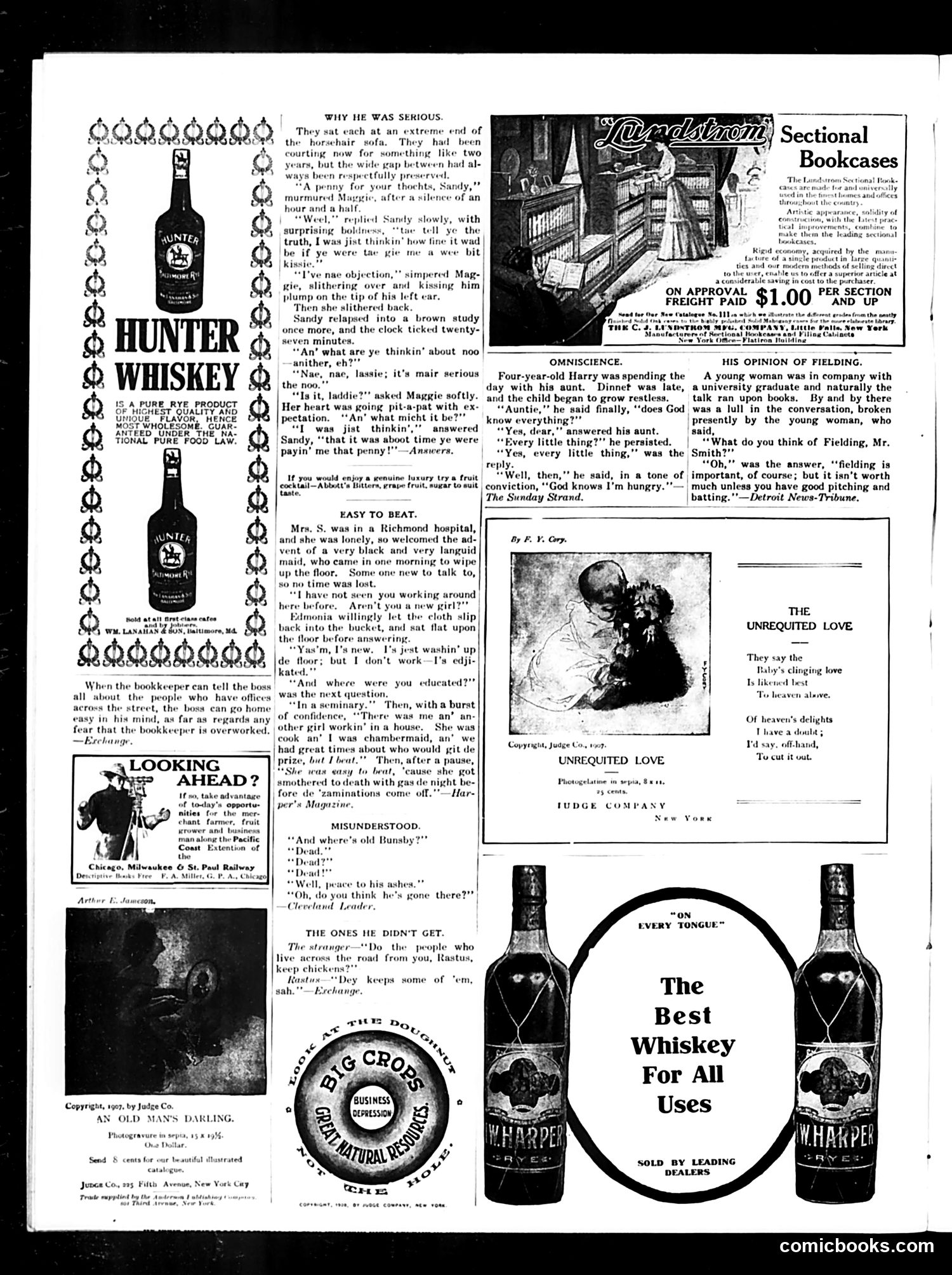
This page from **Judge** (circa 1907) is primarily **advertising and light humor** rather than political satire. **Main Content:** The page features several brief comedic anecdotes and advertisements: 1. **"Why He Was Serious"** — A Scottish romance sketch where a courting couple sits on a sofa; the man reveals he's been thinking about when the woman will repay him a penny he lent her—a joke about Scottish frugality. 2. **"Easy to Beat"** — A hospital scene mocking an uneducated Black maid's grammatically incorrect speech. 3. **"Omniscience"** — A child's simple joke about God knowing he's hungry. 4. **"His Opinion of Fielding"** — A pun where someone confuses the novelist Henry Fielding with baseball fielding positions. **Advertisements** dominate: Hunter Whiskey, Wharpe Rye Whiskey, and sectional bookcases are prominently featured. The humor reflects era-typical stereotypes and wordplay. There is no significant political commentary—this appears to be a general entertainment/advertising issue.
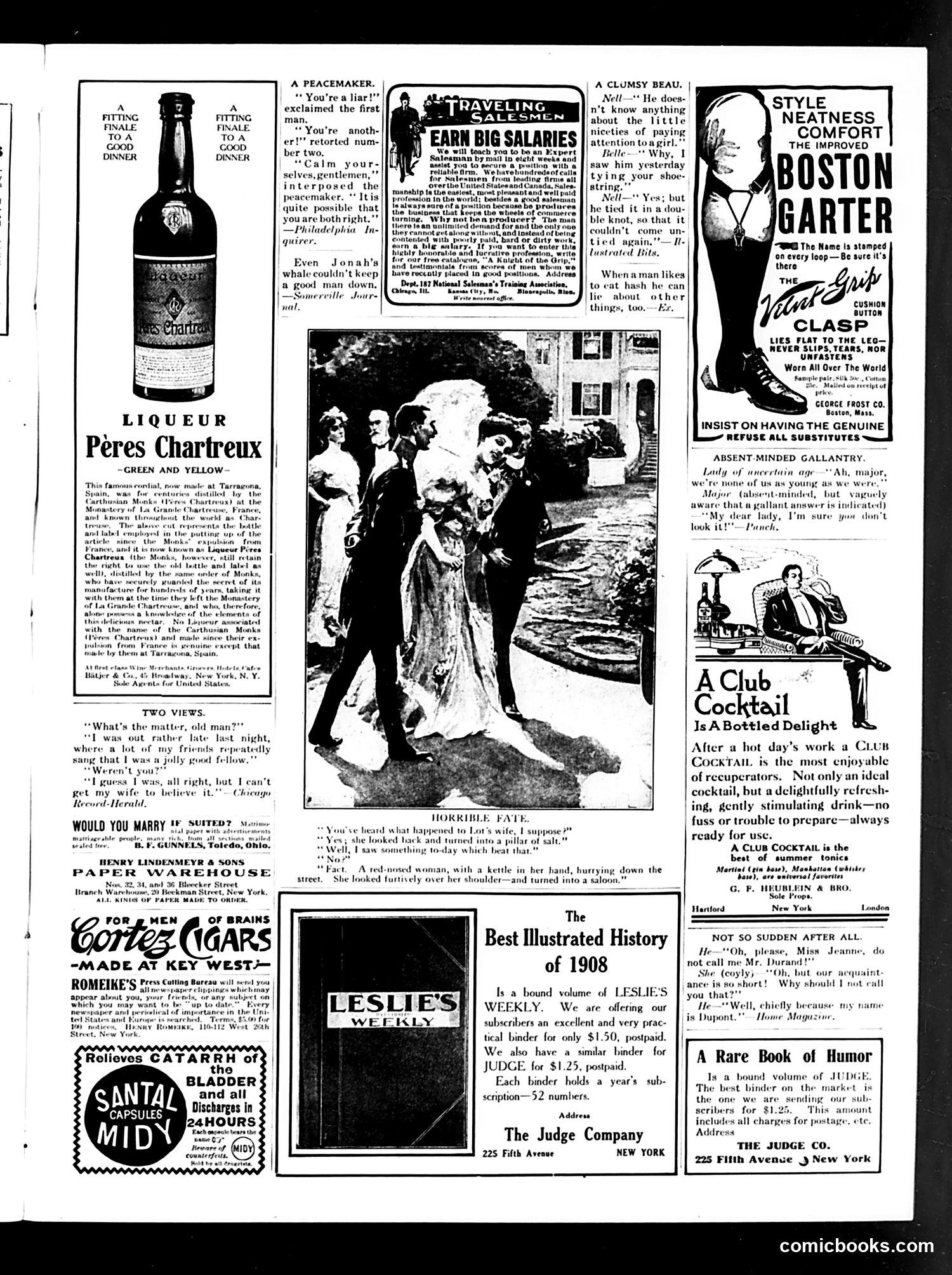
This page is primarily **advertising and filler content** rather than political cartoons. It contains several brief humorous anecdotes and numerous product advertisements typical of 1908 publications. The humor pieces are mild social observations: "A Peacemaker" jokes about two men quarreling until a third suggests both might be right; "Two Views" contrasts perspectives on the same incident; "Horrible Fate" makes a crude joke equating a red-nosed woman turning toward a saloon with Lot's wife turning to salt; "A Clumsy Beau" and "Not So Sudden After All" feature romantic misunderstandings. **No significant political satire appears**—these are domestic humor vignettes about everyday awkwardness. The advertisements promote liqueur, cigars, garters, cocktails, and binders for collecting Leslie's Weekly and Judge magazines themselves. The page reflects *Judge*'s primary function as entertainment and advertising vehicle rather than hard-hitting satire. The humor is genteel and inoffensive by design.
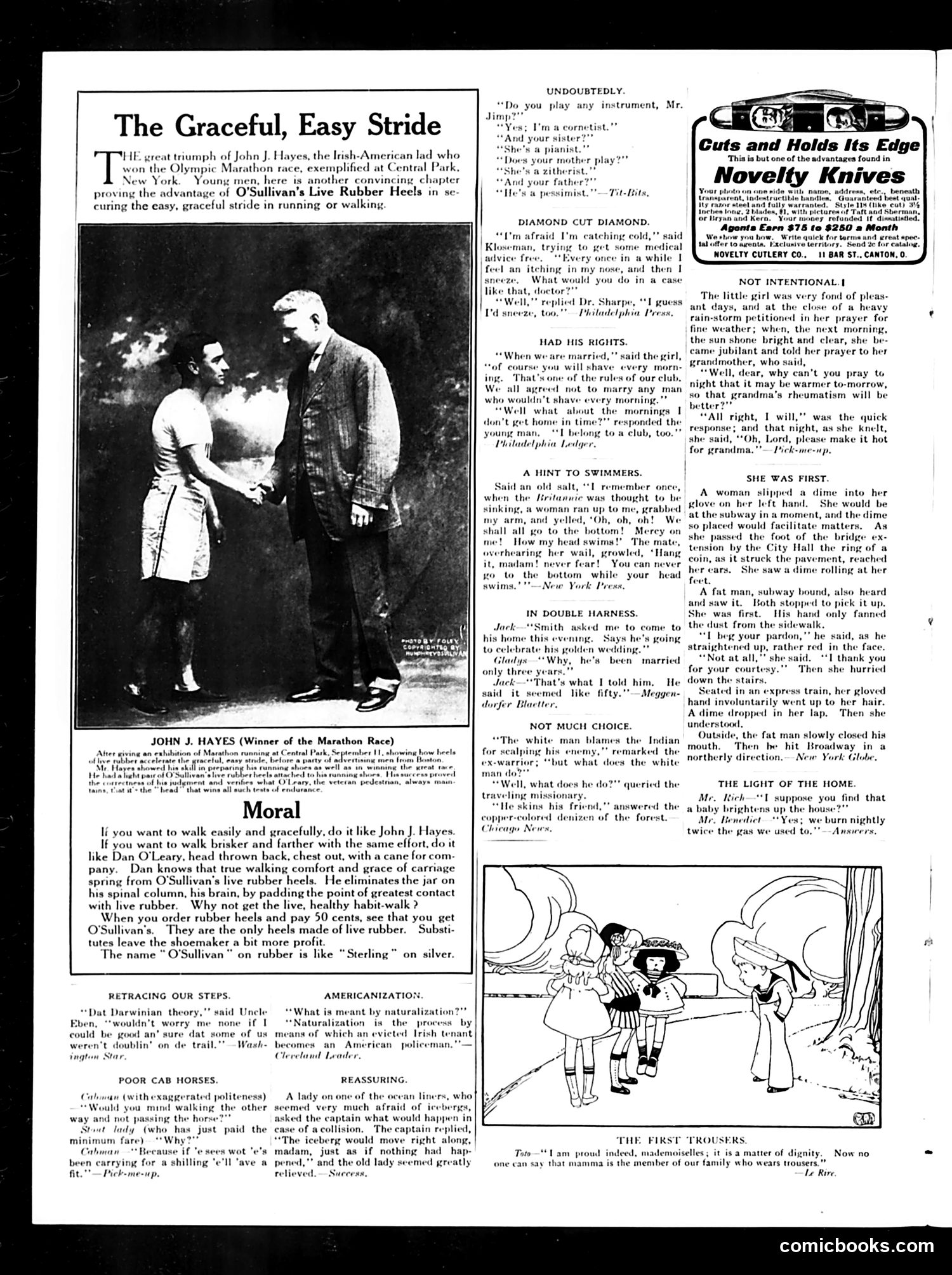
This page is primarily **advertising** for O'Sullivan's Live Rubber Heels, using John J. Hayes, the Irish-American winner of an Olympic Marathon race, as the celebrity endorser. The main article "The Graceful, Easy Stride" argues that O'Sullivan's rubber heels enabled Hayes's running success. The page includes numerous **brief humor columns** typical of Judge magazine's format—short jokes on marriage, swimming, naturalization, and animal welfare. These satirize everyday American life: marital expectations, bureaucratic processes (naturalization of Irish immigrants becoming American policemen), and Victorian social conventions. One notable joke references "Americanization," portraying an Irish tenant becoming a policeman—commentary on Irish-American assimilation and upward mobility in early 20th-century America. The cartoons at bottom depict children and domestic scenes with sentimental humor about innocence and prayer. Overall, this is a **typical Judge issue combining product advertising with light social satire** reflecting contemporary American attitudes toward immigrants, marriage, and class mobility.
This is primarily a **advertising page** from Judge magazine, with several small satirical jokes interspersed among commercial ads. The main cartoons are brief humor pieces: "Pretty Hard" jokes about courtship difficulties; "How Unfair" presents gendered humor about mosquitoes versus men; "Universal Opinion" concerns a church fair booth; and "A Natural Result" features a temperance lecturer whose rhetorical question about drowning drunkards produces an ironic punchline. The page reflects **early 20th-century American attitudes**: casual misogyny (girls as marriage prospects), genteel temperance advocacy (Underberg Bitters marketed as medicinal), and class consciousness (servants, professors, gentlemen's clubs). The advertisements—for whiskey, cigarettes, a hotel, pencil sharpeners, and house plans—anchor the page in its era. "Judge" magazine mixed social satire with marketing, targeting educated, affluent readers. The humor relies on then-familiar tropes: awkward courtship, servant malapropisms, and academic pomposity.
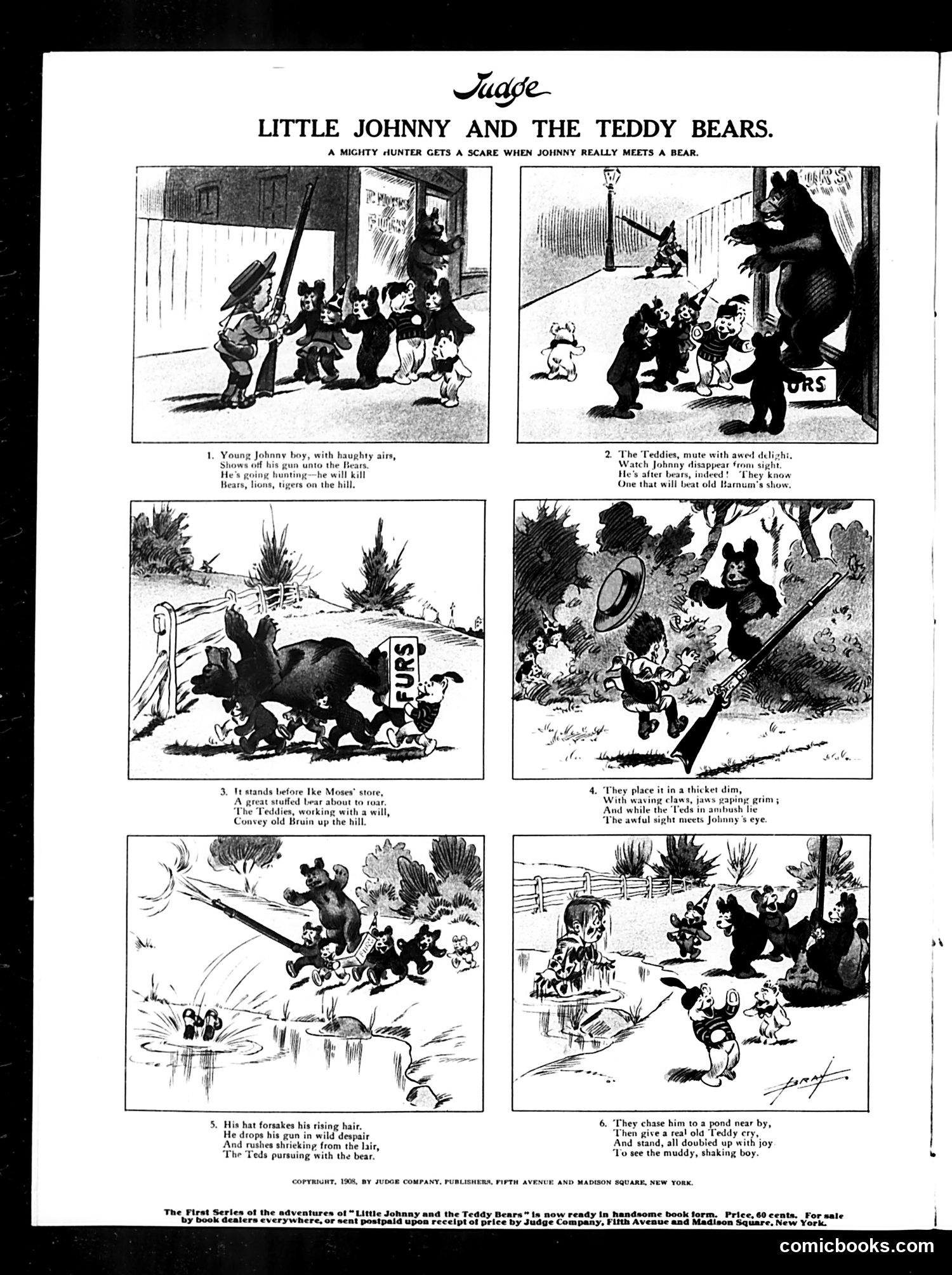
This is a humorous six-panel comic strip about a boastful young hunter named Johnny who brags about hunting "bears, lions, tigers on the hill" to his toy teddy bears. The bears, charmed by his swagger, arrange an elaborate prank: they obtain a real stuffed bear from "Ike Moses' store" and set it up as a trap in the woods. When Johnny encounters what he believes is an actual bear—complete with "waving claws, jaws gaping grim"—he panics completely, abandoning his gun and fleeing in terror to a nearby pond. The comic's joke is the comeuppance: the mighty hunter gets a genuine scare and becomes "muddy, shaking," while his teddy bears rejoice at seeing their boastful owner humbled. The strip satirizes childhood braggadocio and false bravado, suggesting that big talk often precedes embarrassing reality. The reference to "Barnum's show" (P.T. Barnum's famous circus) adds to the artificial spectacle setup.