
A complete issue · 16 pages · 1908
Judge — September 26, 1908
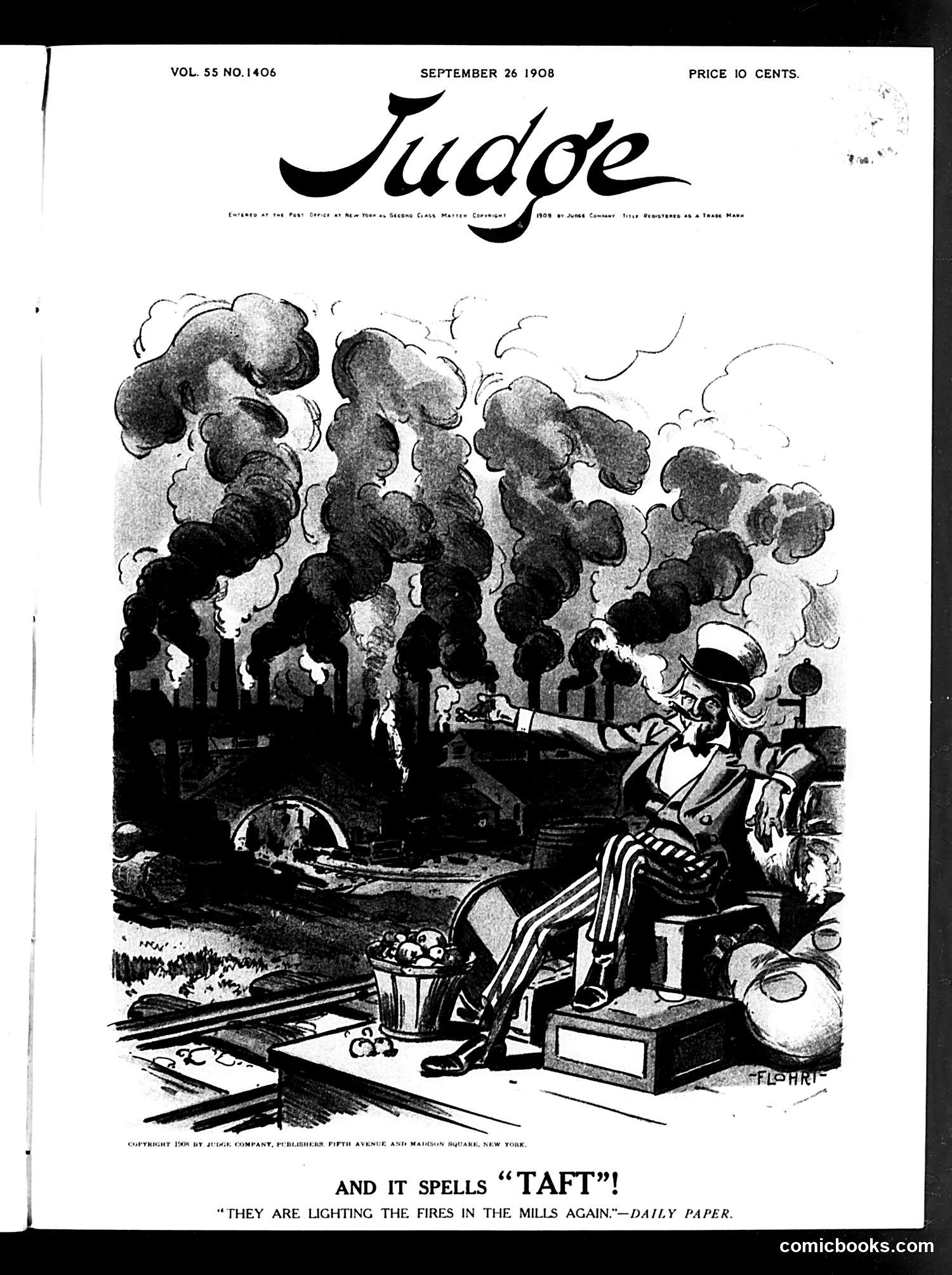
This cartoon satirizes **William Howard Taft** during the 1908 presidential campaign. The figure in the foreground, dressed in striped pants and top hat, appears to represent Taft relaxing contentedly while industrial smokestacks belch black smoke behind him—symbolizing factories operating at full capacity. The caption "AND IT SPELLS 'TAFT'!" combined with the subtitle about "lighting the fires in the mills again" suggests this is pro-Taft propaganda. The cartoon argues that Taft's policies will restore industrial prosperity and employment—"reigniting" American manufacturing after an economic downturn. The relaxed, confident pose presents Taft as the solution to economic concerns, appealing to voters worried about jobs and factory production.
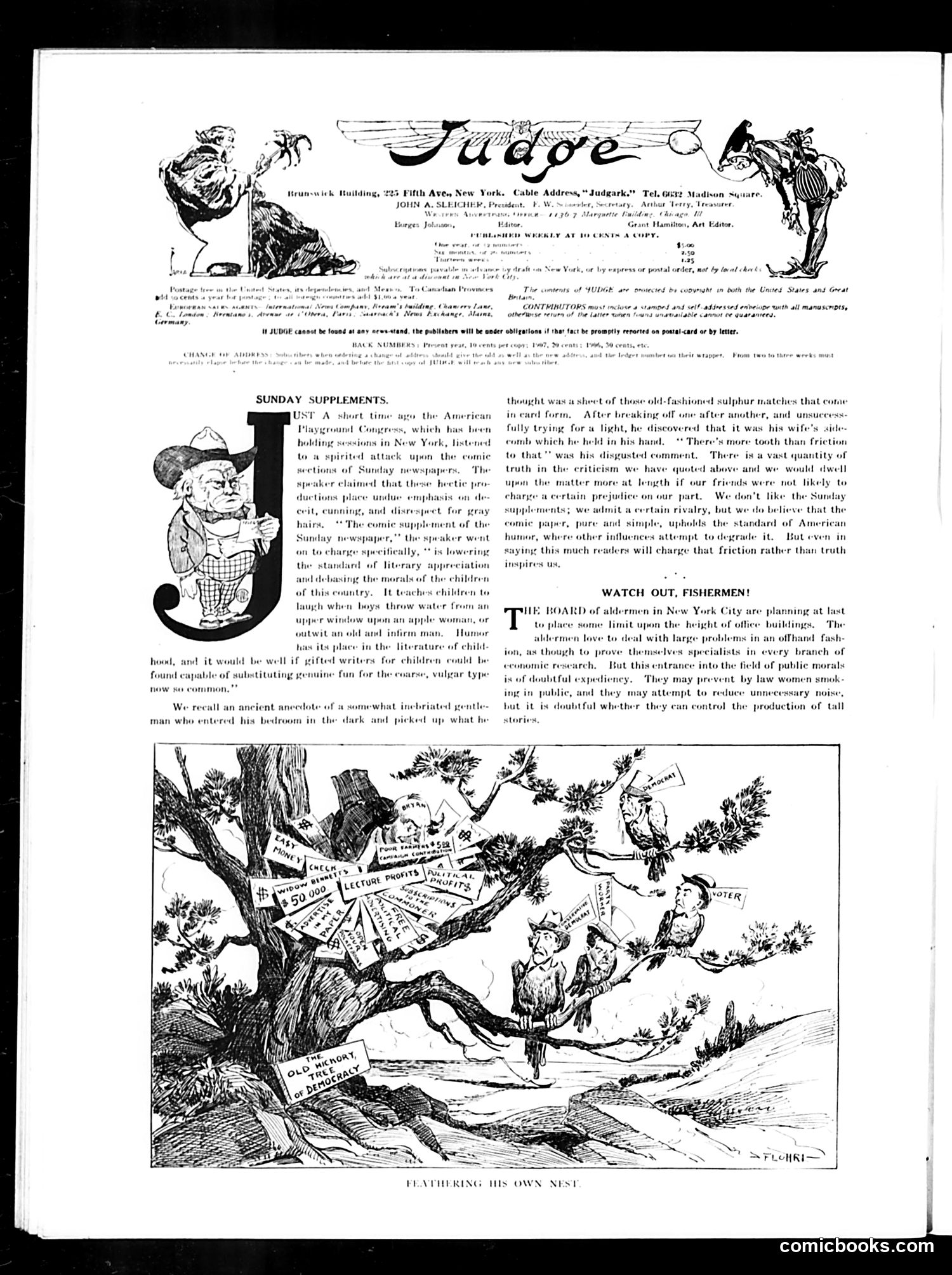
The main cartoon titled "Feathering His Own Nest" depicts a tree full of birds (likely representing politicians or office-seekers) perched on branches labeled with various profit opportunities and political positions. The tree's roots are labeled "Old Glory" and "The Library," suggesting these nest-builders are exploiting patriotic and cultural institutions for personal gain. The satire criticizes politicians and public figures who use their positions to accumulate wealth and power—"feathering their nest"—rather than serving the public interest. The birds metaphor emphasizes opportunistic behavior and self-serving exploitation of public office. The accompanying text discusses attacks on comics in newspapers, defending their social value while acknowledging debates about their appropriateness as children's literature, suggesting early 20th-century concerns about mass media's influence.
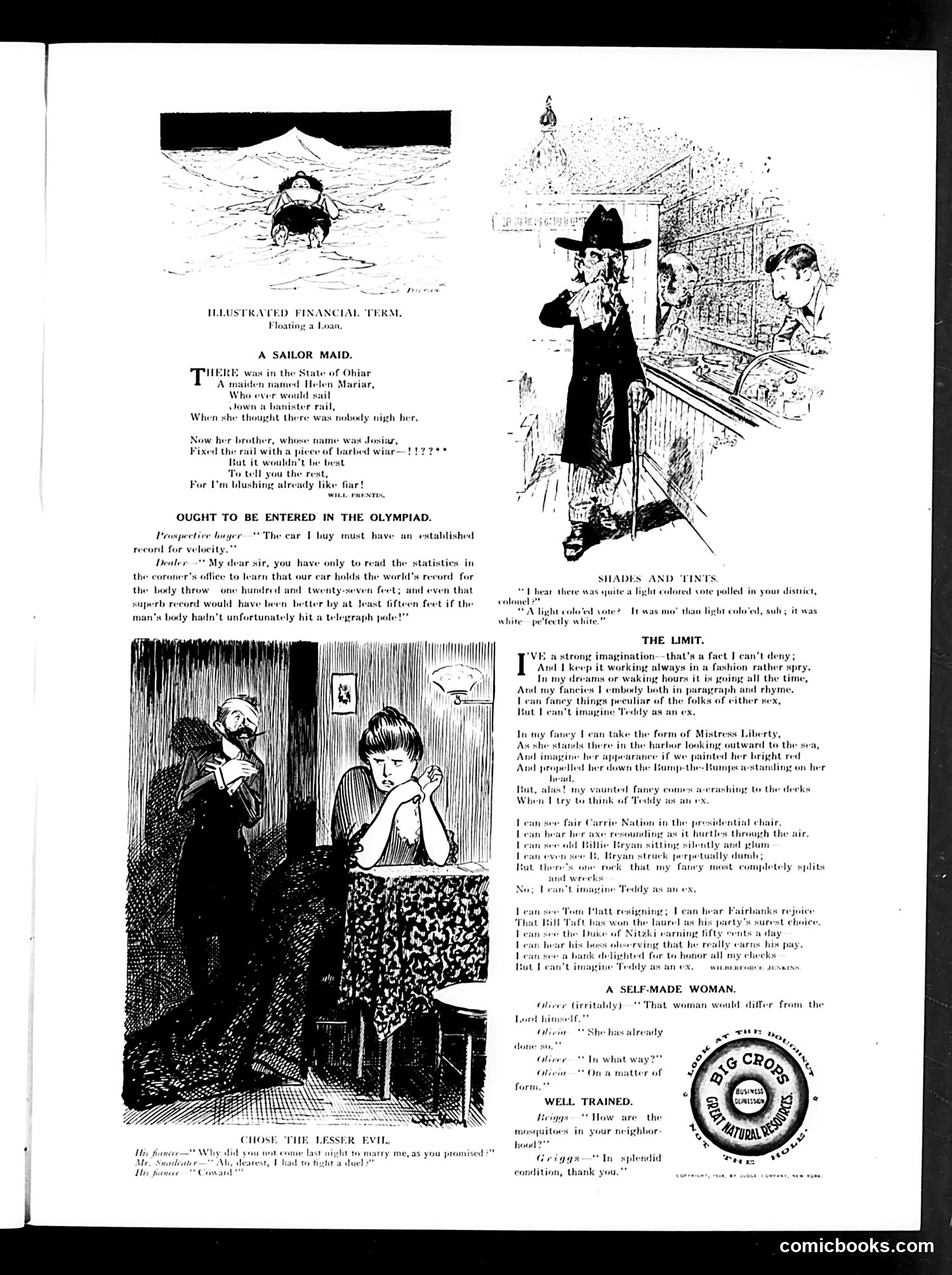
This Judge magazine page contains several satirical pieces and illustrations typical of early 20th-century American humor: **"A Sailor Maid"** is a humorous poem about a woman from Ohio who sails a boat despite lacking maritime experience—poking fun at unconventional gender roles. **"Ought to be Entered in the Olympiad"** mocks automotive sales claims through dialogue between a car buyer and dealer, satirizing exaggerated marketing about speed records. **"Chose the Lesser Evil"** depicts a domestic dispute where a husband avoided marrying his sweetheart due to a duel, choosing instead to marry her—dark humor about marriage as the "lesser evil." **"Shades and Tints"** and **"The Limit"** are brief joke sections about everyday social situations and fantasies. The overall page represents Judge's typical blend of domestic humor, gender-role satire, and commentary on consumerism and marriage—reflecting early 1900s American anxieties about modernity.
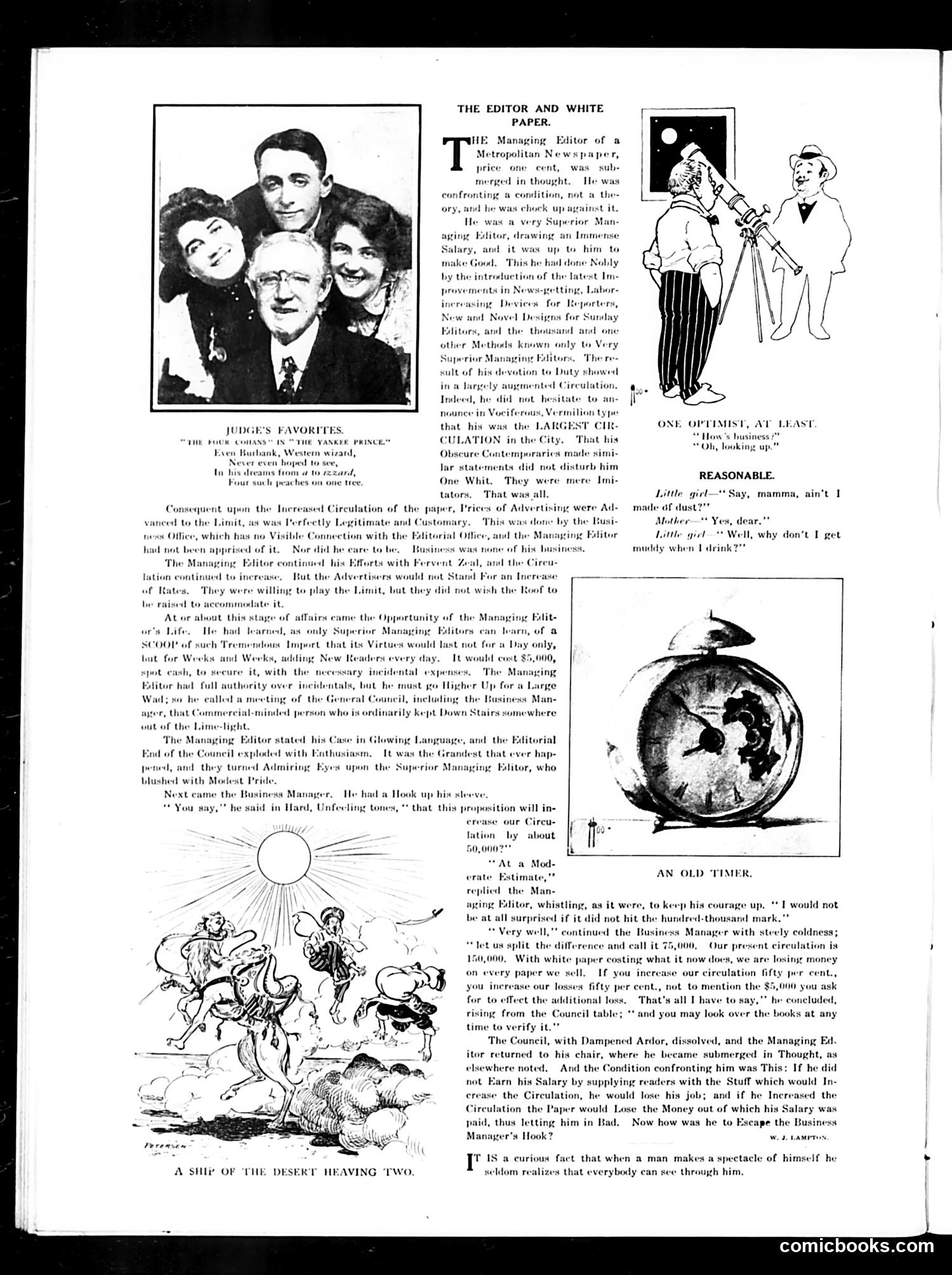
This page satirizes newspaper management during an era of circulation wars. "The Editor and White Paper" depicts a managing editor navigating pressures to increase readership and advertising revenue. The central narrative describes tension between editorial integrity and business demands. The editor must choose between maintaining quality or adopting sensationalist methods ("white paper" likely refers to cheap newsprint). The cartoon "One Optimist, At Least" shows a simple domestic scene—a mother and child discussing spending—seemingly contrasting innocent household economics with the complex newspaper business dilemma above. "An Old Timer" depicts an elderly figure, possibly representing traditional journalism values being displaced by modern commercial pressures. The satire critiques how profit motives corrupt editorial independence—a timeless journalism theme. The specific circulation figures and business strategies referenced suggest this addresses early 20th-century newspaper industry practices.
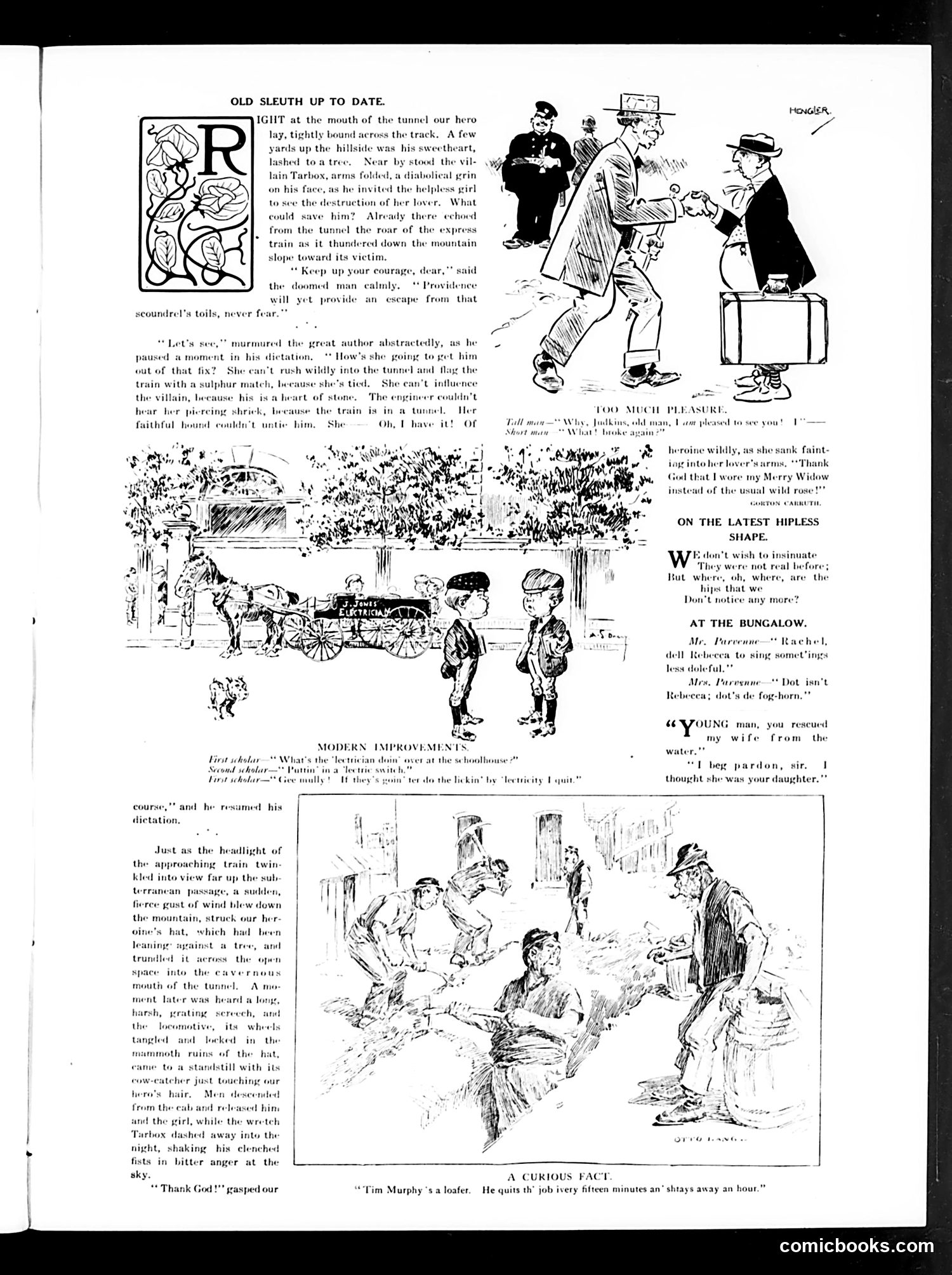
This page contains a serialized story titled "Old Sleuth Up to Date" with accompanying illustrations, rather than political satire. The narrative concerns a detective ("Old Sleuth") investigating a tunnel scheme involving villains named Tarbox who threaten a helpless girl. The plot emphasizes melodramatic danger—the tunnel "thundered down the mountain slope toward its victim." Secondary humorous sections include "Modern Improvements" (a brief joke about a technician), "On the Latest Hipless Shape" (fashion commentary), "At the Bungalow" (domestic humor), and "A Curious Fact" (a workplace joke about an employee named Murphy). This appears to be entertainment content rather than political commentary—typical of Judge magazine's mixed approach combining serialized fiction with light humor pieces.
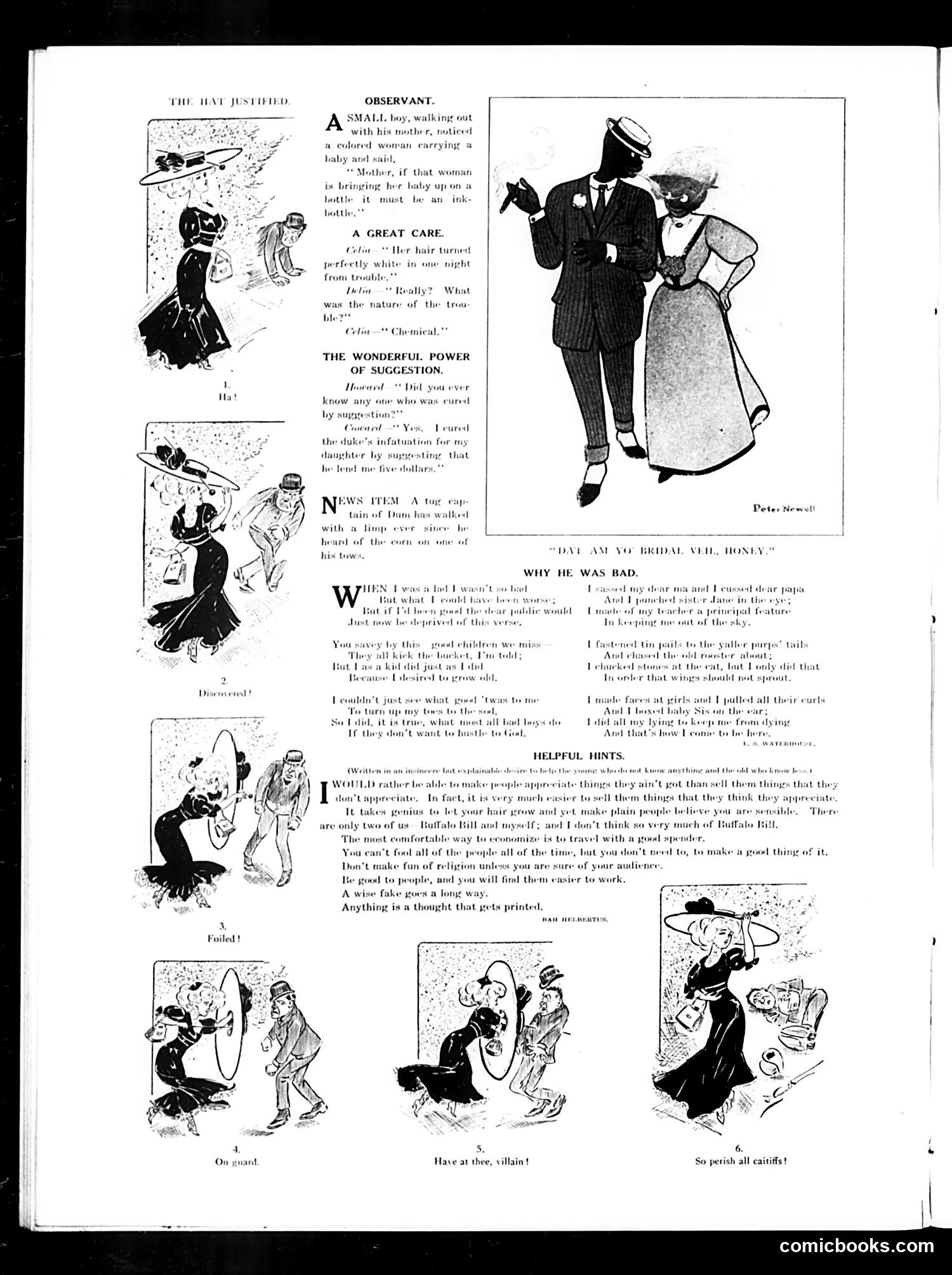
This page from *Judge* contains multiple brief satirical pieces and cartoons typical of the magazine's format. **Main content includes:** - **"Observant"**: A joke about a small boy assuming a Black woman carrying a baby must be using an inkbottle—racist humor based on stereotyping. - **"A Great Care"**: A brief dialogue joke about someone's hair turning white, with a pun on "chemical." - **"The Wonderful Power of Suggestion"**: Satire on gullibility—someone claims to have cured infatuation by suggesting the person lend five dollars. - **"Why He Was Bad"**: A longer humorous poem justifying mischievous childhood behavior, likely by a well-known personality (possibly Buffalo Bill is mentioned). - **"Helpful Hints"**: Practical advice mixed with jokes about selling, hair growth, religion, and economy. The cartoons feature slapstick scenarios with people in exaggerated poses. The overall tone is lighthearted, relying on wordplay, stereotype-based humor typical of early 20th-century American satire.
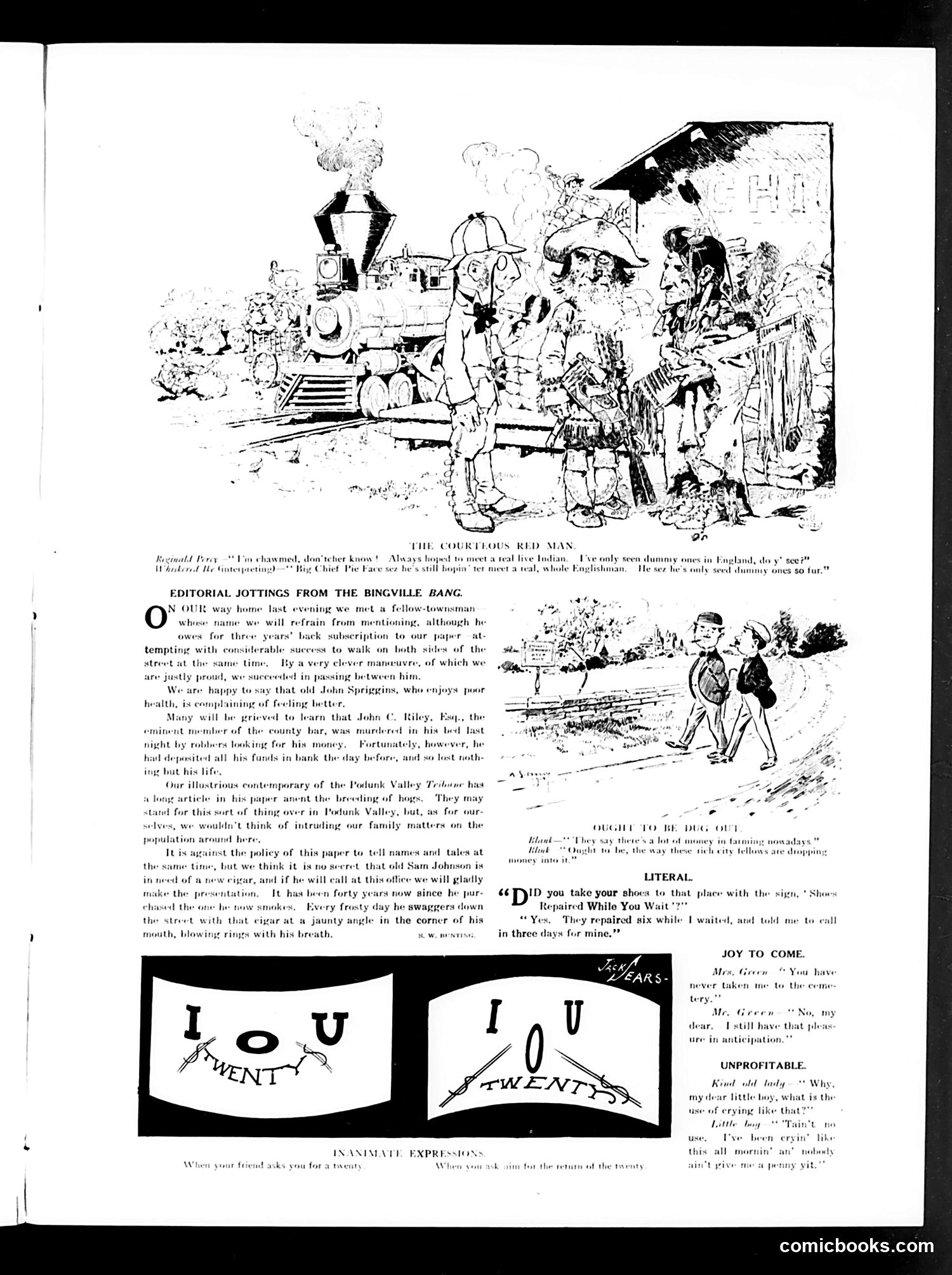
**Top Cartoon:** This appears to be satirizing Native American stereotypes common to the era. The title "The Courteous Red Man" and dialogue references suggest ironic commentary—likely mocking either stereotypical depictions of Native Americans or contemporary attitudes toward them. The railroad setting may reference westward expansion tensions. **Editorial Section:** The "Bingville Bang" comprises humorous anecdotes about small-town life. Notable items include a local notable (John C. Riley, Esq.) who lost his fortune to robbers but recovered funds left in a bank, and commentary on the neighboring "Podunk Valley Tribune" regarding hog breeding. The jokes are localized, small-town humor typical of Judge's satirical style. **Lower Humor Sections:** Brief jokes about shoe repair delays, cemetery visits, and children crying—generic domestic humor with no obvious political content. These appear filler material rather than substantive satire. The page mixes visual satire with editorial commentary and light domestic humor characteristic of early-20th-century American humor magazines.
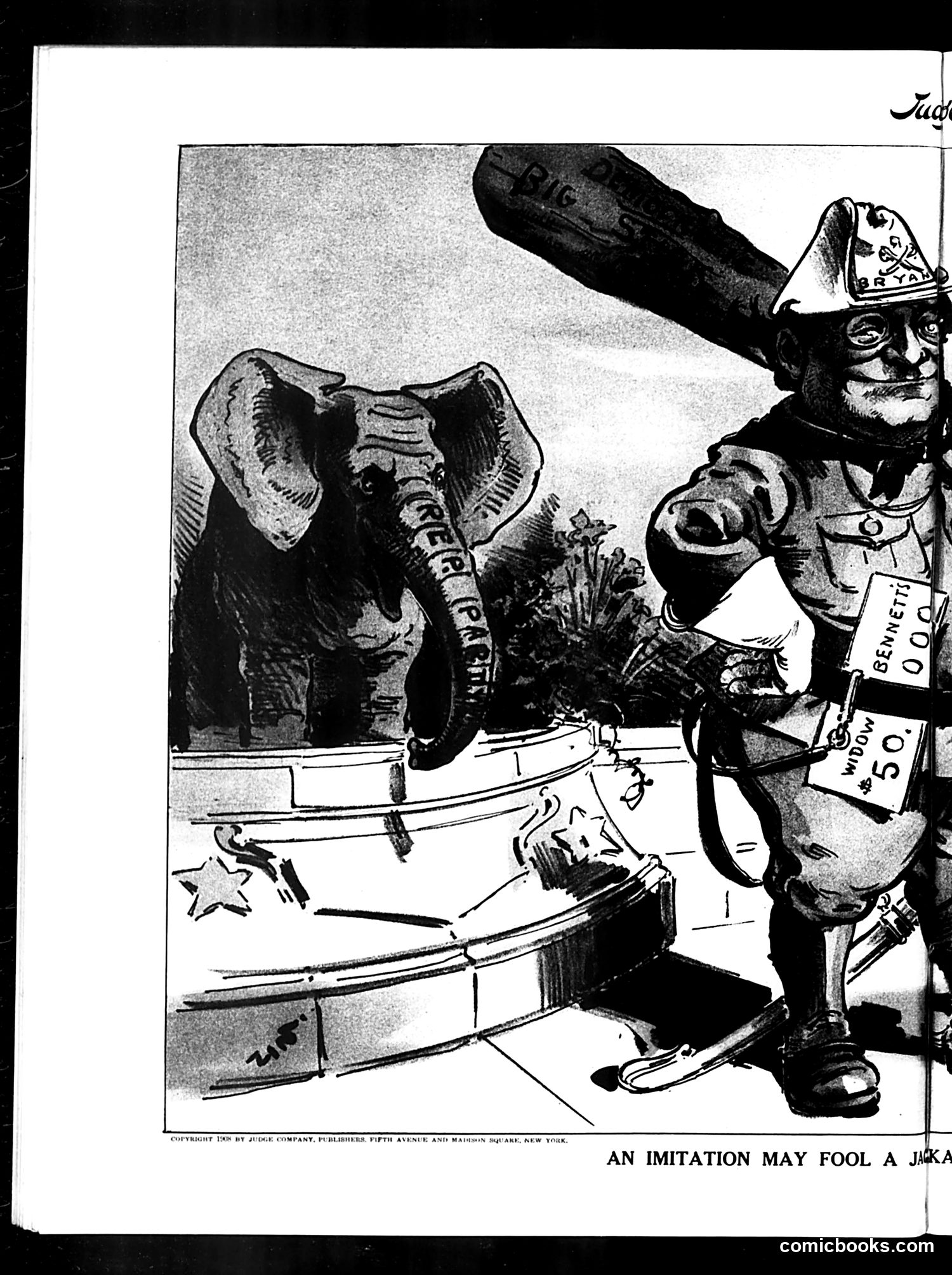
This Judge magazine cartoon depicts a German military officer (identifiable by the spiked Prussian helmet) presenting an elephant labeled "BELGICA" (Belgium) to what appears to be a circus or showman context. The officer holds price tags reading "WITH BENT COLLAR" and "BENT DOCTOR." The satire references Germany's violation of Belgian neutrality during World War I. The elephant—representing Belgium—is portrayed as a captured prize or commodity being displayed, suggesting Belgium has been conquered and is now under German control. The "imitation" reference in the title likely mocks Germany's claims or justifications for the invasion, implying their explanations were false pretenses masking territorial ambition. The cartoon criticizes German imperialism and Belgium's helpless victimization.
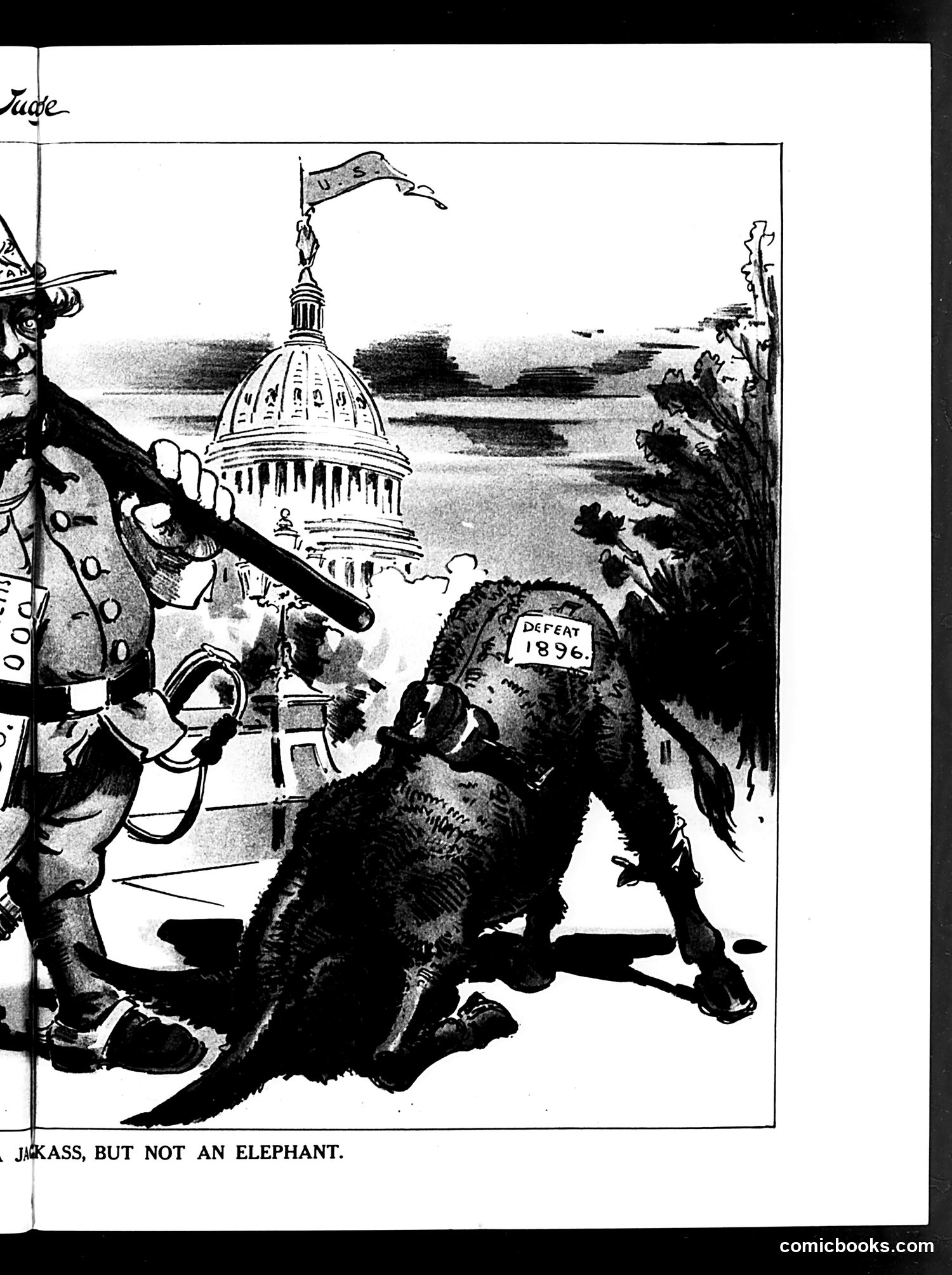
This **Judge** magazine cartoon depicts a donkey marked "DEFEAT 1896" being attacked or confronted by a soldier at the U.S. Capitol. The caption reads "JACK ASS, BUT NOT AN ELEPHANT." The donkey symbolizes the Democratic Party (its traditional mascot), while the elephant represents Republicans. The 1896 date and "DEFEAT" label reference the Democratic Party's loss in that year's presidential election—likely William Jennings Bryan's defeat by William McKinley. The cartoon's point appears to be mocking Democrats: while they were defeated like a jackass, they are "not an elephant"—meaning they lack the strength or intelligence of the Republican opposition. The soldier or military figure suggests Republican strength or victory in this political struggle.
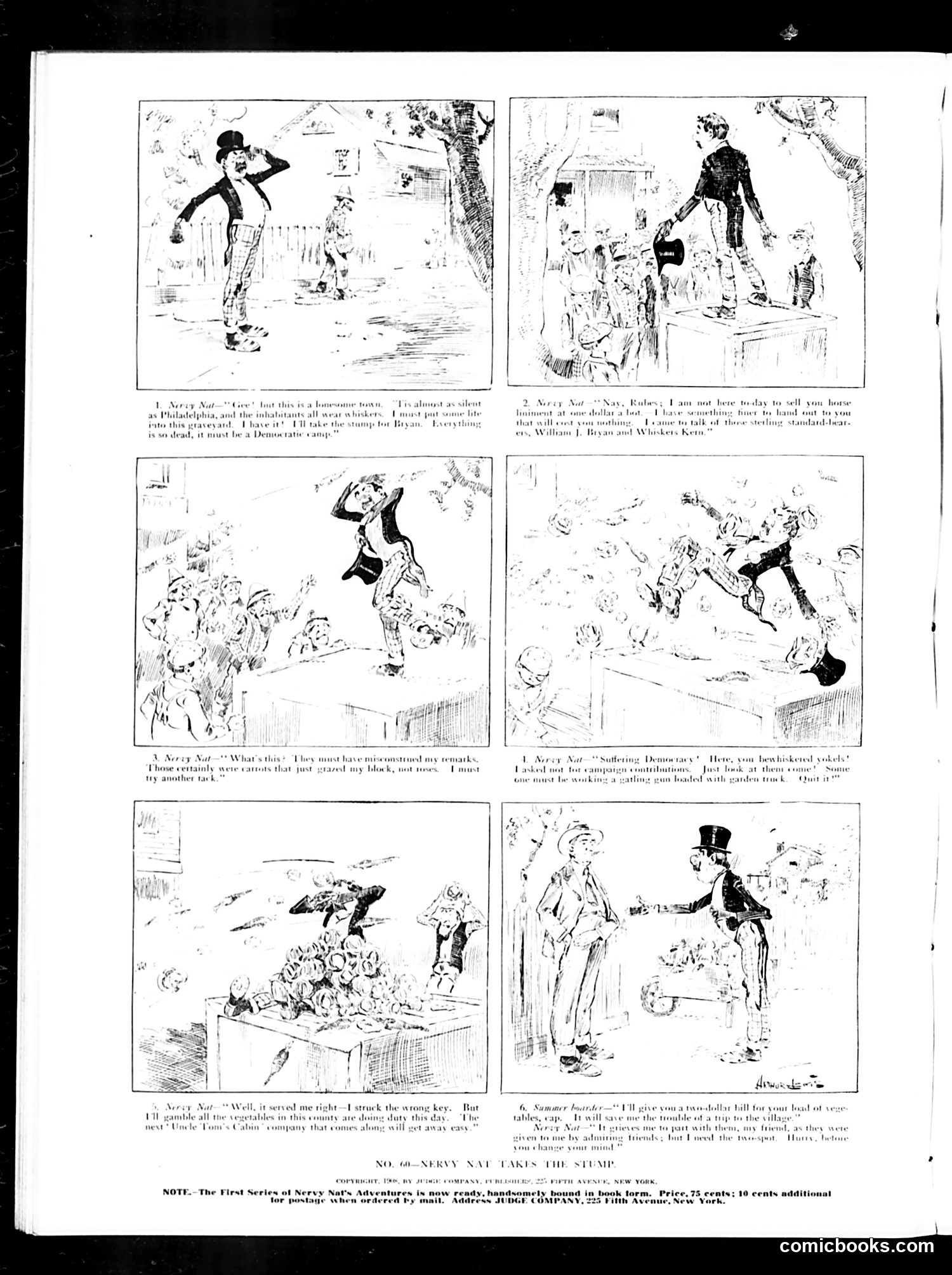
This is a six-panel comic strip following "Nervy Nat," a character who appears to be a con artist or schemer. The narrative shows Nat attempting various deceptions: 1. He tries to sell a fake "Dennycratic range" to a Philadelphia resident 2. He attempts to swindle someone with fraudulent standard bearers (likely political references) 3. His schemes backfire when victims recognize his tricks 4. He gets physically beaten by angry marks who've discovered his deceptions 5. He finally admits defeat to "Uncle Tom's Cabin company" The satire targets small-time fraud and con games common in the era. "Nervy" suggests audacious scheming that repeatedly fails. The political references ("Dennycratic," "standard bearers") appear to mock election-related fraud, though specific figures aren't clearly identified. The strip's humor relies on slapstick comeuppance—the con artist repeatedly getting his due from cheated victims—a common Judge magazine theme mocking dishonesty and rewarding justice.
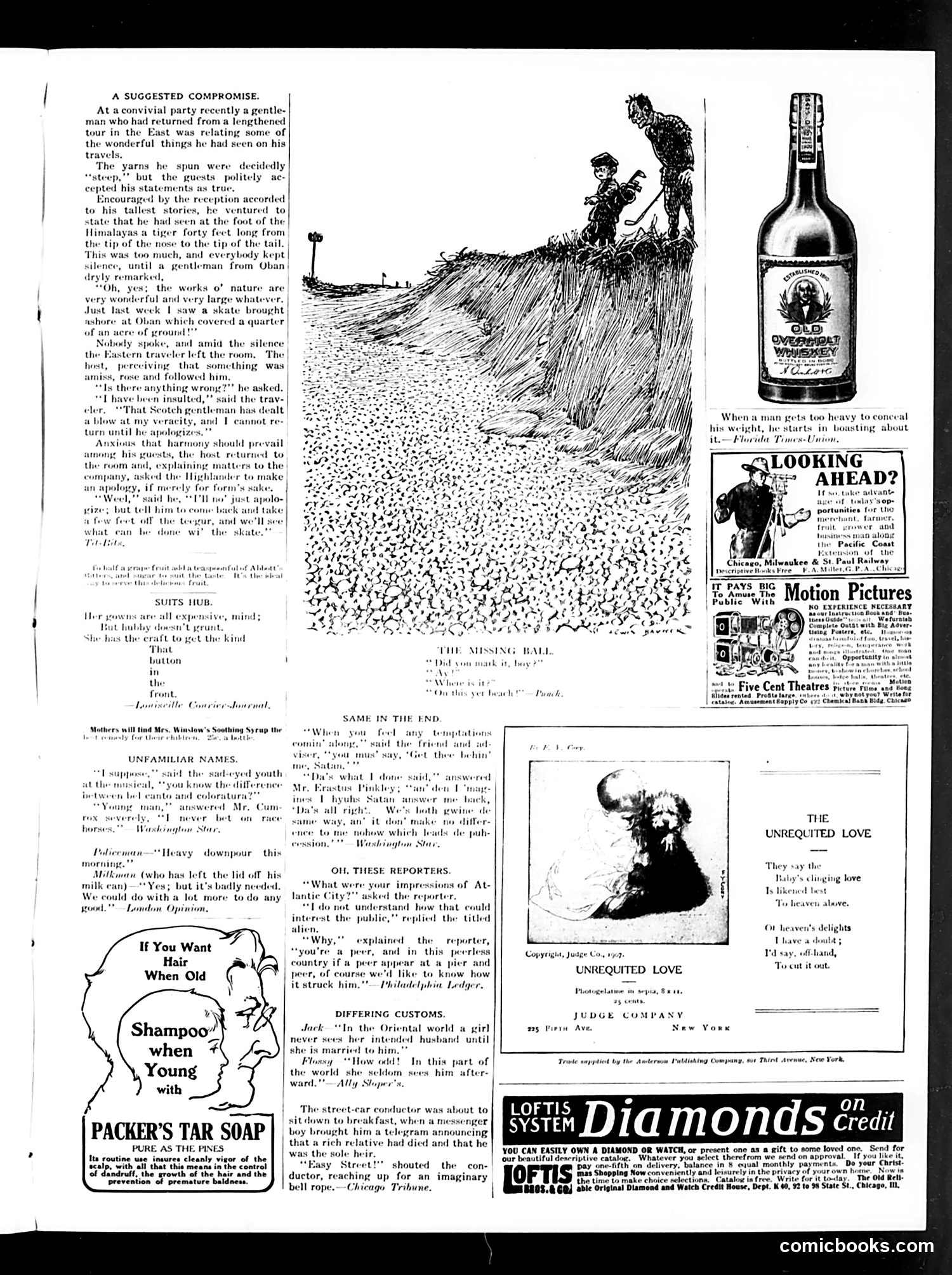
This page contains satirical humor pieces typical of Judge magazine's style. The main cartoon, "The Missing Bale," depicts a comedic scenario where two figures (likely a traveler and a porter or local worker) discuss a missing shipment. The satire plays on miscommunication and exaggeration—a common Judge theme. The accompanying text "A Suggested Compromise" frames the cartoon: a gentleman returning from the East tells tall tales about Himalayan tigers; skeptical guests counter with their own exaggerated stories. The Highlander's anecdote about seeing a snake deliberately undercuts the traveler's claims by being equally implausible but mundane. The page also includes period advertisements (Packer's Tar Soap, Loftis Diamonds) and other brief humorous items exploiting "unfamiliar names" and cultural misunderstandings—typical early-20th-century American humor relying on ethnic and class-based comedy now considered offensive. The satire ultimately mocks pretentious travelers and one-upmanship in polite society.
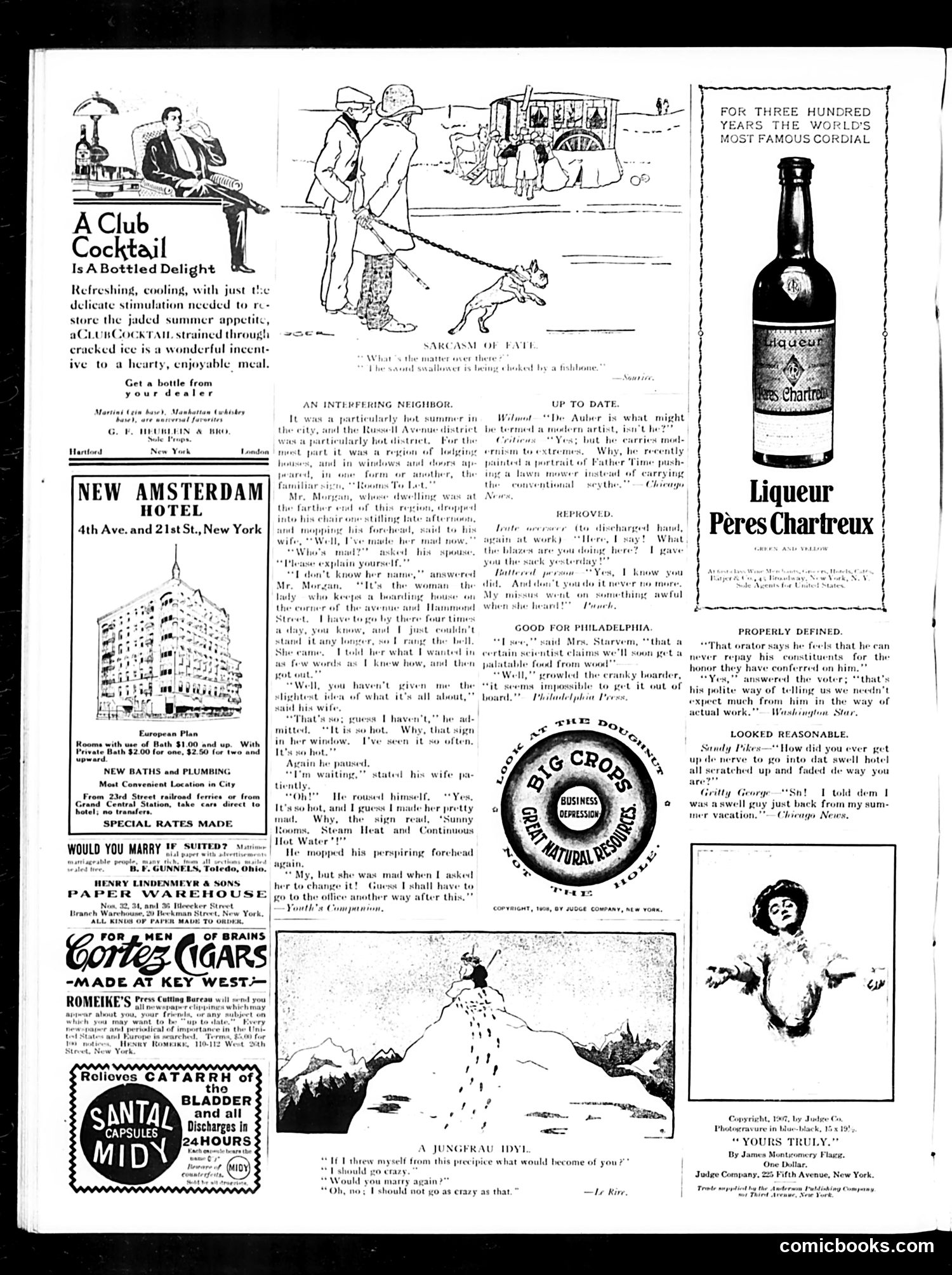
This is primarily an **advertising page** from Judge magazine with several small cartoon vignettes interspersed. The ads dominate—for cocktails, hotels, cigars, and patent medicines typical of early 20th-century publications. The cartoon content includes brief humorous sketches: - **"Sarcasm of Fate"**: Two men with a dog on a leash; the caption jokes about the smaller of two men being "choked by a fishbone"—physical comedy about masculine pride and misfortune. - **"An Interfering Neighbor"**: Domestic comedy involving a nosy neighbor offering unwanted advice about household matters. - **"A Junfrau Idyll"**: Shows someone at a cliff edge; plays on romantic/reckless behavior and marriage proposals. The cartoons reflect Judge's typical humor: mild social satire about everyday life, domestic relations, and class dynamics. The overall page demonstrates how early-20th-century magazines blended advertising revenue with light entertainment—the ads are as prominent as editorial content, reflecting the commercial nature of the publication.
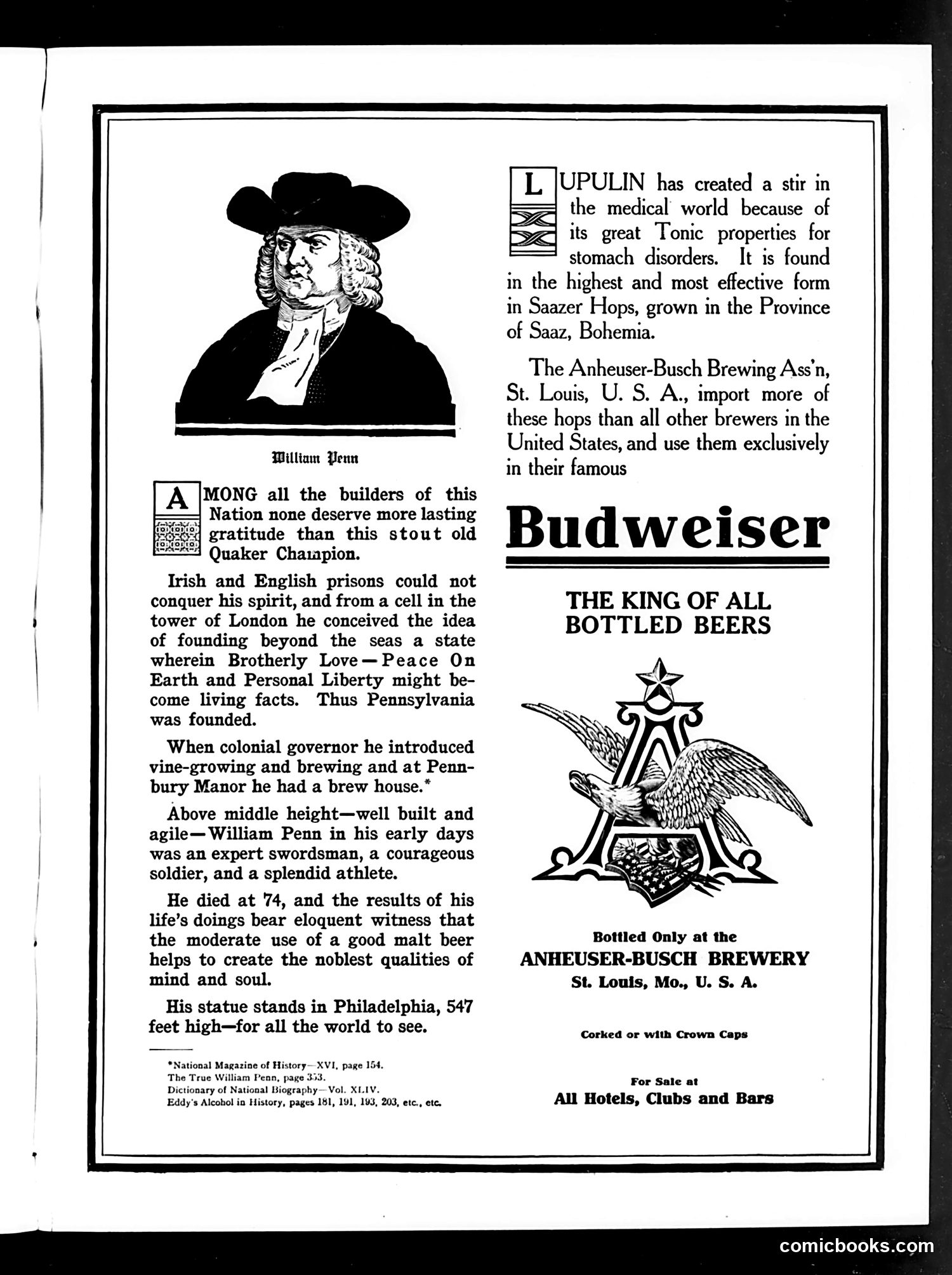
This is primarily **advertising masquerading as editorial content**—a common practice in early 20th-century magazines. The page celebrates William Penn, Pennsylvania's founder, to promote Budweiser beer. **The Strategy**: The text presents Penn as a noble historical figure who introduced brewing to colonial America and argues that "moderate use of a good malt beer helps to create the noblest qualities of mind and soul." This frames beer-drinking as patriotic and character-building, rooted in American founding ideals. **The Sales Pitch**: The right column pivots to Anheuser-Busch's commercial claims—that their Budweiser uses superior Saazer hops (from Bohemia) for digestive health benefits. The "Tonic properties" language appeals to contemporary beliefs that beer had medicinal value. **Modern Context We'd Miss**: - Early 1900s brewers routinely made health claims about beer - Linking products to national founders and history was standard advertising - Judge magazine mixed satire with paid promotional content - The Bohemian hop reference reflects pre-Prohibition era celebration of imported brewing traditions This isn't satirical commentary—it's straightforward brand promotion dressed in historical narrative.
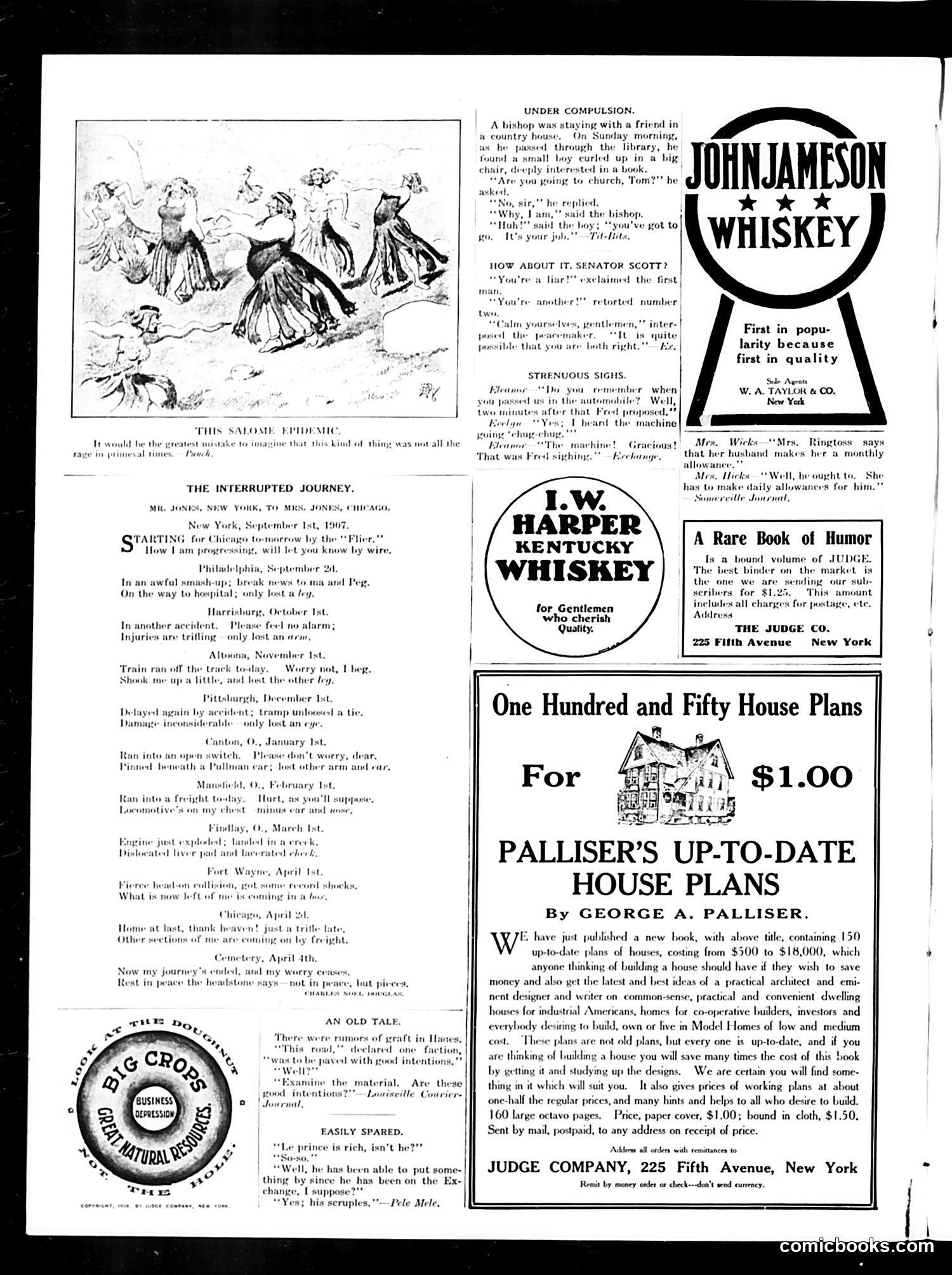
This page from *Judge* magazine contains several distinct pieces of satire and humor: **"Under Compulsion"** depicts a bishop discovering fighting boys in a library. The joke satirizes clergy attempting to impose morality and decorum—the boy claims they're arguing theology rather than fighting, exposing the dishonesty people use when caught misbehaving. **"The Interrupted Journey"** recounts Mr. Jones's progressively catastrophic trip from New York to Chicago via telegram—each message reveals escalating injuries (lost leg, arm, eye, etc.). The satire mocks both the husband's hapless misfortune and his wife's calm, domestic response ("he ought to make daily allowances for him"), treating his disasters as routine annoyances rather than tragedy. **"This Salome Epidemic"** references contemporary craze for "Salome" dances, likely inspired by Richard Strauss's scandalous 1905 opera. The cartoon satirizes this fashionable mania among society women. The remainder of the page comprises advertisements for whiskeys, house-plan books, and a bound volume of *Judge* itself—reflecting the magazine's commercial function alongside satirical content.
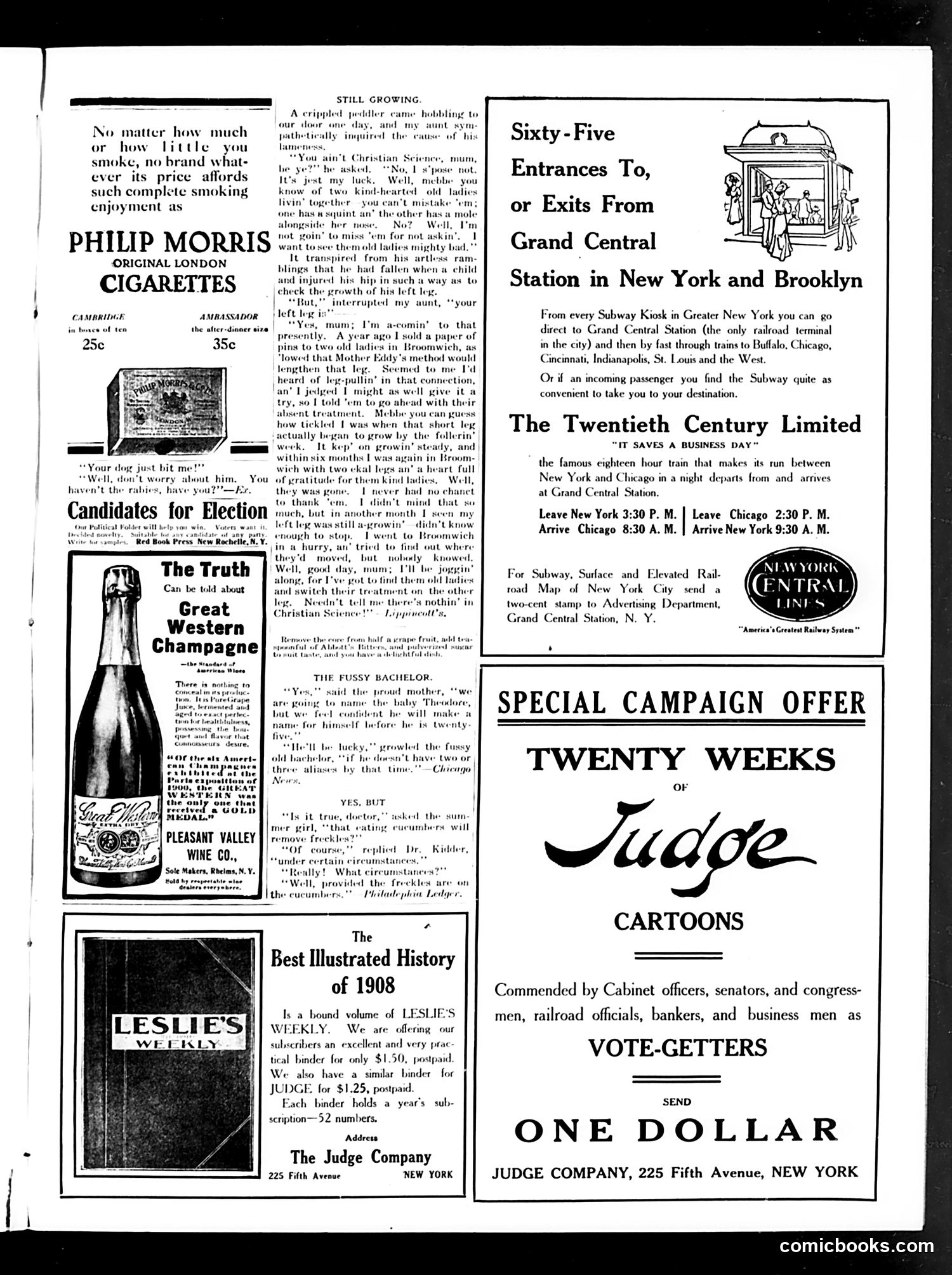
This is primarily an **advertising page** from Judge magazine, not a political cartoon issue. The page features multiple commercial advertisements interspersed with brief humorous anecdotes. The main content includes ads for **Philip Morris cigarettes**, **Western Champagne**, and promotional offers for Judge cartoons and Leslie's Weekly illustrated histories. There's a notable railroad advertisement for **Grand Central Station** and the **Twentieth Century Limited** train service between New York and Chicago. Embedded among the ads are short comedic dialogues—one about a dog bite and another called "The Pussy Bachelor" involving a doctor and freckles—typical of Judge's light satirical humor. The page's dominant feature is a **special campaign offer**: Judge cartoons are being promoted as "vote-getters" for election purposes, endorsed by politicians and businessmen. This suggests the publication positioned its political satire as persuasive material for campaigns. The $1 subscription offer reflects Judge's attempt to expand readership during an election season.
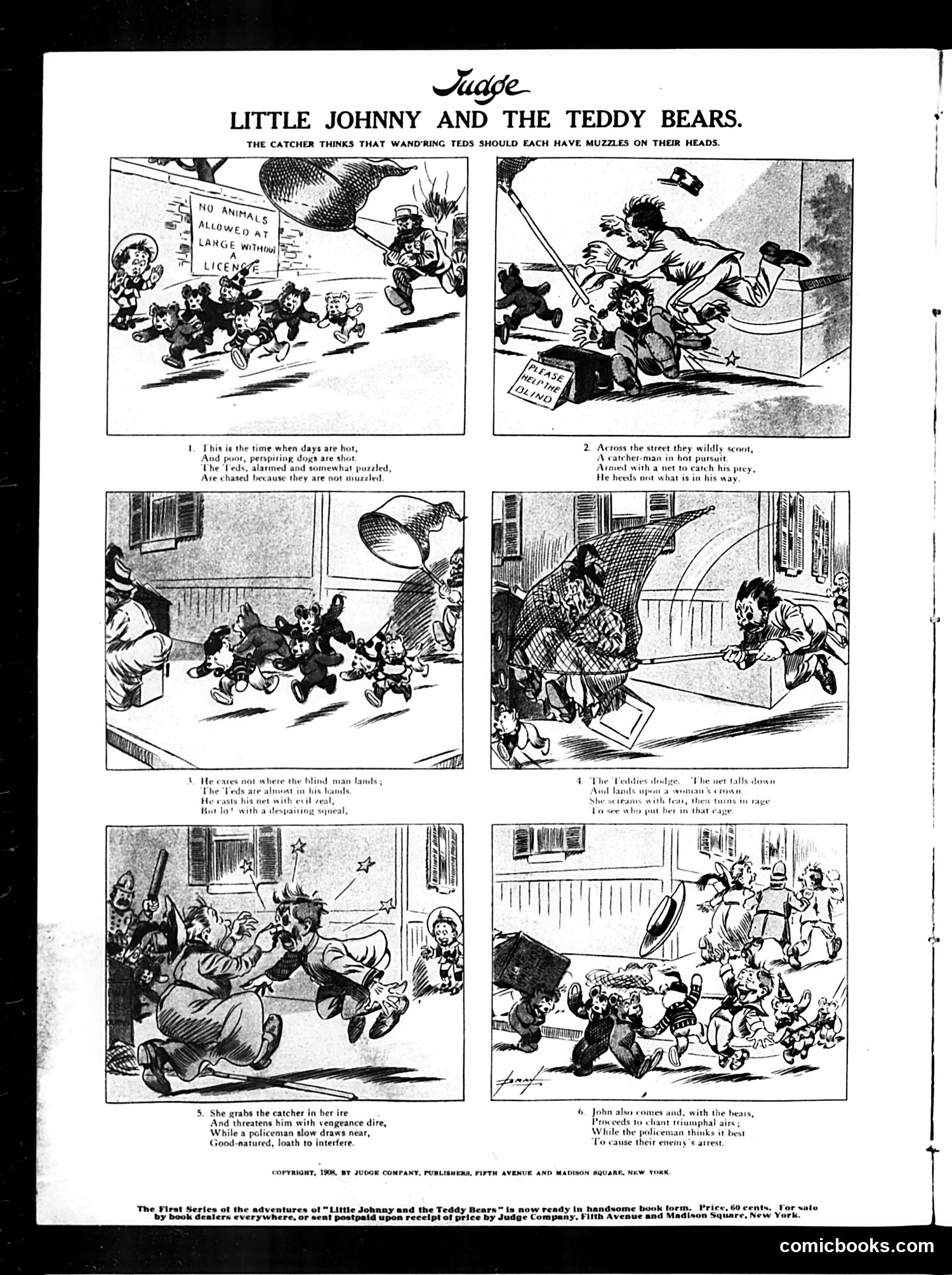
This 1908 Judge magazine comic strip satirizes Theodore Roosevelt's popularity and his association with "teddy bears"—toys named after him following a famous 1902 hunting incident. "Little Johnny" represents the American public enchanted by Roosevelt's vigor and persona. The subtitle's reference to a "catcher" wanting muzzles on "wand'ring Teds" suggests anxiety about Roosevelt's uncontrollable energy and influence spreading unchecked through society. Panel 5 depicts a woman (likely representing America or a concerned citizen) attacking the catcher in "vengeance dire," with police reluctant to intervene—satirizing public support for Roosevelt despite establishment concerns about his assertive policies and unpredictability. The strip mocks both Roosevelt-mania and elite discomfort with his populist appeal and independent behavior. The "teddy bears" metaphor transforms the president into something cuddly yet potentially dangerous if left unmuzzled.