
A complete issue · 16 pages · 1908
Judge — August 1, 1908
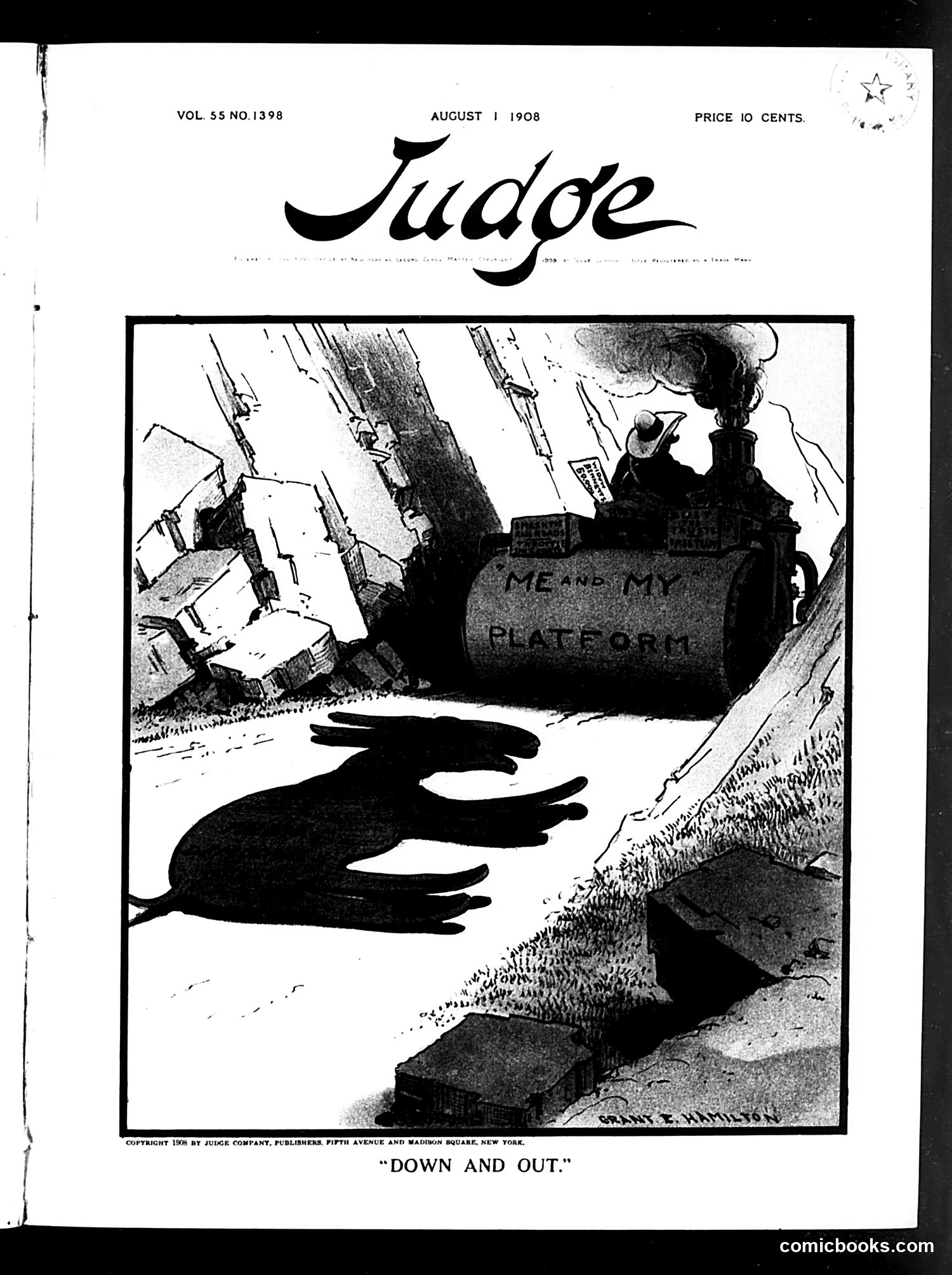
This satirical cartoon titled "Down and Out" depicts a military figure lying prone on the ground, apparently defeated or exhausted. A large cannon labeled "ME AND MY PLATFORM" looms behind, suggesting the figure's political agenda or campaign has become a weapon that has backfired or overwhelmed them. The imagery appears to reference a 1908 political candidate or figure whose policy platform has failed or caused their downfall. The prone position and the title "Down and Out" emphasize complete defeat. Without clearer identification of the specific figure or campaign referenced, the exact political context remains unclear, though it clearly satirizes a prominent political figure whose ambitious platform has proven disastrous.
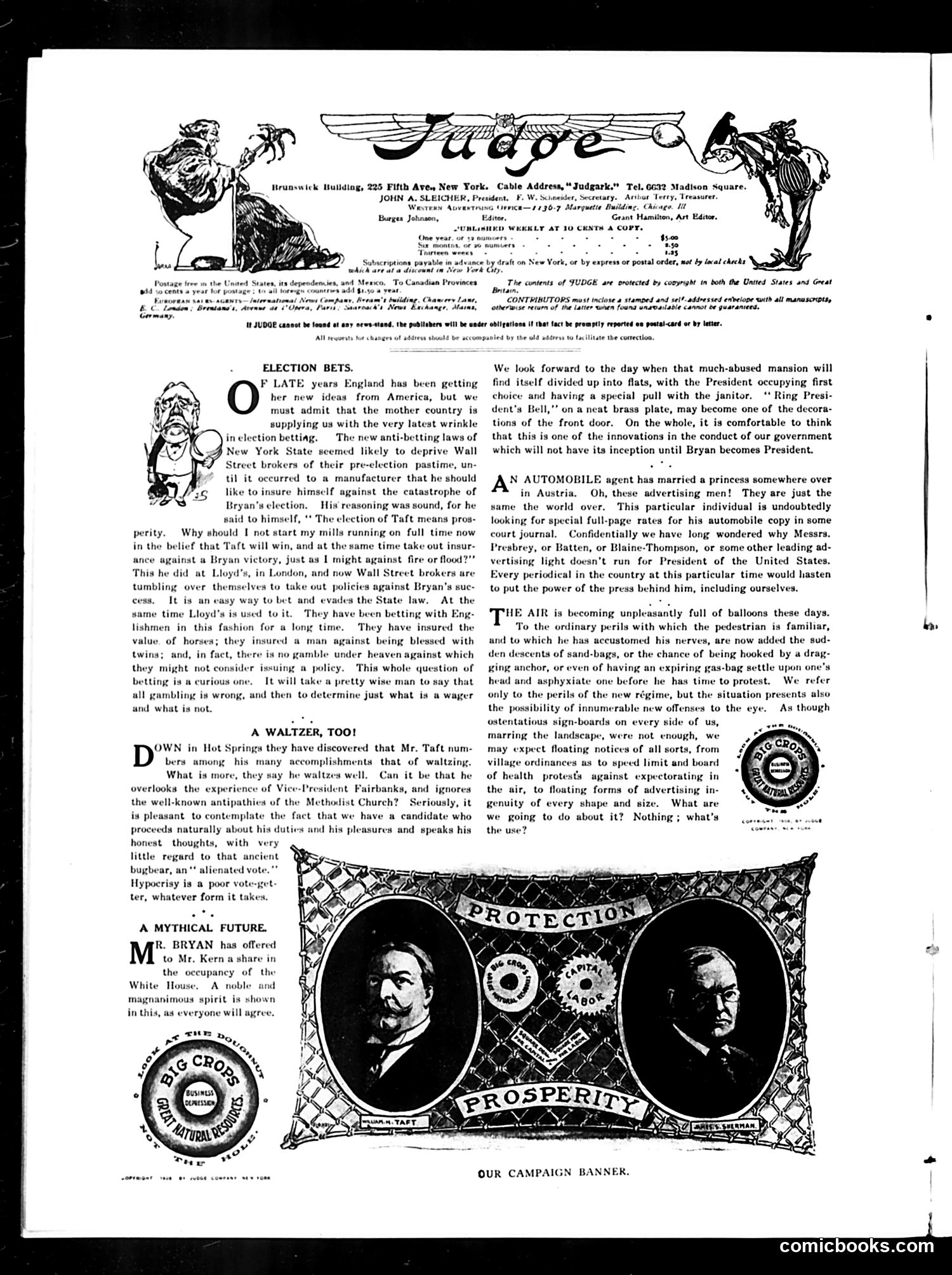
This page satirizes the 1908 U.S. presidential election. The "Election Bets" section mocks Wall Street's anxiety about William Jennings Bryan's potential candidacy—wealthy financiers feared his populist economic policies. The cartoon ridicules their protective measures, suggesting they're over-reacting to a hypothetical threat. "A Waltzer, Too!" jabs at Vice President James Sherman's waltzing skills, implying he's an unsuitable leader compared to President Taft. "A Mythical Future" sarcastically presents Bryan sharing the White House occupation with Kern (likely Vice Presidential candidate John Kern) as absurd fantasy. The bottom banner features portraits labeled "Protection" and "Prosperity"—Republican campaign slogans contrasting with Bryan's perceived radicalism. The satire targets both Bryan's potential return and Republican anxiety about electoral vulnerability.
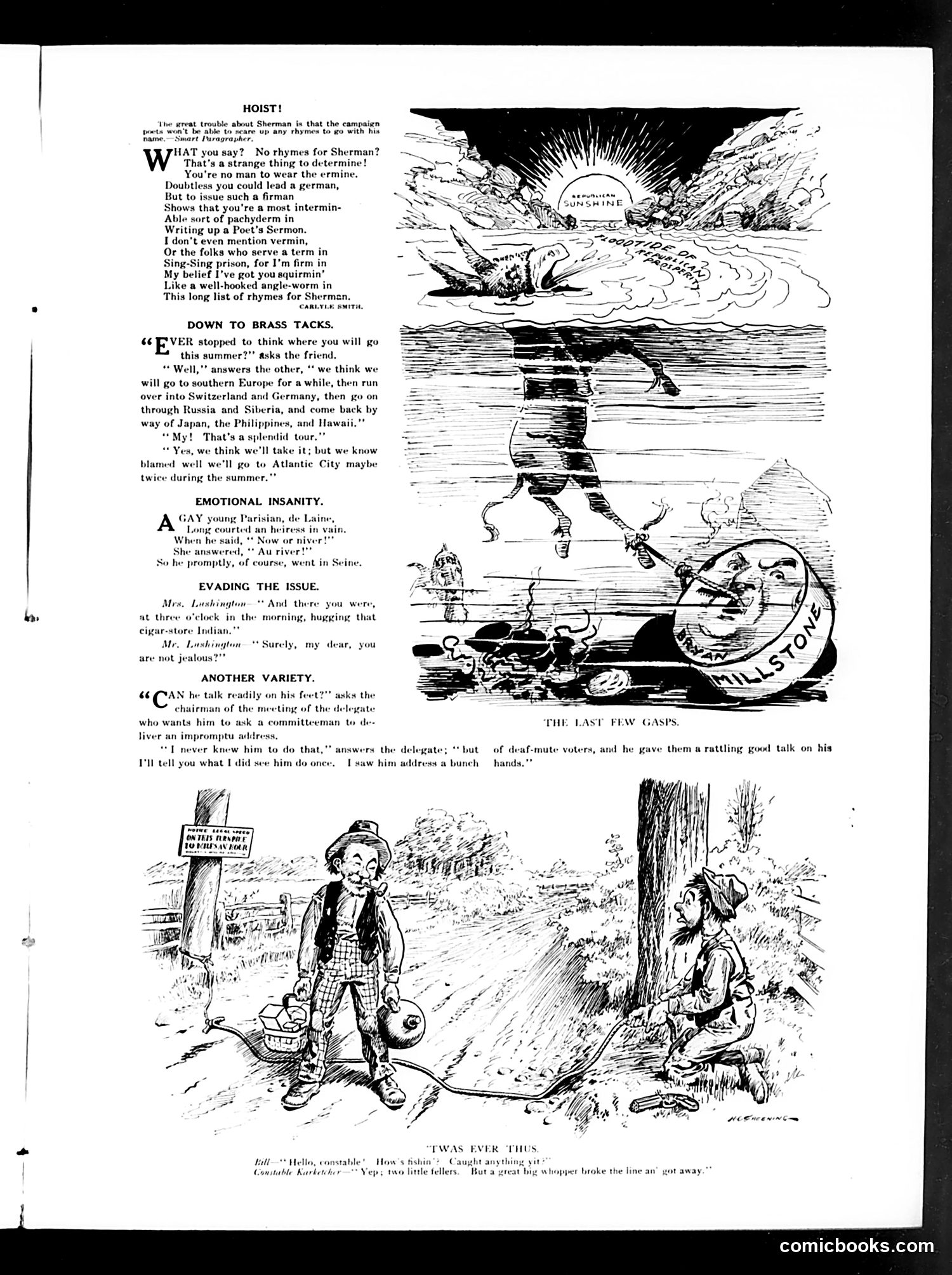
This page contains several humorous sketches and anecdotes typical of Judge's satirical style. The main content includes: **"Hoist!"** — A poem mocking someone named Sherman, criticizing his character through rhyming verse about wearing "the ermine" (formal robes), suggesting hypocrisy. **"Down to Brass Tacks"** — A dialogue about summer travel plans to Europe, Atlantic City, and Japan—satirizing middle-class vacation aspirations. **"The Last Few Gasps"** — An illustration showing what appears to be a political figure or organization ("Willstone") in its death throes, likely referencing a failed political movement or candidacy. **Bottom cartoon** — Shows rural characters discussing fishing, making a pun about "breaking the line." Without clearer dating or identifying labels, the specific political figures and events remain unclear, though the content targets familiar American political and social pretensions of the era.
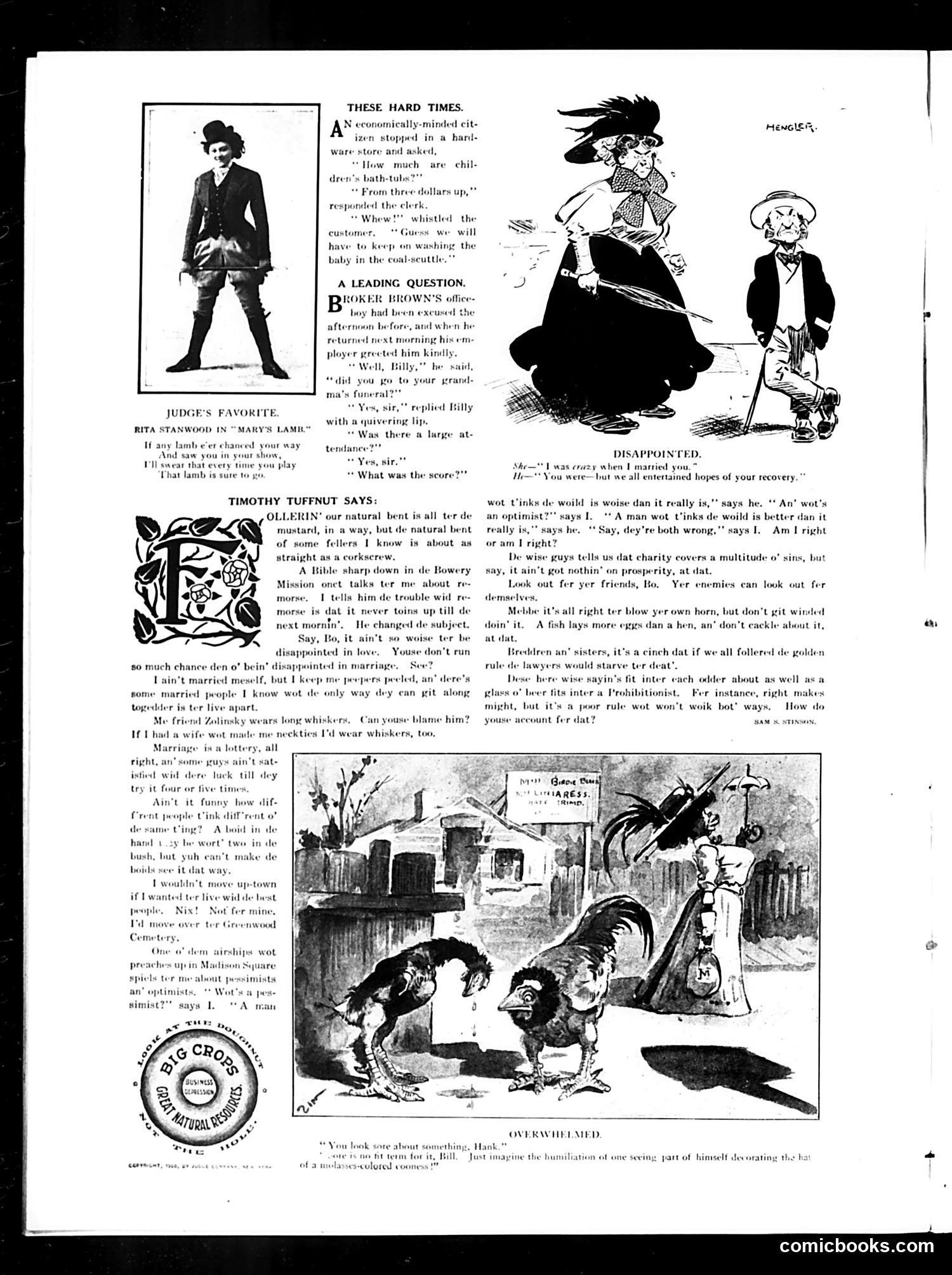
This page contains satirical commentary on economic hardship ("These Hard Times") typical of early 20th-century Judge magazine. The main cartoon "Disappointed" depicts a woman confronting a man, with text suggesting marital discord over financial recovery prospects. The accompanying sketches show caricatured figures—likely representing different social types dealing with economic strain. The longer prose piece "Timothy Turlerin" uses folk-style dialect to discuss marriage, poverty, and social attitudes. The language and illustrations employ period stereotypes common to Judge's satirical approach. The bottom cartoon "Overwhelmed" shows dogs fighting over scraps near a house, appearing to satirize how economic competition reduces people to animal desperation—a commentary on class struggle during financial crisis. The overall page targets working and middle-class anxieties about economic insecurity through humor and caricature.
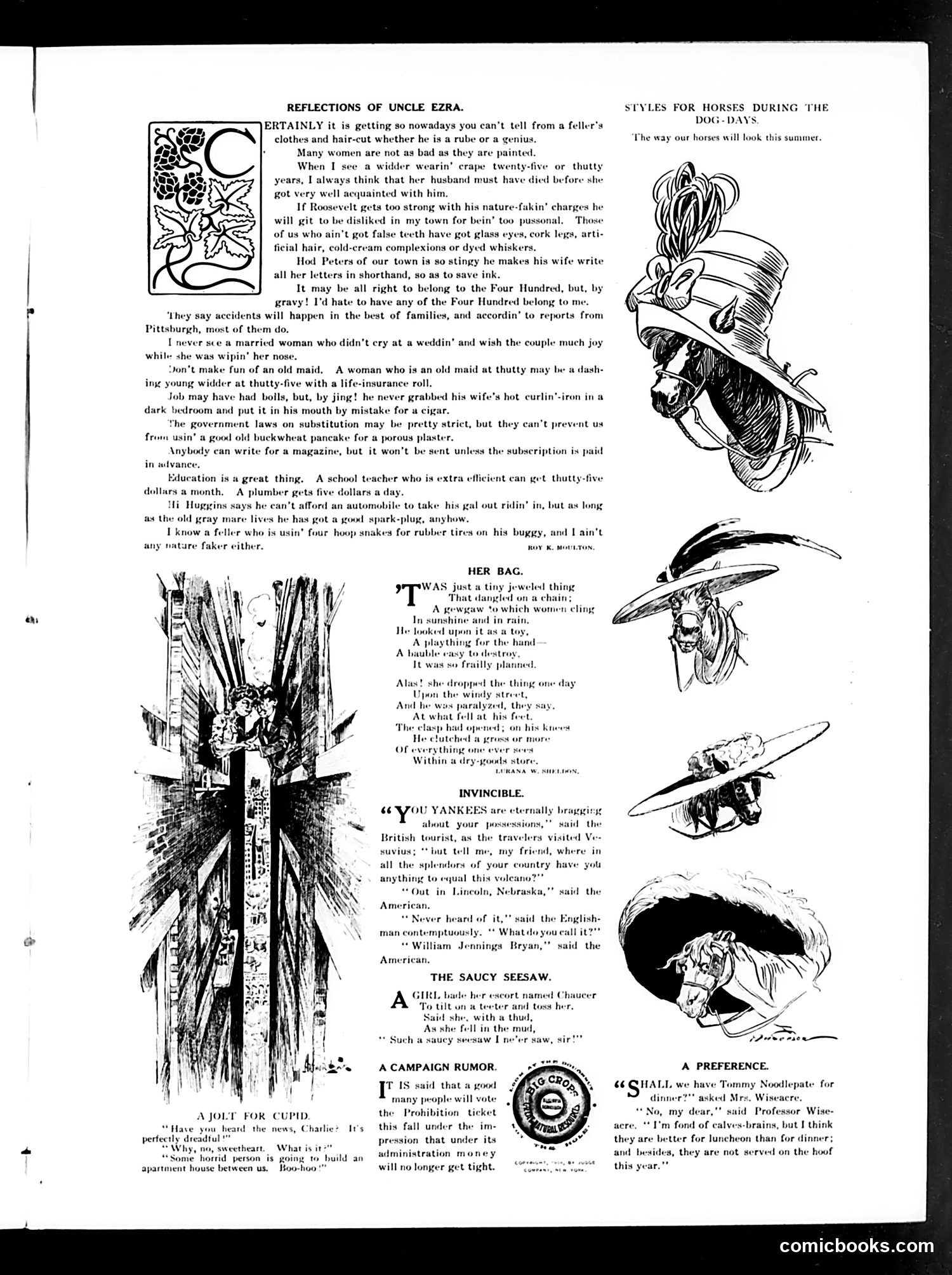
This page contains several humorous pieces rather than political cartoons. "Reflections of Uncle Ezra" offers folksy social commentary on marriage, clothing, education, and fake credentials. "Her Bag" tells a cautionary poem about a woman losing her handbag on a windy street. "Invincible" appears to be a dialogue mocking American boasting about superiority compared to British and Nebraskans. "The Saucy Seesaw" is a brief anecdote. The right side features illustrations labeled "Styles for Horses During the Dog Days" — whimsical drawings of horses wearing various outfits, likely satirizing fashionable human clothing trends by comically applying them to animals. The overall tone is lighthearted satire of American society, fashion, and national character rather than focused political commentary.
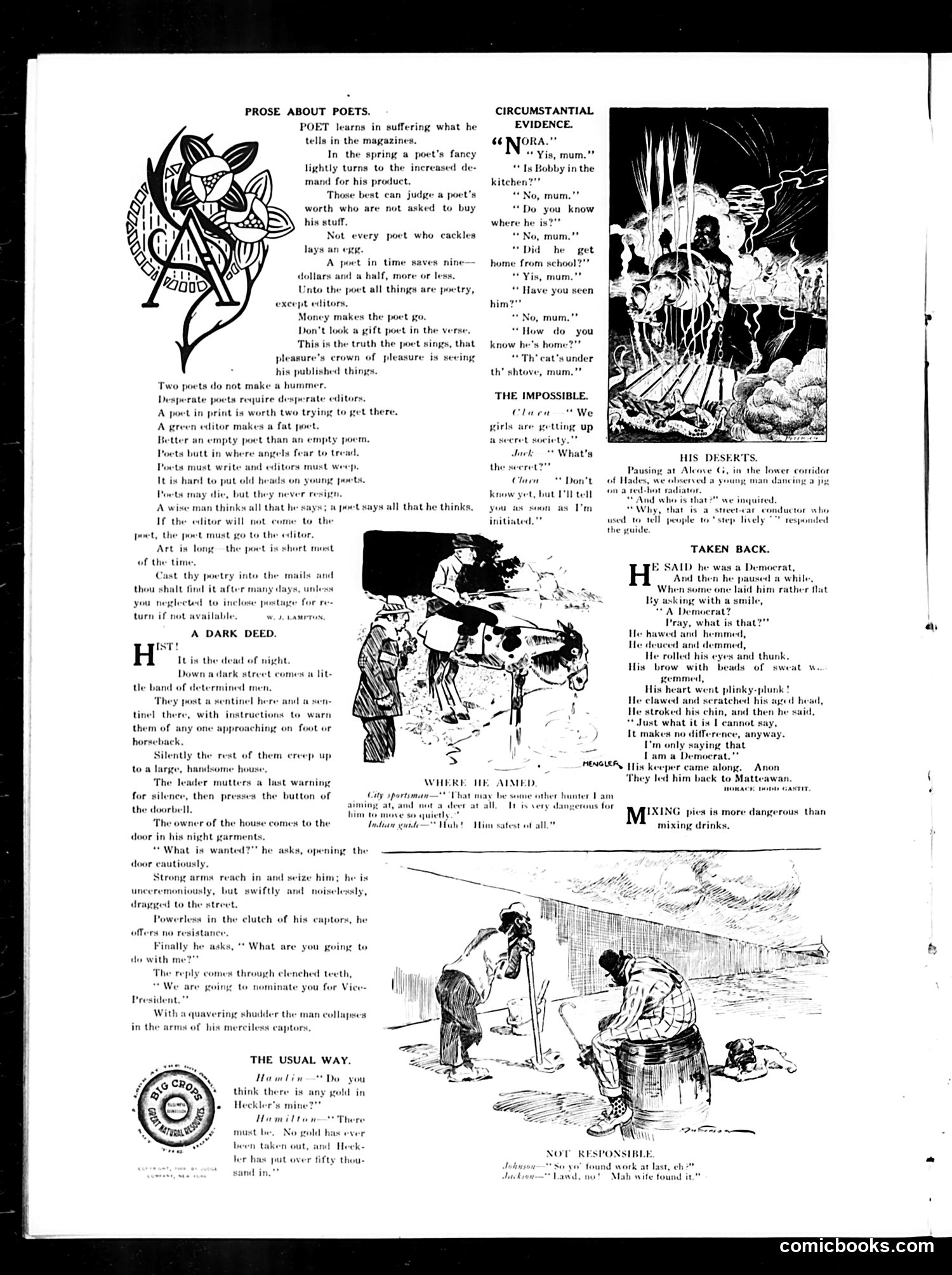
This page mocks struggling poets and the publishing industry through satirical verse and illustrations. The left column contains cynical aphorisms about poets—that they're unprofitable, desperate for editors' acceptance, and doomed to obscurity. Lines like "Money makes the poet go" and "A poet in time saves nine dollars and a half" parody inspirational sayings while highlighting poets' financial desperation. The various cartoon vignettes illustrate poets' comic misfortunes: one shows a mother searching for her missing son Bobby, another depicts a man being forcibly removed from a house at night (apparently a "dark deed" involving poets), and others show everyday poverty and humiliation. The satire targets both impoverished poets—portrayed as delusional and persistent—and the publishing establishment that exploits them. The overall message: poets are pitiable figures whose romantic notions of art cannot survive economic reality. This reflects late 19th/early 20th-century American attitudes toward artistic poverty and commercial culture.
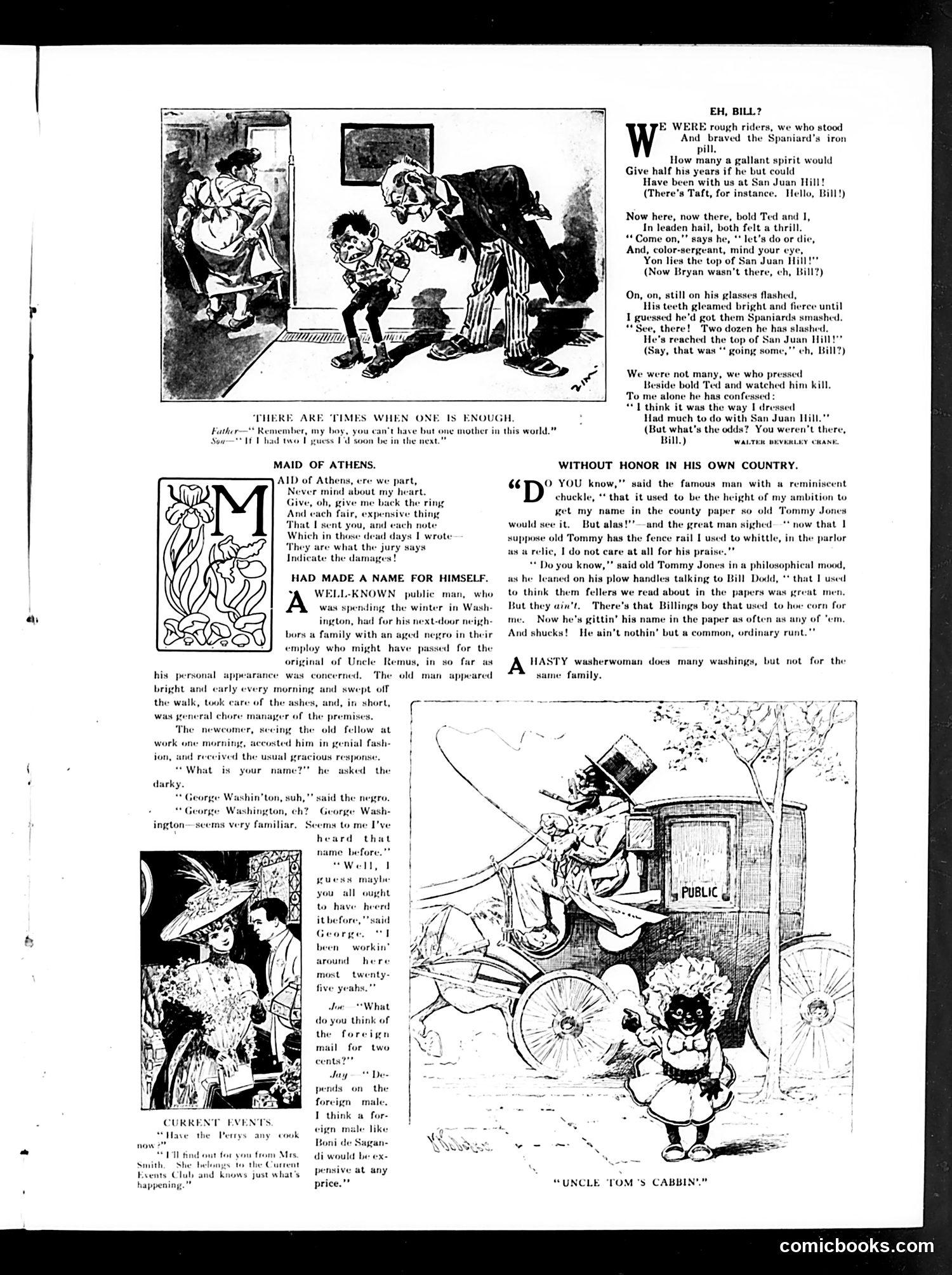
This page satirizes American political pretension and false heroism, circa early 1900s. **Top cartoon "Eh, Bill?"** mocks Theodore Roosevelt's San Juan Hill prominence. The speaker reminisces about the Spanish-American War charge with "bold Ted," contrasting Roosevelt's celebrated role with William Jennings Bryan's absence. The satire suggests Roosevelt leveraged this military moment into political capital (he later became President). References to Taft indicate contemporary political discussion. **"Without Honor in His Own Country"** ridicules how famous men seek newspaper recognition and public adulation, yet are dismissed by ordinary people like "Tommy Jones" and "Bill Dodd." The anecdote about the fence rail relic and the "Billings boy" illustrates that local fame means nothing—common people see through celebrity pretense. **"Maid of Athens" and related sections** appear to be humorous poetry and social commentary about vanity and class. The page's overall message: ambitious men crave public recognition and inflated reputations, but their actual worth remains unchanged in common judgment. Success requires more than newspaper coverage.
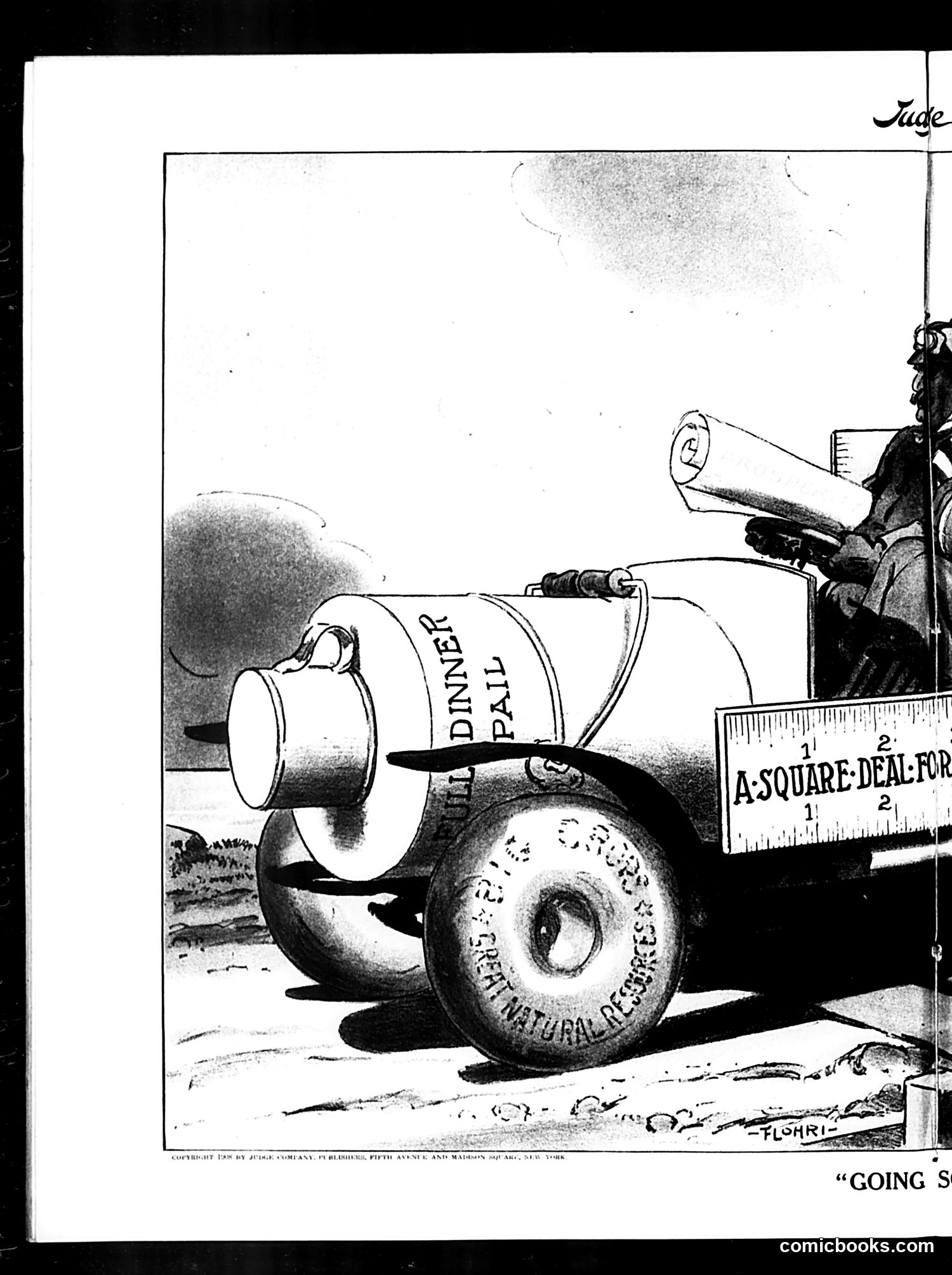
This Judge magazine cartoon depicts a vehicle labeled "DINNER PAIL" being towed or transported, with text reading "A SQUARE DEAL FOR" visible on a sign. The imagery appears to reference Theodore Roosevelt's "Square Deal" domestic policy platform from the early 1900s. The cartoon likely satirizes political promises around labor and working-class prosperity—the "dinner pail" symbolizing workers' livelihood. The vehicle's precarious positioning suggests skepticism about whether such promises would actually be delivered or sustained. The specific context of "Going S[omewhere]" (text cuts off) remains unclear, but the overall message appears to mock the gap between political rhetoric and actual economic outcomes for ordinary workers during this era.
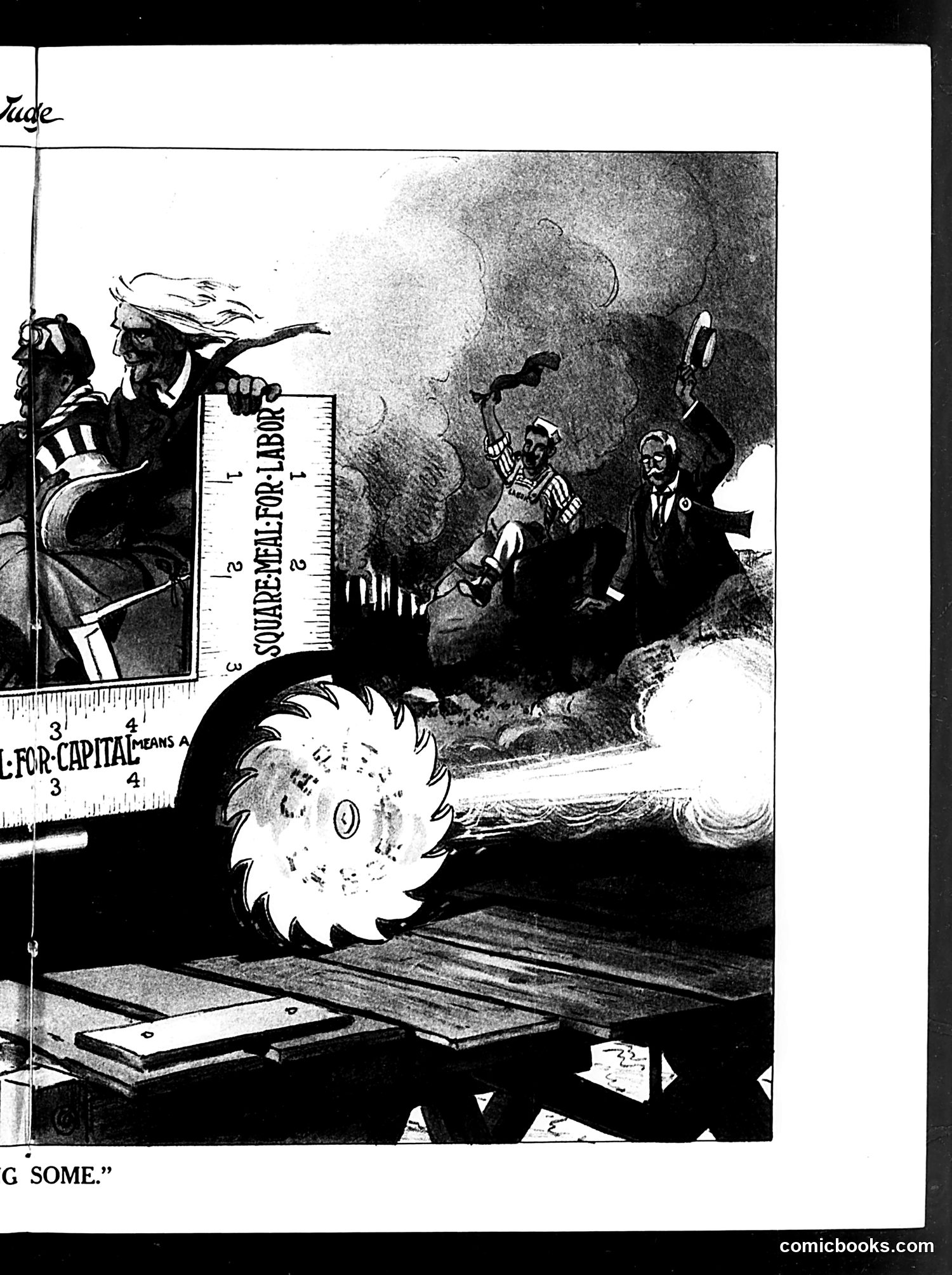
This appears to be a satirical cartoon about labor exploitation and industrial capitalism. On the left, a wealthy capitalist or factory owner operates a large saw labeled "SQUEEZEFOR LABOR" (the text is partially visible). The saw is actively cutting through wood, while on the right, workers—depicted as small figures in military or work uniforms—appear distressed or being harmed by the machinery. The cartoon's message seems critical of how capitalists "squeeze" labor from workers, using industrial machinery as a metaphor. The scale disparity between the powerful figure controlling the saw and the vulnerable workers emphasizes the power imbalance. This reflects early-20th-century concerns about workers' rights and industrial safety that *Judge* magazine frequently satirized. The incomplete OCR text makes some details unclear.
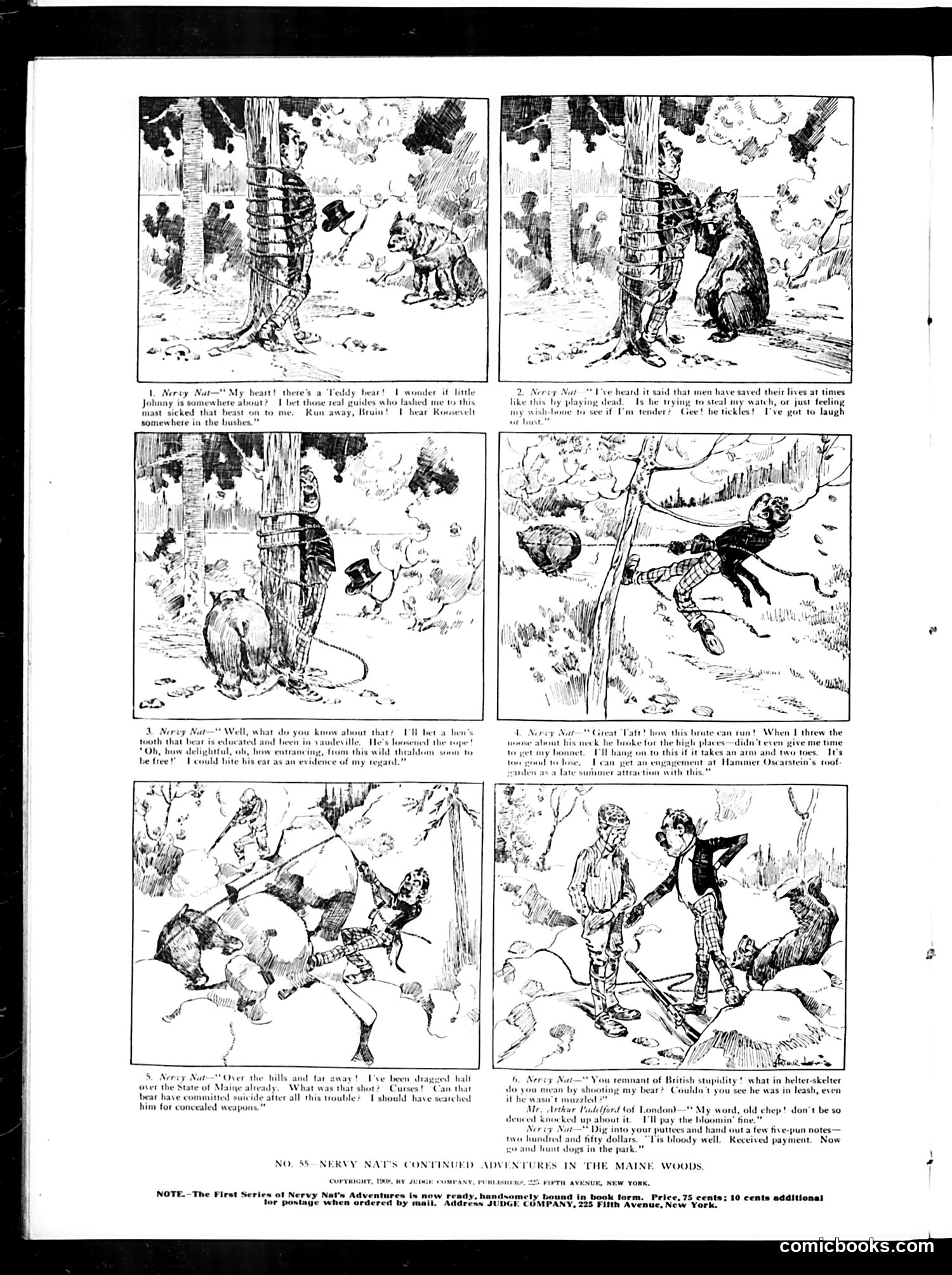
This page depicts a comic strip series titled "Nervy Nat's Adventures in the Maine Woods." The protagonist, Nervy Nat, appears to be a young American adventurer encountering various wilderness situations and mishaps. The narrative involves Nat's interactions with animals (a bear appears prominently) and encounters with what seems to be a British character, indicated by references to "British stupidity" and stereotypical British expressions ("My word, old chep"). The humor derives from Nat's resourcefulness and quick thinking—he appears to outwit both dangerous wildlife and the somewhat bumbling British figure through cunning (playing dead, stealing, strategic thinking). The satire likely reflects early 20th-century American attitudes: celebrating American pluck and ingenuity while gently mocking British pomposity. The strip was advertised as available in book form for 75 cents, indicating this was a popular entertainment feature in *Judge* magazine.
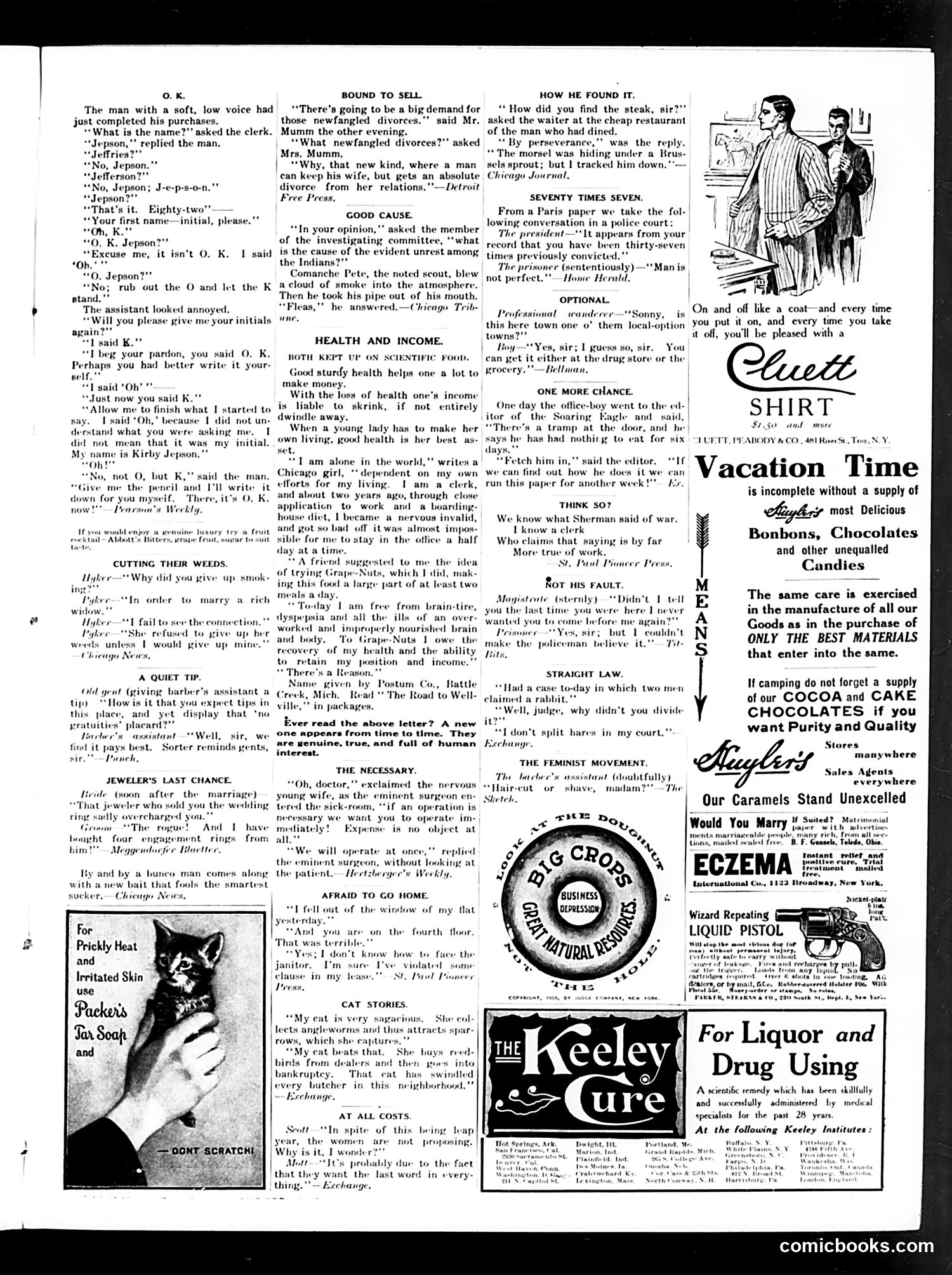
Looking at this page from *Judge* magazine, the visible cartoons and jokes reflect early 20th-century American social concerns: The cartoons appear largely text-driven, using dialogue-based humor. One joke mocks a clerk's confusion over a customer's name spelled "O.K. Jepson"—a simple misunderstanding pun. Another satirizes newfangled divorce laws allowing men to separate from wives' relatives, poking fun at both modern marriage complications and in-law tensions. A piece on health and income uses Grape-Nuts cereal (then a real advertised product) to joke about the connection between physical health and earning potential—reflecting contemporary anxieties about productivity and modernity. Other fragments joke about barbering, jewelry (with a surgeon needing "engagement rings"), and domestic disputes over smoking habits—typical genteel humor of the era, targeting middle-class anxieties about marriage, money, and modern life. The bulk of the page is advertisements for period products (Packer's Tar Soap, Keeley Cure institutes) rather than substantive satire.
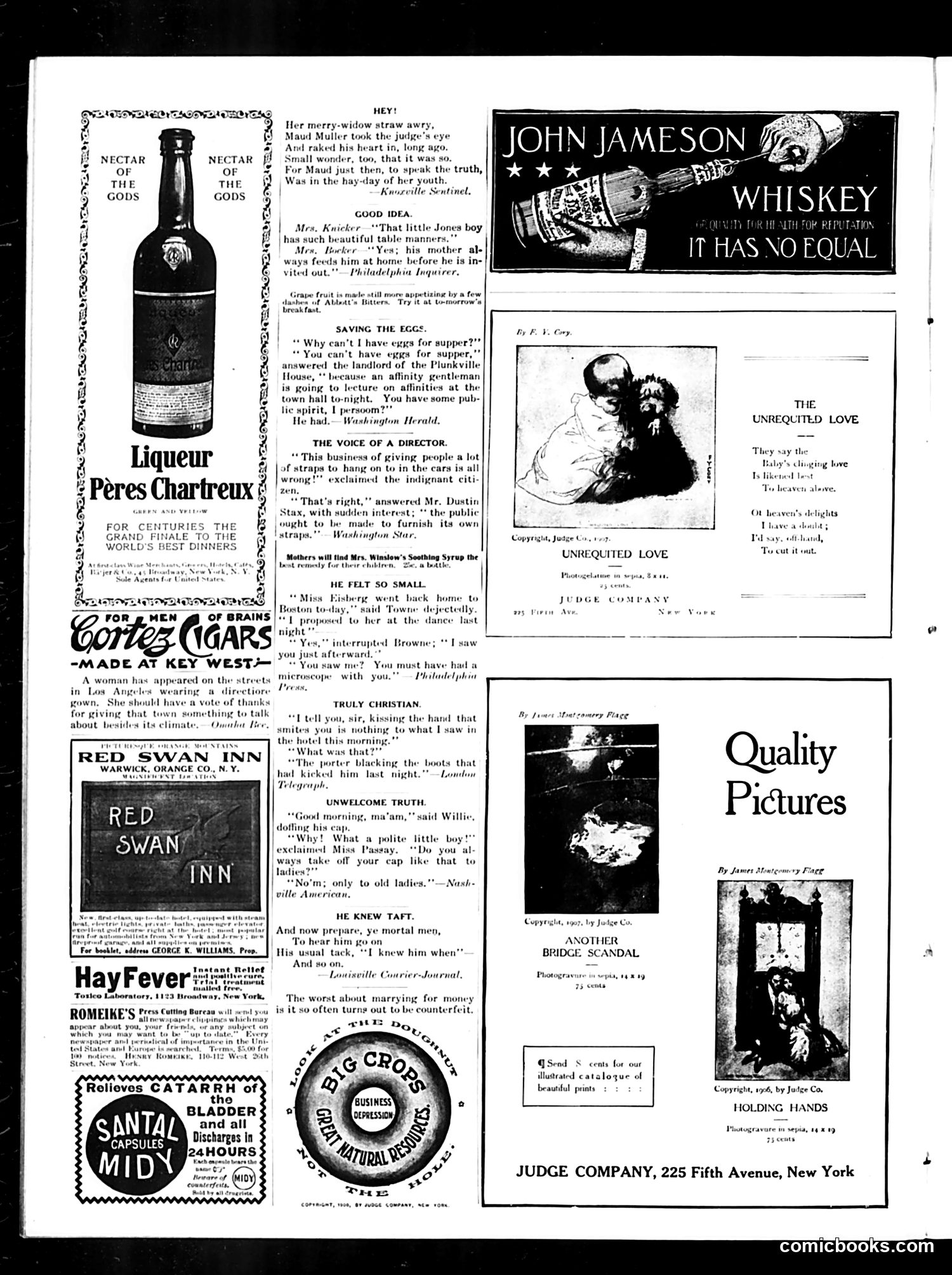
This is primarily an **advertising and humor compilation page** rather than a single political cartoon. The content consists of: **Social Humor Snippets:** Short jokes about contemporary manners and courtship—a woman praising a boy's table manners, a man proposing at the town hall, complaints about egg prices due to "affinity gentlemen" (likely a reference to free-love advocates). These reflect early 20th-century concerns about changing social propriety. **Advertisements:** Prominent liquor and patent medicine ads typical of the era (Peres Chartreux liquor, Santal capsules for bladder issues, Hay Fever remedies), reflecting Judge's male-skewing readership. **Art reproductions:** The "Quality Pictures" section advertises Judge Company's illustrated prints, including "The Unrequited Love" and "Another Scandal." **No clear political satire** is evident on this page. The humor is gentle social commentary on manners, romance, and small-town life rather than pointed political critique. The page functions as a miscellaneous content-and-revenue vehicle typical of early 1900s satirical magazines.
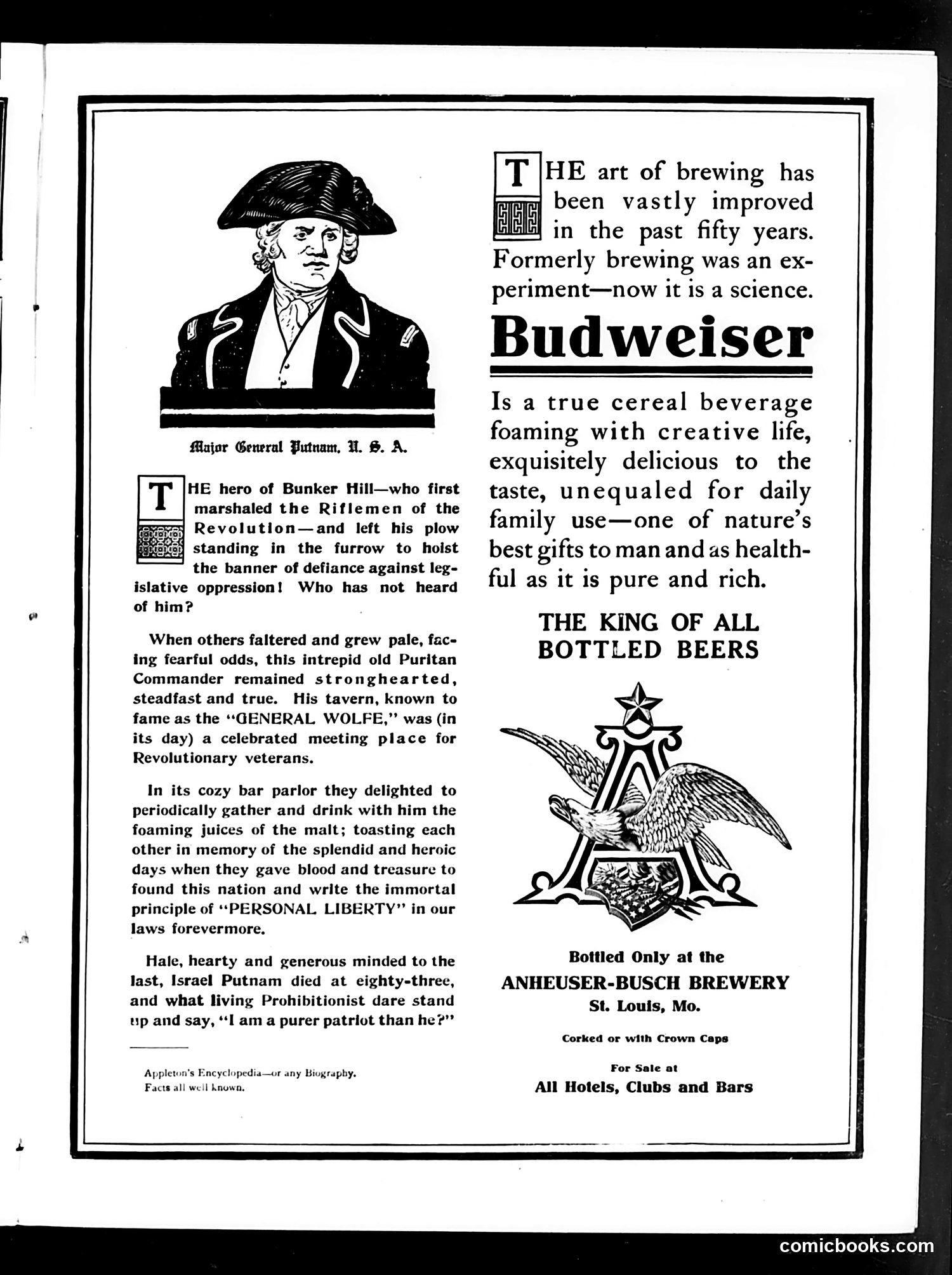
This is primarily **Budweiser advertising disguised as patriotic content**, likely from the Prohibition era or just before it. The ad invokes Major General Israel Putnam (Revolutionary War hero) to argue that beer consumption is patriotic and wholesome. It describes his tavern, "The General Wolfe," as a gathering place where veterans toasted "Personal Liberty"—a transparent jab at Prohibitionists who sought to ban alcohol. The final rhetorical question—"what living Prohibitionist dare stand up and say, 'I am a purer patriot than he?'"—is the satirical punch: it equates drinking beer with patriotism and suggests Prohibitionists are *un*-patriotic. This represents beer industry propaganda against the temperance/Prohibition movement. The page uses false historical legitimacy ("Appleton's Encyclopedia—Facts all well known") to lend credibility to what is essentially a commercial argument wrapped in Revolutionary nostalgia.
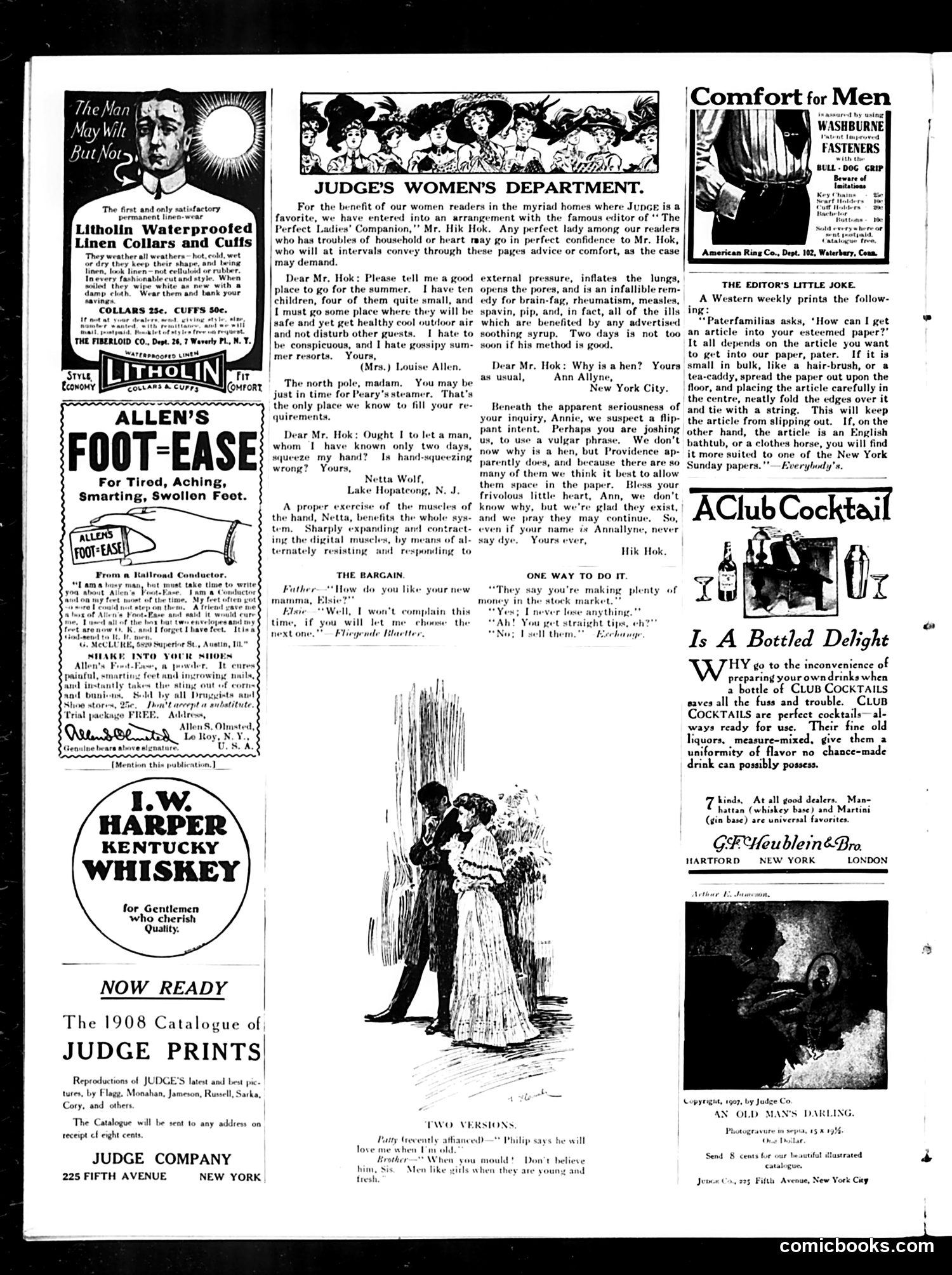
This page consists primarily of **advertising and advice column content** rather than political satire. The main featured element is "Judge's Women's Department," an advice column where "Mr. Hik Hok" (a stereotypical character name suggesting ethnic mockery, common to the era) responds to humorous letters from women readers. The jokes are domestic in nature—where to vacation, whether to let a man squeeze her hand—with satirical answers (suggesting the North Pole for summer, calling a woman's romantic inquiry "frivolous"). The page's satire targets **Victorian-era propriety and women's conventional concerns** through exaggeration and absurdist responses. The remaining content is product advertising (Litholin collars, Allen's Foot-Ease, I.W. Harper Whiskey, and Club Cocktails), with one brief editorial joke mocking how to submit articles to magazines. No specific historical figures or major political events are referenced—this is light, domestic humor typical of Judge's style in the early 1900s.
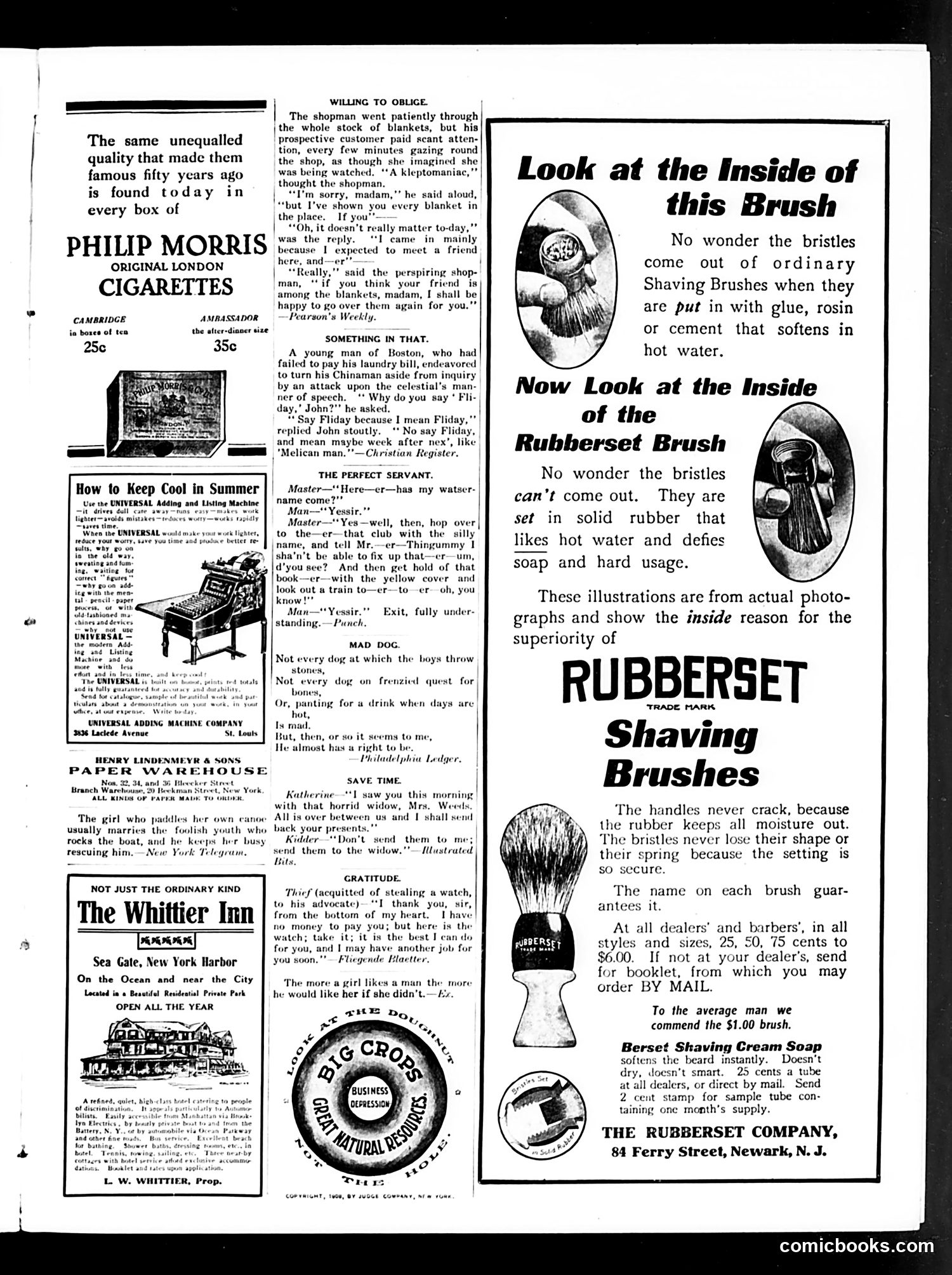
This page is primarily **advertising**, not political satire. It contains multiple ads for consumer products (Philip Morris cigarettes, Universal adding machines, The Whittier Inn hotel) alongside brief humorous anecdotes and jokes typical of Judge magazine's filler content. The main substantive content is a **Rubberset Shaving Brushes advertisement** featuring product comparison illustrations. It argues that ordinary brushes fail because bristles are "put in with glue, rosin or cement that softens in hot water," whereas Rubberset uses "solid rubber" that resists moisture and wear. The ad includes cross-section photographs to demonstrate superiority. The scattered jokes—about a woman browsing blankets, a Chinese laundry man's speech, a servant following vague orders—are generic period humor with no evident political messaging. The "Mad Dog" poem and romantic anecdotes appear designed simply as entertainment between advertisements. This reflects Judge's mixed format: satirical cartoons alongside conventional advertising and light humor.
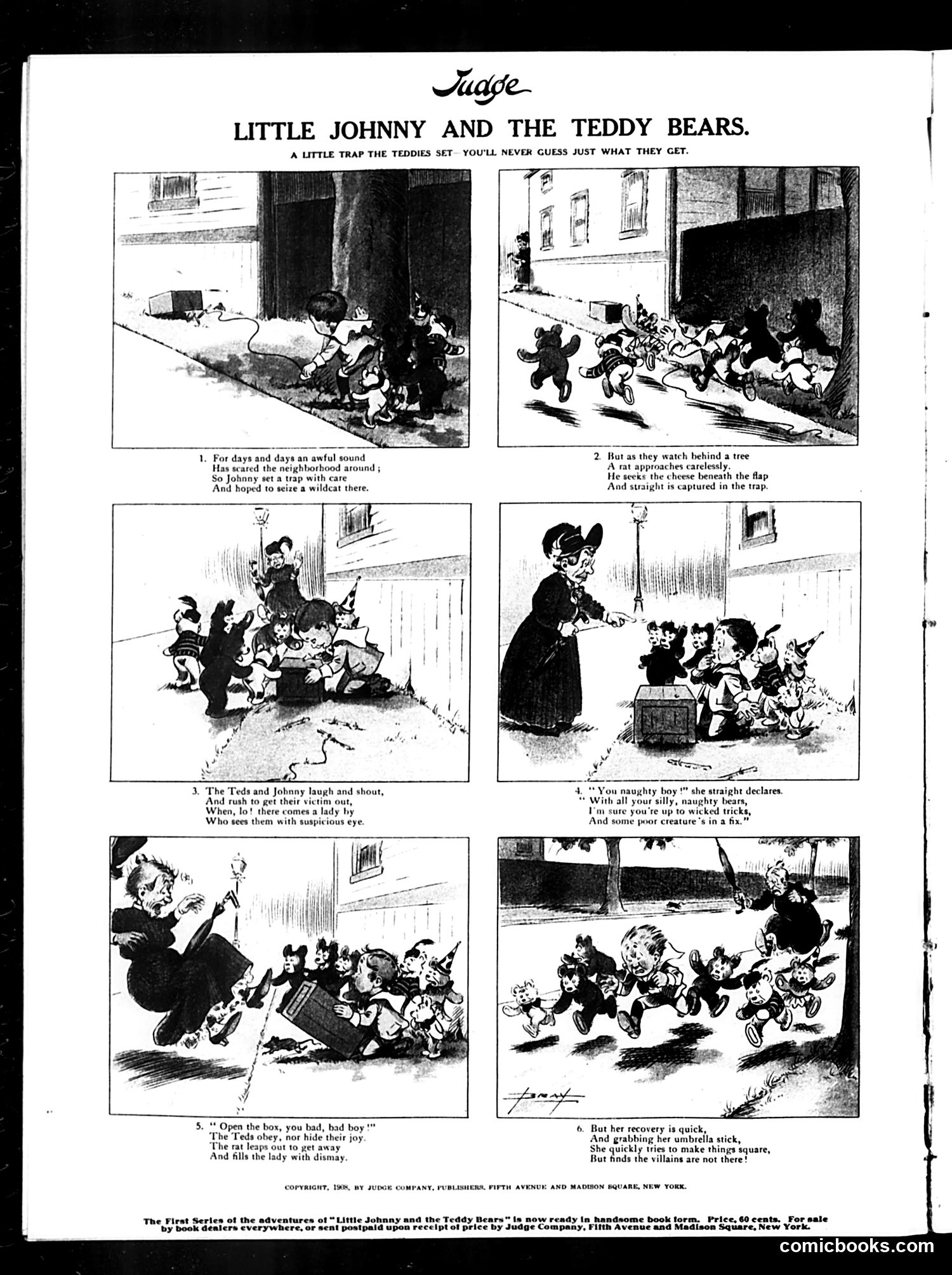
This is a humorous six-panel children's story from Judge magazine (copyright 1900). It features a boy named Johnny and his teddy bears—likely referencing the popular "Teddy Bear" toy craze that emerged around President Theodore Roosevelt. The plot: Johnny sets a trap to catch a wildcat terrorizing the neighborhood. The teddy bears help, but a rat gets caught instead. When a stern woman arrives and sees them releasing the rat from the box, she assumes they're mischievous troublemakers playing cruel tricks on animals. She scolds them harshly. However, she quickly discovers the "villains" (the bears and boy) have fled, leaving her alone—subverting her moral authority with a comedic ending. The satire appears gentle: mocking both children's innocent mischief and adult paranoia about youth behavior. The teddy bears themselves are the joke's centerpiece, reflecting their novelty and popularity at the time.