
A complete issue · 16 pages · 1908
Judge — May 23, 1908
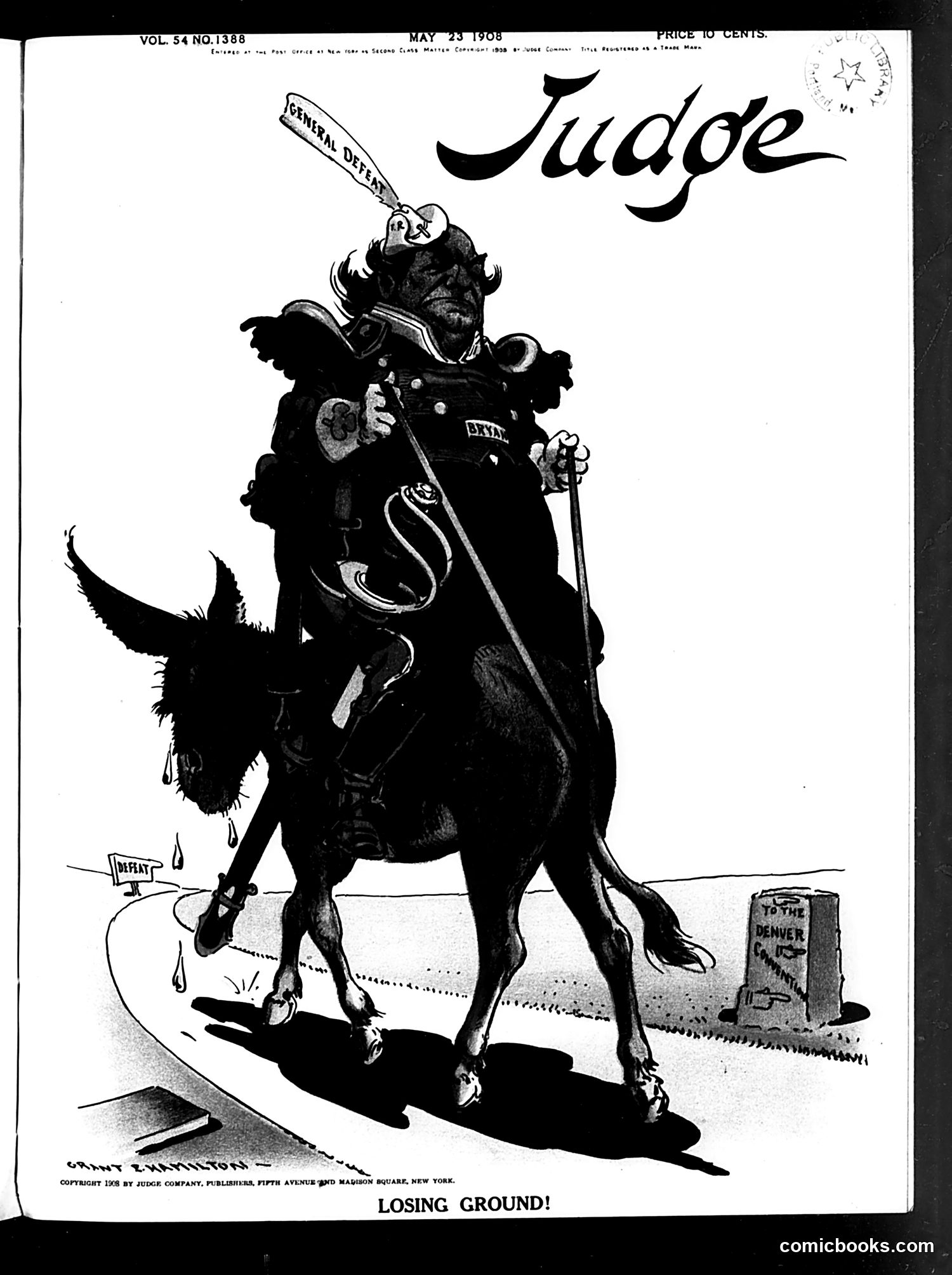
This political cartoon satirizes the Denver police or law enforcement, depicted as a grotesque military figure on a donkey, losing ground. The caricature wears a uniform marked "D.P.D." (Denver Police Department) and holds a "General Defiant" banner. A gravestone reading "To The Denver Police" appears on the right, suggesting institutional decline or failure. The title "LOSING GROUND!" indicates the cartoon critiques Denver's police force—likely responding to a specific scandal, corruption case, or public safety failure occurring in 1908. The absurd military posturing combined with the doomed setting implies the police department faced serious institutional problems or public loss of confidence during this period. The grotesque characterization emphasizes contempt for the subject.
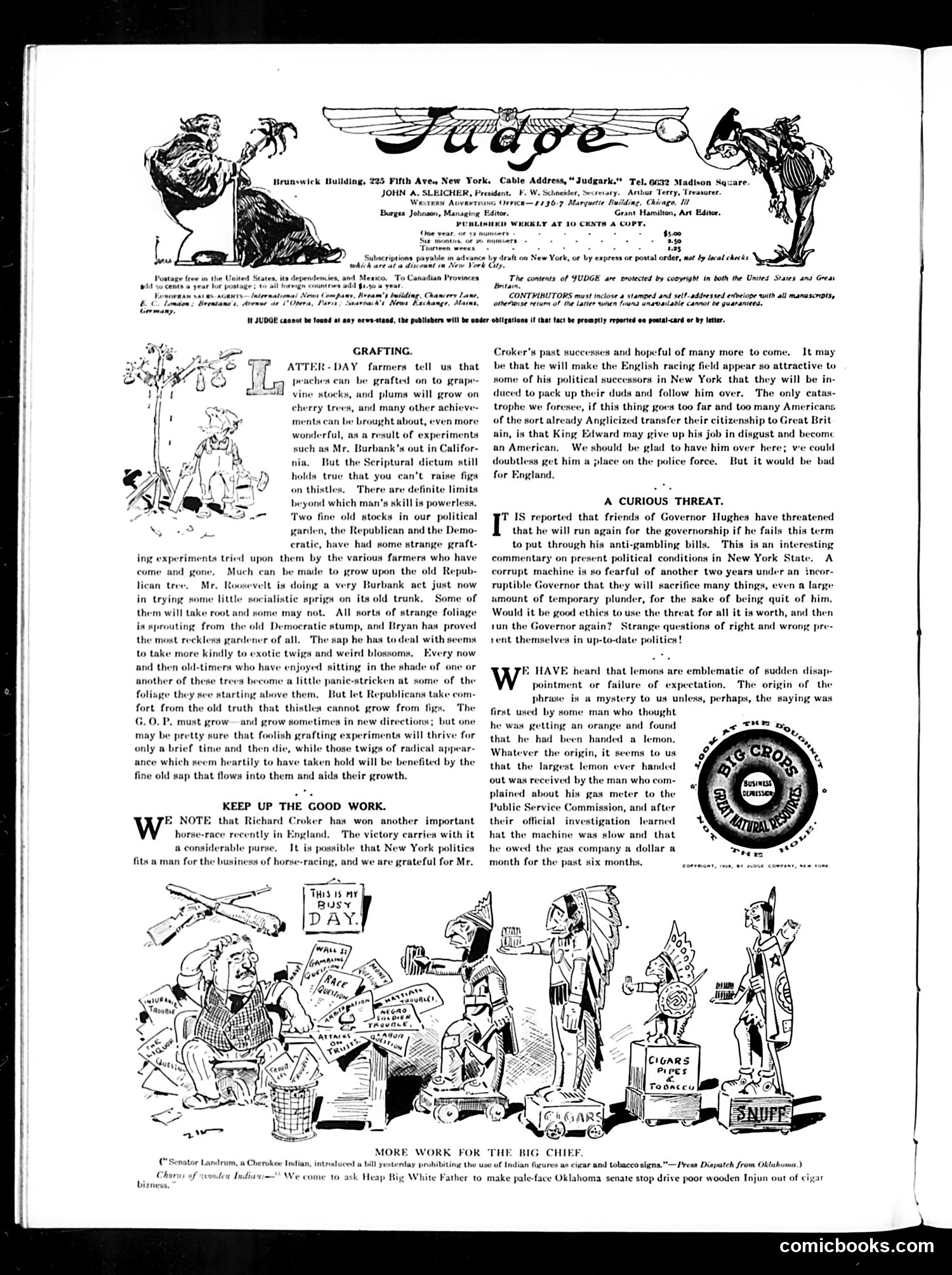
This page contains several satirical pieces critiquing early 20th-century American politics and social issues. **"Grafting"** mocks politicians' experimental corruption schemes, comparing Republican and Democratic attempts to exploit public funds—a commentary on widespread political corruption of the era. **"Keep Up the Good Work"** praises Richard Croker's recent English horse-racing victory, sarcastically suggesting New York politics benefits from his absence. **"A Curious Threat"** discusses Governor Hughes facing re-election challenges and political intrigue regarding citizenship and gubernatorial ambitions—likely referencing New York state politics. **"More Work for the Big Chief"** (bottom cartoon) satirizes Native American representation in politics, with a reference to Senator Lashtrum introducing legislation involving "Indian figures as cigar and tobacco signs." The page reflects Judge's focus on political corruption, electoral maneuvering, and era-specific satirical commentary.
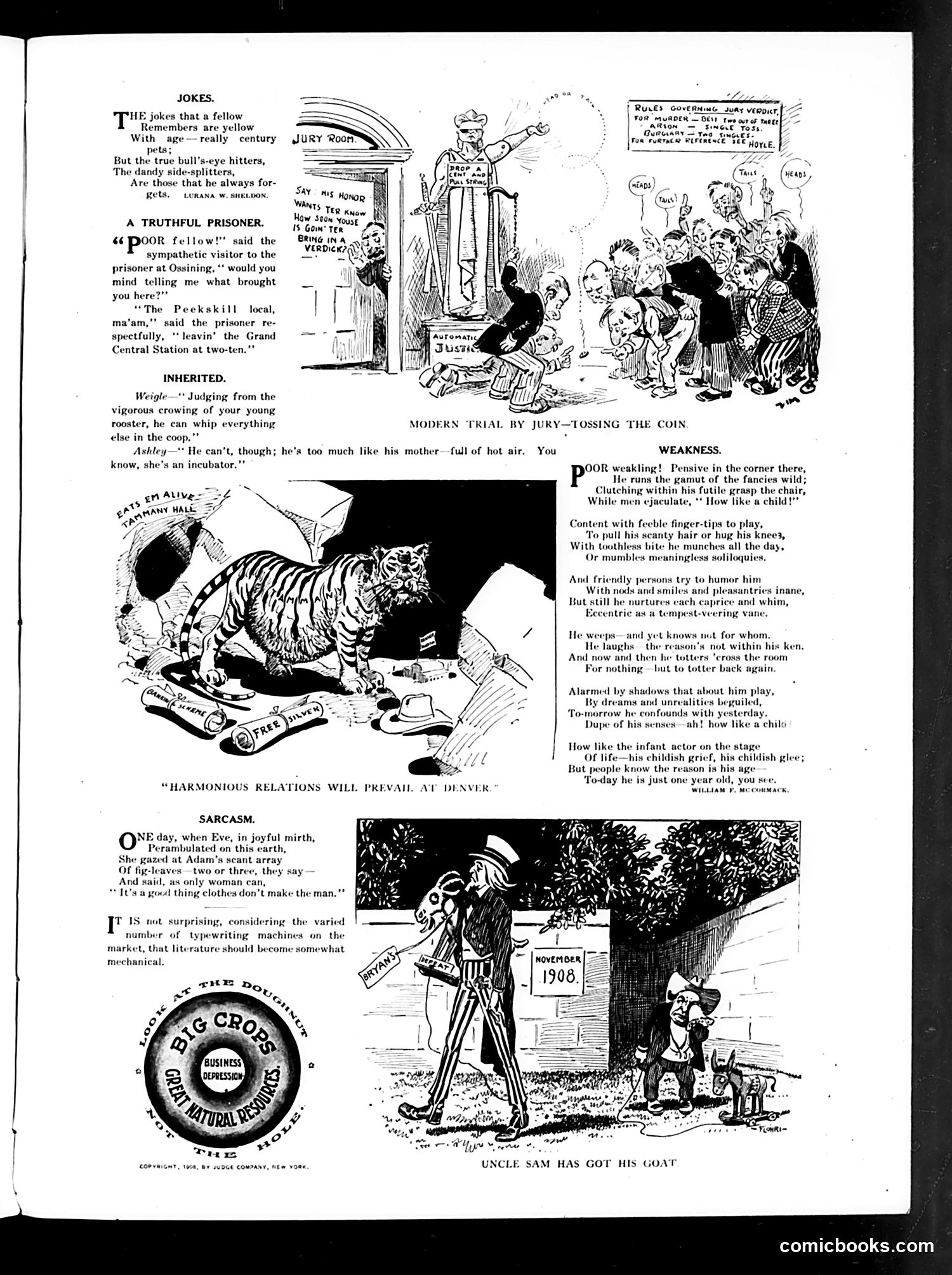
This page contains several satirical pieces from 1908. The main cartoon "Uncle Sam Has Got His Goat" appears to reference American political or diplomatic frustration—Uncle Sam (representing the U.S.) confronts a figure labeled November 1908, likely alluding to the upcoming presidential election and its uncertainties. The "Modern Trial by Jury—Tossing the Coins" cartoon satirizes the judicial system, suggesting juries decide cases arbitrarily rather than thoughtfully. Other content includes poems like "Weakness" and "Sarcasm," plus jokes about prisoners and inherited traits. A recurring theme appears to be critiquing institutions—courts, inheritance laws, and social behavior—through humor and caricature typical of Judge's satirical approach to contemporary American life and politics.
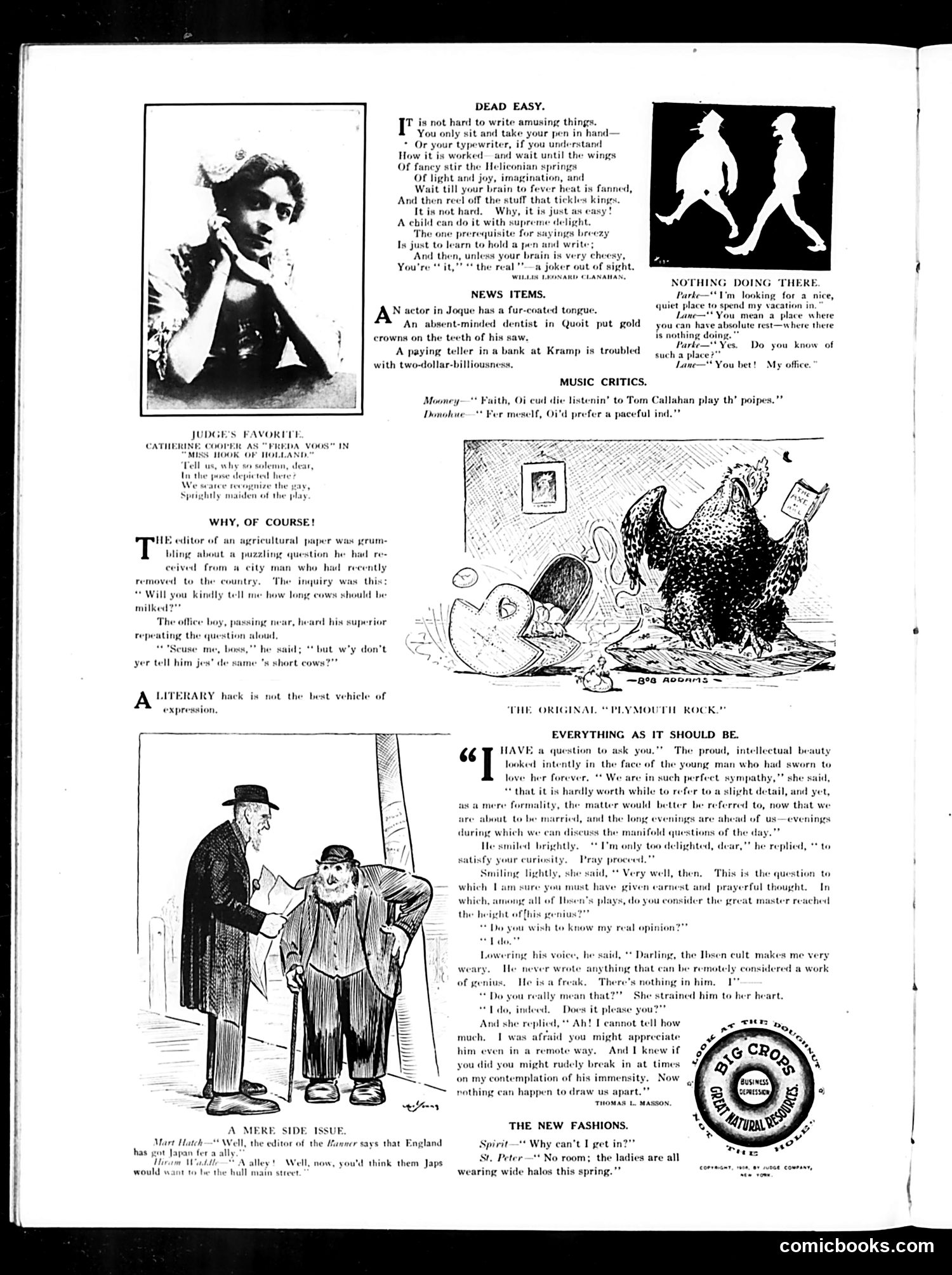
This page contains multiple satirical pieces typical of early 20th-century humor journalism: **"Dead Easy"** (top) mocks aspiring writers, suggesting anyone can write if they simply "hold a pen and write"—satirizing the proliferation of amateur authors. **"News Items"** lampoons various professions: an actor with a fur-coated tongue, a dentist putting gold crowns on a cat, and a banker with financial troubles. **"Why, Of Course!"** depicts an agricultural editor receiving a absurd letter from a city man asking about milking "long cows"—the joke being the questioner's ignorance of rural life. **"A Mere Side Issue"** (bottom cartoon) appears to mock international relations, with dialogue about England and Japan regarding trade. **"Everything As It Should Be"** features a conversation about Ibsen's plays, likely satirizing intellectual pretension among those claiming to appreciate serious drama. The overall tone reflects Judge's characteristic mockery of social pretension, professional incompetence, and cultural pretenders.
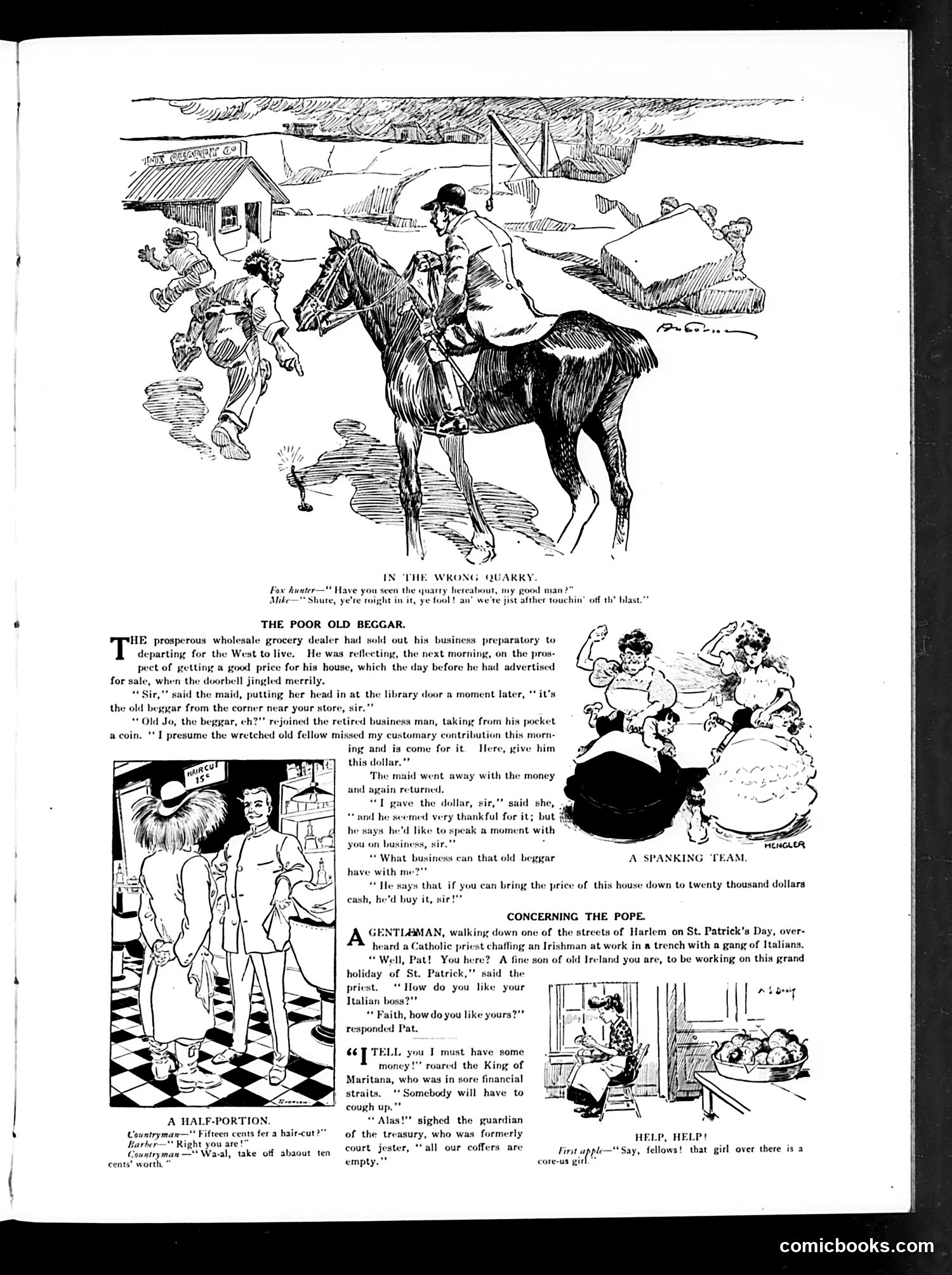
This page contains three separate satirical pieces: 1. **"In the Wrong Quarry"** (top): A horseman encounters someone, with dialogue about a "quarry foxhunt" — appears to be a hunting-related joke, though the specific reference is unclear. 2. **"The Poor Old Beggar"** (center-left): Satirizes wealth inequality. A wealthy businessman grudgingly gives a dollar to a desperate beggar while negotiating real estate deals. The humor lies in the contrast between his casual business transactions involving thousands of dollars versus his reluctance to help the poor. 3. **"Concerning the Pope"** and **"A Half-Portion"** (right): References to St. Patrick's Day and Irish immigrants in Harlem; includes a joke about palace finances and guardians lacking funds. The page reflects turn-of-century American anxieties about poverty, class disparity, and Irish immigration.
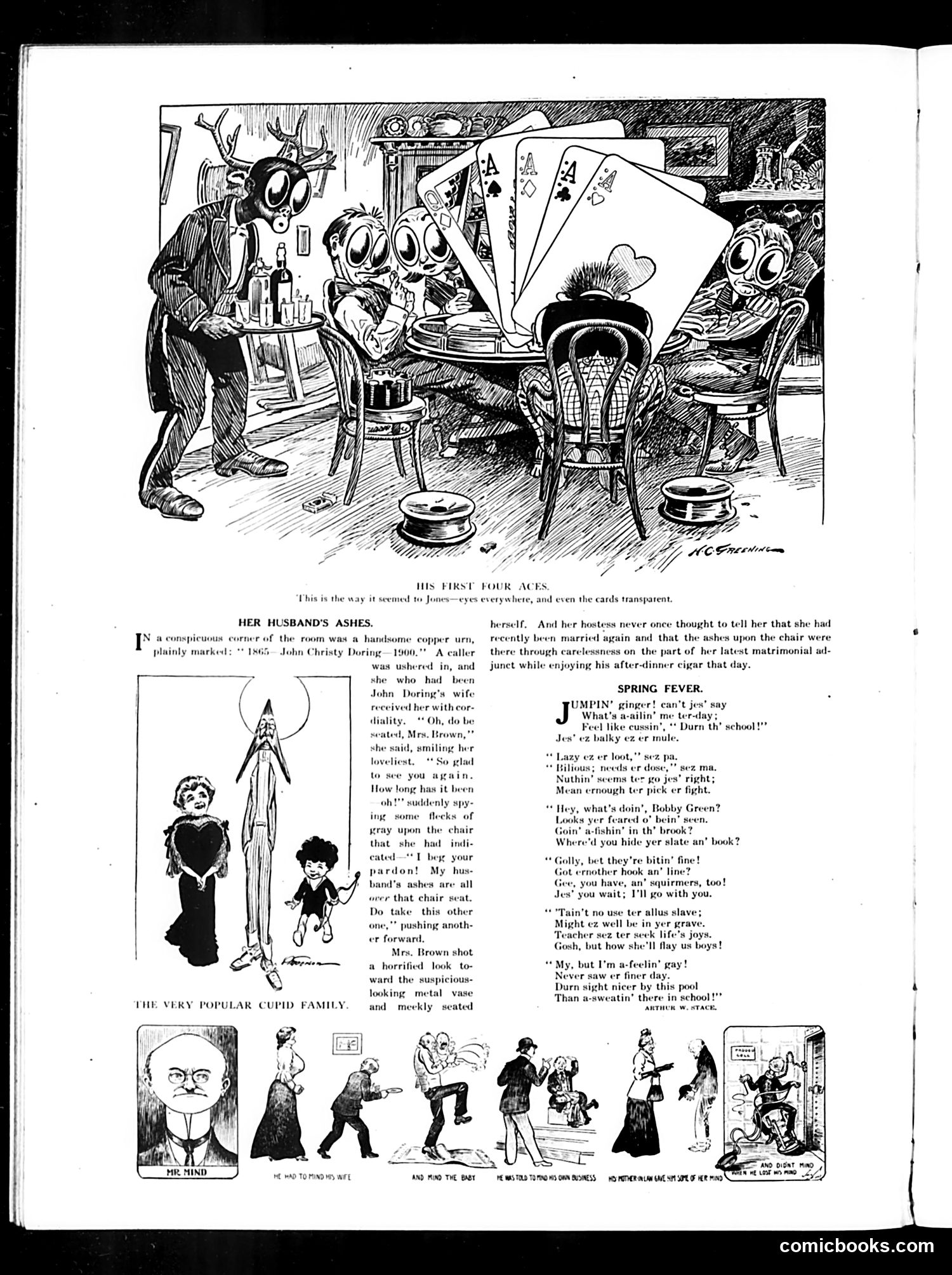
**Top Cartoon - "His First Four Aces":** A humorous scene depicting a man (Jones) playing cards while experiencing paranoia or guilt—he perceives the other players and even the cards themselves as having eyes watching him. The joke plays on the expression "four aces" (a winning hand) while suggesting he feels scrutinized, likely implying dishonest play or nervous guilt about cheating. **Middle Section - "Her Husband's Ashes":** Social satire about a widow visiting her late husband's former mistress. The hostess tactlessly seats the widow next to a copper urn containing "John Christy Doring's ashes" (1865-1900), then offers her another chair, appearing oblivious or deliberately cruel. The humor derives from the awkward situation and the widow's dawning realization of her husband's infidelity. **"Spring Fever"** (right column): A dialect poem about schoolchildren, particularly emphasizing restless youth wanting to escape school for outdoor activities—fishing and mischief rather than studying. **Bottom section:** Appears to be a comic strip sequence showing cupid-related scenarios, though details are unclear in this reproduction.
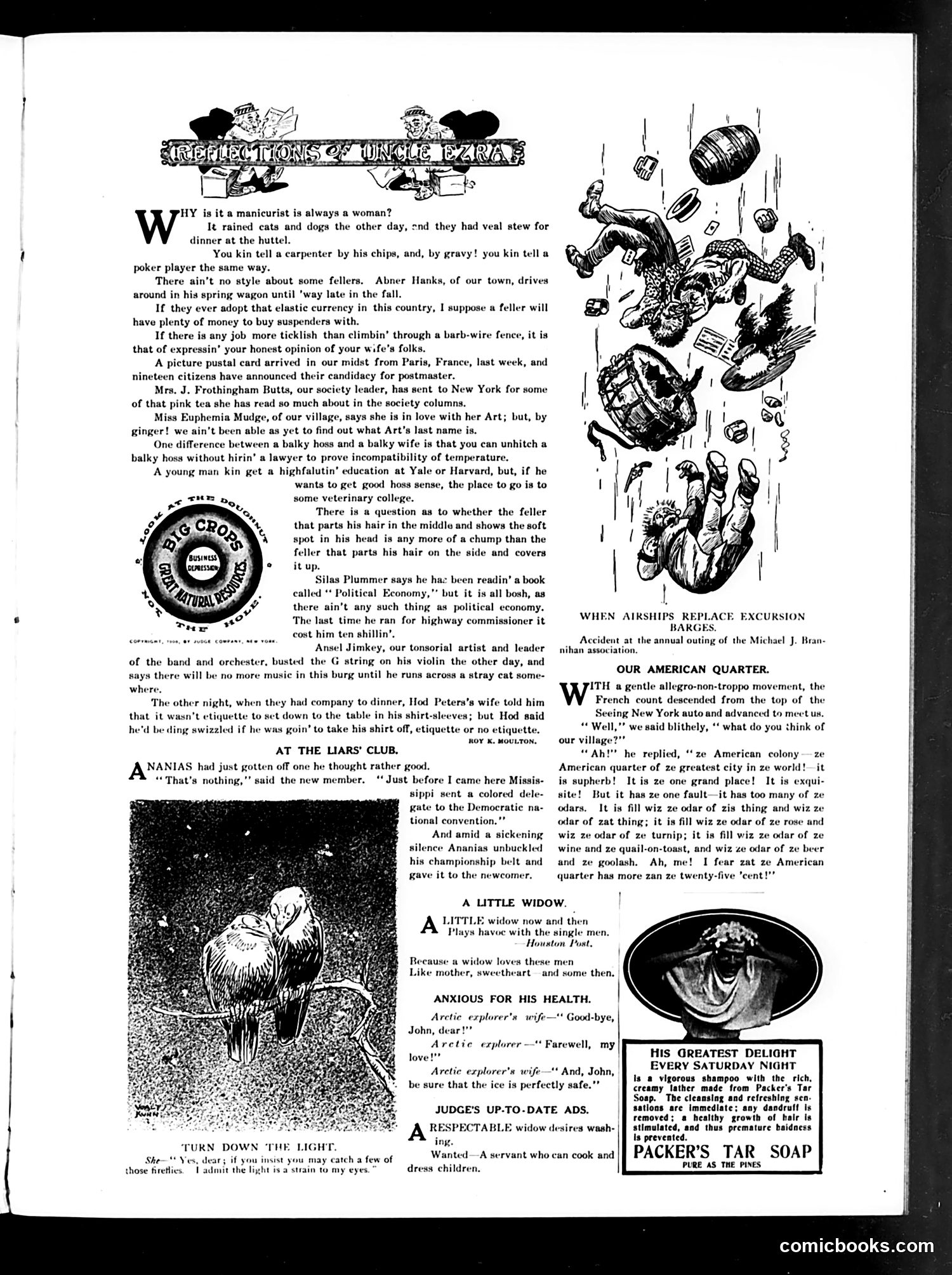
This page is primarily **humorous rural commentary** rather than political satire. The main feature, "Reflections of Uncle Ezra," consists of folksy observations about small-town life—manicurists, poker players, wives' relatives, etiquette disputes. These gentle jokes target universal human behaviors rather than specific political figures. The **"Liars' Club"** cartoon is the only topical content: it references a delegate sent by Mississippi to a Democratic national convention—a likely jab at Reconstruction-era politics when Southern delegations featured controversial appointments. The joke rewards the newcomer's tall tale, suggesting Mississippi's delegation itself was absurd. Supporting content includes modest advertisements (Parker's Tar Soap) and miscellaneous short humor pieces about Arctic explorers and widows. The overall tone is small-town American humor circa early 1900s, emphasizing rural common sense over city sophistication—a Judge magazine staple. The page offers entertainment and advertising rather than sustained political commentary.
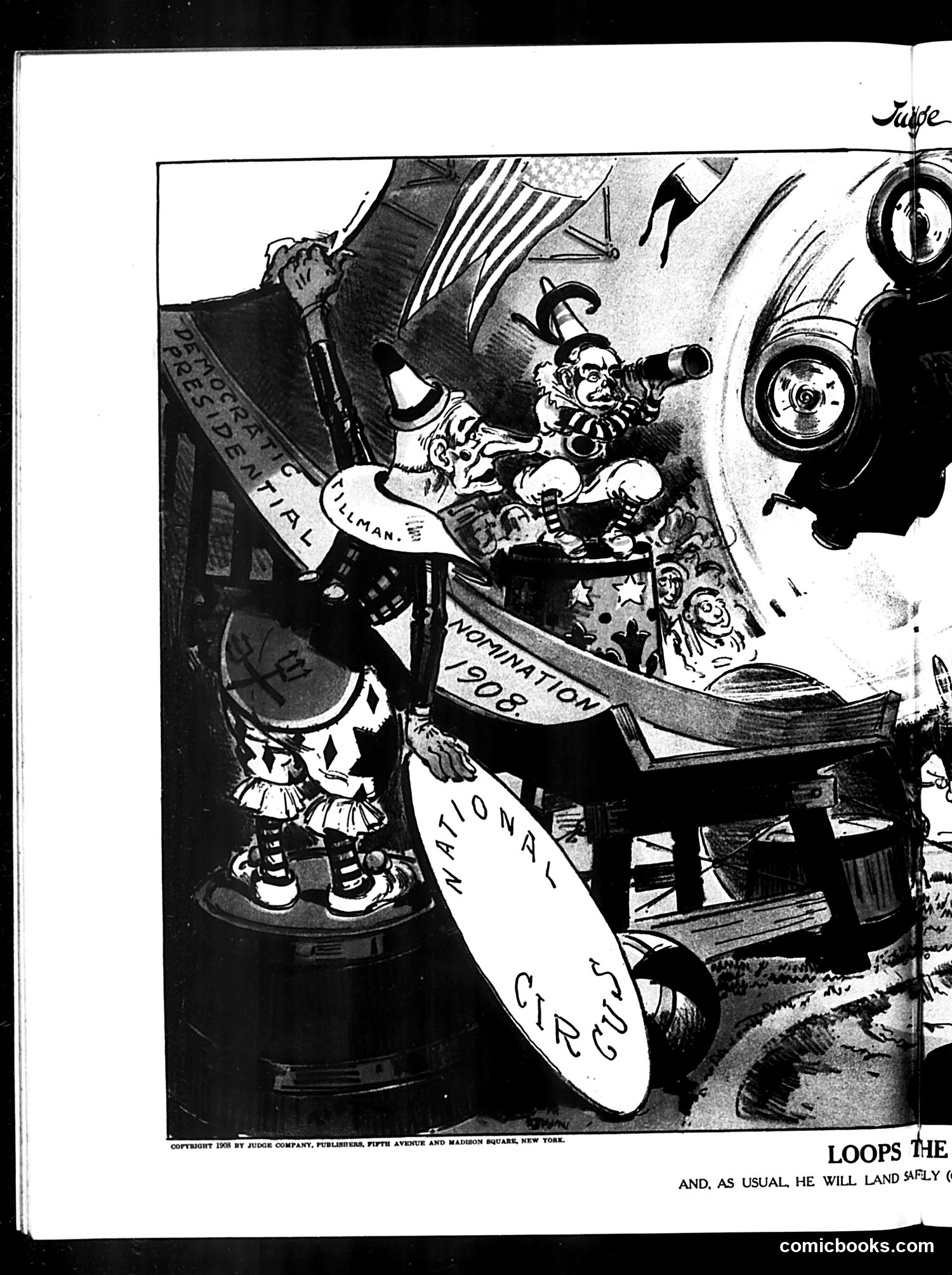
This 1908 Judge magazine cartoon depicts a circus performer executing an aerial loop maneuver. The visible text references "LOOPS HE" and notes he "will land safely," suggesting the cartoon uses acrobatic performance as metaphor for a political figure navigating a precarious situation. The aircraft and mechanical imagery, combined with the circus setting, likely satirizes a contemporary political figure repeatedly performing risky political maneuvers while maintaining public confidence in their ability to "land safely." The specific identity of the politician remains unclear from the visible text, though the 1908 date and aeronautical references suggest this relates to early aviation-era politics or a politician known for bold, risky actions viewed as acrobatic political maneuvering. The cartoon's humor derives from equating political risk-taking with circus stunts.
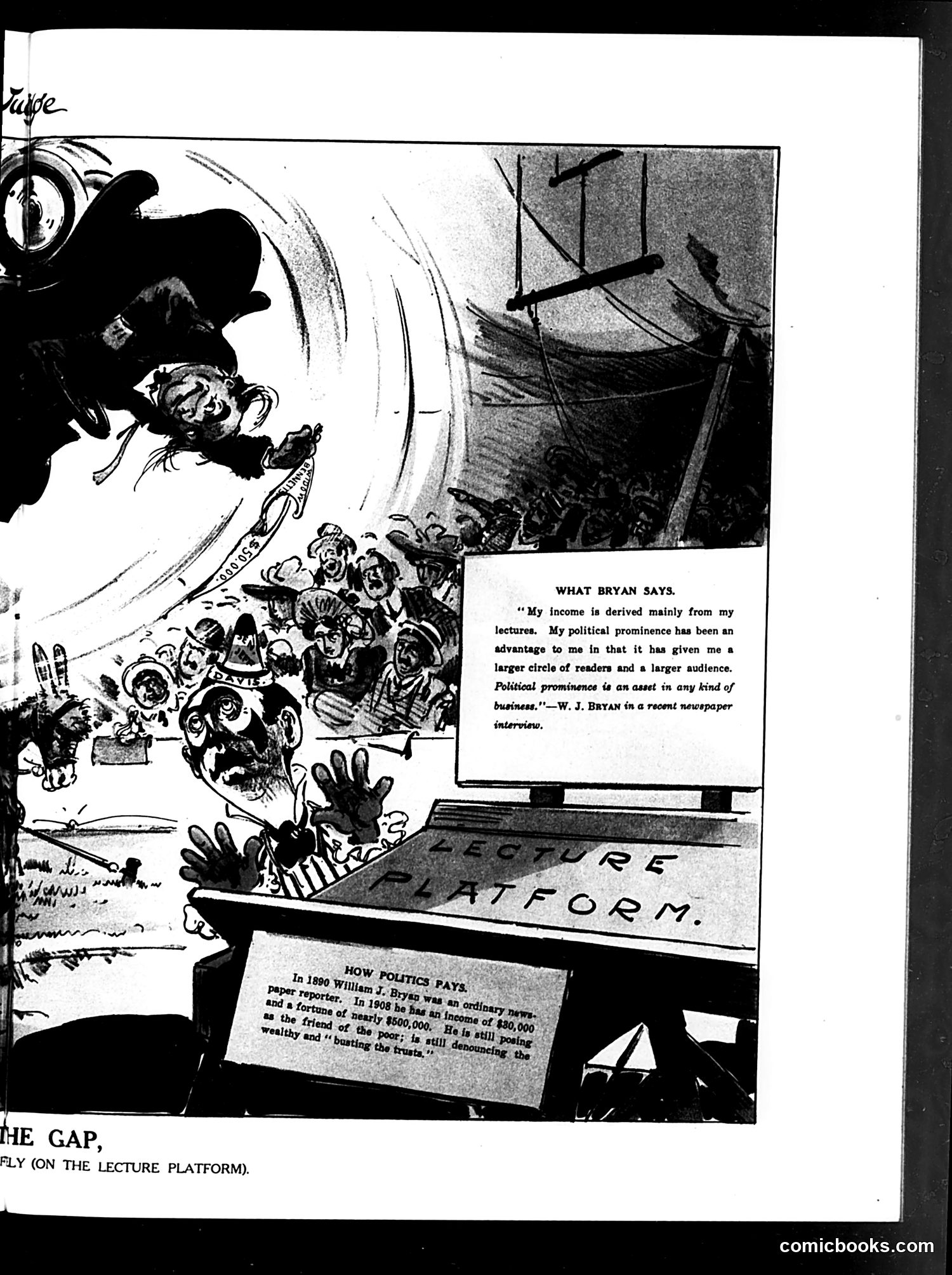
This Judge cartoon satirizes William Jennings Bryan's financial hypocrisy. The image shows Bryan on a lecture platform surrounded by an eager crowd (depicted as flies), with a visual pun: he's literally a "fly on the lecture platform." The satire targets Bryan's claim that his political prominence benefits his lecture income—essentially admitting he profits from his political status rather than merit. The cartoon implies Bryan is parasitic (a fly), feeding off his political fame for financial gain while lecturing the public. The "HOW POLITICS PAYS" caption reinforces the critique that Bryan exploits his political position for personal enrichment, contradicting any pretense of principled public service. Judge presents this as hypocrisy: Bryan profits directly from politics while presumably advocating for the common people.
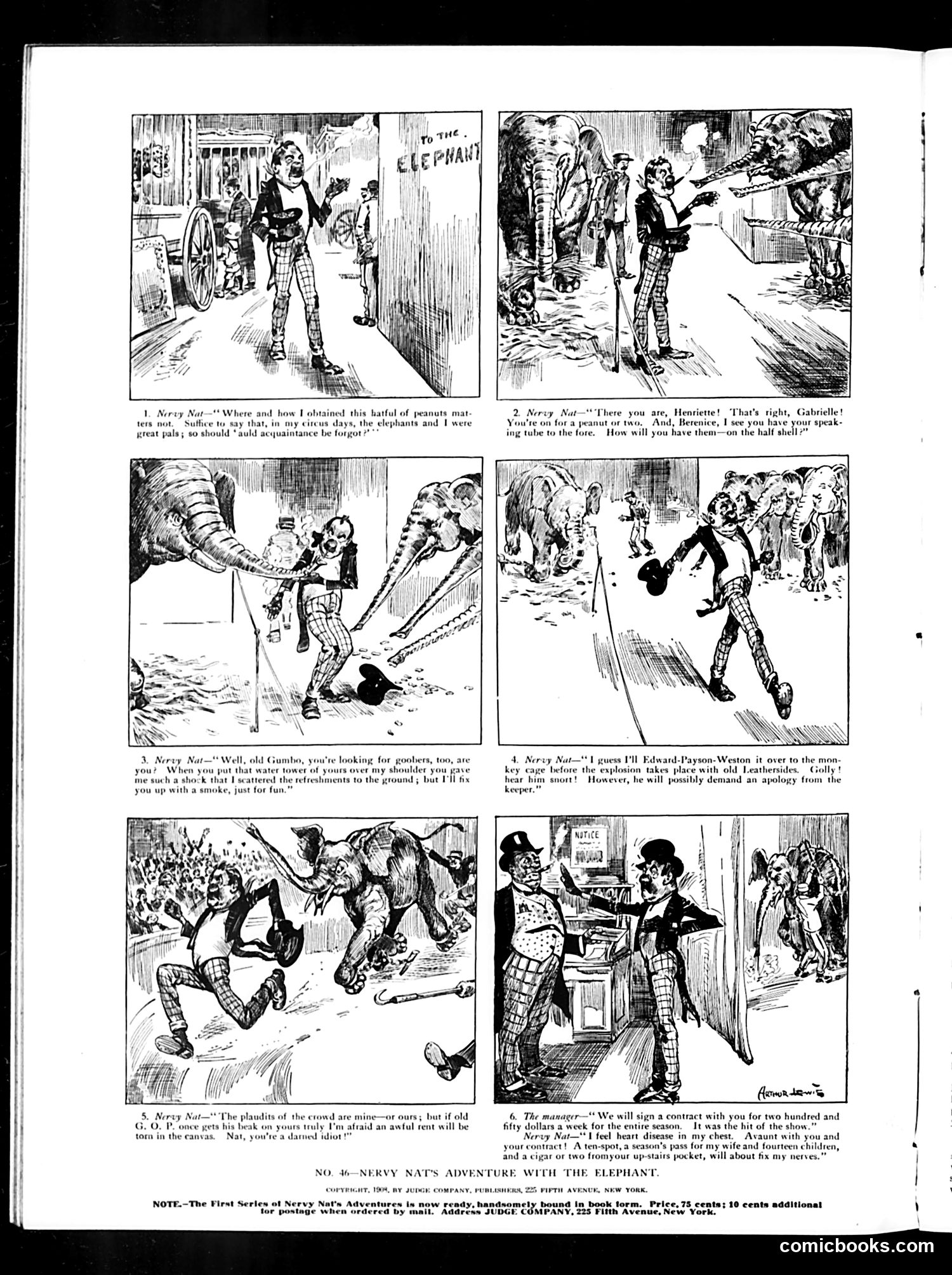
This is a comic strip featuring "Nervy Nat," a character who encounters an elephant in what appears to be a circus or street setting. The narrative follows Nat's interactions with circus performers and the animal. The humor centers on Nat's brazen, opportunistic personality—he claims to have owned peanuts for circus elephants in his carnival days, then attempts to profit from the situation. When offered a legitimate contract worth fifty dollars weekly, he dismissively demands instead small payment, a season pass, and cigars "to fix my nerves." The satire appears to mock working-class con artists or hustlers of the early 1900s who used audacious bluffing and quick talk to extract minor benefits rather than accept formal employment. "Nervy Nat" embodies a particular American character type—the small-time grifter more interested in scheming than honest work. The cartoon reflects period attitudes toward street-level con men and hustlers.
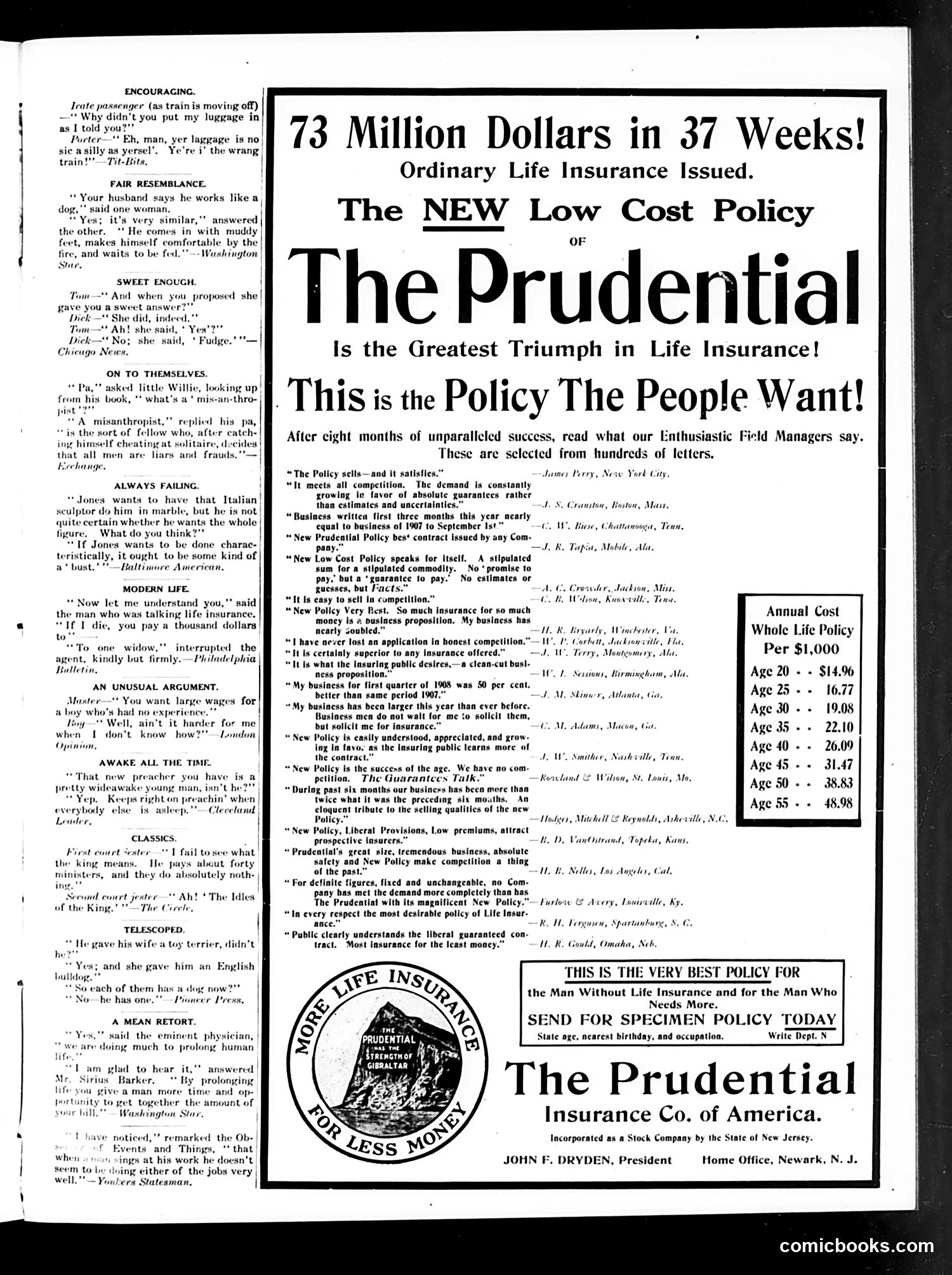
This page is primarily **advertising**, not satire. The dominant content is a full-page advertisement for The Prudential Insurance Company's "New Low Cost Policy," promoting $73 million in ordinary life insurance issued in 37 weeks. The left column contains unrelated short humor pieces typical of Judge magazine—brief jokes about trains, husbands, marriage proposals, and sculptors. These are generic social commentary with no political content. The advertisement itself presents testimonials from insurance field managers praising the policy's competitiveness, clarity, and sales success. It includes an annual cost table showing premiums per $1,000 of coverage by age (ranging from $14.90 at age 20 to $48.98 at age 55). **There is no political cartoon or satire on this page.** The page represents Judge functioning as a vehicle for paid advertising alongside its entertainment content—a common practice for magazines of this era (appears to be early 1900s based on dates mentioned).
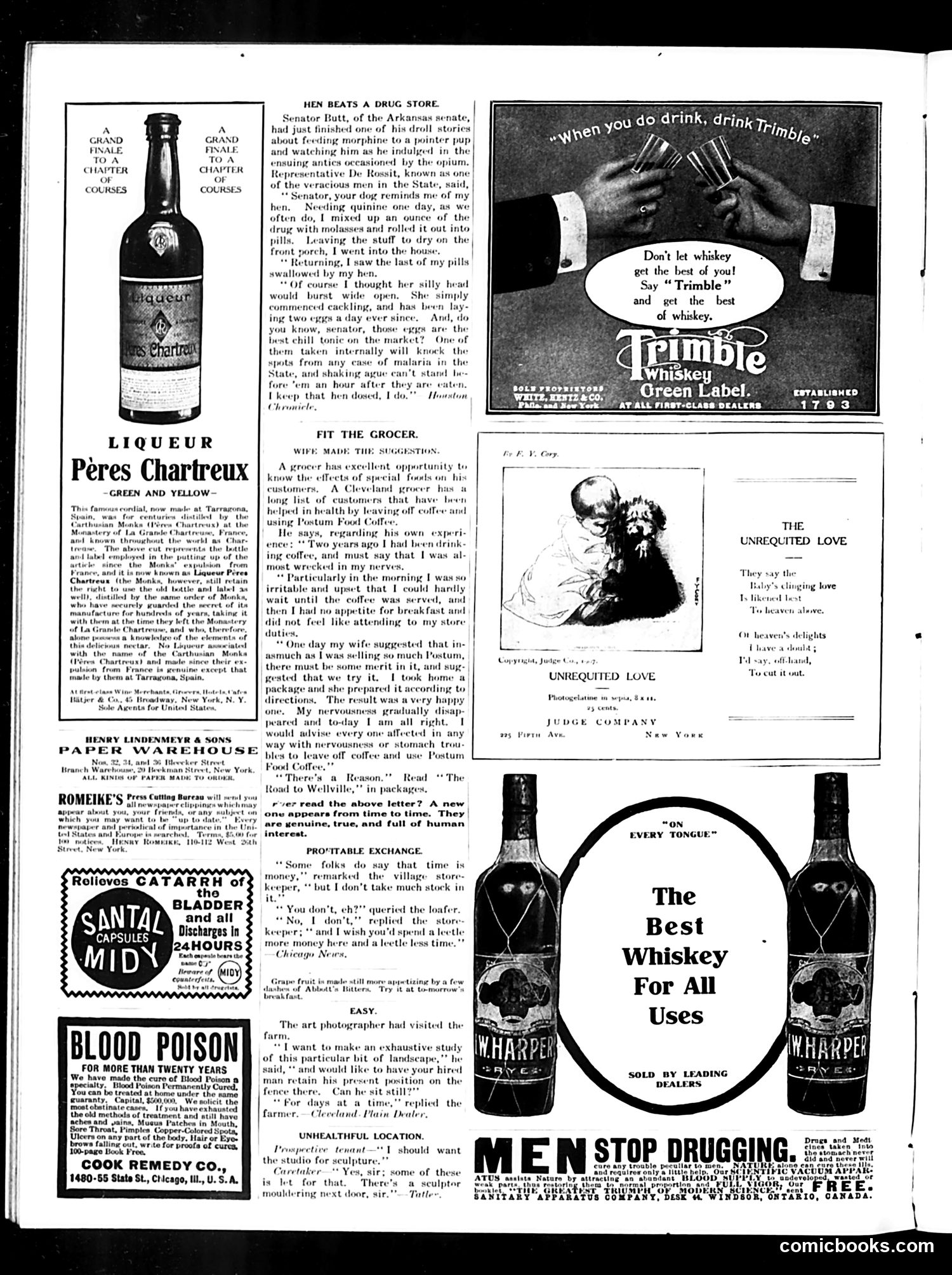
This page is primarily **advertising**, dominated by liquor and patent medicine ads typical of early 20th-century publications—a period before modern FDA regulations. **Key content:** The satirical pieces are brief anecdotes mocking common tropes: - "Hen Beats a Drug Store" jokes about a senator feeding morphine to a dog, then a congressman's hen laying eggs after consuming quinine-laced molasses - "Fit the Grocer" features a store owner crediting Postum (caffeine-free coffee substitute) for curing his coffee-induced nervousness - "Profitable Exchange" and "Easy" are mild humor about rural/small-town life **The ads reveal period attitudes:** Prominent are whiskey ads (Trimble, Harper's) and quack remedies—"Blood Poison" cures, "Santal" capsules for male ailments, and Cook Remedy Company's vague "blood poison" treatments. These ads exploited health anxieties before regulation. **The satire is gentle**: poking fun at rural characters, hypochondria, and advertising claims rather than targeting specific political figures or events.
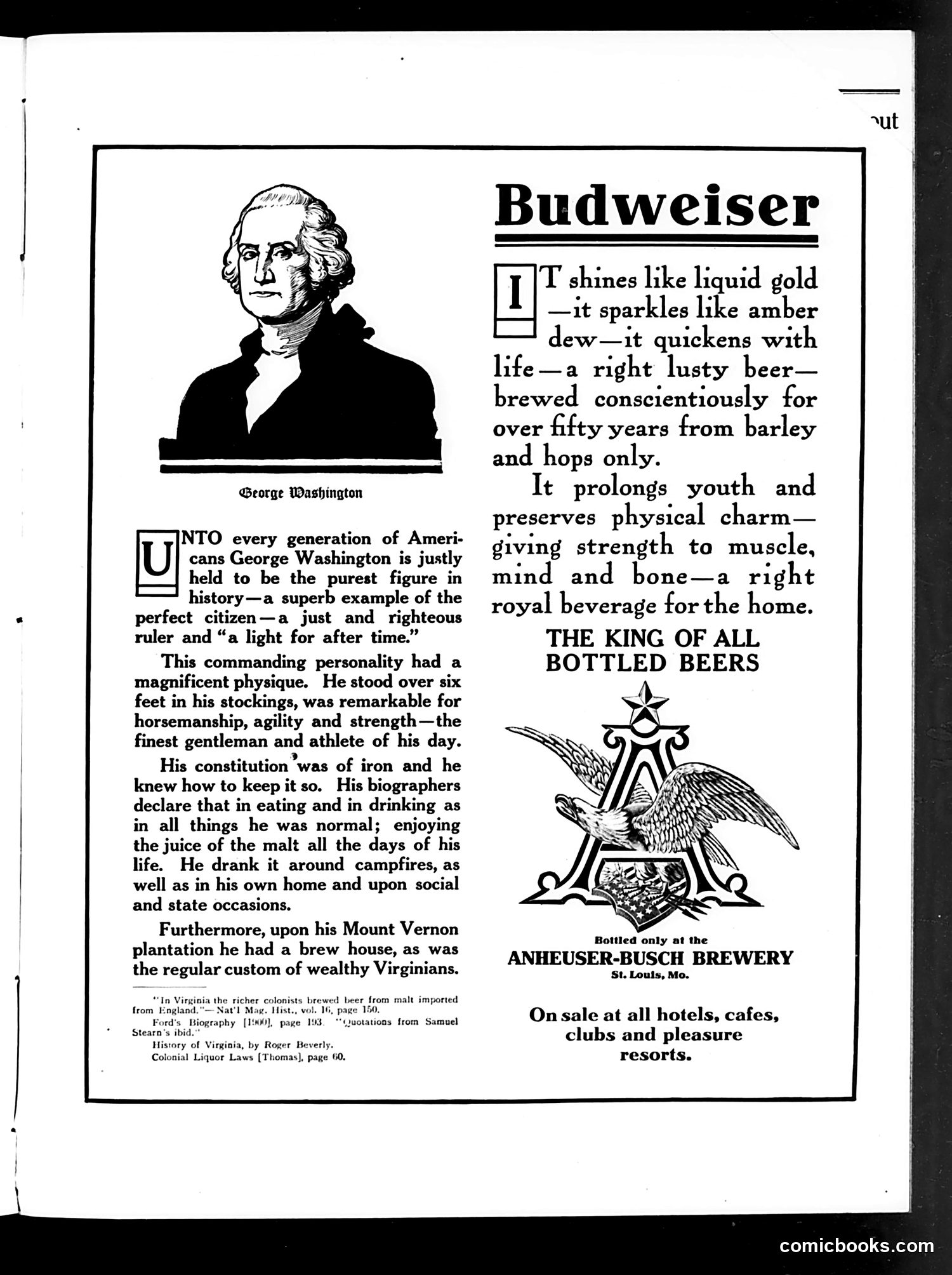
This is a **beer advertisement**, not satire. Anheuser-Busch uses George Washington's historical reputation to sell Budweiser by claiming the Founding Father was a regular beer drinker. The ad argues that Washington—portrayed as the ideal American citizen and athlete—drank malt beverages throughout his life, owned a brewhouse at Mount Vernon, and maintained perfect health. The implication: if Washington drank beer "normally," it's wholesome and patriotic. Modern readers should note this exploits Washington's credibility to make health claims (beer "prolongs youth," gives "strength to muscle, mind and bone") that would be illegal advertising today. The strategy conflates historical fact (wealthy colonists did brew beer) with marketing exaggeration to legitimize a commercial product through association with American virtue and national heritage.
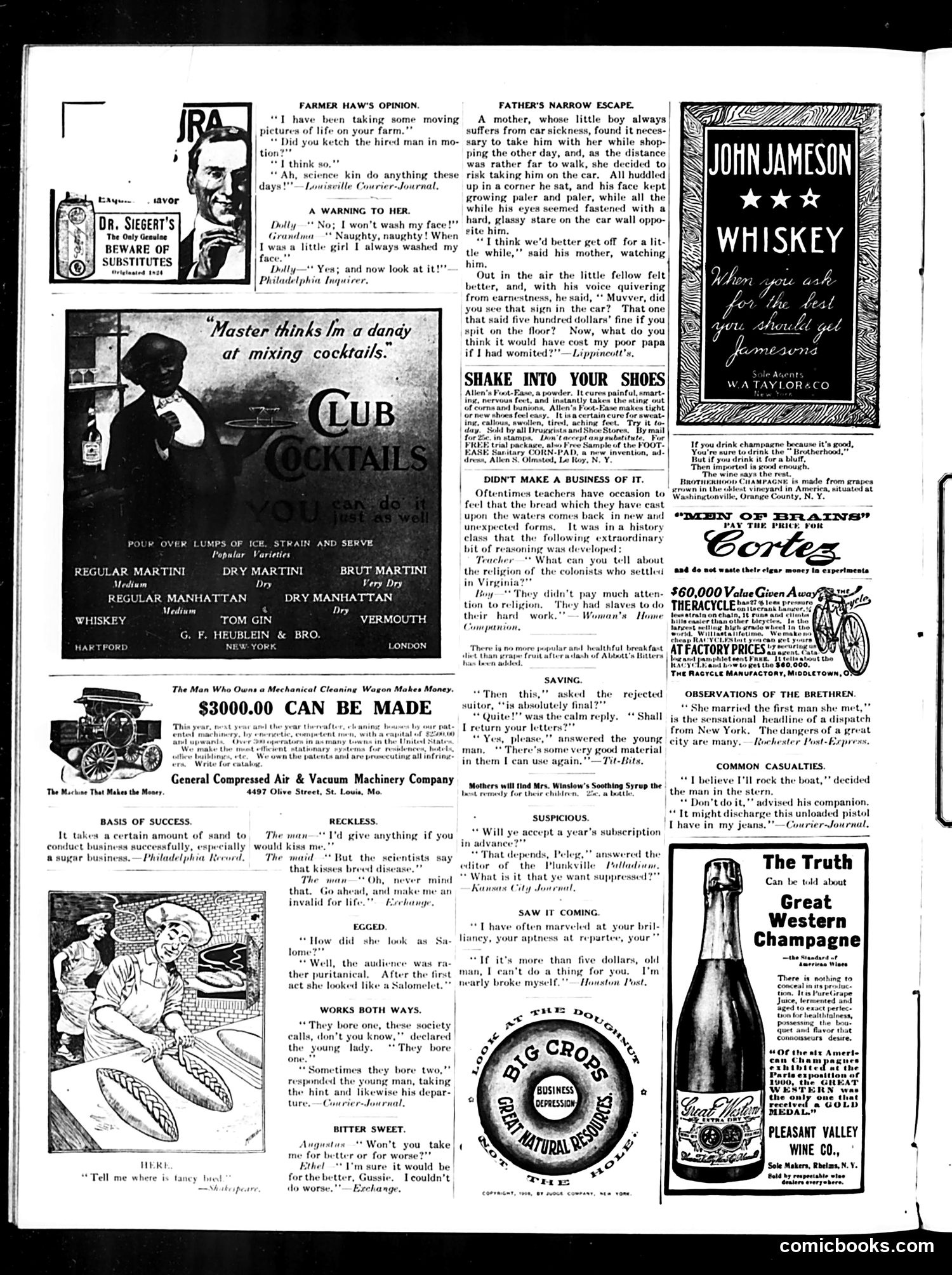
This page from Judge magazine contains mostly **advertisements and brief humorous anecdotes** rather than political cartoons. The visible content includes: **Small comic items** depicting domestic/social humor: a farmer discussing farm photography, a mother dealing with her son's car sickness, and various other brief jokes about everyday situations. **Extensive advertising** for alcohol (whiskey, champagne, wine), cleaning machinery, and patent medicines—typical of early 20th-century magazines. **One small illustrated cartoon** showing a couple discussing "fancy" food, captioned about mixing cocktails. The humor is **gentle and domestic** rather than politically charged—focusing on family situations, miscommunications, and social conventions of the era. References to car sickness, train travel, and "Mrs. Winslow's Soothing Syrup" (a patent medicine) date this clearly to the early 1900s. The page lacks the sharp political satire one might expect from Judge; it's primarily a vehicle for period advertisements with light filler content.
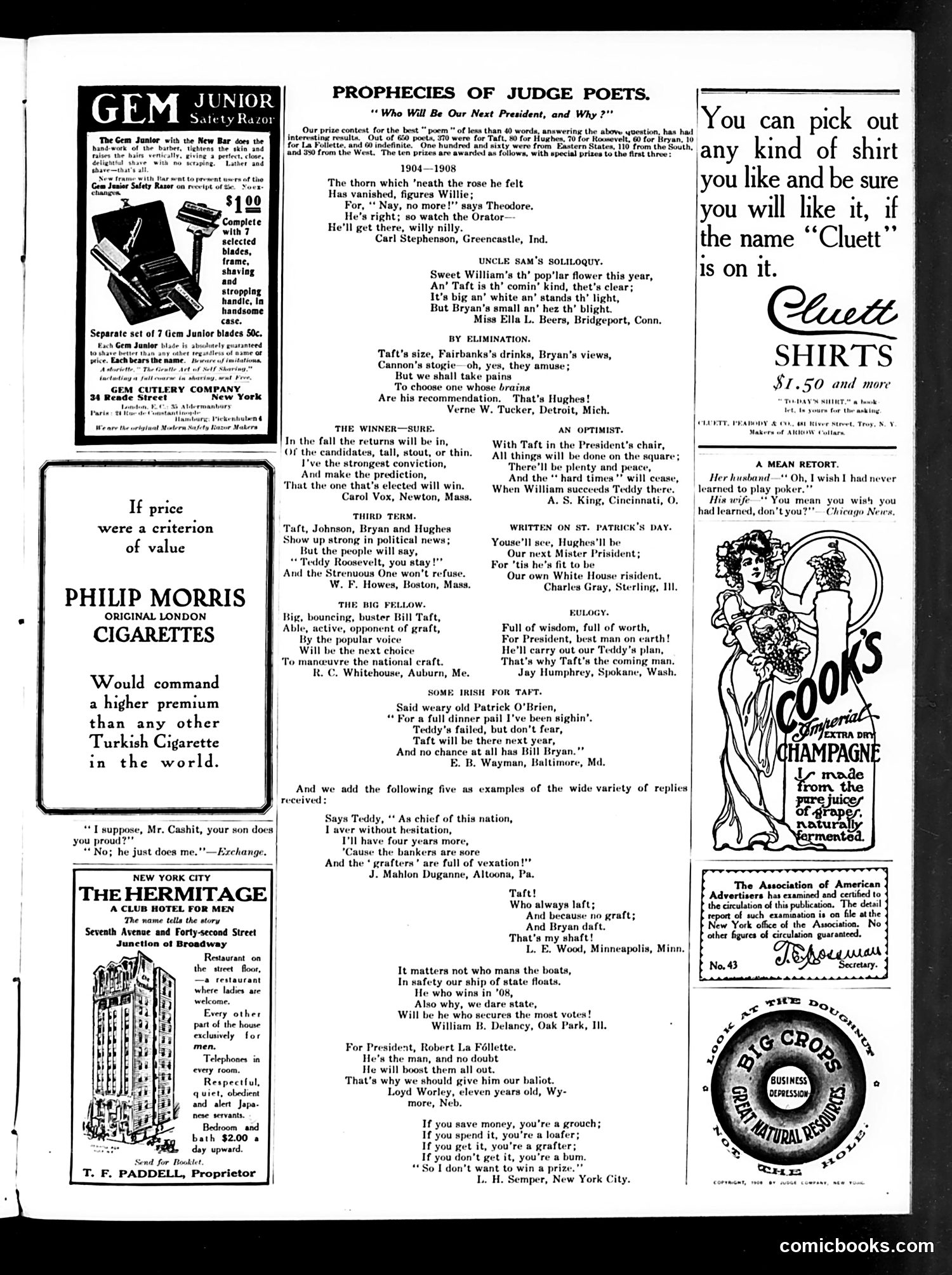
This page features **Judge magazine's satirical poetry contest** predicting the 1908 U.S. presidential election. The context: President Theodore Roosevelt had pledged not to seek another term, creating uncertainty about his successor. **Key figures referenced:** - **William Howard Taft** (overwhelmingly favored in submissions—310 of 660 entries) - **Theodore Roosevelt** (the outgoing president) - **William Jennings Bryan** (three-time Democratic candidate, repeatedly mocked as weak/"small") - **Charles Evans Hughes** (Supreme Court justice, alternative choice) **The satire's point:** Judge presents winning poems mocking various candidates while celebrating Taft as the obvious choice. Bryan is ridiculed as diminished ("small," having "the blight"). One poem jokes that Roosevelt won't actually leave office. The contest itself satirizes both political prognostication and public sentiment—showing how business and establishment interests (represented by Judge's readership) preferred the safe, conservative Taft over Bryan's progressive populism. The surrounding advertisements reinforce the magazine's upper-class, male-oriented audience.
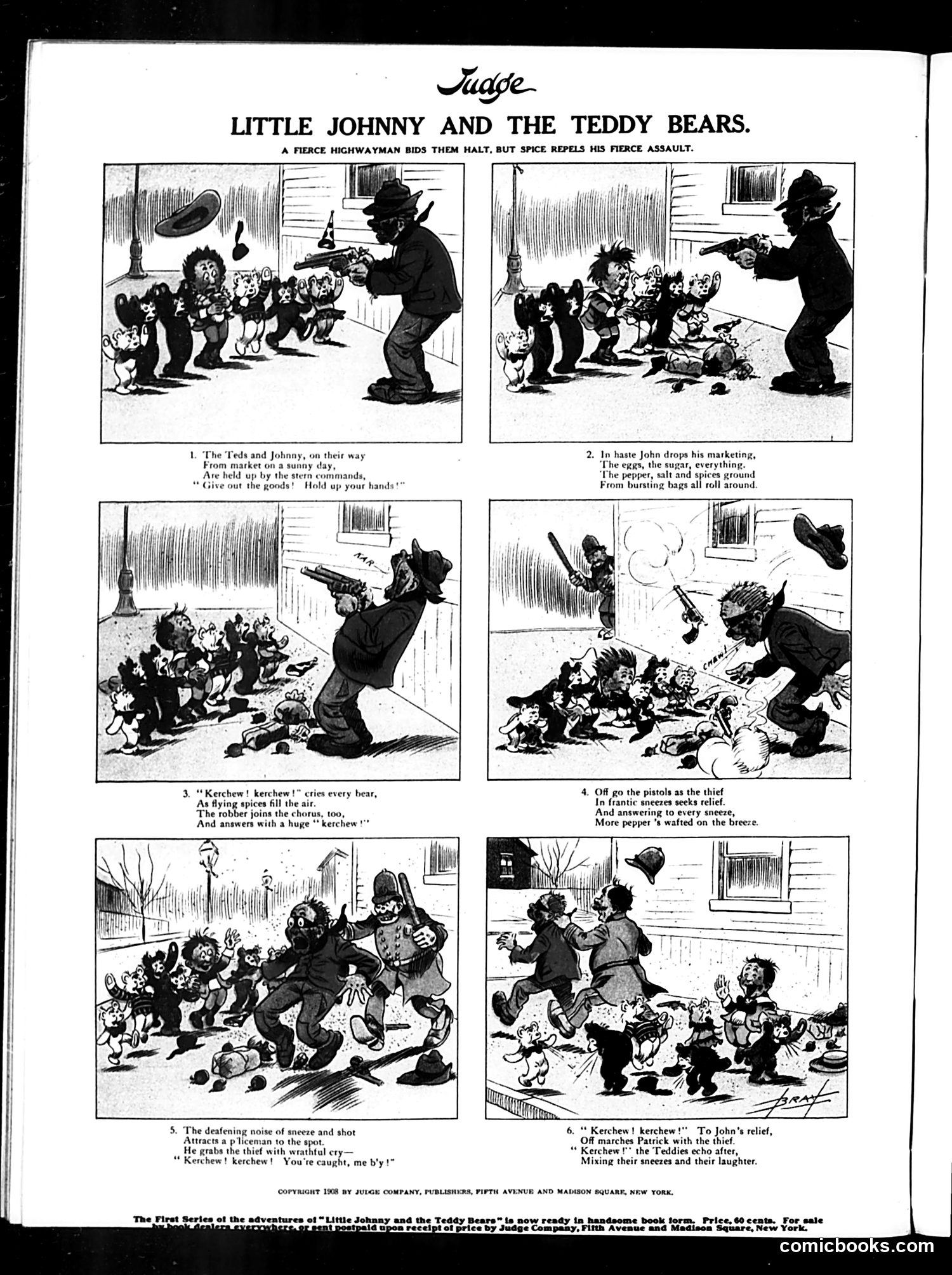
This is a children's comic strip about a boy and toy bears thwarting a highwayman. When a robber demands their goods, Johnny's shopping bag spills—scattering pepper and spices everywhere. The resulting sneezing chaos incapacitates the thief: the bears and Johnny sneeze repeatedly, the robber joins in involuntarily, and more pepper gets "wafted on the breeze," creating a feedback loop of sneezing fits. A policeman arrives, attracted by the gunshots and commotion, and apprehends the thief while the bears continue their triumphant sneezing. The humor relies on slapstick absurdity—weaponized spices and unstoppable sneezing as an accidental defense mechanism. This appears to be promotional material advertising the story in book form (60 cents), published by Judge Company around 1908.