
A complete issue · 16 pages · 1908
Judge — March 28, 1908
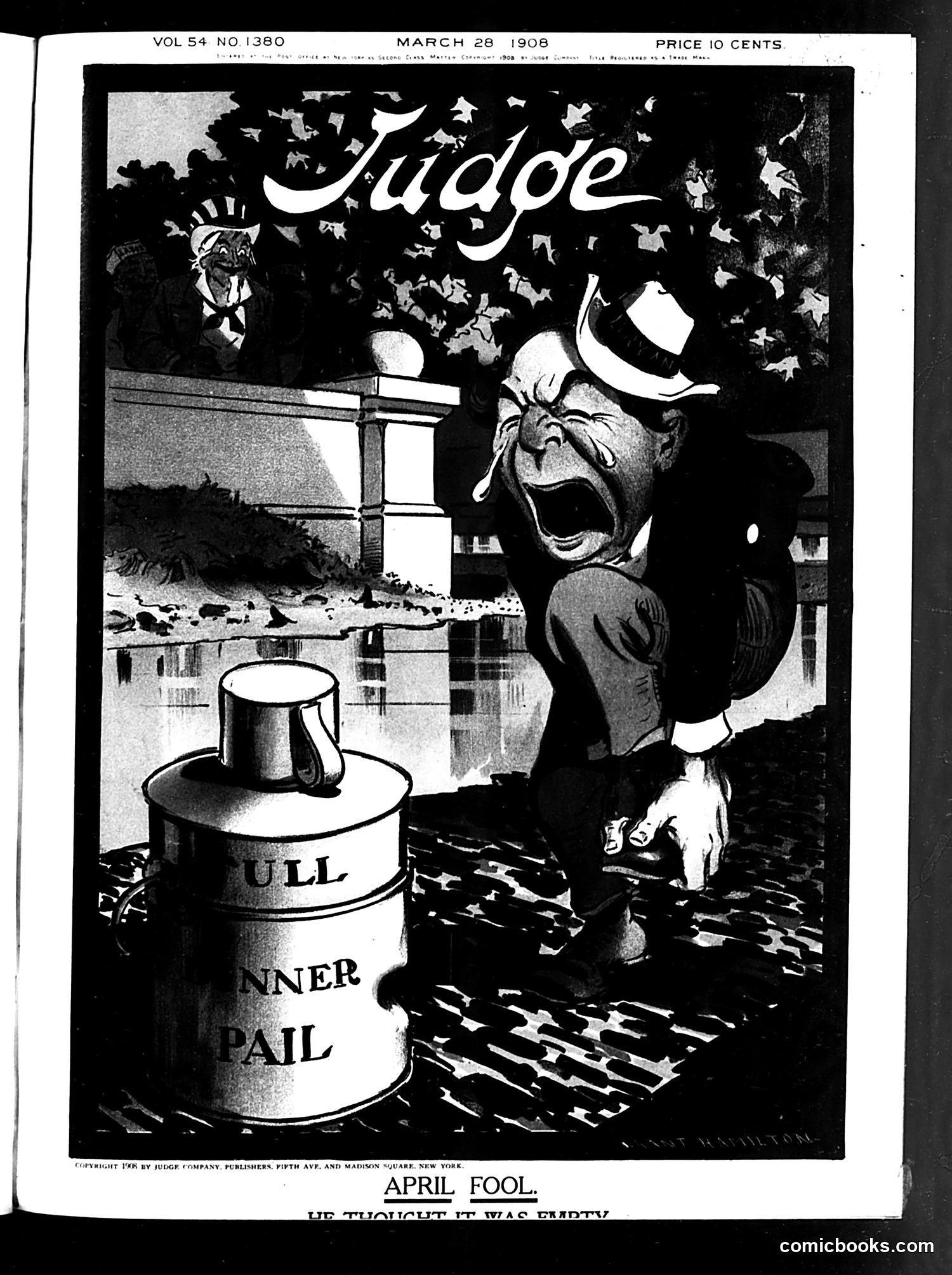
This is an April Fool's Day satirical cover titled "April Fool; He Thought It Was Partly" (text partially obscured). The cartoon depicts a character in a straw hat and formal dress reacting with shock and dismay. He appears to have discovered a "Full Dinner Pail"—a political slogan associated with Republican prosperity messaging from the McKinley era. The character's exaggerated expression of horror suggests the "full dinner pail" promise has proven false or disappointing to ordinary workers. The autumn leaves and barren landscape reinforce themes of decay and broken promises. This April Fool's joke mocks Republican claims of worker prosperity, suggesting the working class has been fooled by empty political rhetoric about economic well-being.
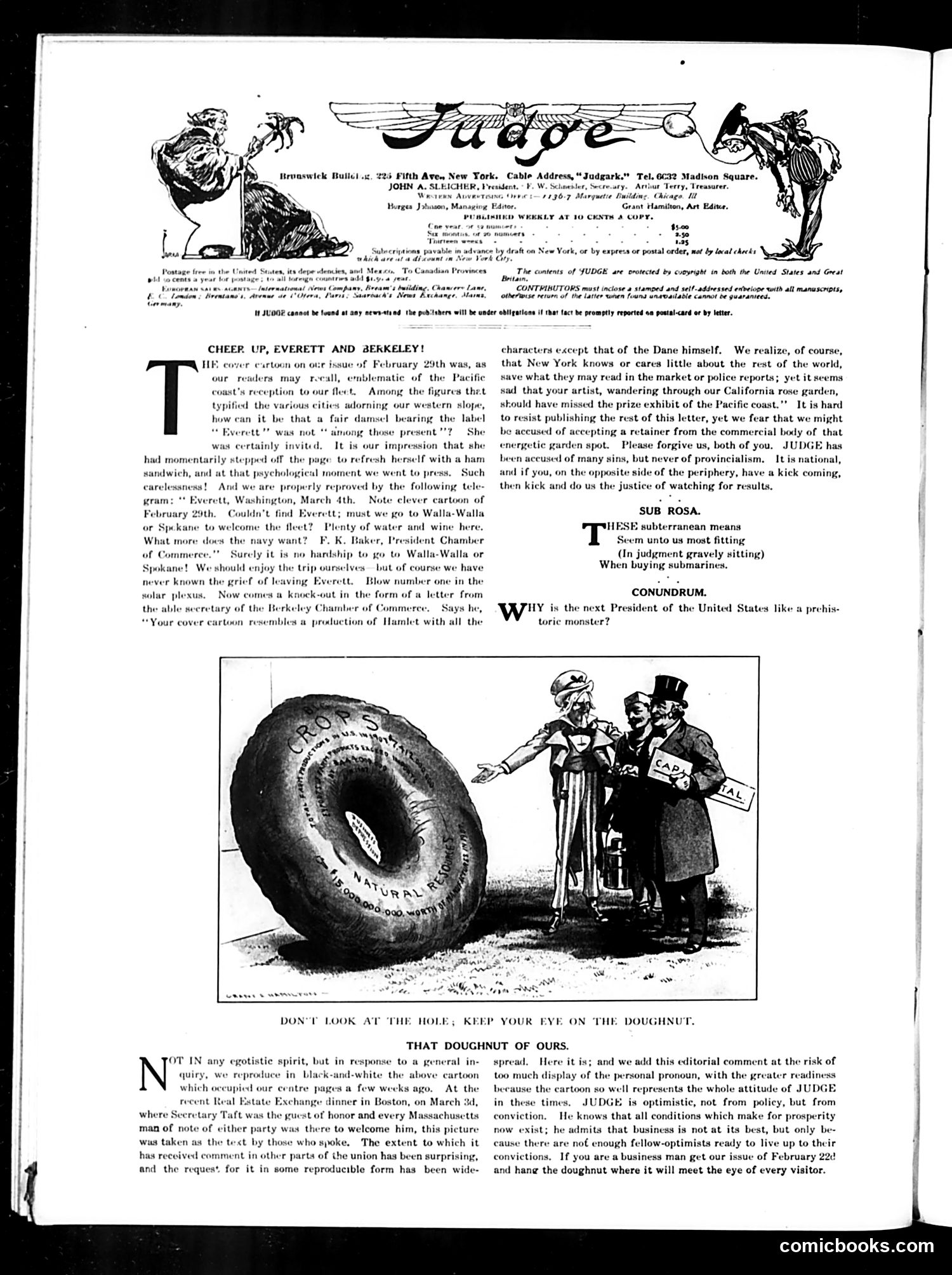
The main cartoon critiques American economic conditions, likely from the early 1920s. It depicts three figures (appearing to represent different classes or political positions—one labeled "CAPITAL") examining a massive tire labeled "NATURAL" with a hole through its center. The caption reads "DON'T LOOK AT THE HOLE; KEEP YOUR EYE ON THE DOUGHNUT." This is a visual pun on the idiom about focusing on the good (the doughnut) rather than the bad (the hole). The satire likely comments on how leaders distract the public from serious economic problems by emphasizing positive aspects. The accompanying editorial discusses optimism versus realistic assessment of business conditions during a period of economic uncertainty.
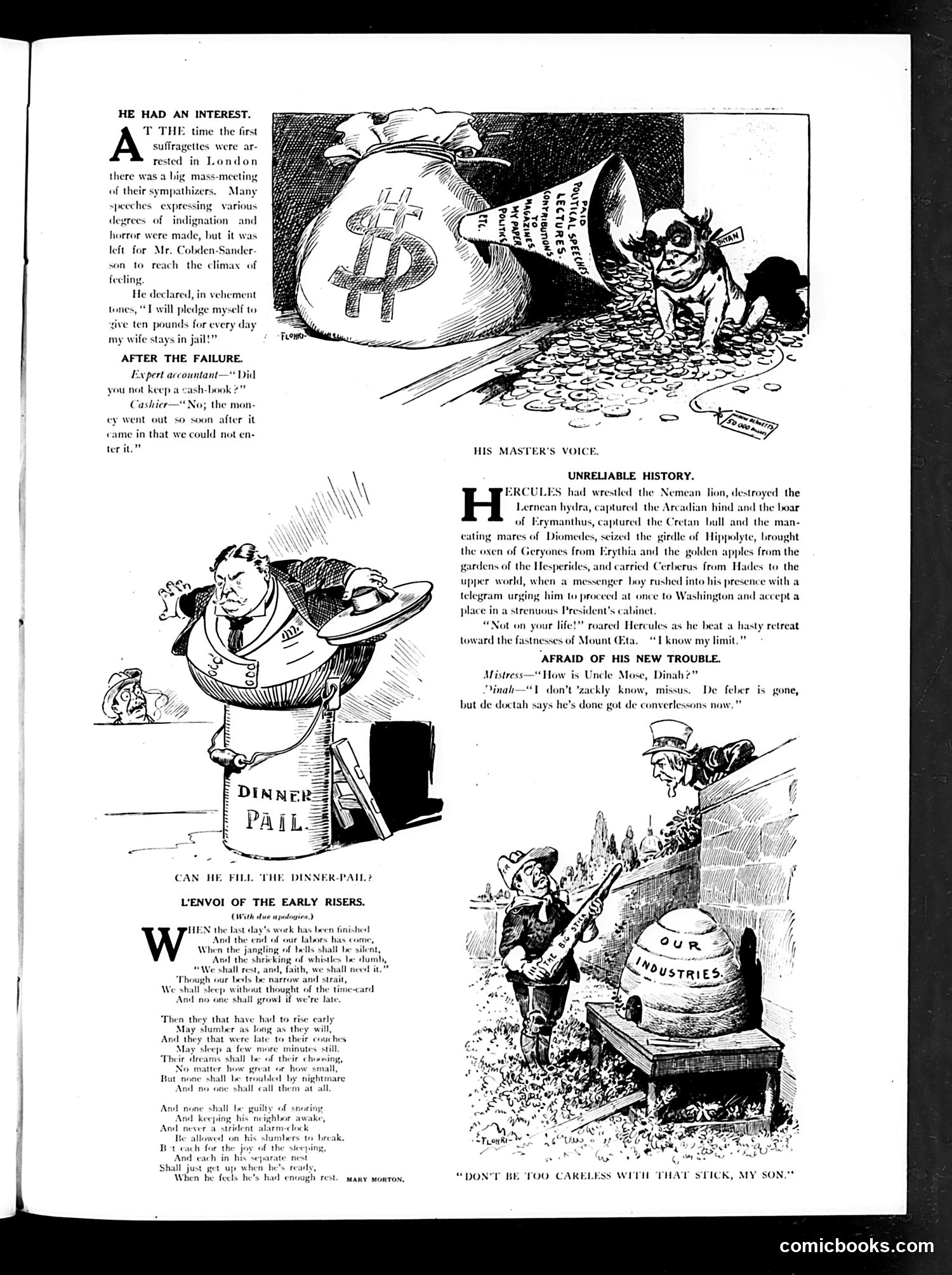
**Top Cartoon: "He Had an Interest"** This satirizes suffragette activism in London. A man (Mr. Colden-Sanderson) pledges to give ten pounds daily to keep his wife in jail during suffragette arrests—a cynical commentary on the women's suffrage movement, suggesting he'd pay to avoid her activism at home. **Middle Section: "Unreliable History"** Parodies Hercules' labors as analogous to Teddy Roosevelt's tasks, with absurd mythological references. The "dinner pail" cartoon below mocks whether politicians can fill workers' economic needs. **Bottom: "Don't Be Too Careless With That Stick"** Shows someone labeled "Our Industries" being threatened. This appears to critique labor unrest or workplace safety issues of the era. The page uses exaggerated caricature and visual metaphor typical of early 20th-century political satire.
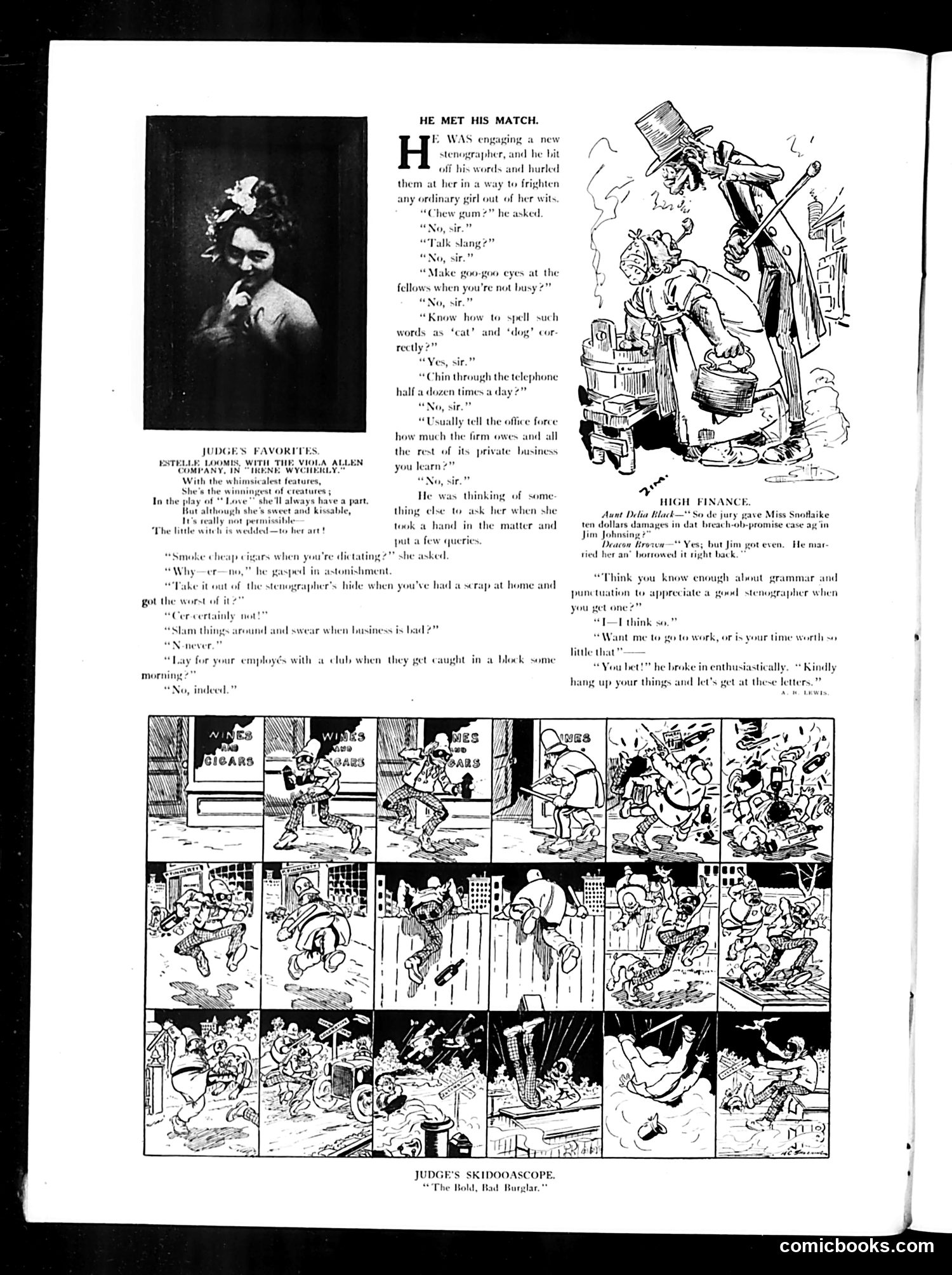
The page contains two sections: **Top: "He Met His Match"** - A dialogue-based story about a stenographer being questioned by her employer about various workplace competencies (typing, shorthand, spelling, phone etiquette, discretion about company finances). The humor derives from the stenographer's consistent "No, sir" responses, suggesting she lacks all required skills, yet somehow maintains her job. **Bottom: "Judge's Skidoascope - 'The Bold, Bad Burglar'"** - A sequential comic strip showing a burglar attempting a heist. The humor appears slapstick-based, with the burglar encountering increasingly chaotic complications as he breaks into a building, ultimately failing in his criminal enterprise. Both items are light workplace/crime satire typical of early 20th-century American humor magazines, without specific political references.
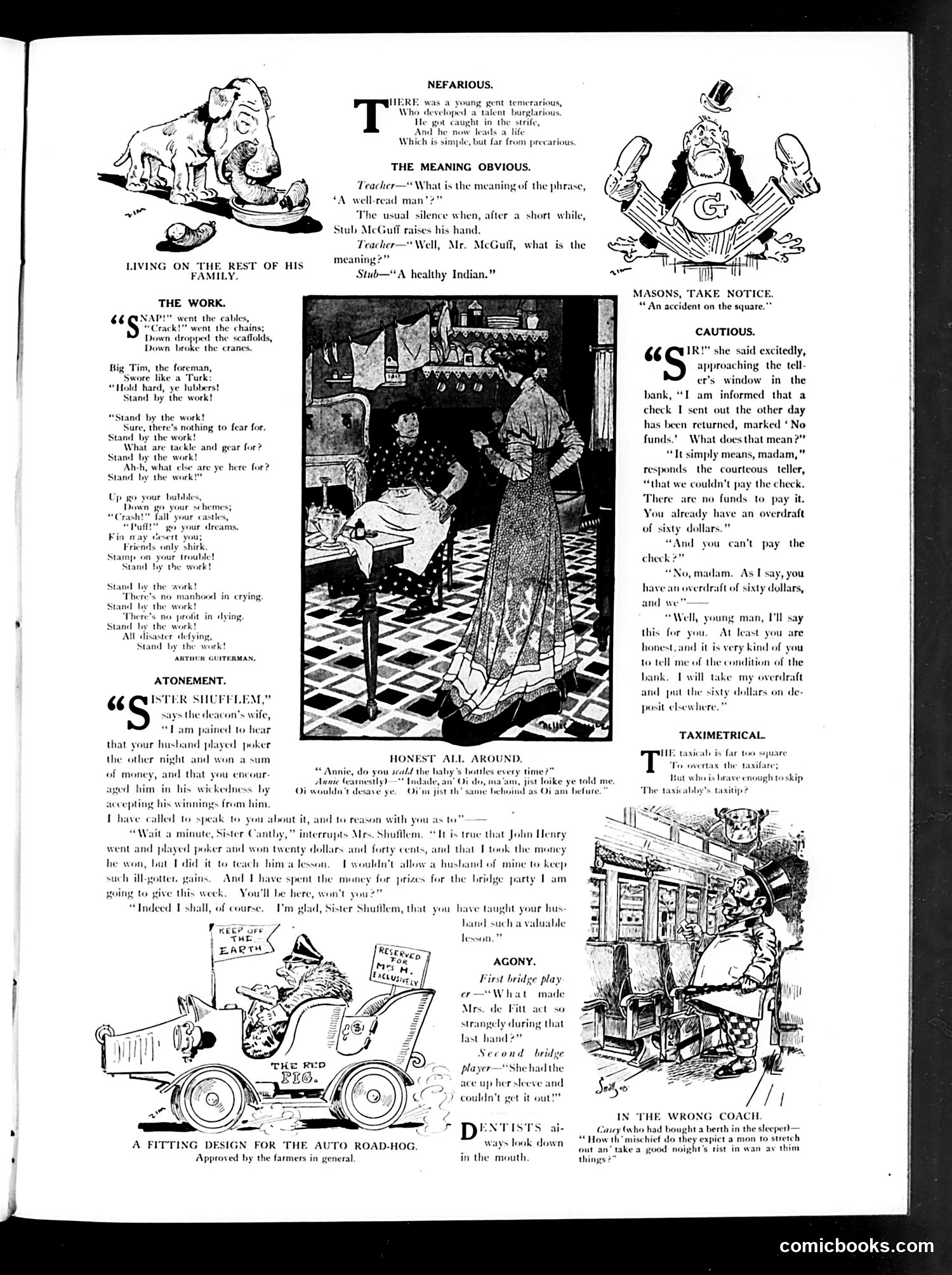
This page contains multiple short satirical pieces and cartoons typical of early 20th-century humor journalism: **"The Work"** celebrates manual laborers with patriotic verse, encouraging workers to "stand by the work." **"Honest All Around"** depicts a domestic dispute where a wife accuses her husband of infidelity, though the illustration's exact context is unclear. **"The Meaning Obvious"** is a classroom joke where a student defines "well-read man" as "a healthy Indian"—likely mocking either Native Americans or misinterpretation of the phrase. **"Masons, Take Notice"** presents a bank teller explaining an overdraft to a customer, punning on masonic/construction references. **"In the Wrong Coach"** appears to concern transportation misunderstandings. The cartoons use crude visual stereotyping typical of the era. Without specific dating or attribution, the exact satirical targets remain somewhat unclear.
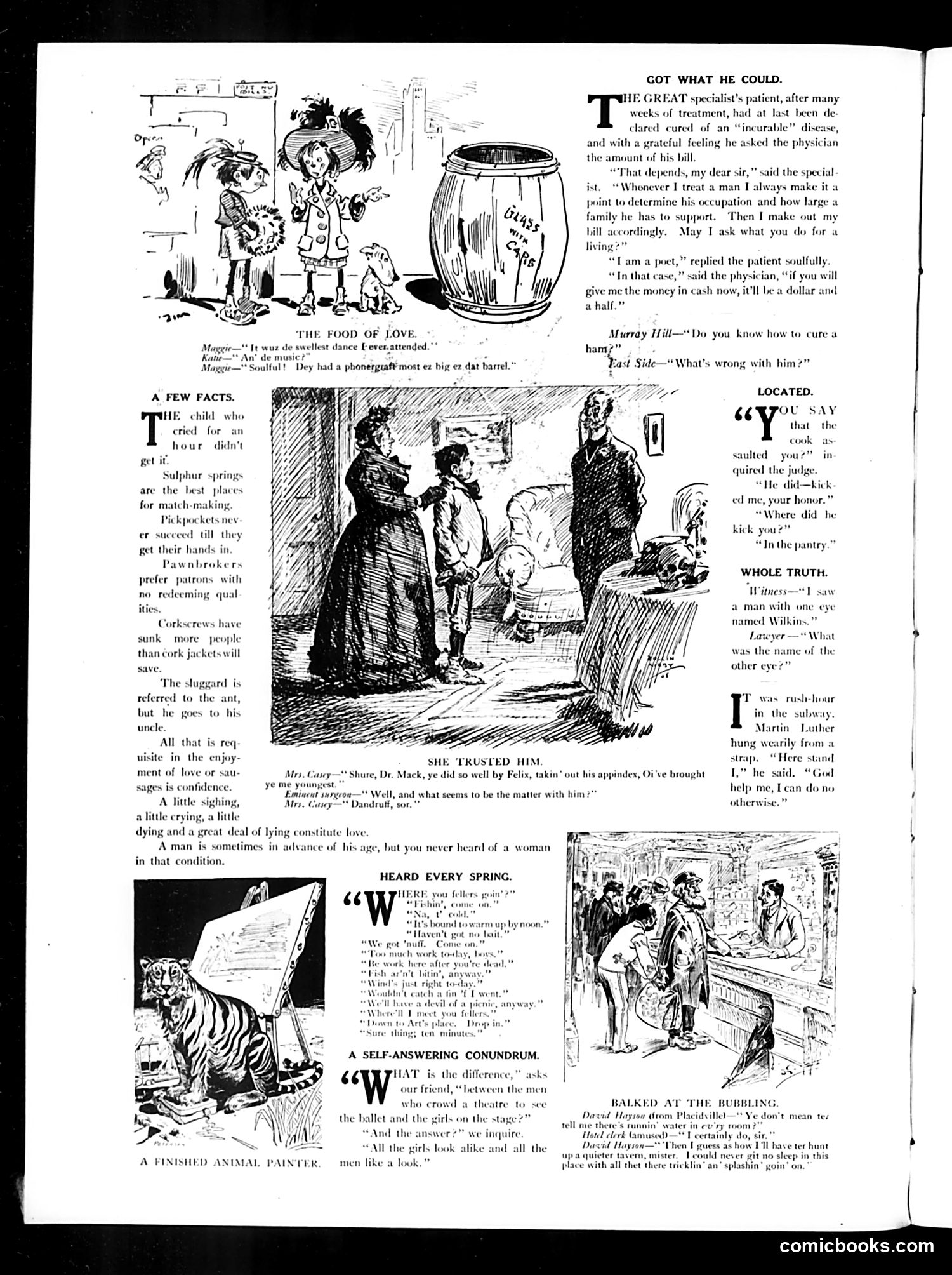
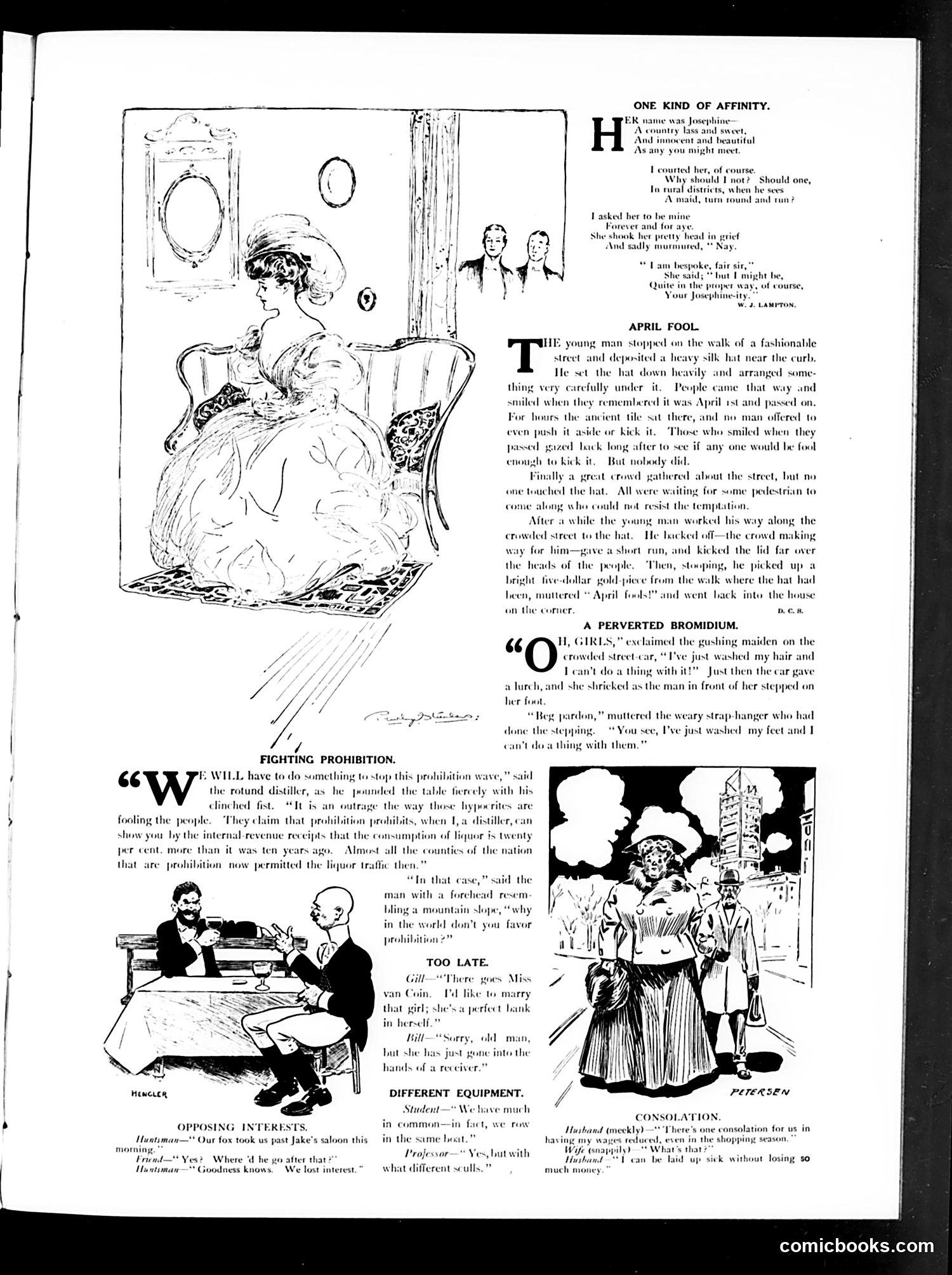
This page contains multiple brief satirical comics and jokes typical of early 20th-century Judge magazine: **"April Fool"** depicts a classic prank: a young man places a five-dollar gold piece under a hat on the street, betting no one will resist picking it up. The joke satirizes human nature and gullibility—people pass by all day avoiding the "trap," but eventually someone kicks the hat and retrieves the money, appearing foolish on April 1st. **"A Perverted Bromidium"** plays on a common saying: a woman complains she "can't do a thing" with her freshly-washed hair; when a man accidentally steps on her foot, she uses the identical phrase about her feet, creating absurdist humor through repetition. **"Fighting Prohibition"** shows a distiller arguing that prohibition doesn't work—liquor consumption has actually *increased* since prohibition began. When challenged why he doesn't support it then, his illogical response satirizes self-interested arguments against temperance reform. The remaining short jokes mock romantic disappointment, class pretension, and relationship dynamics with period-typical humor.
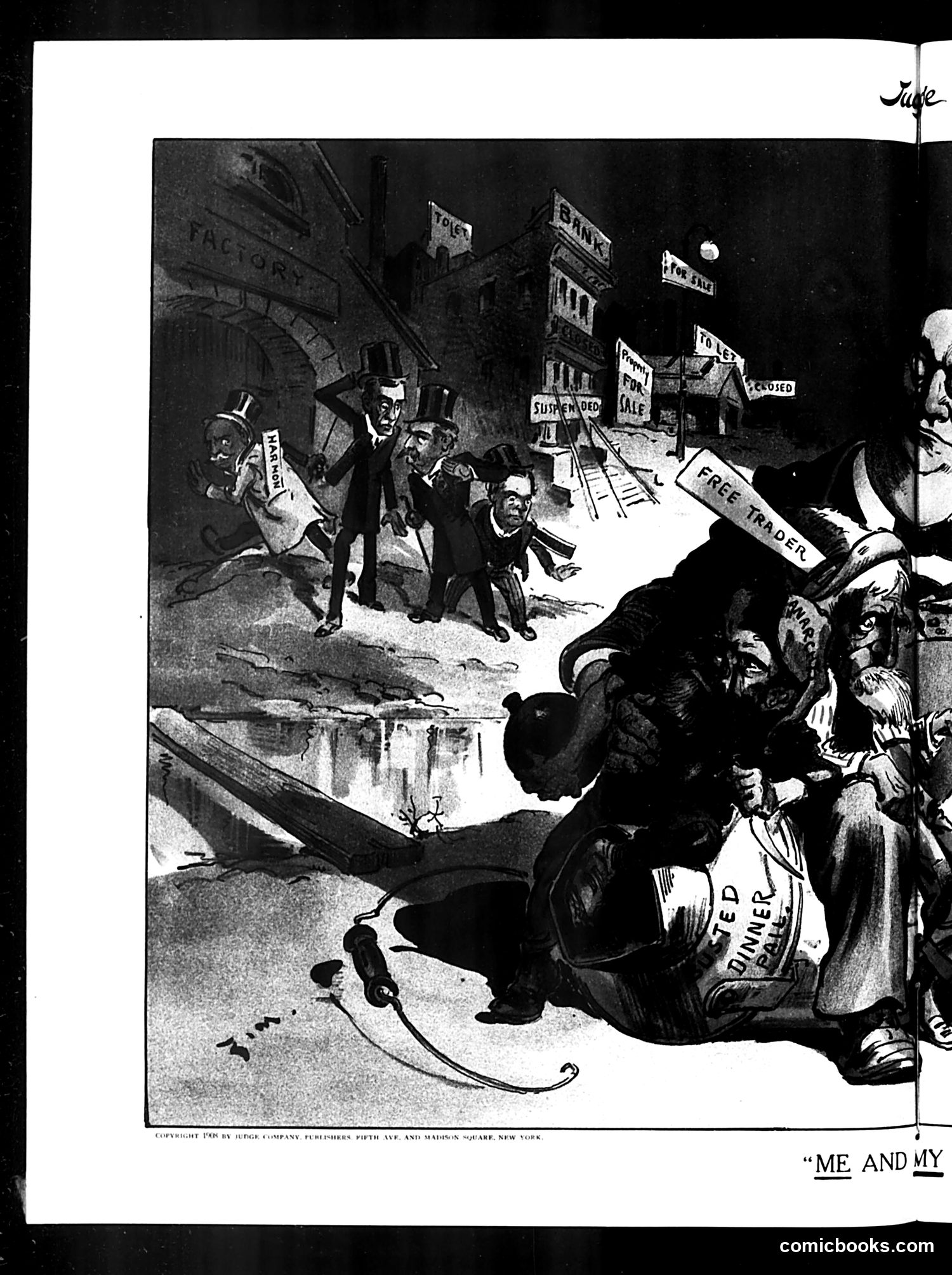
This is a satirical cartoon from *Judge* magazine depicting industrial labor conflict. The scene shows factory workers or laborers (depicted as caricatured figures in the foreground, some labeled "DISPLACED DINNER") confronting well-dressed businessmen and factory owners in an industrial setting. Signs visible in the background reference labor disputes: "SUSPENDED," "SALE," and "FREE TRADER." The cartoon appears to satirize the consequences of free trade policies or labor displacement on working-class people. The contrast between the impoverished, struggling workers in the foreground and the officials/owners in the factory setting suggests criticism of how industrial and trade policies hurt ordinary laborers while benefiting business interests. The exact historical moment remains unclear without additional context or visible date information.
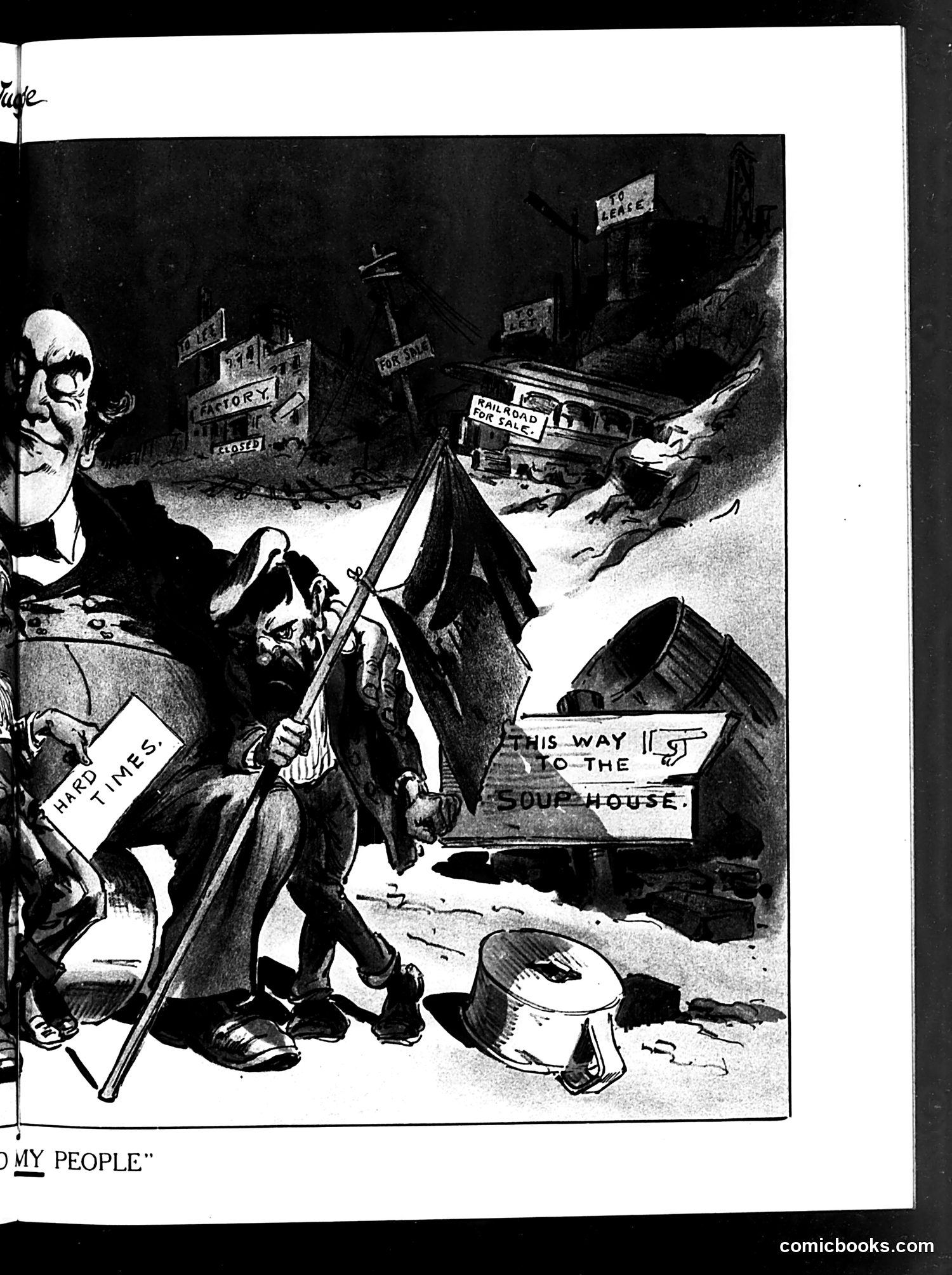
This appears to be an early 20th-century satirical cartoon from *Judge* magazine depicting a capitalist or wealthy industrialist (left, skull-faced caricature labeled "Hard Times") observing a impoverished encampment or "Hooverville" (the tent settlement marked "This Way to the Soup House"). The cartoon satirizes wealth inequality and economic hardship, likely referencing the Great Depression era. The skeleton figure represents how economic crisis strips away humanity, while the desperate poor are shown seeking basic sustenance at soup houses. The factories and industrial signs in the background suggest capitalism's failure to provide for workers. The point appears to be condemning how the wealthy remain indifferent while common people suffer destitution and hunger during economic collapse.
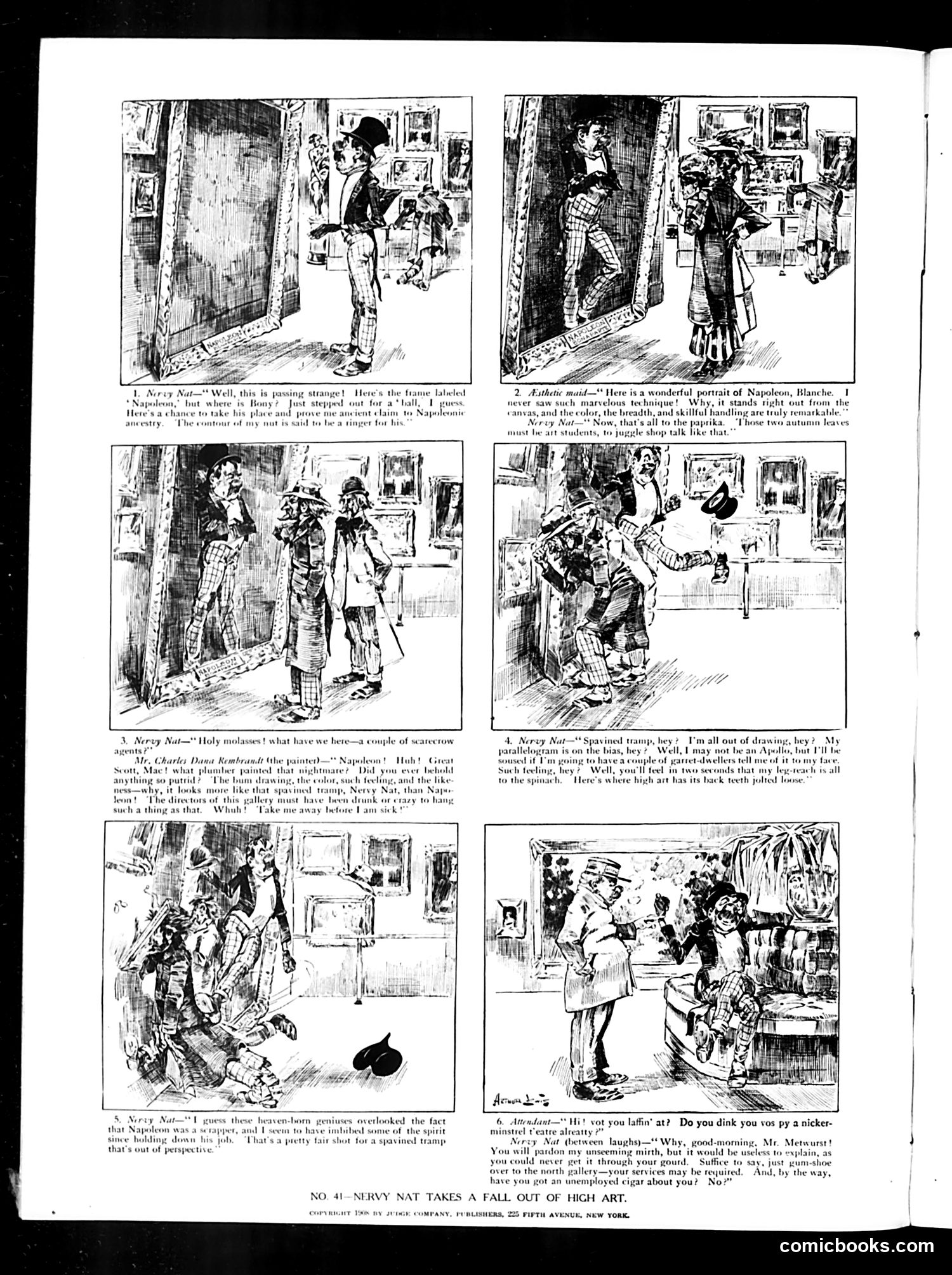
This is a six-panel comic strip satirizing pretentious art world figures. "Nervy Nat" (the protagonist) encounters what appears to be an art dealer or connoisseur in a gallery displaying paintings. The humor centers on class conflict: Nat challenges the dealer's affected sophistication about art, dismissing his grandiose claims about Napoleon and artistic technique as nonsense. The final panels show Nat literally fighting with or roughing up the pompous dealer. The satire targets the early 20th-century American art establishment's snobbery and affectation—the pretension that viewing or discussing art requires special intellectual superiority. Nat represents the common-sense everyman deflating such pretense through blunt skepticism and, ultimately, physical action.
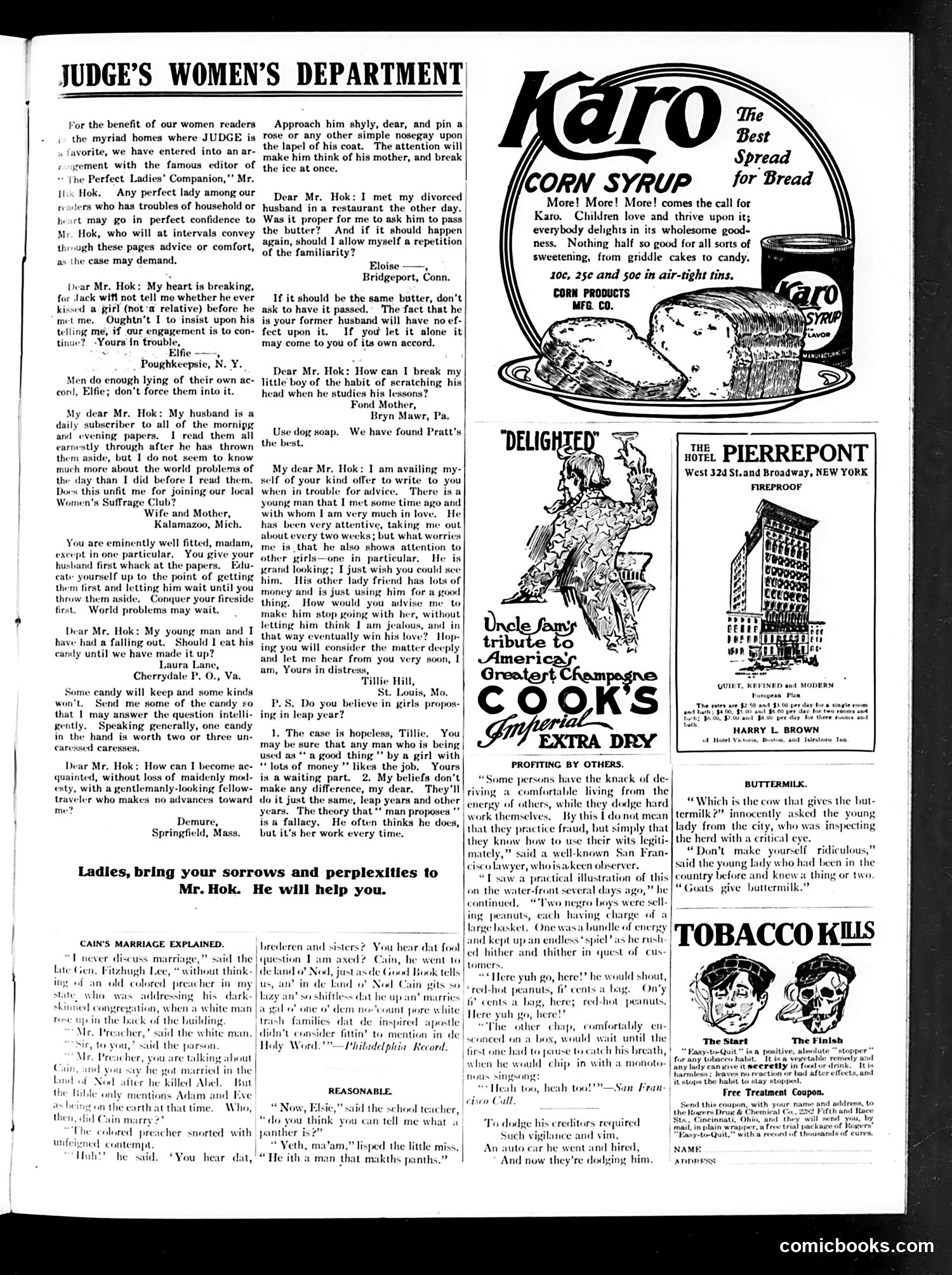
This page features "Judge's Women's Department," a satirical advice column hosted by "Mr. Hok." Rather than genuine counsel, the column offers absurdist, tongue-in-cheek responses to women's domestic concerns. The satire targets both women and men: women are portrayed as naive, emotionally volatile, and obsessed with romantic trivialities (whether a boyfriend kissed before, breaking engagement over candy), while men are depicted as lazy, dishonest newspaper-hoarders indifferent to their wives' intellectual growth. Key satirical points include mocking women's suffrage aspirations (reading newspapers doesn't qualify women for political participation), patronizing romantic advice, and suggesting women's concerns are trivial. The column also includes a separate joke about Cain's marriage from the Bible—presented through a condescending racial stereotype dialogue. The overall message satirizes contemporary anxieties about women's changing roles while reinforcing traditional gender hierarchies through humor.
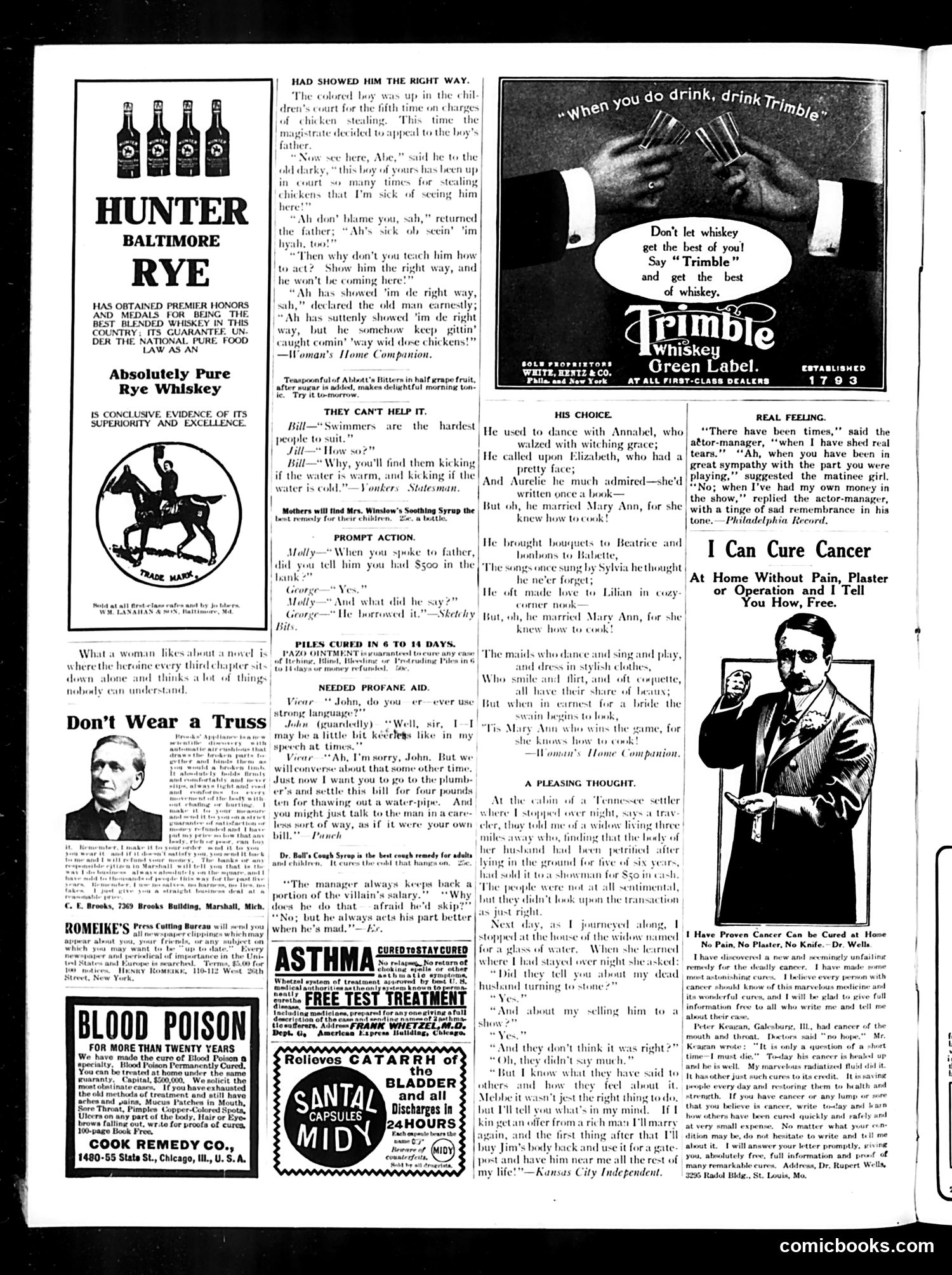
This page is primarily **advertisements and short humor pieces**, not political cartoons. The main content includes: **Visible humor items:** - A brief dialogue about a "colored boy" in children's court for chicken-stealing, where the magistrate suggests the father teach him "the right way"—a satirical commentary on ineffective criminal justice - Several short joke pieces (Jill and Bill dialogues, etc.) poking fun at everyday situations **Advertisements dominate:** - Hunter Baltimore Rye Whiskey (top left, with trade mark image) - Trimble Whiskey ("When you do drink, drink Trimble") - Medical quack ads: "I Can Cure Cancer at Home Without Pain," "Blood Poison" cure, "Asthma Free Treatment" **Historical context for modern readers:** The quack medical advertisements reveal common early 20th-century medical fraud. The racist dialect humor reflects the magazine's casual bigotry. The overall page reflects Judge's mix of mild satire and commercial content.
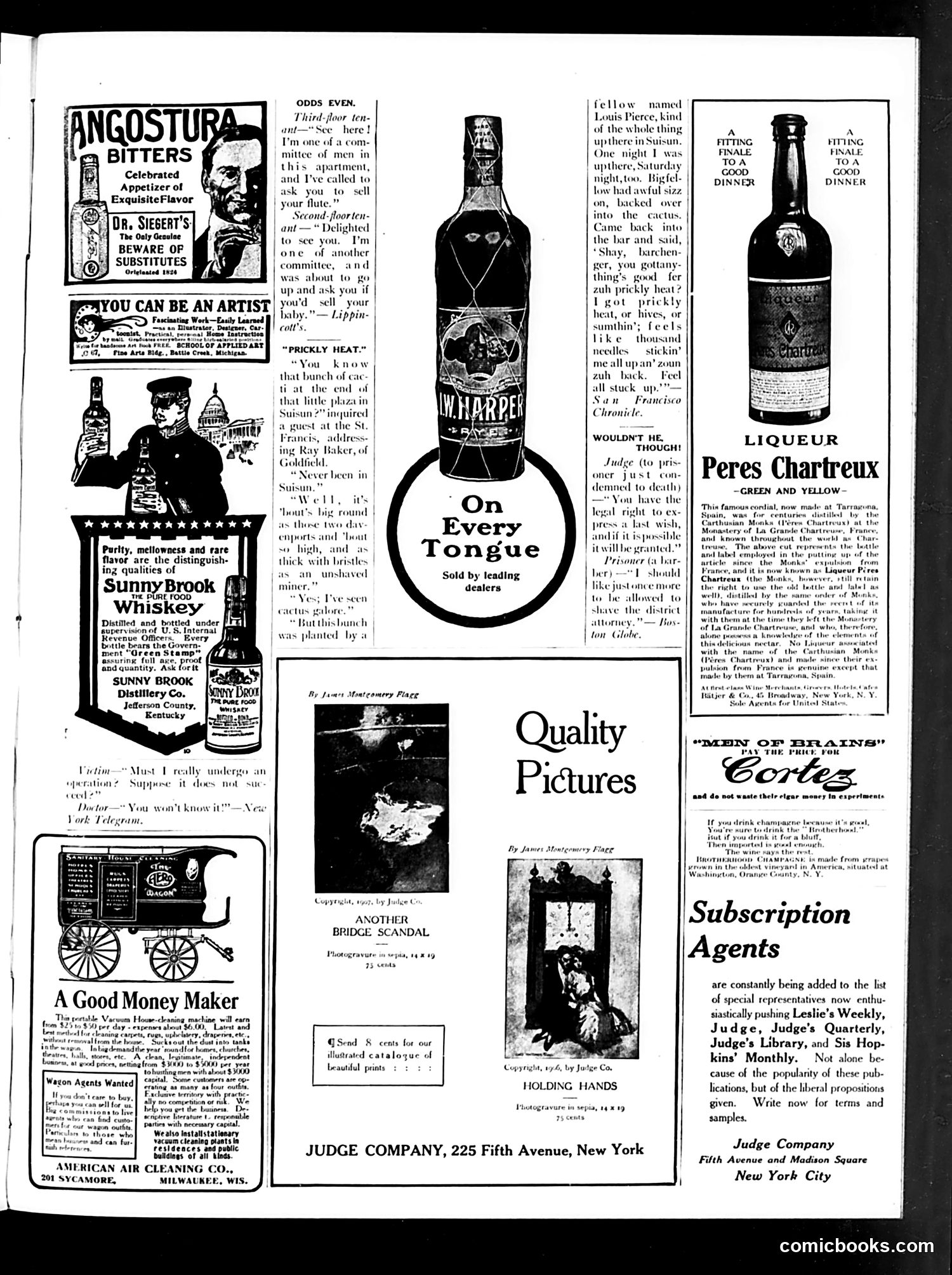
This page consists primarily of **advertisements and short humorous anecdotes** rather than political cartoons. The main satirical content includes: 1. **"Odds Even"** — A joke about neighboring apartment tenants both forming committees to ask each other to stop playing the flute, satirizing bureaucratic absurdity. 2. **"Prickly Heat"** — A crude dialogue about a man covered in cactus spines in Suisun (California), playing on the double meaning of "heat" as both discomfort and attraction. 3. **"Wouldn't He, Though!"** — Dark humor about a death-row prisoner asking to shave his executioner, the district attorney. The remaining content is **advertising**: liqueur, whiskey, cleaning machines, and art schools. The page reflects Judge magazine's typical format of mixing lowbrow humor with commercial promotion, aimed at early-20th-century readers seeking light entertainment and consumer goods.
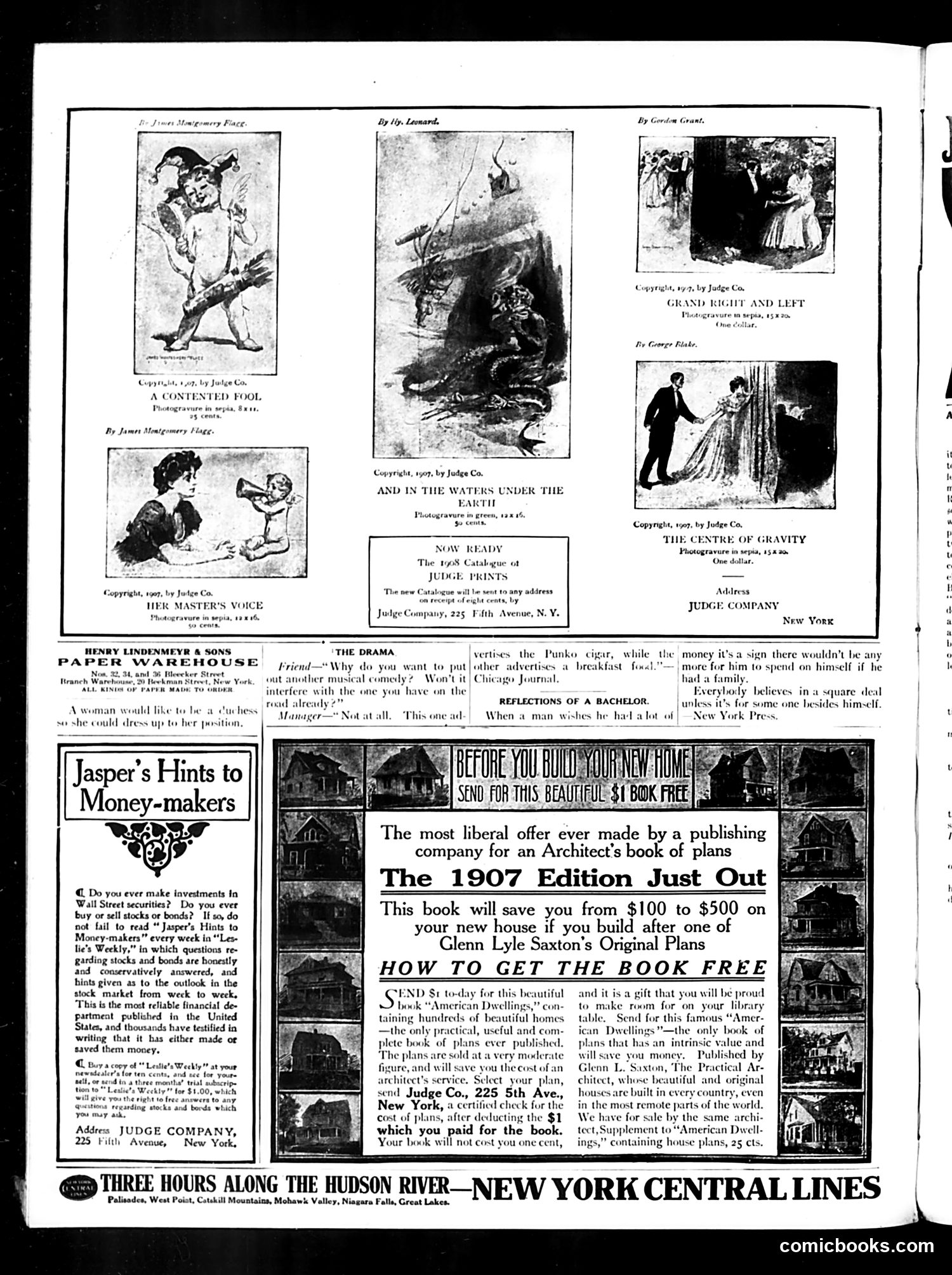
This page consists primarily of **advertisements and filler content** rather than political cartoons. The main elements are: **Top section**: Small illustration credits for various artists (James Montgomery Flagg, Gordon Grant, George Blake) accompanying what appear to be brief humorous sketches or cartoons—typical Judge magazine fare—though the images are poorly reproduced and their specific satirical content is unclear. **Central content**: "The Drama" section contains short joke exchanges about musicians and cigars, reflecting the magazine's light humor format. **Dominant feature**: A large advertisement for Glenn Lyle Saxton's "1907 Edition" architectural plan book, offering designs to save homeowners $100-$500 on construction costs. This was apparently a popular mail-order service of the era. **Additional ads**: "Jasper's Hints to Money-makers" (financial advice column) and travel promotion for New York Central Lines. The page reflects Judge's business model: satirical humor mixed with commercial advertising to monetize the publication.
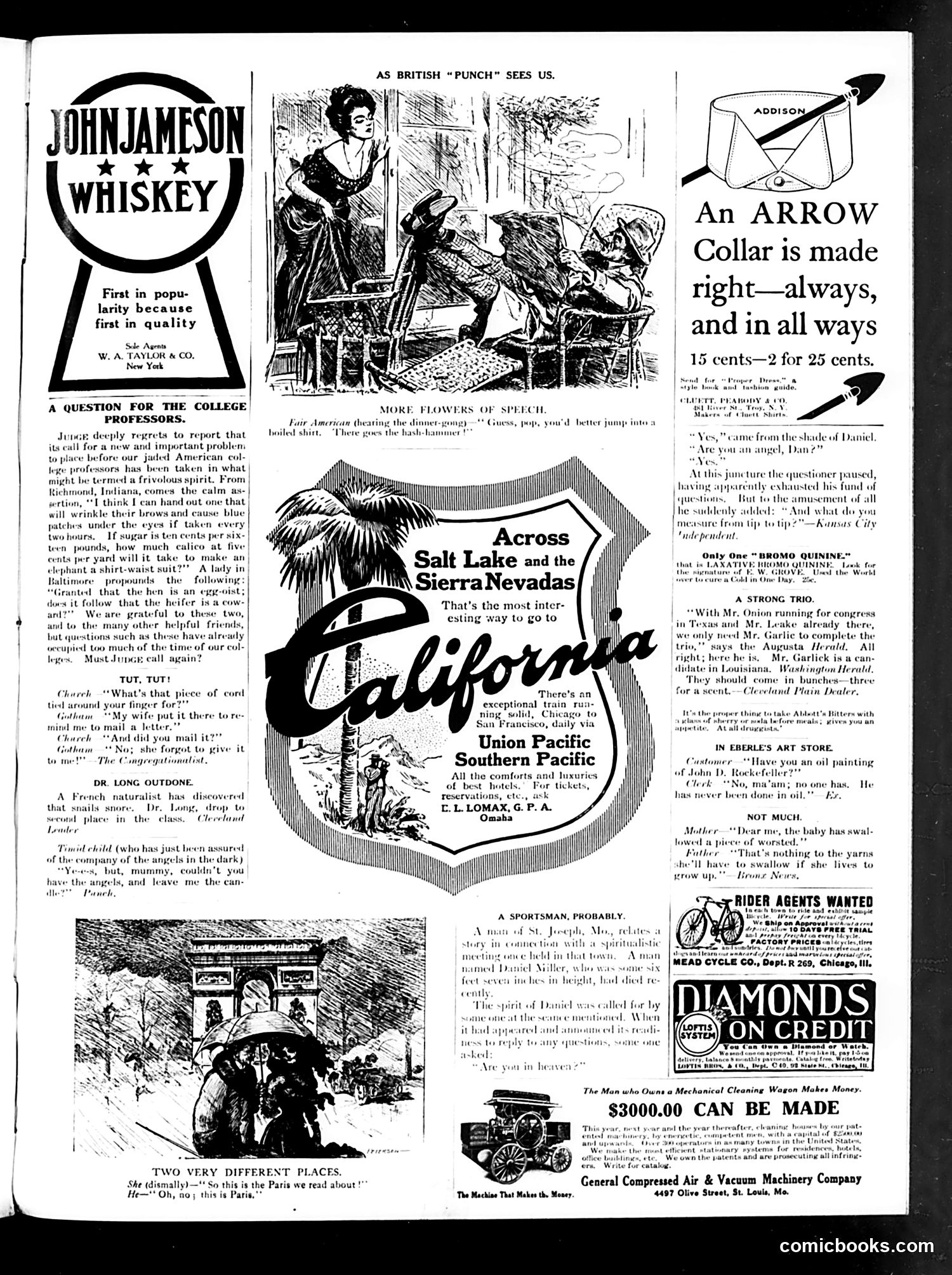
This page is primarily **advertising with minimal editorial cartoons**. The main content includes: **"As British 'Punch' Sees Us"**: A satirical panel showing British perceptions of Americans—depicting them as crude and boisterous (the dinner-gong joke about jumping into a boat reflects the stereotype of uncouth American behavior). **"Two Very Different Places"**: A brief joke contrasting Paris with an unnamed location, relying on the era's fascination with Paris as exotic/romantic. The bulk of the page comprises **product advertisements**: John Jameson Whiskey, Arrow Collars, Union Pacific/Southern Pacific railroads, bicycles, diamonds, and compressed air machinery. These ads reflect early 1900s consumer goods and services. **Political/social context**: The British mockery reflects transatlantic tensions about American manners and refinement—a common Judge theme. The advertisements themselves reveal what affluent Americans valued: luxury goods, travel, and emerging technology. The page reflects Judge's dual function: satirical commentary mixed with paid advertising targeting middle-to-upper-class readers.
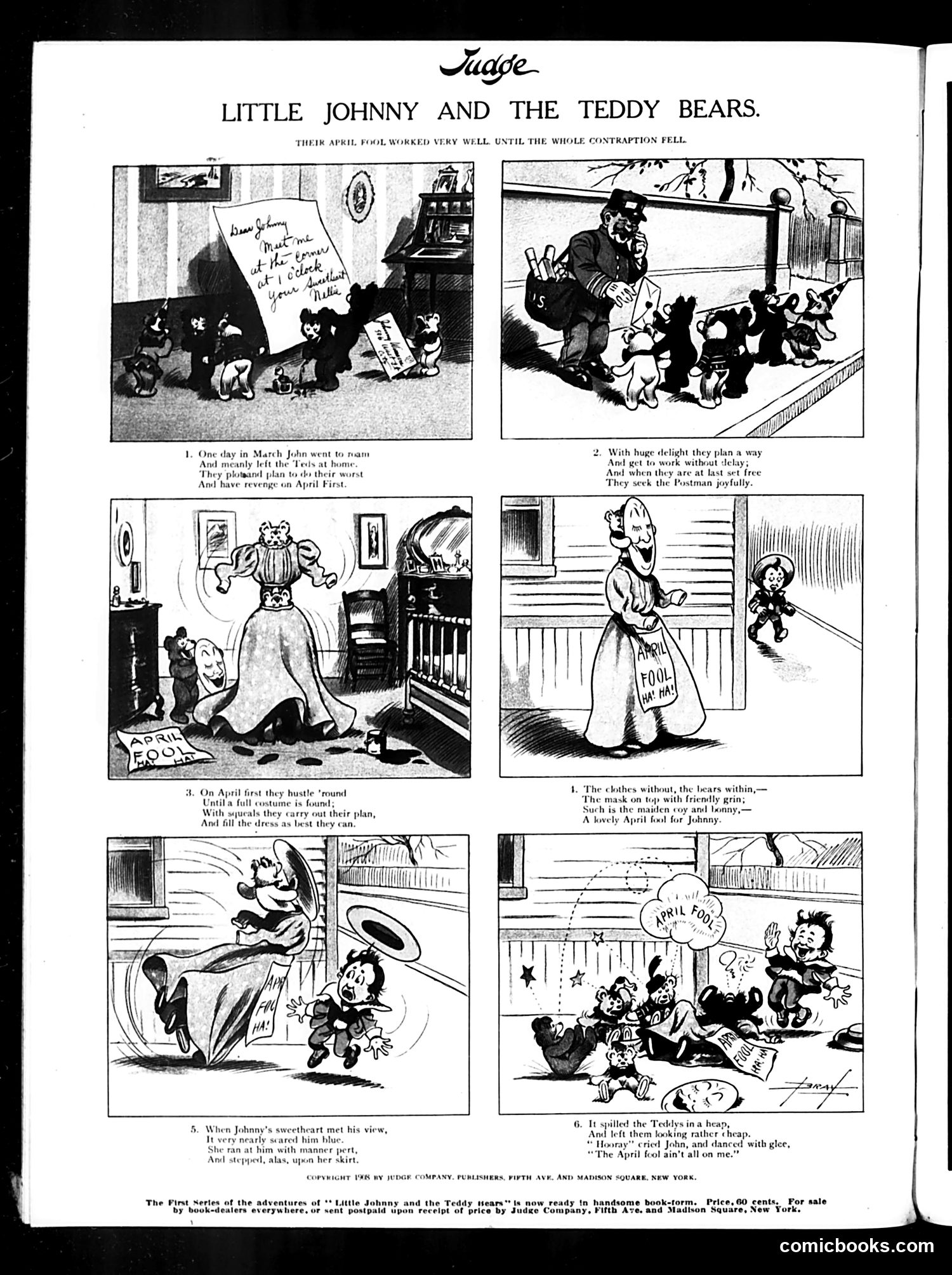
This is a six-panel comic strip satirizing April Fools' Day pranks. "Little Johnny" is a mischievous child character who, along with teddy bears, executes an elaborate April Fools' scheme on his mother and the household. The plot: Johnny and the bears plan to trick the family (panels 1-2), construct a costume disguise (panel 3), and successfully fool Johnny's mother and sweetheart with an elaborate fake—causing panic and chaos (panels 4-5). The final panel shows the prank's literal and figurative collapse when "the whole contraption fell" (panel 6), leaving Johnny exposed and his mother angry. The satire targets the exaggerated consequences of April Fools' pranks and childhood mischief. The "Teddy Bears" reference likely alludes to Theodore Roosevelt's popularity at the time, making the toys fashionable cultural references. The strip advertises the book version of this character series, suggesting Johnny was an established recurring comic property in *Judge*.