
A complete issue · 16 pages · 1908
Judge — February 22, 1908
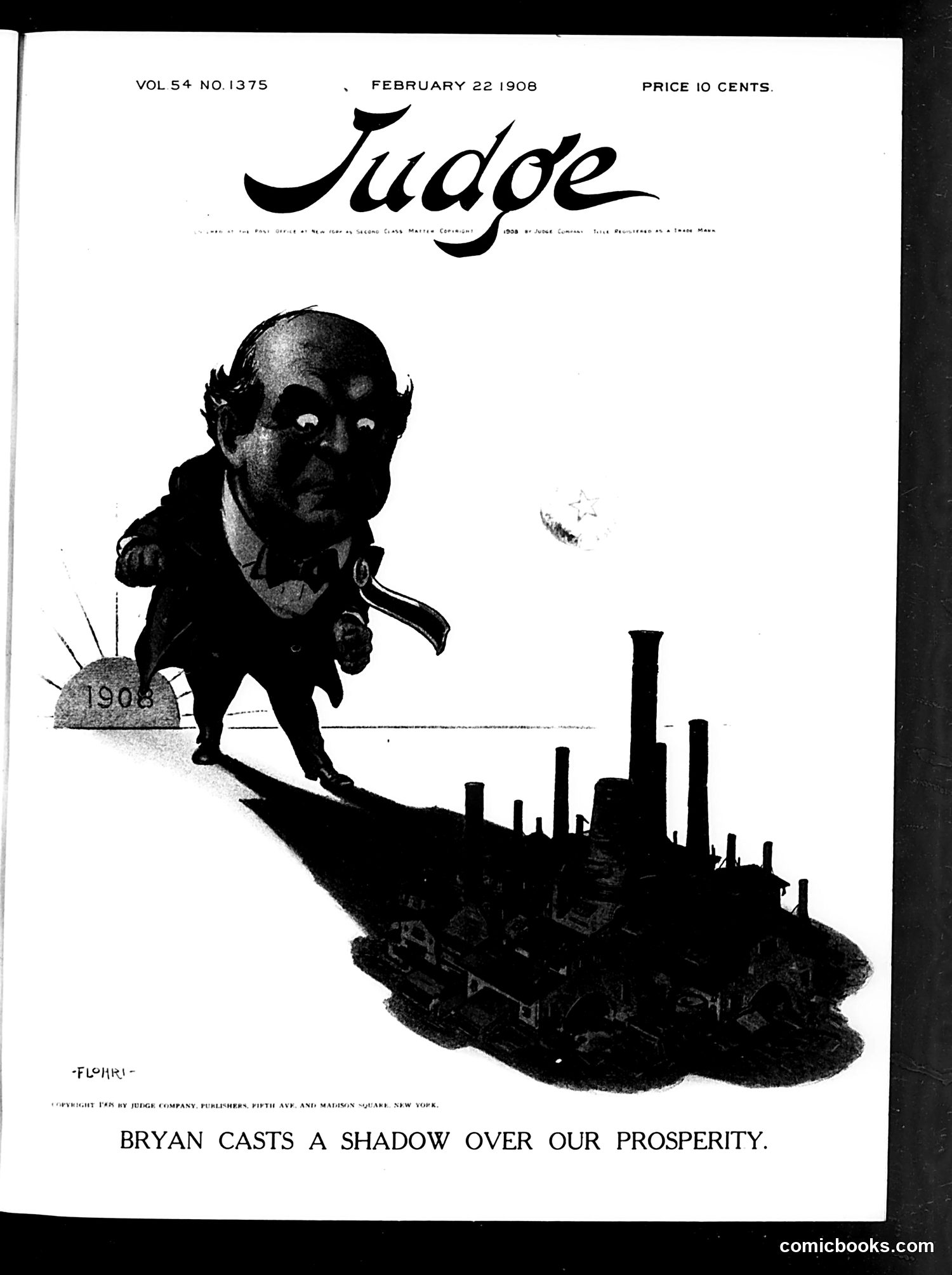
This political cartoon satirizes William Jennings Bryan, the three-time Democratic presidential candidate. The caption "Bryan Casts a Shadow Over Our Prosperity" expresses Republican opposition to Bryan's political influence. The caricature shows Bryan as a menacing figure looming over an industrial cityscape (with factory smokestacks), casting a dark shadow. The "1908" label suggests this addresses the upcoming 1908 election. Bryan's exaggerated features and threatening posture convey conservative fears that his populist politics—particularly his opposition to big business and monetary policies—threatened American economic growth and industrial prosperity. The cartoon reflects Judge's Republican editorial stance and business-friendly perspective of the era.
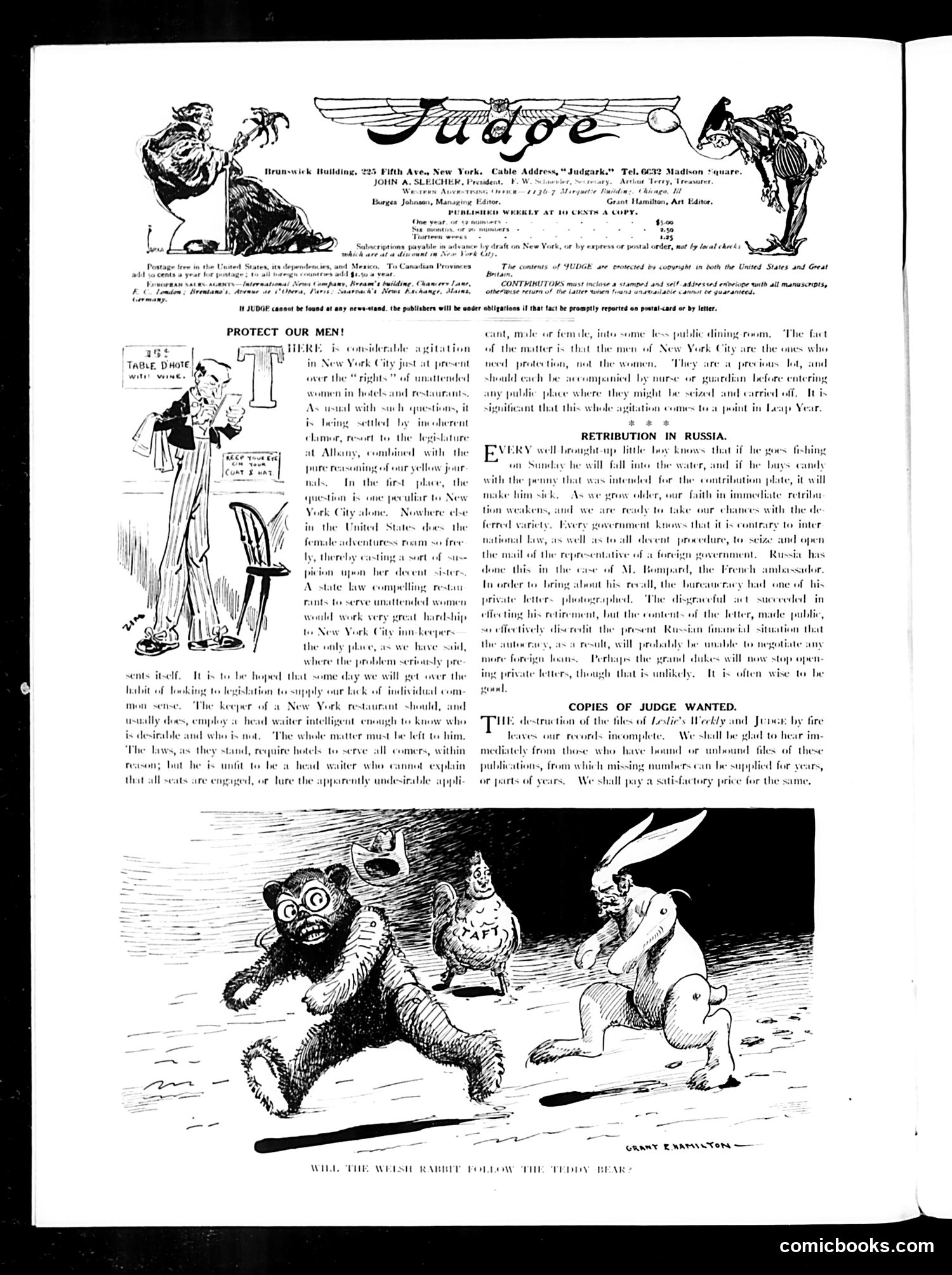
The main cartoon "Will the Welsh Rabbit Follow the Teddy Bear?" depicts anthropomorphic animals in what appears to be a political allegory. A bear (likely representing Theodore Roosevelt's "Teddy Bear" mascot) confronts a rabbit and a chubby figure, possibly referencing contemporary political figures or policies. The accompanying text articles discuss dining room segregation in New York City restaurants and "Retribution in Russia," suggesting international political tensions of the early 1900s. Without clearer identification of the specific animals and figures, the exact political meaning remains somewhat unclear, though it likely satirizes early-20th-century political rivalries or diplomatic relations, using animal metaphors typical of Judge's satirical style.
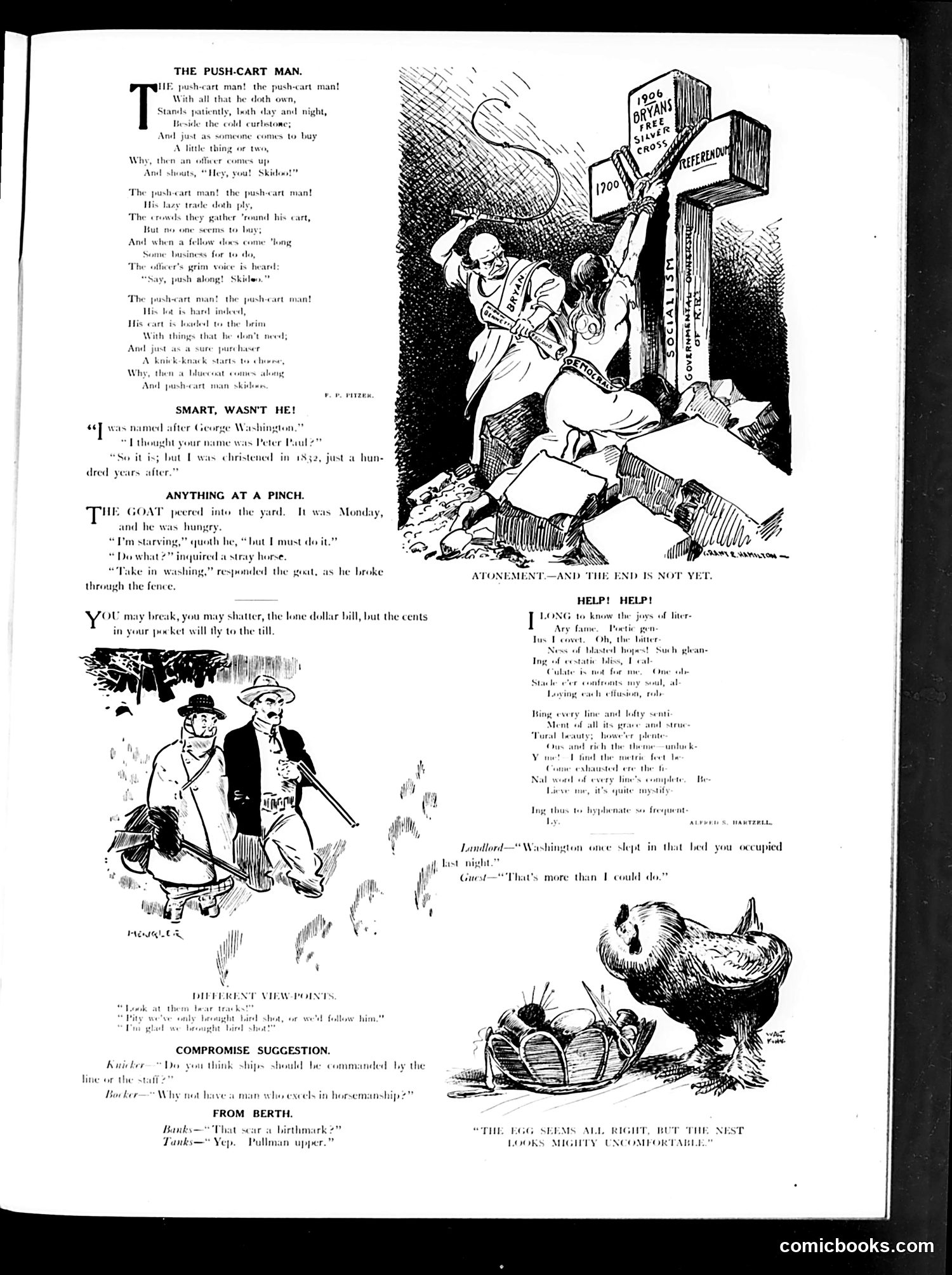
This page contains several satirical pieces mocking everyday life and social conventions: **"The Push-Cart Man"** poem (top left) humorously describes a street vendor's relentless work, with the punchline that he's constantly harassed by children shouting "Hey, you! Shikes!" **"Smart, Wasn't He!"** jokes about a man named after George Washington, humorously noting he was christened in 1812—a hundred years after the president. **"Anything at a Pinch"** depicts a goat breaking through a fence, asking for laundry work, suggesting resourcefulness in difficult economic times. **"Help! Help!"** is a melodramatic poem about romantic distress and heartbreak. The bottom cartoon shows a hen with eggs, captioned about discomfort—likely a crude joke about reproduction. These pieces satirize working-class struggles, poverty, and Victorian sentimentality typical of early 20th-century American humor magazines.
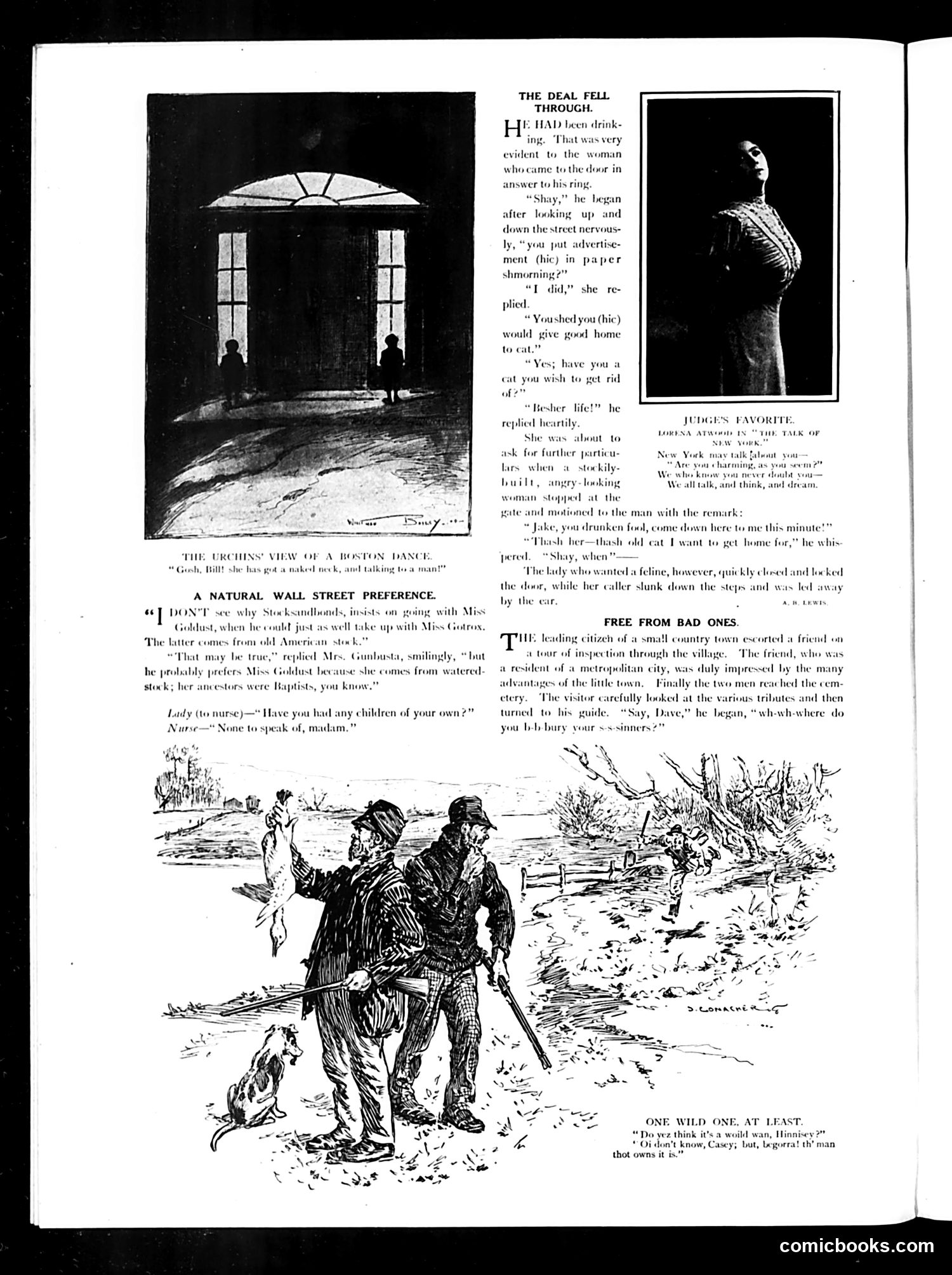
This page contains three separate humorous pieces typical of Judge's satirical content: 1. **"The Deal Fell Through"** - A sketch about a drunk man negotiating with a woman at her door, attempting to justify placing an advertisement for a cat. The humor rests on his inebriation and her dismissive response. 2. **"A Natural Wall Street Preference"** - A brief dialogue joke about stock preferences, playing on financial/investment terminology for comedic effect. 3. **"Free From Bad Ones"** - A rural scene where a visitor asks a guide where townspeople bury "sinners," mocking small-town morality and suggesting the town is so virtuous it has no bad citizens to bury. The illustrations use period-appropriate ink-drawing style. The satire targets urban drunks, financial pretension, and rural smugness.
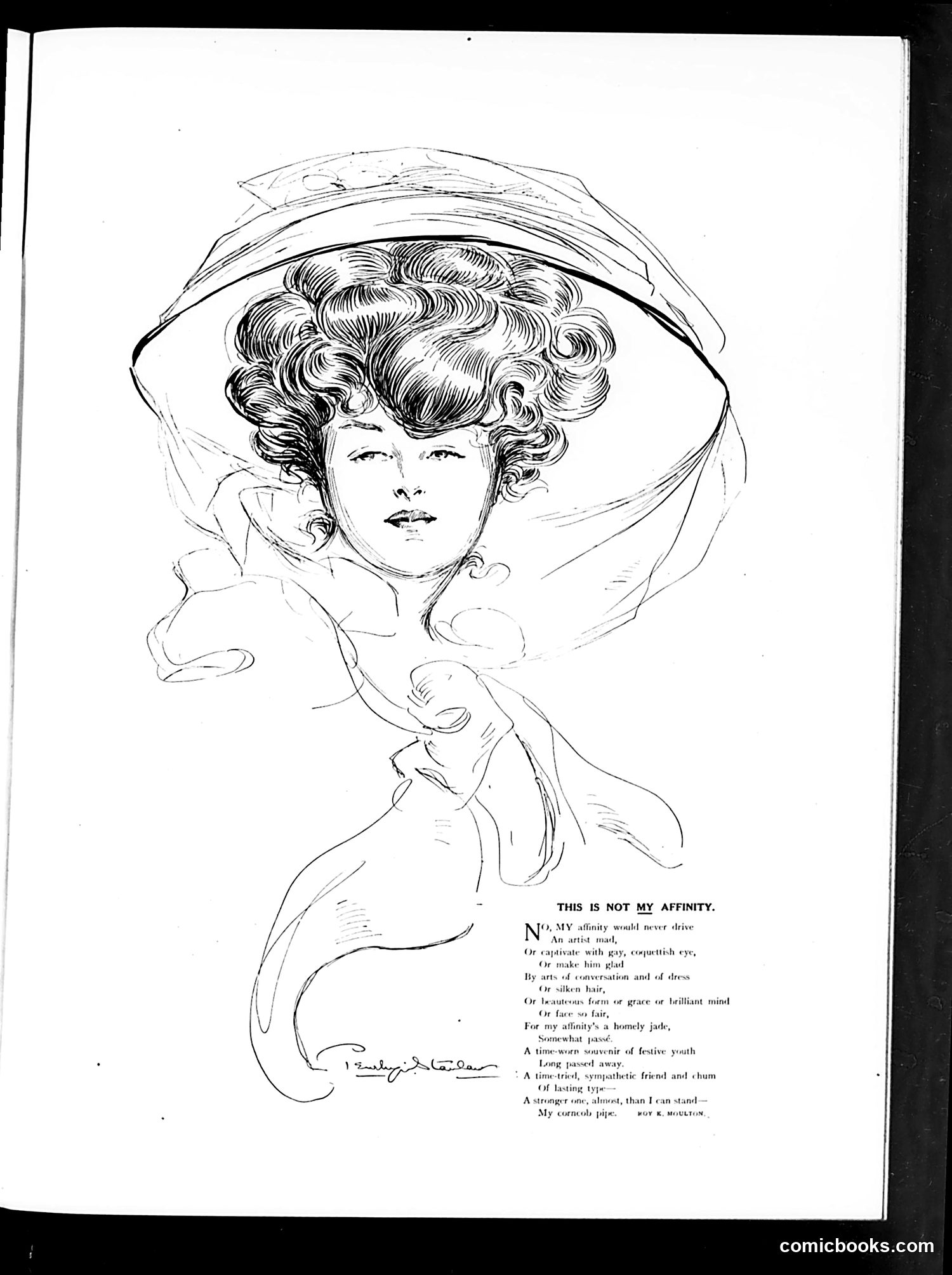
This page features an elegant pen-and-ink illustration of a fashionable woman with elaborate curled hair and a wide-brimmed hat, accompanied by the poem "THIS IS NOT MY AFFINITY." The poem expresses a woman's rejection of certain character types as romantic partners—specifically those who are artistic, vain, cowardly, or superficially charming. She declares preference instead for strength and substance over vanity or artistic temperament. The satire appears to target the "Gibson Girl" aesthetic and the romantic ideals of the early 1900s, mocking both the elaborate fashion sense depicted and the sentimental courtship conventions of the era. The poem humorously asserts that despite her fashionable appearance, this woman values genuine character over the superficial qualities typically associated with her social class. The artist's signature is visible but unclear in the reproduction.
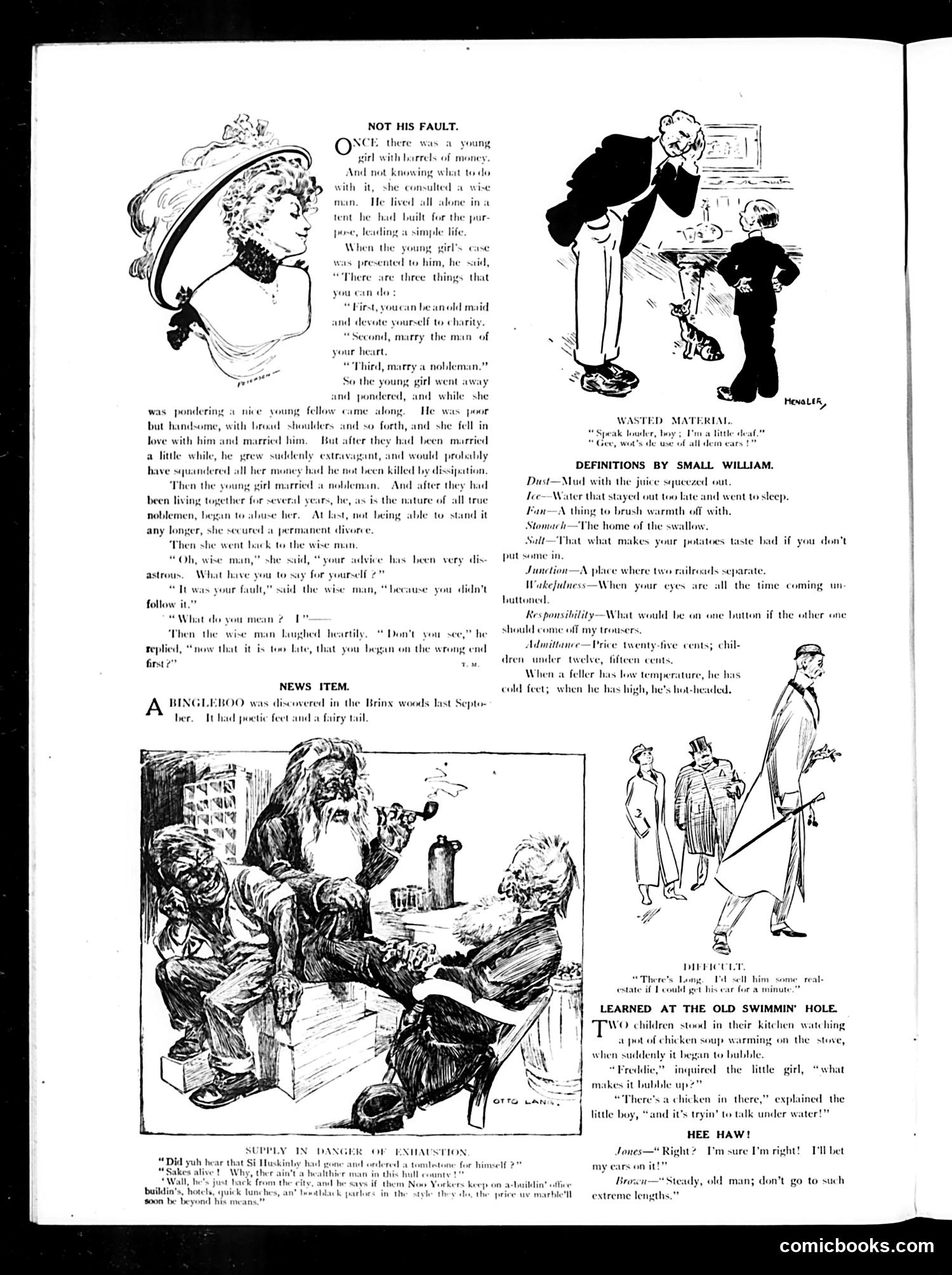
This page contains several unrelated humorous pieces typical of Judge magazine's format: **"Not His Fault"** (top left): A moral fable where a wealthy young woman ignores a wise man's three life options (charity work, marry for love, marry nobility). She marries a poor man who squanders her fortune, then a nobleman who abuses her. The punch line: her failures resulted from not following his original advice—she chose wrong from the start. **The remaining content** consists of light humor pieces: a "News Item" about a fantastical creature; "Definitions by Small William" (a recurring feature offering children's humorous definitions of everyday words); "Learned at the Old Swimmin' Hole" (children's bath-time dialog); and "Hee Haw!" (a joke about someone betting their ears). The illustrations are generic satirical drawings typical of early-20th-century American humor magazines. No specific political figures or events are referenced—this is pure entertainment content aimed at general audiences.
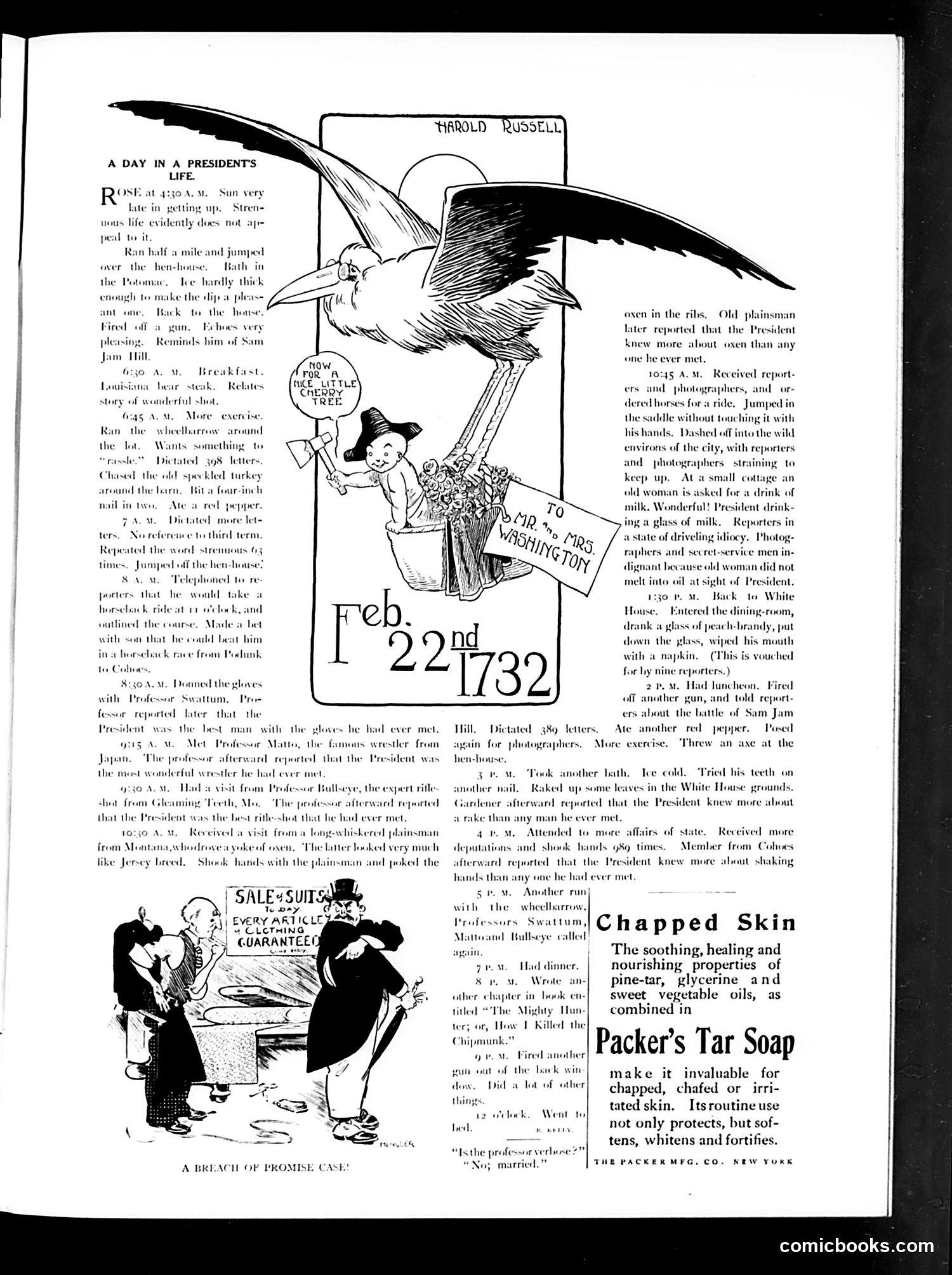
This satirical piece mocks President Theodore Roosevelt's famous "strenuous life" philosophy. The cartoon parodies his relentless activity by listing an absurdly packed daily schedule: rising at 4 AM, running, shooting guns repeatedly, wrestling professors, riding horses, shaking hands with frontiersmen, and dictating hundreds of letters—all while eating red peppers and biting nails. The joke targets Roosevelt's well-publicized vigor and his cultivation of a hyper-masculine public image. Every activity is presented as exhausting and pointless, yet reporters constantly validate it with exaggerated praise ("the best...he ever met"). The repetitive gun-firing and constant physical feats lampoon how newspapers breathlessly covered Roosevelt's energy as proof of presidential fitness. The satire suggests Roosevelt's theatricality—that his strenuous persona was performative rather than genuinely purposeful, designed primarily to impress journalists and the public.
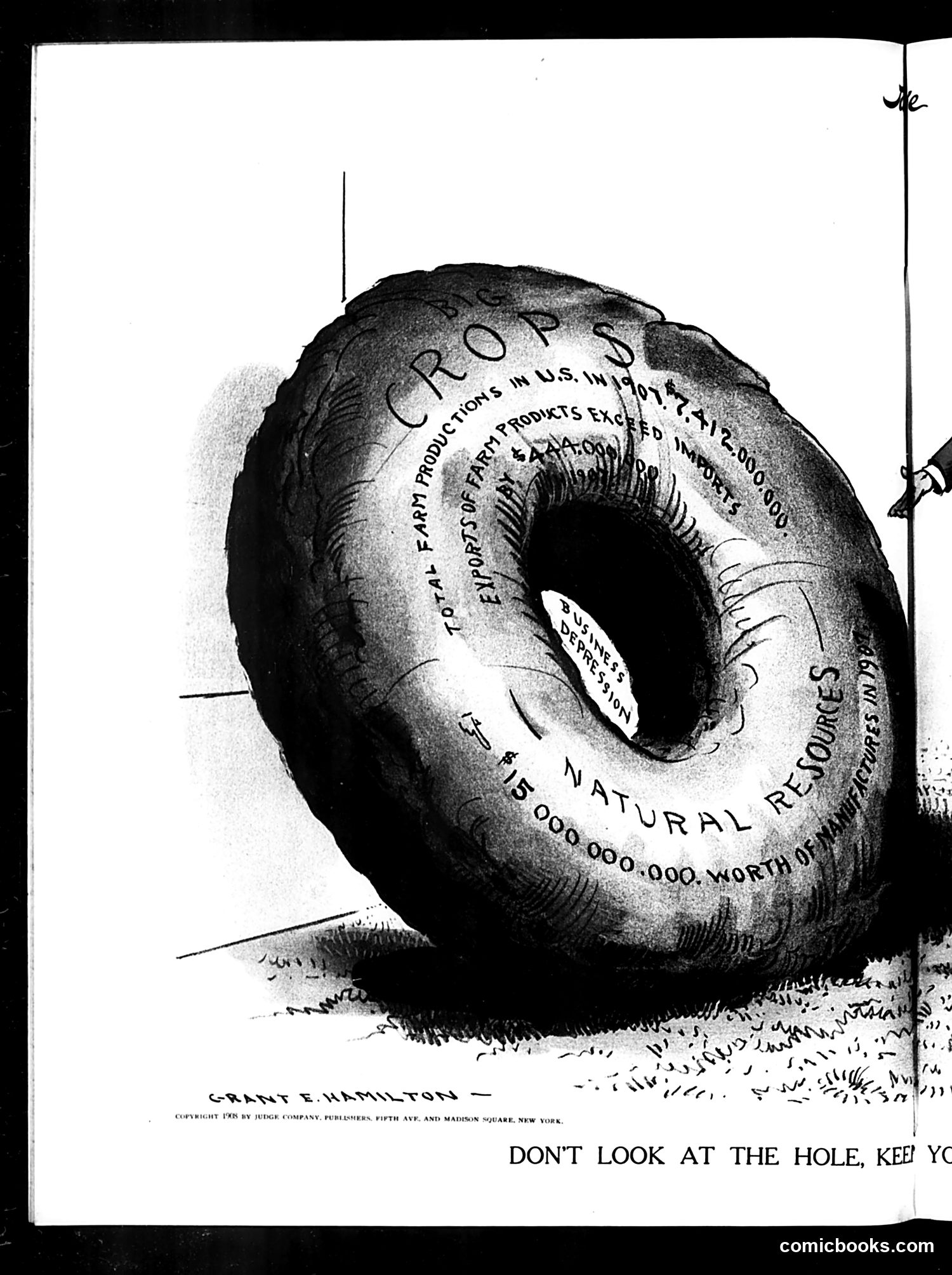
This 1908 Judge magazine cartoon depicts a massive donut labeled "CROPS" with text referencing "TOTAL FARM PRODUCTIONS IN U.S. IN 1907" and "EXPORTS EXCEEDED IMPORTS." The donut has a conspicuous hole, labeled "NATURAL RESOURCES" with specific dollar figures ("$15,000,000,000 WORTH OF CROPS"). The satire critiques American agricultural abundance and exports during the early 1900s, likely commenting on either wasteful farming practices or the gap between produced crops and actual profit/resources. The caption "DON'T LOOK AT THE HOLE" suggests the cartoonist wants viewers to ignore the deficit or loss—implying politicians or agricultural interests were deliberately obscuring economic problems beneath statistics about productivity. Artist: Grant E. Hamilton (credited at bottom).
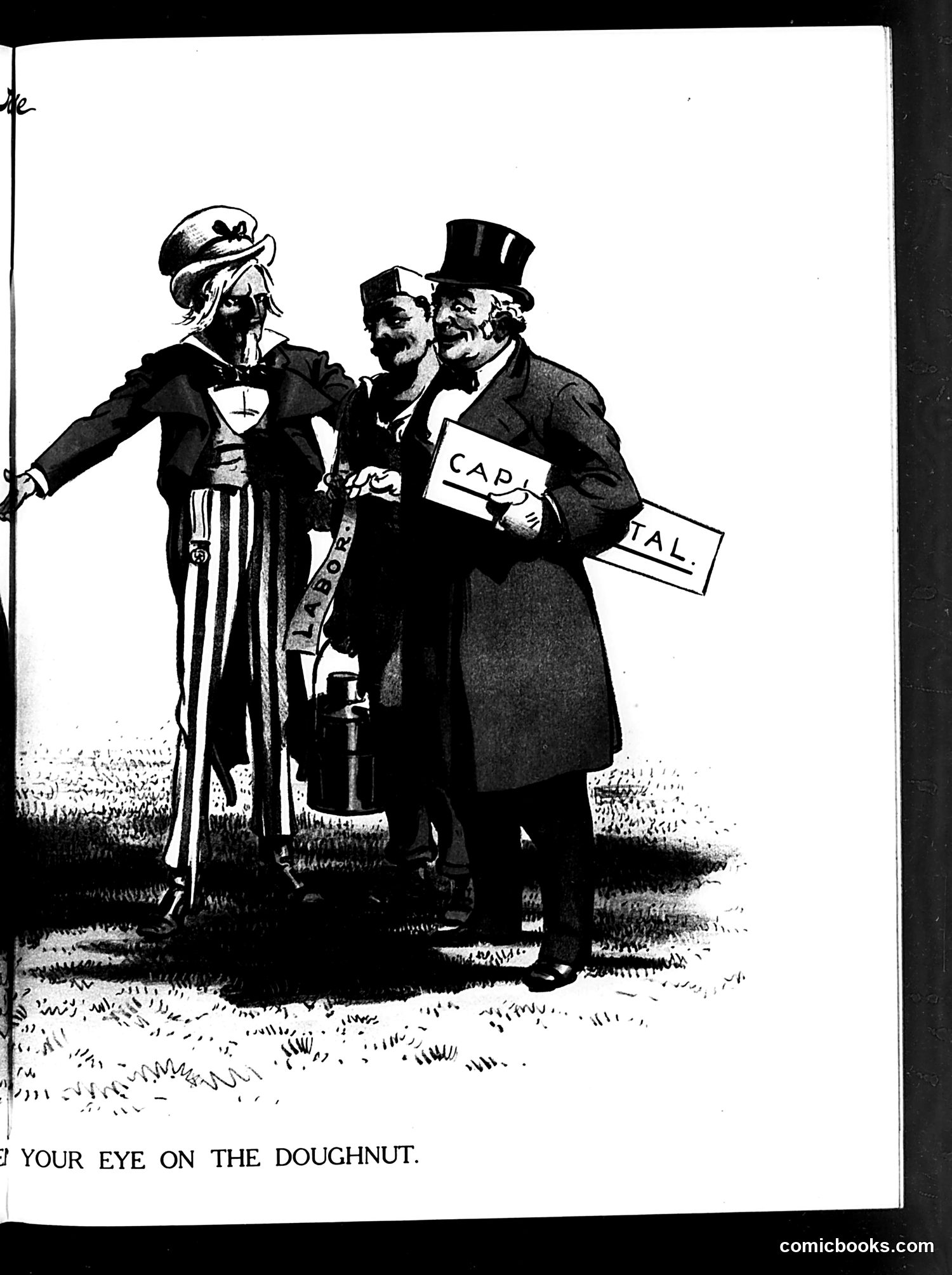
This Judge magazine cartoon satirizes American political and business figures regarding "Capital." The image shows Lady Liberty (left, in patriotic dress) confronted by two wealthy gentlemen in top hats—likely representing capitalists or politicians. One holds a sign reading "CAPITAL," suggesting the cartoon critiques how capital/wealth is being concentrated or manipulated. The caption "Keep Your Eye on the Doughnut" is a period idiom meaning "don't be distracted from what matters"—here implying Americans should watch how capital is being handled by the powerful, rather than being distracted by superficial concerns. This reflects late 19th or early 20th-century anxieties about monopolies, financial power, and whether democratic ideals could survive unchecked capitalism. Without a specific date, the exact political figures remain unclear, though the artwork style and themes suggest the Progressive Era.
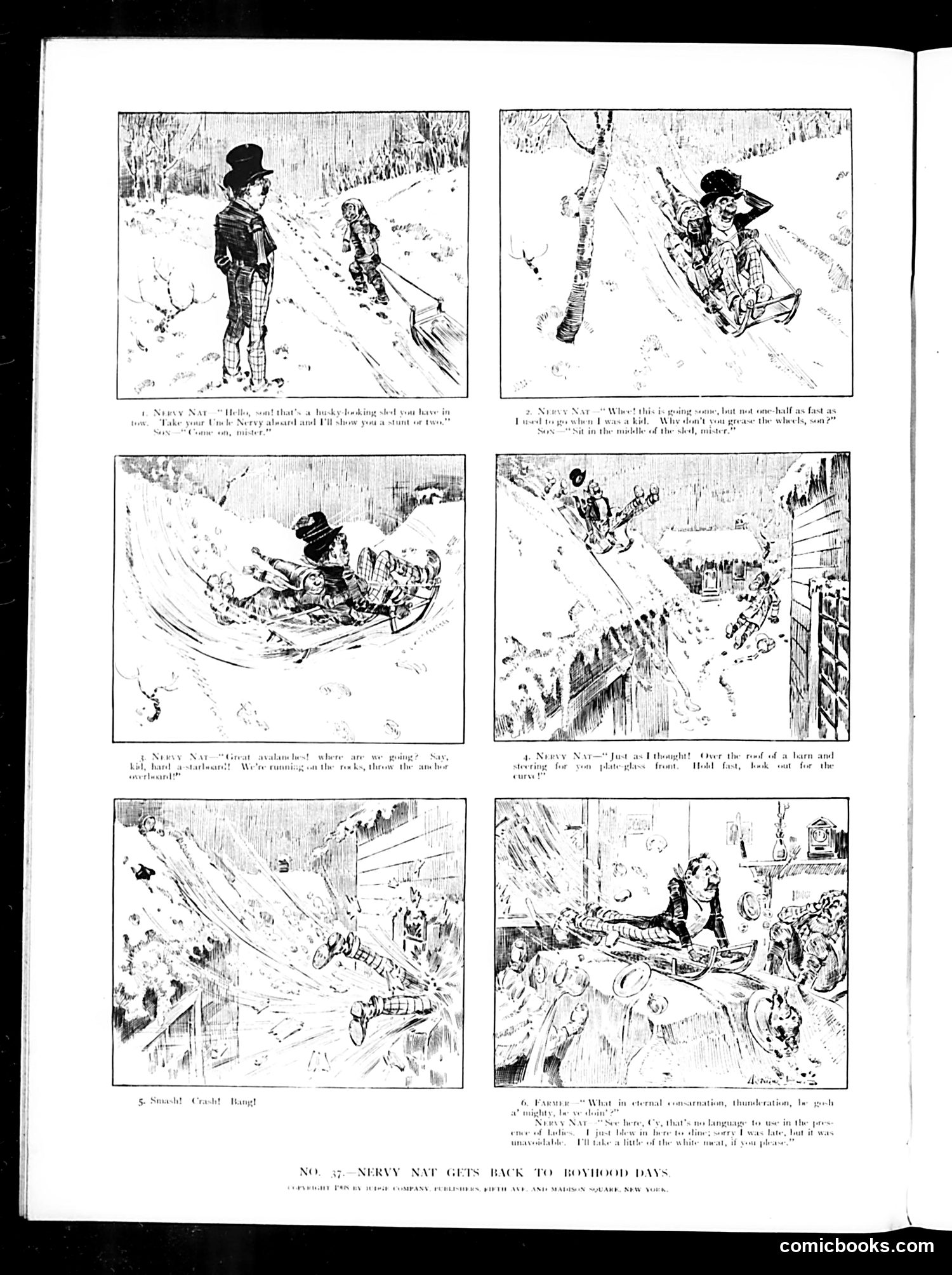
This is a six-panel comic strip following a character named Nervy Nat sledding down a snowy hill. The narrative progression shows: Nat meeting an Uncle who challenges his sledding skills, Nat confidently accepting; racing downhill; losing control ("Great Jerichos!"); crashing into a barn; and finally ending up in the farmer's chicken coop surrounded by angry birds. The satire is straightforward slapstick comedy playing on the contrast between youthful bravado and humiliating failure. "Getting back to boyhood days" ironically means Nat reverts to childlike overconfidence, resulting in disaster. The humor relies on visual comedy—the escalating chaos and undignified ending in the chicken coop—typical of early 20th-century American comic strip conventions in *Judge* magazine.
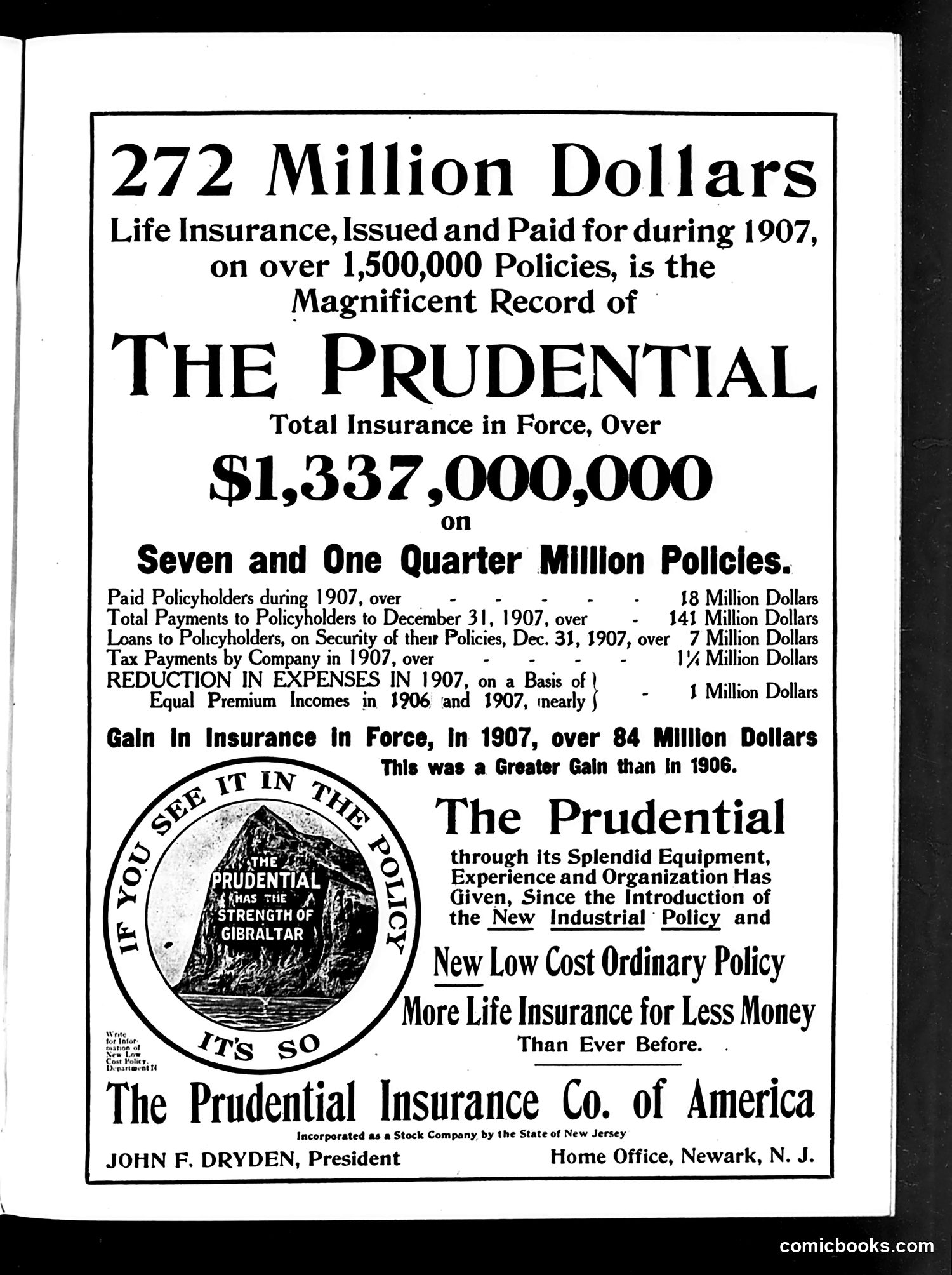
This is primarily a full-page advertisement for The Prudential Insurance Company, not satirical content. The page showcases the company's 1907 financial performance—$272 million in life insurance issued, $1.3 billion total in force, and substantial payments to policyholders. The only visual element is The Prudential's logo: a circular seal depicting Gibraltar with the text "If You See It In the Poultry It's So," playing on Gibraltar's reputation for strength and permanence as a metaphor for the company's stability. The advertisement emphasizes new affordable insurance products—"New Industrial Policy" and "Low Cost Ordinary Policy"—positioning Prudential as offering "More Life Insurance for Less Money Than Ever Before." This reflects early 20th-century expansion of life insurance into working-class markets. No satire or political commentary is evident; this is straightforward corporate marketing claiming financial strength and consumer value.
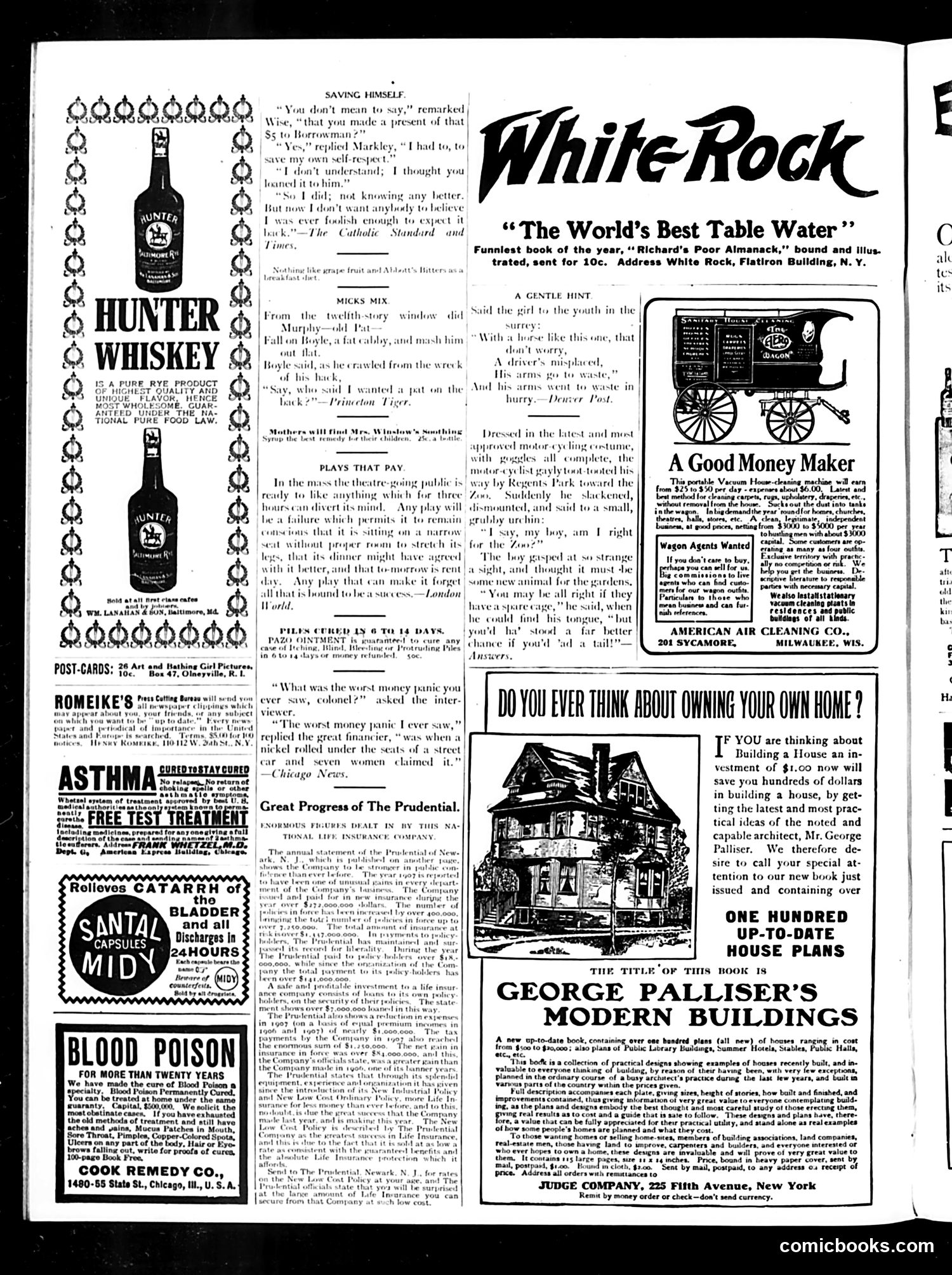
This page is primarily **advertising** rather than editorial satire. The dominant features include: - **Hunter Whiskey** ad (left column): Period liquor advertisement emphasizing "pure, fine" product with ornamental border design - **White Rock water** ad (top right): Claims "The World's Best Table Water" with illustration of a vendor wagon - **George Palliser's Modern Buildings** (center-right): Book advertisement offering "one hundred up-to-date house plans" - Various smaller medical/remedy ads (Asthma treatment, blood poison cure, etc.) The few humorous items are brief jokes and anecdotes scattered throughout—typical of Judge magazine's format mixing satire with advertising. There are **no significant political cartoons** on this page. The content reflects early 20th-century consumer culture and advertising practices.
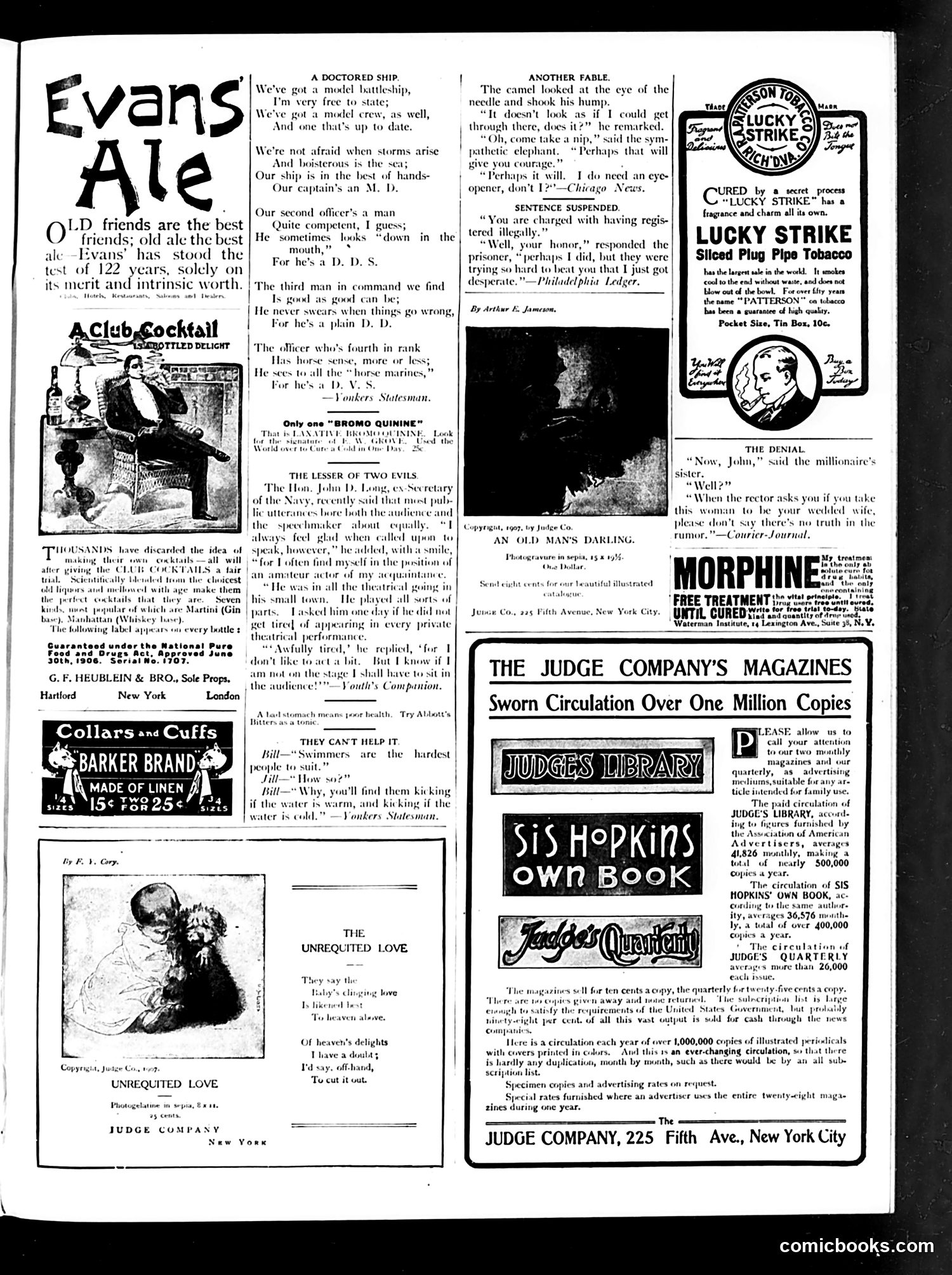
This page is primarily **advertising and promotional content** for Judge Company publications, with minor satirical sketches interspersed. The small cartoons include occupational humor: "A Doctored Ship" jokes that a ship's officers are all dentists (D.D.S.) and veterinarians (D.V.S.)—punning on their abbreviations. "The Lesser of Two Evils" presents ex-Navy Secretary John D. Long discussing public speaking anxiety. "Another Fable" offers a camel-and-needle joke about impossibility. The page's main purpose is promoting **Judge's magazine line**, boasting "Sworn Circulation Over One Million Copies." It advertises *Judge's Library*, *Sis Hopkins' Own Book*, and *Judge's Quarterly*, emphasizing their reach and affordability (ten cents per copy). Interspersed are period product advertisements (Evans Ale, Lucky Strike tobacco, morphine treatment, Barker Brand collars)—typical for early 20th-century magazines. The satirical content is secondary to the publication's self-promotion.
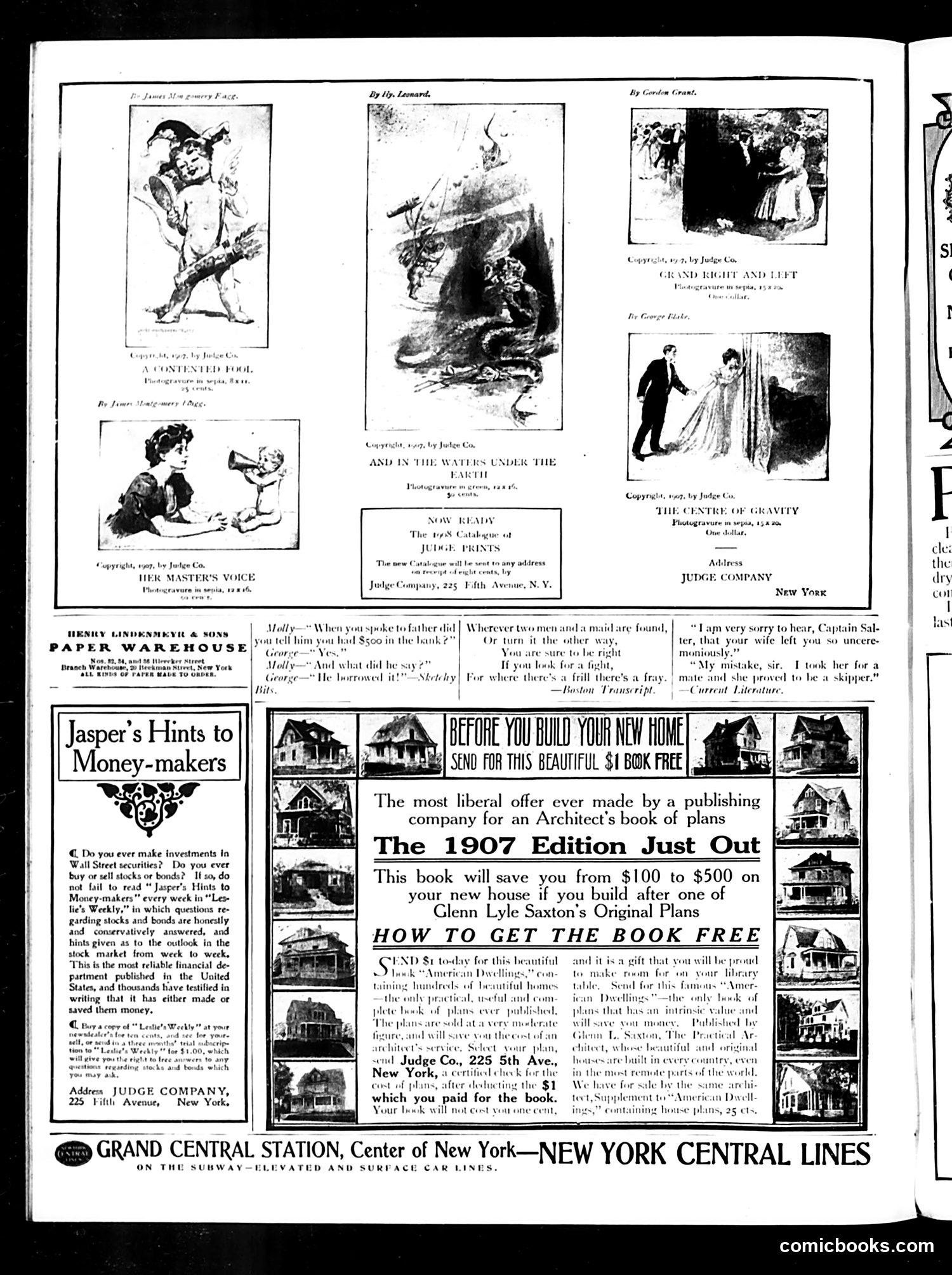
This page primarily consists of **advertisements** rather than editorial cartoons, though it includes several small illustrated pieces at the top. The top section shows what appear to be theatrical or literary illustrations by various artists (Leonard, Grant, Crask, Elate), with titles like "A Contented Fool" and "And in the Waters Under the Earth"—likely promoting Judge's print catalog. A humor section includes brief joke exchanges (notably one about borrowing money) that reflect period comedy conventions. The dominant content is **advertising**: A large promotion for Glenn Lyle Saxton's 1907 house-plan book offers it free to readers who send $1 (later deducted), claiming it saves $100-$500 on construction. Below this is "Jasper's Hints to Money-makers," promoting financial advice from Leslie's Weekly about stock market investments. The page reflects early 1900s consumer culture—emphasizing practical self-improvement, home ownership, and financial literacy as accessible to middle-class readers. The Grand Central Station ad at bottom promotes New York Central Lines' transit infrastructure.
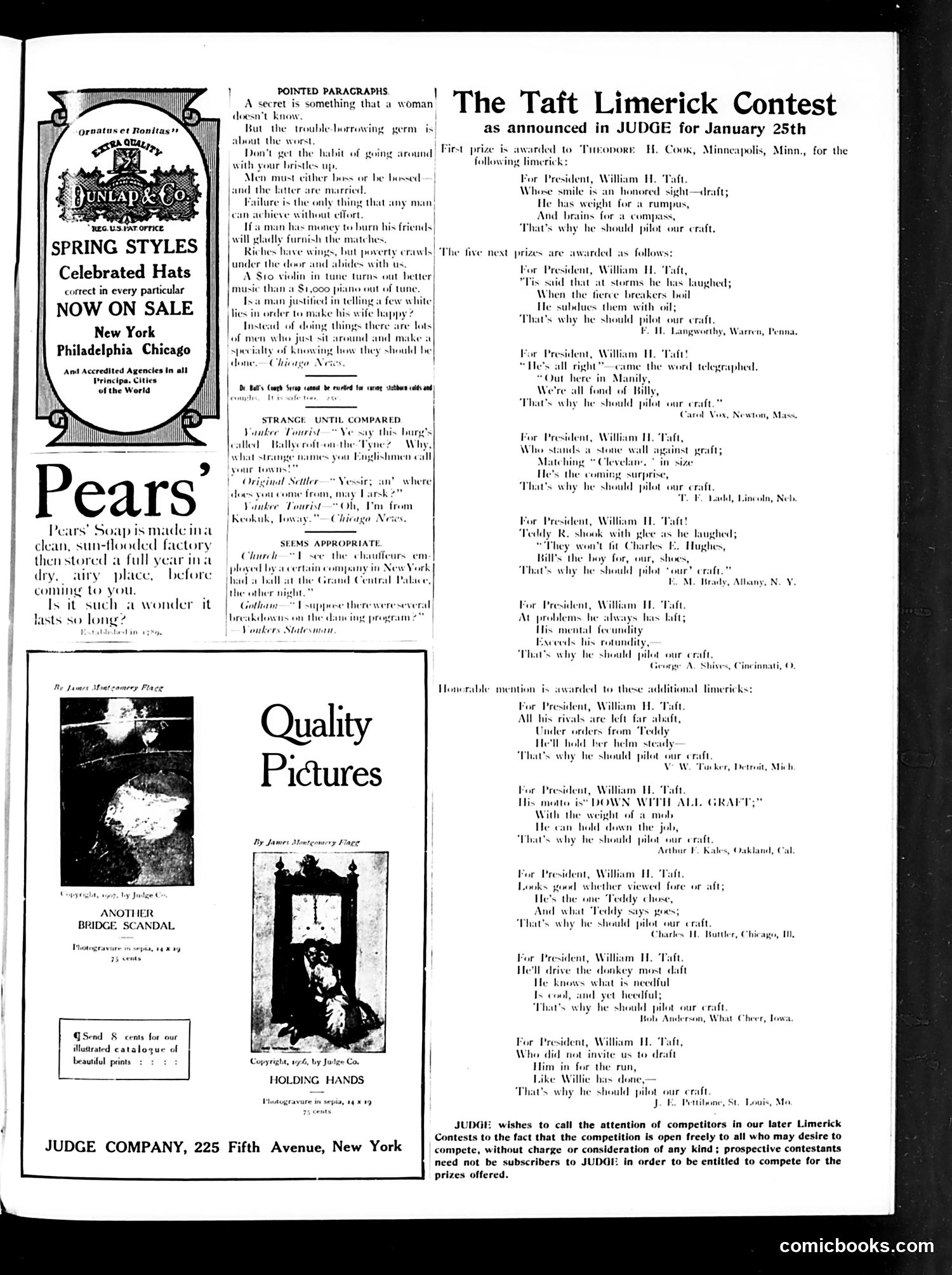
This page announces Judge magazine's limerick competition celebrating President William H. Taft. The contest invites readers to submit humorous five-line poems about Taft, with prize winners published here. The limericks employ lighthearted political humor typical of early 1900s satire. Common themes include Taft's physical weight (referenced as "rumpus," "weight of a mob"), his stability as a leader ("stone wall," "helm steady"), and his role as Theodore Roosevelt's chosen successor ("what Teddy chose"). The contest itself reflects Taft's popularity among Judge's readership at this moment. The repeated refrain "That's why he should pilot our craft" plays on nautical metaphors, positioning the president as a skilled captain steering the nation. This was evidently a celebratory, populist engagement rather than satirical critique.
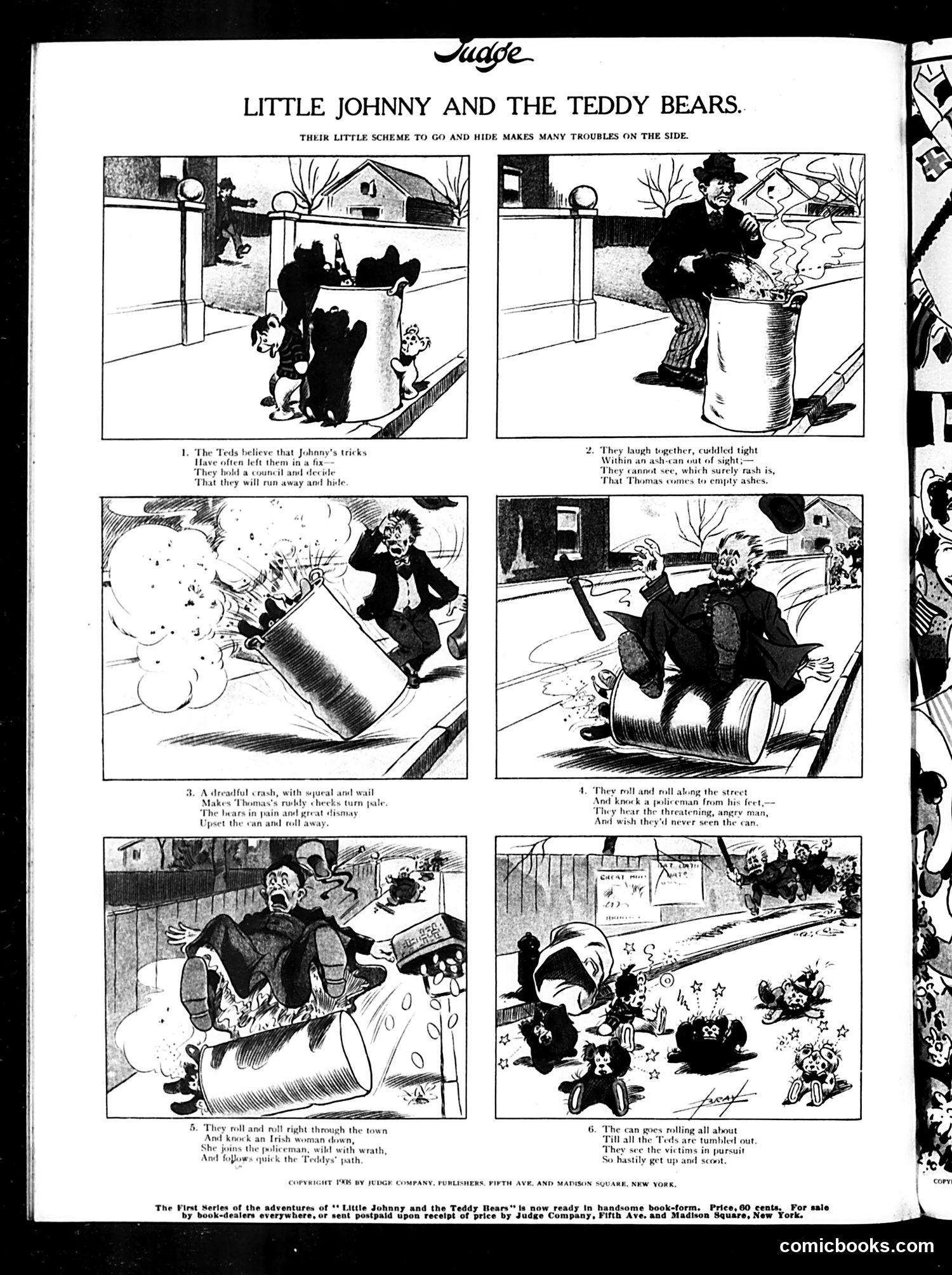
This is a humorous comic strip titled "Little Johnny and the Teddy Bears," likely referencing President Theodore Roosevelt, whose nickname was "Teddy" and who was associated with teddy bears (following a famous 1902 hunting incident). The strip depicts Johnny's scheme to hide with the teddy bears, which backfires spectacularly—the bears cause chaos throughout town: they tip over an ash can, knock down a policeman, roll through streets causing mayhem, and scatter everywhere. The satire appears to mock how Roosevelt's policies or political maneuvers, though perhaps well-intentioned ("hiding" or avoiding trouble), create unintended public disruption and disorder. The strip is essentially political commentary using child's play as metaphor—suggesting that attempts to hide problems or manipulate situations result in widespread chaos and public embarrassment rather than orderly solutions.