
A complete issue · 16 pages · 1908
Judge — January 25, 1908
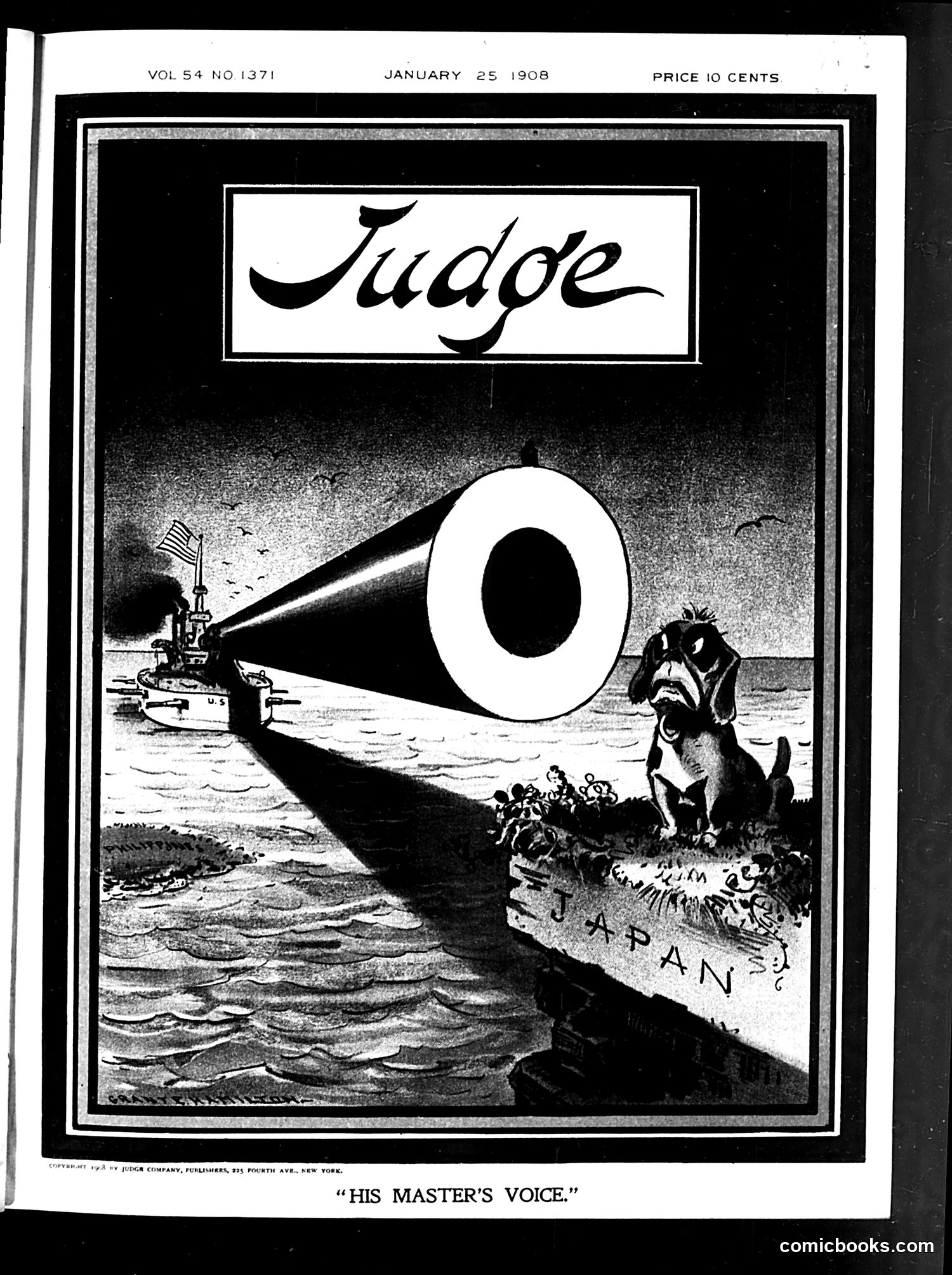
**Date:** January 25, 1908 | **Issue:** Vol 54, No 1371 This cover satirizes American naval power and its global reach. A massive naval gun (labeled "U.S.") aims directly at "JAPAN," depicted as a fearful dog cowering on shore. The weapon's enormous barrel dominates the composition, emphasizing American military superiority. The satire references rising tensions with Japan in the early 1900s—a period when the U.S. Navy was expanding and Japan was emerging as a Pacific power. The caption "His Master's Voice" invokes the famous RCA trademark (featuring a dog), suggesting America controls Japan through military might. The cartoon reflects American confidence in naval dominance during the pre-World War I era, when the Great White Fleet had recently completed its world tour (1907-1909), intended partly to impress Japan.
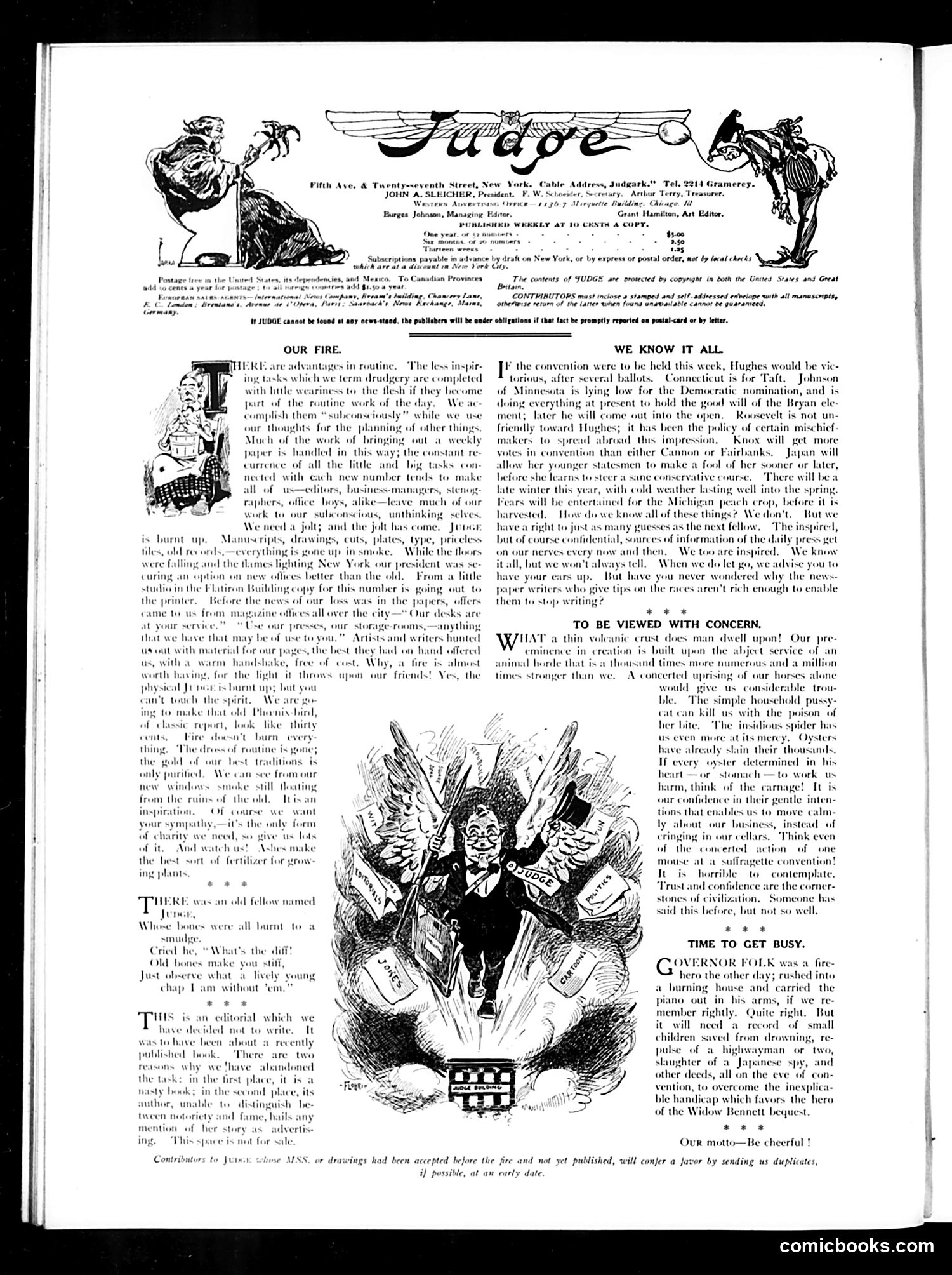
This appears to be an editorial page from Judge magazine featuring several satirical pieces. The main central illustration shows a figure surrounded by what appear to be newspapers or publications, suggesting commentary on press coverage or public information dissemination. The articles—"Our Fire," "We Know It All," "To Be Viewed With Concern," and "Time to Get Busy"—discuss topics including fire safety, volcanic eruptions, and Governor Folk's heroic actions. The "Governor Folk" reference suggests this dates to the early 1900s when Joseph W. Folk was a notable political figure. The satirical tone critiques various social issues: journalistic practices, public confidence in institutions, and civic leadership. However, without clearer image resolution or specific date information, precise political context remains unclear.
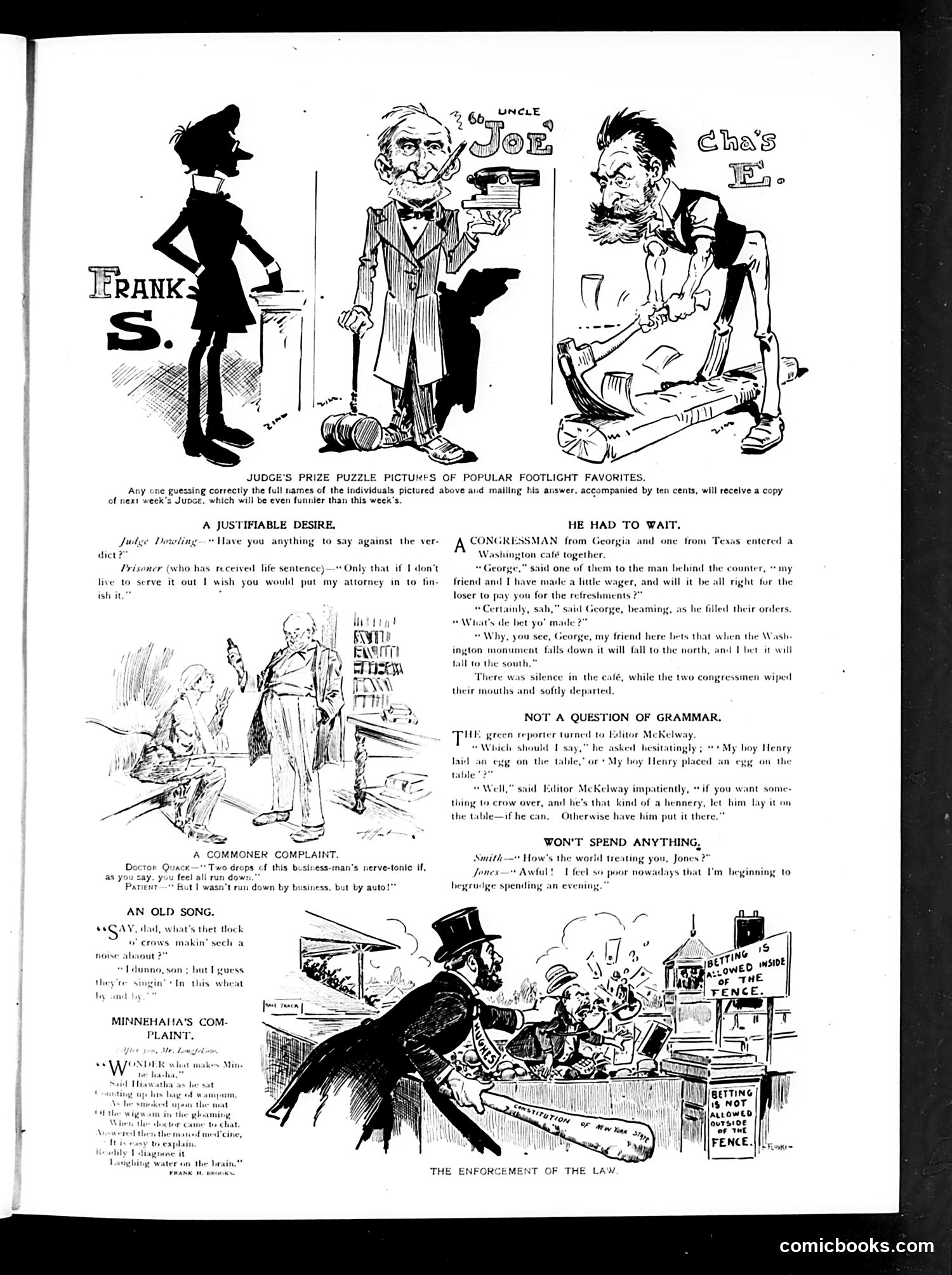
This page contains multiple short humorous pieces typical of Judge's satirical format. The top section features "Judge's Prize Puzzle" - caricatures of popular figures labeled "Franks S.," "Uncle Joe," and "Cha's E." (identities unclear from visual alone). Below are several brief comedic sketches: "A Justifiable Desire" (about a prisoner and judge), "He Had to Wait" (two congressmen betting on a Washington monument collapse), and "A Commoner's Complaint" (about nerve-tone). The largest cartoon, "The Enforcement of the Law," depicts what appears to be a wealthy gentleman in a top hat near signs advertising betting operations, apparently mocking inconsistent law enforcement regarding gambling establishments. The overall theme suggests satire about legal hypocrisy and selective prosecution during the Progressive Era.
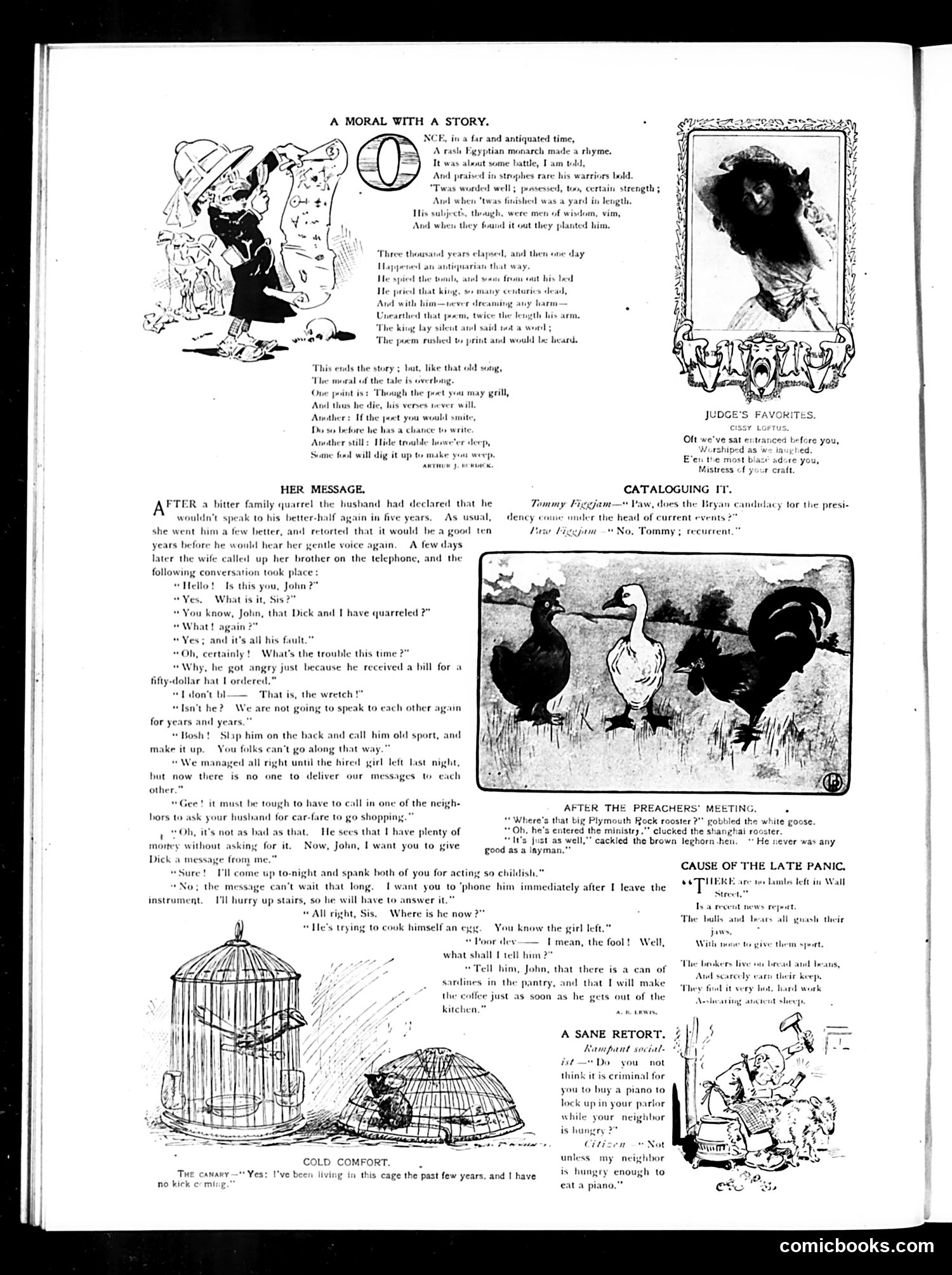
This Judge magazine page contains humor pieces and illustrations without clear political cartoons requiring historical context. **"A Moral with a Story"** presents a whimsical tale about an Egyptian monarch, illustrated with a figure in Egyptian dress—typical of Judge's lighthearted fiction. **"Her Message"** depicts a domestic quarrel where a husband and wife reconcile through a telephone conversation, a contemporary scenario reflecting early 20th-century technology. **"After the Preachers' Meeting"** shows geese discussing a rock, likely satirizing clerical gossip. The remaining pieces—"Judge's Favorites," "Cataloguing It," "Cause of the Late Panic," and "A Sane Retort"—are brief humorous anecdotes without apparent political content. Overall, this page emphasizes general domestic and social humor rather than partisan satire or topical commentary requiring historical knowledge to decode.
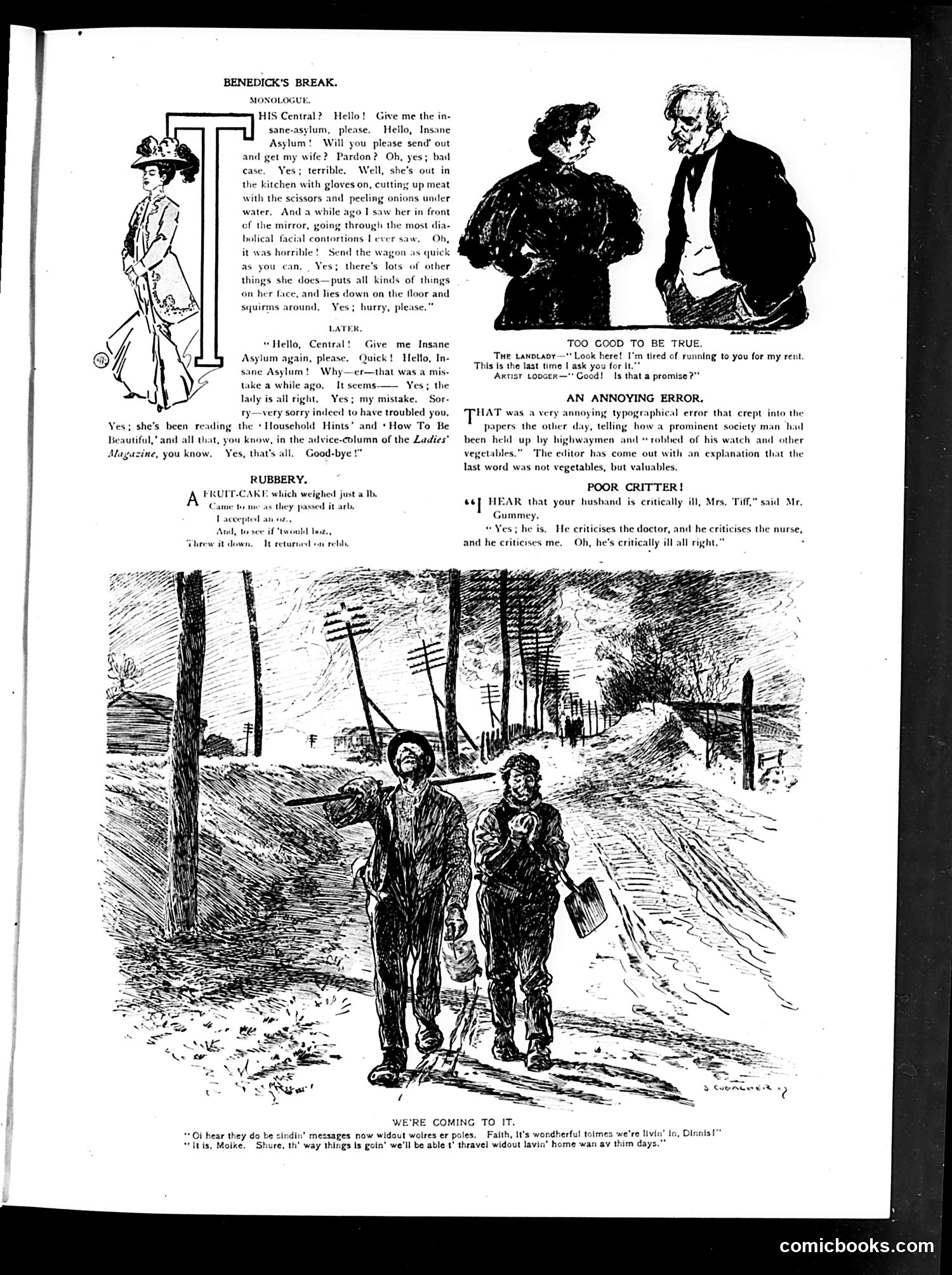
This page from *Judge* magazine contains several brief humorous pieces satirizing early 20th-century urban life: **"Monologue"** mocks a Central Exchange operator fielding complaints about a wife at an insane asylum who's causing domestic chaos. **"Too Good to Be True"** depicts a landlady pressuring an artist tenant for overdue rent. **"An Annoying Error"** satirizes a newspaper's embarrassing typo claiming a "prominent society man" was held up by "highwaymen and robbed on his vegetables" instead of "valuables." **"Poor Critter"** jokes about a husband being critically ill. **"We're Coming to It"** features two working-class men discussing optimism despite hardship—reflecting Depression-era sentiment about better times ahead. The cartoons use sharp, satirical dialogue typical of *Judge's* social commentary on everyday middle and working-class frustrations.
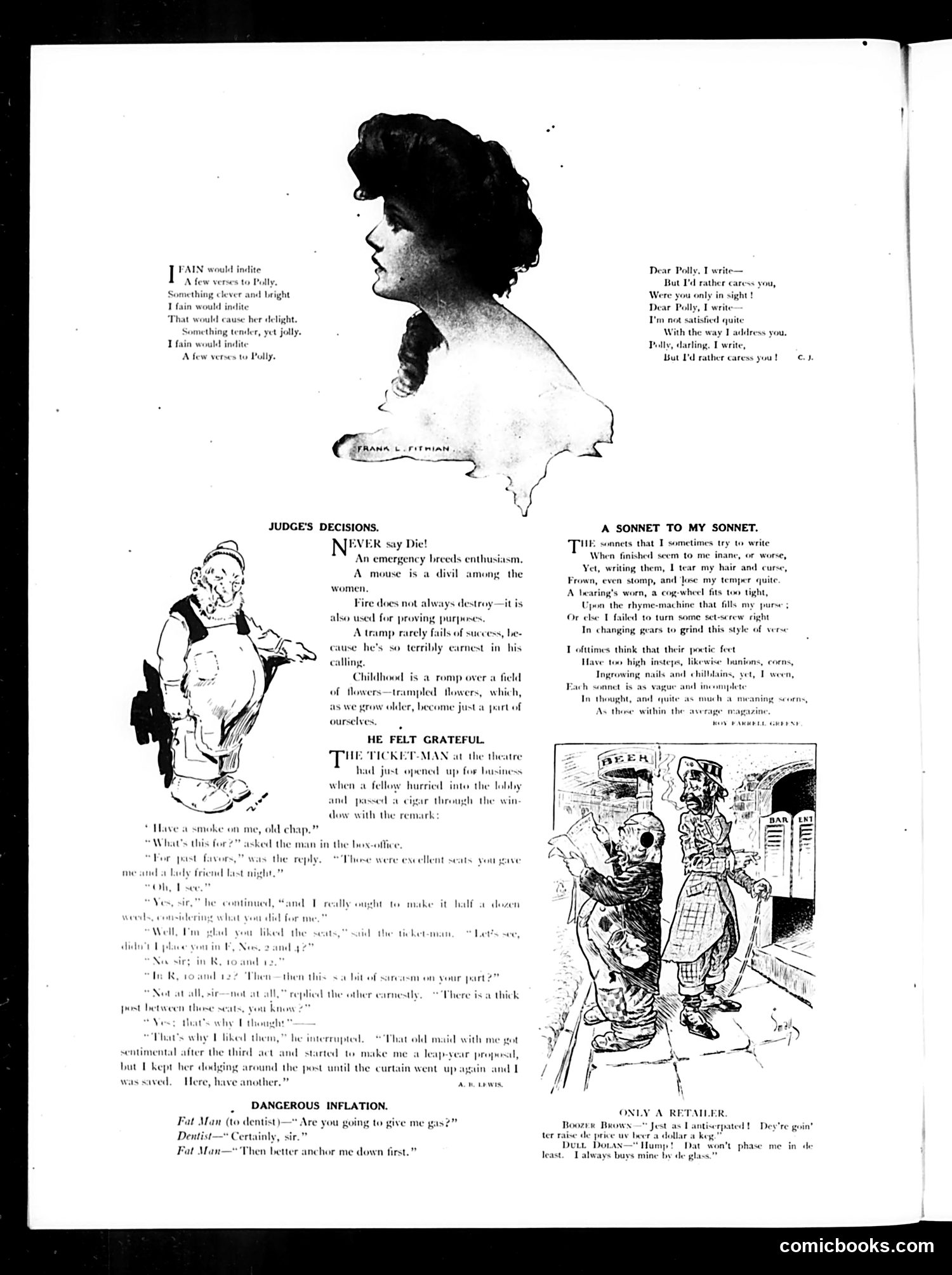
This page contains several short humorous pieces typical of early 20th-century satirical journalism: **"He Felt Grateful"** mocks theater etiquette through a ticket seller's story. A man tips the usher with a cigar, claiming excellent seats were provided. The punchline reveals the usher deliberately seated him next to an obstructing post to separate him from an annoying elderly woman—making the "service" accidentally beneficial. **"Judge's Decisions"** offers brief aphorisms on life (childhood, ambition, mice as problems for women), typical of the magazine's moralizing humor. **"Dangerous Inflation"** satirizes rising costs. A dentist's gas anesthesia fee concerns a portly patient, who jokes he needs anchoring down instead—suggesting both weight and inflation anxiety. **"Only a Retailer"** shows a drunk man unconcerned about beer price increases since he buys by the glass rather than in bulk, missing economic reality. The verso portrait and love poems appear to be romantic content, possibly featuring a notable woman ("Polly") of the era, though the subject is unclear from this excerpt.
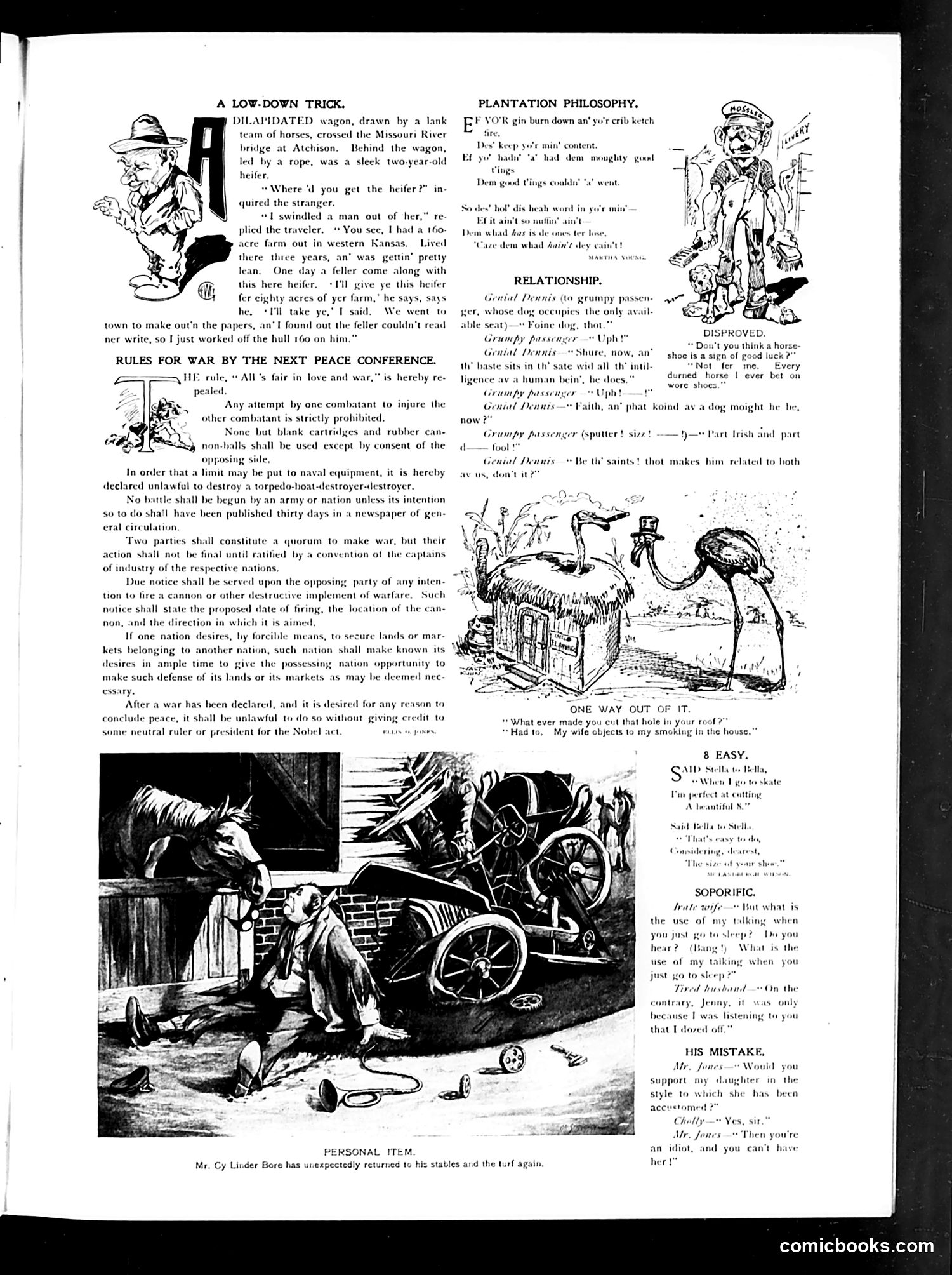
This page from *Judge* contains multiple satirical pieces typical of the magazine's humor: **"A Low-Down Trick"** (top left): A traveler brags about swindling a Kansas farmer out of 160 acres by trading a heifer for the land, then exploiting the farmer's illiteracy during the paperwork. The satire targets agricultural gullibility and frontier dishonesty. **"Rules for War by the Next Peace Conference"** (center): Mock regulations proposing absurdly bureaucratic constraints on warfare—requiring 30 days' notice, "captains of industry" ratification, and neutral mediator credit for peace. This satirizes the optimistic but impractical peace conferences following WWI, suggesting that even well-intentioned rules can't realistically govern war. **"Plantation Philosophy"** (right): Dialect humor from an African American character offering folk wisdom about hardship and fate—typical of the era's often-demeaning racial comedy. **Bottom section**: Various brief jokes about marriage, horses, and relationships. The page reflects early 20th-century satirical style: targeting political naivety, agricultural/frontier culture, and domestic life through exaggeration and dialect humor.
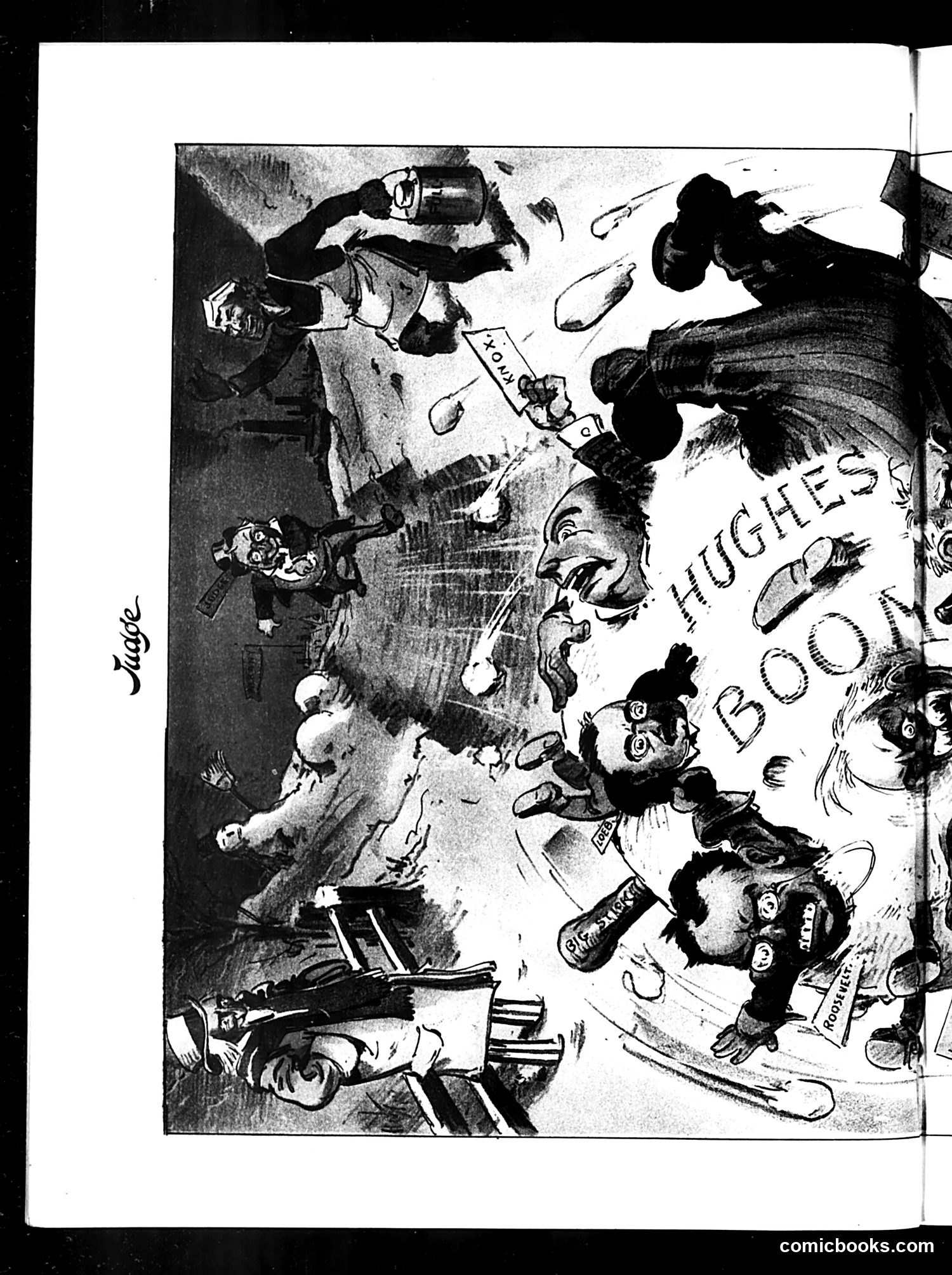
This appears to be a satirical cartoon from *Judge* magazine depicting a chaotic scene labeled "BOOHGIES" (likely a play on "booze" or "boogie"). The cartoon shows multiple caricatured figures in exaggerated poses, seemingly intoxicated or in disarray, with bottles visible. The style and content suggest this is commentary on Prohibition-era excess or the social consequences of illegal drinking during that period. The figures appear to be caricatures of notable individuals or types, rendered in the sharp, mocking style typical of *Judge's* political satire. Without clearer identification markers, I cannot definitively name specific figures, but the overall message appears to criticize either bootleggers, speakeasy culture, or the hypocrisy of those flouting Prohibition laws. The artwork is signed "Juge" (likely the cartoonist's name).
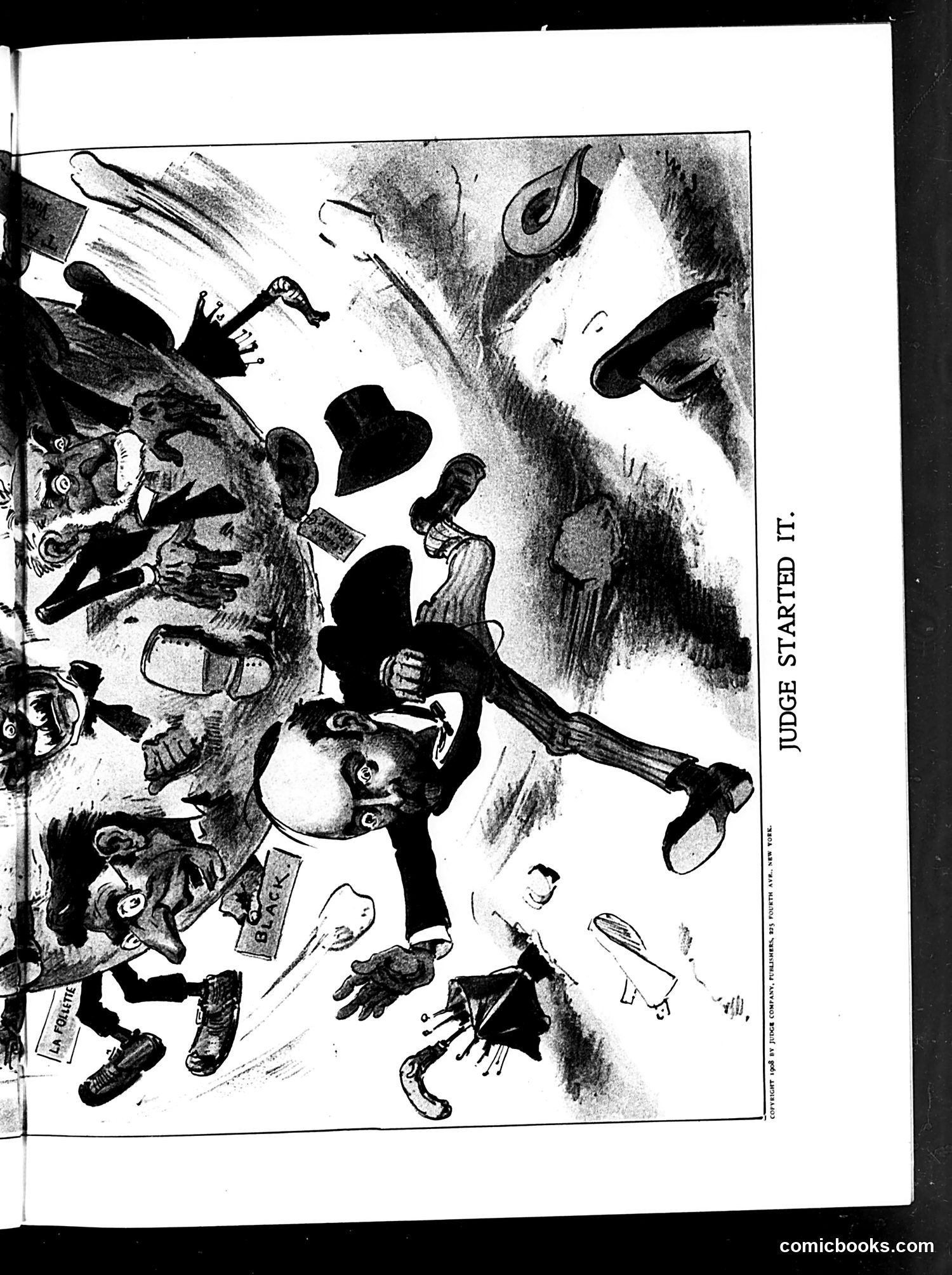
This political cartoon depicts a chaotic courtroom scene with a judge wielding an axe at the center. The title "JUDGE STARTED IT" suggests the cartoon is satirizing the *Judge* magazine itself or a judicial figure's role in initiating conflict. The scattered figures around the judge appear to represent various social or political groups in disarray—some wearing hats, some with money or documents visible—suggesting conflict over wealth, power, or legal authority. The visual chaos and the judge's aggressive posture with the axe indicate criticism of judicial overreach or blame-shifting. Without clearer OCR text or date information, the specific political context remains unclear, but the cartoon appears to critique either *Judge* magazine's editorial stance or a real judge's controversial actions that sparked broader societal turmoil. The satirical point seems to be ironic assignment of blame to the authority figure.
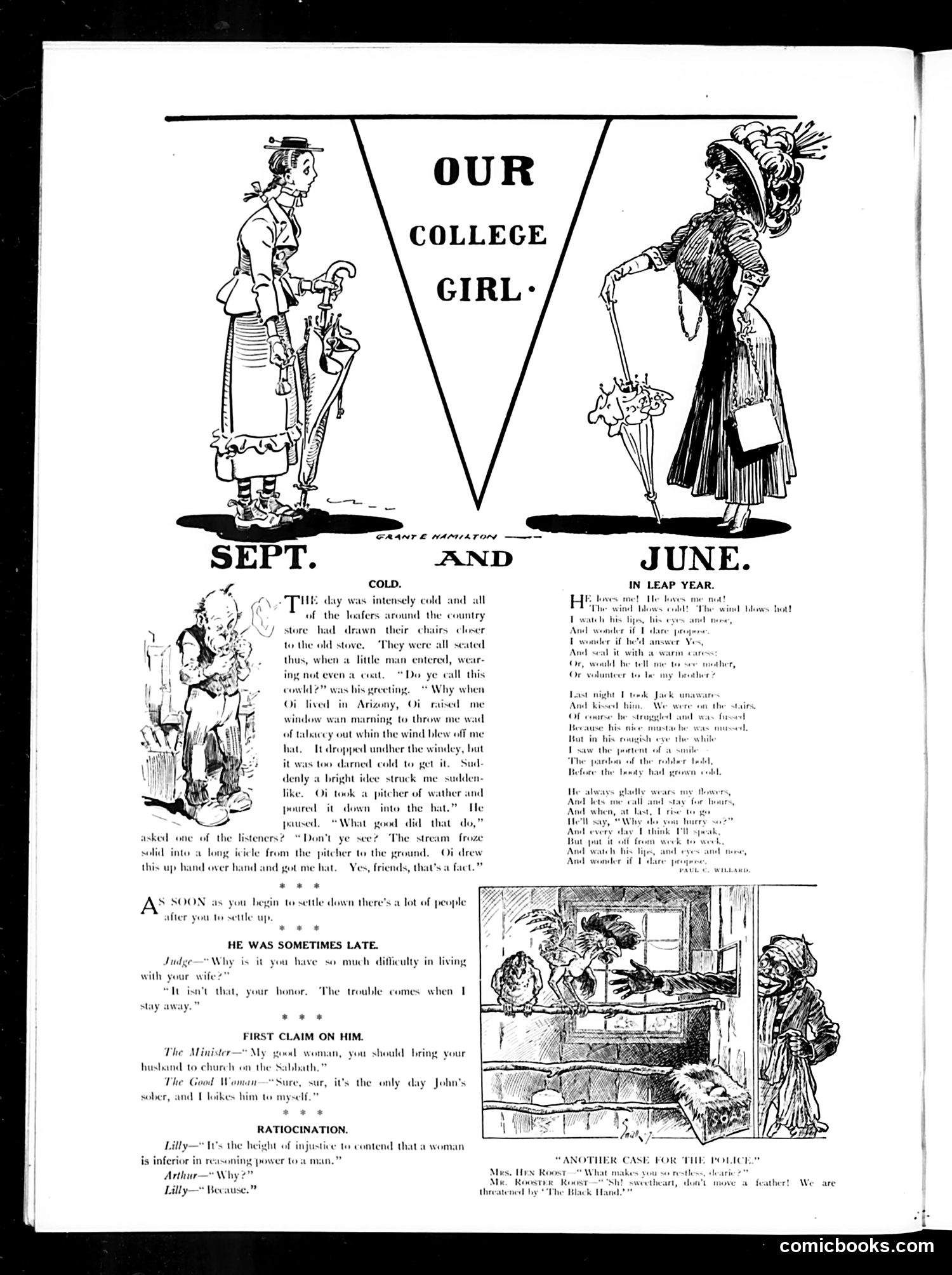
This page from *Judge* magazine presents satirical vignettes about courtship and marriage, common themes in early 20th-century humor. **"Our College Girl"** contrasts September (arrival at college, practical and industrious) with June (departure, romantic and sentimental). The accompanying poem mocks female sentimentality during "leap year"—when tradition allowed women to propose to men—showing a college girl obsessing over a boy's every gesture. **Below** are brief jokes mocking married life: husbands who disappear ("trouble comes when I stay away"), wives who strategically use church as the only way to keep husbands sober and faithful, and a woman's illogical "reasoning" that simply contradicts her husband. **"Another Case for the Police"** references the "Black Hand," a real extortion gang that terrorized Italian immigrants, used here for domestic comedy—a woman threatening her husband with police involvement. The satire targets women's education, romantic obsession, marital discord, and wives' manipulation tactics—reflecting period anxieties about changing gender roles.
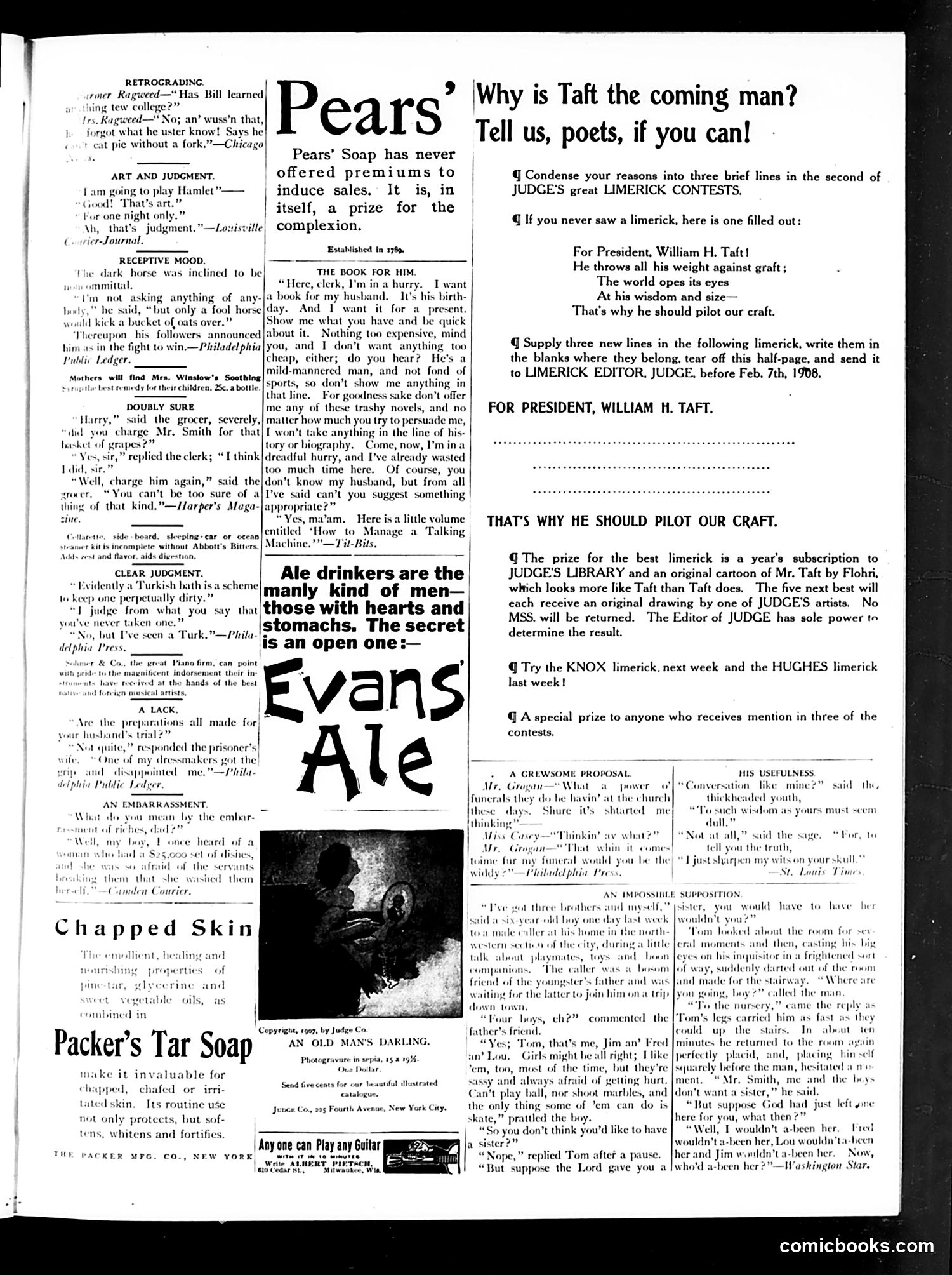
This page from the satirical magazine *Judge* centers on a **limerick contest promoting William H. Taft for president**. The main feature invites readers to complete limericks explaining "Why is Taft the coming man?" The sample limerick praises Taft for fighting graft and emphasizes his physical size and wisdom as qualifications to "pilot our craft" (govern the nation). This references Taft's substantial weight, which was a known characteristic frequently mocked in contemporary satire. The contest deadline of February 7, 1908, confirms this is from early 1908, when Taft was emerging as Theodore Roosevelt's chosen successor for the presidency. The page also contains typical *Judge* content: brief humorous anecdotes and advertisements (Pears' Soap, Packer's Tar Soap, Evans Ale). These unrelated jokes and ads were standard filler in satirical magazines of the era. The overall tone is promotional rather than critical—*Judge* was championing Taft's candidacy through popular engagement.
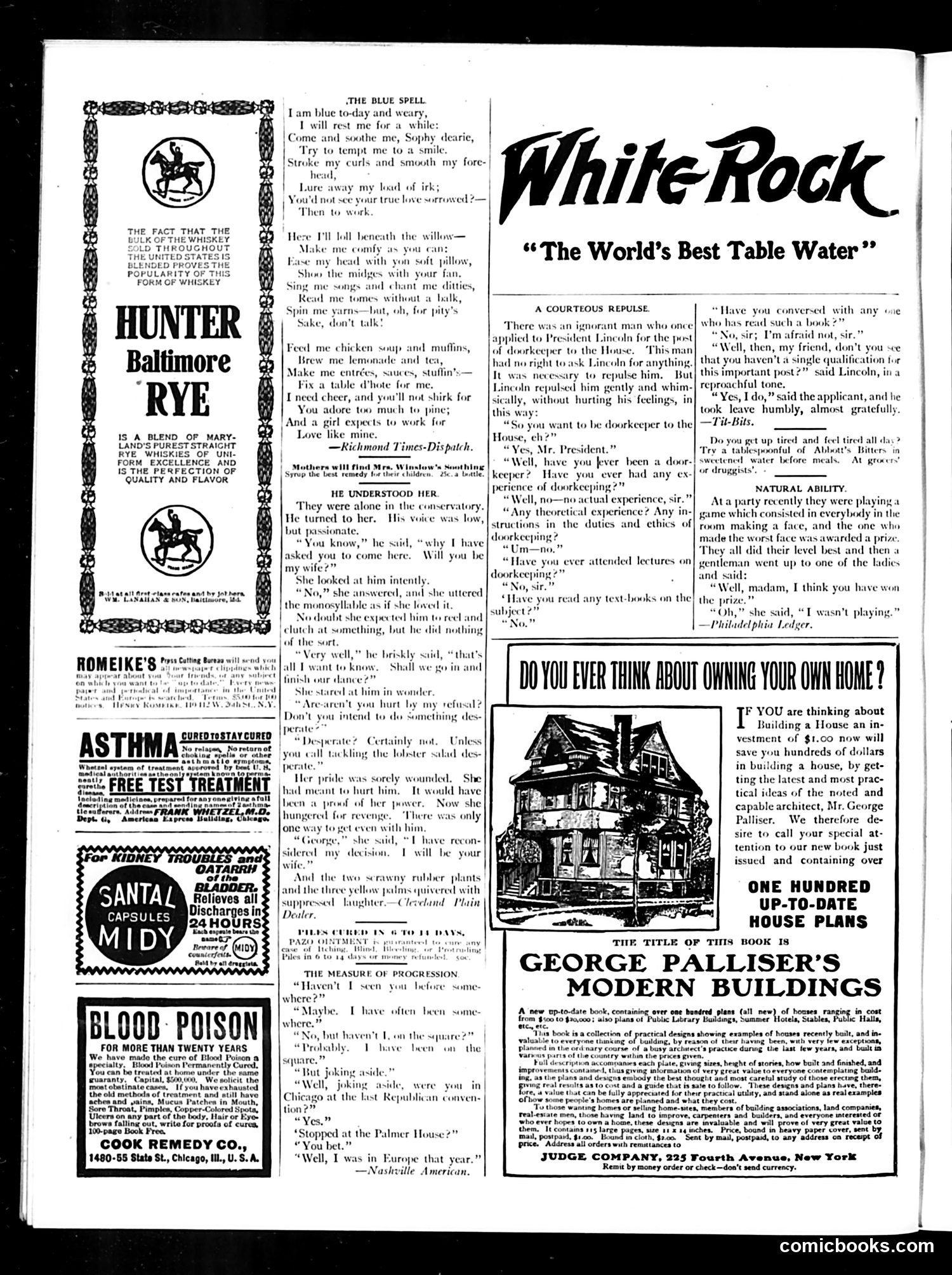
This page contains three distinct elements: **Literary Content:** Two humorous short stories from Judge magazine—"The Blue Spell" (a sentimental poem about a man wanting comfort) and "A Courteous Repulse" (a Lincoln anecdote about an unqualified job applicant). These illustrate period humor and social attitudes. **The Cartoons:** "He Understood Her" depicts a marriage proposal rejection played for laughs—the man calmly accepts dismissal and pivots to finishing their dance, subverting romantic expectations. **Historical Context:** The advertisements (whiskey, asthma treatments, "blood poison" cures) reflect turn-of-the-century patent medicine marketing and social attitudes toward alcohol. The house-plans advertisement represents progressive architectural design marketing. **Point:** Judge presented genteel, middle-class humor mixing sentiment, courtship comedy, and practical advice—reflecting Gilded Age anxieties about courtship, careers, and self-improvement through consumption.
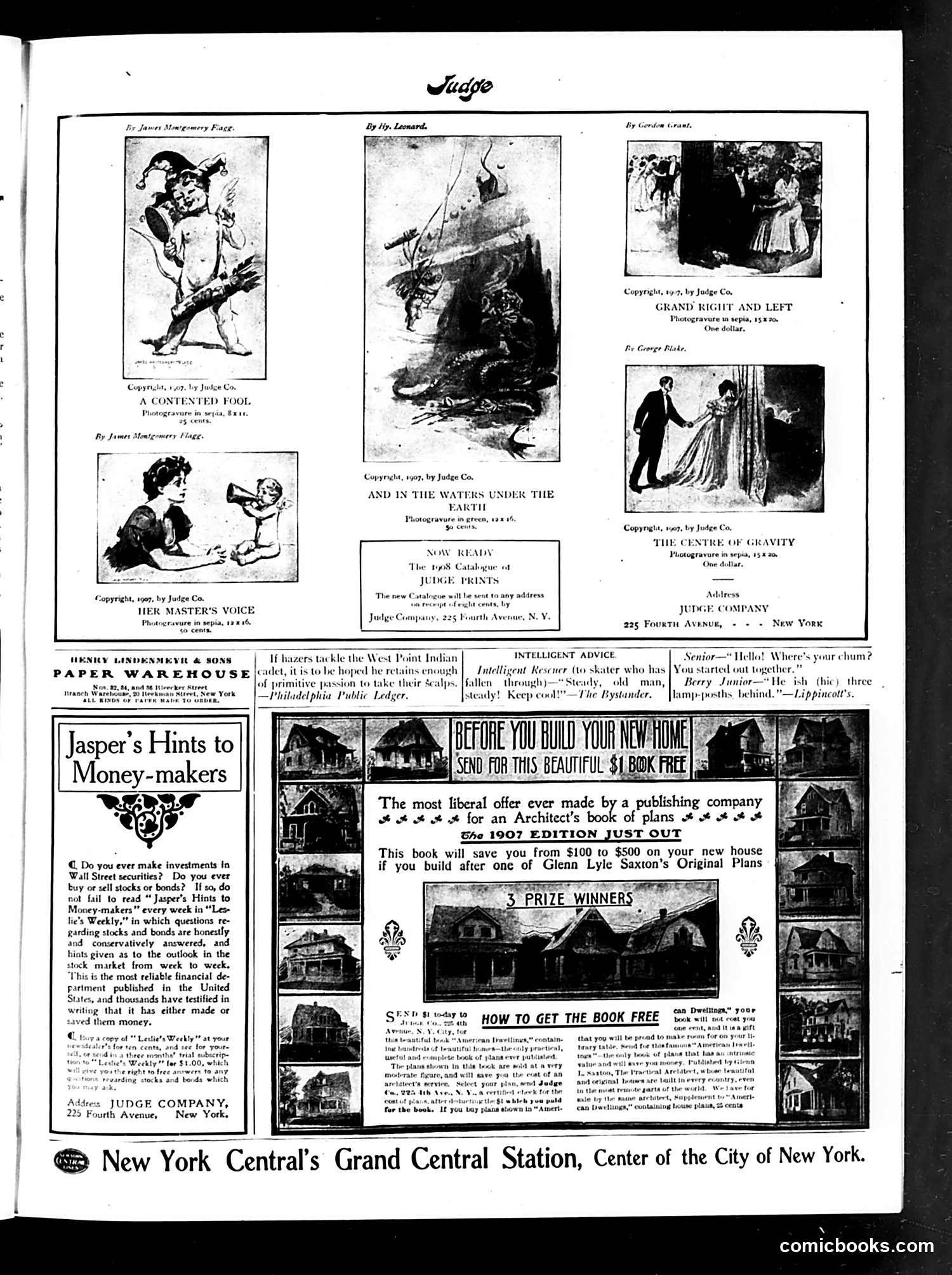
This page is primarily **advertising and promotional content** rather than editorial cartoons, though it includes three small cartoon prints at the top offered for sale (photogravures). The visible cartoons appear to be Judge's typical satirical fare: "A Contented Fool," "And in the Waters Under the Earth," and pieces titled "Grand Right and Left" and "The Centre of Gravity"—though their specific political/social references are unclear from the small reproductions. The bulk of the page comprises **advertisements**: Jasper's investment advice column (promoting stock market tips), a paper warehouse listing, and prominently, a 1907 architectural book offer claiming to save homebuilders $100-$500. There's also a brief "Intelligent Advice" humor section with genteel jokes about social situations. This reflects Judge's dual nature as both satirical magazine and advertising vehicle for educated, wealthy readers interested in investments and home improvement—the magazine's target demographic in the early 1900s.
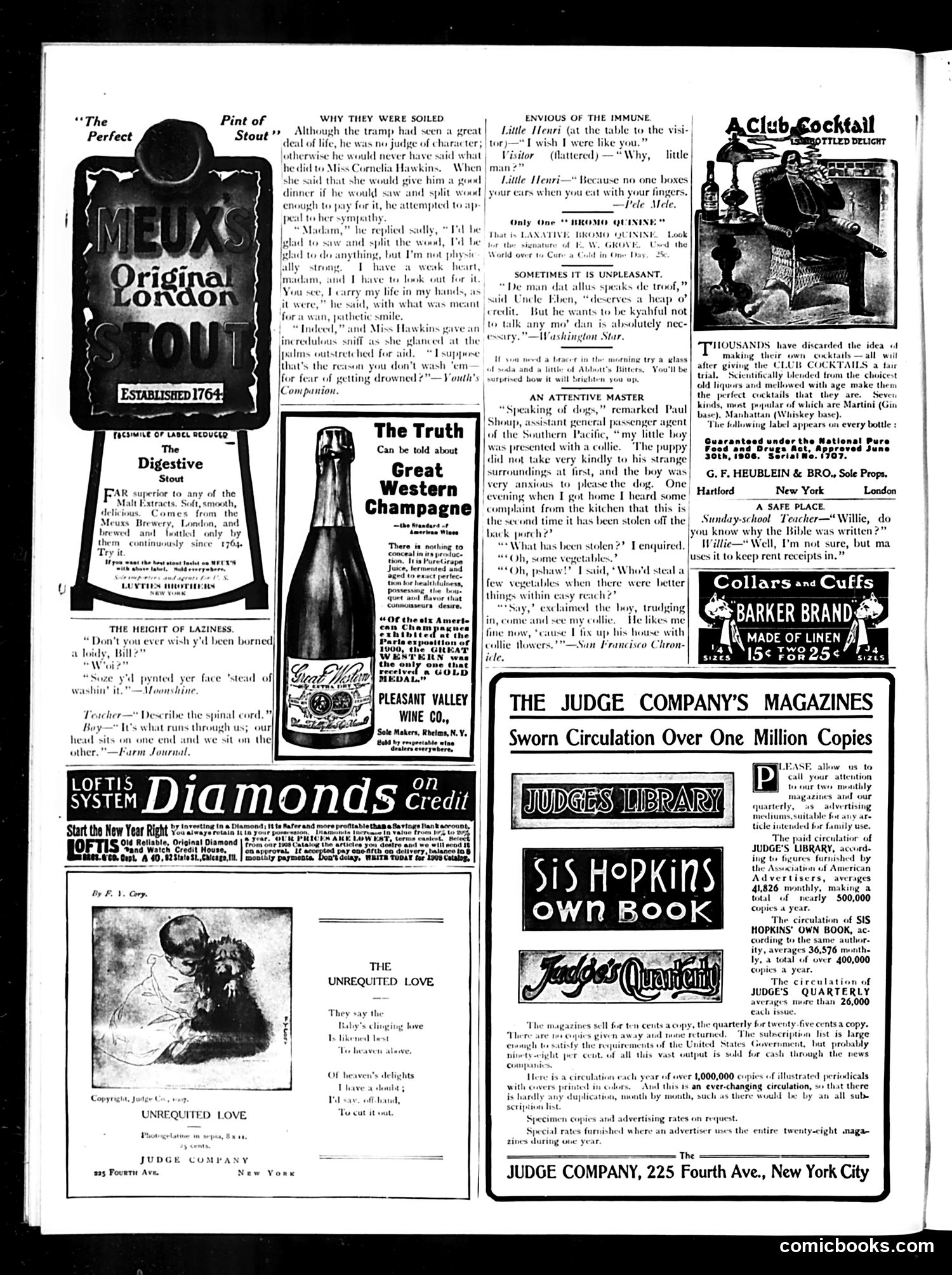
This page is primarily **advertising and promotional material** for Judge Company publications and commercial products from the early 1900s. The small cartoons and jokes scattered throughout are light humor typical of the era: - A lazy laborer refusing yard work, claiming a "weak heart" - A boy assuming wealthy people don't wash their hands - A father pleased his son's dog now steals vegetables to line its bed ("collie flowers")—childish wordplay - A Sunday school reference to using the Bible as a rent receipt holder **The advertisements** dominate: Meux's stout beer, Loftis diamond credit systems, Western champagne, and heavily, **Judge Company's own magazines** (Judge's Library, Sis Hopkins' Own Book, Judge's Quarterly)—claiming over one million copies sworn circulation. There's no obvious **political satire or caricature** on this page. It's essentially a **magazine back-matter page** mixing filler humor with self-promotion and era-typical product ads (alcohol, diamonds, magazines). The "satire" consists of mild social observation jokes rather than pointed political commentary.
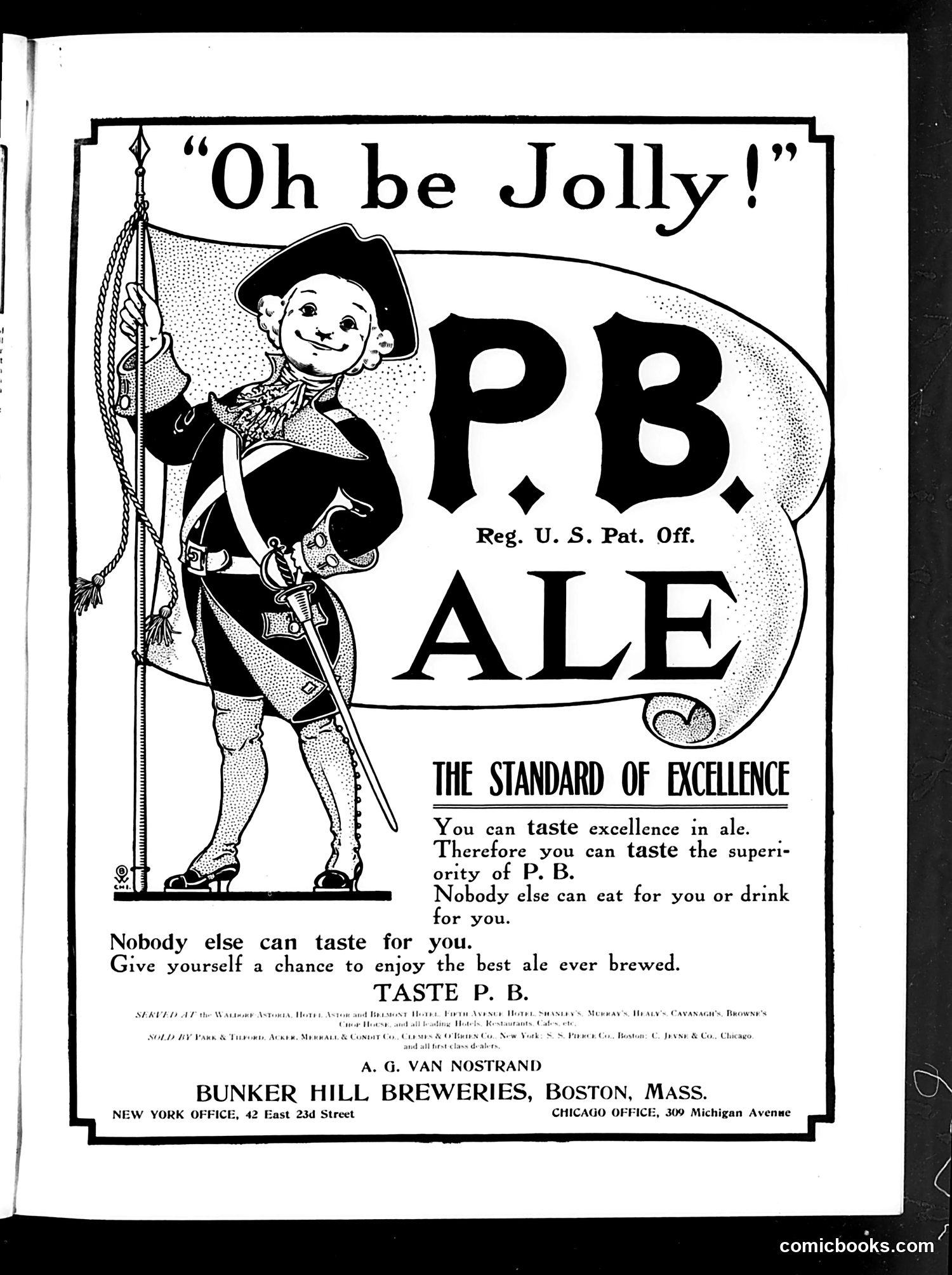
This is primarily a **beer advertisement**, not political satire. It promotes P.B. Ale from Bunker Hill Breweries (Boston) using a cheerful, rotund character in colonial or Revolutionary War-era costume—likely invoking the "Bunker Hill" brand name's historical reference. The "joke" is the slogan "Oh be Jolly!"—a pun playing on the character's jolly appearance and demeanor. The ad's messaging emphasizes personal choice and individual taste ("Nobody else can taste for you"), positioning ale-drinking as a matter of personal judgment and quality appreciation. This appears to be from the early-to-mid 20th century, when such nostalgic, character-driven beer advertising was common. There's no evident political commentary—it's straightforward commercial promotion.
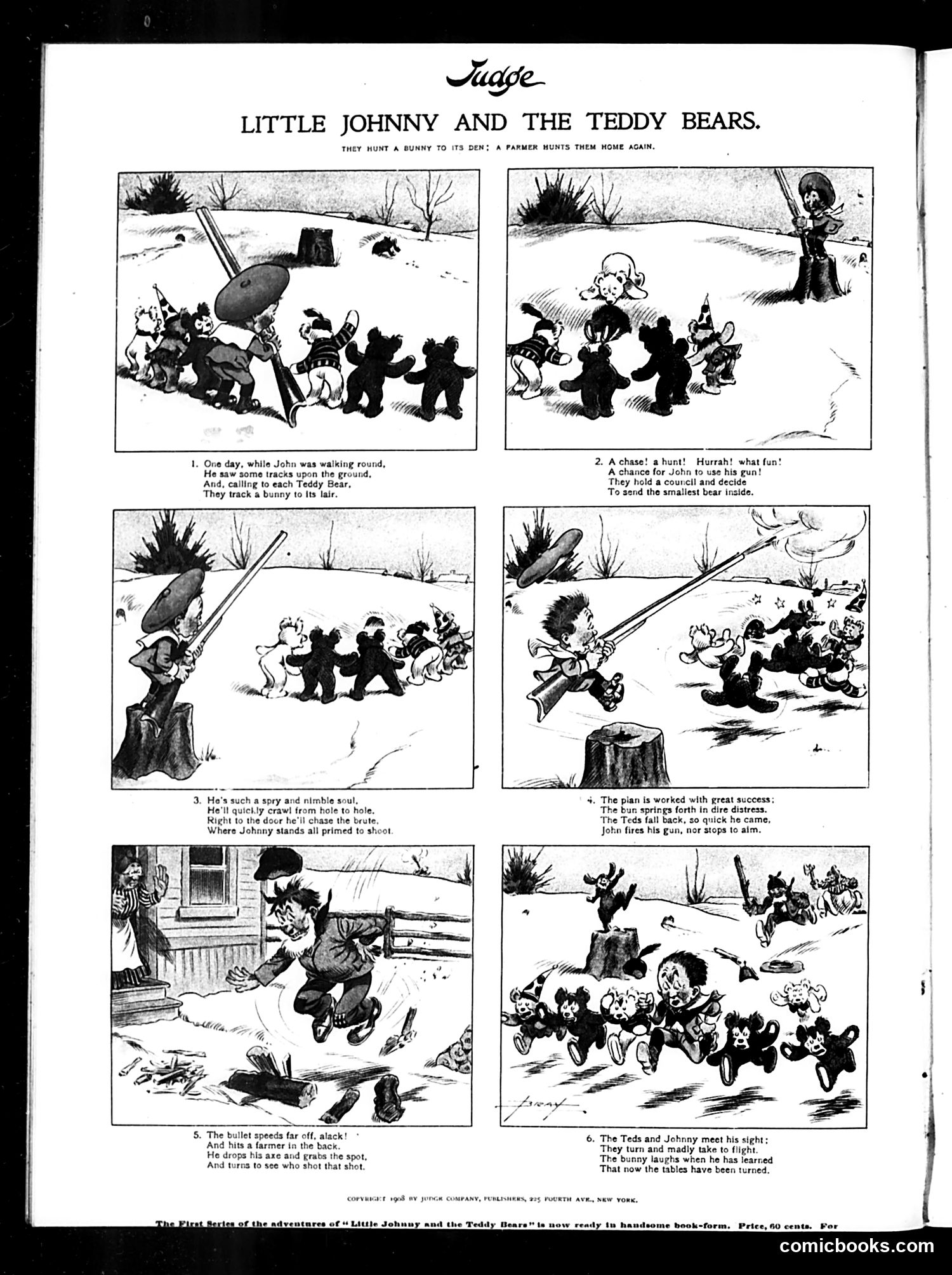
This is a children's comic strip, not political satire. It tells a straightforward hunting adventure story: Little Johnny and his teddy bears track a rabbit to its den. They devise a plan—sending the smallest bear inside to flush out the bunny. When the rabbit bolts and Johnny shoots, his bullet accidentally hits a nearby farmer instead of the prey. The farmer chases them, and Johnny and the bears flee while the rabbit escapes, having the last laugh. The humor derives from the slapstick misadventure and role-reversal (the hunted becoming the hunters of the hunters). "Teddy Bears" likely references the popular toy trend that emerged after Theodore Roosevelt's hunting exploits. This appears to be wholesome entertainment from Judge magazine's family-oriented content, circa 1908.