
A complete issue · 16 pages · 1908
Judge — January 4, 1908
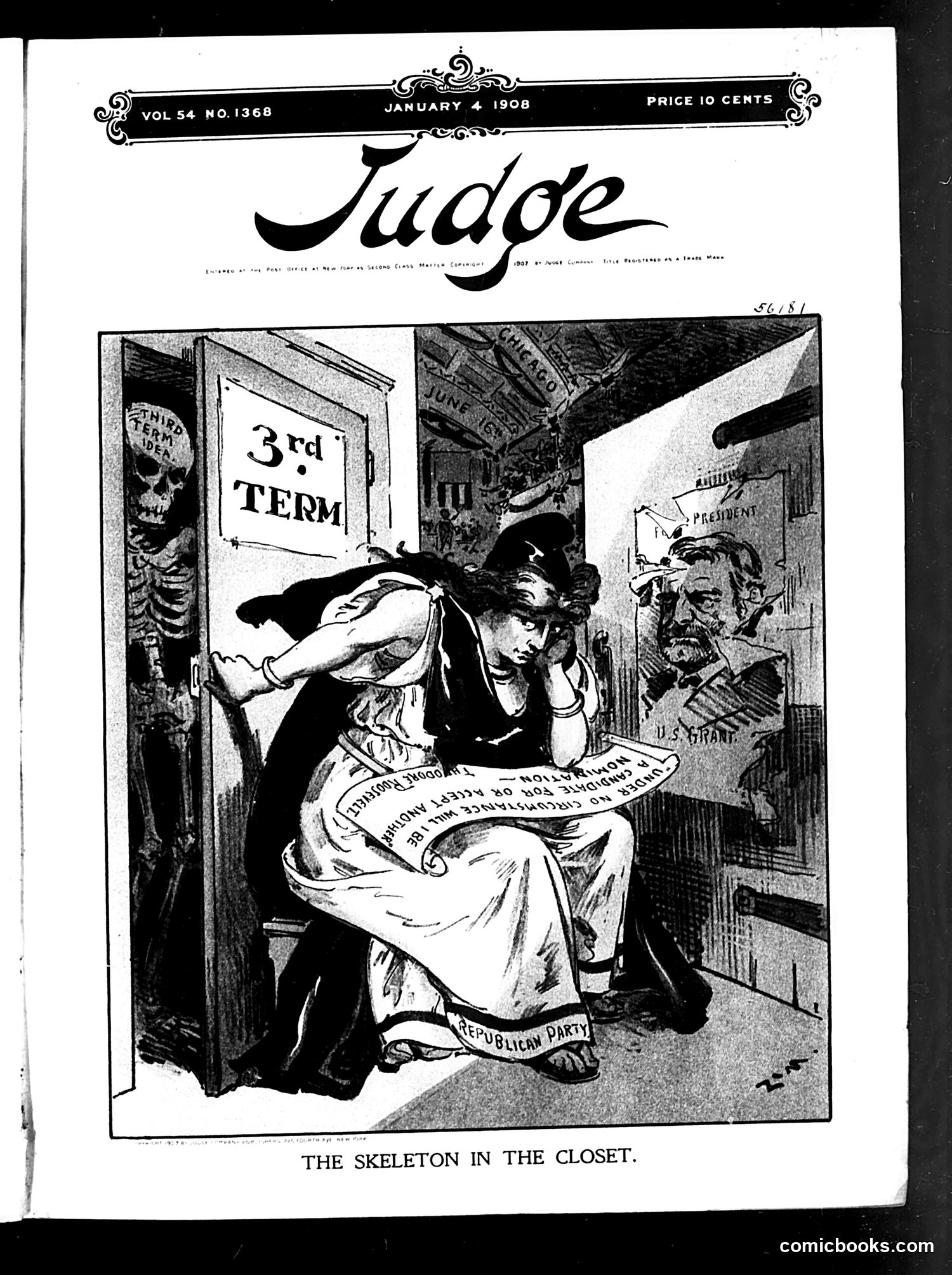
This political cartoon satirizes the Republican Party's internal scandals or embarrassments heading into the 1908 presidential election (the "3rd TERM" reference likely concerns Theodore Roosevelt's presidency). The central figure appears to be a Republican Party representative, forced to confront damaging revelations symbolized as a skeleton—a metaphor for hidden scandals that threaten the party's image. The figures on either side likely represent political opponents or party leaders, with one appearing to be a caricatured presidential figure. The cartoon criticizes how Republicans cannot escape their controversial record as they prepare for the next election cycle. The "skeleton in the closet" idiom suggests deeply buried wrongdoing that is now being exposed, undermining the party's political standing.
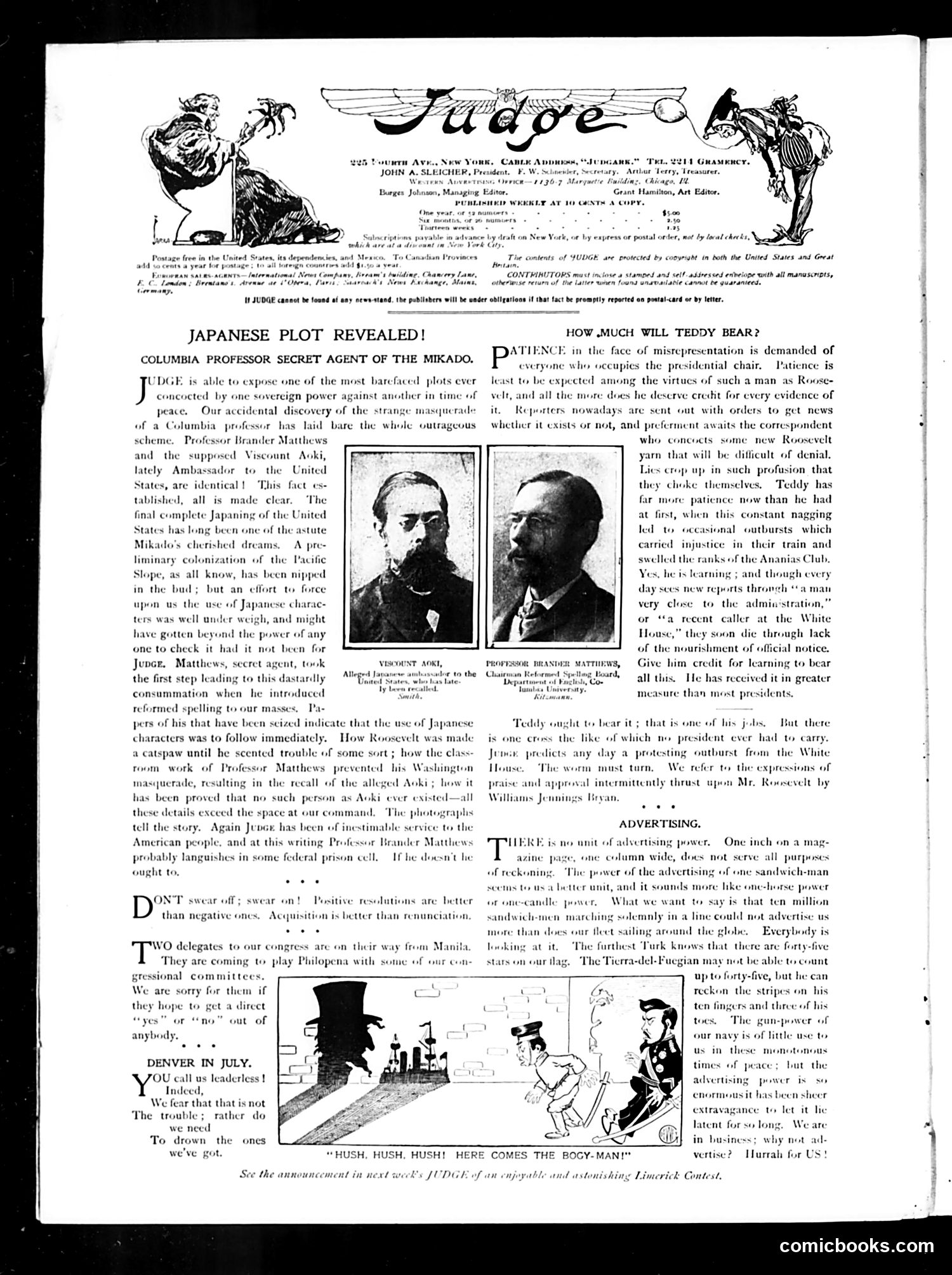
This Judge magazine page satirizes Roosevelt's handling of a diplomatic incident involving Japanese officials. The main article "JAPANESE PLOT REVEALED!" describes a Columbia professor exposing a scheme allegedly involving Viscount Aoki (Japanese Ambassador) and other diplomats. Two portrait photographs show the men implicated. The text criticizes the "outrageous scheme" while praising Roosevelt's patience in addressing misrepresentation and maintaining diplomatic composure—qualities the author suggests Roosevelt deserves credit for demonstrating. The bottom cartoon "HUSH, HUSH! HERE COMES THE BODY-MAN!" appears to mock Filipino delegates visiting to play Pilipeno, with warship imagery suggesting American imperial interests. The satire targets diplomatic embarrassment and foreign affairs complexity during Roosevelt's presidency.
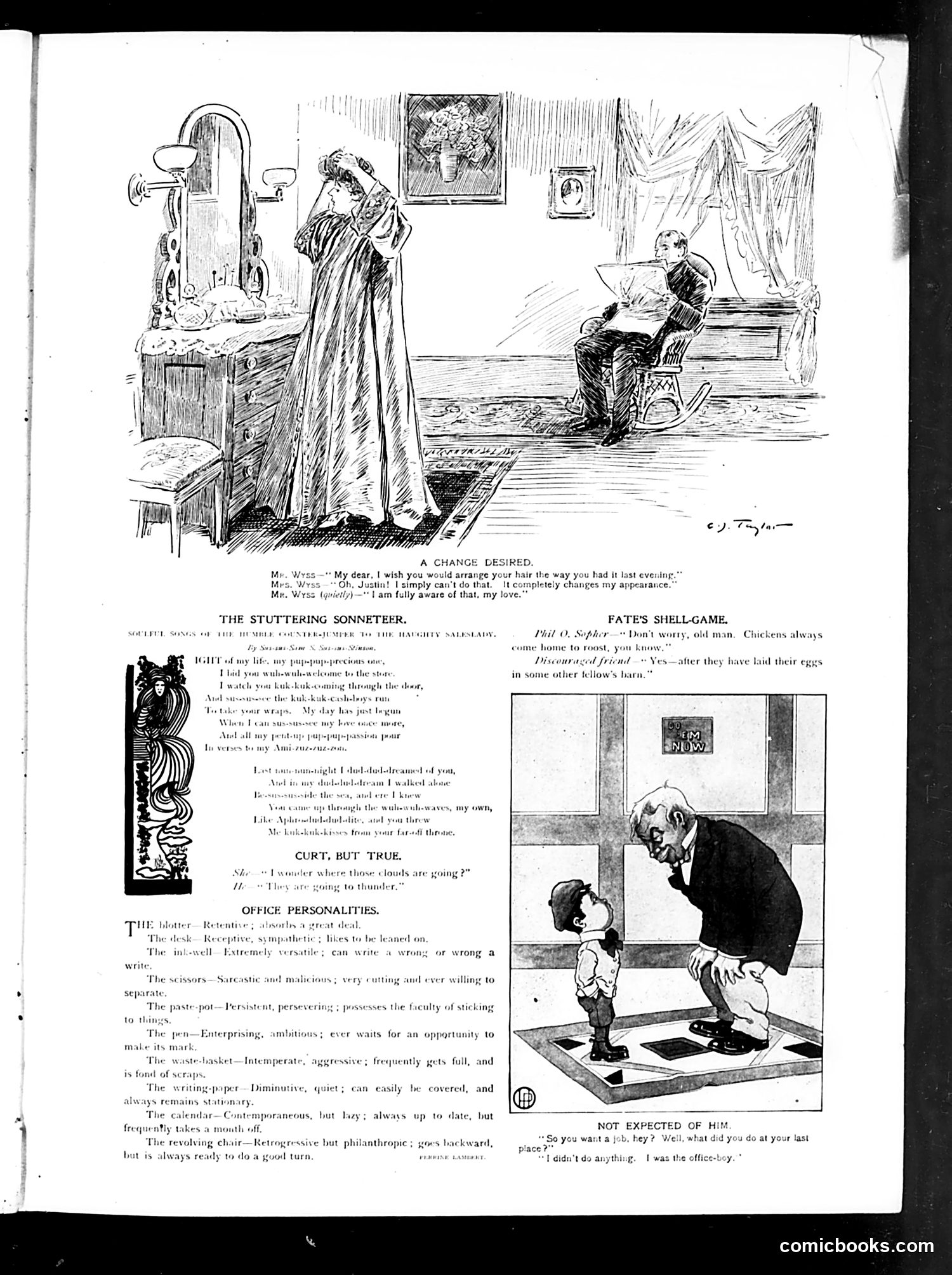
This page contains several satirical pieces typical of Judge's humor: **"A Change Desired"** (top): A domestic scene where a wife requests her husband arrange his hair differently, claiming it completely changes his appearance. The satire targets vanity and marital dynamics around physical appearance. **"The Stuttering Sonneteer"** and **"Curt, But True"**: Brief humorous verse pieces about social awkwardness and weather predictions. **"Office Personalities"**: Descriptions of archetypal office workers—the blotter, receptionist, ink-well, scissors, paste-pot, and others—each characterized by exaggerated professional traits. This satirizes workplace stereotypes and bureaucratic tedium. **"Not Expected of Him"** (bottom cartoon): Shows what appears to be a priest or religious figure with a child, with dialogue about an office job, likely satirizing unexpected behavior or role-breaking. The page exemplifies Judge's social satire targeting everyday American life, workplace culture, and domestic situations.
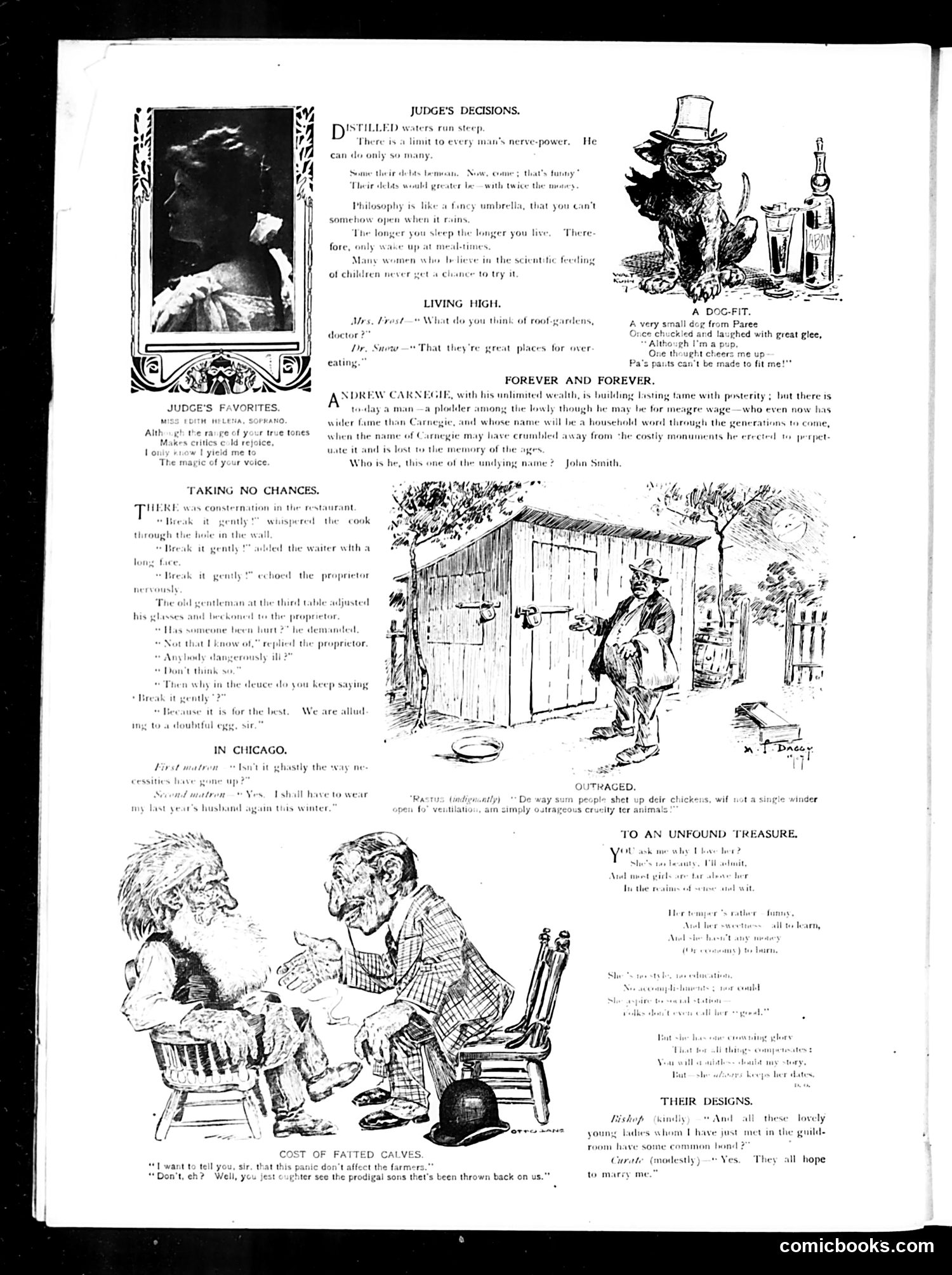
This page contains several distinct satirical pieces rather than a single unified cartoon. **"Judge's Decisions"** mocks philosophical pretension about sleep and children's scientific education. **"A Dog-Fit"** is a humorous poem about a drunk dog in Paris. **"Taking No Chances"** satirizes restaurant hygiene, showing a cautious diner inspecting water quality with a long face. **"In Chicago"** jokes about winter clothing needs. **"Cost of Fattened Calves"** depicts two men discussing agriculture's economics. **"Outraged"** comments on animal welfare concerns regarding chicken ventilation. The remaining pieces—"Forever and Forever," "Living High," "To an Unfound Treasure," and "Their Designs"—appear to be poetry or literary commentary on wealth, social aspirations, and romance. The page reflects turn-of-century American social satire and humor rather than focused political commentary.
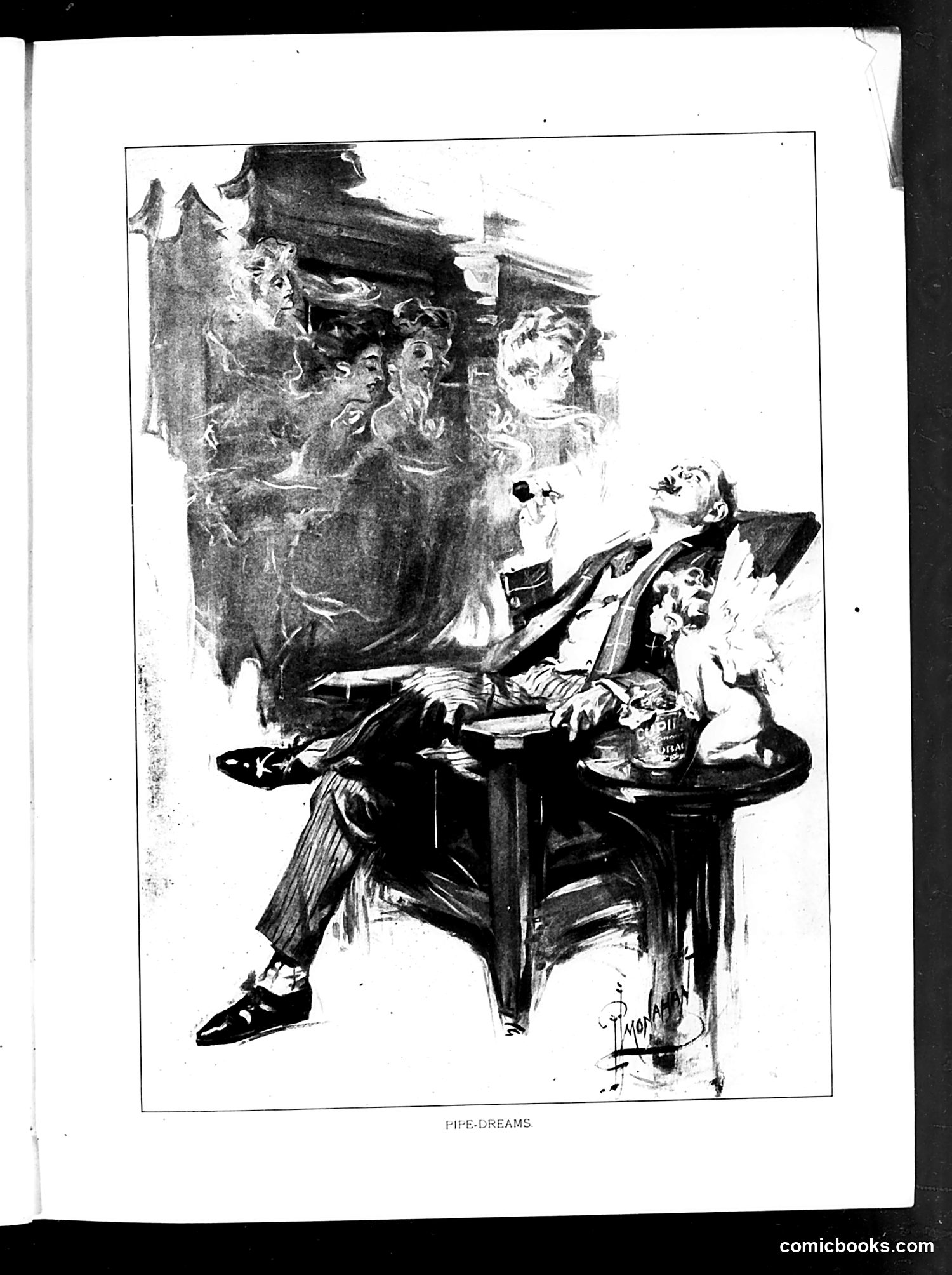
This cartoon titled "Pipe-Dreams" depicts a well-dressed man seated at a table, gazing upward at a vision of classical figures (appearing to be Greek or Roman busts/statues) emerging from smoke, likely from a pipe. The man appears to be in a state of reverie or intoxication, lost in romantic fantasies. The satire likely mocks idealistic or overly romantic notions—suggesting that such grand visions are mere illusions produced by smoking, not reality. The classical imagery implies the man is imagining himself in elevated, heroic circumstances while seated in ordinary, mundane reality. This was a common Judge magazine theme: ridiculing men's escapist fantasies and the gap between aspiration and actual circumstance. The specific figures are unclear, but the general message concerns delusion versus reality.
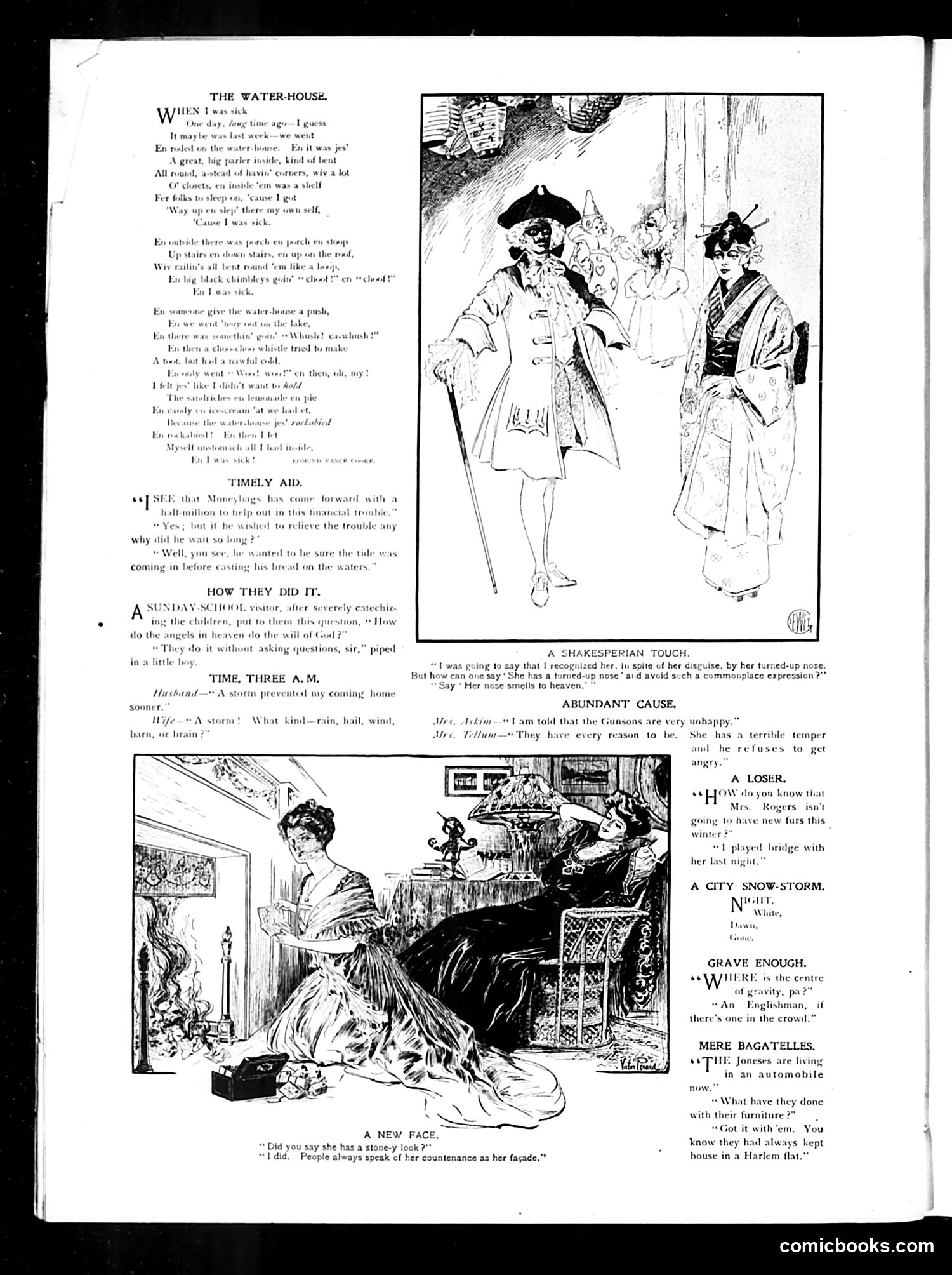
This page contains several brief satirical jokes typical of early 20th-century Judge magazine, rather than a single unified cartoon. **Key items:** - **"Timely Aid"**: Mocks a wealthy financier ("Moneyhags") who donates during a financial crisis only *after* ensuring personal profit—satirizing self-interested philanthropy. - **"How They Did It"**: A Sunday school joke about children's unquestioning obedience, poking gentle fun at religious instruction. - **"Time, Three A.M."**: A domestic humor piece about a husband returning home late, complaining of a "storm" (apparently his wife's anger). - **"Abundant Cause"** and **"A Loser"**: Brief jokes about unhappy marriages and bridge playing. - **"A New Face"**: Wordplay on a woman having a "stone-y look" and "facade"—conflating her expression with architecture. The illustrations show domestic and social scenes. The overall page exemplifies Judge's style: punchy one-liners targeting marriage dynamics, wealth, and social pretension, with minimal political content visible here.
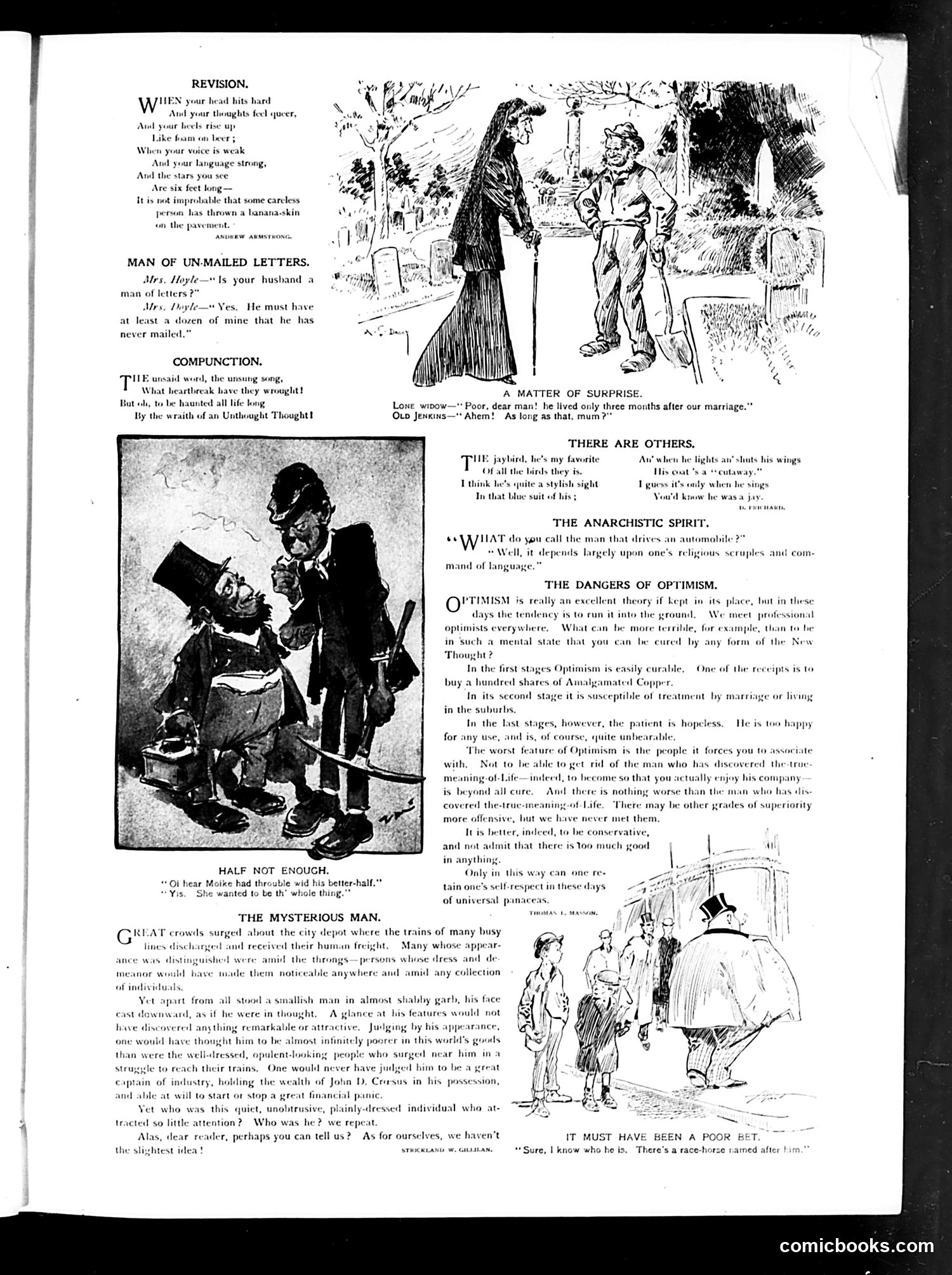
This page from Judge magazine contains several brief satirical pieces mocking everyday social situations and contemporary trends: **"Man of Un-mailed Letters"** jokes about a husband who receives but never sends letters—a mild domestic jab. **"The Dangers of Optimism"** critiques the popular "New Thought" movement (early 1900s self-help philosophy). Judge sarcastically suggests optimism is a disease progressing from curable to incurable stages, with its worst symptom being forced association with overly cheerful people who've discovered "the true meaning of Life." **"The Mysterious Man"** presents a paradox: a shabby, poor-looking stranger amid well-dressed wealthy crowds at a train depot. The final panel's punchline suggests he's notable only because a racehorse shares his name—mocking society's arbitrary judgments of importance. The cartoons reflect Judge's characteristic cynicism toward American optimism, social pretension, and self-help trends of the era.
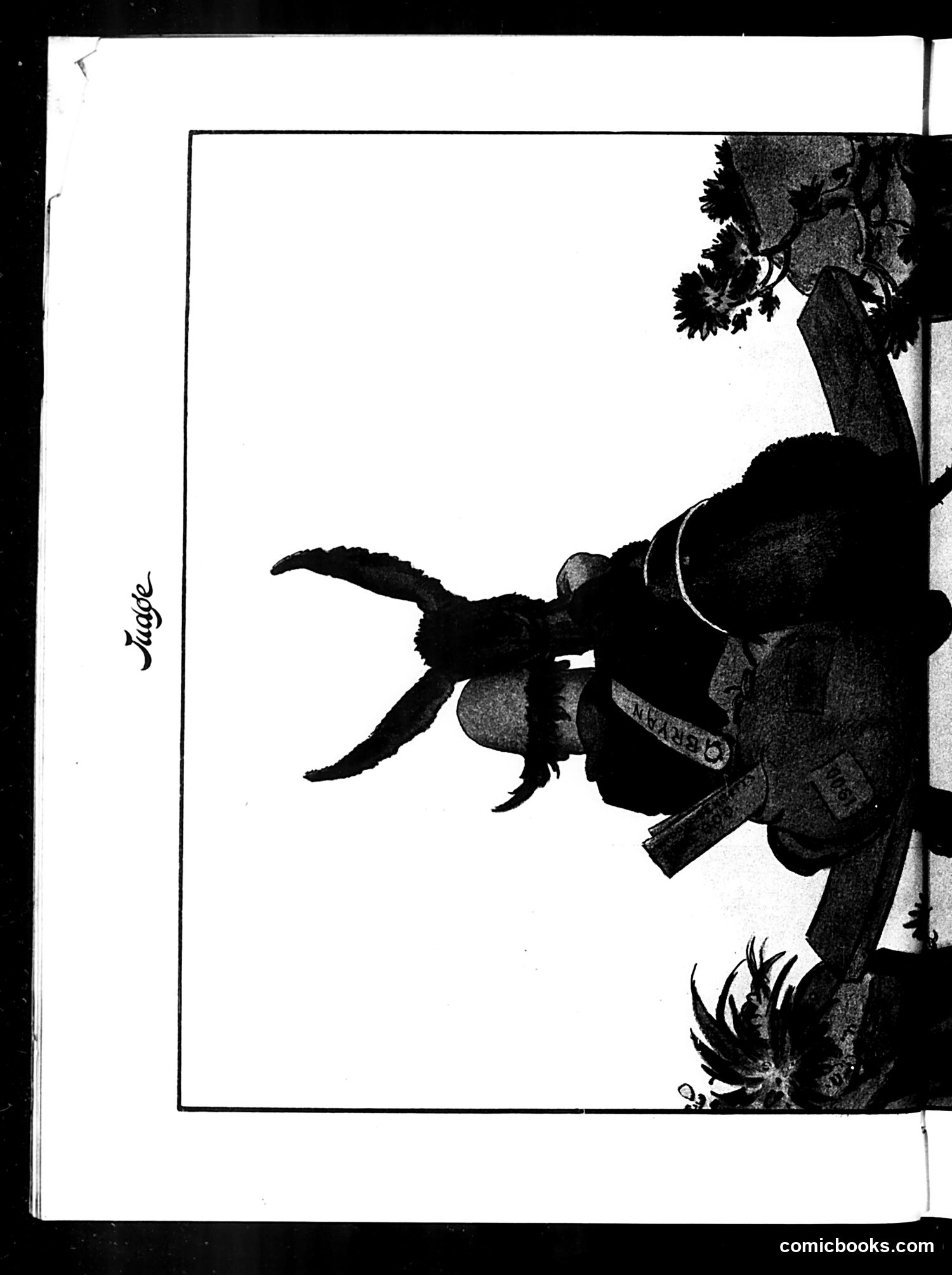
This appears to be a title page or section divider from *Judge* magazine, rotated 90 degrees. The image shows a silhouetted figure in dynamic pose—appearing to be falling or diving—wearing what looks like period clothing with decorative elements. There's a flowering plant visible in the composition. The signature "Judge" appears on the left margin. However, without legible text on this particular page identifying the cartoon's subject, title, or context, I cannot definitively explain what political or social event this satirizes. The dramatic action pose and silhouette technique suggest it comments on a specific contemporary incident or personality from the magazine's era, but the specific target and meaning remain unclear from this image alone.
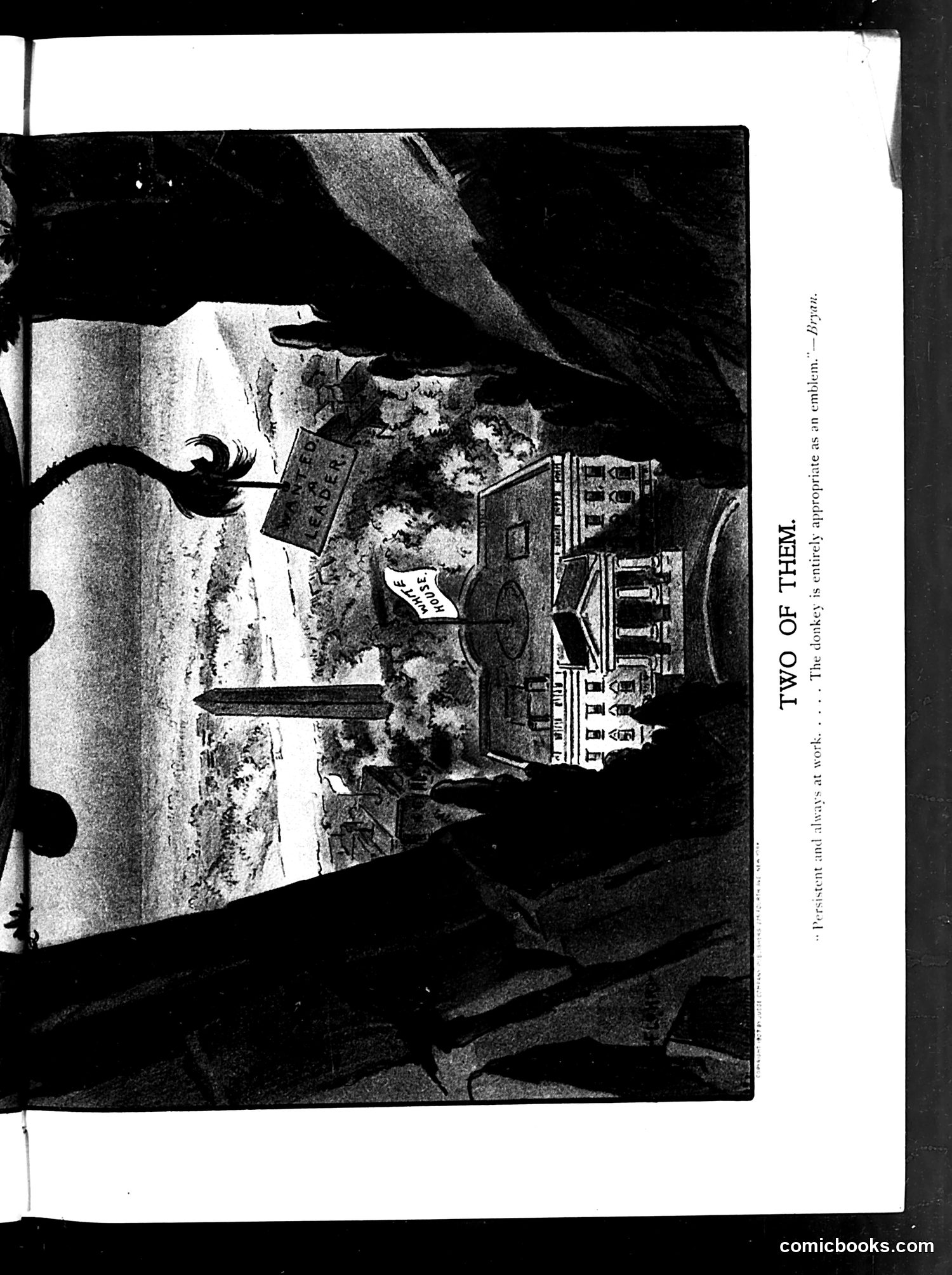
This appears to be a political cartoon from *Judge* magazine, though the image quality and rotation make specific details difficult to discern with certainty. The caption "TWO OF THEM" suggests a comparison or pairing of two figures or concepts, likely meant as social or political commentary. The OCR text reference to "Present in all always a work" and mention of "hands is entirely appropriate—Laypml" is unclear and may contain significant OCR errors. Without being able to definitively identify the figures depicted or read accompanying text clearly, I cannot accurately explain the specific satire or references intended. The cartoon appears to involve architectural or structural elements and possibly commentary on duplicity or hypocrisy, but more legible source material would be needed for accurate historical interpretation.
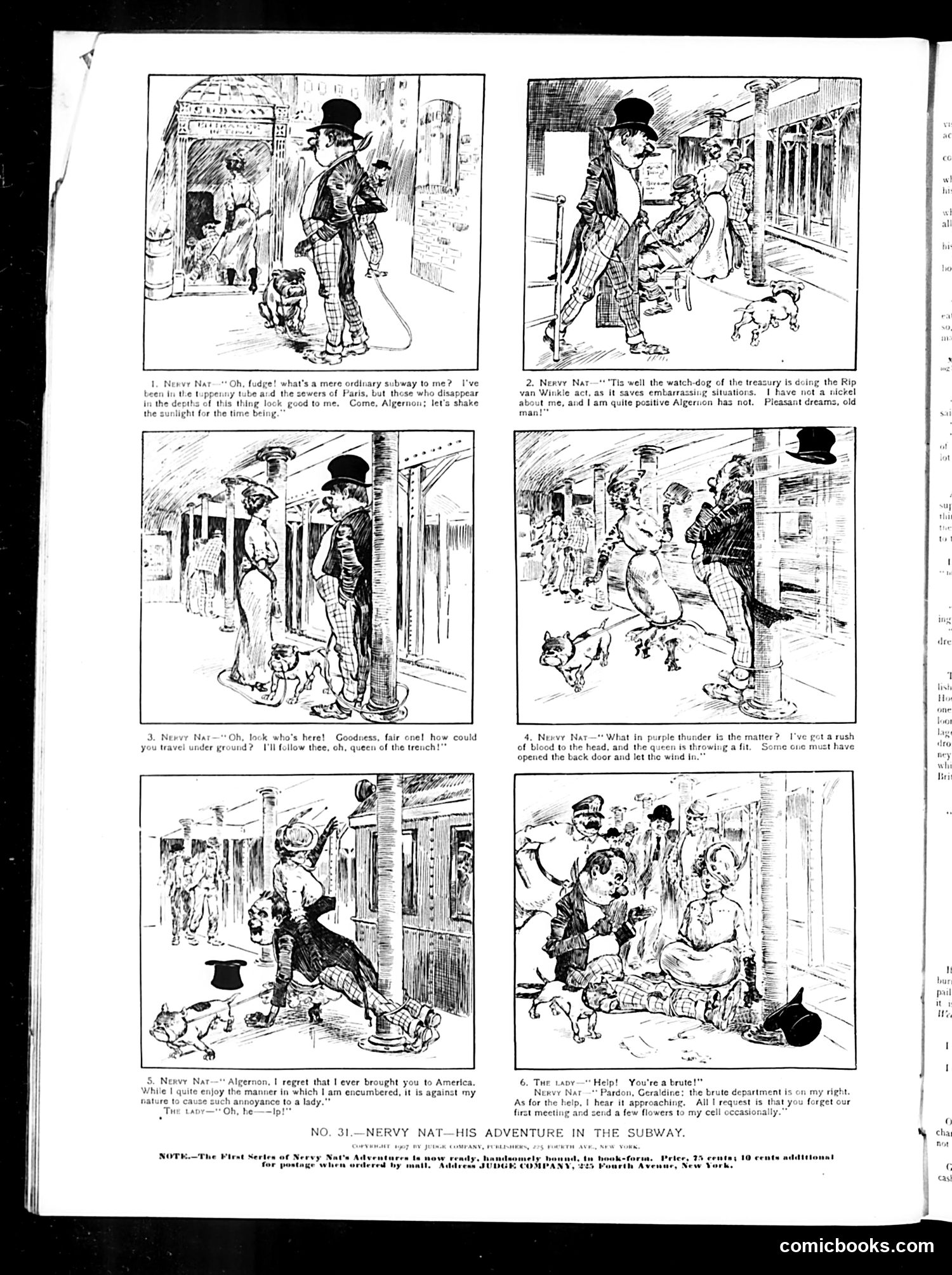
This is a six-panel comic strip featuring "Nervy Nat," a character type common in early 20th-century American humor. The strip depicts Nat encountering various women in a subway setting, pursuing them with increasingly forward and inappropriate behavior—what the text calls "nervy" advances. The humor relies on dated gender dynamics: Nat makes bold passes at women, uses flattery ("queen of the trench"), and responds to rejection with facetious quips about being called a "brute" or sending flowers "to my cell." The "watch-dog of the treasury" reference in panel 2 appears to reference government oversight, though its specific meaning is unclear without fuller context. The satire targets both Nat's presumptuous behavior toward women and broader early-1900s social conventions around courtship and public encounters. The subway setting—a new urban space—frames this as contemporary social commentary on changing city life and gender relations.
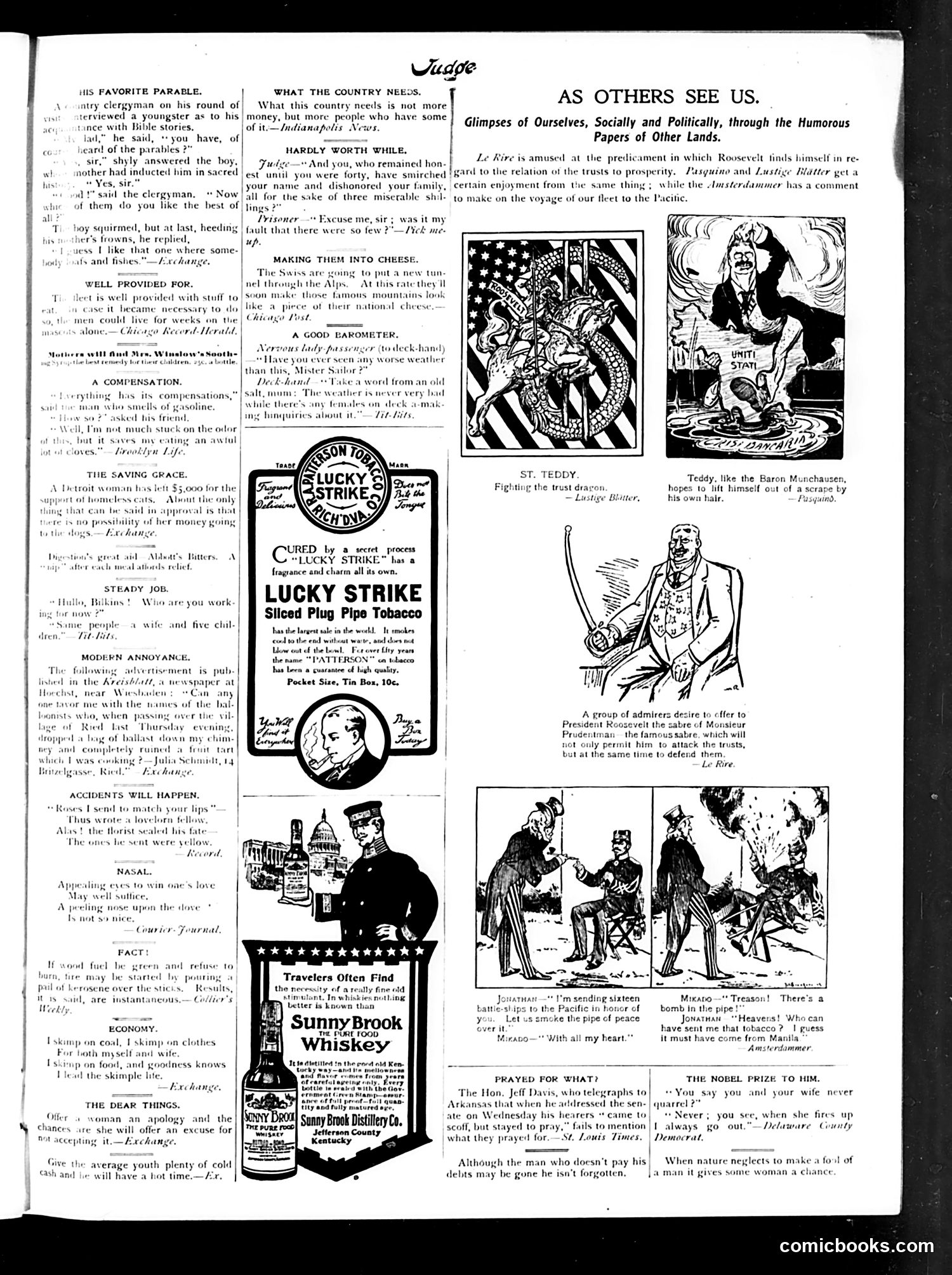
This page from Judge (an American satirical weekly) contains multiple short humor pieces and advertisements typical of early 20th-century satire magazines. **Key Content:** The "AS OTHERS SEE US" section reprints satirical commentary from European papers about American politics and society—specifically mocking President Theodore Roosevelt's struggle with trust regulation. European publications (Lustige Blätter, Le Rire, etc.) joke that Roosevelt is simultaneously attacking and defending trusts, and mock American military ambitions (the Pacific fleet voyage). The "ST. TEDDY" cartoon depicts Roosevelt as a dragon-slayer, referencing his "trust-busting" presidential agenda—a major political issue of his administration. **Supporting Content:** The page includes various short joke items on everyday topics (romance, work, accidents, naval life) and period advertisements for Lucky Strike tobacco and Sunny Brook Whiskey. The humor relies on wordplay, puns, and social observation rather than sustained narrative—typical of Judge's format as a weekly humor magazine for educated readers.
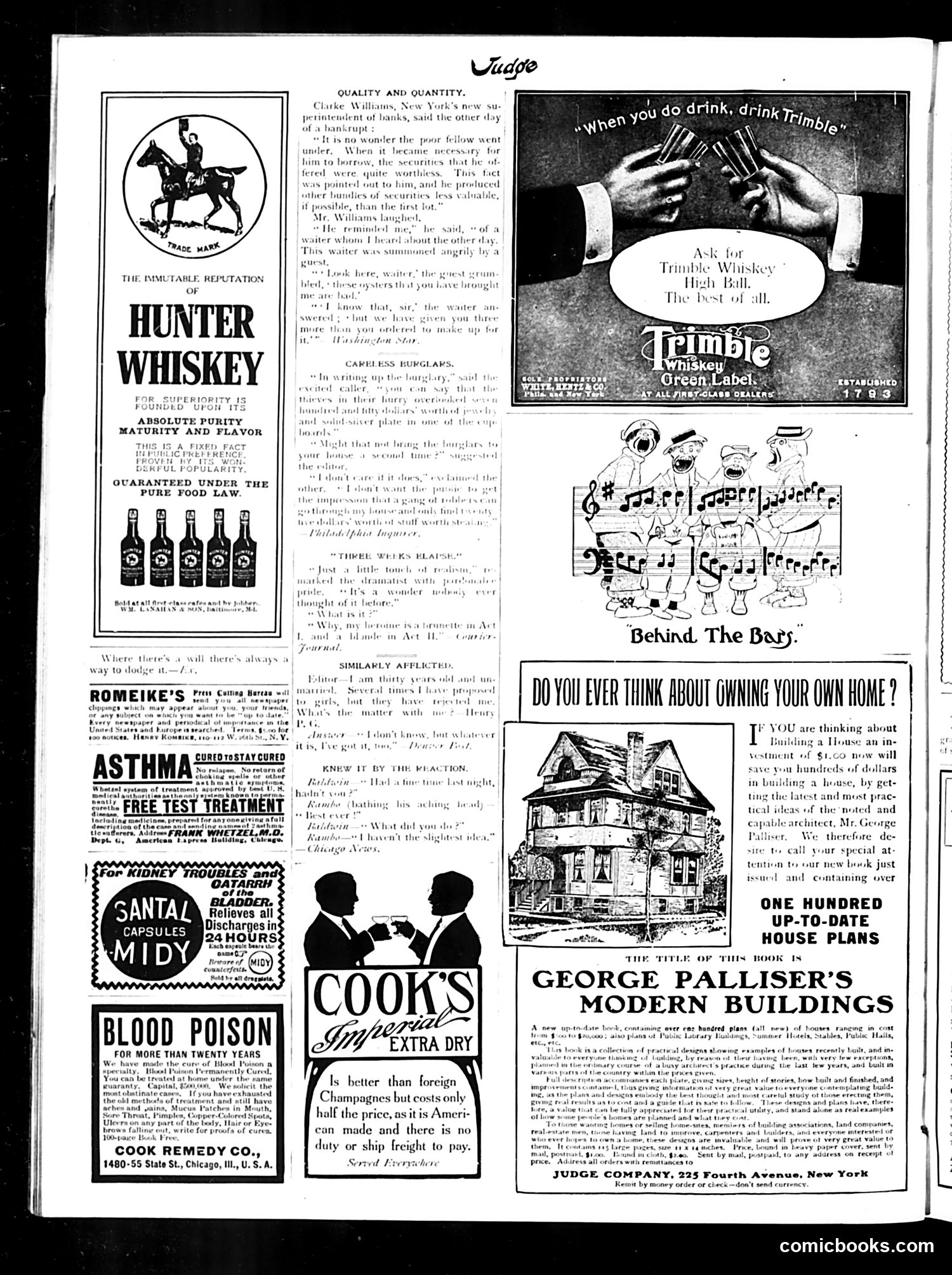
This page is primarily **advertising**, typical of early-20th-century magazines. The advertisements promote various products: Hunter Whiskey (emphasizing purity under food laws), Trimble Whiskey, Santal Capsules (for kidney/bladder issues), a blood poison remedy, Cook's Extra Dry champagne, and George Palliser's house plan book. The brief text snippets labeled "Quality and Quantity," "Three Weeks Blush," and "Similarly Afflicted" appear to be **humorous anecdotes** rather than political cartoons. They're disconnected jokes: one about a bankrupt banker, another about a waiter, and brief dialogue exchanges. The only illustration shows **two silhouetted figures exchanging drinks or toasts**, accompanying the Trimble Whiskey ad. This page reflects **period advertising norms**: medical patent medicines (many containing dubious ingredients), alcohol promotion without health warnings, and architectural services. There's no evident political satire or social commentary—it's a straightforward advertising section interspersed with light humor, representative of Judge's revenue model.
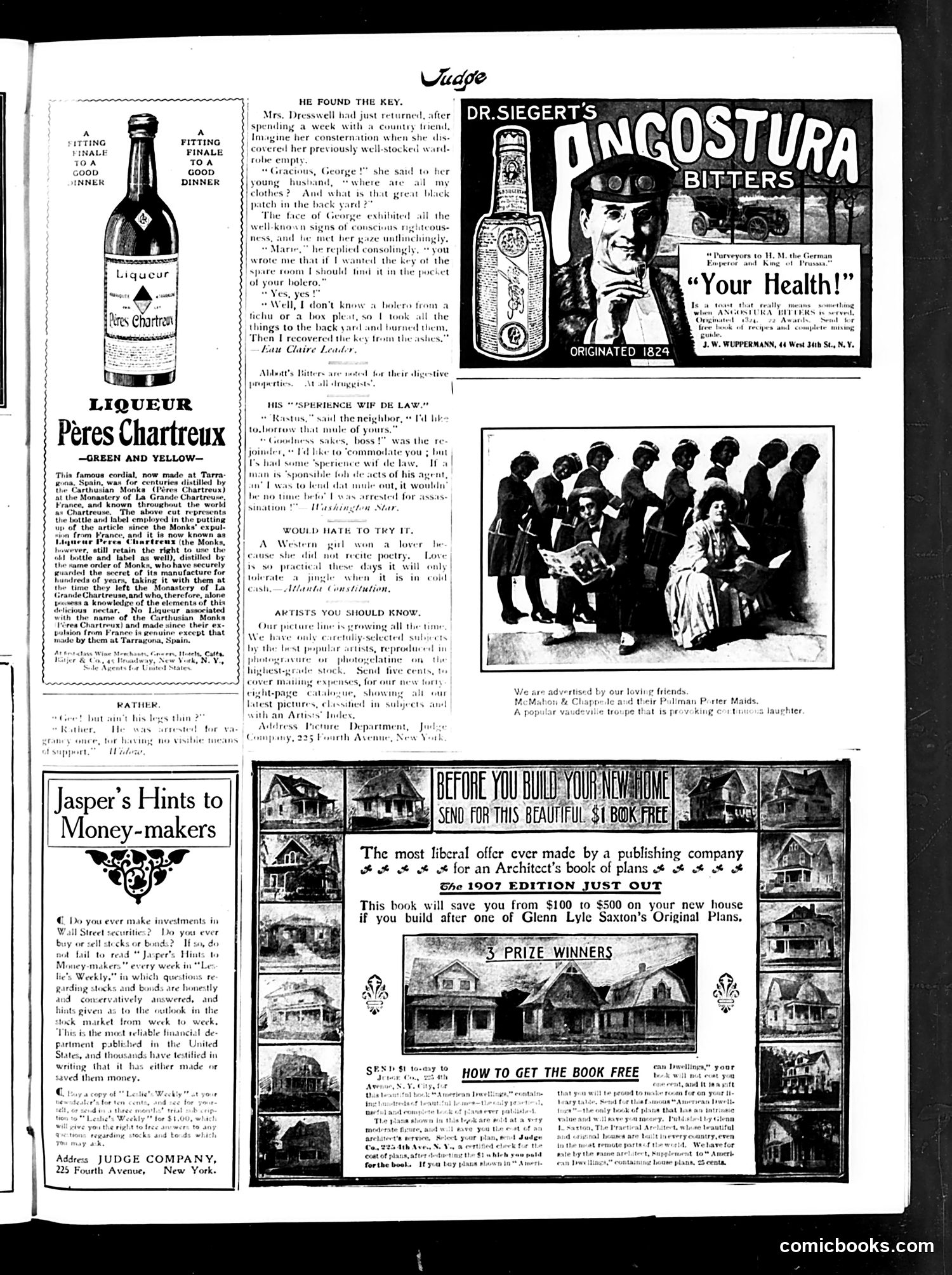
This page is primarily **advertising with minimal editorial content**. The small cartoon "He Found the Key" depicts a domestic scene: Mrs. Dresswell burned her husband's old clothes to retrieve a key from the ashes. The joke relies on early 20th-century domestic humor—the wife's practical (if extreme) solution to a household problem. The page is dominated by advertisements for liqueur, bitters, architectural house plans, and investment advice. Most notable is Dr. Siegert's Angostura Bitters, marketed with a mustachioed gentleman promoting health benefits—typical of the era's patent medicine advertising before FDA regulations. The "Jasper's Hints to Money-makers" section advertises investment guidance for stock trading, reflecting Judge's affluent readership. Overall, this represents Judge's business model: satirical content subsidized by advertisements targeting wealthy, educated readers interested in finance, home ownership, and consumer goods.
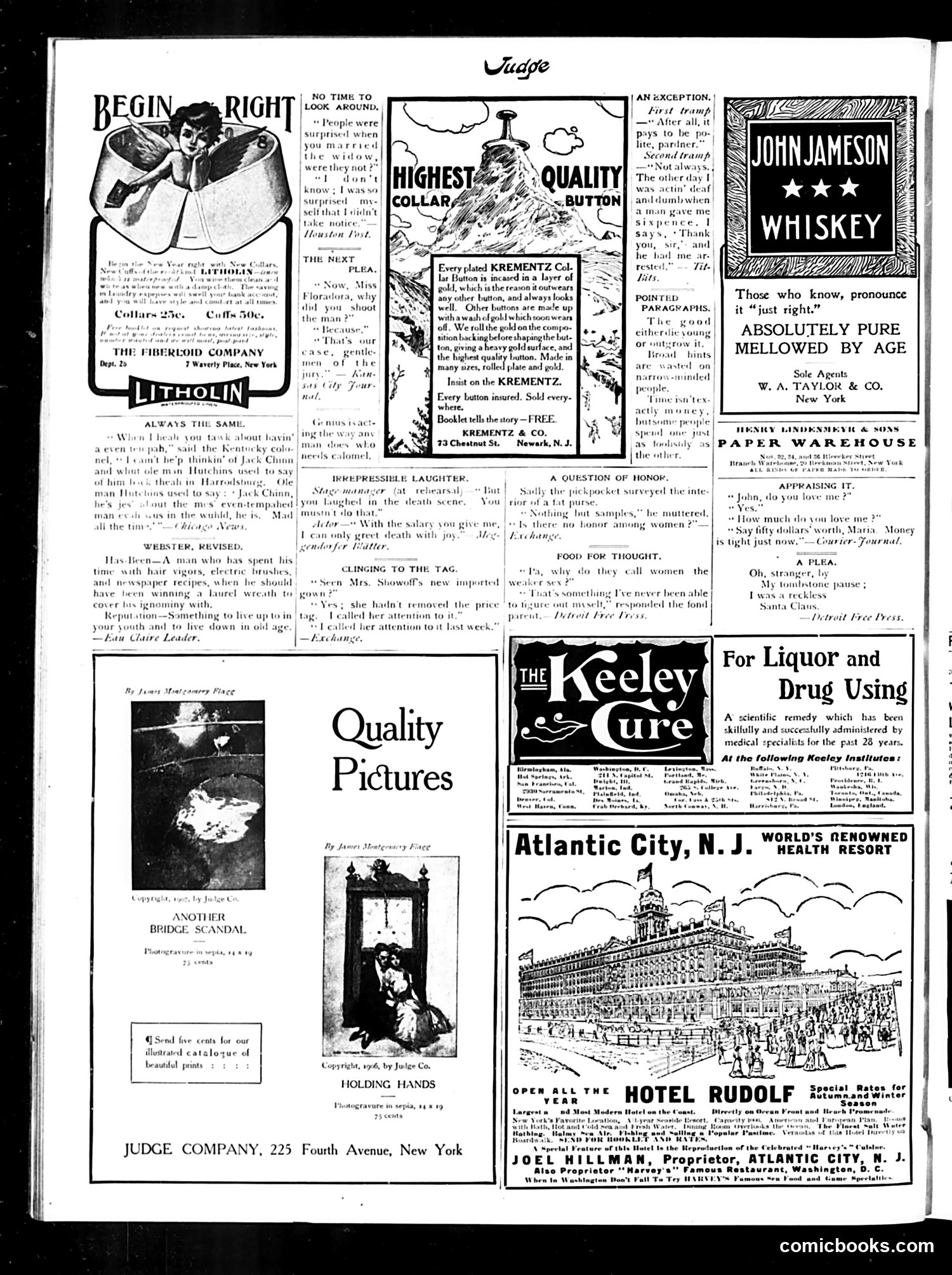
This page from *Judge* (a satirical magazine) consists primarily of **advertisements and brief humor pieces** rather than political cartoons. The content includes: **Advertisements:** Multiple product ads (Litholin collars, John Jameson whiskey, Krementz buttons, Quality Pictures, The Keeley Cure for drug/alcohol addiction, and Hotel Rudolf in Atlantic City). **Humor Pieces:** Short comedic exchanges and definitions, including: - "Webster, Revised" — satirical dictionary entries poking fun at social types - "Pointed Paragraphs" — brief jokes about courtship, theater, and social etiquette - Comic dialogues about marriage, salary disputes, and gender relations **Social Commentary:** The humor targets middle-class concerns of the era: materialism ("price tags" on clothing), marital expectations, and workplace hierarchies. References to "the weaker sex" reflect period attitudes toward gender. The page reflects early 20th-century American attitudes toward consumption, courtship, and social propriety, presented through light satire rather than pointed political commentary.
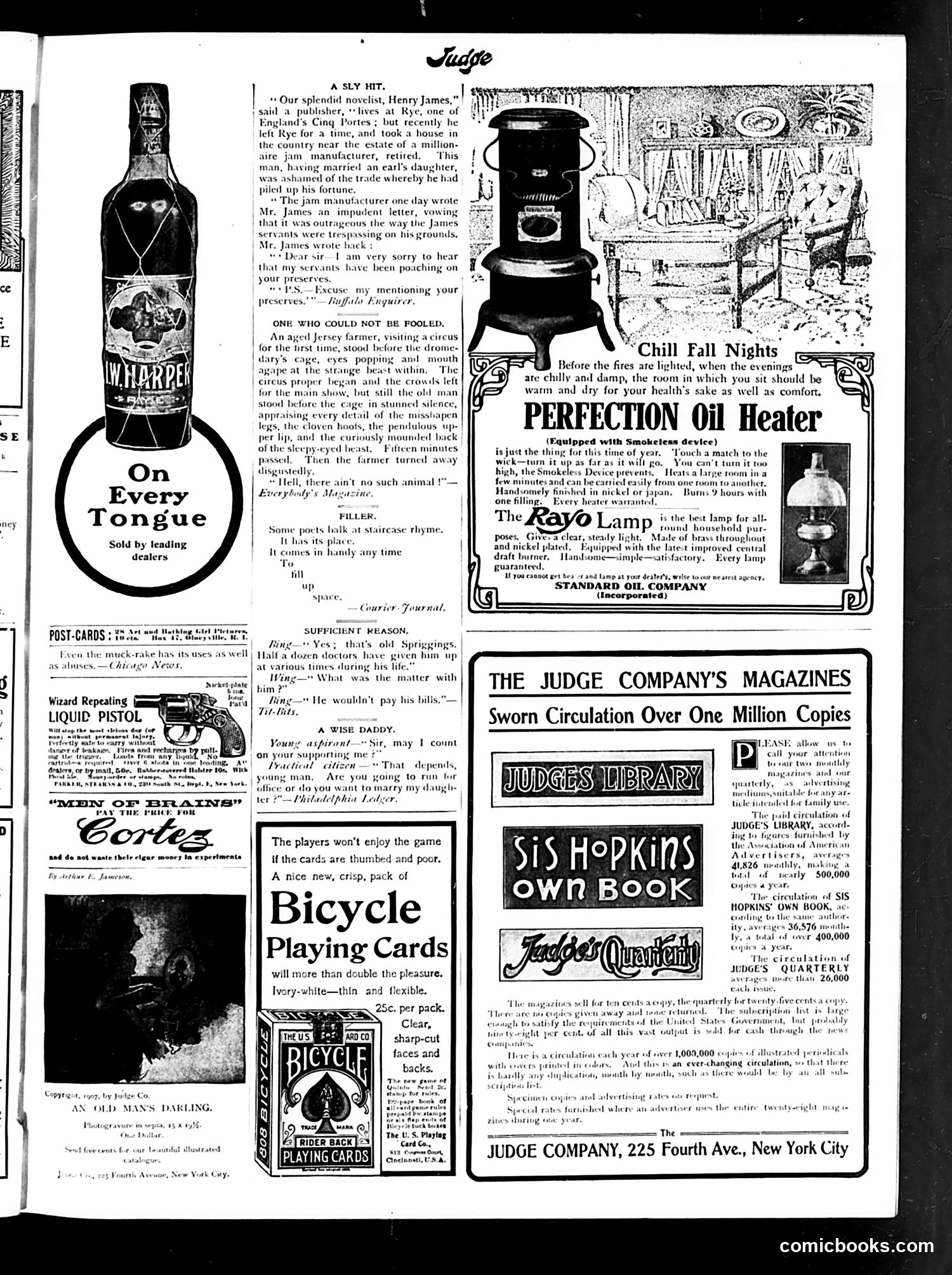
This page is primarily **advertising and promotional content** rather than political satire. The main cartoon sections are brief humorous anecdotes: **"A Sly Hit"** is a joke about author Henry James: a wealthy jam manufacturer, ashamed of his trade despite marrying into nobility, complains that James's servants are trespassing on his grounds. James replies with a pun—apologizing for his servants "poaching on your **preserves**" (playing on the double meaning: both trespassing and the jam manufacturer's actual product). **"One Who Could Not Be Fooled"** depicts a farmer examining what appears to be a camel or exotic animal at a circus, remaining skeptical: "Hell, there ain't no such animal!" The page also features other brief jokes and substantial advertising for Perfection Oil Heaters, Rayo Lamps, Bicycle Playing Cards, and Judge Company magazines. The advertisements dominate the layout, suggesting this is a commercial magazine relying heavily on paid placement rather than pure editorial content.
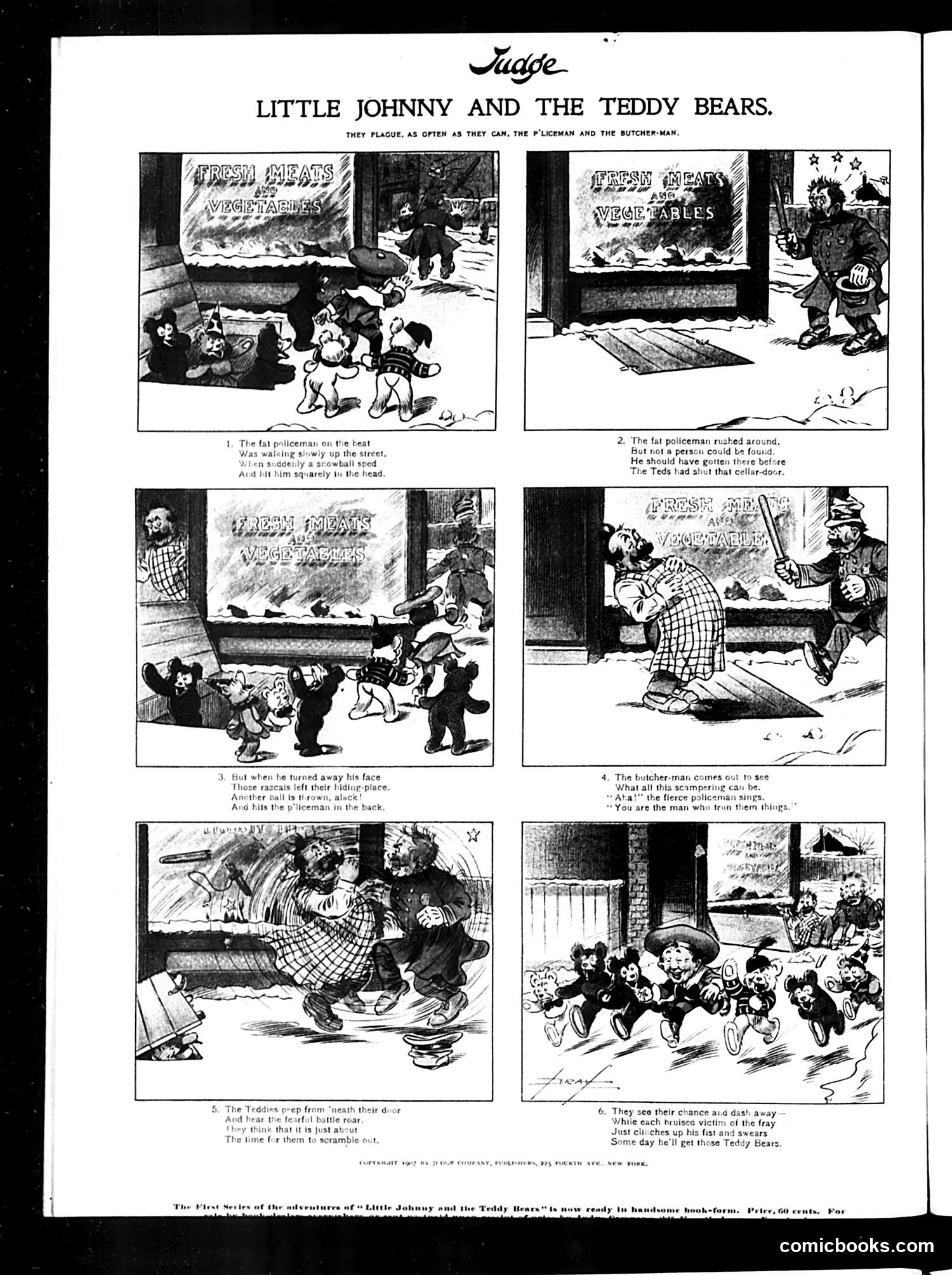
This is a children's comic strip satirizing turn-of-the-century urban life. "Little Johnny" and his gang of "Teddy Bears" (likely street urchins, the term reflecting President Theodore Roosevelt's popular "Teddy Bear" mascot) are mischievous troublemakers who harass two authority figures: a policeman and a butcher-man. The narrative follows their pranks: they steal from the butcher's shop, evade the policeman, cause chaos, and create general mayhem in the streets. The humor derives from adults (representing law and order) being outwitted by clever children—a common theme in early comics. The satire reflects anxieties about urban disorder and juvenile delinquency, presenting street children as pests that plague respectable merchants and police. The strip's tone is lighthearted rather than condemnatory, treating mischief as inevitable boyish behavior rather than serious crime.