
A complete issue · 16 pages · 1907
Judge — June 8, 1907
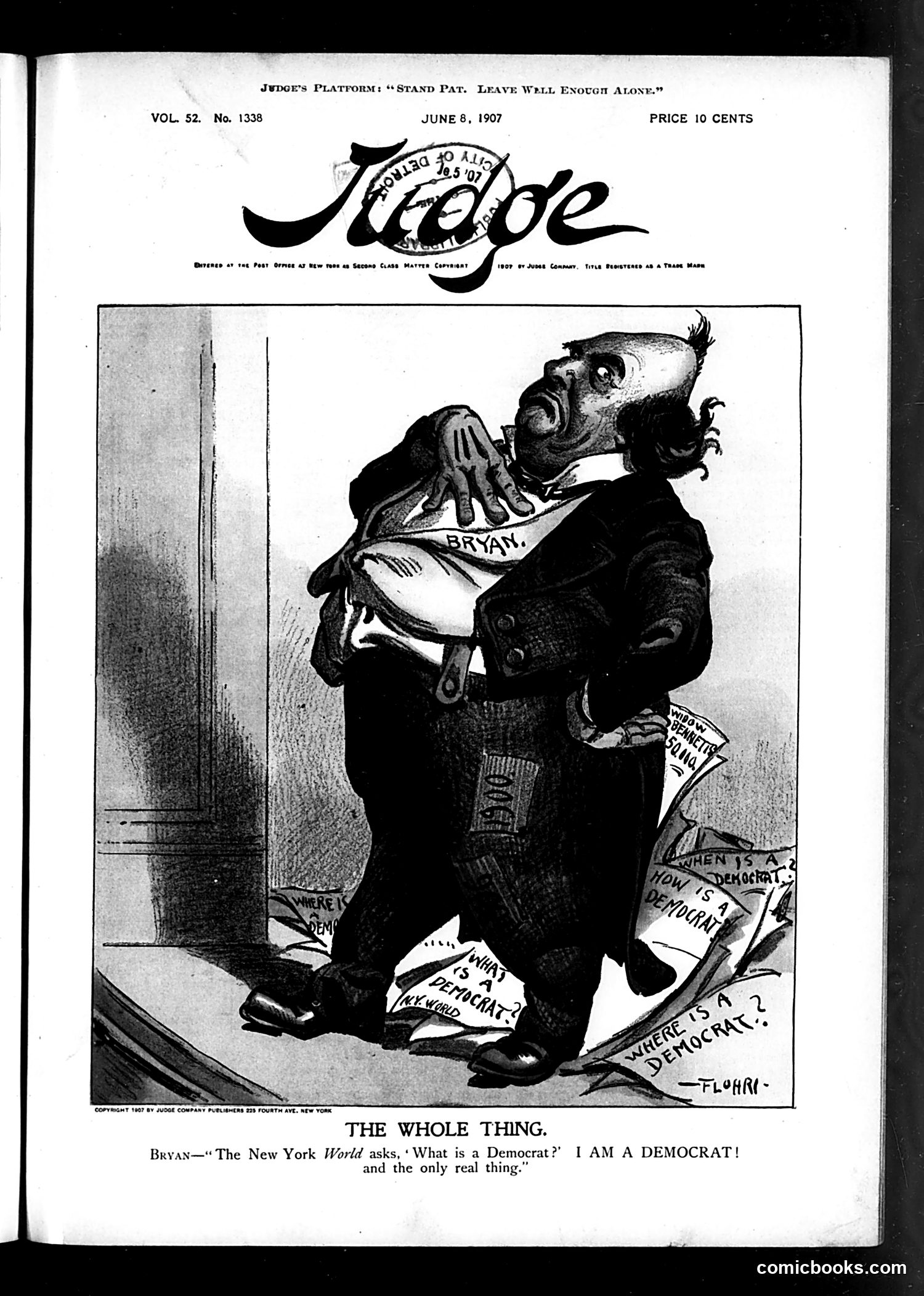
This political cartoon satirizes William Jennings Bryan, the three-time Democratic presidential candidate. The caption quotes Bryan's response to the New York *World*'s question "What is a Democrat?" with his proclamation "I AM A DEMOCRAT!" The cartoon depicts Bryan clutching a chaotic bundle of contradictory Democratic positions and ideologies—papers labeled with conflicting views scattered around him. The satire suggests that Bryan's definition of "Democrat" encompasses such incompatible positions that the party itself is incoherent or self-contradictory. By 1907, Bryan had lost two presidential elections (1896, 1900) and his influence within the party was contested. The cartoon mocks his attempt to claim sole authority over Democratic identity while the party remains fractured and confused about its actual principles.
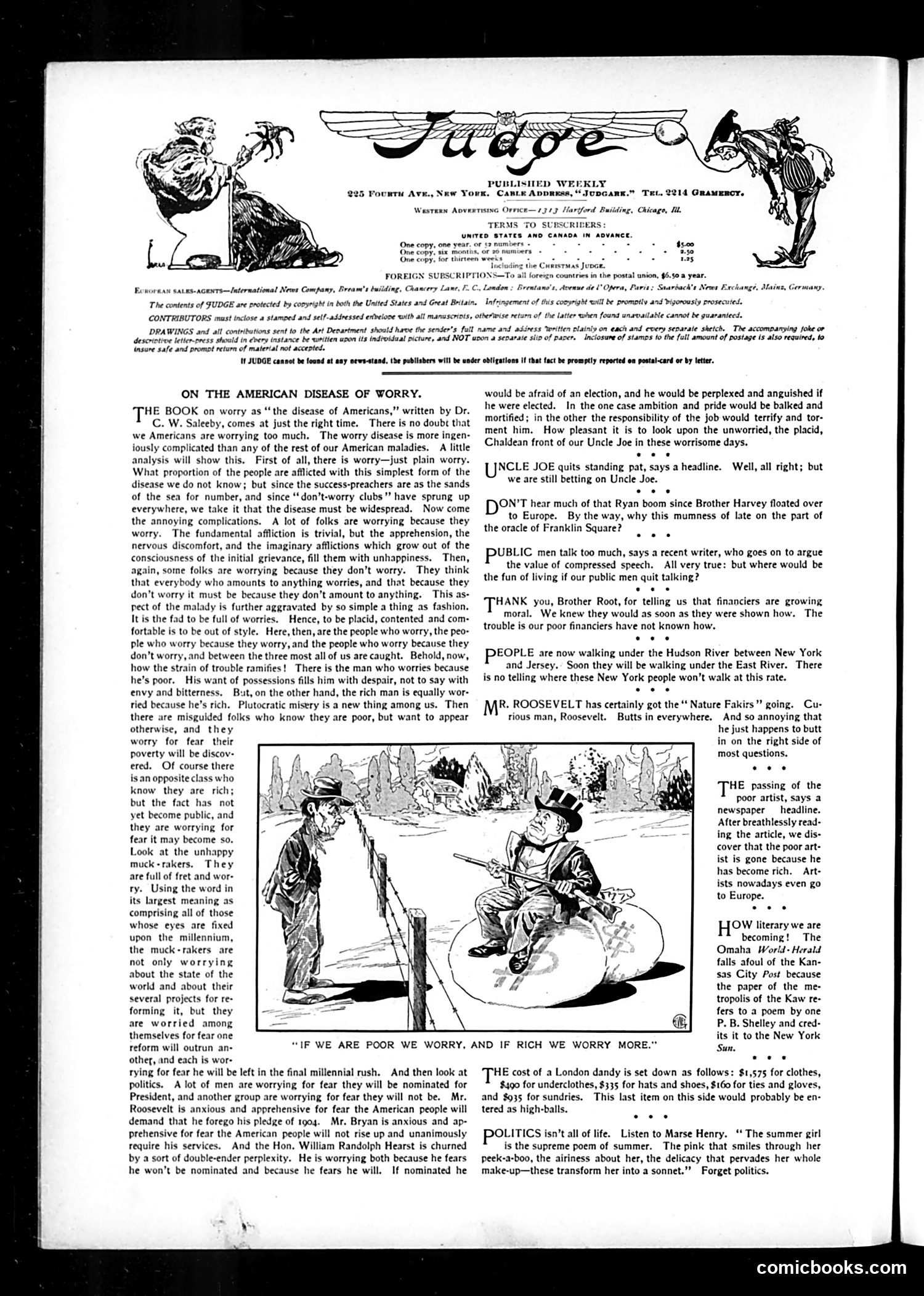
The cartoon depicts two figures fishing by a pole—one appearing shabby (poor) and one well-dressed (rich)—illustrating the article's central thesis about universal American anxiety. The accompanying essay "On the American Disease of Worry" argues that worry pervades all social classes regardless of wealth or status. The satire targets American anxiety culture specifically, suggesting that both poverty and prosperity generate distress: the poor worry about survival; the rich worry about losing position. The cartoon humorously visualizes this paradox through the contrasting figures sharing the same predicament, suggesting that worry is an inescapable American condition transcending economic class.
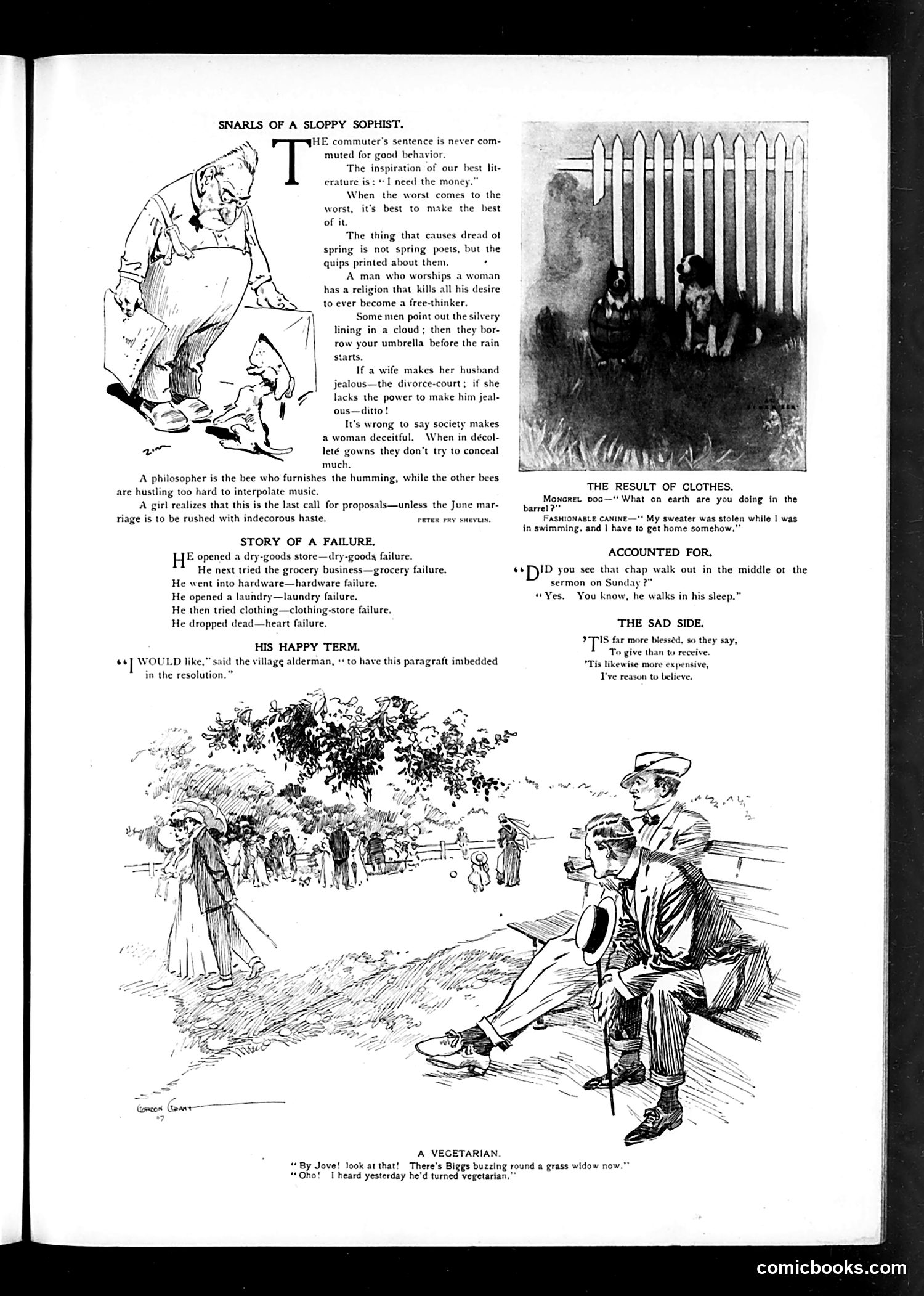
This page contains several short satirical pieces and cartoons typical of Judge's humor: **"Snarls of a Sloppy Sophist"** offers cynical observations on human behavior—relationships, philosophy, and social hypocrisy. The accompanying caricature depicts a disheveled figure. **"Story of a Failure"** uses repetition for comic effect, detailing a man's sequential business failures. **"The Result of Clothes"** shows a woman at a fence, with dialogue about stolen clothing—likely satirizing class pretension or women's vanity. **"A Vegetarian"** (bottom cartoon) jokes about a man becoming vegetarian, with the punchline playing on misheard information. The cartoons employ standard early-20th-century Judge style: social commentary, domestic humor, and absurdist jokes targeting contemporary foibles without referencing specific political events or individuals.
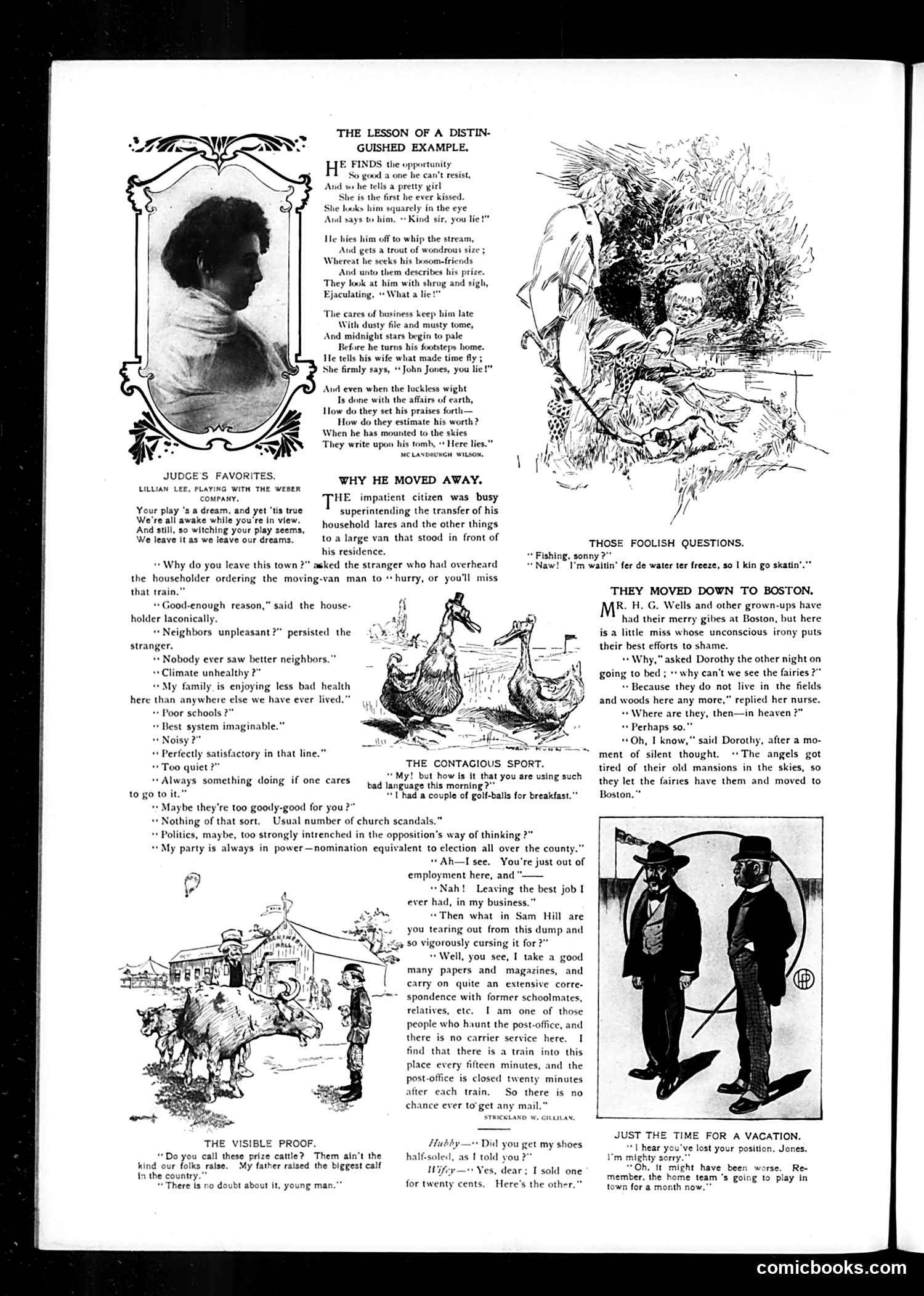
This page contains several satirical pieces and illustrations typical of early 20th-century American humor magazine Judge. **"The Lesson of a Distinguished Example"** presents a poem about a man who apparently abandons his responsibilities—likely critiquing someone who shirks duty or leaves their family/community. The accompanying portrait suggests this targets a specific public figure, though the OCR text doesn't identify whom. **"Why He Moved Away"** and related pieces mock a man relocating to Boston, with humor centered on his excuses and neighbors' reactions—common satirical fodder about urban migration and changing social status. The remaining sections use illustrations of rural/working-class figures for comedic effect, playing on period stereotypes about simple country folk and their perceived foolishness—typical Judge magazine fare targeting lower classes for laughs.
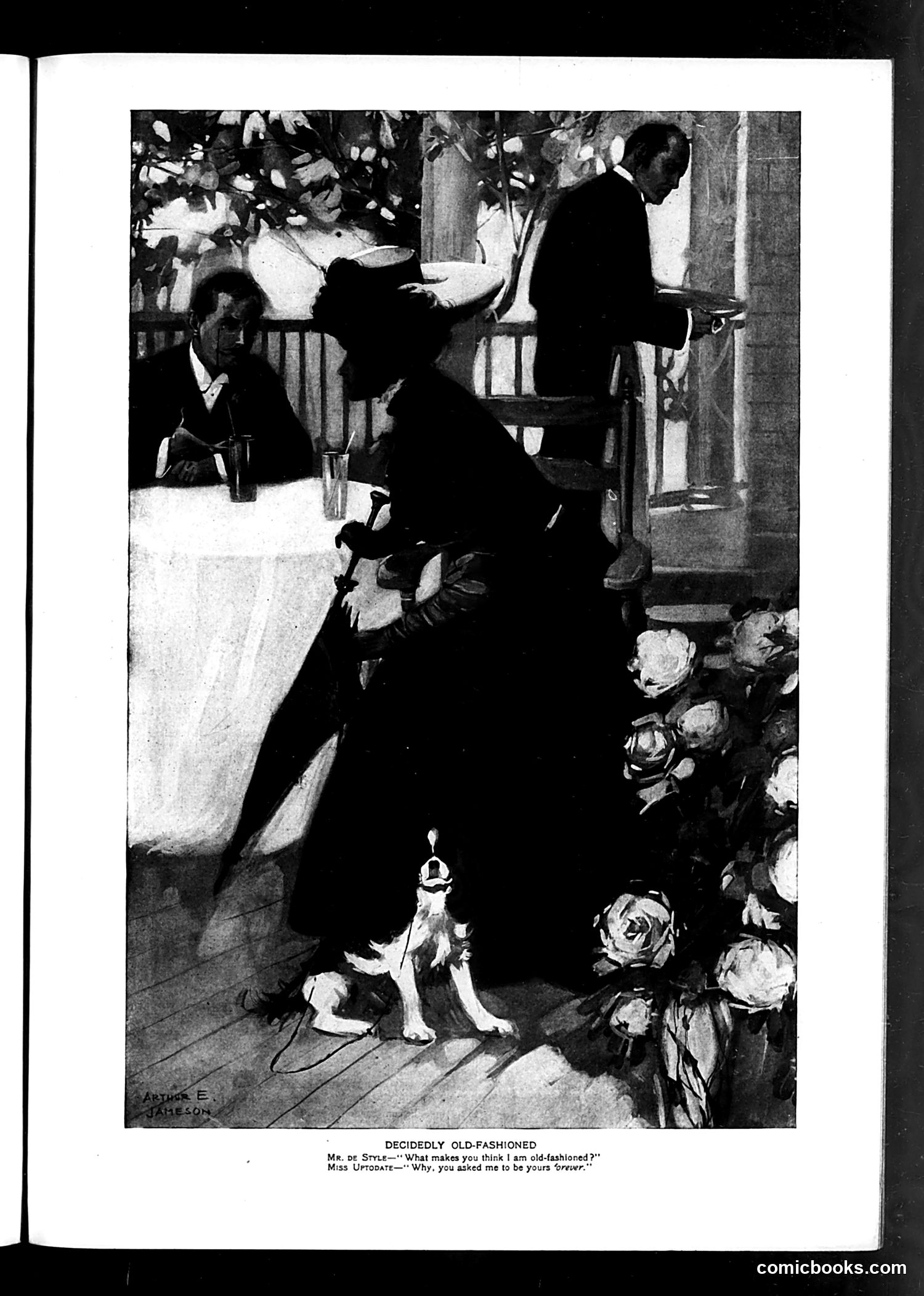
This cartoon satirizes outdated courtship conventions. The caption reads: **Man of Style**: "What makes you think I am old-fashioned?" **Miss Uptodate**: "Why, you asked me to be your 'Fiancée.'" The humor mocks a man who considers himself modern while still using old-fashioned romantic terminology. "Fiancée" (an engaged woman awaiting marriage) represented formal, Victorian-era courtship rituals that younger readers of Judge magazine would have viewed as stuffy and antiquated by the early 20th century. The small dog wearing a decorative collar among roses reinforces the "romantic" setting. The satire targets the disconnect between masculine self-perception and actual behavior—he thinks himself contemporary while clinging to traditional relationship language and conventions.
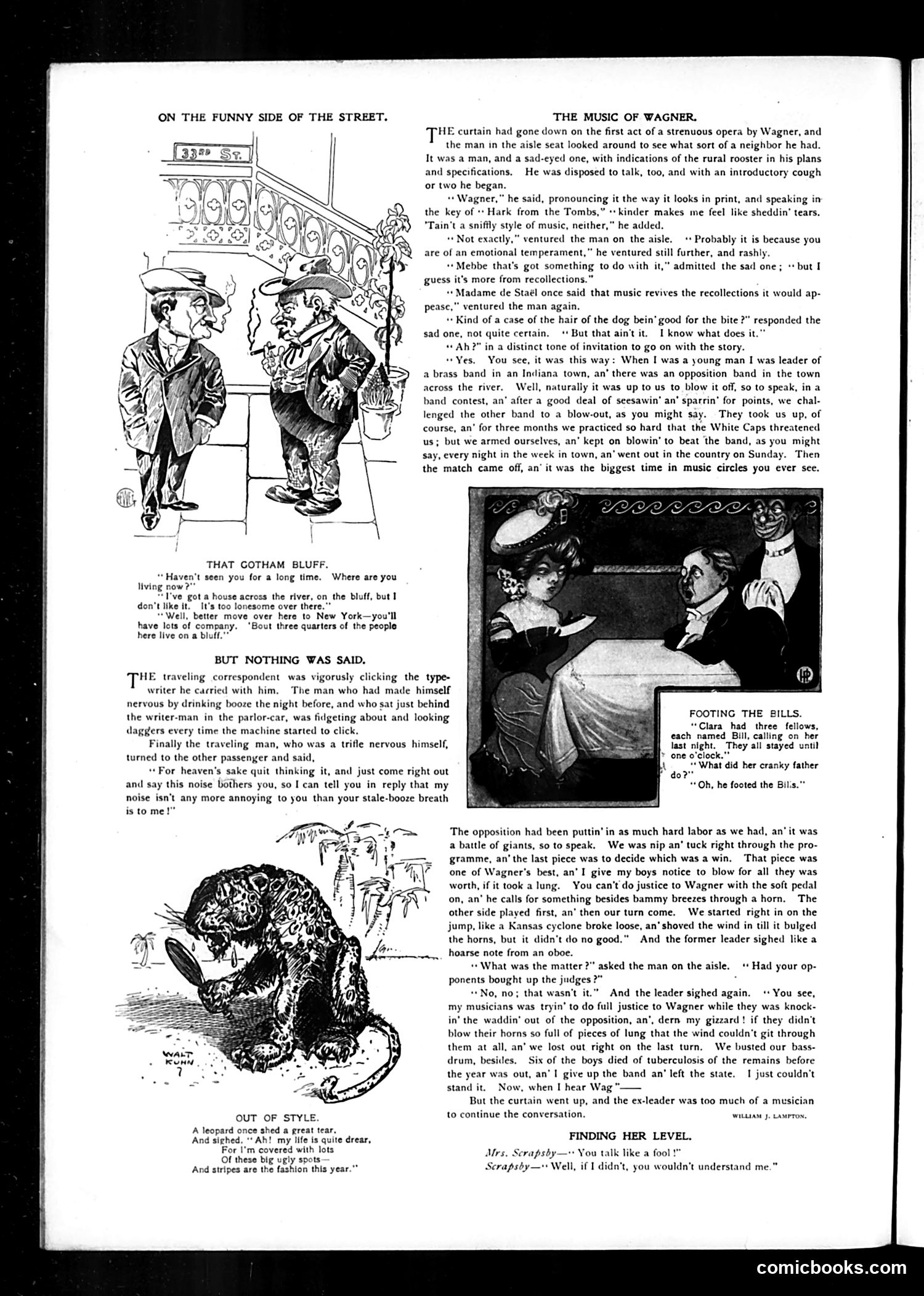
This Judge magazine page contains three separate humorous pieces: **"The Music of Wagner"**: A country man at an opera explains his emotional reaction to Wagner's music. He recalls leading a brass band in Indiana that competed against a rival town's band. They practiced intensely for the match, which became a major local event. The joke relies on the contrast between Wagner's sophisticated reputation and this rustic character's nostalgic connection to it through a small-town music competition—suggesting highbrow culture unexpectedly resonates with ordinary people for humble reasons. **"That Gotham Bluff"**: A man from across the river complains New York is too lonely. A New Yorker quips that three-quarters of New Yorkers live "on a bluff" (figuratively, meaning they're phonies or pretenders). It's social satire about metropolitan artificiality. **"Footing the Bills"**: A brief joke about a woman's cranky father who, when asked what he did about her staying out late, simply "footed the bills"—paid for everything rather than objecting. Light domestic humor about parental permissiveness.
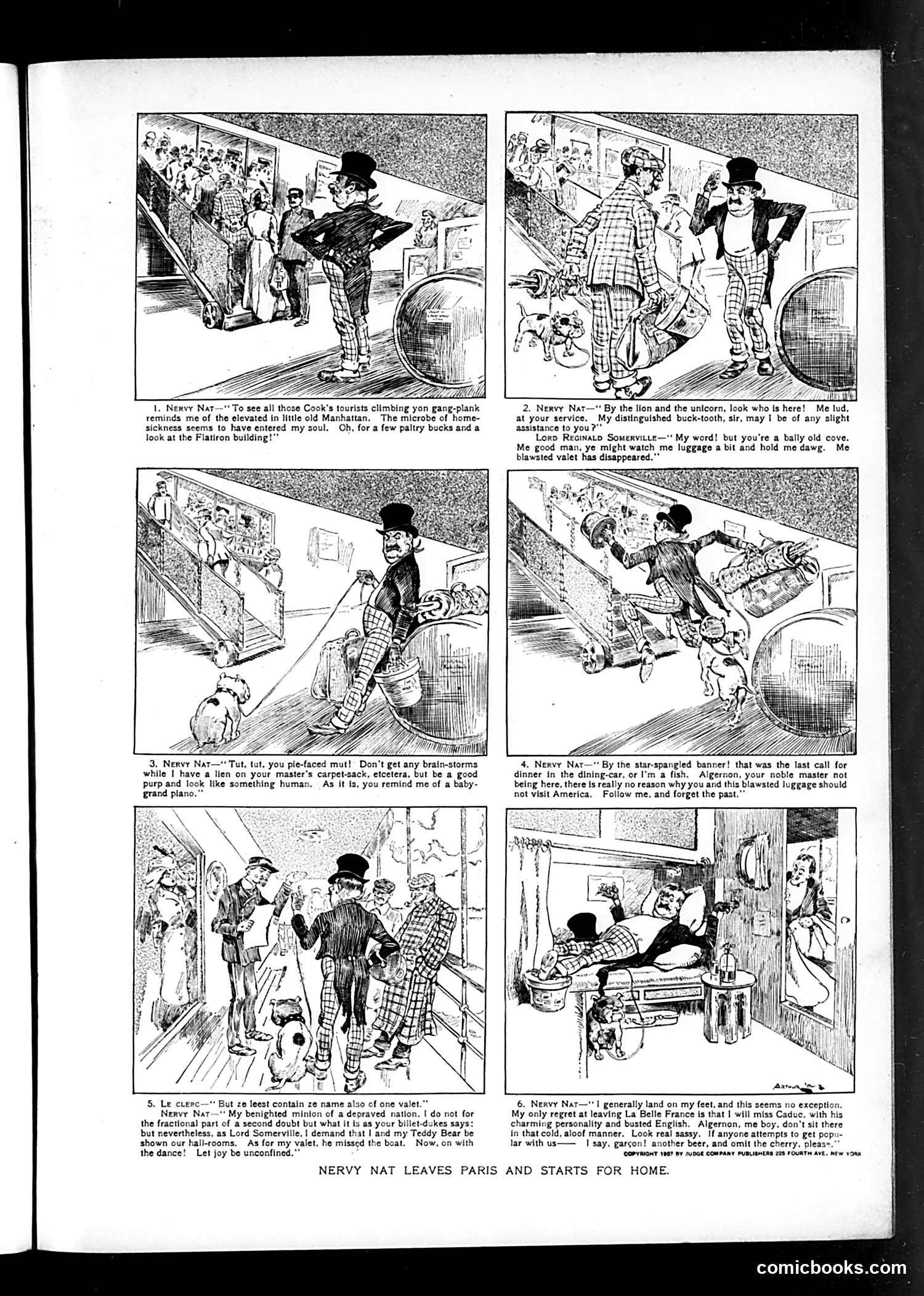
This six-panel comic strip satirizes American tourists abroad, specifically a brash character named "Nervy Nat" traveling with an English aristocrat, Lord Reginald Somerville. The humor plays on contrasting national stereotypes: Nat represents the vulgar, homesick American (nostalgic for Manhattan's Flatiron building), while Somerville embodies pompous British upper-class affectation with exaggerated speech ("bally," "blawsted"). The satire targets Nat's tourist behavior—complaining about homesickness despite traveling, his obnoxious confidence ("land on my feet"), and his casual disrespect toward servants and luggage. The final panel shows him drunk and ordering another beer, reinforcing stereotypes of uncouth American tourists. The recurring joke involves Nat's irreverent treatment of Somerville's lost valet and general disregard for European proprieties, mocking American travelers' perceived lack of sophistication and manners.
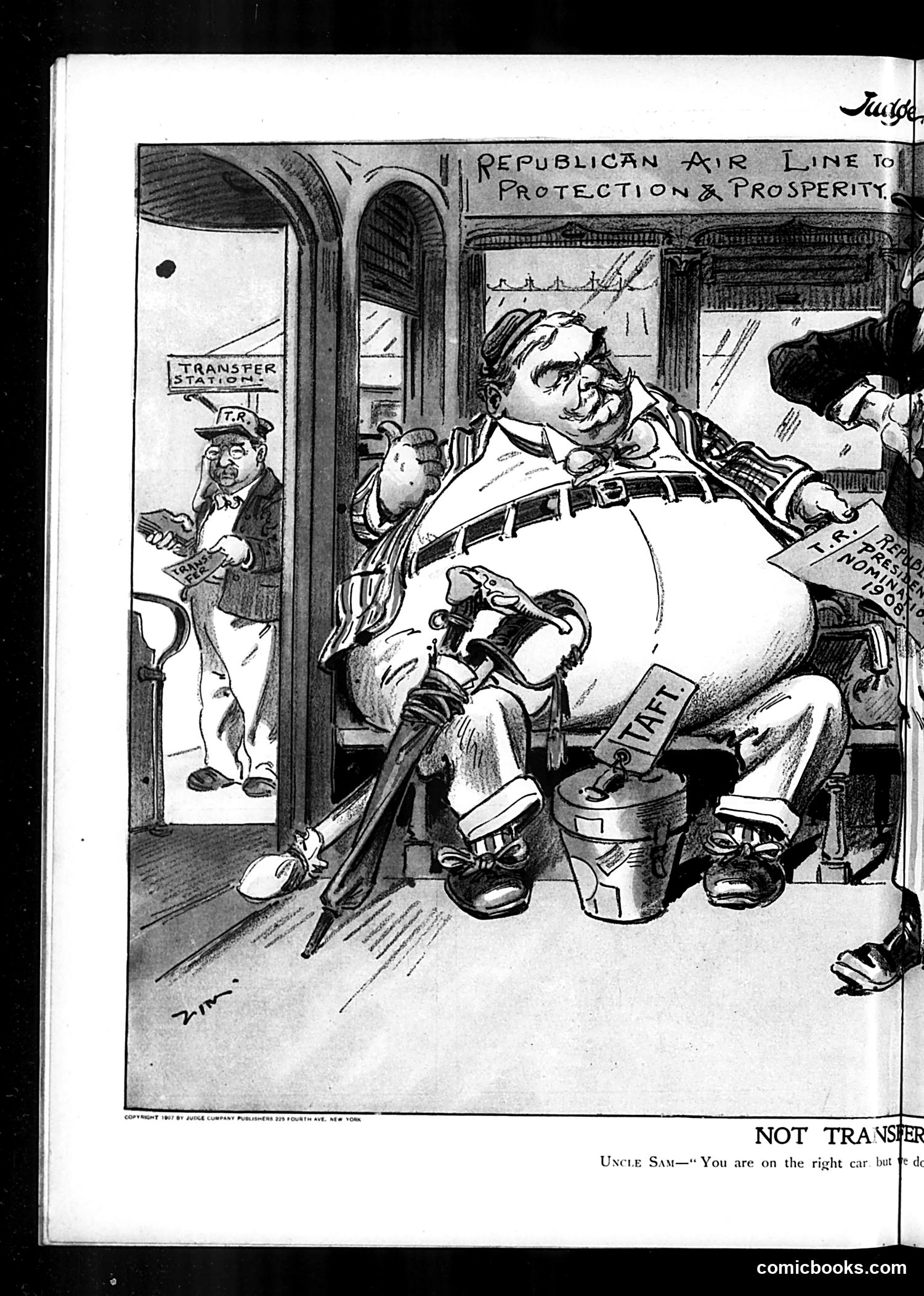
This Judge magazine cartoon depicts Uncle Sam (representing the United States government) boarding a streetcar labeled "TRANSFER STATION." The banner overhead reads "REPUBLICAN AID TO PROTECTION & PROSPERITY." A conductor at the door appears to be directing Uncle Sam, saying "You are on the right car, but fe dc" (text cuts off). Various figures around the car carry signs including "TARIFF" and what appears to be "MONOPOLY." The satire appears to critique Republican trade policies—specifically protective tariffs—as a mechanism that promises prosperity but may actually benefit monopolies and special interests rather than the general public. The "transfer" metaphor suggests the government is being redirected or manipulated by these economic forces. The cartoon's point seems skeptical of Republican claims that protectionist policies benefit ordinary Americans.
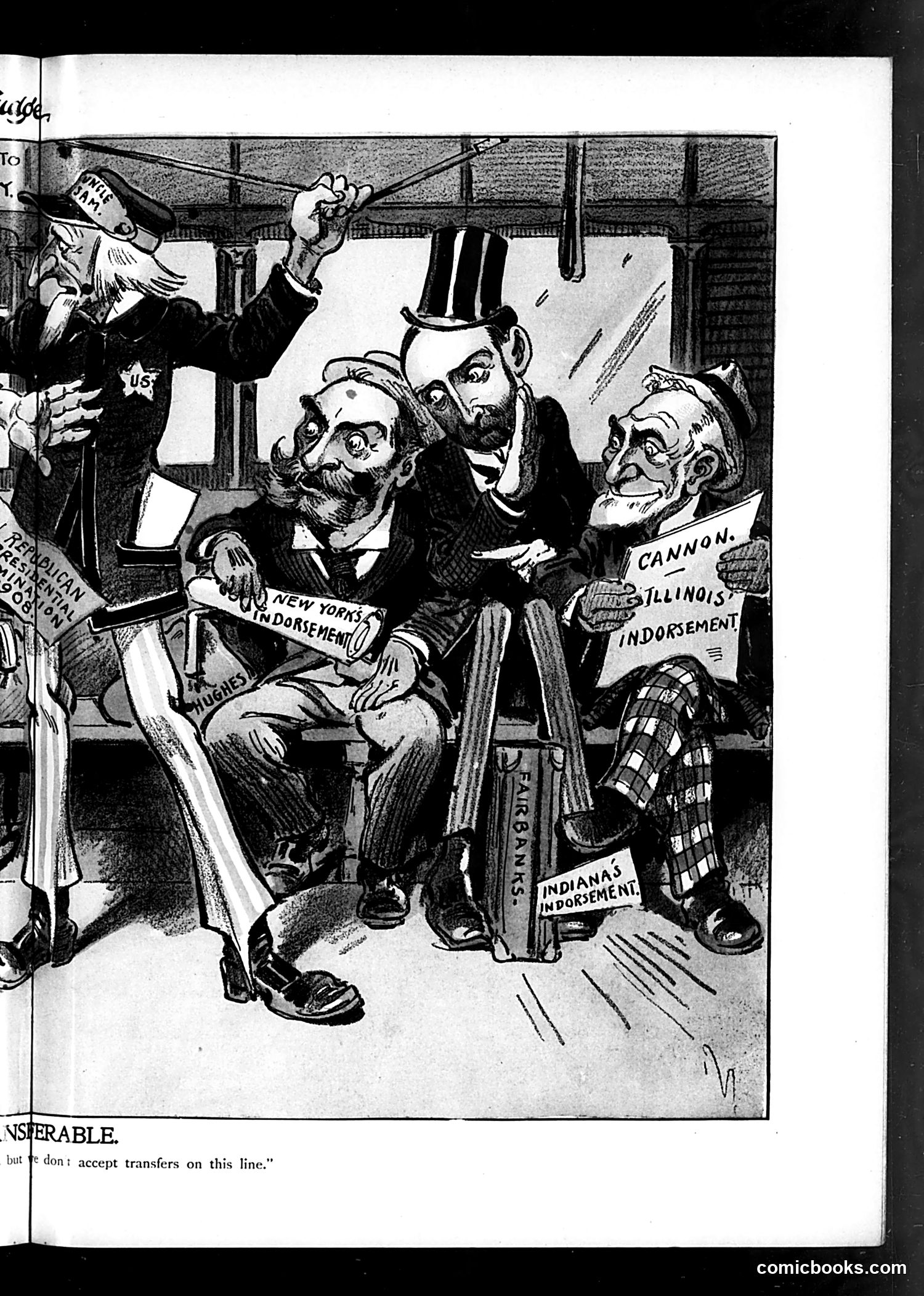
This cartoon depicts three well-dressed men in a railway car labeled with state endorsements: "New York Indorsement," "Cannon, Illinois Indorsement," and "Indiana's Indorsement." The central figure wears a top hat and appears to be a political candidate receiving backing from multiple states. The joke centers on the phrase "but we don't accept transfers on this line"—a railway reference suggesting that while these state endorsements look good, they may not actually be transferable or useful for the candidate's political journey. The caricatures likely represent political figures or factions from the early 1900s, though specific identities aren't clearly labeled. The satire mocks politicians collecting regional support that may prove worthless or incompatible for their broader ambitions.
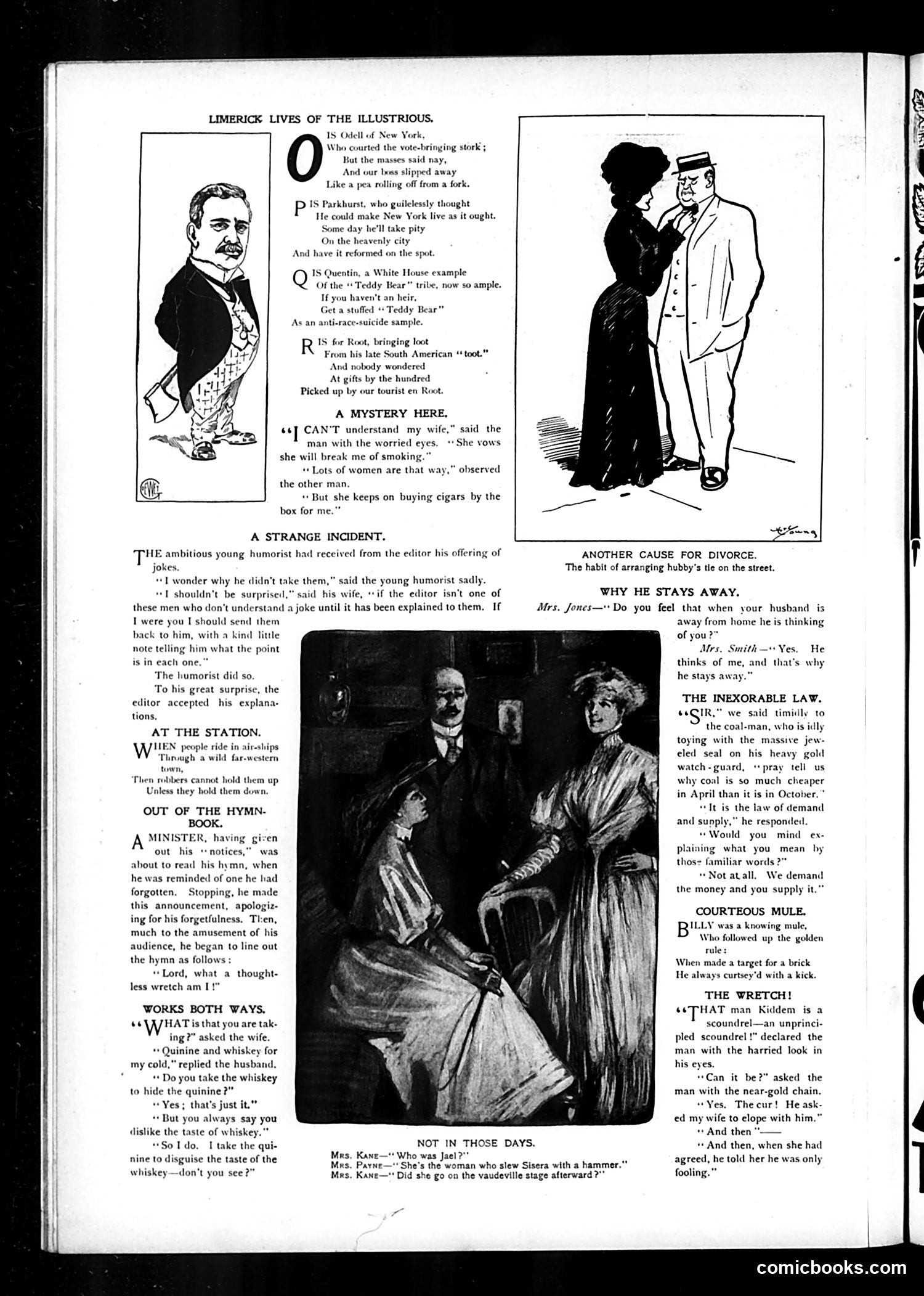
This page from *Judge* satirizes prominent American political figures through mock-biographical limericks: **"O" (Odell of New York)**: Likely Frank W. Odell, criticized for pursuing votes through populist measures ("vote-bringing stork") that failed with the public. **"P" (Parkhurst)**: Appears to reference Rev. Charles Parkhurst, a reformer who aimed to clean up New York City but whose efforts seem perpetually incomplete—mocked as naive idealism. **"Q" (Quentin, Teddy Bear)**: References President Theodore Roosevelt's family, with "Teddy Bear" toys satirizing how the Roosevelt administration used populist imagery. **"R" (Elihu Root)**: Secretary of State Root is mocked for acquiring wealth from South American diplomatic missions—implying graft or inappropriate "gifts." The remaining content comprises unrelated humorous anecdotes about marriage, coal prices, and a mule. The page demonstrates *Judge*'s typical early-1900s approach: mixing political satire of actual figures with domestic humor for broad appeal.
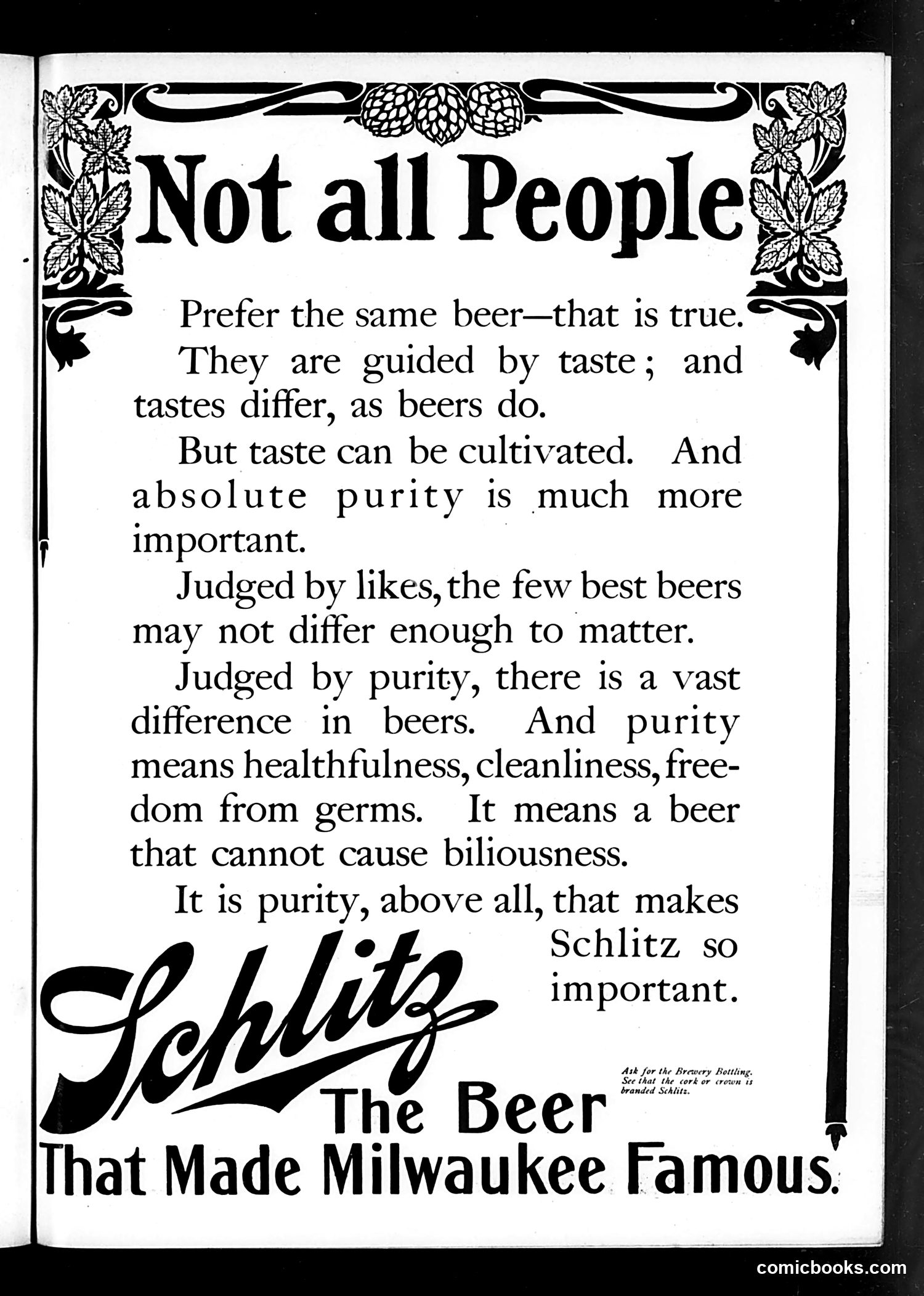
This is a **Schlitz beer advertisement**, not satire or political commentary. The "Not all People" headline introduces an argument about beer preferences: while people differ in taste, purity matters more than personal preference. The ad's central claim is that Schlitz beer's value lies not in superior flavor but in its **purity**—freedom from germs, cleanliness, and healthfulness. It promises the beer won't cause "biliousness" (digestive upset), a common complaint about period beers. This reflects early 20th-century **food safety anxieties** when contaminated beer and food caused genuine illness. Schlitz marketed scientific purity as a health benefit rather than taste superiority, positioning itself as the responsible choice for health-conscious consumers. The decorative border and typography suggest this appeared in *Judge* magazine as a paid advertisement promoting Milwaukee's famous brewery.
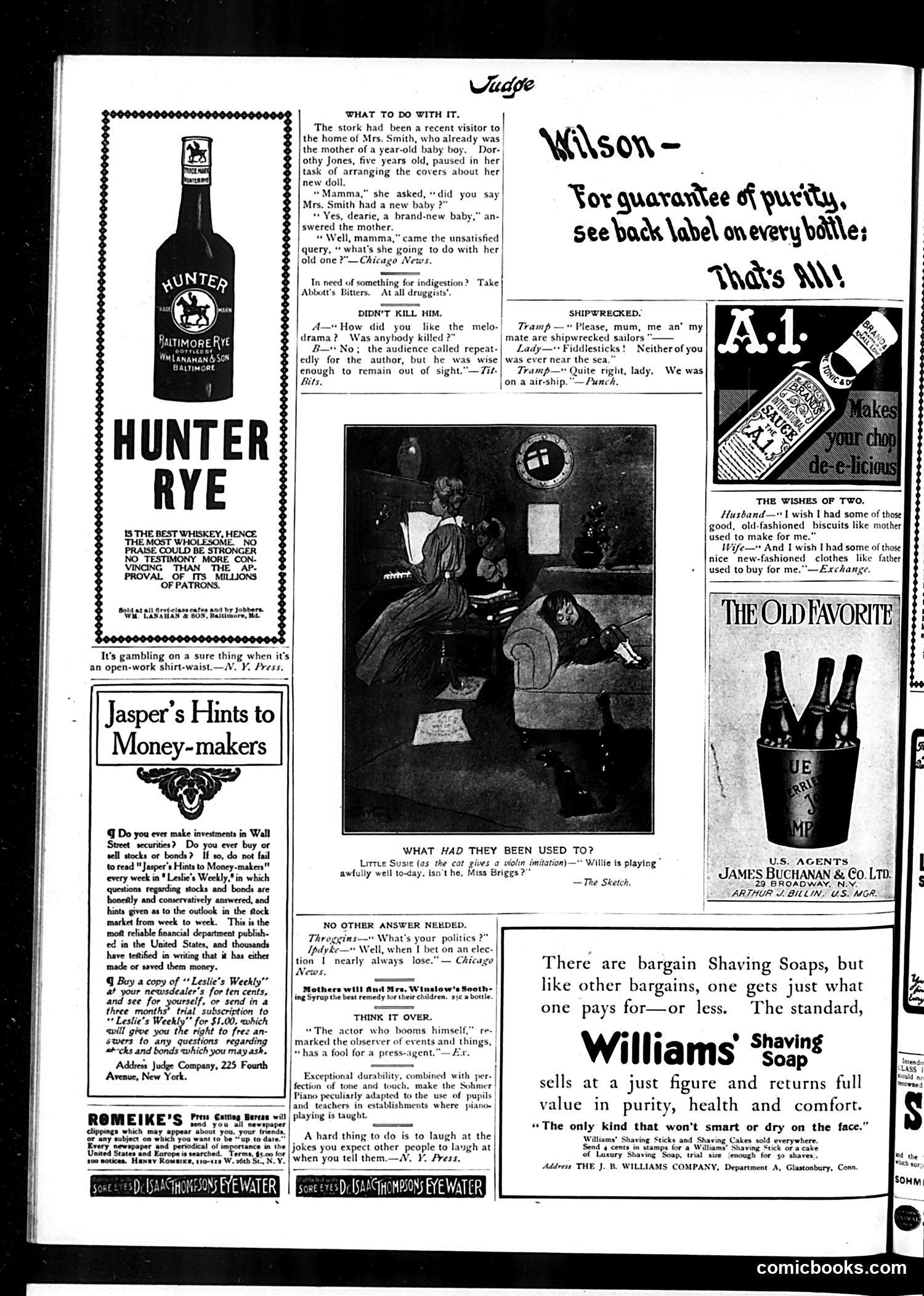
This is primarily an **advertising and humor page** from Judge magazine, a satirical publication. The content consists of: **Main Elements:** - Multiple brief comic anecdotes mocking social situations (a child's naive question about a newborn, disappointed theater audiences, shipwrecked con artists) - "Jasper's Hints to Money-makers"—financial advice column - **Large advertisements** for consumer products: Hunter Rye whiskey, A.I. sauce, Williams' Shaving Soap, and The Old Favorite liquor brand **The Satire:** The humor targets everyday absurdities: adult foolishness (audiences demanding authors appear), working-class deception (fake sailors), and pretension (an actor "booming himself"). The financial column offers tongue-in-cheek investment tips, treating stock speculation as gambling. **Context for Modern Readers:** This reflects early 20th-century attitudes toward alcohol consumption (advertised openly), gender roles (wives wishing for "old-fashioned" domesticity), and class-based humor. The page blends entertainment with commercial promotion—typical of period magazines that monetized through advertising.
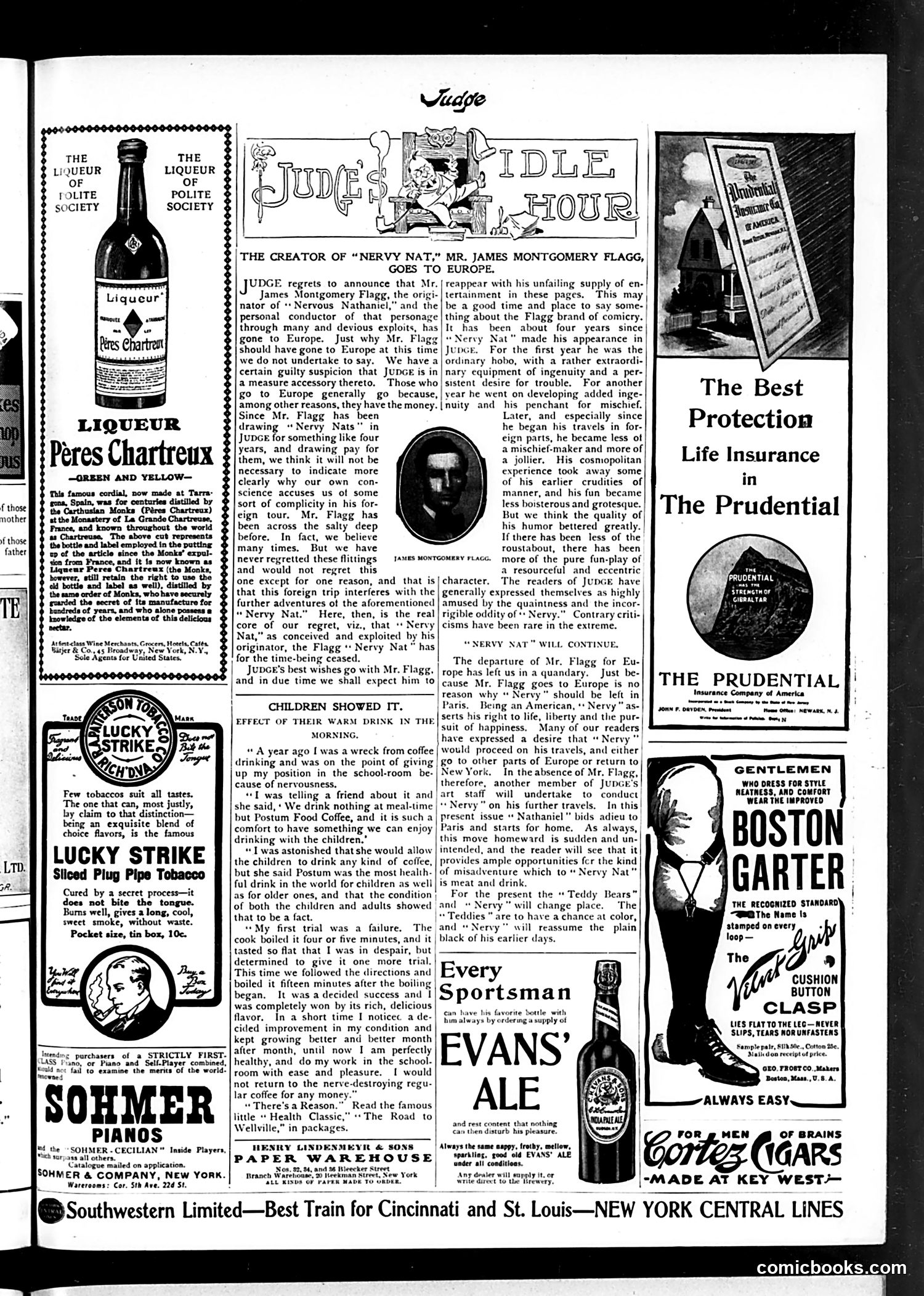
This page is primarily **advertising with one substantial article** about cartoonist James Montgomery Flagg. ## Main Content: The central piece announces that **James Montgomery Flagg**, creator of the comic strip character **"Nervy Nat,"** is departing for Europe. Judge expresses mock regret, humorously suggesting the magazine itself is "accessory" to his departure since they've profited from publishing his work for four years. The article describes Flagg's comedic style: "Nervy Nat" began as an ordinary hobo character but evolved into a figure of "ingenious" trouble-making that readers found entertaining. Judge's tongue-in-cheek tone—claiming conscience-stricken guilt over complicity in his European trip—is the satire: they're joking that they've benefited so much from his popular comic that they feel responsible for his ability to afford foreign travel. ## Advertisements: The page is surrounded by period product ads (Pères Chartreux liqueur, Lucky Strike tobacco, Sohmer Pianos, Postum coffee, Life Insurance, Boston Garter, Evans' Ale, and Cortez Cigars)—typical of Judge's revenue model.
This page from Judge magazine contains satirical commentary and advertisements typical of early 20th-century American humor. **Main Content:** The lead poem "Why Wait?" advocates showing kindness and appreciation to people before they die, rather than only praising their virtues posthumously—a sentimental moral plea. **"A Sensitive Editor"** satirizes the financial vulnerabilities of country newspaper editors. The piece argues that editors face constant economic pressure: taking editorial stances costs them advertising revenue and reader subscriptions, regardless of which position they take. This critiques how economic interests constrain press freedom and editorial integrity. **Other humor pieces** include brief jokes about marital clothing costs and a rhymed anecdote about an alligator swallowing a fisherman named Billy. **Advertisements dominate the page**, hawking period remedies (Santa Midy capsules for kidney troubles, Cook Remedy Co. for blood poison) and spirits (I.W. Harper Rye, Trimble Whiskey, Sunny Brook Whiskey, Underberg Bitters)—common in magazines of this era before strict advertising regulations. The page primarily exemplifies Judge's mix of social commentary and commercial content rather than featuring specific political cartoons or identifiable caricatures.
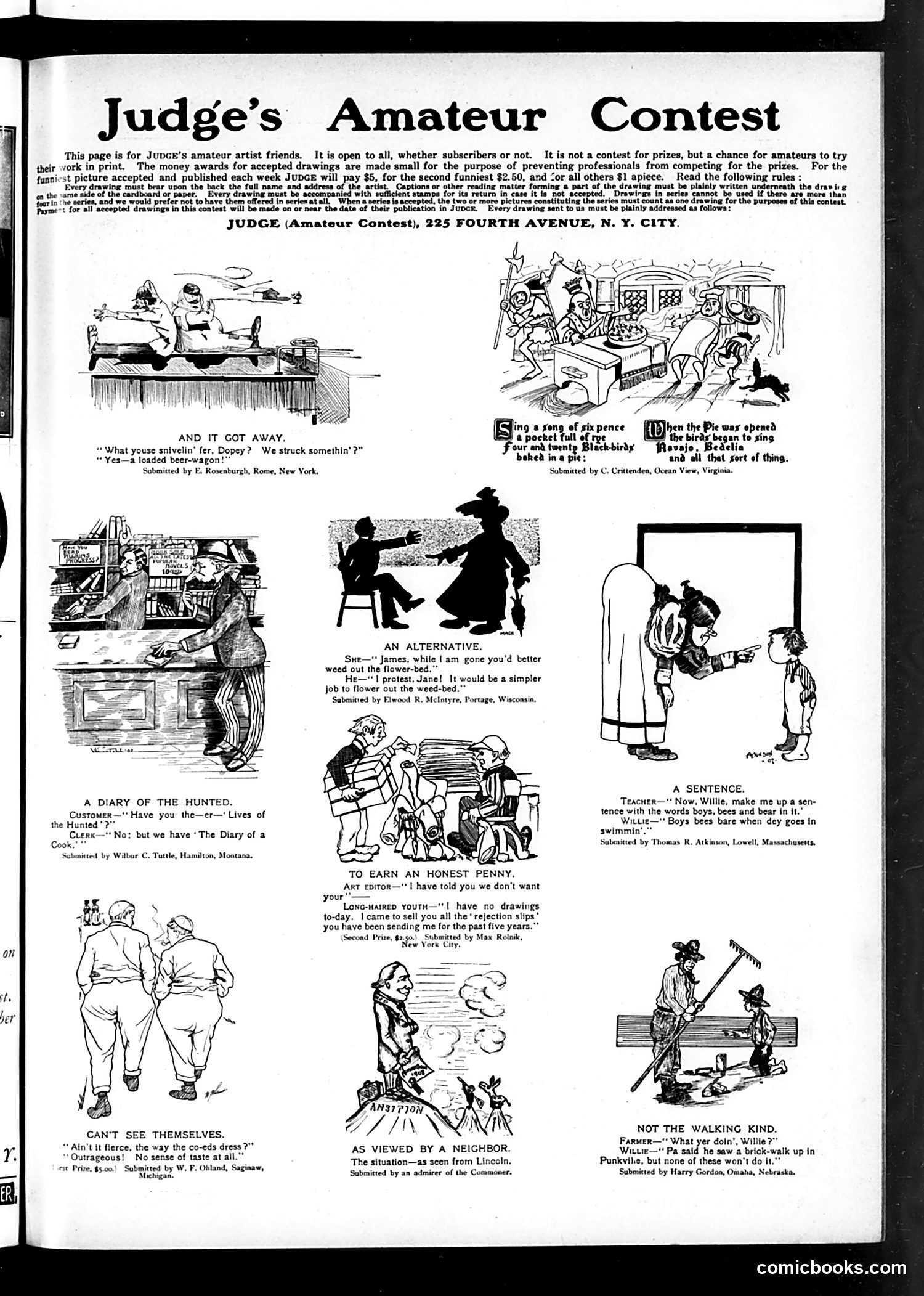
This is a submissions page for *Judge* magazine's amateur cartoonist competition, showcasing humorous single-panel cartoons and brief comic scenarios from readers. The cartoons employ period humor conventions: "And It Got Away" uses working-class dialect humor about a beer wagon collision; "A Diary of the Hunted" makes a pun equating a cookbook with game-hunting literature; "Can't See Themselves" satirizes young women's fashion choices through female hypocrisy; "An Alternative" uses wordplay about weeding flower beds versus flowers. Other entries target specific audiences: schoolteachers ("A Sentence"), struggling artists ("To Earn an Honest Penny"), and rural characters using exaggerated dialect. The jokes rely on malapropisms, puns, and social observation rather than political commentary. The page itself advertises the contest's modest payments ($5 first prize, $2.50 second), encouraging amateur participation while discouraging professionals. This was typical early-20th-century magazine content—accessible, genteel humor aimed at middle-class readers.
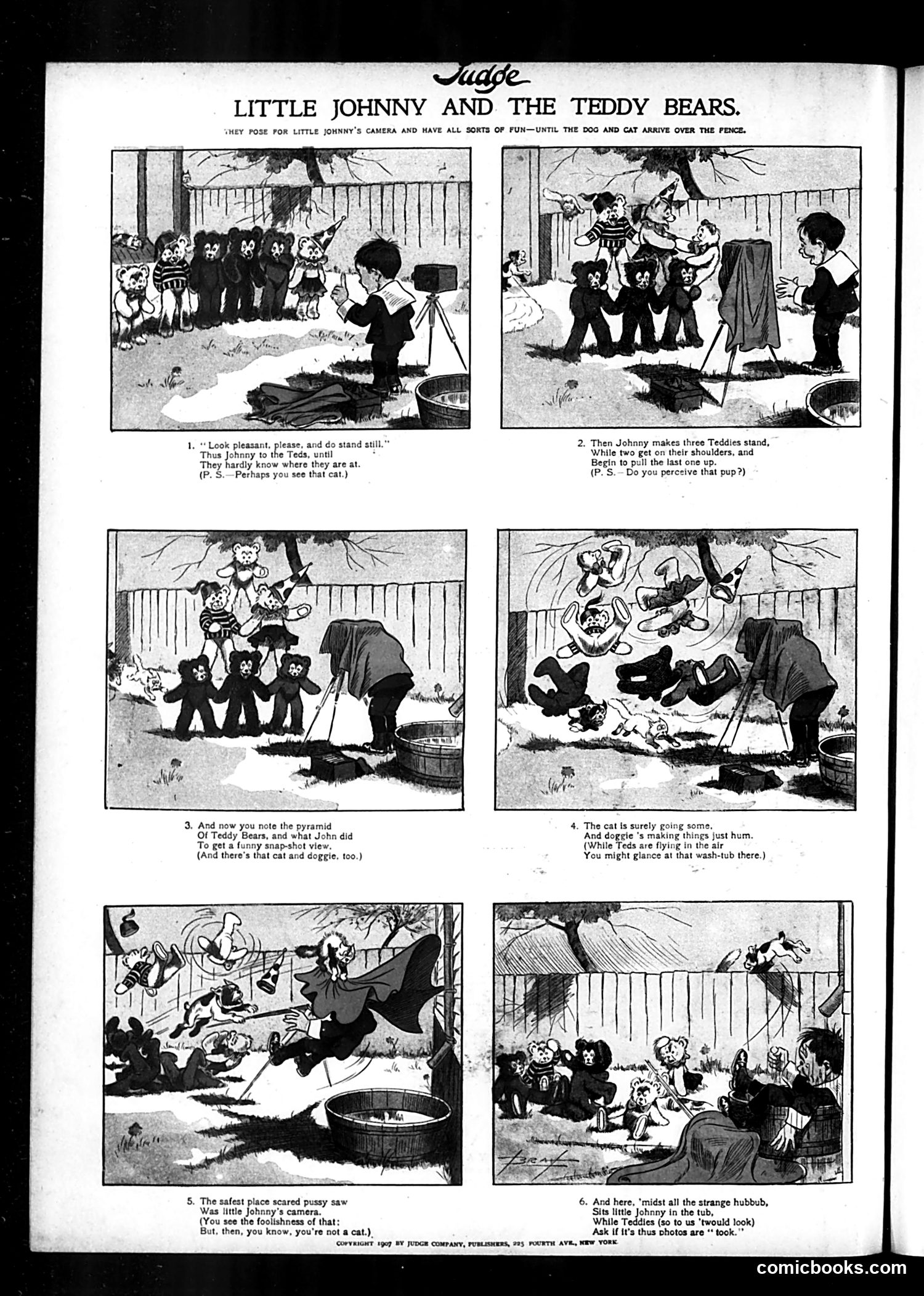
This is a humorous six-panel children's comic strip from Judge magazine (1907) with no political satire. It depicts a boy named Johnny staging a photo shoot with stuffed teddy bears, arranging them into an increasingly precarious pyramid formation for his camera. The joke builds progressively: the bears cooperate initially, but chaos erupts when a dog and cat crash through the fence, scattering the bears and animals everywhere. The cat seeks refuge in Johnny's camera, while the dog causes mayhem. The humor culminates with Johnny himself ending up in a washtub amid the pandemonium. The accompanying verse provides running commentary on each panel's action, emphasizing the comedic disorder and the irony of how the animals' instinctive reactions differ from how photography "should" work. It's gentle, slapstick humor aimed at children—no deeper satirical meaning intended.