
Judge, 1907-06-08 · page 2 of 16
Judge — June 8, 1907 — page 2: what you’re looking at
What you’re looking at
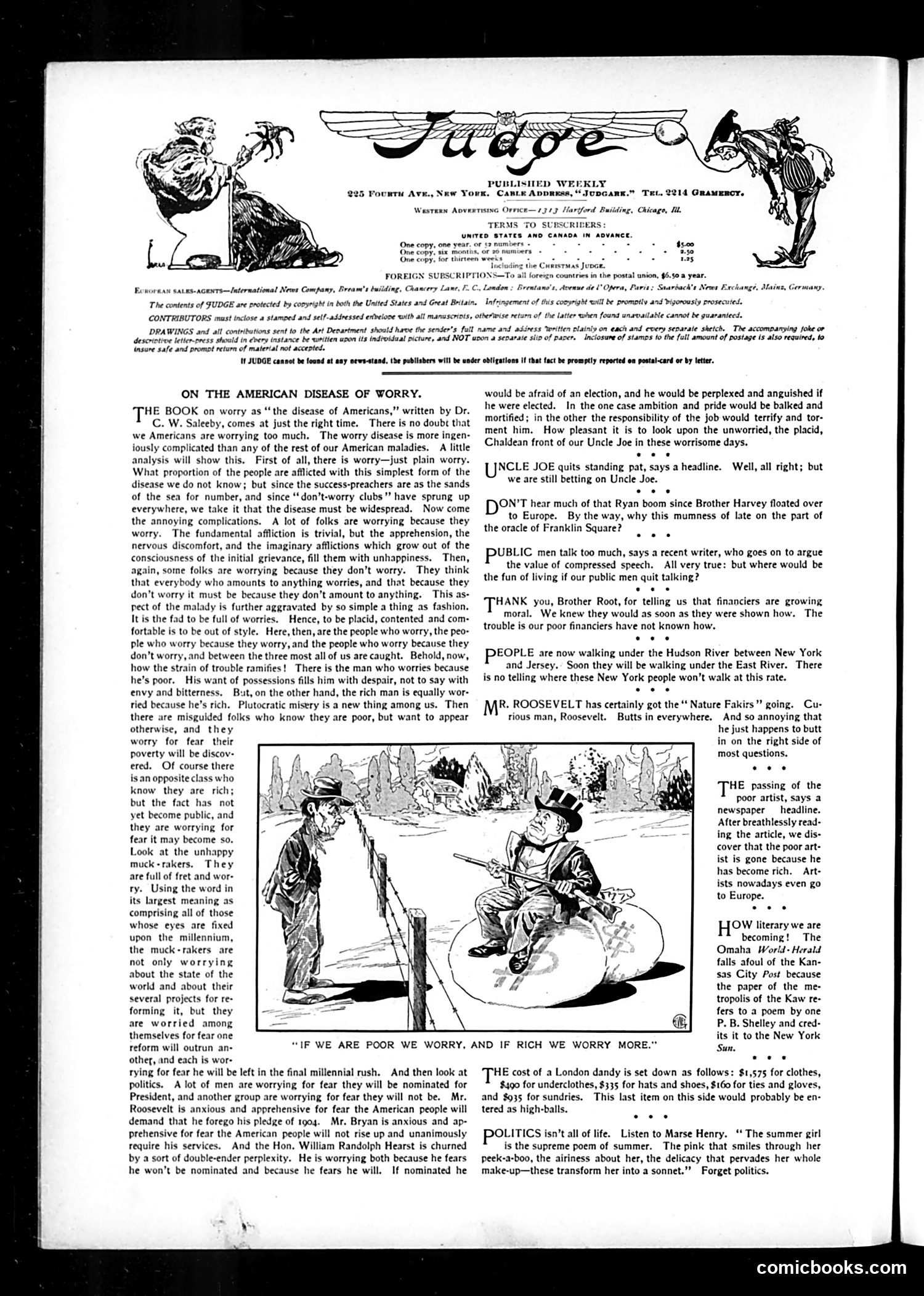
The cartoon depicts two figures fishing by a pole—one appearing shabby (poor) and one well-dressed (rich)—illustrating the article's central thesis about universal American anxiety. The accompanying essay "On the American Disease of Worry" argues that worry pervades all social classes regardless of wealth or status. The satire targets American anxiety culture specifically, suggesting that both poverty and prosperity generate distress: the poor worry about survival; the rich worry about losing position. The cartoon humorously visualizes this paradox through the contrasting figures sharing the same predicament, suggesting that worry is an inescapable American condition transcending economic class.
📄 Transcribed text from this page (OCR, searchable)
Machine-transcribed from the original scan — historical spelling and the odd misread are preserved.
Fourtu Ave., New Yous, Cai ISHED WEEKLY Appress, “JopcaRrK.” Tet, 2214 Grawencr. Western Aovexnisixc Orr Eonoraan satns-acents—Jaternational News Company, Bream's building, Chancery Lane, F.C, Landon : Brentans's, Avenue de "Opera, Pari TERMS AND CANADA IN ADVANCE. estas Juoce. countries in the postal union, $5.50. year. Starbach's News Exchange, Mains, Germany. The contents of FUDGE are protected by copyright in both the United States and Great Britain. Infringement of this covyright will be promptly and digorously prosecuted. CONTRIBUTORS must inciose a stamped and self-addressed endeiove with all manuscriots, otherwise retarn of the I when found unavailaNe cannot be guaranteed. DRAWINGS and all contributions sent to the Art Decartment should have the sender's fall name and adress written plainly on each and every separate sketch. The accompanying joke or descrinteve letter-press should in ebery instance be written upon iis indroasaal picture, and NOT ucon a sevarate slip of paver. Inclosure of stamps 10 the full amount of postage (s also required, to tnsure safe and prompt return of material not accepted. MW JUDGE cansot be found at any sews-stand, te publishers will be under obligations if rhat fact be promptly reported on postal-card or by letter. ON THE AMERICAN DISEASE OF WORRY. THE BOOK on worry as “the disease of Americans,” written by Dr. C. W. Saleeby, comes at just the right time. There is no doubt that we Americans are worrying too much. The worry disease is more ingen- iously complicated than any of the rest of our American maladies. A little analysis will show this. First of all, there is worry—just plain worry. What proportion of the people are afflicted with this simplest form of the disease we do not know; but since the success-preachers are as the sands of the sea for number, and since “‘don’t-worry clubs” have sprung up everywhere, we take it that the disease must be widespread. Now come the annoying complications. A lot of folks are worrying because they worry. The fundamental affliction is trivial, but the apprehension, the nervous discomfort, and the imaginary afflictions which grow out of the consciousness of the initial grievance, fill them with unhappiness. Then, again, some folks are worrying because they don’t worry. They think that everybody who amounts to anything worries, and that because they don’t worry it must be because they don’t amount to anything. This as- pect of the malady is further aggravated by so simple a thing as fashion. It is the fad to be full of worries. Hence, to be placid, contented and com- fortable is to be out of style. Here, then, are the people who worry, the peo- ple who worry because they worry, and the people who worry because they don’t worry, and between the three most all of us are caught. Behold, now, how the strain of trouble ramifies! There is the man who worries because he’s poor. His want of possessions fills him with despair, not to say with envy and bitterness. But, on the other hand, the rich man is equally wor- ried because he’s rich. Plutocratic misery is a new thing among us. Then there are misguided folks who know they are poor, but want to appear otherwise, and they worry for fear their poverty will be discov- ered. Of course there is an opposite class who know they are rich; but the fact has not yet become public, and they are worrying for fear it may become so. Look at the unhappy muck-rakers. They are full of fret and wor- ry. Using the word in its largest meaning as comprising all of those whose eyes are fixed upon the millennium, the muck-rakers are not only worrying about the state of the world and about their several projects for re- forming it, but they are worried among themselves for fear one reform will outrun an- other, and each is wor- rying for fear he will be left in the final millennial rush. And then look at politics. A lot of men are worrying for fear they will be nominated for President, and another group are worrying for fear they will not be. Mr. Roosevelt is anxious and apprehensive for fear the American people will demand that he forego his pledge of 1904. Mr. Bryan is anxious and ap- prehensive for fear the American people will not rise up and unanimously require his services. And the Hon. William Randolph Hearst is churned by a sort of double-ender perplexity. He is worrying both because he fears he won't be nominated and because he fears he will. If nominated he “IF WE ARE POOR WE WORRY, AND IF RICH WE WORRY MORE.” would be afraid of an election, and he would be perplexed and anguished if he were elected. In the one case ambition and pride would be balked and mortified; in the other the responsibility of the job would terrify and tor- ment him. How pleasant it is to look upon the unworried, the placid, Chaldean front of our Uncle Joe in these worrisome days. [UNCLE JOE quits standing pat, says a headline. we are still betting on Uncle Joe. Don't. hear much of that Ryan boom since Brother Harvey floated over to Europe. By the way, why this mumness of late on the part of the oracle of Franklin Square? Well, all right; but PUBLIC men talk too much, says a recent writer, who goes on to argue the value of compressed speech. All very true: but where would be the fun of living if our public men quit talking? eee THANK you, Brother Root, for telling us that financiers are growing moral. We knew they would as soon as they were shown how. The trouble is our poor financiers have not known how. PEOPLE are now walking under the Hudson River between New York and Jersey. Soon they will be walking under the East River. There is no telling where these New York people won't walk at this rate. R, ROOSEVELT has certainly got the “‘ Nature Fakirs”” going. Cu- rious man, Roosevelt. Butts in everywhere. And so annoying that he just happens to butt in on the right side of most questions. eee THE passing of the poor artist, says a newspaper headline. After breathlessly read ing the article, we dis cover that the poor art- ist is gone because he has become rich. Art- ists nowadays even go to Europe. HOW literary we are becoming! The Omaha World-Herald falls afoul of the Kan- sas City Post because the paper of the me- tropolis of the Kaw re- fers to a poem by one P. B. Shelley and cred- its it to the New York Sun. THE cost of a London dandy is set down as follows: $1,575 for clothes, $490 for underclothes, $335 for hats and shoes, $160 for ties and gloves, and $935 for sundries. This last item on this side would probably be en- tered as high-balls. wee POLITICS isn’t all of life. Listen to Marse Henry. “ The summer girl is the supreme poem of summer. The pink that smiles through her peek-a-boo, the airiness about her, the delicacy that pervades her whole make-up—these transform her into a sonnet.” Forget politics. comicbooks.com