
A complete issue · 16 pages · 1906
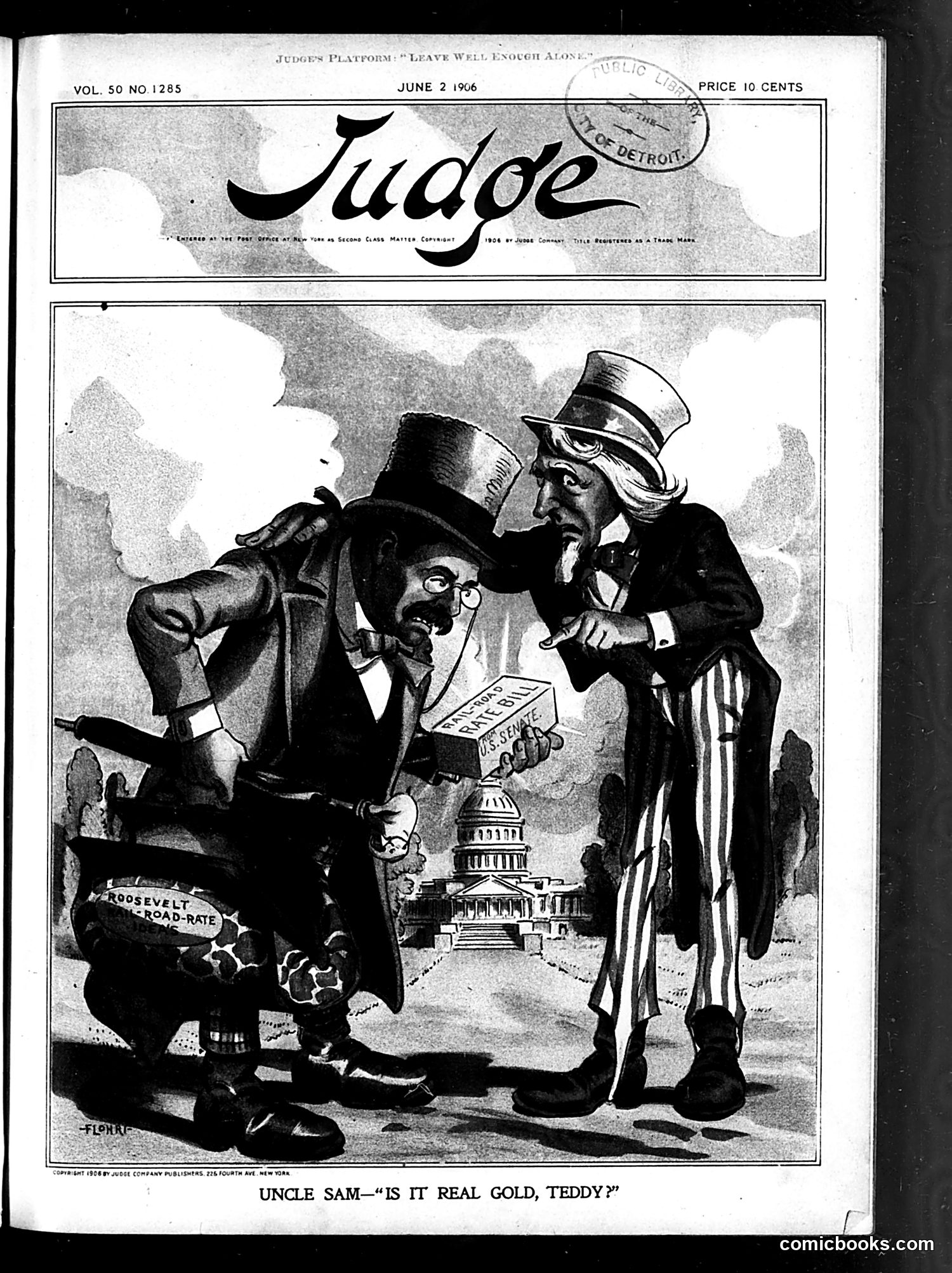
Judge — June 2, 1906
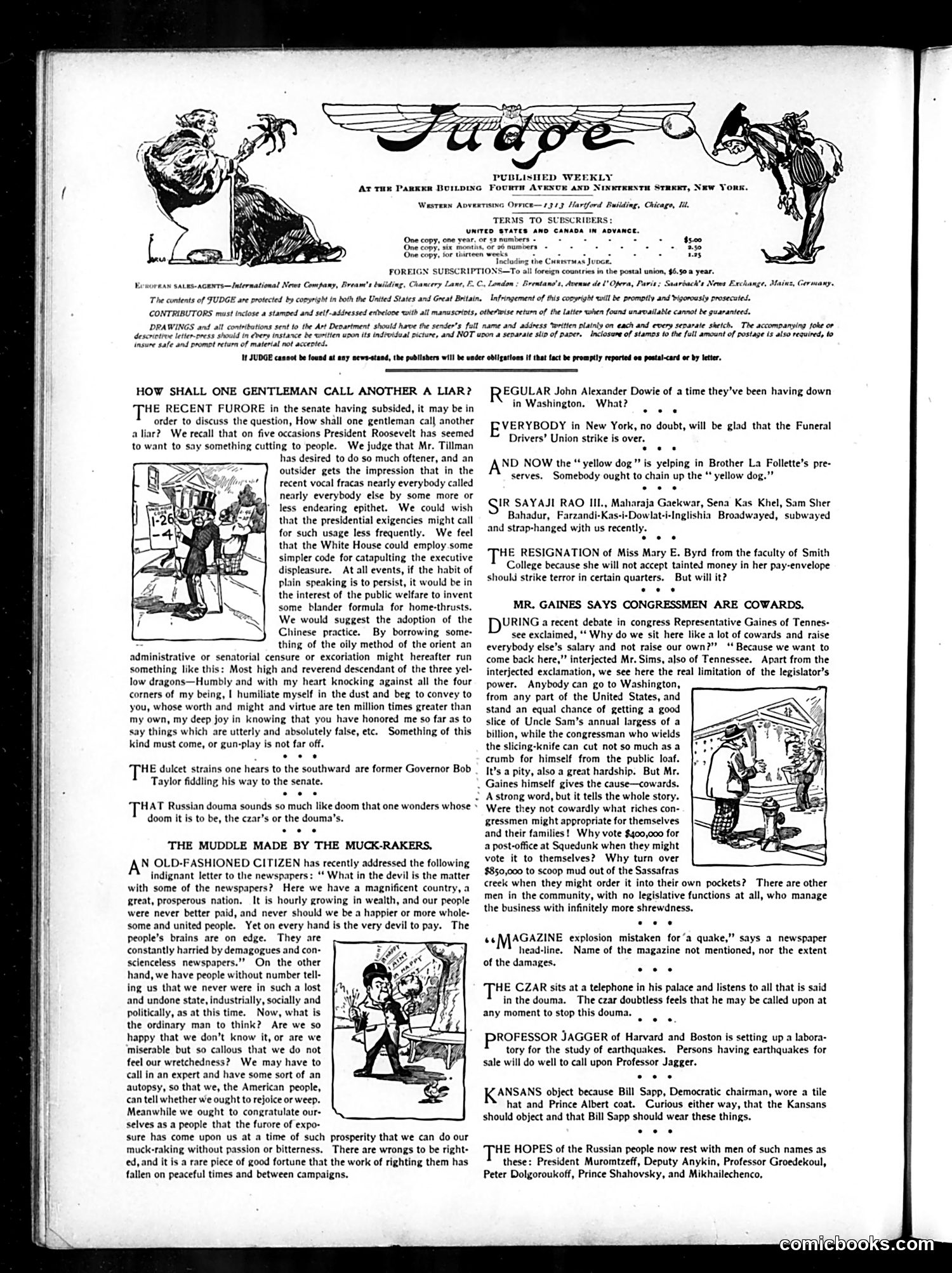
This page contains several satirical pieces. The main article "How Shall One Gentleman Call Another a Liar?" mocks President Roosevelt's recent vocal attacks on critics, suggesting alternatives to direct name-calling. A separate section titled "The Muddle Made by the Muck-Rakers" addresses an indignant letter criticizing investigative journalists. The satire argues these publications expose corruption but are themselves sometimes reckless, questioning whether their crusades genuinely serve public interest. Additional brief items mock various political figures including Congressman Gaines (criticized for hypocrisy on salaries) and reference Russian political figures. The overall tone suggests Judge was skeptical of both Progressive muckraking journalism and certain politicians' rhetorical excess during the early 20th century.
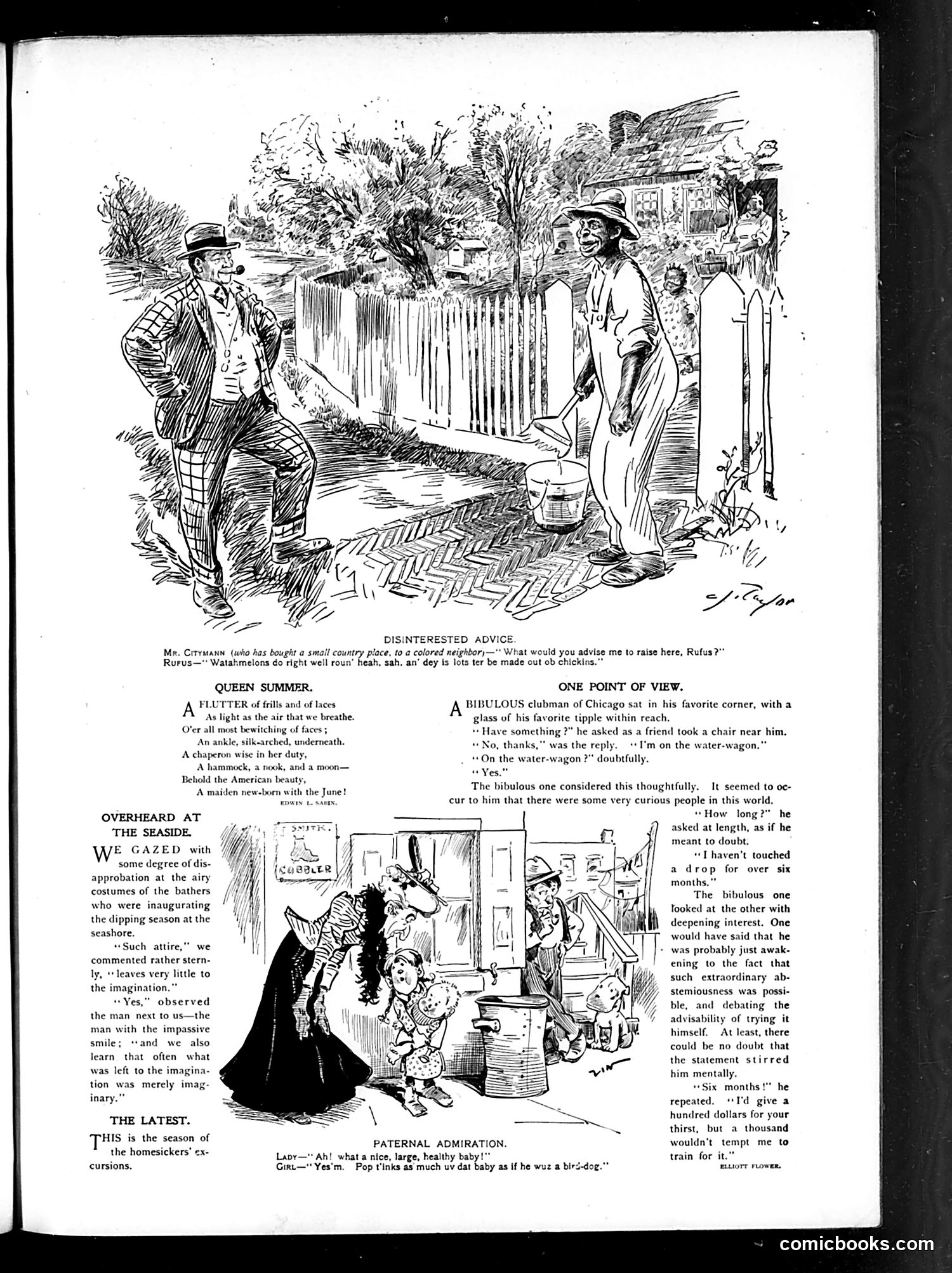
**Top Cartoon - "Disinterested Advice":** A well-dressed man (labeled Mr. Citymann) seeks advice from a rural neighbor about raising Rufus, a colored neighbor's child. The rural figure's deadpan response—"Watermelons do right well I ren' fresh, sah, an' day is lots let be made out ob chickens"—is a racist stereotype joke implying African Americans are suited only for agricultural servitude. The satire appears directed at the naive city dweller rather than endorsing the stereotype. **Other Content:** "Queen Summer" and "Overheard at the Seaside" are lighthearted seasonal humor pieces. "One Point of View" depicts a Chicago businessman's indifference to charitable giving. "Paternal Admiration" jokes about a baby's size. These are typical period humor columns without overt political content. The page reflects Judge's satirical style mixing social commentary with period-typical racist stereotypes.
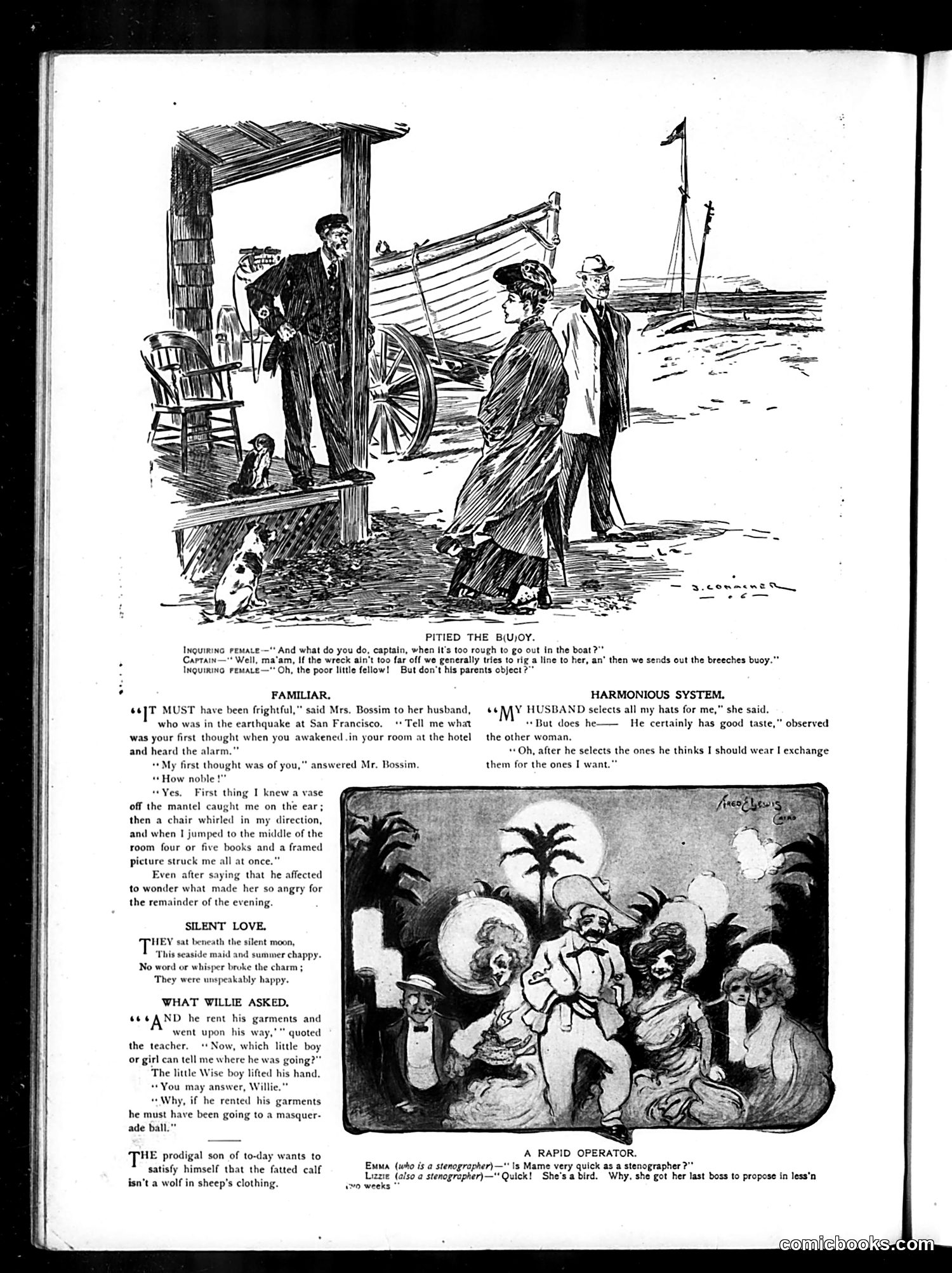
This page contains three separate humorous pieces typical of early 20th-century American satirical magazine content: 1. **"Pitied the Buoy"** - A seaside sketch about a woman inquiring whether it's safe to go boating, playing on nautical misunderstandings. 2. **"Harmonious System"** - A domestic humor piece where a wife explains her husband's hat selection philosophy, satirizing marital dynamics and gender relations of the era. 3. **"Silent Love," "What Willie Asked," and "A Rapid Operator"** - Brief comedic vignettes about romantic and workplace situations. The illustrations are pen-and-ink drawings in the period's typical style. The content reflects common Judge magazine themes: domesticity, romance, class distinctions, and gentle social observation rather than sharp political commentary. Without identifying specific historical figures or events, these appear to be timeless domestic humor pieces aimed at middle-class readers.
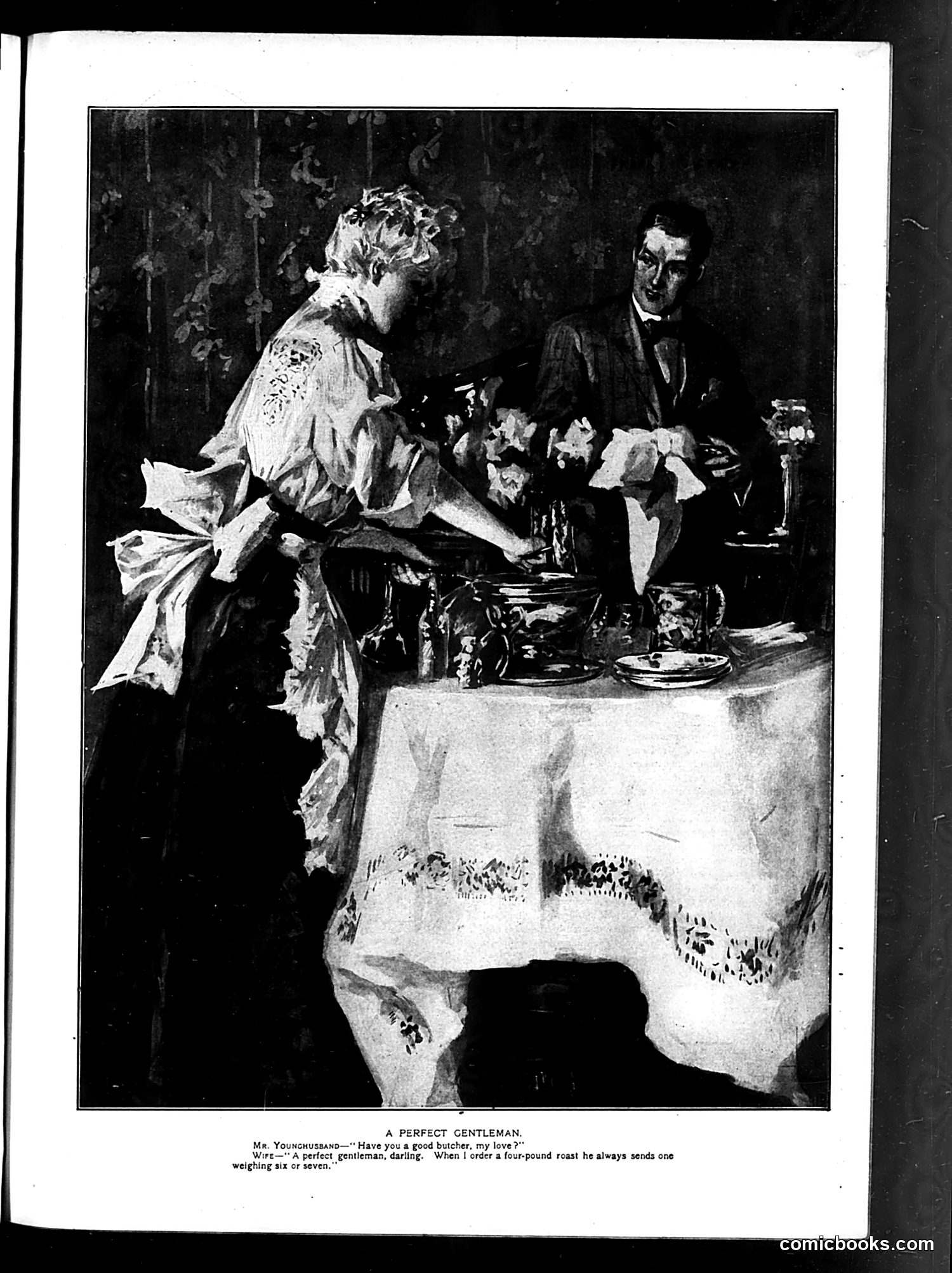
This cartoon satirizes upper-class pretension about masculinity and domesticity. A well-dressed man (labeled "Mr. Younghusbandβ€"") sits at a dining table while his wife speaks to him. The caption quotes her saying a "perfect gentleman" is one with "a good butcher, my love?" and that when ordering a four-pound roast, he always sends one "weighing six or seven." The joke targets gentlemen who cheat or deceive in domestic transactions—they present themselves as morally upright in social settings while engaging in petty dishonesty about household purchases. The satire mocks the contradiction between Victorian ideals of gentlemanly honor and actual middle/upper-class behavior in everyday commercial dealings.
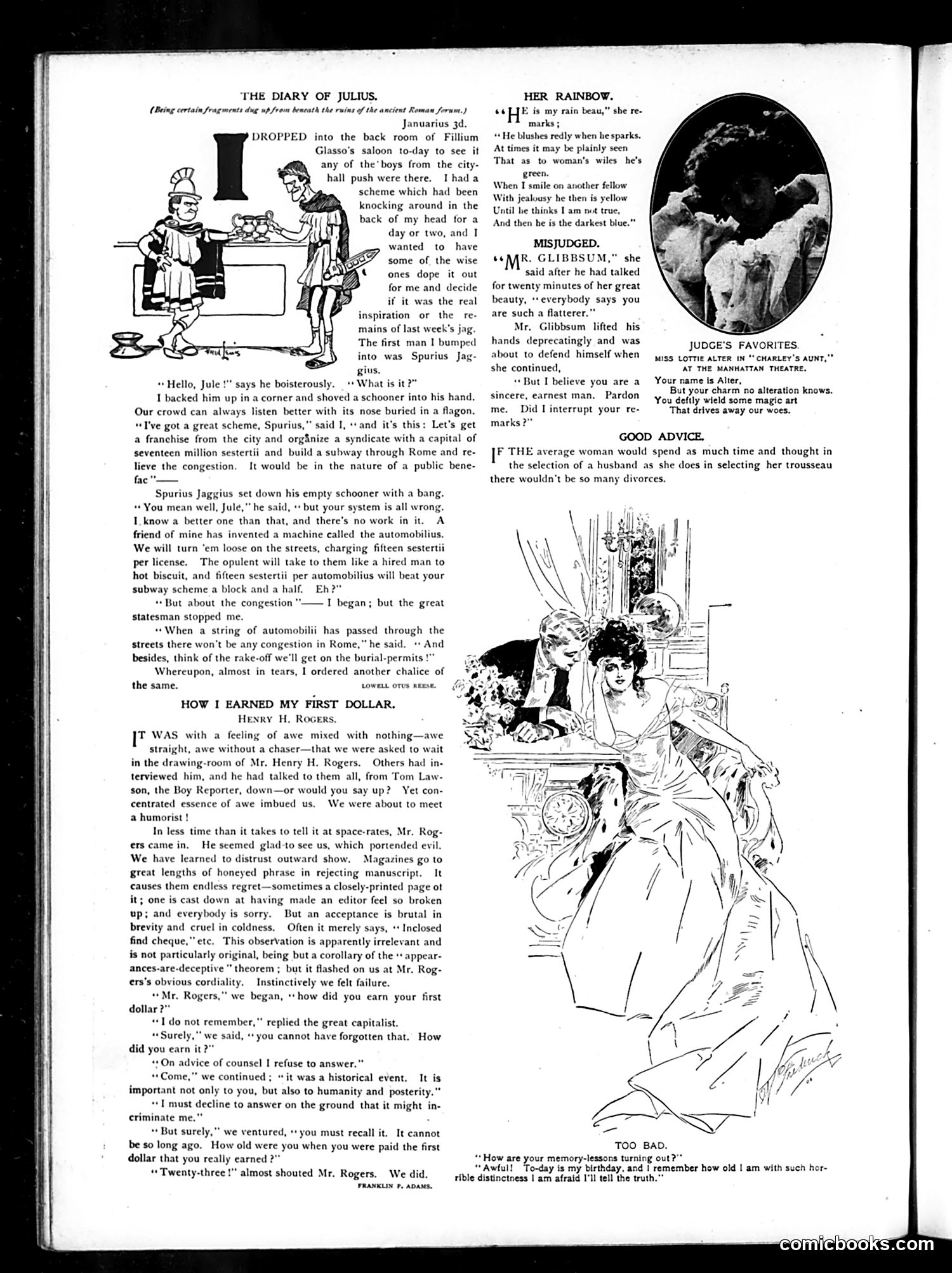
This page contains two satirical pieces typical of early-20th-century American humor journalism. **"The Diary of Julius"** parodies ancient Rome by transplanting modern urban political corruption into a classical setting. "Spurius Jaggius" and "Julius" discuss a subway franchise scheme, then pivot to an automobile licensing scheme—transparently mocking contemporary city-hall graft and backroom deals. The joke is that even in ancient Rome, politicians would abandon one corrupt scheme for a more profitable one (burial permits from automobile deaths). This satirizes contemporary municipal corruption. **"How I Earned My First Dollar"** appears to be an interview setup mocking Henry H. Rogers, a Standard Oil magnate and public figure. The piece humorously suggests meeting a "humorist" and references rejection of manuscripts with "honeyed phrase"—satirizing both Rogers' public persona and magazine editorial practices. The cartoon "Her Rainbow" uses color-based wordplay about a jealous boyfriend ("yellow," "blue," "green"). "Good Advice" offers conventional matrimonial satire. "Judge's Favorites" promotes theatrical productions. The overall tone reflects Judge's focus on political/social satire and contemporary scandal.
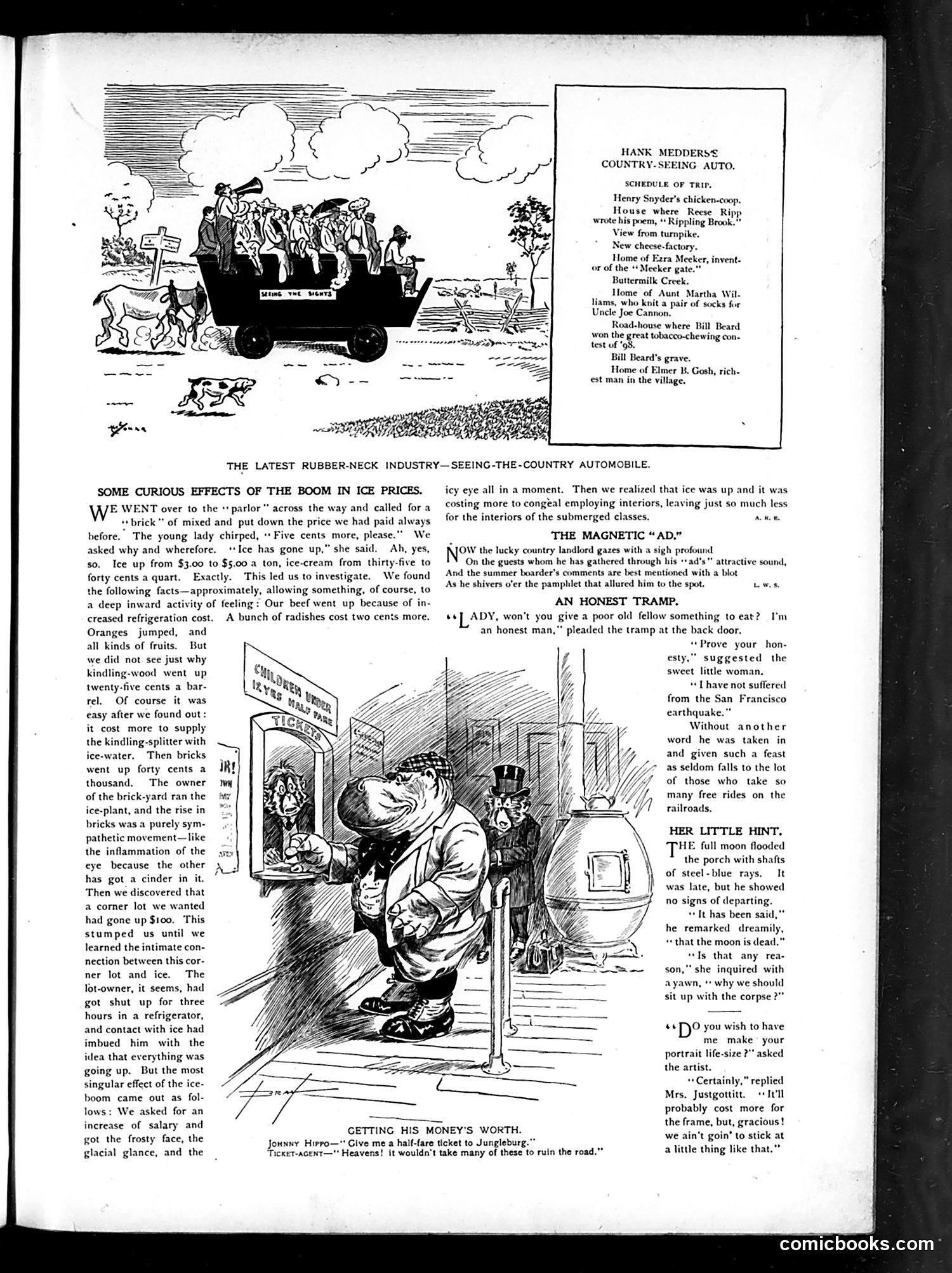
This page contains several satirical pieces mocking early-20th-century American life: **"Rubber-Neck Industry" cartoon** (top): Depicts tourists in an automobile visiting mundane rural attractions—a chicken coop, a cheese factory, someone's grave. The satire targets the novelty of automobile tourism and Americans' appetite for sightseeing, no matter how trivial the destinations. **"Ice Boom" article**: A humorous commentary on inflation caused by rising ice prices. The writer traces absurd economic cascades—ice-cream costs more, so radishes cost more, so brick prices rise, so real estate values jump. The final joke: when denied a salary increase, he realizes the boss himself is inflated by the ice boom's psychology. **Remaining pieces** ("Magnetic Ad," "Honest Tramp," "Her Little Hint," "Getting His Money's Worth"): Brief comedic vignettes about dishonest advertising, a tramp claiming earthquake immunity to prove honesty, romantic tension, and ticket fraud. The overall tone is **gentle mockery** of American commercialism, economic absurdity, and social pretension during the early automobile era.
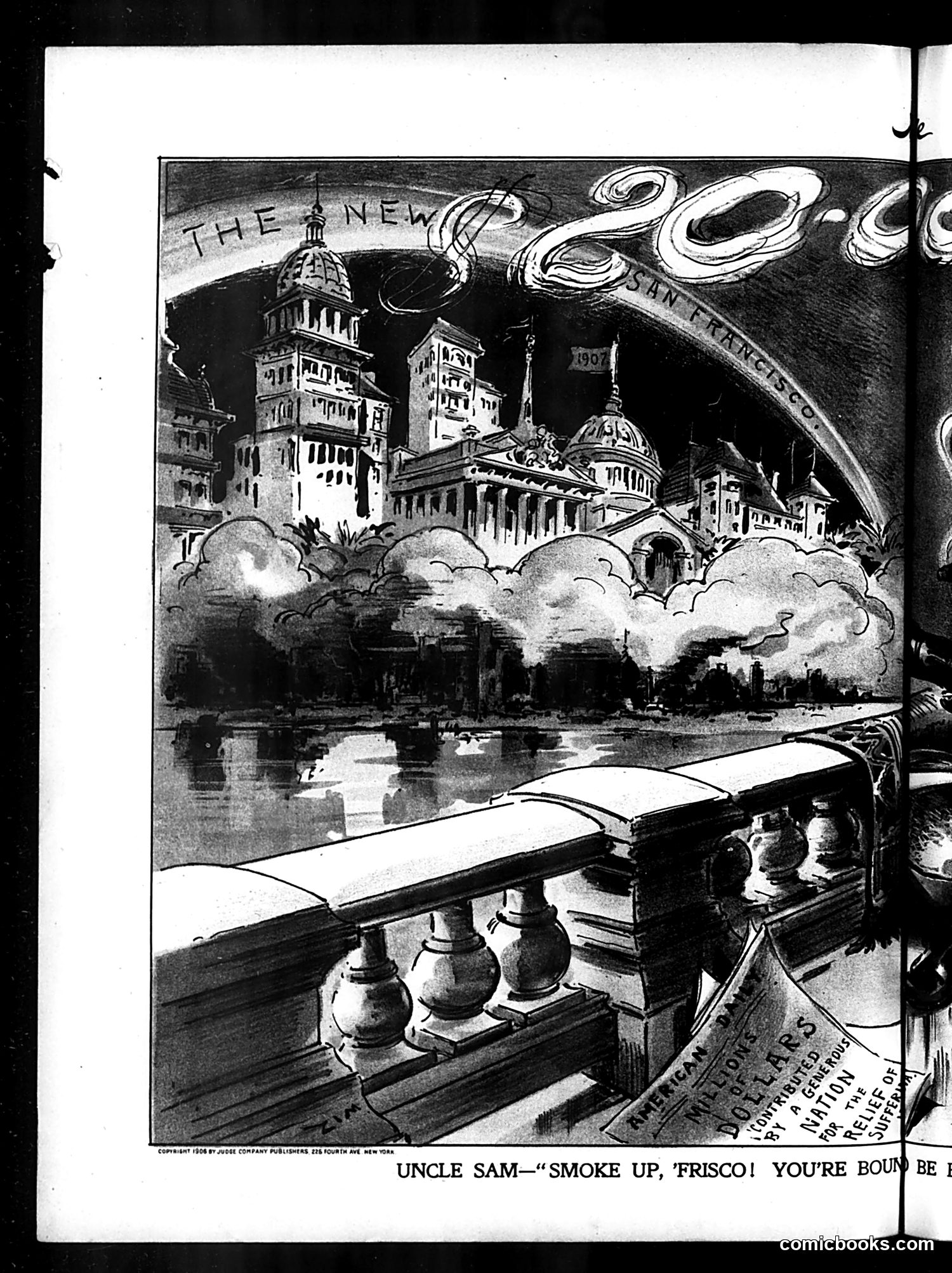
This satirical cartoon depicts San Francisco's skyline rising from fog and smoke. The caption features Uncle Sam (representing the U.S. government) addressing the city, with the phrase "Smoke Up, 'Frisco! You're Bound Be!" suggesting encouragement or inevitability. The image appears to reference San Francisco's reconstruction following the 1906 earthquake and fire—the prominent smoke and clouds likely allude to that disaster. "The New San Francisco" (visible in the header) reinforces this theme of rebuilding. The satire likely mocks either the city's rapid reconstruction ambitions or government involvement in recovery efforts. The tone suggests optimistic but somewhat cynical commentary on San Francisco's future development during the early 20th century recovery period.
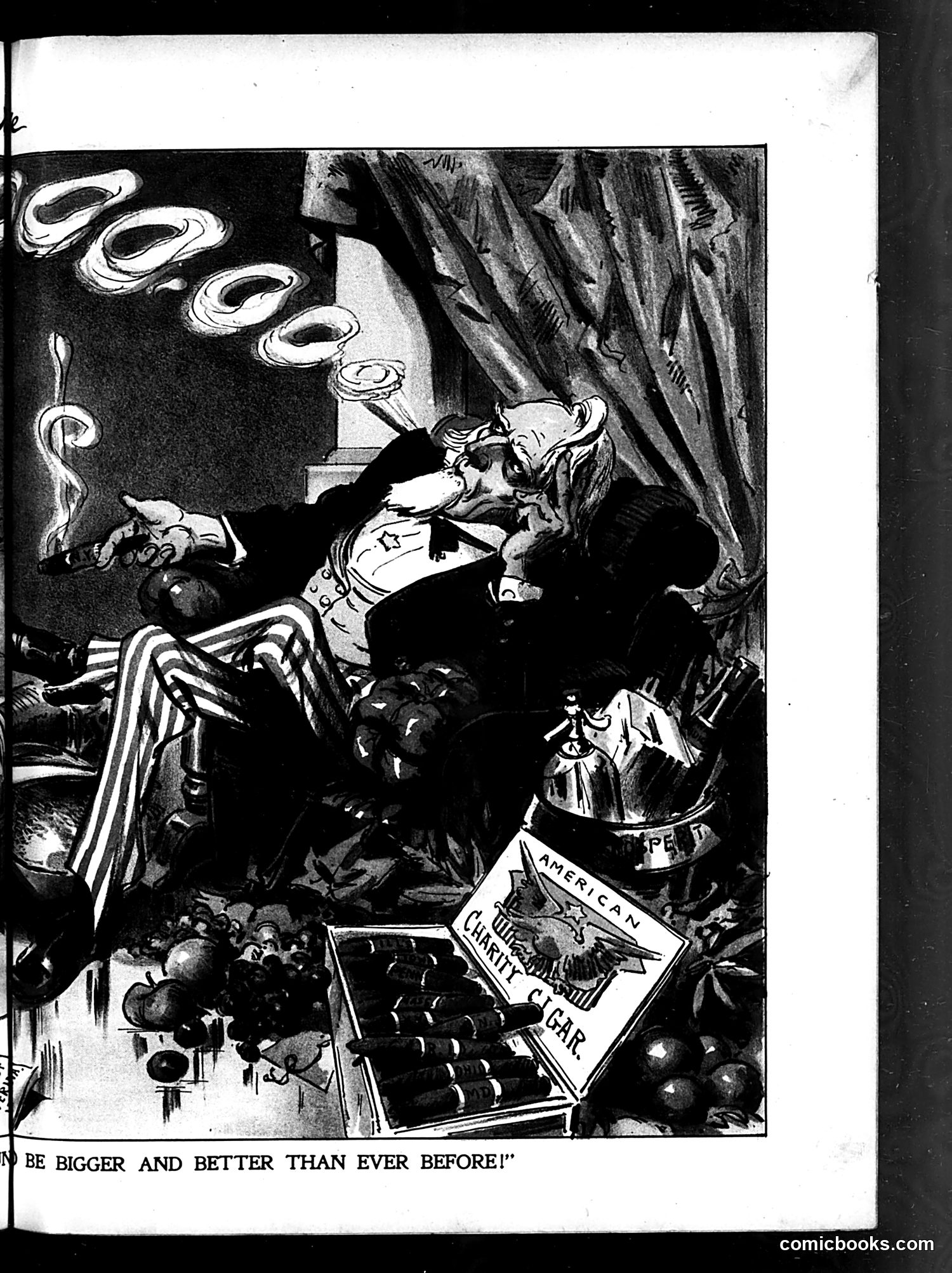
This **Judge** magazine cartoon satirizes American commercial ambition and excess. A rotund, caricatured businessman (depicted with exaggerated features common in early 20th-century political art) reclines luxuriously amid symbols of wealth and indulgence: cigars labeled "American Liberty Cigar," flowing champagne, fruits, and draped fabrics suggesting opulence. The caption—"BE BIGGER AND BETTER THAN EVER BEFORE!"—appears to mock corporate boasting and consumerist rhetoric. The figure's gluttonous pose and self-satisfied expression suggest satire of American materialism and capitalist excess. The caricature style, featuring stereotypical features, was typical of period satirical art, though by modern standards this imagery reflects problematic artistic conventions of that era. Without a visible date or byline, the exact historical moment remains unclear, but the content critiques American business culture and unbridled consumption.
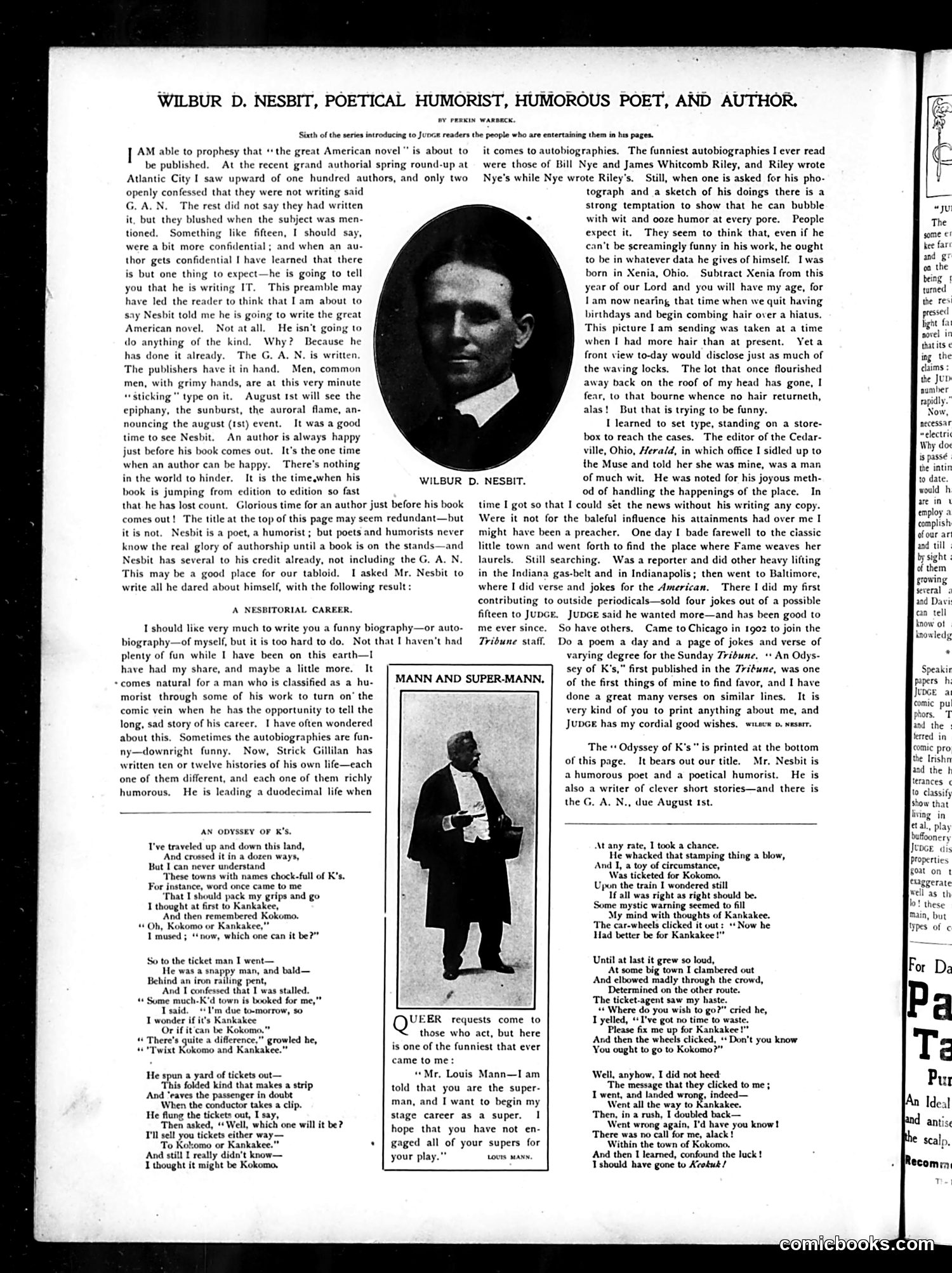
This is a biographical profile of **Wilbur D. Nesbit**, a contemporary humorist and author, part of Judge's series introducing entertainers. The page contains his portrait photograph and an autobiographical essay he wrote about himself. The humor lies in Nesbit's self-deprecating tone: he jokes about losing his hair, claims he's written "the great American novel" (which publishers are typesetting), and reflects on his early career learning to set type in a Ohio newspaper office. There's gentle satire about authors' vanity—the article notes that Nesbit, despite being a published humorist, feels pressure to be funny even in a serious biographical sketch. The accompanying poem "An Odyssey of K's" appears to be Nesbit's humorous verse about train travel. The overall piece celebrates Nesbit as representative of American literary talent while gently mocking authorial pretensions.
This is primarily an editorial defense rather than a political cartoon. Judge magazine responds to criticism from the Portland Oregonian newspaper, which had dismissed Judge-style farmers as outdated while praising modern "electric-light farmers." Judge argues that its comic depictions of rural life—the goat, the Irishman, the hayseeder—are not anachronistic relics but have evolved with contemporary reality. The magazine defends American comic journalism generally, asserting that Judge, along with other quality publications, employs the same talented writers and artists, producing humor of equal caliber to competitors. The piece reflects early-20th-century tensions between newer, more "scientific" agricultural modernization and traditional comic archetypes that had anchored American humor for decades. Judge stakes its claim as current and relevant, not antiquated.
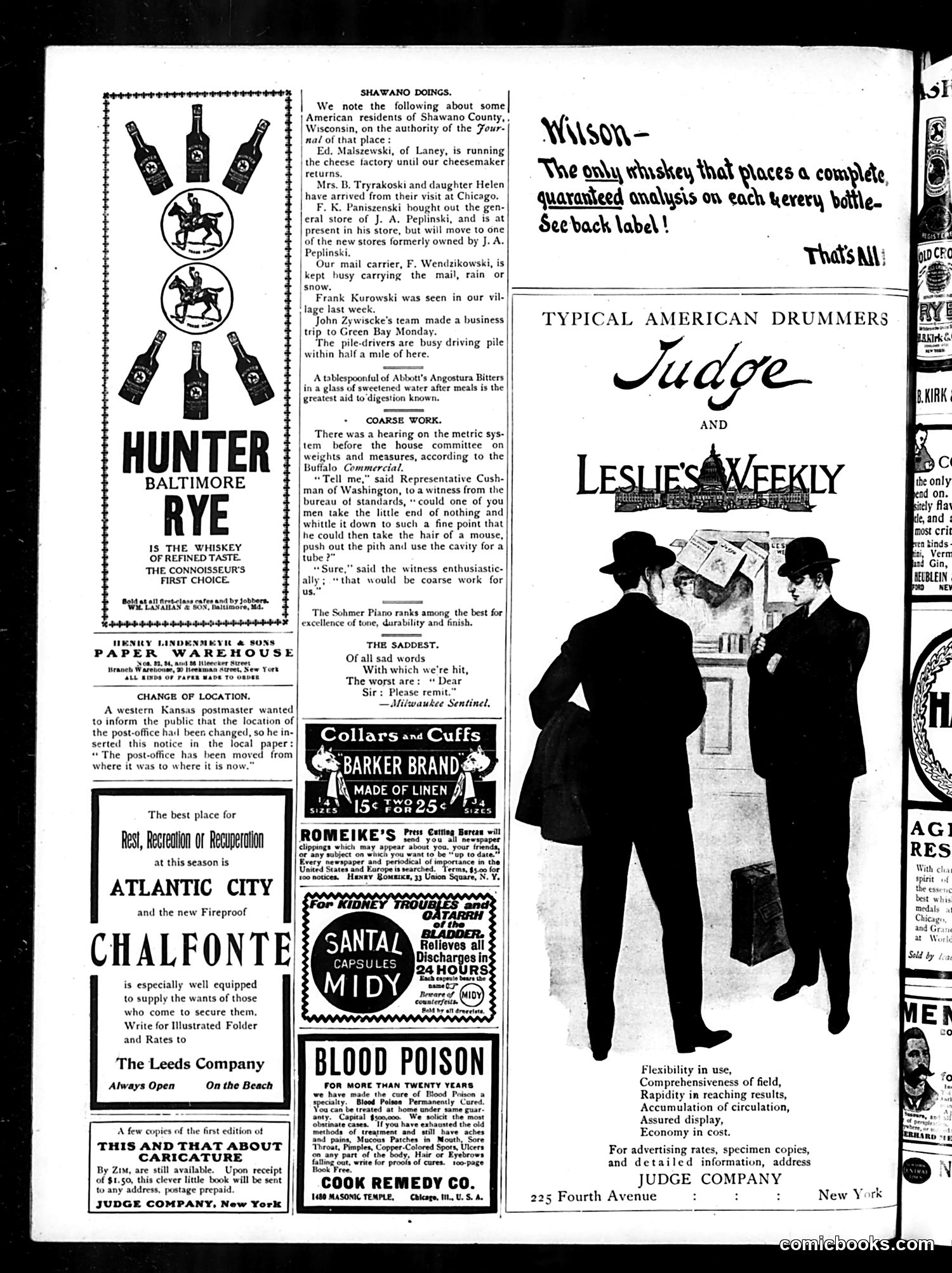
This page from *Judge* magazine is primarily a **collection of advertisements and brief local news items** rather than political satire. The main content includes: - Small-town Wisconsin gossip ("Shawano Doings") about cheese factories and mail carriers - A humorous anecdote about a Kansas postmaster's circular notice about the post office relocation - A joke about a Congressional hearing on the metric system, where a witness claims one could whittle "nothing" so fine as to use a mouse hair as a cavity—the humor being the absurdity of the premise - A melancholy note from *Milwaukee Sentinel* about receiving dunning letters ("Dear Sir: Please remit") The bulk of the page consists of **period advertisements**: whiskey, collages and cuffs, remedies for kidney troubles and blood poison, hotel accommodations, and piano sales. The silhouette illustration labeled "Typical American Drummers" (traveling salesmen) appears to be promotional for *Judge* and *Leslie's Weekly* magazines' advertising capabilities. There is **no significant political commentary or caricature** on this page.
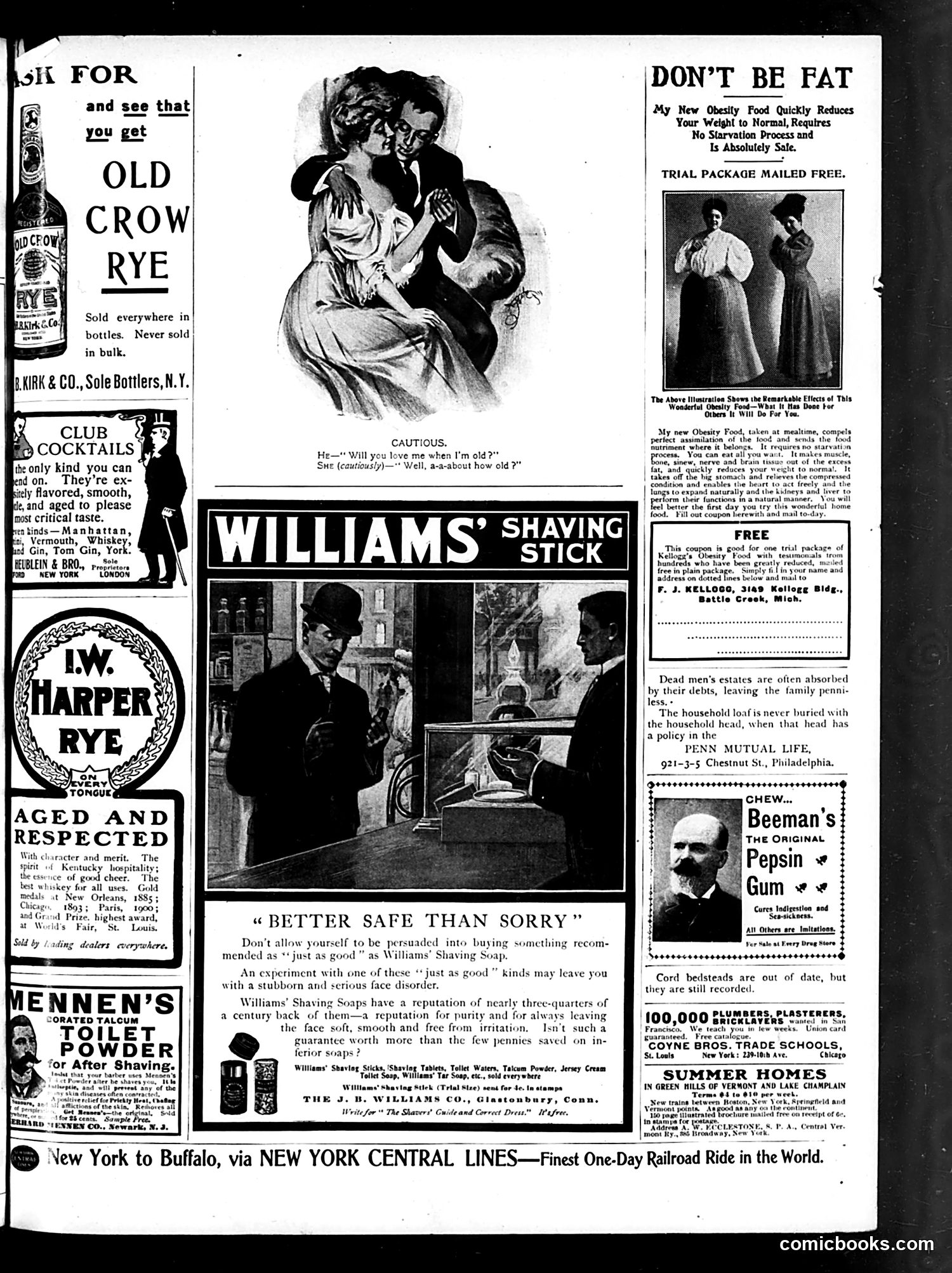
This page consists primarily of **advertisements** from an early 20th-century publication, with one small cartoon. The cartoon titled **"Cautious"** shows a flirtatious exchange: a man asks a woman "Will you love me when I'm old?" She replies "Well, a-a-about how old?" The joke plays on her apparent unwillingness to commit to loving him at an advanced age—she wants specifics, suggesting she may abandon him once he reaches a certain age. It's a mild joke about romantic uncertainty and female materialism. The rest of the page is advertising: whiskey brands (Old Crow, I.W. Harper), Williams' Shaving Stick (emphasizing reliability and purity over cheap imitations), an "Obesity Food" weight-loss product, insurance, talcum powder, chewing gum, and other period goods. These ads reveal what early 1900s consumers worried about: grooming, weight management, estates, and modern conveniences. The obesity ad is particularly notable for its before-and-after imagery and promise of painless weight loss.
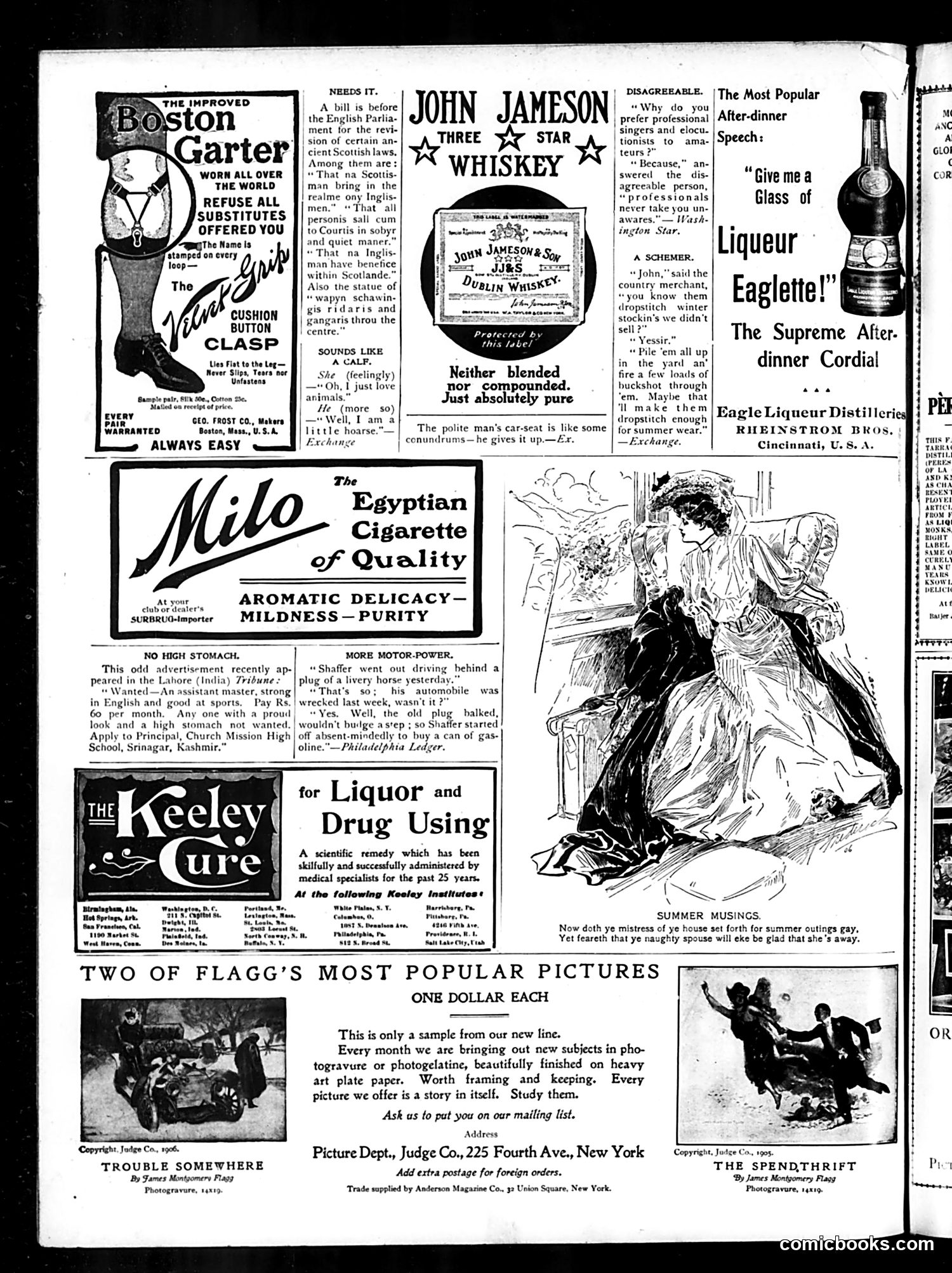
This is primarily an **advertising page** (circa early 1900s) with minimal satirical content. The main items are product advertisements and two unrelated cartoon illustrations. **Notable advertisements** include: Boston Garter (garment support), John Jameson Whiskey, Eaglette Liqueur, Milo Egyptian Cigarettes, The Keeley Cure (substance abuse treatment), and Flagg's picture reproductions. **The two cartoons** are standalone pieces titled "Summer Musings" and "The Spendthrift" by James Montgomery Flagg, showing domestic scenes—one of a wife departing for summer outings while her husband secretly stays behind, the other apparently depicting financial irresponsibility. **Social context**: The Keeley Institute advertisement is noteworthy historically, representing early-20th-century medical treatment for alcohol and drug addiction, reflecting contemporary concerns about substance abuse. The page reflects period attitudes toward drink, smoking, and gender dynamics in marriage, presented without particular satire or commentary.
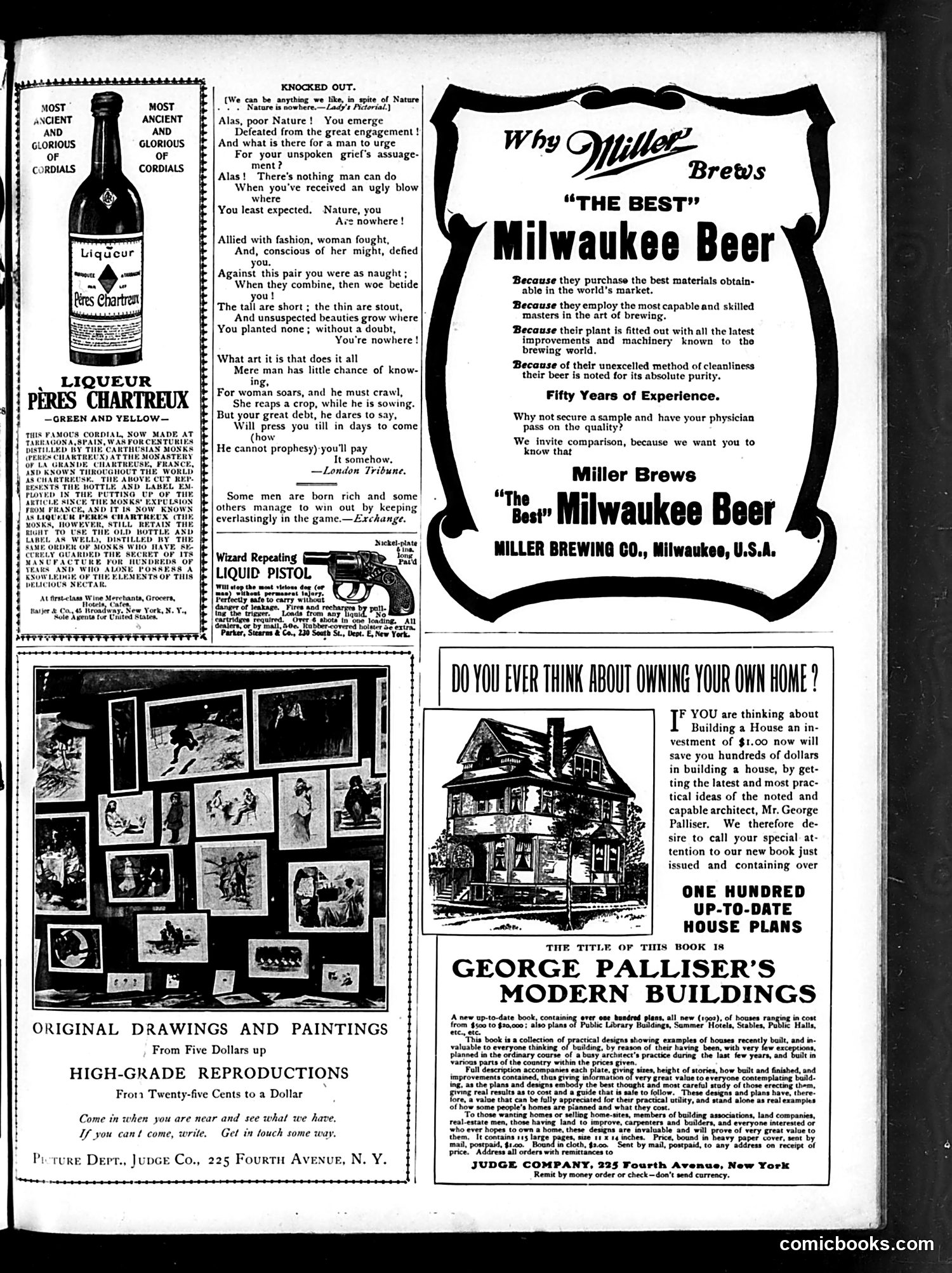
This page is primarily **advertising** rather than political satire, though it contains one small cartoon. **The cartoon** ("Knocked Out") depicts Nature as a defeated female figure, personified and lamenting her loss to "fashion" and "woman" in some unspecified contest. The poem suggests women's use of cosmetics and fashion has triumphed over natural beauty—a common satirical theme mocking both women's vanity and the cosmetics industry. The joke relies on personifying Nature as a loser in a battle against artifice. **The advertisements** promote: - **Pères Chartreux liqueur** (French import) - **Miller Brewing Company's Milwaukee Beer** (emphasizing 50 years' experience, quality materials, and cleanliness) - **House plans** by architect George Palliser ($1 investment) - **Art reproductions** from the Picture Department The page reflects early 20th-century American consumer culture and advertising practices in a satirical magazine.
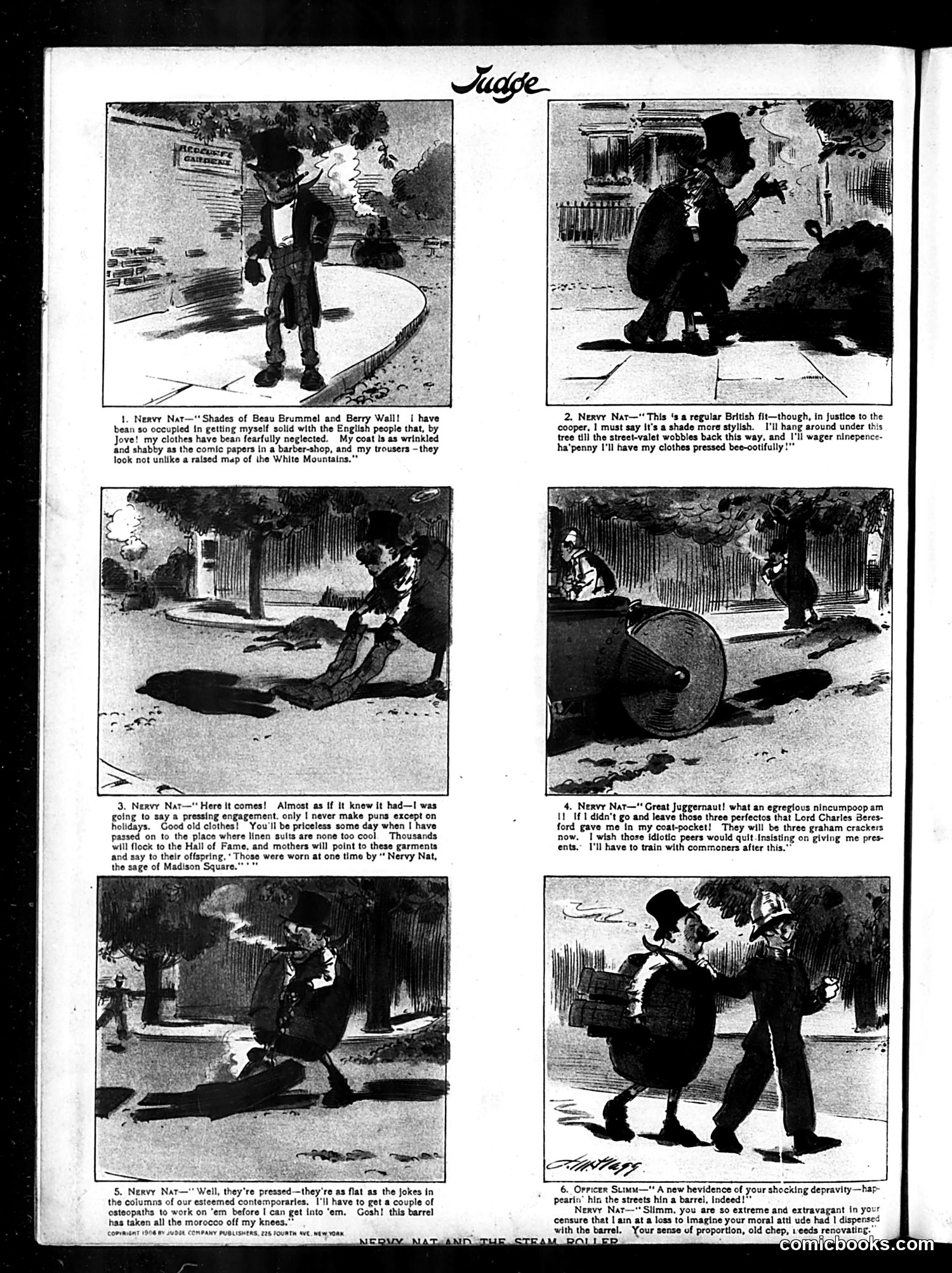
This is a serial comic strip following "Nervy Nat," a well-dressed American dandy who has been so focused on impressing English society that he's neglected his wardrobe. The humor centers on his attempts to restore his wrinkled, shabby clothes—ultimately resorting to having them pressed by a steam roller, which flattens them completely. The satire mocks American social climbing and anglophilia: Nat's obsession with gaining acceptance among the English elite has left him looking ridiculous. His affected speech ("bee-cotifull," references to Lord Charles Beresford and Graham crackers) lampoons both pretentious Americans and the absurdity of their self-important pursuits. The final panel shows him arrested for appearing in public inside a barrel—the ultimate humiliation for someone so concerned with proper appearance and social standing.