
A complete issue · 16 pages · 1905
Judge — June 3, 1905
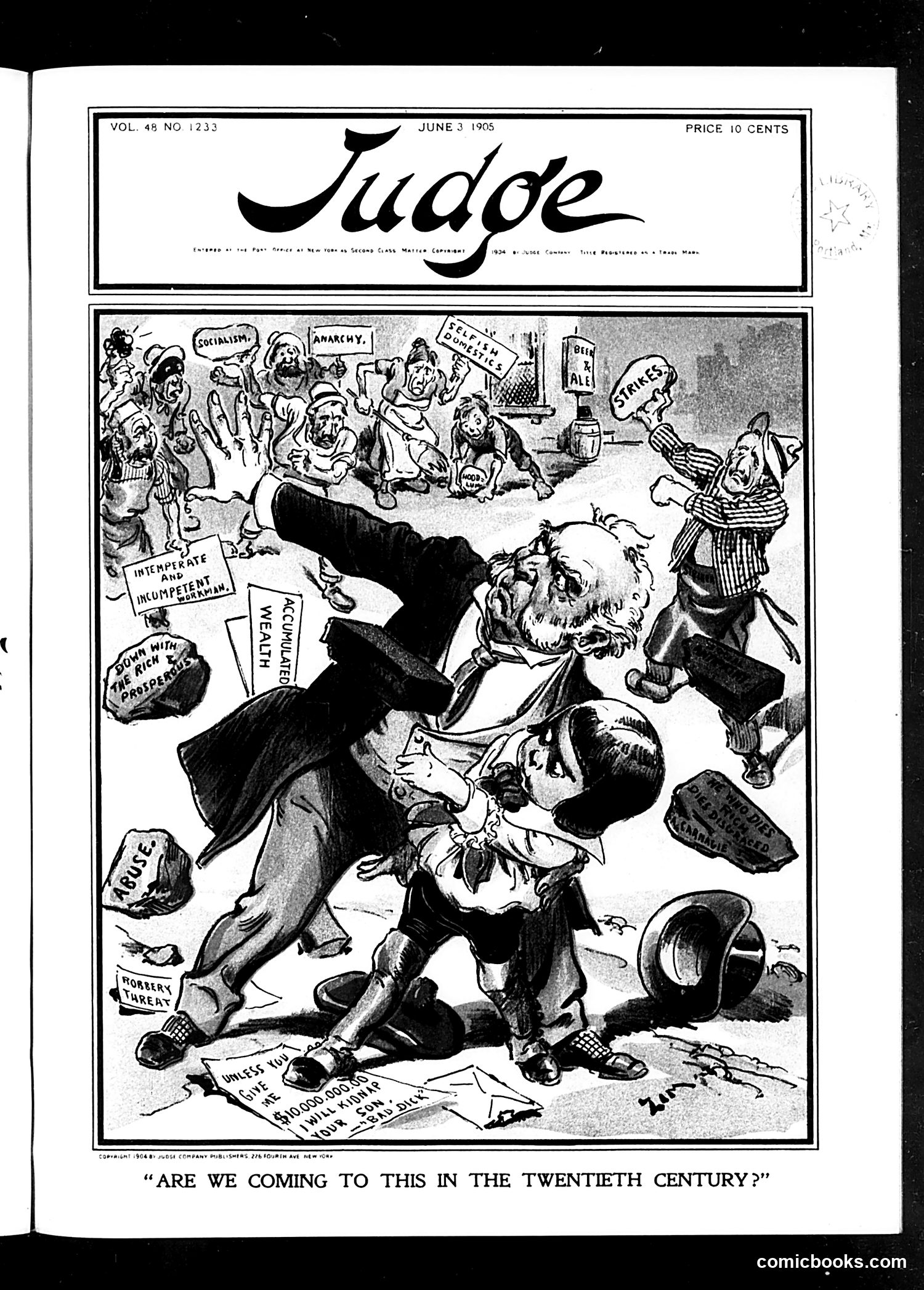
This 1905 *Judge* cartoon satirizes labor unrest and social disorder through a chaotic street scene. A well-dressed gentleman (possibly representing capital, government, or established order) is knocked down amid violent chaos. Signs visible include "Anarchy," "Socialism," "Strike," "Incompetence," and references to various labor grievances and social problems ("Robbery," "Graft," "Dishonesty"). The cartoon expresses anxiety about modernization and social upheaval entering the 20th century—specifically labor strikes, socialist movements, and anarchist ideology gaining traction in America. The title questions whether civilized society will descend into violent disorder. This reflects upper-class fears of the period regarding labor organizing and radical political movements that were gaining prominence in early 1900s America.
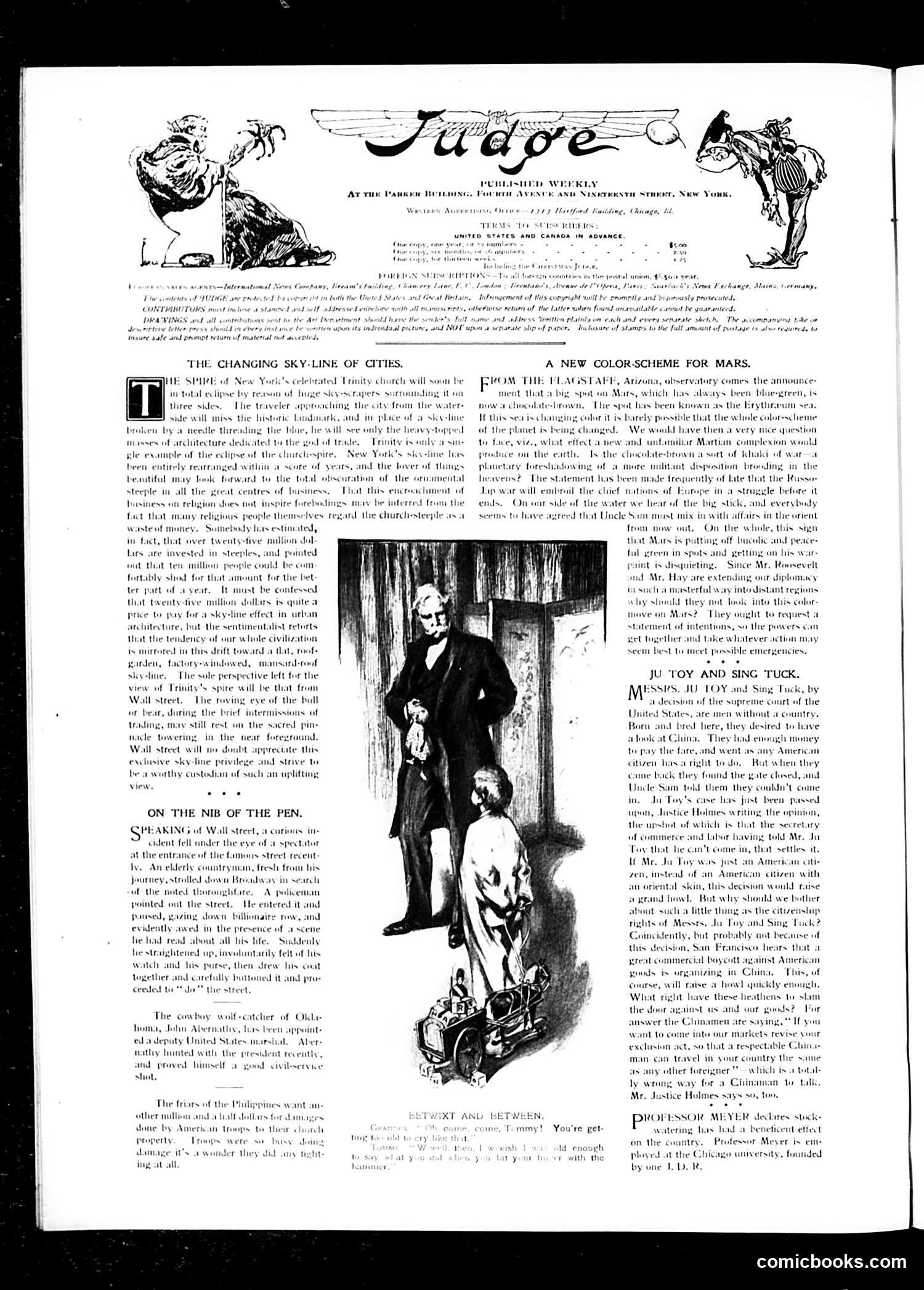
This page contains several articles and a prominent illustration titled "Between and Between" (bottom right). The central cartoon depicts what appears to be a Chinese official or dignitary in traditional dress encountering a Western figure, likely satirizing American-Chinese diplomatic relations or immigration tensions of the era. The text below references a Supreme Court case involving "Ji Toy and Sing Tuck," Chinese individuals challenging U.S. citizenship rights. Justice Holmes' opinion apparently ruled against them despite their American birth claims, suggesting discrimination in citizenship law. The cartoon likely mocks either Chinese exclusion policies, Western intervention in China, or the contradictions in American citizenship law—themes consistent with Judge's satirical approach to contemporary political controversies. The exact historical moment remains unclear without the publication date.
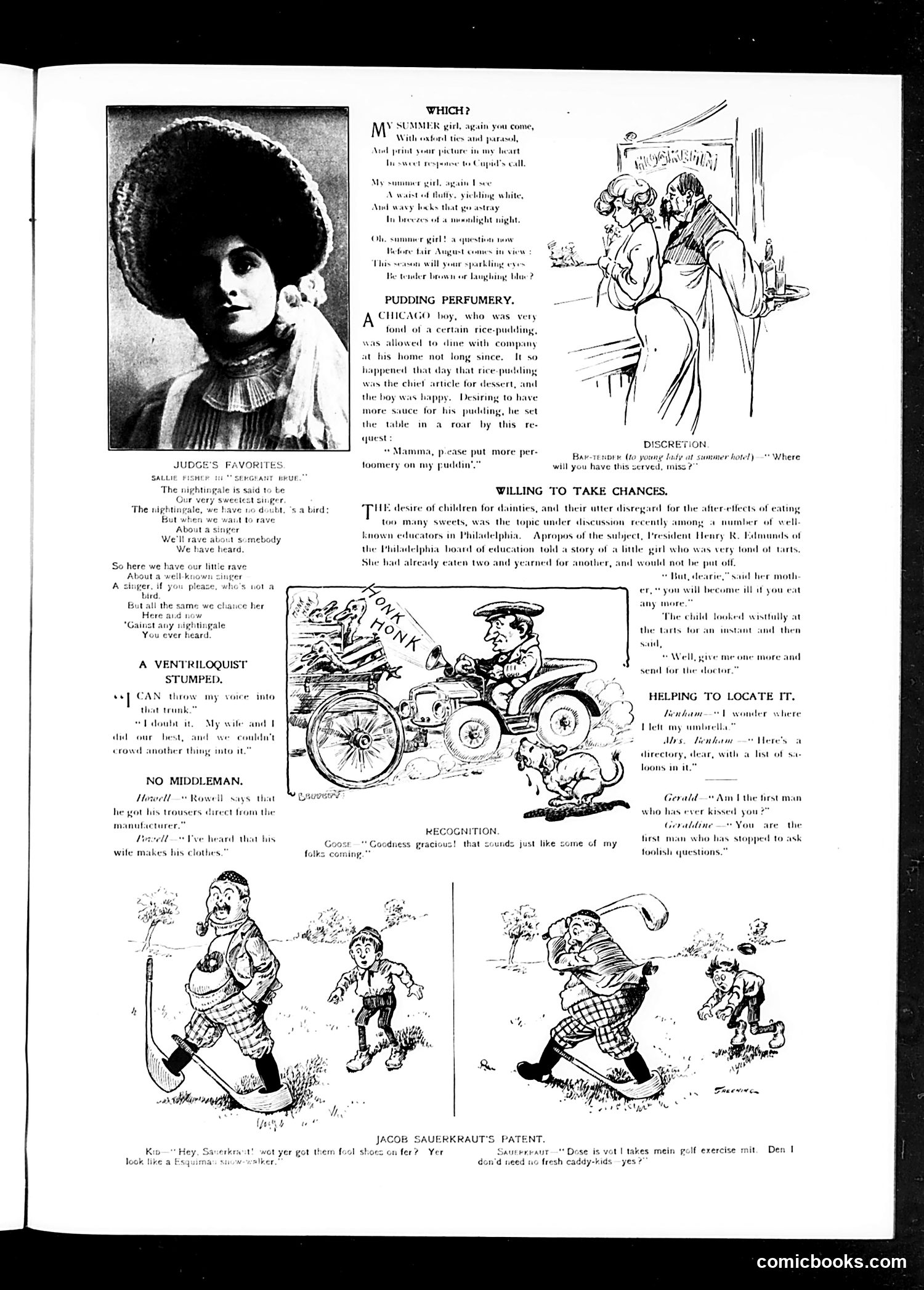
This page contains several unrelated humorous sketches and anecdotes typical of Judge's format. The top features "Judge's Favorites"—verses about nightingales and love. "Pudding Perfumery" recounts a Chicago boy requesting extra sauce on pudding, humorously misinterpreted by his mother as wanting perfume added. "A Ventriloquist Stumped" presents a brief joke about a ventriloquist's wife. "A Middleman" offers wordplay about trouser direction. The cartoons illustrate these pieces with exaggerated character drawings in Judge's characteristic style. "Jacob Sauerkraut's Patent" shows a man demonstrating fool's shoes to a child—likely satirizing dubious patent products or immigrant characters (the name suggests German ethnicity, common in contemporary American humor). No major political figures or events appear prominently. This represents Judge's typical domestic humor content rather than editorial commentary.
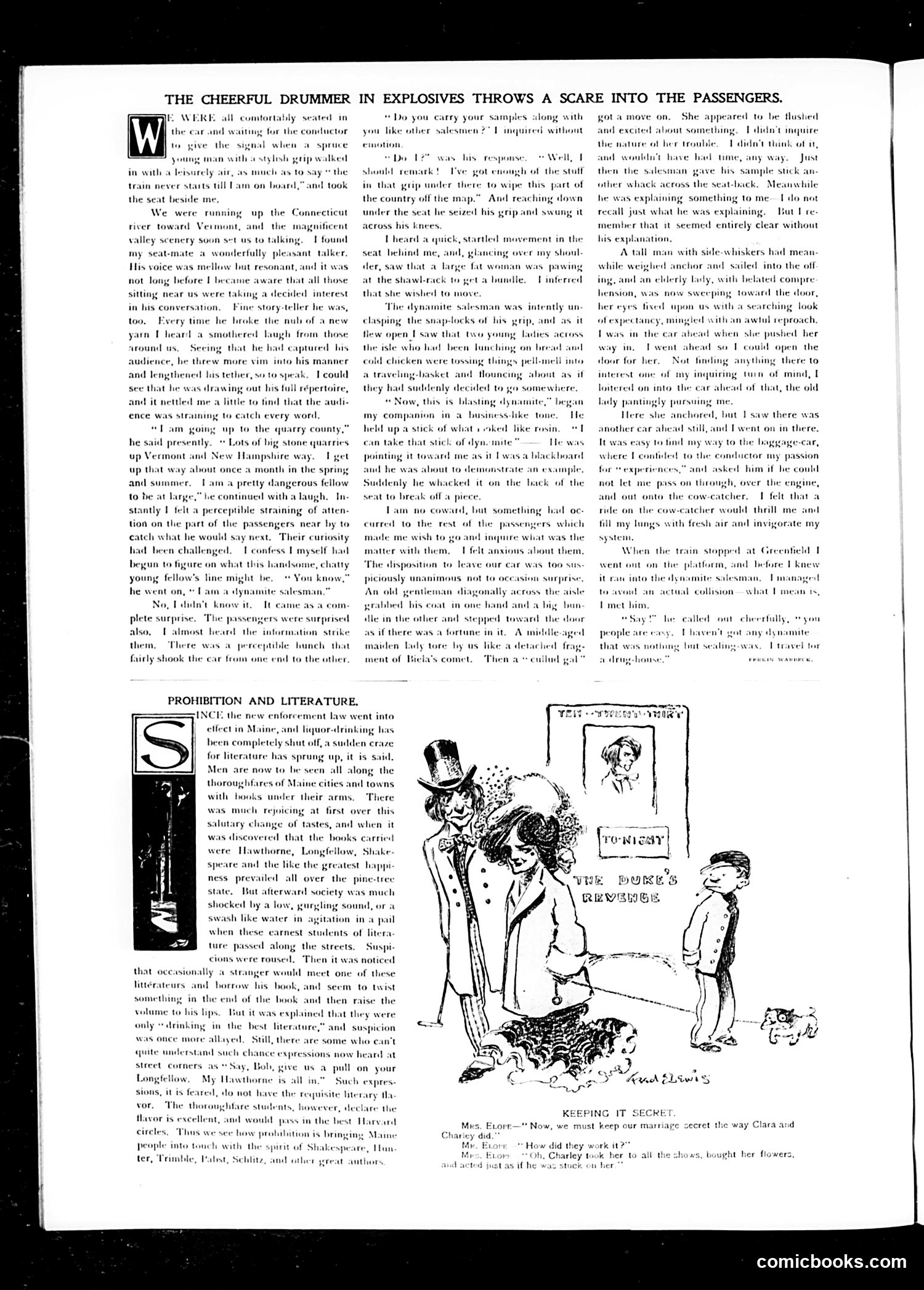
The page contains two distinct sections: **Upper section**: A narrative story about train passengers and a "dynamite salesman" carrying explosives. The text describes nervousness about the man's dangerous cargo and appears to be humorous fiction rather than political satire. **Lower section**: "Prohibition and Literature" discusses Maine's alcohol enforcement laws and their cultural impact. The cartoon labeled "Keeping It Secret" depicts what appears to be a woman (possibly Mrs. Elof) discussing keeping a marriage secret, with references to flowers and "Charley." The prohibition content reflects 1920s-era American debates about alcohol bans and their social consequences. The cartoon's exact satirical point about marriage secrecy remains unclear from the image alone, though it likely comments on social hypocrisy or changing mores during Prohibition.
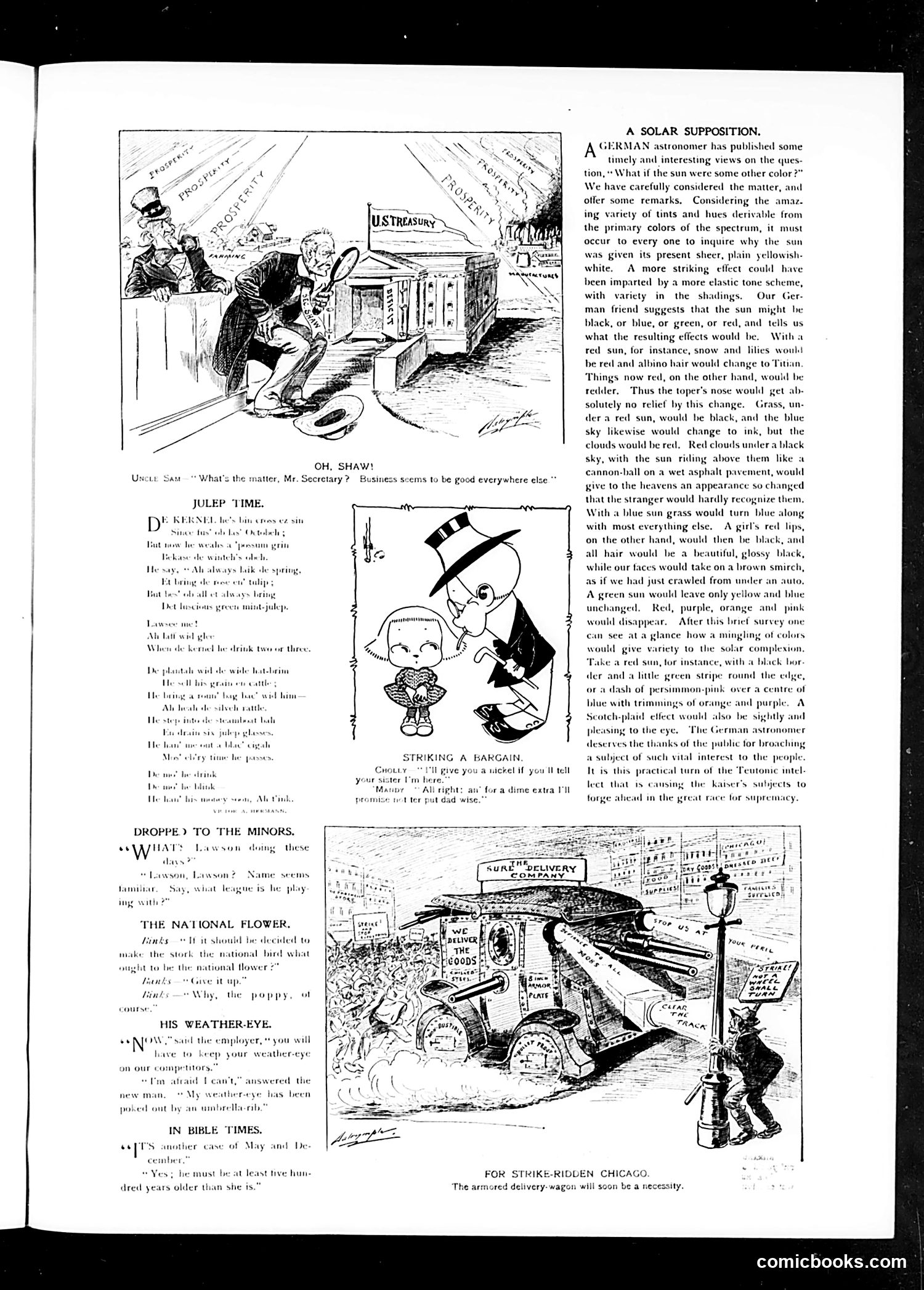
This page contains several humorous pieces typical of Judge's satirical content: **"Oh, Shaw!"** depicts Uncle Sam confronting a Treasury official about business conditions, likely referencing economic concerns of the era. **"Julep Time"** is a dialect poem (using stereotypical African American speech patterns common to the period) about enjoying mint juleps, reflecting the magazine's casual racial humor of that time. **"A Solar Supposition"** is the page's main feature—a lengthy satirical essay imagining if the sun were different colors. It humorously explores absurd consequences: a red sun would make snow red and provide "no relief" to drunkards' red noses; a blue sun would make hair "glossy black"; a green sun would eliminate red and orange hues. The piece satirizes both scientific speculation and contemporary social observations. **"For Strike-Ridden Chicago"** cartoon shows an armored delivery wagon, referencing Chicago's labor strikes (likely early 1900s), joking that such protection would soon be necessary for commerce. The remaining items are brief joke exchanges with minimal context needed for modern readers.
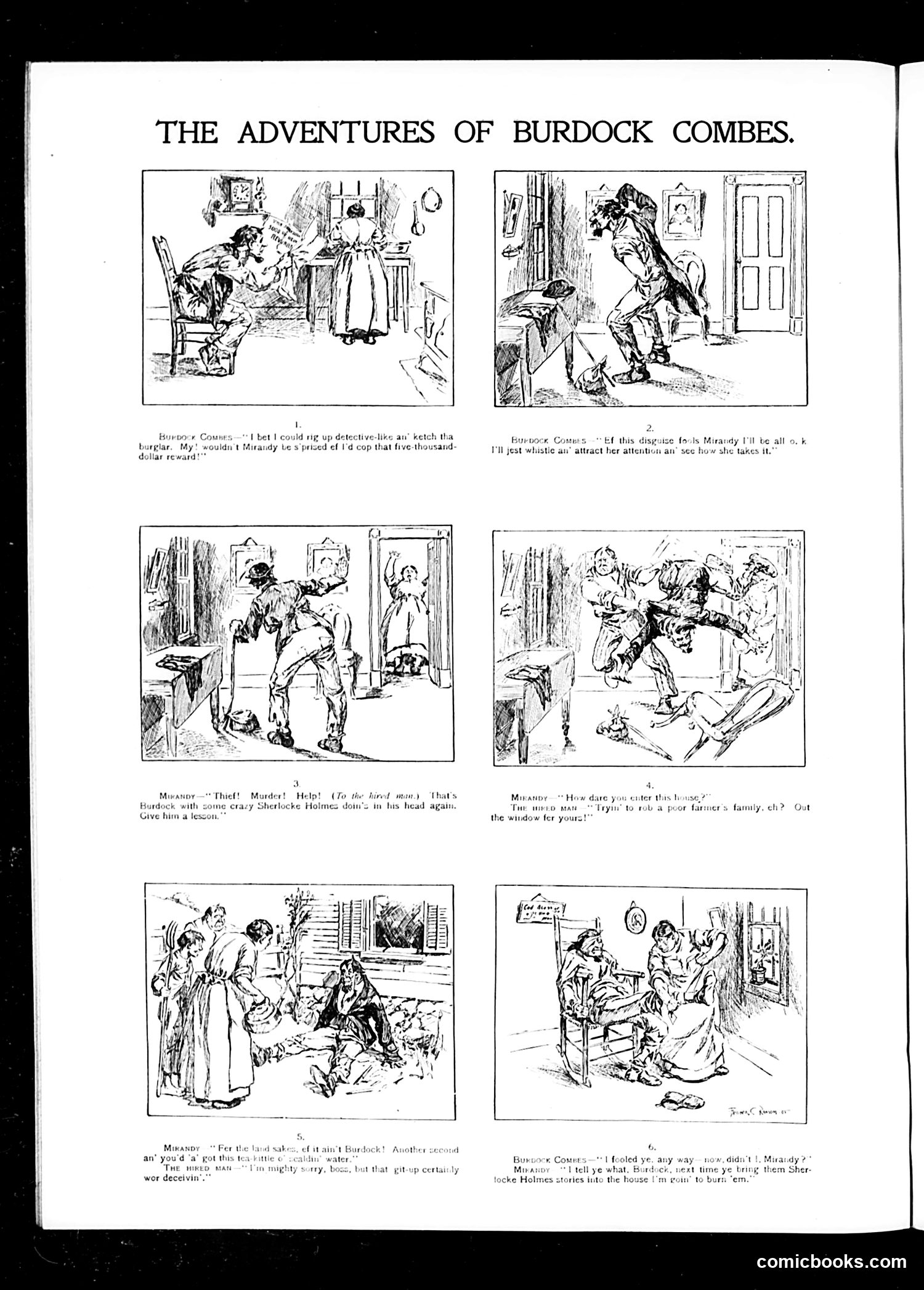
This is a comic strip following Burdock Combes, an apparent amateur detective wannabe. Panel 1 shows him boasting to a woman that he could solve a crime and collect a $5,000 reward. Subsequent panels depict his bumbling attempts at detective work—he's chased through a house, physically attacked, thrown out windows, and generally humiliated. The satire targets amateur detectives and the public's fascination with detective fiction popular in early 20th-century America. Burdock embodies the delusional everyman who imagines himself a Sherlock Holmes but proves completely incompetent. The slapstick violence emphasizes the gap between detective-story fantasy and reality, mocking both the genre and the character's pretensions.
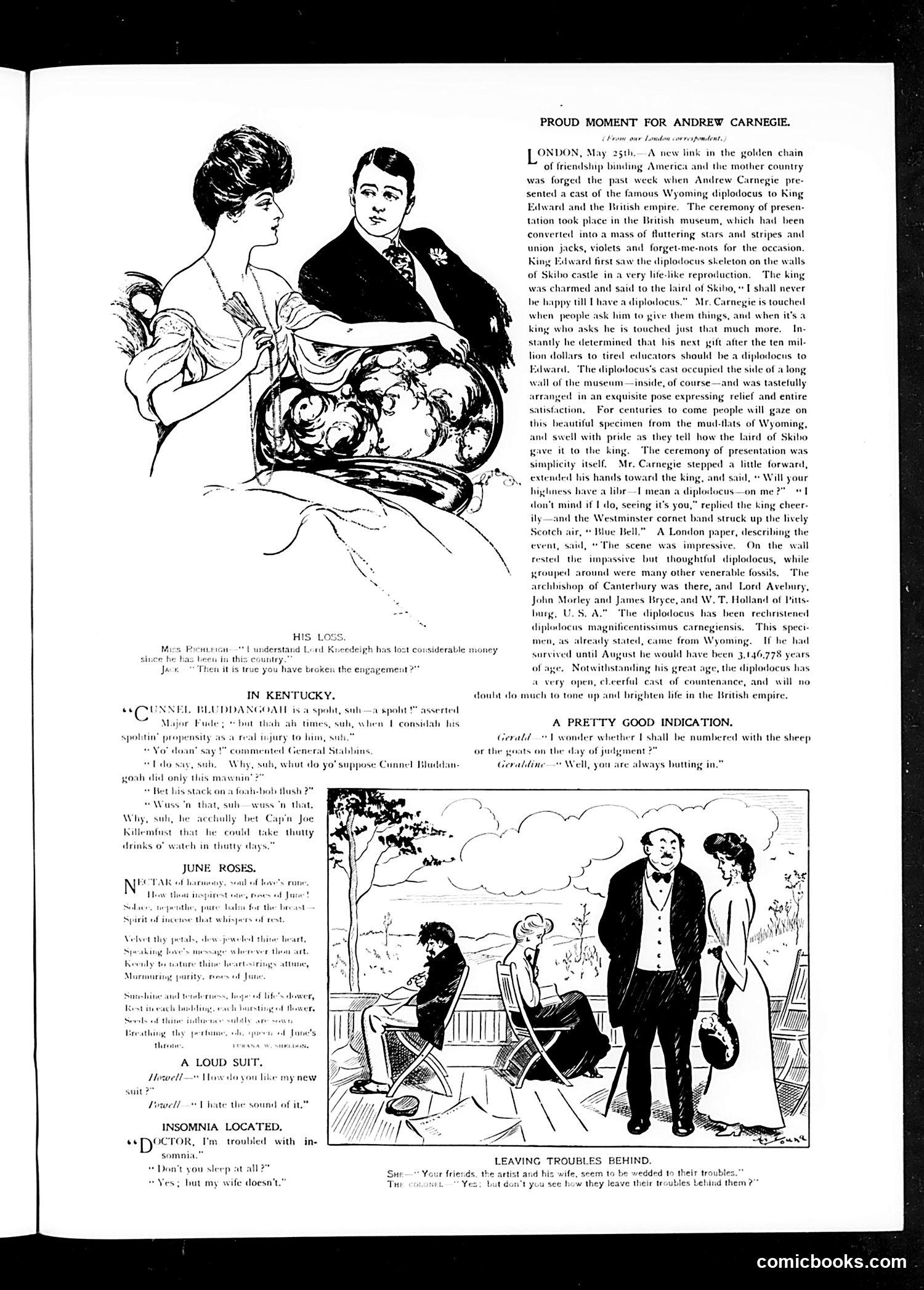
This page from *Judge* magazine contains multiple satirical pieces from early 1900s America. **"Proud Moment for Andrew Carnegie"** (top): The main article mocks industrialist Andrew Carnegie's gift of a dinosaur skeleton cast to King Edward VII. The satire targets Carnegie's ostentatious philanthropy and social climbing—he presents a diplodocus fossil to Britain with great ceremony, positioning himself as a bridge between nations. The joke is that Carnegie, a Scottish-American steel magnate, seeks validation through expensive gestures to royalty. The text humorously describes the fossil as "magnificentissimus carnegiensis" and notes the dinosaur was ancient but has "a very open, cheerful cast of countenance." **Lower cartoons** are brief humor pieces: "In Kentucky" mocks Southern gambling culture; "June Roses" is sentimental verse; "A Loud Suit," "Insomnia Located," and "A Pretty Good Indication" are one-liner jokes typical of the era's magazine humor format. The page reflects early 20th-century American attitudes toward wealthy industrialists, British-American relations, and regional stereotypes.
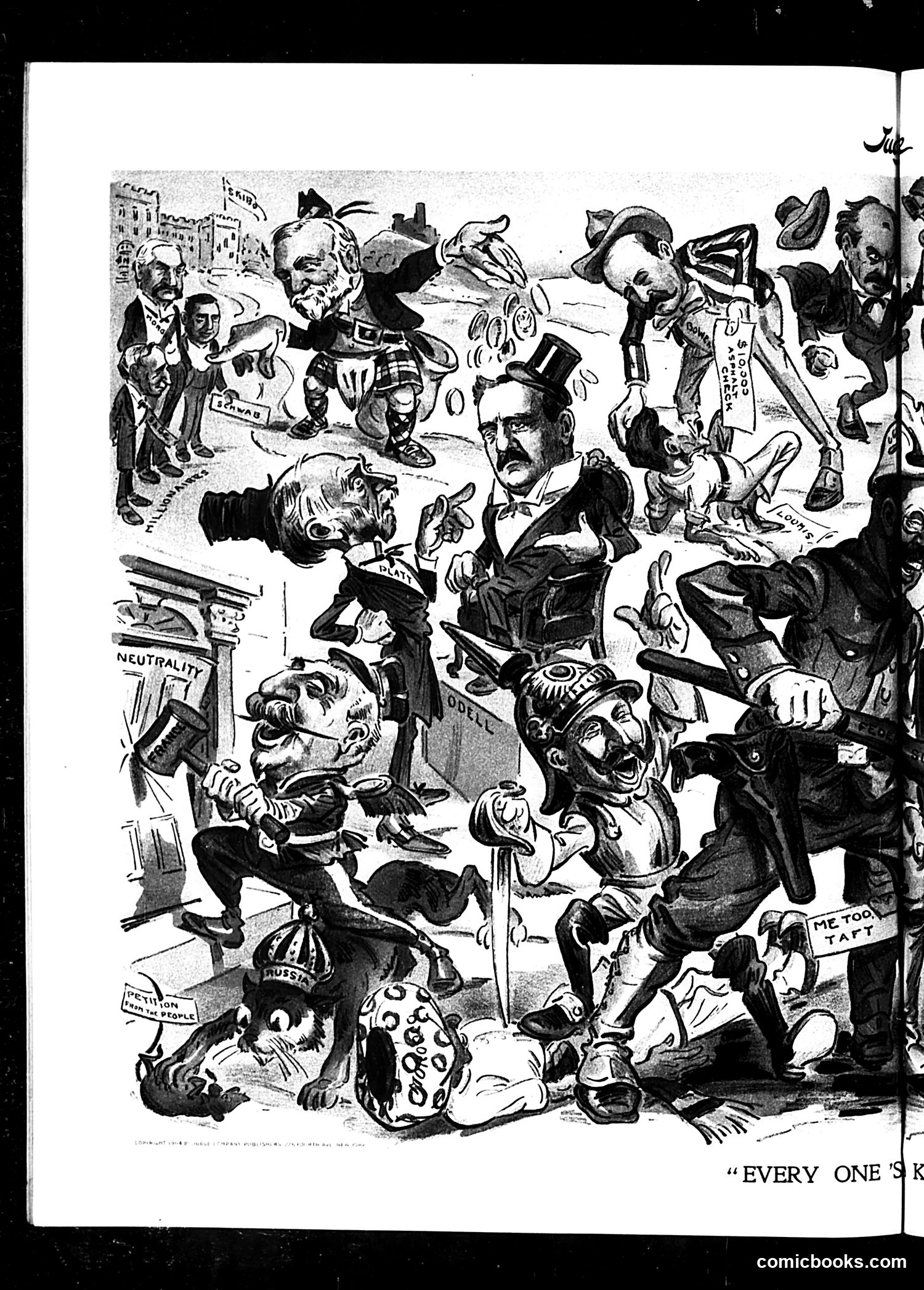
This appears to be a satirical Judge magazine cartoon depicting political chaos or diplomatic confusion, likely from the early 20th century based on style and clothing. The central figure is a man in formal dress with a prominent mustache, surrounded by caricatured figures in military uniforms and formal wear, some appearing as exaggerated or grotesque characters. The word "NEUTRALIS" (visible on the left) suggests commentary on neutrality during a conflict period, possibly World War I era. The various figures seem to represent different national powers or political actors engaged in some form of dispute or negotiation. The crowded, chaotic composition emphasizes disorder and competing interests. Without clearer labels or the full caption, the specific political figures and exact event remain unclear, though the satire targets international relations or diplomatic failure.
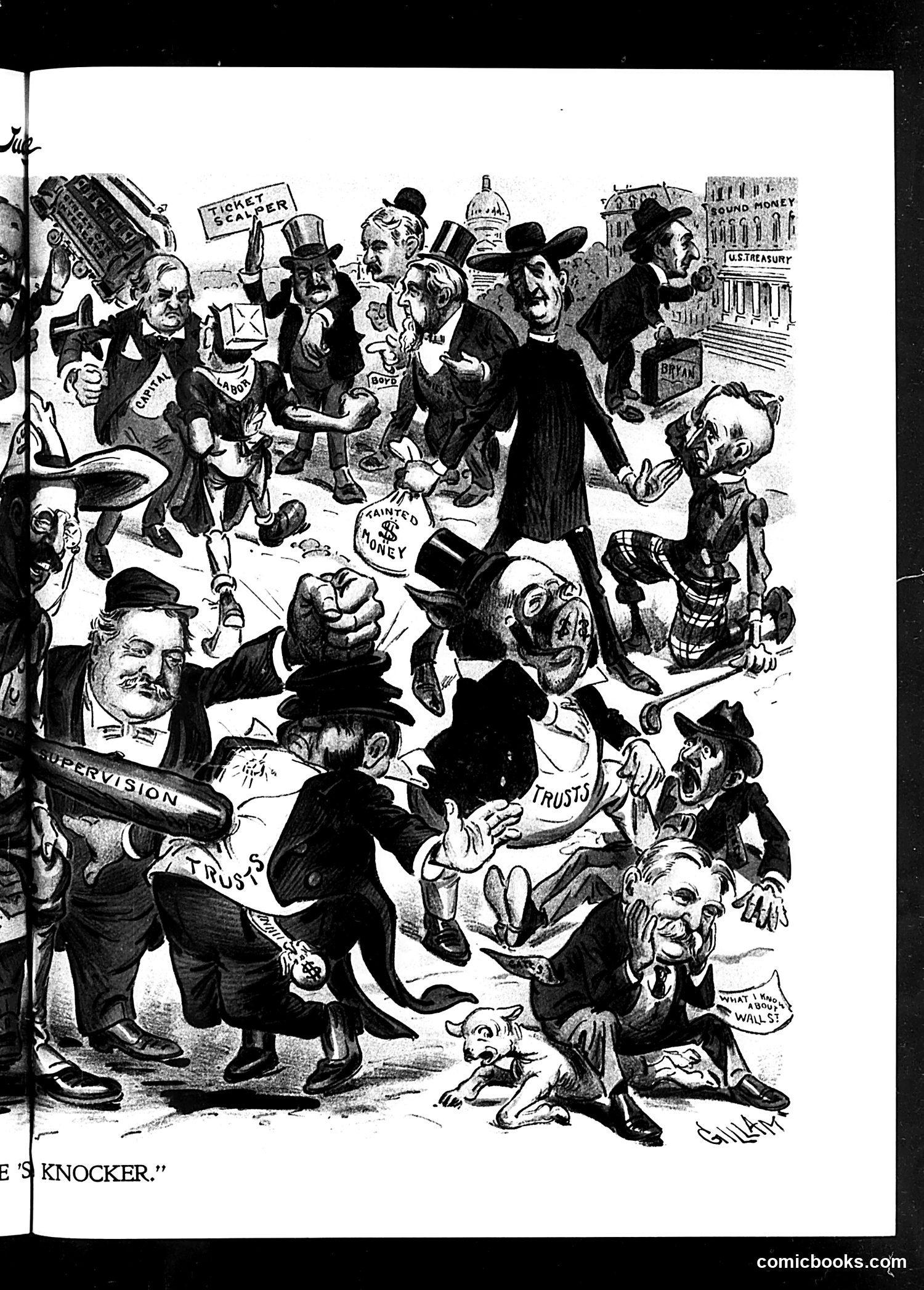
This appears to be a turn-of-the-century political satire depicting corruption in American government and finance. The cartoon shows numerous caricatured figures engaged in disreputable activities around the U.S. Capitol building (visible in background). Key visible elements include: - Labels reading "Tainted Money," "Trusts," "Ticket Scalper," and "Supervision" - References to the Treasury - A small dog at bottom asking "What I Want to Know is—Will S—?" The satire criticizes financial manipulation, monopolistic trusts, and government corruption. The exaggerated caricatures and chaotic composition emphasize the disorder and duplicity the cartoonist saw in these institutions. The title "Knocker" (referring to critics/complainers) suggests this is commentary on those exposing governmental malfeasance.
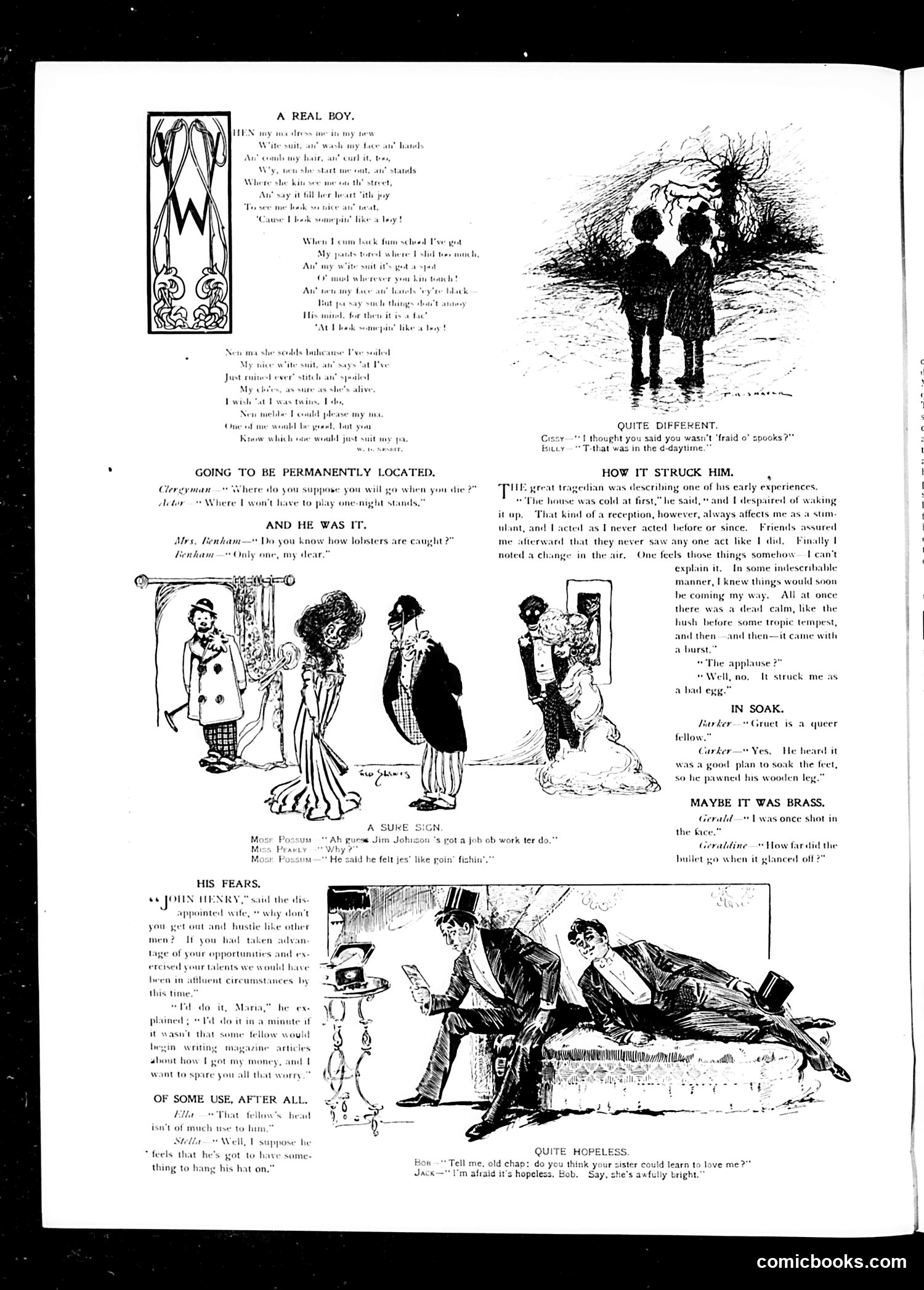
This page from the satirical magazine *Judge* contains several humorous short dialogues and comic vignettes mocking social pretensions and human foibles of the era. **Key sections:** - **"A Real Boy"**: A poem celebrating boyish roughness and dirt—contrasting with Victorian ideals of pristine children. - **"Going to Be Permanently Located"**: A joke about an actor claiming he'll be "permanently located" in heaven—mocking theatrical pretension and religiosity. - **"How It Struck Him"**: A tragic actor's overwrought account of a failed performance, with the punchline that his dramatic suffering impressed no one—satire of thespian self-importance. - **"His Fears"**: A husband afraid to succeed financially because magazine writers would exploit his story—mockery of new celebrity culture and self-made-man narratives. - Various brief witticisms about lobster-catching, wooden legs, and useless hats—typical light social comedy. The overall tone targets inflated egos, theatrical affectation, and anxiety about modern publicity culture.
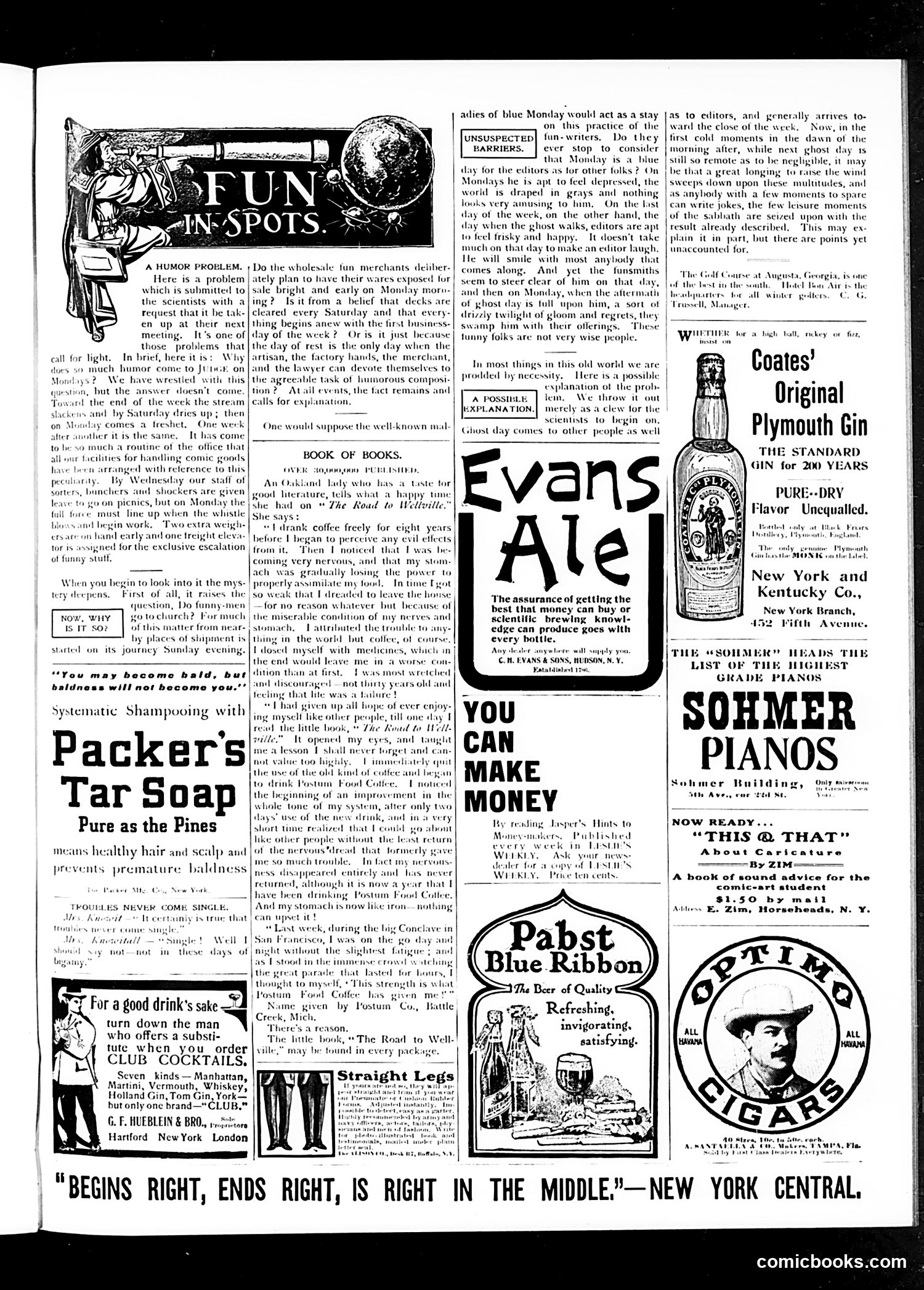
This page is primarily **advertising**, with one sidebar feature about editorial submissions. The main editorial content is "A Humor Problem," which humorously questions why **Judge receives far more comic submissions on Mondays than other days**. The writer speculates whether humor writers attend church on Sundays (implying Monday recovery), whether they deliberately time submissions for Monday's "ghost day" (payday, when editors are happier), or whether Monday's melancholy actually inspires funny writing as compensation. The piece gently mocks both submission patterns and the psychology of "funny folks," suggesting they're "not very wise people" for flooding the office when editors are least receptive. The remainder consists of period advertisements for **Parker's Tar Soap, Evans Ale, Coates Plymouth Gin, Pabst Blue Ribbon beer, Sohmer Pianos, and Optic Cigars**—typical consumer products of the early 20th century. No specific political figures or events are referenced; this is social/workplace humor about the magazine's own operations.
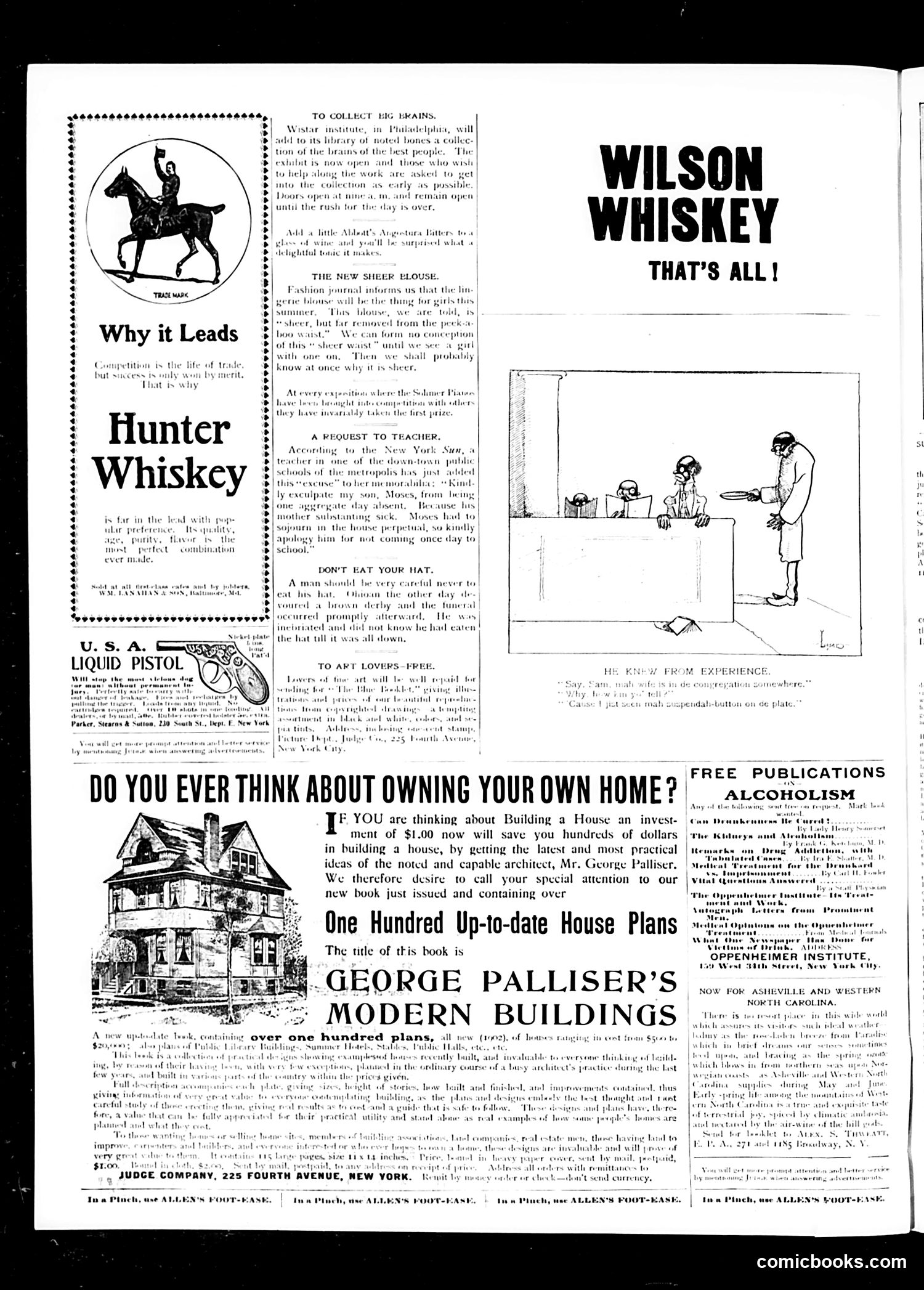
This page from *Judge* magazine mixes advertisements with satirical content typical of early 20th-century American humor publications. The main cartoon depicts a domestic scene where a woman scolds a man about eating food (the caption "Don't Eat Your Hat" references an anecdote about someone accidentally consuming a derby hat). The satire appears to mock domestic incompetence or marital friction. The whiskey advertisements ("Wilson Whiskey," "Hunter Whiskey," "U.S.A. Liquid Pistol") promote alcohol products with claims about superiority and quality—standard commercial messaging of the era before Prohibition. The page also includes humorous pieces about fashion ("The New Sheer Blouse"), education (a teacher's excuse note), and art collecting. These reflect genteel, middle-class concerns of the period. The substantial real estate advertising for George Palliser's house-building book indicates the magazine's audience: aspiring homeowners with disposable income. Overall, this represents *Judge*'s characteristic blend of satirical humor targeting contemporary social conventions alongside commercial promotion to affluent readers.
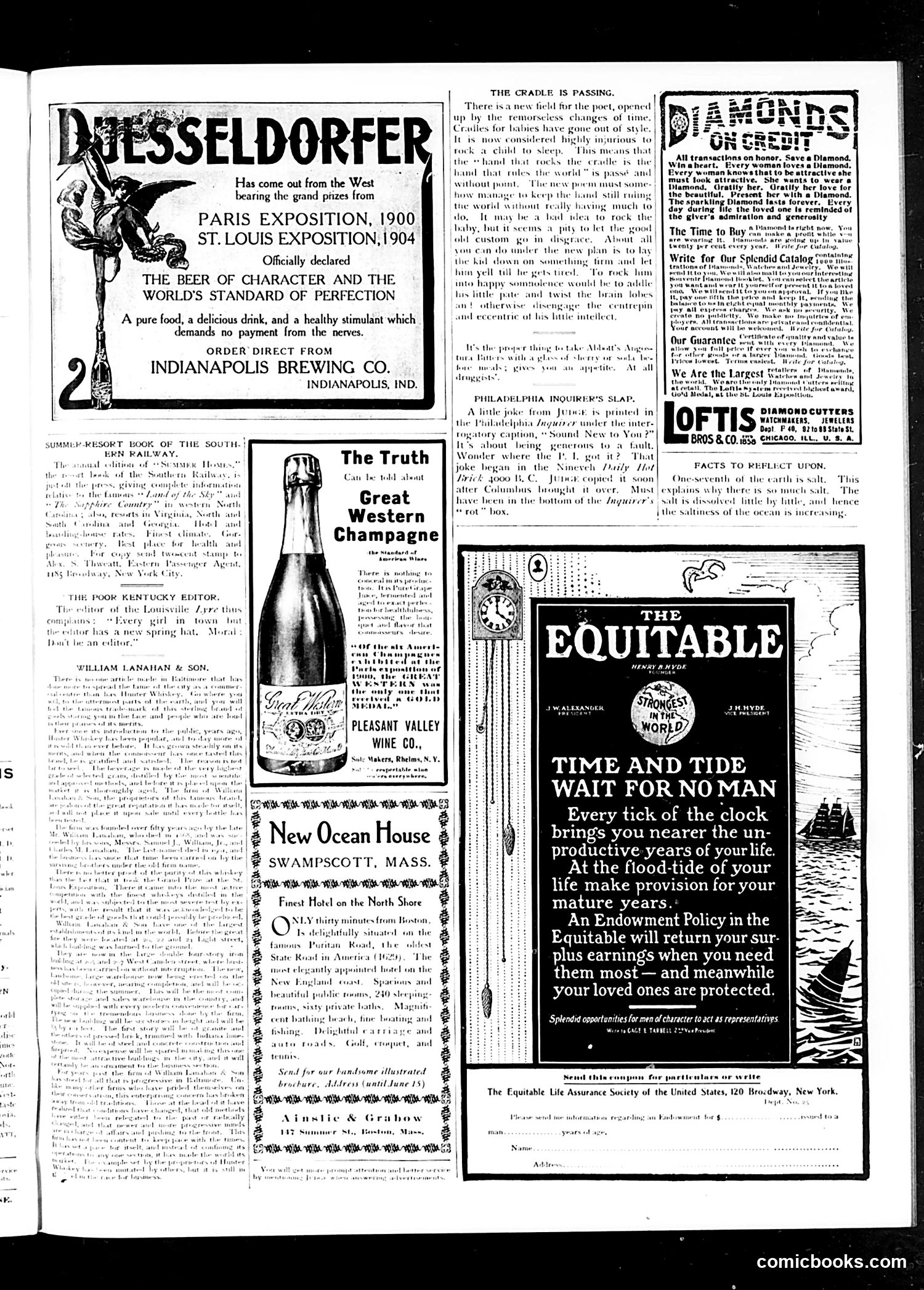
The main editorial cartoon critiques shifting attitudes toward child-rearing in the early 1900s. The text laments that rocking cradles—once a standard parenting practice—have become "out of style" due to new medical theories claiming the motion harms children's development. The satire's point: modern "scientific" advice has eliminated a gentle, traditional practice without offering anything better. The author notes parents can now only "lay the firm and let him yell til he gets tired" or alternatively "twist the brain lobes"—implying the new methods are actually worse than the old ones. This reflects genuine early-20th-century debates about child psychology and parenting, where emerging scientific claims often contradicted proven folk wisdom. The cartoon mocks how eagerly society abandons tradition for fashionable but questionable expert opinion. The page is primarily advertisements (beer, champagne, insurance, jewelry), with this editorial piece offering social commentary typical of Judge magazine's satirical approach.
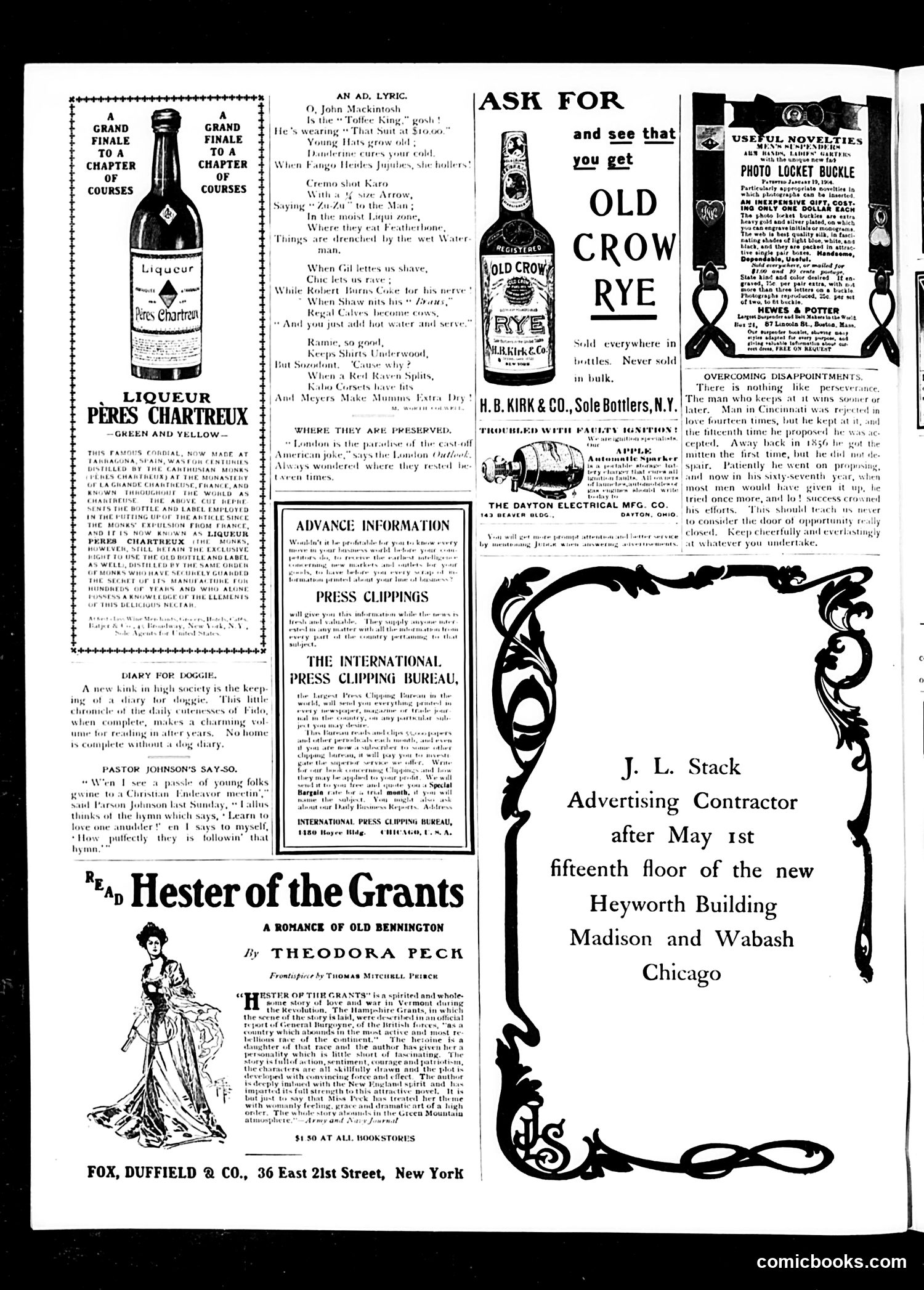
This page is primarily **advertising and announcements** rather than political satire. It contains: **Main content:** - A liqueur advertisement for Pères Chartreux (left column) - An Old Crow Rye whiskey ad (center) - A photo locket buckle advertisement (right) - A book announcement for "Hester of the Grants" by Theodora Peck (bottom left) - J.L. Stack's advertising contractor notice (right) **The "lyric" at top** appears to be a humorous advertising jingle mixing product names (Arrow shirts, Dunderine hair product, Fango mud, Cremo cigars, etc.) into verse—a satirical commentary on *advertising itself* rather than politics. It mocks how brands infiltrate everyday language. **Social reference:** The "Diary for Doggie" blurb satirizes upper-class pretension by noting wealthy people keep diaries documenting their pets' activities. This is a typical Judge magazine page: **mostly commercial space** with light satirical humor about consumer culture and high-society vanity, not political commentary.
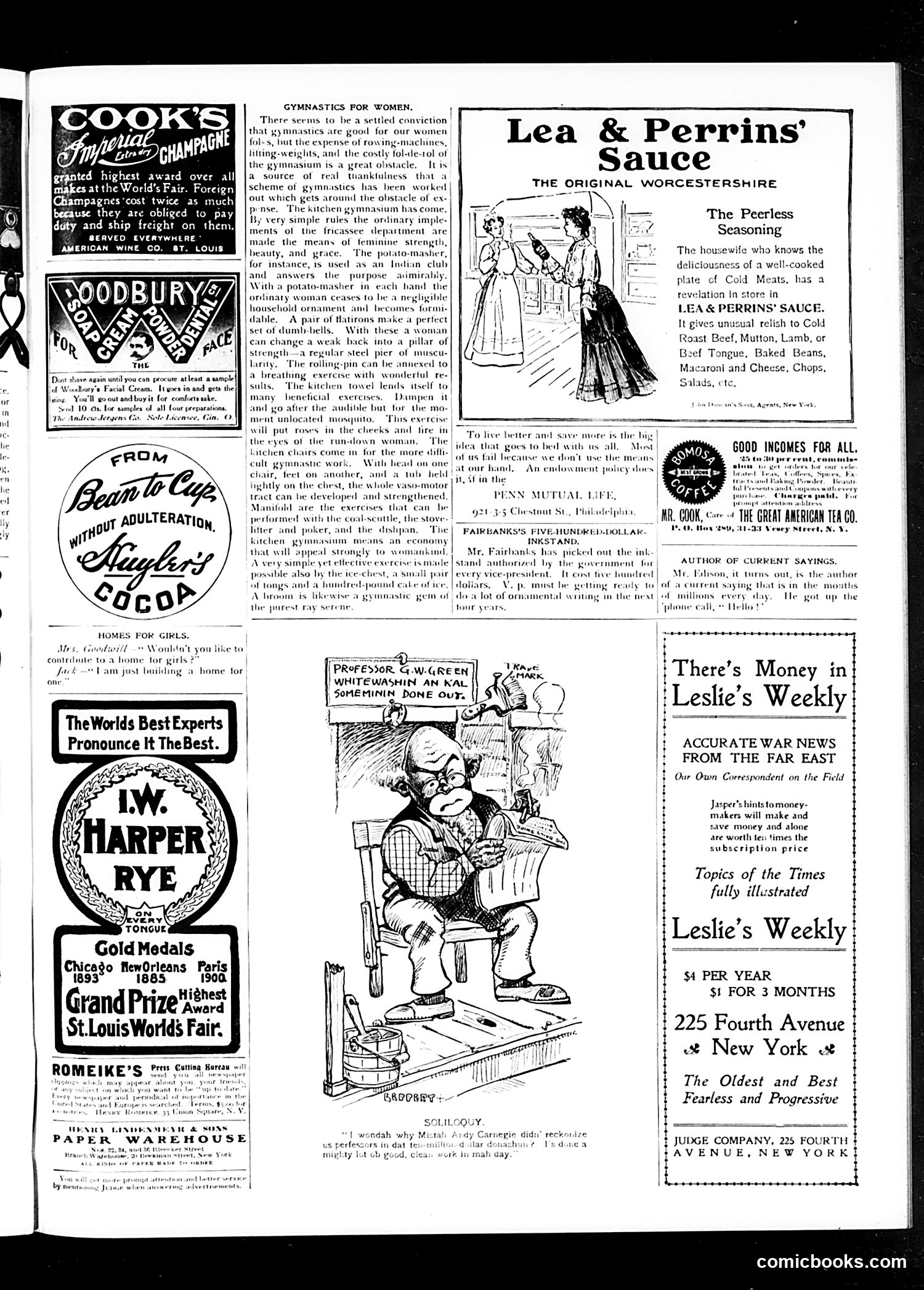
This page is primarily **advertising with one small political cartoon**. ## The Main Cartoon The cartoon titled "SOLILOQUY" depicts a figure (labeled "DADORRY") whitewashing a wall. The caption references "Professor G.W. Green" and includes dialogue about whitewashing and something being "done out." This appears to be **satire about political corruption or cover-up**—"whitewashing" is a metaphor for concealing wrongdoing. However, without clearer identification of who "Dadorry" or "Professor Green" represent, the specific political target remains unclear. ## Page Content The bulk of the page consists of **advertisements** for Cook's Champagne, Lea & Perrins Sauce, various food products, and Leslie's Weekly magazine. The article "Gymnastics for Women" is **satirical humor** mocking the notion that women could achieve fitness through ordinary kitchen tasks (using rolling pins, potato mashers, and flatiirons as exercise equipment). It's gentle social satire about women's limited gymnasium access and the absurdity of improvised alternatives. The page reflects early 1900s commercial advertising mixed with light social commentary rather than hard political satire.
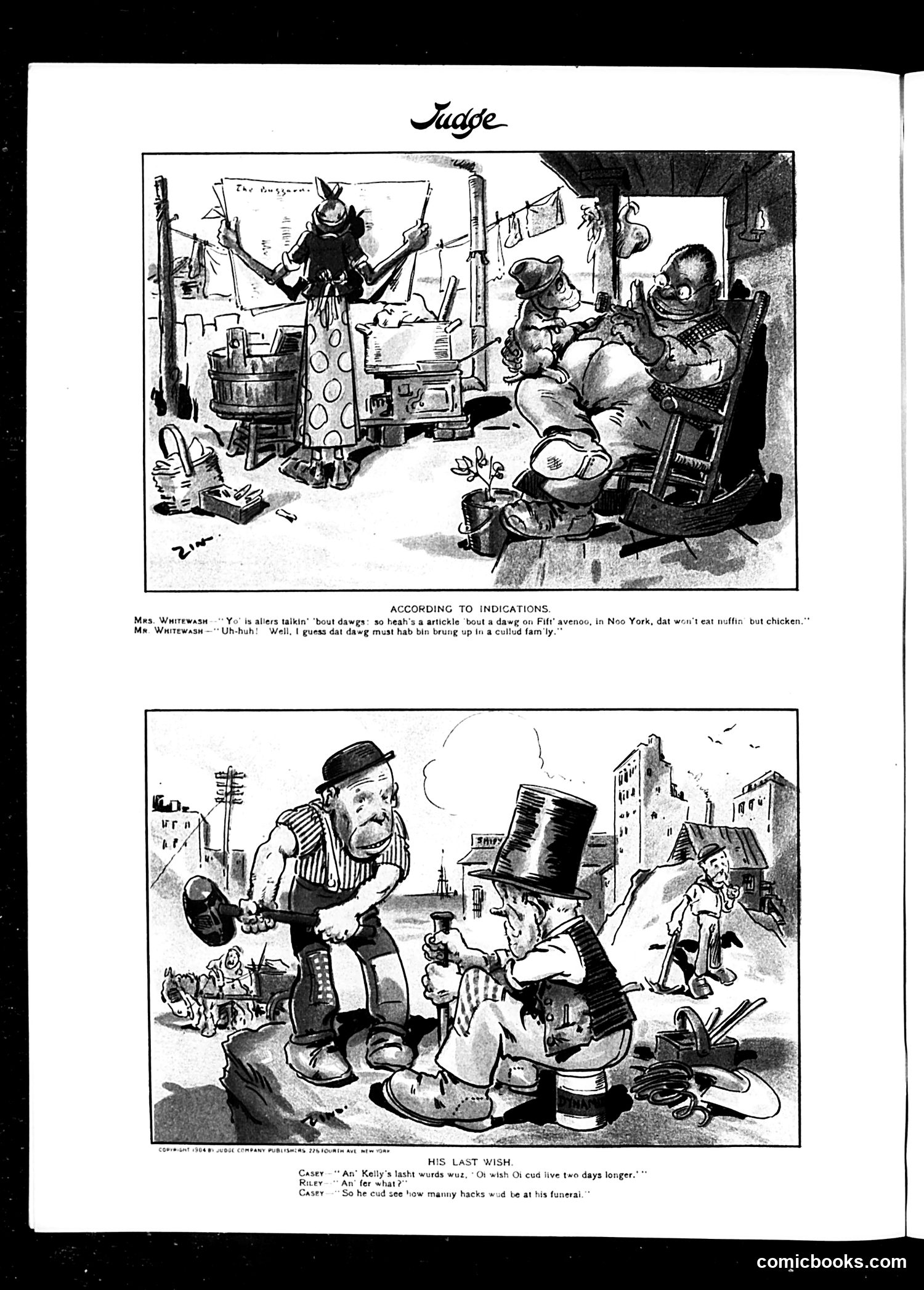
These are two separate cartoons employing racial stereotypes common to early 20th-century American humor. **Top cartoon ("According to Indications")**: Uses dialect humor mocking African Americans. The joke relies on a racist stereotype that Black families feed their dogs chicken—implying both poverty and cultural difference. The humor targets both the dog's pickiness and the characters' speech patterns. **Bottom cartoon ("His Last Wish")**: Features what appears to be an Irish immigrant character (suggested by "Kelly" and "Oi" dialect). The dark humor centers on someone's deathbed wish: living two extra days to see how many taxi drivers ("hacks") attend his funeral—implying he's so unpopular or notorious that even this morbid metric would be noteworthy. Both cartoons use ethnic caricature and dialect comedy—standard Judge magazine fare for ridiculing immigrant and minority communities through exaggerated speech and crude stereotypes.