
A complete issue · 16 pages · 1905
Judge — May 27, 1905
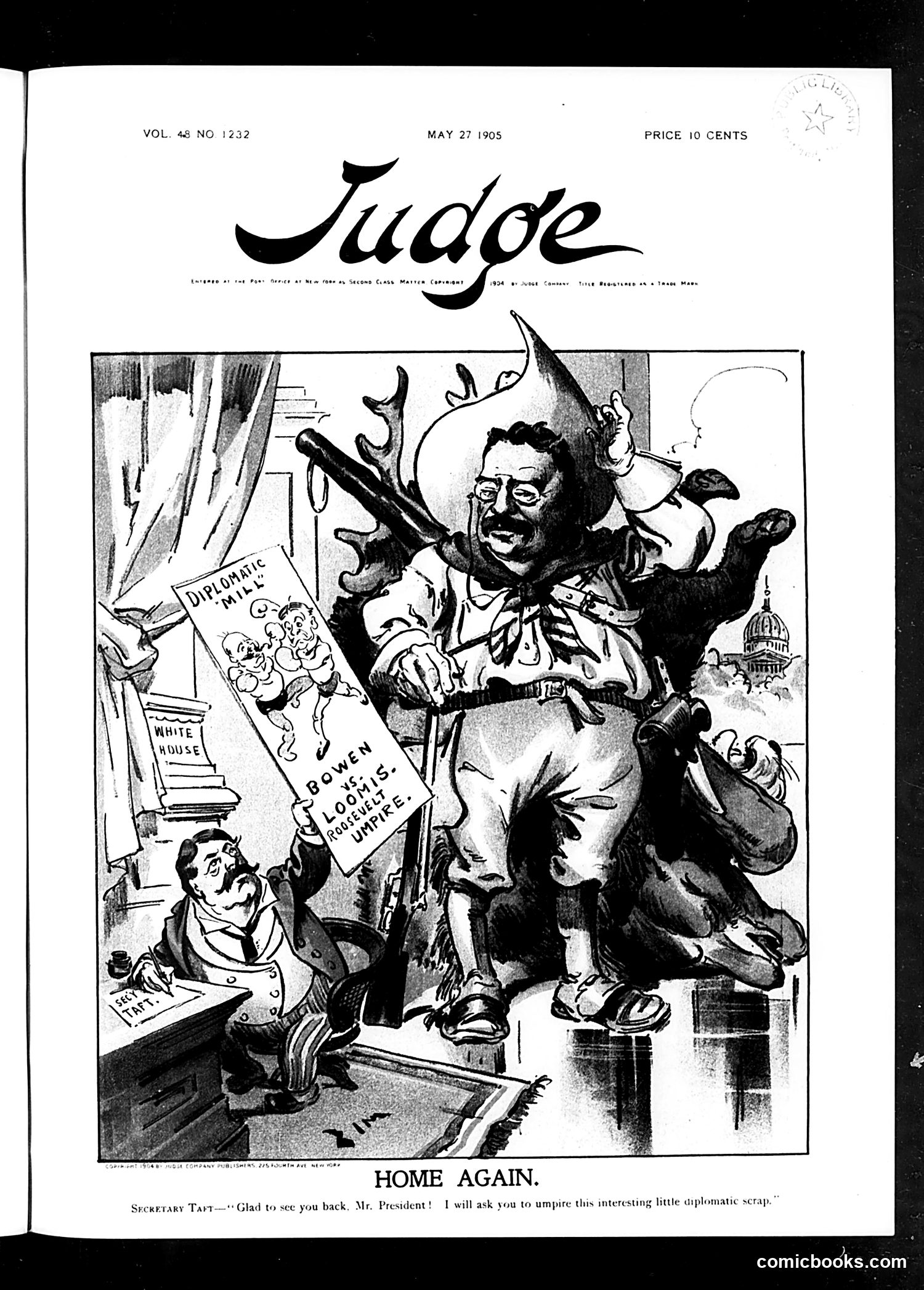
This cartoon satirizes President Theodore Roosevelt's return from diplomatic travels abroad. The central caricatured figure (likely Roosevelt, given the prominent mustache and energetic posture) is depicted as a theatrical character juggling various diplomatic matters—labeled items appear to reference international relations and foreign policy. Secretary Taft (identified in the caption) welcomes Roosevelt back, referencing "this interesting little diplomatic scrap" the President will need to address upon his return. The satire mocks Roosevelt's expansive foreign policy engagements and the domestic complications awaiting his return. The theatrical staging—with devils, props, and chaotic energy—suggests the cartoon views his diplomatic ventures as dramatic but perhaps destabilizing to American affairs.
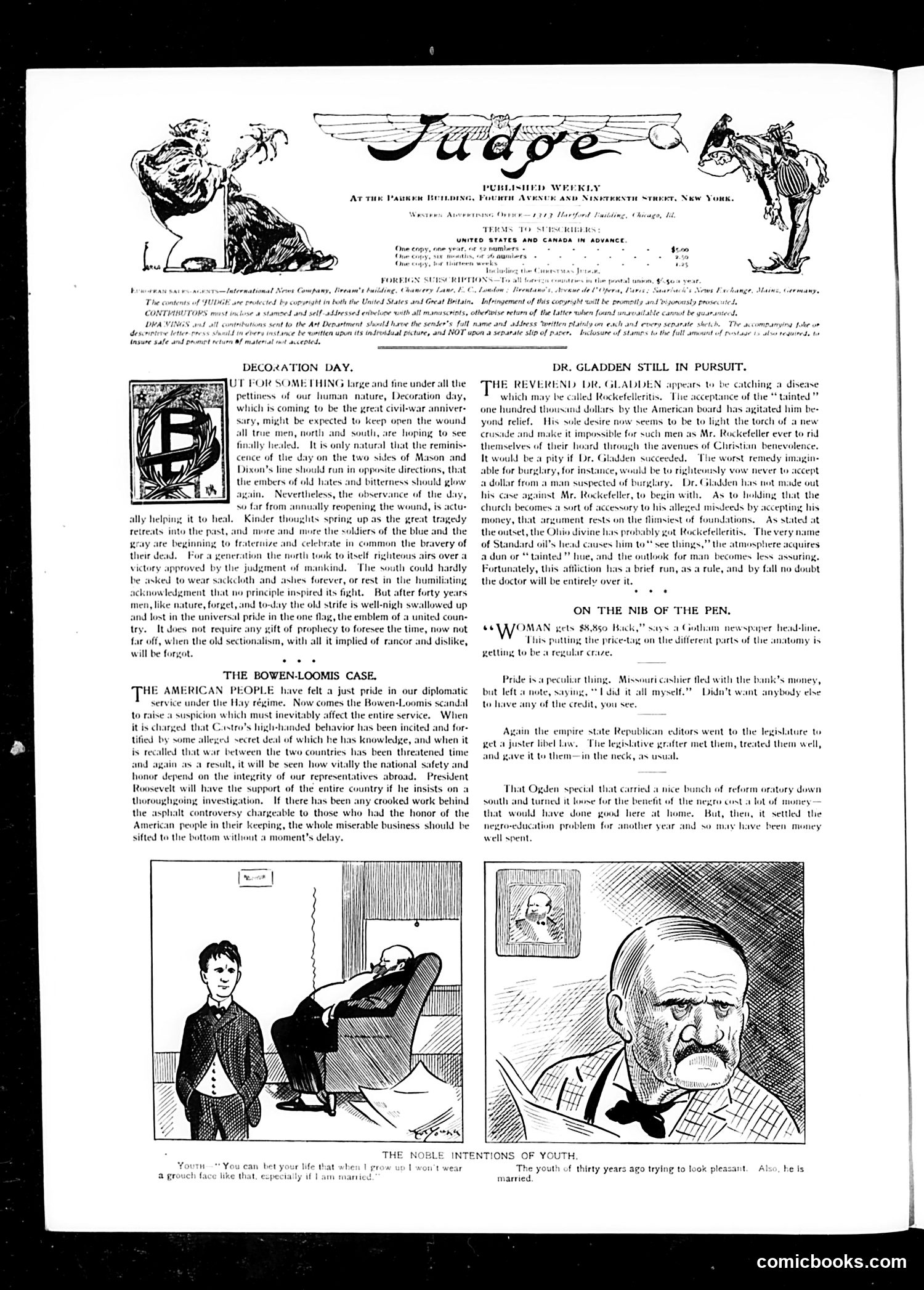
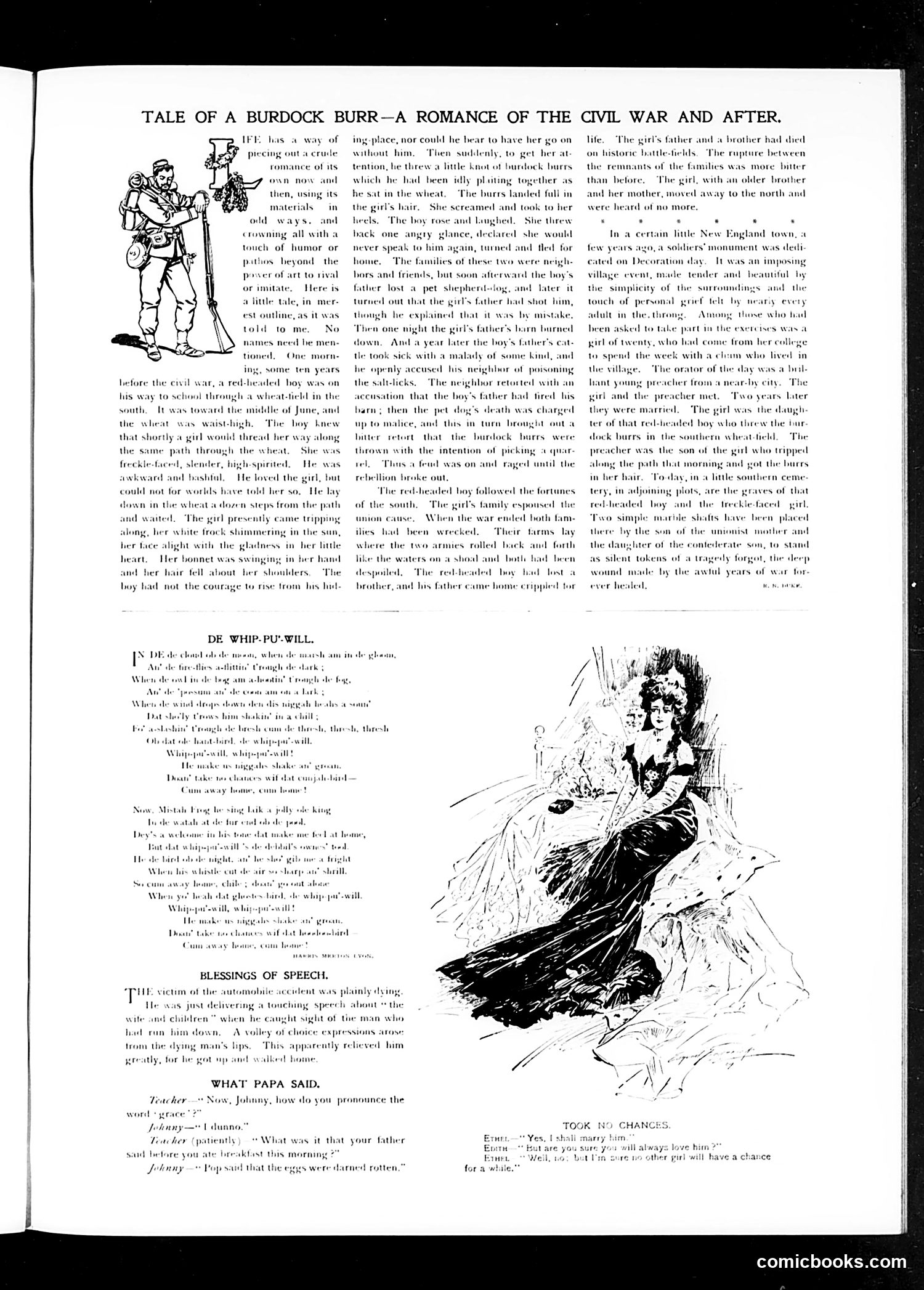
This page contains three distinct sections: 1. **"Tale of a Burdock Burr"** (top): A sentimental Civil War-era romance story about a soldier and girl separated by conflict, their families' feuding, and eventual reconciliation. This is narrative fiction, not satire. 2. **"De Whip-Pu-Will"** (middle): A dialect poem, apparently humorous verse using African American vernacular speech patterns common to period humor literature. 3. **"What Papa Said"** (bottom): A brief joke involving a teacher, student named Johnny, and wordplay about pronouncing "grace" and eggs being "darned rotten." The illustration shows a romantic figure on fabric/clothing. The page is primarily **literary content rather than political satire**—it's entertainment fiction typical of Judge magazine's mixed editorial approach, not topical commentary requiring historical context to decode.
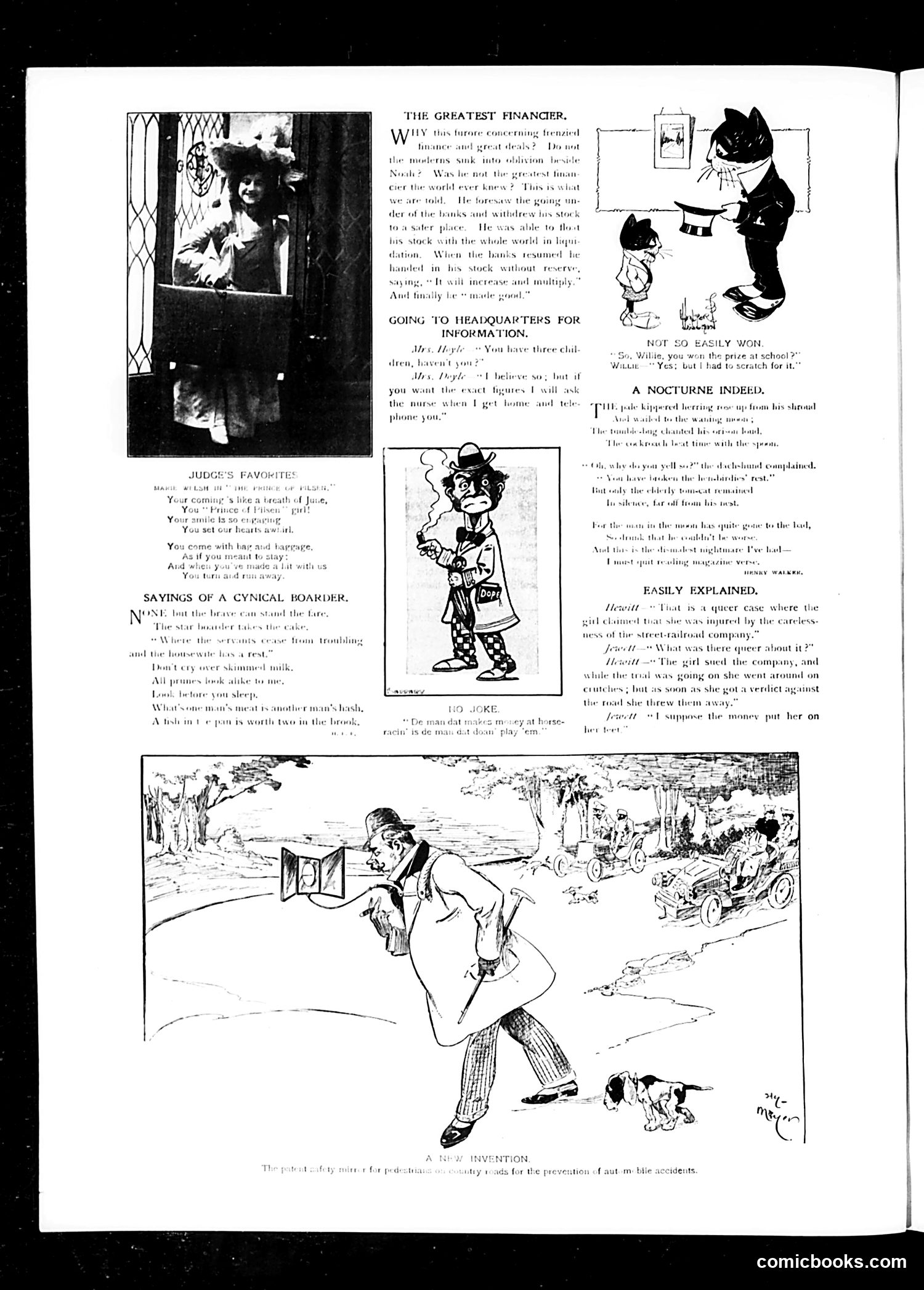
This page contains several unrelated satirical pieces typical of Judge magazine's format: **"The Greatest Financier"** appears to reference banking/financial manipulation, suggesting someone used stock manipulation to control markets—a common Progressive-era concern about monopolies and Wall Street power. **"Going to Headquarters for Information"** is a simple domestic joke about a child asking their mother about three children she mentioned. **"A New Invention"** (bottom cartoon) shows a man with an umbrella-like device, apparently designed to protect against accidents—likely satirizing either an absurd patent or over-engineered safety solutions. The other pieces ("Saying of a Cynical Boarder," "Not So Easily Won," "A Nocturne Indeed") are brief humorous anecdotes or poetry. Without clearer captions identifying specific public figures, most satirical targets remain unclear from the image alone.
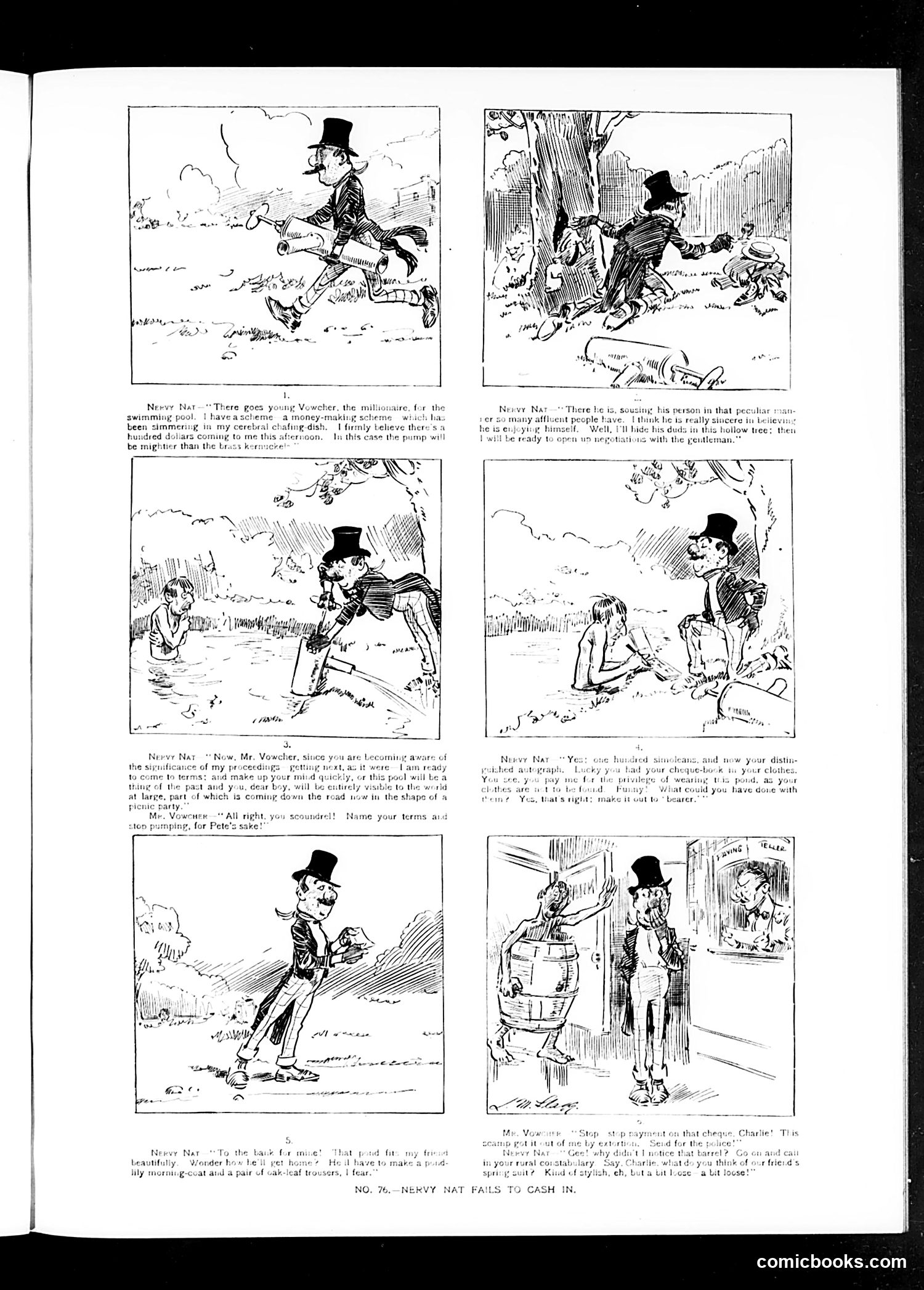
This page presents a six-panel comic strip titled "No. 76—Nervy Nat Fails to Cash In." The narrative follows a character named Nervy Nat (a con artist or schemer type, identifiable by his top hat and exaggerated features) attempting various get-rich-quick schemes. The satire targets naive entrepreneurship and social climbing. Each panel shows Nat pitching dubious money-making ideas—apparently involving a pump scheme and fraudulent financial dealings—to other characters who become suspicious or reject his proposals. The humor relies on physical comedy and Nat's repeated failures to convince people to invest in his schemes. The "nervy" characterization suggests someone undeterred by rejection but fundamentally dishonest. This reflects early 20th-century Judge magazine's satirical interest in exposing financial fraud and social pretension among working and middle-class characters.
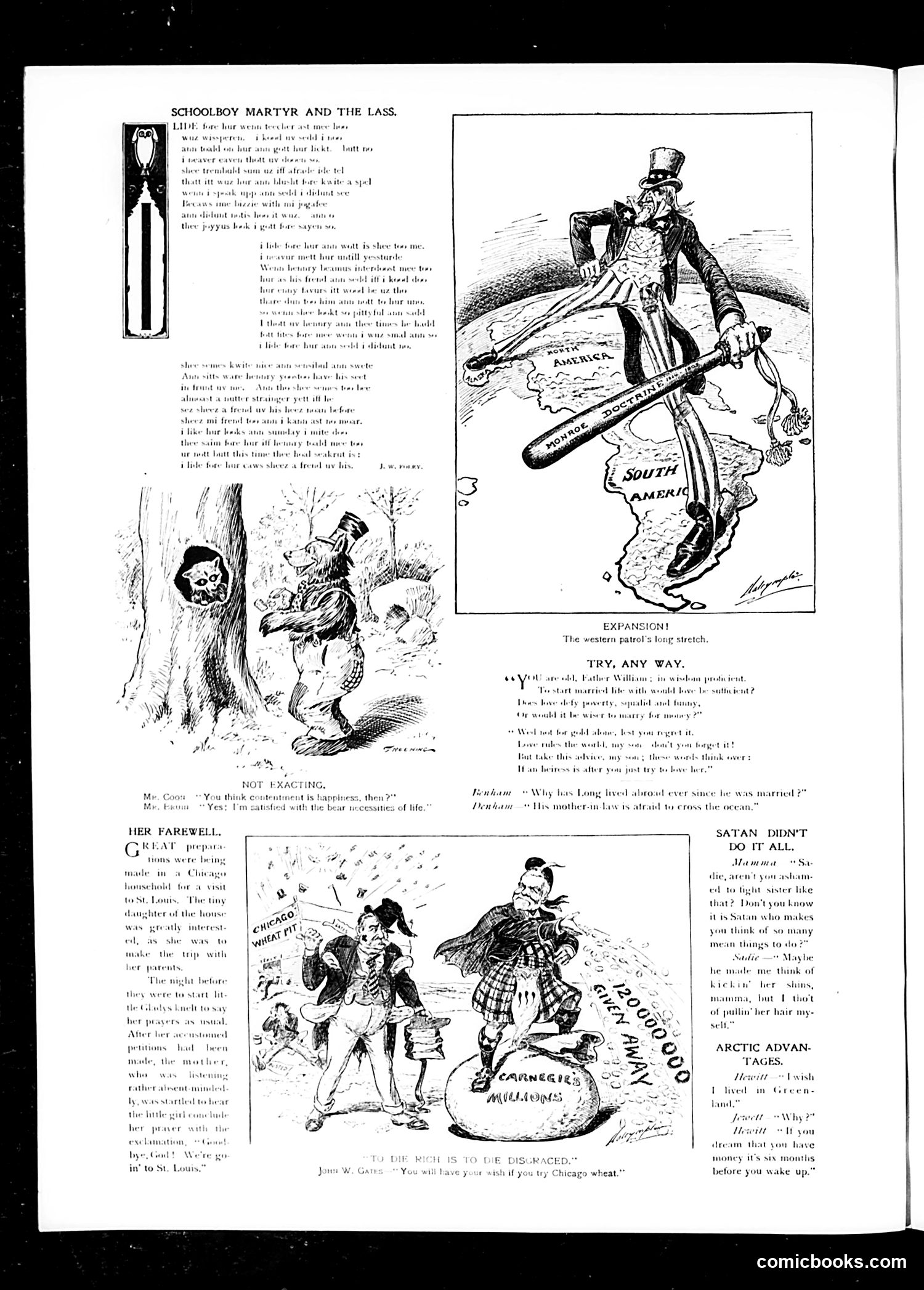
This page contains several satirical pieces reflecting early 20th-century American humor and social attitudes: **"Schoolboy Martyr and the Lass"** appears to be a sentimental poem about young love, likely mocking overwrought romantic narratives common in literature of the era. **"Expansion!"** features a caricatured figure (possibly Uncle Sam or a political leader) stretching across South America, satirizing American imperial ambitions and territorial expansion—a significant political issue of the period. **"Her Farewell"** and related pieces deal with domestic scenes, including dialogue between figures labeled with racial stereotypes ("Mr. Coon," "Denham"). These reflect the regrettable racist conventions of Judge's era. **"Satan Didn't Do It All"** is a domestic humor piece about a child's mischief. **"Arctic Advantages"** offers wordplay about polar regions and financial matters. The page overall represents Judge's mix of political satire, sentimental parody, and domestic comedy typical of early American satirical magazines.
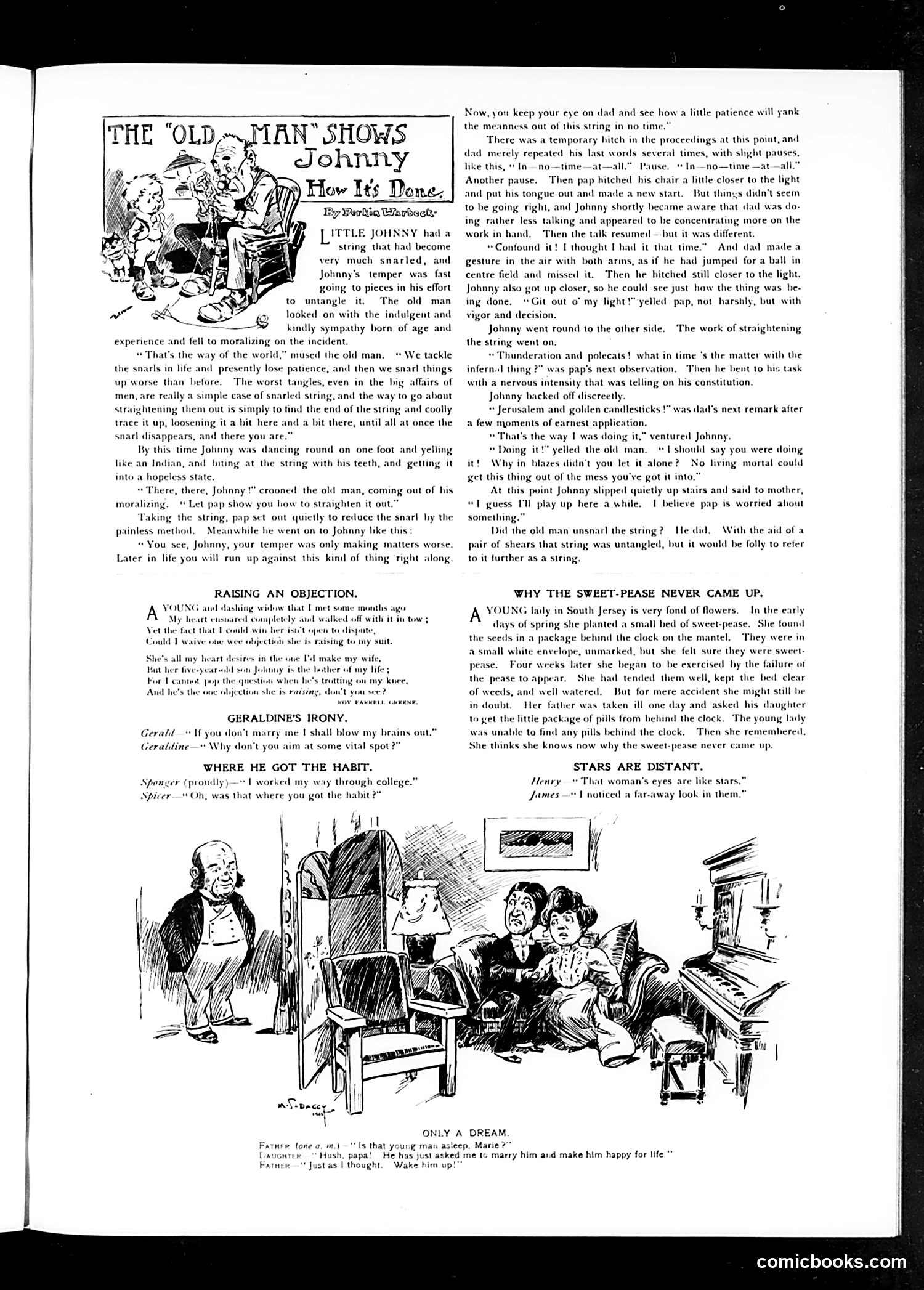
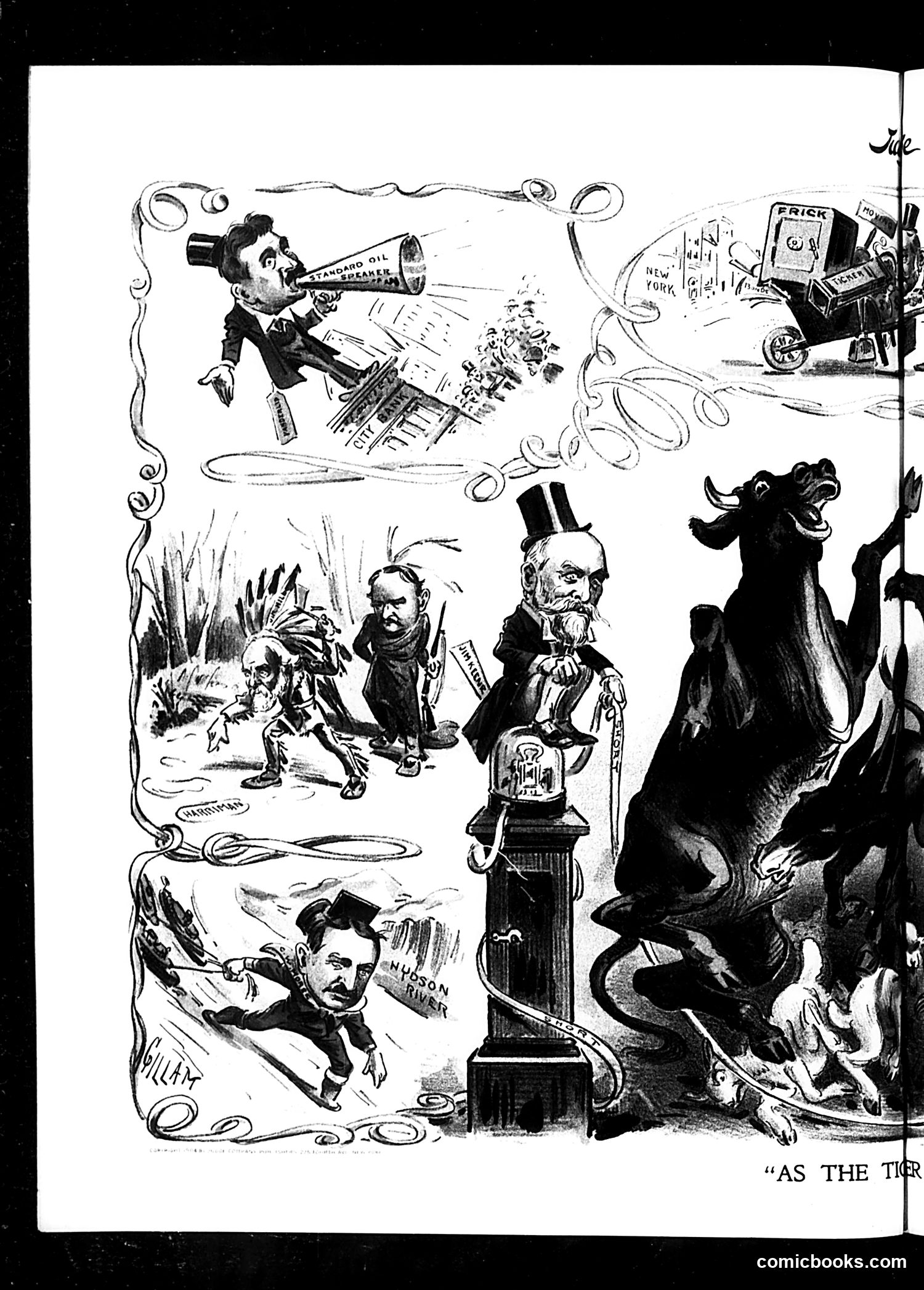
This appears to be a satirical cartoon from *Judge* magazine depicting corporate and political figures as caricatured creatures and characters. The top section shows a figure with a "Standard Oil" telescope surveying a landscape of buildings and financial charts, suggesting commentary on corporate monopoly and market manipulation. The lower section features exaggerated caricatures of what appear to be politicians or industrialists in formal dress, positioned around a tall pedestal or monument. On the right, large beast-like figures (possibly representing corporate interests or foreign powers) loom over the scene. The incomplete caption "AS THE TI[GER]" suggests this cartoon critiques the relationship between big business, politics, and predatory practices during the Progressive Era, though the full context remains unclear without complete text.
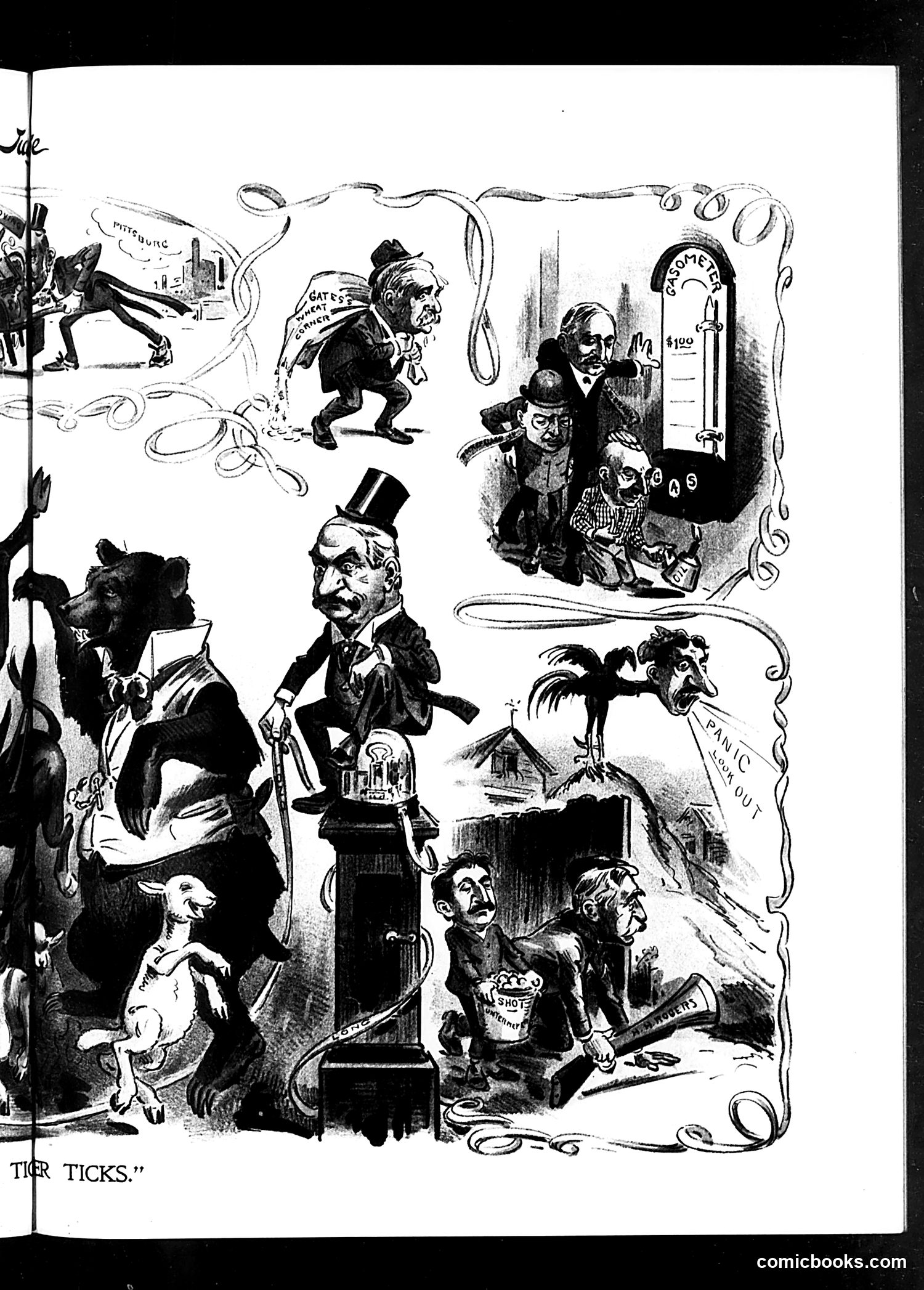
This political cartoon uses animal caricatures—prominently featuring exaggerated human faces with animal characteristics—to satirize political or social figures of the era. The title "Tiger Ticks" suggests parasitic corruption or disease infecting power structures. The composition shows a hierarchical arrangement: a well-dressed man in a top hat (likely a political leader) dominates the center, surrounded by smaller, more animalistic figures below. These appear to represent corrupt subordinates or hangers-on feeding off the main figure's authority. The "Panic" label visible in the upper right suggests this relates to economic crisis or fear. The cartoon's message likely critiques how corruption and incompetence proliferate within government, with smaller parasitic figures (the "ticks") depending on and feeding from those in power.
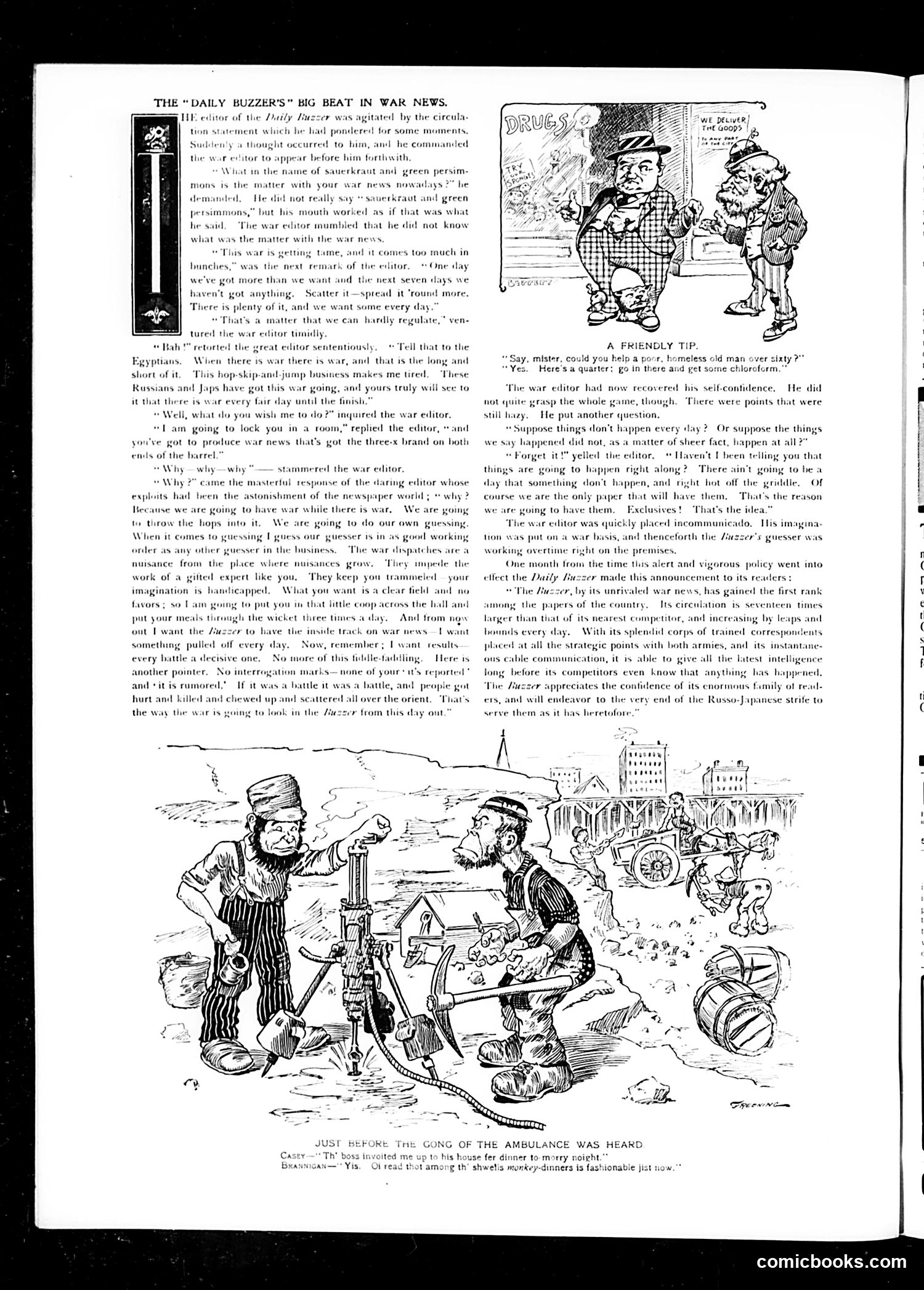
This satirical piece mocks sensationalist journalism during wartime. The editor of the *Daily Buzzer* newspaper demands his war editor produce *constant* war news—spread evenly across every day rather than arriving in "bunches." When the editor protests that wars don't happen on schedule, the editor dismisses reality: "Suppose things don't happen every day? Forget it!" The satire escalates when the editor locks the war editor away to "guess" news without interference from actual facts, declaring their made-up dispatches superior to real war reports. The punchline: within a month, the *Buzzer*'s fabricated coverage achieves seventeen times the circulation of competitors. The cartoon critiques how newspapers prioritize sensationalism and profit over truthful reporting, inventing or exaggerating stories to maintain reader interest. The "chloroform" joke suggests such fabrication is essentially criminal.
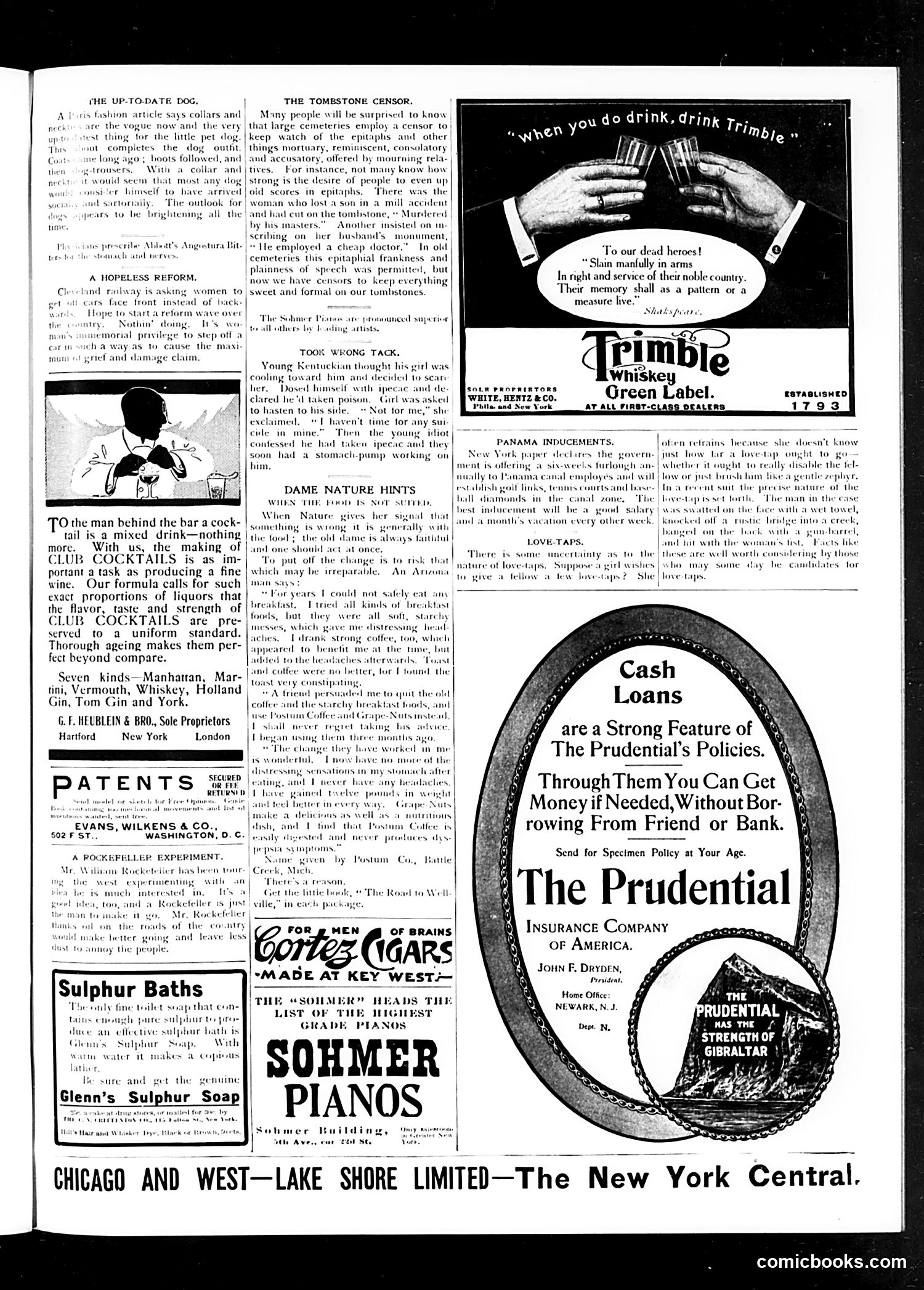
This page is primarily **advertising** with several short satirical pieces typical of Judge magazine's format. **Main cartoons/articles:** 1. **"The Up-to-Date Dog"** and **"Cleveland Railway Reform"** — brief social commentary on modern pet fashion and transit system accountability, suggesting progress in everyday life. 2. **"The Tombstone Censor"** — satirizes cemetery authorities who censor epitaphs to remove accusations and vindictive messages from grieving relatives. The joke: mourners wanted to use tombstones to settle old scores (e.g., blaming employers for deaths), but censors now enforce bland, formal language. This mocks Victorian propriety and suppression of genuine emotion. 3. **"Took Wrong Tack"** — humorous anecdote about a young man faking poisoning to scare his girlfriend; she calls for ipecac instead of rushing to help him, exposing his manipulation. 4. **"Dame Nature Hints"** — testimonial about switching from coffee/breakfast foods to Postum cereal drink, resolving digestive issues—essentially an advertorial. The remainder consists of **product advertisements** (Trimble Whiskey, Prudential Insurance, Sohmer Pianos, etc.).
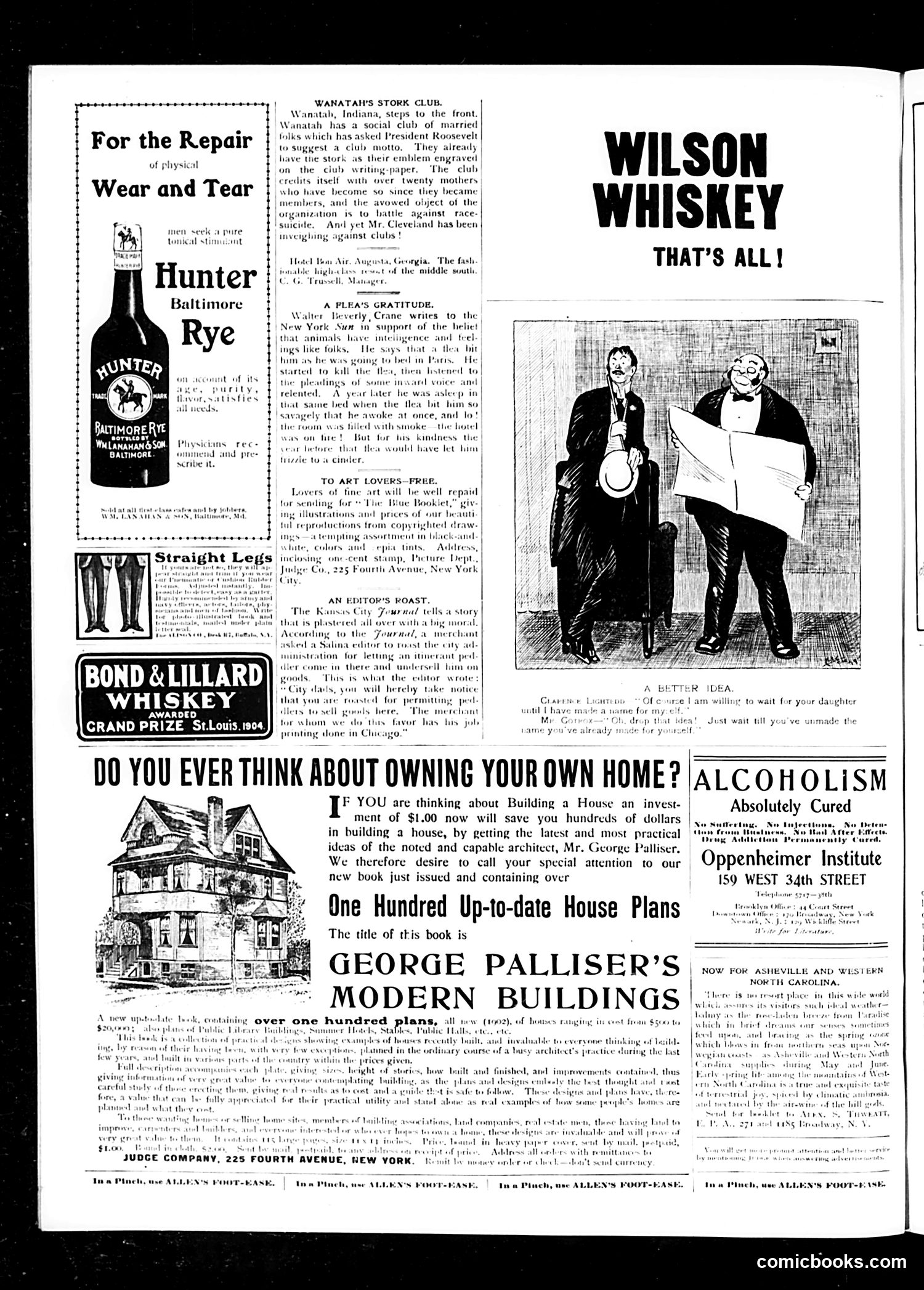
This page is primarily **advertising with minimal editorial content**. The main cartoons are small: **"A Better Idea"** (right side): A husband and wife discuss naming their newborn. He suggests waiting for the daughter to "grow up" and make a name for herself, implying she should build her own reputation rather than inherit one. This is gentle domestic humor about identity and self-determination. **"Wanatah's Stork Club"** (top center): References a married women's social club in Wanatah, Indiana, explicitly dedicated to combating "race suicide"—a period concern about declining birth rates among white middle-class Americans. The text sardonically notes President Cleveland opposed such clubs, adding ironic commentary on this eugenic-minded social movement. The bulk of the page features advertisements for whiskey (Wilson, Hunter, Bond & Lillard brands), house-building plans by architect George Palliser, and the Oppenheimer Institute (an alcoholism cure facility), reflecting early 1900s consumer culture and contemporary concerns about substance abuse and housing.
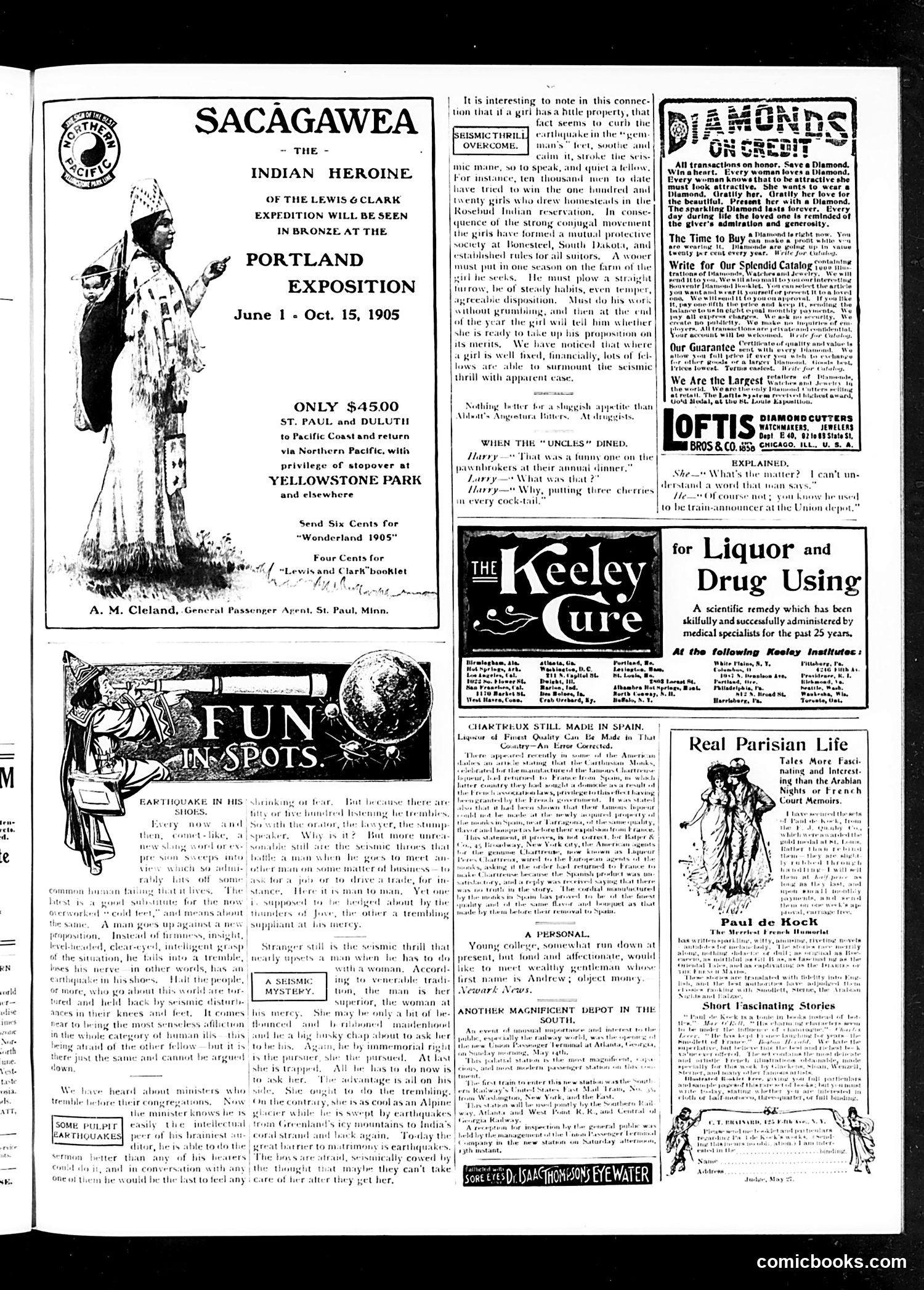
This page is primarily **advertising and promotional content** rather than political satire. The dominant feature is a large advertisement for the **1905 Portland Exposition**, promoting a bronze statue of Sacagawea (labeled "the Indian Heroine of the Lewis & Clark Expedition") for $4,500. The remaining space contains various period advertisements: diamonds, liquor treatment remedies, and tourist attractions like "Real Parisian Life" shows. There's minimal political commentary. The small "Fun in Spots" section contains mild jokes about earthquakes and domestic situations—typical light humor for the era, not satire. The page reflects early 1900s consumer culture and the popular fascination with both Native American imagery and world's fair exhibitions.
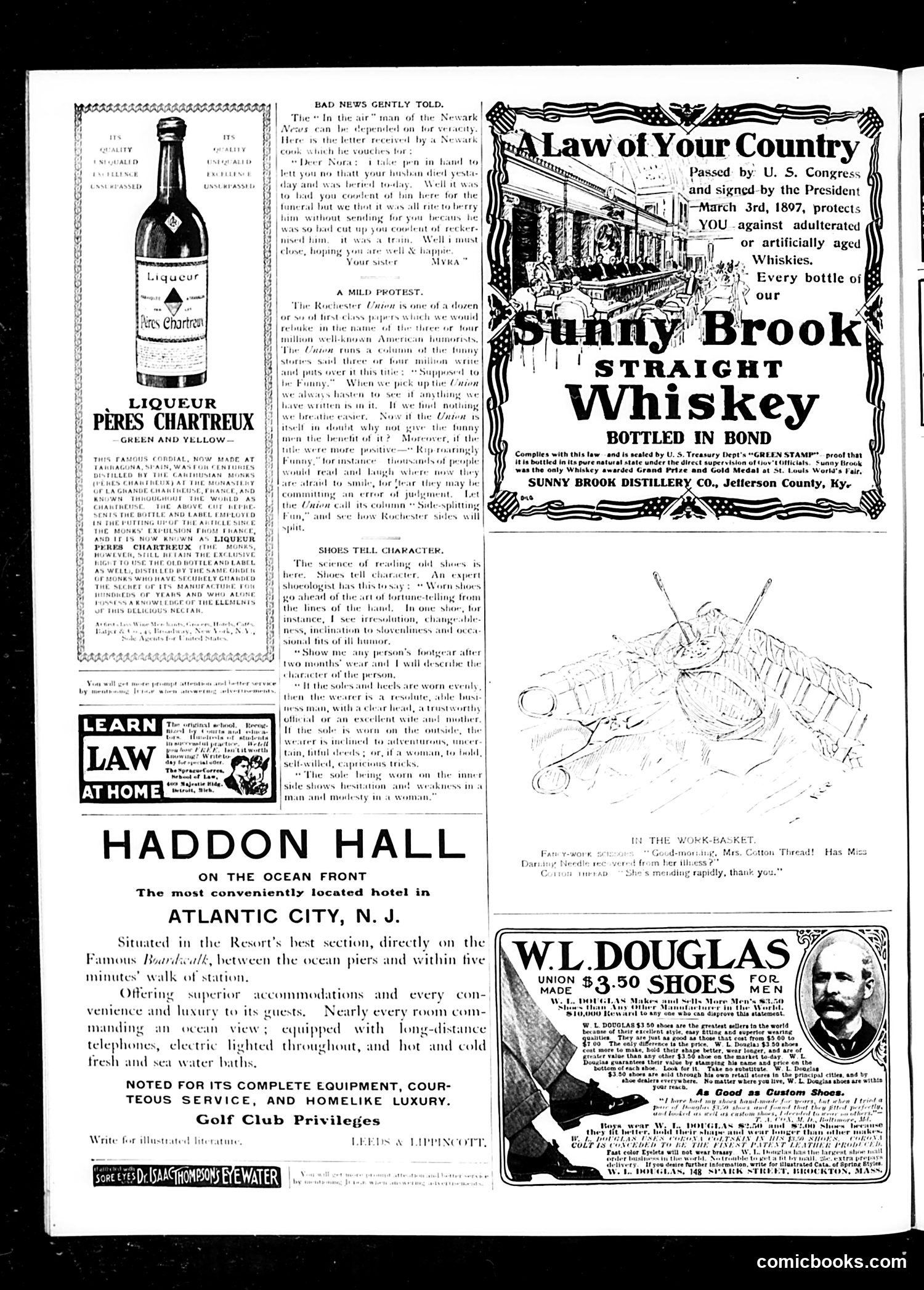
This page is primarily **advertising and filler content**, not political satire. The main items are: **"Bad News Gently Told"**: A brief humorous letter announcing someone's death in an awkwardly casual, grammatically poor manner—a joke about crude notification rather than political commentary. **"A Mild Protest"**: The Rochester Union newspaper is criticized for reprinting stories attributed to famous American humorists without properly crediting them. This is industry commentary, not political satire. **"Shoes Tell Character"**: A pseudo-scientific piece claiming one can determine personality from worn shoe patterns—apparently meant as entertainment/pseudo-psychology humor. The remaining content consists of straightforward advertisements: Liqueur Pères Chartreux, Haddon Hall hotel in Atlantic City, W.L. Douglas shoes ($3.50), and Sunny Brook Whiskey (emphasizing it complies with 1897 federal law against adulteration). No political figures, caricatures, or meaningful satire are present on this page.
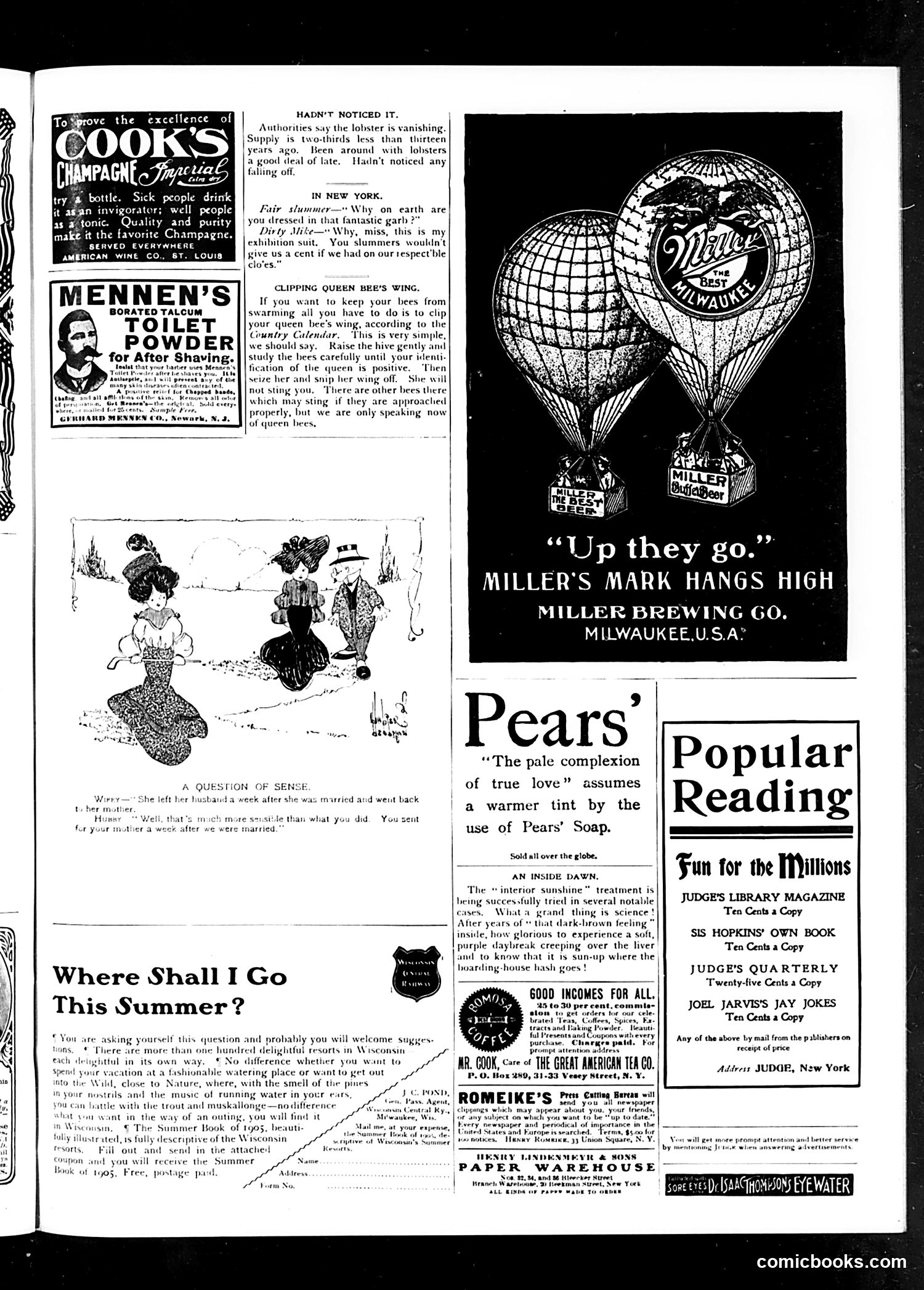
This page is primarily **advertising and miscellaneous content** rather than a coherent political cartoon. The main visual humor appears in "A Question of Sense"—a domestic joke where a wife tells her husband she dressed him in ridiculous clothing a week after marriage and sent him back to her mother. The husband's confused response ("Well, that's much more sensible than what you did") inverts expectations: he suggests *she* was the problem, not his appearance. The other notable item, "Clipping Queen Bee's Wing," offers **practical agricultural advice disguised as satire**—instructions for beekeepers to prevent swarming by clipping the queen's wing. The mild humor lies in treating a delicate operation ("seize her and snip") as simple, and reassuring readers the queen won't sting them. The remainder consists of **advertisements** (Cook's Champagne, Mennen's Talcum, Miller's Beer, Pears' Soap) and **house ads** promoting Judge magazine's related publications. No significant political satire or contemporary figures are identifiable on this page.
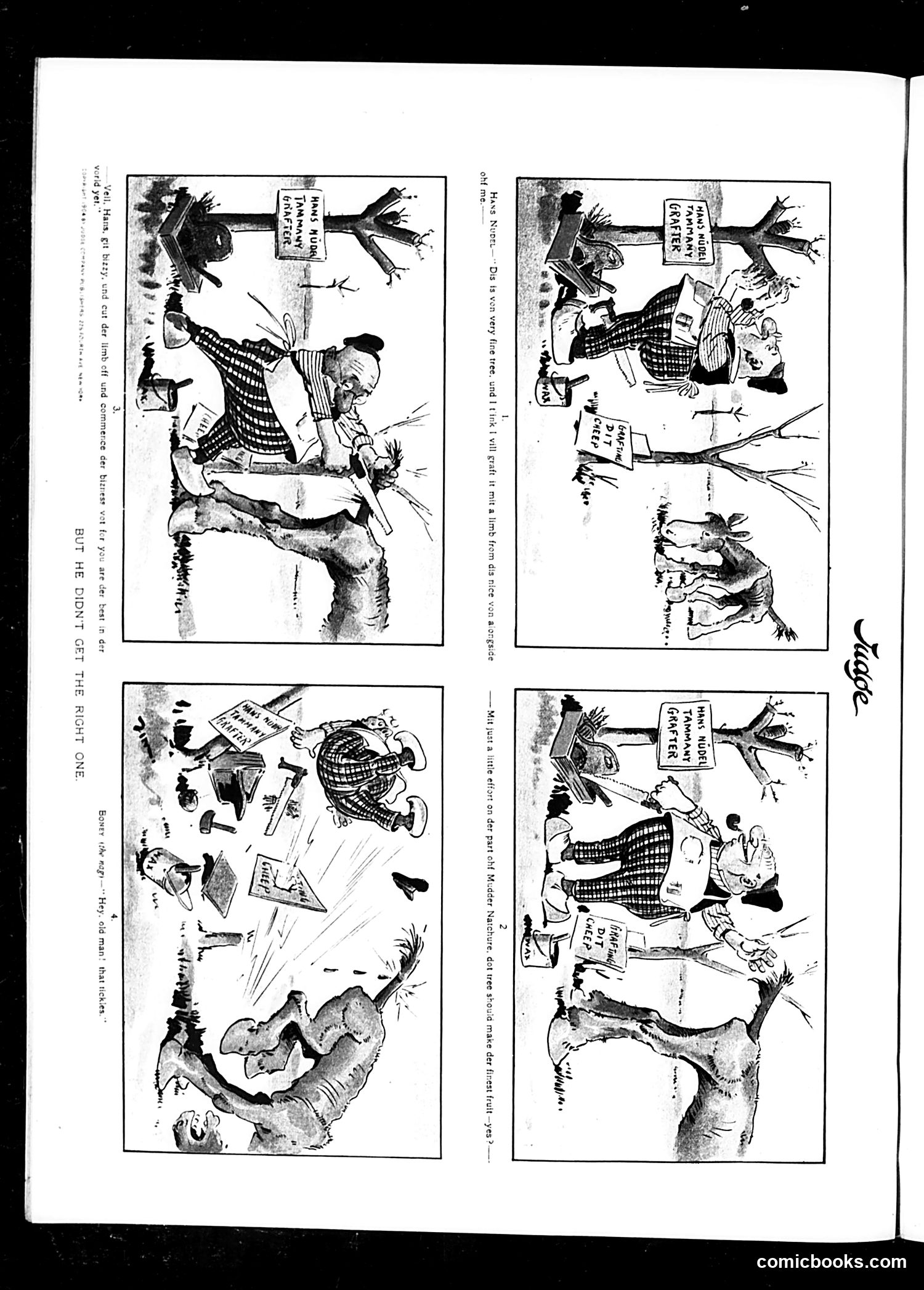
This satirical cartoon depicts **Tammany Hall corruption** through the metaphor of tree grafting. The figure labeled "Hans" (a caricatured German immigrant) represents a Tammany Hall operative attempting to graft a tree—a visual pun on "grafting" as political corruption. The joke plays on the double meaning: just as improper tree grafting produces inferior results, Tammany's corrupt political "grafting" (stealing from public funds, accepting bribes) corrupts the civic system. The caption "BUT HE DIDN'T GET THE RIGHT ONE" suggests the grafters bungled their scheme or took the wrong target. **Tammany Hall** was New York's Democratic political machine, notorious for 19th-century urban corruption. Judge magazine frequently mocked it. The ethnic caricature of "Hans" reflects period attitudes toward immigrant communities, though the satire targets corrupt politicians exploiting them rather than immigrants themselves. The cartoon criticizes how graft damages public institutions.