
A complete issue · 16 pages · 1905
Judge — May 20, 1905
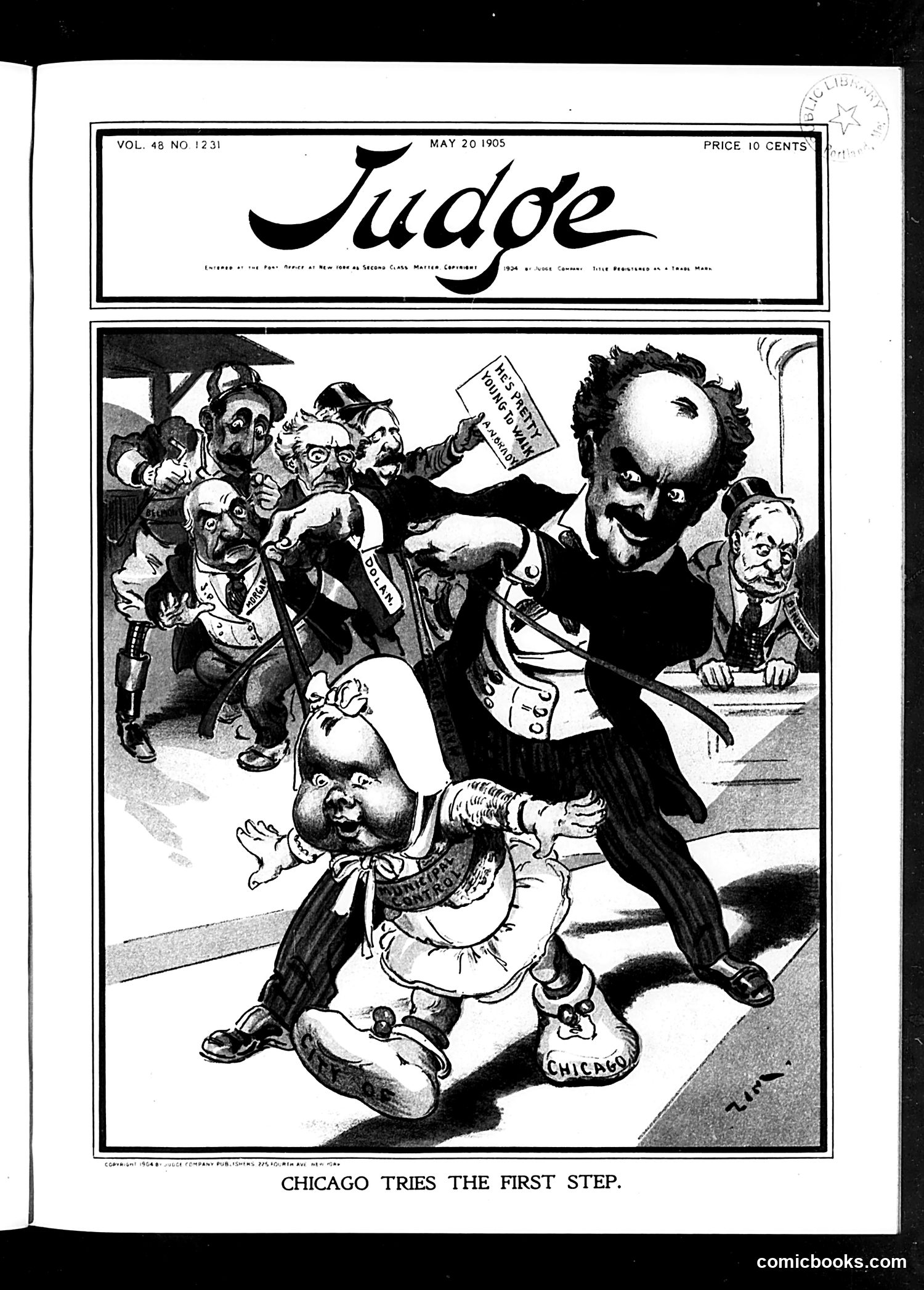
This political cartoon depicts a grotesquely caricatured tall figure (likely representing a political leader or force associated with Chicago) holding a baby labeled "CHICAGO" while surrounded by smaller figures with exaggerated features—a common cartooning style of the era. The caption "Chicago Tries the First Step" suggests this comments on Chicago undertaking some new policy or reform initiative around 1905. The baby imagery implies Chicago is attempting something new or developmental, possibly related to municipal governance. The surrounding figures appear to represent various political or social interests—their expressions suggest skepticism or concern about Chicago's new direction. Without additional context about 1905 Chicago politics, the specific reform initiative referenced remains unclear, though the satirical tone suggests editorial skepticism about the endeavor's prospects.
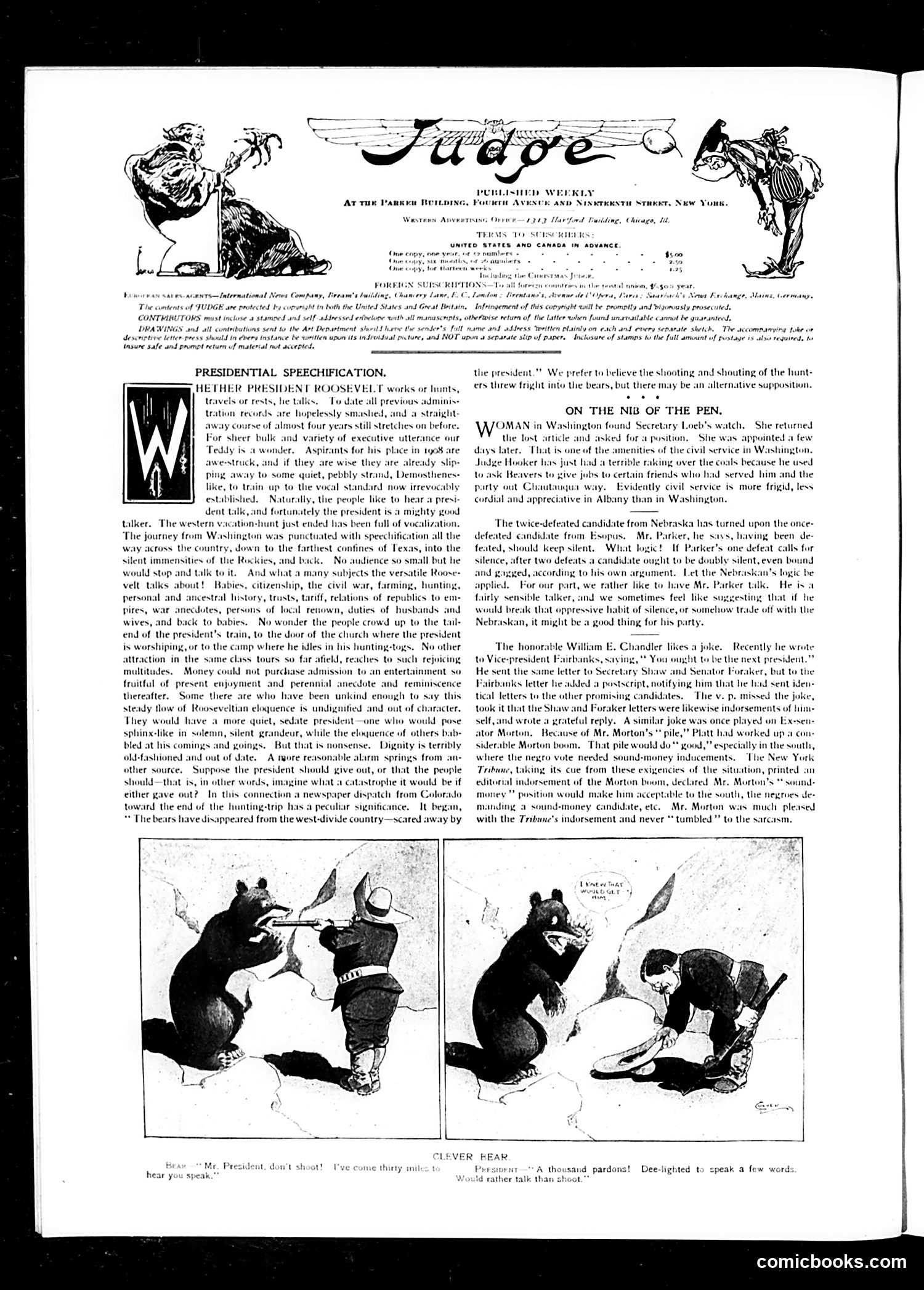
This page contains political commentary on President Theodore Roosevelt's administration and the 1908 presidential succession. The main article, "Presidential Specification," discusses Roosevelt's travels and his preferred successor—Secretary of War William Howard Taft. The two cartoons below, titled "Clever Bear," feature a bear (representing Roosevelt) and a hunter. The satire depicts Roosevelt as dominating and controlling, with the hunter appearing subordinate. The caption "Mr. President don't shoot! I've come thirty miles to hear you speak" suggests Roosevelt's outsized influence and the public's eagerness to listen to him, even as questions arise about who will actually lead next. The overall message critiques Roosevelt's continued political dominance despite his pledge not to seek another term.
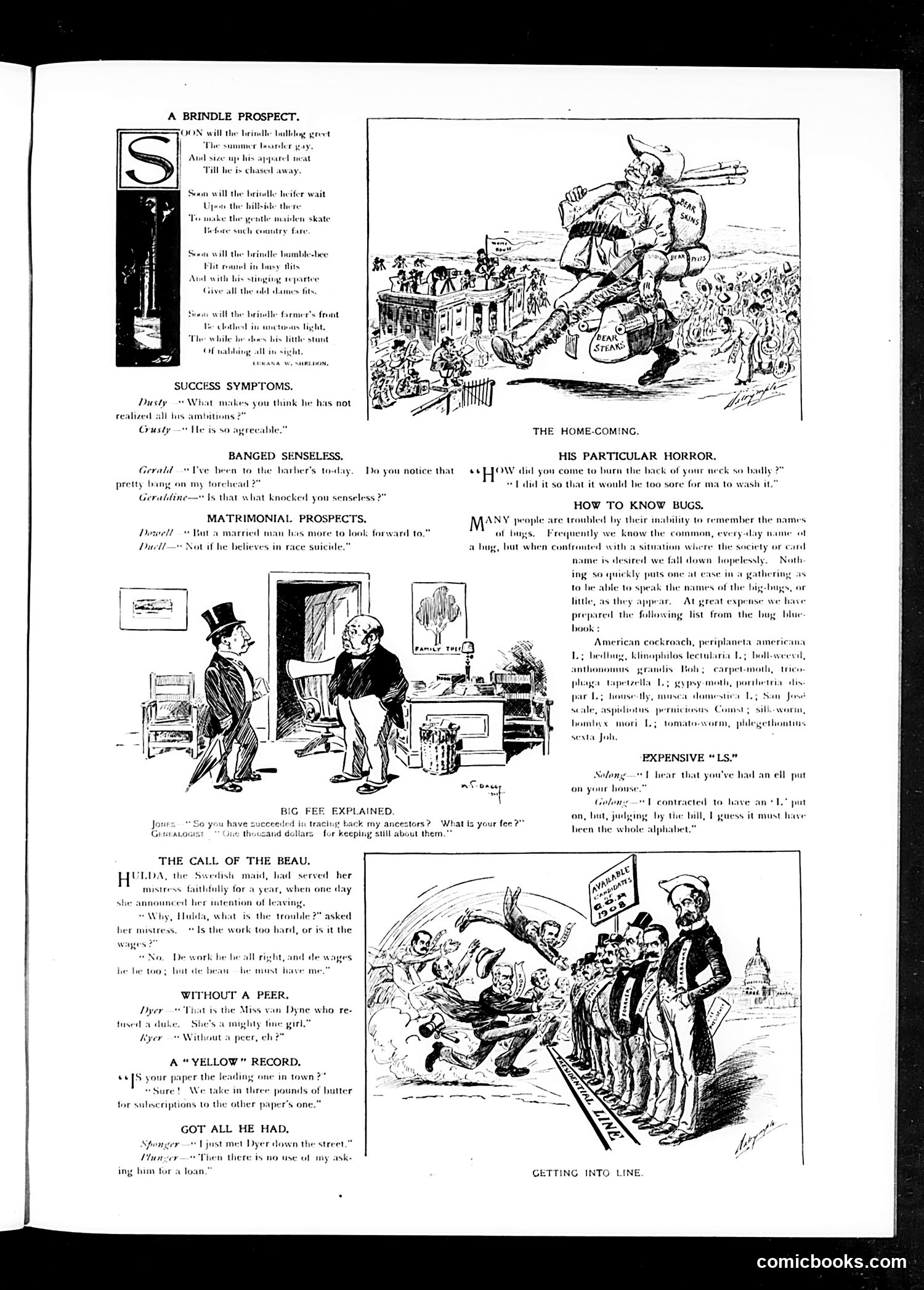
This page contains several standalone satirical pieces rather than a coherent political cartoon. The content includes: **"A Brindle Prospect"** — A poem about Irish building and domestic life, illustrated with a figure carrying supplies. **"The Home-Coming"** — A caricatured figure (appearing to be an Irish immigrant based on the exaggerated features) returning with parcels, satirizing immigrant domestic situations. **"How to Know Bugs"** — An informational piece listing insect names, likely poking fun at readers' inability to identify common pests. **"Matrimonial Prospects" and other humor pieces** — Brief joke exchanges about marriage, ancestry, and domestic matters. **"Getting Into Line"** — An illustration showing people queuing, possibly referencing immigration or naturalization processes. The overall tone targets Irish immigrants and working-class domestic life with period-typical ethnic caricature and gentle mockery of social pretensions.
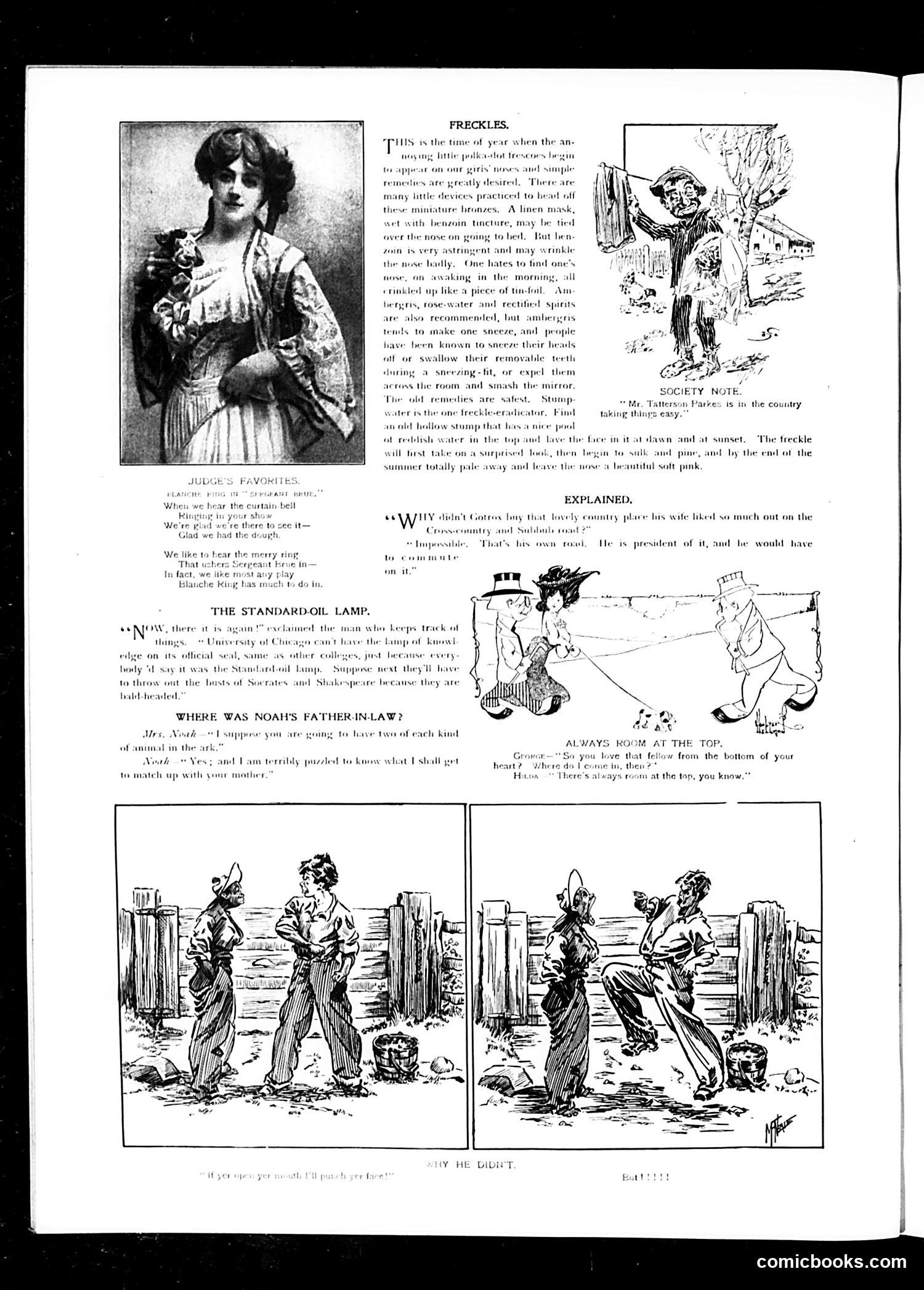
This page contains several unrelated humor pieces typical of Judge's format: **"Freckles"** discusses beauty remedies for removing freckles—a vanity concern of the era. The accompanying illustration shows a woman with freckles, reflecting period beauty standards. **"Judge's Favorites"** appears to be a brief poem or joke (text partially unclear in OCR). **"The Standard-Oil Lamp"** is a satirical piece about Standard Oil, likely mocking the monopoly's dominance. The reference to Socrates suggests ironic commentary on a powerful institution. **"Where Was Noah's Father-in-Law?"** is a riddle or joke with no clear political meaning. **"Why He Didn't" and "Always Room at the Top"** are cartoon panels depicting social humor unrelated to politics—appearing to be domestic or class-based comedic observations. The page mixes genuine consumer advice with light satire, typical of Judge's entertainment-focused approach.
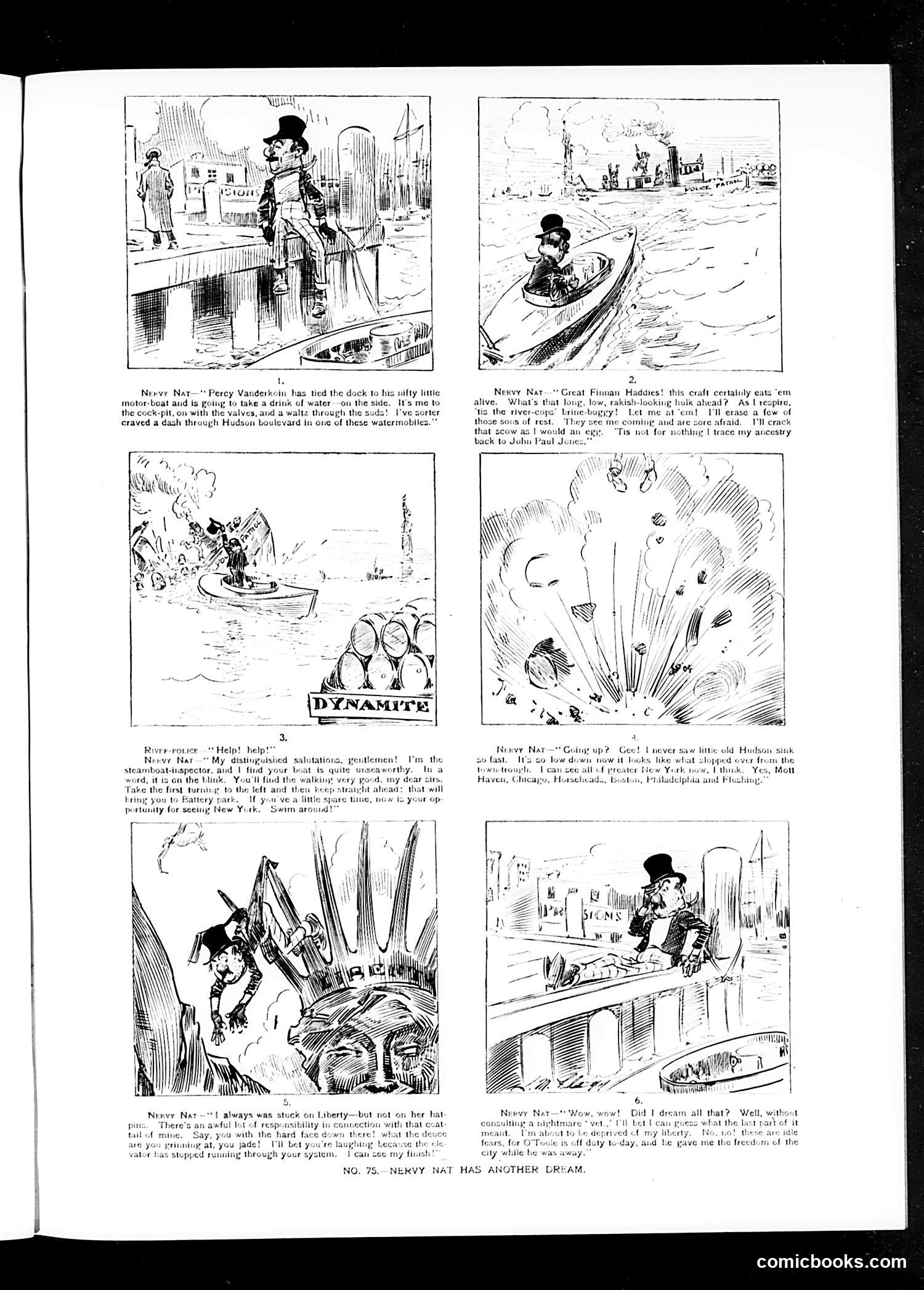
This is a six-panel comic strip about "Nervy Nat," a character who dreams of recklessly operating a motor-boat on the Hudson River. The strip appears to be satirizing the early auto-boating craze and the dangerous, irresponsible behavior of wealthy thrill-seekers. In the narrative, Nat imagines commandeering a speedboat and causing mayhem—mentioning he previously "craved a dash through Hudson boulevard in one of these watermobiles." The subsequent panels show his fantasy escalating into increasingly chaotic scenes: high-speed boating, explosions (labeled "DYNAMITE"), and near-collisions. The satire targets both the obsession with new motorized vehicles as status symbols and the reckless disregard for public safety by those operating them. Nat's dream-sequence format allows Judge to exaggerate his dangerous fantasies for comedic effect while mocking this behavior as foolish and irresponsible.
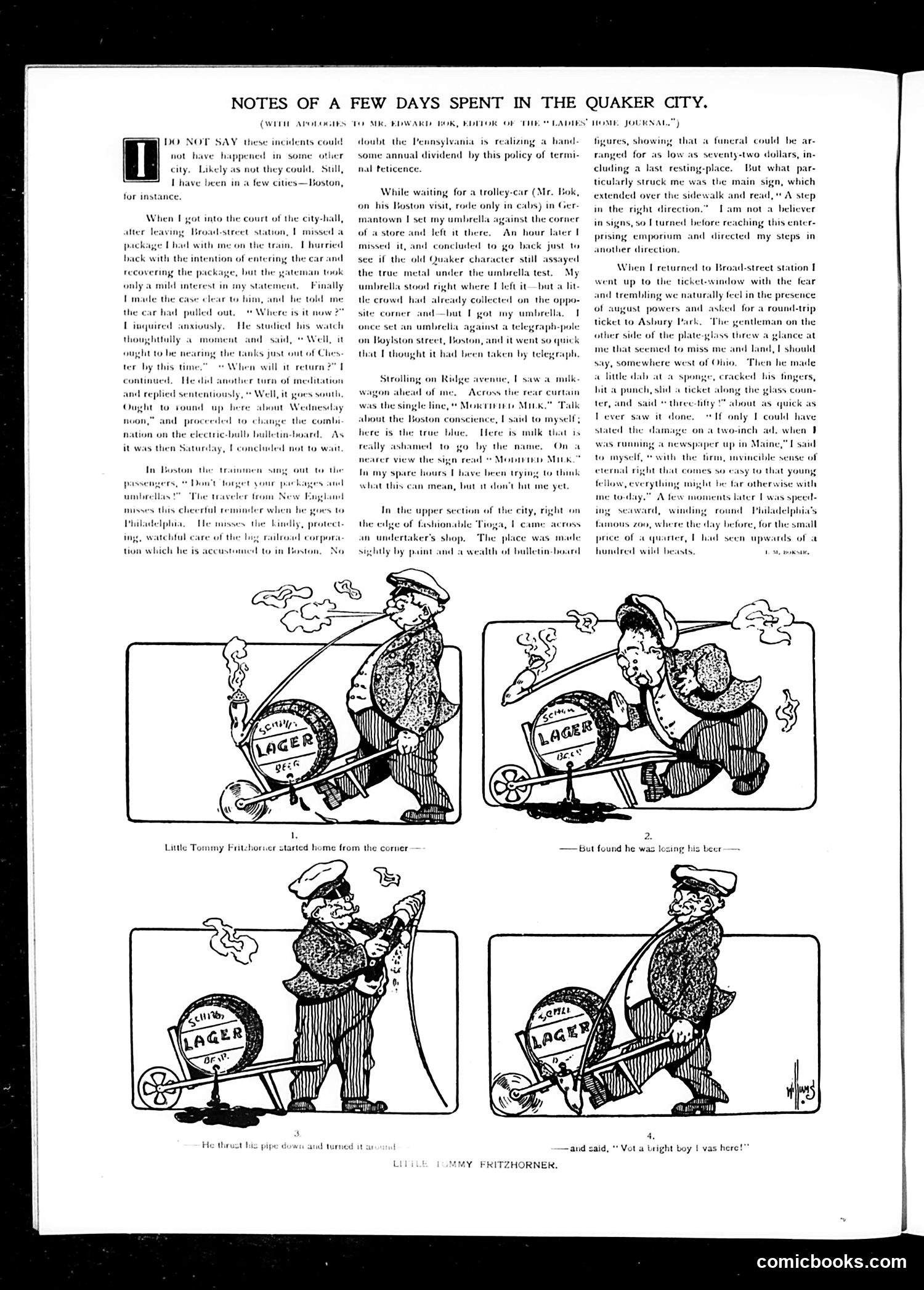
This is a humorous travel essay about Philadelphia (the "Quaker City"), illustrated with comic strips about "Little Tommy Fritzhorner" losing his beer keg. **The Main Satire:** The text mocks Philadelphia's bureaucratic inefficiency and lack of customer service compared to other cities. The author experiences frustrating interactions: a streetcar conductor who can't locate a lost package, and a train ticket agent who processes transactions rudely and impatiently. **The Comic Strips:** The four-panel illustrations show a boy with a small beer barrel ("lager") on wheels—a character reference suggesting immigrant German-American culture. The narrative shows him losing the barrel, finding it, attempting to retrieve it, and celebrating its recovery. **Social Context:** This reflects late 19th/early 20th-century American attitudes toward Philadelphia's reputation for cold, unhelpful service. The beer references reflect the German immigrant presence and brewing culture of the period. The piece plays on stereotypes about regional American differences in hospitality and civic character.
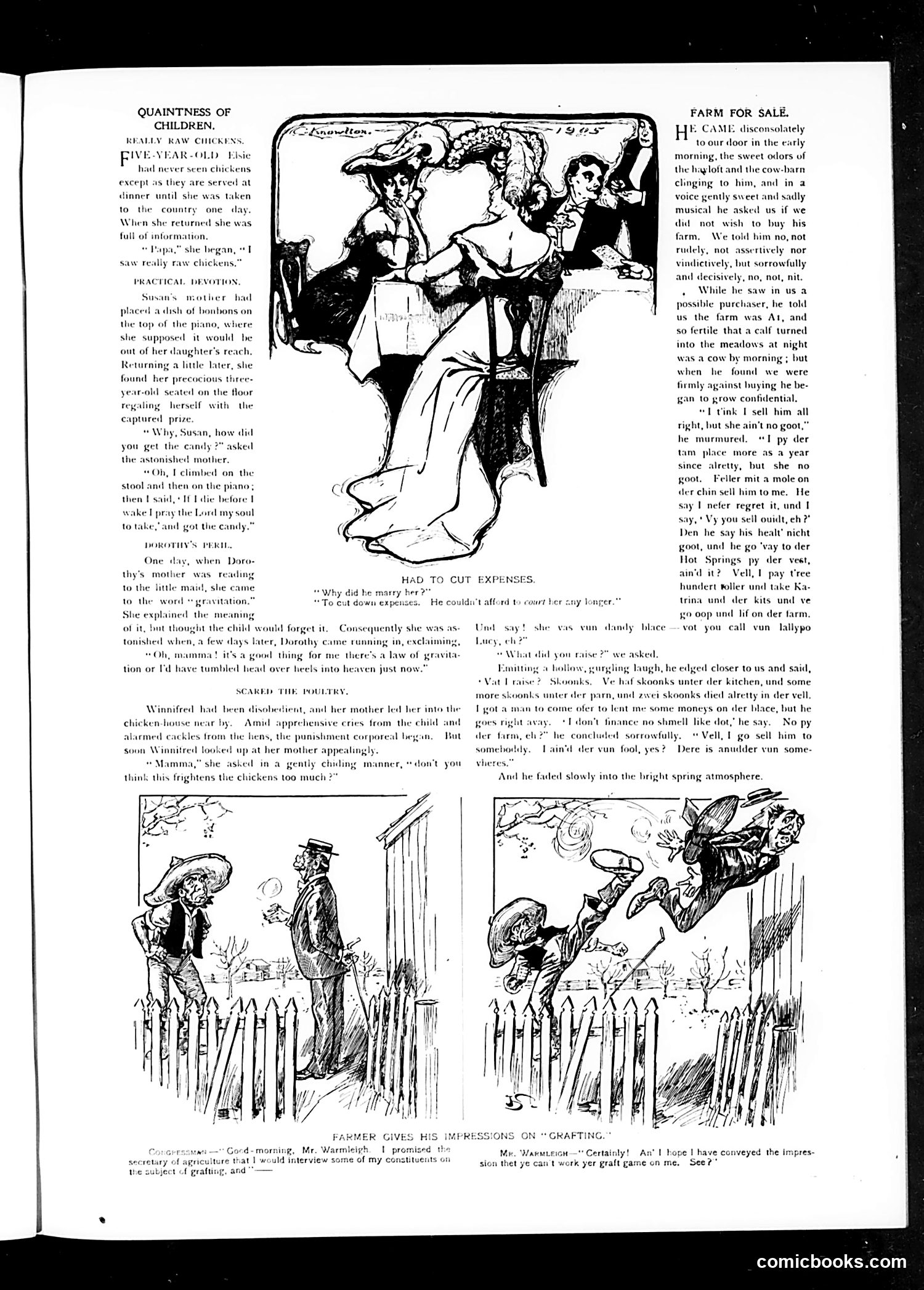
This page contains humorous anecdotes about children's innocent misunderstandings, plus political commentary about corruption. **The children's stories** satirize how young children hilariously misinterpret adult concepts: a girl thinks raw chickens exist only in the countryside; another child invokes prayer to justify stealing candy; a third fears spanking in a chicken-house will traumatize the poultry. **The significant political content** appears in the bottom section titled "Farmer Gives His Impressions on 'Grafting.'" A rural farmer (depicted with ethnic dialect, likely German-American) describes selling his farm while complaining of its problems—skunks, dead animals, a swindler neighbor. **The satire targets political corruption**: Mr. Warmleigh (a politician) interviews constituents about "graft" (political corruption/bribery), while the farmer's rambling story serves as commentary—suggesting rural Americans recognize grafting and manipulation when they see it. The farmer's final statement to Warmleigh essentially warns the politician that honest people cannot be corrupted: "ye can't work yer graft game on me." The page mocks both rural immigrant perspectives and urban political dishonesty.
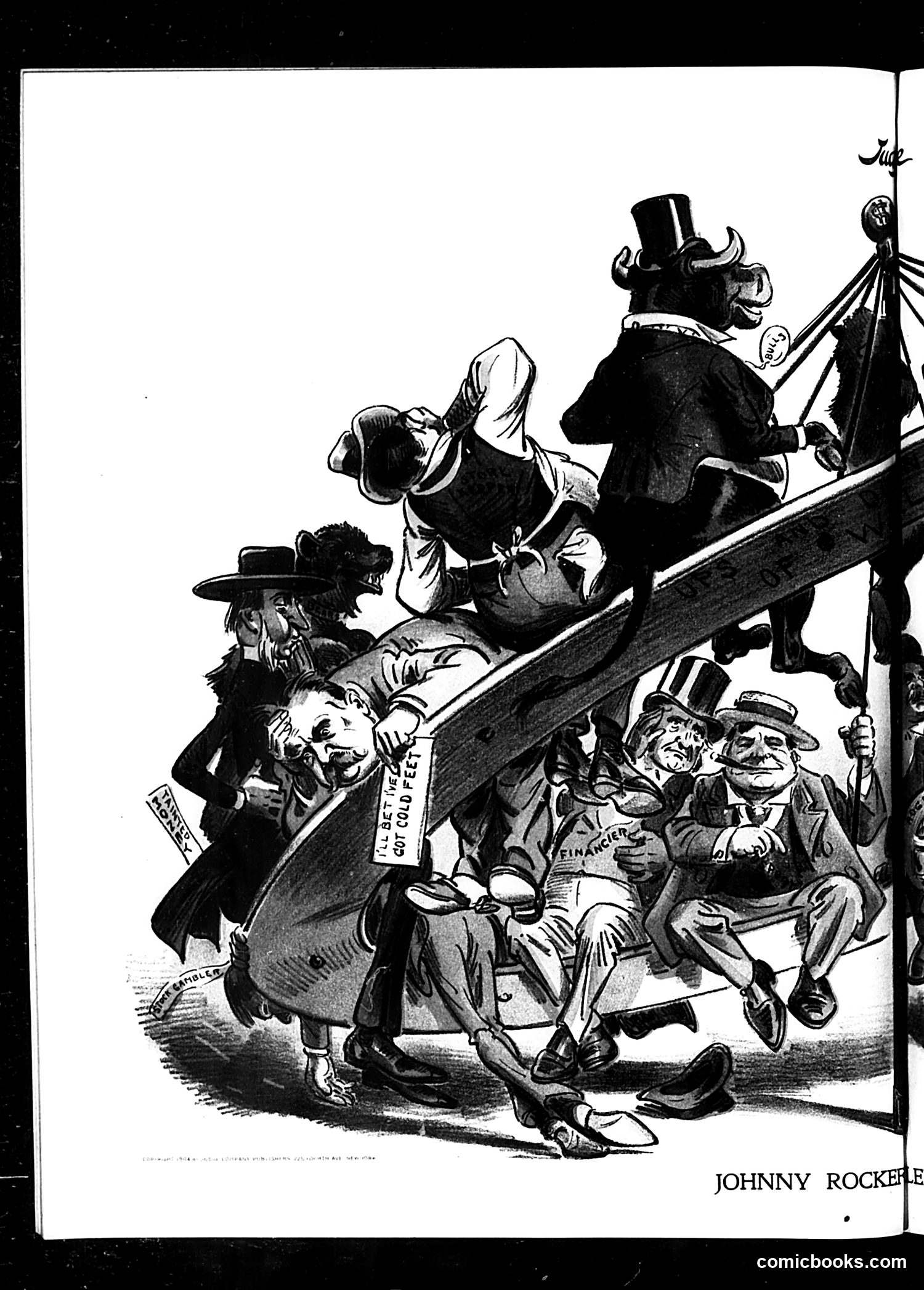
This appears to be a political cartoon from *Judge* magazine featuring caricatured figures climbing or ascending a ramp or plank. The artwork style and exaggerated facial features suggest early-20th-century satirical commentary. The title "JOHNNY ROCKEHE" (likely a play on "Rockefeller") suggests the cartoon critiques wealthy industrialists or financiers. However, without clearer text labels on the figures or additional context from the page, I cannot definitively identify the specific individuals being caricatured or pinpoint the exact political/social issue being satirized. The hierarchical composition—with figures at different levels—suggests commentary on class, wealth disparity, or social climbing, but the precise point remains unclear from the image alone.
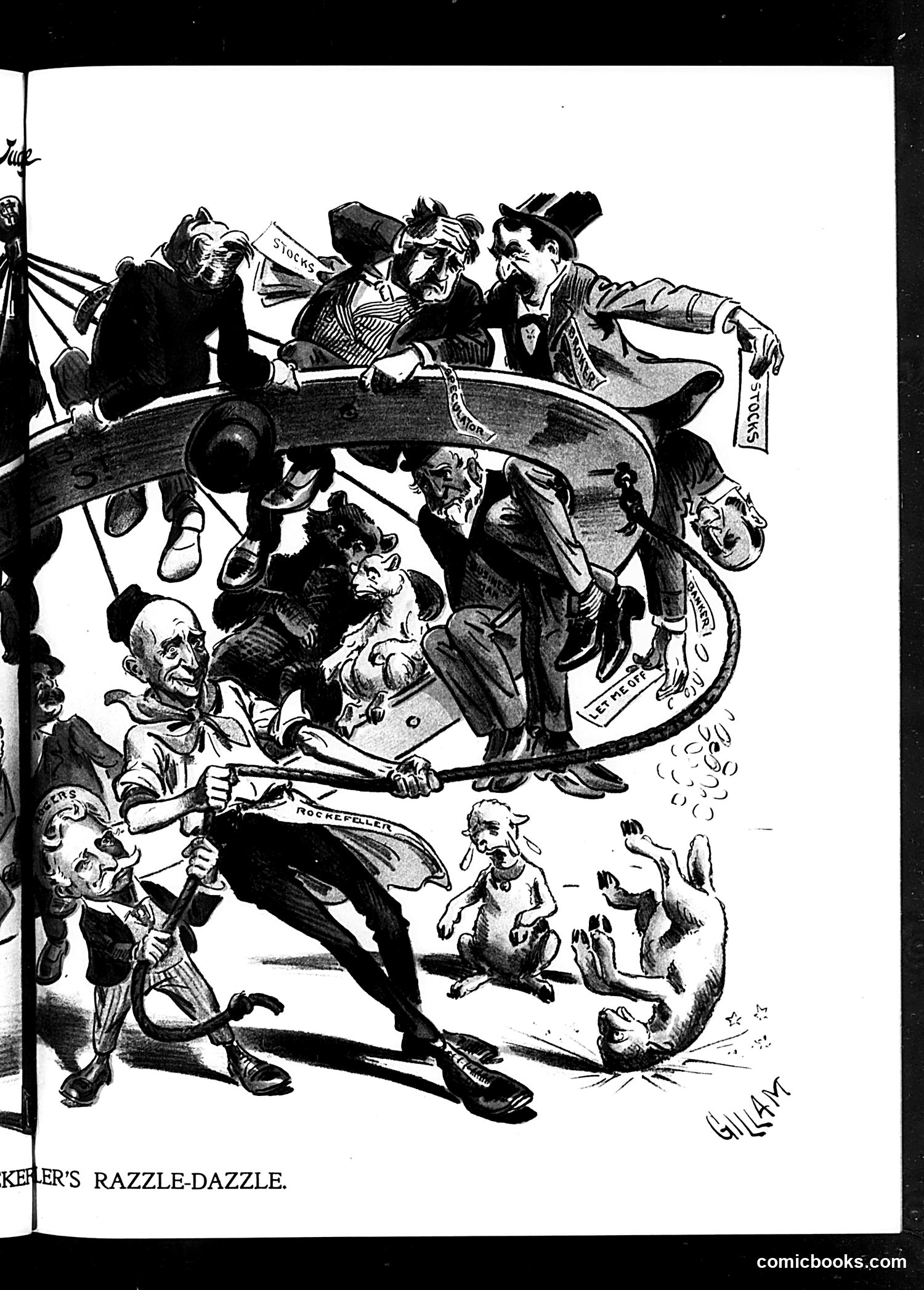
This political cartoon depicts wealthy financiers and industrialists aboard a ship, appearing to manipulate or control various figures below them. The title references someone named Keller (likely a prominent businessman of the era), and "razzle-dazzle" suggests deceptive showmanship or distraction tactics. The composition shows a clear hierarchy: well-dressed men in top hats controlling the vessel from above, while smaller figures—including what appear to be working-class people and animals—operate below or are tossed about. Labels visible include "stocks" and references to financial instruments. The satire critiques how wealthy elites used spectacle and financial manipulation to control ordinary citizens and the economy, keeping the masses confused or complicit while enriching themselves. The cartoon exposes the illusion of control masked as legitimate business.
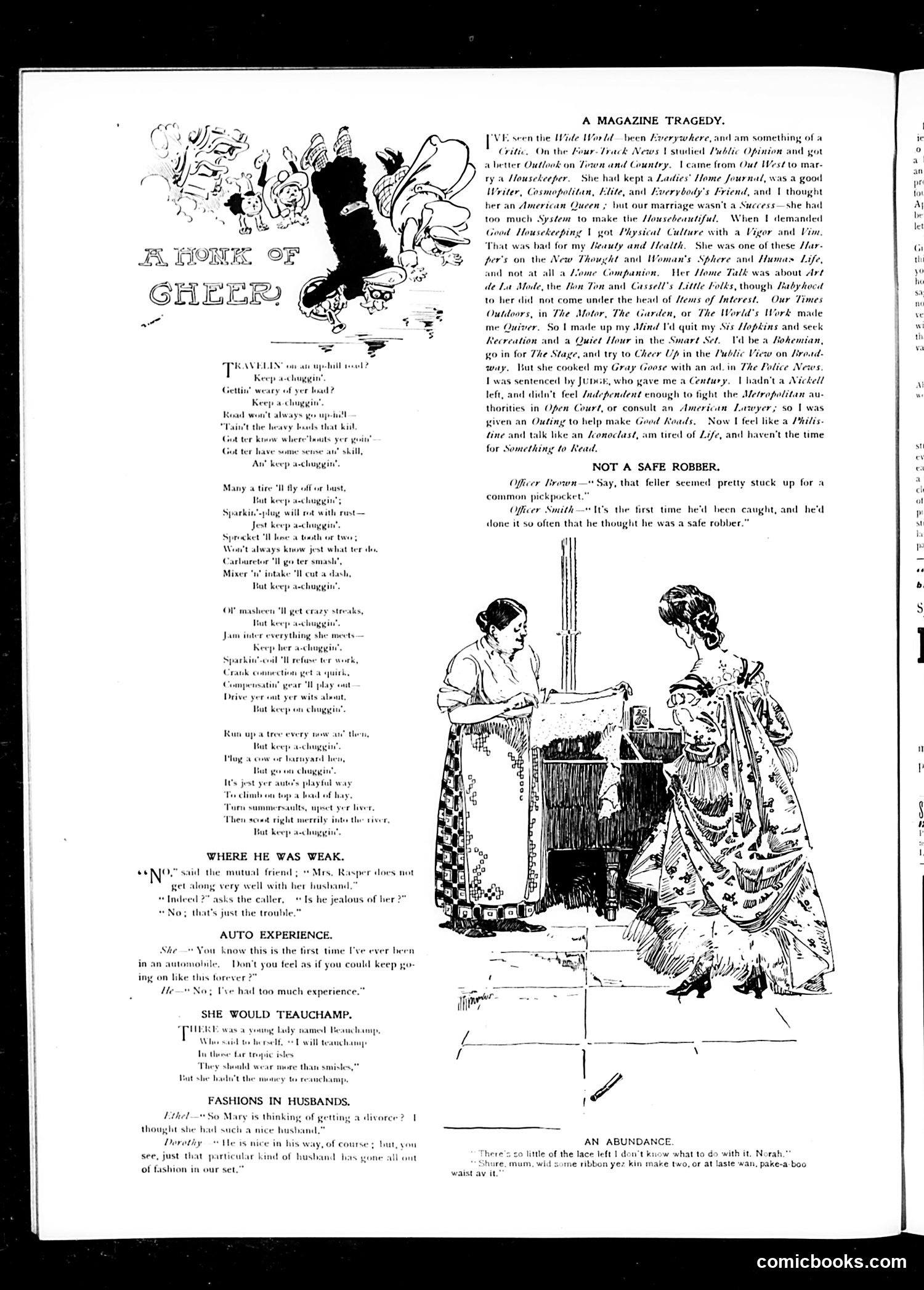
This page contains several satirical pieces mocking early 20th-century magazine culture and social trends. **"A Magazine Tragedy"** ridicules a man who married a woman obsessed with *Ladies' Home Journal*, *Cosmopolitan*, *Good Housekeeping*, and similar publications. She became so consumed with the "New Thought" lifestyle and intellectual pursuits these magazines promoted that she neglected domestic duties. He abandoned her, got caught committing a crime, and was imprisoned—blaming her magazine-influenced priorities for his downfall. The satire targets both women's magazines' influence on housewives and the conflict between domestic expectations and modern aspirations. **"Not a Safe Robber"** is a brief joke about a pickpocket arrested so repeatedly he delusionally considers himself a "safe robber"—a more prestigious criminal. Other brief sketches include jokes about automobiles, marital jealousy, and fashion. The overall tone mocks both the pretensions of women's magazines and the social anxieties they created around modern womanhood, domesticity, and consumer culture.
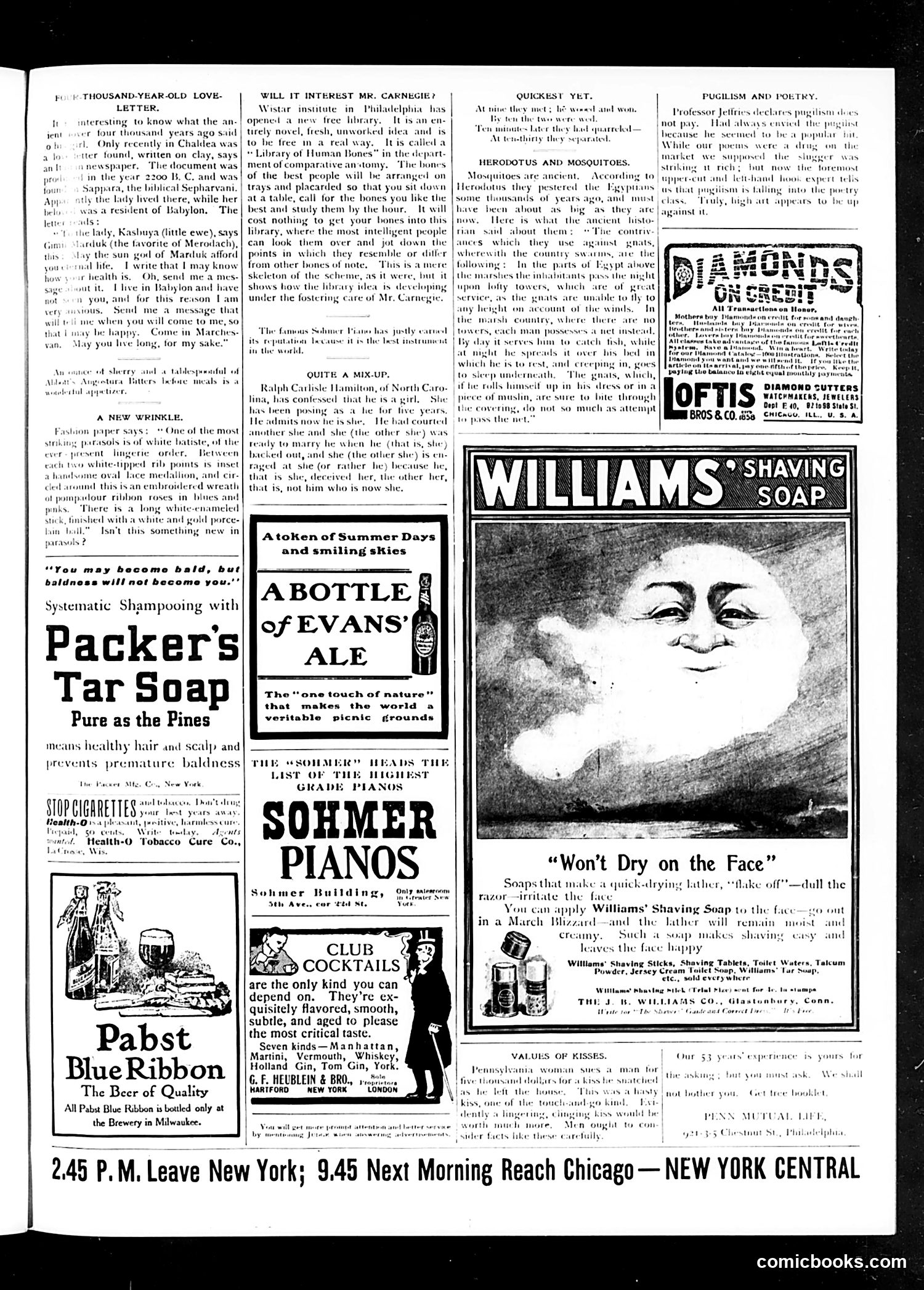
This page is primarily **advertisements and miscellaneous humor pieces**, not a coherent political cartoon. The main content includes: **"Thousand-Year-Old Love-Letter"**: A humorous article claiming Chaldeans discovered an ancient Babylonian love letter—likely satirizing both contemporary archaeology excitement and romantic sentimentality. **"Quite a Mix-Up"**: A brief comedy piece about gender confusion involving a woman posing as a man for five years, and subsequent romantic entanglements. The humor relies on early-20th-century confusion about identity. **"Will It Interest Mr. Carnegie?"**: References industrialist Andrew Carnegie, apparently commenting on the Wistar Institute's new "Library of Human Bones"—a legitimate anatomical research library. The satire likely mocks either Carnegie's philanthropic pretensions or the unusual nature of bone libraries. The remaining content consists entirely of **product advertisements** (Packer's Tar Soap, Pabst Blue Ribbon beer, Evans' Ale, Sohmer Pianos, Williams Shaving Soap, Club Cocktails), which dominated Judge's revenue model. No significant political commentary or recognizable caricatures appear on this page.
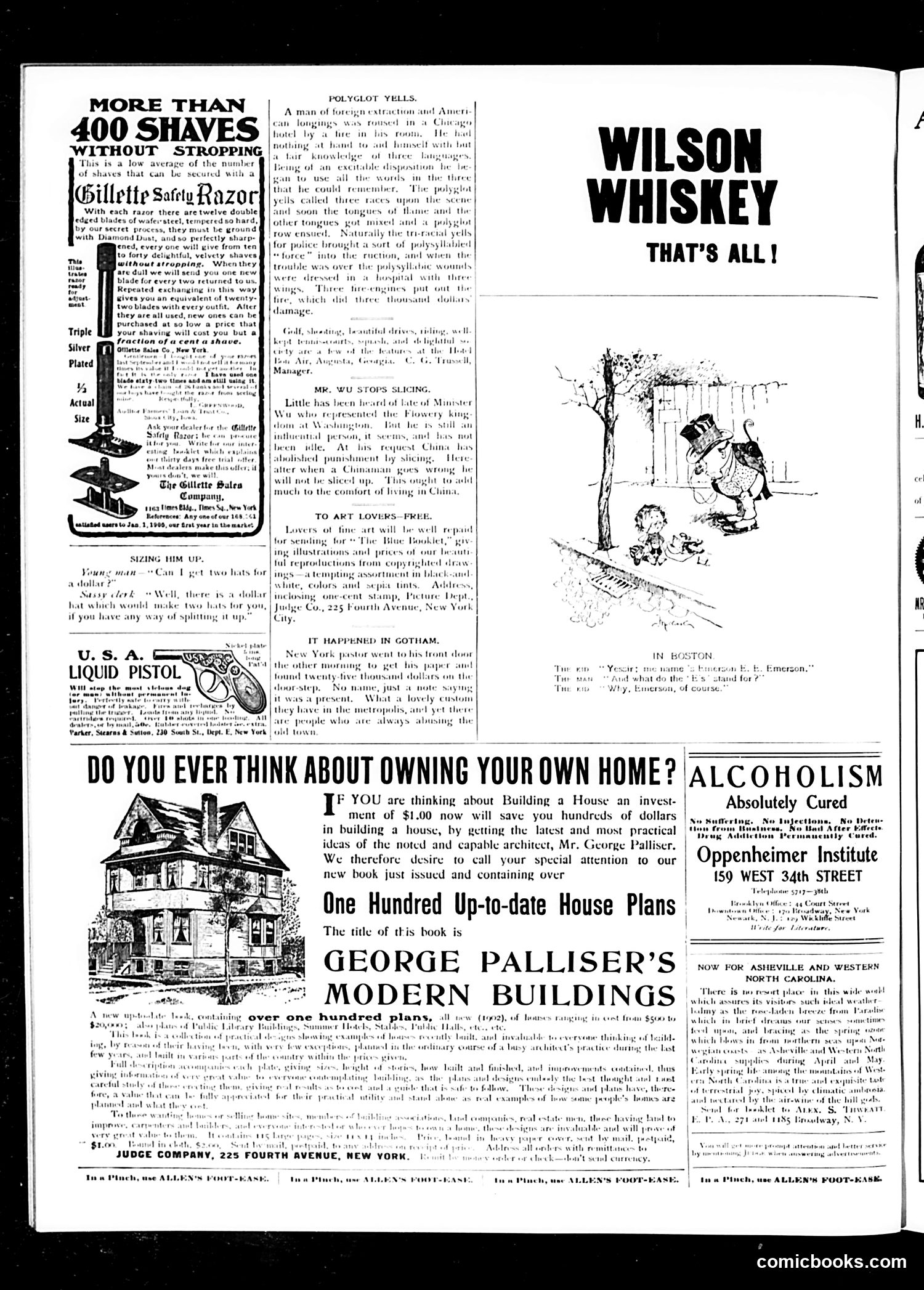
This page is primarily **advertising**, with scattered editorial content. The main items of note: **"Wilson Whiskey—That's All!"** A simple product advertisement with an illustration of two figures by a tree, likely playing on Wilson's straightforward marketing approach. **Gillette Safety Razor ad** dominates the left side—a standard product pitch about shaving efficiency. **"Mr. Wu Stops Slicing"** appears to reference Chinese diplomatic news: Wu (likely Chinese Minister Wu Ting-fang) reportedly requested that China abolish the traditional execution method of slicing. The brief item treats this as curious foreign custom ripe for satirical comment. **Minor items** include jokes about New York society ("It Happened in Gotham"), a liquor bottle prank, and comic exchanges about splitting bills. **George Palliser's Modern Buildings** ad (center-bottom) promotes a book of house plans for aspiring homeowners. The overall tone is light satirical observation of current events, advertising, and urban life—typical of Judge's mix of humor and commerce. No major political cartoons are visible on this page.
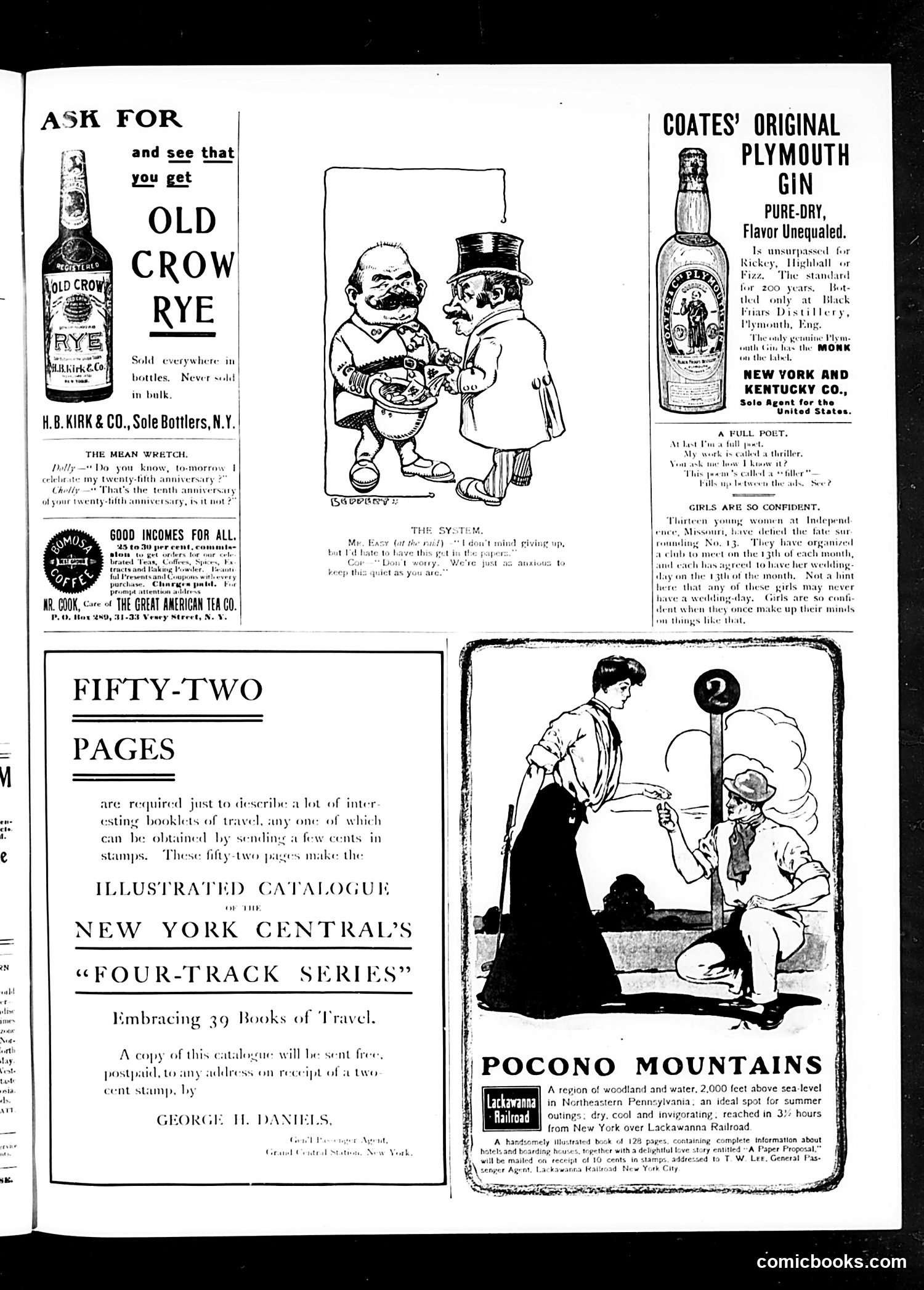
This page is primarily **advertising** with one small central cartoon. The cartoon depicts two caricatured figures—one appears to be a stingy or miserly man in formal dress with a top hat, the other a younger person (possibly a child or servant). The title "The Mean Wretch" suggests social satire about stinginess or miserliness, a common Judge magazine theme. The joke likely plays on the contrast between the wealthy-looking "mean wretch" and his victim, reflecting turn-of-the-century anxieties about class and greed. The specific dialogue is partially illegible in the image, but the setup appears to mock selfish behavior. The page is otherwise dominated by liquor and travel advertisements (Old Crow Rye, Plymouth Gin, Pocono Mountains tourism, and a New York Central Railroad catalog), typical of Judge's commercial content from this era.
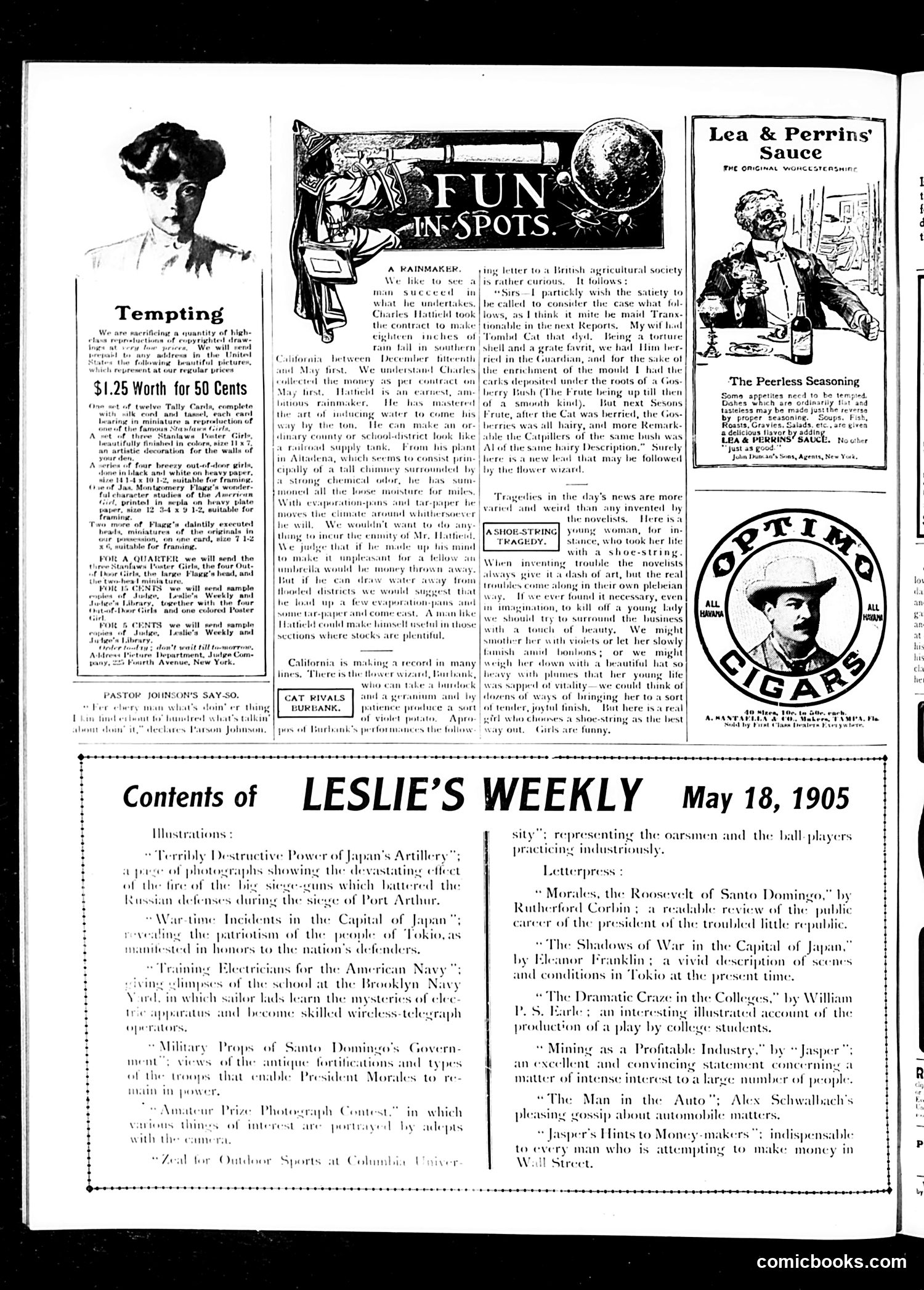
This satirical piece mocks **Charles Hatfield**, a real rainmaker who contracted to produce eighteen inches of rainfall in California between December and May. The cartoon ridicules the notion that Hatfield—operating from Altadena with chemical apparatus and a tall chimney—could actually control weather through pseudo-scientific methods. The satire highlights the absurdity of hiring someone to manufacture rain, comparing Hatfield's dubious claims to California's other fantastical figures like Luther Burbank (the "flower wizard" who bred new plant varieties). The accompanying letter—purportedly from a British agricultural society—adds mock-earnest humor by describing ridiculous results from using Hatfield's rainwater. The joke reflects early-1900s skepticism toward unproven scientific claims and get-rich-quick schemes, while poking fun at California's reputation for attracting eccentric characters promising miraculous results.
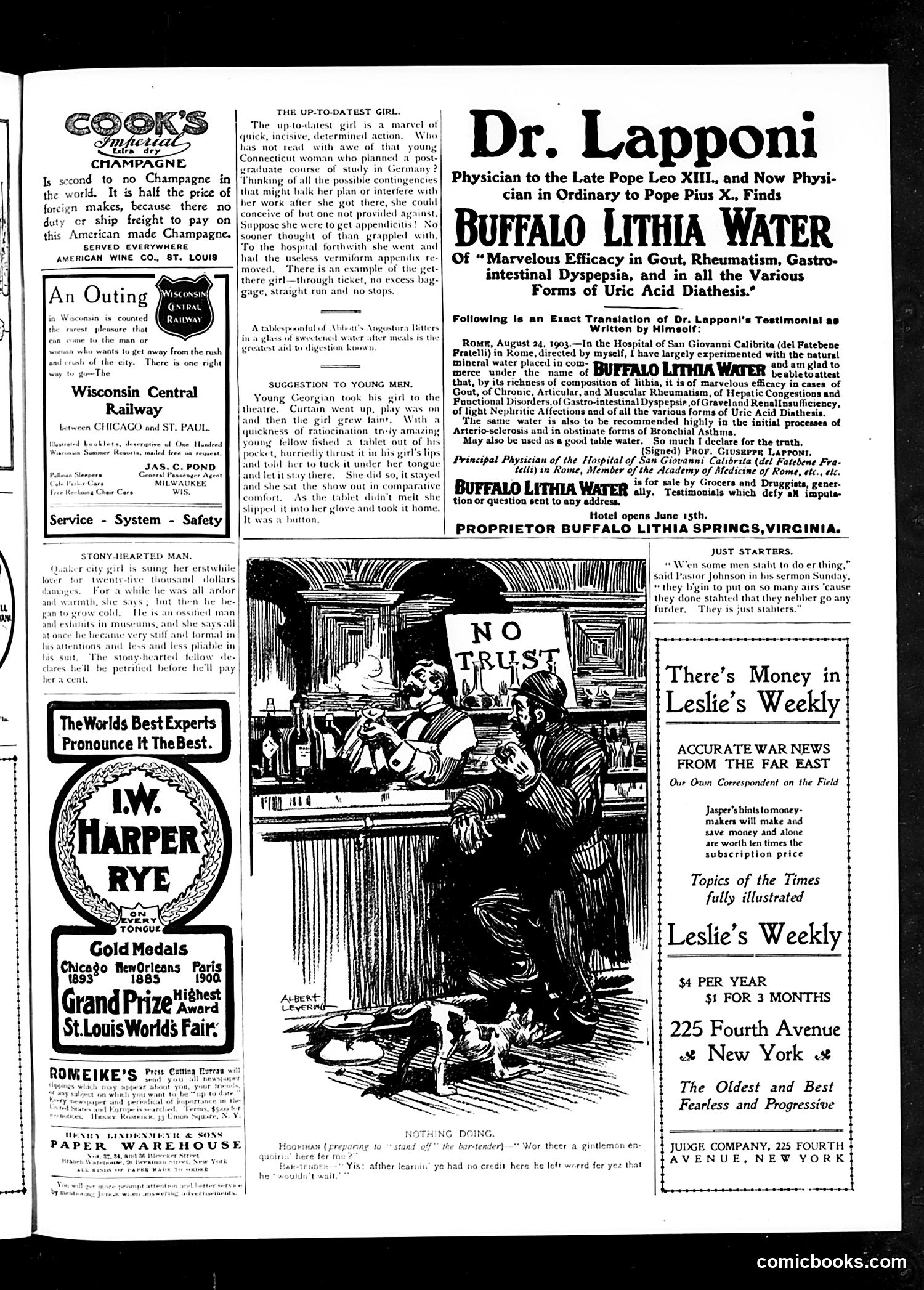
This page is primarily **advertising**, with minimal political satire. The dominant feature is a large testimonial advertisement for Buffalo Lithia Water, endorsed by Dr. Lapponi, physician to Pope Leo XIII and Pope Pius X, claiming the water treats gout, rheumatism, and digestive ailments. The small cartoon labeled "NO TRUST" (center-left) depicts what appears to be a **anti-monopoly or consumer skepticism message**—figures around a table marked "NO TRUST," likely referencing the era's widespread concern about corporate trusts and monopolistic practices. The specific figures are unclear from the image. The page also contains light humor columns ("The Up-to-Datest Girl," "Story Hearted Man") depicting modern social behavior with comedic exaggeration—a woman removing her appendix preemptively, a man slipping a button into his girlfriend's mouth at the theater. The remaining content consists of period advertisements for wine, railways, whiskey, and Leslie's Weekly magazine.
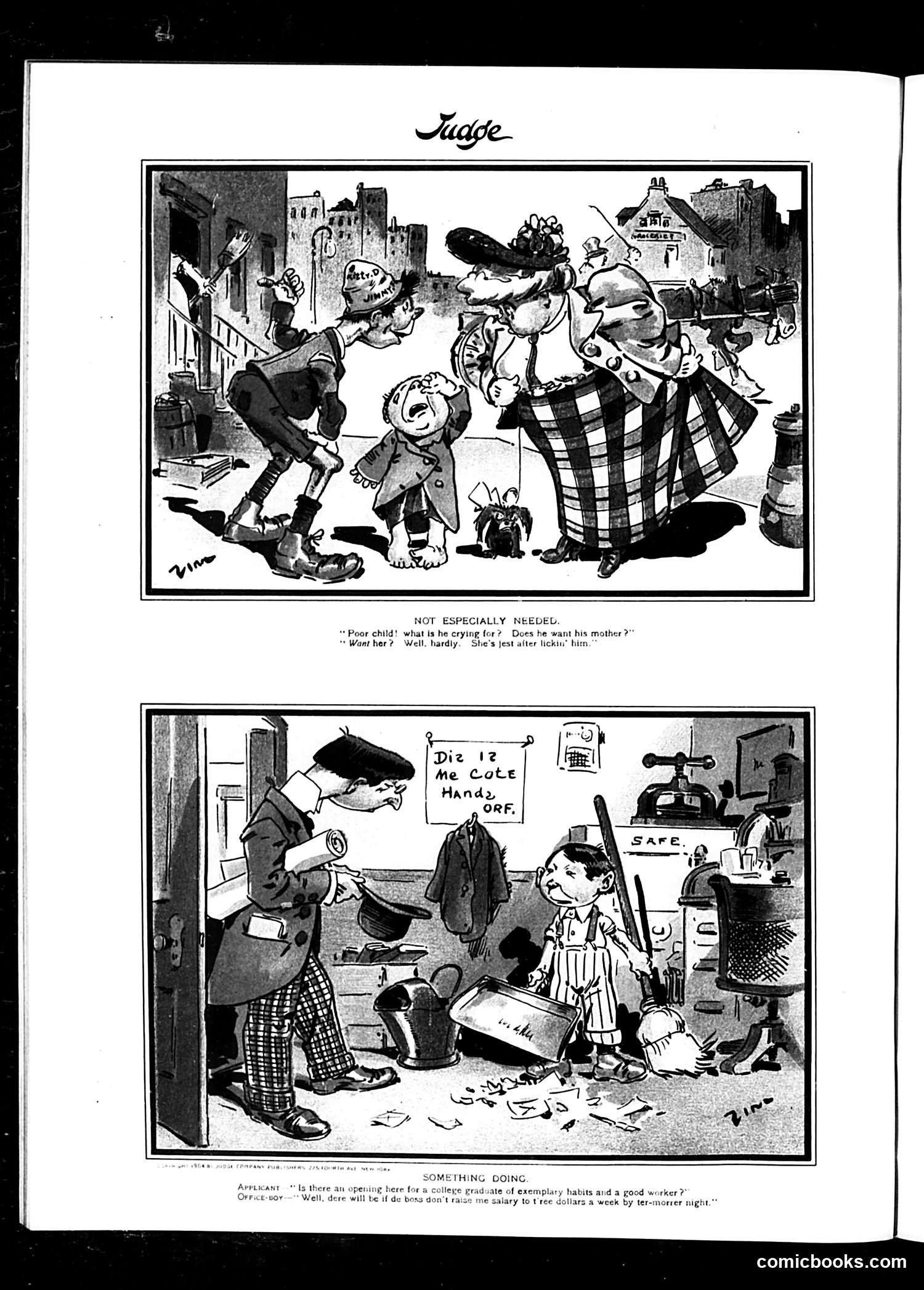
This page contains two satirical cartoons about childhood and labor. **Top cartoon ("NOT ESPECIALLY NEEDED"):** A street scene shows a crying child being questioned by adults about wanting his mother. The joke satirizes callous attitudes toward poor children's welfare—adults dismiss the child's emotional needs, suggesting he's "just after lickin' him" (beaten). It mocks indifference to child suffering. **Bottom cartoon ("SOMETHING DOING"):** An office manager interviews a job applicant, asking if he has "exemplary habits and a good worker" record. The applicant responds he'll work for "early to 'ee dollars a week by ten-o'clock night"—accepting exploitative wages and long hours. The satire critiques both employer greed and desperate workers accepting terrible conditions during what appears to be an economically difficult period.