
A complete issue · 16 pages · 1905
Judge — May 13, 1905
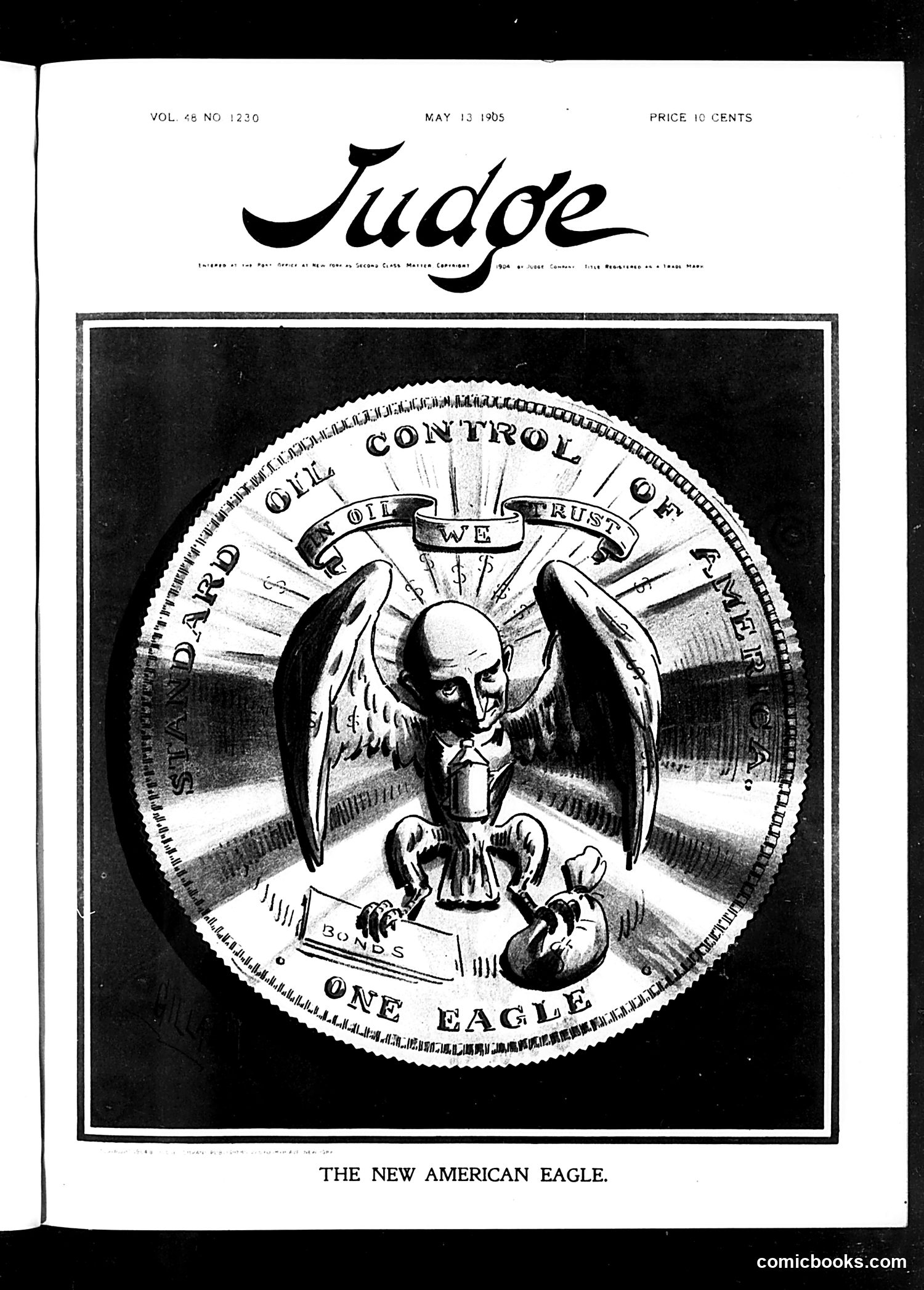
This political cartoon satirizes **Standard Oil's monopolistic control** of American commerce. The eagle—traditionally symbolizing American independence and freedom—is depicted as a skeletal, demonic figure with wings, perched over "boxes" (likely representing commerce or industries). The circular seal reads "STANDARD OIL CONTROL OF AMERICA" with "WE TRUST" at center, mocking the phrase "In God We Trust." This suggests Standard Oil has replaced God/patriotic values as what Americans must trust. The vulture-like eagle represents how the oil monopoly has corrupted American ideals. This reflects the early 1900s Progressive Era concerns about **corporate consolidation and antitrust issues**—Standard Oil was famously broken up by the Supreme Court in 1911.
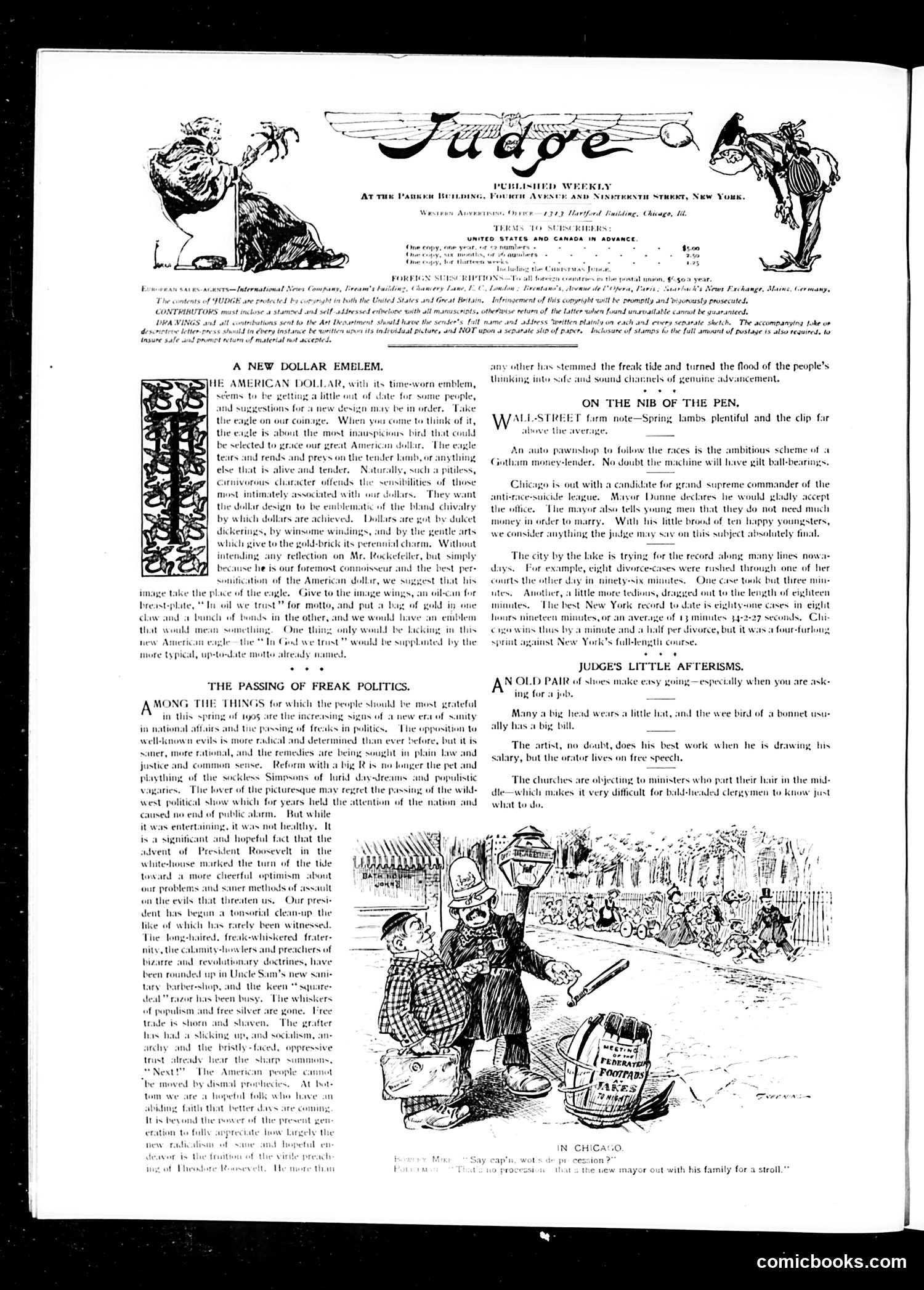
This page contains three satirical pieces from Judge magazine. "A New Dollar Emblem" argues the American eagle should replace the dollar sign, criticizing how currency has become the nation's true symbol over ideals. "The Passing of Freak Politics" laments the end of colorful 19th-century political excess—the "wild-eyed political show" and theatrical candidates—replaced by modern seriousness. The author regrets losing figures like Theodore Roosevelt, viewing contemporary politics as dull. "Judge's Little Afterisms" offers brief witty observations about everyday life. The main cartoon labeled "In Chicago" (bottom) appears to show a beggar or unemployed person asking for help, with text mentioning a "stroll" with family—likely satirizing poverty or economic hardship during this era.
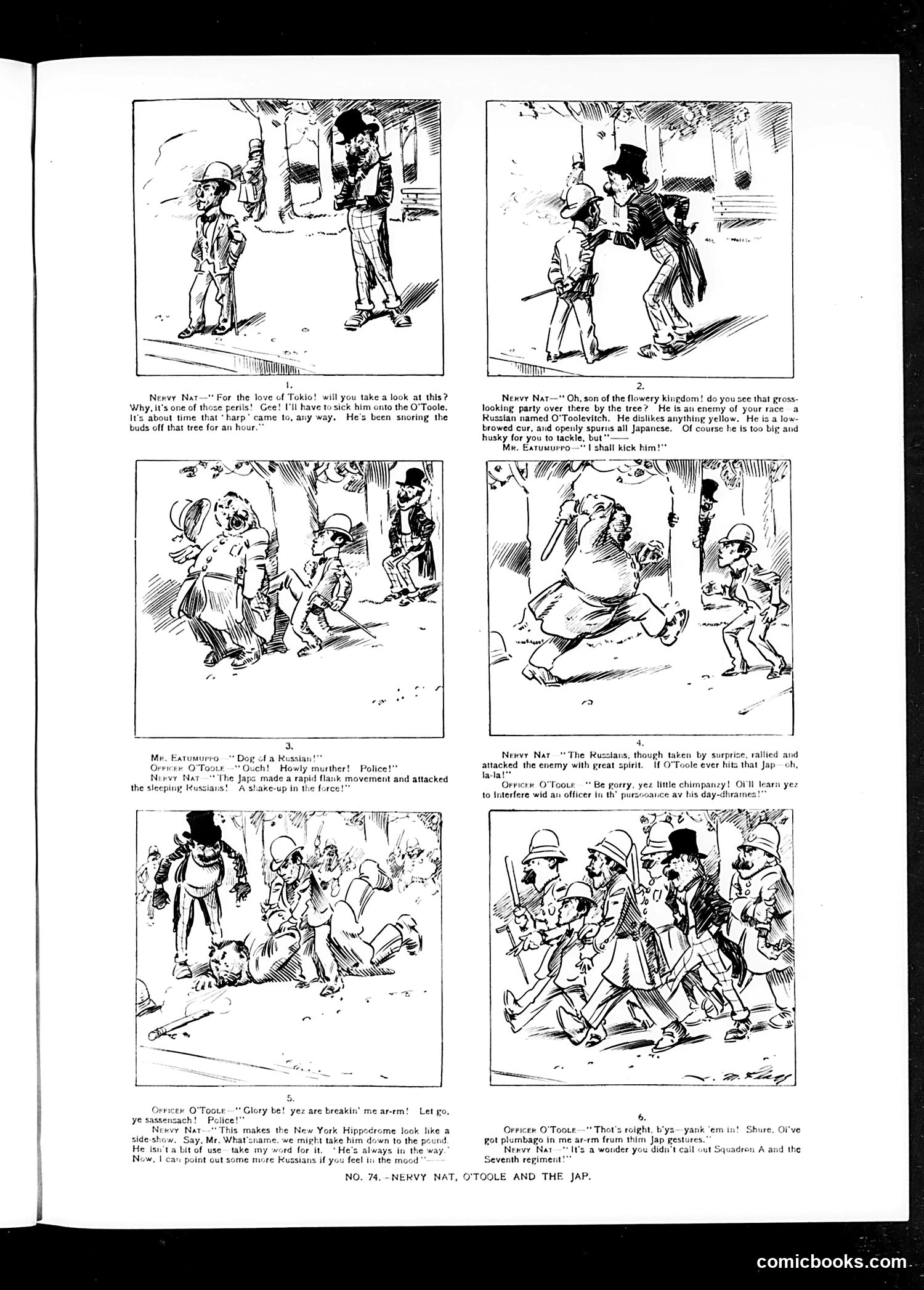
This appears to be a satirical comic strip from Judge magazine depicting Irish characters ("Nevvy Nat" and "Ottoole") encountering a Japanese character in New York City. The humor relies on ethnic stereotyping common to early 20th-century American satire—caricaturing both Irish-American speech patterns and Japanese physical features. The narrative involves mistaken identity and escalating chaos: the Japanese visitor is initially mistaken for a "flowery kingdom" outsider, leading to a confrontation that spirals into broader street violence involving police and crowds. The satire targets xenophobia and cultural friction in urban America, mocking both the Irish-American residents' provincial attitudes and the exotic "otherness" attributed to Japanese immigrants, reflecting period anxieties about immigration and national identity.
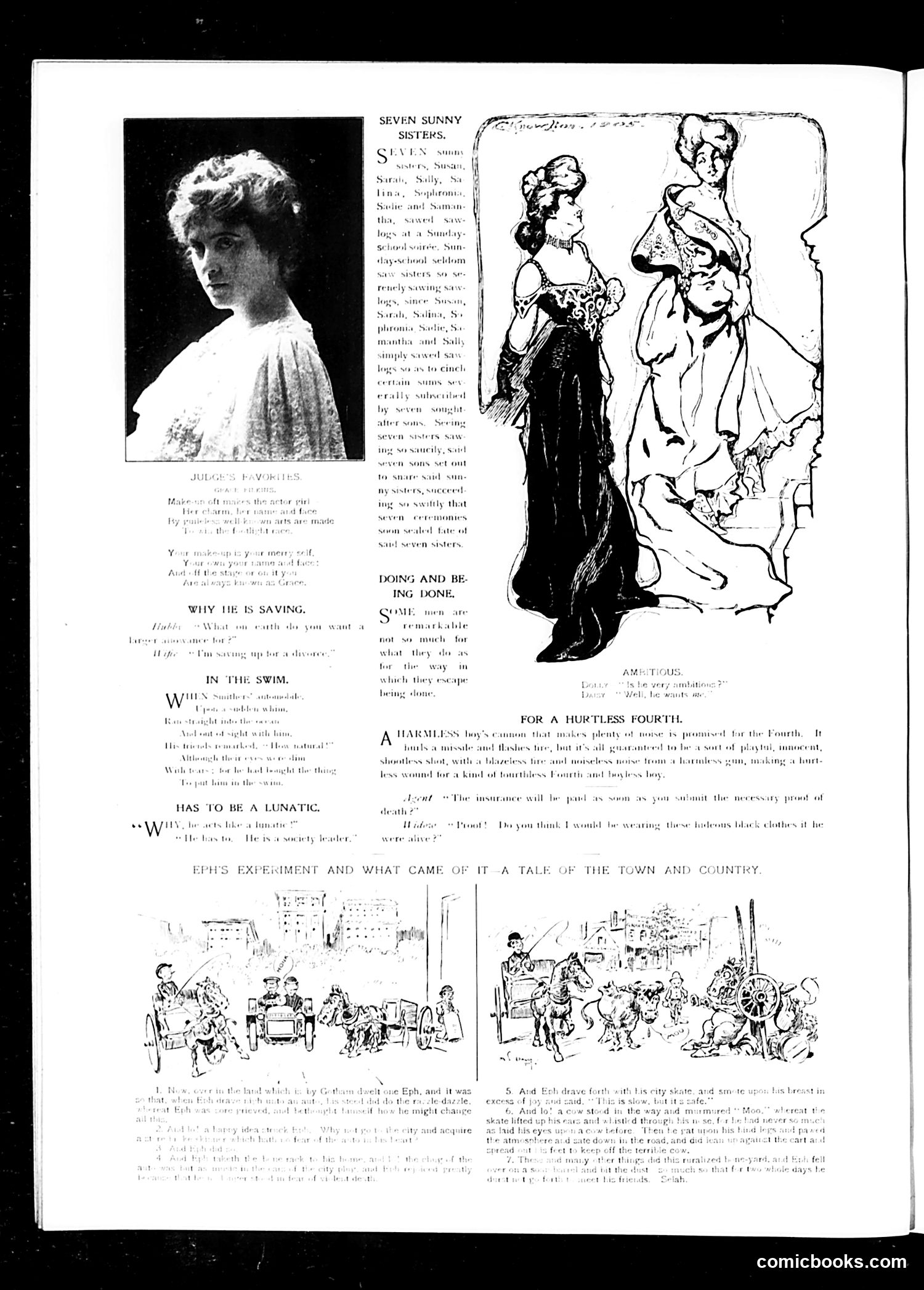
This page contains several pieces of humor rather than a unified political cartoon: **"Seven Sunny Sisters"** features a biographical sketch with portrait and illustrations of seven sisters, emphasizing their domestic roles and marriageability—typical early-20th-century women's magazine content. **The dialogue pieces** ("Why He Is Saving," "In the Swim," "Has a Lunatic") are brief joke exchanges on domestic and social themes, reflecting period humor about marriage, divorce, and class distinctions. **"Effs Experiment"** at the bottom presents two illustrated scenes depicting a humorous town/country narrative, though the specific satirical subject is unclear from the visible text. The content overall reflects Judge's characteristic blend of social satire, domestic humor, and commentary on contemporary manners—targeting middle-class audiences through relatable scenarios rather than explicit political critique.
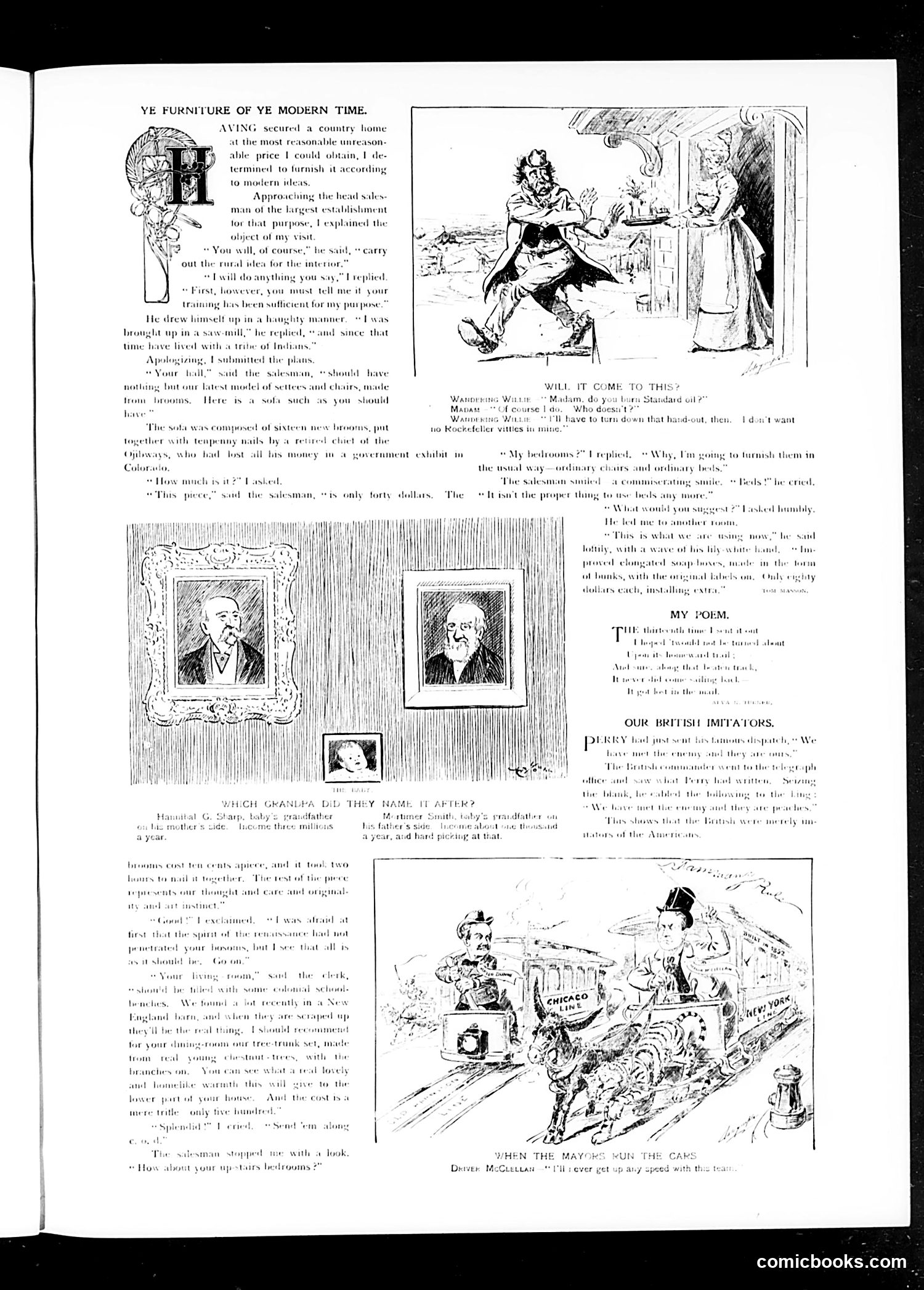
This page satirizes the pretentious "Arts and Crafts" furniture movement gaining popularity among wealthy Americans seeking "modern" aesthetics. The narrative mocks a nouveau-riche homeowner consulting a pompous furniture salesman who dismisses traditional comfort in favor of artistic fashion. The salesman's credentials are absurdly humble (he worked in a saw-mill with Native Americans), yet he speaks with unearned authority about "modern ideas." The satire targets: - **Conspicuous consumption** among the affluent - **Snobbish rejection of practicality** (replacing beds with broom-bundles, sofas made from brooms) - **Empty pretension** masquerading as sophistication - The **class aspirations** of the wealthy trying to appear cultured The joke: following trendy "modern" design principles results in absurdly uncomfortable, impractical furnishings—yet the salesman's confidence and the buyer's deference suggest this ridiculous approach is somehow superior to common sense.
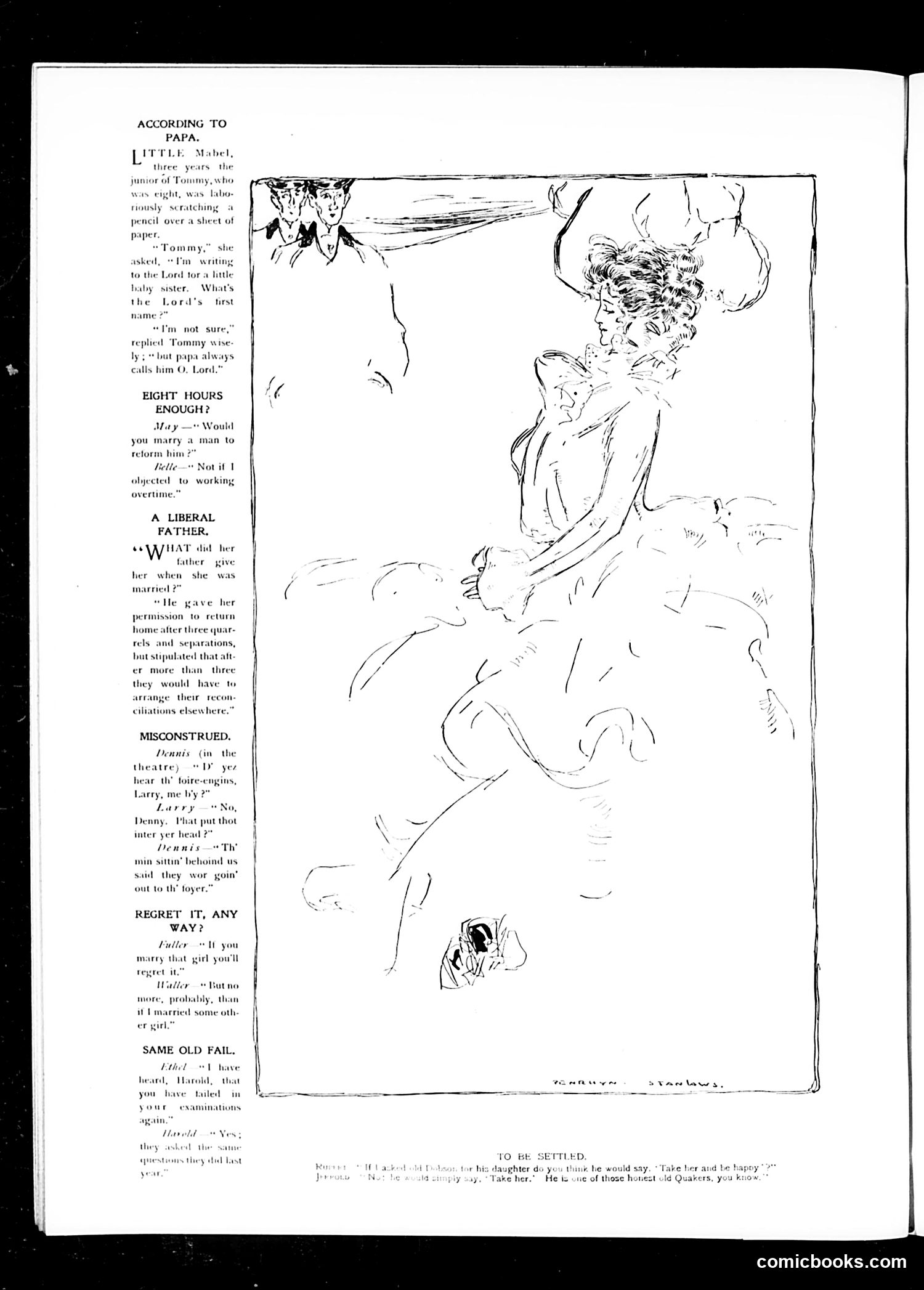
This page contains six separate comic vignettes satirizing early 20th-century American domestic life and social attitudes: 1. **"According to Papa"**: A child mishears her father's exclamation "O Lord!" as the deity's actual name—humor from innocent misinterpretation. 2. **"Eight Hours Enough?"**: Mocks women's marriage reform rhetoric; a woman won't marry to "reform" a man, only to avoid working overtime. 3. **"A Liberal Father"**: Satirizes permissive parenting—a father grants his daughter leave to return home after only three quarrels before requiring reconciliation elsewhere. The "liberalism" is absurdly enabling rather than principled. 4. **"Misconstrued"**: Irish working-class men misunderstand theater terminology; when told actors are "going out to the foyer," they think it means leaving entirely. 5. **"Regret It, Any Way?"**: A man expresses cynical indifference about marriage—he won't regret marrying one woman more than any other. 6. **"Same Old Fail"**: A student repeatedly fails exams because teachers ask identical questions annually. These reflect period anxieties about gender roles, class, education, and social change.
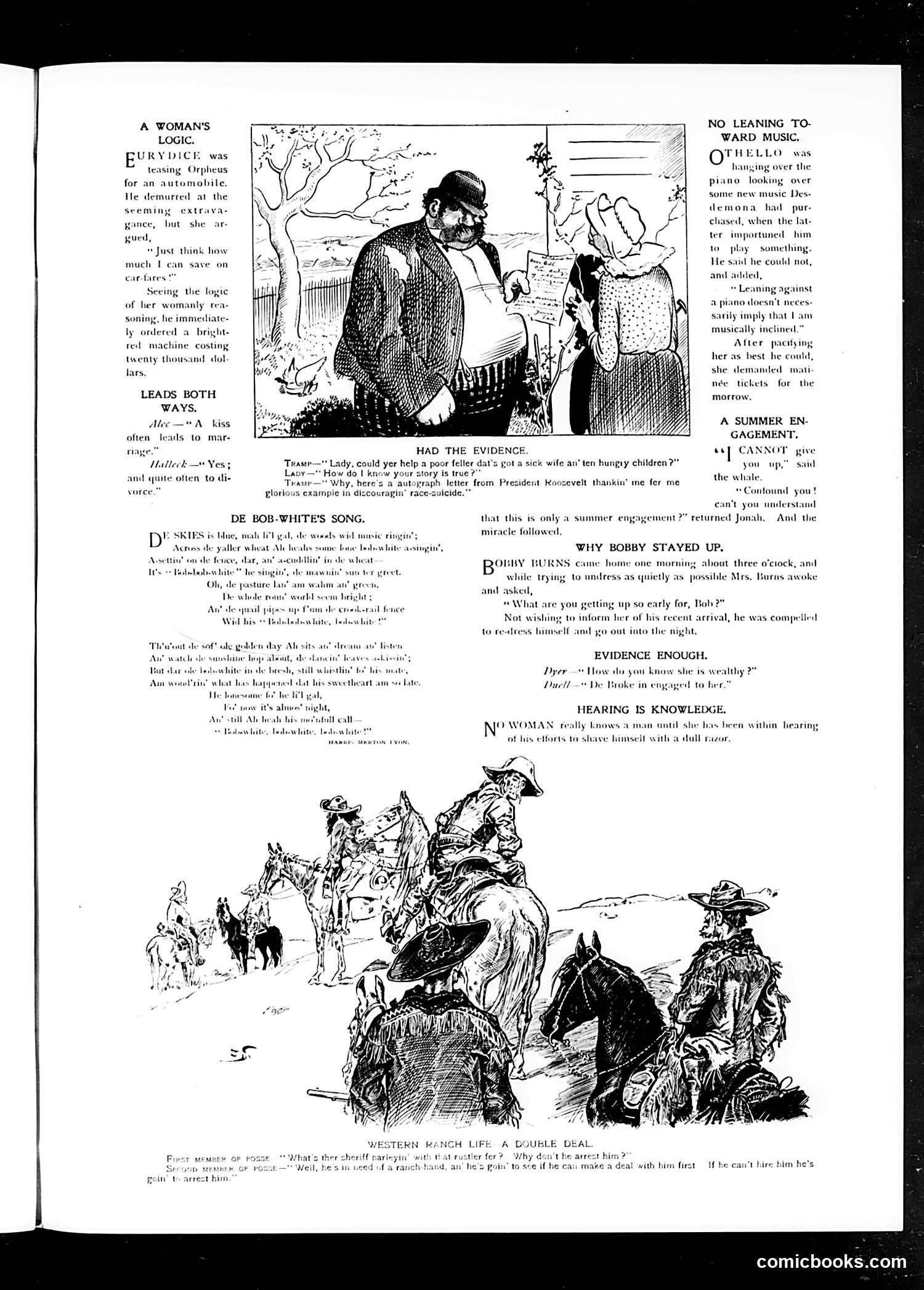
This page contains several satirical humor pieces typical of early 20th-century American magazines: **"A Woman's Logic"**: Mocks female reasoning by showing a wife convincing her husband to buy a $20,000 automobile by appealing to savings on cab fares—absurd arithmetic presented as typical "woman's logic." **"De Bob-White's Song"**: A dialect poem celebrating a bird's song, likely using racist minstrel-show conventions common to the era. **"Had the Evidence"**: A beggar claims credibility by producing a letter from President Roosevelt thanking him for discouraging suicide—satirizing both charitable gullibility and Roosevelt's public moralism. **"Why Bobby Stayed Up"**: A husband caught sneaking home at 3 AM must pretend to wake early, avoiding admitting his late night out. **"Hearing is Knowledge"**: Implies women learn about men through eavesdropping on their private moments (specifically shaving struggles). The humor relies on period stereotypes: foolish women, working-class dialect, marital deception, and class-based humor. The Roosevelt reference dates this approximately to his presidency (1901-1909).
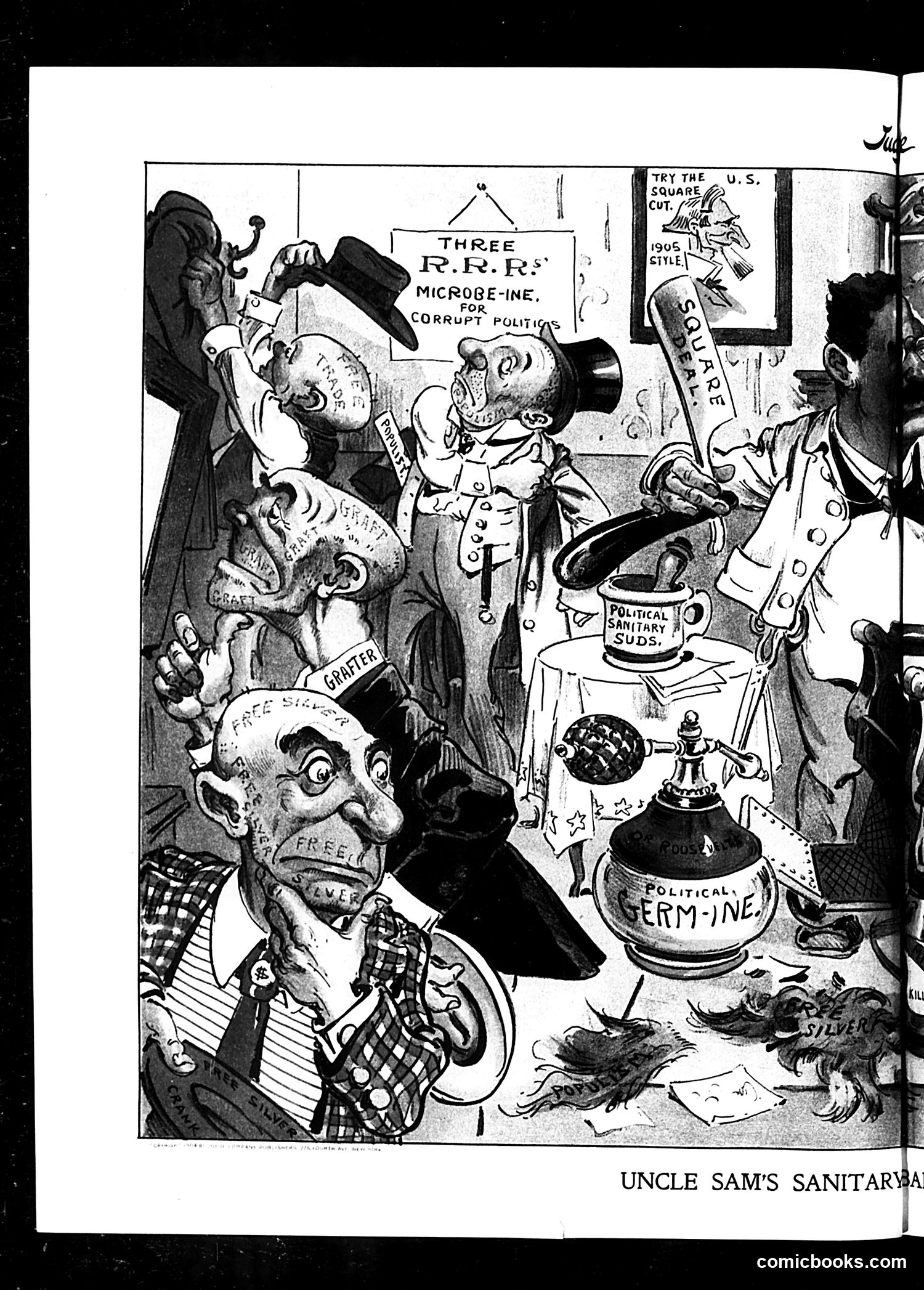
This Judge magazine cartoon satirizes political corruption through the metaphor of hygiene products. The central figure appears to be Uncle Sam (identifiable by his patriotic outfit) attempting to clean up politics using three "R.R.R's Microge-ine" products labeled "Corrupt Politics." The cartoon depicts various caricatured political figures engaged in what appears to be a cleaning or purification effort. Two bottles labeled "Political Sanitarium Suds" and "Political Germi-ne" sit on a table—suggesting that political corruption is portrayed as a contagion requiring disinfection. The satire implies that politicians were attempting cosmetic reforms to address deeper systemic corruption, treating serious problems as if they could be simply "cleaned up" like dirt. The exaggerated caricatures and comedic props mock the ineffectiveness of these purification efforts against entrenched political malfeasance.
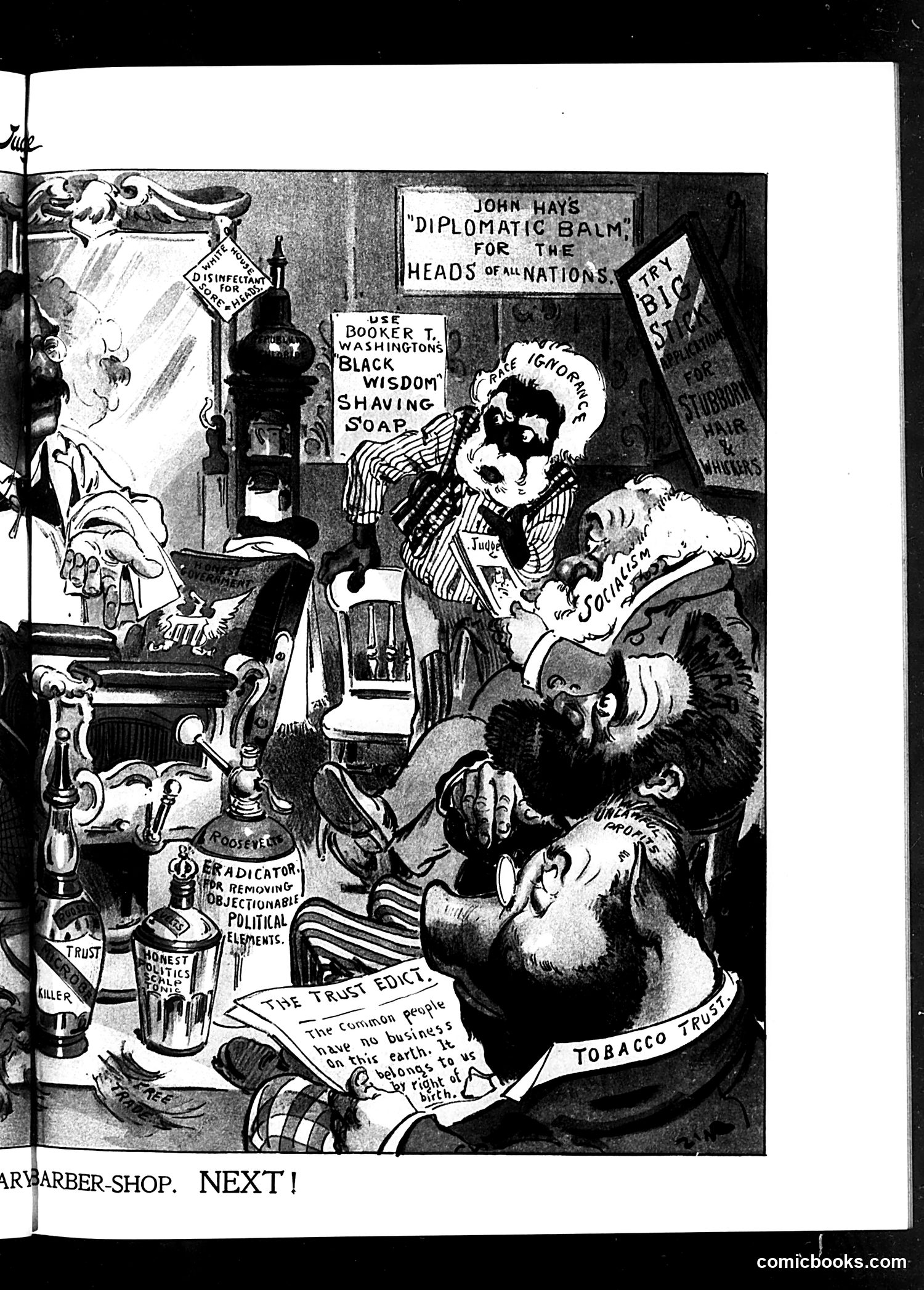
This satirical cartoon depicts caricatured figures examining various patent medicines and products labeled with political references. The visible products include "John Hays' Diplomatic Balm for the Heads of All Nations," "Booker T. Washington's Black Wisdom Shaving Soap," and bottles labeled "Eradicator," "Trust," "Killer," and "Tobacco Trust." The cartoon satirizes turn-of-the-century American politics by suggesting political leaders and reforms are mere commercial "cures" or snake oil—products to be tested like remedies in a barber shop. The caricatures appear to represent political figures or types examining these dubious solutions, mocking the proliferation of patent medicines alongside political ideology. The "Trust" references likely allude to monopolistic business practices of the Gilded Age, a major reform issue of the era.
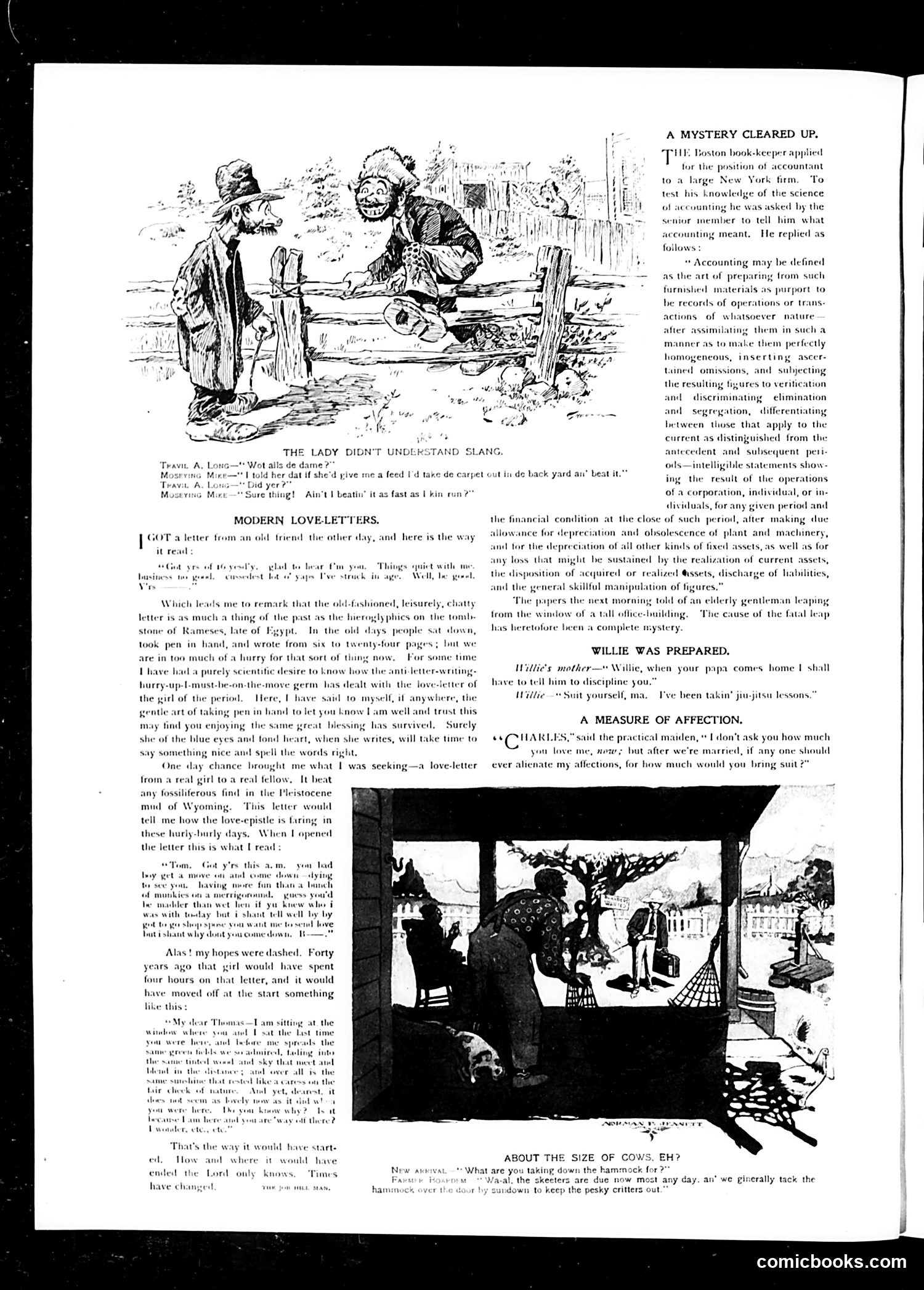
This Judge magazine page contains three satirical pieces: 1. **"The Lady Didn't Understand Slang"** (top cartoon): Two working-class men discuss a woman who misunderstood crude slang. The humor relies on her literal interpretation of vulgar language—typical period satire about class differences and linguistic misunderstandings. 2. **"Modern Love-Letters"** (center): Contrasts old-fashioned romantic letters (lengthy, flowery, careful) with modern ones (rushed, misspelled, crude). The "real" modern love-letter shown is deliberately poorly written ("yer," "waal," "yipe"), mocking both contemporary haste and working-class speech patterns. Nostalgic satire about declining standards. 3. **"A Mystery Cleared Up"** (bottom right): A Boston accountant's absurdly inflated, jargon-filled definition of "accounting" satirizes professional pretension—using deliberately convoluted language to describe what should be simple bookkeeping. The joke: professionals obscure simple concepts with unnecessary complexity. All three pieces mock contemporary manners, speech, and professional pomposity.
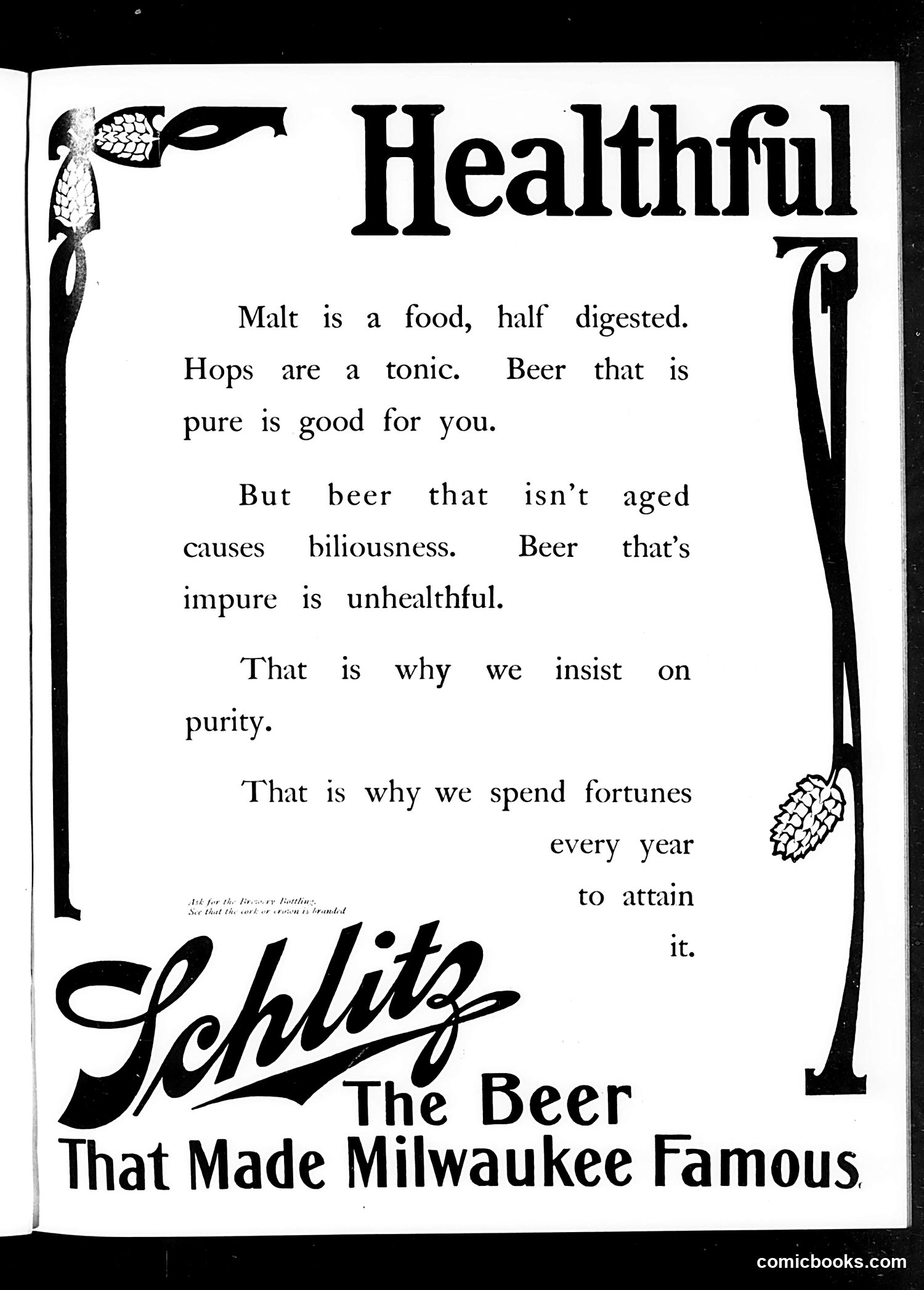
This is a **Schlitz beer advertisement**, not political satire. It presents health claims common to early-20th-century beer marketing. The ad argues that beer—specifically Schlitz—is healthful when pure and properly aged. It claims malt is "half digested" food, hops are medicinal tonics, and that impure or unaged beer causes "biliousness" (digestive upset). The satire lies in the **exaggerated health claims**: modern readers recognize this as laughably false advertising. Early beer companies positioned their products as tonics or medicines to market them during an era when such claims seemed plausible to consumers unfamiliar with scientific nutrition standards. The decorative hop illustrations reinforce the "natural, wholesome" messaging. "The Beer That Made Milwaukee Famous" was Schlitz's actual slogan, emphasizing their market dominance in that brewing center.
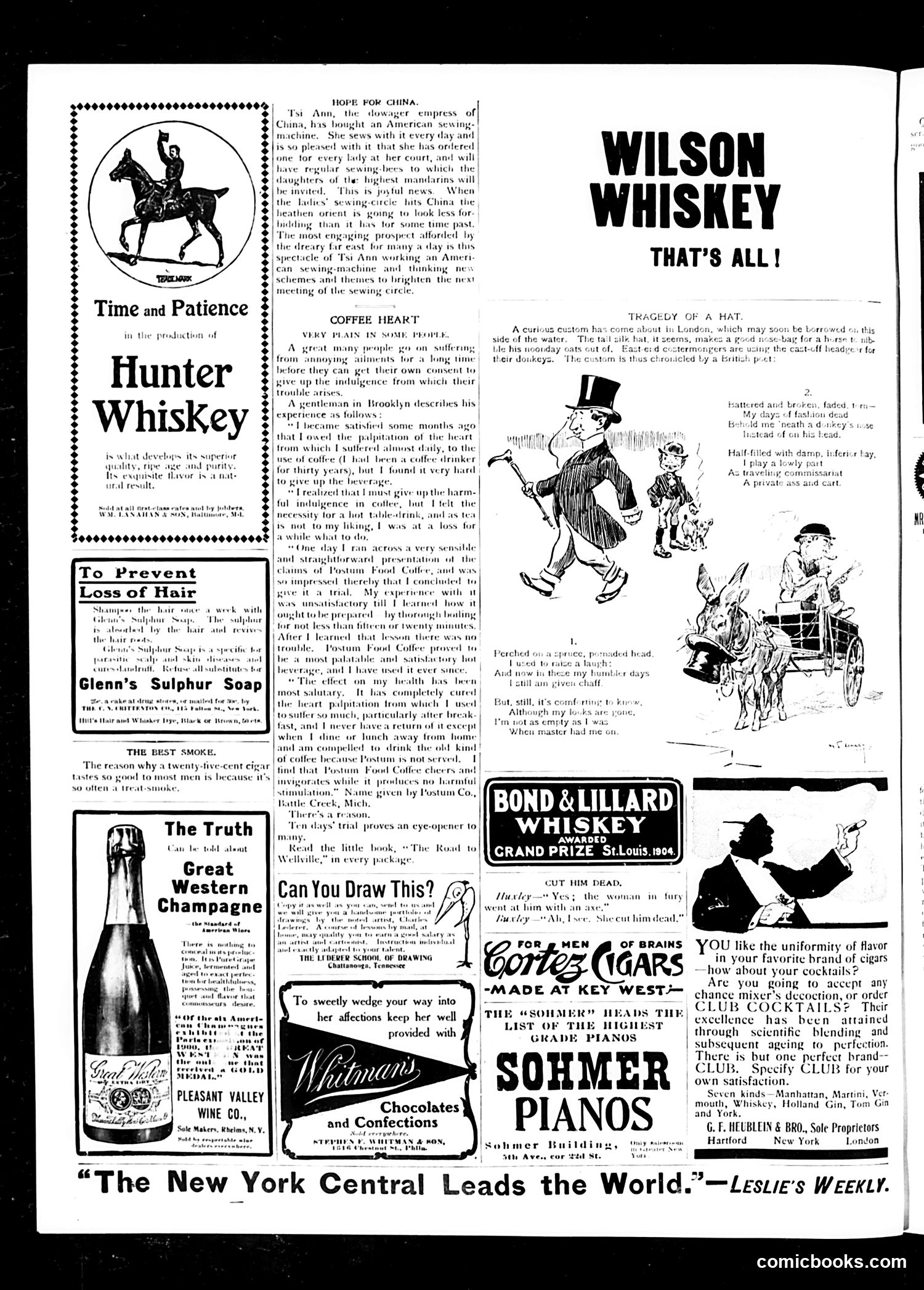
This is primarily an **advertising page** with minimal editorial content. The notable satirical piece is "Hope for China," which mocks the Dowager Empress Cixi's adoption of an American sewing machine. The satire suggests that Western domesticity—specifically women's sewing circles—represents "progress" for China, implying that traditional Chinese culture lacks such refinement. This reflects the patronizing, imperialist attitudes of early 1900s America toward Asia. The remaining content consists of product advertisements (whiskey, champagne, cigars, chocolates, pianos) and a small cartoon titled "Tragedy of a Hat" about a man's top hat being lost, with accompanying humorous verse. The page reflects early 20th-century consumer culture and American attitudes of cultural superiority toward non-Western nations.
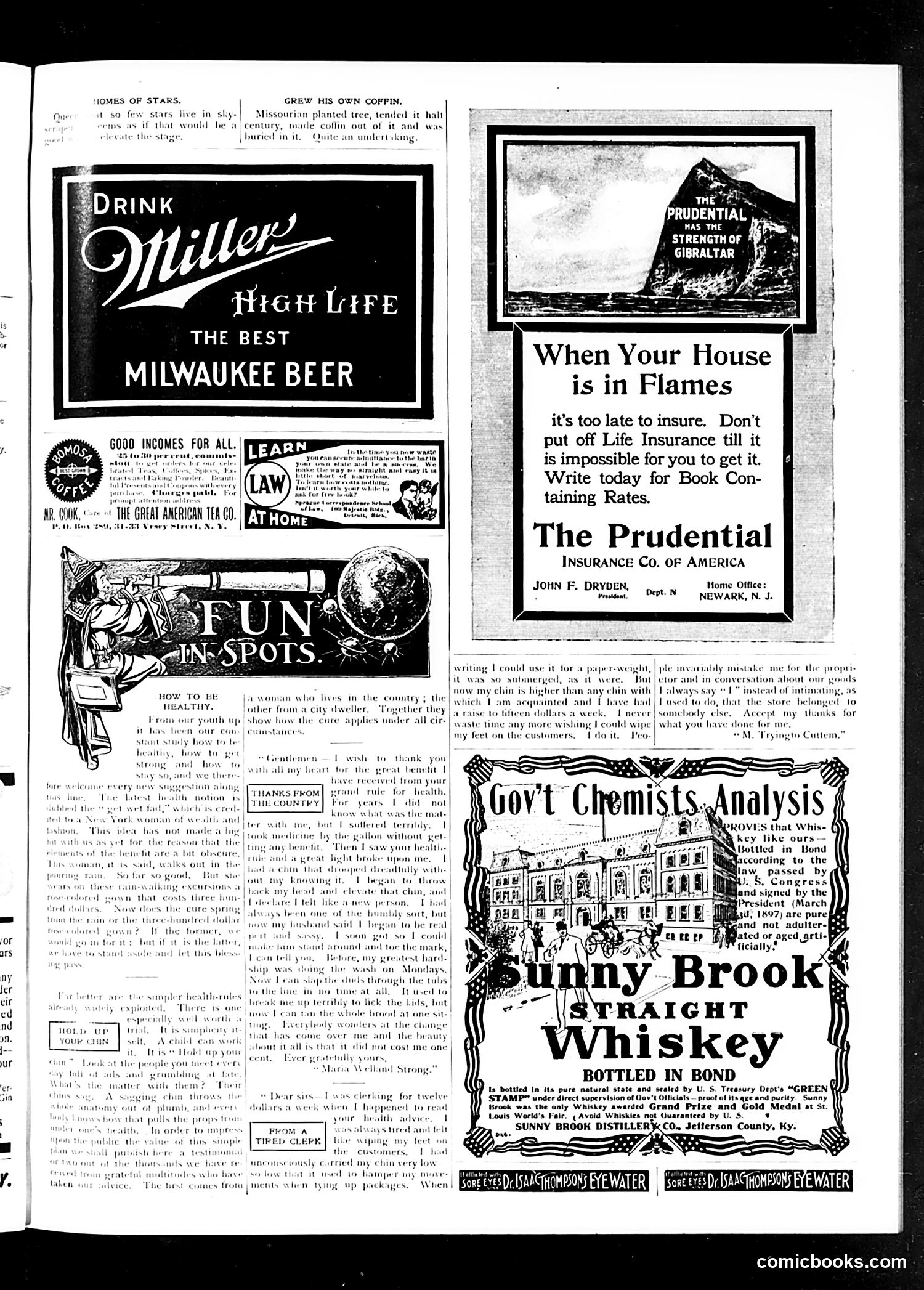
This page is primarily **advertising**, not political satire. It contains vintage ads from approximately the early 1900s for: - **Miller High Life beer** (Milwaukee) - **Prudential Insurance** (with imagery of the Rock of Gibraltar, their corporate symbol) - **Sunny Brook Whiskey** (bottled in bond, emphasizing it won awards at the St. Louis World's Fair) - **Learn Law at Home** correspondence course - Various other products The page also includes reader letters thanking Judge magazine for health advice, suggesting the publication mixed editorial content with reader correspondence. **For modern readers**: These ads reflect early 20th-century consumer culture—products marketed by reliability symbols (Gibraltar), fair awards (World's Fair medals), and government regulation (bonded whiskey). The insurance ad's "it's too late" messaging uses fear-based marketing still recognizable today. The page shows how magazines subsidized themselves through advertising rather than subscription fees alone. There is no discernible political cartoon or satire on this page.
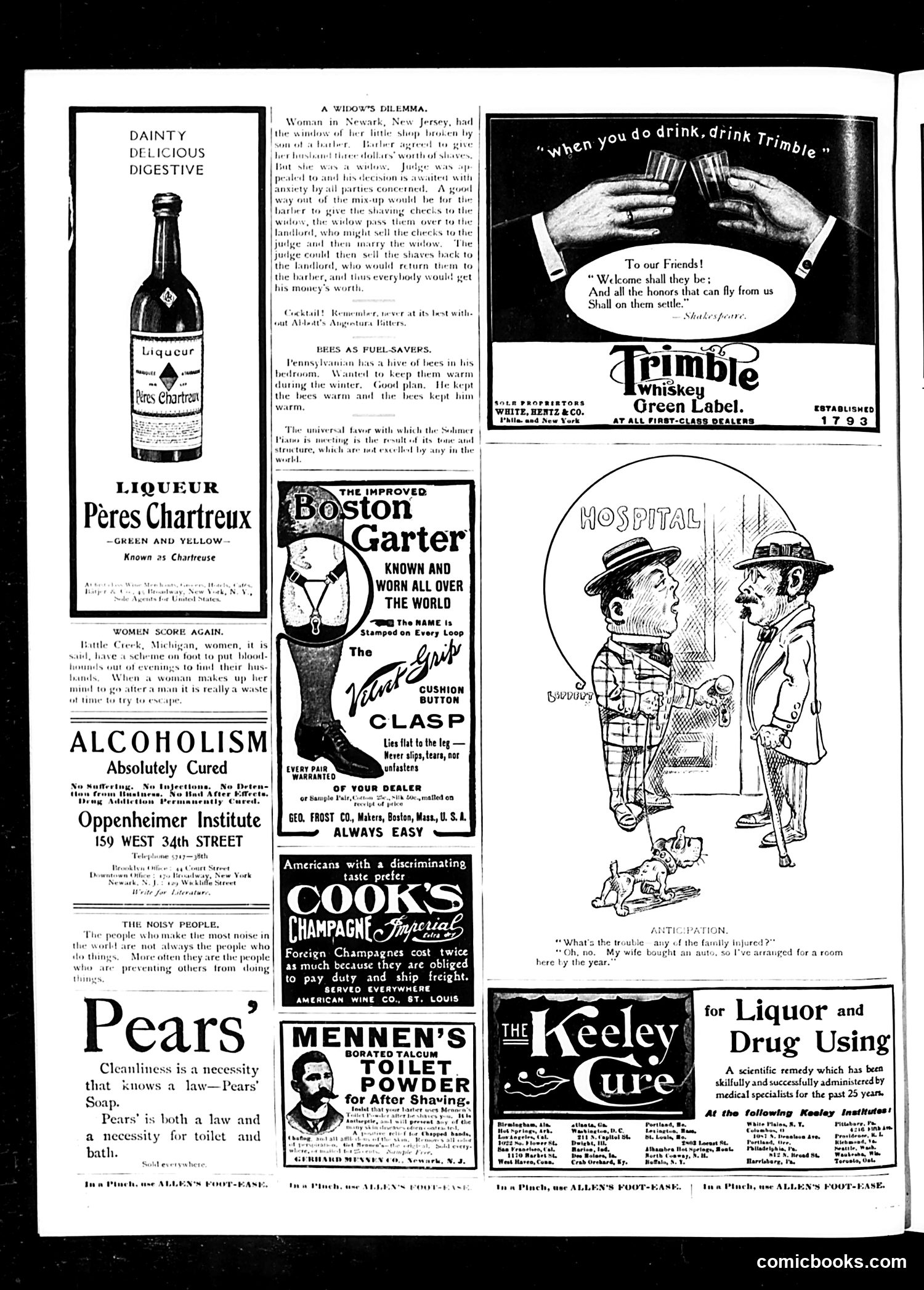
This page is primarily **advertising**, typical of early 1900s magazines. However, it contains one notable cartoon: **The Main Cartoon: "Amputation"** A construction worker with an injured leg visits a hospital, where a doctor suggests amputation. The worker protests, saying his wife bought a car and he's arranged for a hospital room "by the year"—implying he plans to stay hospitalized as a financial arrangement rather than pursue treatment. **The Satire:** This mocks the absurdity of early auto-ownership culture and the economic desperation of working-class families. The joke suggests someone would prefer prolonged hospitalization to facing his wife's extravagant car purchase, satirizing both marital power dynamics and the financial burden of new automobiles on ordinary households. **Supporting Content:** The page also advertises dubious period remedies—including an "Alcoholism Cure" and a "Keeley Institute" for drug treatment—reflecting contemporary medical quackery and the era's widespread substance-abuse problems that these ads exploited.
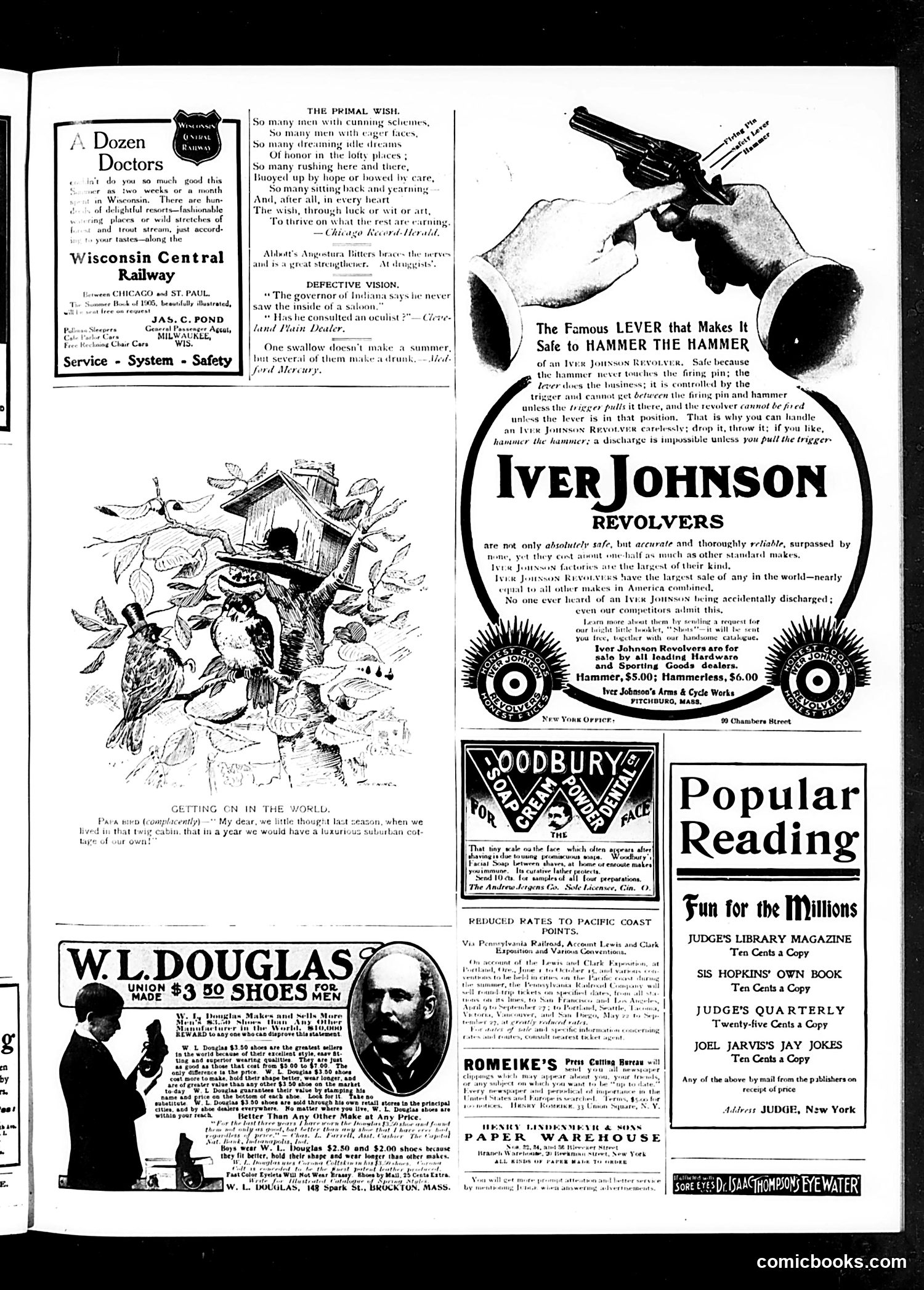
This page is primarily **advertising** with minimal editorial content. The main elements are: **Editorial Content:** - A short poem titled "The Primal Wish" about human ambition and the universal desire to profit from others' labor - A brief joke about "Defective Vision" (unclear reference, appears to involve an Indiana governor) **Major Advertisements:** - **Iver Johnson Revolvers**: Emphasizes the safety lever mechanism that prevents accidental firing—a selling point for the era when firearm safety was a genuine consumer concern - **W.L. Douglas Shoes ($3.50)**: Features a mustachioed man promoting affordable quality footwear - **Wisconsin Central Railway**: Tourism promotion **Lower Section:** Listings for Judge's various publications (Judge's Library Magazine, Judge's Quarterly, etc.) and other publishers' catalogs. There is no clear political cartoon visible. The page functions primarily as a revenue-generating advertising vehicle typical of early 20th-century magazine publishing.
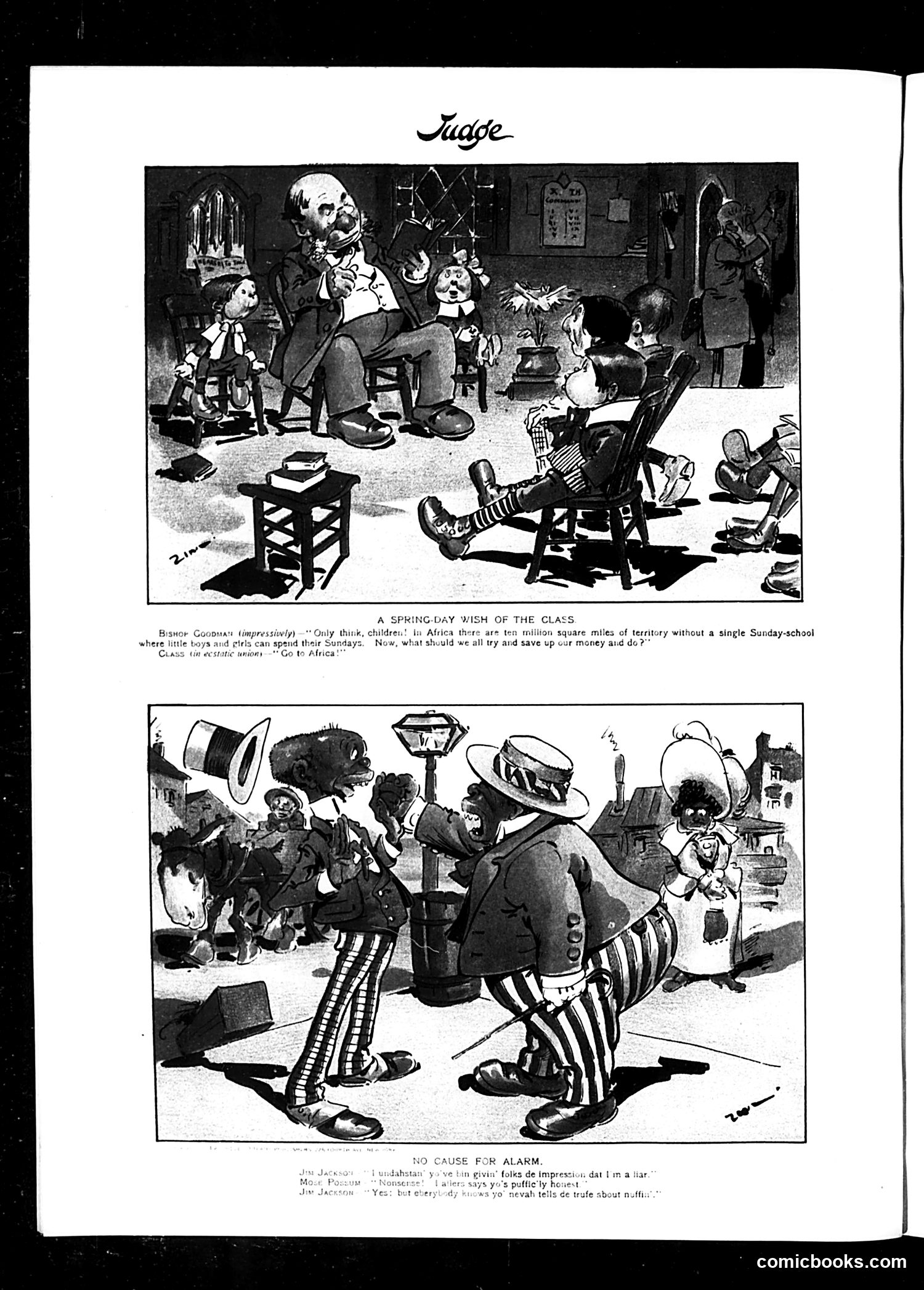
This page contains two satirical cartoons about colonial Africa and racial stereotypes. The top cartoon, "A Spring-Day Wish of the Class," depicts a schoolteacher (likely a missionary) describing African territory lacking Sunday schools, implying these regions need Christian "civilizing." The joke critiques imperialist attitudes—the teacher's earnest missionary zeal is presented as absurd naïveté. The bottom cartoon, "No Cause for Alarm," shows caricatured Black figures in striped clothing. The dialogue references "missionaries" and honesty, appearing to mock both colonial anxiety about Africa and the stereotypical depiction of African people. Both cartoons reflect early 20th-century American attitudes toward colonialism and race—presenting imperial expansion as humorous while relying on dehumanizing caricature. The satire targets missionary zeal and colonial pretensions rather than challenging the underlying racism.