
A complete issue · 16 pages · 1905
Judge — March 18, 1905
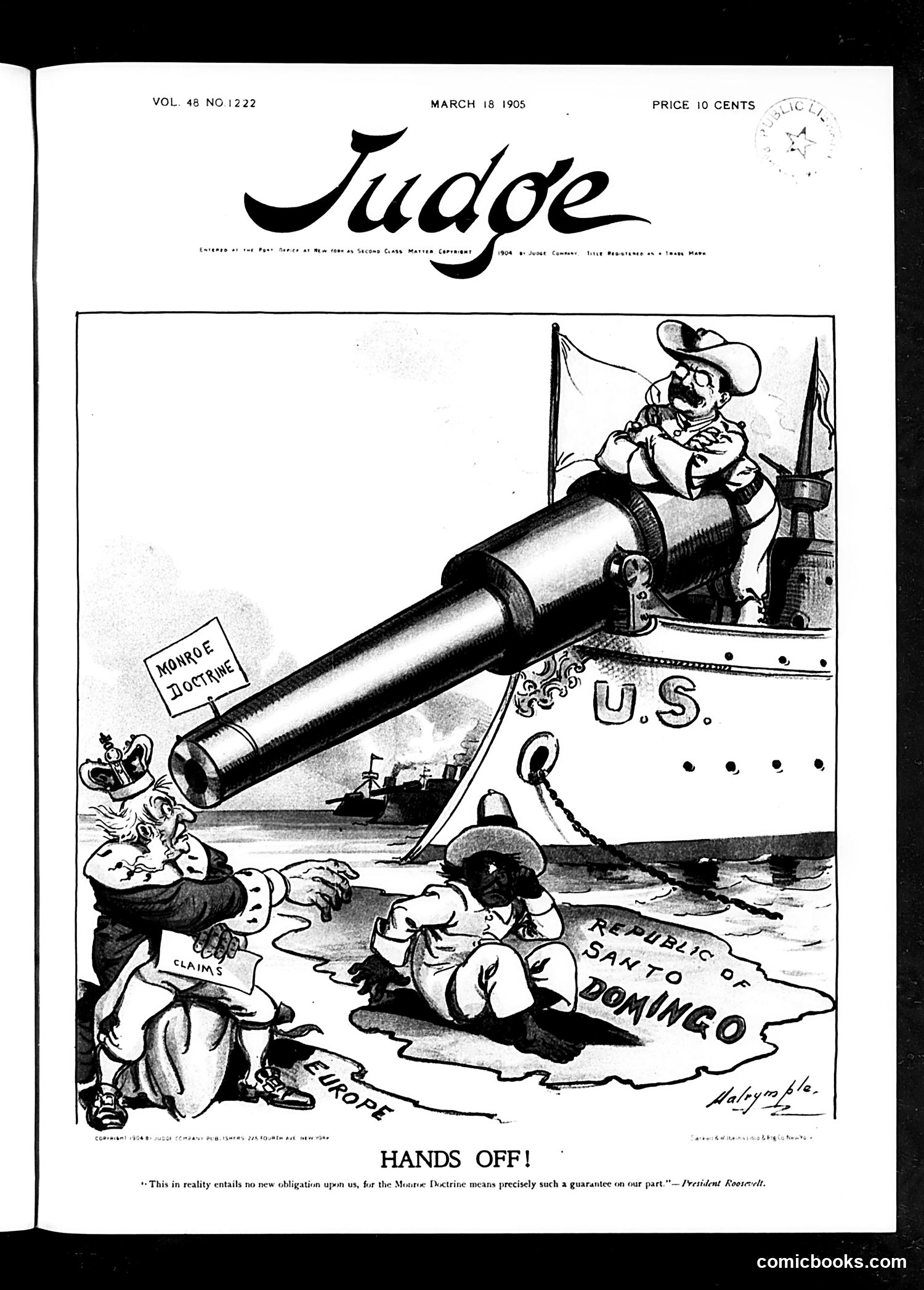
This cartoon satirizes U.S. military intervention in the Caribbean, specifically targeting the Monroe Doctrine as justification. A large naval cannon labeled "Monroe Doctrine" points from a U.S. warship toward the Dominican Republic and Santo Domingo. European figures (labeled "Europe" and "Claims") cower on the left, while Uncle Sam operates the weapon from the ship's gun turret, appearing aggressive and threatening. President Roosevelt is quoted approvingly: the Monroe Doctrine "entails no new obligation upon us" but guarantees U.S. dominance. The cartoon criticizes American imperialism—using the Monroe Doctrine not defensively against European colonialism, but offensively to dominate Latin America through military force and intimidation.
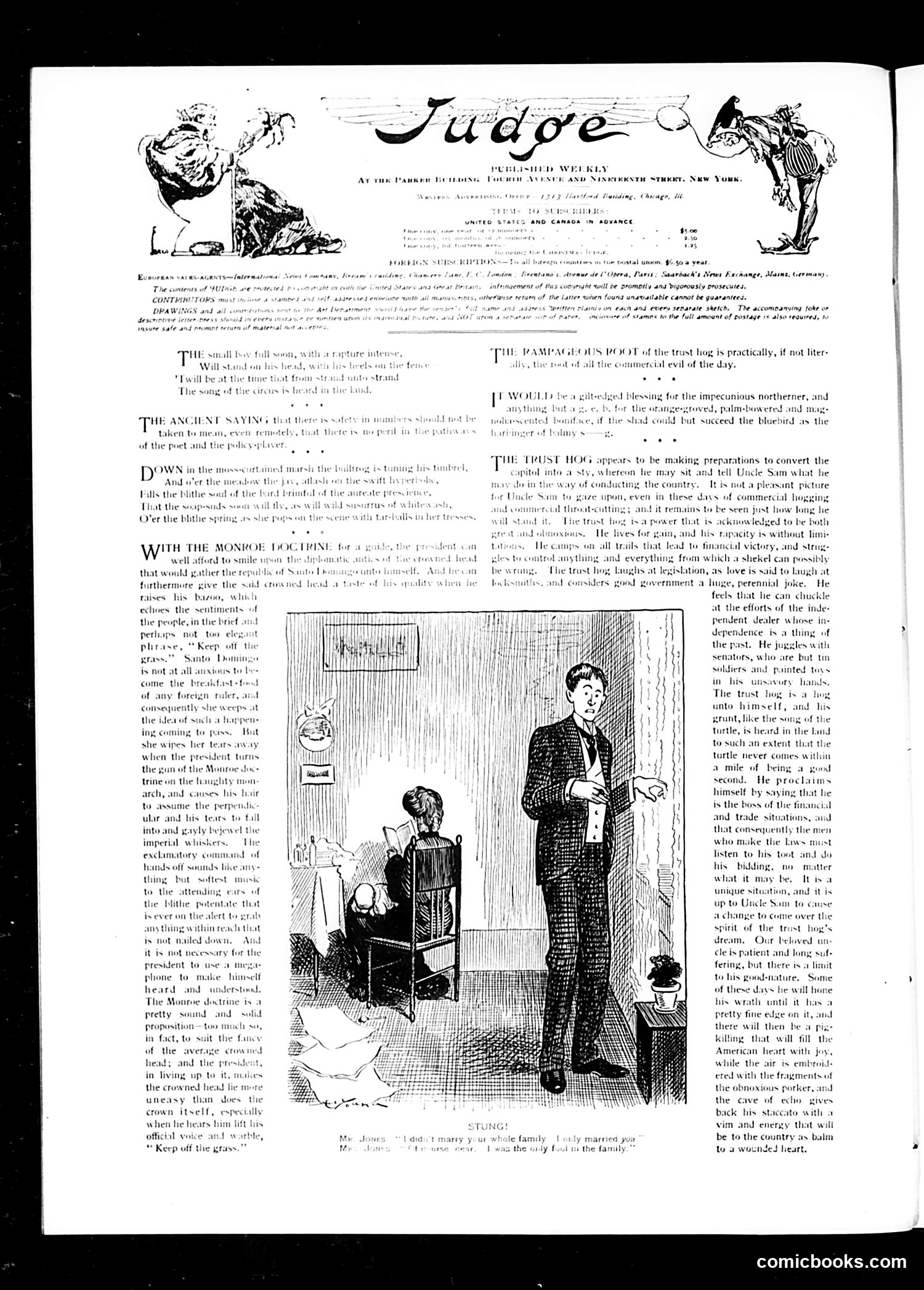
This page contains several short satirical pieces and an illustration. The central cartoon depicts two men in conversation—one seated, one standing—with a caption reading "STUNG!" and dialogue about marriage and family finances. The satirical articles mock various targets: "The Trust Hog" criticizes monopolistic business practices and their corrupting political influence; "The Monroe Doctrine" satirizes American foreign policy interventionism in Latin America; "The Ancient Saying" and other pieces comment on contemporary politics and social hypocrisy. The overall tone suggests late 19th or early 20th-century concerns: trust-busting, imperialism, and domestic political corruption. Without clearer date or contextual markers visible, specific political figures cannot be definitively identified, though the Trust Hog piece likely references contemporary monopoly debates common during the Progressive Era.
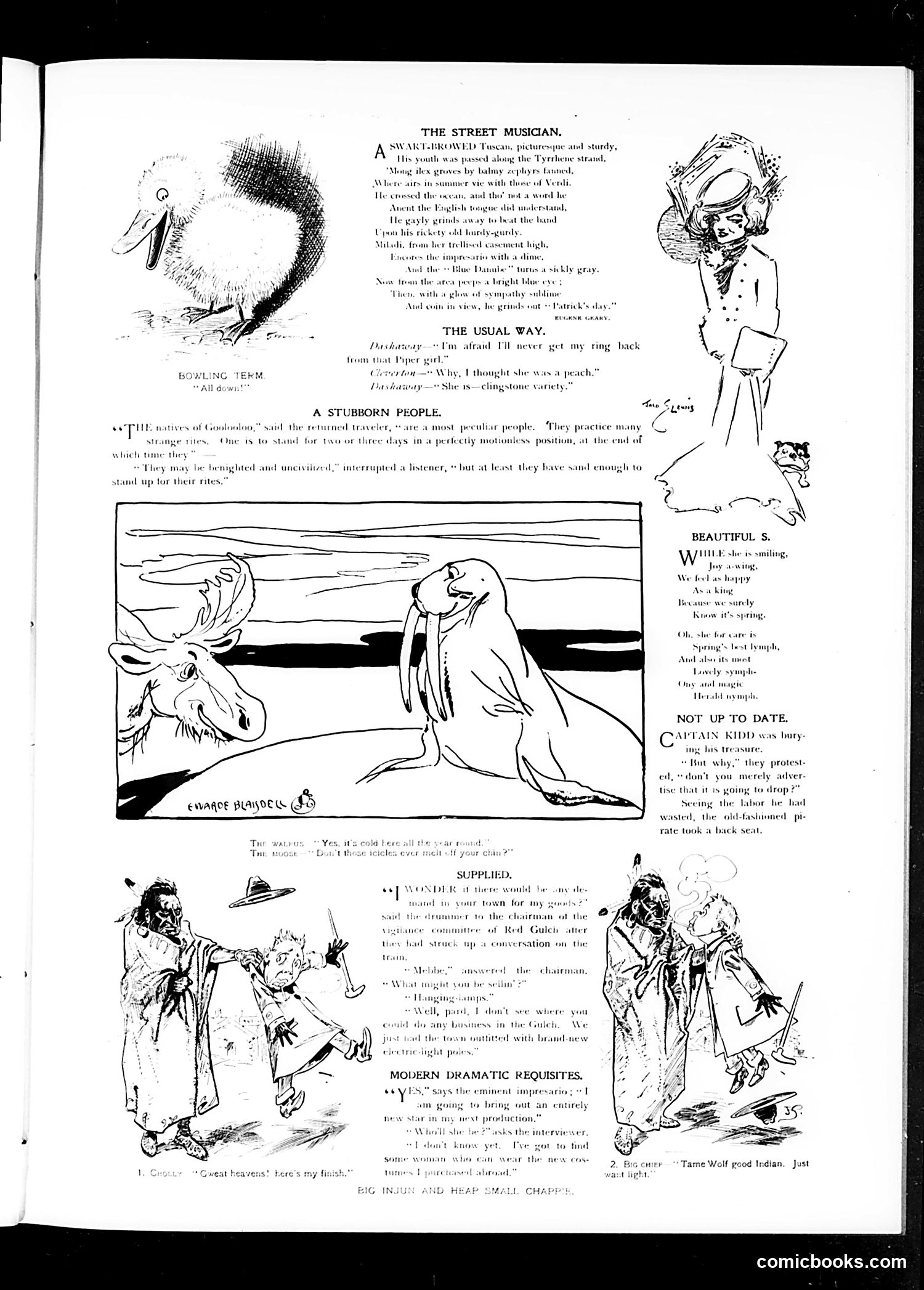
This page contains several short humorous pieces and illustrations rather than a unified political cartoon. **"The Street Musician"** depicts a Tuscan street performer—likely mocking Continental European types that American audiences found quaint or ridiculous. **"A Stubborn People"** includes a large illustration of a walrus and seal, accompanying text about Londoners being "stubborn"—apparently satirizing British character traits. **Other sections** ("The Usual Way," "Beautiful S.," "Not Up to Date," "Supplied," "Modern Dramatic Requisites") are brief comedic sketches with minimal illustrations, targeting various subjects from romantic miscommunications to theatrical affectations. The page emphasizes domestic American humor and mild mockery of foreigners and social pretension rather than serious political commentary. Without publication date confirmation, specific references remain unclear.
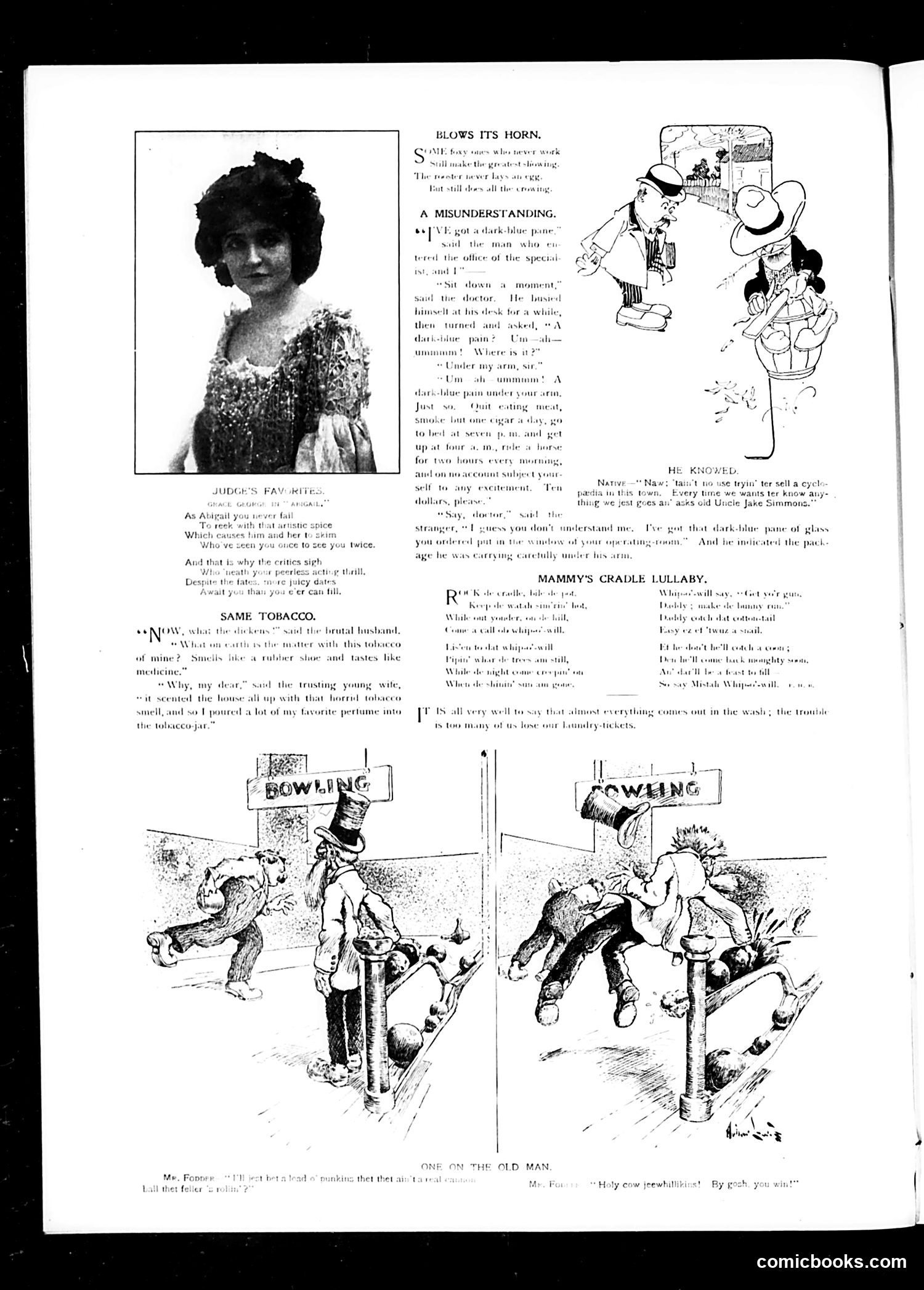
This page contains several short humorous pieces and cartoons typical of Judge magazine's satirical style. **"A Misunderstanding"** depicts a doctor-patient exchange where a man complains of dark-blue pain under his arm. The doctor misinterprets "eating meat, smoke but use sugar a day" as medical symptoms, when the patient is actually describing his daily habits. The satire mocks miscommunication between doctor and patient. **"Same Tobacco"** jokes about a husband's complaint regarding his wife's use of tobacco—a social commentary on smoking habits of the era. **"One on the Old Man"** (bowling cartoons) shows slapstick humor at a bowling alley, where elderly figures are struck by bowling balls—typical physical comedy of the period. The page also includes a poem, **"Mammy's Cradle Lullaby,"** and a photograph labeled "Judge's Favorite," though the subject is unclear from this reproduction.
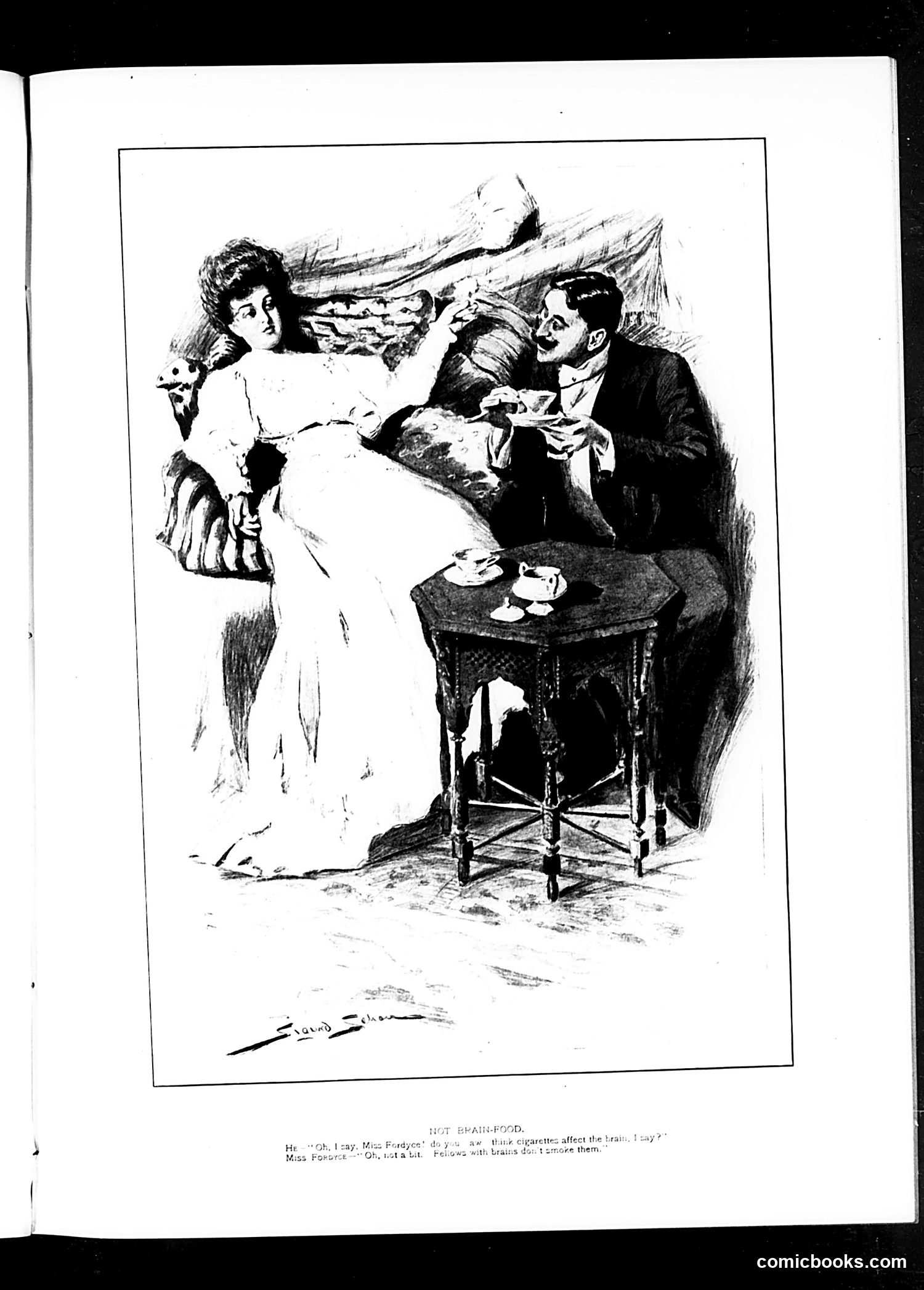
The OCR text is too corrupted to read the caption clearly, but the image shows a sketch in the style of early 20th-century Judge magazine satire. The cartoon depicts a woman in an elegant white dress speaking with a well-dressed man seated at a small table. The woman appears animated while the man listens. Based on the title "Hot Brainfood" and the composition, this likely satirizes intellectual or social pretensions—possibly mocking either a woman's attempt at witty conversation or critiquing how men and women engaged in sophisticated discourse of the era. Without the legible caption text, I cannot definitively identify the specific figures or the precise social commentary intended. The artistic style and setting suggest commentary on upper-class social interactions, but the exact satirical point remains unclear.
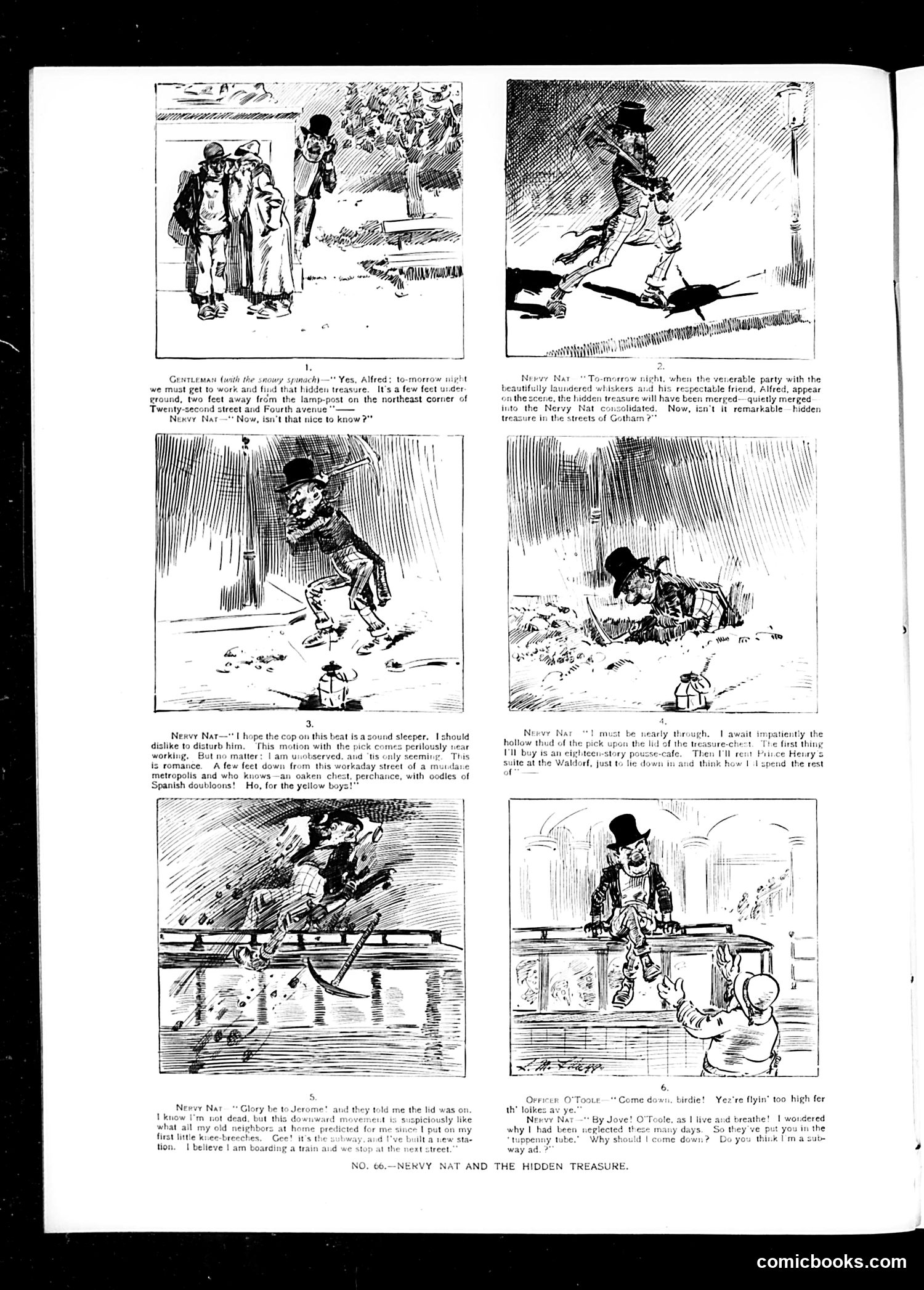
This appears to be a comic strip sequence rather than political satire. It depicts "Nervy Nat," a recurring character (likely a street urchin or working-class boy), discovering hidden treasure buried in an urban location. The plot involves Nat overhearing gentlemen discussing buried Spanish doubloons, then attempting to retrieve the treasure himself. The sequence shows him evading a policeman and dealing with various obstacles while digging. The final panels suggest Nat encounters an authority figure (possibly a priest or well-dressed gentleman) who warns him away. The humor relies on slapstick mishaps and Nat's scrambling street-kid antics—typical of early 20th-century comic strip humor aimed at entertaining readers rather than making political commentary. The title character's "nervy" nature drives the comedic action throughout.
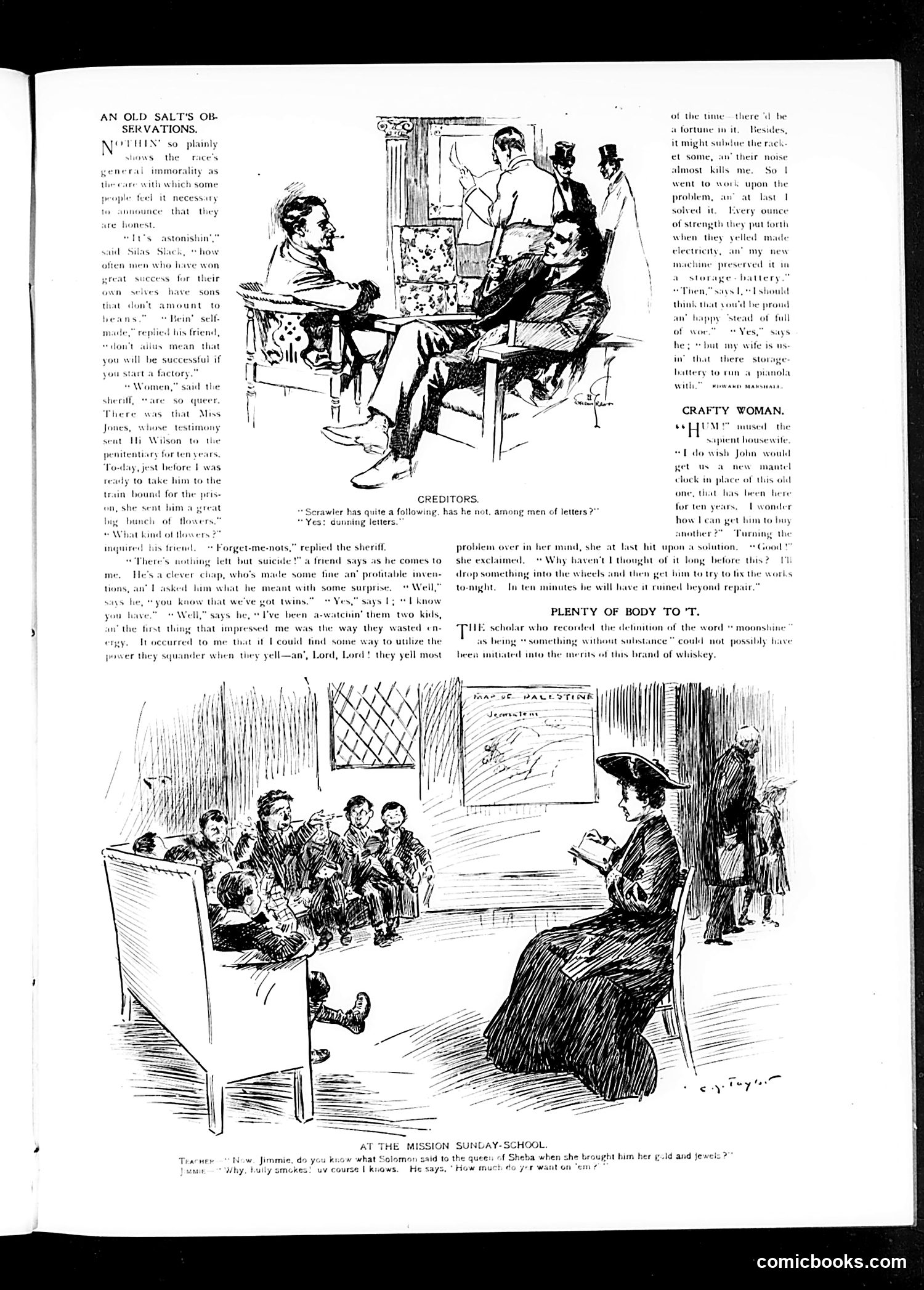
This page contains three separate satirical pieces typical of late 19th/early 20th-century humor: **"An Old Salt's Observations"**: A crusty sailor character observes human nature—particularly that success doesn't guarantee morality, and women's unpredictability. One anecdote describes a woman (Miss Jones) who testified against a man (Hi Wilson) sending him to prison for ten years, then later marrying him. The satire mocks the illogic of romantic attachment. **"Creditors"**: A brief joke about a man with a large following among writers—implying he's a debtor constantly pursued by creditors seeking payment. **"Crafty Woman"**: A housewife deliberately breaks her mantel clock so her husband John will attempt repair, destroying it beyond fixing—forcing him to buy the new one she wants. The satire targets domestic manipulation and gender dynamics in marriage. **"At the Mission Sunday-School"**: A teacher asks a child about Solomon; the child confuses him with a cigar brand "Sully smokes," satirizing consumer advertising's pervasive influence even on religious education. All reflect period attitudes toward gender relations, commercialism, and social behavior.
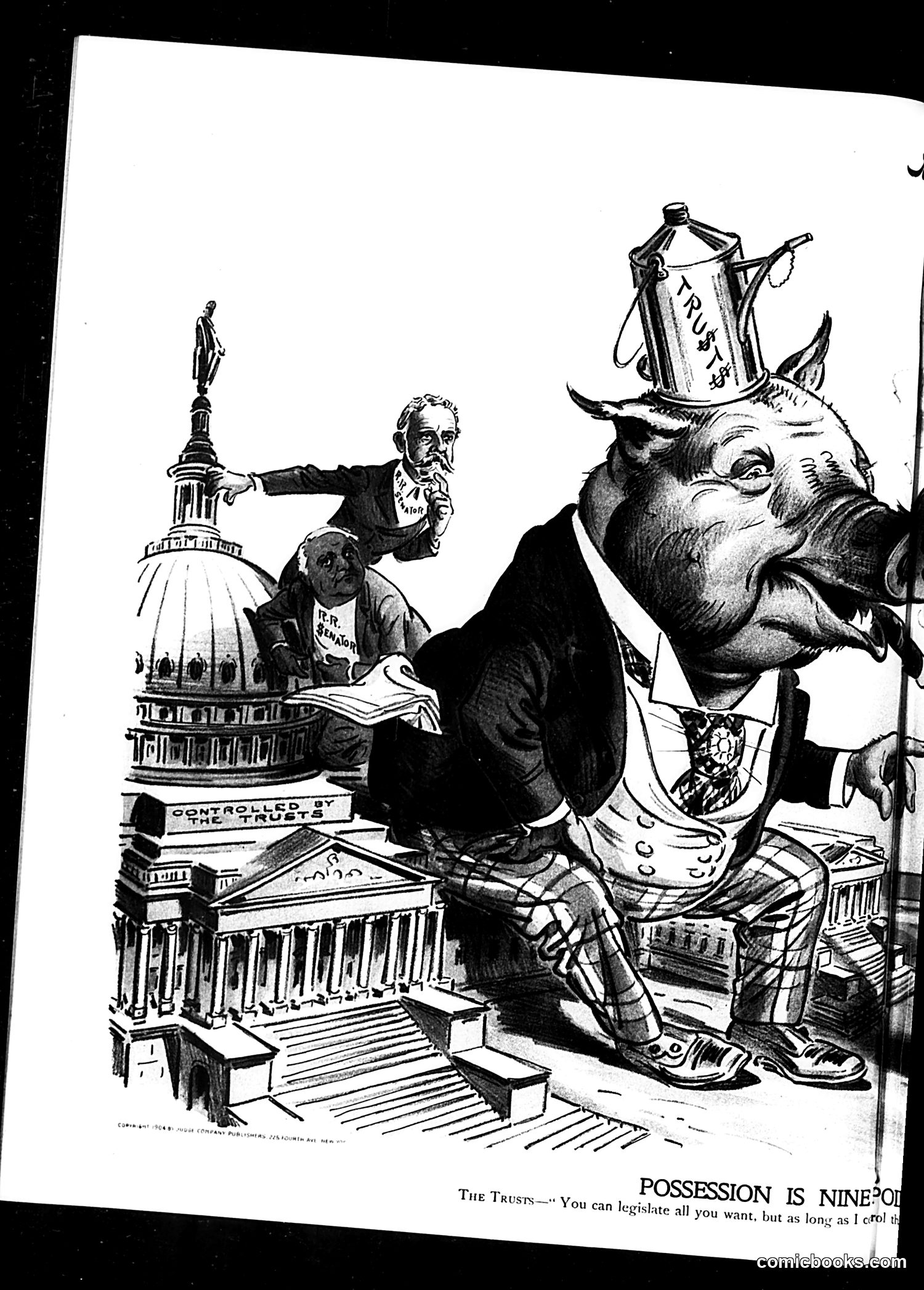
This satirical cartoon critiques corporate trusts' control over American government. The large pig-headed figure represents the trusts themselves, depicted with money pouch and teapot (symbolizing wealth and corporate interests). Two human figures—likely representing legislators or politicians—interact with this dominant force at the Capitol building. The caption's play on "possession is nine-tenths of the law" suggests that despite efforts to legislate against trusts, the trusts maintain practical control through their economic power. The cartoon argues that laws mean little when corporate interests hold actual dominion over the political system. This reflects early 20th-century Progressive Era anxieties about monopolistic corporations' influence on democracy and government regulation's ineffectiveness against entrenched economic power.
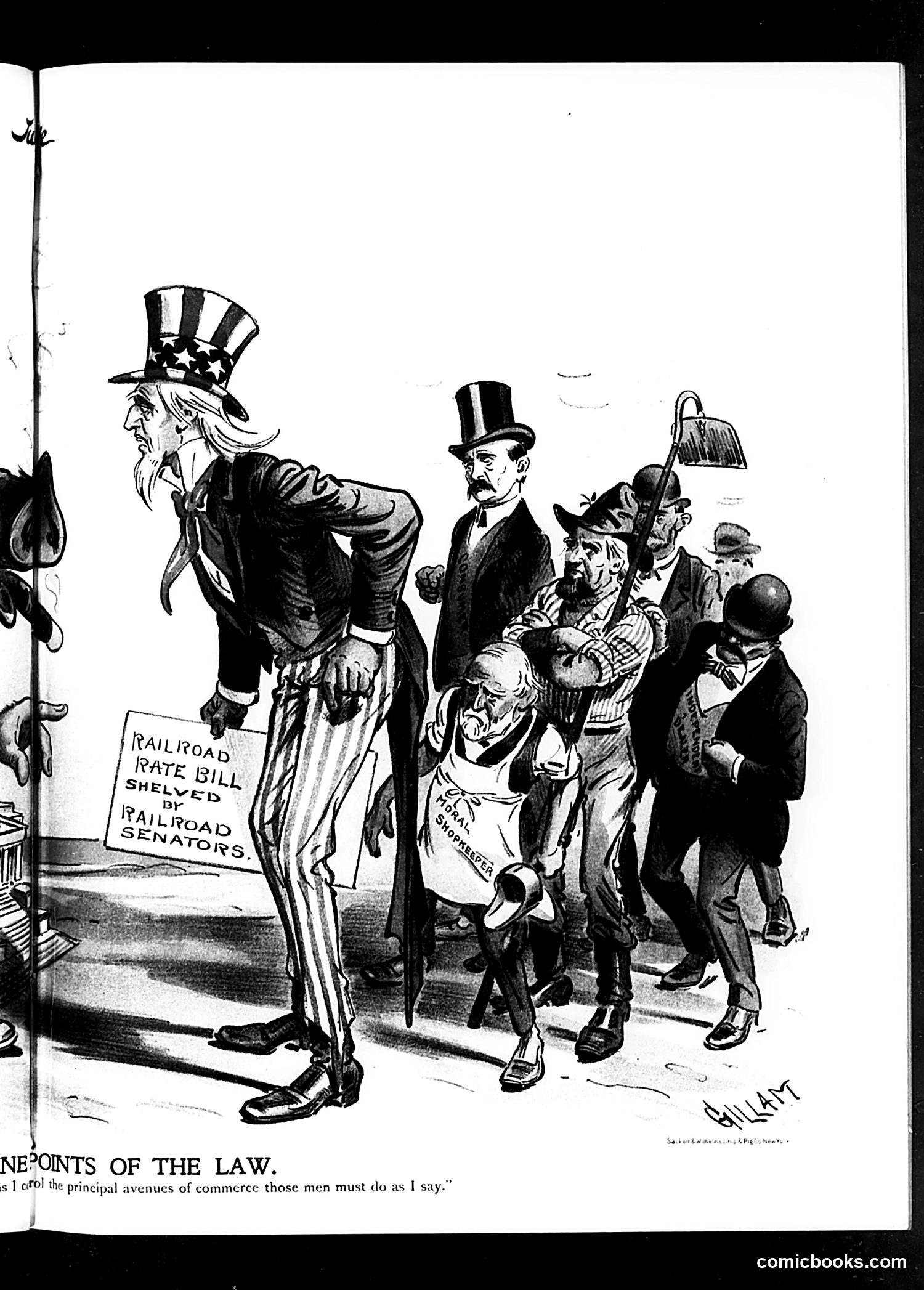
This Gilded Age satirical cartoon depicts **Uncle Sam** (tall figure in stars-and-stripes top hat) confronting a group of men representing **railroad interests** and **senators**. A sign reads "RAILROAD RATE BILL SHELVED BY RAILROAD SENATORS," indicating that railroad-friendly senators blocked rate-regulation legislation. The cartoon criticizes the cozy relationship between railroad companies and their political allies in the Senate. Uncle Sam declares he controls "principal avenues of commerce," yet the senators appear to defy him by protecting railroad monopolies from regulation. This reflects **Progressive Era tensions** (likely early 1900s) over whether government could regulate powerful corporate interests. The satire suggests senators prioritized railroad profits over public interest—a common theme in Judge magazine's muckraking commentary.
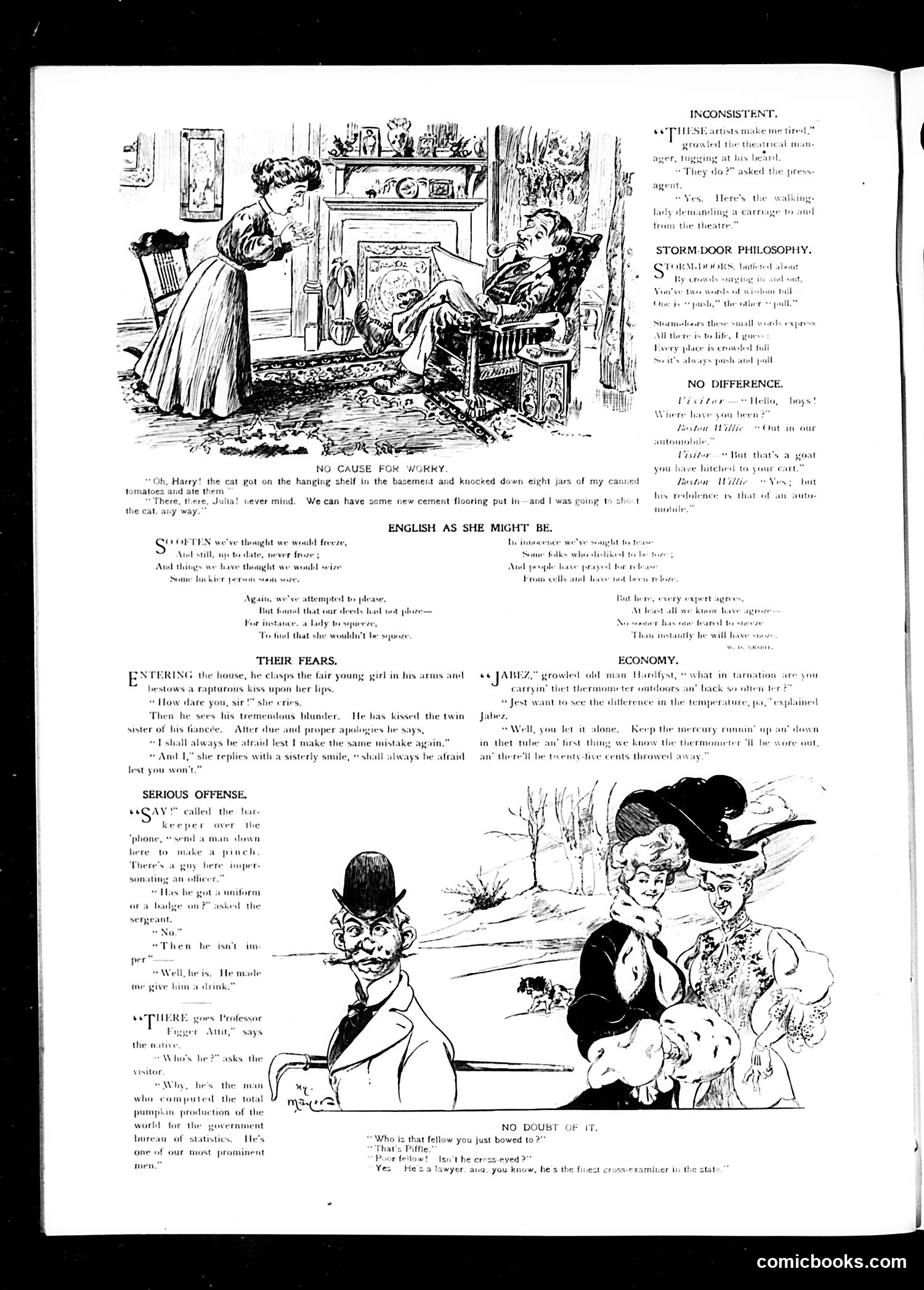
This page contains several standalone humor pieces typical of early 20th-century Judge magazine: **"Their Fears"**: A man mistakenly kisses his fiancée's twin sister upon meeting her. The joke plays on the social awkwardness and impropriety of the situation—the "fear" being that he'll make the same mistake again, and her reassurance that she'll "always be afraid" he won't repeat it. **"Storm-Door Philosophy"**: Depicts casual domestic banter about a cat destroying basement shelving. The humor lies in the man's flippant attitude toward destruction ("we can have some new cement flooring"). **"Economy"**: An elderly man complains about someone taking a thermometer outdoors to check temperature differences, wasting "twenty-five cents." The joke mocks penny-pinching frugality. **"Serious Offense"**: A sergeant's complaint that a man isn't properly "impudent"—the absurdist humor suggests military discipline expects subordinates to show disrespect. **"No Doubt of It"**: A brief exchange establishing that a man is a lawyer and "cross-examiner"—confirming a stereotype about lawyers' argumentative nature. These are light domestic and social satires with no apparent political commentary.
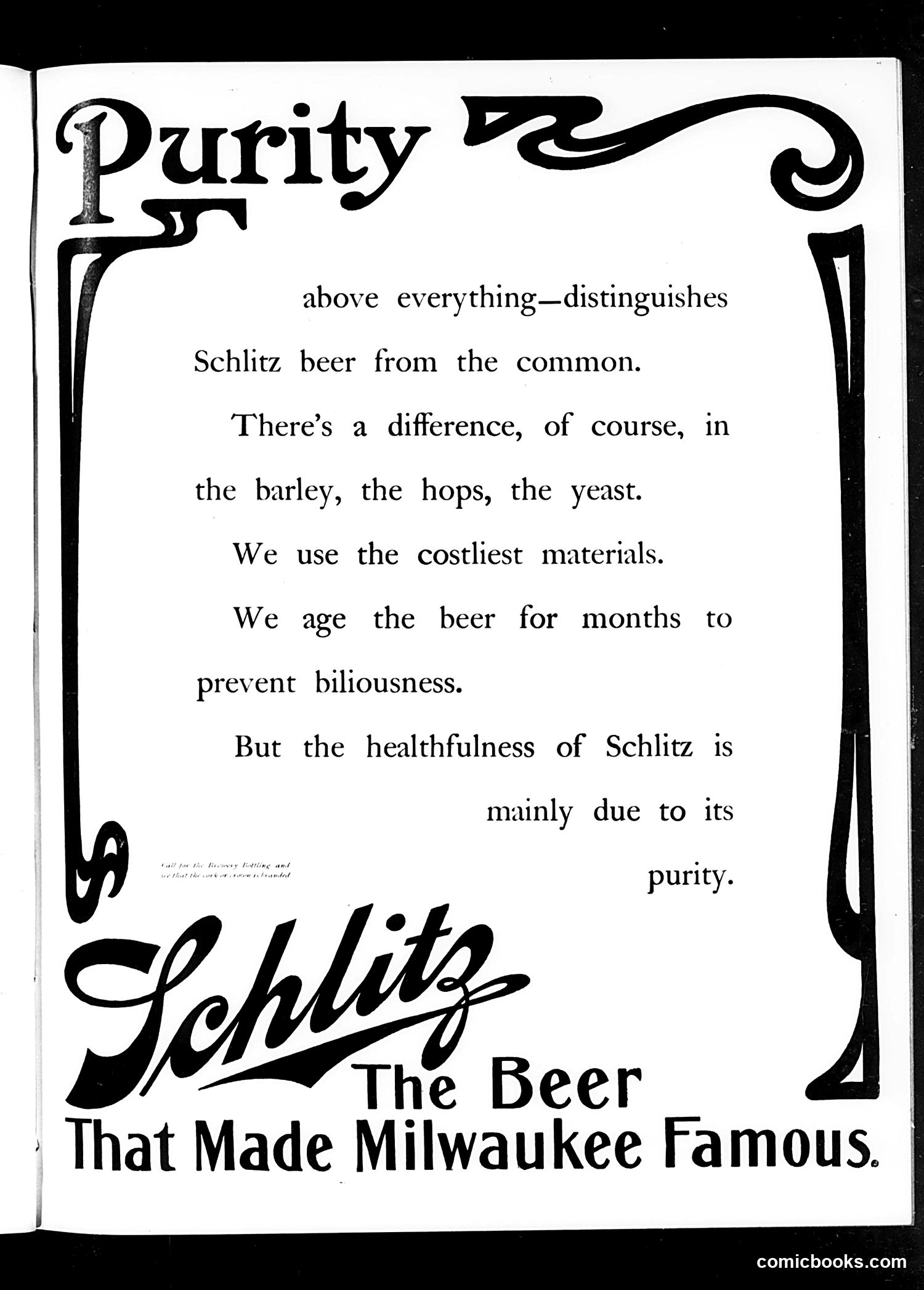
This is a **Schlitz beer advertisement**, not a political cartoon. The page promotes Schlitz as a premium beer by emphasizing "purity" above all else—a marketing strategy highlighting superior ingredients (barley, hops, yeast) and extended aging to prevent digestive upset ("biliousness"). The ad's claim that Schlitz's "healthfulness" derives from purity reflects early 20th-century beer marketing, when brewers positioned their products as health beverages rather than mere alcohol. The tagline "The Beer That Made Milwaukee Famous" references Milwaukee's prominence as a brewing center. There is no satire or political content visible here—it's straightforward product advertising typical of Judge magazine's commercial pages.
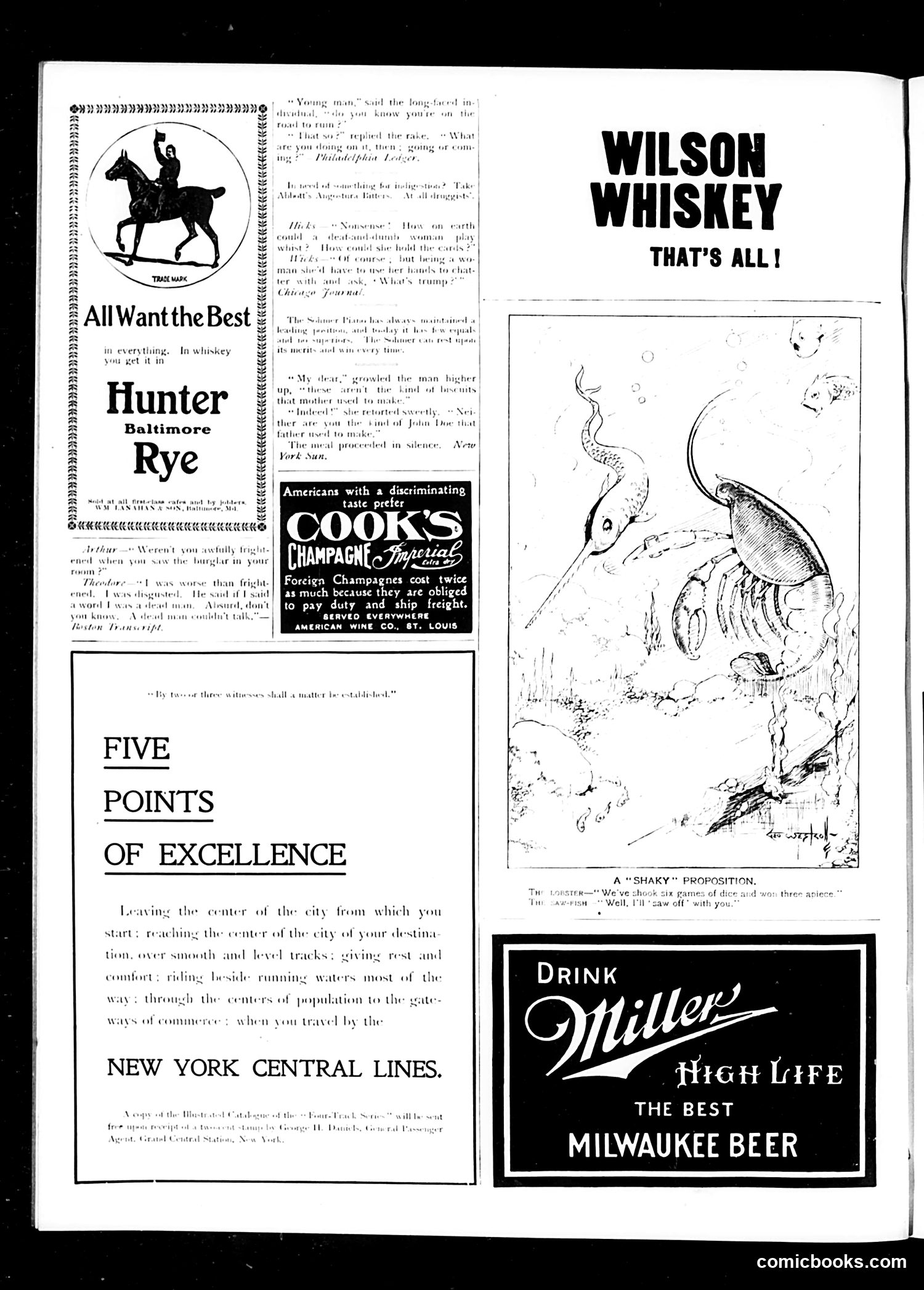
This page is primarily **advertisements** for alcohol and transportation, typical of early 20th-century Judge magazine. The main cartoon, titled "A 'Shaky' Proposition," depicts two figures engaged in dice gambling. The dialogue suggests one has lost repeatedly ("shook six games of dice") and proposes a compromise ("saw off" with you)—period slang for agreeing to call it even. The satire mocks the foolishness of compulsive gambling and the desperation of the losing player. The surrounding advertisements promote **Wilson Whiskey**, **Hunter Baltimore Rye**, **Cook's Champagne** (emphasizing American over foreign brands to avoid import duties), **Miller High Life beer**, and the **New York Central Lines** railroad. The page reflects early 1900s consumer culture and social attitudes: alcohol consumption was normalized and heavily advertised, while the cartoon gently ridicules human weakness to gambling—a common Judge theme.
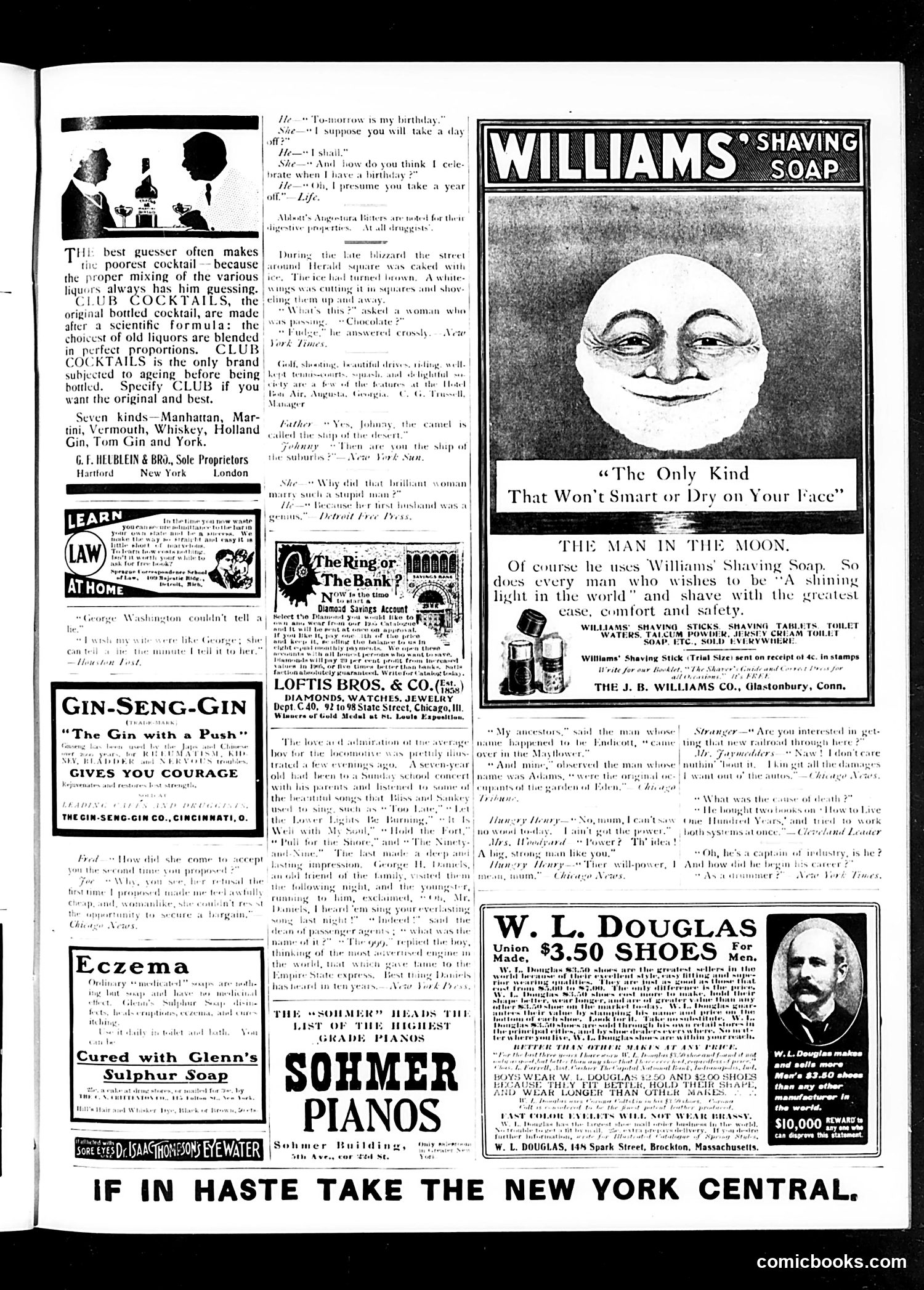
This is primarily an **advertising page** with minimal editorial cartoon content. The dominant feature is the "Man in the Moon" Williams Shaving Soap advertisement, which uses a caricatured face with exaggerated features to humorously suggest that even the lunar inhabitant uses their product—a whimsical advertising claim common to the era. The page contains several unrelated joke snippets and advertisements for products like Club Cocktails, Gin-Seng-Gin tonic, Sohmer Pianos, W.L. Douglas shoes, and eczema remedies. One brief exchange jokes about a woman's brilliance, asking why she married poorly—typical early-20th-century domestic humor. The "New York Central" railroad reference at the bottom is a simple transit advertisement, not political satire. Overall, this reflects Judge's mixed format: **satirical magazine content interspersed with commercial advertising**, rather than focused political or social commentary.
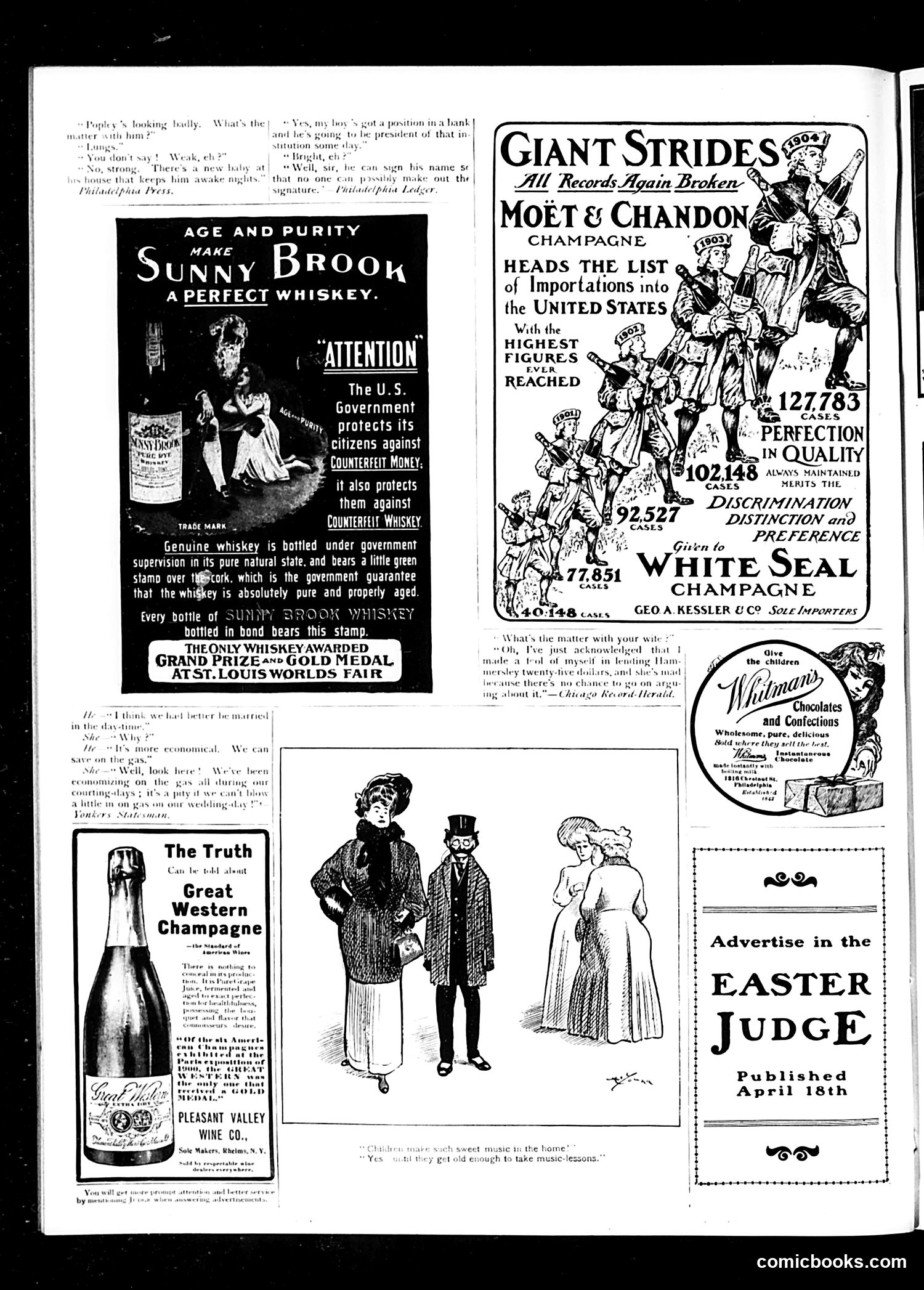
This page is primarily **advertising**, not political satire. It contains multiple liquor and confectionery advertisements from the early 1900s, likely pre-Prohibition. The ads emphasize government regulation as a selling point—Sunny Brook whiskey advertises that the U.S. government protects citizens against "counterfeit whiskey" through official bottling and stamping. Moët & Chandon champagne boasts record importation figures and "highest figures ever reached." These appeals suggest consumers were concerned about product authenticity and quality. The small cartoon (center) appears to show a domestic scene about music lessons, unrelated to the surrounding ads. The page reflects an era when alcohol was openly advertised and government oversight was marketed as a desirable quality assurance measure—a stark contrast to post-Prohibition attitudes.
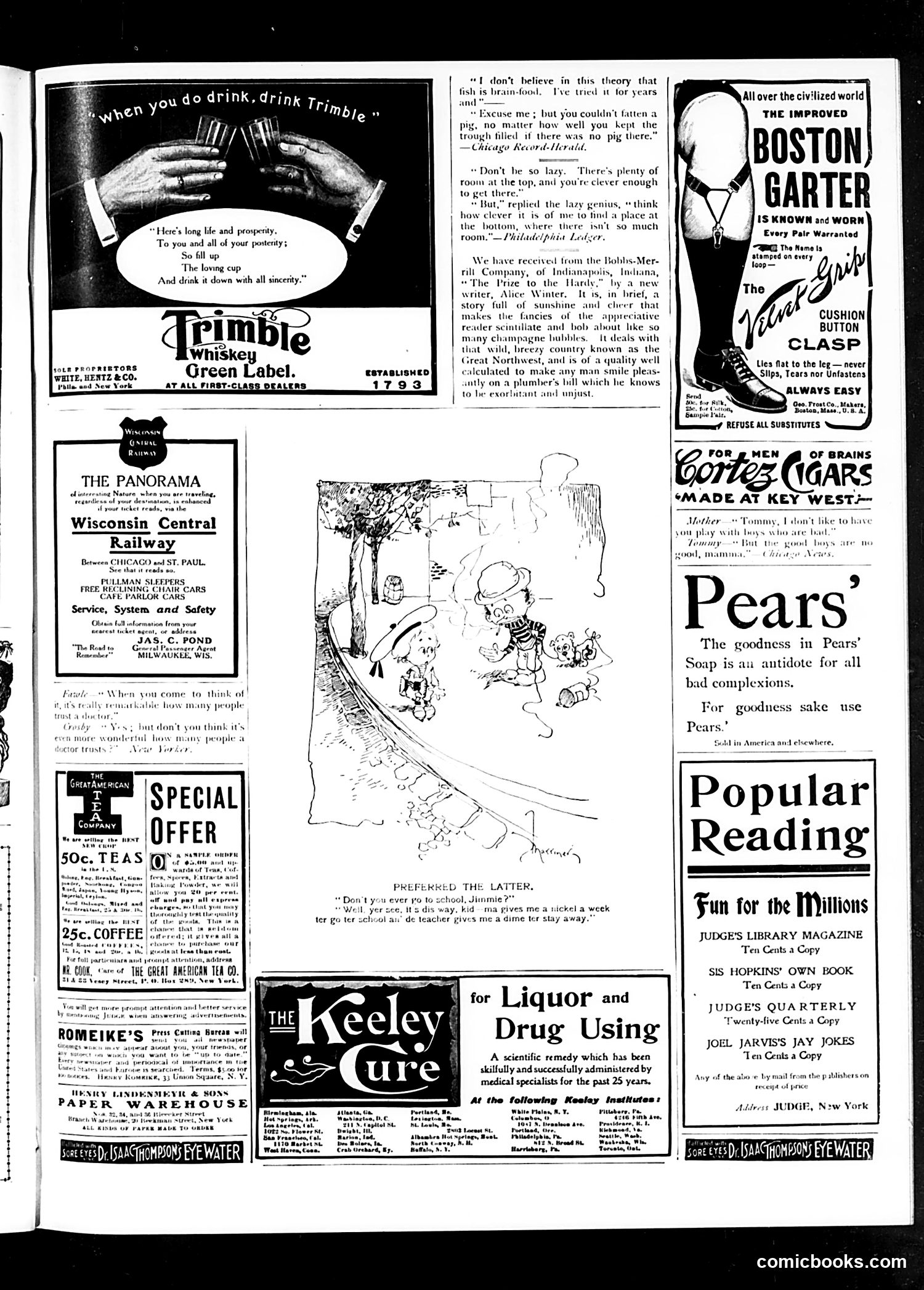
This is primarily an **advertising page** from Judge magazine, with minimal editorial cartoon content. The main satirical element is a small **dialogue-based joke** (center-left) about fish as "brain food": One character claims fish aids intelligence; another counters that you can't fatten a pig without an actual pig present—implying the first speaker lacks the basic intelligence to understand this obvious point. It's a simple ad hominem insult disguised as logic. The page is dominated by **period advertisements**: Trimble Whiskey, Boston Garters, Pears' Soap, Gomez Cigars, The Keeley Cure (an addiction treatment), Wisconsin Central Railway, and various other products and publications. One small cartoon shows children discussing school: a boy admits his mother pays him a nickel to stay home rather than attend—social commentary on parental attitudes toward education, presented as humor. The overall page reflects early-20th-century advertising standards and Judge's format of mixing satirical commentary with commercial content.
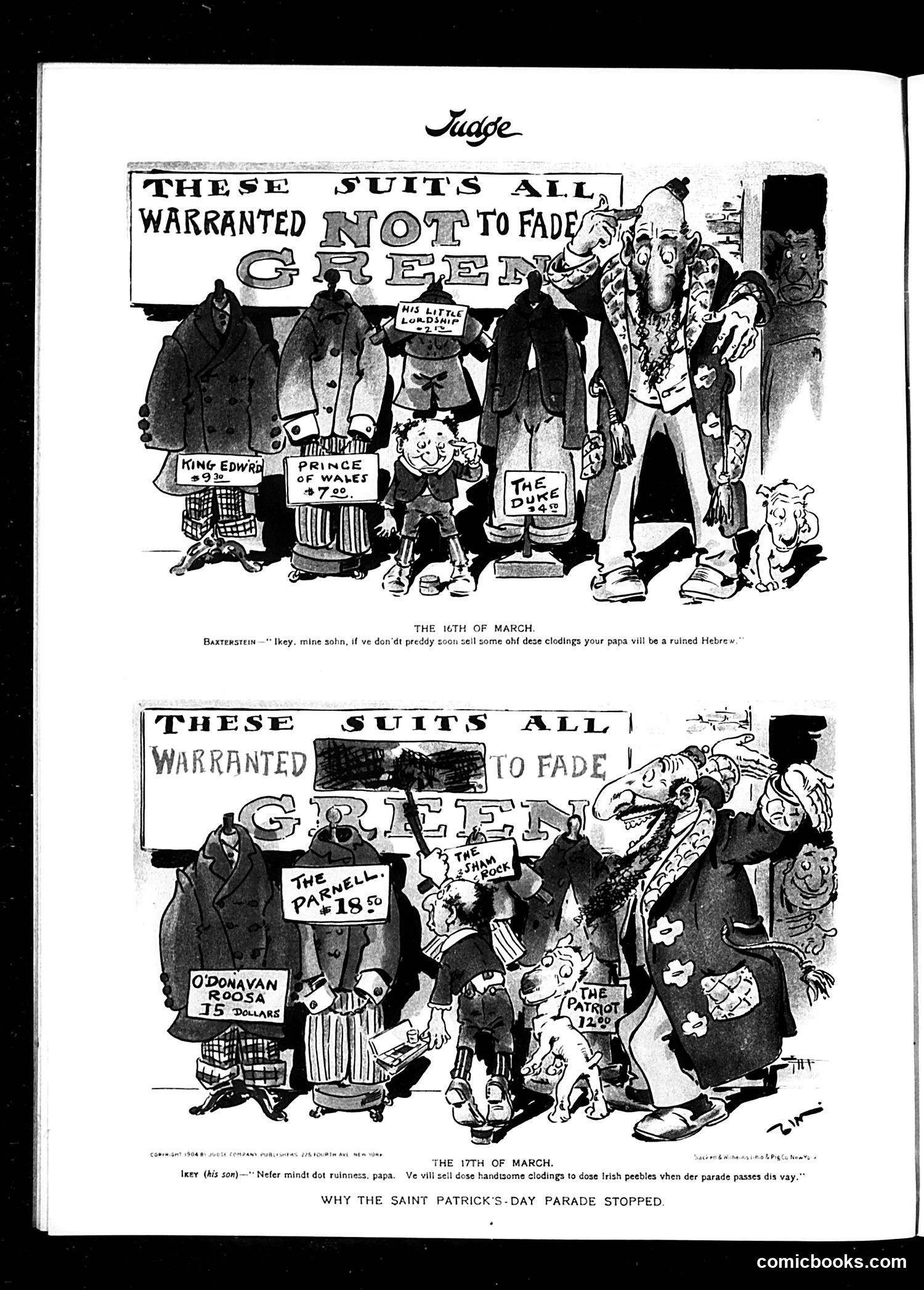
This two-panel Judge cartoon satirizes Jewish and Irish immigrant tensions in early 20th-century America. **The Setup (March 16):** A Jewish clothier named Batterstein (caricatured with Yiddish dialect) worries his clothing inventory won't sell, threatening financial ruin. **The Punchline (March 17):** His son Ikey proposes selling the clothes to Irish people during the St. Patrick's Day parade. The cartoon's title suggests the parade "stopped"—implying the Irish community's reaction to this Jewish merchant's attempt to profit from their celebration. The satire mocks both groups: the Jewish merchant's desperate commercialism and the Irish parade's presumed disapproval or disruption. It reflects contemporary prejudices and the competitive economic anxieties between immigrant communities in American cities, presenting their cultural celebration as an opportunity for cross-ethnic exploitation and conflict.