
A complete issue · 16 pages · 1905
Judge — January 21, 1905
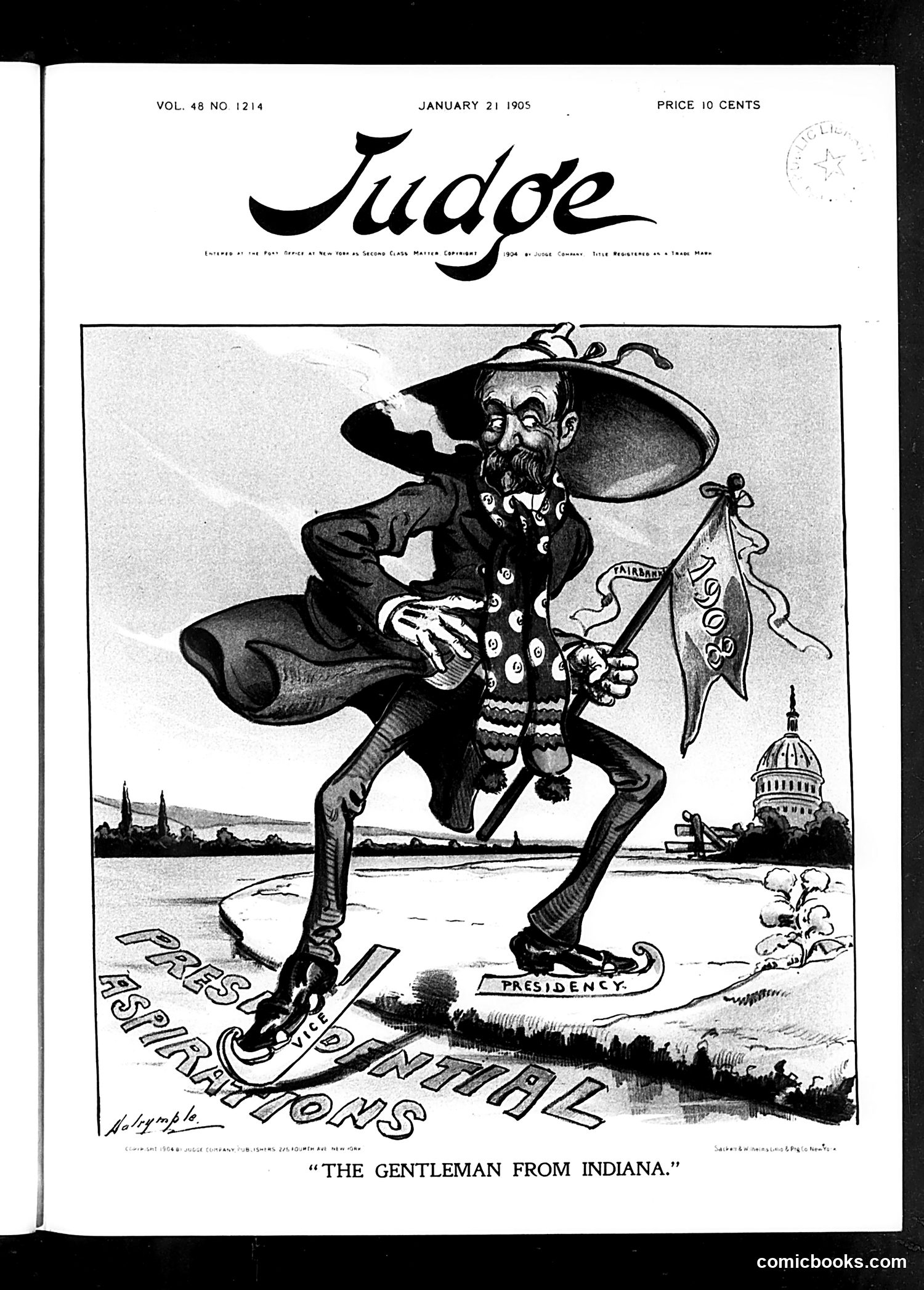
This political cartoon depicts a figure labeled "The Gentleman from Indiana," shown as a caricatured man in formal dress juggling peas labeled "PATRONAGE" while straddling the Potomac River. The Capitol building appears in the background on the right. The cartoon satirizes political patronage—the practice of distributing government jobs and favors to supporters. The juggling imagery suggests the difficulty of managing these appointments. The figure's awkward position between two shores may reference tensions between competing interests or the precarious nature of balancing political obligations. The "Indiana" reference likely connects to a specific political figure or controversy of 1905, though the specific individual remains unclear from the image alone. The satire critiques the corrupt practice of using public positions as political rewards.
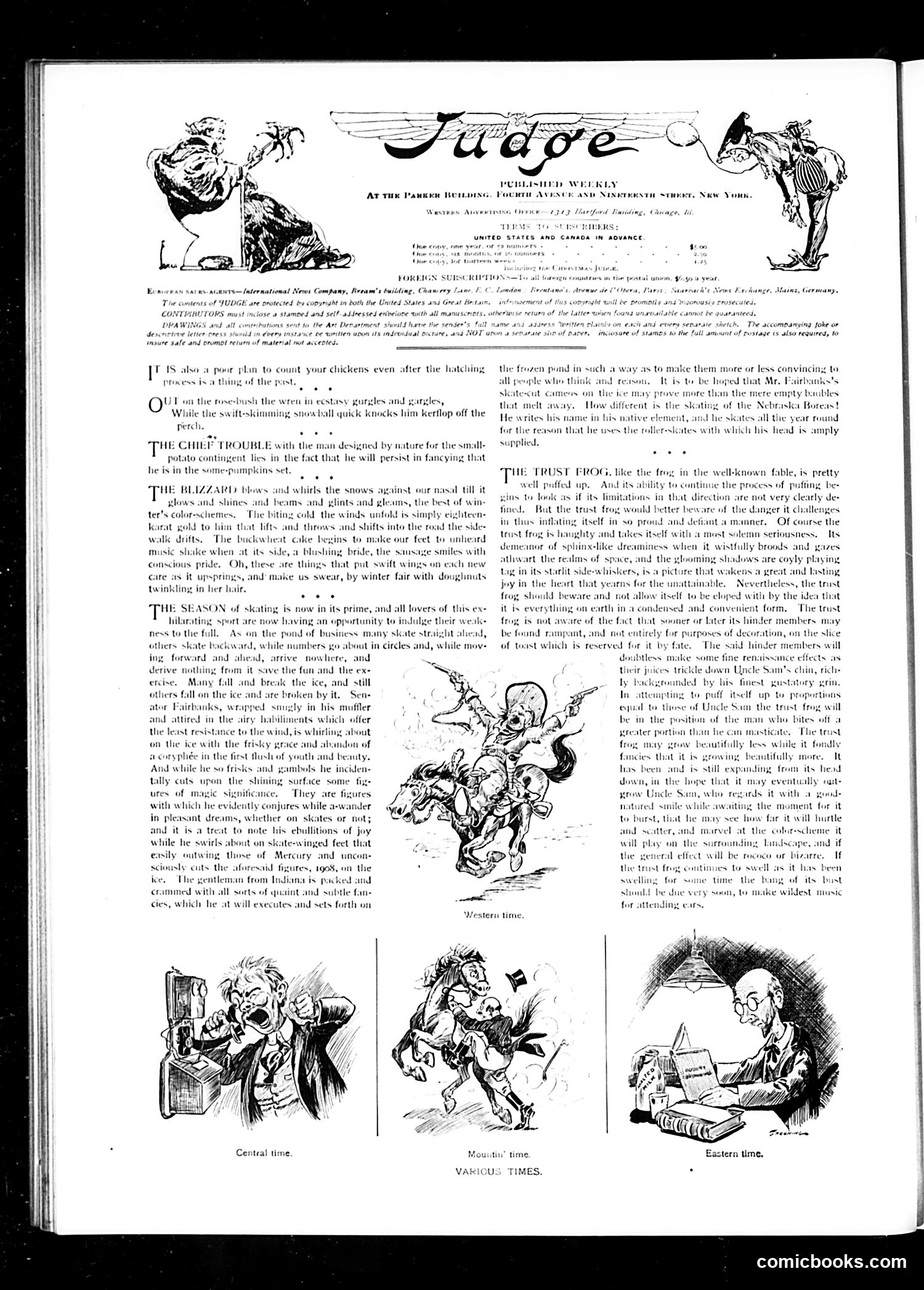
This page contains humorous essays and illustrations about animals with anthropomorphic qualities. The main text discusses various creatures—chickens, blizzards, trust frogs, and other animals—using them as vehicles for social commentary. The illustrated section titled "VARIOUS TIMES" shows three cartoon panels depicting how the same character responds differently across time zones (Central, Mountain, and Eastern time). This appears to be satirizing the practical confusion and behavioral changes caused by America's adoption of standardized time zones, a relatively recent development in the late 19th century. The illustrations throughout use exaggerated, grotesque character designs typical of Judge's satirical style. The overall piece seems to mock contemporary concerns about modern technology and social systems through animal metaphors and absurdist humor rather than direct political commentary.
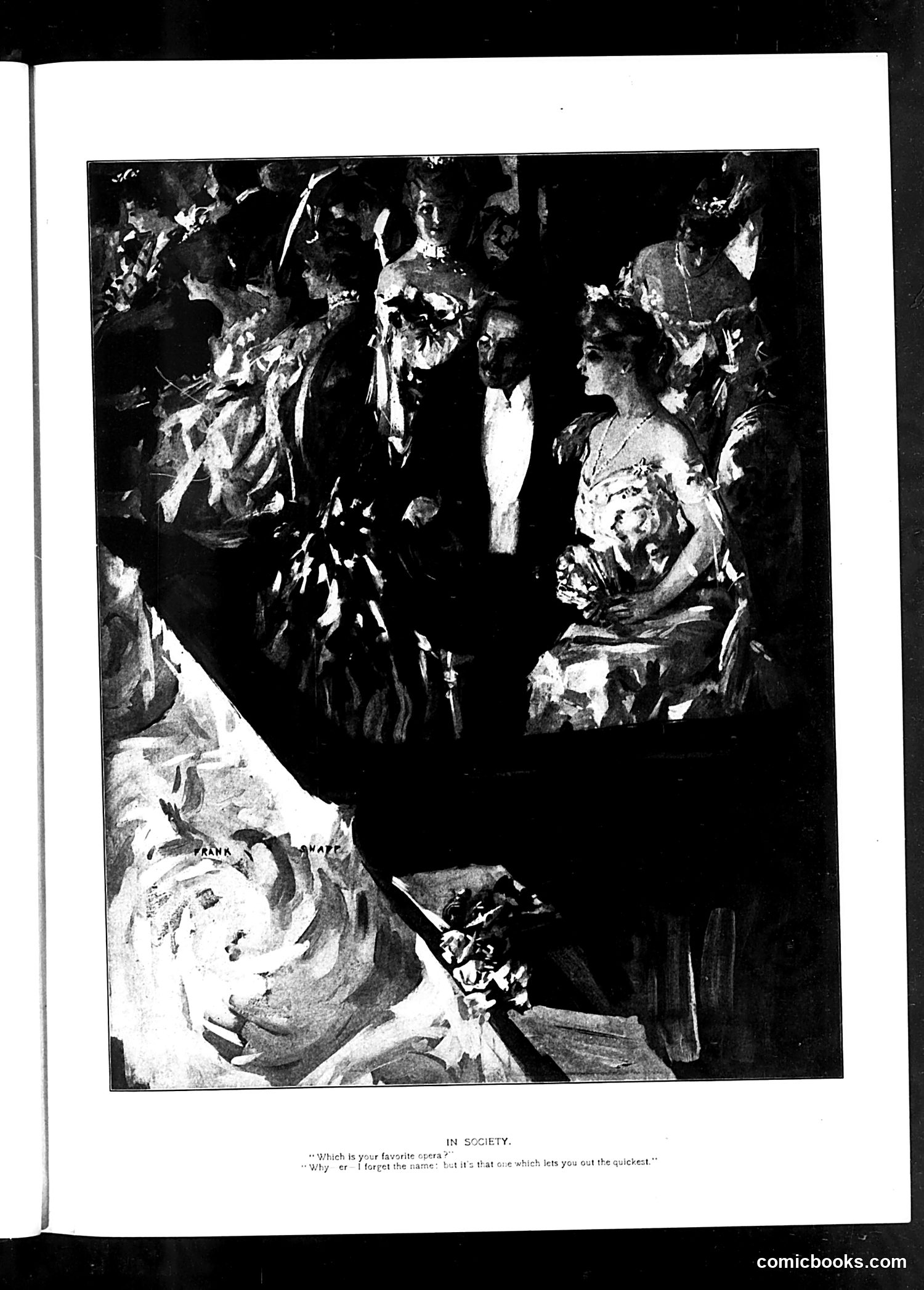
This cartoon satirizes upper-class social pretension. The caption reads: "Which is your favorite opera?" / "Why er I forget the name; but it's that one which lets you out the quickest." The joke mocks wealthy socialites who attend opera for fashionable appearance rather than genuine cultural appreciation. The respondent admits they don't actually remember which opera they supposedly enjoy—they simply choose whichever performance ends soonest, allowing them to return to social activities. The elegantly dressed figures and ornate setting emphasize the artificial nature of high society. The satire targets the disconnect between cultural sophistication's appearance and the actual indifference or ignorance of those claiming refined taste. This reflects *Judge* magazine's frequent criticism of American nouveaux riches pretending to European cultural superiority.
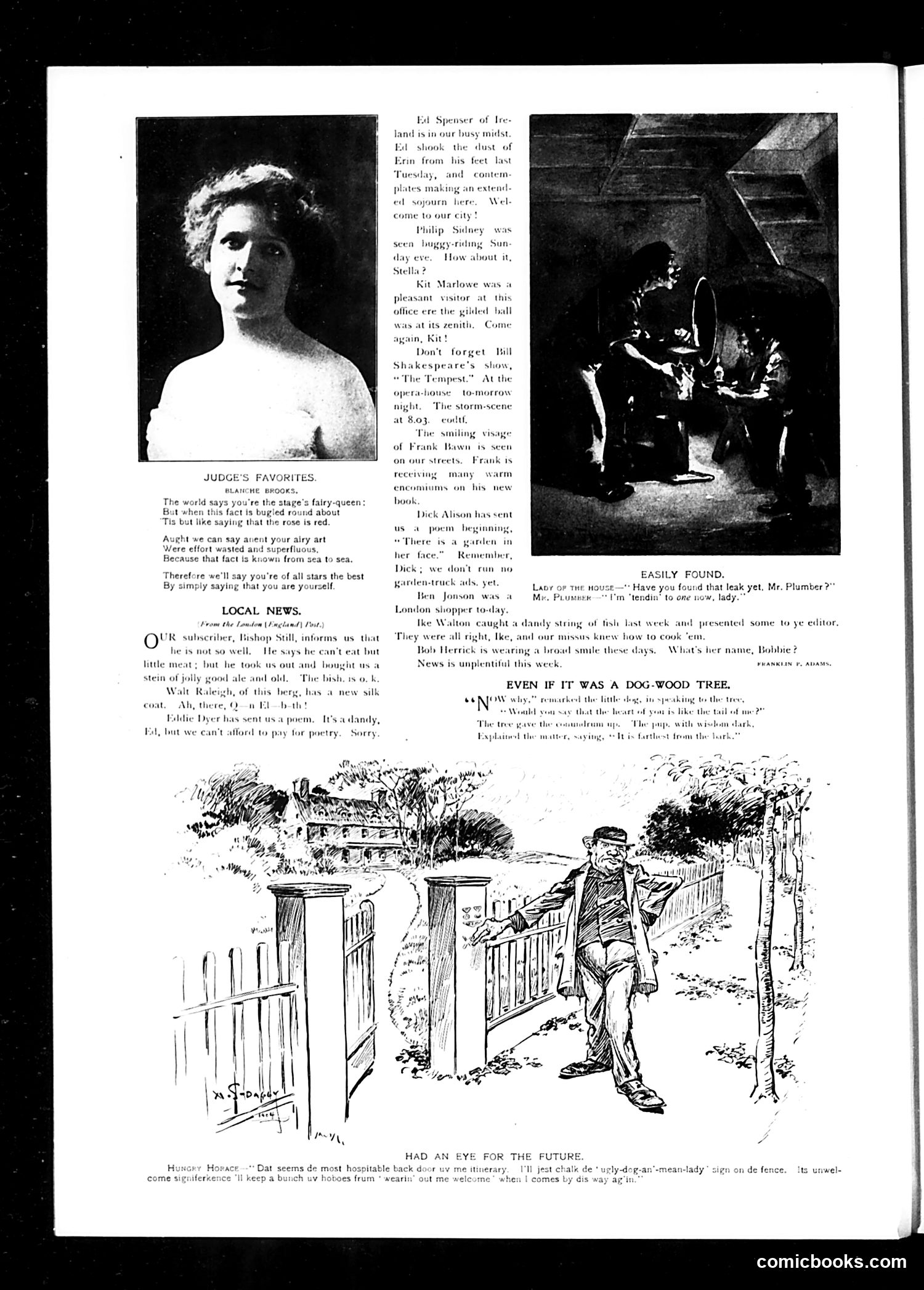
This page contains social commentary and humor typical of early 20th-century Judge magazine. The upper section includes "Judge's Favorites" featuring a portrait and brief social observations about local figures—references to people like Philip Sidney, Kit Marlowe, and Frank Bacon suggest these are pseudonyms or inside jokes for recognizable contemporaries. The main cartoon, "Even If It Was a Dog-Wood Tree," depicts a man at a fence gate. The humor appears to center on a misunderstanding or double meaning involving "dog-wood"—likely a play on words involving both the plant and dogs. The rural setting and the man's bemused expression suggest the joke plays on miscommunication between characters of different social backgrounds or knowledge levels, a common Judge satire trope. The exact historical reference remains unclear without additional context.
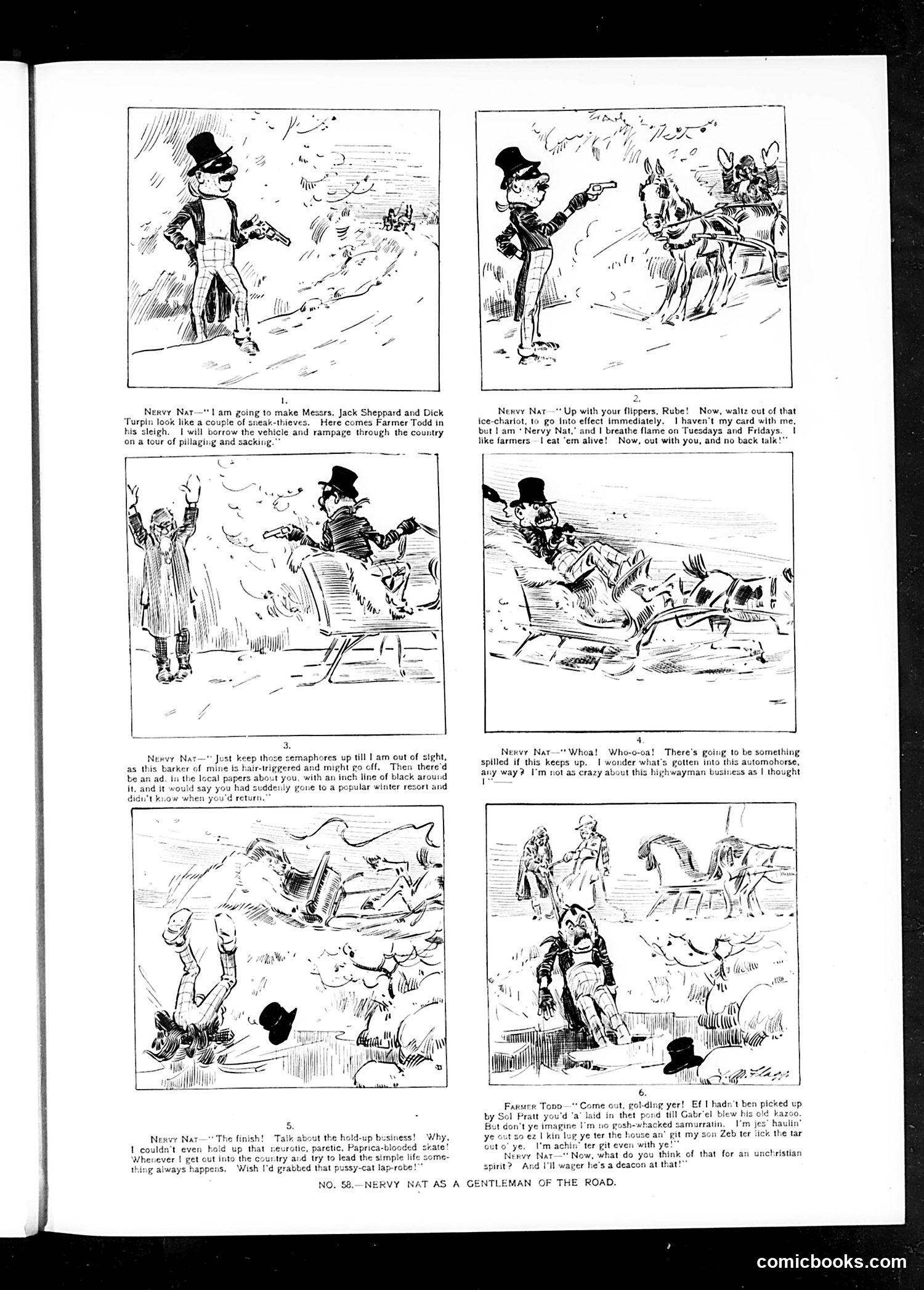
This six-panel comic follows "Nervy Nat," a character who announces plans to become a highway robber, comparing himself to famous historical outlaws Jack Sheppard and Dick Turpin. He steals Farmer Todd's sleigh to begin his criminal rampage. The satire lies in Nervy Nat's grandiose incompetence: his robbery attempts repeatedly backfire. He's thrown from the sleigh, crashes the vehicle, and creates chaos—all while maintaining his theatrical self-aggrandizement about being a fearsome bandit. The humor targets blowhards and con artists who fancy themselves dangerous criminals but are merely destructive nuisances. His claim to "breathe flame" and the farmer's final comment about Nat being "a deacon"—suggesting moral hypocrisy—reinforce the mockery of his pretensions. It's a slapstick takedown of false bravado and wannabe criminality.
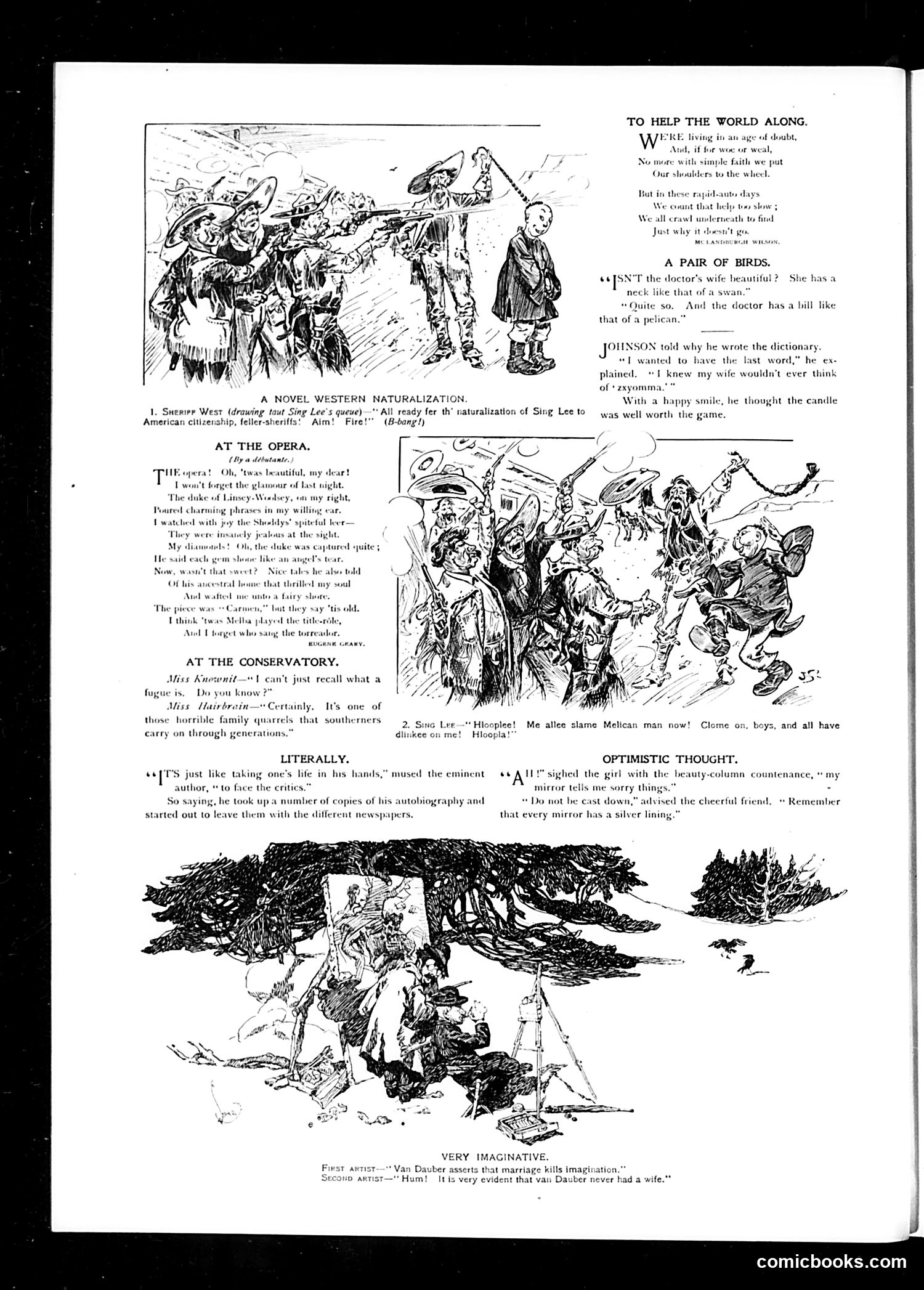
This page satirizes various American social pretensions and absurdities circa early 1900s. The top cartoon mocks "Americanization" of Chinese immigrants. Sheriff "West" naturalizes a Chinese man (Sing Lee) by literally shooting off his queue (traditional braid), suggesting forced assimilation through violent means—critiquing both xenophobia and the crude methods of "Americanization." Other segments mock the wealthy and educated: an opera-goer obsessed with aristocratic genealogy; a conservatory student who confuses a musical "fugue" with family feuds (Southern feuds specifically—a regional stereotype); an author cynically distributing his autobiography to newspapers to manipulate reviews. The humor targets vanity, class pretension, and shallow social climbing among the upper classes. The final "Optimistic Thought" jokes about women consulting mirrors and beauty columns—mocking superficiality. Throughout, Judge employs ethnic caricature, class satire, and gender stereotyping typical of early Gilded Age American humor.
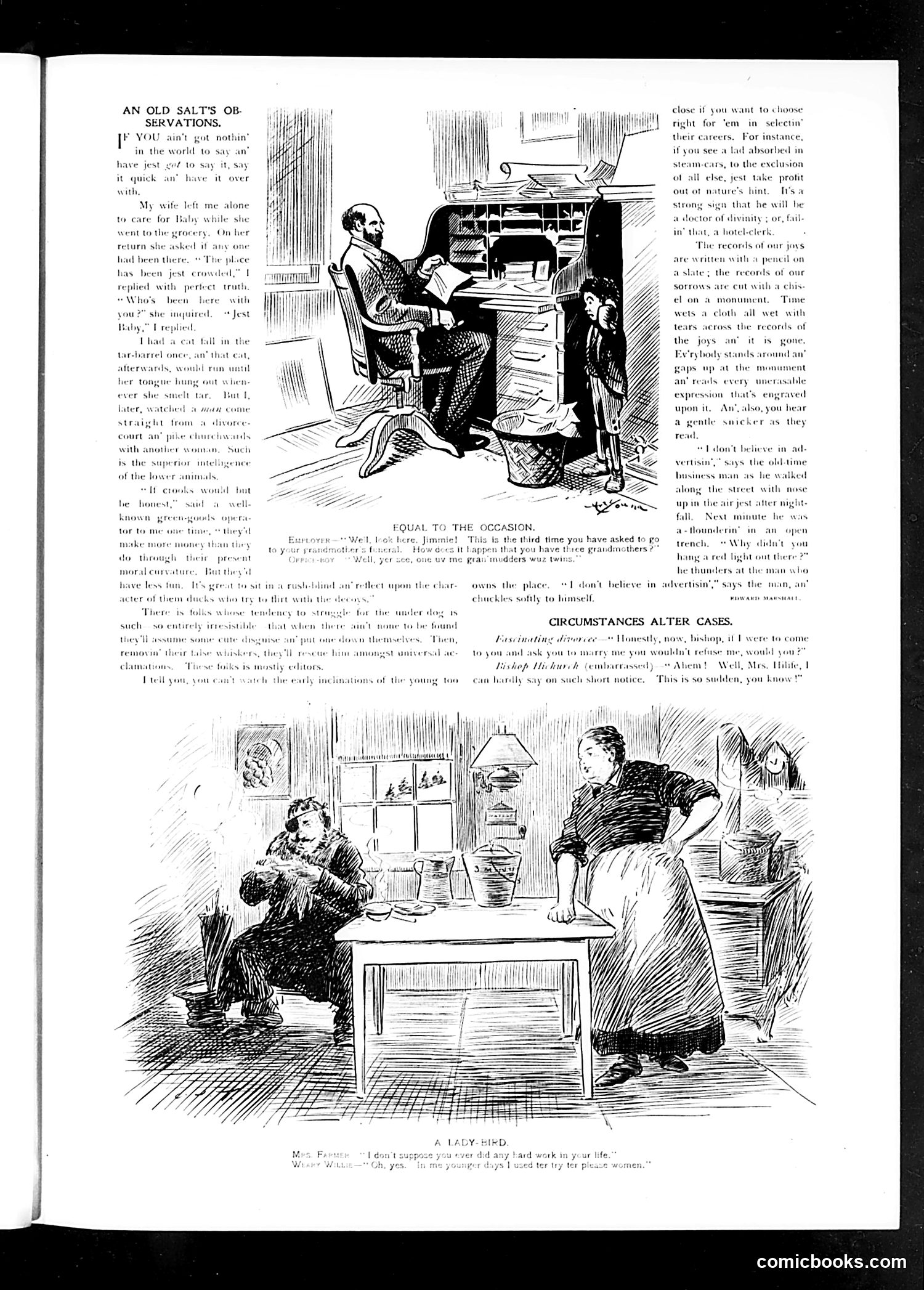
This Judge page contains two separate satirical pieces from the late 19th/early 20th century. **Top section** presents folksy observations from an old sailor character. His anecdotes mock sentimental Victorian sentimentality—he jokes about a cat in tar-barrel ruining its moral character, then philosophizes about how joy and sorrow are recorded differently (joy in pencil, sorrow carved in stone). The humor lies in applying grand moral lessons to trivial domestic situations and the absurdity of a sailor dispensing pseudo-profound wisdom. **Bottom section ("A Lady-Find")** satirizes remarriage and social hypocrisy. A woman asks a bishop if he'd marry her a second time, implying scandal or unsuitability. His shocked refusal to commit "on such short notice" mocks how clergy bend principles based on circumstances—he'd likely marry her eventually despite moral disapproval, contradicting his religious authority. Both pieces target Victorian pretension and the gap between public morality and private behavior.
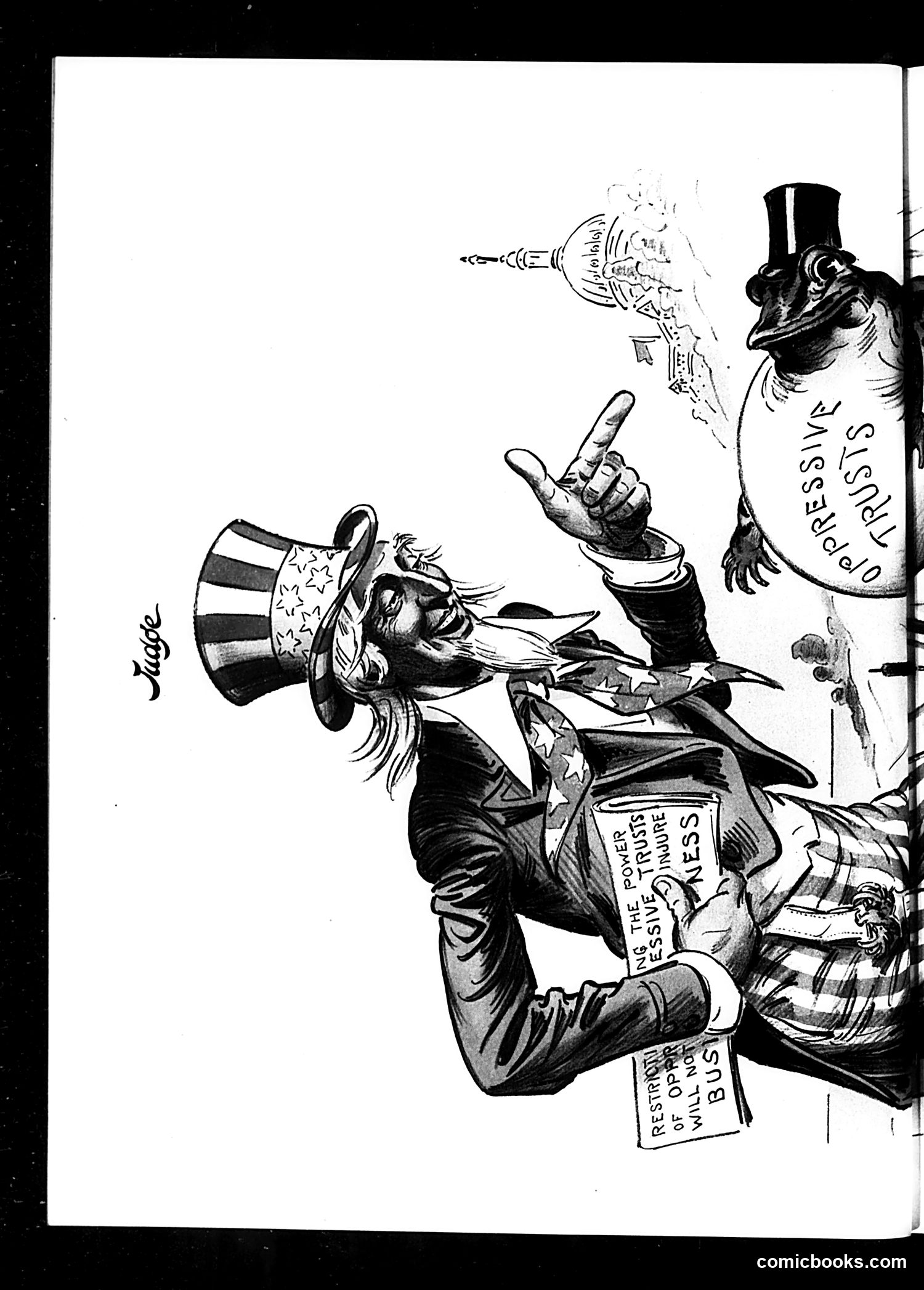
This Judge magazine cartoon depicts two figures in a satirical confrontation. On the left, a character wearing an Uncle Sam top hat appears to be a personification of American authority or power. On the right stands another caricatured figure labeled "Despotism" or similar (text partially unclear in OCR). The cartoon satirizes the tension between American democratic ideals and authoritarian forces. Labels visible reference "trusts," "power," and "business" concerns, suggesting commentary on monopolistic corporate practices or foreign despotism threatening American interests. The cartoonist (signed "Udo") depicts Uncle Sam in a confrontational pose, implying criticism of either American complicity with despotic regimes or concerns about concentrated corporate power undermining democratic values—common Judge magazine themes from the Progressive Era. Without a clear date, specific historical context remains uncertain.
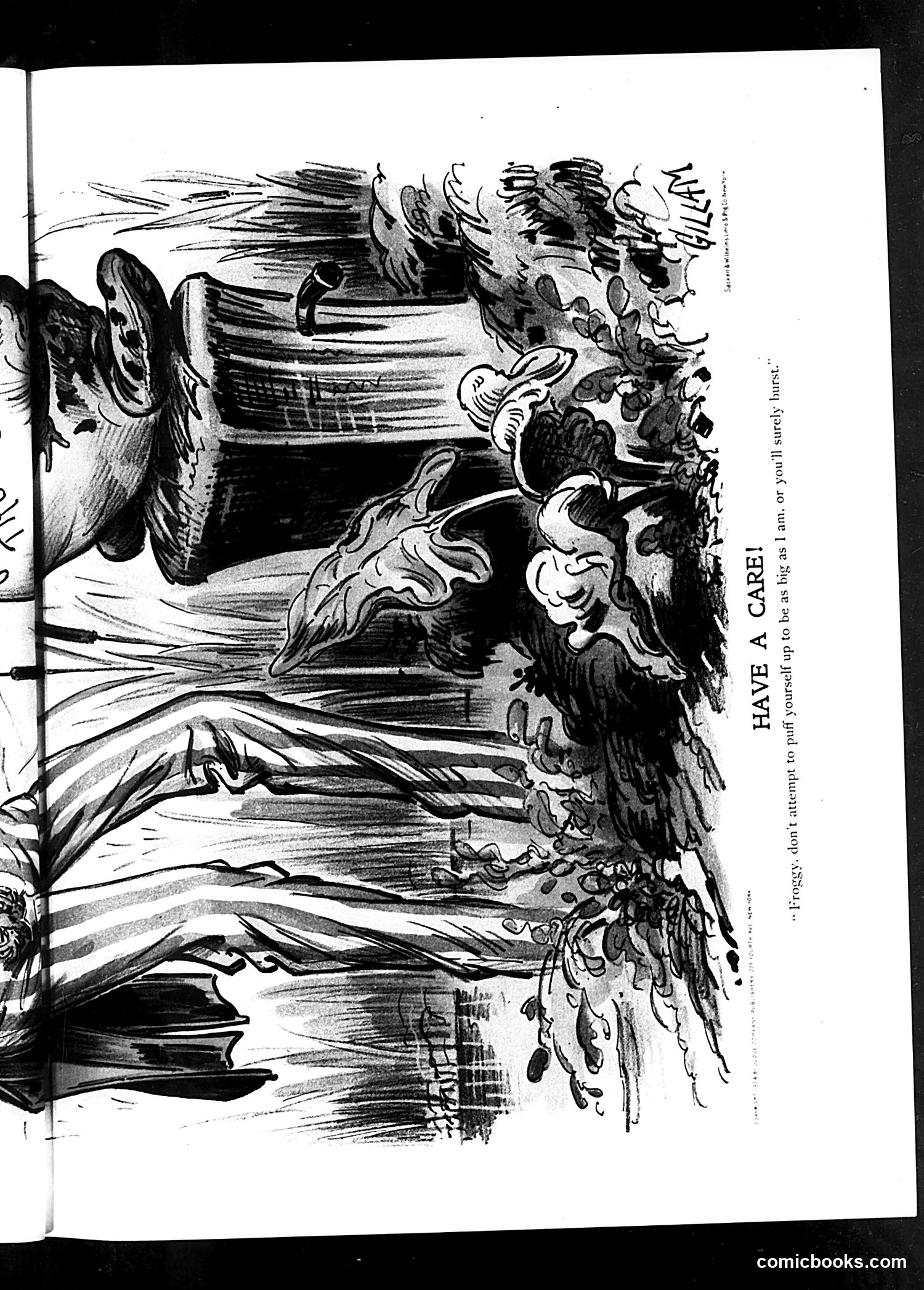
This political cartoon depicts frogs in formal attire (wearing top hats and elaborate clothing) appearing agitated or in distress. The title "HAVE A CARE!" suggests a warning or cautionary message. The frogs likely represent French people or French politicians—frogs being a stereotypical national symbol. The formal dress and animated gestures suggest these are dignified figures in a state of alarm over some political matter. Without a clear date or additional context visible on this page, the specific political crisis being referenced remains unclear. However, the cartoon's tone warns someone (likely American readers of *Judge* magazine) to be careful regarding French affairs, possibly relating to diplomatic tensions, financial issues, or international conflict during the late 19th or early 20th century. The OCR text is largely illegible, preventing precise identification of the specific historical event satirized.
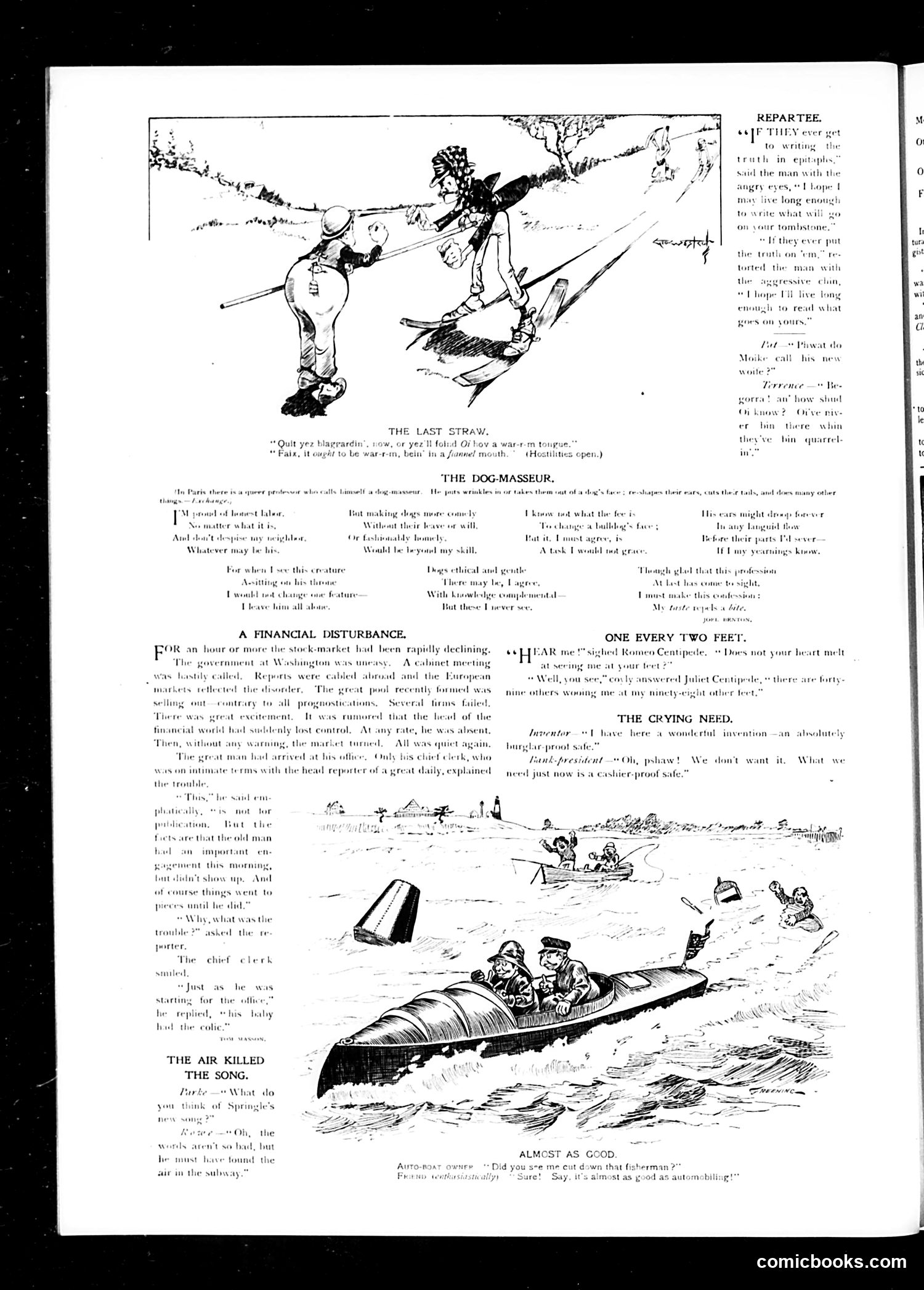
This page contains multiple satirical sketches typical of early 20th-century American humor: **"The Last Straw"** depicts two working-class men (likely Irish immigrants, suggested by dialect) quarreling about writing truthful epitaphs—social satire on hypocrisy and self-deception. **"The Dog-Masseur"** mocks a Parisian profession of cosmetically "improving" dogs' appearances, satirizing vanity and the absurd lengths wealthy people go to for aesthetic enhancement. **"A Financial Disturbance"** satirizes stock market volatility and the panic it causes among government officials—the joke being that a single missing clerk causes chaos, mocking institutional fragility. **"The Crying Need"** presents an inventor pitching a "burglar-proof safe" when what's actually needed is a "cashier-proof safe"—commentary on embezzlement and employee theft as bigger threats than robbery. **"The Air Killed the Song"** jokes that subway air is so foul it silences a singer—urban infrastructure criticism disguised as humor. The page exemplifies Judge's approach: social commentary through exaggeration and wordplay targeting contemporary American urban life, workplace absurdities, and class dynamics.
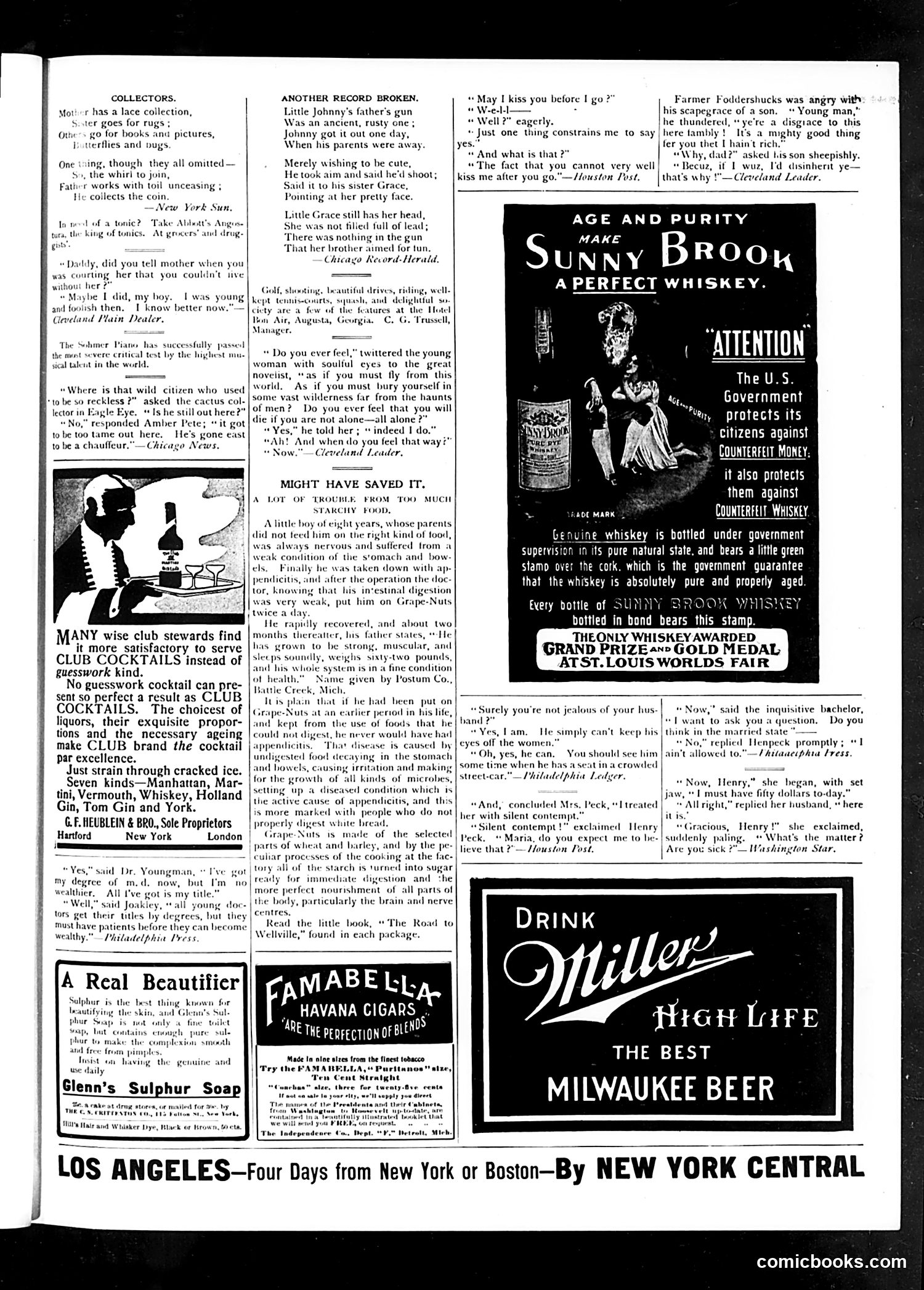
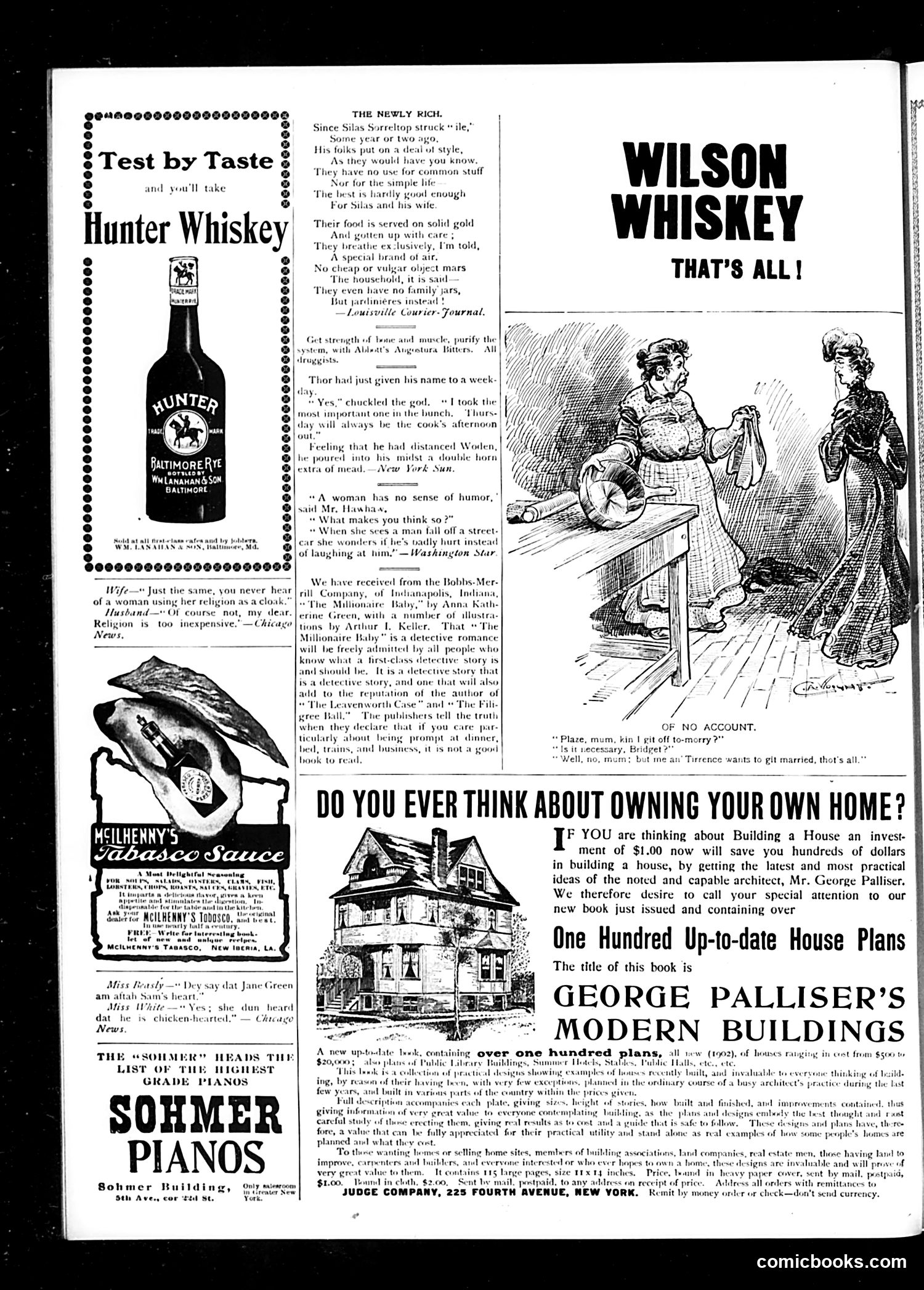
This page contains mostly **advertisements** interspersed with brief satirical content typical of Judge magazine's format. ## Main Cartoon: The illustrated sketch titled "OF NO ACCOUNT" depicts a domestic servant (Bridget) asking her employer about time off. The employer dismissively responds that servant Terrence wants to marry—implying his personal desires are irrelevant to household operations. This satirizes the era's class attitudes treating servants' lives as subordinate to employers' needs. ## Satirical Poems/Jokes: "THE NEWLY RICH" mocks nouveaux riche pretension—the Sorreltop family, having recently struck wealth ("ile"), ostentatiously displays luxury (gold serving dishes, "special brand of air") while abandoning simplicity. This reflects Gilded Age anxieties about new money's vulgar display. ## Advertisements: The page heavily advertises Hunter Whiskey, Sohmer Pianos, and George Palliser's house-plan book—typical period consumer products marketed to aspirational middle-class readers.
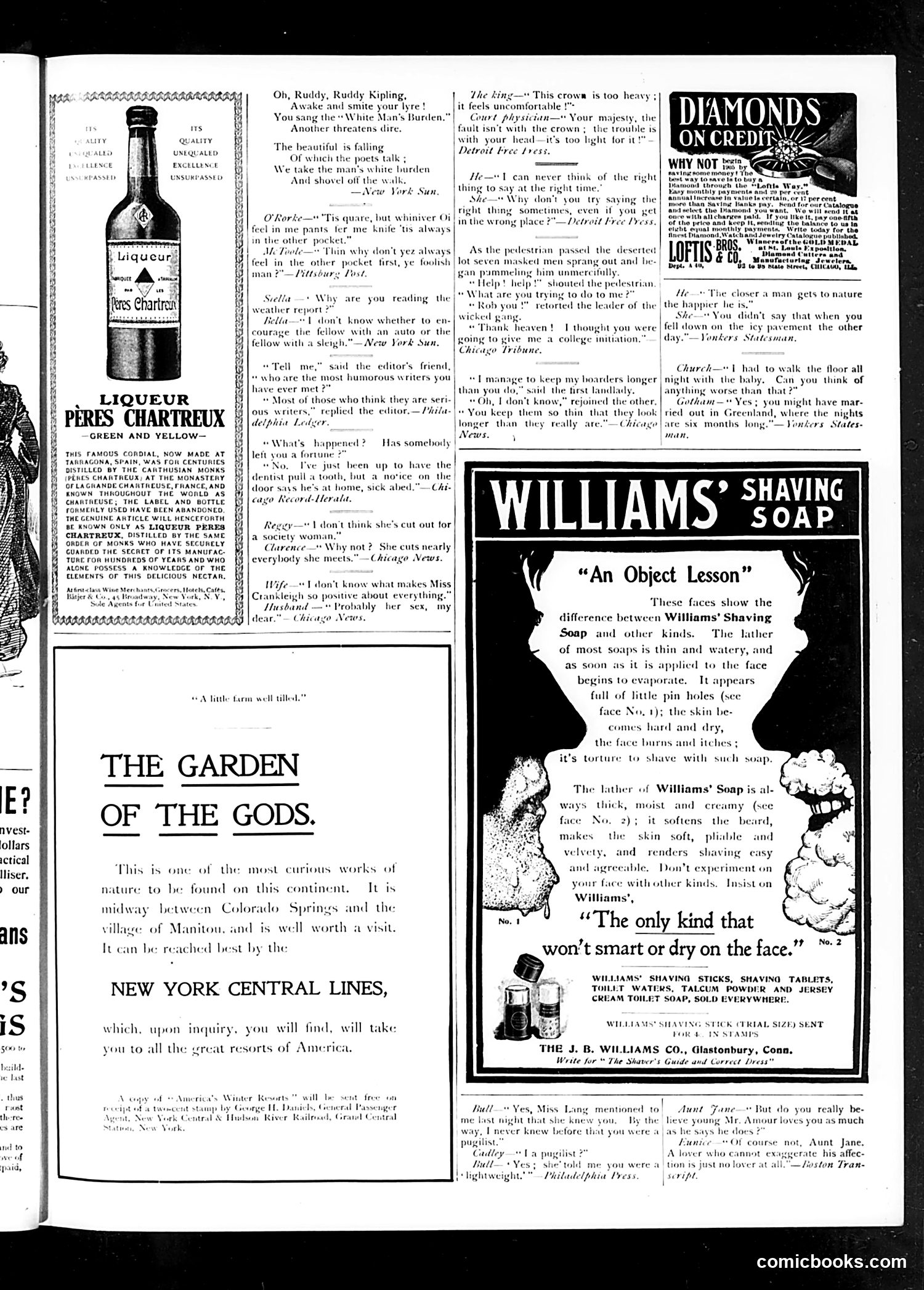
This page combines humor pieces with advertisements, primarily satirizing social conventions and human nature circa early 1900s. **The "White Man's Burden" parody** (top left) mocks Rudyard Kipling's famous imperialist poem, suggesting Americans merely steal credit for the burdens they claim to shoulder—they "shovel off the walk" rather than bear genuine responsibility. **Other humor items** include Irish dialect jokes (O'Rorke), domestic squabbles about courtship choices, editorial banter about humorists, and relationship quips. These reflect period stereotypes and class attitudes. **The advertisements** for Liqueur Peres Chartreux (a cordial) and Williams' Shaving Soap dominate the right side, with the latter featuring an "object lesson" about soap quality—demonstrating why superior lather prevents skin irritation. **The "Garden of the Gods" article** promotes Colorado tourism via New York Central Lines. The page represents typical Judge content: light satire of everyday life mixed with consumer marketing, reflecting early-20th-century American humor sensibilities and advertising practices.
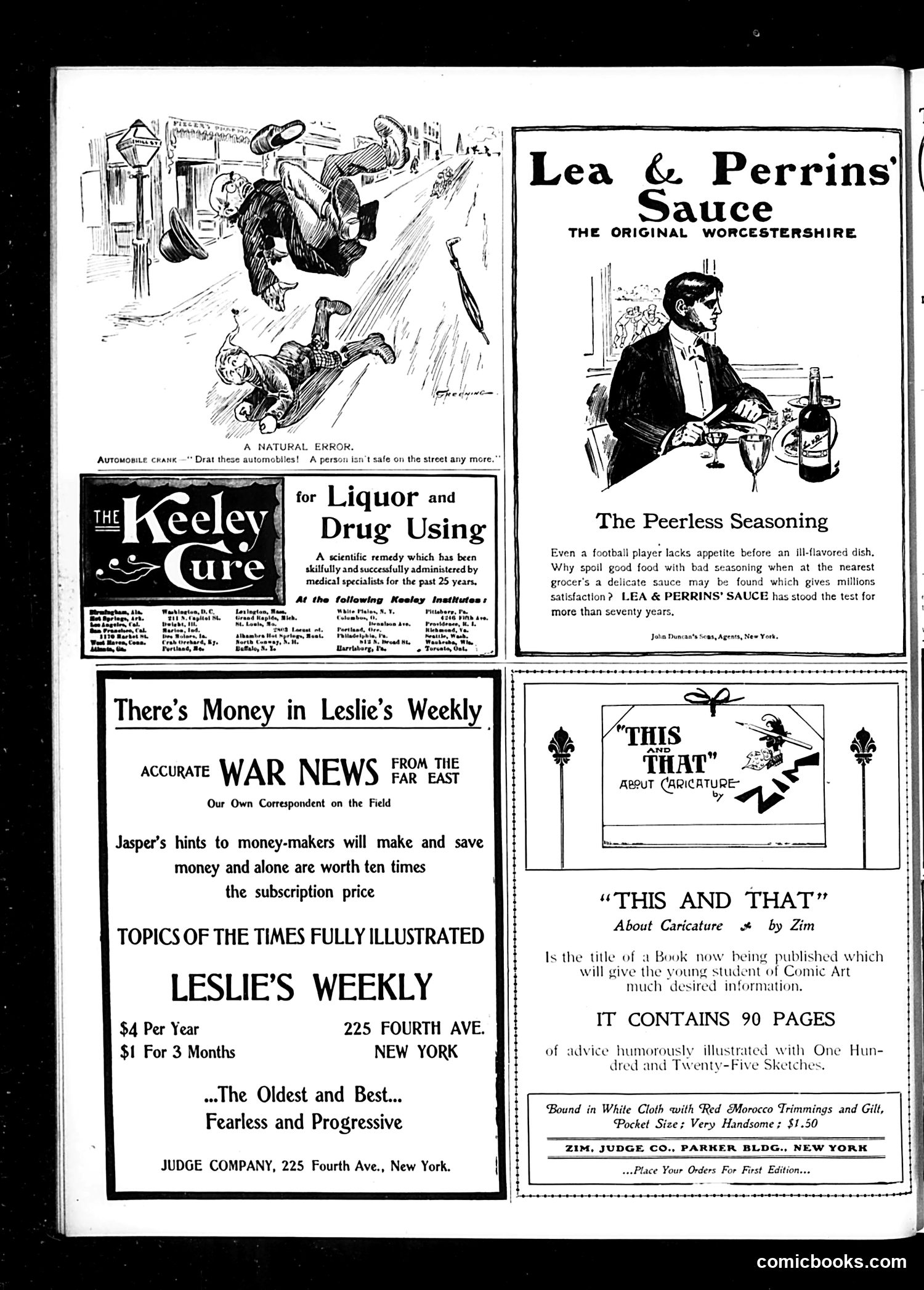
The main cartoon depicts a pedestrian being struck by an automobile, with the caption suggesting the person blames cars for being unsafe on streets. The satire is straightforward: the victim ironically complains about automobile danger while apparently being hit by one—the "natural error" being the absurd logic of blaming the vehicles rather than acknowledging one's own carelessness or the genuine hazard they pose. This reflects early 20th-century anxieties about automobiles as novel, dangerous urban intrusions. The joke mocks those who denounce the technology while remaining oblivious to actual risks. It's social commentary on how people adapt (or fail to adapt) to modernization and changing street safety. The page is primarily advertisements for period products: Lea & Perrins sauce, Keeley Institute addiction treatment, Leslie's Weekly magazine, and a cartooning instruction book.
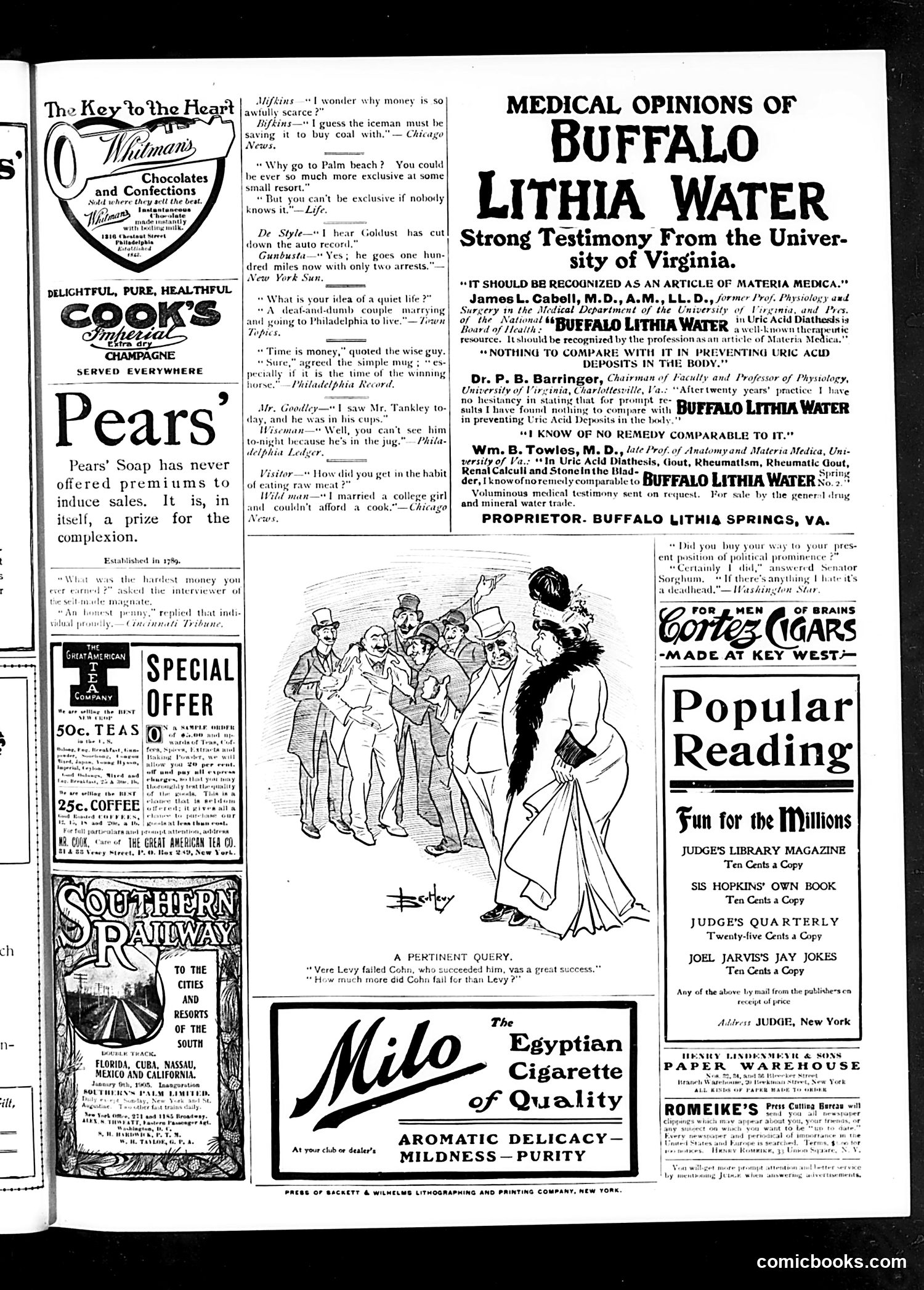
This page is primarily **advertising and filler content** rather than political satire. The main cartoon—titled "A Pertinent Query"—appears to be a crude ethnic joke about Jewish businessmen named Levy and Cohn, playing on stereotypes about Jewish merchants and financial failure. The humor relies on antisemitic tropes common to early 20th-century American publications. The bulk of the page comprises advertisements (Whitman's Chocolates, Pears' Soap, Cook's tea) and testimonials for "Buffalo Lithia Water," promoted as medical treatment for gout and uric acid conditions, featuring endorsements from University of Virginia doctors. Brief comic snippets scattered throughout offer mild social humor about wealth, marriage, and urban life—typical period comedy with no clear political significance. The page reflects early-1900s Judge magazine: mixing light humor with aggressive marketing and period-typical ethnic stereotyping.
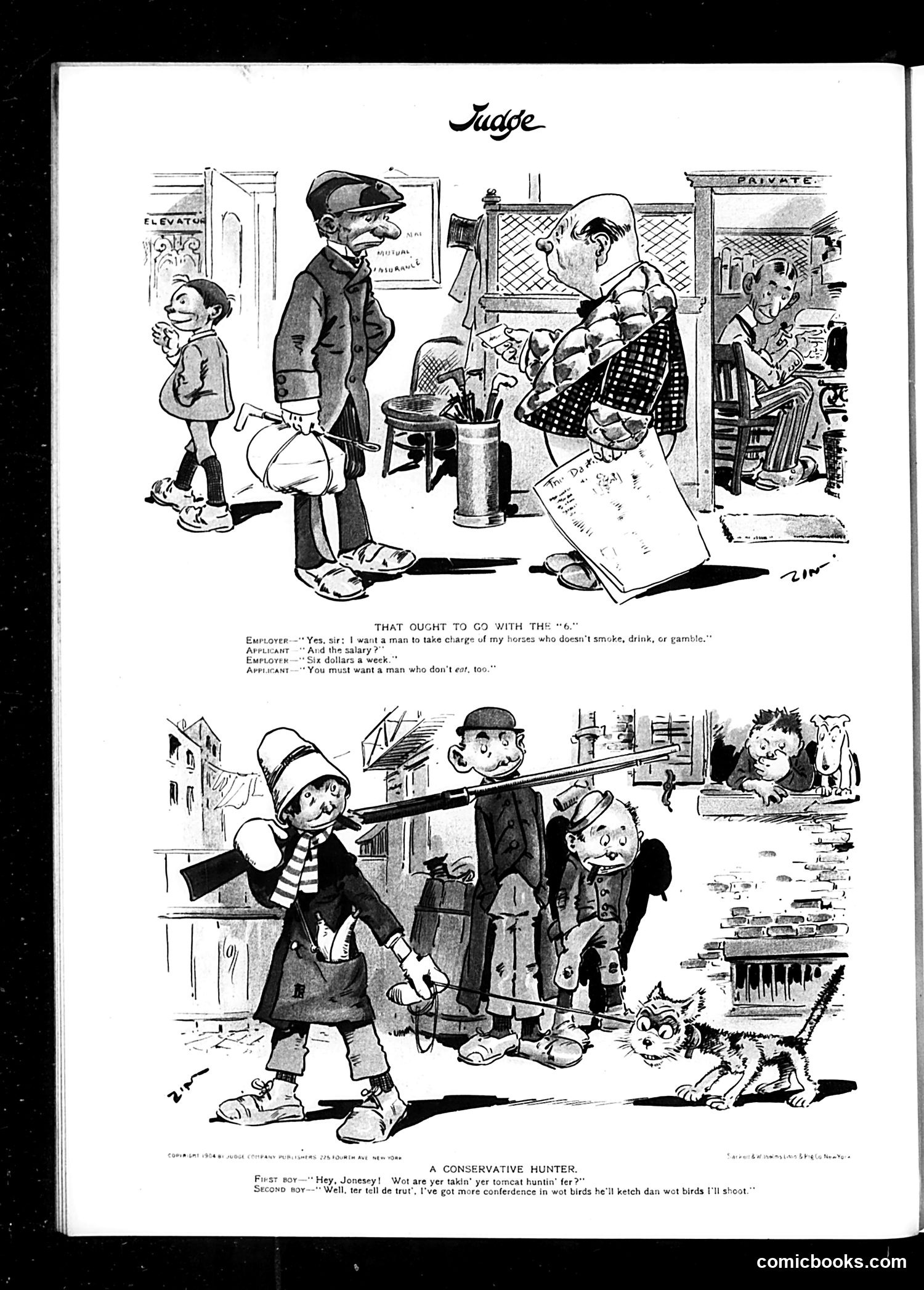
This page contains two satirical cartoons critiquing social class and labor conditions. **Top cartoon**: An employer interviews an applicant, demanding a man who doesn't smoke, drink, or gamble—for six dollars weekly. The applicant sarcastically notes he'd need to avoid eating too. The satire targets exploitative employers offering poverty wages while demanding moral perfection from working-class employees. **Bottom cartoon** ("A Conservative Hunter"): A boy with a gun aims at birds while an adult warns him to show "confidence in wet birds he'll ketch." The humor appears to reference hunting ethics or conservation—the "conservative" title suggesting criticism of those claiming environmental concern while wastefully hunting. Both cartoons use exaggerated character drawings typical of early-20th-century Judge illustrations to mock social hypocrisy and labor exploitation.