
A complete issue · 16 pages · 1904
Judge — November 26, 1904
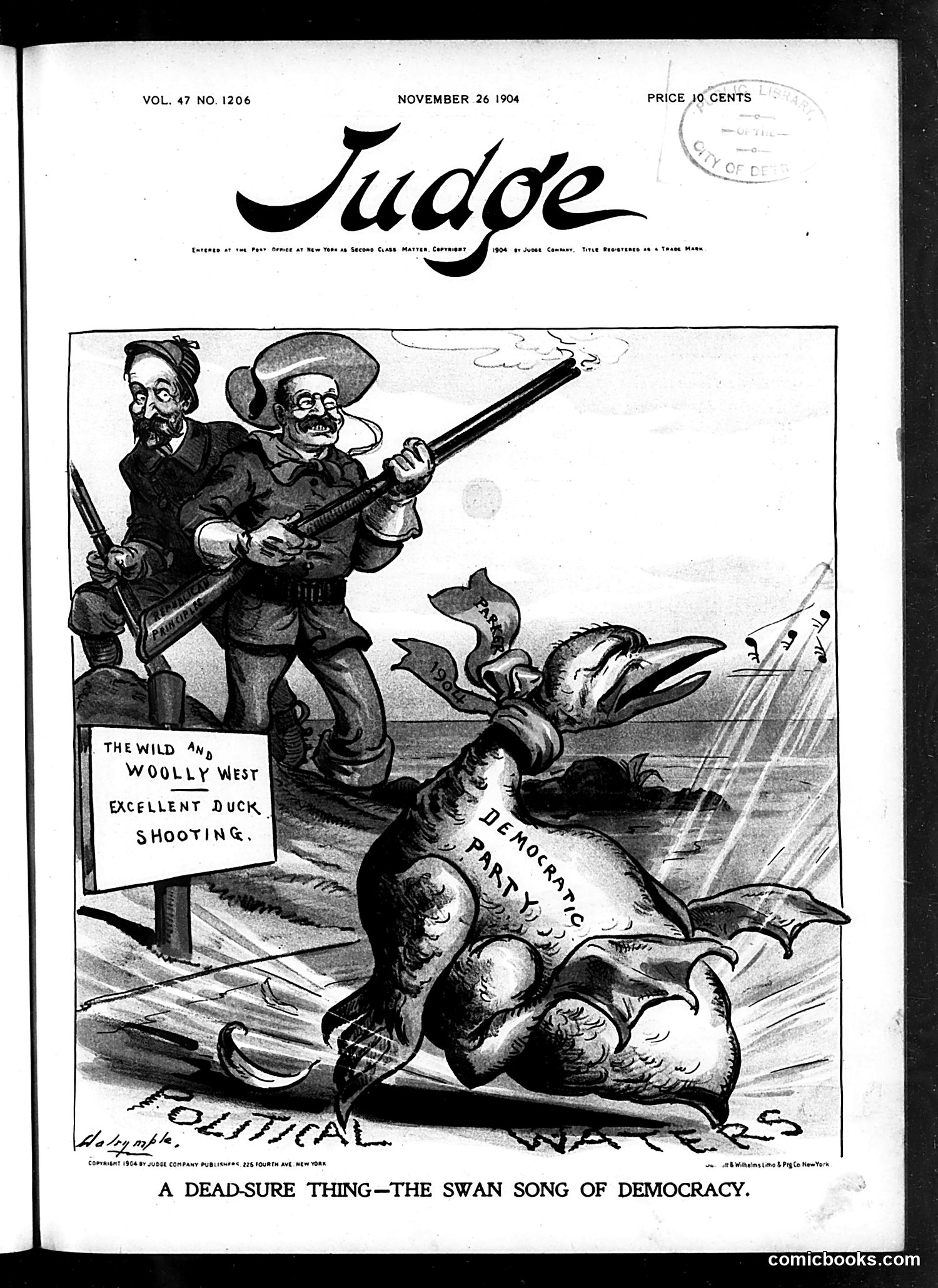
This cartoon satirizes the Democratic Party's predicted defeat in the 1904 presidential election. The sign reads "The Wild and Woolly West—Excellent Duck Shooting," depicting Democratic Party figures as dead ducks being hunted by Republican gunmen in cowboy attire. The caption "A Dead-Sure Thing—The Swan Song of Democracy" suggests the cartoonist viewed Democratic prospects as hopeless. The "swan song" reference implies this represents the party's final performance before electoral collapse. The imagery conflates the American frontier ("Wild and Woolly West") with political slaughter, presenting Republican victory as inevitable and the Democratic Party as helpless prey. This reflects Republican confidence heading into Theodore Roosevelt's 1904 reelection campaign.
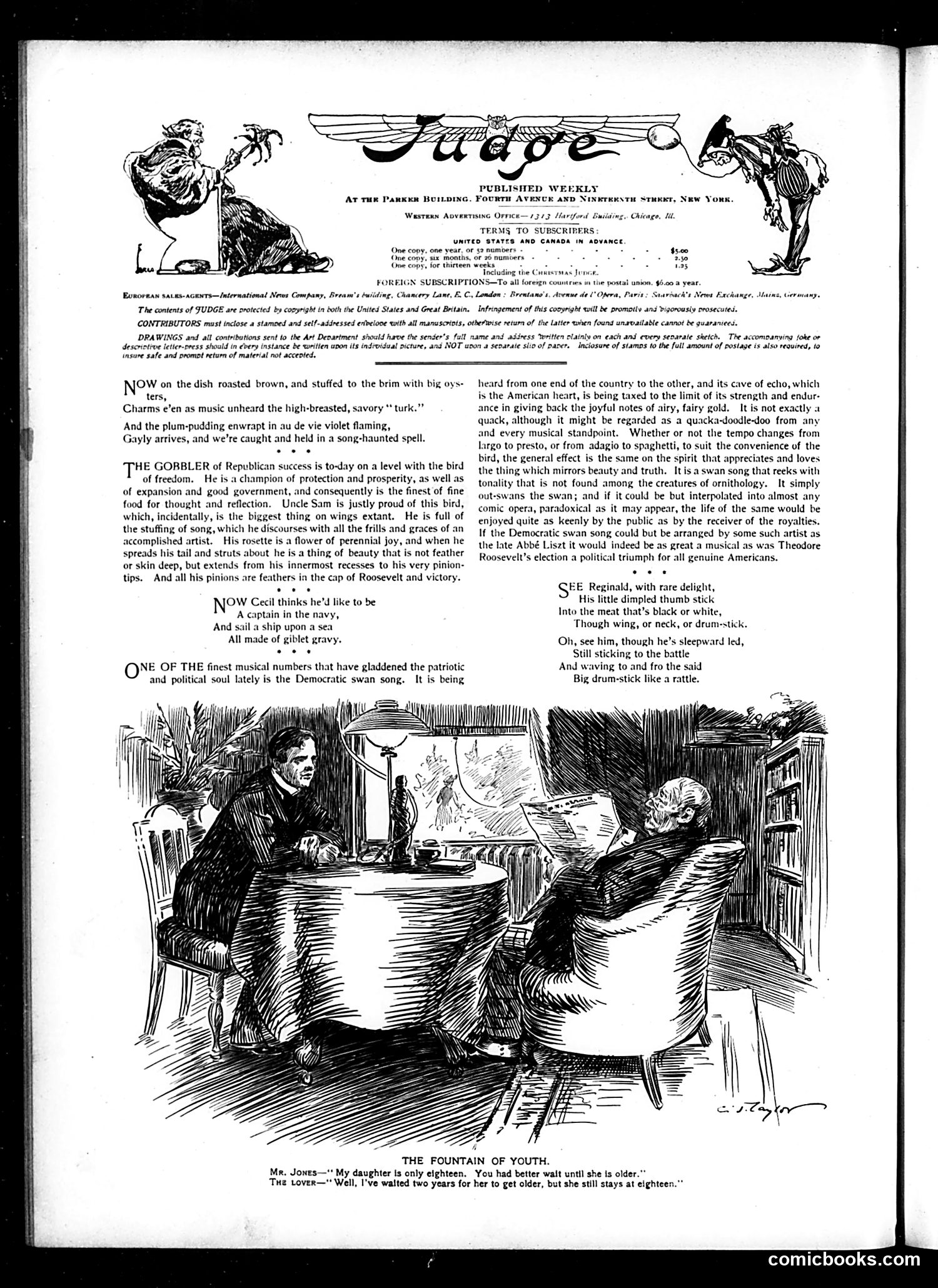
This page contains political and social commentary typical of early 20th-century Judge magazine. The main cartoon, "The Fountain of Youth," depicts two men discussing a young woman—one warns the other that his daughter is only eighteen, counseling patience; the lover responds he's "waited two years for her to get older, but she still stays at eighteen." The satire mocks both male predation (the lover's impatience for the girl to mature) and perhaps the artificiality of feminine youth culture. The accompanying text praises the "Democratic swan song" and the Republican "Gobbler," using bird metaphors to satirize both political parties—comparing their political messaging to animal calls rather than substantive policy. The overall tone suggests skepticism toward both parties and contemporary social mores.
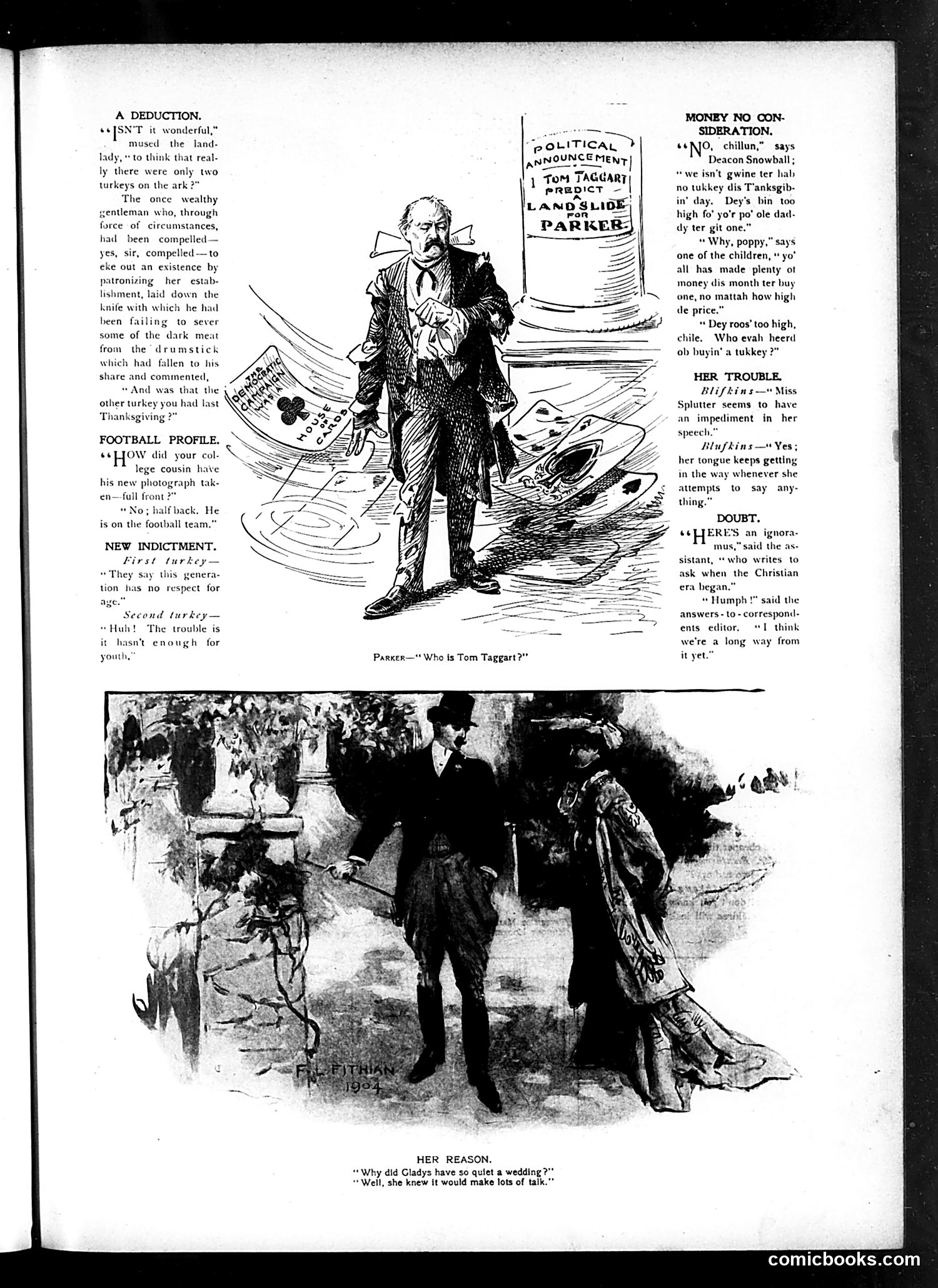
The top cartoon features a man holding a political announcement for "Tom Taggart" as a candidate for "Landslide Parker." The figure appears to be struggling with turkeys and related Thanksgiving imagery, suggesting a satirical commentary on political promises versus reality. The caption asks "Who is Tom Taggart?"—likely referencing actual political figures of the era, though their specific significance isn't entirely clear from the image alone. The lower illustration shows two figures examining what appears to be wedding attire or fabric, captioned "Why did Gladys have so quiet a wedding?" with the response "Well, she knew it would make lots of talk." The page also contains several humorous short pieces about money, children, and miscellaneous social observations—typical of Judge's satirical content format.
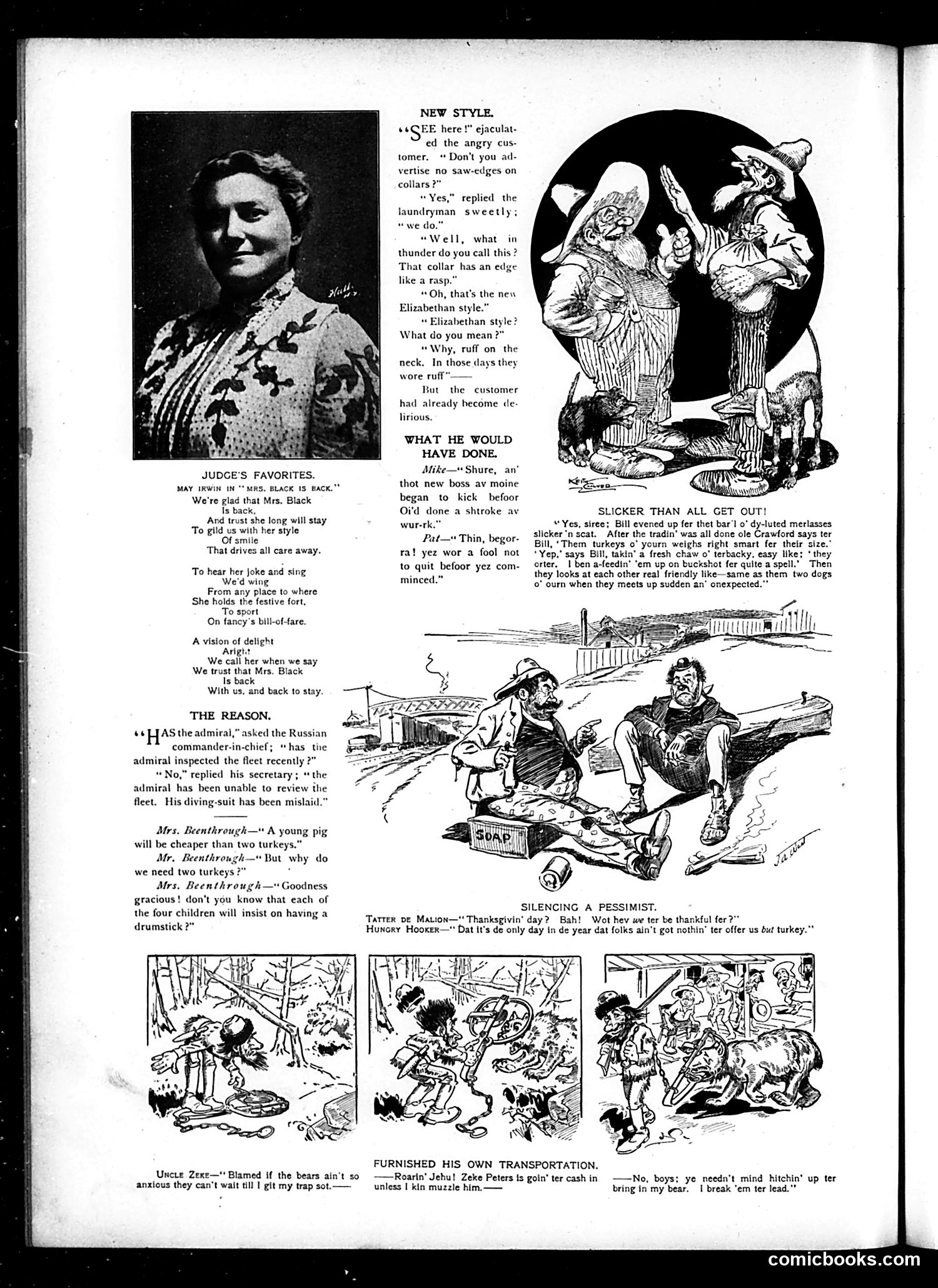
This page combines fashion commentary with humorous sketches. The top section titled "NEW STYLE" mocks contemporary collar fashions, specifically Elizabethan-style ruffled collars that were apparently back in vogue. The dialogue satirizes a laundry customer's complaint about sharp collar edges, with the laundress defending the new fashion trend. The middle and bottom sections feature various unrelated comic sketches with Irish and working-class characters in domestic situations—a pig cheaper than turkeys, Thanksgiving dinner complaints, and a bear-transport joke. These appear to be generic humor pieces rather than political commentary. The page reflects early 20th-century Judge content: fashion satire aimed at upper-class readers, ethnic-stereotype humor in supporting sketches, and domestic comedy. No specific political figures or events are clearly referenced.
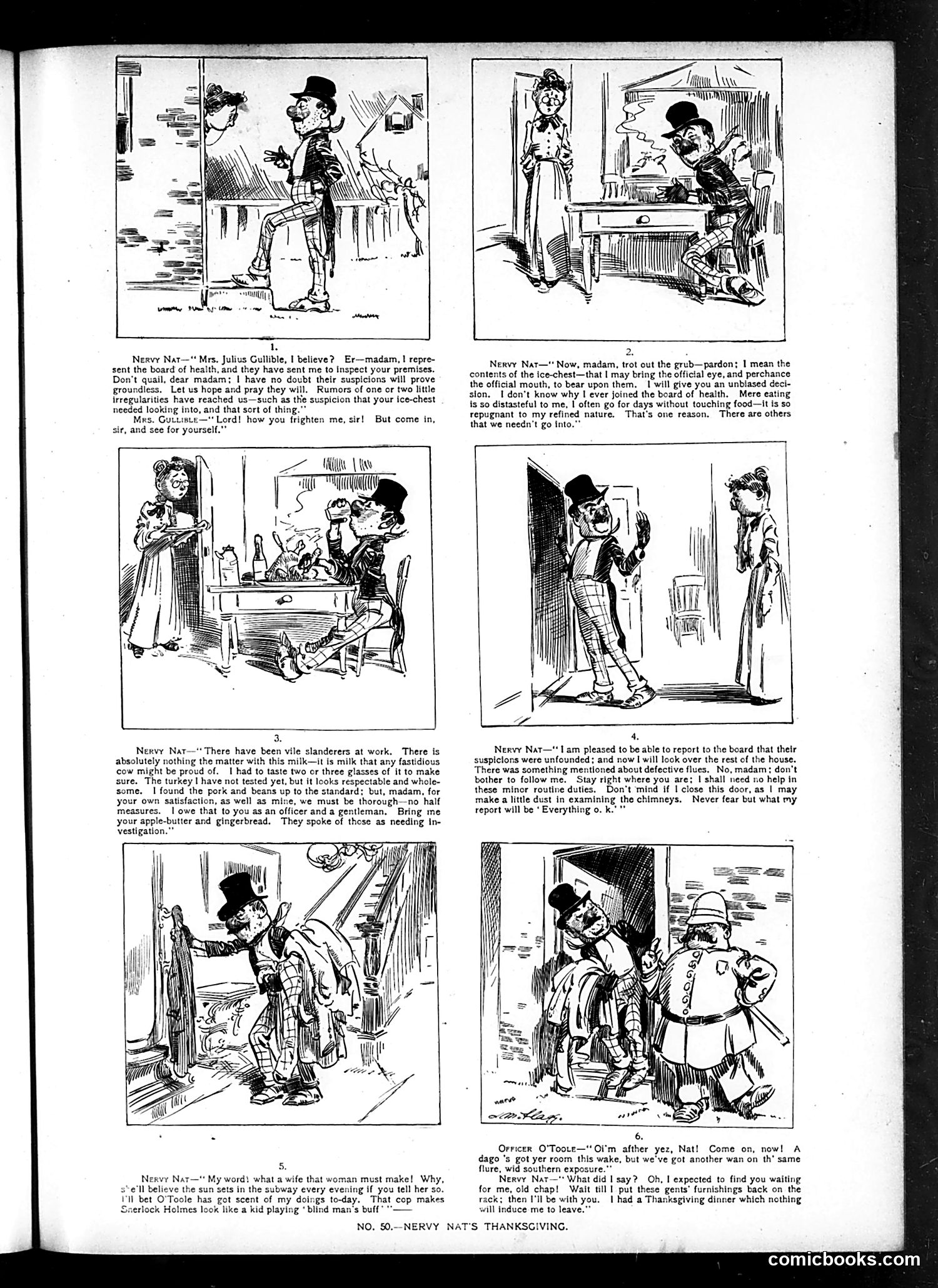
This comic satirizes a corrupt health inspector ("Nervy Nat") who uses his official position for personal gain. Arriving at Mrs. Gullible's home to inspect her premises, Nat's real agenda is clear: he shamelessly eats her food while conducting a perfunctory "investigation," claiming to taste milk, turkey, and other provisions in the name of official duty. The satire targets municipal corruption and incompetence—specifically inspectors who abuse their authority to extort food and favors from citizens. Nat's transparent excuses ("I must be thorough") and his shameless consumption reveal the fraud. The final panels show him being pursued by Officer O'Toole, suggesting such inspectors face occasional accountability, though Nat remains undeterred. The "Thanksgiving" title ironically references Nat's self-serving feast at the Gullibles' expense—a darkly comic commentary on turn-of-the-century urban corruption and the powerlessness of ordinary citizens before dishonest officials.
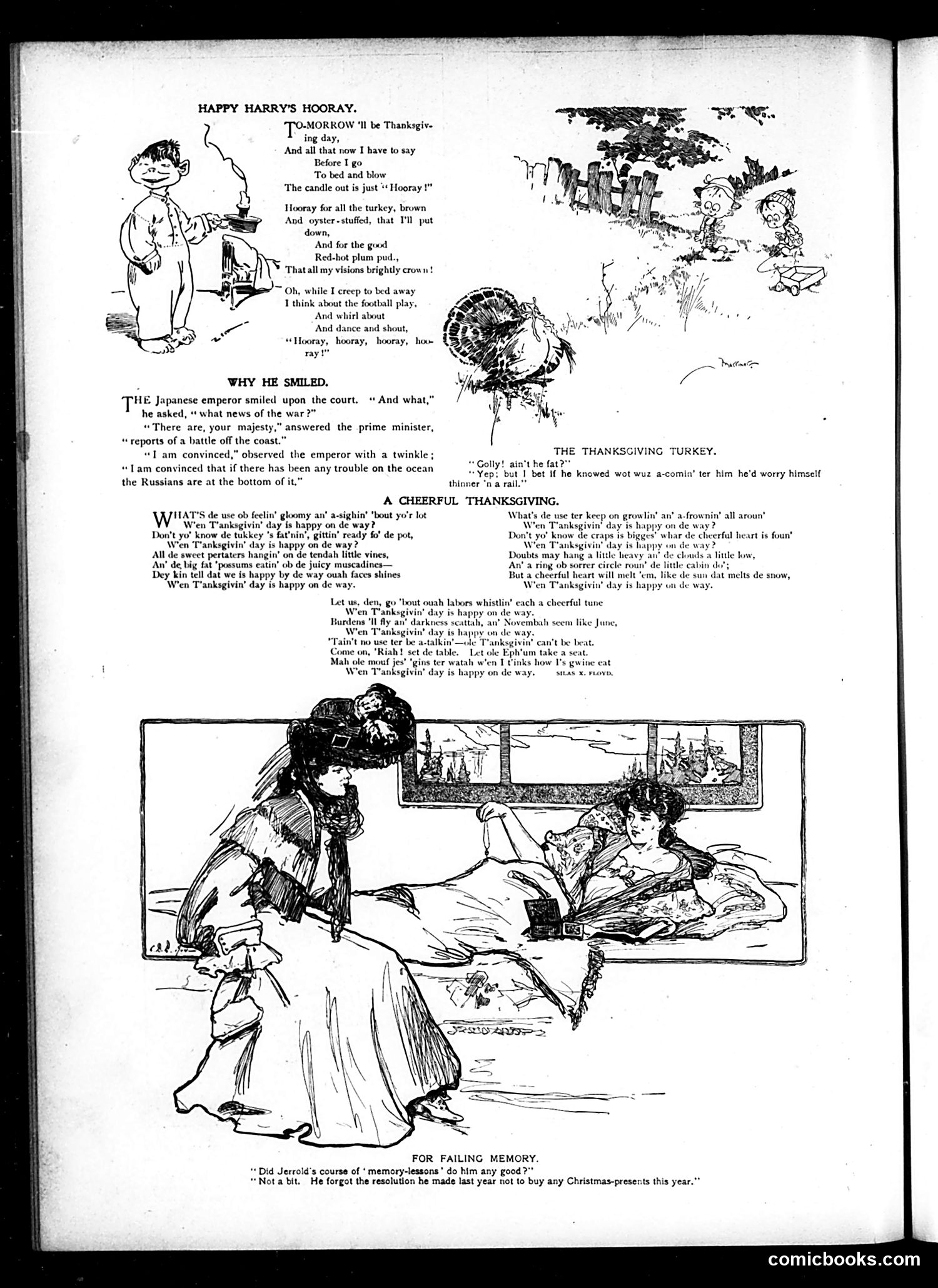
This page contains three separate humorous pieces typical of early 20th-century American satire: **"Happy Harry's Hooray"** features a child excited about Thanksgiving—turkey, plum pudding, and football—rendered as innocent holiday enthusiasm. **"Why He Smiled"** satirizes the Russo-Japanese War (1904-1905). The Japanese emperor smiles upon hearing of naval conflict, quipping that if there's been ocean trouble, "the Russians are at the bottom of it"—a dark joke about Japanese naval victories that sank Russian ships. **"The Thanksgiving Turkey"** uses dialect humor (common but now offensive) to present a farm hand's observation that the turkey doesn't realize its fate. **"A Cheerful Thanksgiving"** continues the dialect-based humor, urging cheerfulness despite hardship—typical of paternalistic period attitudes toward working-class life. **"For Failing Memory"** is a domestic joke: a man's memory-improvement course failed because he forgot last year's resolution not to buy expensive Christmas gifts. The page emphasizes Thanksgiving themes alongside topical war commentary and gentle domestic humor.
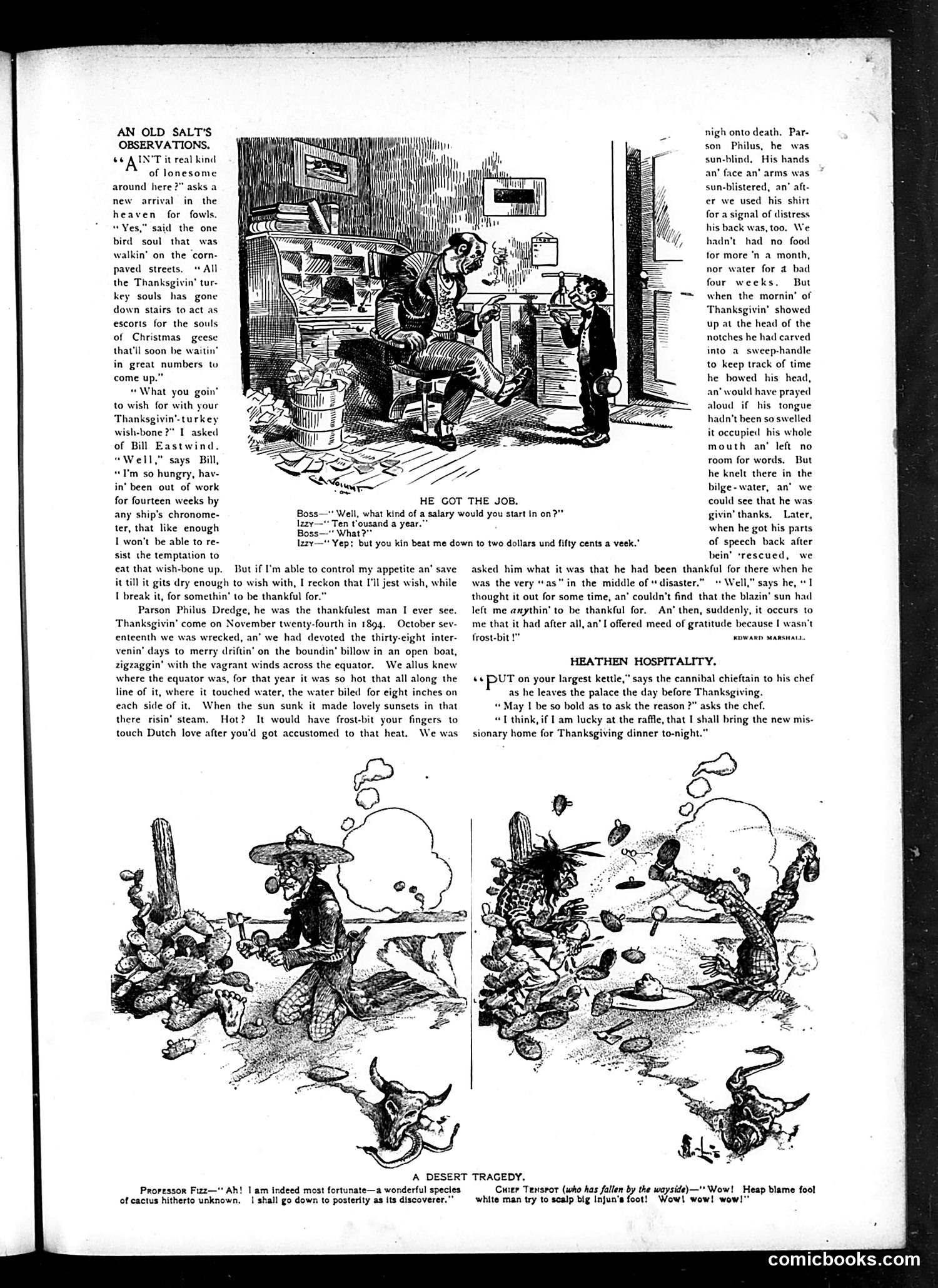
This page from *Judge* contains three separate humorous pieces: **"An Old Salt's Observations"** presents a sailor's tall tale about Thanksgiving 1894, featuring Parson Philus Dredge—a shipwreck survivor so starved and sun-blistered after 38 days adrift that he gives thanks merely for not being frostbitten. The satire mocks religious gratitude taken to absurd extremes. **"He Got the Job"** is a brief joke about an immigrant worker (Izzy) so desperate he negotiates his own salary downward from ten thousand to two dollars fifty cents weekly—satirizing labor exploitation and immigrant desperation. **"Heathen Hospitality"** and **"A Desert Tragedy"** are illustrated jokes about cannibals and Native Americans, reflecting common (and offensive) period stereotypes used for comedic effect in mainstream publications. The page exemplifies *Judge*'s satirical approach: exaggeration, ethnic caricature, and social commentary targeting labor conditions, religious hypocrisy, and contemporary anxieties.
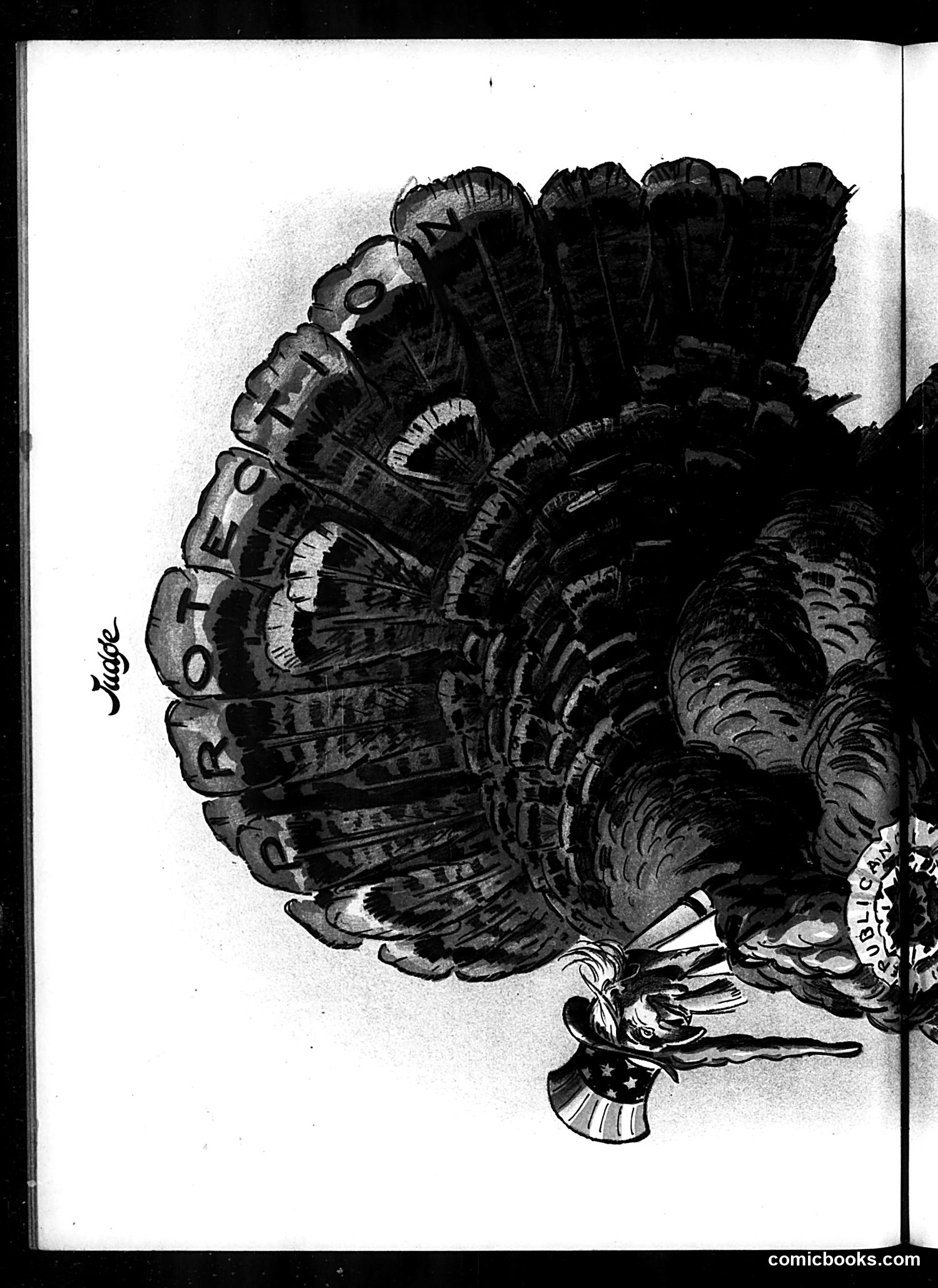
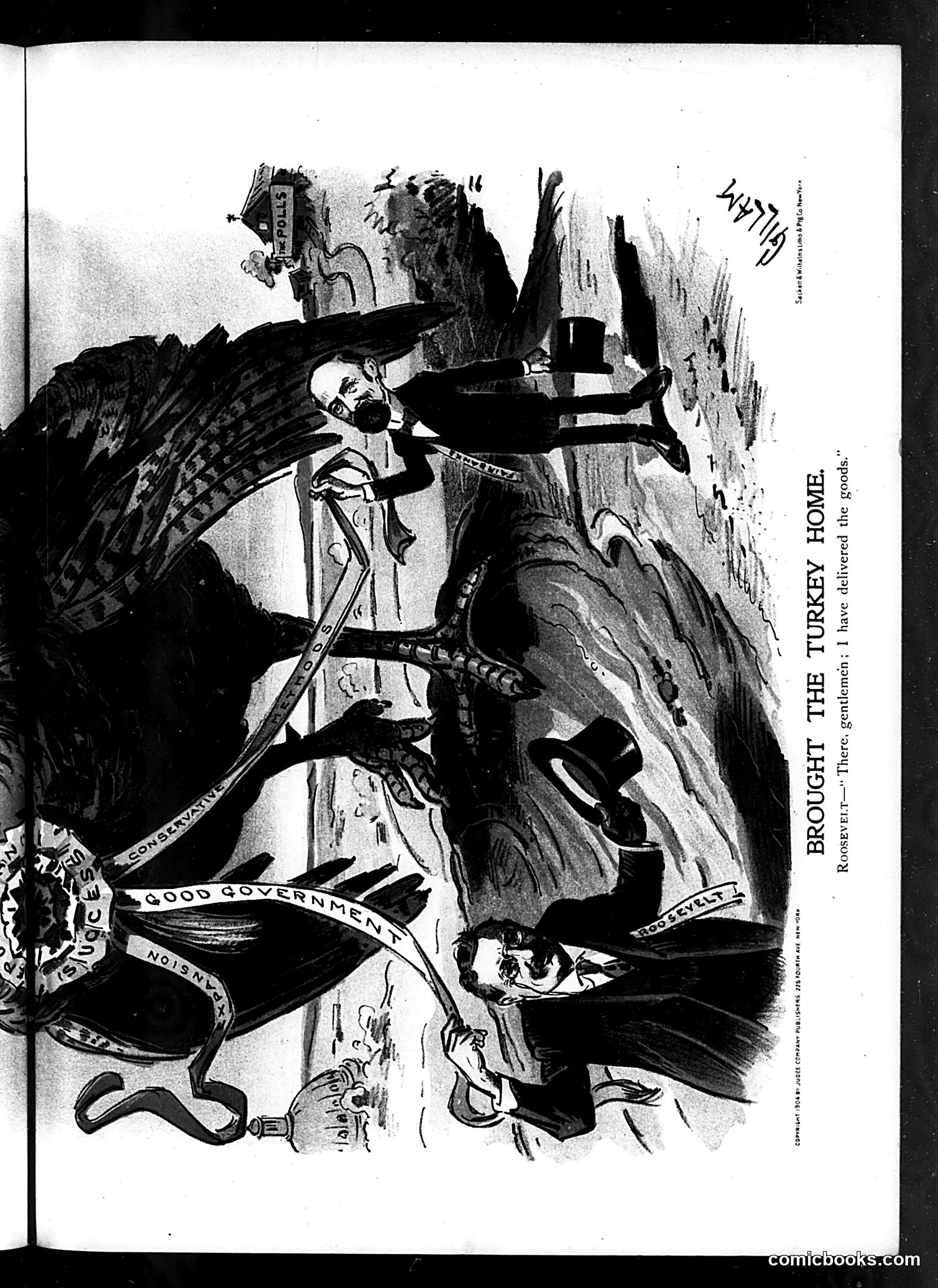
I can see this is a detailed black and white illustration of a turkey displaying its full plumage, drawn in a naturalistic style typical of late 19th-century magazine illustration. The image appears rotated on the page. However, the OCR text provided contains only scattered characters and numbers with no readable words, making it impossible to identify the specific political or social satire intended. Without accompanying caption text or article content, I cannot determine what political figures or events this turkey illustration may reference, or what satirical point Judge magazine was making. To properly explain this cartoon's meaning to a modern reader, I would need legible text identifying the subject matter and context.
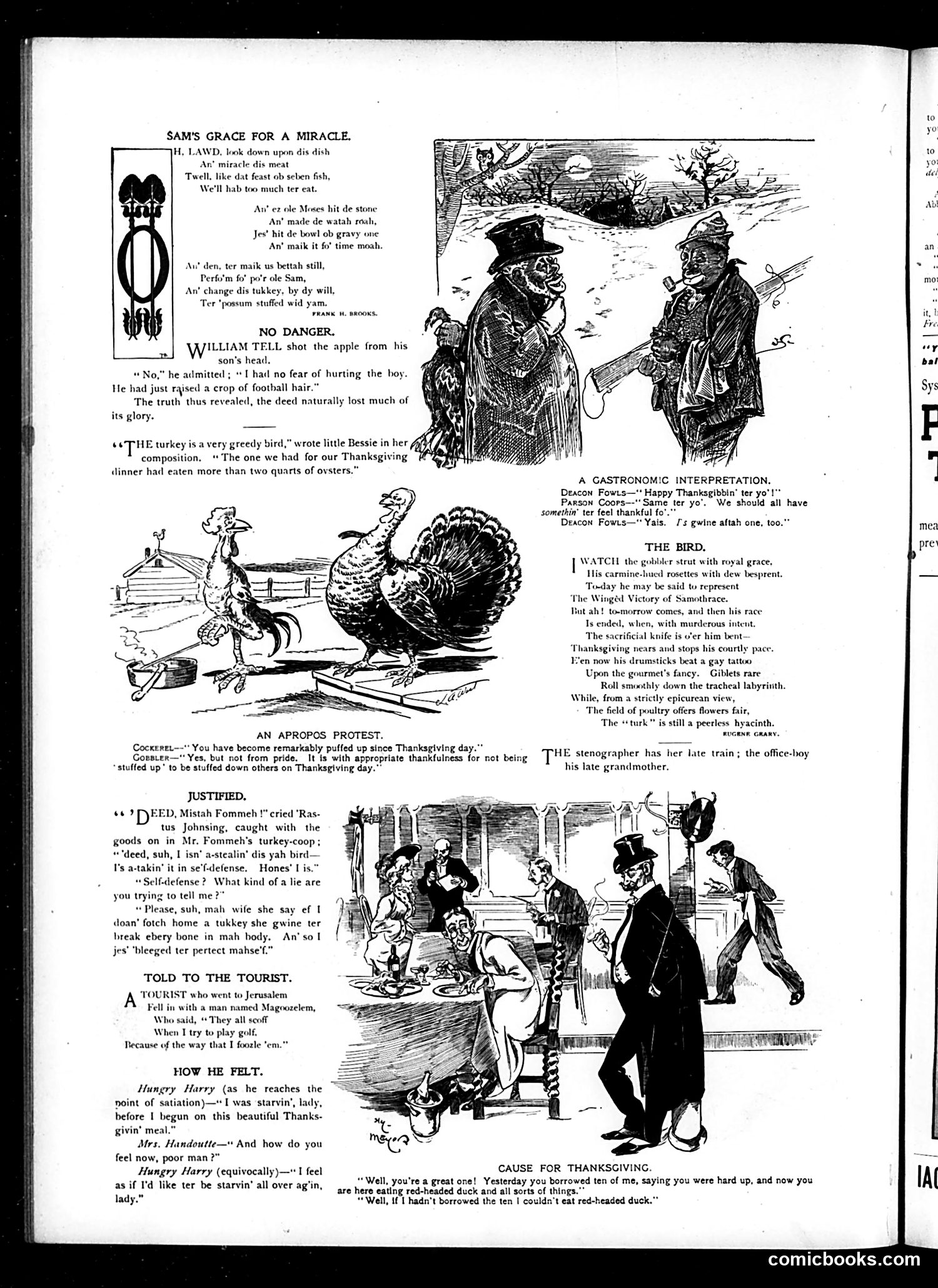
This Thanksgiving-themed satirical page uses racial caricatures and dialect humor typical of early 20th-century American comedy. The cartoons mock Black Americans through exaggerated stereotypes: **"Sam's Grace for a Miracle"** features a Black man's prayer using heavy dialect, asking God to multiply food—satirizing both religious fervor and poverty stereotypes. **"A Gastronomic Interpretation"** shows two Black men (Deacon Fowls and Parson Coors) discussing Thanksgiving, implying they're primarily motivated by eating. **"Justified"** depicts a Black man ("Rastus Johnsing") stealing a turkey, claiming self-defense because his wife threatened violence—joking about domestic abuse and criminality. The page also includes non-racial humor about William Tell, a greedy turkey, and a tourist's golf pun. **For modern readers:** This reflects deeply offensive historical attitudes. Judge magazine used racist caricature as standard entertainment, portraying Black Americans as dialect-speaking, gluttonous, dishonest, and violent. The humor relied entirely on racial prejudice rather than wit.
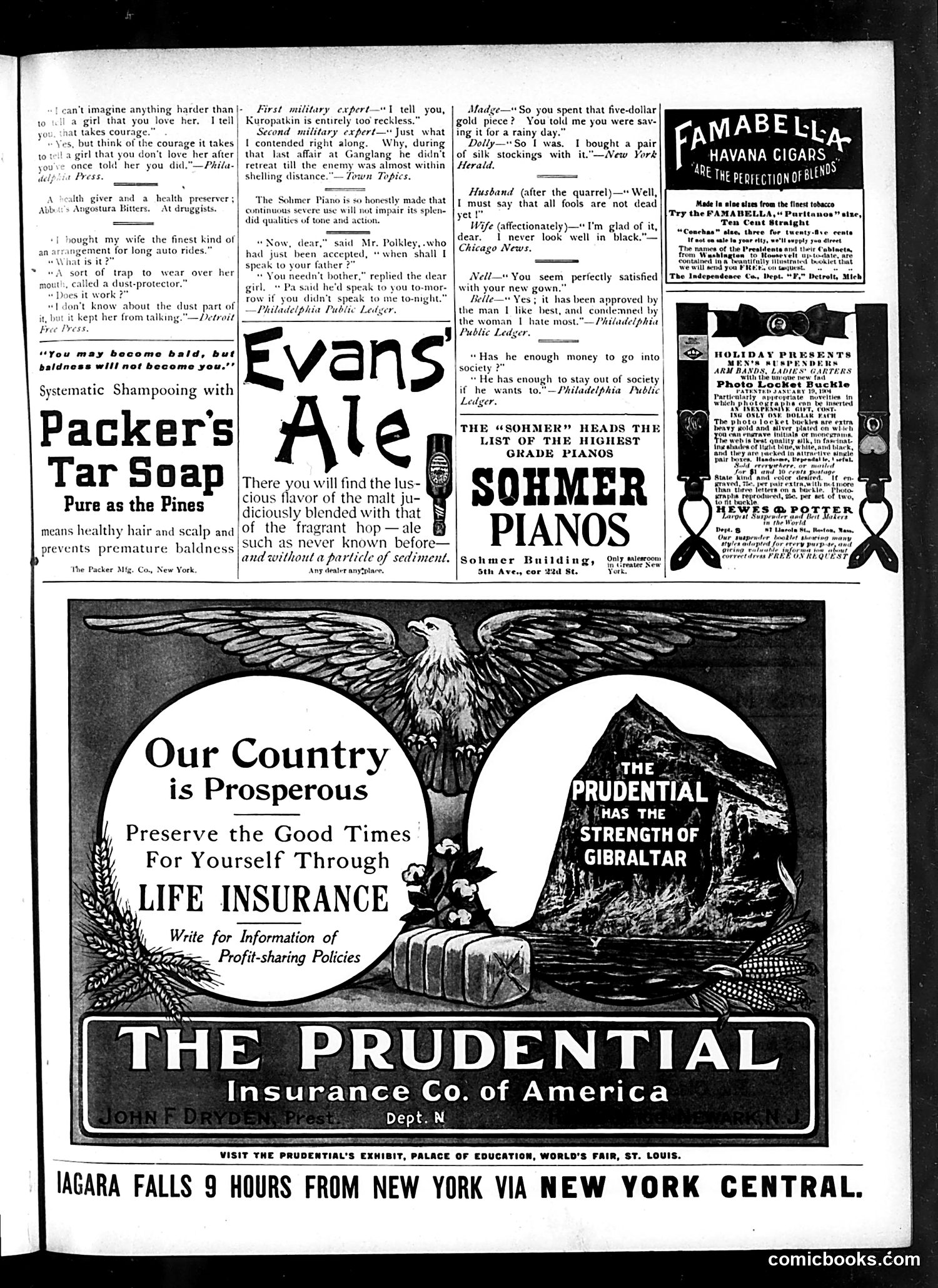
This page is primarily **advertising** with brief comedic vignettes scattered among ads. The humor pieces are typical early-1900s domestic comedy: **The "Military Expert" joke** references Kuropatkin, a Russian general in the Russo-Japanese War (1904-05), mocking military incompetence through a fictional debate about his recklessness. **Other jokes** involve marital comedy (wives spending money, husbands afraid to speak to fathers-in-law) and gendered humor about women's vanity and chattiness—standard for the era. **The large Prudential Insurance ad** features an eagle and Gibraltar imagery, using patriotic symbolism to promote life insurance as preserving prosperity during America's boom period. The **Evans Ale and Sohmer Pianos ads** use period marketing language about "purity" and quality craftsmanship. The page reflects early-20th-century advertising aesthetics and social assumptions: anxiety about marriage dynamics, consumer optimism, and appeals to American prosperity and national strength.
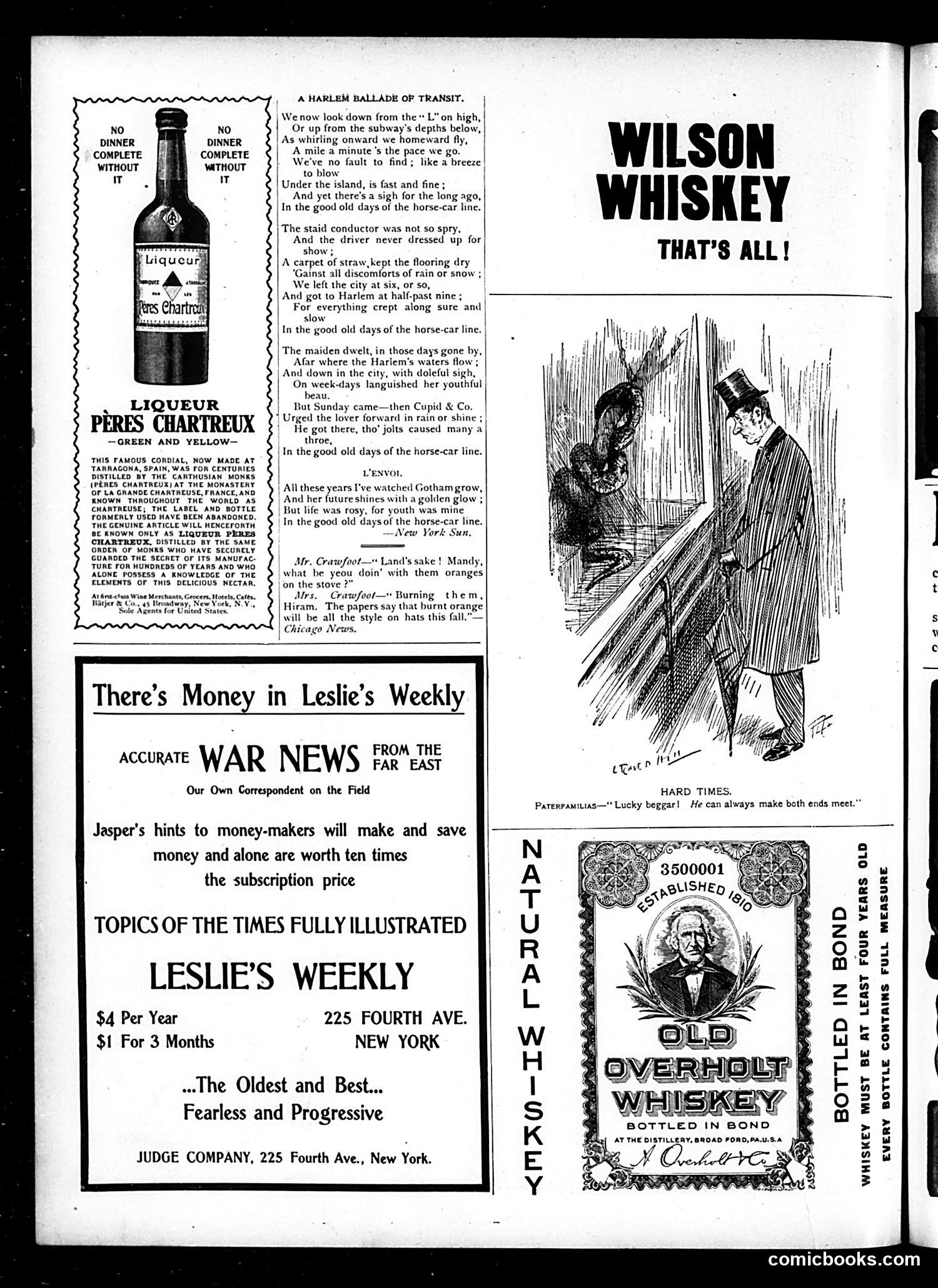
This page is primarily **advertising**, with one notable cartoon and a nostalgic poem. ## Main Content: **"Hard Times" Cartoon**: Shows a well-dressed man and woman on what appears to be a tenement fire escape or exterior stairs. The caption reads: "Paternfamilias—'Lucky beggar! He can always make both ends meet.'" This is satirical commentary on economic hardship—the joke being darkly ironic about someone who can "make both ends meet" during financially difficult times, likely suggesting lower-class struggles or marital financial tension. **"Harlem Ballade of Transit"**: A nostalgic poem lamenting the shift from slow horse-drawn streetcars to modern rapid transit (the elevated "L" train and subway). The poem contrasts modern speed with romanticized memories of slower, gentler transportation when courtship involved leisurely Sunday rides to Harlem. ## Advertisements: The page features liqueur, whiskey, and Leslie's Weekly subscription ads—typical early 1900s magazine content with no particular satirical intent. The page reflects **early-20th-century urban anxiety** about modernization and economic struggle.
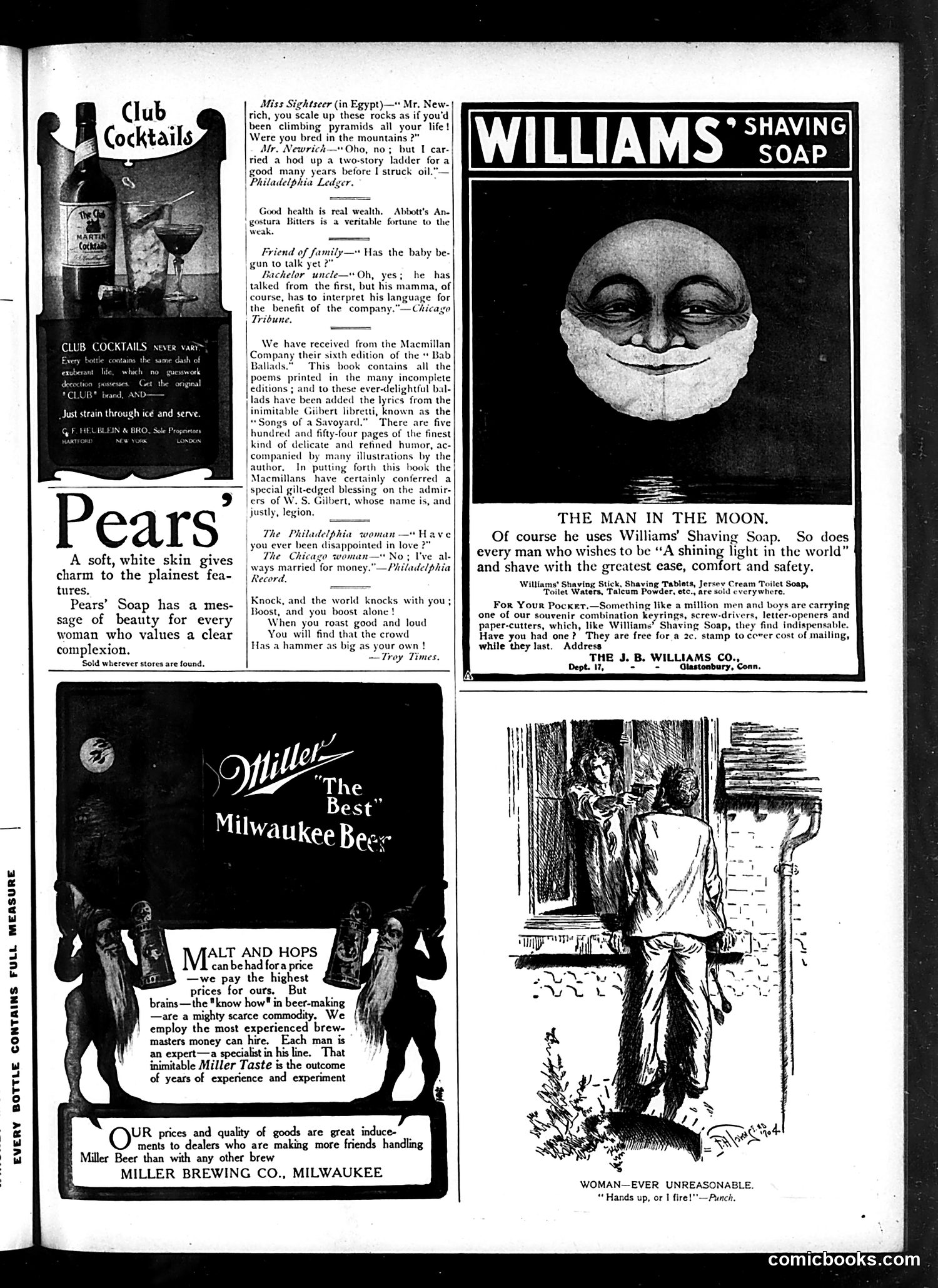
This page consists primarily of **advertisements and short humorous anecdotes** rather than political satire. The content includes: **Advertisements:** Williams' Shaving Soap (featuring "The Man in the Moon"), Pears' Soap, Miller Beer, and Club Cocktails dominate the layout. **Humor pieces:** Short jokes touching on period stereotypes—a newly wealthy man (implied to have made money in oil) bragging about his humble origins; a bachelor uncle interpreting a baby's babbling; a Philadelphia woman admitting she married for money. **The single cartoon** (bottom right, titled "Woman—Ever Unreasonable") shows a woman holding a gun on a man, captioned "Hands up, or I fire!"—apparently satirizing women as illogical or temperamental, typical of early 20th-century gender humor. The page reflects Judge's mixed advertising-and-humor format rather than serious political commentary. The jokes reflect contemporary attitudes about class mobility, gender, and domestic life.
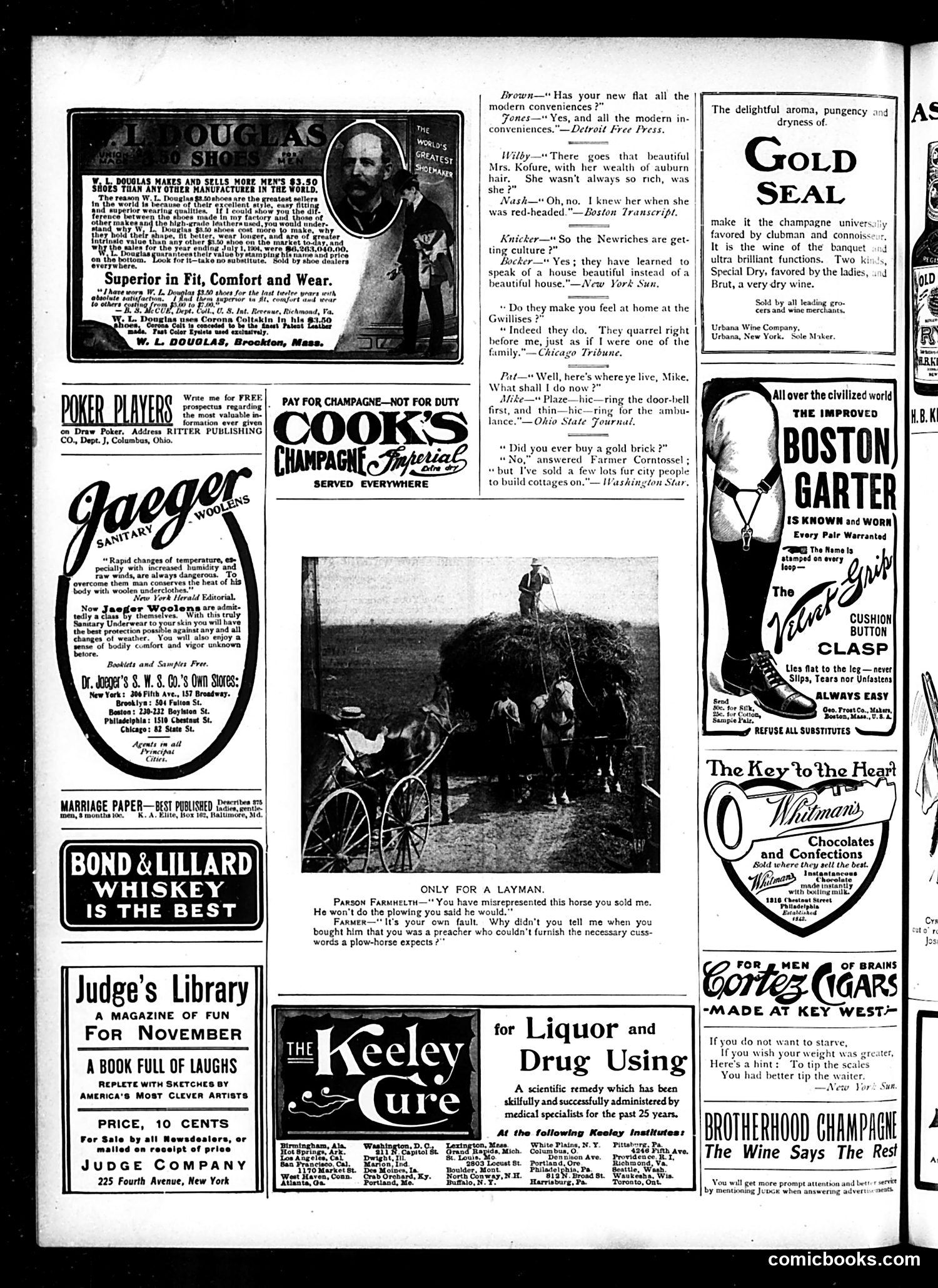
This is primarily an **advertising page** from Judge magazine, with minimal editorial content. The few cartoon captions present are light social humor typical of early 1900s American publications: **Notable content:** - A photograph labeled "Only for a Layman" depicts a parson complaining to a farmer about a defective plow-horse. The joke: the preacher can't make the horse work because he lacks the "necessary cuss-words" farmers use—satirizing clergy as ineffectual outside their domain. - Brief conversational jokes mock newly-wealthy "Newriches" trying to acquire culture, city dwellers being swindled into buying rural land for cottages, and social pretension. **Advertisements dominate**, including: W.L. Douglas shoes, Jaeger woolens, Cook's champagne, Boston garters, Whitman's chocolates, Keeley Institute (drug/alcohol treatment), and various other products. The page reflects **early 20th-century consumer culture** and gentle, class-conscious humor rather than sharp political satire. No specific political figures or events are referenced.
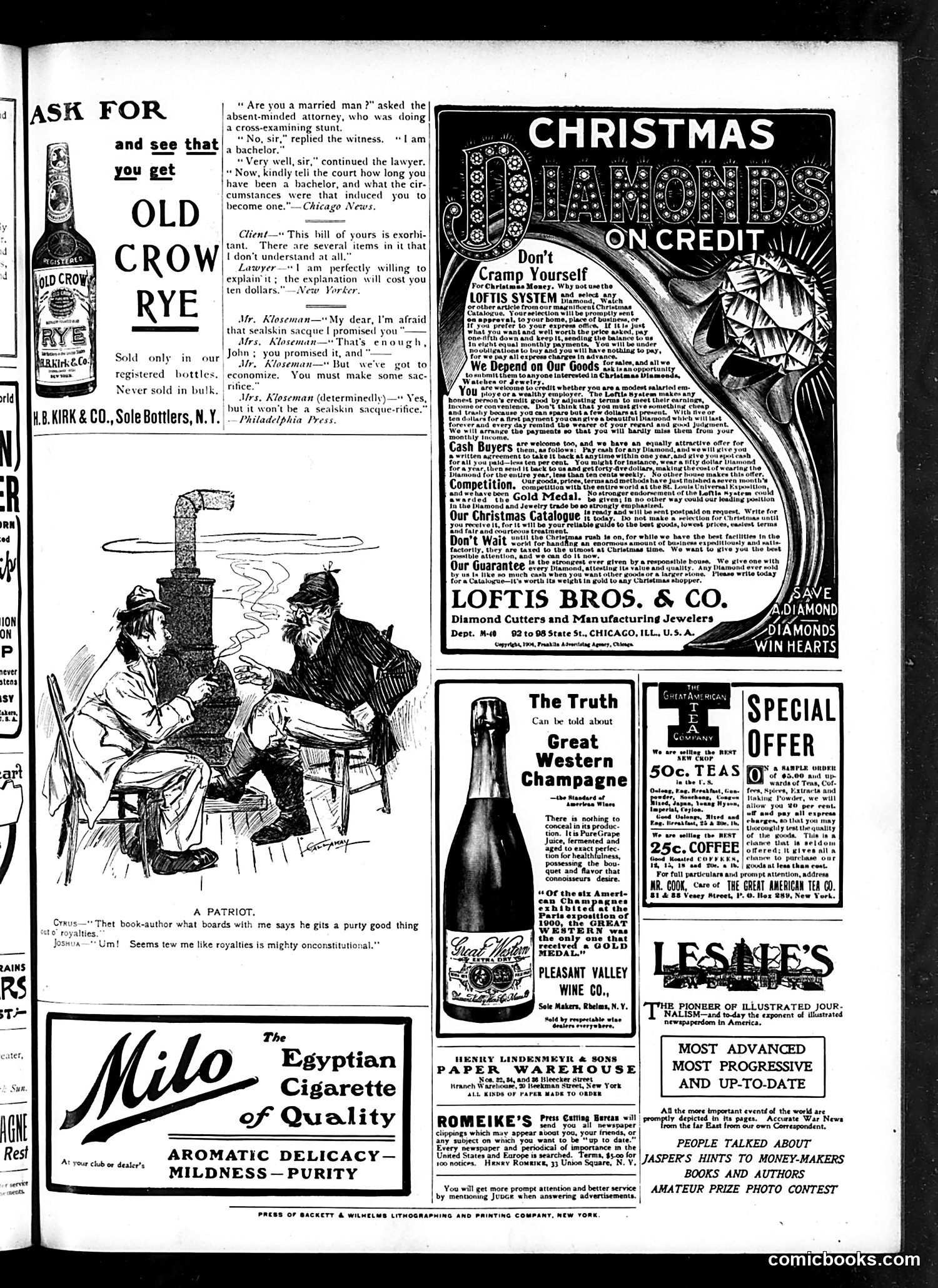
This page from Judge magazine (appears to be early 1900s) contains several short humor pieces and advertisements rather than a single political cartoon. **The main cartoons:** 1. **"A Patriot"** shows two men discussing a book-author's royalties, with one character expressing mock outrage that authors receive payment ("seems tew me like royalties is mighty unconstitutional"). This satirizes working-class attitudes toward intellectual property or perhaps anti-capitalist sentiment. 2. **The Kloseman domestic joke** plays on a wife's pun about a "sealskin sacque-rifice" (sacrifice/sac), mocking both a husband's broken promise and marital financial disputes. 3. **The lawyer joke** satirizes attorney greed—charging extra to explain their own bills. The page is primarily **advertising-heavy**, featuring liquor (Old Crow Rye, champagne), cigarettes, jewelry, and business services, typical of Judge's revenue model. The humor is light, domestic, and class-conscious rather than overtly political.
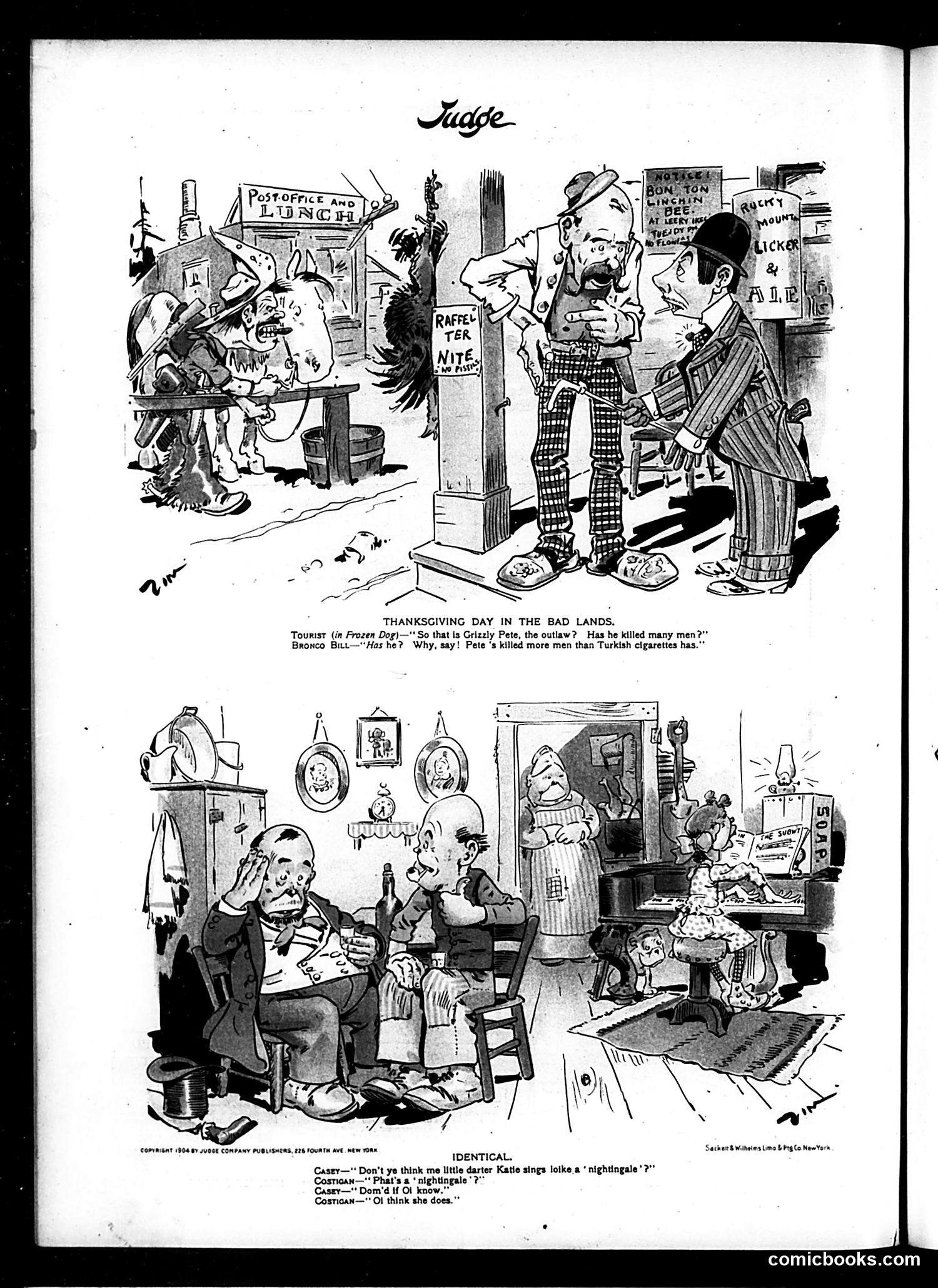
**Top cartoon**: Two Western characters discuss "Grizzly Pete," a frontier outlaw. The joke compares Pete's body count to Turkish cigarettes—a contemporary consumer product. This is satirical hyperbole: the comparison mocks both Pete's notoriety and the ubiquity of Turkish cigarettes in early 1900s America, where such cigarettes were fashionable and heavily advertised. **Bottom cartoon**: An Irish immigrant (Casty) asks another Irishman (Costican) if his daughter Katie sings like a "nightingale." Costican admits he doesn't know what a nightingale is, then quips she does anyway—implying the daughter sings poorly. This plays on ethnic stereotypes of Irish immigrants as uneducated while also gently mocking parental pride that overlooks obvious flaws. Both cartoons employ contemporary references and ethnic humor typical of Judge's early 1900s satire.