
A complete issue · 16 pages · 1904
Judge — June 11, 1904
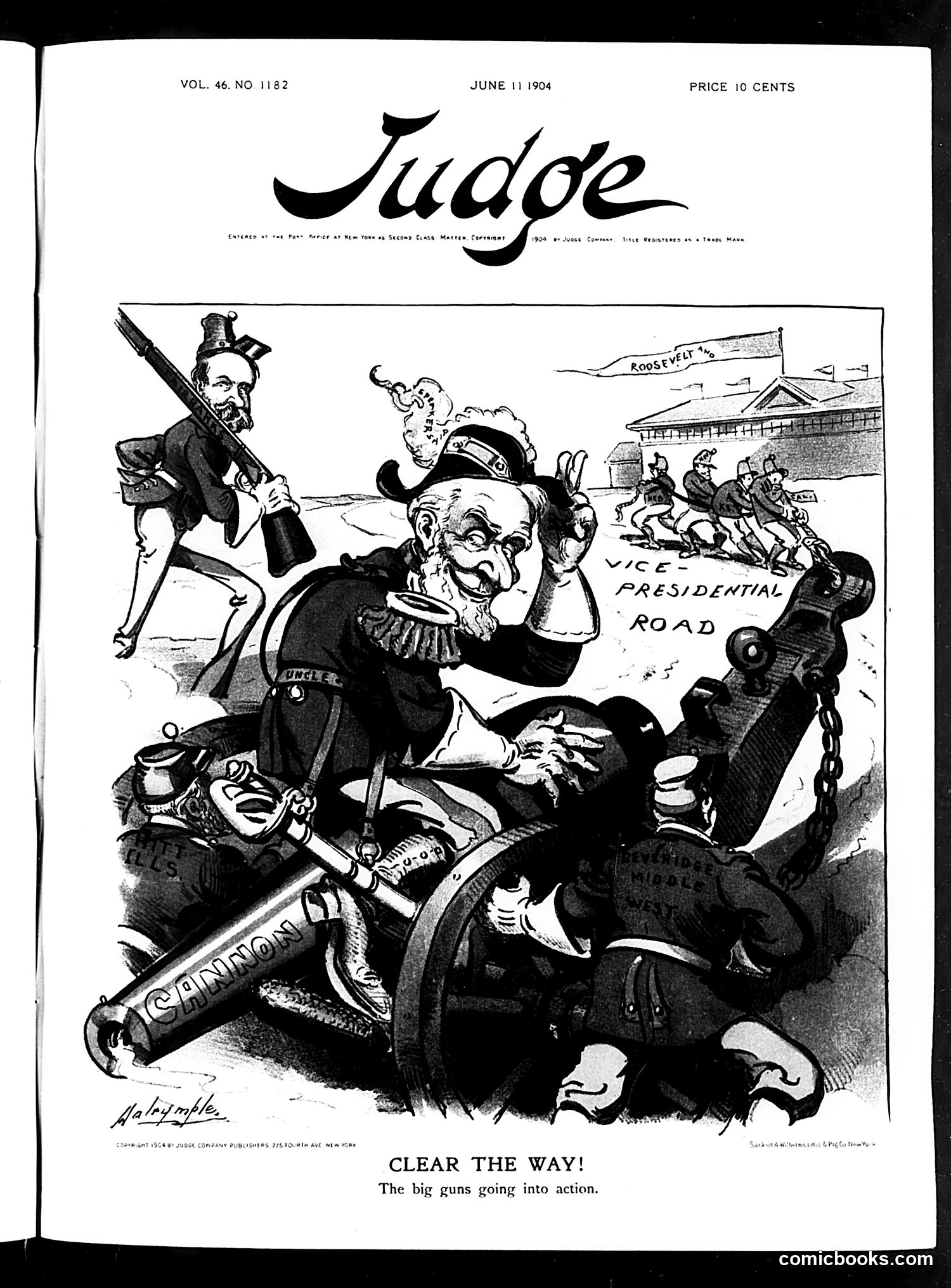
This June 1904 Judge cartoon satirizes Vice-President Theodore Roosevelt's political ambitions. The central caricatured figure (likely Roosevelt, given the "Vice-Presidential Road" label) operates a cannon labeled "CANNON," firing toward the Roosevelt building visible in the background. The imagery suggests Roosevelt aggressively clearing obstacles on his path to higher office—the "big guns" being deployed metaphorically and literally. The cartoon appears critical of Roosevelt's forceful political maneuvering, depicting him as a military figure literally blasting his way forward. The exaggerated features and action convey satirical mockery of his ambitions and methods. This reflects 1904 political tensions surrounding Roosevelt's presidential aspirations following McKinley's assassination.
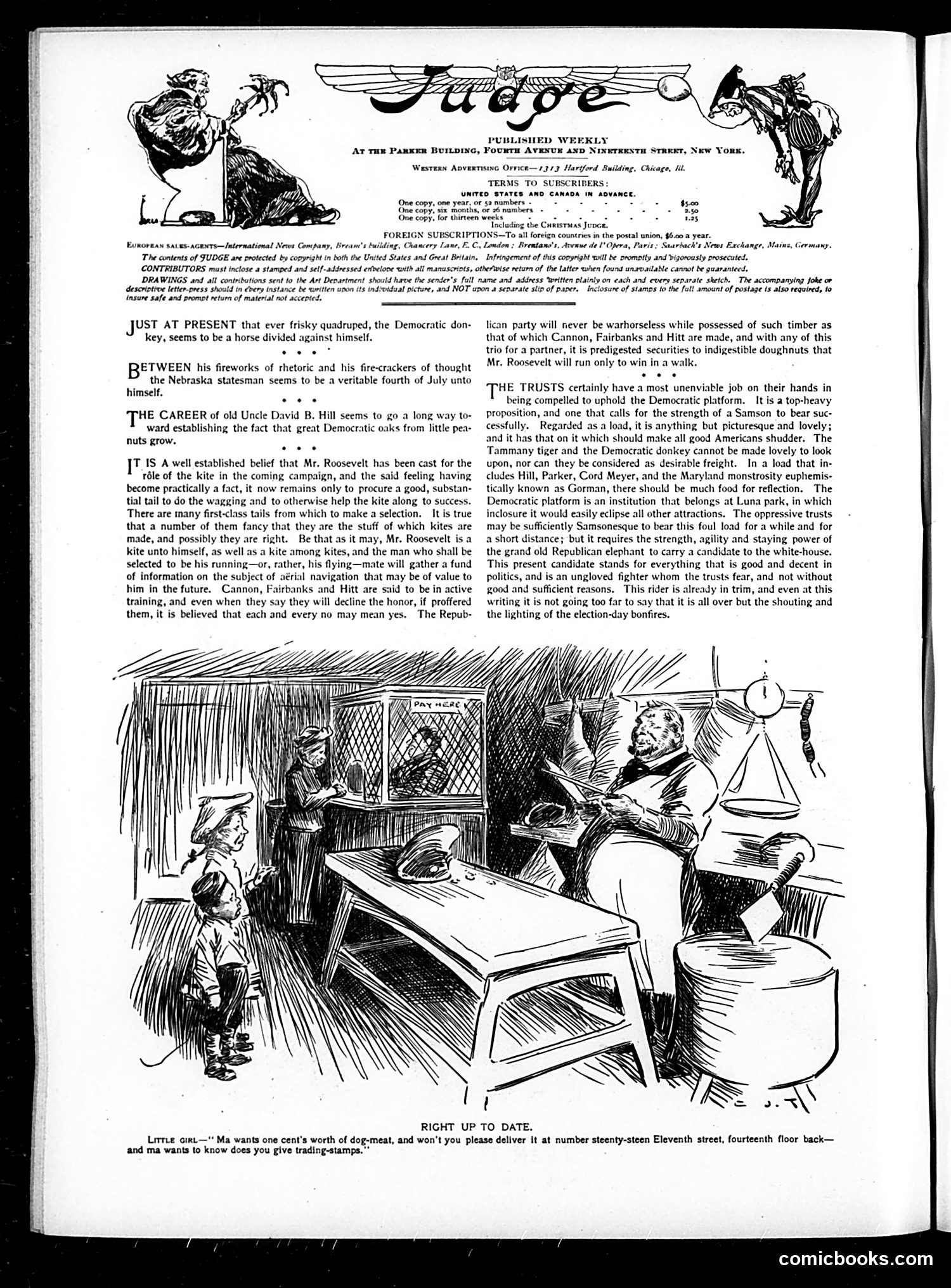
This page from Judge magazine contains political commentary on the 1912 presidential election. The articles discuss Roosevelt's role as a "kite" candidate, suggesting he's been positioned to split the Republican vote and help the Democratic nominee. The text criticizes various political figures—apparently including Cannon, Fairbanks, and Hitt—for their roles in party machinations. The bottom cartoon, "Right Up to Date," depicts a working-class interaction: a mother requests dog-meat and wants delivery with trading stamps, while a butcher appears to be her grocer. This satirizes both poverty (dog-meat as food for the poor) and commercialized consumerism (trading stamps as promotional incentives), reflecting early 20th-century economic anxieties and consumer culture tensions.
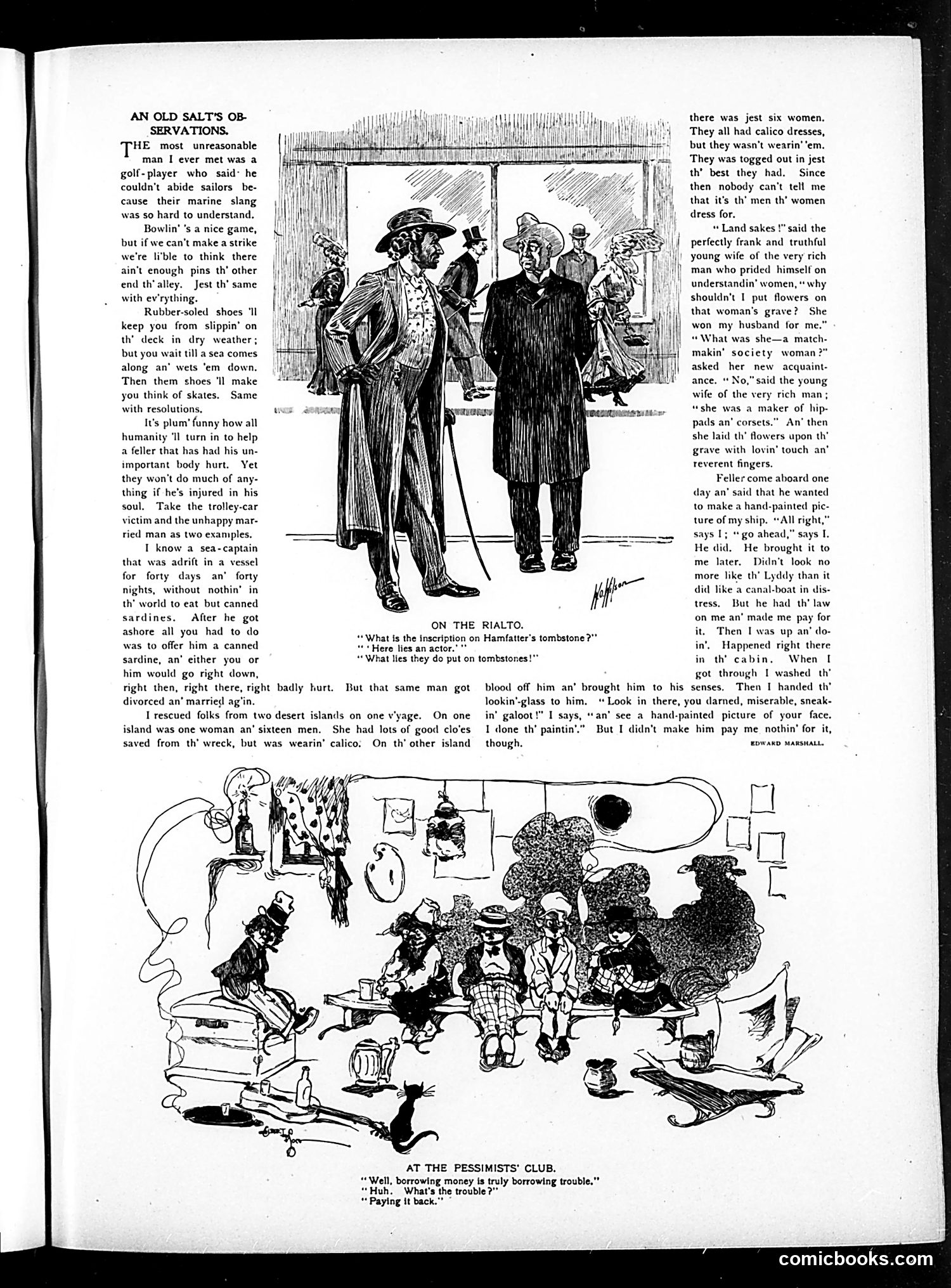
This page contains two satirical pieces: **"An Old Salt's Observation"** (top): A salty sailor critiques golf as unsuitable for seafarers, arguing maritime experience makes land sports pointless. He uses colorful nautical language to dismiss golf as trivial compared to real dangers at sea. **"On the Rialto"** (middle): Two men discuss a tombstone inscription. One reveals it marks "an actor," prompting dark humor about actors being "put on tombstones"—a joke about theatrical performance and mortality. **"At the Pessimists' Club"** (bottom): A satirical cartoon showing club members discussing borrowed money, with the punchline "Paying it back"—mocking people who worry excessively about debt repayment. All three pieces use gentle humor about masculine concerns: sports, theater, and financial anxiety.
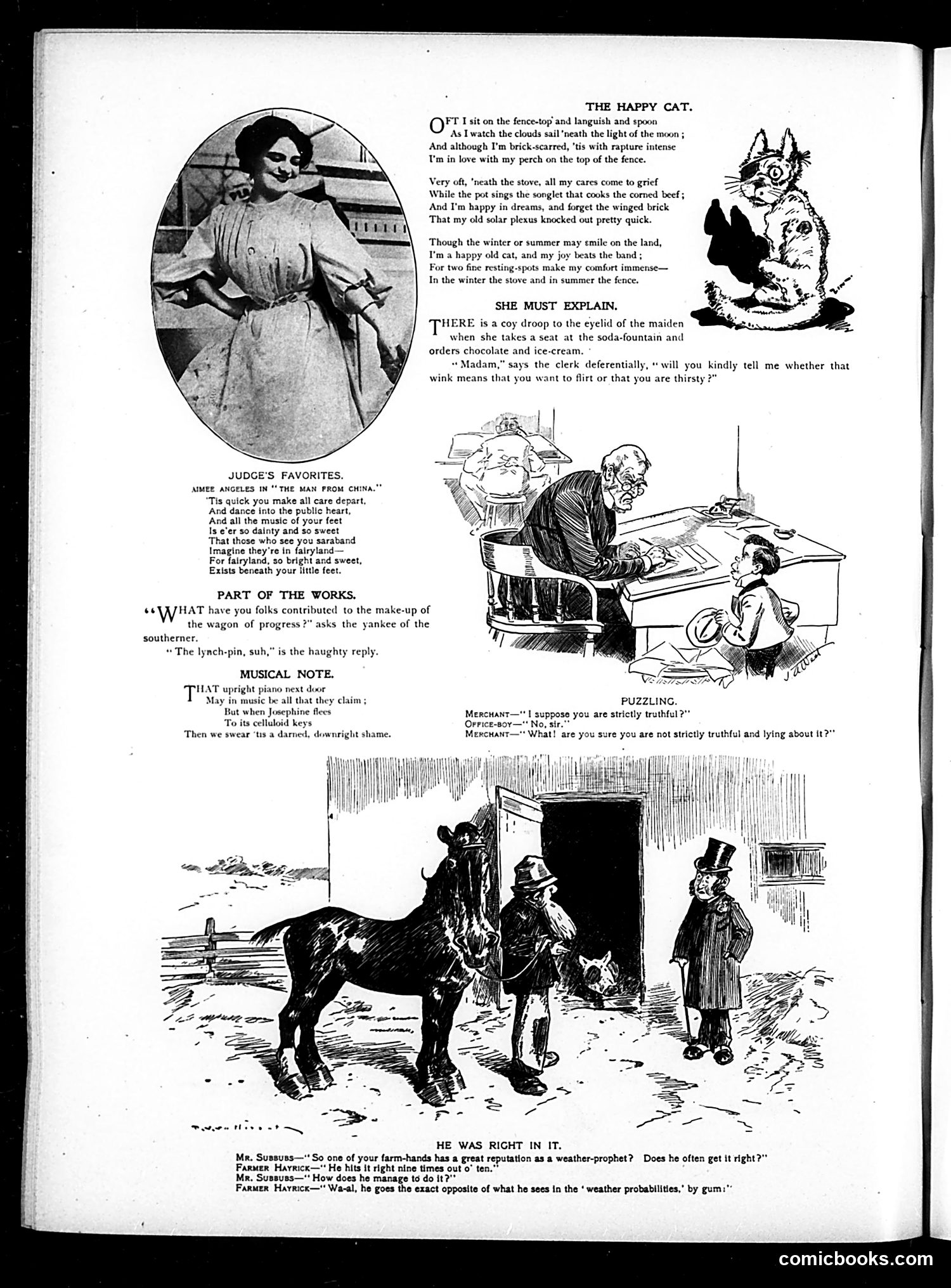
This page contains several unrelated humorous pieces rather than a unified political cartoon. **"The Happy Cat"** is a sentimental poem about a contented feline, accompanied by a cat illustration. **"Judge's Favorites"** quotes Aimee Angeles performing in "The Man from China," with a poem praising theatrical entertainment. **"She Must Explain"** and **"Puzzling"** are brief comic dialogues about social interactions—a soda-fountain clerk questioning a maiden's intentions, and merchants debating a customer's truthfulness. **"He Was Right in It"** depicts a farmer and two well-dressed men discussing a farm-hand's weather-prediction abilities, joking that he "goes the exact opposite of what he sees in the 'weather probabilities.'" The page appears primarily entertainment-focused rather than overtly political satire.
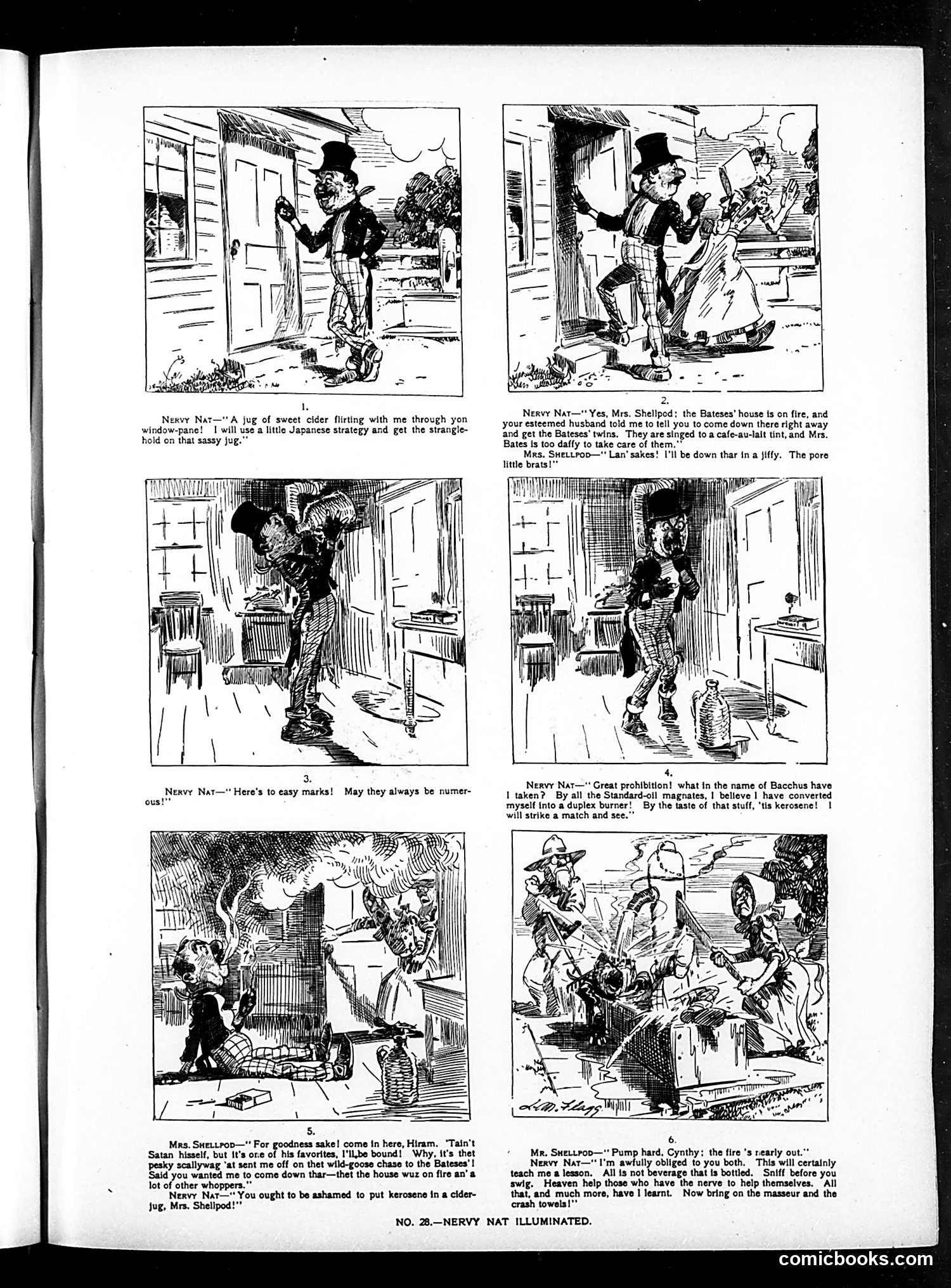
This is a six-panel comic strip satirizing a mischievous character called "Nervy Nat." The humor relies on slapstick consequences for his pranks and deceptions. The plot: Nat tricks Mrs. Shellpod with a false emergency (claiming her neighbors' house is on fire and their children need rescue), sending her on a wild goose chase. Meanwhile, he attempts to steal cider from a window but accidentally acquires a jug of kerosene instead. When he drinks it, believing it's alcohol, the liquid ignites when he strikes a match near his mouth, leaving him badly burned. The Shellpods discover Nat's deception and ironically witness his self-inflicted injury while trying to extinguish the fire he inadvertently started. The satire mocks both Nat's criminality and his comeuppance—a morality tale delivered through physical comedy. The racial caricature of Mrs. Shellpod (depicted with exaggerated features and dialect) reflects the magazine's period conventions. The "illuminated" title puns on Nat being literally set ablaze.
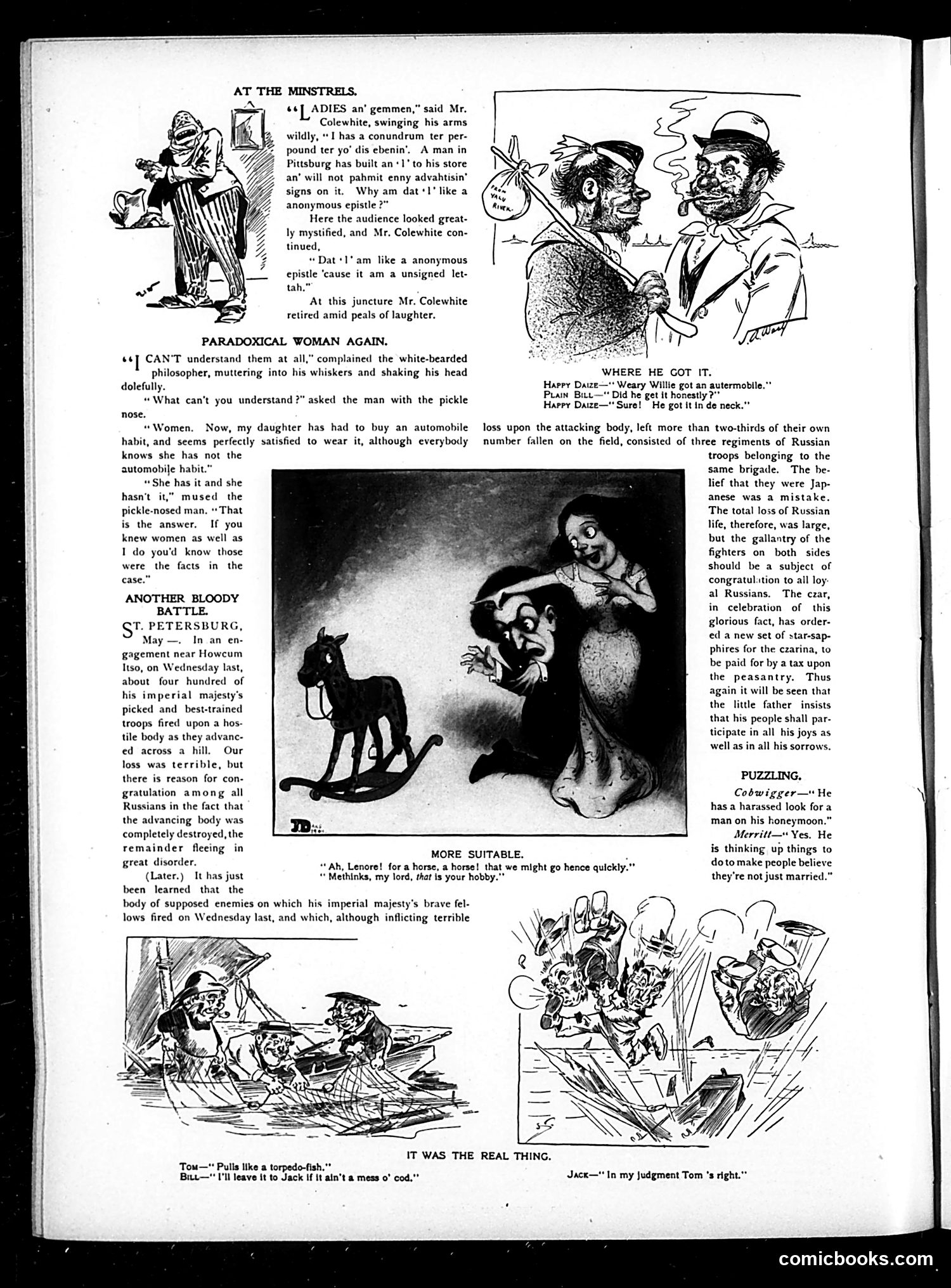
This page from **Judge** magazine contains period humor and satire, likely from the early 1900s: **"At the Minstrels"**: A minstrel performer (Colewhite) tells a joke in exaggerated dialect—a common entertainment format of the era, though the dialect representation reflects outdated racial stereotyping practices. **"Paradoxical Woman Again"**: Satirizes the contradiction of women's independence—a daughter buys an automobile but lacks automotive knowledge. This reflects early-20th-century anxieties about women's changing social roles. **"Another Bloody Battle"**: Mocks Russia's military losses in what appears to be the Russo-Japanese War (1904-05). The satire targets Czarist leadership celebrating minor victories while peasants bear tax burdens to fund the war—critiquing imperial indifference to human cost. **Bottom cartoons**: Various domestic humor gags unrelated to serious topics. The page exemplifies Judge's mix of social commentary, gender humor, and political satire typical of American satirical magazines of this period.
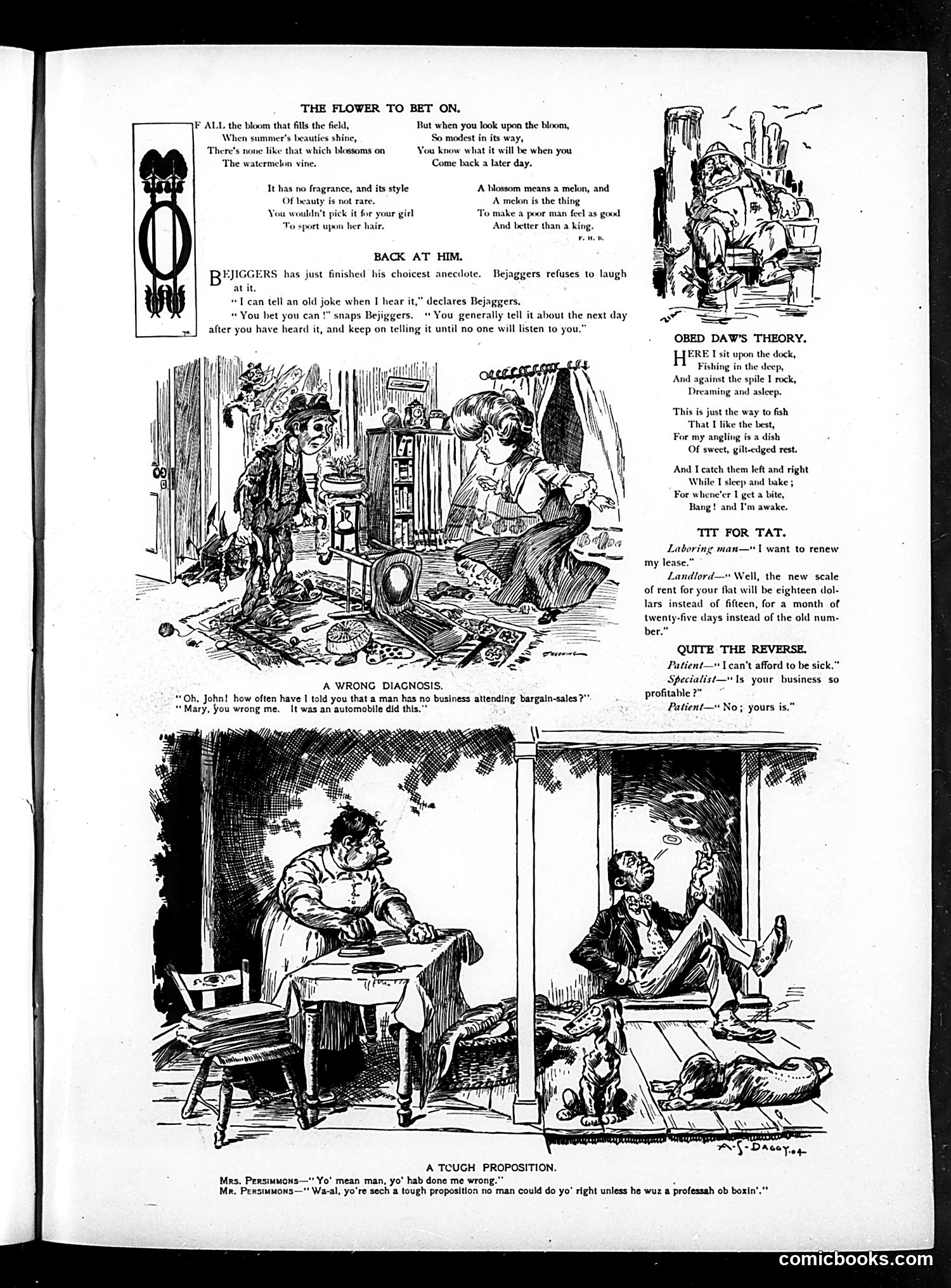
This page of early 20th-century satirical humor contains several unrelated comic vignettes: **"The Flower to Bet On"** celebrates the watermelon—a working-class fruit that reliably produces value, unlike ornamental flowers. The poem humorously contrasts its lack of aesthetic appeal with its practical worth to poor men. **"Back at Him"** is a simple joke about someone who compulsively retells old anecdotes and gets called out for it. **"Obed Daw's Theory"** humorously presents lazy fishing—sleeping while waiting for bites—as an ideal leisure activity. The remaining sections ("Tit for Tat," "Quite the Reverse," "A Wrong Diagnosis," "A Tough Proposition") are brief comedic exchanges about landlords raising rent, a doctor's profitable business, a man injured at bargain sales, and marital conflict. **The "Tough Proposition" cartoon uses dialect humor** featuring African American characters (indicated by the phonetic speech pattern), common to period humor magazines, though such stereotyping would be considered offensive today. The jokes center on everyday frustrations: inflation, medical costs, consumer culture, and relationships.
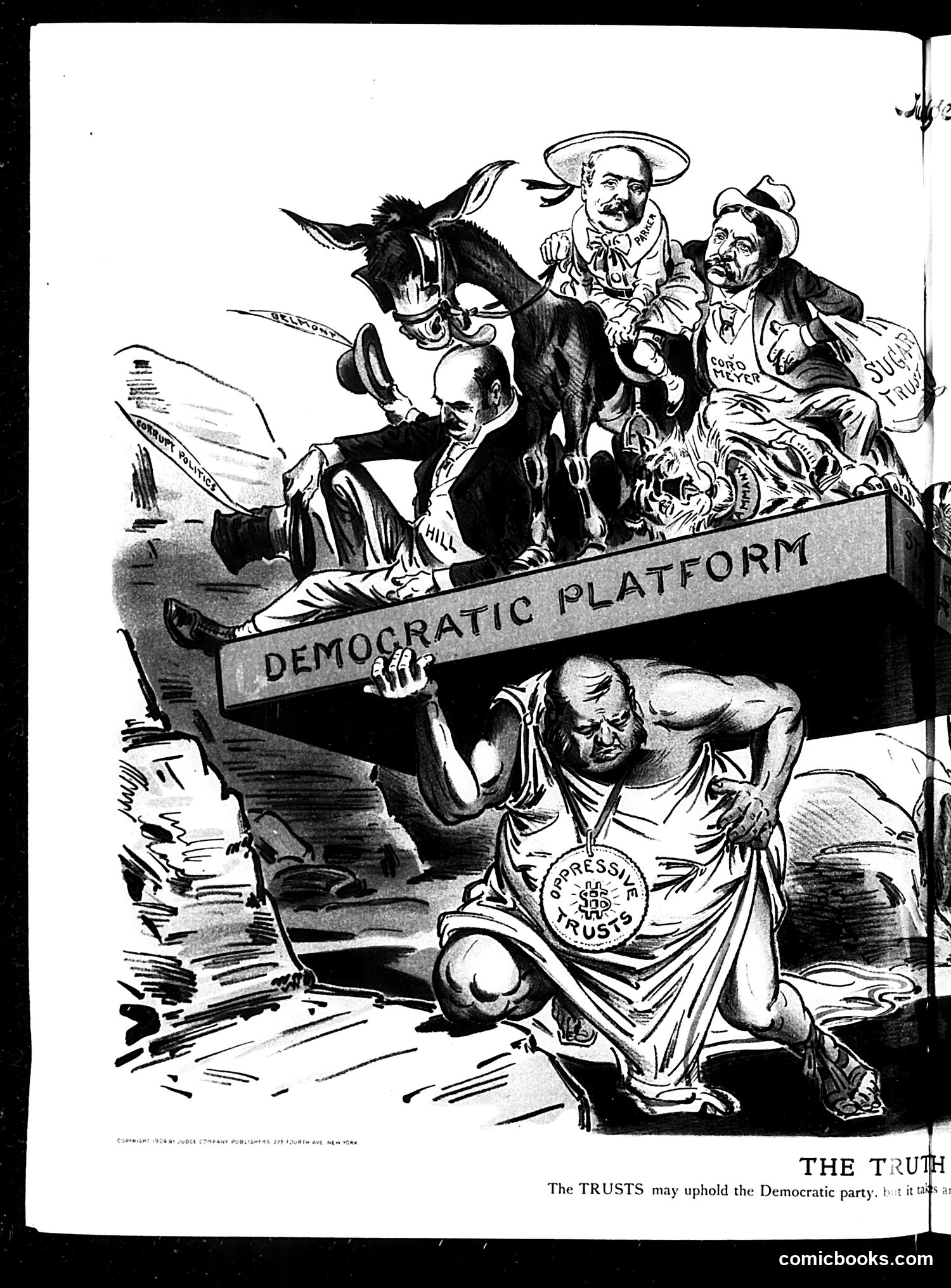
This political cartoon critiques the relationship between corporate trusts and the Democratic Party. The "Democratic Platform" is literally being held up by a grotesque figure labeled "Monopoly Trusts"—suggesting trusts artificially support Democratic politics rather than genuine democratic principles. The platform stands precariously on this unstable foundation while well-dressed politicians ride atop it. The mountainous pile of papers below labeled "Trusts" indicates massive corporate influence. The cartoon's message: the Democratic Party depends on monopolistic business interests for its power, undermining democratic integrity. The satire warns that trusts control politics from behind the scenes, making the Democratic platform merely their puppet. The exaggerated, unflattering caricatures emphasize the corruption implied by this arrangement. This reflects late 19th/early 20th-century anxiety about concentrated corporate power in American politics.
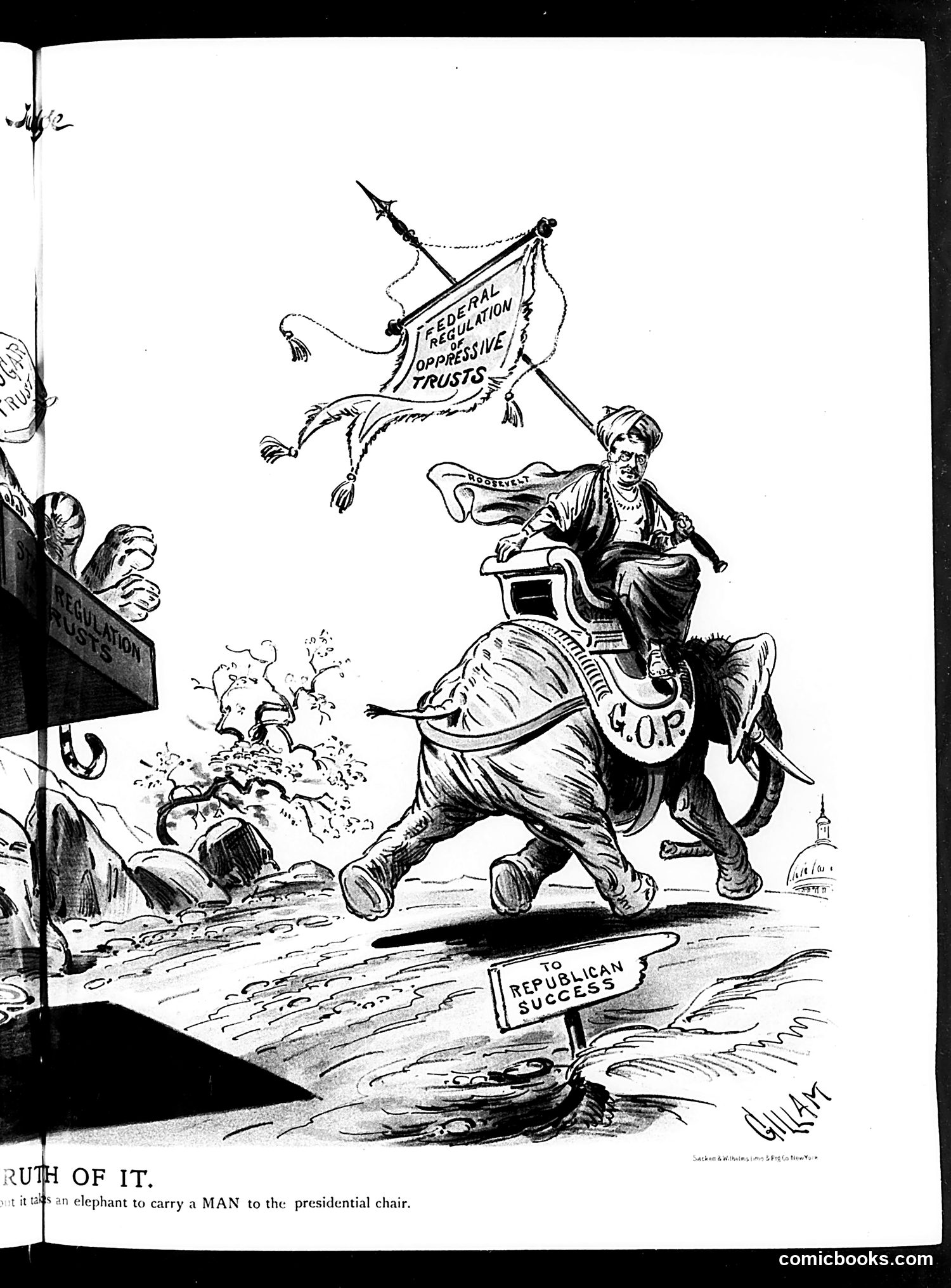
This cartoon satirizes Republican electoral strategy. The figure riding an elephant (the Republican Party symbol) toward "Republican Success" represents a GOP candidate being carried to the presidency. The elephant is labeled "G.O.P." (Grand Old Party). Above, a tattered flag reading "Federal Regulation of Oppressive Trusts" appears to be falling or abandoned—suggesting Republicans have discarded this policy position. On the left, figures representing "Regulation" and other interests appear frustrated or defeated. The cartoon's title, "Ruth of It," plays on "truth"—criticizing what the cartoonist saw as Republican hypocrisy: using the elephant's power to reach the presidency while abandoning promises to regulate monopolistic trusts that harmed ordinary citizens.
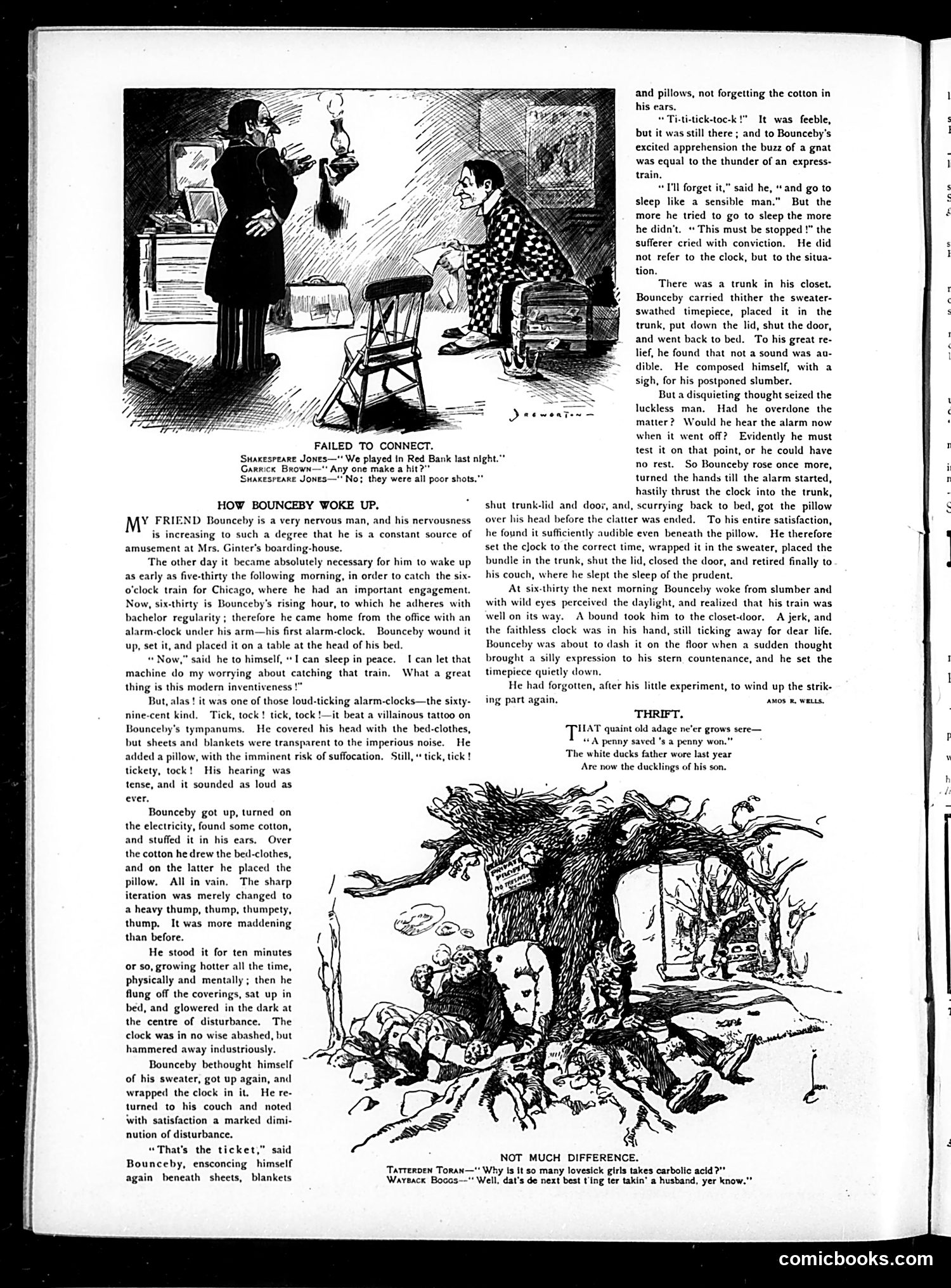
This is a comedic short story illustrated with line drawings, not political satire. It mocks a nervous, anxious man named Bounceby who purchases his first alarm clock to catch an early train. The joke centers on his neurotic overreaction: the loud ticking drives him progressively mad. He attempts increasingly absurd solutions—cotton in ears, wrapping it in a sweater, locking it in a trunk—each time doubting whether he'll actually hear the alarm. The satire targets not politics but **modern anxieties about new technology**. The alarm clock represents how contemporary mechanical devices, meant to solve problems, instead create neurotic stress. Bounceby's escalating panic satirizes the nervous tension of modern urban life and contemporary anxieties about industrial-age gadgetry. The humor relies on his self-aware hysteria being both relatable and ridiculous to Judge's readers.
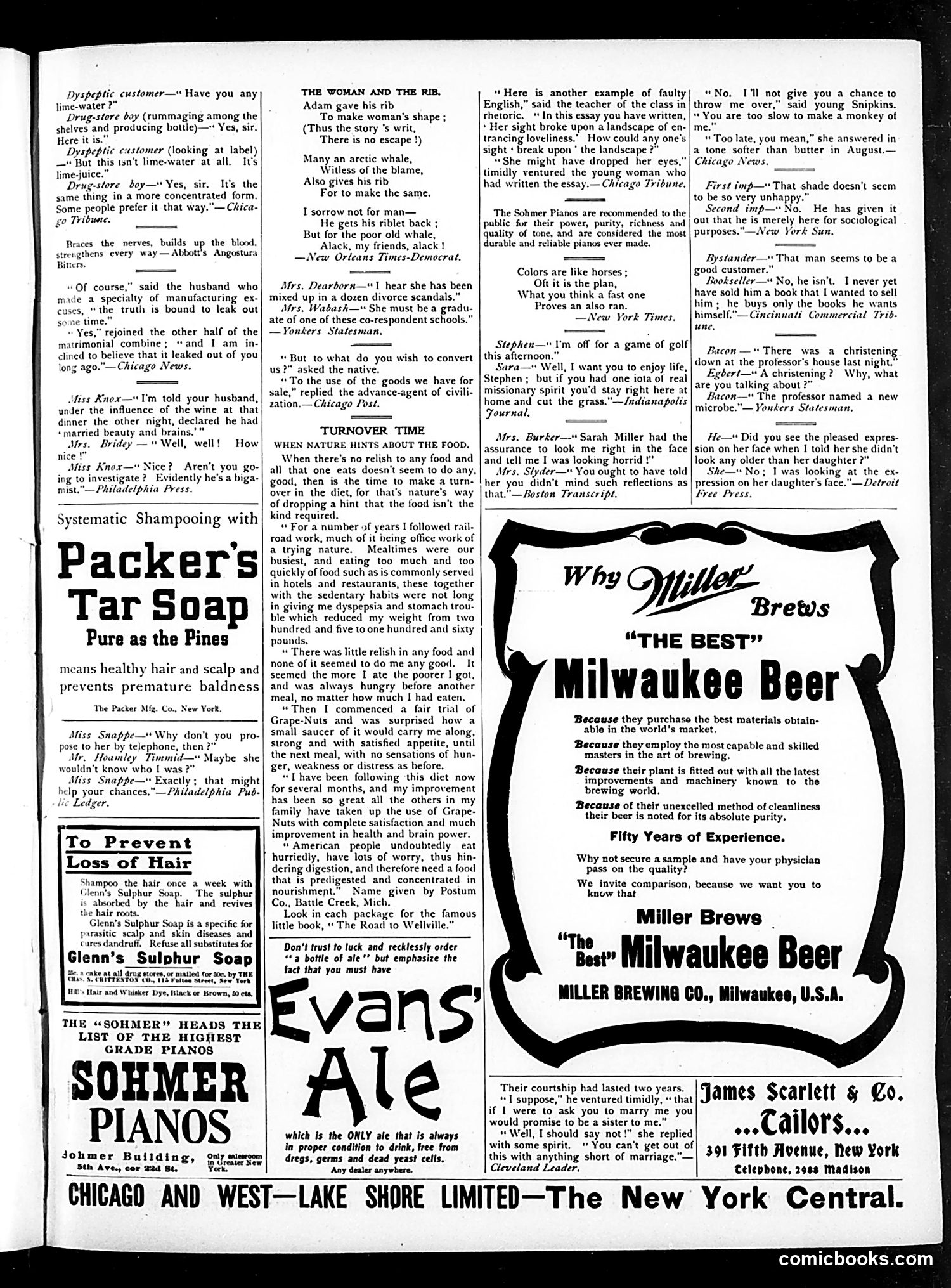
This page is primarily **advertising and humor columns**, not political satire. The content includes: **Humor Pieces**: Short, unrelated jokes about domestic life, miscommunication, and social awkwardness—typical early-20th-century light humor. Examples include a dyspeptic customer confused about lime-water versus lime-juice, and a nervous man afraid to propose by telephone. **Advertisements**: The page features several product ads (Packer's Tar Soap, Glenn's Sulphur Soap, Sohmer Pianos, Miller Brews beer, James Scarlett tailors) mixed throughout—standard for Judge magazine's revenue model. **Verse**: A short poem titled "The Woman and the Rib" makes a mild biblical joke comparing woman's creation from Adam's rib to whales' ribs used in corset-making. **Testimonial**: A longer piece about Grape-Nuts cereal improving digestion after years of railroad work. None of this content carries significant political meaning or social commentary—it's simply entertainment and commercial content typical of period magazines.
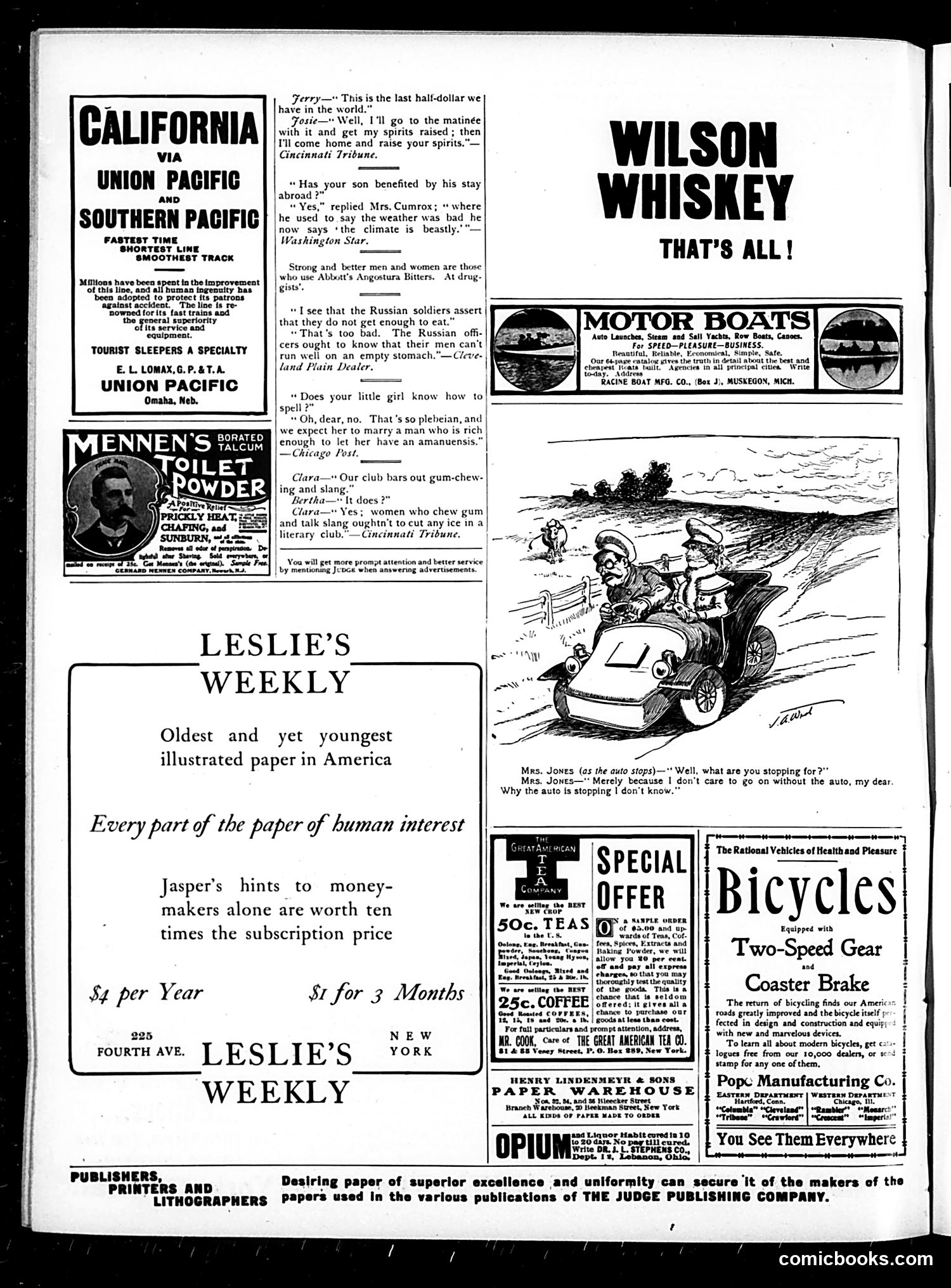
This is primarily an **advertising page** from Judge magazine, with several brief humorous items interspersed. The main content consists of period advertisements for railroads (Union Pacific), talcum powder, Leslie's Weekly magazine, motor boats, bicycles, tea, and other products typical of early 20th-century American commerce. The small humor pieces are brief social jokes, including one about a couple arguing over why their automobile has stopped (the joke being the wife doesn't know—she just knows it has), and exchanges mocking affectation (a woman expecting to marry a rich man so she needn't learn spelling, and another about women who chew gum being unsuitable for literary clubs). These represent light, accessible humor about courtship, class aspiration, and emerging automobile culture. The page primarily serves Judge's business function: selling advertising space while maintaining reader interest with genteel satire about American social pretensions.
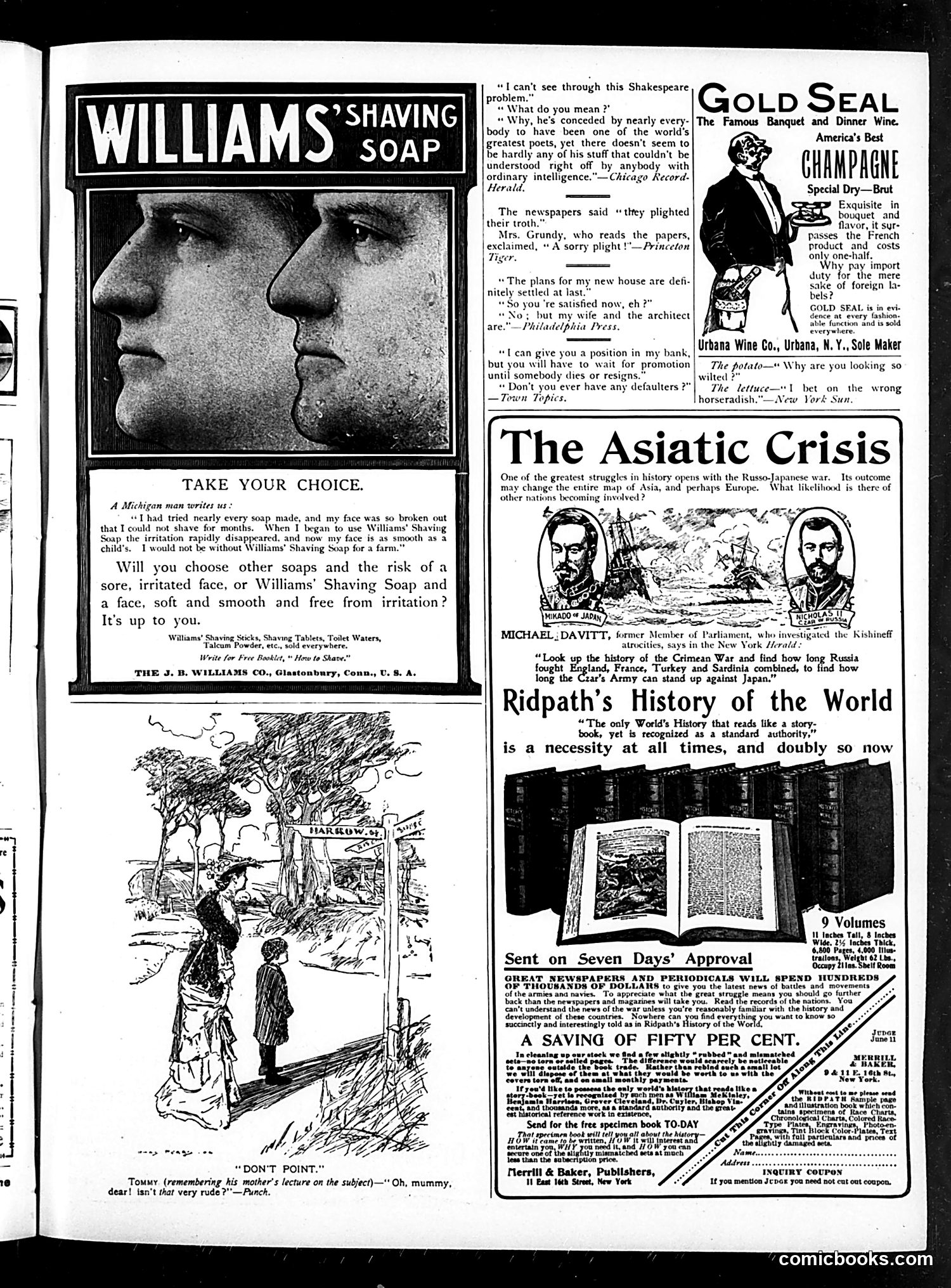
This page mixes advertisements with brief satirical jokes typical of early 1900s Judge magazine. **Main Content:** The largest ad promotes Williams' Shaving Soap, using before/after imagery and testimonials about skin irritation relief—standard product advertising. **Satirical Jokes:** Several short pieces mock contemporary issues: - A joke about Shakespeare's difficulty: his reputation as a "greatest poet" contradicts how easily his work can be understood by ordinary people—satire on pretentious literary criticism - "Mrs. Grundy" (a stock character representing conventional morality) misunderstands newspaper phrase "plighted their troth" as "sorry plight"—mockery of prudish sensibilities - A bank job joke about waiting for promotion "until somebody dies"—cynicism about corporate advancement **Secondary Ads:** Gold Seal Champagne (claiming superiority to French imports at half price) and Ridpath's History of the World, tied to coverage of the Russo-Japanese War ("The Asiatic Crisis"). The page reflects early 1900s concerns: product efficacy, social propriety, class anxieties, and contemporary geopolitics—all filtered through Judge's characteristic snark.
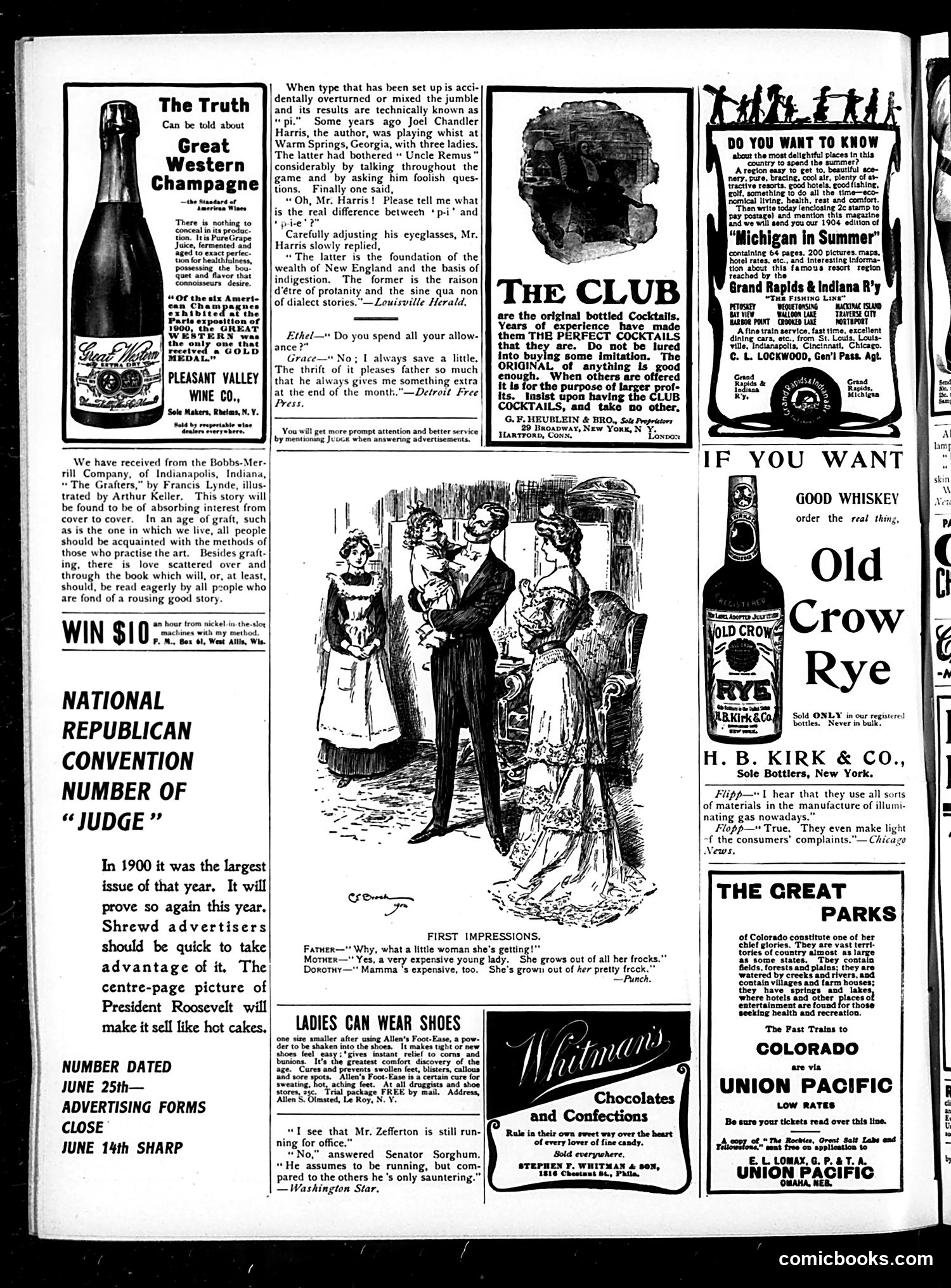
This single-panel cartoon depicts a domestic scene with three figures—a father, mother, and young daughter named Dorothy. The humor centers on a play on words about expense. The father remarks that the growing daughter is becoming "a little woman," prompting the mother to explain she's "a very expensive young lady" because she outgrows her clothing so quickly. Dorothy then delivers the punchline: "Mamma's expensive, too. She's grown out of her pretty freck[s]." The joke relies on a double meaning of "grown out of"—the daughter interprets it literally (the mother no longer fits into her clothes), while the mother meant it figuratively (the daughter costs money). This reverses expectations by suggesting the mother has become physically less attractive, a mild insult masked as innocent childish misunderstanding. It's gentle Victorian-era humor about aging, weight gain, and children's tactlessness—typical of the *Punch* magazine style credited here.
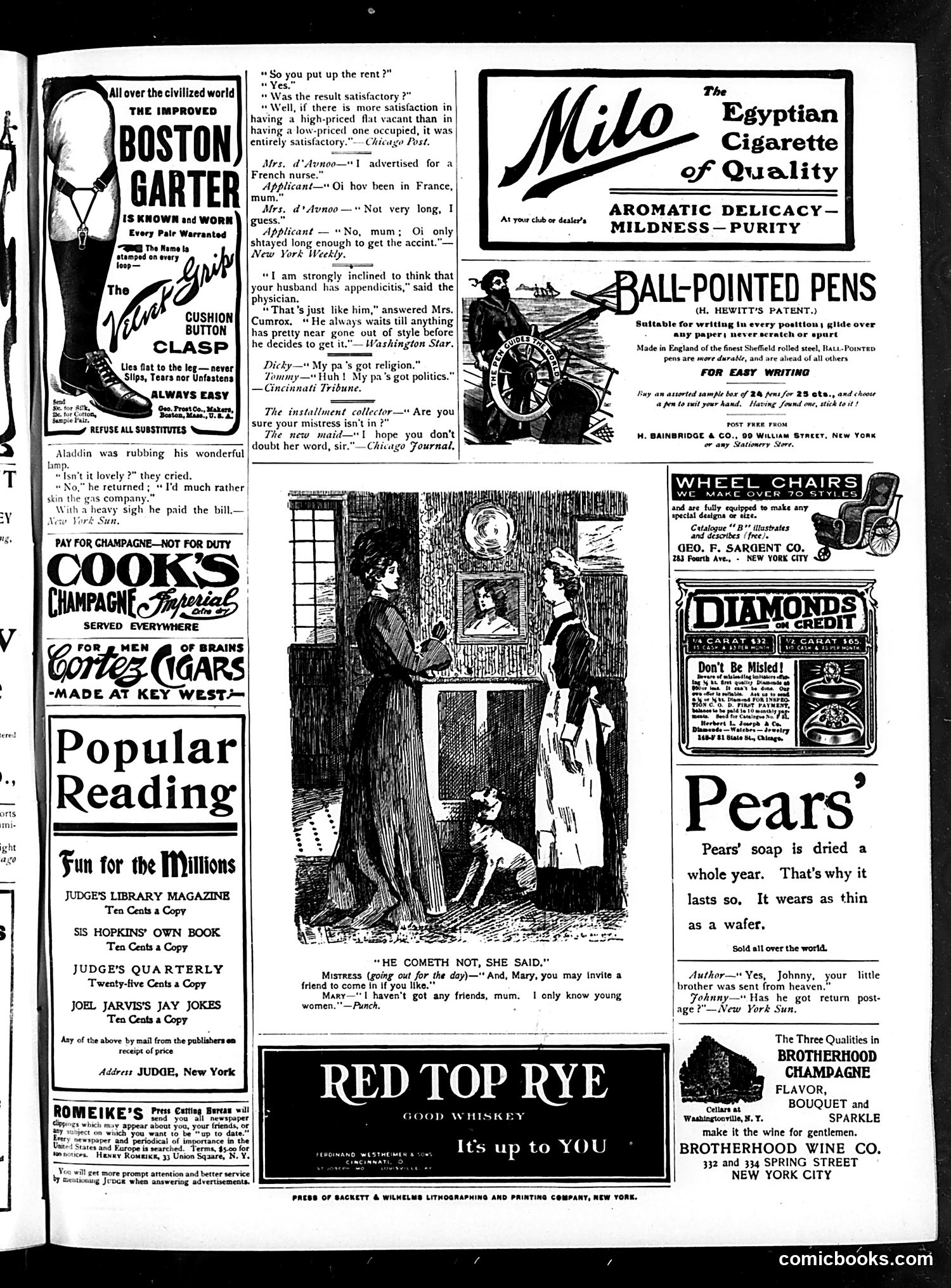
This is primarily an **advertising page** from Judge magazine, with a few brief humorous anecdotes interspersed. The small cartoons and jokes address early 20th-century domestic and social concerns: - **Rent disputes**: A landlord raises rent, resulting in a vacant apartment rather than occupied tenancy—satirizing rigid property management. - **French governesses**: A comedic exchange mocking an applicant's claim to French experience gained from a brief stay. - **Medical fashion**: A joke about a husband delaying getting appendicitis treatment until the ailment becomes fashionable—satirizing social pretension. - **Domestic staff**: A maid admits to knowing only "young women," not "friends," implying servants occupied a separate social sphere. The bulk of the page features period advertisements for cigarettes, champagne, pens, wheel chairs, and soap—representing typical consumer goods marketed to Judge's middle and upper-class readership. The messaging emphasizes quality, imported goods, and genteel consumption.
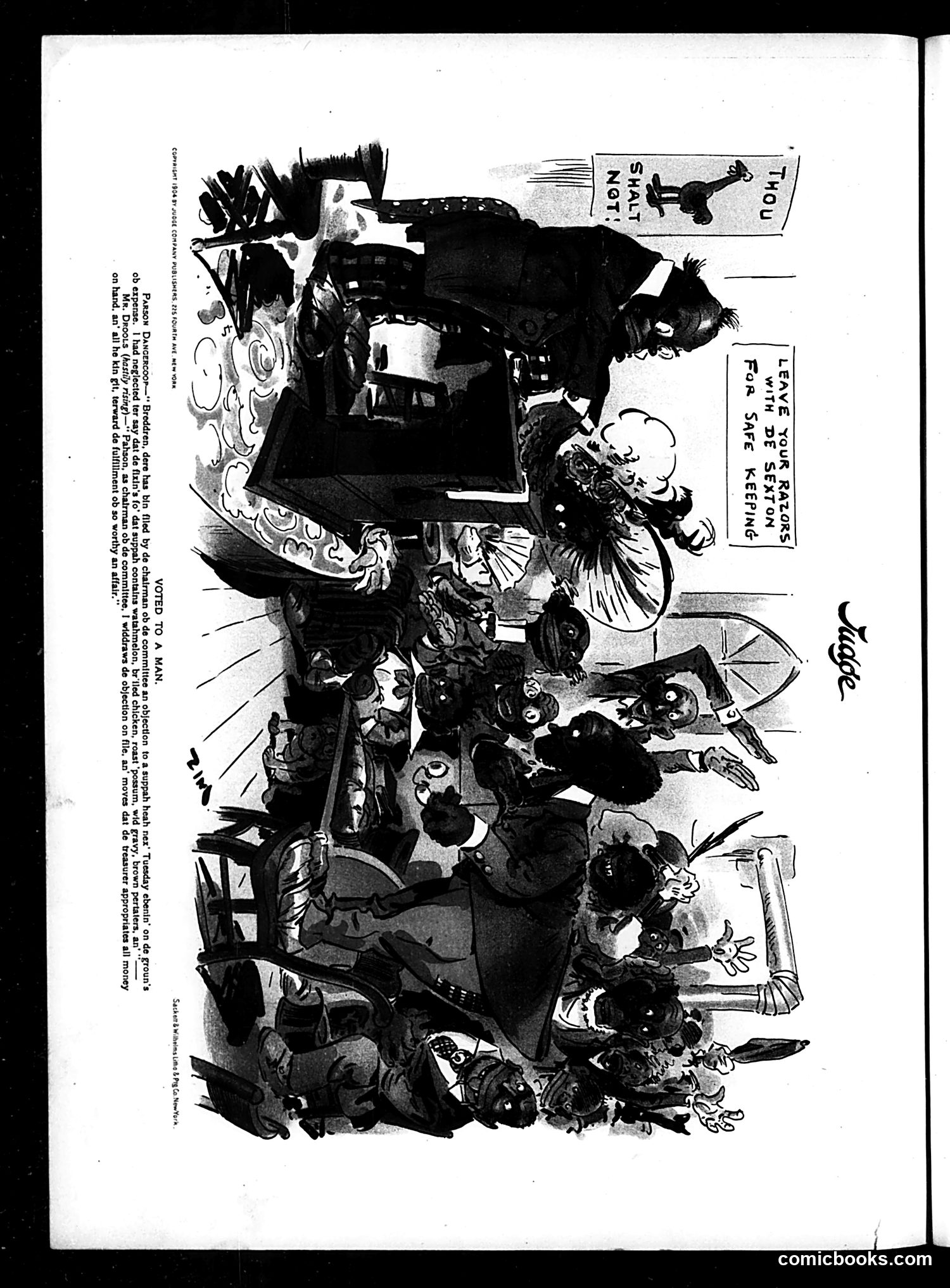
This page satirizes African American church governance through racist caricature and dialect. The cartoon depicts a church meeting where a treasurer objects to funding a planned supper on grounds of expense. When the chairman mentions the menu—watermelon, fried chicken, possum, and potatoes—the treasurer immediately withdraws his objection and moves to spend all available funds. The satire relies on dehumanizing racial stereotypes: exaggerated dialect spelling ("Breddren," "terward"), depiction of Black men as motivated primarily by stereotypical "soul food," and the implication that financial responsibility dissolves when such foods are mentioned. The cartoon mocks Black church organizations as frivolous and easily distracted. This reflects late-19th/early-20th-century white American prejudice, presenting racist caricatures as humor for Judge's white readership.