
A complete issue · 16 pages · 1904
Judge — April 16, 1904
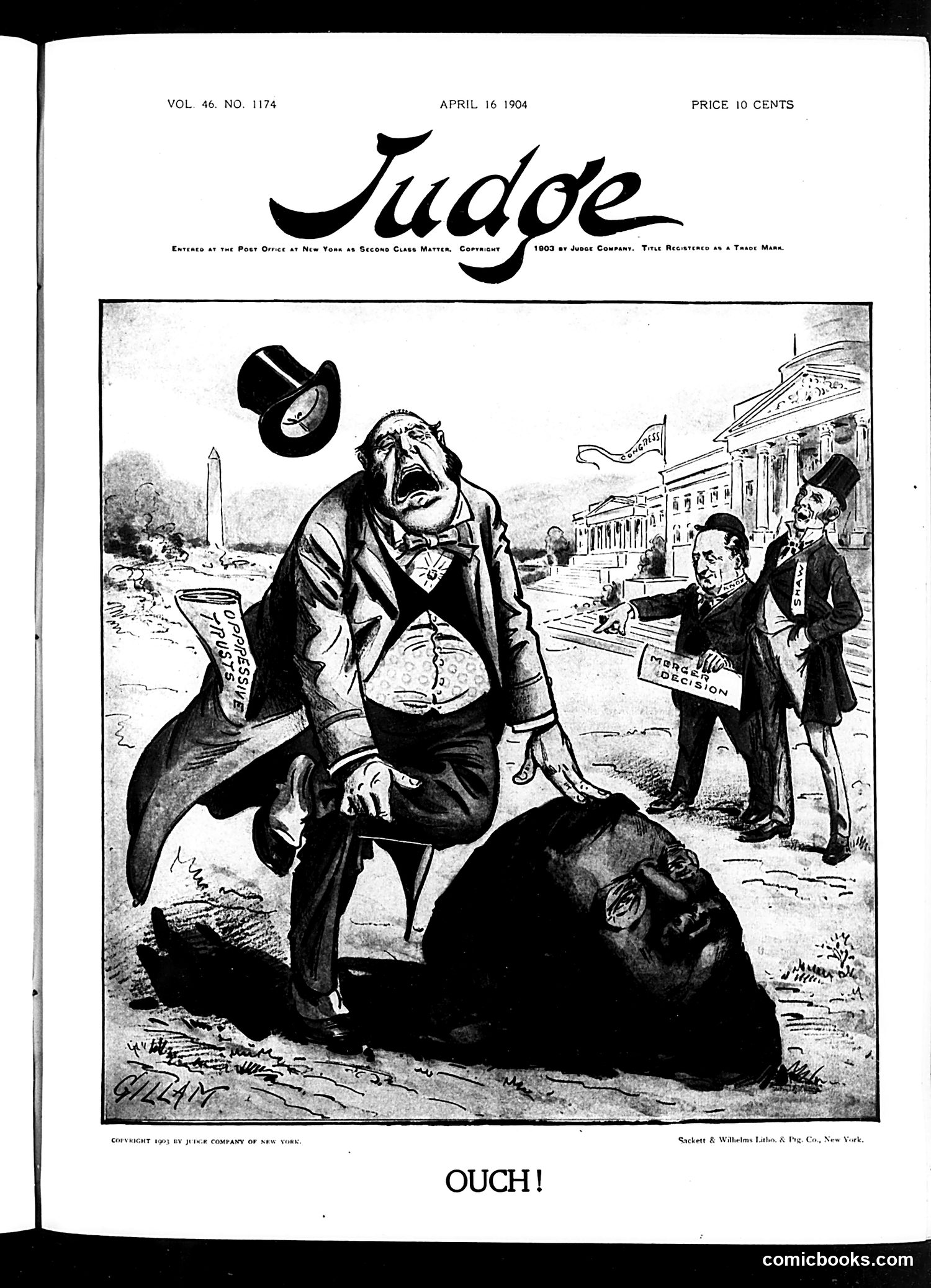
This political cartoon titled "OUCH!" depicts a man in formal attire being struck or kicked by what appears to be a large dark figure (possibly representing a political force or policy). The victim's top hat flies off, and he's shown in distress in front of the Capitol building in Washington, D.C. The seated figures in the background appear to be observing the scene with interest. The cartoon likely satirizes a political controversy or legislative defeat affecting a prominent political figure of 1904—possibly related to Theodore Roosevelt's administration or congressional proceedings—though the specific identity of the central figure and the exact political event referenced are unclear from the image alone.
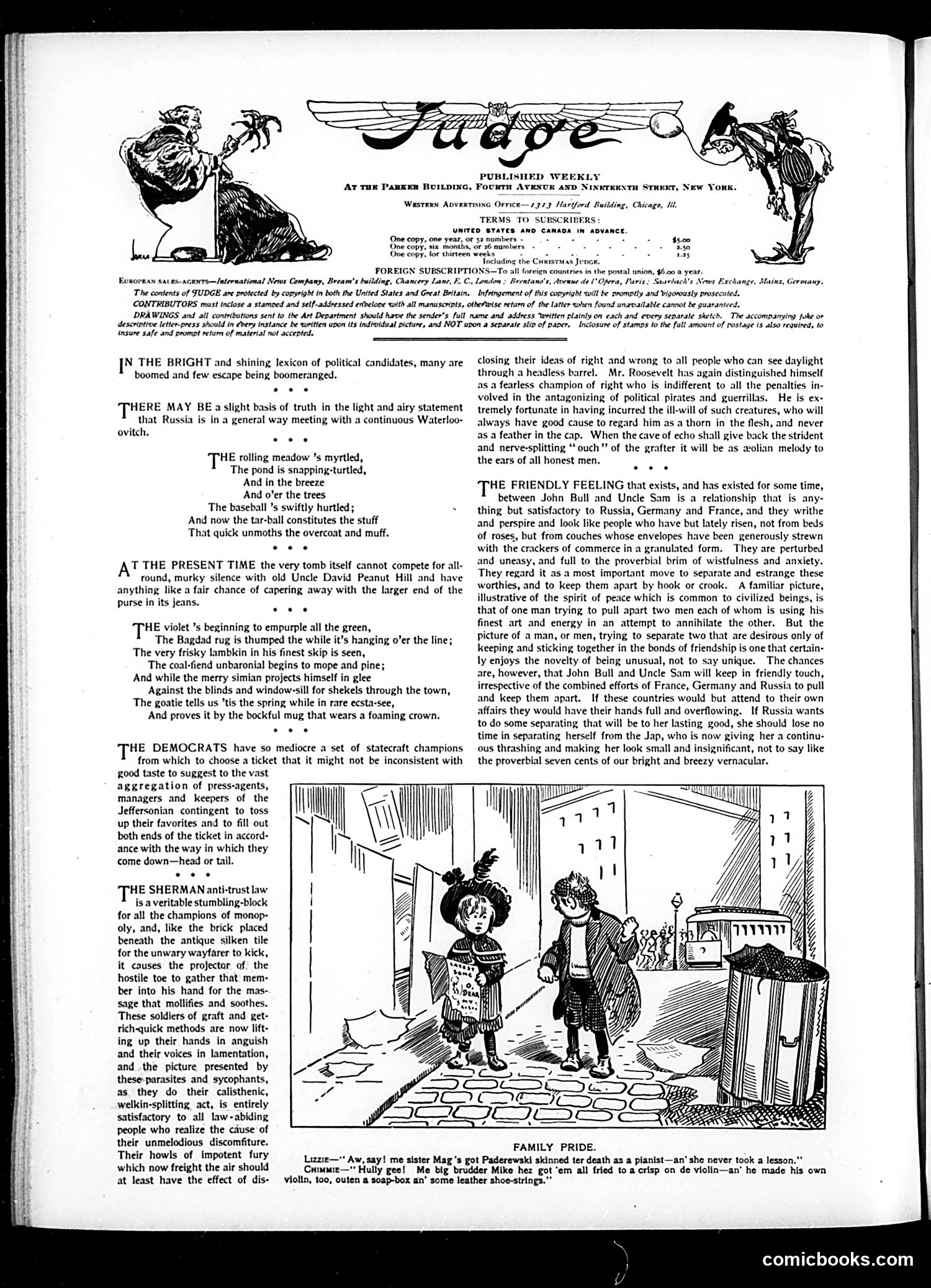
This page contains editorial commentary and poetry criticizing political figures of the era. The text praises President Roosevelt as "a fearless champion of right" who confronts political "pirates and guerrillas," suggesting he's taking a strong stance against corruption or foreign threats. The piece also discusses "John Bull and Uncle Sam"—British and American personifications—noting their friendly relations despite economic tensions with Russia, Germany, and France. The lower cartoon depicts two children (Lizzie and Cologne) discussing music lessons involving improvised instruments (a Paderewski-skinned rat, violin made from a soapbox and leather shoe-strings), satirizing poverty or scarcity conditions, though the specific historical context is unclear without additional dating information. The overall tone criticizes both domestic political corruption and international economic instability.
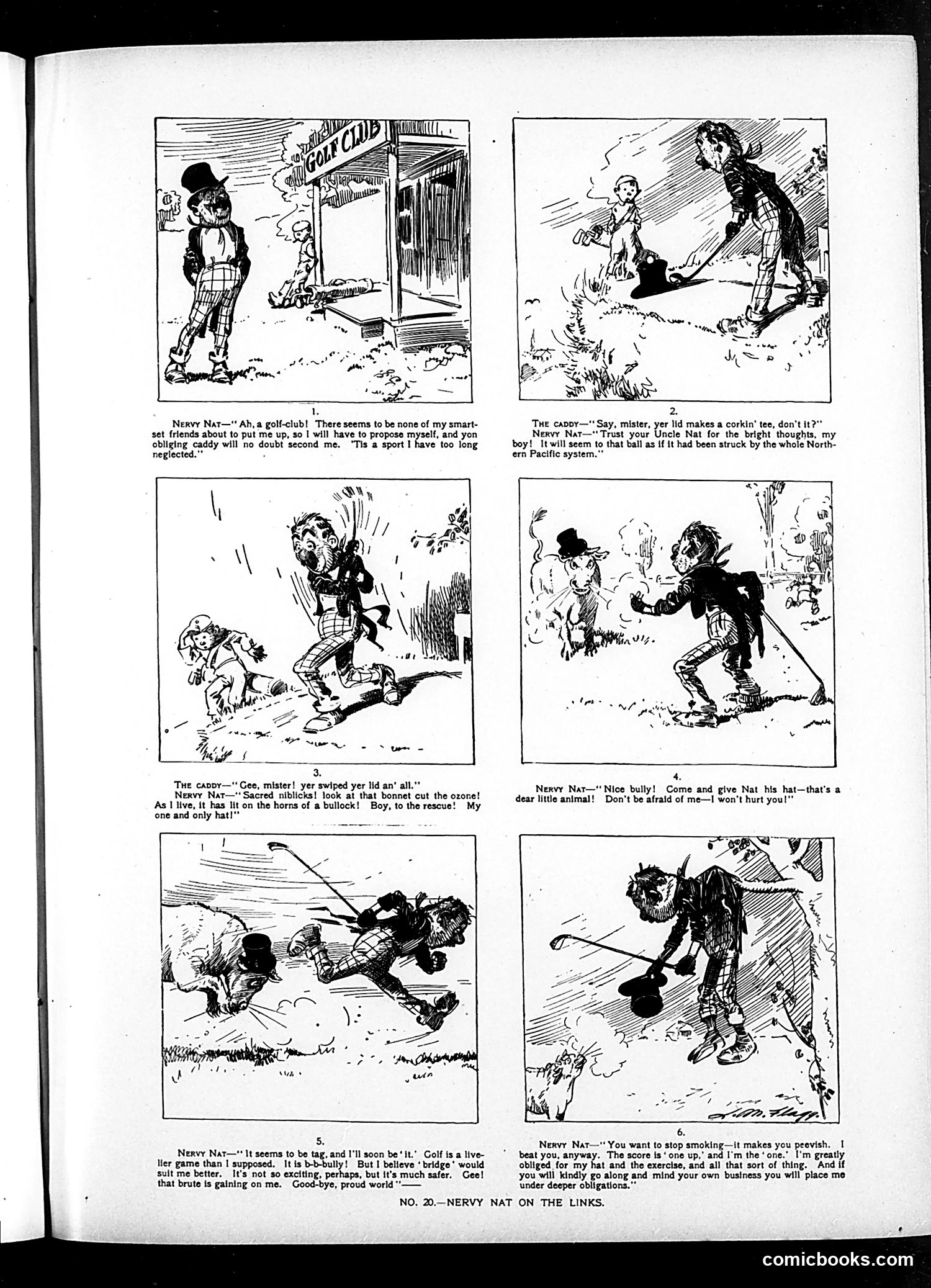
This is a comic strip about a character named "Nervy Nat" playing golf. The humor relies on slapstick physical comedy rather than political satire: Nat repeatedly gets into accidents and altercations while golfing—tangling with a bulldog, falling, being chased, and generally causing chaos on the golf course. The strip appears to be pure entertainment humor typical of early 20th-century Judge magazine comics, focusing on an impudent, accident-prone character navigating everyday situations for comedic effect. There are no apparent political figures or social commentary visible. The "nervy" character type was a common comic archetype of the era—brash, bold, and perpetually in trouble.
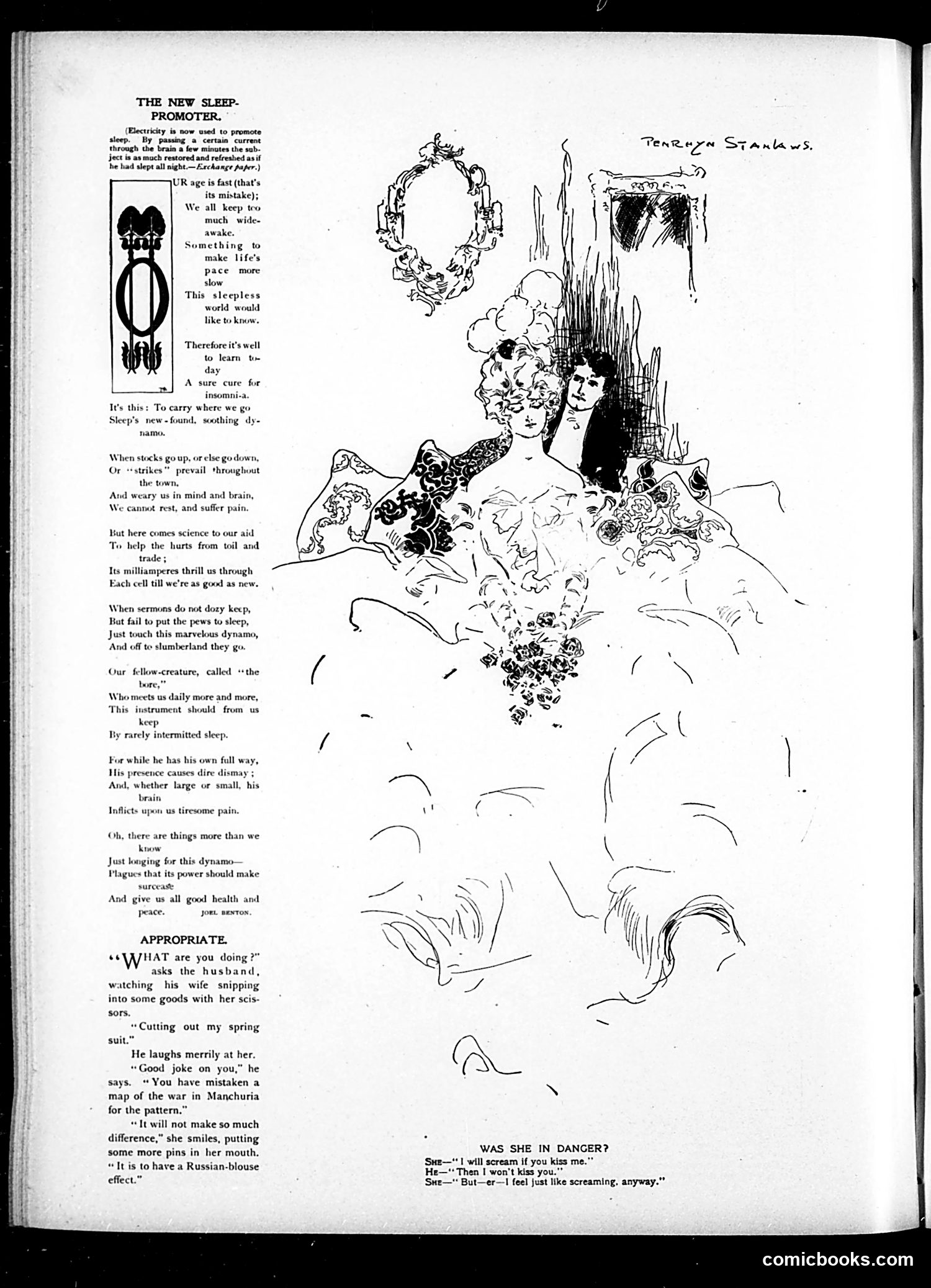
**"The New Sleep-Promoter"** (left) is a humorous poem advocating electricity as a cure for insomnia. It suggests using electrical current through the brain to induce sleep—a satirical jab at late-19th/early-20th-century pseudo-scientific medical devices that promised miraculous cures. **"Terpsichorean Stanches"** (right) is an illustration accompanying a brief comic dialogue titled "Was She in Danger?" The sketch depicts a woman at a dressing table, while the joke plays on a husband's misunderstanding—he confuses a sewing pattern for a "map of the war in Manchuria," suggesting he's distracted or inattentive. The Russo-Japanese War (1904-05) provides the historical reference point for contemporary readers' amusement at this domestic misfire.
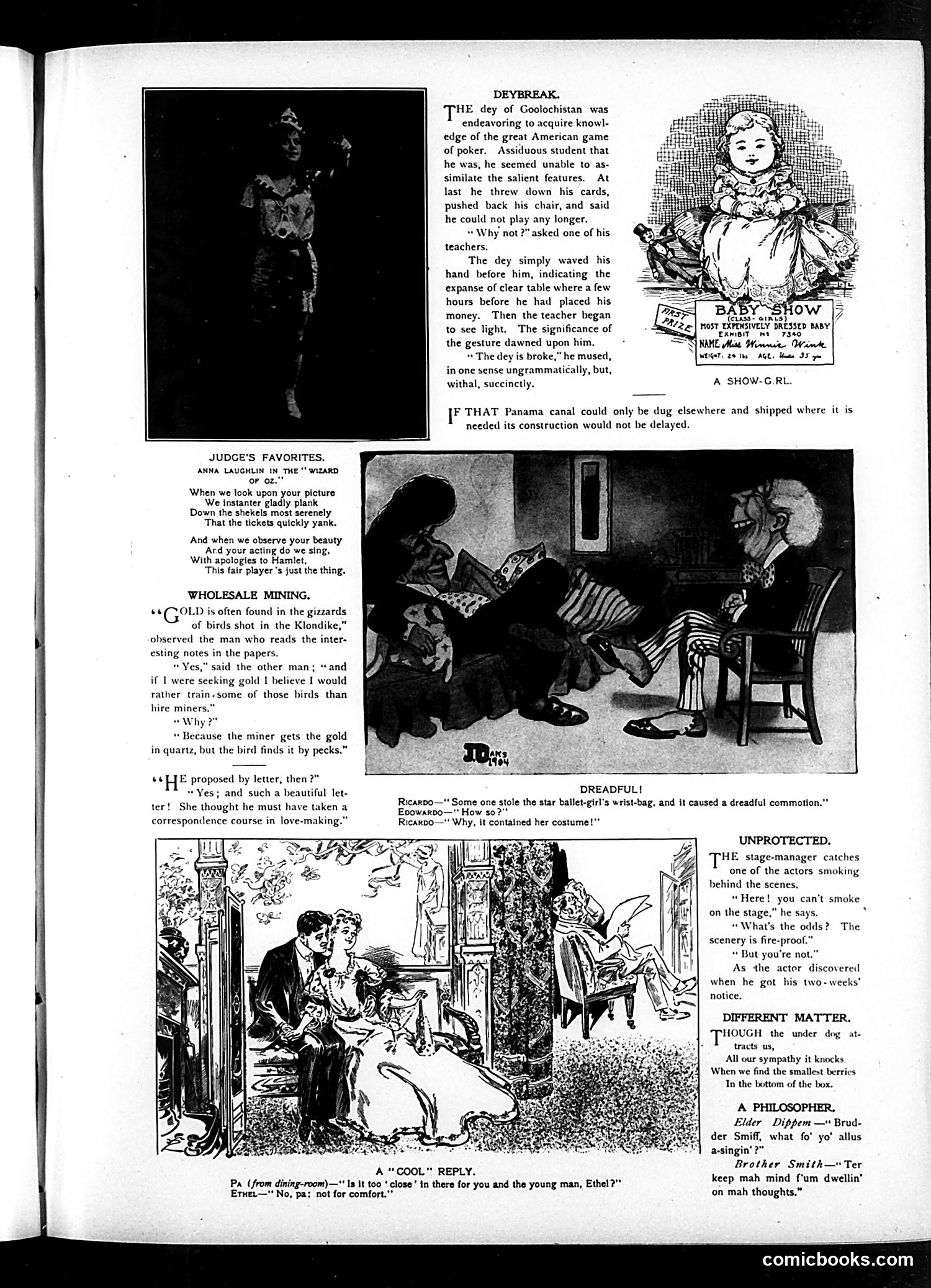
This page contains multiple satirical items typical of early 20th-century humor: **"Daybreak"**: A joke mocking a foreign ruler (the "dey of Goolochistan"—likely referencing Ottoman Turkish officials) who loses all his money at poker, then cannot continue playing. The satire targets both the foreigner's naïveté about American games and the inevitability of losing money gambling. **Panama Canal aside**: A brief joke suggesting the canal's construction delays could be solved by digging it elsewhere—absurdist satire on engineering/political incompetence. **Other items**: Theater and show-business gossip ("Judge's Favorites," "Dreadful," "Unprotected") typical of the era, plus dialect-heavy ethnic humor ("A Philosopher") and domestic comedy ("A Cool Reply"). The page reflects early 1900s Judge content: foreign mockery, gambling criticism, theater chitchat, and broad comedy with heavy reliance on racial/ethnic caricature—offensive by modern standards but standard for contemporary American satirical magazines.
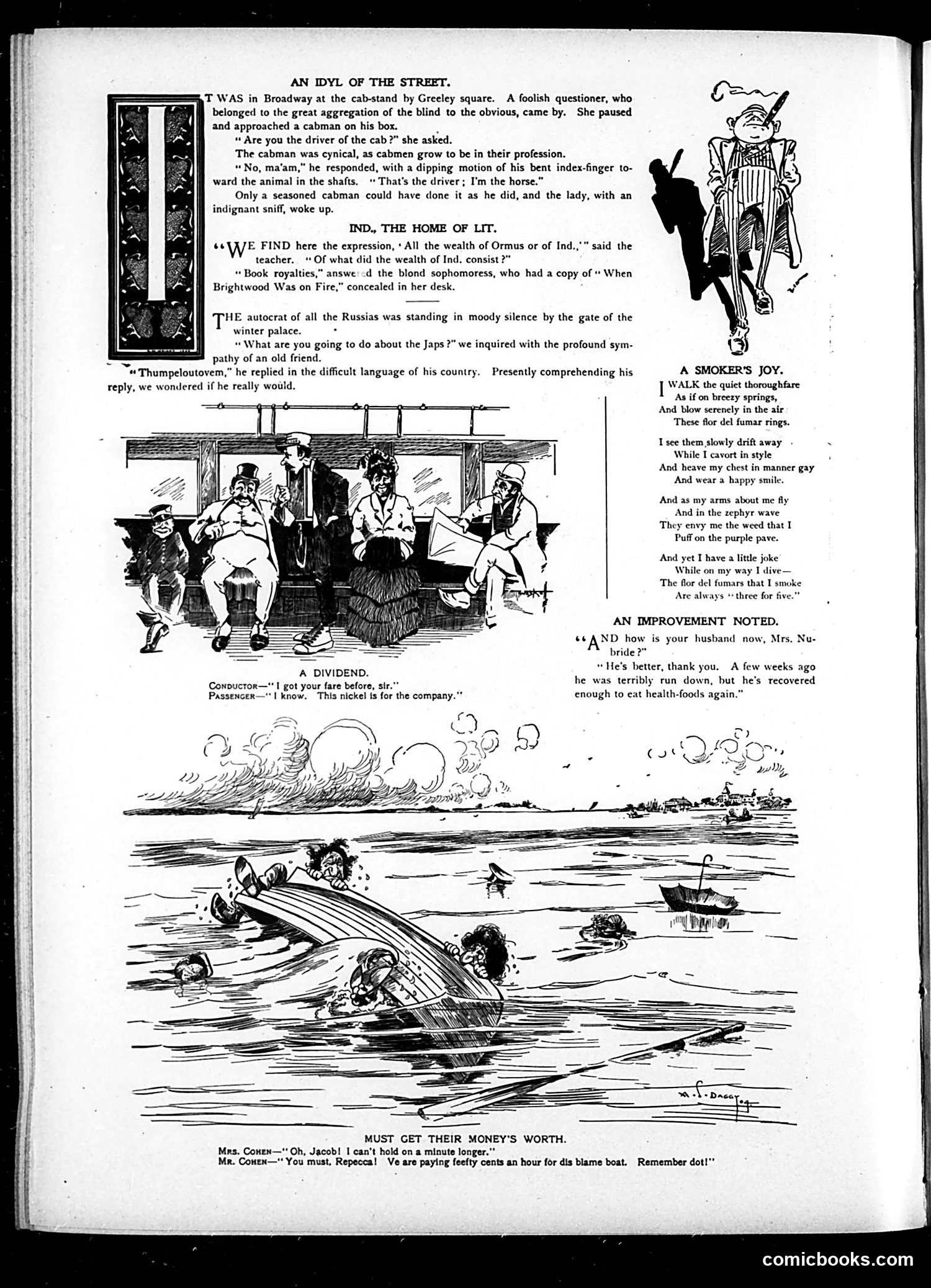
This page contains multiple satirical vignettes typical of early 20th-century American humor: **"An Idyl of the Street"**: A woman asks a Broadway cabman if he's the driver; he cynically responds that *he's* the horse and points to the animal—mocking tourists' obliviousness and cabmen's world-weary wit. **"Ind., The Home of Lit."**: A schoolgirl answers that "Ind." (India)'s wealth consists of "book royalties," revealing she's smuggling a novel ("When Brightwood Was on Fire") to class—satire on students' priorities over actual education. **Russian autocrat joke**: References the Russo-Japanese War (1904-05), with the unnamed Russian leader (likely Tsar Nicholas II) responding in incomprehensible Russian when asked about Japan strategy—mocking his indecisiveness during this military disaster. **"A Smoker's Joy"** and **"An Improvement Noted"**: Light domestic humor about marital life. **"Must Get Their Money's Worth"**: Jewish immigrants (indicated by dialect) overstay a rental boat to extract value—ethnic stereotype humor common in the era.
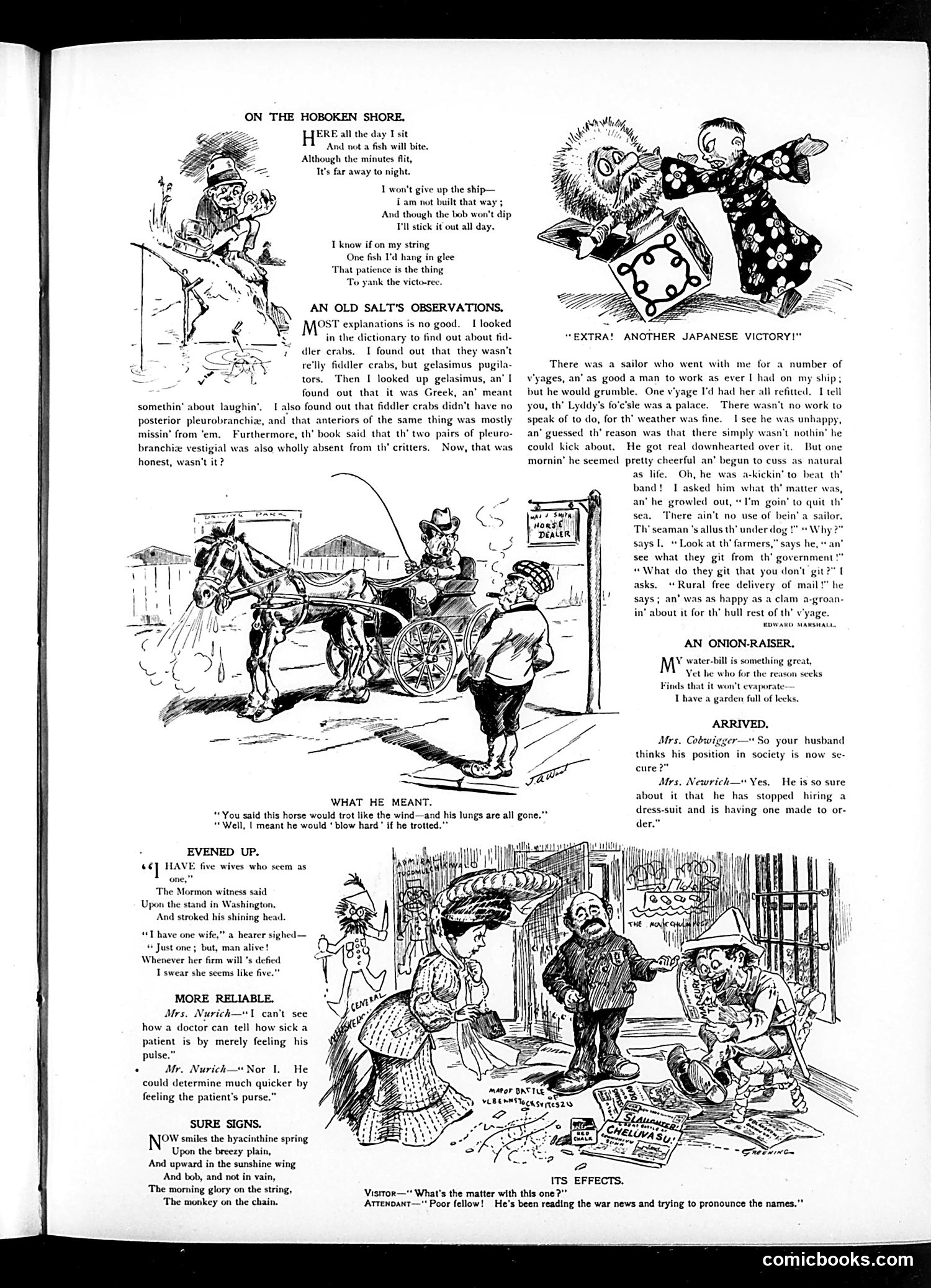
This page from Judge contains several satirical pieces reflecting early 20th-century American humor: **"Extra! Another Japanese Victory!"** references Japan's military victories, likely during the Russo-Japanese War (1904-05), which dominated contemporary news. **"What He Meant"** satirizes deceptive salesmanship—a horse seller's claim that the animal would "blow hard" if trotted, a play on words mocking commercial dishonesty. **"More Reliable"** jokes that doctors determine patients' wealth ("purse") better than their actual health through pulse-feeling—social commentary on materialism. The page also includes poems and brief anecdotes mocking various subjects: fishing patience, Mormon polygamy testimony, spring weather, and naval life complaints about lack of hardship. **"Its Effects"** shows a newspaper reader struggling to pronounce Japanese names from war coverage—gentle satire of contemporary public interest in foreign affairs despite linguistic unfamiliarity. Throughout, the humor targets pretension, greed, and the absurdities of modern life.
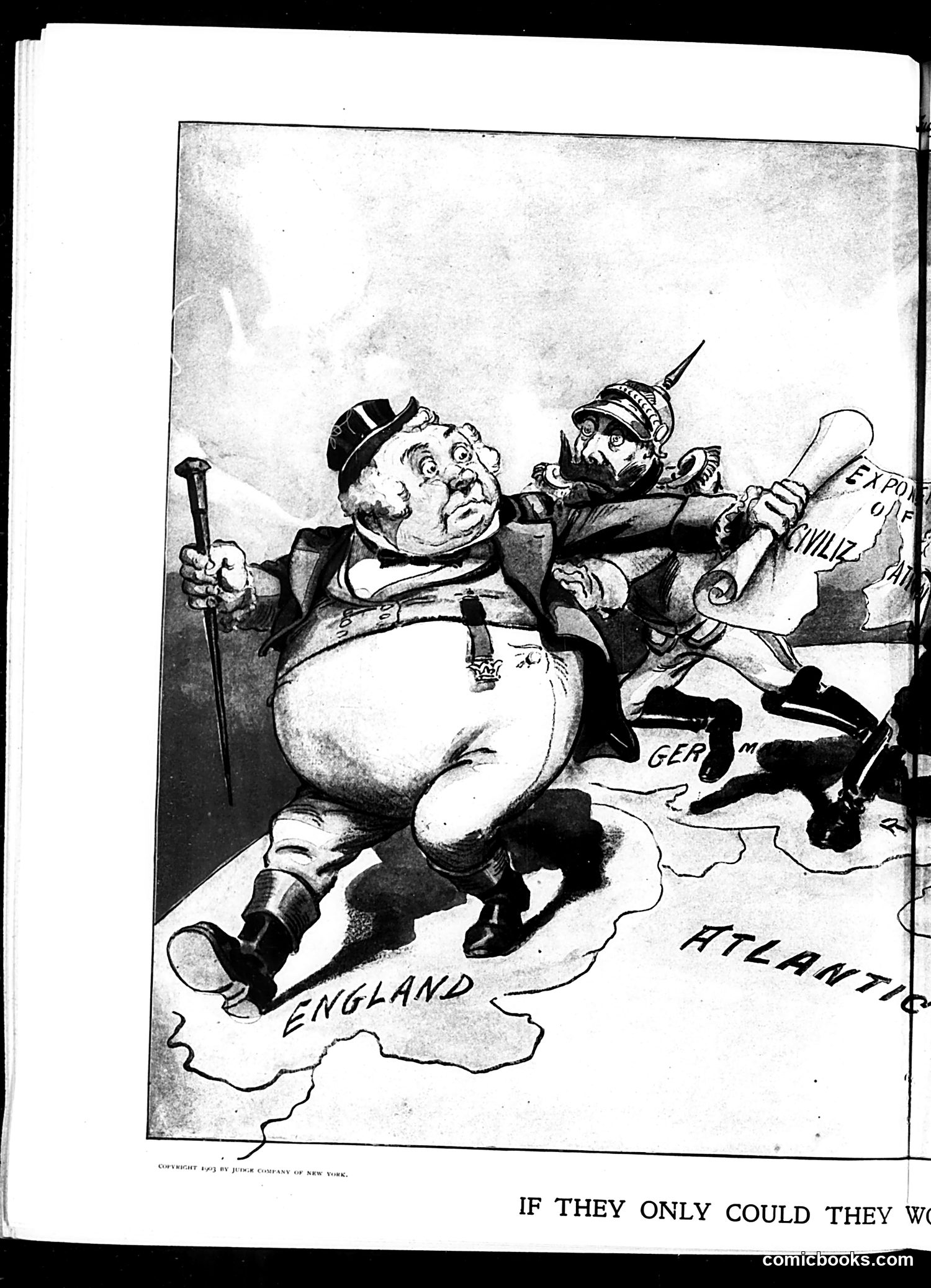
This Judge magazine cartoon depicts two figures on a map of England: a rotund man in formal dress (center) and a German military officer in a Prussian spiked helmet (right). The German figure appears to be restraining or attacking the British character while holding what looks like colonial expansion documents labeled "ILLIZ" and references to "EXPO" (possibly trade exposition or colonial claims). The labels "ENGLAND," "ATLANTIC," and "GER" (Germany) identify the geographic dispute. The title "IF THEY ONLY COULD THEY WO[ULD]" (text cut off) suggests frustration about Germany's imperial ambitions being thwarted. This likely satirizes pre-World War I tensions over colonial competition and naval rivalry between Britain and Germany, with the cartoon suggesting Germany wished to dominate British interests but was prevented from doing so.
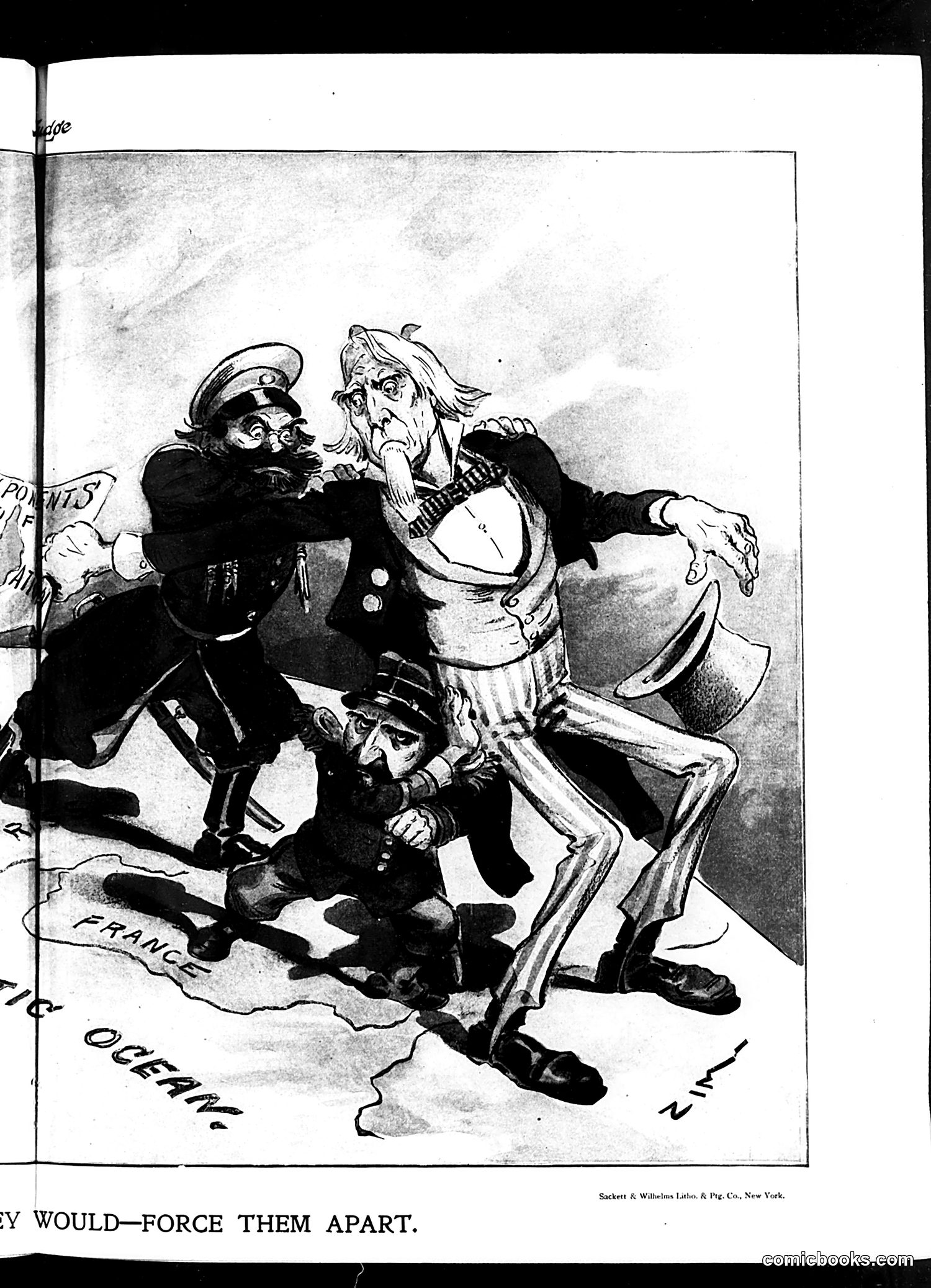
This political cartoon depicts a tall, bearded military figure forcibly separating two smaller figures labeled "France" and "Italy." The caption reads "...Y WOULD—FORCE THEM APART," suggesting the tall figure represents a power seeking to divide these nations. Based on the military uniforms, exaggerated caricature style, and the interwar period context of Judge magazine, this likely satirizes diplomatic tensions or military intervention regarding Franco-Italian relations. The cartoon criticizes intervention that would separate these nations—possibly referencing concerns about external powers (the tall figure remains unclear, but appears to be an authoritarian military leader) interfering in European affairs or threatening their alliance. The satire warns against such divisive foreign policy.
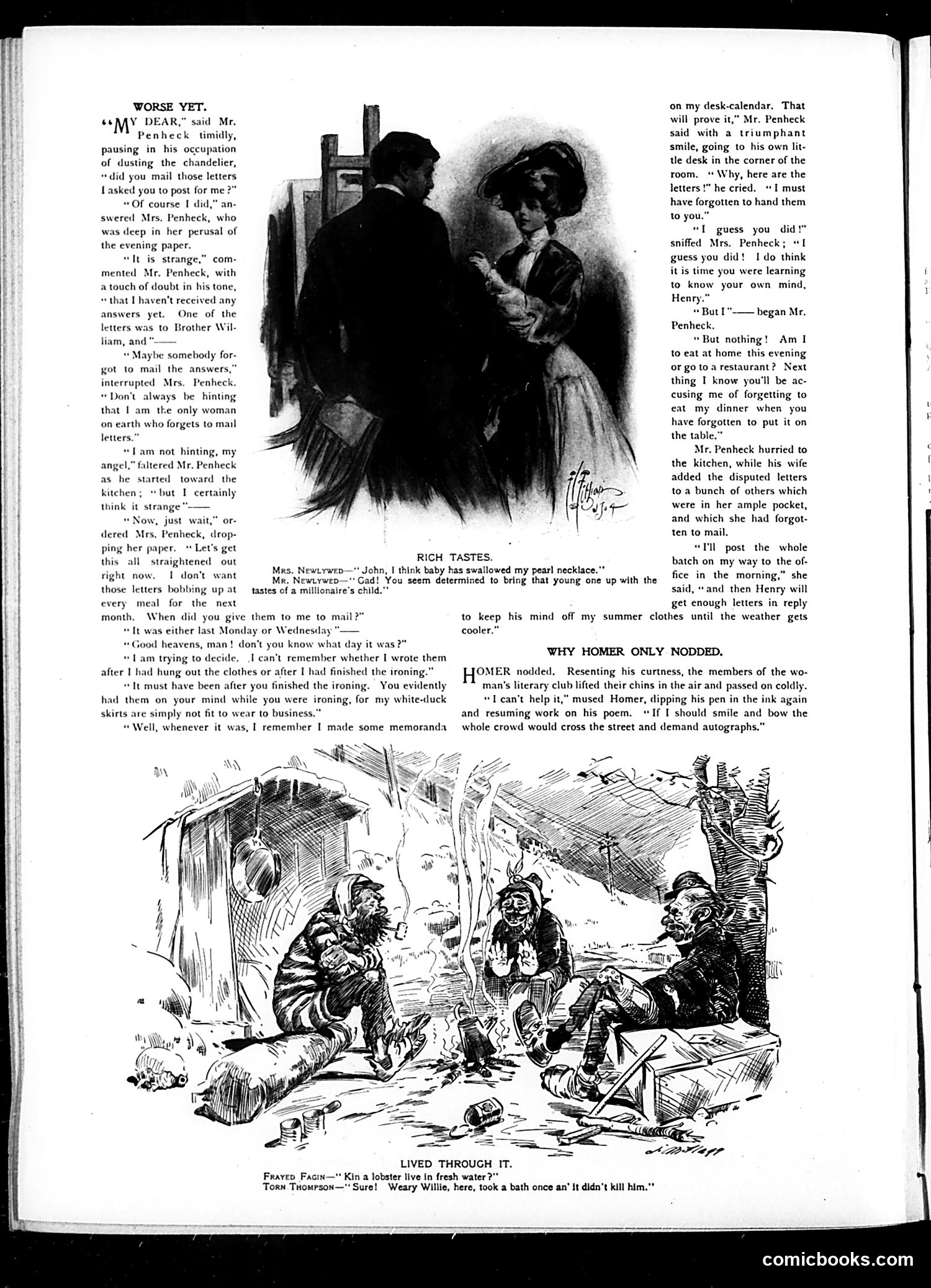
This page contains three domestic humor pieces satirizing early-20th-century middle-class marriage dynamics. **"Worse Yet"**: Mr. Penheck accuses his wife of forgetting to mail letters; she indignantly denies it, turning his complaint back on him. The irony—revealed at the end—is that *she* actually forgot to mail them, but successfully deflected blame onto him through aggressive defensiveness. The satire targets wives who use emotional manipulation and accusation to avoid accountability. **"Rich Tastes"**: A brief joke where a newlywed mother claims her baby swallowed her pearl necklace. The husband's response suggests she's deliberately raising the child with expensive tastes—satirizing wealthy or status-conscious parenting. **"Why Homer Only Nodded"**: A writer (Homer) curtly nods at women's club members rather than smiling, fearing that friendliness will encourage them to demand autographs. This mocks both celebrity-chasing behavior and the inconvenience famous people endure. The bottom cartoon, "Lived Through It," is a separate joke about a vagrant (Weary Willie) surviving a bath—unrelated to the marriage theme above.
This page from *Judge* magazine is primarily composed of advertisements and humorous short pieces typical of early 20th-century satirical publications. **Key content:** The cartoon/poem "A Heavenly Vision" depicts "Uncle" Jason, an African American character, dreaming of watermelons—this reflects the racist stereotype equating Black Americans with watermelon consumption that was prevalent in this era. "A Tired Brother" similarly uses dialect and religious imagery of an African American speaker, presenting a minstrel-style poem. **The broader context:** These pieces represent the casual racism embedded in mainstream American humor of the period. The stereotyped portrayals—broken dialect, watermelon imagery—were considered acceptable entertainment for *Judge's* white, educated readership. The page also contains numerous product advertisements (Sohmer Pianos, Egyptian Deities cigarettes, etc.) typical of magazine monetization, alongside light domestic humor and anecdotes unrelated to the racist content. This material illustrates how systemic racism was normalized through popular cultural outlets during this era.
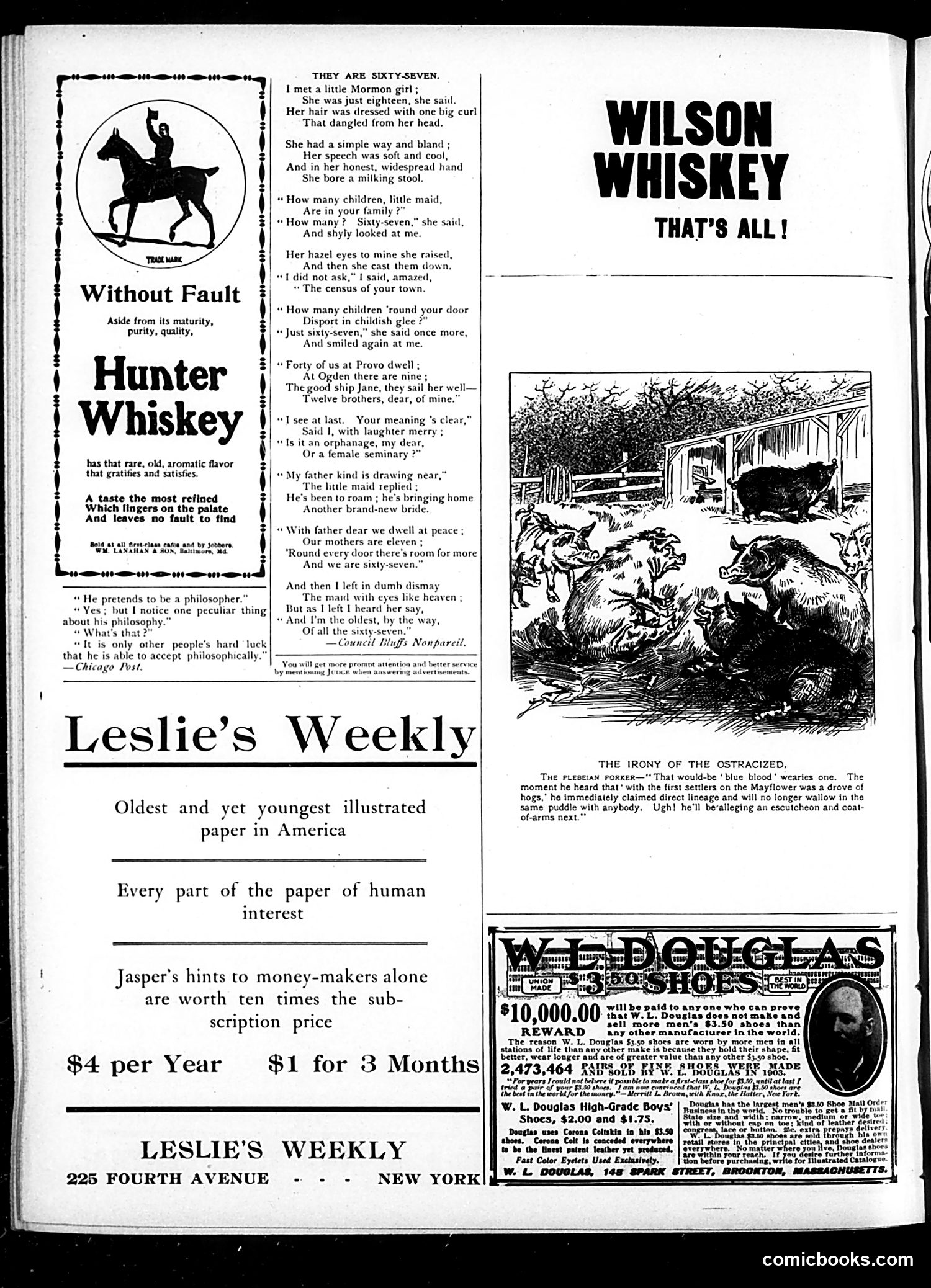
This page is primarily **advertising with one satirical poem**, not a political cartoon. The poem "They Are Sixty-Seven" satirizes **polygamy among Mormon communities**. A speaker encounters an 18-year-old Mormon girl who reveals her family consists of 67 children from her father's eleven wives—distributed across settlements in Provo and Ogden, Utah. The humor derives from the speaker's increasingly bewildered reactions as he realizes the shocking scope of plural marriage practices. The poem targets **the Church of Jesus Christ of Latter-day Saints' historical practice of polygamy**, which was controversial and illegal in most U.S. states. The girl's innocent, cheerful recitation of her massive blended family underscores the satirist's point about the absurdity and social disruption of the practice. The page otherwise contains **whiskey and shoe advertisements**, including a separate cartoon about "The Irony of the Ostracized"—a pun about a pig claiming ancestry from the Mayflower.
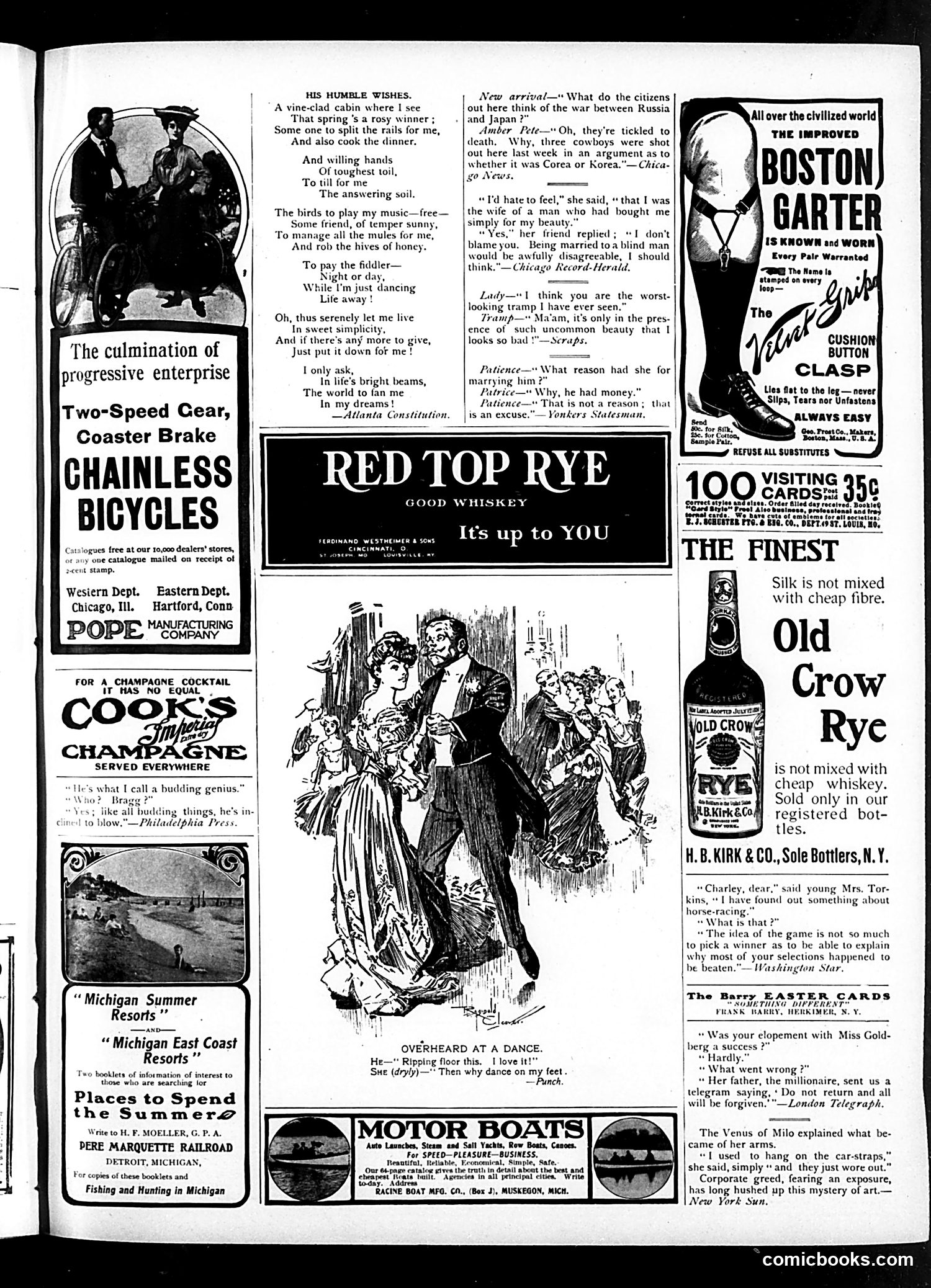
This page is primarily **advertisements and humor columns** rather than political satire. The content includes: **Main Cartoons/Jokes:** - "His Humble Wishes": A poem about a man's idealized rural life with servants and entertainment - Several brief exchanges mocking social pretensions: a woman ashamed her husband "bought" her for beauty; a man claiming his rudeness stems from a woman's uncommonness; a widow marrying for money **Social Commentary:** The humor reflects early 20th-century attitudes about gender, class, and hypocrisy. One joke references the Russo-Japanese War, with cowboys debating "Corea or Korea"—mocking American frontier ignorance of international affairs. **Advertisements:** Prominent ads for Pope bicycles, Red Top Rye whiskey, Boston garters, Old Crow Rye, and motor boats dominate the page—typical of Judge's revenue model. The page shows Judge as a magazine balancing light social satire with commercial advertising rather than hard political commentary.
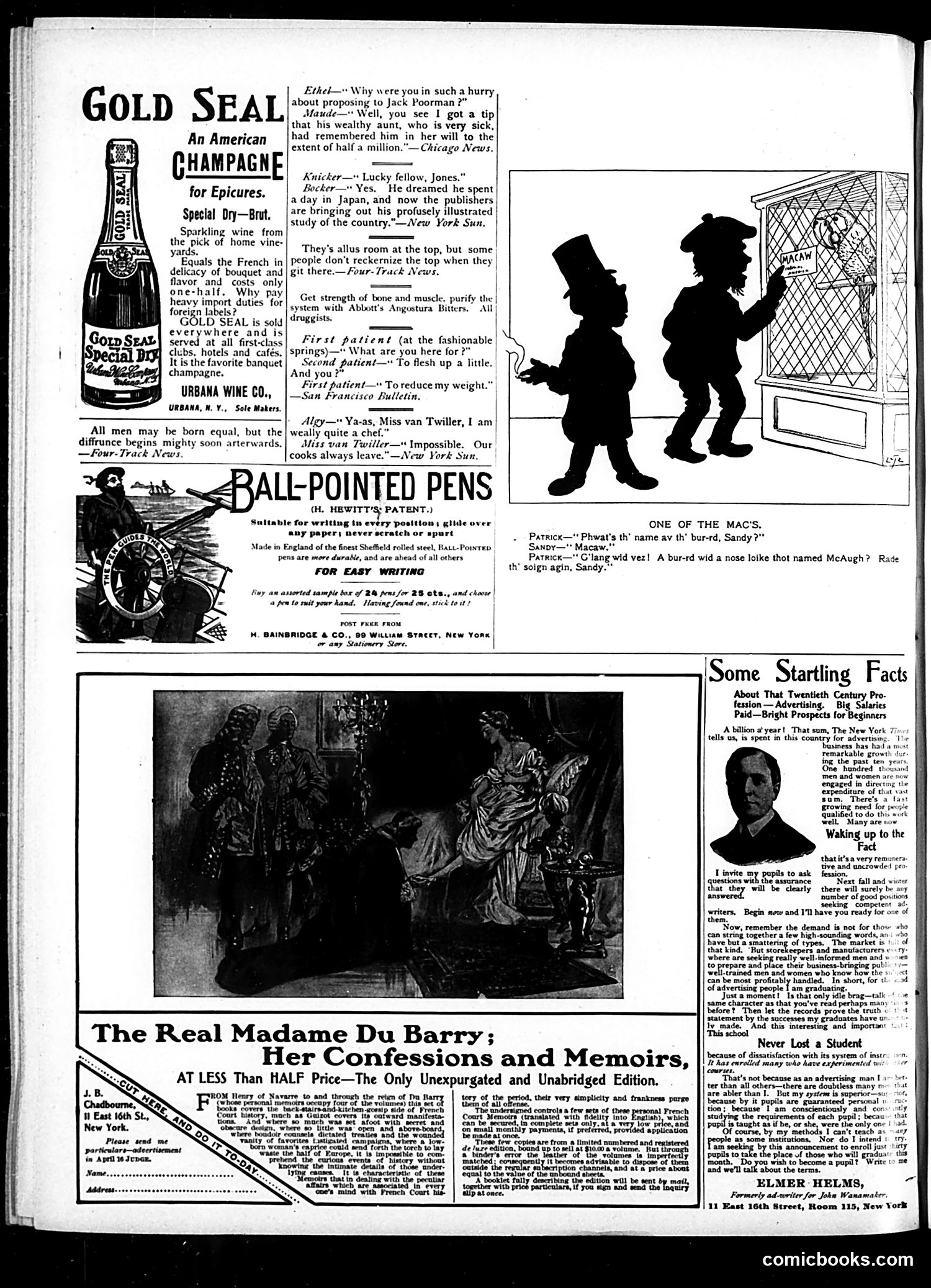
This page from *Judge* magazine contains primarily **advertisements and short humor items** rather than political cartoons. The humor pieces are brief, disconnected jokes: - A woman rushes to propose to a poor man after learning his aunt might leave him money - A man's dream trip to Japan gets published as a travel guide - Patients at a health spa with opposite goals (weight loss vs. gain) - A joke about a man claiming to be a chef, but all cooks leave his employ - An Irish immigrant (Patrick and Sandy) mishearing "macaw" as "McAugh" The advertisements promote **Gold Seal Champagne** (American-made, cheaper than imports), **Ball-Pointed Pens** for writing, and **Madame Du Barry's memoirs** (unabridged edition at half price). There's also a section on advertising as a career, promoting training for the "billion-dollar-a-year" advertising profession. **The satire is mild and domestic** — poking fun at social climbing, pretension, and misunderstandings rather than addressing political issues. This appears to be a typical turn-of-the-century humor/lifestyle magazine page.
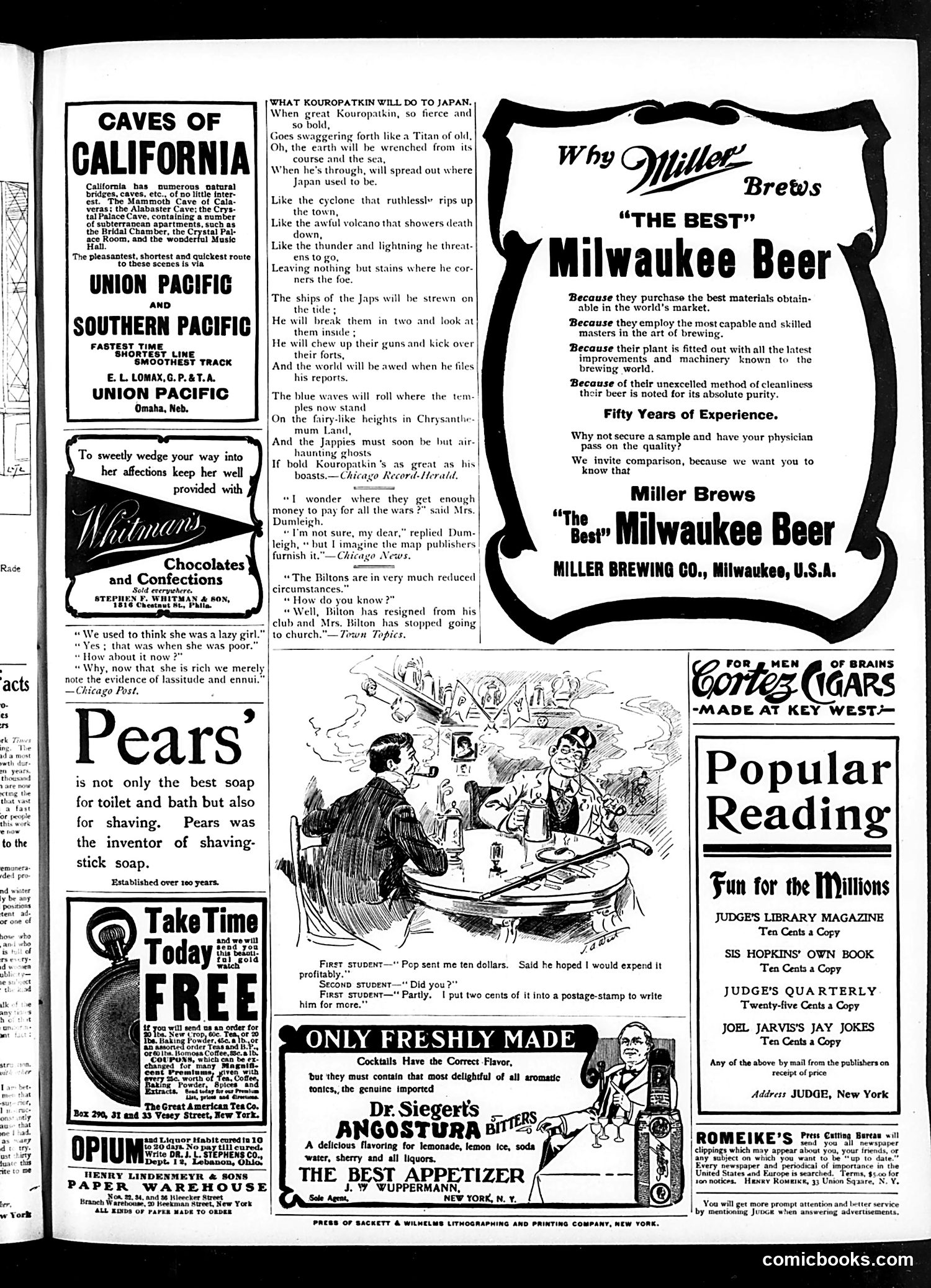
This page features a satirical poem mocking Russian General Alexei Kouropatkin's boastful predictions about defeating Japan in the Russo-Japanese War (1904-1905). The cartoon ridicules his grandiose threats with exaggerated, absurd imagery: he will destroy Japan so completely that the landscape itself will vanish, temples will become "air-haunting ghosts," and Japanese ships will be "strewn on the tide." The satire works through hyperbole—comparing Kouropatkin's swagger to mythological titans and natural disasters—to deflate his arrogance. The joke is that such overconfident military braggadocio typically precedes embarrassing defeats. Historically, Russia *did* lose this war decisively, making this contemporary satire prophetic mockery of Kouropatkin's hubris. The remainder of the page consists of period advertisements for beer, soap, cigars, and patent medicines—typical Judge magazine content.
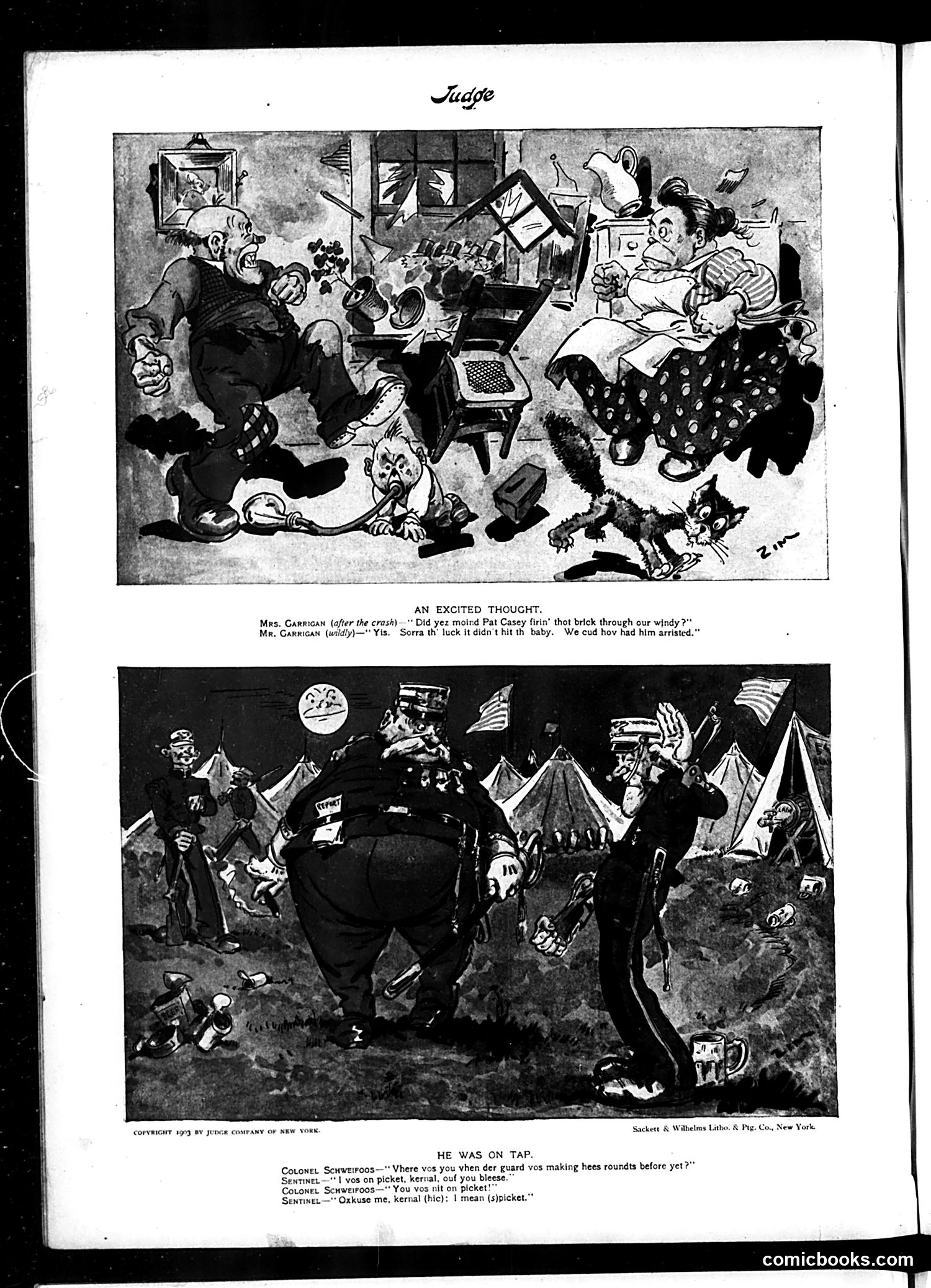
This page contains two separate satirical cartoons exploiting ethnic stereotypes common in 1890s American humor. **Top cartoon ("An Excited Thought"):** Features Irish characters (indicated by dialect spelling: "yez," "Sorra th'") discussing a brick thrown through their window. The dark humor turns on Mr. Garrigan's relief that the brick missed their baby—because they could have had him "tented" (likely meaning compensated/insured). The satire mocks working-class Irish families and suggests casual indifference to children's safety. **Bottom cartoon ("He Was On Tap"):** Depicts a rotund German military officer interrogating a sentinel (indicated by "kernal" for colonel, "vos" for was). The punchline involves the drunk soldier's wordplay: claiming he was "on picket" when actually "(s)picket"—playing on his intoxication. The satire ridicules both German militarism and drunkenness. Both cartoons rely on exaggerated ethnic caricature and dialect humor—styles Judge used extensively to appeal to native-born American readers.