
Judge, 1904-04-16 · page 7 of 16
Judge — April 16, 1904 — page 7: what you’re looking at
What you’re looking at
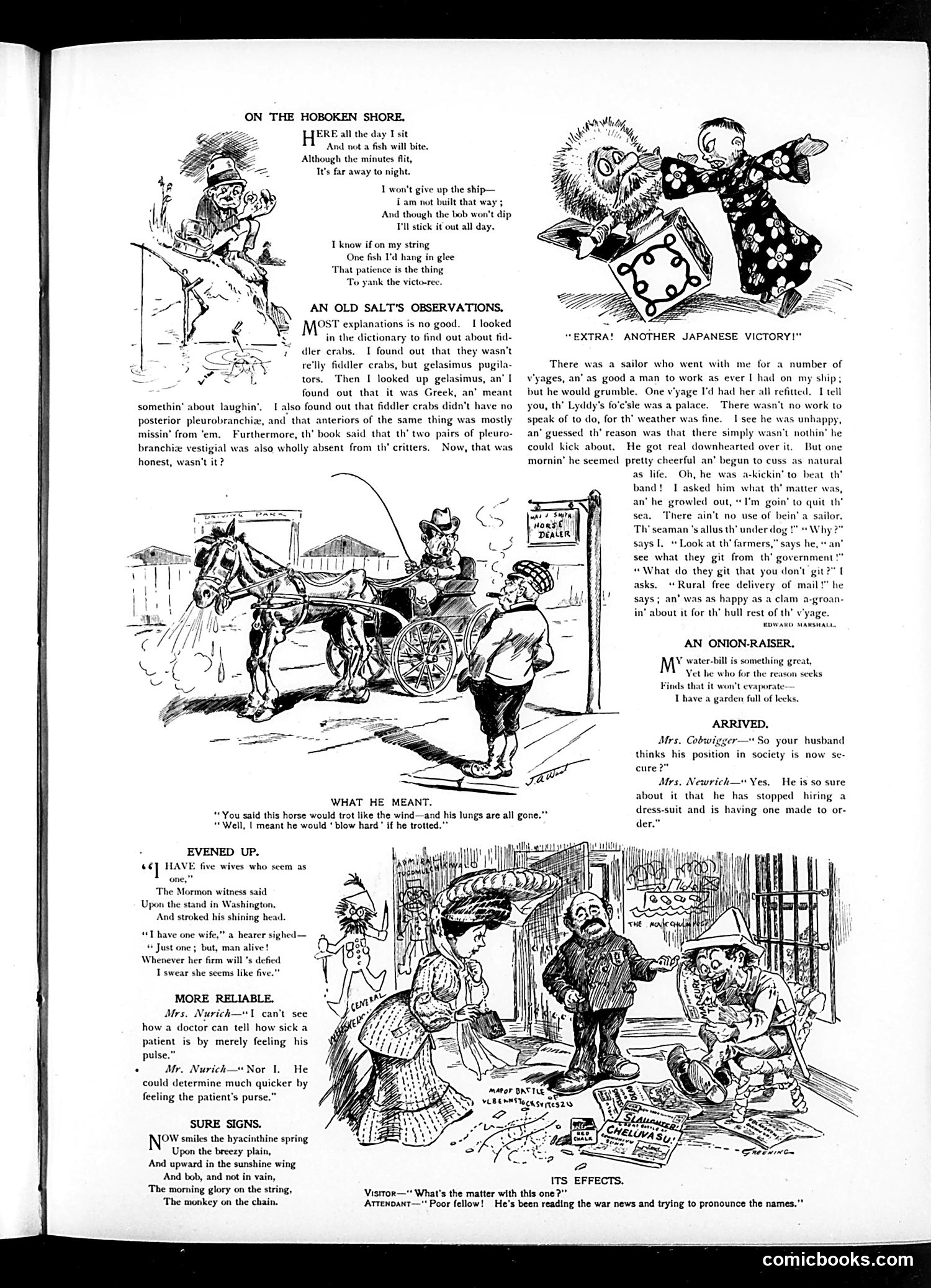
This page from Judge contains several satirical pieces reflecting early 20th-century American humor: **"Extra! Another Japanese Victory!"** references Japan's military victories, likely during the Russo-Japanese War (1904-05), which dominated contemporary news. **"What He Meant"** satirizes deceptive salesmanship—a horse seller's claim that the animal would "blow hard" if trotted, a play on words mocking commercial dishonesty. **"More Reliable"** jokes that doctors determine patients' wealth ("purse") better than their actual health through pulse-feeling—social commentary on materialism. The page also includes poems and brief anecdotes mocking various subjects: fishing patience, Mormon polygamy testimony, spring weather, and naval life complaints about lack of hardship. **"Its Effects"** shows a newspaper reader struggling to pronounce Japanese names from war coverage—gentle satire of contemporary public interest in foreign affairs despite linguistic unfamiliarity. Throughout, the humor targets pretension, greed, and the absurdities of modern life.
📄 Transcribed text from this page (OCR, searchable)
Machine-transcribed from the original scan — historical spelling and the odd misread are preserved.
ON THE HOBOKEN SHORE. ERE all the day I sit And not a fish will bite. Although the minutes fi It's far away to night. 1 won't give up the ship— iam not built that way ; And though the bob won't dip T'll stick it out all day. I know if on my string One fish I'd hang in glee ‘That patience is the thing To yank the victo-ree. AN OLD SALT’S OBSERVATIONS, OST explanations is no good. I looked in the dictionary to find out about tid- dler crabs. 1 found out that they wasn’t re'lly fiddler crabs, but gelasimus. pugila- tors. Then I looked up gelasimus, an’ I found out that it was Greek, an’ meant somethin’ about laughin’, [also found out that fiddler crabs didn't have no posterior pleurobranchiz, and that anteriors of the same thing was mostly missin’ from ‘em. Furthermore, th’ book said that th’ two pairs of pleuro- branchiae vestigial was also wholly absent from th’ critters. Now, that was honest, wasn't it? WHAT HE MEANT. ** You said this horse would trot like the wind—and his lungs are all gone."* “Well, | meant he would ‘ blow hard’ if he trotted.” ve wives who seem as The Mormon witness said Upon the stand in Washington, And stroked his shining h “T have one wife,” a hea & Just om Whenever her firm will 's defied but, man ali I swear she seems like five.” MORE RELIABLE. Mrs. Nurich—“1 can’t see how a doctor can tell how sick a patient is by merely feeling his pulse.” + Mr. Nurich— Nor 1. He could determine much qui feeling the patient's purse.” er by SURE SIGNS. OW smiles the hyacinthine spring Upon the breezy plain, And upward in the sunshine wing And bob, and not in vain, “EXTRA! ANOTHER JAPANESE VICTORY!" There was a sailor who went with me for a number of v'yages, an’ as good a man to work as ever I had on my ship; but he would grumble. One v'yage I'd had her all refitted, I tell you, th’ Lyddy’s fo'c’sle was a palace. There wasn't no work to speak of to do, for th’ weather was fine. I see he was unhappy, an’ guessed th’ reason was that there simply wasn’t nothin’ he could kick about. He got real downhearted over it, But one mornin’ he seemed pretty cheerful an’ begun to cuss as natural as life. Oh, he was ackickin’ to beat th’ band! [asked him what th’ matter was, an’ he growled out, “I'm goin’ to quit th’ sea, There ain‘t no use of bein’ a sailor. Th’ seaman ‘sallus th’ under dog !" «Why says L. * Look at th’ farmers,” says he, “an see what they git from th’ government ! “What do they git that you don’t git?” [ asks. “Rural free delivery of mail!” he says; an’ was as happy as a clam a-groan- in’ about it for th’ bull rest of th’ v'yag EDWARD MARSHALL AN ONION-RAISER, MY water-bill is something great, Finds that it won't evaporate T have a garden full of lecks, ARRIVED. Mrs. Cobwigger 0 your husband thinks his position in society is now se- cure 2” Mrs. Newrich— Yes. He is so sure about it that he has stopped hiring a dress-suit and is having one made to or- der.” ol 3 ITS EFFECTS. The morning glory on the string, Vistror—" What's the matter with this one?” ‘The monkey on the chain. Artenoant—"'Poor fellow! He's been reading the war news and trying to pronounce the names.””