
A complete issue · 16 pages · 1904
Judge — January 30, 1904
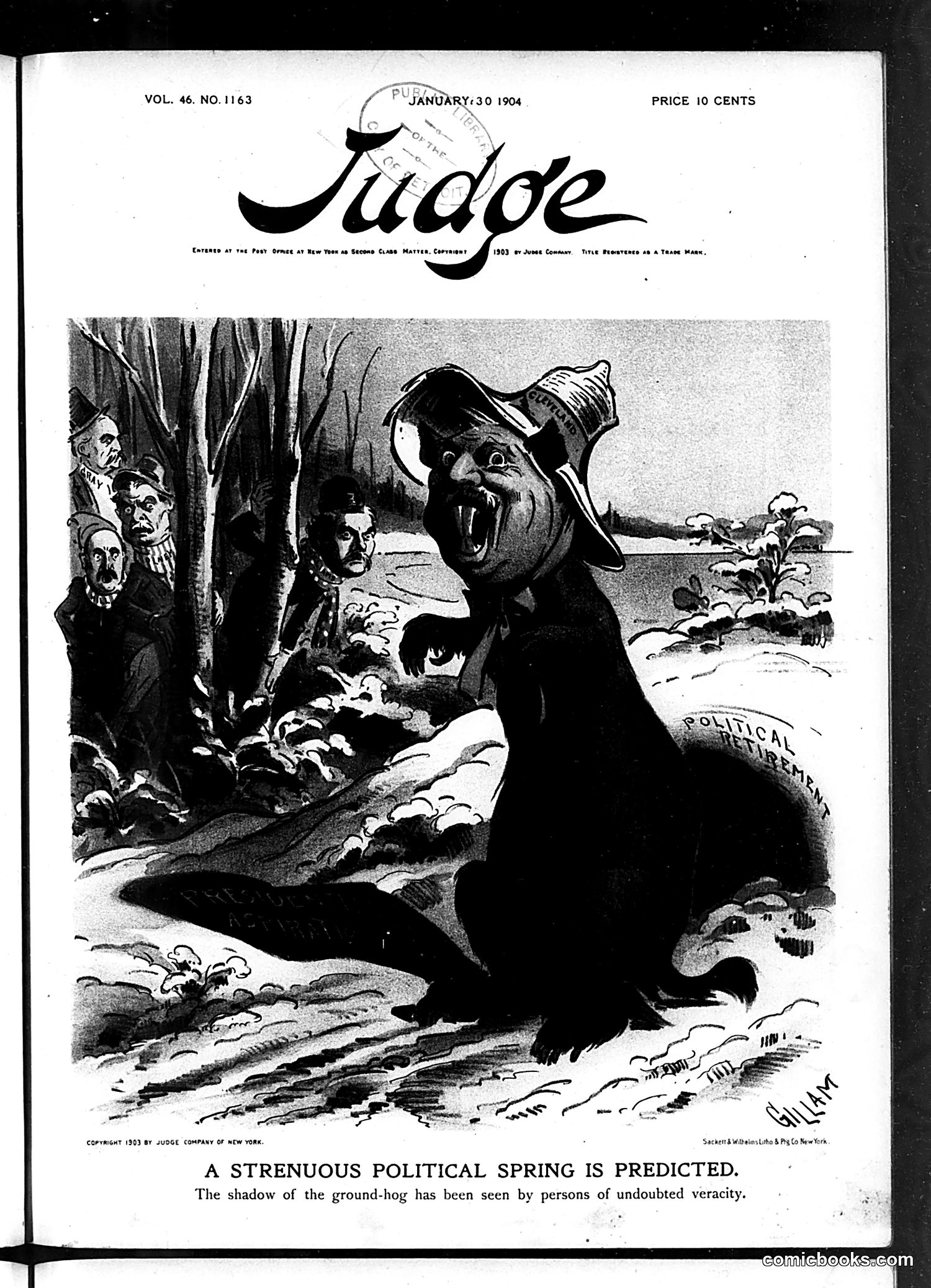
This January 1904 Judge magazine cartoon uses a groundhog metaphor for political prophecy. The large demonic groundhog represents political uncertainty emerging from hibernation. The caption references the folk tradition that a groundhog's shadow on Candlemas predicts weather—here adapted to predict turbulent politics ahead. The frightened observers on the left appear to be politicians or political figures alarmed by what's emerging. The label "POLITICAL UPHEAVAL" on the figure's body makes the satire explicit: the cartoonist warns that 1904 will bring significant political turmoil. Given the 1904 date, this likely relates to Theodore Roosevelt's presidency and the upcoming election season, though the cartoon's style keeps specific identities ambiguous.
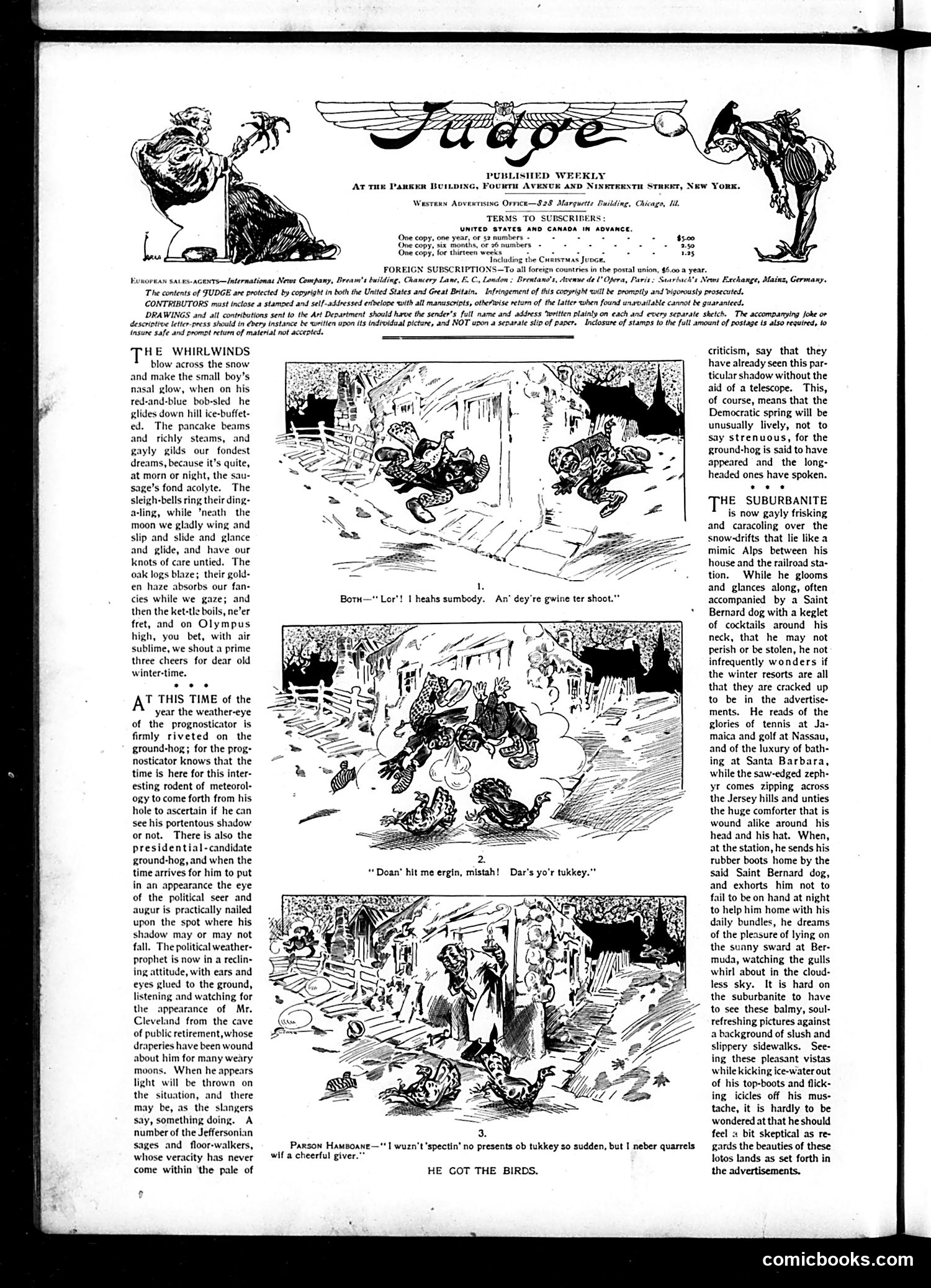
This page combines satirical commentary with humorous winter illustrations. The main text, "The Whirlwinds," discusses political uncertainty around a presidential candidate—likely referencing Grover Cleveland's political standing, as the OCR mentions "Cleveland from the cave of political oblivion." The piece uses meteorological metaphors to describe turbulent political conditions. The three captioned illustrations depict chaotic winter scenes with people struggling in snow, using dialect humor typical of the era. The captions ("Loo!" "Dean' hit me ergin, mish!" and a reference to turkeys) employ working-class speech patterns common in period satire. The "Suburbanite" section describes winter recreational activities at resorts, contrasting rural hardship with wealthy leisure—a typical Judge theme emphasizing class distinctions. The overall page mixes political commentary with social satire about winter life across different economic classes.
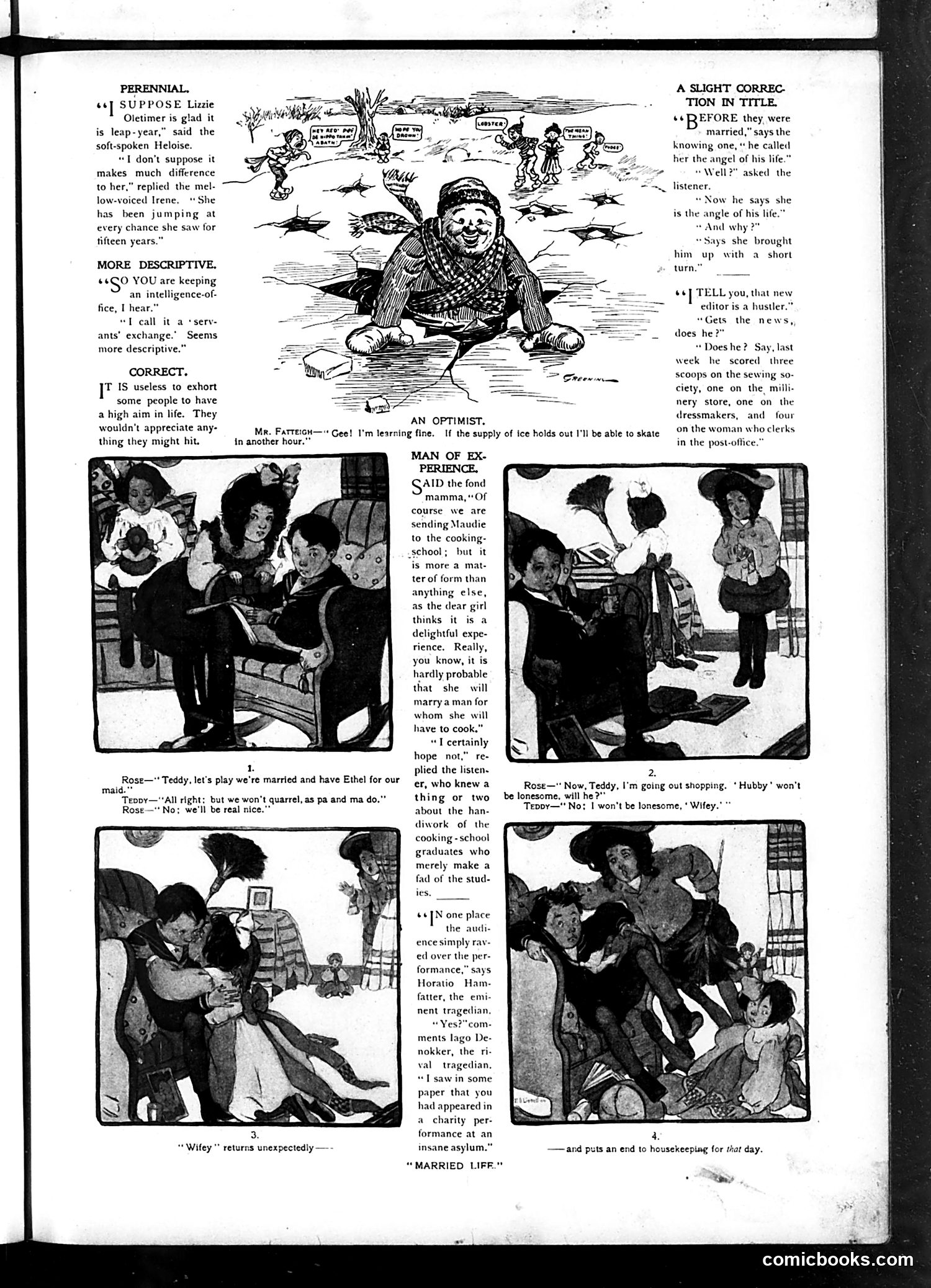
This page from *Judge* magazine contains satirical commentary on women's roles and marriage, typical of early 20th-century humor magazines. The central cartoon "An Optimist" depicts a figure (Mr. Patterson) optimistically planning ice-skating despite winter shortages—satirizing misplaced priorities during resource scarcity. The numbered scenes below tell a domestic story titled "Married Life," following a couple named Rose and Teddy. The narrative progresses from marriage discussion through shopping, and concludes with domestic chaos, ending with the caption "and puts an end to housekeeping for that day." The humor relies on period stereotypes: women's shopping habits, marital quarrels, and the incompatibility of wives with domestic management. The dialogue emphasizes traditional anxieties about women's spending and housekeeping capabilities—social commentary reflecting contemporary anxieties about women's roles and consumer behavior.
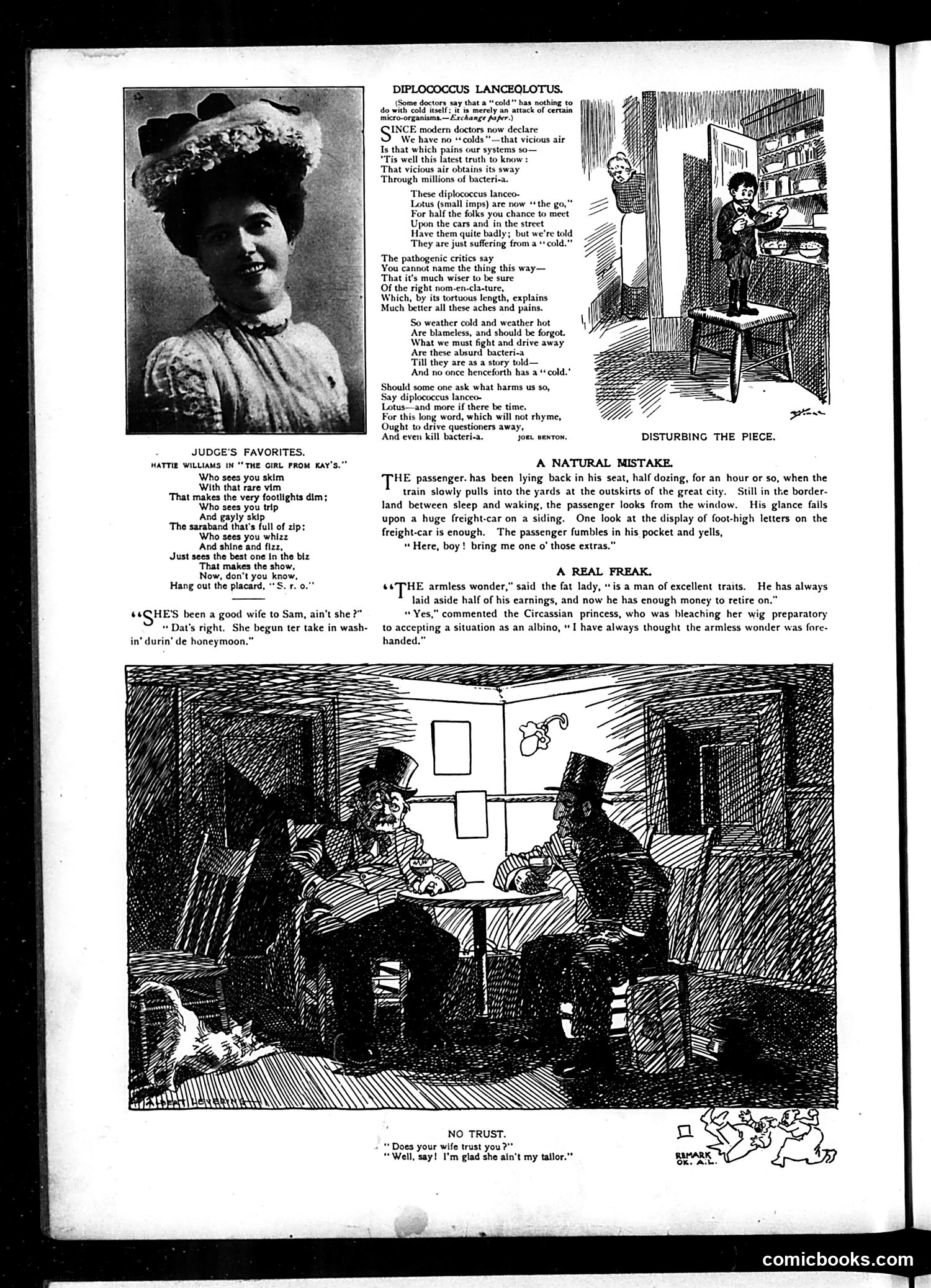
This page contains several satirical pieces and illustrations typical of early 20th-century Judge magazine: **"Diplococcus Lanceolotus"** - A poem mocking contemporary medical debates about bacteria and disease transmission, particularly the "germ theory" of illness. The satire suggests doctors cannot agree on or properly name infectious agents. **"Judge's Favorites"** and other brief jokes address domestic life and relationships with the period's characteristic humor about marriage and gender roles. **"Disturbing the Piece"** and **"A Natural Mistake"** appear to be brief anecdotal jokes about everyday situations. **"No Trust"** - A cartoon dialogue between two men in what appears to be a tailor's shop, joking about trust and tailoring. The page exemplifies Judge's typical mix of social satire, medical/scientific mockery, and domestic humor aimed at educated middle-class readers of the era.
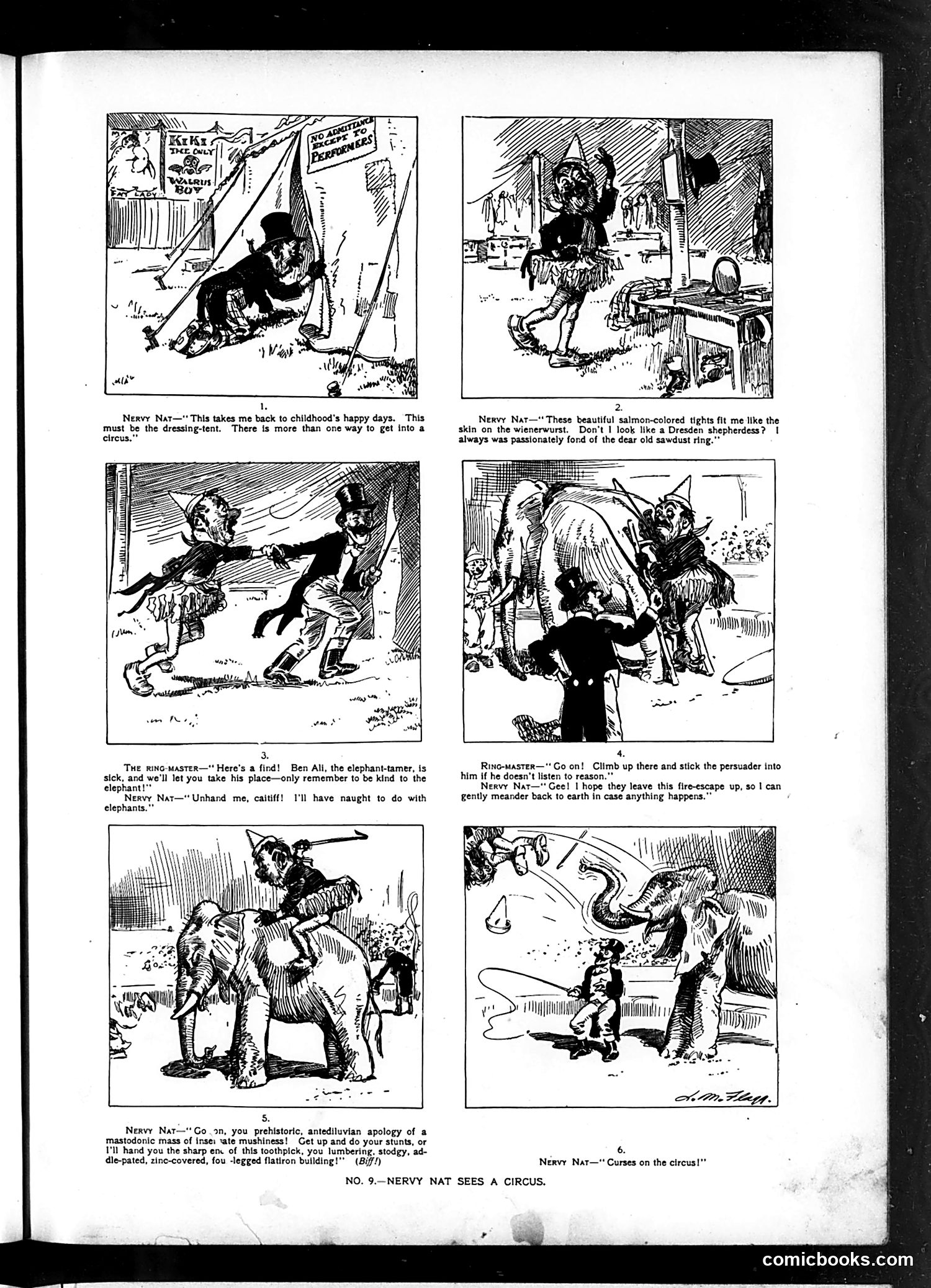
This is a slapstick comic strip following a character named "Nervy Nat" who stumbles into circus work. The humor relies on physical comedy and verbal exaggeration typical of early 20th-century humor magazines. The plot: Nat sneaks into a circus dressing tent, dons performer tights (comparing himself mockingly to a "Dresden shepherdess"), and is pressed into service as an elephant handler when the regular trainer falls ill. Despite his protests, he's forced to manage the elephant using a "persuader" (prod). The comedy escalates through increasingly absurd insults he hurls at the uncooperative animal—describing it as "prehistoric," "mastodonic," and comparing it to a "flatiron building." The satire appears gentle rather than political—mocking both the character's pretension and circus life itself. The recurring phrase "Nervy Nat" suggests this was a series character, likely appealing to readers through predictable physical mishaps and exaggerated dialogue. No specific political figures or events appear referenced.
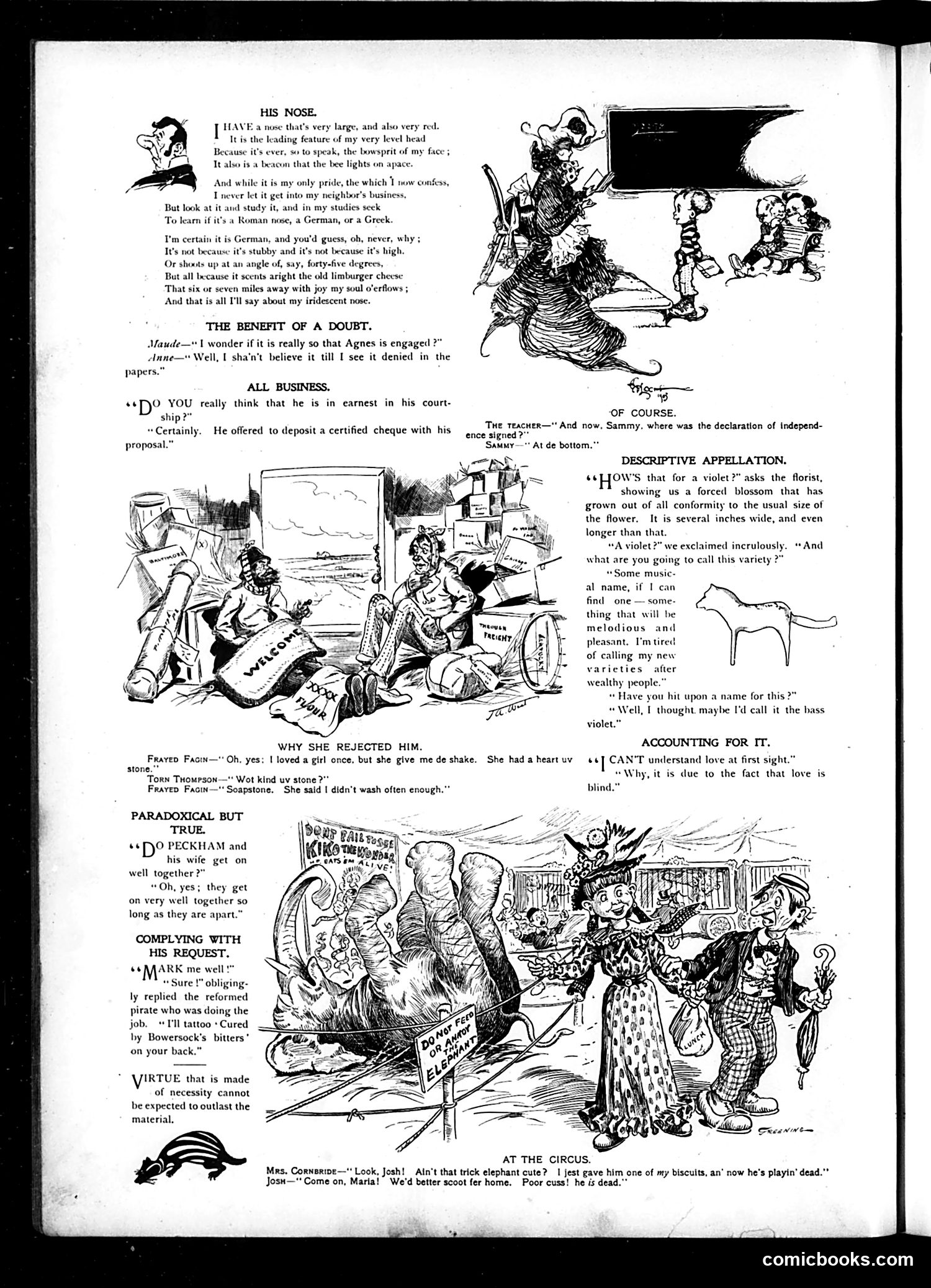
This page contains multiple short humor pieces typical of early 20th-century American satire: **"His Nose"** mocks German ethnic stereotypes, suggesting a German nose can identify Limburger cheese (a notoriously pungent cheese associated with German immigrants) from miles away—playing on period anti-German sentiment and caricatures. **"The Benefit of a Doubt"** satirizes newspaper gossip culture: a woman won't believe an engagement rumor until she sees it *denied* in print, suggesting papers traffic in scandalous denials. **"All Business"** jokes that modern courtship has become transactional—a suitor's sincerity is measured by depositing a certified check. **"Why She Rejected Him"** uses dialect humor to mock working-class suitors based on hygiene. **"At the Circus"** features rural stereotypes (Josh and Maria) whose homemade biscuits are so inedible they kill an elephant. The cartoons employ period conventions: ethnic caricatures, class-based humor, and exaggerated dialect. The satire targets courtship customs, advertising culture, and newspaper sensationalism.
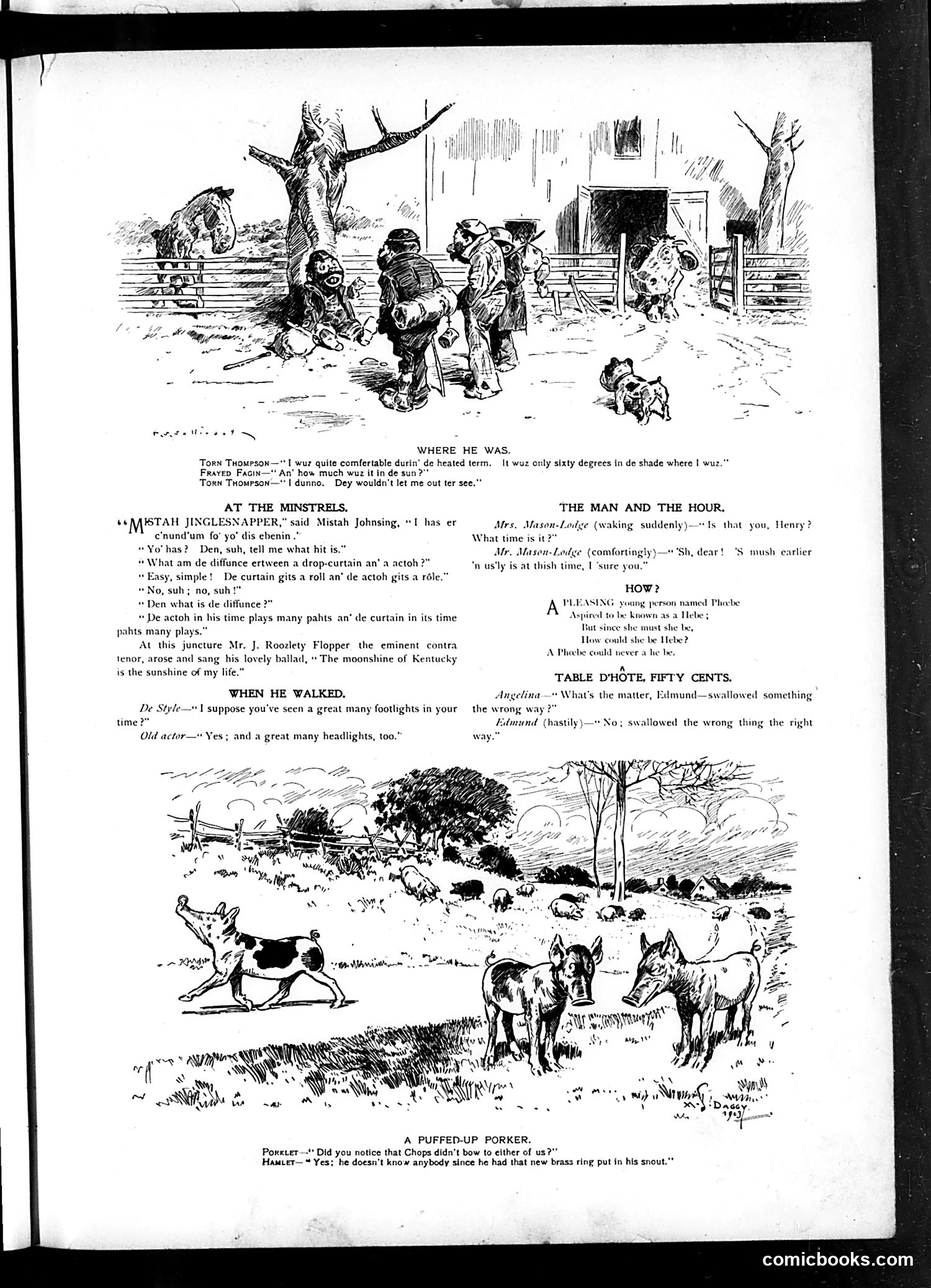
This page contains multiple short humor pieces typical of late 19th/early 20th-century American satire magazines: **"At the Minstrels"** presents a racist minstrel show joke featuring exaggerated dialect humor common to that era's entertainment. **"When He Walked"** is a vaudeville joke playing on an aging actor's numerous performances ("footlights") versus car headlights—likely referencing the emerging automobile era. **"Where He Was"** jokes about prison conditions during summer heat. **"The Man and the Hour"** depicts a drunk husband reassuring his wife about the time. **"How?"** is a wordplay riddle about the name "Phoebe." **"Table d'Hôte"** involves digestive mishap humor. **"A Puffed-Up Porker"** anthropomorphizes farm animals, with a pig becoming snobbish after receiving a decorative nose ring. The illustrations—particularly the lower pastoral scene—employ the sentimental rural imagery popular in period humor. The content reflects Judge's typical blend of vaudeville jokes, class commentary, and crude ethnic/gender humor characteristic of early American magazine satire.
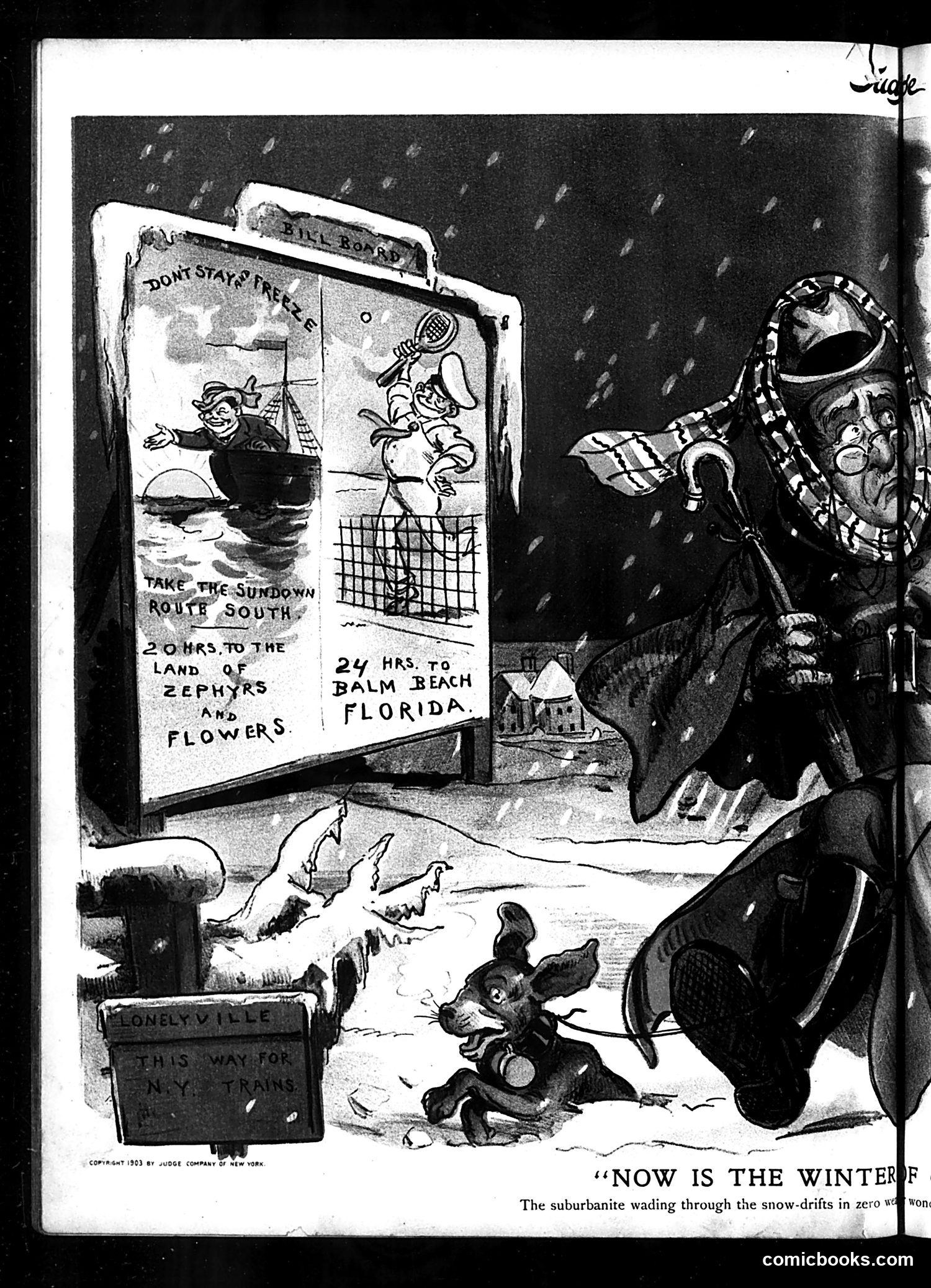
This cartoon satirizes winter tourism marketing to suburbanites. On the left, promotional posters advertise Florida destinations—"The Sundown Route South" promising "20 hours to the land of zephyrs and flowers," and "Balm Beach, Florida" (24 hours away)—with cheerful illustrations of sunshine and leisure. On the right, reality: a bundled figure trudges through heavy snow and bitter cold ("zero weather"), struggling against winter's harsh conditions. The contrast between the idyllic vacation advertisements and the actual brutal winter experience creates the joke. A sign reading "Lonelyville" reinforces the grim present. The satire targets both railroad advertising hyperbole and the escapist fantasies it sells to cold, miserable northerners—the gap between marketing promises and lived experience.
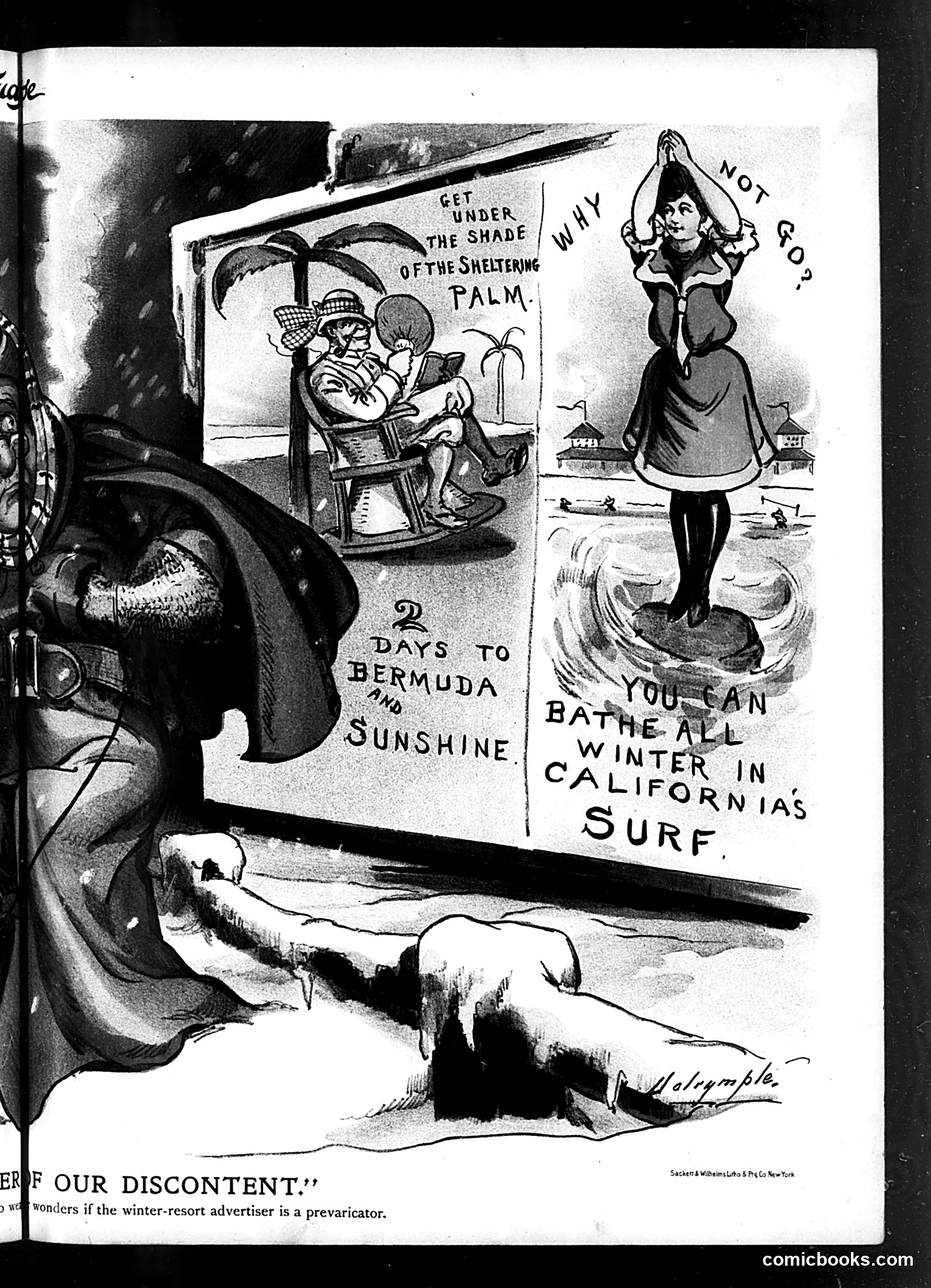
This satirical cartoon critiques deceptive winter-resort advertising. The left panel shows a cozy couple under a palm tree's shade in warm Bermuda. The right panel sarcastically presents a woman shivering in California's surf, captioned "NOT GOOD—YOU CAN BATHE ALL WINTER IN CALIFORNIA'S SURF." The humor lies in the contradiction: warm-weather resort advertisements promise sunshine and comfort, yet the reality (California's cold winter ocean) is freezing and unpleasant. The caption's final note—"Wonders if the winter-resort advertiser is a prevaricator"—directly accuses travel advertisers of lying. This reflects early 20th-century skepticism about aggressive advertising claims, when winter resorts heavily promoted destinations to attract wealthy travelers escaping cold northeastern winters. The cartoon suggests their promises didn't match actual conditions.
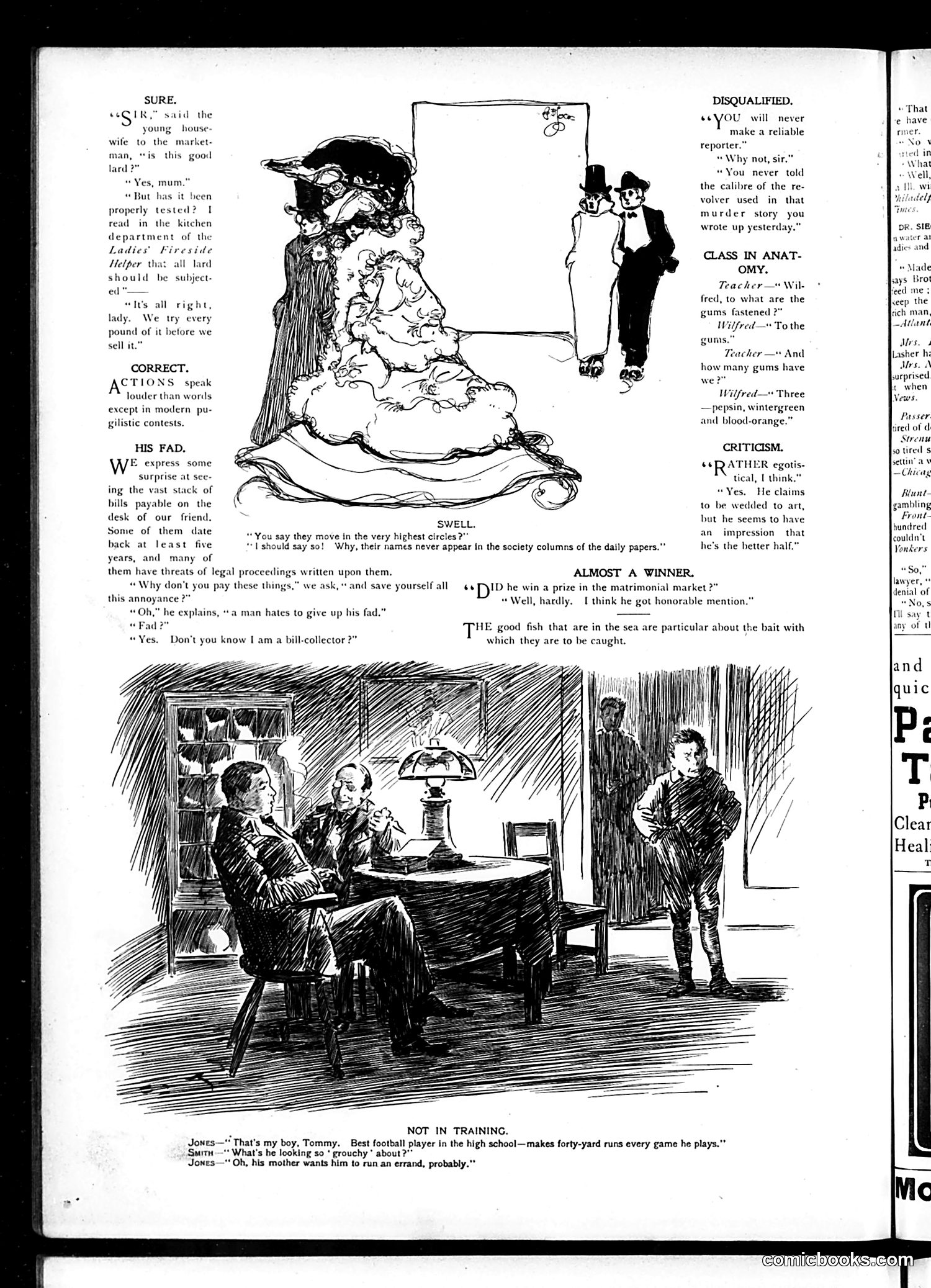
This page contains multiple satirical sketches lampooning early 20th-century American social conventions: **"Sure"/"Correct"**: Mocks market wives and housekeeping advice columns (the *Ladies' Fireside Helper*), satirizing domestic testing rituals for lard quality. **"Disqualified"**: A reporter is deemed unreliable because he never disclosed what type of revolver was used in a murder story—poking fun at sensationalist journalism's careless accuracy. **"Class in Anatomy"**: A schoolroom joke where a teacher asks students about gum anatomy; a boy answers "pepsin, wintergreen, and blood-orange"—conflating chewing gum flavors with actual anatomy. **"His Fad"/"Swell"**: A man accumulates unpaid bills as a hobby, comparing himself to wealthy socialites who "move in highest circles" yet avoid society column scrutiny. **"Not in Training"**: A football star plays brilliantly but won't run errands for his mother—satirizing misplaced athletic priorities. The overall tone mocks middle-class pretensions, journalistic incompetence, and social absurdities.
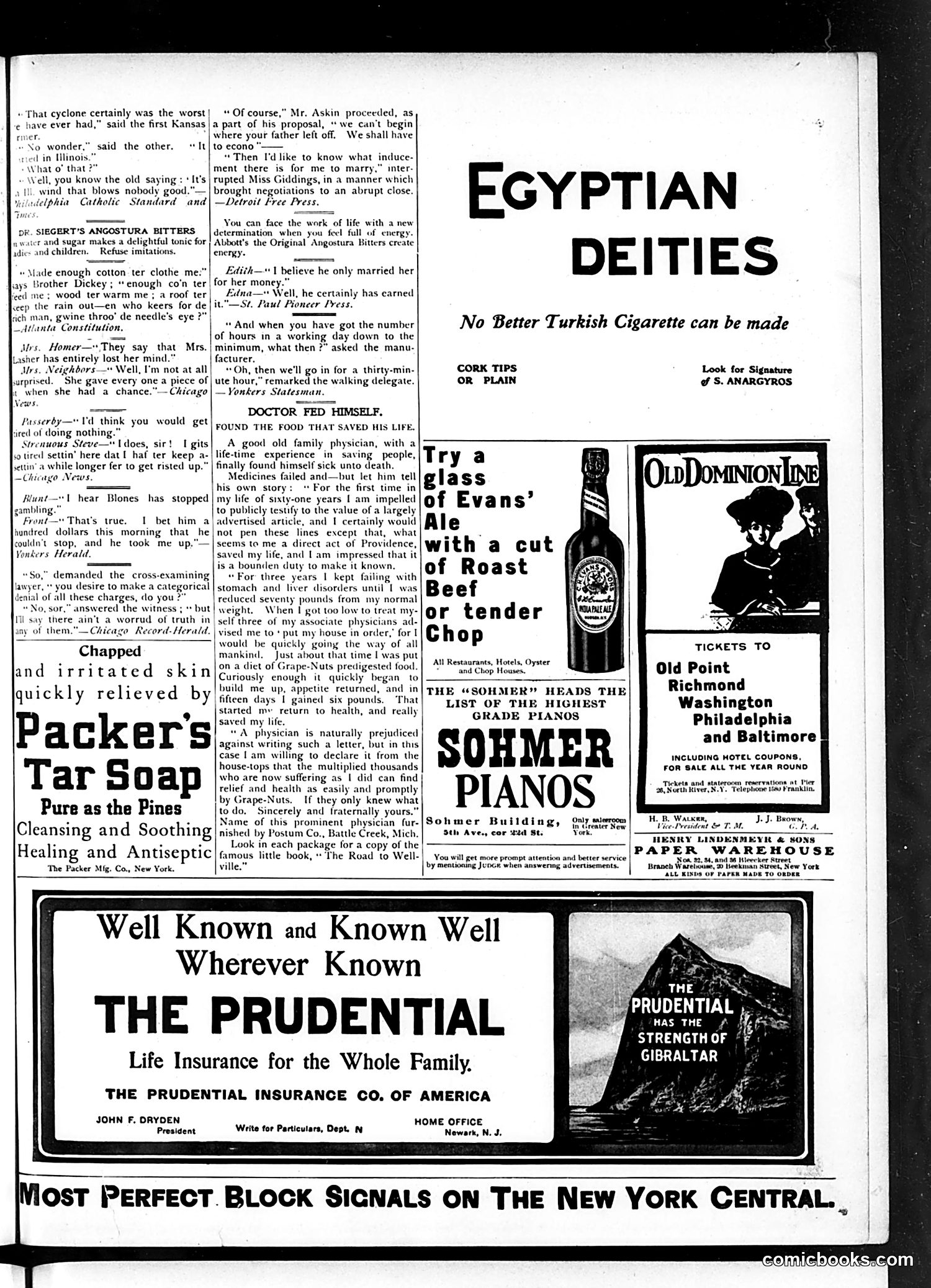
This page is primarily **advertising with minimal political content**. The main elements are: **The Cartoons/Jokes:** Several brief, disconnected satirical anecdotes appear at the top—typical Judge fare mocking everyday situations: Kansas cyclones, reluctant suitors, and labor negotiations about working hours. These are mild social humor with no specific political figures or major references. **The Advertisements:** The page is dominated by product ads: Egyptian Deities cigarettes, Packer's Tar Soap, Evans' Ale, Sohmer Pianos, Old Dominion Line (travel), Prudential Insurance, and a paper warehouse. These reflect early 20th-century consumer goods and services. **Historical Context for Modern Readers:** The brief jokes' humor relies on now-dated assumptions (reluctant marriage for money, labor-management tensions). The heavy advertising demonstrates how magazines financed themselves entirely through ads—content was secondary. **Overall:** This is a typical Judge page mixing light humor with commercial messaging, containing no identifiable political cartoons or satirical commentary on current events.
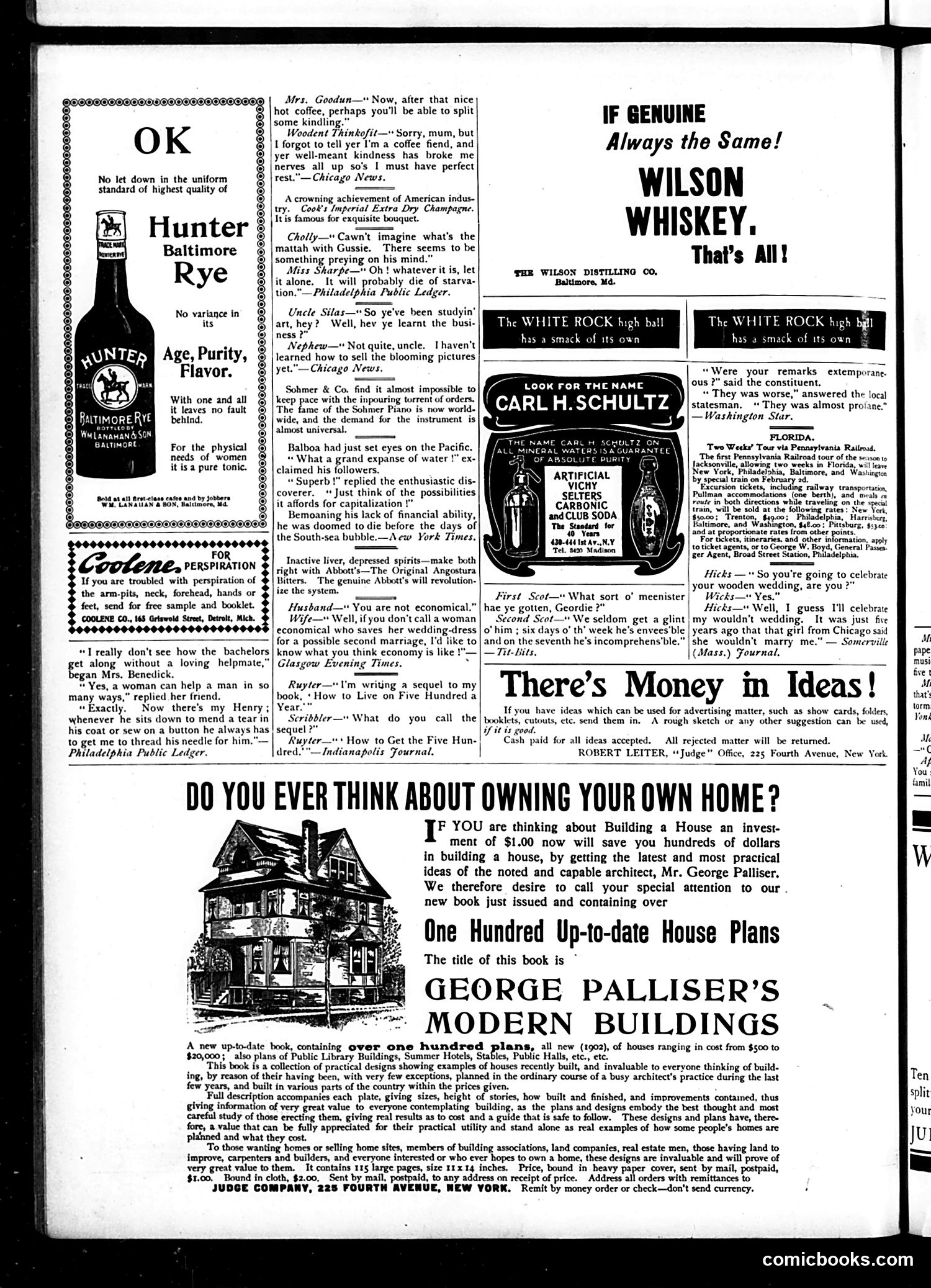
This page is primarily **advertisements and humor snippets** rather than political cartoons. The content reflects early 20th-century American consumer culture and social attitudes. **Key Elements:** **Advertisements:** Hunter Baltimore Rye whiskey, Wilson Whiskey, Coolene (perspiration remedy), and George Palliser's house-plan book dominate the layout. **Humor Sketches:** Short, domestic jokes satirizing: - Gender roles (wives helping husbands with needlework) - Working-class aspirations (a young artist who can't sell paintings) - Marriage and economy (a woman saving her wedding dress for a "possible second marriage") - Class pretension (Balboa capitalizing on discovery rather than appreciating it) **Social References:** The jokes reflect period anxieties about marriage, economic hardship, and social mobility. The humor is gentle, relying on stereotypes about women's domesticity and men's incompetence rather than sharp political critique. **Context:** This represents *Judge*'s typical mix of advertising revenue and light satirical content aimed at middle-class readers.
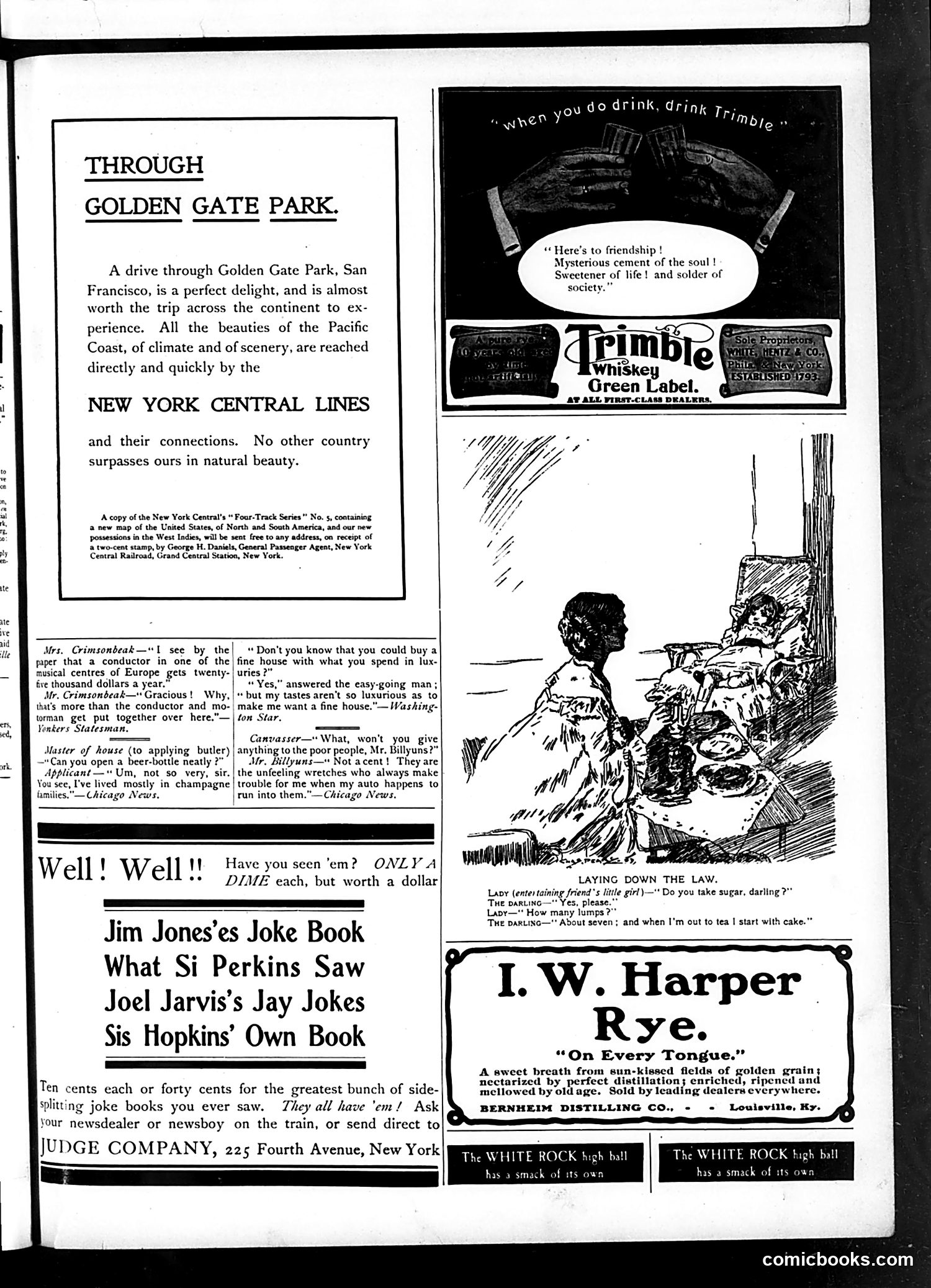
This page combines advertisements with brief humor pieces typical of early 20th-century satirical magazines. **Main Content:** The top features a Trimble Whiskey ad using a toast about friendship as sales copy. Below are several short comic vignettes mocking social pretensions: a woman impressed that a European conductor earns more than American workers; a man claiming champagne (not beer) is his background; a wealthy man refusing charity; and a child earnestly asking for seven lumps of sugar at tea. **The Satire:** These jokes target **class anxiety and social climbing**—Americans obsessed with European sophistication, the wealthy indifferent to poverty, and performative gentility. The humor derives from characters' self-contradiction and obliviousness. **Advertising:** Multiple whiskey and rye ads dominate the lower half, alongside promotions for joke books sold via Judge Company—a common revenue source for the magazine. **Context for Modern Readers:** This reflects pre-Prohibition American attitudes toward liquor and leisure consumption as markers of respectability, alongside satirical jabs at gilded-age wealth inequality and social pretense.
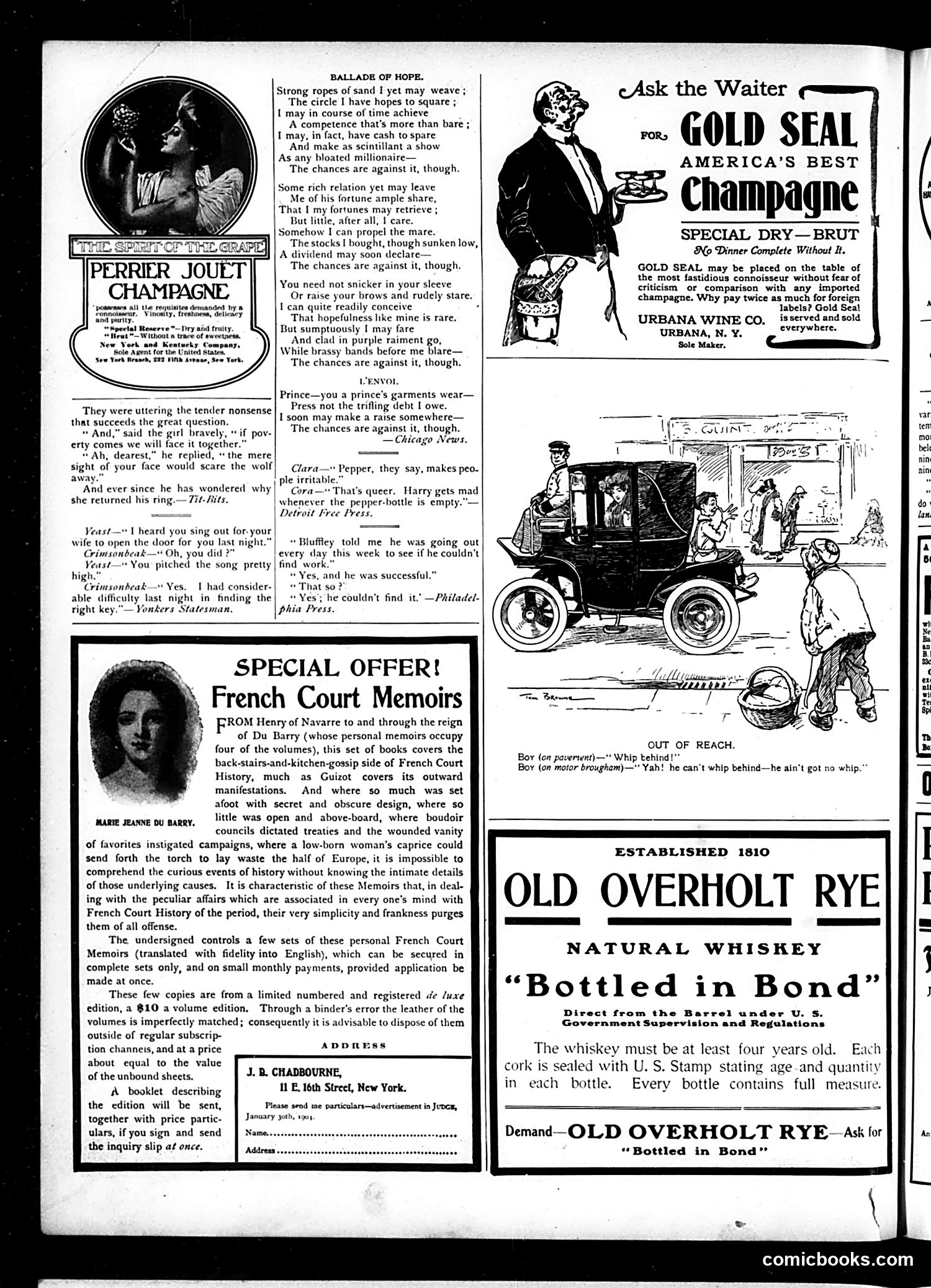
This page from the satirical magazine *Judge* contains mostly **light humor and advertisements** rather than pointed political satire. The main literary content is a "Ballade of Hope"—a poem mocking working-class optimism about wealth and fortune. The speaker fantasizes about inheriting money, striking it rich, or achieving prosperity, but repeatedly admits "the chances are against it, though." The satire targets **naive hopefulness among the poor** who cling to unlikely scenarios rather than accepting their circumstances. Supporting this theme are brief humorous anecdotes about romantic disappointment and marital friction—the couple who promise to face poverty together, yet she returns his ring when she realizes poverty is real; the exchanges about pepper and irritability. These reinforce a cynical view of human nature and romantic delusions. The page is primarily **commercial space**—advertisements for Perrier-Jouet Champagne, Gold Seal Champagne, Old Overholt Rye whiskey, and French Court Memoirs. These luxury goods contrast ironically with the poverty theme of the poetry above.
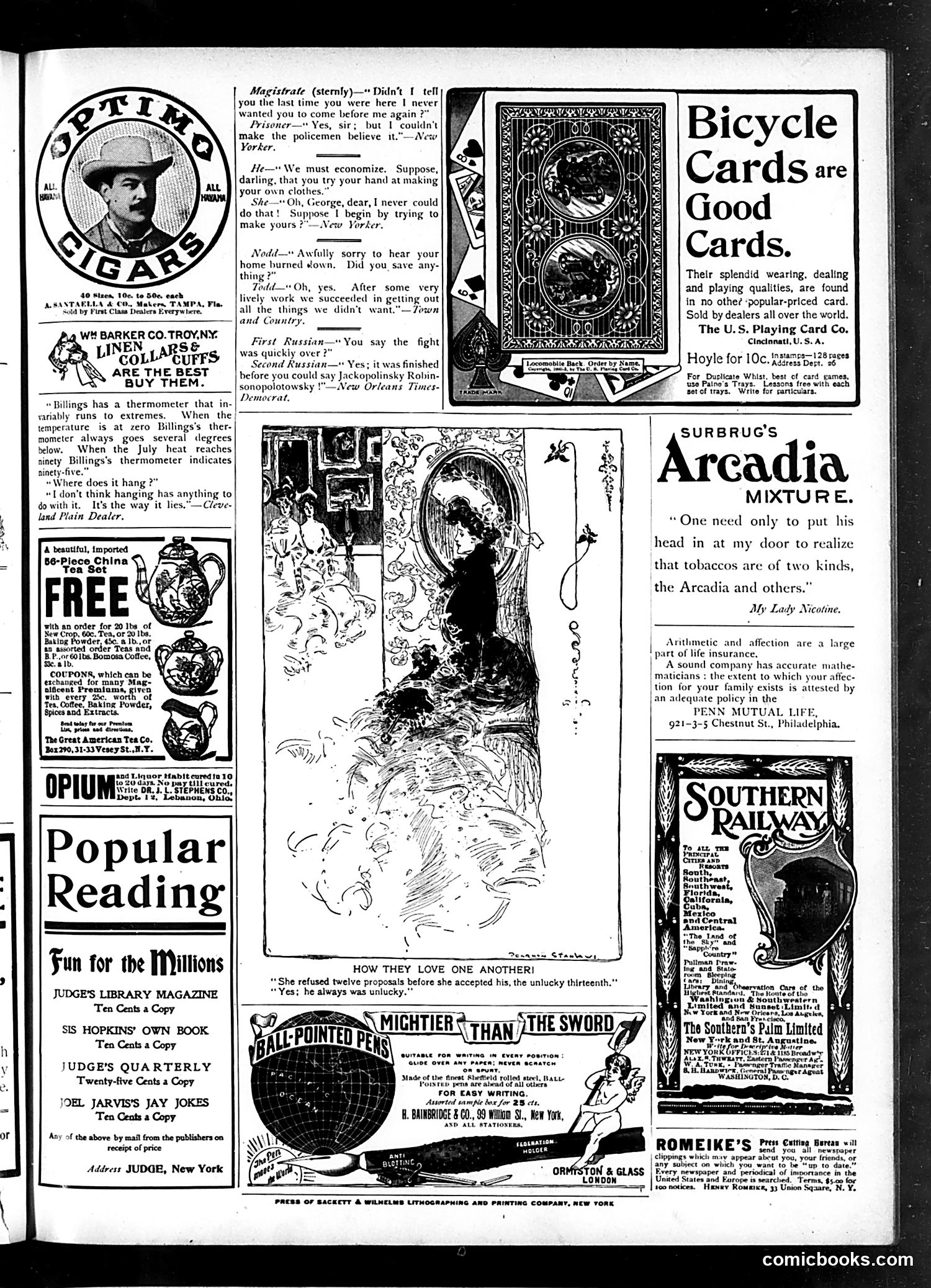
This page is primarily **advertising and humor**, typical of early 20th-century magazines. **The Cartoons/Jokes:** The page features several short jokes under headings like "Magistrate," "He—We must economize," and "First Russian." These are simple one-liners playing on: - A prisoner claiming he can't avoid court (wordplay on "belief") - A husband's economizing suggestion backfiring when his wife suggests making *his* clothes - Russian names used as a joke about incomprehensibility **The Central Cartoon** shows a couple with the caption "She refused twelve proposals before she accepted his, the unlucky thirteenth"—a dark humor joke about the husband being the least desirable option. **Advertisements dominate**, including Opium (a common patent medicine), Judge Library publications, Bicycle Playing Cards, Surburg's Arcadia tobacco mixture, and Penn Mutual Life Insurance. **Historical Context:** This reflects pre-1920s American humor: casual ethnic stereotyping (Russian names), acceptance of dangerous substances in advertising, and domesticity-based comedy targeting middle-class readers.
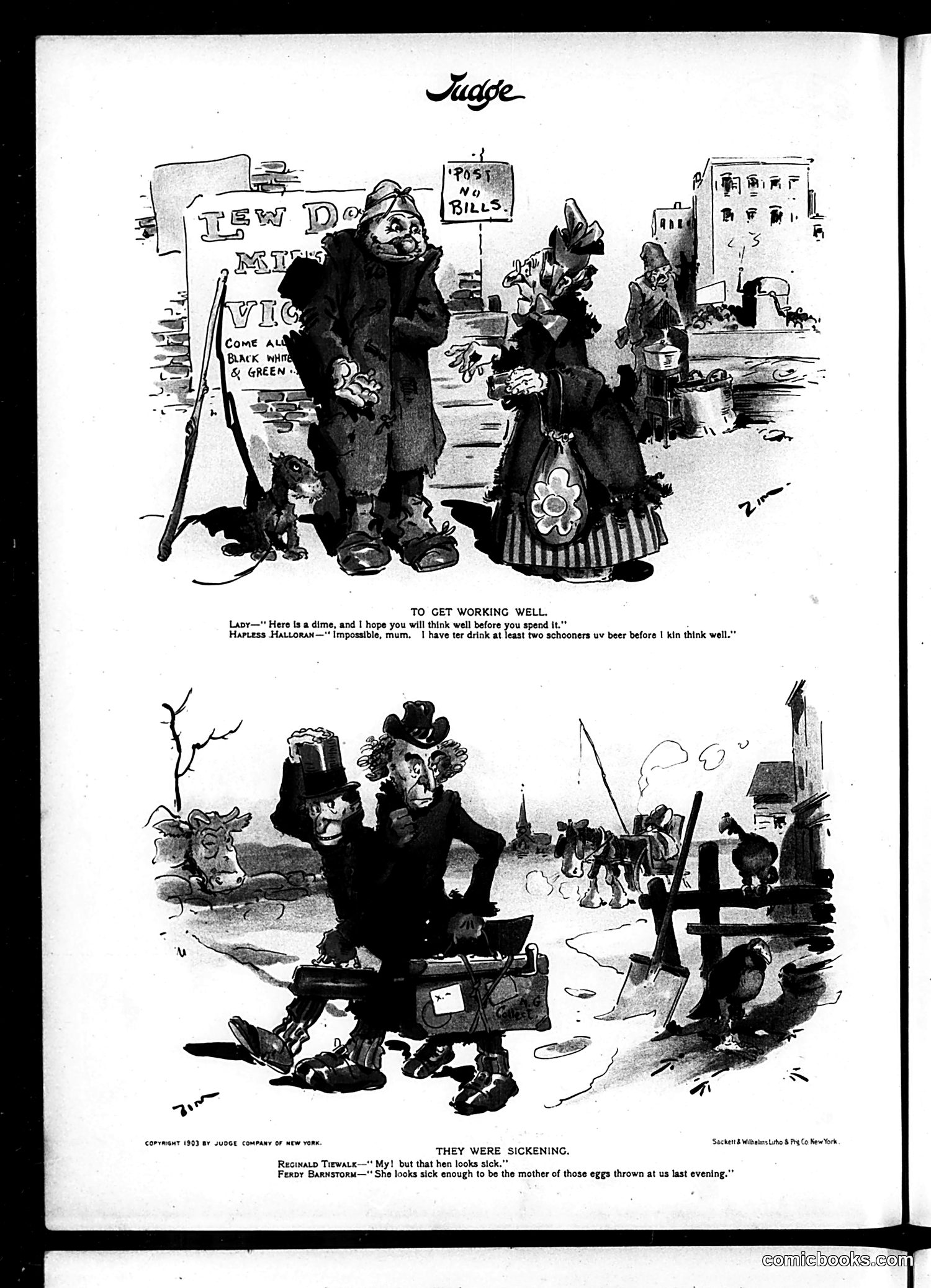
**Top cartoon ("To Get Working Well"):** A wealthy lady gives a dime to a poor Irish immigrant woman ("Hapless Hattoran"), hoping she'll spend it wisely. The immigrant responds that she needs to drink two beers first before she can think clearly. This stereotypes Irish working-class people as alcoholics and mocks the condescension of wealthy charitable givers. **Bottom cartoon ("They Were Sickening"):** Two men discuss a sickly hen, with one remarking it looks ill enough to be the mother of eggs thrown at them "last evening." This appears to reference a theatrical performance where audiences pelted bad actors with rotten eggs—a common form of audience disapproval. The joke equates bad acting with diseased parentage. Both cartoons employ ethnic stereotyping and crude humor typical of early-1900s American satire.