
A complete issue · 16 pages · 1903
Judge — November 7, 1903
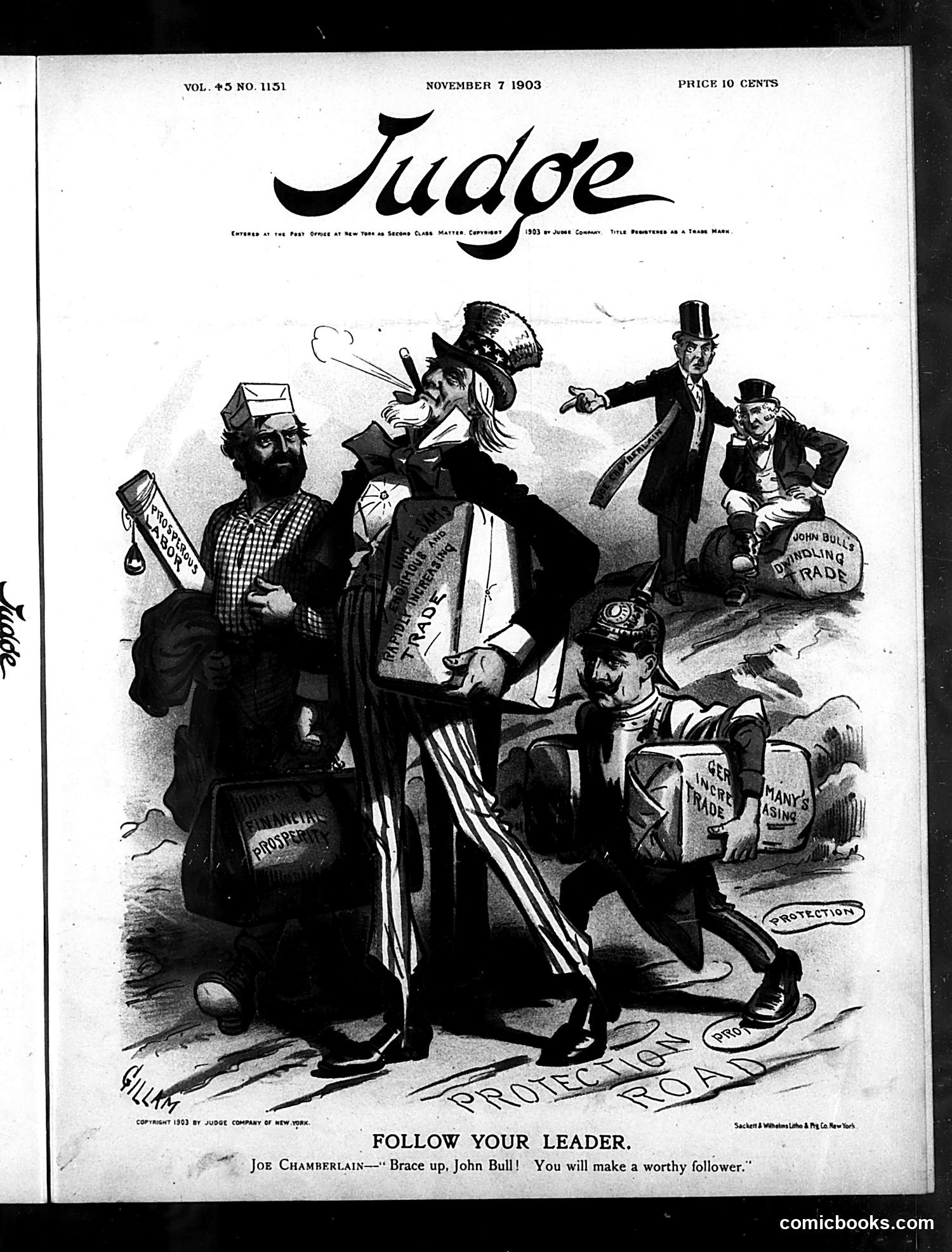
This political cartoon satirizes American protectionism and tariff policy. The central figure appears to be Uncle Sam (representing America), leading various characters labeled with trade-related concepts like "Protection" down a road. The caption "Follow Your Leader" with the quote "Brace up, John Bull! You will make a worthy follower" mocks Britain's trade policies by suggesting America's protectionist approach is superior. The figures surrounding Uncle Sam—including what appears to be "John Bull" (Britain's personification)—represent different nations or economic interests being pulled along by American tariff protectionism. The satirical point suggests America's aggressive trade protection is leading other nations astray, or alternatively, critiques American economic nationalism as misguided leadership during this period of rising trade tensions between industrial powers.
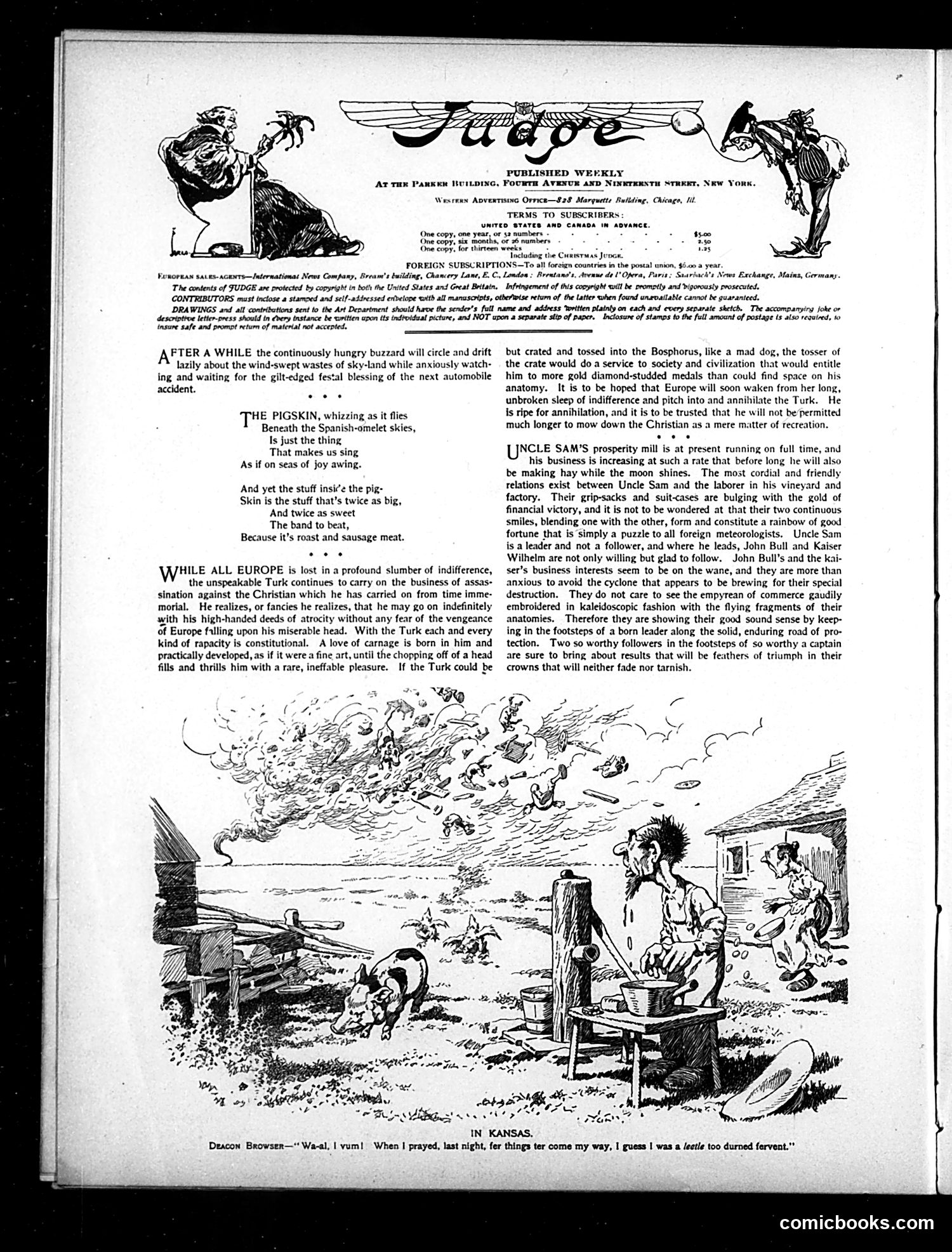
This page contains two distinct sections: **Top Section:** Editorial commentary criticizing European indifference to Christian persecution. The text argues that while Europe ignores religious violence, American business interests (represented by "Uncle Sam's prosperity mill") are pragmatically profiting regardless of moral concerns. It suggests American industrialists are deliberately avoiding ethical debates to maintain financial gain. **Bottom Cartoon:** Titled "In Kansas," depicts a frontier family amid chaos—livestock scattered, figures in disarray. The caption quotes "Dragon Browser": "Wa-al, I yum! When I prayed, last night, for things to come my way, I gums I was a deelie too darned fervent." This appears to satirize rural prayer or frontier desperation, possibly mocking simplistic faith-based approaches to hardship. The page juxtaposes serious geopolitical critique with rural American humor.
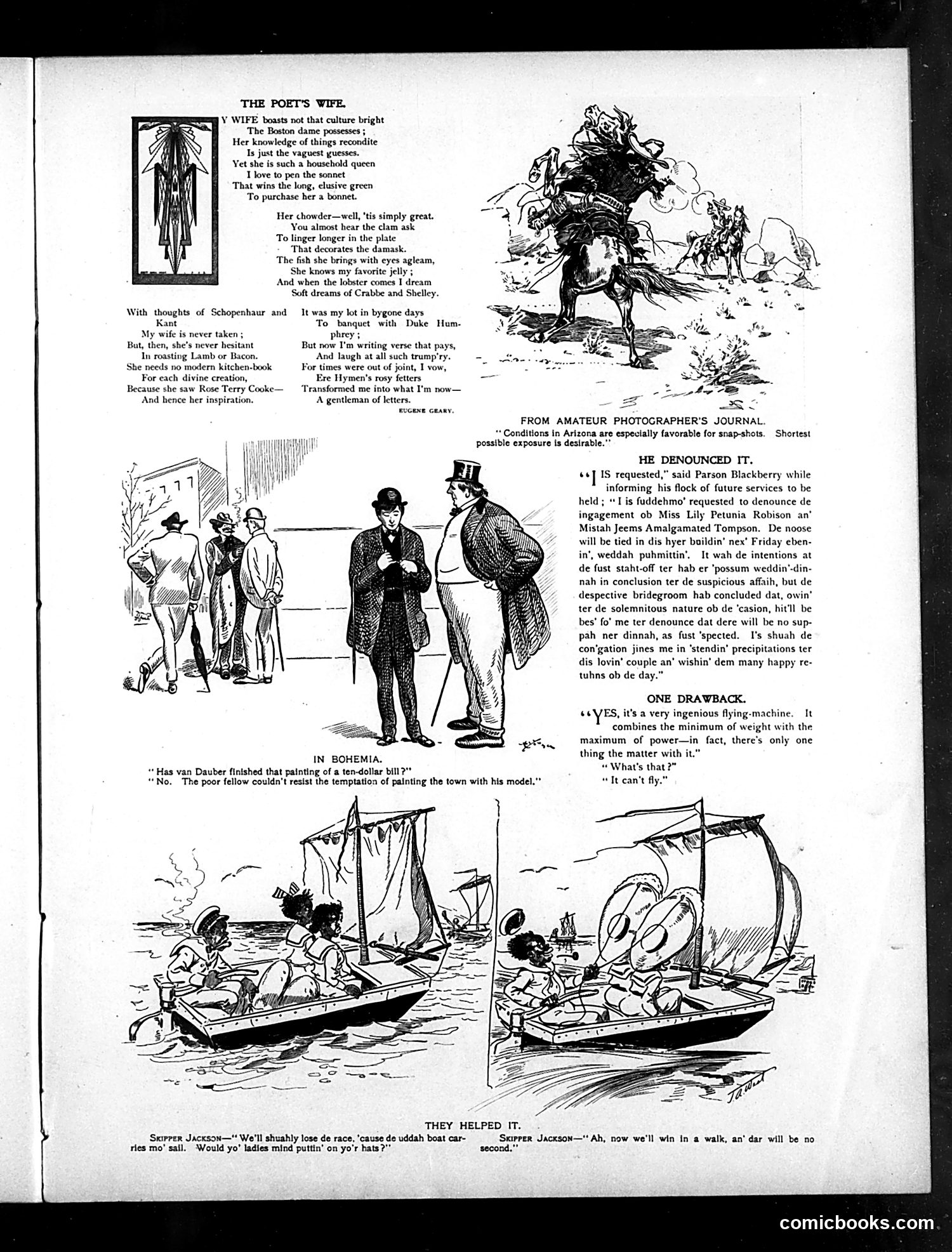
This page contains literary content and humor cartoons rather than political satire. **"The Poet's Wife"** is a poem about a Boston woman cultured in literature who nonetheless enjoys practical pleasures like fresh fish and lobster. The humor juxtaposes her intellectual interests (Schopenhauer, Kant) with her enthusiasm for cooking—a common satirical theme about educated women's dual nature. The cartoon "In Bohemia" jokes about an artist (Hals van Dauber) so absorbed in painting he neglected his town's appearance. The remaining cartoons about boat races and "Skipper Jackson" appear to be nautical humor without clear political reference. The "Amateur Photographer's Journal" entry concerns Arizona exposure times. The overall tone is genteel humor rather than sharp political commentary.
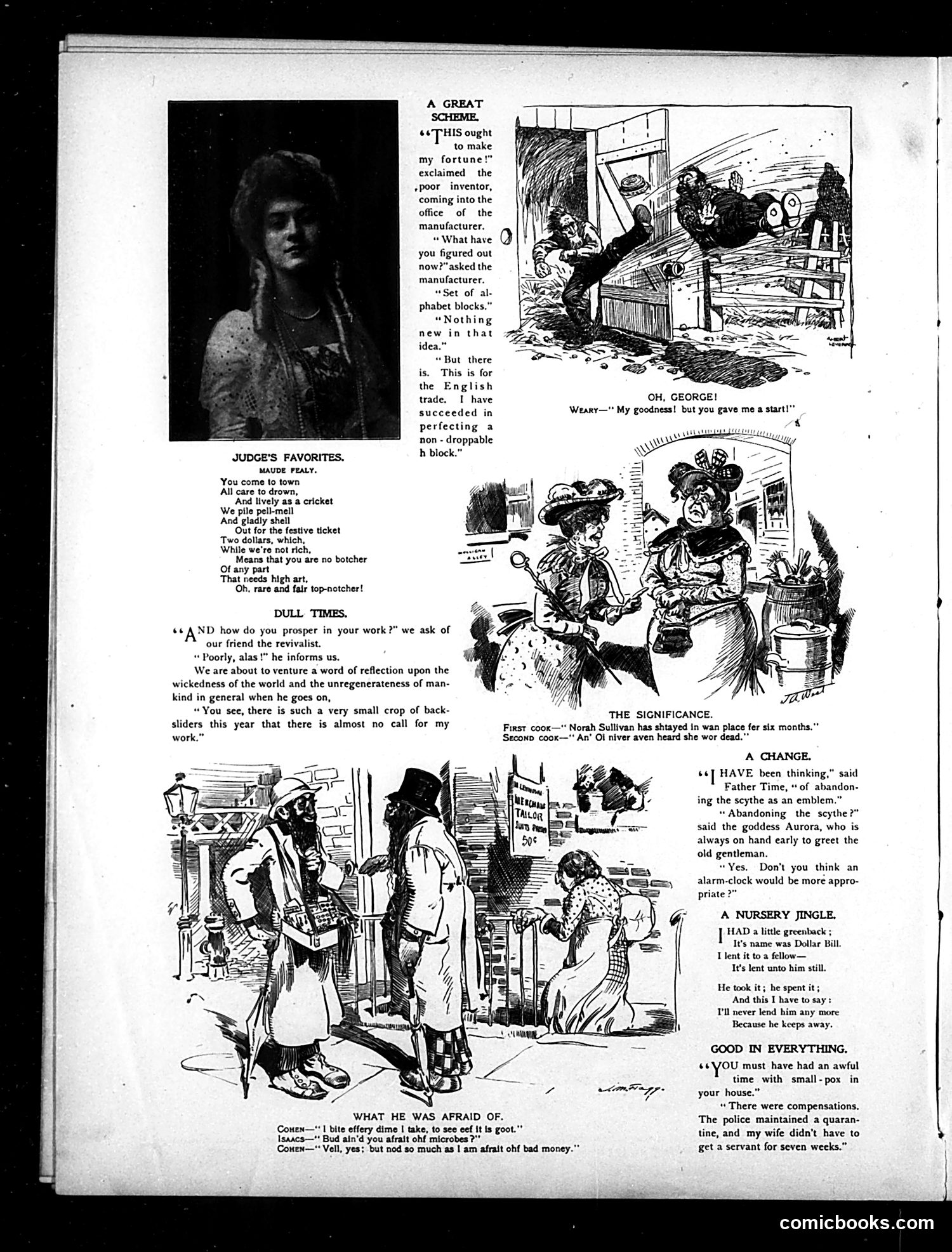
This page contains several satirical pieces and cartoons typical of early 20th-century humor magazines: **"A Great Scheme"** shows an inventor pitching a "non-droppable block" to a manufacturer—satirizing inventors' grandiose claims about ordinary innovations. **"Judge's Favorites"** and **"Dull Times"** are poems mocking social pretension and the tedium of revival meetings. **"What He Afraid Of"** depicts street characters discussing money anxieties—Cohen fears counterfeit coins, Isaac fears microbes—reflecting working-class concerns of the era. The remaining pieces ("The Significance," "A Change," "A Nursery Jingle," "Good in Everything") are humorous anecdotes and verses about domestic life, servants, and small misfortunes—typical Judge content offering gentle social satire rather than political commentary.
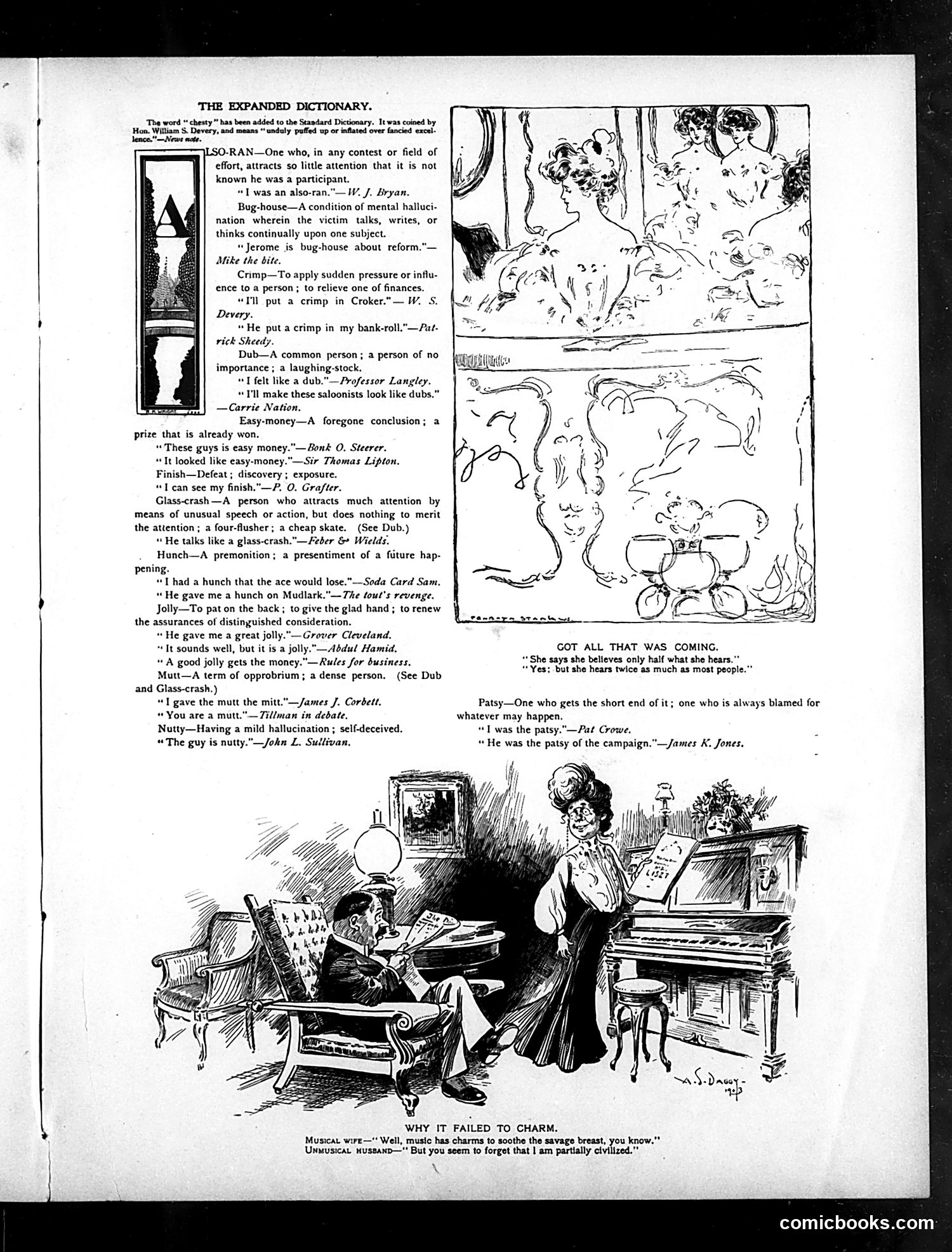
This page satirizes contemporary political and social figures through mock dictionary definitions of slang terms. The left column adds words like "also-ran" (attributed to William Jennings Bryan, suggesting he's a political failure), "bug-house" (reformer Jerome, mocked as obsessively fixated), and "dub" (linked to Carrie Nation, the temperance crusader, implying saloon owners aren't worth her attention). The definitions mock real politicians: William S. Devery (NYC corruption figure), Boss Croker (Tammany Hall), and others. The bottom cartoon "Why It Failed to Charm" depicts a couple at a piano—a musical wife citing the classical maxim that "music hath charms to soothe the savage breast," while her unmusical husband dismisses it, claiming partial civilization exempts him from such refinement. The satire targets both pretentious reformers and corrupt political machines of the Progressive Era.
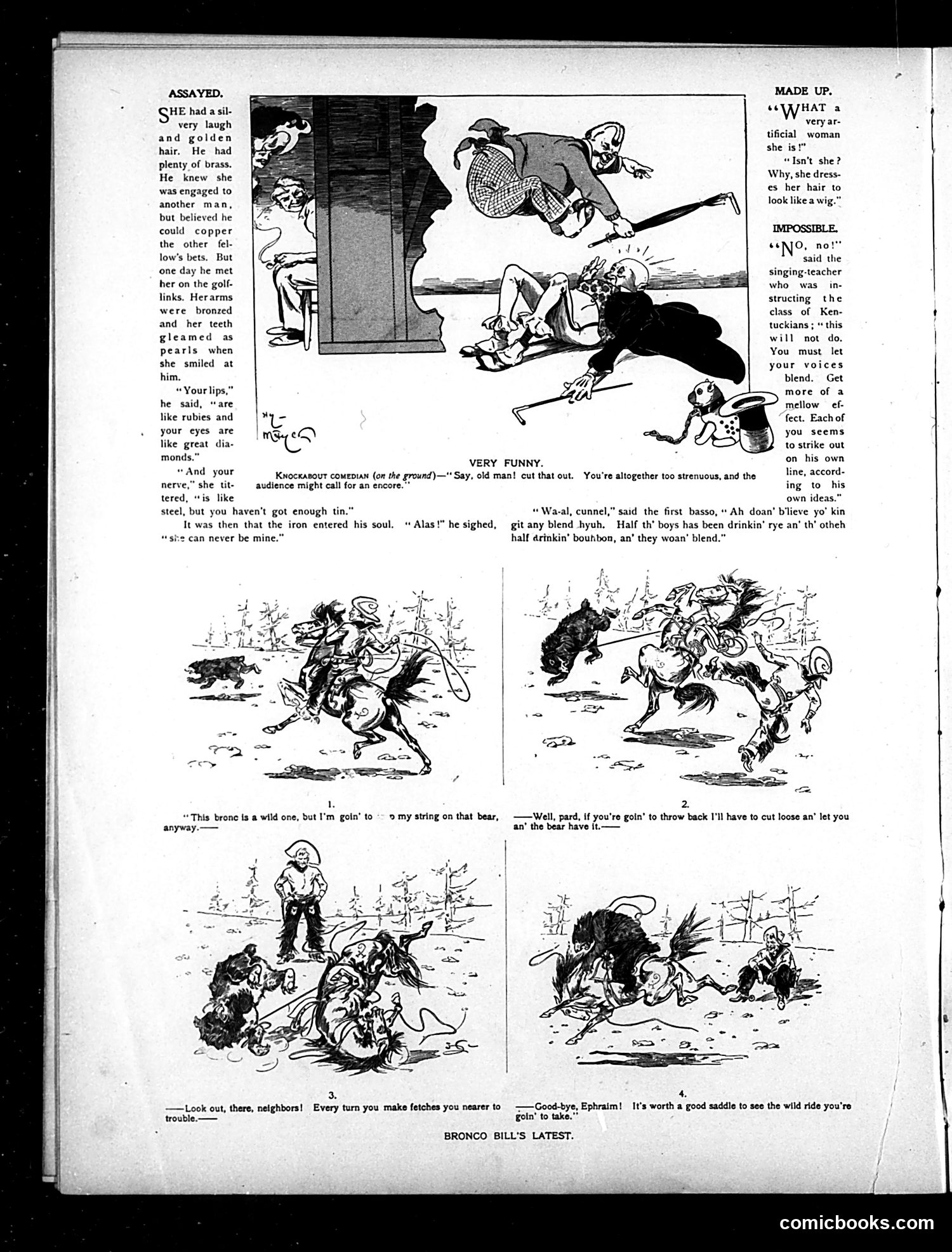
This Judge magazine page contains several short satirical pieces: **"Assayed"** (top): A romantic comedy where a man flatters a woman with flowery metaphors ("lips like rubies," "eyes like diamonds"), using precious metal terminology. She deflates his advances by noting he has "nerve like steel, but you haven't got enough tin" (slang for money). The joke: his flattery can't overcome his lack of wealth. **"Very Funny"** (center): A comedic dialogue between a Knockabout Comedian and an audience member about rowdy behavior—likely referencing vaudeville performance standards. **"Made Up"** and **"Impossible"** (right): Brief one-liners mocking artificiality and a singing teacher's futile attempt to blend Kentuckians' voices when half are drunk on rye whiskey and half on bourbon. **"Bronco Bill's Latest"** (bottom): A four-panel Western comic strip showing bronco-busting and wild horse riding—typical adventure comedy of the era. The page reflects early 20th-century American humor: class commentary, gender dynamics, ethnic stereotyping, and Wild West nostalgia.
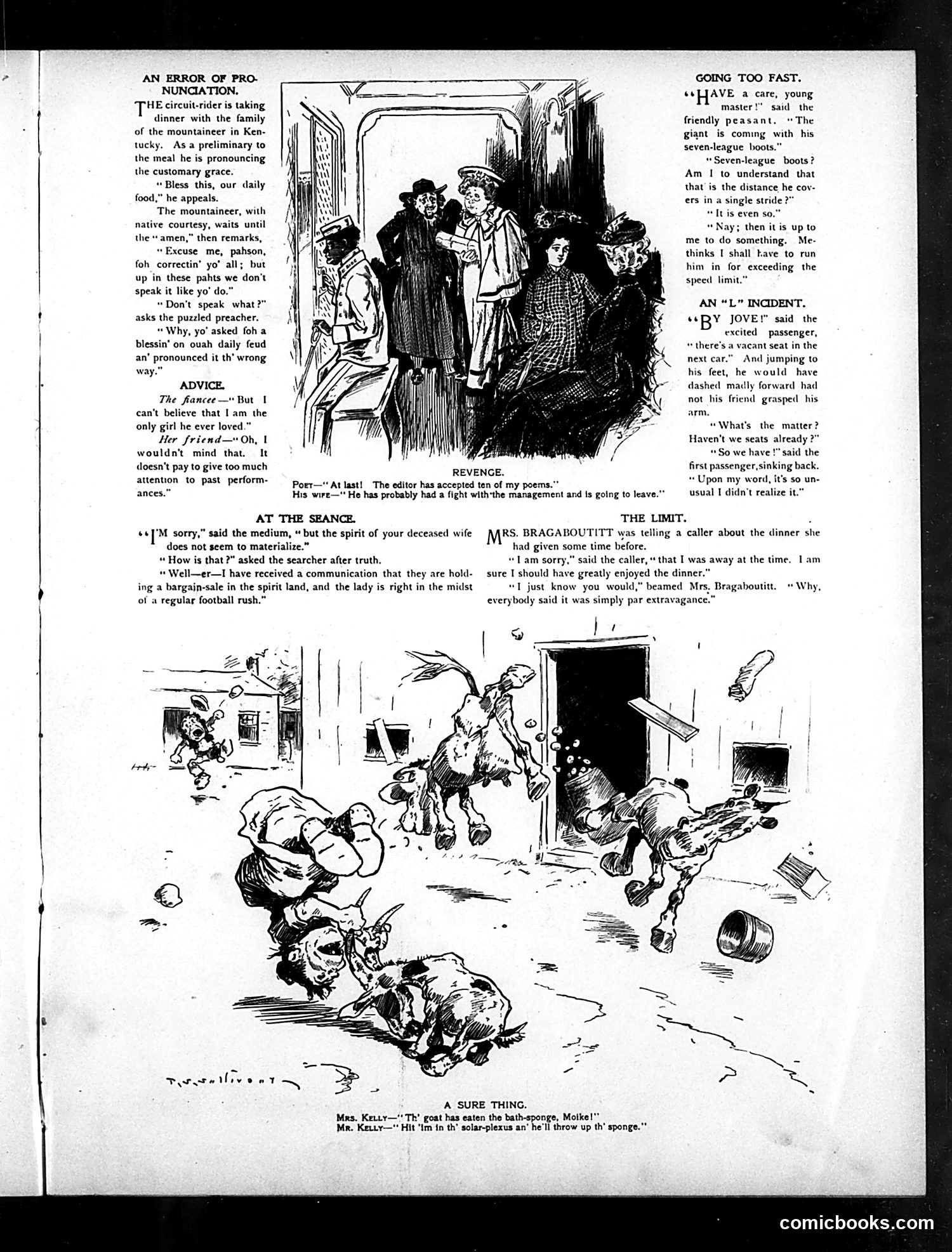
This page contains multiple short humorous pieces typical of early 20th-century satirical magazines: **"An Error of Pronunciation"**: A circuit-riding preacher says grace requesting "blessin' on ouah daily feud" (food). The Kentucky mountaineer corrects him—they pronounce it "feud," making the blessing sound like a blessing for their family conflict. The humor derives from dialect comedy and the preacher's embarrassment. **"At the Séance"**: A spiritualist medium explains the deceased wife won't materialize because she's at a bargain sale in the spirit world during a "football rush"—satirizing both spiritualism as fraud and contemporary consumer culture's grip on people. **"Going Too Fast"**: A passenger prepares to move to an empty seat before his friend stops him, revealing he's so unused to available seats on public transit that he almost rushed without thinking. This mocks crowded urban transportation conditions. **Other brief jokes** satirize romantic advice, poetry rejection, and domestic absurdities. The cartoons use visual slapstick and puns typical of period humor.
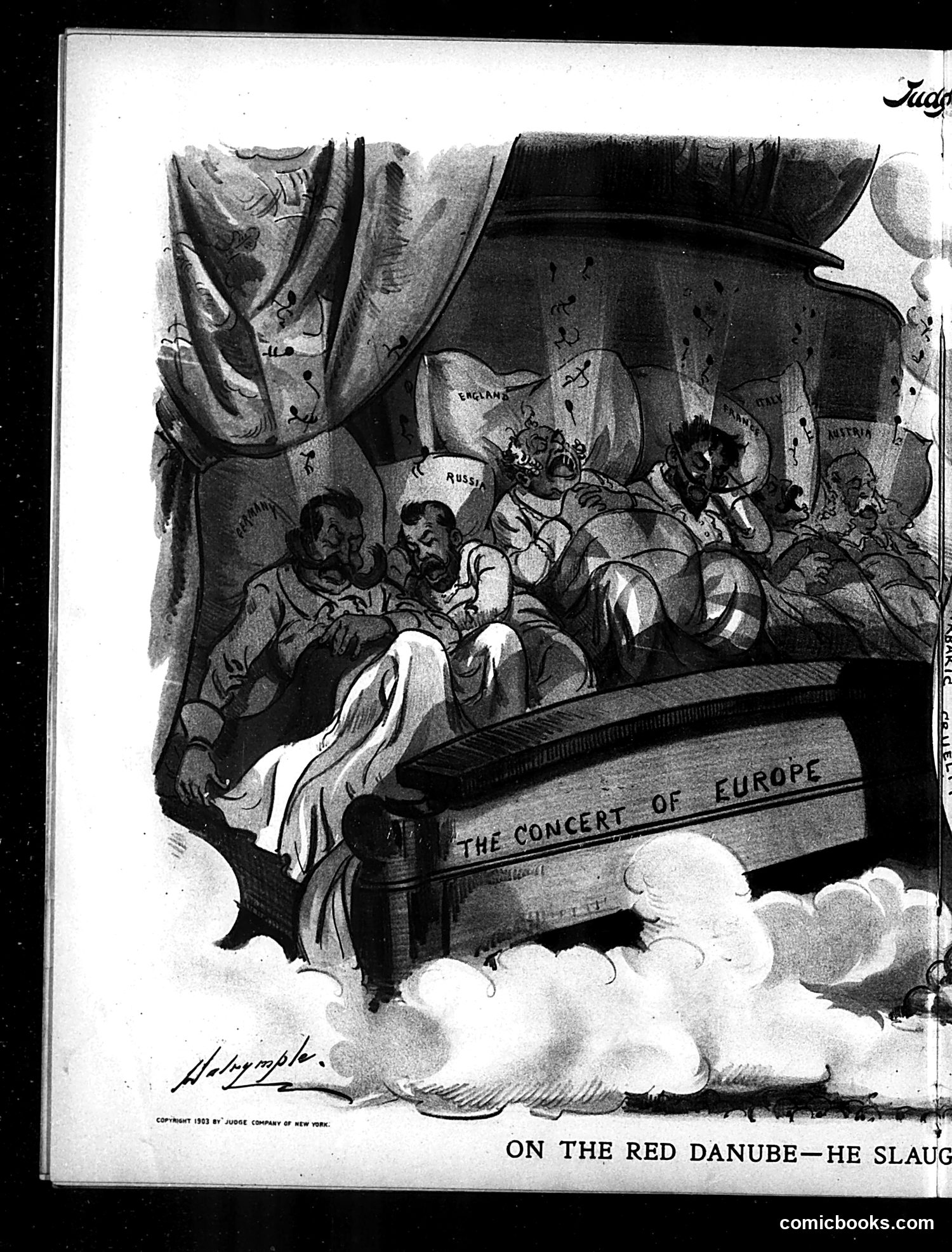
This 1903 political cartoon satirizes European powers' diplomatic coordination. "The Concert of Europe" refers to the collective great-power management of continental affairs following the Napoleonic Wars. The image shows national figures (labeled England, Russia, and Austria are visible) gathered in a tent or pavilion suspended above clouds, labeled "The Concert of Europe." The title's partial caption reads "On the Red Danube—He Slaug[hters]," likely referencing violence or instability in the Danube region, which was contested territory among European powers. The satire suggests these distant European leaders orchestrate grand diplomatic arrangements while ignoring or enabling bloodshed on the ground. The heavenly setting emphasizes their detachment from actual human consequences of their policies.
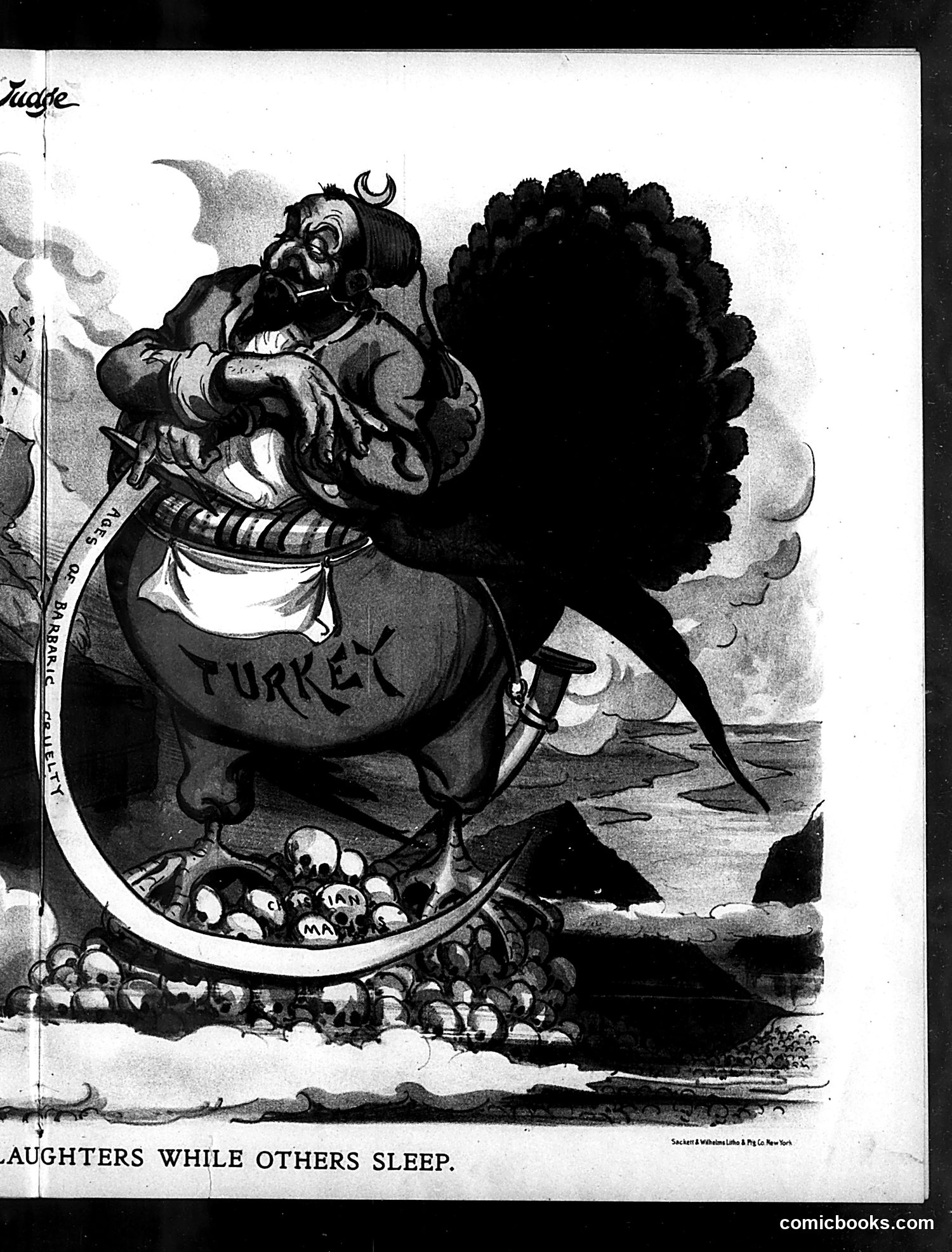
This appears to be a satirical cartoon titled "Laughters While Others Sleep" depicting Turkey as a demonic or villainous figure (marked "TURKEY" on its body) engaged in violence. The figure on the right—rendered in silhouette with exaggerated features—likely represents an ethnic or national group being attacked or massacred. The crescent moon symbol on the Turkish figure and the aggressive posture suggest this cartoon addresses Ottoman violence, possibly referencing Armenian massacres or other atrocities committed under Ottoman rule that were widely reported in early 20th-century American media. The caption's reference to acts occurring "while others sleep" implies Western indifference to these events. This reflects period attitudes toward Ottoman imperial violence and American isolationism regarding foreign atrocities.
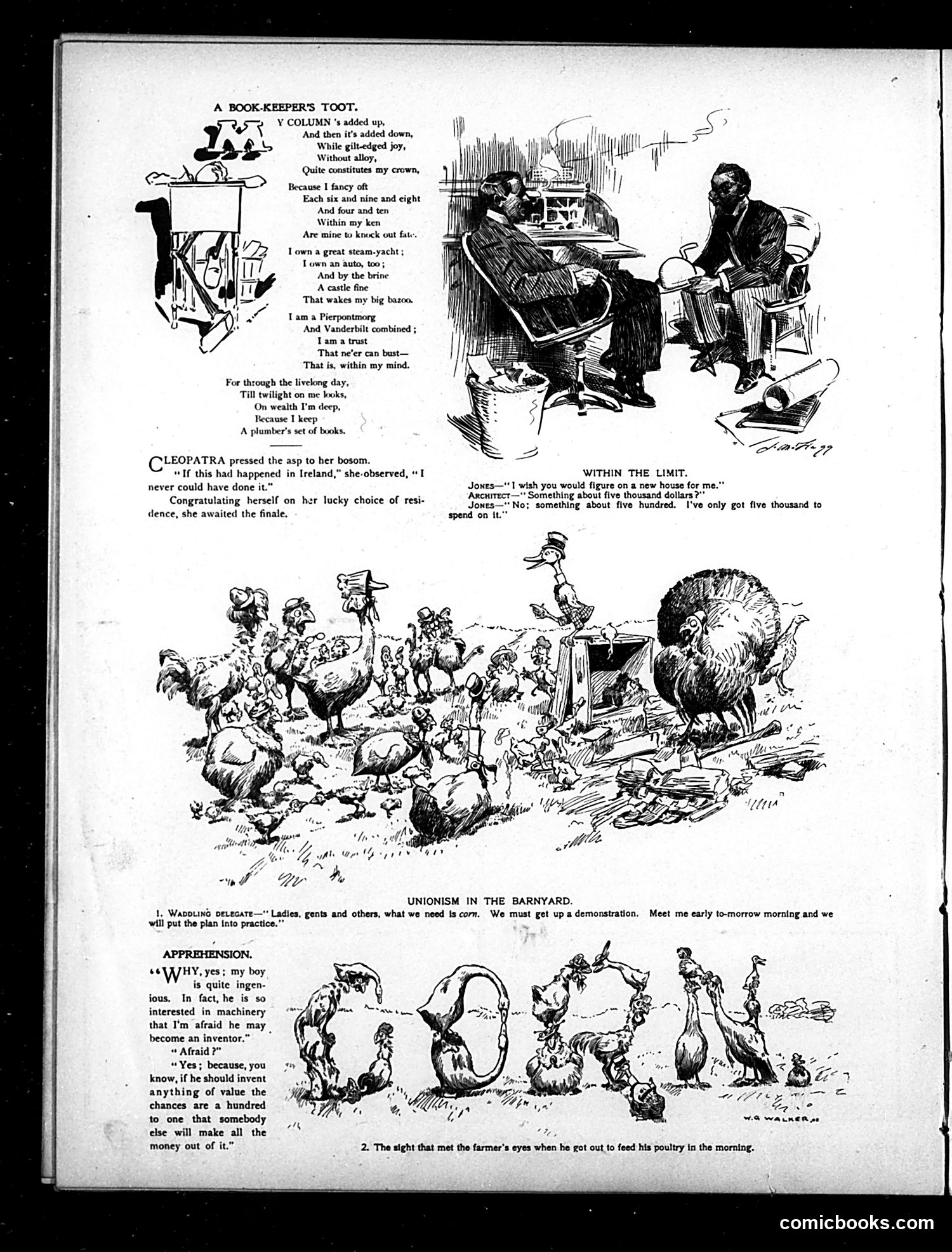
This Judge magazine page contains three satirical cartoons: **"A Book-Keeper's Toot"** mocks a humble accountant who fantasizes about wealth while keeping ledgers. The joke: he imagines owning yachts and castles through his power over numbers, though his actual riches exist only "within my mind." **"Within the Limit"** jokes about a man asking an architect for a house but clarifying he can only *spend* five hundred dollars, not the five thousand he *owns*—a comment on living beyond one's means or financial constraints. **"Unionism in the Barnyard"** satirizes labor organizing by depicting farm animals as union delegates calling a demonstration. The humor lies in applying serious labor-movement tactics to poultry concerned with corn. **"Apprehension"** critiques American patent/invention culture: a father fears his inventive son will create something valuable, but someone else will profit from it—reflecting anxieties about intellectual property theft and unfair business practices of the era.
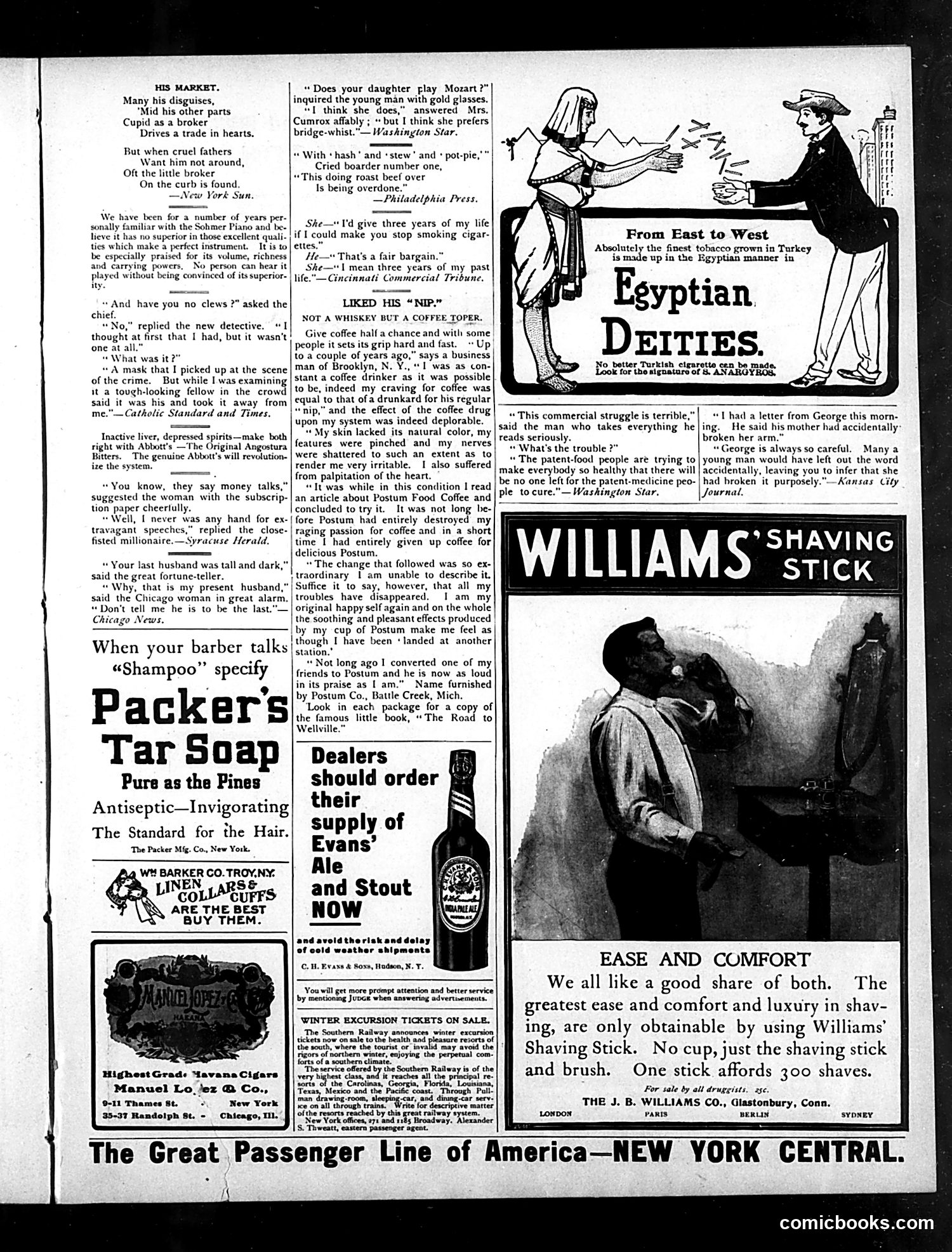
This page is primarily **advertisements and humorous short jokes** typical of Judge magazine's satirical format—not a unified political cartoon. The small jokes mock everyday situations: a fortune-teller's awkward prediction about a woman's husbands; a boarder complaining about repetitive boarding-house meals; young couples discussing Mozart and bridge; a man trading three years of his life to quit cigarettes. The main advertisement features a testimonial about **Postum**, a caffeine-free coffee substitute popular in the early 1900s. The "coffee toper" (addict) describes how switching from coffee to Postum cured his nervousness, poor complexion, and heart palpitations—a common health claim of the era before modern understanding of caffeine's actual effects. Other ads promote **Packer's Tar Soap**, **Williams' Shaving Stick**, and **Evans' Ale**. The page reflects Edwardian-era concerns: anxiety about caffeine dependency, gender roles (daughters playing music for suitors), and product marketing based on medical claims now considered dubious.
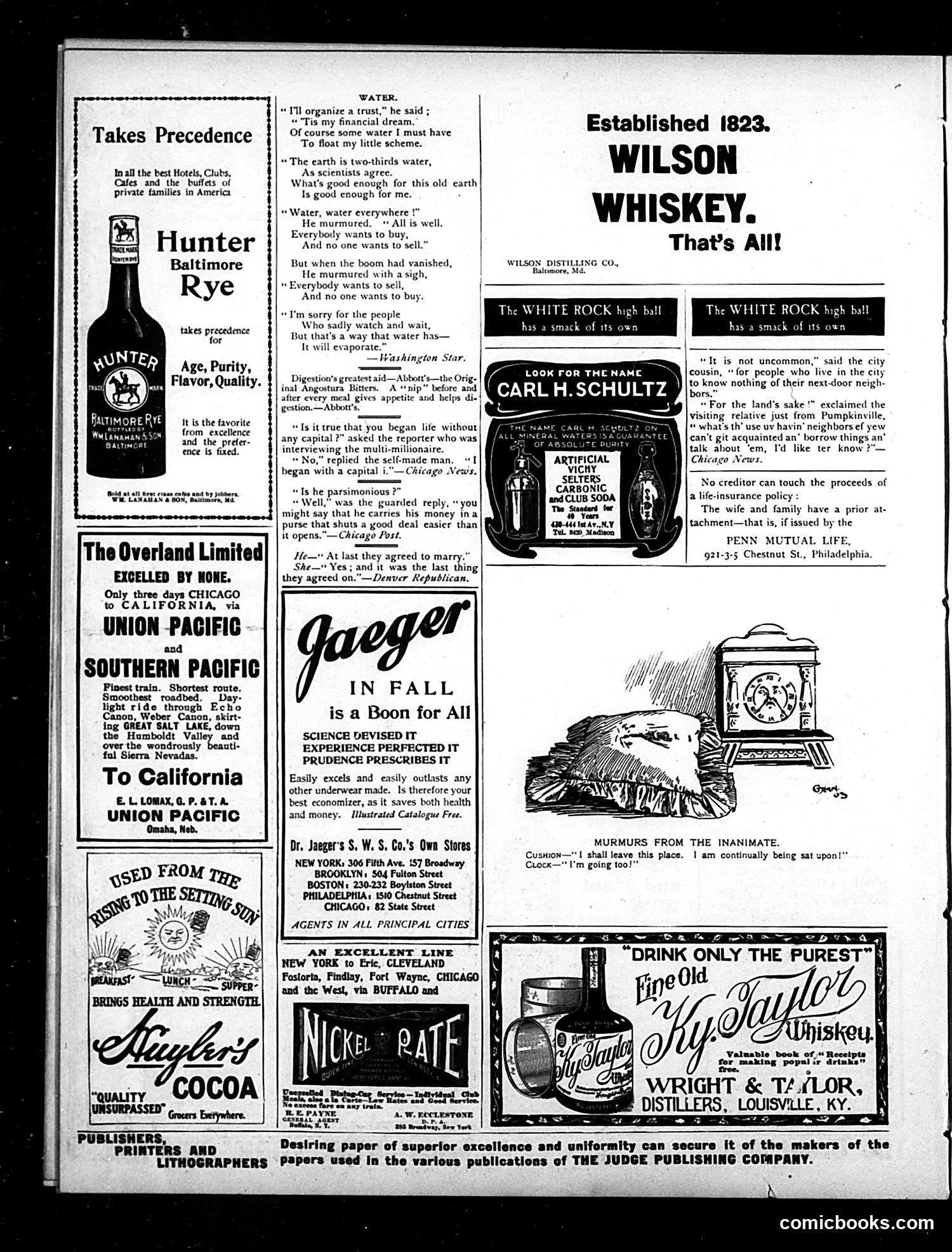
This page is primarily **advertising** with minimal editorial cartoons. The main content consists of liquor, patent medicine, and travel ads typical of early 1900s publications. The one clear cartoon is "**Water**"—a satirical poem about a man attempting to monopolize water through a trust scheme. When his business fails, water predictably "evaporates" (both literally and figuratively as his fortune disappears). The joke mocks the era's rampant trust-building and scheme-mongering, suggesting such monopolies are as futile as trying to corner the market on an essential natural resource. Small comic snippets scattered throughout joke about: a self-made millionaire who started with only "capital I" (wordplay), a parsimonious businessman with a tight purse, and a couple's only agreement being their decision to marry. The cartoons reflect **Gilded Age anxieties** about monopolies and get-rich-quick schemes while offering gentle domestic humor. Most of the page space advertises whiskey, cocoa, underwear, and railroad routes—reflecting Judge's commercial priorities.
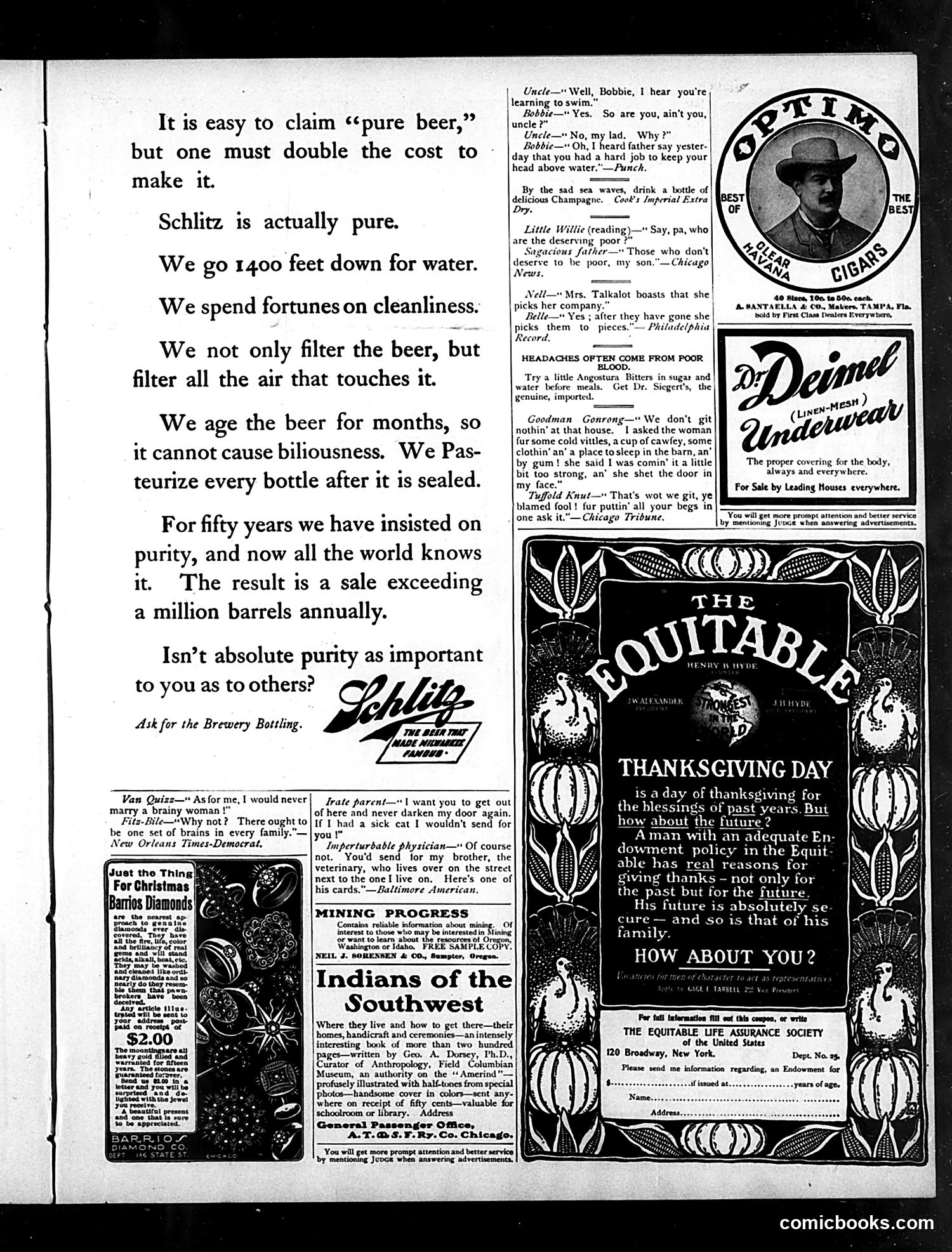
This page primarily contains **advertisements and humorous short jokes** rather than political cartoons. The main content is a lengthy **Schlitz beer advertisement** claiming absolute purity through extreme production methods (1400-foot-deep water sources, extensive filtering and pasteurization). The satire is subtle: the company's obsessive purity claims ironically prove that "pure beer" requires doubling costs—suggesting competitors' claims of purity are hollow marketing. The page also features several **brief comedic dialogues** poking fun at Victorian social pretensions: a uncle caught in hypocrisy about swimming, a father's cynical definition of "deserving poor," and a rural farmhand's unsuccessful plea for charity. Additional advertisements include **Dermel Underwear, Equitable Life Insurance, diamond rings, and a book about Southwestern Native Americans**. The humor throughout is genteel and mildly satirical rather than sharply political. The page reflects early 20th-century consumer culture and middle-class anxieties about authenticity, social obligation, and respectability.
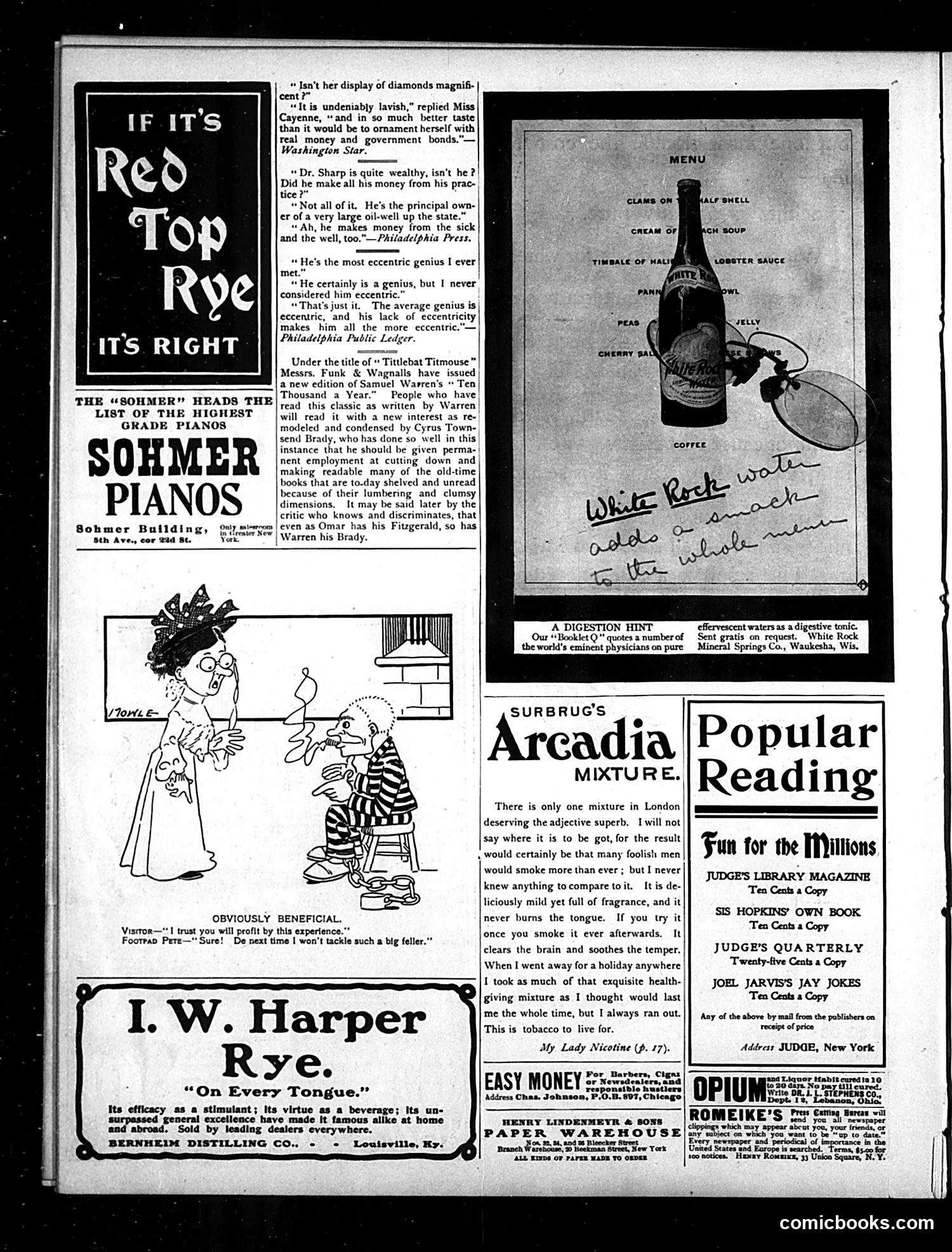
This page consists primarily of **advertisements and short satirical quips** rather than a coherent political cartoon. The visible humor relies on **ironic reversals and social commentary**: - A woman flaunts diamonds instead of "real money and government bonds"—satirizing nouveau-riche ostentation - A doctor profits from both the sick (medical practice) and the well (oil wells)—mocking opportunistic wealth-building - A "genius" lacks eccentricity, making him eccentric by contrast—absurdist wordplay The **cartoon labeled "Obviously Beneficial"** shows a street fight where one man, having lost, tells his opponent he won't tackle "such a big feller" next time—gentle humor about learning from experience. The remainder consists of **period product advertising** (pianos, rye whiskey, tobacco mixture, paper goods) and notices for Judge's publications—typical magazine filler of the era. No specific politicians or major events are referenced; this represents Judge's general satirical style: lightweight social observation aimed at middle-class readers.
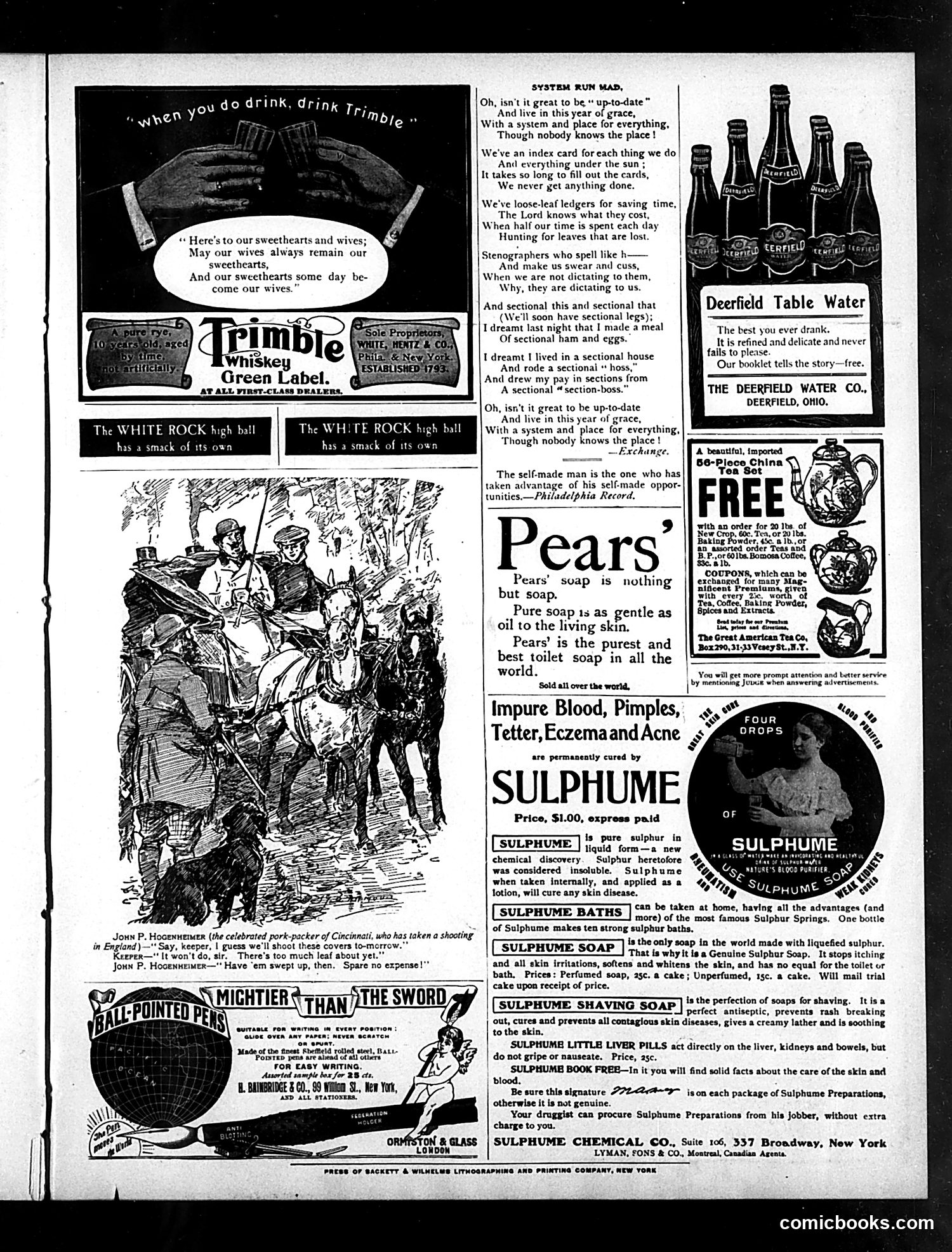
This page is primarily **advertising**, though it contains one significant satirical poem titled "System Run Mad." The poem mocks early-20th-century corporate obsession with "systematization"—the era's management craze. It ridicules excessive bureaucracy: index cards that waste time instead of saving it, loose-leaf ledgers where pages constantly go missing, and stenographers who argue back. The satire peaks with absurdist imagery of "sectional" everything (sectional houses, sectional pay, even sectional ham and eggs), suggesting that taking systems to extremes becomes nonsensical. The accompanying John P. Hockenheimer illustration appears to show a pork-packer dismissing concerns about leaves in his product, ordering them "swept up" at great expense—likely satirizing industrial carelessness disguised as efficiency. The rest of the page consists of period patent medicines and consumer goods ads (Trimble Whiskey, Pears' Soap, Sulphume for skin conditions), typical Judge magazine content from this era.
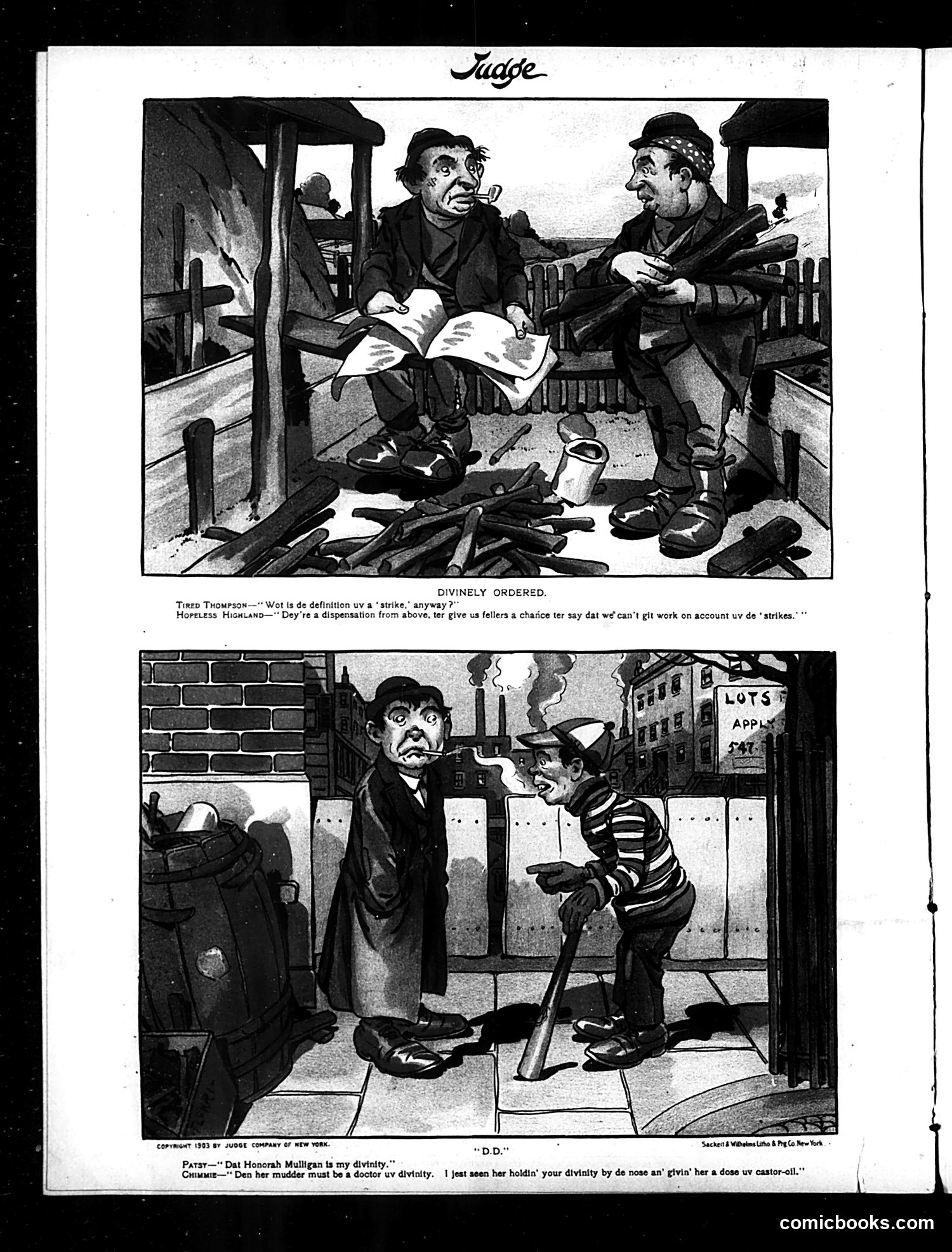
This page contains two separate satirical comics mocking working-class Irish immigrants during a labor strike era (likely early 1900s). **Top cartoon:** "Tired Thompson" and "Hopeless Highland" discuss strike definitions. The joke is sardonic—strikes are presented as "divine dispensation" (God's will) that *permit* workers to claim they can't find work, suggesting strikes are merely excuses rather than legitimate labor actions. The dialect reinforces ethnic stereotyping. **Bottom cartoon:** "D.D." plays on "divinity" (religious studies). A man claims "Honorah Mulligan is my divinity," but another character retorts that her mother must be "a doctor of divinity" since he saw her administering castor oil to the girl—a crude reference to maternal discipline or illness treatment, used here as crude humor. Both comics mock Irish-American workers and their speech patterns through crude humor and religious wordplay.