
Judge, 1903-11-07 · page 5 of 16
Judge — November 7, 1903 — page 5: what you’re looking at
What you’re looking at
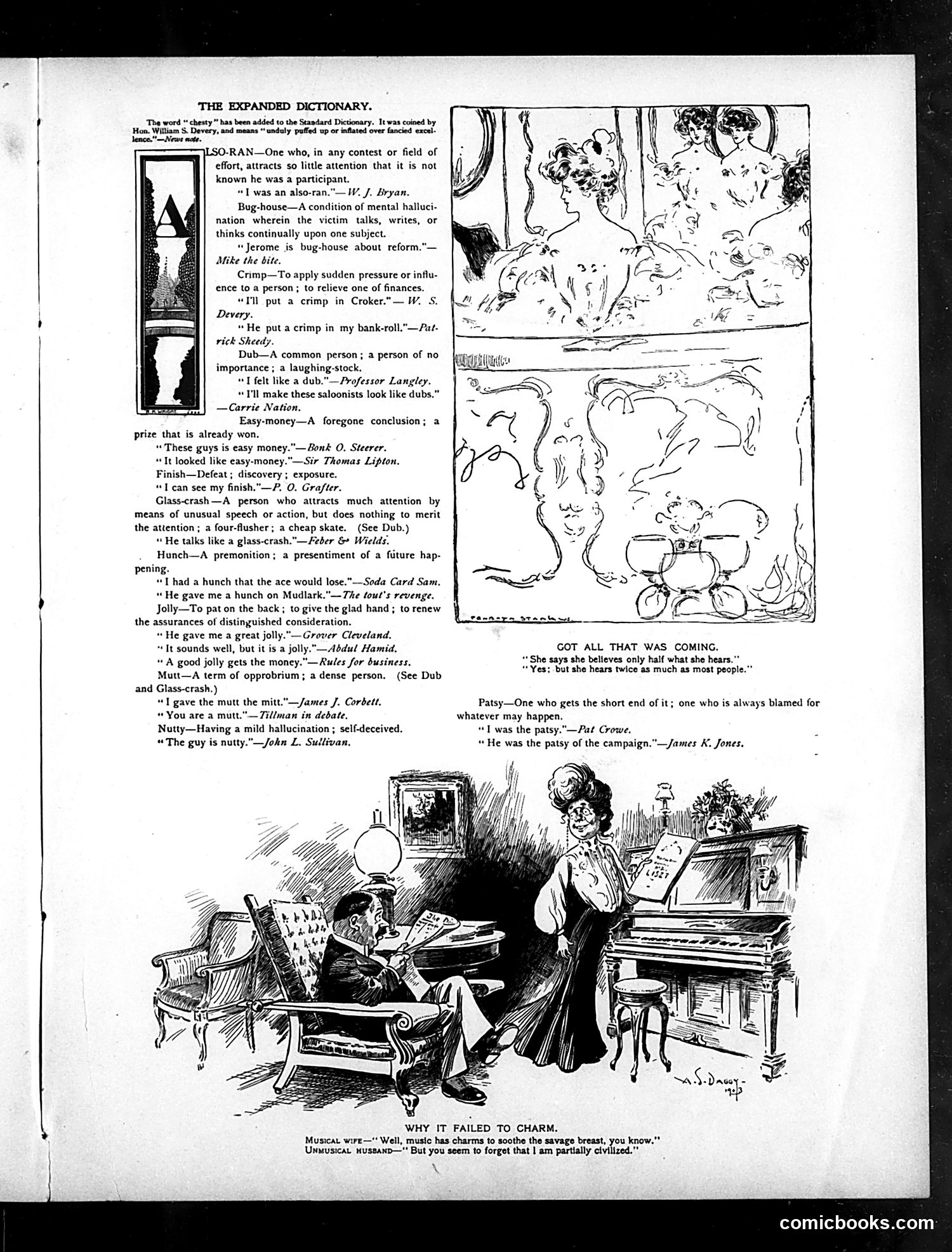
This page satirizes contemporary political and social figures through mock dictionary definitions of slang terms. The left column adds words like "also-ran" (attributed to William Jennings Bryan, suggesting he's a political failure), "bug-house" (reformer Jerome, mocked as obsessively fixated), and "dub" (linked to Carrie Nation, the temperance crusader, implying saloon owners aren't worth her attention). The definitions mock real politicians: William S. Devery (NYC corruption figure), Boss Croker (Tammany Hall), and others. The bottom cartoon "Why It Failed to Charm" depicts a couple at a piano—a musical wife citing the classical maxim that "music hath charms to soothe the savage breast," while her unmusical husband dismisses it, claiming partial civilization exempts him from such refinement. The satire targets both pretentious reformers and corrupt political machines of the Progressive Era.
📄 Transcribed text from this page (OCR, searchable)
Machine-transcribed from the original scan — historical spelling and the odd misread are preserved.
‘THE EXPANDED DICTIONARY. ‘The word “ chesty” has been added to the Stasdard Dictionary. It was coined by ‘Hon. William S. Devery, and means “unduly puffed up or inflated over fancied excel- lence."—News nate. SO-RAN—One who, in any contest or field of effort, attracts so little attention that it is not known he was a participant. “Twas an also-ran."—W. J. Bryan. Bug-house—A condition of mental halluci- nation wherein the victim talks, writes, or thinks continually upon one subject. “Jerome is bug-house about reform."— Mike the bite. Crimp—To apply sudden pressure or influ- ence to a person ; to relieve one of finances. “IM put a crimp in Croker."—W, S. Devery. “He puta crimp in my bank-roll."—Pat- rick Sheedy. Dub—A common person ; a person of no importance ; a laughing-stock. I felt like a dub."—Professor Langley. “T'll make these saloonists look like dubs.” —Carrie Nation. Easy-money—A foregone conclusion; a prize that is already won. “These guys is easy money."—Bonk O. Steerer. looked like easy-money."—Sir Thomas Lipton. ish—Defeat ; discovery ; exposure. “Tcan see my finish."—P. 0. Grafter. Glass-crash—A person who attracts much attention by means of unusual speech or action, but does nothing to merit the attention ; a four-flusher; a cheap skate. (See Dub.) “He talks like a glass-crash."—Feber & Wields. Hunch—A premonition; a presentiment of a fiture hap- pening. “Thad a hunch that the ace would lose."—Soda Card Sam. « He gave me a hunch on Mudlark."— Tie fout's revenge. Jolly—To pat on the back ; to give the glad hand ; to renew the assurances of distinguished consideration. “ He gave me a great jolly."—Grover Cleveland. “It sounds well, but it is a jolly."—Adbdul Hamid. GOT ALL THAT WAS COMING. “A good jolly gets the money."—Rules for business. ‘" She says she belleves only half what she hears."" MateoA teint of opprobeiom ya jaa pea (See Dub “SY.es ebay she hears: twice, es much es most people: and Glass-crash.) “IT gave the mutt the mitt."—/ames J. Corbett. Patsy—One who gets the short end of it; one who is always blamed for “You are a mutt."—Tillman in debate, whatever may happen. Nutty—Having a mild hallucination ; self-deceived. “was the patsy."—Pat Crowe. “The guy is nutty."—Jokn L. Sullivan, * He was the patsy of the campaign."—/ames K. Jones. WHY IT FAILED TO CHARM. Musica wire—“‘ Well, music has charms to soothe the savage breast, you know.” UmusicaL nussan>—" But you seem to forget that | am partially civilized.” comicbooks.com