
A complete issue · 16 pages · 1903
Judge — October 10, 1903
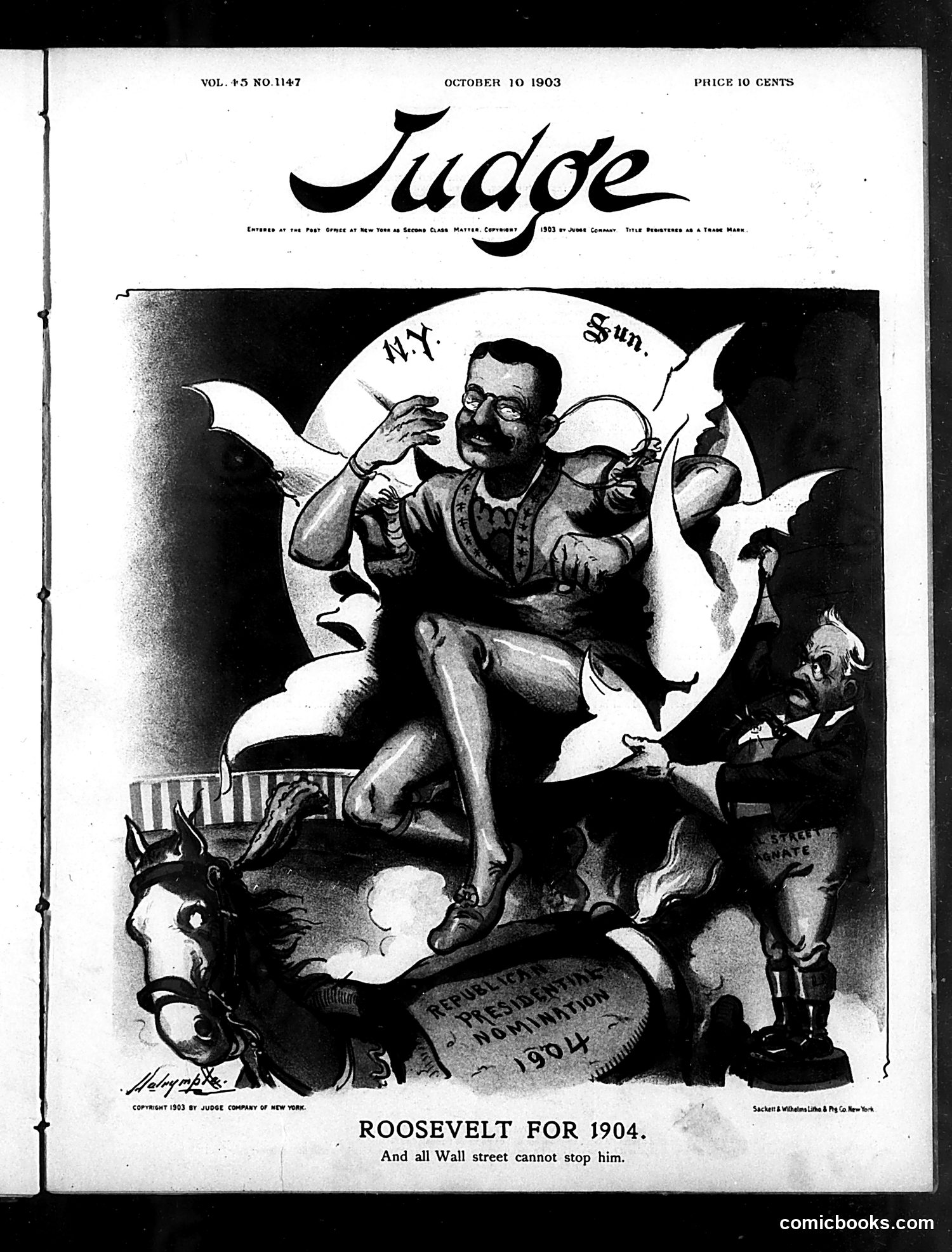
This political cartoon satirizes President Theodore Roosevelt's anticipated 1904 re-election campaign. The central figure depicts Roosevelt as a powerful, almost mythological force—muscular and dynamic—riding atop a horse labeled "Republican Presidential Nomination 1904," crushing obstacles beneath. The imagery suggests Roosevelt's political dominance and inevitability. The caption "And all Wall Street cannot stop him" indicates the satire's target: wealthy financial interests who may have opposed his candidacy, yet lacked power to prevent it. The caricatured faces on the right appear to represent Wall Street opposition, rendered powerless against Roosevelt's momentum. The overall message celebrates Roosevelt's political strength and his ability to override establishment resistance during the 1904 election cycle.
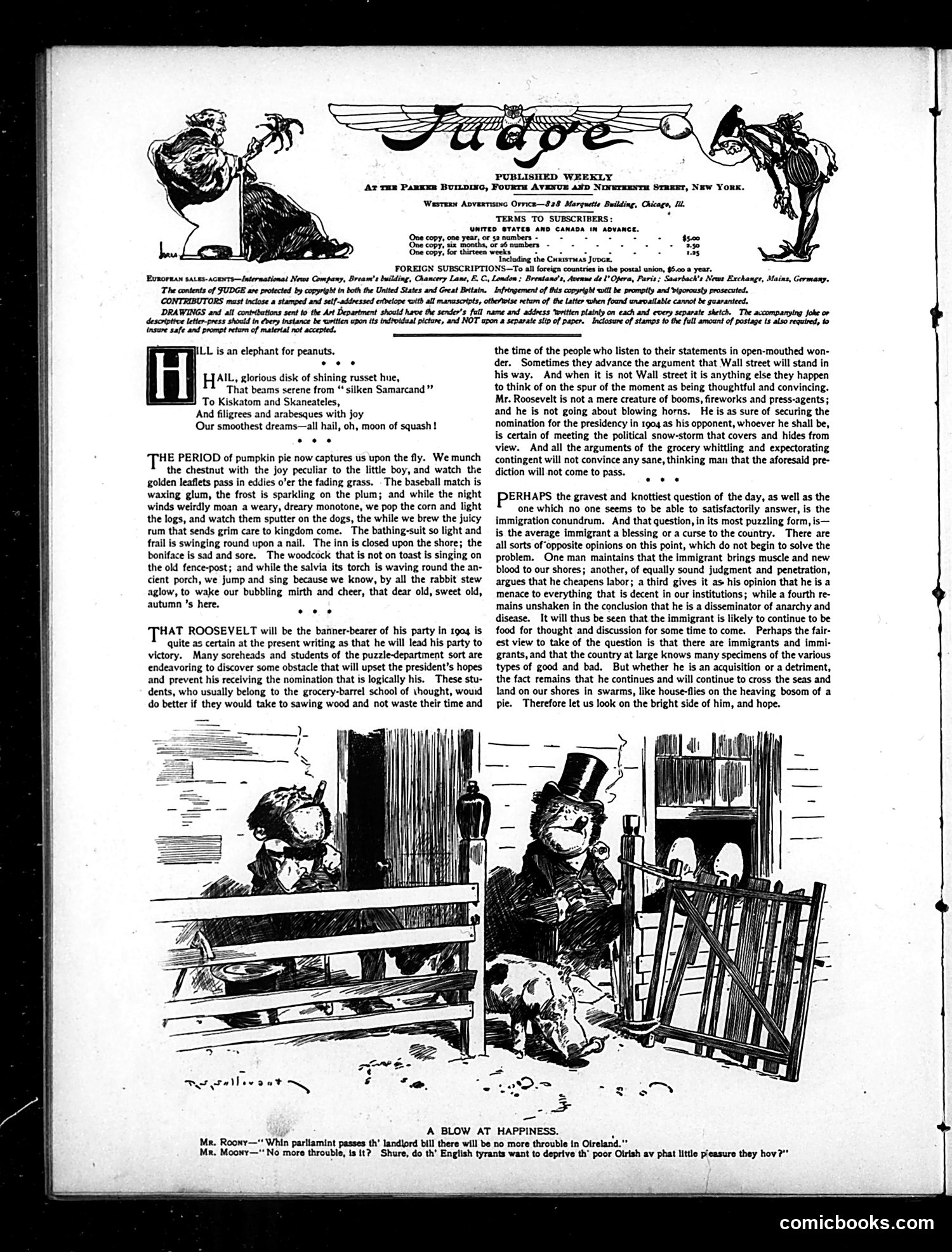
This Judge magazine page satirizes Roosevelt's 1904 presidential campaign. The editorial text argues that Roosevelt, despite opposition from party skeptics, will unite Republicans around his banner and secure victory. The main cartoon, titled "A Blow at Happiness," depicts two Irish-accented characters (likely representing working-class immigrants) discussing a parliamentary bill affecting Ireland. One says such measures will cause trouble in Cleveland; the other responds sarcastically that English tyrants presumably enjoy denying poor Irish people small pleasures. The satire operates on two levels: it mocks both Roosevelt's political situation and contemporary anxieties about immigration and Irish-American politics. The cartoon suggests tension between immigrant communities' interests and American political leadership, while the editorial attempts to rally disparate Republican factions behind Roosevelt's nomination.
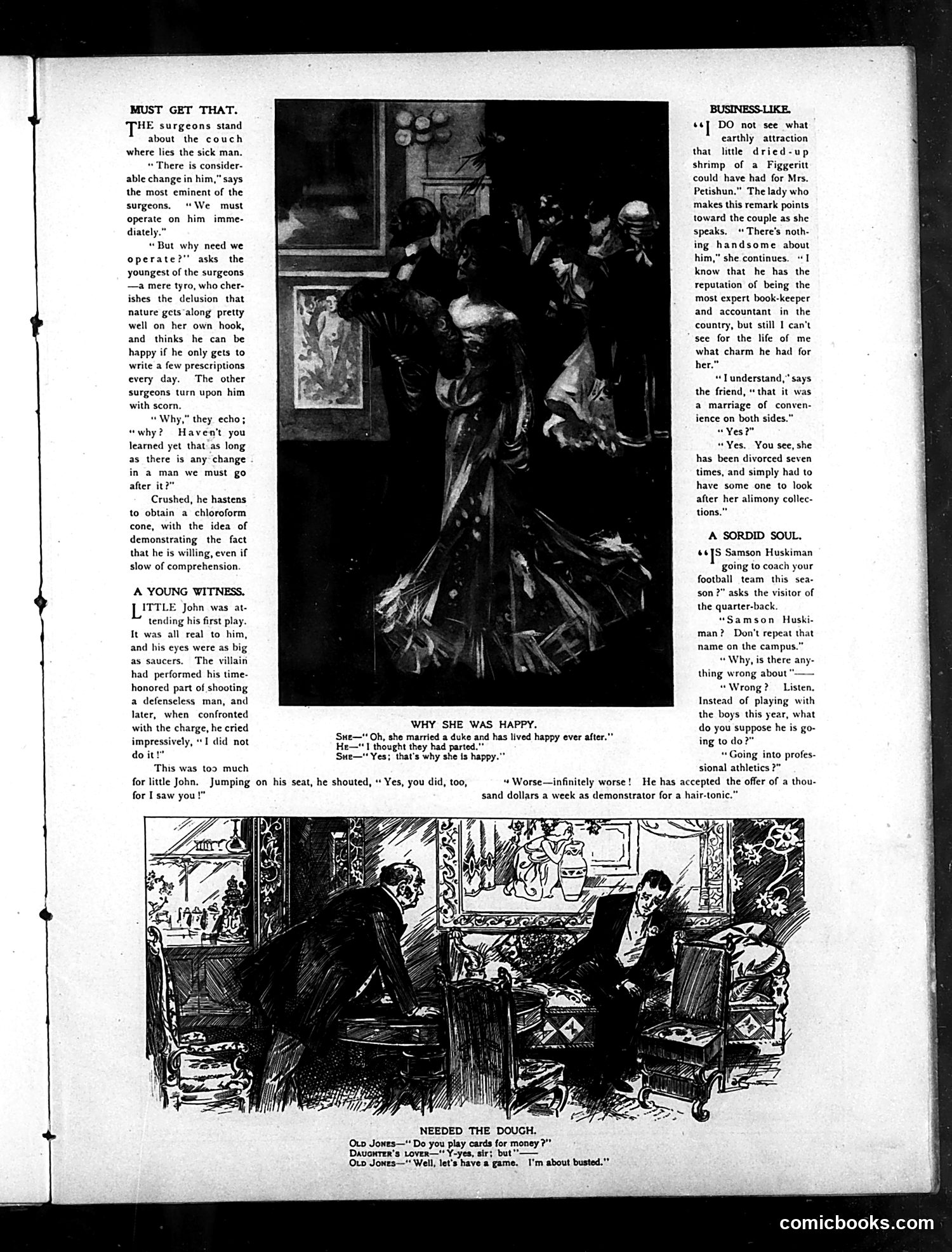
This page contains two satirical scenes with accompanying dialogue: **Upper image**: Depicts what appears to be a dramatic medical or theatrical scene with multiple figures in period dress, illustrating a story about surgeons debating whether to operate on a sick man. **Lower image** (titled "Needed the Dough"): Shows two men in conversation. The caption identifies "Old Jones" asking "Do you play cards for money?" and his "Daughter's Lover" responding about being "busted." The joke appears to satirize a young suitor's financial desperation—he's willing to gamble to solve money problems, likely to impress his girlfriend's father. The surrounding text columns contain unrelated satirical commentary on various social topics, including remarks about marriage and professional athletics. Without clearer date markers or specific historical references visible, the exact political context remains uncertain, though the tone reflects typical Gilded Age social satire.
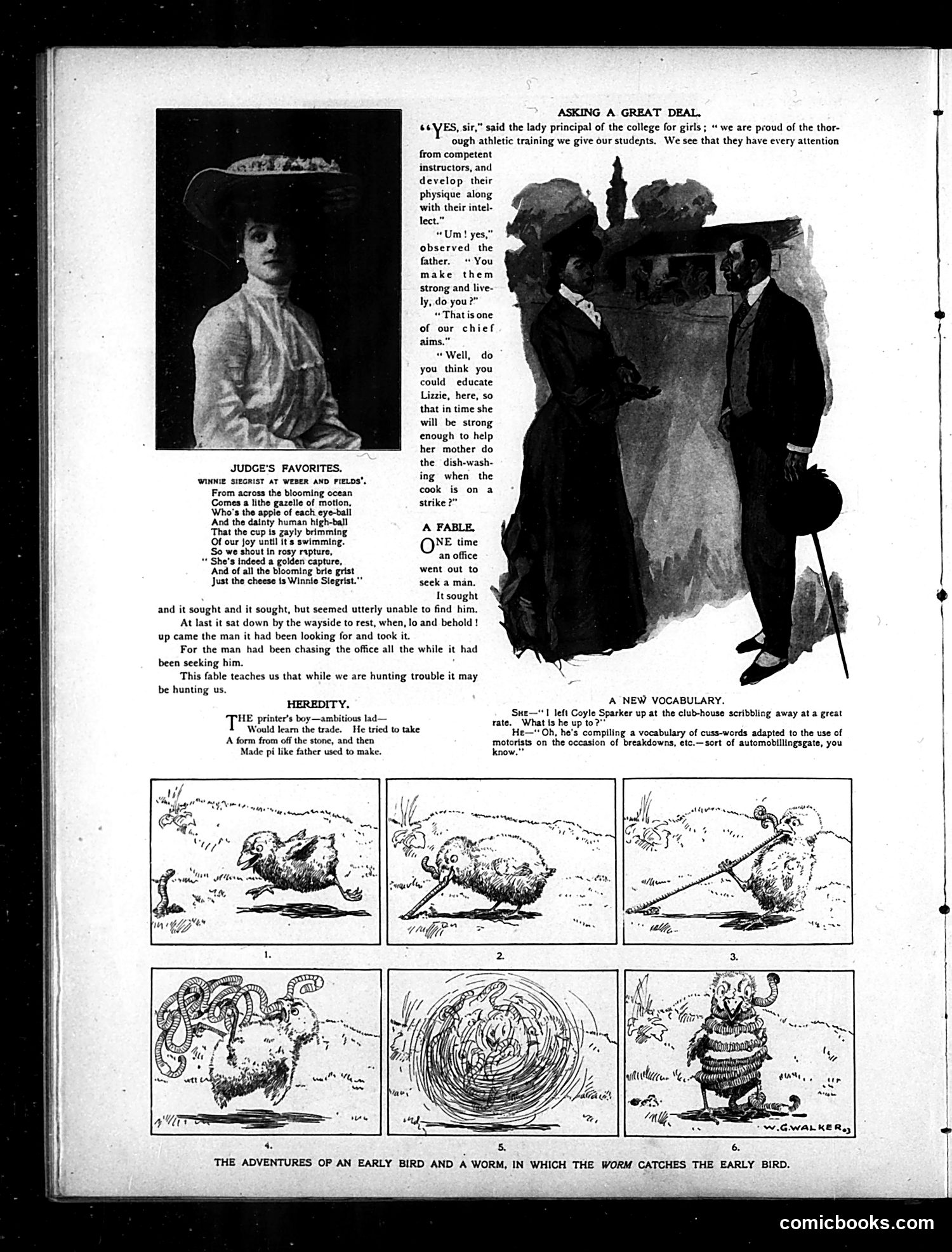
This page contains several distinct sections: **"Judge's Favorites"** features a portrait photograph of a woman (identity unclear from image alone) accompanied by poetry praising her athletic accomplishments and physical strength. **"Asking a Great Deal"** depicts a dialogue between a college principal and a father about educating girls to be physically strong and independent—reflecting early 20th-century debates about women's education and roles. **"A Fable"** offers a morality tale about an office seeking a man, illustrating that troubles may pursue us even when we're not seeking them. The page concludes with a six-panel comic strip titled **"The Adventures of an Early Bird and a Worm"** showing the reversal of the traditional proverb—here the worm catches the bird—presenting a humorous inversion of conventional wisdom.
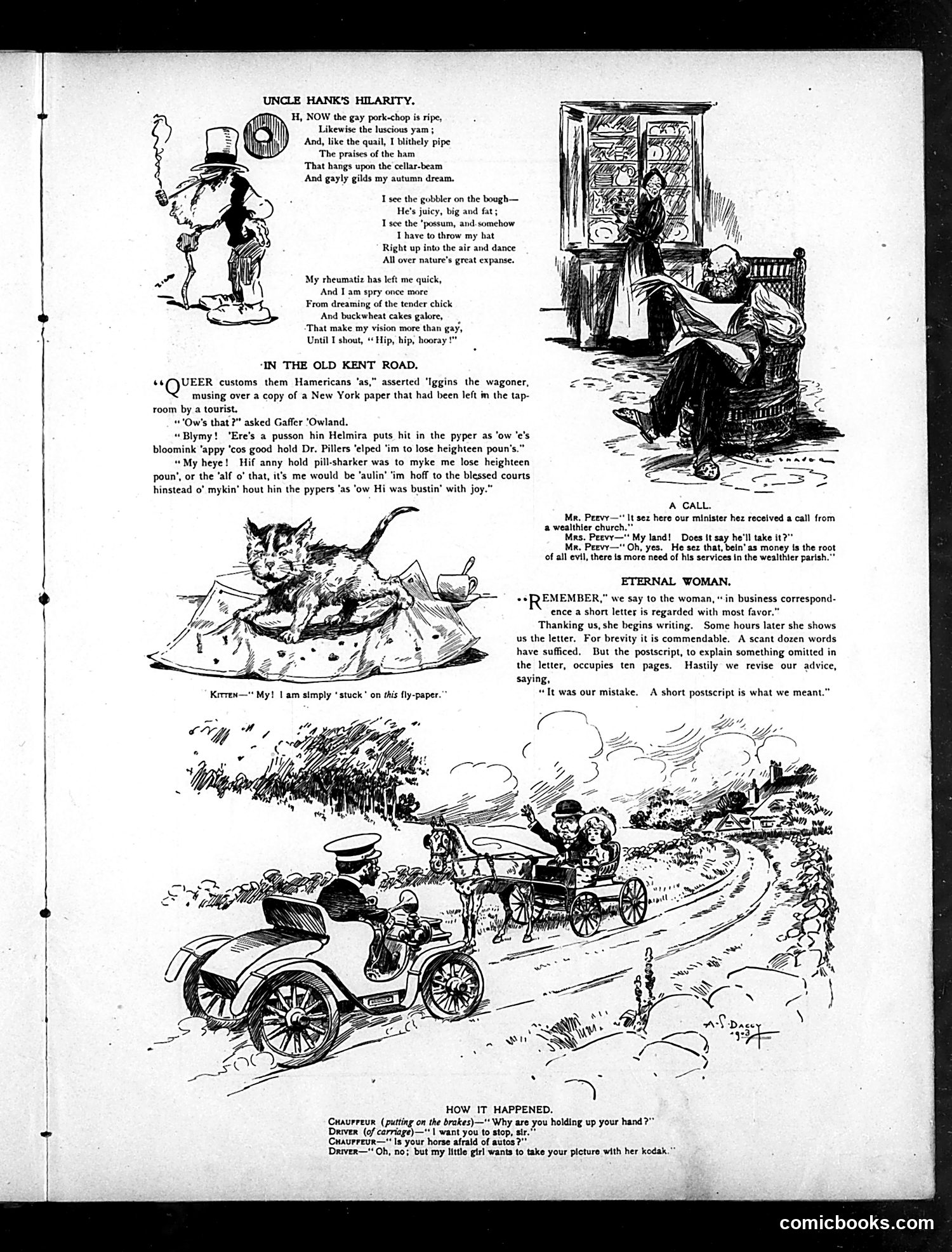
This page contains three separate humorous pieces typical of early 20th-century American satire: **"Uncle Hank's Hilarity"** presents rustic nostalgia—a country figure celebrating autumn harvest foods (pork, yams, ham, turkey, possum) with such enthusiasm that his rheumatism vanishes. The humor lies in the exaggerated sentimentality and dialect. **"In the Old Kent Road"** mocks American health culture through British working-class characters expressing bewilderment that an American would publicly celebrate weight loss or consult a doctor. The satire critiques American enthusiasm for medical self-improvement as peculiar. **"A Call"** jokes about ministerial hypocrisy: a pastor accepts a lucrative position at a wealthier church while claiming poverty's spiritual necessity—the irony being his stated principle contradicts his actions. **"How It Happened"** satirizes the new automobile era and kodak photography craze, suggesting even children now document life mechanically rather than simply experiencing it. The page reflects early 1900s American anxieties about modernity, changing values, and class distinction.
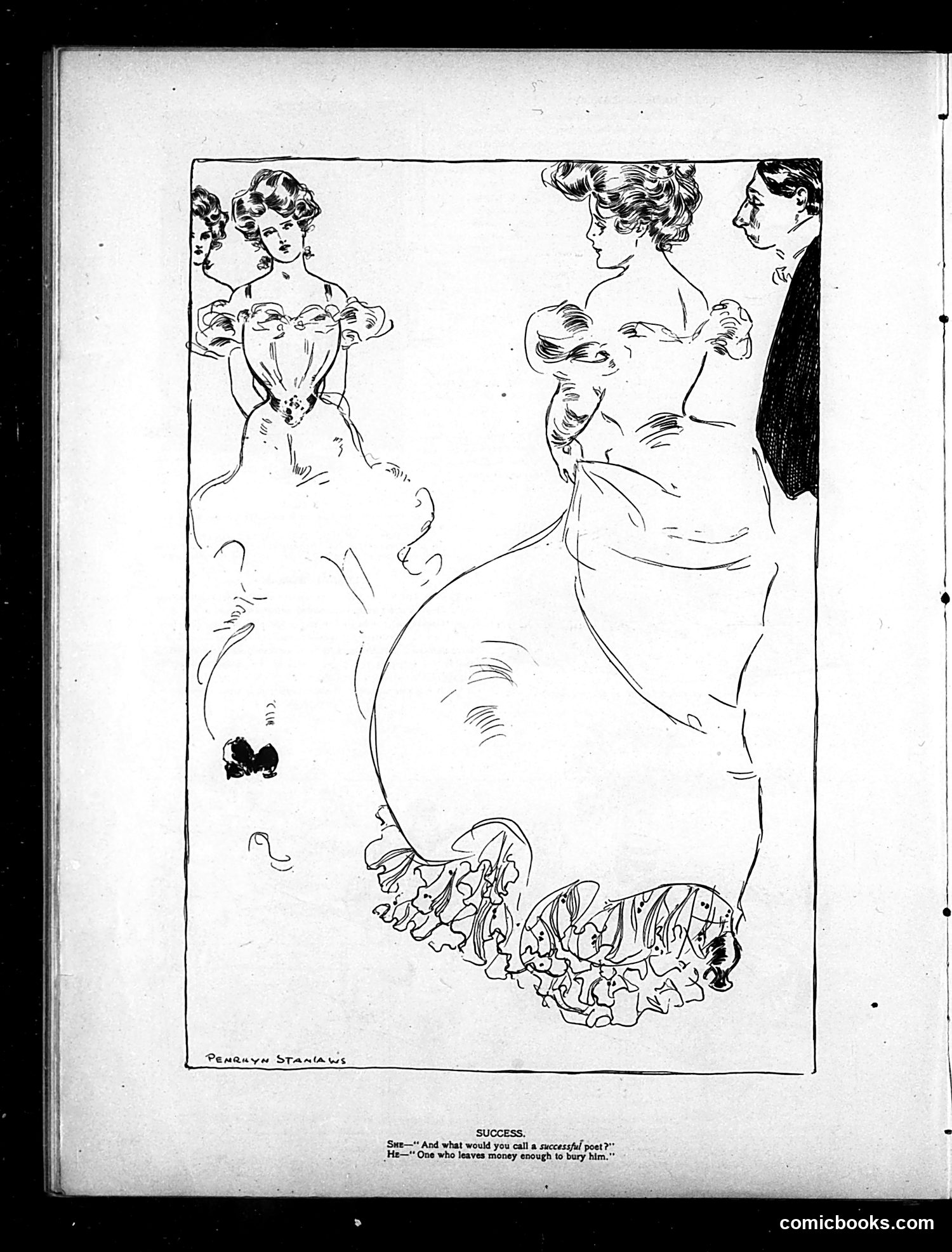
This Penrhyn Stanlaws cartoon satirizes wealth and social class through a dialogue between a man and woman at what appears to be a formal social gathering. The joke hinges on differing definitions of "success": She asks "And what would you call a real success?" He responds that success is "One who leaves money enough to bury him"—a sardonic comment on the meager aspirations of the working class or poor. The implication is that merely affording one's own funeral represents achievement for ordinary people. The cartoon mocks both the wealthy woman's presumption that success means something grander, and the grim reality that for many people, basic dignity in death was a luxury. It reflects early 20th-century anxieties about economic inequality and class distinction.
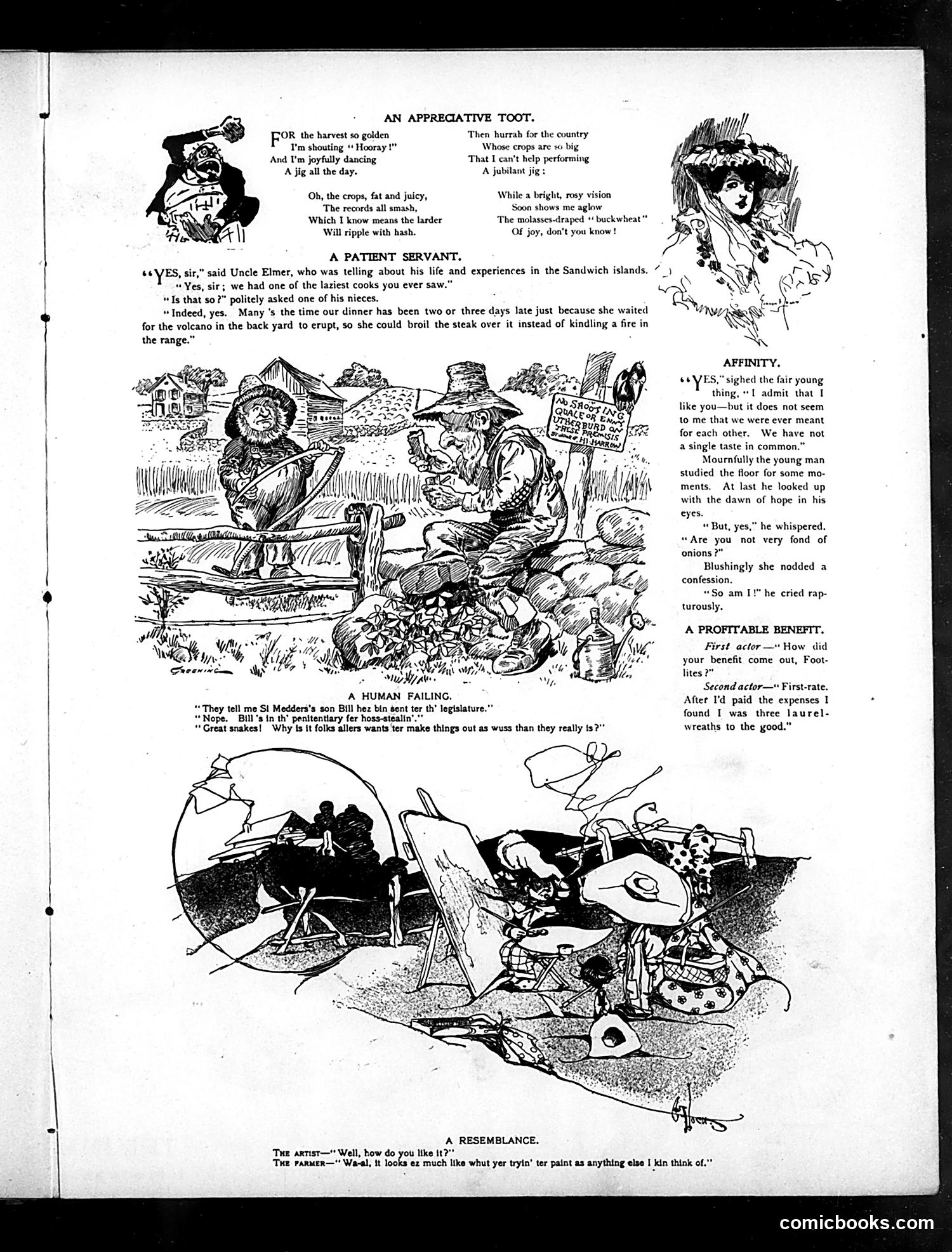
This page contains several unrelated humor pieces typical of Judge magazine's satirical format: **"An Appreciative Toot"** mocks agricultural inefficiency—a farmer boasts about his crops while acknowledging they're failing due to poor farming methods. **"A Patient Servant"** features Uncle Elmer recounting experiences from the Sandwich Islands, with humor centered on domestic incompetence (a cook waiting for volcanic eruption rather than using the stove). **"Human Failing"** appears to satirize legislative absurdity regarding Si Madden's son and house-raising, though the specific reference is unclear without historical context. **"Affinity"** presents a romantic subplot about a young man and woman finding common ground through shared dislike of onions. **"A Resemblance"** concludes with a visual gag comparing artwork to farming. The humor relies on period-specific references, domestic scenarios, and mild social observation rather than sharp political commentary.
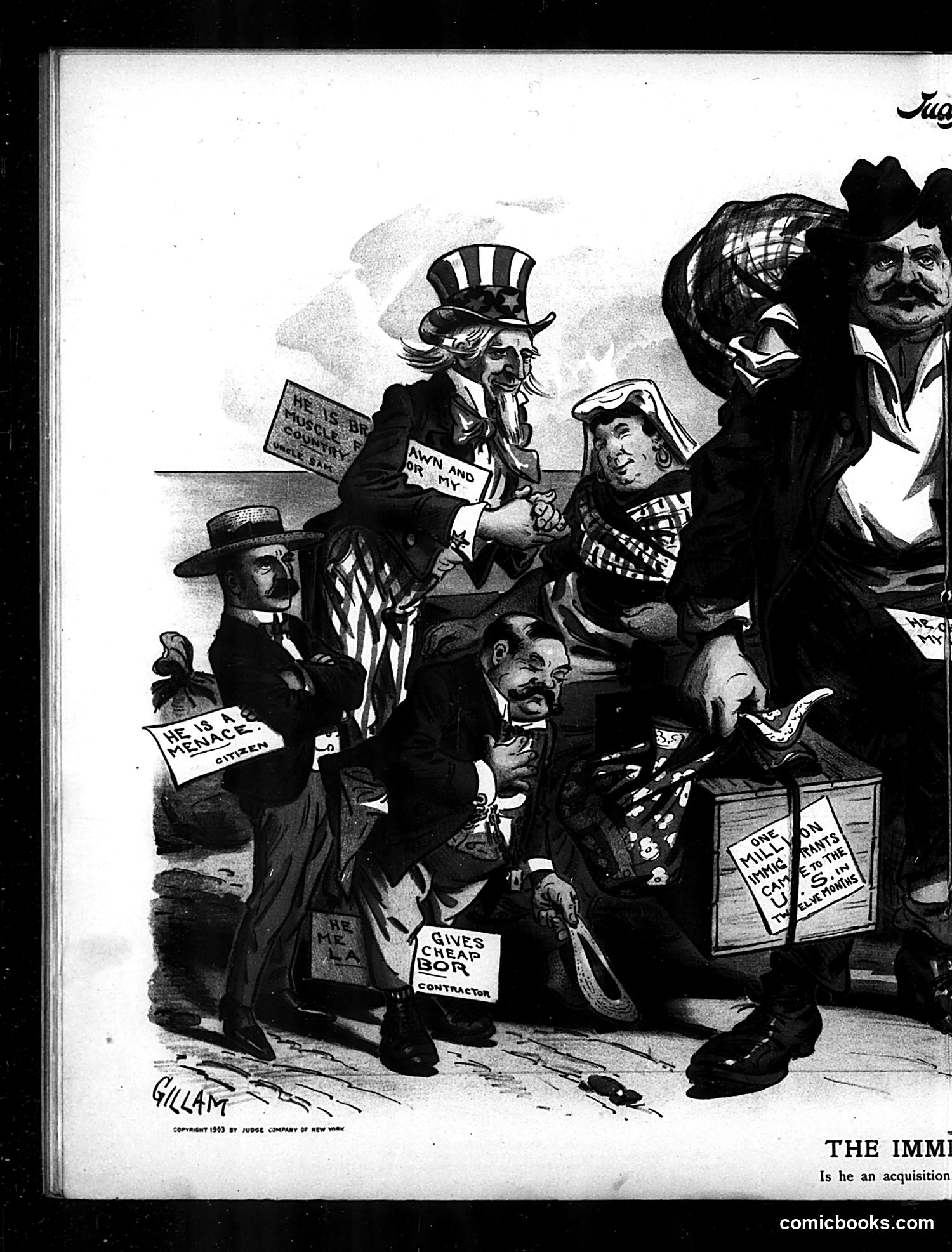
This is a political cartoon by Gillam from Judge magazine (copyright 1923). The central figure is Uncle Sam (identifiable by the top hat with stars and stripes), surrounded by caricatured figures representing various immigrant or foreign groups. The labels visible include references to "cheap labor" and "contractor," suggesting the cartoon satirizes concerns about immigration and its economic impacts. The cartoon appears to critique either the recruitment of cheap immigrant labor or anxieties about foreign acquisition/influence in America. The caricatures employ exaggerated ethnic features typical of 1920s satirical art. The headline fragment "THE IMM" likely refers to "immigration," with the question "Is he an acquisition?" asking whether immigrants constitute a beneficial addition to America. The satire targets nativist concerns prevalent during the restrictive immigration period of the 1920s.
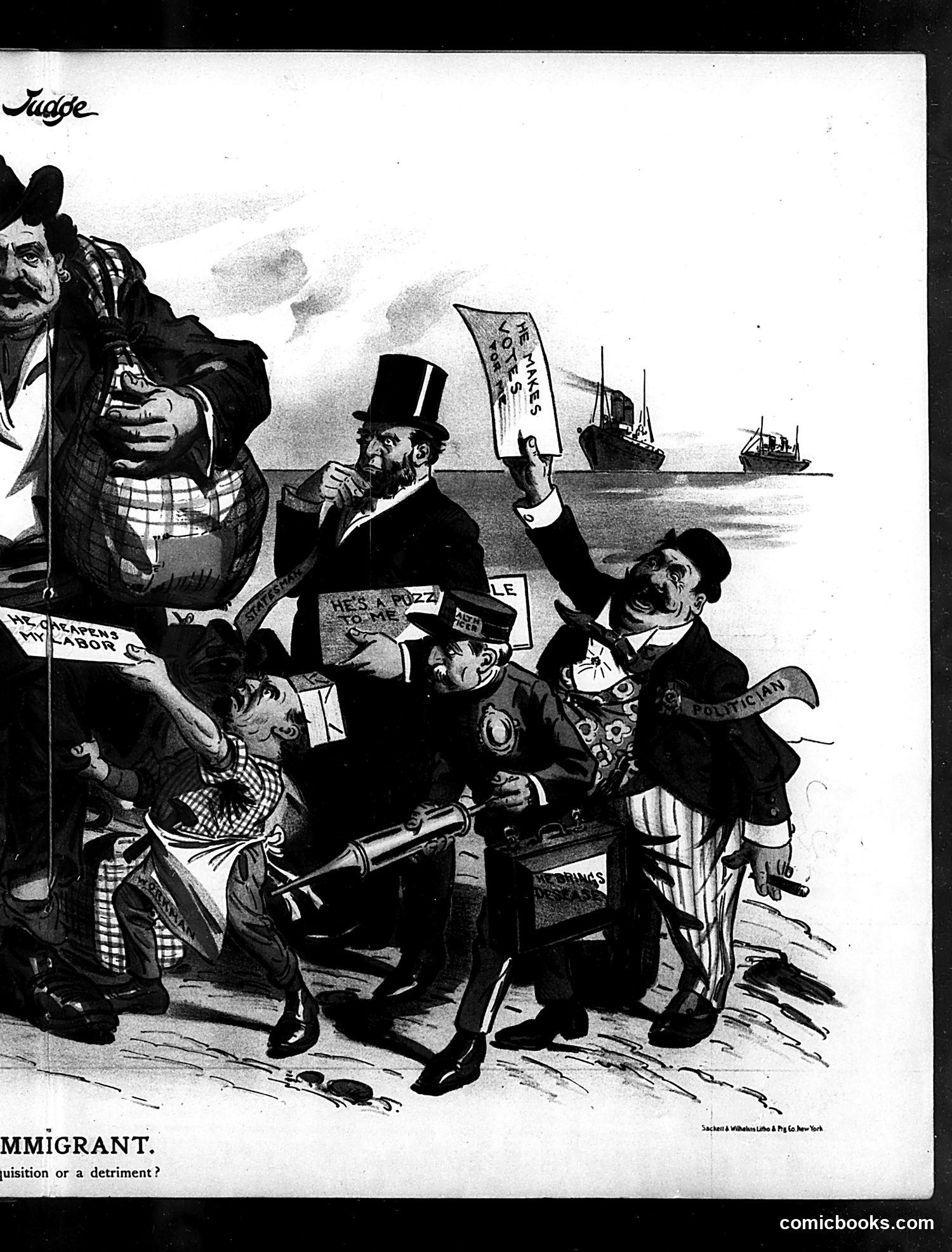
This political cartoon from *Judge* magazine satirizes immigration to America. The composition shows ships arriving at what appears to be a port, with caricatured immigrant figures labeled with various stereotypes and prejudices. The figures appear to represent different immigrant groups, depicted with exaggerated features common to late 19th/early 20th-century anti-immigrant propaganda. The headline question—"Acquisition or a detriment?"—frames the central debate about whether immigrants benefit or harm America. The cartoon clearly takes a skeptical, xenophobic stance, using caricature to suggest immigrants represent problems or threats rather than contributions. The style and content reflect the period's widespread nativist sentiment opposing immigration, particularly from non-Western European sources. Ships in the background emphasize immigration's literal arrival point, making the cartoon's anti-immigrant message unmistakable.
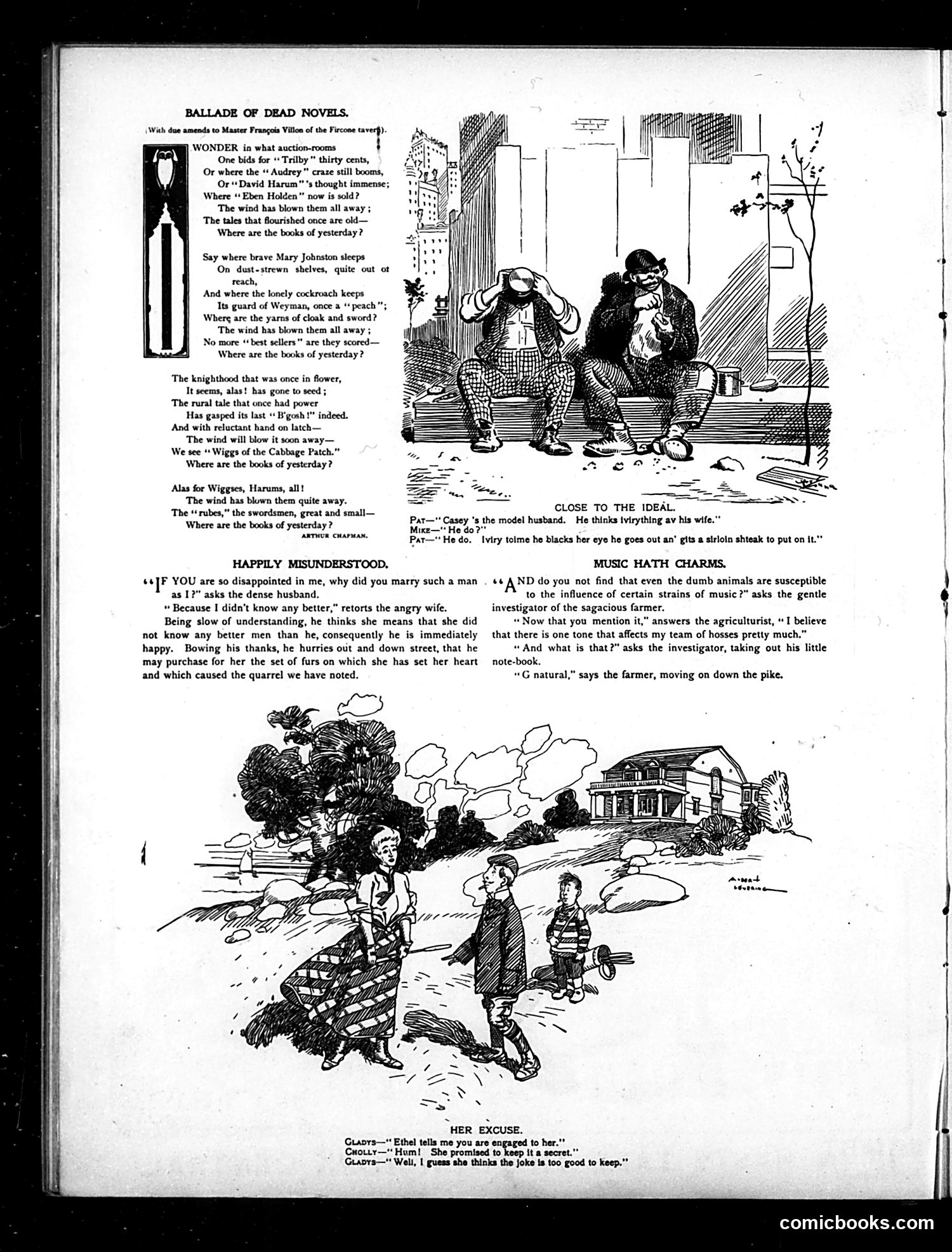
This page from Judge magazine contains multiple satirical pieces typical of early 20th-century American humor: **"Ballade of Dead Novels"** parodies Francois Villon's medieval poem form to mock the fleeting popularity of contemporary bestsellers. It laments forgotten novels like "Trilby," "David Harum," and "Eben Holden"—books that were wildly popular but have already faded from public interest. The satire targets both the disposable nature of commercial fiction and readers' fickle tastes. The three humor cartoons below employ Judge's signature format: brief domestic/social scenarios with punchy punchlines. "Happily Misunderstood" plays on a husband's deliberate obtuseness, "Music Hath Charms" uses rural dialect for humor about horses responding to music, and the bottom item jokes about keeping engagement secrets. The overall page satirizes popular culture, marriage dynamics, and rural stereotypes—standard Judge fare emphasizing class-conscious urban mockery of both mass-market fiction and working-class life.
This page from *Judge* magazine contains primarily **humorous short jokes and advertisements** rather than political cartoons. The jokes satirize American social types: a wealthy industrialist testing a suitor's character; a tailor avoiding a debtor; commentary on women's hat fashions; and children's innocent misunderstandings (Welsh rabbit as food; vaccination preventing seasickness). The advertisements promote period products: Packer's Tar Soap, Dr. Siegert's Angostura Bitters, Postum (caffeine-free coffee substitute), Sohmer Pianos, Evans Ale, Egyptian Deities cigars, and Prudential Insurance. **Key context for modern readers:** The Postum ad reflects early 1900s anxiety about coffee's health effects—a common marketing claim of the era. The children's dialogue jokes reflect contemporary concerns about food safety and medical practices. The fashion joke references the excessively large hats popular among Edwardian women. The page is primarily a advertising vehicle disguised as entertainment.
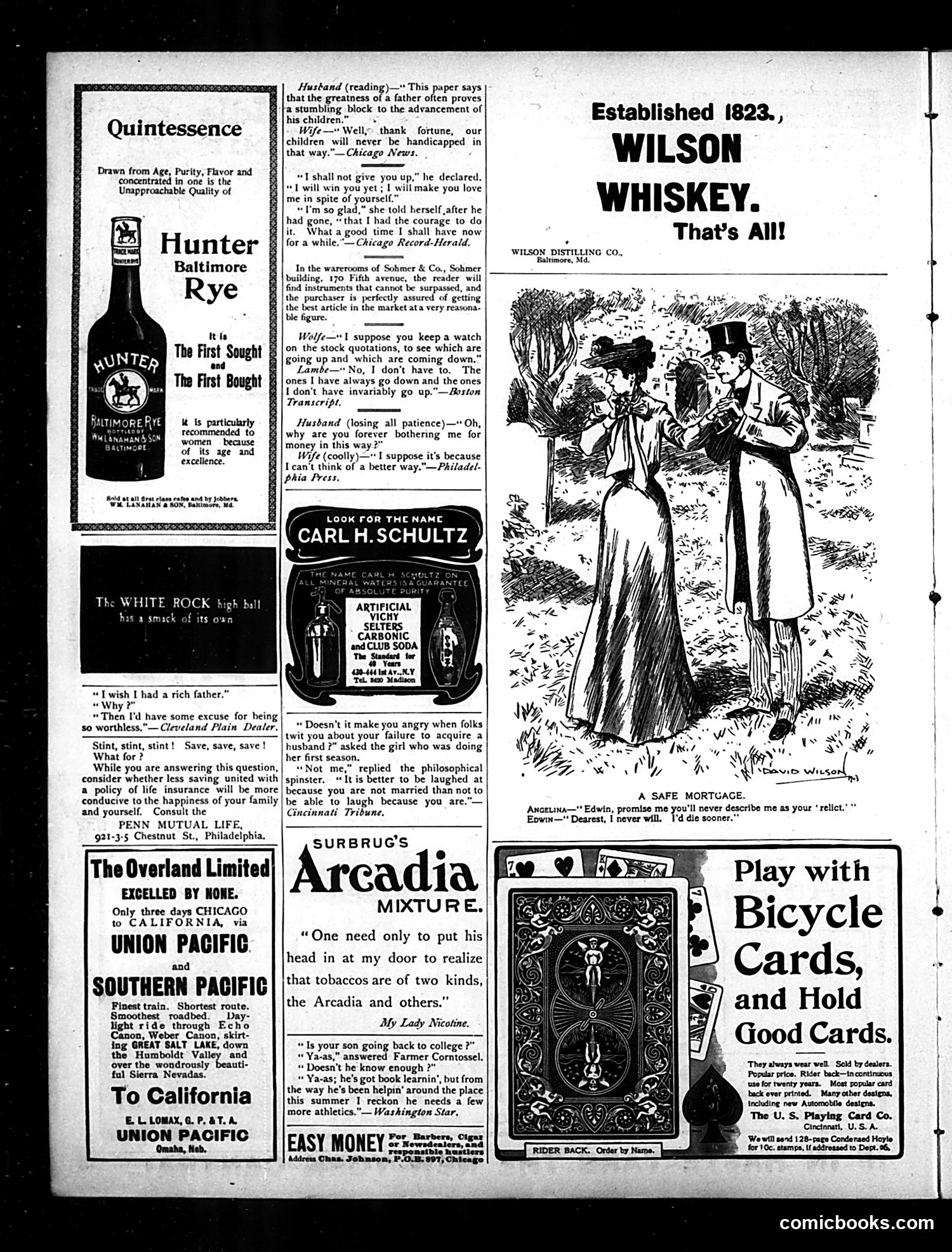
This single-panel cartoon depicts a marriage proposal scene. A man (Edwin) kneels before a woman, declaring eternal devotion. She responds with a humorous condition: he must promise never to describe her as his "relict" (widow) after his death. The satire targets Victorian marriage conventions and women's anxieties about widowhood. The joke hinges on the uncomfortable reality that wives often outlived husbands or faced the indignity of being legally defined by their marital status even after death. By framing spousal devotion as a "safe mortgage," the cartoon cynically compares marriage to a financial transaction—suggesting that marriage itself is primarily an economic arrangement rather than a romantic one. The cartoon reflects turn-of-the-century anxieties about women's legal status and marital property rights during a period when married women had limited independent legal standing.
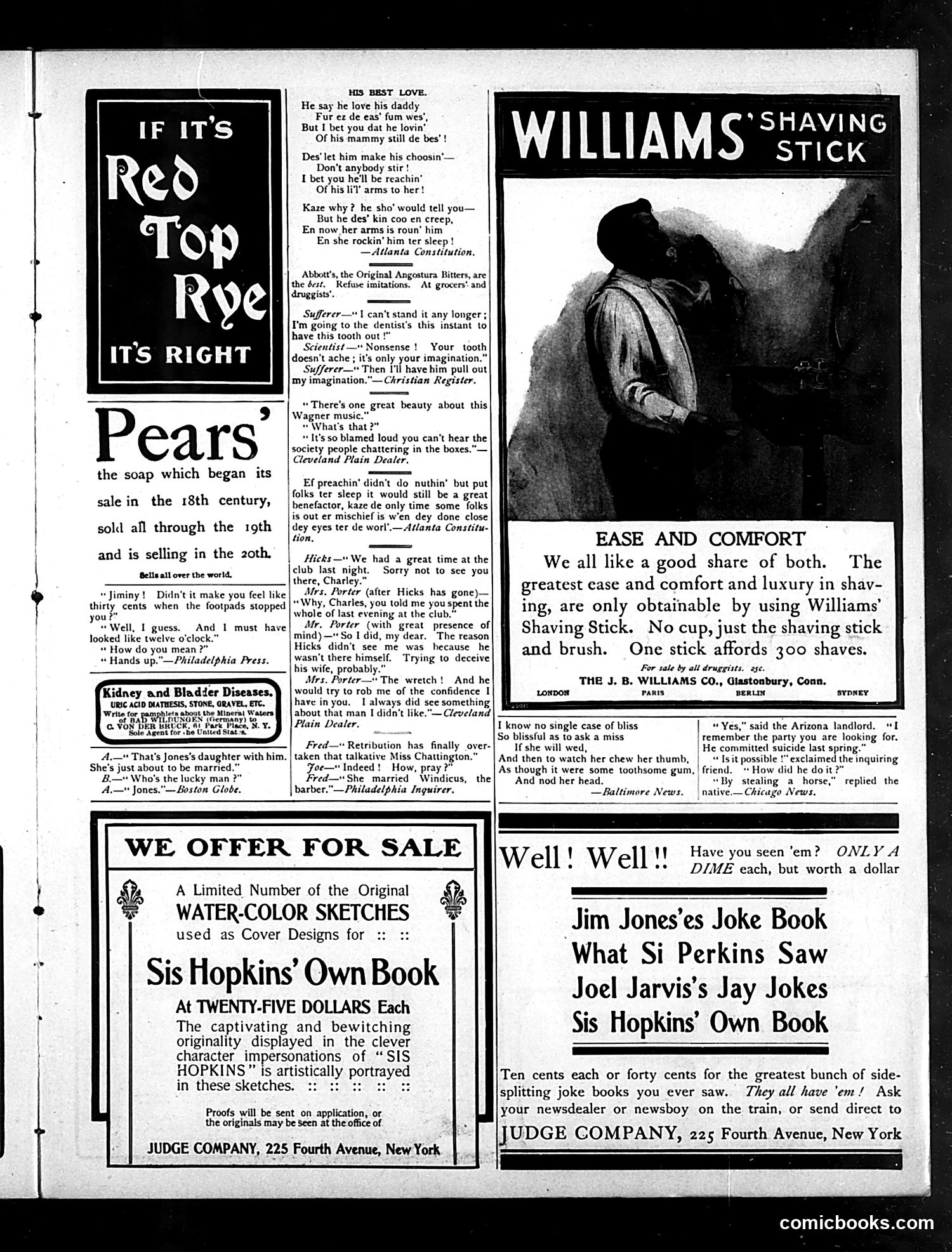
This is primarily an **advertising and humor page** from Judge magazine, mixing short jokes with product advertisements. The content includes: **Humor pieces**: Brief jokes on everyday topics—a mugging victim's "hands up" pun, a wife catching her husband in a lie about club attendance, a talkative woman punished by marrying a barber, and romantic/courtship humor. These are generic period jokes with no specific political targets. **Notable dialect humor**: Several pieces use African American vernacular ("Fur ez de eas' fum we's," "des' kin coo"), reflecting early-20th-century magazine conventions that would be considered offensive today. **Advertisements**: Pears' soap, Williams' Shaving Stick, Sis Hopkins' book sketches, and Judge's own joke books dominate the page. There are **no identifiable political cartoons or caricatures** of public figures visible. The page appears typical of Judge's mixed content formula: light social satire through jokes rather than visual political commentary.
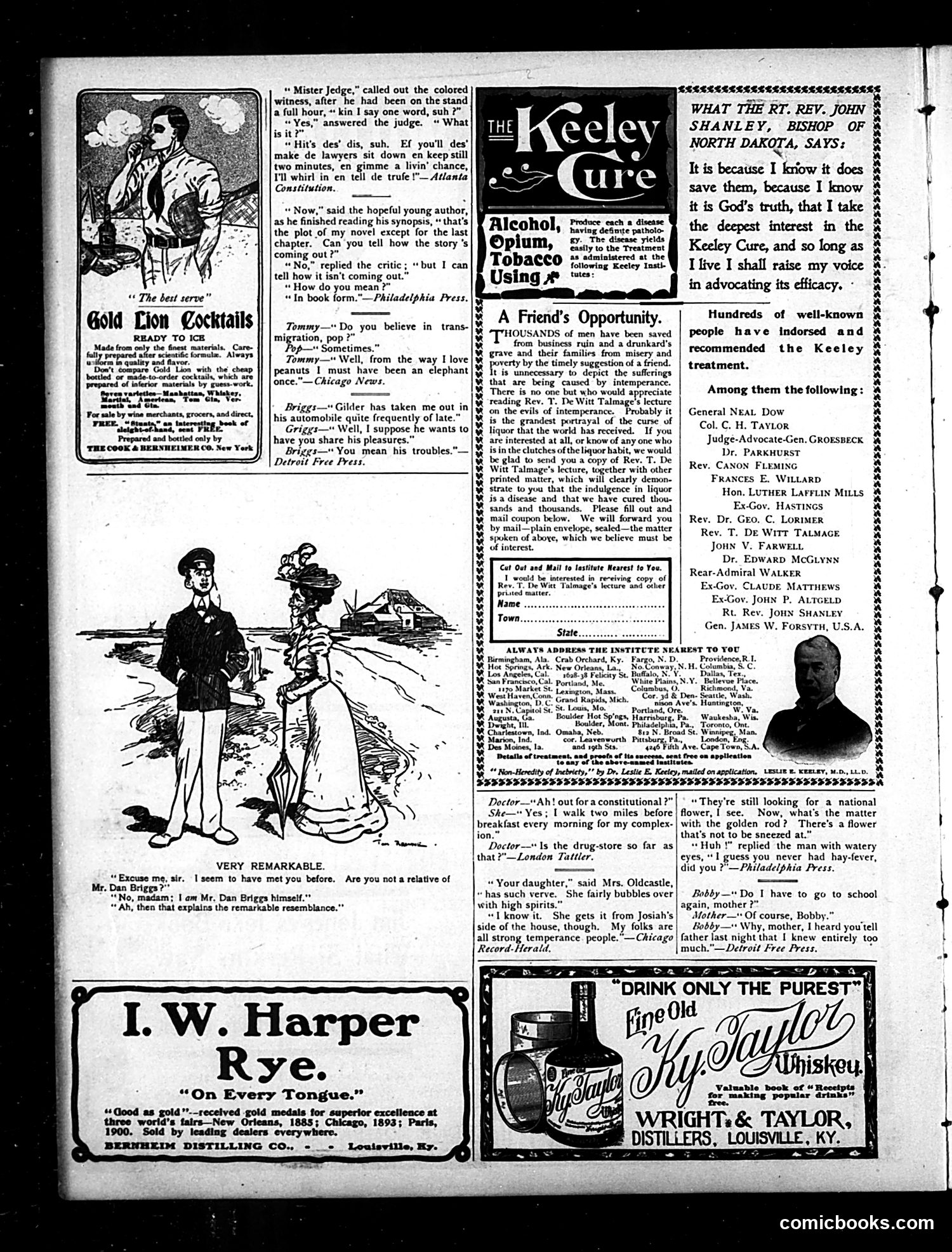
This page from *Judge* magazine (appears to be early 1900s) is primarily **advertising content** rather than political satire. The dominant feature is a large advertisement for the **Keeley Cure**, a commercial treatment claiming to cure alcoholism, opium addiction, and tobacco use. The satire is **subtle and implicit**: by endorsing the Keeley treatment, the page mocks American society's serious substance-abuse problems while promoting a commercial "cure." Notable is the endorsement from "RT. REV. JOHN SHANLEY, BISHOP OF NORTH DAKOTA," lending religious authority to what was essentially a profit-driven enterprise. The scattered humorous anecdotes (about lawyers, authors, and a witness wanting to testify) serve as filler. The "Very Remarkable" cartoon plays on a common joke format—mistaken identity based on resemblance. Alcohol and tobacco advertisements appear alongside the anti-drinking Keeley promotion, reflecting the contradictory messaging of the era—simultaneously promoting and condemning intoxicants.
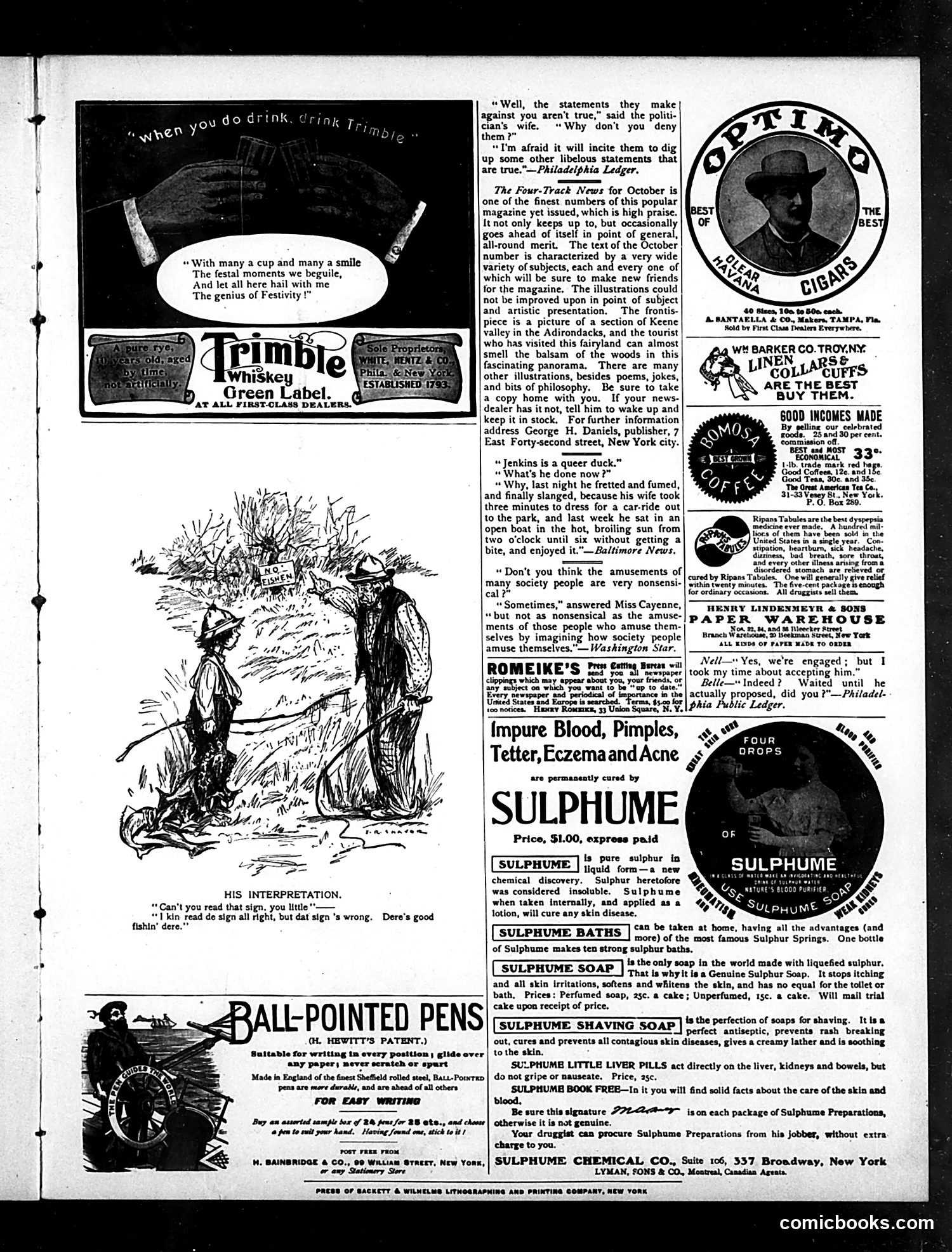
This page contains primarily **advertisements and humor columns** rather than political cartoons. The main satirical content includes: **"His Interpretation"**: A brief comic about a Black figure who misreads a "No Fishing" sign, claiming "there's good fishin' dere." This reflects the era's racist humor stereotyping Black Americans through dialect and intelligence. **Politician's Wife Joke**: A brief anecdote where a politician's wife urges him to deny false statements, but he refuses, fearing it will prompt his enemies to reveal *true* damaging information instead. This satirizes political corruption and hypocrisy. **Society Humor**: Several jokes about wealthy social circles, their amusements, and courtship rituals—typical Judge magazine fare mocking upper-class pretensions. The page is dominated by **period advertisements** for Trimble Whiskey, Sulphume (a patent medicine), Ball-Pointed Pens, and other products. These ads are historically valuable for showing late 19th/early 20th-century marketing and dubious health claims.
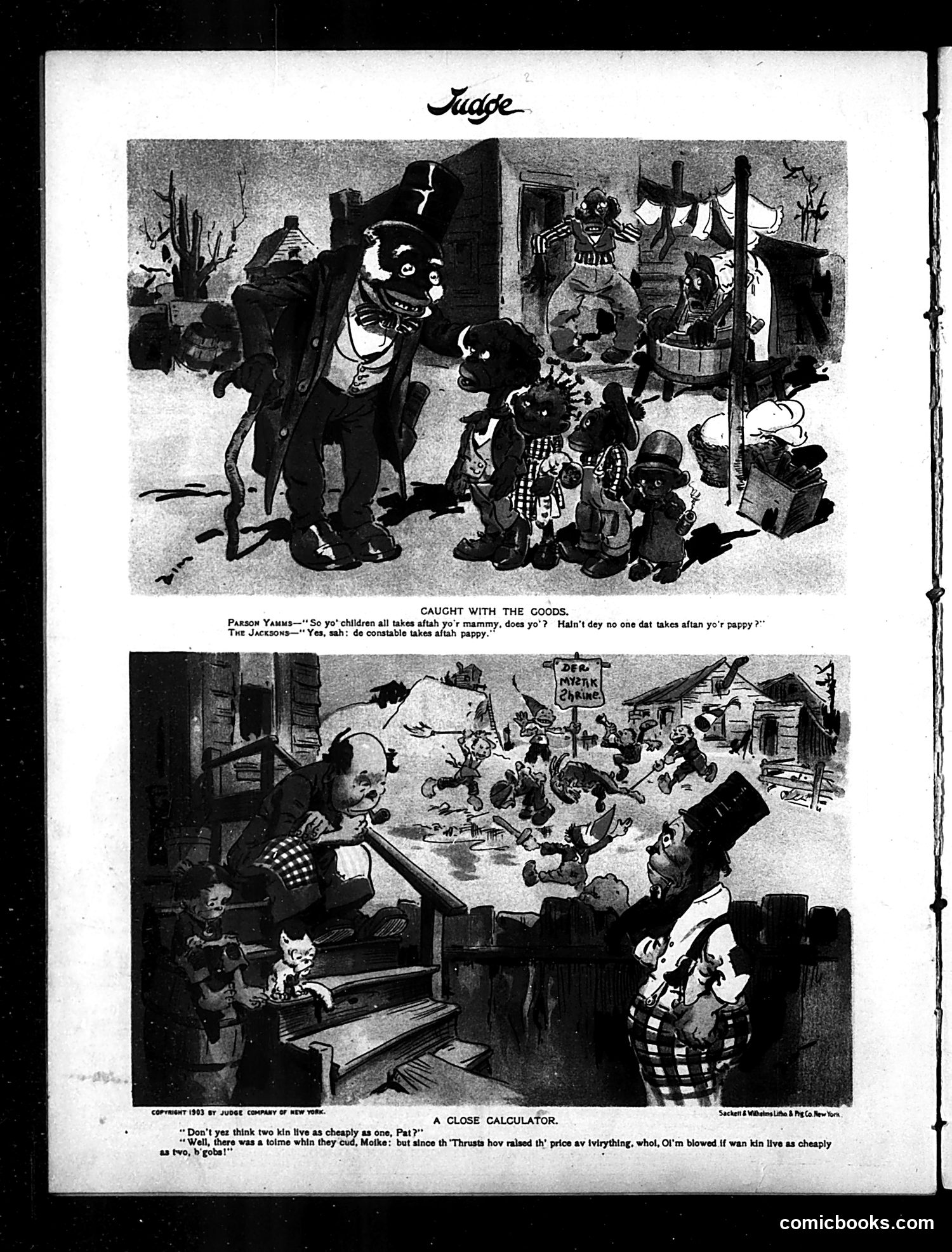
This 1903 page contains two racist caricatures typical of the era's offensive stereotyping: **"Caught with the Goods"** depicts a white parson questioning a Black family (the Jacksons) about their children. The "joke" relies on a stereotype that the father is in legal trouble—the constable "takes after" him, implying arrest or criminality. It's a crude pun playing on racial prejudice. **"A Close Calculator"** features two Irish immigrants (Pat and Moike, identified by dialect) discussing whether two people can live as cheaply as one. The satire targets trusts and monopolies—rising prices from consolidated corporations mean even shared living costs have become prohibitively expensive. This reflects genuine 1903 economic anxiety about corporate consolidation, though the humor depends on ethnic stereotyping of Irish characters. Both cartoons use caricature and dialect to demean their subjects while delivering social commentary.